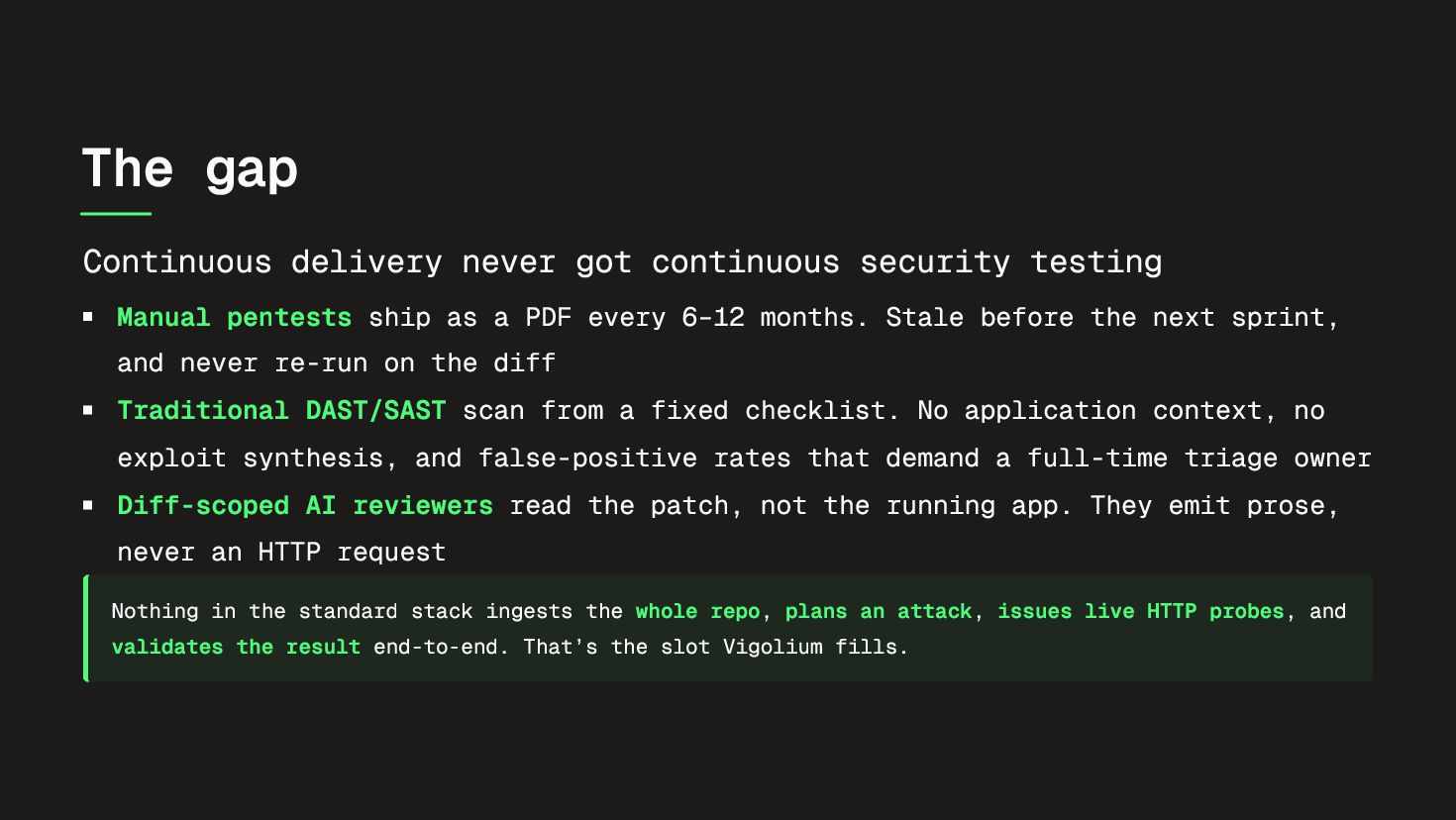
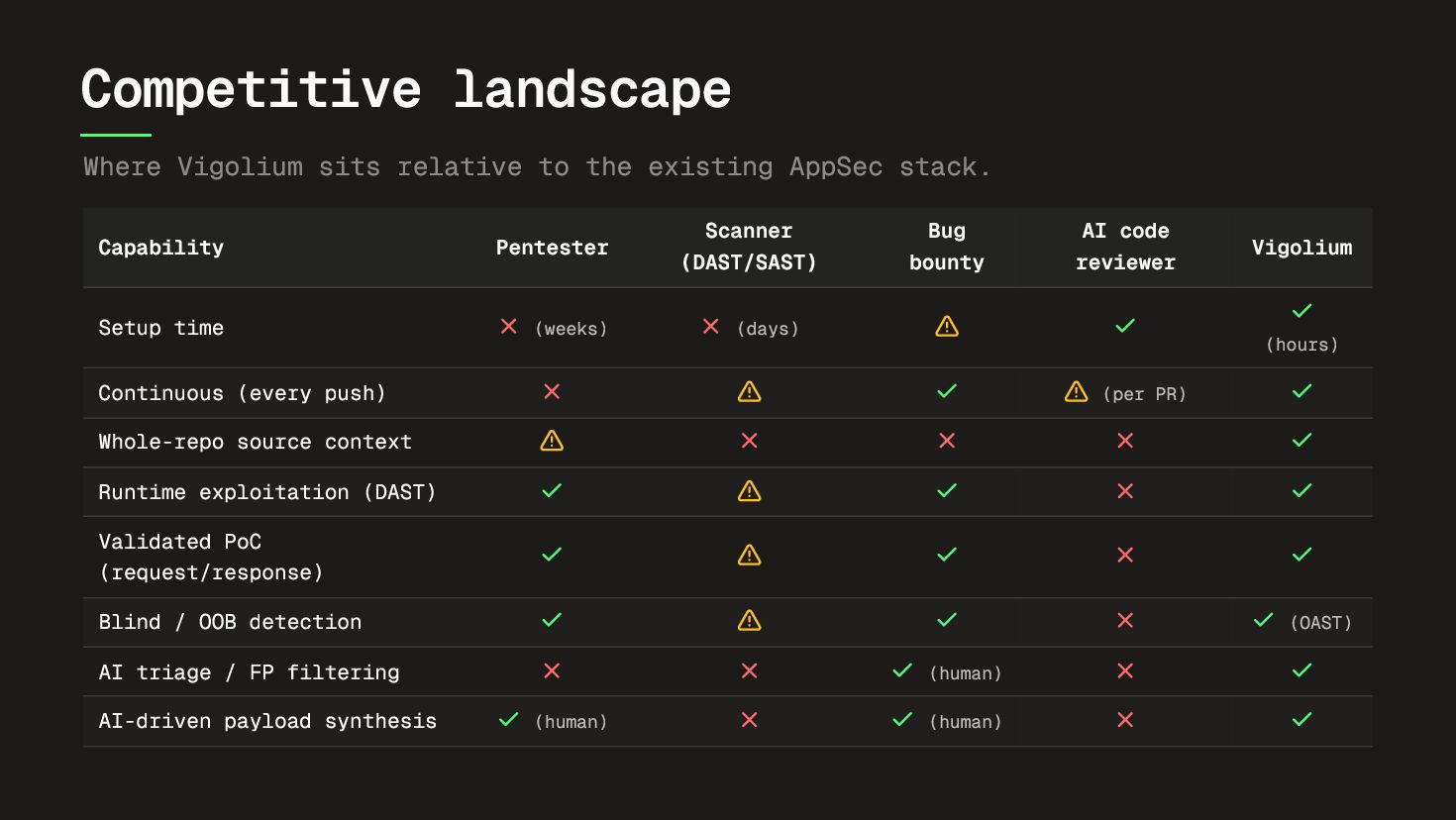
security testing Manual pentests ship as a PDF every 6–12 months. Stale before the next sprint, and never re-run on the diff Traditional DAST/SAST scan from a fixed checklist. No application context, no exploit synthesis, and false-positive rates that demand a full-time triage owner Diff-scoped AI reviewers read the patch, not the running app. They emit prose, never an HTTP request Nothing in the standard stack ingests the whole repo, plans an attack, issues live HTTP probes, and validates the result end-to-end. That’s the slot Vigolium fills.
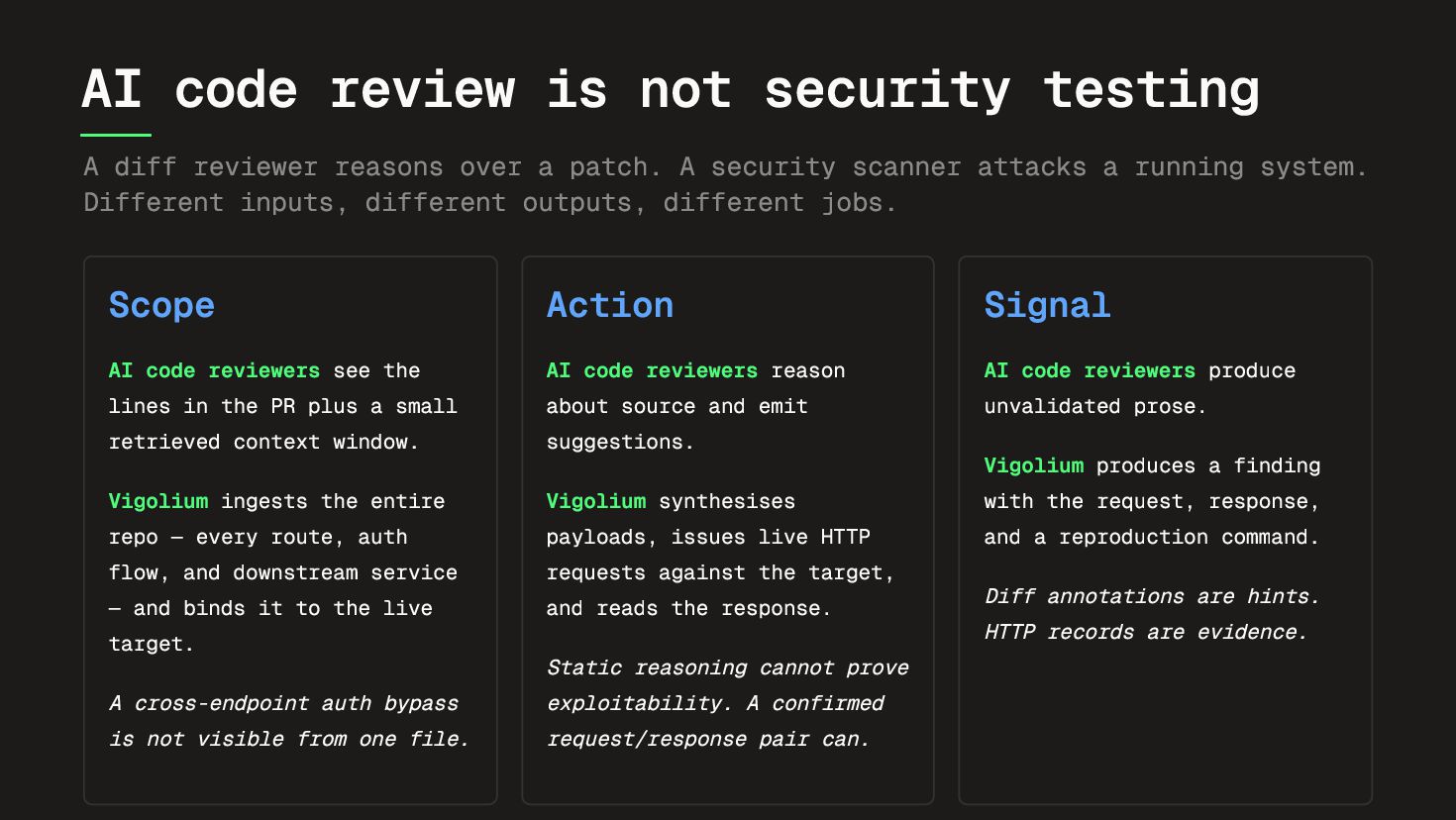
Scope AI code reviewers see the lines in the PR plus a small retrieved context window. Vigolium ingests the entire repo — every route, auth flow, and downstream service — and binds it to the live target. A cross-endpoint auth bypass is not visible from one file. Action AI code reviewers reason about source and emit suggestions. Vigolium synthesises payloads, issues live HTTP requests against the target, and reads the response. Static reasoning cannot prove exploitability. A confirmed request/response pair can. Signal AI code reviewers produce unvalidated prose. Vigolium produces a finding with the request, response, and a reproduction command. Diff annotations are hints. HTTP records are evidence. A diff reviewer reasons over a patch. A security scanner attacks a running system. Different inputs, different outputs, different jobs.
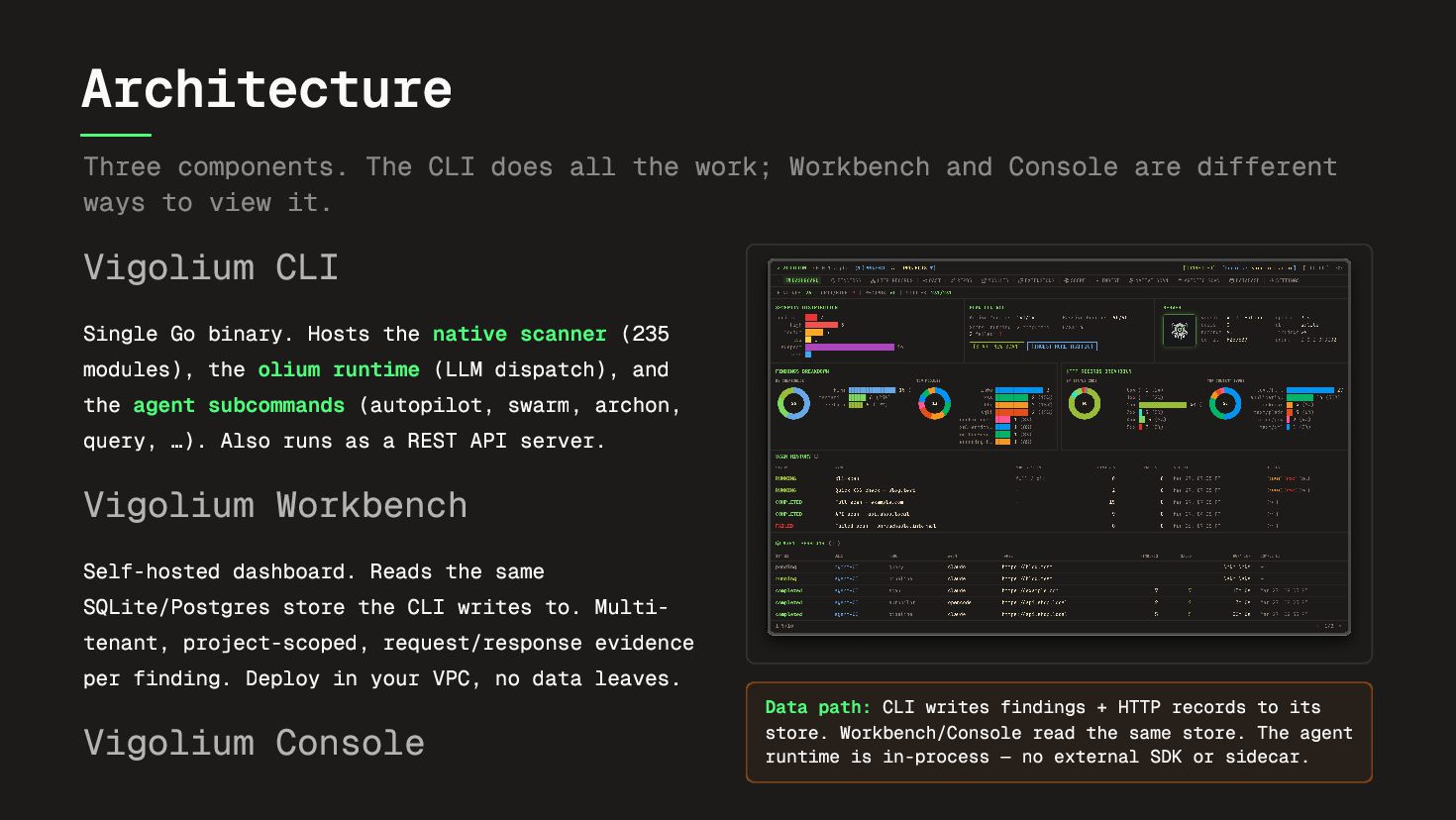
the native scanner (235 modules), the olium runtime (LLM dispatch), and the agent subcommands (autopilot, swarm, archon, query, …). Also runs as a REST API server. Vigolium Workbench Self-hosted dashboard. Reads the same SQLite/Postgres store the CLI writes to. Multi- tenant, project-scoped, request/response evidence per finding. Deploy in your VPC, no data leaves. Vigolium Console Data path: CLI writes findings + HTTP records to its store. Workbench/Console read the same store. The agent runtime is in-process — no external SDK or sidecar. Three components. The CLI does all the work; Workbench and Console are different ways to view it.
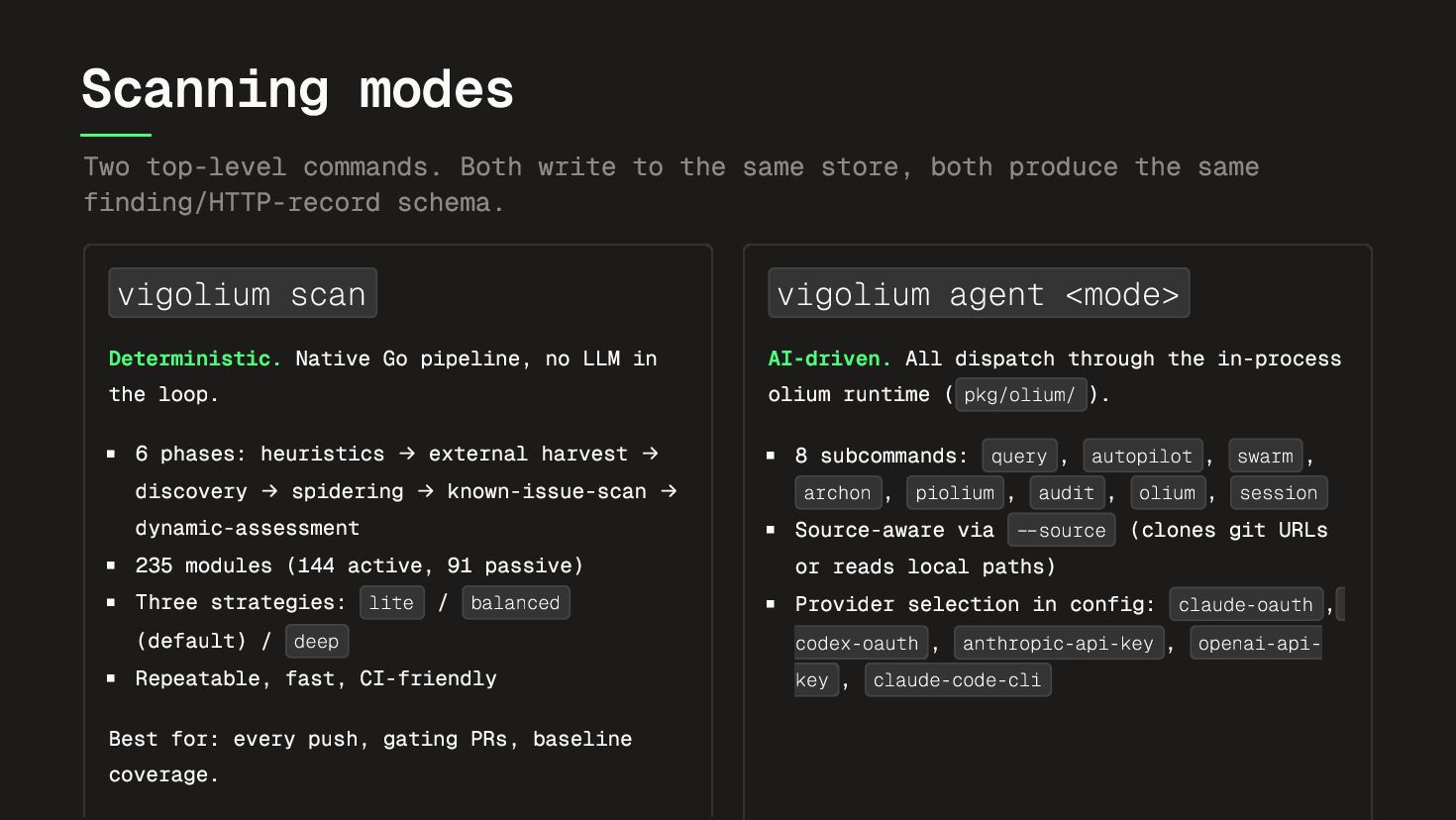
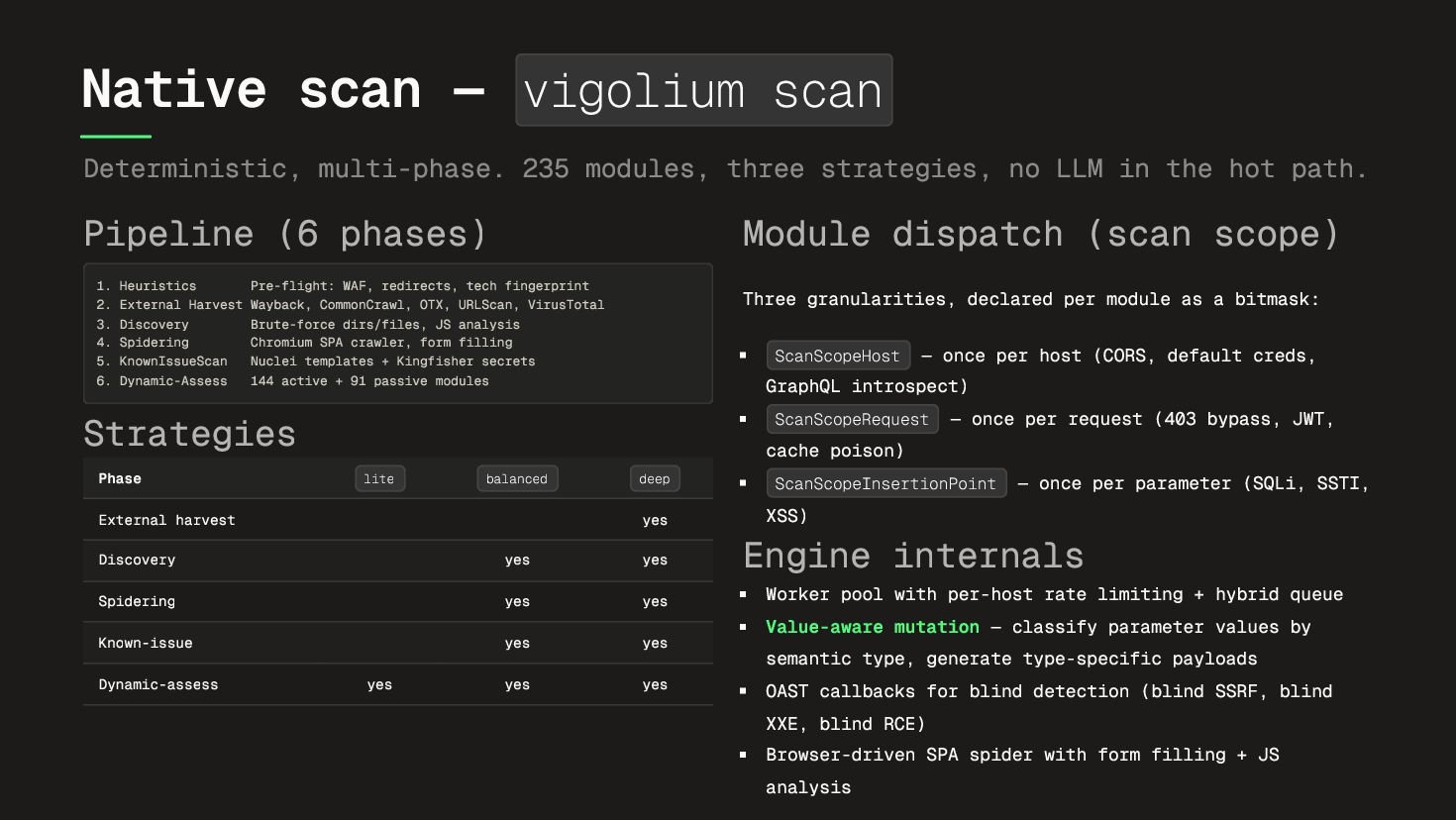
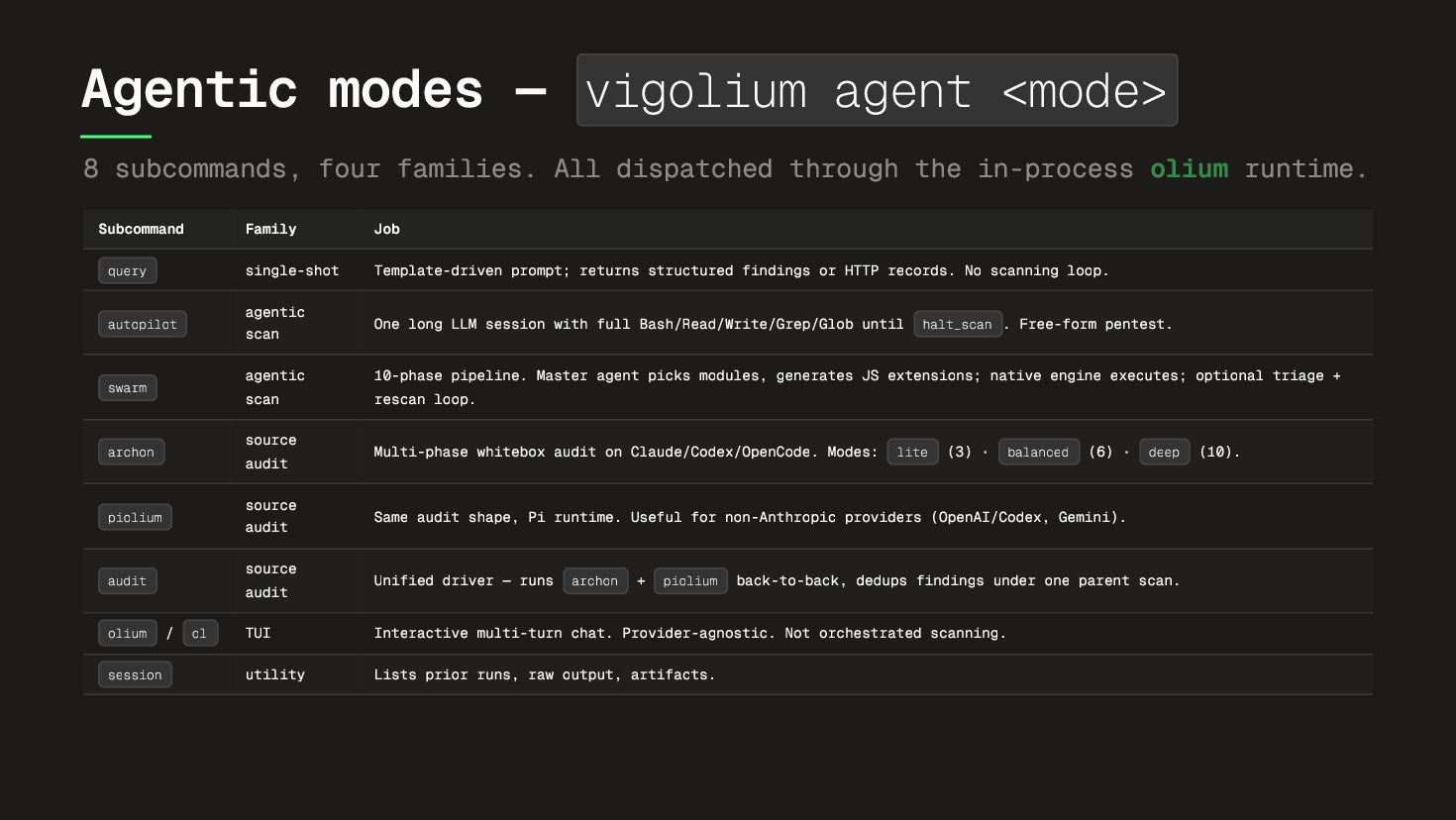
pipeline, no LLM in the loop. 6 phases: heuristics → external harvest → discovery → spidering → known-issue-scan → dynamic-assessment 235 modules (144 active, 91 passive) Three strategies: lite / balanced (default) / deep Repeatable, fast, CI-friendly Best for: every push, gating PRs, baseline coverage. vigolium agent <mode> AI-driven. All dispatch through the in-process olium runtime ( pkg/olium/ ). 8 subcommands: query , autopilot , swarm , archon , piolium , audit , olium , session Source-aware via --source (clones git URLs or reads local paths) Provider selection in config: claude-oauth , codex-oauth , anthropic-api-key , openai-api- key , claude-code-cli Two top-level commands. Both write to the same store, both produce the same finding/HTTP-record schema.
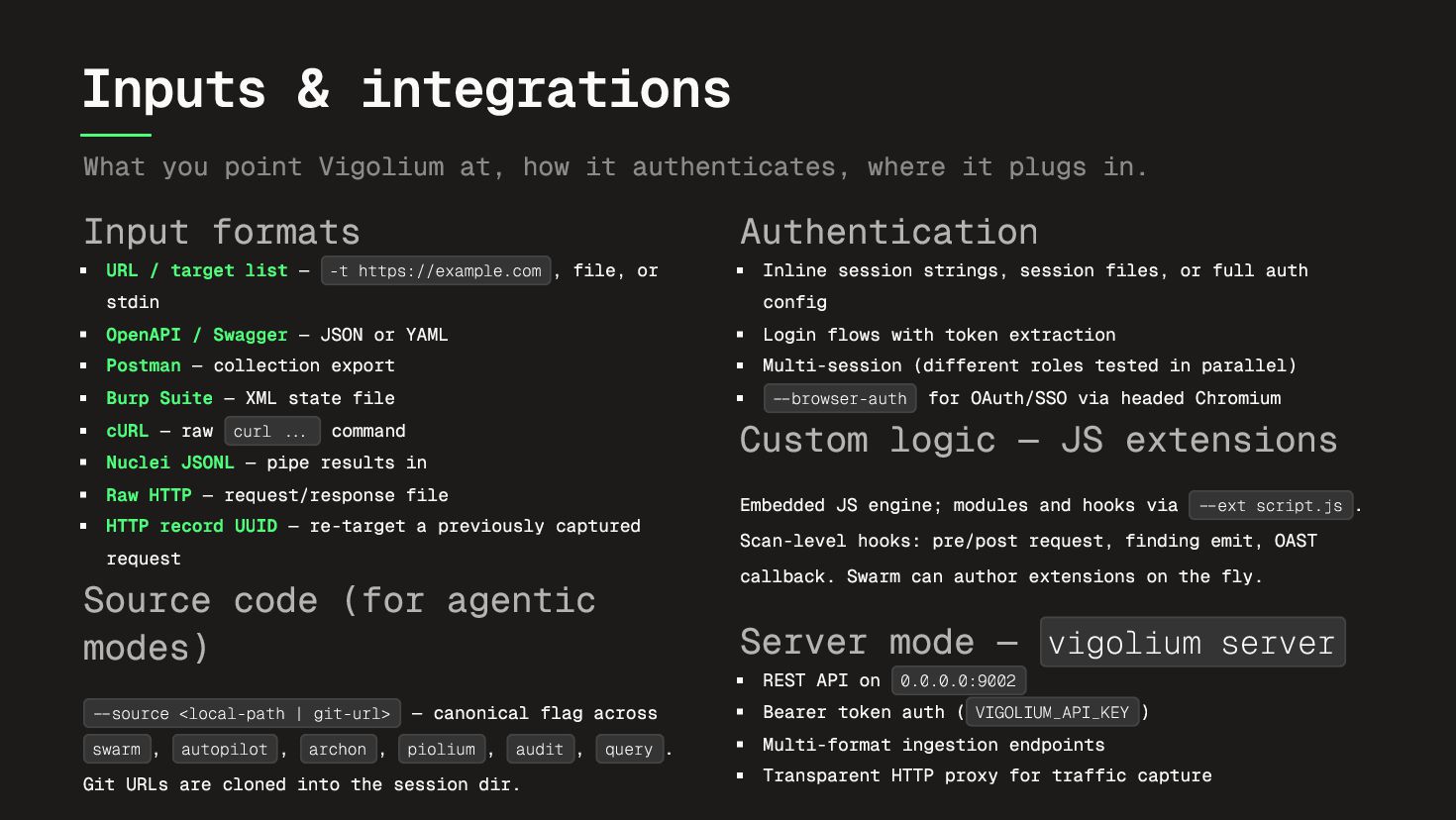
target list — -t https://example.com , file, or stdin OpenAPI / Swagger — JSON or YAML Postman — collection export Burp Suite — XML state file cURL — raw curl ... command Nuclei JSONL — pipe results in Raw HTTP — request/response file HTTP record UUID — re-target a previously captured request Source code (for agentic modes) --source <local-path | git-url> — canonical flag across swarm , autopilot , archon , piolium , audit , query . Git URLs are cloned into the session dir. Authentication Inline session strings, session files, or full auth config Login flows with token extraction Multi-session (different roles tested in parallel) --browser-auth for OAuth/SSO via headed Chromium Custom logic — JS extensions Embedded JS engine; modules and hooks via --ext script.js . Scan-level hooks: pre/post request, finding emit, OAST callback. Swarm can author extensions on the fly. Server mode — vigolium server REST API on 0.0.0.0:9002 Bearer token auth ( VIGOLIUM_API_KEY ) Multi-format ingestion endpoints Transparent HTTP proxy for traffic capture What you point Vigolium at, how it authenticates, where it plugs in.
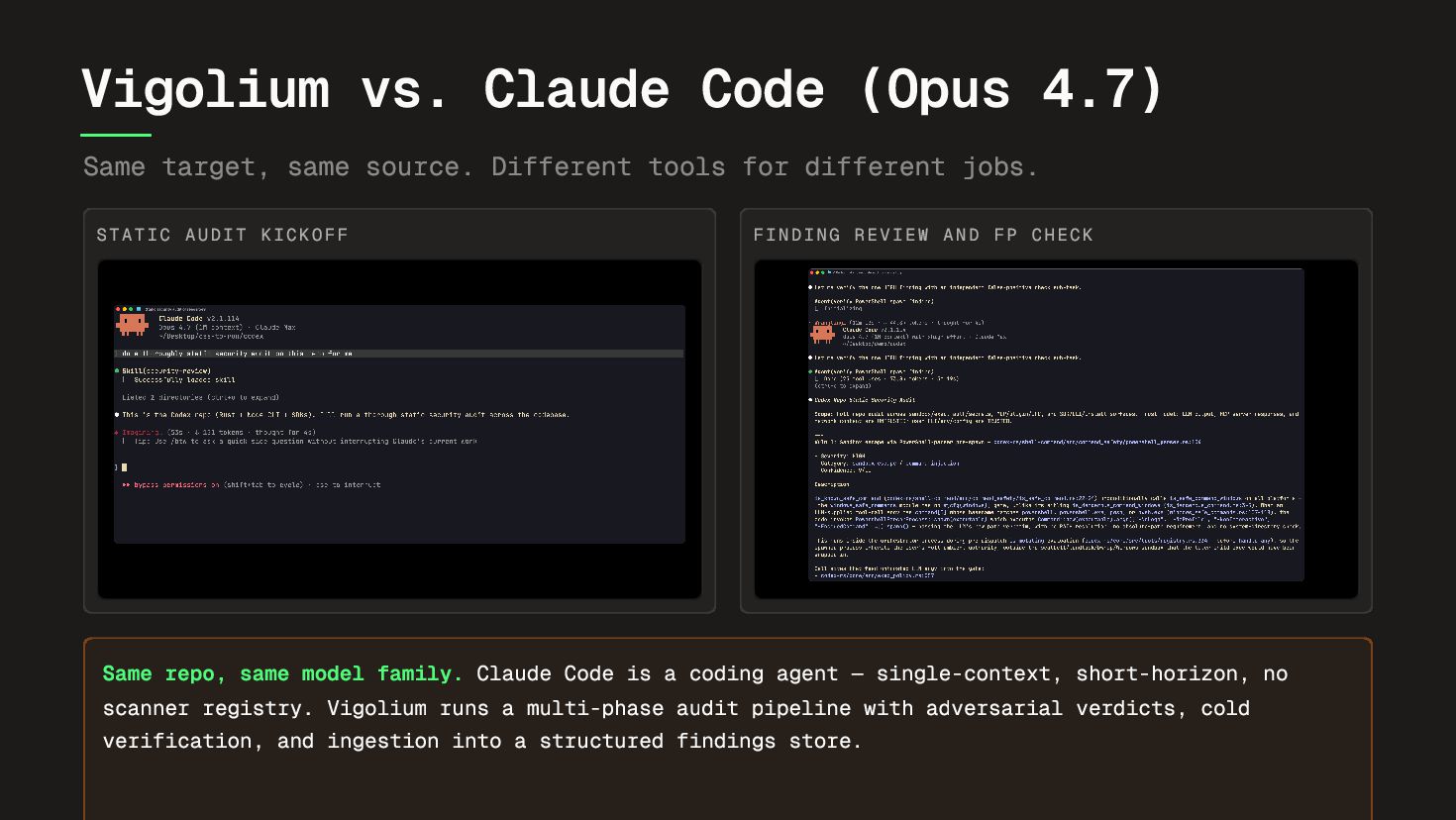
repo, same model family. Claude Code is a coding agent — single-context, short-horizon, no scanner registry. Vigolium runs a multi-phase audit pipeline with adversarial verdicts, cold verification, and ingestion into a structured findings store. Same target, same source. Different tools for different jobs. STATIC AUDIT KICKOFF FINDING REVIEW AND FP CHECK
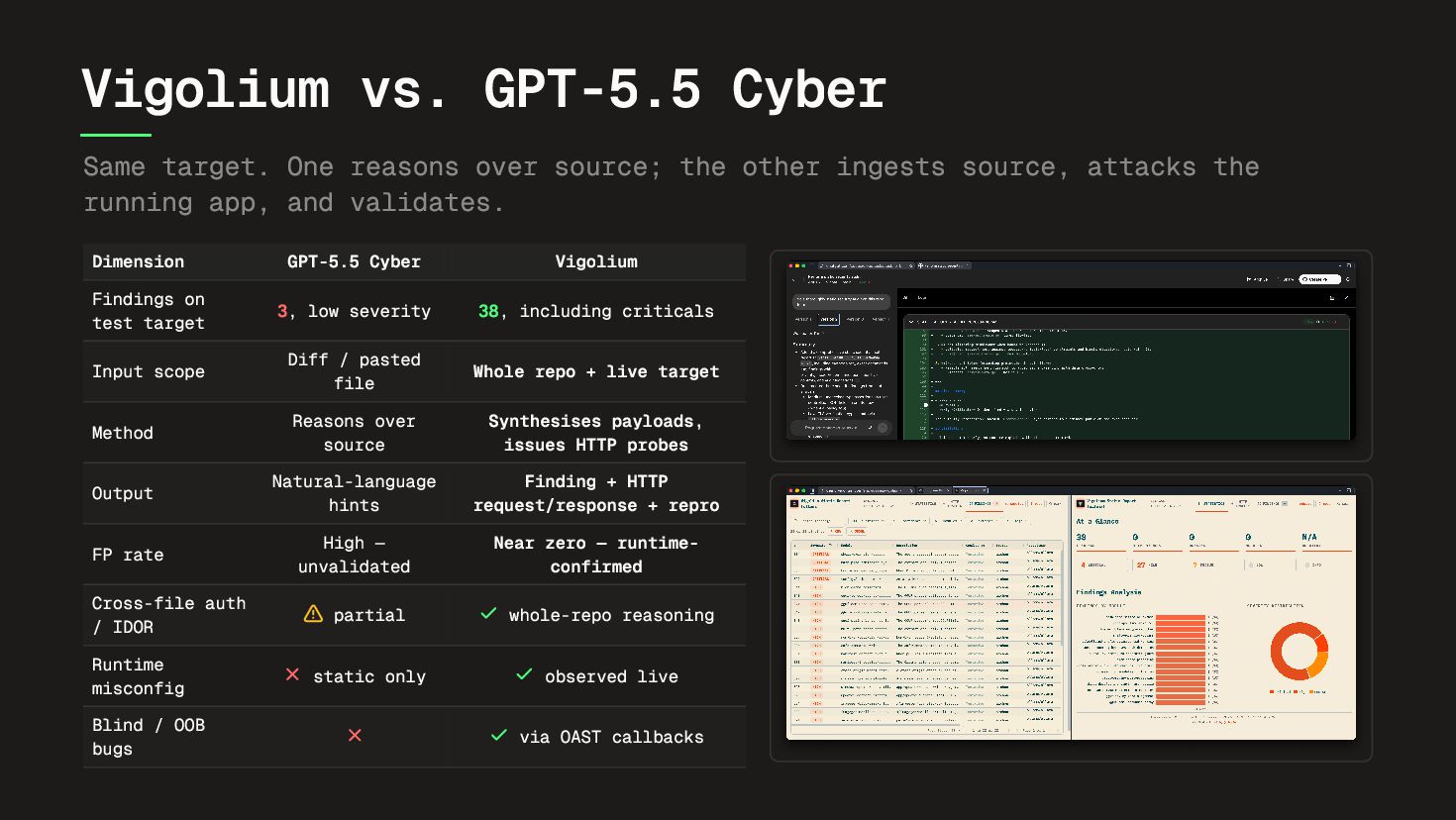
Vigolium Findings on test target 3, low severity 38, including criticals Input scope Diff / pasted file Whole repo + live target Method Reasons over source Synthesises payloads, issues HTTP probes Output Natural-language hints Finding + HTTP request/response + repro FP rate High — unvalidated Near zero — runtime- confirmed Cross-file auth / IDOR partial whole-repo reasoning Runtime misconfig static only observed live Blind / OOB bugs via OAST callbacks Same target. One reasons over source; the other ingests source, attacks the running app, and validates.
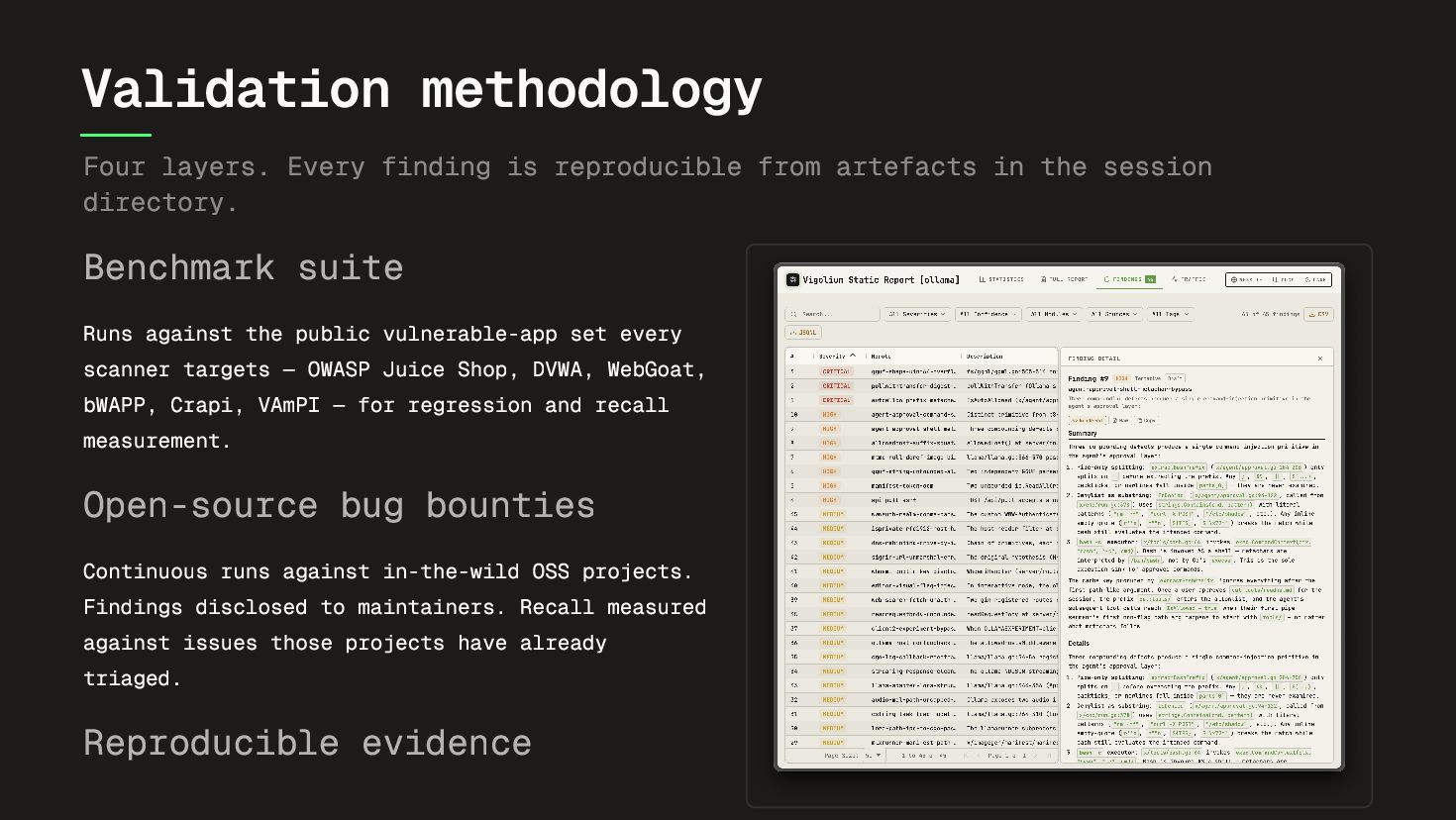
public vulnerable-app set every scanner targets — OWASP Juice Shop, DVWA, WebGoat, bWAPP, Crapi, VAmPI — for regression and recall measurement. Open-source bug bounties Continuous runs against in-the-wild OSS projects. Findings disclosed to maintainers. Recall measured against issues those projects have already triaged. Reproducible evidence Four layers. Every finding is reproducible from artefacts in the session directory.
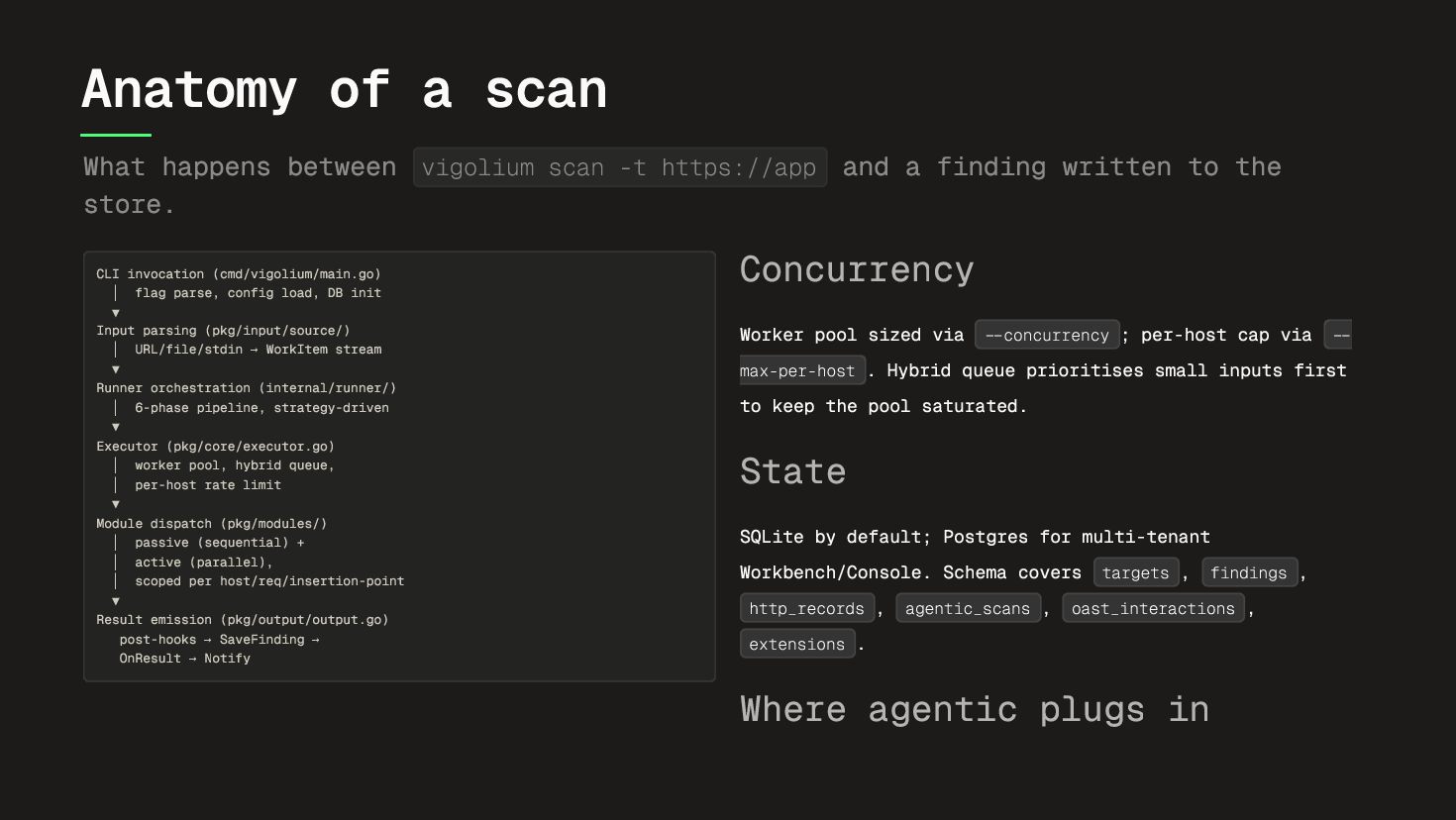
sized via --concurrency ; per-host cap via -- max-per-host . Hybrid queue prioritises small inputs first to keep the pool saturated. State SQLite by default; Postgres for multi-tenant Workbench/Console. Schema covers targets , findings , http_records , agentic_scans , oast_interactions , extensions . Where agentic plugs in What happens between vigolium scan -t https://app and a finding written to the store. CLI invocation (cmd/vigolium/main.go) │ flag parse, config load, DB init ▼ Input parsing (pkg/input/source/) │ URL/file/stdin → WorkItem stream ▼ Runner orchestration (internal/runner/) │ 6-phase pipeline, strategy-driven ▼ Executor (pkg/core/executor.go) │ worker pool, hybrid queue, │ per-host rate limit ▼ Module dispatch (pkg/modules/) │ passive (sequential) + │ active (parallel), │ scoped per host/req/insertion-point ▼ Result emission (pkg/output/output.go) post-hooks → SaveFinding → OnResult → Notify
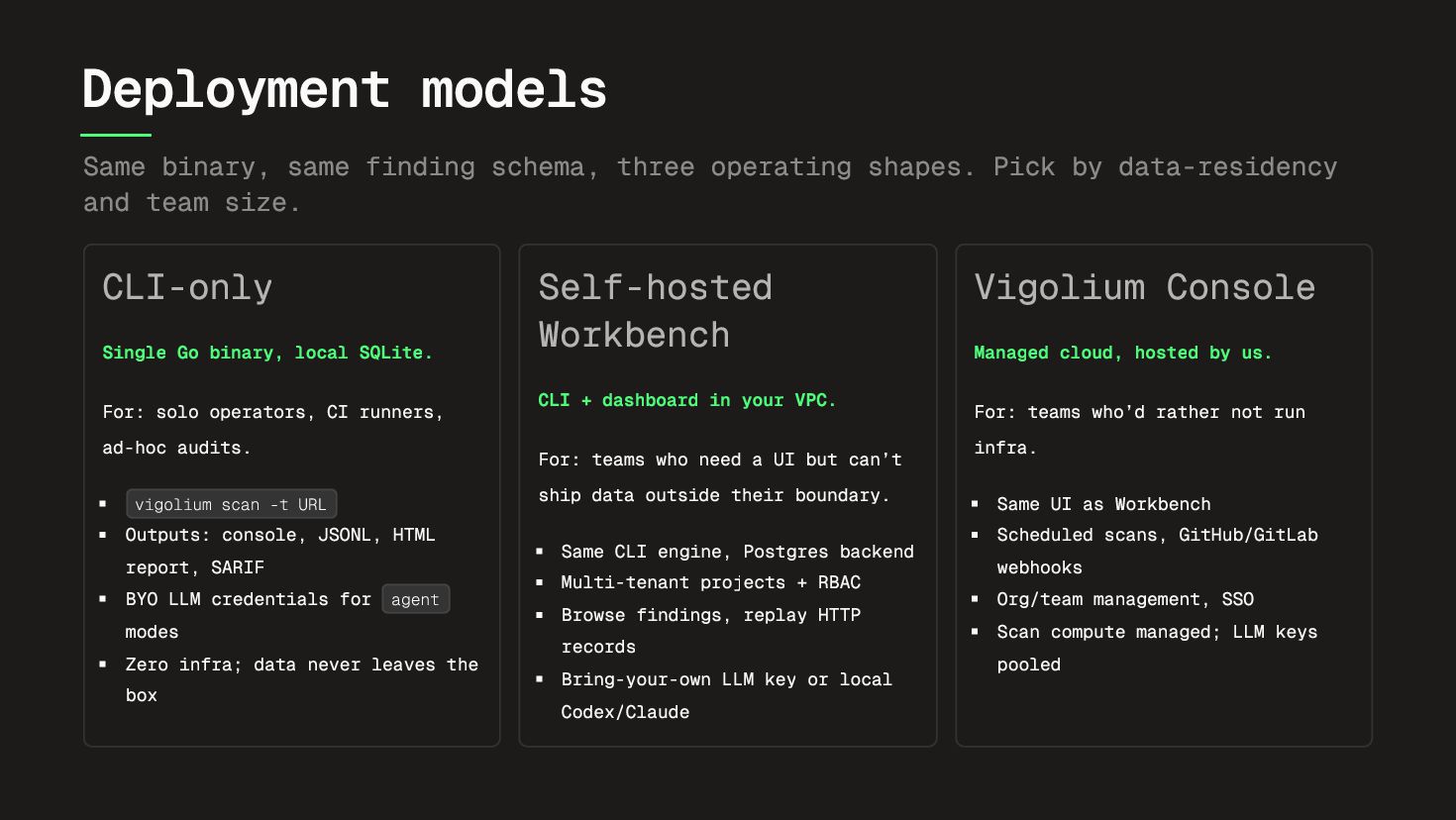
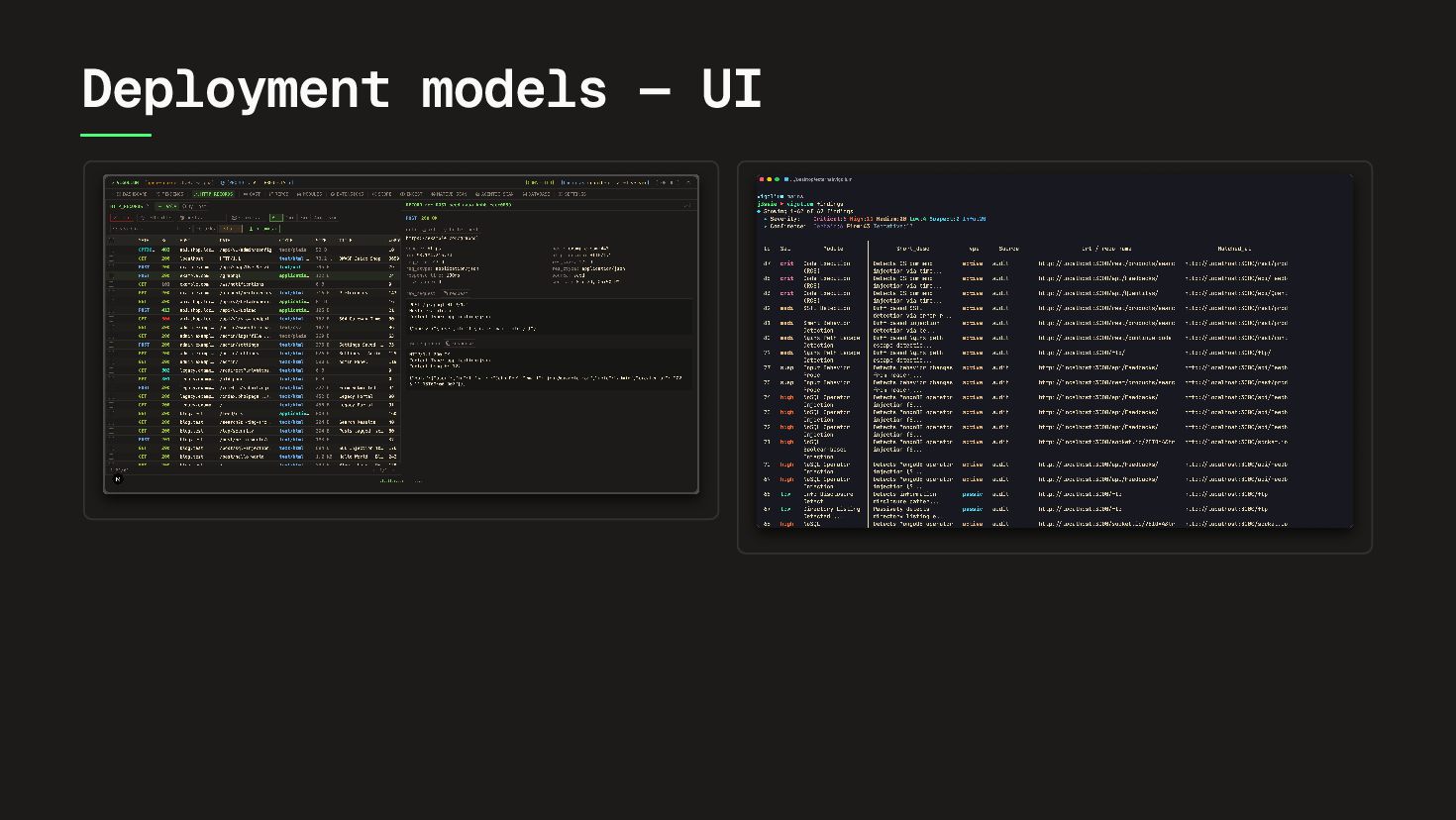
SQLite. For: solo operators, CI runners, ad-hoc audits. vigolium scan -t URL Outputs: console, JSONL, HTML report, SARIF BYO LLM credentials for agent modes Zero infra; data never leaves the box Self-hosted Workbench CLI + dashboard in your VPC. For: teams who need a UI but can’t ship data outside their boundary. Same CLI engine, Postgres backend Multi-tenant projects + RBAC Browse findings, replay HTTP records Bring-your-own LLM key or local Codex/Claude Vigolium Console Managed cloud, hosted by us. For: teams who’d rather not run infra. Same UI as Workbench Scheduled scans, GitHub/GitLab webhooks Org/team management, SSO Scan compute managed; LLM keys pooled Same binary, same finding schema, three operating shapes. Pick by data-residency and team size.


 j3ssie
 eileencodes
 destraynor
 katarinadahlin
 dugsong
 cassininazir
 panda_program
.jpg) cargoodrich
cargoodrich
 techseoconnect
 asonas
 bkeepers
 tammyeverts