Step-by-Step Guide to Building Assessment Tools for Your RTO: A Beginner’s Edition
Learn how to build effective assessment tools for your RTO with this beginner’s guide, covering all steps from design to implementation and compliance.
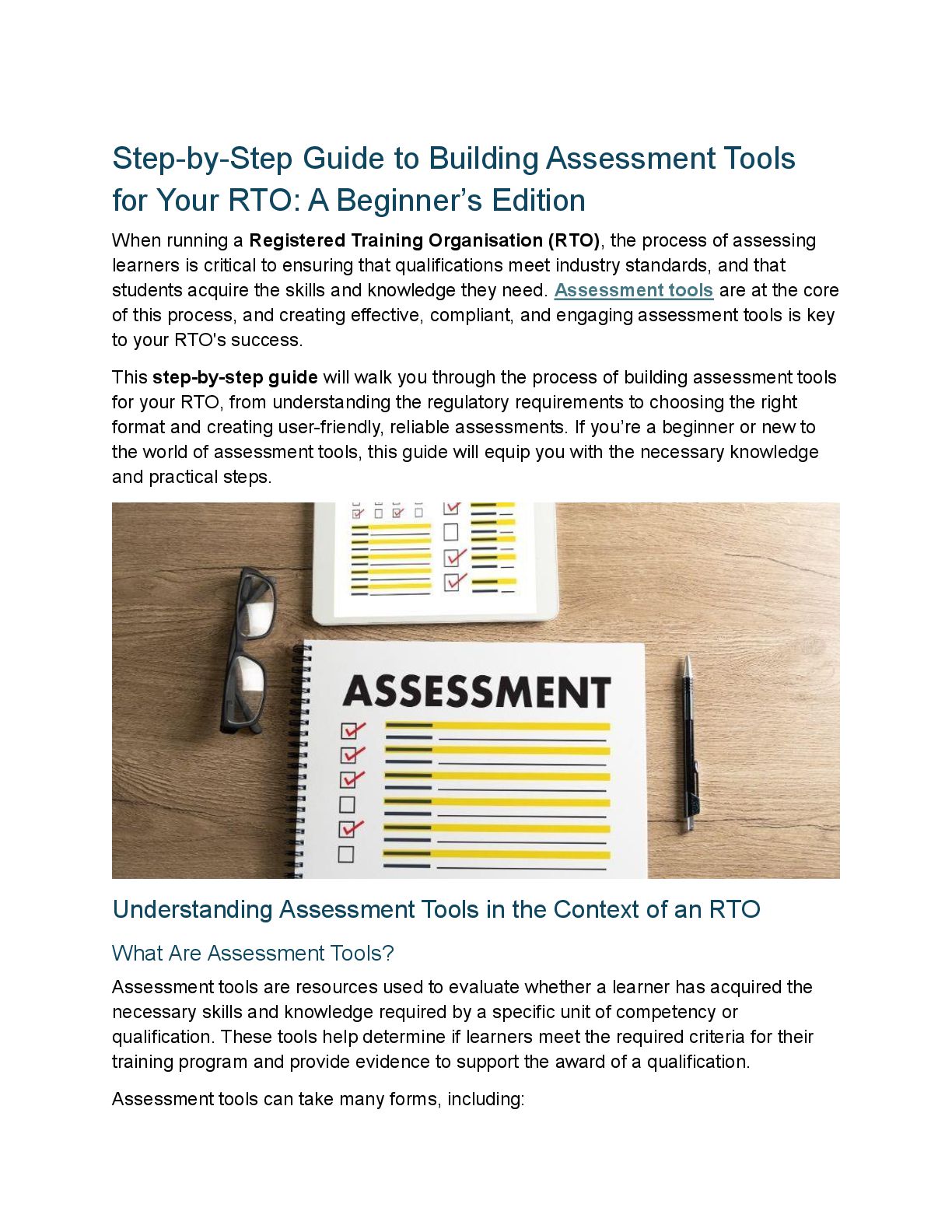
Beginner’s Edition When running a Registered Training Organisation (RTO), the process of assessing learners is critical to ensuring that qualifications meet industry standards, and that students acquire the skills and knowledge they need. Assessment tools are at the core of this process, and creating effective, compliant, and engaging assessment tools is key to your RTO's success. This step-by-step guide will walk you through the process of building assessment tools for your RTO, from understanding the regulatory requirements to choosing the right format and creating user-friendly, reliable assessments. If you’re a beginner or new to the world of assessment tools, this guide will equip you with the necessary knowledge and practical steps. Understanding Assessment Tools in the Context of an RTO What Are Assessment Tools? Assessment tools are resources used to evaluate whether a learner has acquired the necessary skills and knowledge required by a specific unit of competency or qualification. These tools help determine if learners meet the required criteria for their training program and provide evidence to support the award of a qualification. Assessment tools can take many forms, including:
demonstrations) Case studies or problem-solving exercises Portfolio assessments (collection of work) Projects or presentations Each assessment tool must align with the unit of competency and provide a valid, reliable, flexible, and fair method of assessment. Why Are Assessment Tools Important? Assessment tools are fundamental to the assessment process. They ensure that learners are assessed in a way that is consistent, transparent, and fair. Well-designed assessment tools also ensure that: Learners are assessed against the required competency standards. The RTO meets the regulatory requirements set out by authorities like ASQA (Australian Skills Quality Authority). Learners are given a fair and valid opportunity to demonstrate their skills and knowledge. The results of assessments are accurate and can be used to support future career opportunities for learners. Understanding Compliance and Regulatory Requirements Before diving into creating assessment tools, it's essential to familiarize yourself with the regulatory frameworks that govern the RTO sector. Compliance with these frameworks ensures that your assessments are valid, reliable, and meet the needs of learners, employers, and industry. Key Compliance Considerations for RTOs: Training Packages and Units of Competency: Assessments must be directly linked to specific training packages and units of competency. These documents outline the skills and knowledge required, and the assessment tools should reflect these. AQF (Australian Qualifications Framework): Assessment tools must meet AQF standards to ensure that qualifications are nationally recognized. ASQA Standards for RTOs 2015: These standards ensure that the RTO's assessment practices are appropriate, ethical, and consistent.
reliability, flexibility, and fairness) are key to ensuring assessments are effective and meet industry standards. o Validity: Assessments must measure what they are intended to measure. o Reliability: Results should be consistent, regardless of who conducts the assessment. o Flexibility: Assessments should accommodate learner differences and be adaptable. o Fairness: Assessments should provide equal opportunities for all learners to succeed. Understanding these regulatory aspects will guide you in ensuring that your assessment tools are compliant and effective. Step 1: Define Your Assessment Objectives Before creating any assessment tool, you need to clearly define your assessment objectives. This will help you identify what you need to measure and how to assess it. How to Define Assessment Objectives: Review the Unit of Competency: The unit of competency is the foundation for assessment. It specifies the skills and knowledge the learner must demonstrate. Identify the key performance criteria and elements that need to be assessed. Determine the Type of Assessment: Decide which assessment method aligns best with the objectives of the unit. This could include multiple-choice questions, written assignments, practical demonstrations, or case studies. Set Clear, Measurable Outcomes: Each assessment tool should have specific, measurable outcomes. For example, you might state that the learner must demonstrate their ability to perform a particular task in a realistic environment. Example of Defining Objectives: If you're assessing a unit in Project Management, your objectives might include: Evaluate the learner’s ability to plan a project from start to finish. Assess their competency in using project management software. Test their understanding of risk management techniques.
you know your assessment objectives, the next step is to choose the right type of assessment that will best measure those objectives. There are several types of assessments commonly used by RTOs: a. Knowledge-Based Assessments Multiple-choice questions (MCQs) Short answer questions Written assignments Quizzes These assessments are designed to test the learner’s understanding of theoretical concepts, models, and definitions. b. Practical Assessments Simulations Role-playing scenarios Demonstrations Workplace assessments Practical assessments allow learners to showcase their ability to apply knowledge in a real-world or simulated environment. c. Portfolio-Based Assessments Portfolios are collections of work that demonstrate the learner’s skills, knowledge, and progression over time. Projects and case studies can also be used as portfolio assessments. These types of assessments are ideal for measuring competencies that require tangible proof of skills and experience. Step 3: Develop the Assessment Criteria and Tools Once you've defined the assessment objectives and chosen the assessment type, it's time to develop the assessment criteria and the actual assessment tools. a. Assessment Criteria
measured. These criteria should align with the performance criteria listed in the unit of competency. b. Designing the Assessment Tools When designing the assessment tools, keep the following in mind: Clarity: The instructions for completing the assessment should be clear and easy to understand. Avoid jargon and overly complex language. Comprehensiveness: Ensure the tool fully assesses the learner’s competency. For example, a written test should cover the full range of content specified in the unit of competency, not just a few areas. Validity and Reliability: Ensure that the tool accurately measures what it’s supposed to and that it provides consistent results when used by different assessors. Example of Designing a Practical Assessment: For a First Aid unit, you might design a practical assessment where learners must demonstrate CPR on a mannequin. The assessment criteria could include: Correct hand placement for chest compressions The correct rate of compressions The correct response to an emergency situation Step 4: Create the Assessment Instructions and Rubric Assessment instructions are key to guiding learners through the process. They should clearly outline what the learner is required to do, the resources available, and any deadlines. Creating a Rubric: A rubric is a scoring guide used to evaluate the learner’s performance. It should outline specific levels of achievement, such as: Novice Competent Advanced
that stage. For example, in a written assignment, a rubric might describe the quality of research, analysis, writing, and referencing at each level of achievement. Step 5: Implement the Assessment Tools Once your tools are developed, it’s time to implement them with learners. Here’s what you should do during implementation: Provide Clear Instructions: Ensure that learners fully understand the expectations of the assessment and how it will be conducted. Conduct the Assessment: Whether it's an online test, a role-play scenario, or a written assignment, make sure all learners are assessed under the same conditions to maintain fairness and consistency. Collect Evidence: Record all relevant evidence, such as learner responses, videos of practical demonstrations, and any written materials provided by the learner. Step 6: Review and Improve Your Assessment Tools Once assessments have been completed, it’s important to review the tools and processes. Here’s how: Gather Feedback: Get feedback from assessors and learners about the clarity and effectiveness of the tools. Analyze Results: Review assessment results to determine whether the tools are accurately measuring the intended competencies. Make Improvements: Adjust the assessment tools based on feedback and performance data to improve them for future use. Conclusion: Building Effective Assessment Tools Building assessment tools for your RTO is a critical process that requires careful planning, adherence to regulatory requirements, and attention to detail. By following this step-by-step guide, you can create assessments that are valid, reliable, and aligned with industry standards. Remember, the goal of assessment is not only to determine if learners are competent but also to ensure that they can apply their knowledge and skills in real-world scenarios. When assessment tools are designed thoughtfully and effectively, they enhance the learning experience and help learners succeed in their careers.


 ainischool
 juanmartin2026
 ytapples613
 signer
 frievea
 3l4l5
 ichiroc
 sciencetokyo
 ssmedikasda
 mfonobong
 kevinliebholz
 jonyablonski
 rkendrick25
 tenderlove
 swwweet
 nonsquared
 tamaranovitovic
 maltzj
 matthewcrist
 katarinadahlin
 dugsong