Upgrade to Pro — share decks privately, control downloads, hide ads and more …

Elemental SWOT: Embrace your Inner Entrepreneur

Sponsored · SiteGround - Reliable hosting with speed, security, and support you can count on. →
Avatar for Yulia Yulia
June 20, 2016

Elemental SWOT: Embrace your Inner Entrepreneur

This workshop was held at Write/Speak/Code-2016 conference in Chicago

Avatar for Yulia

Yulia

June 20, 2016

Other Decks in Technology

Transcript

  1. Elemental SWOT Embrace your Inner Entrepreneur What we know about

    Entrepreneur? • Sees opportunities • Leads a team • Makes it work • Enjoys benefits Today we will look at Entrepreneur from an unusual angle: by @JOvchinnikova
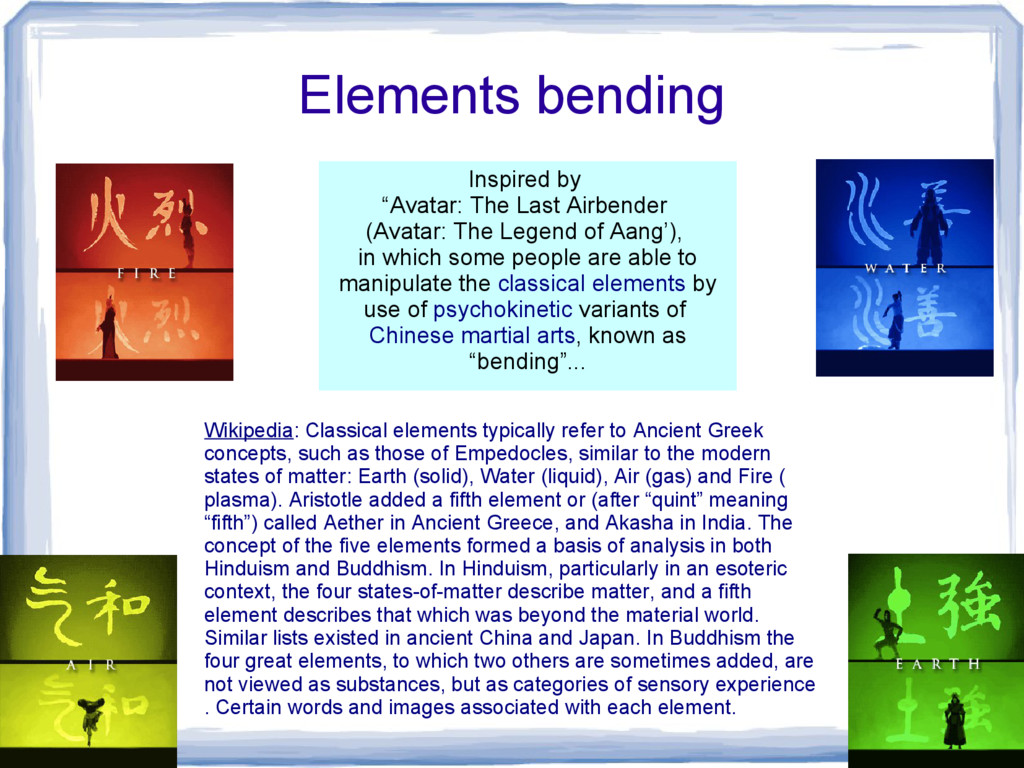
  2. Elements bending Inspired by “Avatar: The Last Airbender (Avatar: The

    Legend of Aang’), in which some people are able to manipulate the classical elements by use of psychokinetic variants of Chinese martial arts, known as “bending”... Wikipedia: Classical elements typically refer to Ancient Greek concepts, such as those of Empedocles, similar to the modern states of matter: Earth (solid), Water (liquid), Air (gas) and Fire ( plasma). Aristotle added a fifth element or (after “quint” meaning “fifth”) called Aether in Ancient Greece, and Akasha in India. The concept of the five elements formed a basis of analysis in both Hinduism and Buddhism. In Hinduism, particularly in an esoteric context, the four states-of-matter describe matter, and a fifth element describes that which was beyond the material world. Similar lists existed in ancient China and Japan. In Buddhism the four great elements, to which two others are sometimes added, are not viewed as substances, but as categories of sensory experience . Certain words and images associated with each element.
  3. What Entrepreneurship IS Mind & Spirit: • Seeing Opportunities everywhere

    • Challenging all Status Quo / 'Why Not?' • Following your Passion • Push-energy
  4. What Leadership IS Maintaining the Dynamic Equilibrium in ourself and

    in our team Leadership begins with the awareness that we are constantly in the process of self-making; it extends into sensitivity to the way we shape our cultural and social climate. So, the experience of self which Elemental Leadership encourages has both an inward and an outward focus. The inward focus enables us to consider how the elemental forces live in and through us, in what balance, with which preferences, and so on. The outward focus reminds us that our leadership is always in context: we are cultural beings and natural beings and our every move is born of, and shapes, our cultural and natural worlds. In one moment, we are called upon to bring insight, vision, clarity and all the fine qualities of Air. In the next moment, we need to connect with Earth as we consider how to plan and implement this vision. On one day, a team may require the transforming Fire of intuition to burn through fixed habits and assumptions. The next day, they may need the receptivity of Water as we listen to their hopes, fears, and dreams.
  5. Questionnaire • How many of you want to start /

    have your own business in the future? • How many of you want to achieve a leader's role in IT industry? • Who wants to make things better? • Who wants to improve this world? • What external obstacles do you anticipate? • What problems do you recognize in yourself? • What holds us back?
  6. The Elemental Leadership There is an approach to leadership development,

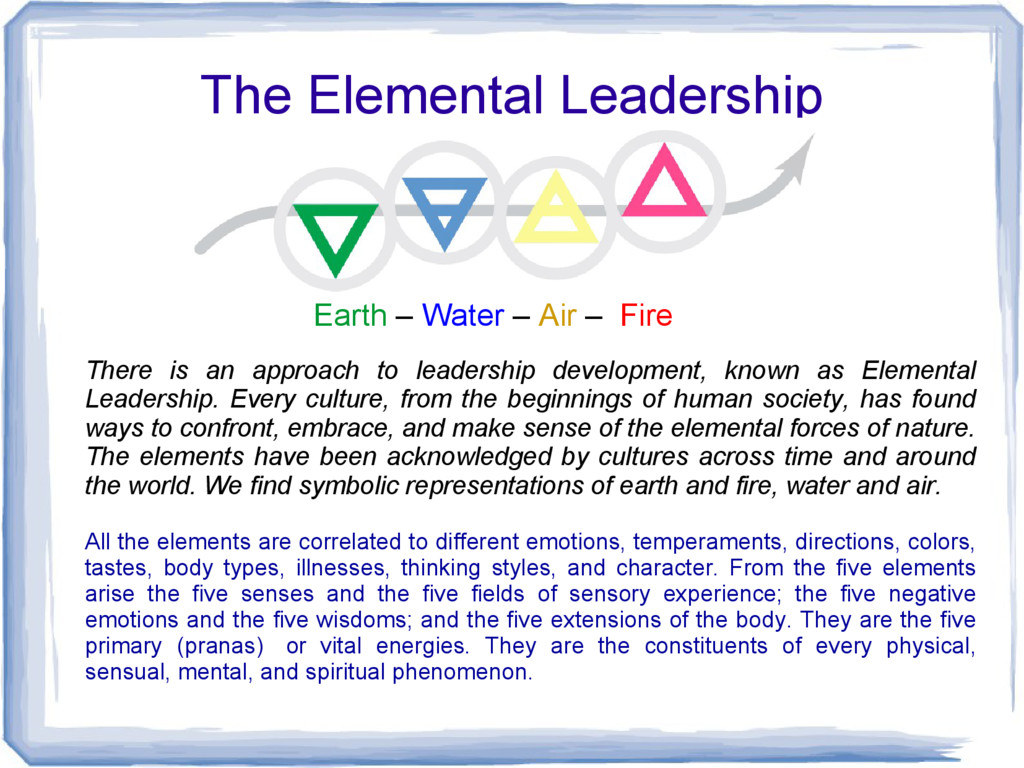
    known as Elemental Leadership. Every culture, from the beginnings of human society, has found ways to confront, embrace, and make sense of the elemental forces of nature. The elements have been acknowledged by cultures across time and around the world. We find symbolic representations of earth and fire, water and air. All the elements are correlated to different emotions, temperaments, directions, colors, tastes, body types, illnesses, thinking styles, and character. From the five elements arise the five senses and the five fields of sensory experience; the five negative emotions and the five wisdoms; and the five extensions of the body. They are the five primary (pranas) or vital energies. They are the constituents of every physical, sensual, mental, and spiritual phenomenon. Earth – Water – Air – Fire
  7. The Plan Maintain the Dynamic Equilibrium Find an intimate knowledge

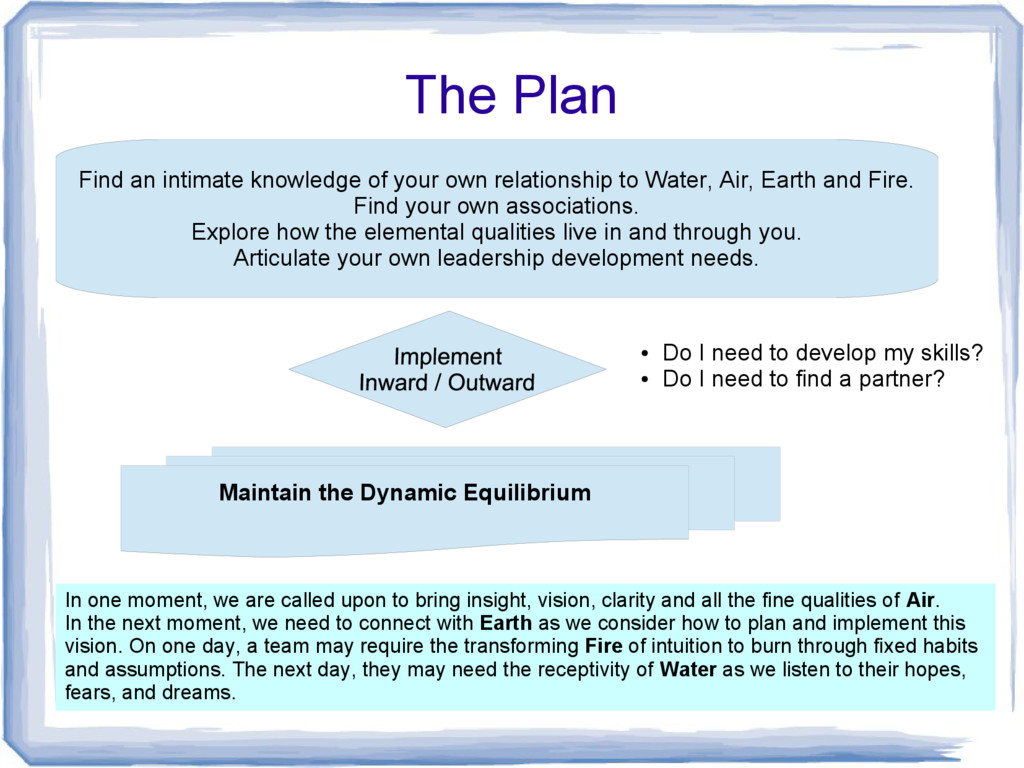
    of your own relationship to Water, Air, Earth and Fire. Find your own associations. Explore how the elemental qualities live in and through you. Articulate your own leadership development needs. • Do I need to develop my skills? • Do I need to find a partner? In one moment, we are called upon to bring insight, vision, clarity and all the fine qualities of Air. In the next moment, we need to connect with Earth as we consider how to plan and implement this vision. On one day, a team may require the transforming Fire of intuition to burn through fixed habits and assumptions. The next day, they may need the receptivity of Water as we listen to their hopes, fears, and dreams.
  8. Introducing the Method • My story: single mom of two,

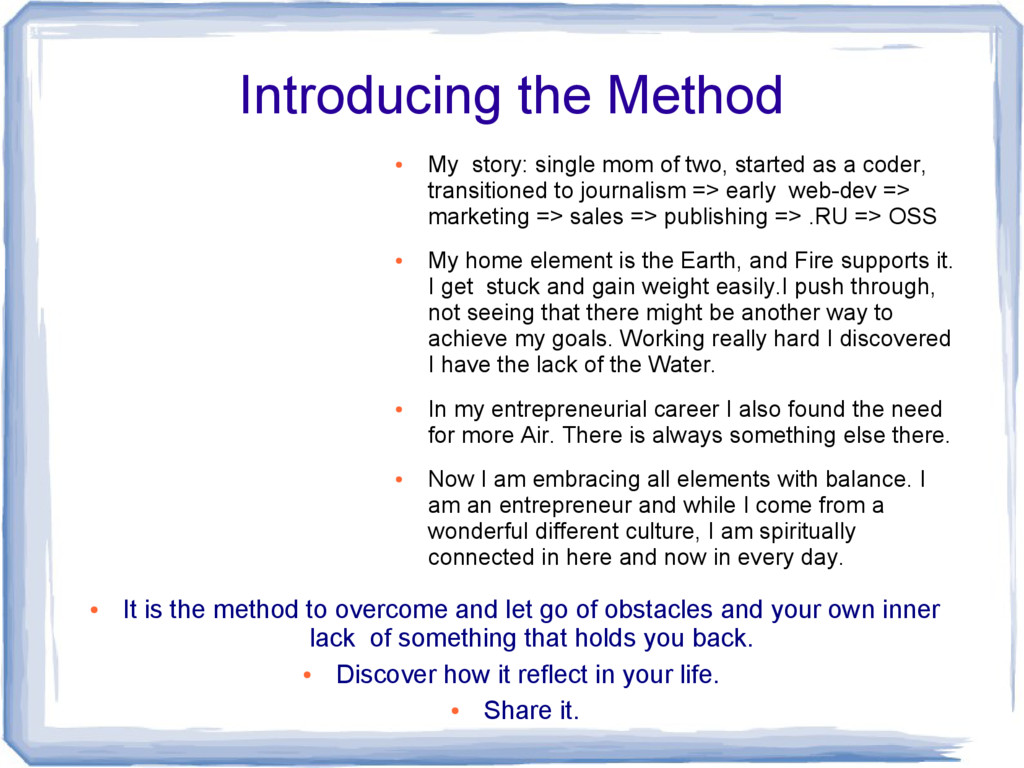
    started as a coder, transitioned to journalism => early web-dev => marketing => sales => publishing => .RU => OSS • My home element is the Earth, and Fire supports it. I get stuck and gain weight easily.I push through, not seeing that there might be another way to achieve my goals. Working really hard I discovered I have the lack of the Water. • In my entrepreneurial career I also found the need for more Air. There is always something else there. • Now I am embracing all elements with balance. I am an entrepreneur and while I come from a wonderful different culture, I am spiritually connected in here and now in every day. • It is the method to overcome and let go of obstacles and your own inner lack of something that holds you back. • Discover how it reflect in your life. • Share it.
  9. Women specifically (SWOT) Natural Strengths: • Intuition (Air) • Inspirational

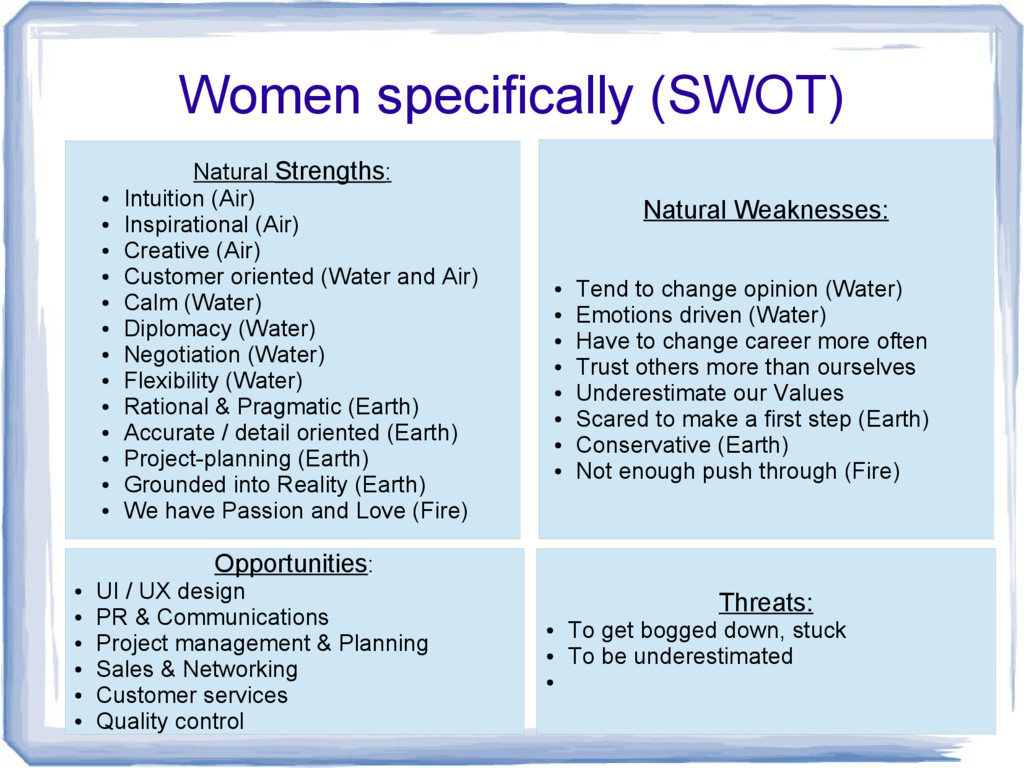
    (Air) • Creative (Air) • Customer oriented (Water and Air) • Calm (Water) • Diplomacy (Water) • Negotiation (Water) • Flexibility (Water) • Rational & Pragmatic (Earth) • Accurate / detail oriented (Earth) • Project-planning (Earth) • Grounded into Reality (Earth) • We have Passion and Love (Fire) Natural Weaknesses: • Tend to change opinion (Water) • Emotions driven (Water) • Have to change career more often • Trust others more than ourselves • Underestimate our Values • Scared to make a first step (Earth) • Conservative (Earth) • Not enough push through (Fire) Opportunities: • UI / UX design • PR & Communications • Project management & Planning • Sales & Networking • Customer services • Quality control Threats: • To get bogged down, stuck • To be underestimated •
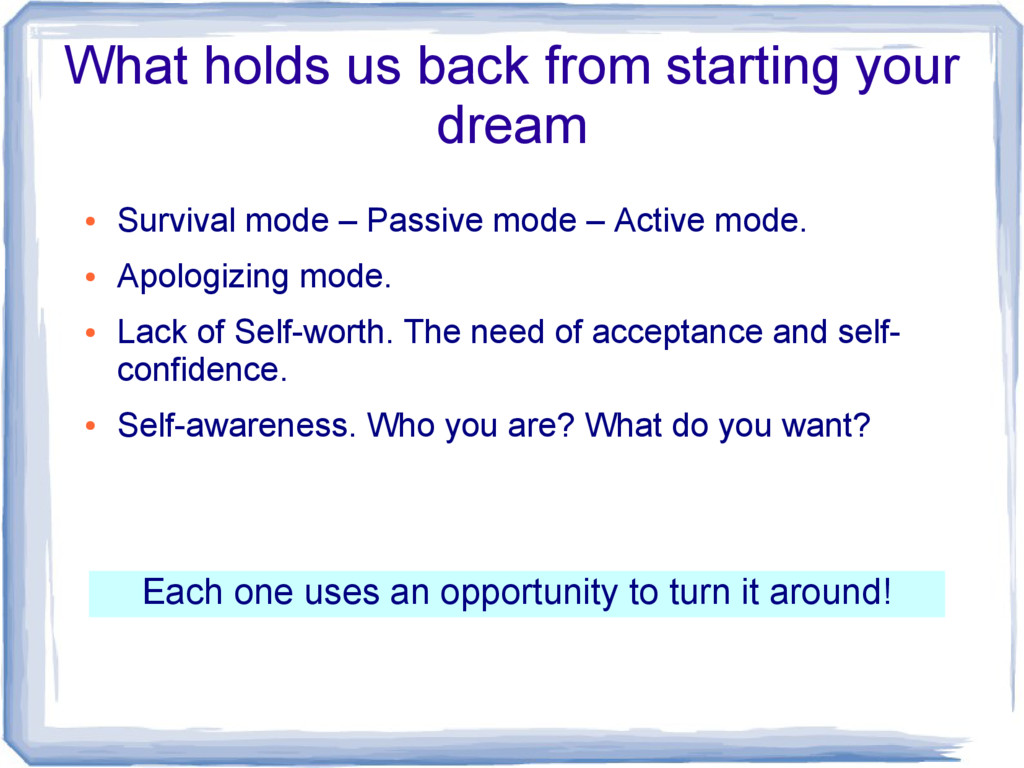
  10. What holds us back from starting your dream • Survival

    mode – Passive mode – Active mode. • Apologizing mode. • Lack of Self-worth. The need of acceptance and self- confidence. • Self-awareness. Who you are? What do you want? Each one uses an opportunity to turn it around!
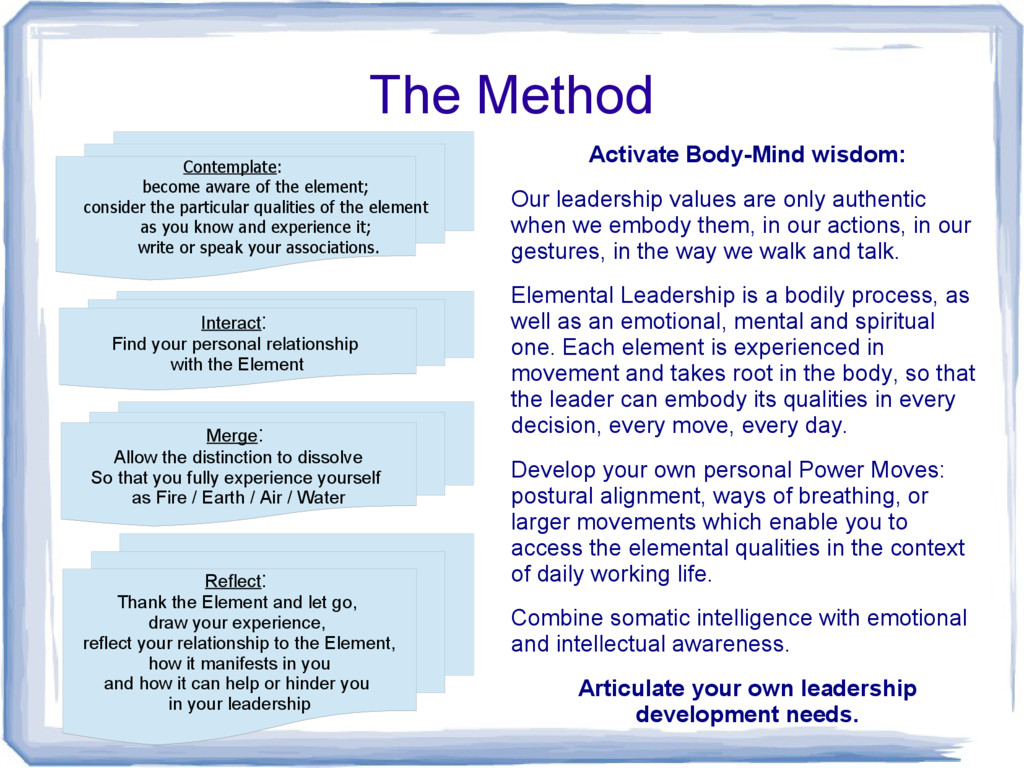
  11. The Method Contemplate: become aware of the element; consider the

    particular qualities of the element as you know and experience it; write or speak your associations. Interact: Find your personal relationship with the Element Merge: Allow the distinction to dissolve So that you fully experience yourself as Fire / Earth / Air / Water Reflect: Thank the Element and let go, draw your experience, reflect your relationship to the Element, how it manifests in you and how it can help or hinder you in your leadership Activate Body-Mind wisdom: Our leadership values are only authentic when we embody them, in our actions, in our gestures, in the way we walk and talk. Elemental Leadership is a bodily process, as well as an emotional, mental and spiritual one. Each element is experienced in movement and takes root in the body, so that the leader can embody its qualities in every decision, every move, every day. Develop your own personal Power Moves: postural alignment, ways of breathing, or larger movements which enable you to access the elemental qualities in the context of daily working life. Combine somatic intelligence with emotional and intellectual awareness. Articulate your own leadership development needs.
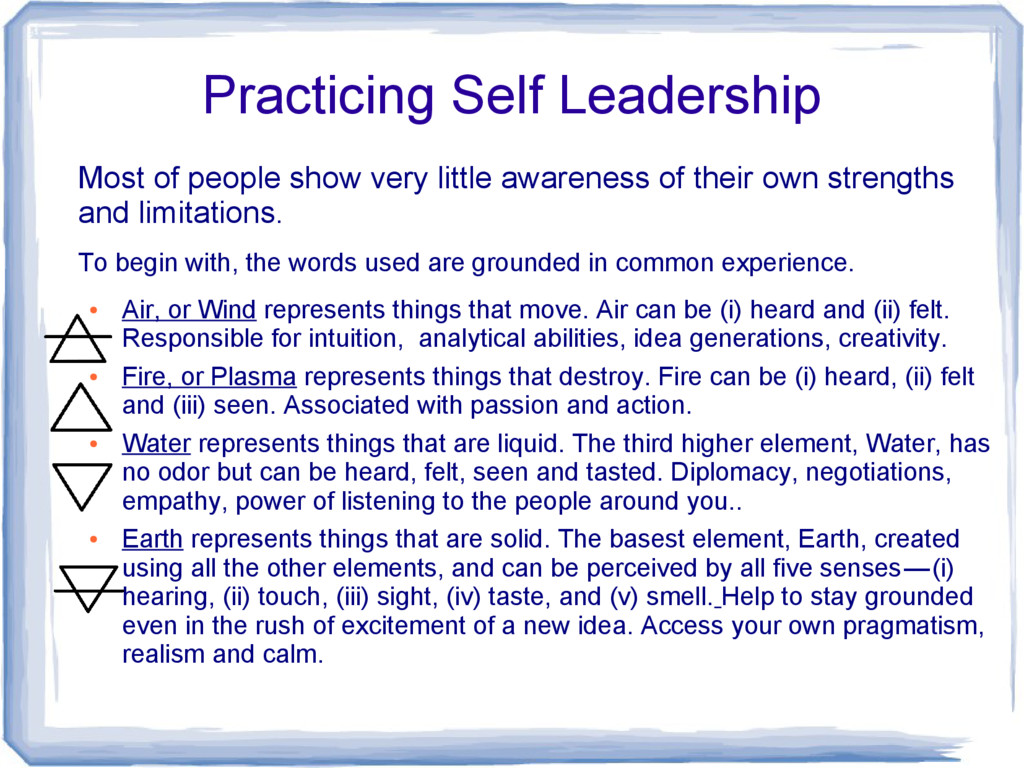
  12. Practicing Self Leadership Most of people show very little awareness

    of their own strengths and limitations. To begin with, the words used are grounded in common experience. • Air, or Wind represents things that move. Air can be (i) heard and (ii) felt. Responsible for intuition, analytical abilities, idea generations, creativity. • Fire, or Plasma represents things that destroy. Fire can be (i) heard, (ii) felt and (iii) seen. Associated with passion and action. • Water represents things that are liquid. The third higher element, Water, has no odor but can be heard, felt, seen and tasted. Diplomacy, negotiations, empathy, power of listening to the people around you.. • Earth represents things that are solid. The basest element, Earth, created using all the other elements, and can be perceived by all five senses — (i) hearing, (ii) touch, (iii) sight, (iv) taste, and (v) smell. Help to stay grounded even in the rush of excitement of a new idea. Access your own pragmatism, realism and calm.
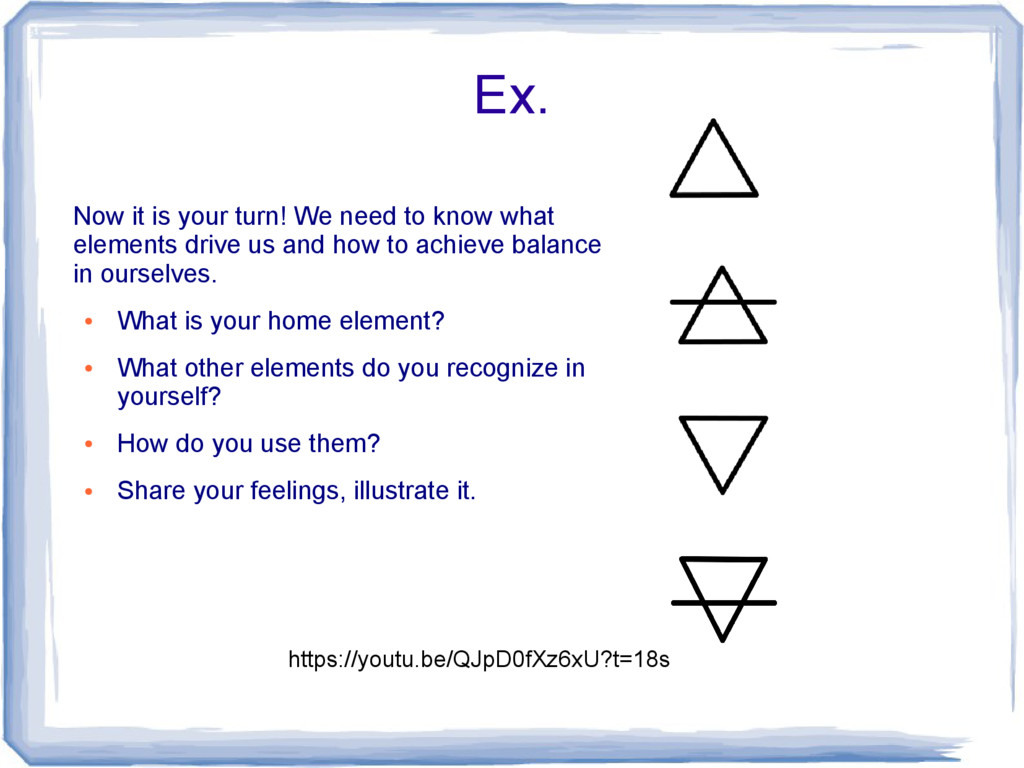
  13. Ex. Now it is your turn! We need to know

    what elements drive us and how to achieve balance in ourselves. • What is your home element? • What other elements do you recognize in yourself? • How do you use them? • Share your feelings, illustrate it. https://youtu.be/QJpD0fXz6xU?t=18s
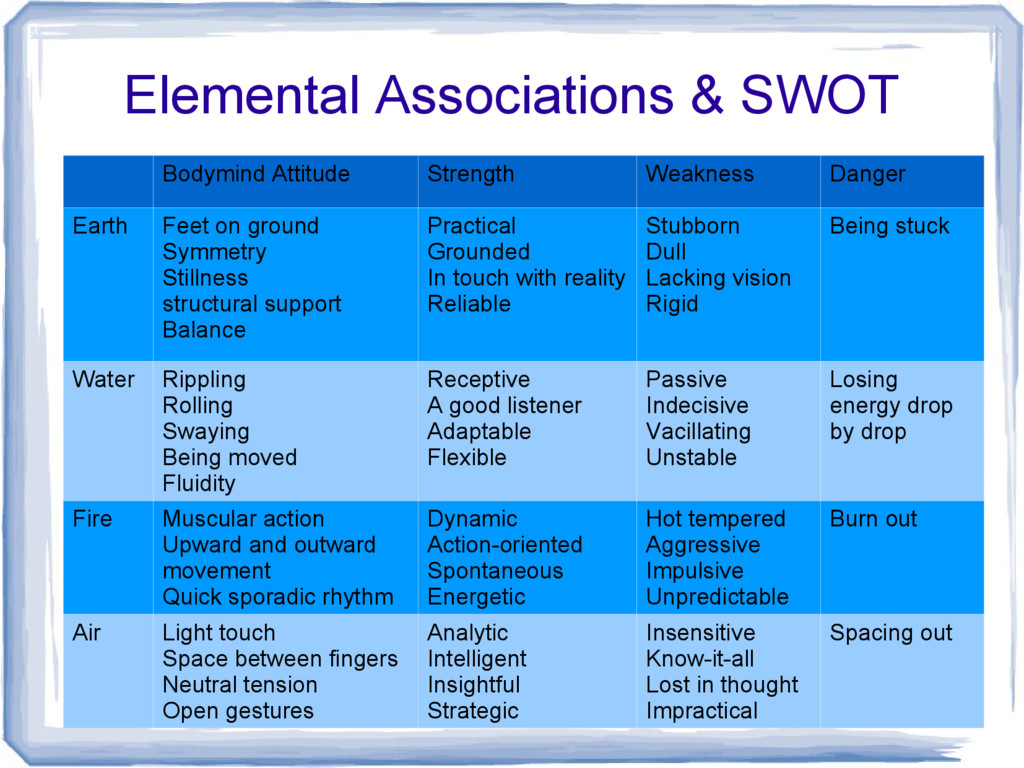
  14. Elemental Associations & SWOT Bodymind Attitude Strength Weakness Danger Earth

    Feet on ground Symmetry Stillness structural support Balance Practical Grounded In touch with reality Reliable Stubborn Dull Lacking vision Rigid Being stuck Water Rippling Rolling Swaying Being moved Fluidity Receptive A good listener Adaptable Flexible Passive Indecisive Vacillating Unstable Losing energy drop by drop Fire Muscular action Upward and outward movement Quick sporadic rhythm Dynamic Action-oriented Spontaneous Energetic Hot tempered Aggressive Impulsive Unpredictable Burn out Air Light touch Space between fingers Neutral tension Open gestures Analytic Intelligent Insightful Strategic Insensitive Know-it-all Lost in thought Impractical Spacing out
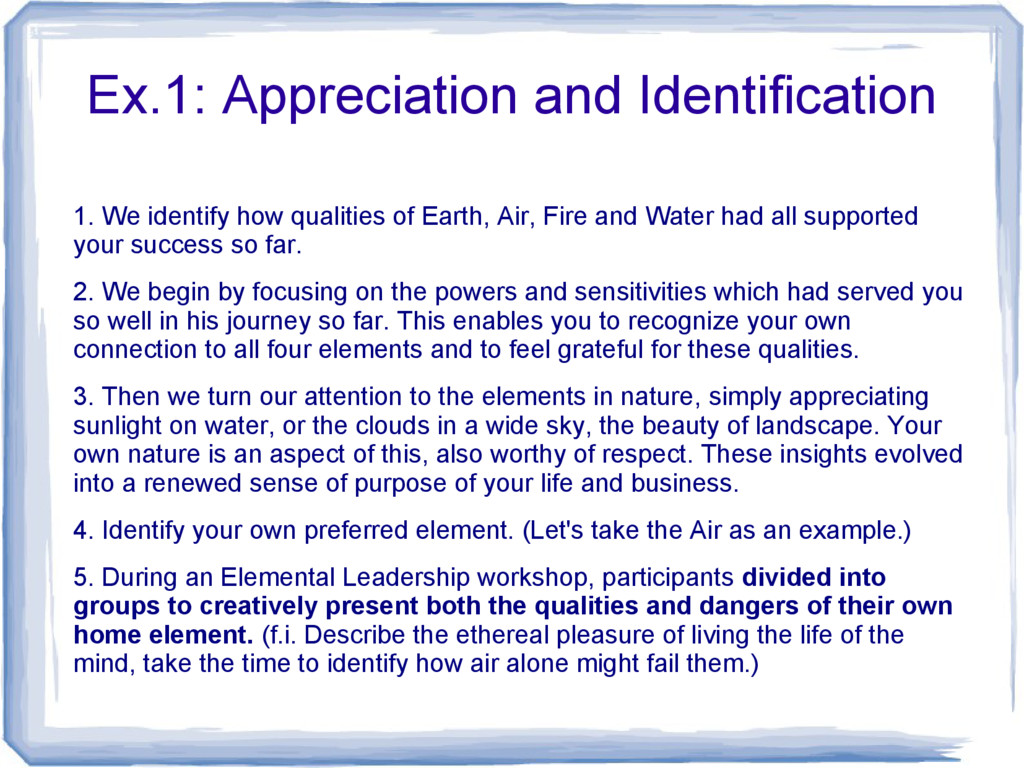
  15. Ex.1: Appreciation and Identification 1. We identify how qualities of

    Earth, Air, Fire and Water had all supported your success so far. 2. We begin by focusing on the powers and sensitivities which had served you so well in his journey so far. This enables you to recognize your own connection to all four elements and to feel grateful for these qualities. 3. Then we turn our attention to the elements in nature, simply appreciating sunlight on water, or the clouds in a wide sky, the beauty of landscape. Your own nature is an aspect of this, also worthy of respect. These insights evolved into a renewed sense of purpose of your life and business. 4. Identify your own preferred element. (Let's take the Air as an example.) 5. During an Elemental Leadership workshop, participants divided into groups to creatively present both the qualities and dangers of their own home element. (f.i. Describe the ethereal pleasure of living the life of the mind, take the time to identify how air alone might fail them.)
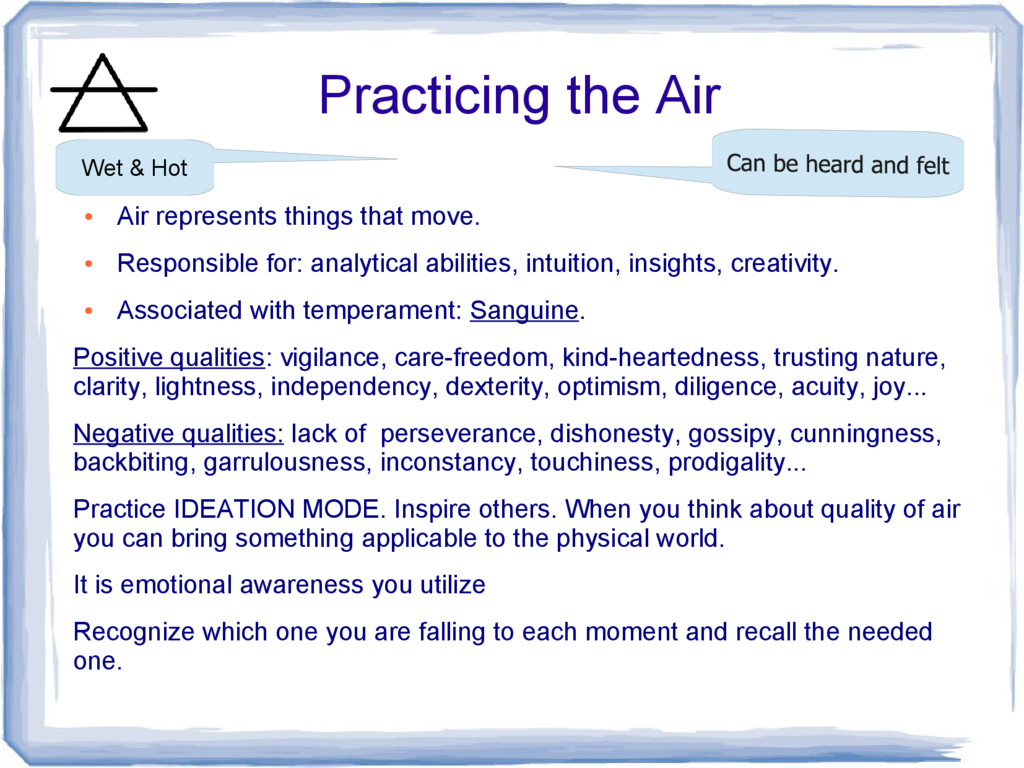
  16. Practicing the Air • Air represents things that move. •

    Responsible for: analytical abilities, intuition, insights, creativity. • Associated with temperament: Sanguine. Positive qualities: vigilance, care-freedom, kind-heartedness, trusting nature, clarity, lightness, independency, dexterity, optimism, diligence, acuity, joy... Negative qualities: lack of perseverance, dishonesty, gossipy, cunningness, backbiting, garrulousness, inconstancy, touchiness, prodigality... Practice IDEATION MODE. Inspire others. When you think about quality of air you can bring something applicable to the physical world. It is emotional awareness you utilize Recognize which one you are falling to each moment and recall the needed one. Wet & Hot
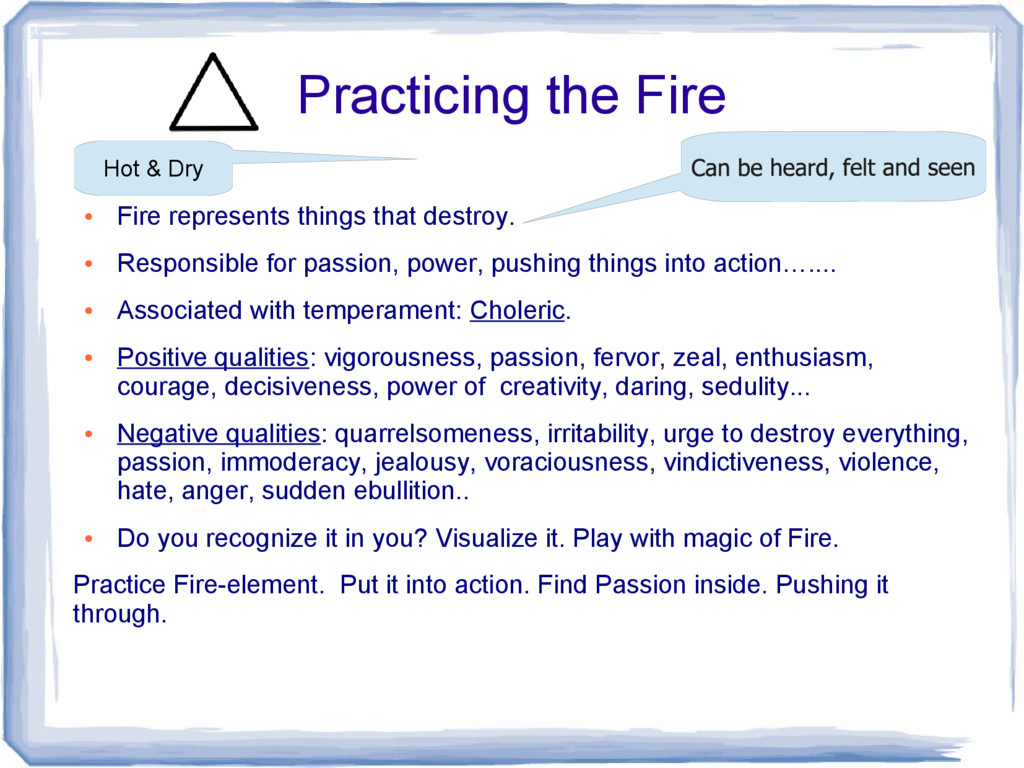
  17. Practicing the Fire • Fire represents things that destroy. •

    Responsible for passion, power, pushing things into action….... • Associated with temperament: Choleric. • Positive qualities: vigorousness, passion, fervor, zeal, enthusiasm, courage, decisiveness, power of creativity, daring, sedulity... • Negative qualities: quarrelsomeness, irritability, urge to destroy everything, passion, immoderacy, jealousy, voraciousness, vindictiveness, violence, hate, anger, sudden ebullition.. • Do you recognize it in you? Visualize it. Play with magic of Fire. Practice Fire-element. Put it into action. Find Passion inside. Pushing it through. Hot & Dry
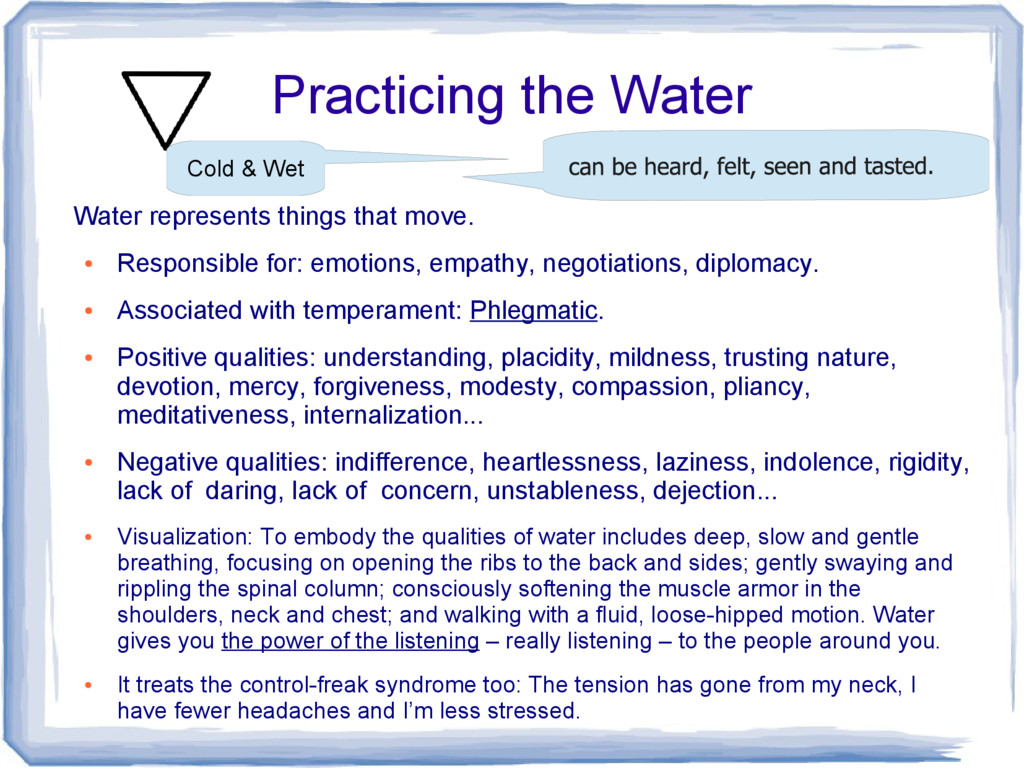
  18. Practicing the Water Water represents things that move. • Responsible

    for: emotions, empathy, negotiations, diplomacy. • Associated with temperament: Phlegmatic. • Positive qualities: understanding, placidity, mildness, trusting nature, devotion, mercy, forgiveness, modesty, compassion, pliancy, meditativeness, internalization... • Negative qualities: indifference, heartlessness, laziness, indolence, rigidity, lack of daring, lack of concern, unstableness, dejection... • Visualization: To embody the qualities of water includes deep, slow and gentle breathing, focusing on opening the ribs to the back and sides; gently swaying and rippling the spinal column; consciously softening the muscle armor in the shoulders, neck and chest; and walking with a fluid, loose-hipped motion. Water gives you the power of the listening – really listening – to the people around you. • It treats the control-freak syndrome too: The tension has gone from my neck, I have fewer headaches and I’m less stressed. Cold & Wet
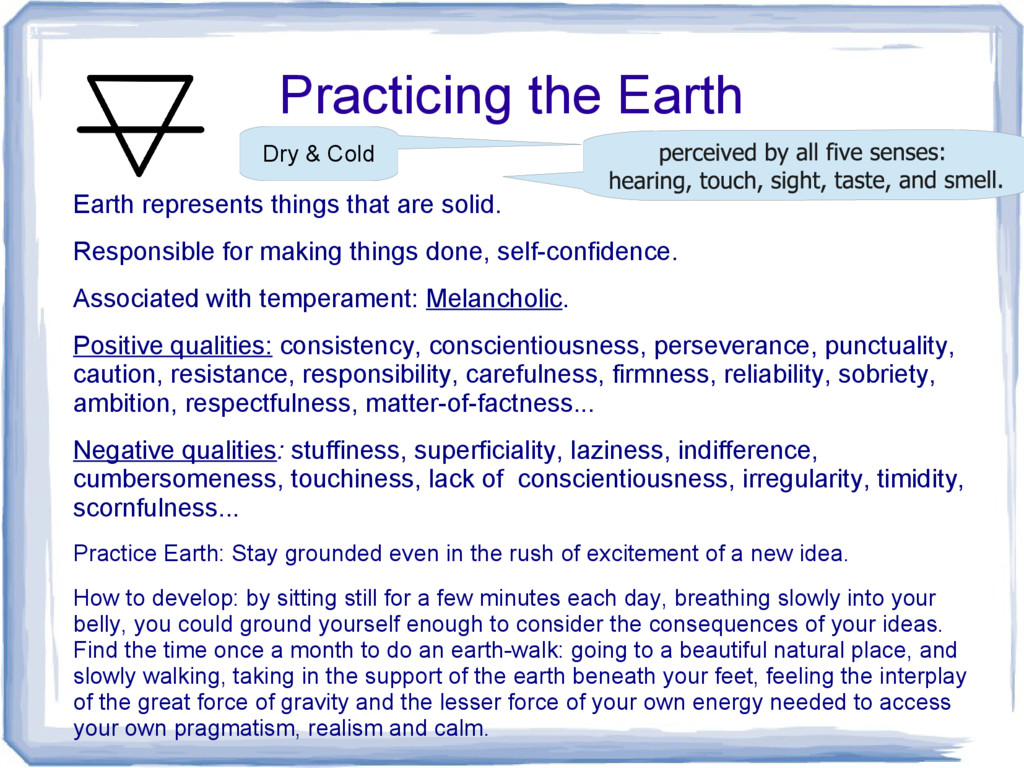
  19. Practicing the Earth Earth represents things that are solid. Responsible

    for making things done, self-confidence. Associated with temperament: Melancholic. Positive qualities: consistency, conscientiousness, perseverance, punctuality, caution, resistance, responsibility, carefulness, firmness, reliability, sobriety, ambition, respectfulness, matter-of-factness... Negative qualities: stuffiness, superficiality, laziness, indifference, cumbersomeness, touchiness, lack of conscientiousness, irregularity, timidity, scornfulness... Practice Earth: Stay grounded even in the rush of excitement of a new idea. How to develop: by sitting still for a few minutes each day, breathing slowly into your belly, you could ground yourself enough to consider the consequences of your ideas. Find the time once a month to do an earth-walk: going to a beautiful natural place, and slowly walking, taking in the support of the earth beneath your feet, feeling the interplay of the great force of gravity and the lesser force of your own energy needed to access your own pragmatism, realism and calm. Dry & Cold
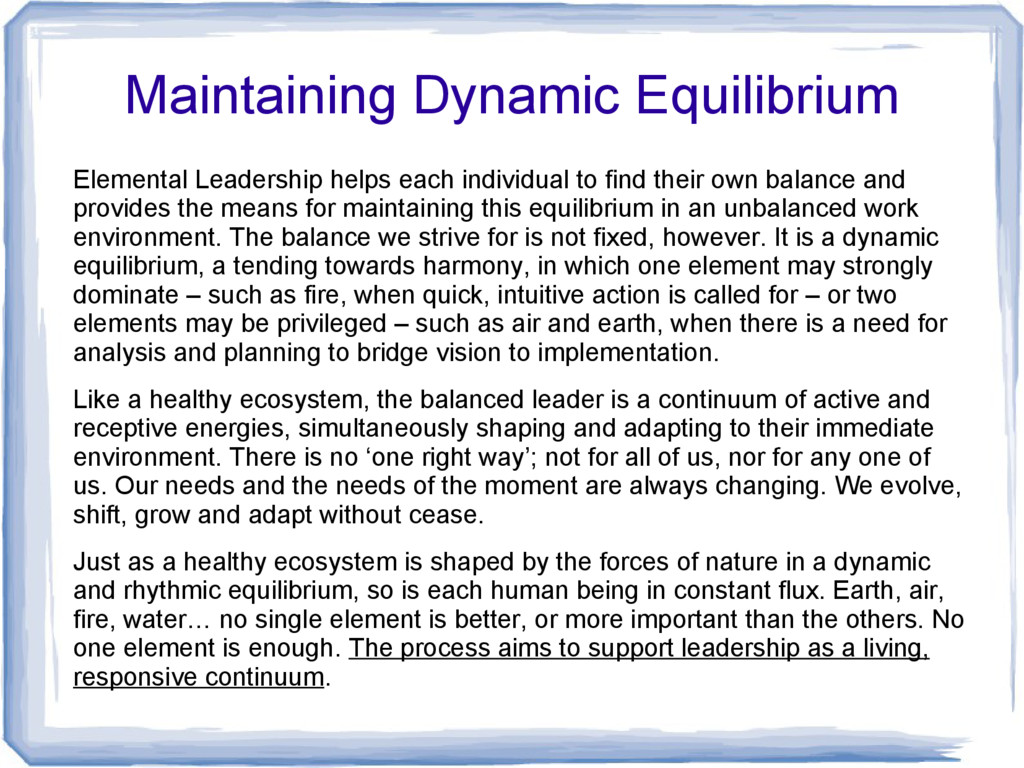
  20. Maintaining Dynamic Equilibrium Elemental Leadership helps each individual to find

    their own balance and provides the means for maintaining this equilibrium in an unbalanced work environment. The balance we strive for is not fixed, however. It is a dynamic equilibrium, a tending towards harmony, in which one element may strongly dominate – such as fire, when quick, intuitive action is called for – or two elements may be privileged – such as air and earth, when there is a need for analysis and planning to bridge vision to implementation. Like a healthy ecosystem, the balanced leader is a continuum of active and receptive energies, simultaneously shaping and adapting to their immediate environment. There is no ‘one right way’; not for all of us, nor for any one of us. Our needs and the needs of the moment are always changing. We evolve, shift, grow and adapt without cease. Just as a healthy ecosystem is shaped by the forces of nature in a dynamic and rhythmic equilibrium, so is each human being in constant flux. Earth, air, fire, water… no single element is better, or more important than the others. No one element is enough. The process aims to support leadership as a living, responsive continuum.
  21. Delighting in Difference Elemental Leadership enhances acceptance of a wide

    range of leadership qualities, from drive to receptivity, from passion to detachment. Participants in the process find new appreciation of these diverse qualities, in themselves and in others. This, in turn, enables effective cooperation in which people delight in their differences. Air-person case: “It’s not just a question of whether I can learn to tolerate these other qualities, I need them for my survival! I don’t think I’ll change much, but instead of avoiding people who are connected to water, earth and fire, I’m going to seek them out. I intend to find bridges between my favorite element and the other three, so that we can help and sustain one another.”