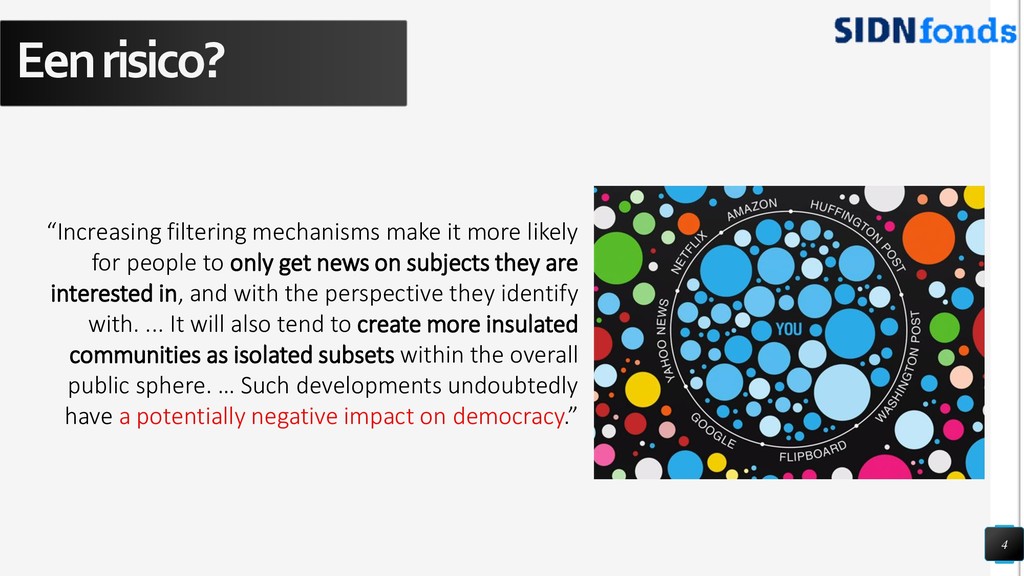
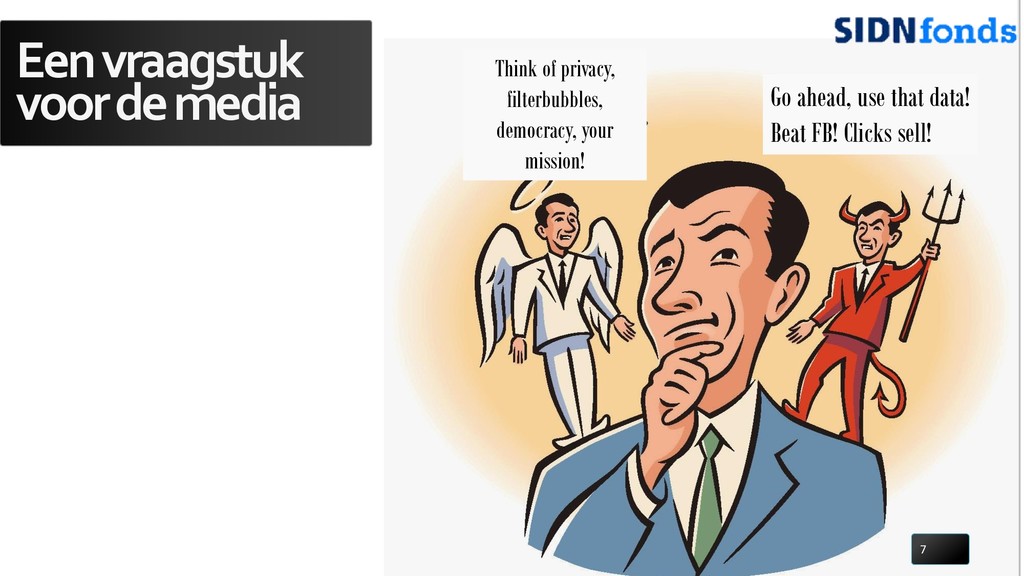
likely for people to only get news on subjects they are interested in, and with the perspective they identify with. ... It will also tend to create more insulated communities as isolated subsets within the overall public sphere. … Such developments undoubtedly have a potentially negative impact on democracy.”
from elitism of writing for itself and back to writing what people are actually looking for.” (Usher, 2010) “Instead of discussing ways journalism can improve, the solution appears to be to burn down the gates and grant agency to the audience.” (Tandoc &Thomas, 2015)
al drie uur lang televisie hebt gekeken, moeten we dan stoppen met het doen van nieuwe suggesties, zodat mensen de tv uitzetten en naar buiten gaan? Is dat een van onze verantwoordelijkheden? Of moeten we er alleen voor zorgen dat je aan het beeld gekluisterd blijft? Is dat waar we voor optimaliseren?” - Data scientist for a large media company)
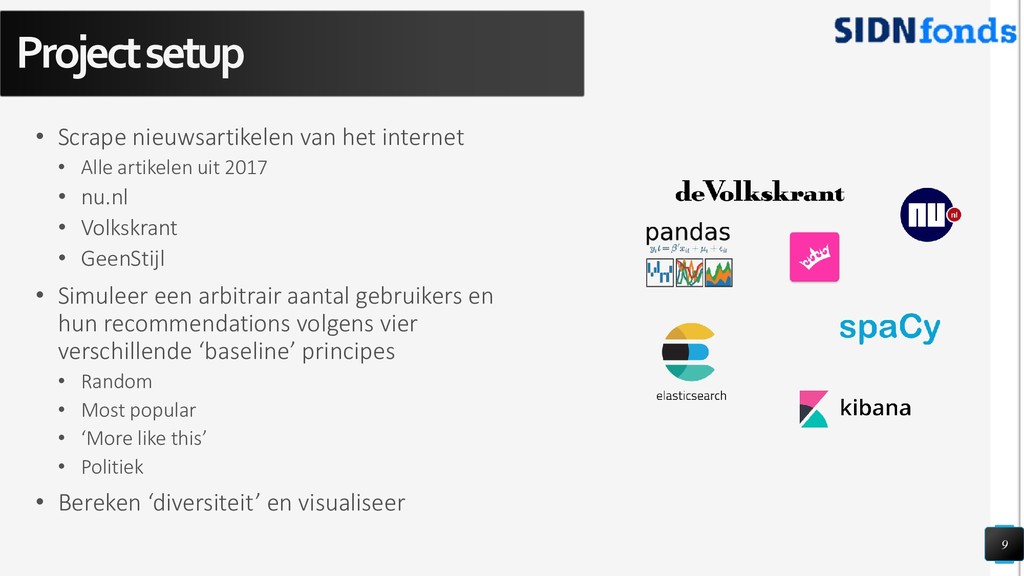
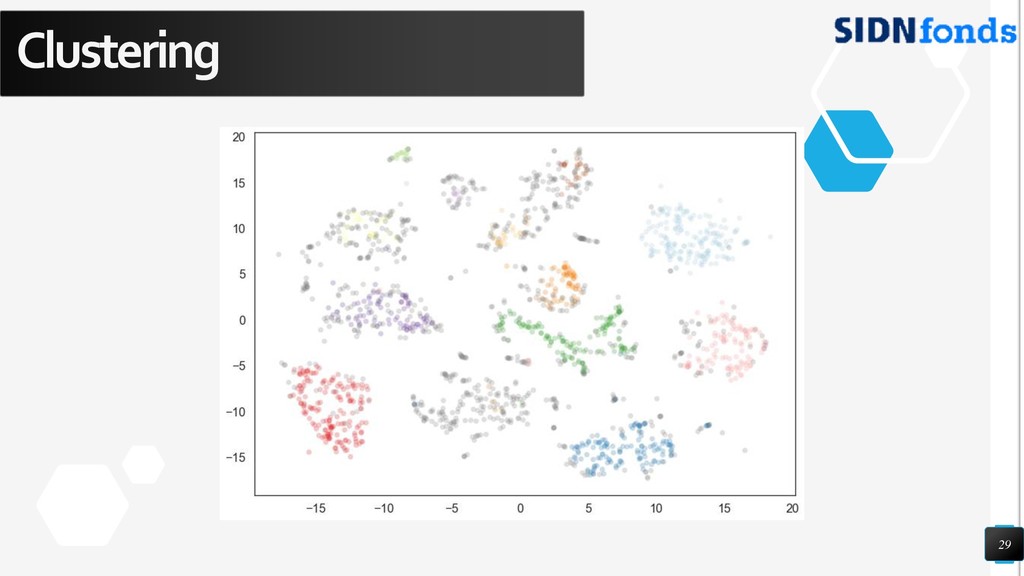
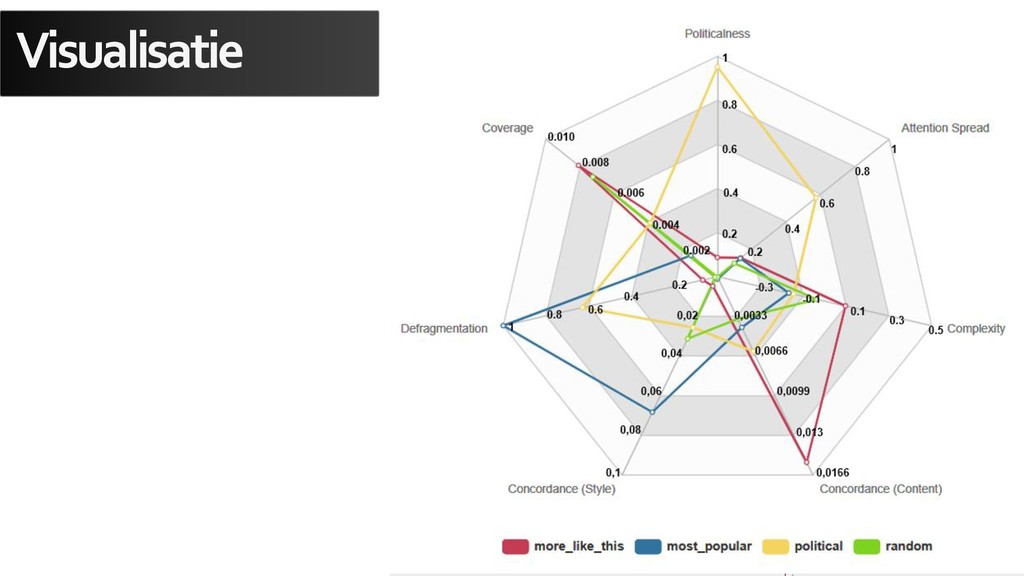
artikelen uit 2017 • nu.nl • Volkskrant • GeenStijl • Simuleer een arbitrair aantal gebruikers en hun recommendations volgens vier verschillende ‘baseline’ principes • Random • Most popular • ‘More like this’ • Politiek • Bereken ‘diversiteit’ en visualiseer 9 Project setup
artikelen uit 2017 • nu.nl • Volkskrant • GeenStijl • Simuleer een arbitrair aantal gebruikers en hun recommendations volgens vier verschillende ‘baseline’ principes • Random • Most popular • ‘More like this’ • Politiek • Bereken ‘diversiteit’ en visualiseer 11 Project setup
artikelen uit 2017 • nu.nl • Volkskrant • GeenStijl • Simuleer een arbitrair aantal gebruikers en hun recommendations volgens vier verschillende ‘baseline’ principes • Random • Most popular • ‘More like this’ • Politiek • Bereken ‘diversiteit’ en visualiseer 12 Project setup
diversiteit is grotendeels afhankelijk van het perspectief op democratie- theorie dat men heeft Afhankelijk van dit perspectief kan diversiteit meerdere doelen en waarden dienen, waar sommigen elkaar ook tegen kunnen spreken. 14 Diversiteiten“democratic theory”
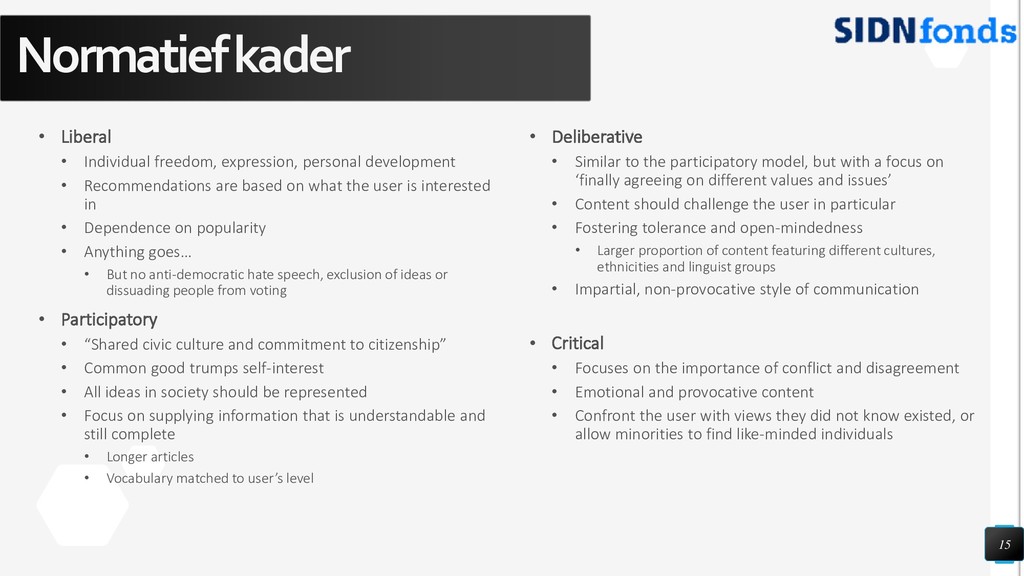
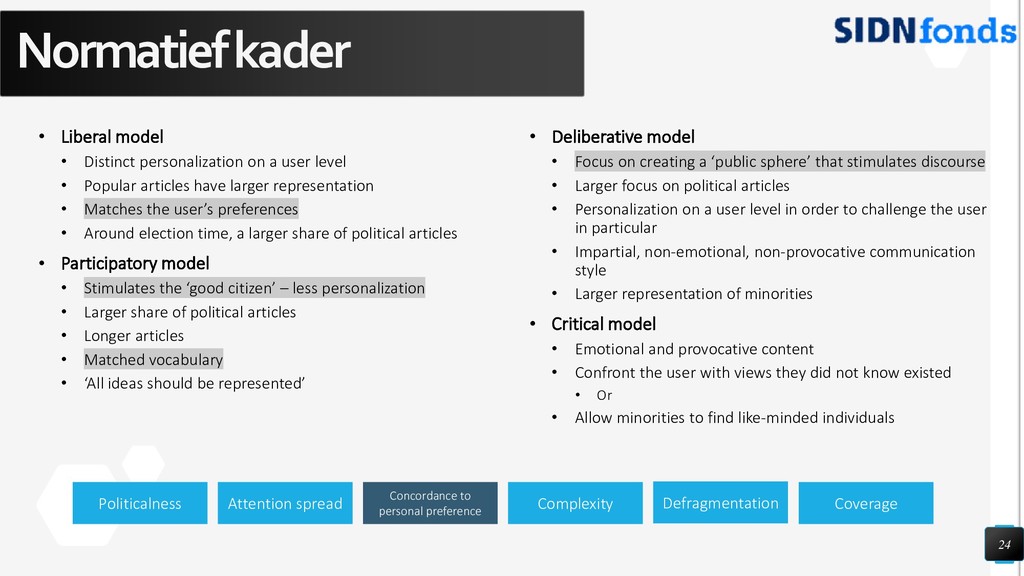
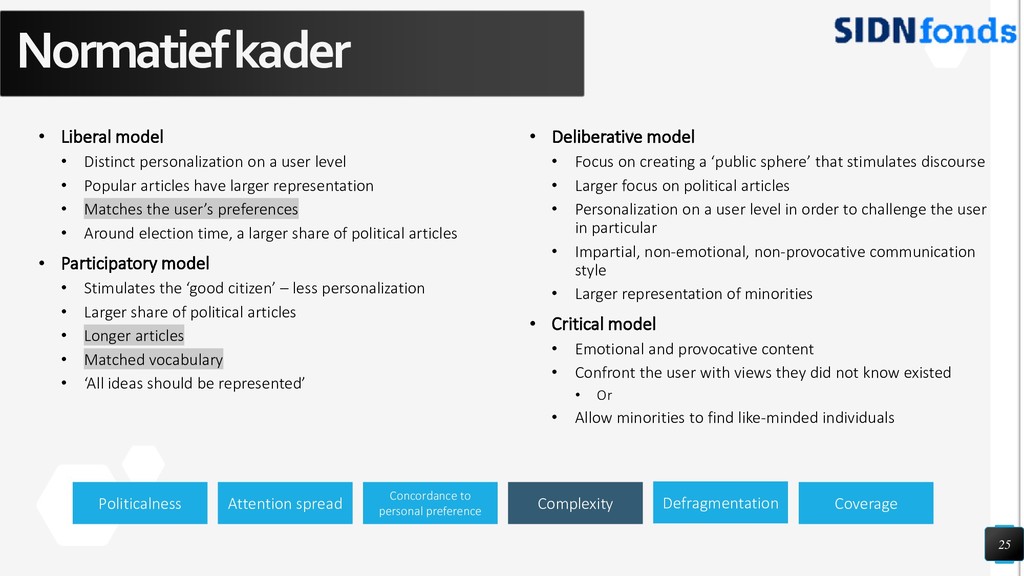
participatory model, but with a focus on ‘finally agreeing on different values and issues’ • Content should challenge the user in particular • Fostering tolerance and open-mindedness • Larger proportion of content featuring different cultures, ethnicities and linguist groups • Impartial, non-provocative style of communication • Critical • Focuses on the importance of conflict and disagreement • Emotional and provocative content • Confront the user with views they did not know existed, or allow minorities to find like-minded individuals • Liberal • Individual freedom, expression, personal development • Recommendations are based on what the user is interested in • Dependence on popularity • Anything goes… • But no anti-democratic hate speech, exclusion of ideas or dissuading people from voting • Participatory • “Shared civic culture and commitment to citizenship” • Common good trumps self-interest • All ideas in society should be represented • Focus on supplying information that is understandable and still complete • Longer articles • Vocabulary matched to user’s level Normatiefkader
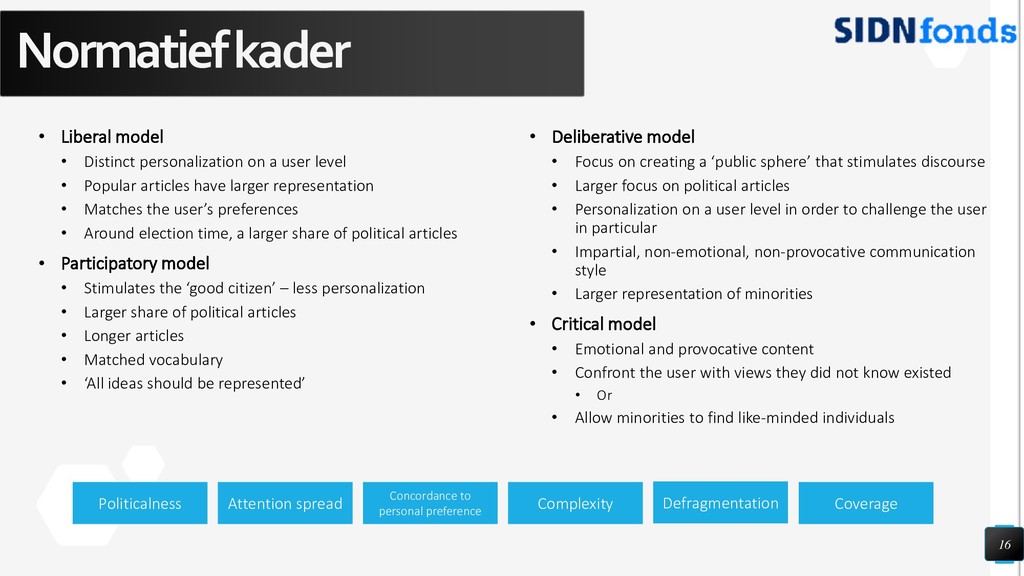
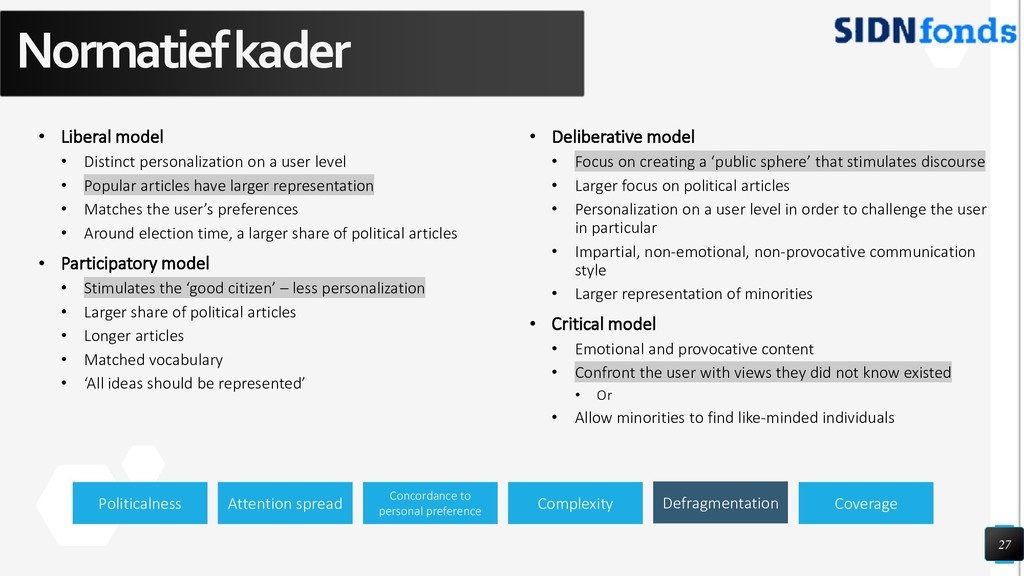
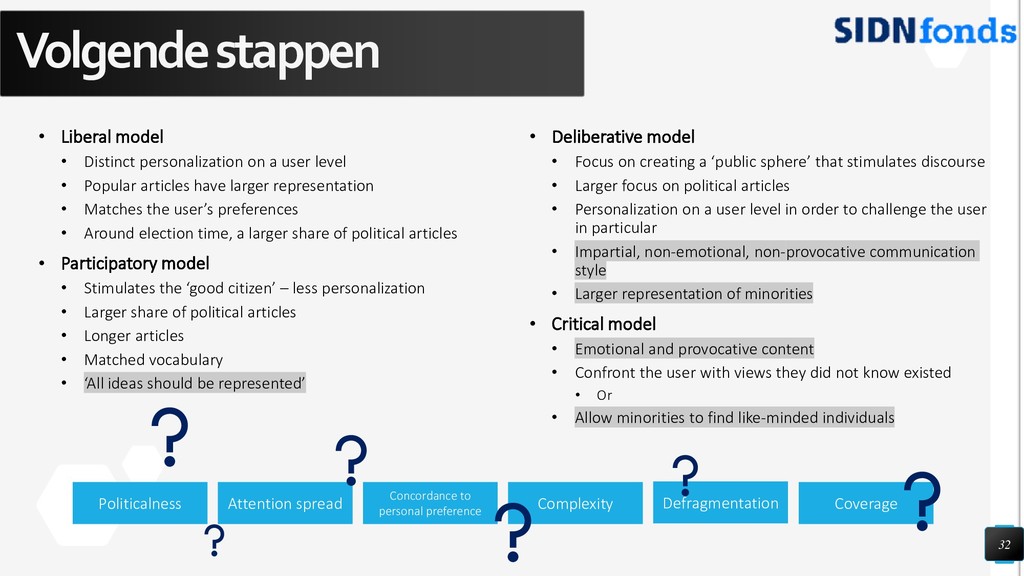
on creating a ‘public sphere’ that stimulates discourse • Larger focus on political articles • Personalization on a user level in order to challenge the user in particular • Impartial, non-emotional, non-provocative communication style • Larger representation of minorities • Critical model • Emotional and provocative content • Confront the user with views they did not know existed • Or • Allow minorities to find like-minded individuals • Liberal model • Distinct personalization on a user level • Popular articles have larger representation • Matches the user’s preferences • Around election time, a larger share of political articles • Participatory model • Stimulates the ‘good citizen’ – less personalization • Larger share of political articles • Longer articles • Matched vocabulary • ‘All ideas should be represented’ Normatiefkader Politicalness Attention spread Concordance to personal preference Complexity Defragmentation Coverage
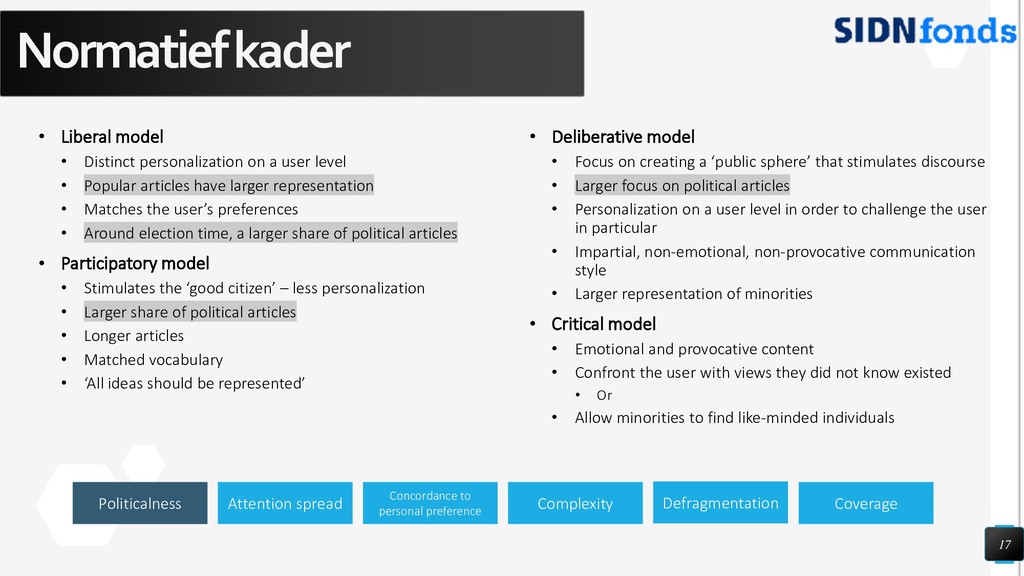
on creating a ‘public sphere’ that stimulates discourse • Larger focus on political articles • Personalization on a user level in order to challenge the user in particular • Impartial, non-emotional, non-provocative communication style • Larger representation of minorities • Critical model • Emotional and provocative content • Confront the user with views they did not know existed • Or • Allow minorities to find like-minded individuals • Liberal model • Distinct personalization on a user level • Popular articles have larger representation • Matches the user’s preferences • Around election time, a larger share of political articles • Participatory model • Stimulates the ‘good citizen’ – less personalization • Larger share of political articles • Longer articles • Matched vocabulary • ‘All ideas should be represented’ Normatiefkader Politicalness Attention spread Concordance to personal preference Complexity Defragmentation Coverage
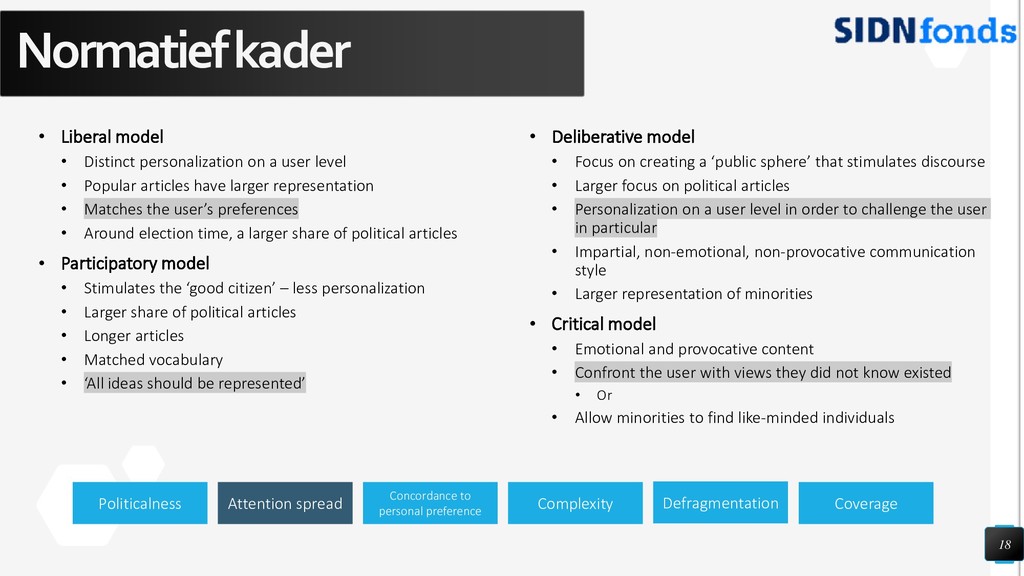
on creating a ‘public sphere’ that stimulates discourse • Larger focus on political articles • Personalization on a user level in order to challenge the user in particular • Impartial, non-emotional, non-provocative communication style • Larger representation of minorities • Critical model • Emotional and provocative content • Confront the user with views they did not know existed • Or • Allow minorities to find like-minded individuals • Liberal model • Distinct personalization on a user level • Popular articles have larger representation • Matches the user’s preferences • Around election time, a larger share of political articles • Participatory model • Stimulates the ‘good citizen’ – less personalization • Larger share of political articles • Longer articles • Matched vocabulary • ‘All ideas should be represented’ Normatiefkader Politicalness Attention spread Concordance to personal preference Complexity Defragmentation Coverage
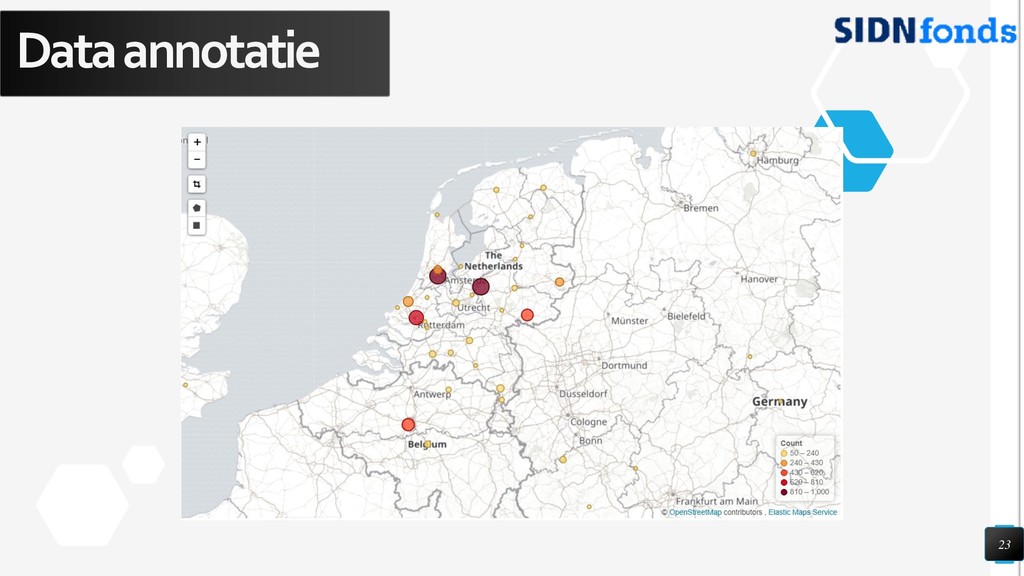
Forum voor Democratie "een aantal parlementariërs" zal leveren in de Europese verkiezingen. Een probleem daarbij is wel dat ChristenUnie duidelijk heeft laten weten dat het niet heel erg blij is dat het straks met Forum voor Democratie in één groep zit.” https://www.nu.nl/europese-verkiezingen-2019/5867613/frans-timmermans-ik-word-voorzitter-van-europese-commissie.html Stap 1: Named Entity Recognition → Herkent personen, organisaties en locaties in mensgeschreven tekst Data annotatie
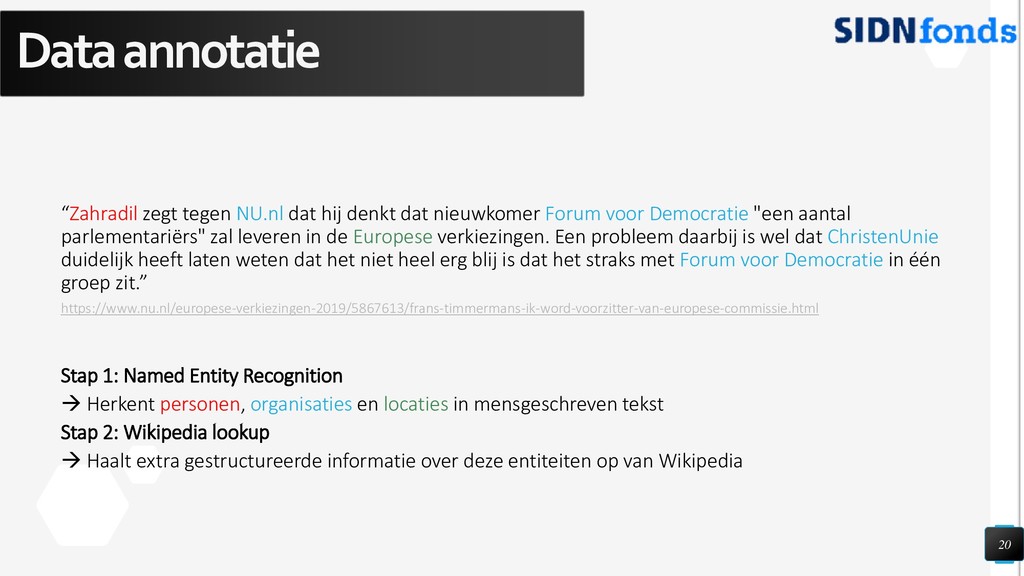
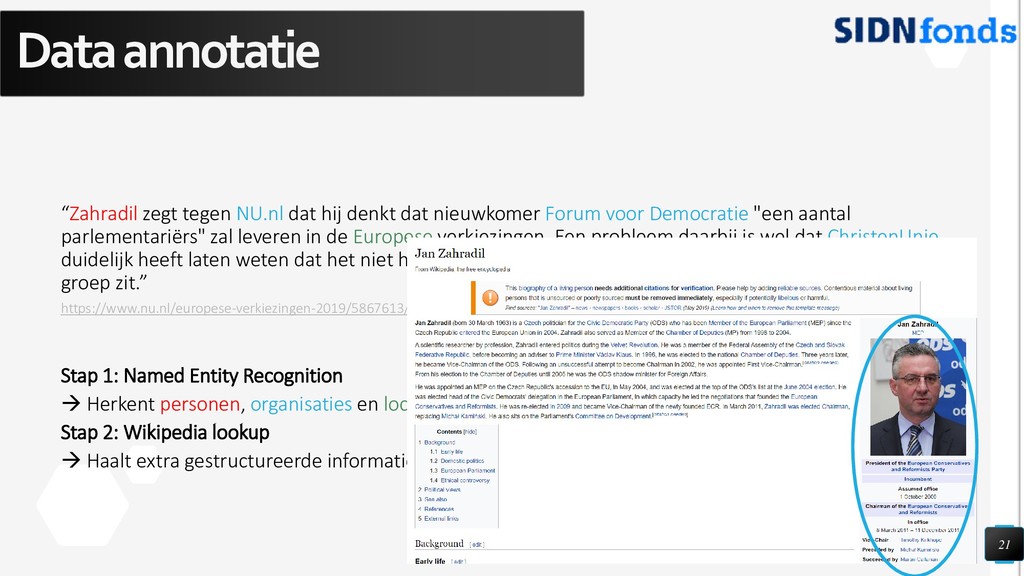
Forum voor Democratie "een aantal parlementariërs" zal leveren in de Europese verkiezingen. Een probleem daarbij is wel dat ChristenUnie duidelijk heeft laten weten dat het niet heel erg blij is dat het straks met Forum voor Democratie in één groep zit.” https://www.nu.nl/europese-verkiezingen-2019/5867613/frans-timmermans-ik-word-voorzitter-van-europese-commissie.html Stap 1: Named Entity Recognition → Herkent personen, organisaties en locaties in mensgeschreven tekst Stap 2: Wikipedia lookup → Haalt extra gestructureerde informatie over deze entiteiten op van Wikipedia Data annotatie
Forum voor Democratie "een aantal parlementariërs" zal leveren in de Europese verkiezingen. Een probleem daarbij is wel dat ChristenUnie duidelijk heeft laten weten dat het niet heel erg blij is dat het straks met Forum voor Democratie in één groep zit.” https://www.nu.nl/europese-verkiezingen-2019/5867613/frans-timmermans-ik-word-voorzitter-van-europese-commissie.html Stap 1: Named Entity Recognition → Herkent personen, organisaties en locaties in mensgeschreven tekst Stap 2: Wikipedia lookup → Haalt extra gestructureerde informatie over deze entiteiten op van Wikipedia Data annotatie
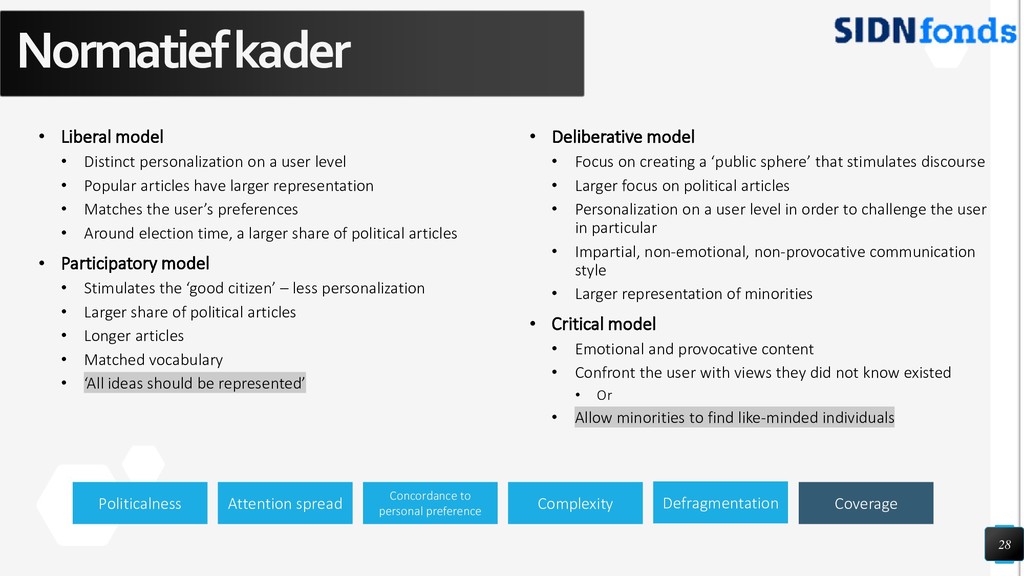
on creating a ‘public sphere’ that stimulates discourse • Larger focus on political articles • Personalization on a user level in order to challenge the user in particular • Impartial, non-emotional, non-provocative communication style • Larger representation of minorities • Critical model • Emotional and provocative content • Confront the user with views they did not know existed • Or • Allow minorities to find like-minded individuals • Liberal model • Distinct personalization on a user level • Popular articles have larger representation • Matches the user’s preferences • Around election time, a larger share of political articles • Participatory model • Stimulates the ‘good citizen’ – less personalization • Larger share of political articles • Longer articles • Matched vocabulary • ‘All ideas should be represented’ Normatiefkader Politicalness Attention spread Concordance to personal preference Complexity Defragmentation Coverage
on creating a ‘public sphere’ that stimulates discourse • Larger focus on political articles • Personalization on a user level in order to challenge the user in particular • Impartial, non-emotional, non-provocative communication style • Larger representation of minorities • Critical model • Emotional and provocative content • Confront the user with views they did not know existed • Or • Allow minorities to find like-minded individuals • Liberal model • Distinct personalization on a user level • Popular articles have larger representation • Matches the user’s preferences • Around election time, a larger share of political articles • Participatory model • Stimulates the ‘good citizen’ – less personalization • Larger share of political articles • Longer articles • Matched vocabulary • ‘All ideas should be represented’ Normatiefkader Politicalness Attention spread Concordance to personal preference Complexity Defragmentation Coverage
on creating a ‘public sphere’ that stimulates discourse • Larger focus on political articles • Personalization on a user level in order to challenge the user in particular • Impartial, non-emotional, non-provocative communication style • Larger representation of minorities • Critical model • Emotional and provocative content • Confront the user with views they did not know existed • Or • Allow minorities to find like-minded individuals • Liberal model • Distinct personalization on a user level • Popular articles have larger representation • Matches the user’s preferences • Around election time, a larger share of political articles • Participatory model • Stimulates the ‘good citizen’ – less personalization • Larger share of political articles • Longer articles • Matched vocabulary • ‘All ideas should be represented’ Normatiefkader Politicalness Attention spread Concordance to personal preference Complexity Defragmentation Coverage
on creating a ‘public sphere’ that stimulates discourse • Larger focus on political articles • Personalization on a user level in order to challenge the user in particular • Impartial, non-emotional, non-provocative communication style • Larger representation of minorities • Critical model • Emotional and provocative content • Confront the user with views they did not know existed • Or • Allow minorities to find like-minded individuals • Liberal model • Distinct personalization on a user level • Popular articles have larger representation • Matches the user’s preferences • Around election time, a larger share of political articles • Participatory model • Stimulates the ‘good citizen’ – less personalization • Larger share of political articles • Longer articles • Matched vocabulary • ‘All ideas should be represented’ Normatiefkader Politicalness Attention spread Concordance to personal preference Complexity Defragmentation Coverage
on creating a ‘public sphere’ that stimulates discourse • Larger focus on political articles • Personalization on a user level in order to challenge the user in particular • Impartial, non-emotional, non-provocative communication style • Larger representation of minorities • Critical model • Emotional and provocative content • Confront the user with views they did not know existed • Or • Allow minorities to find like-minded individuals • Liberal model • Distinct personalization on a user level • Popular articles have larger representation • Matches the user’s preferences • Around election time, a larger share of political articles • Participatory model • Stimulates the ‘good citizen’ – less personalization • Larger share of political articles • Longer articles • Matched vocabulary • ‘All ideas should be represented’ Volgendestappen Politicalness Attention spread Concordance to personal preference Complexity Defragmentation Coverage
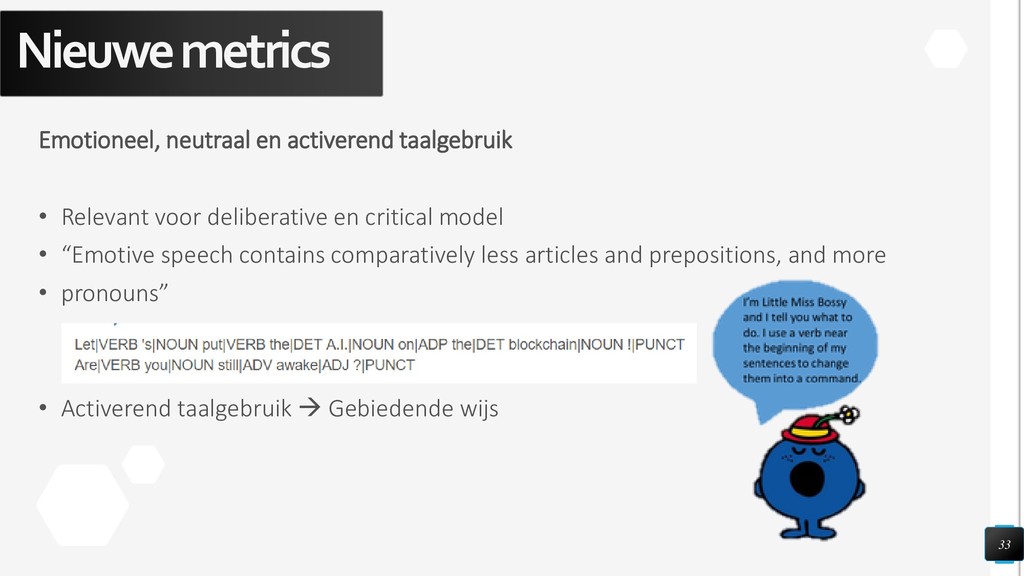
en critical model • “Emotive speech contains comparatively less articles and prepositions, and more • pronouns” • Activerend taalgebruik → Gebiedende wijs Nieuwemetrics
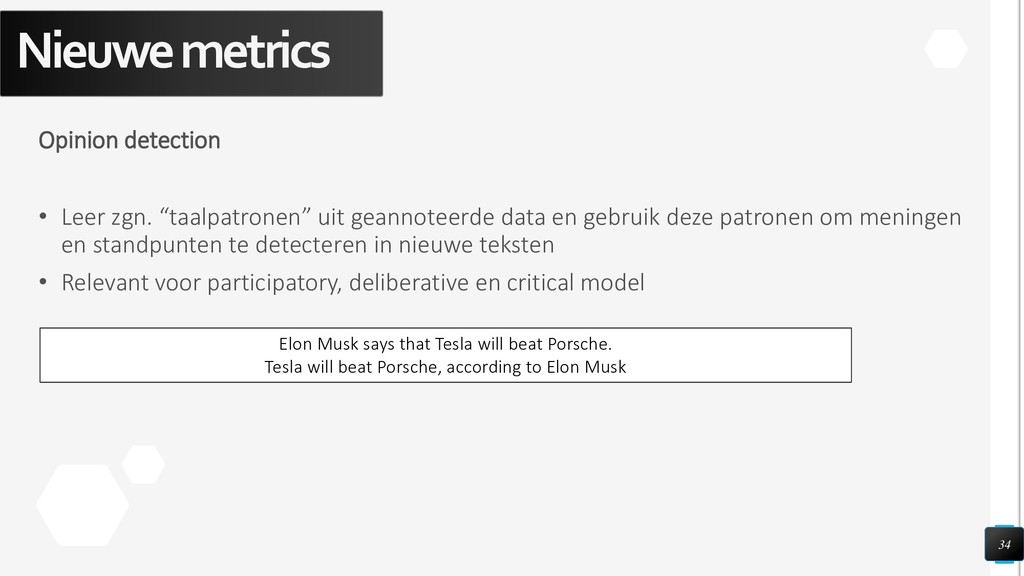
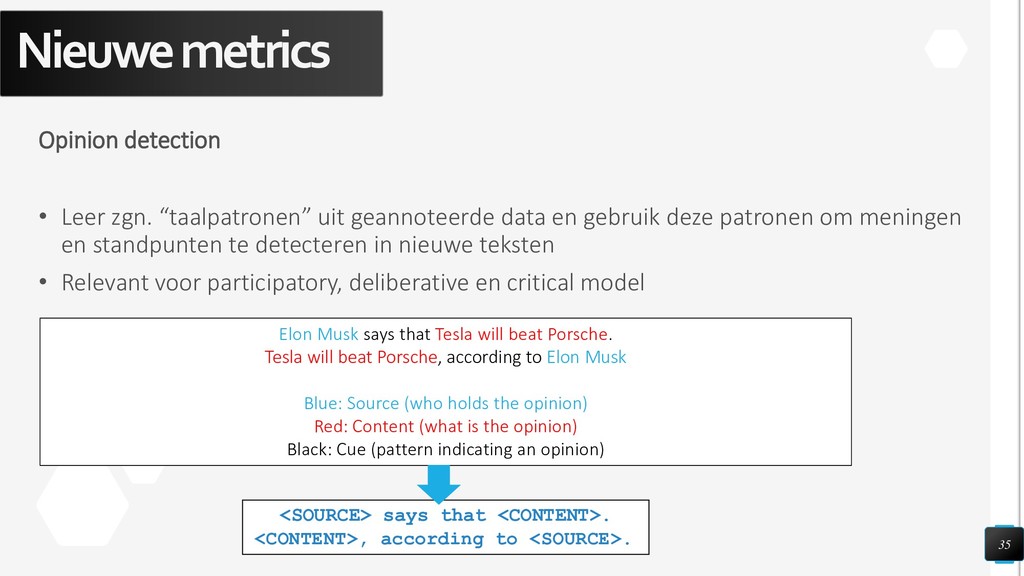
en gebruik deze patronen om meningen en standpunten te detecteren in nieuwe teksten • Relevant voor participatory, deliberative en critical model Elon Musk says that Tesla will beat Porsche. Tesla will beat Porsche, according to Elon Musk Nieuwemetrics
en gebruik deze patronen om meningen en standpunten te detecteren in nieuwe teksten • Relevant voor participatory, deliberative en critical model <SOURCE> says that <CONTENT>. <CONTENT>, according to <SOURCE>. Elon Musk says that Tesla will beat Porsche. Tesla will beat Porsche, according to Elon Musk Blue: Source (who holds the opinion) Red: Content (what is the opinion) Black: Cue (pattern indicating an opinion) Nieuwemetrics
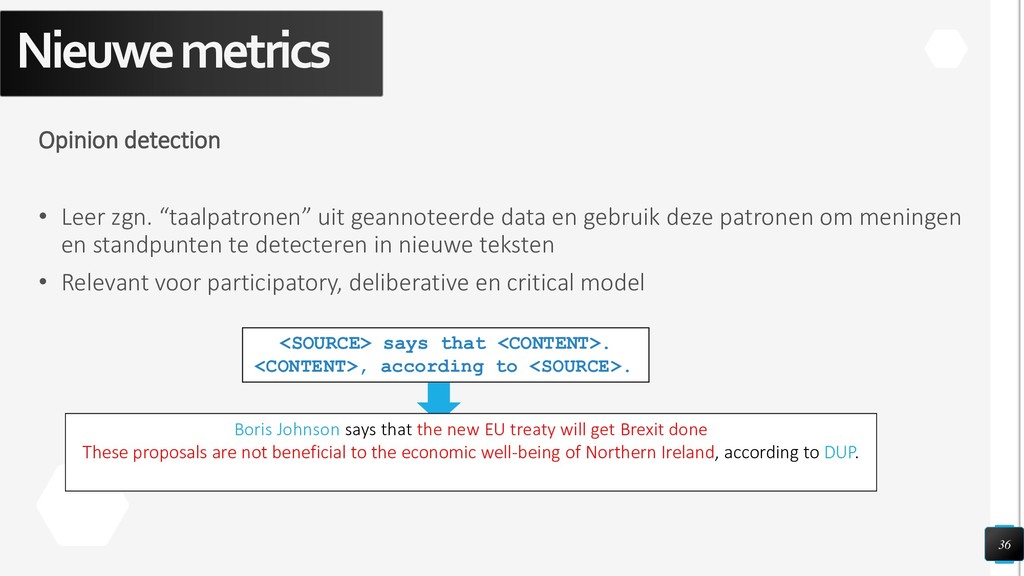
en gebruik deze patronen om meningen en standpunten te detecteren in nieuwe teksten • Relevant voor participatory, deliberative en critical model <SOURCE> says that <CONTENT>. <CONTENT>, according to <SOURCE>. Boris Johnson says that the new EU treaty will get Brexit done These proposals are not beneficial to the economic well-being of Northern Ireland, according to DUP. Nieuwemetrics
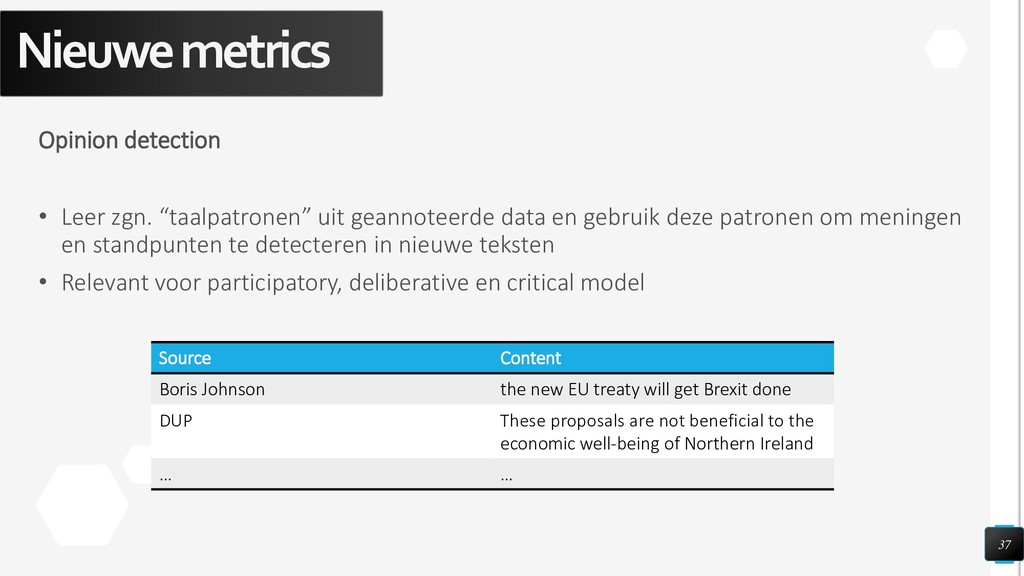
en gebruik deze patronen om meningen en standpunten te detecteren in nieuwe teksten • Relevant voor participatory, deliberative en critical model Source Content Boris Johnson the new EU treaty will get Brexit done DUP These proposals are not beneficial to the economic well-being of Northern Ireland … … Nieuwemetrics
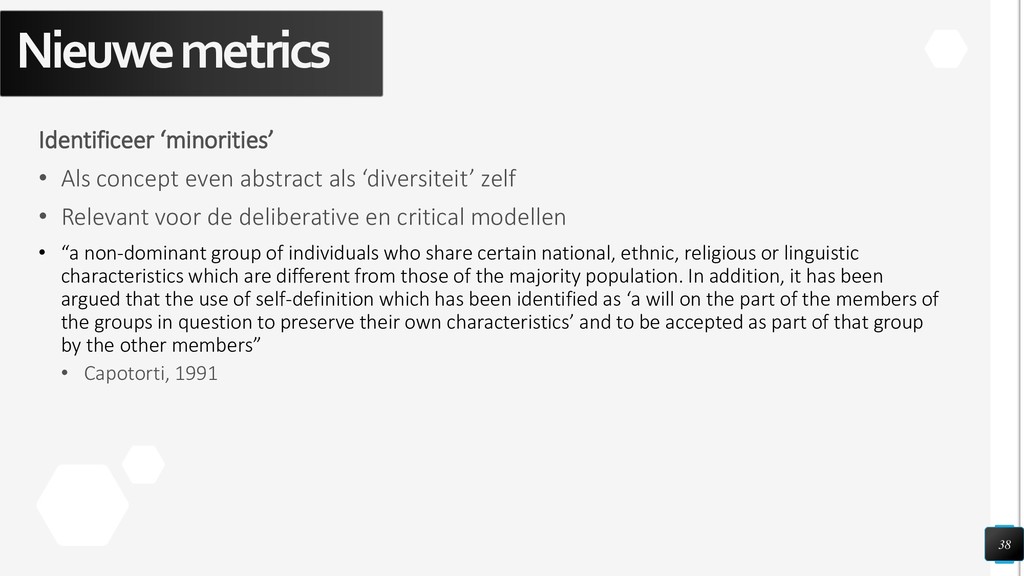
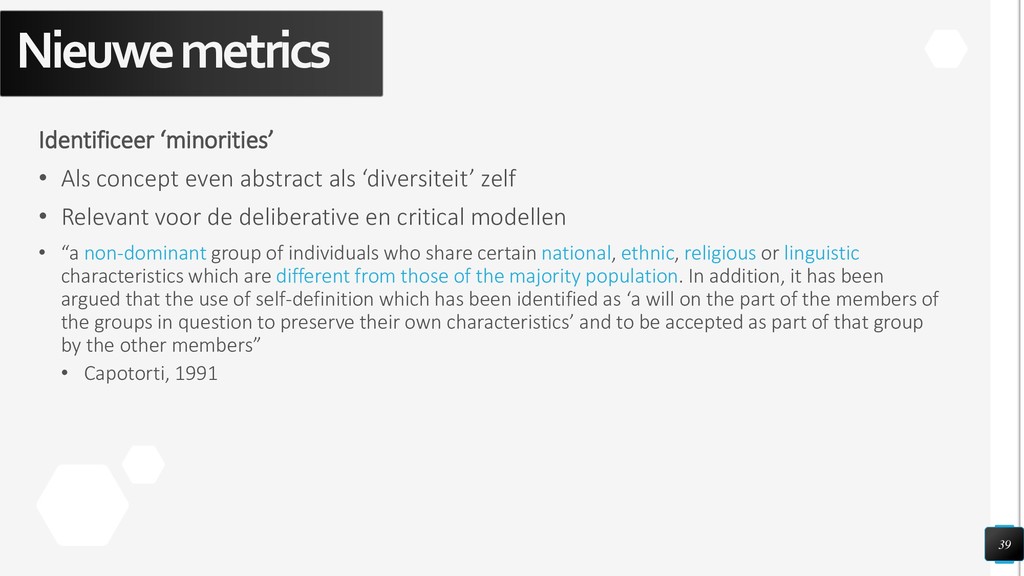
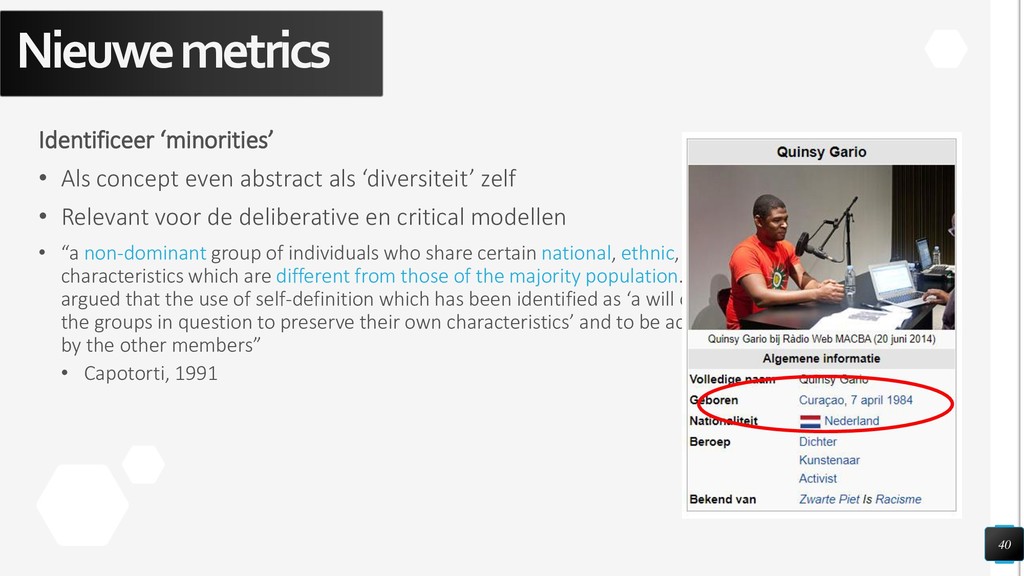
zelf • Relevant voor de deliberative en critical modellen • “a non-dominant group of individuals who share certain national, ethnic, religious or linguistic characteristics which are different from those of the majority population. In addition, it has been argued that the use of self-definition which has been identified as ‘a will on the part of the members of the groups in question to preserve their own characteristics’ and to be accepted as part of that group by the other members” • Capotorti, 1991 Nieuwemetrics
zelf • Relevant voor de deliberative en critical modellen • “a non-dominant group of individuals who share certain national, ethnic, religious or linguistic characteristics which are different from those of the majority population. In addition, it has been argued that the use of self-definition which has been identified as ‘a will on the part of the members of the groups in question to preserve their own characteristics’ and to be accepted as part of that group by the other members” • Capotorti, 1991 Nieuwemetrics
zelf • Relevant voor de deliberative en critical modellen • “a non-dominant group of individuals who share certain national, ethnic, religious or linguistic characteristics which are different from those of the majority population. In addition, it has been argued that the use of self-definition which has been identified as ‘a will on the part of the members of the groups in question to preserve their own characteristics’ and to be accepted as part of that group by the other members” • Capotorti, 1991 Nieuwemetrics
zowel een risico als een kans voor democratische warden • Hoewel er nog heel veel ruimte is voor verbetering zijn de eerste resultaten veelbelovend • In de toekomst willen we werken aan de uitwerkingen van drie nieuwe ‘metrics’, en deze in de praktijk testen met partners uit de industrie


 trycycle
 institutdelelevage
 naospon
 arfon
 peterdesmet
 ykiyota
 brainpadpr
 tsoh
 addyosmani
 bkeepers
 marktimemedia
 yeseniaperezcruz
 mfonobong
 destraynor
 wayneb77
 baasie
 zakiyama
 eitanlees
 holman
 iamctodd