has covered a wide range of projects include comprehensive planning system improvements at both refinery and petrochemical planning and corporate planning levels. They include projects for both single site and multi-site companies, and include the following: • Planning process redesign and implementation • Multi-refinery LP development and data generation • LP data maintenance tools and practices • LP sub-model data generation using process simulators KBC Executive Symposium Japan 2018 April 19, 2018
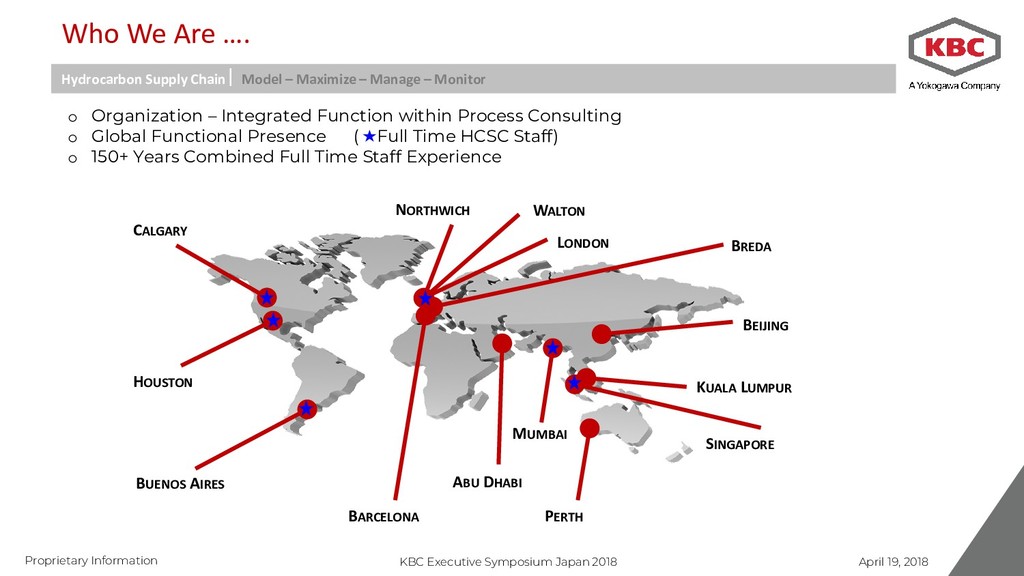
– Monitor Who We Are …. KBC Executive Symposium Japan 2018 April 19, 2018 o Organization – Integrated Function within Process Consulting o Global Functional Presence ( Full Time HCSC Staff) o 150+ Years Combined Full Time Staff Experience CALGARY HOUSTON NORTHWICH BARCELONA LONDON PERTH SINGAPORE KUALA LUMPUR BEIJING MUMBAI WALTON BREDA BUENOS AIRES ABU DHABI
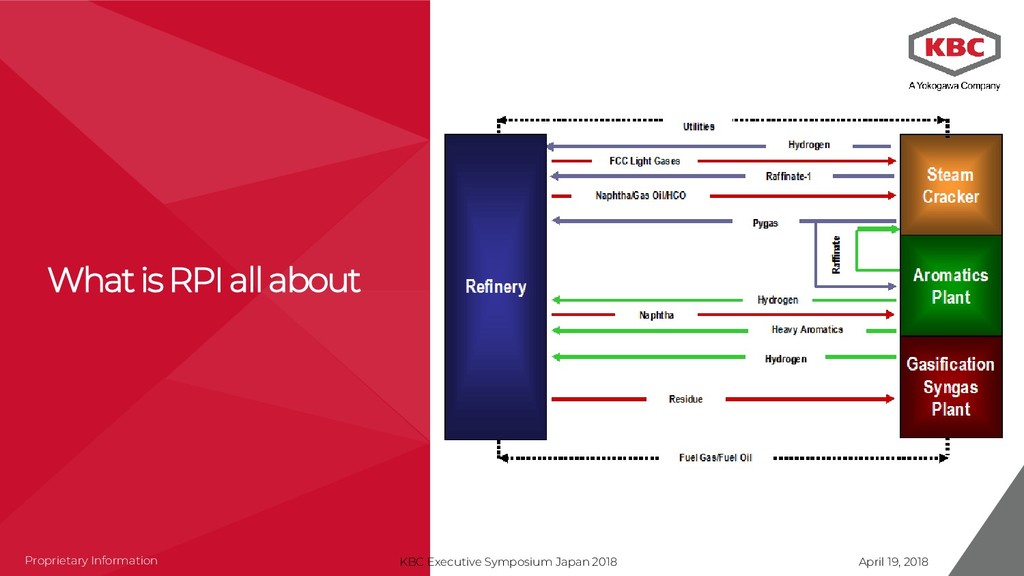
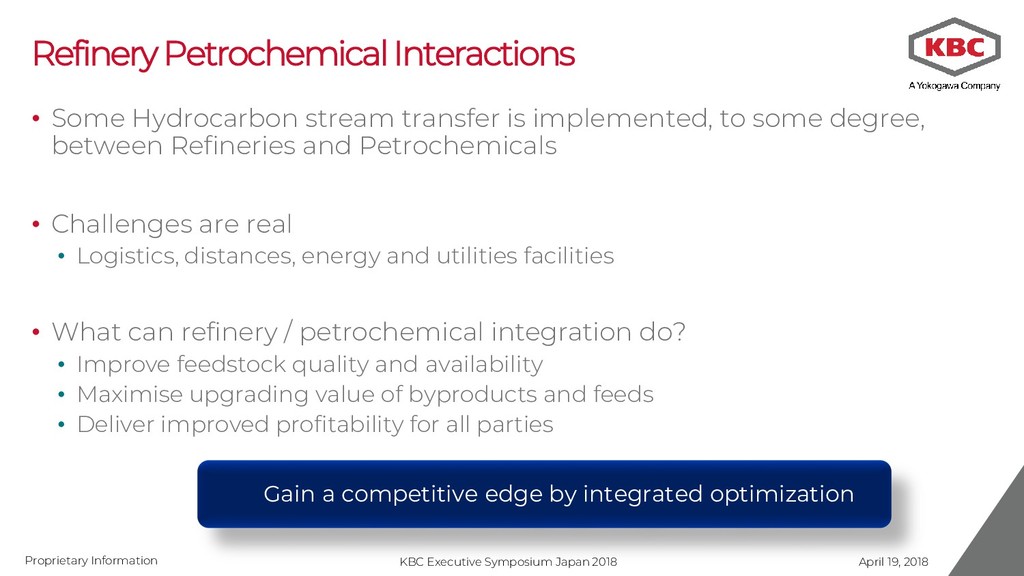
is implemented, to some degree, between Refineries and Petrochemicals • Challenges are real • Logistics, distances, energy and utilities facilities • What can refinery / petrochemical integration do? • Improve feedstock quality and availability • Maximise upgrading value of byproducts and feeds • Deliver improved profitability for all parties KBC Executive Symposium Japan 2018 April 19, 2018
is implemented, to some degree, between Refineries and Petrochemicals • Challenges are real • Logistics, distances, energy and utilities facilities • What can refinery / petrochemical integration do? • Improve feedstock quality and availability • Maximise upgrading value of byproducts and feeds • Deliver improved profitability for all parties KBC Executive Symposium Japan 2018 April 19, 2018 Gain a competitive edge by integrated optimization
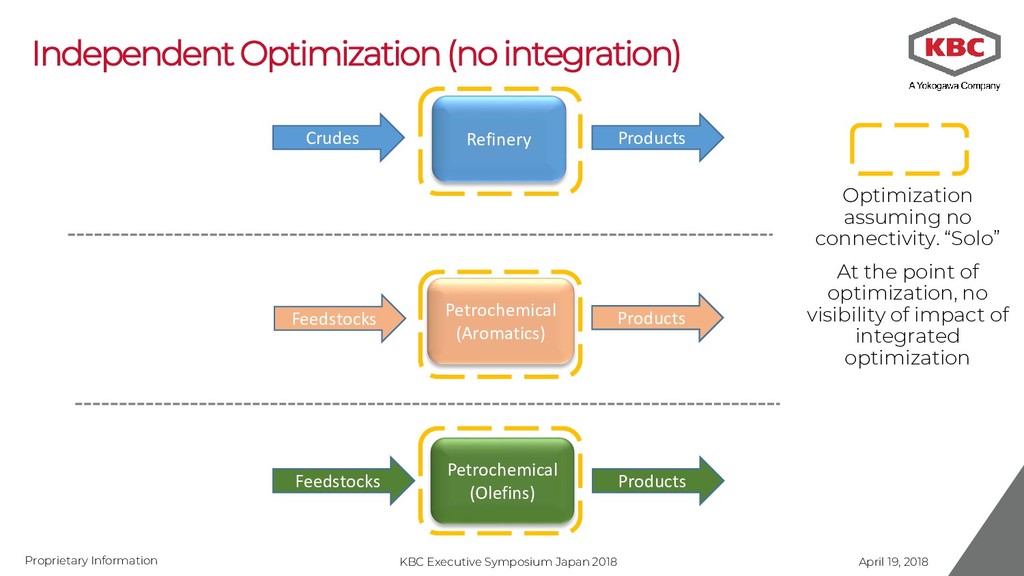
(Olefins) Independent Optimization Boundary Crudes Products Feedstocks Products Optimization assuming no connectivity. “Solo” At the point of optimization, no visibility of impact of integrated optimization Feedstocks Products KBC Executive Symposium Japan 2018 April 19, 2018
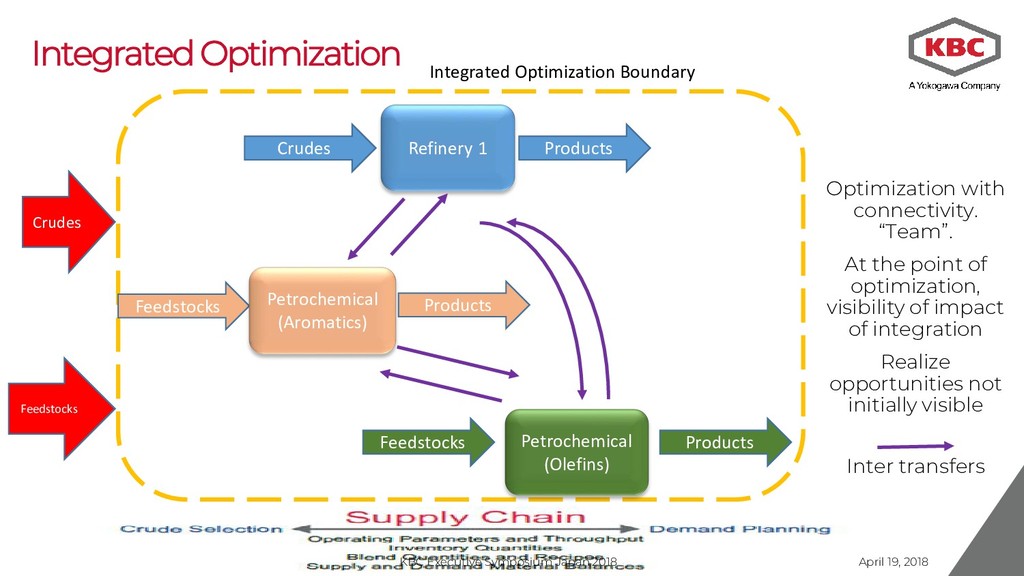
Optimization with connectivity. “Team”. At the point of optimization, visibility of impact of integration Realize opportunities not initially visible Inter transfers Feedstocks Products Crudes Feedstocks Petrochemical (Aromatics) Petrochemical (Olefins) Integrated Optimization Boundary KBC Executive Symposium Japan 2018 April 19, 2018
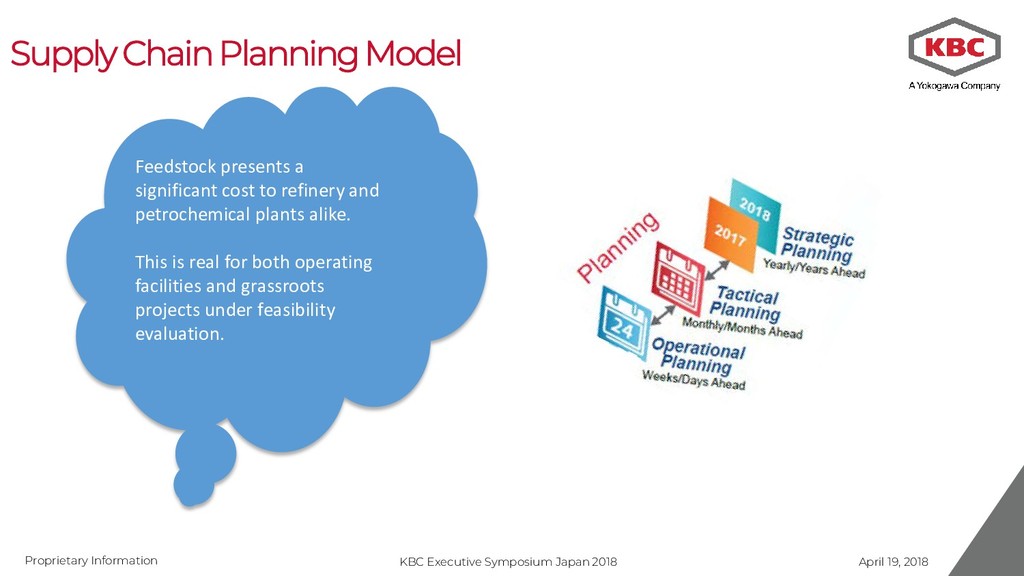
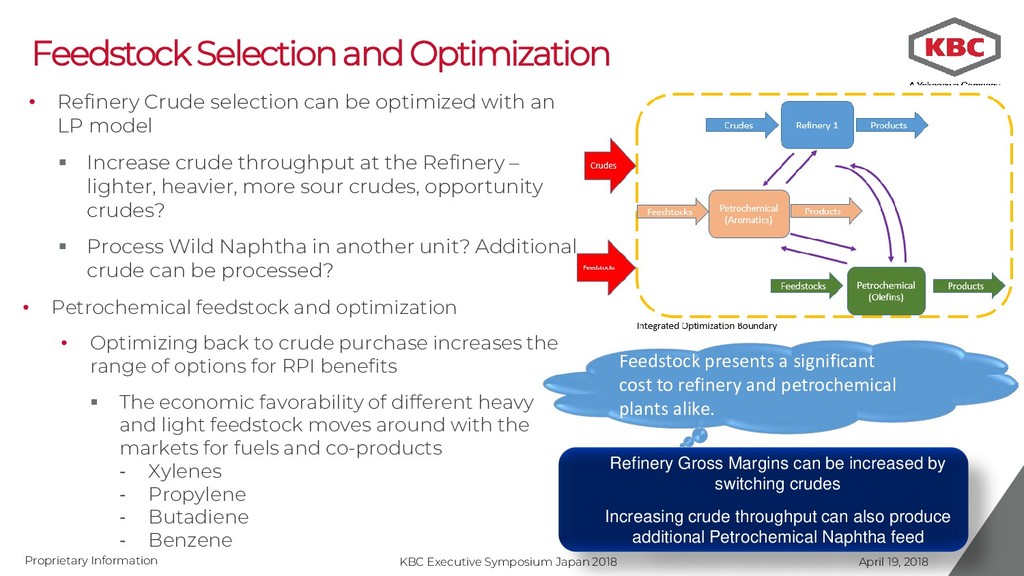
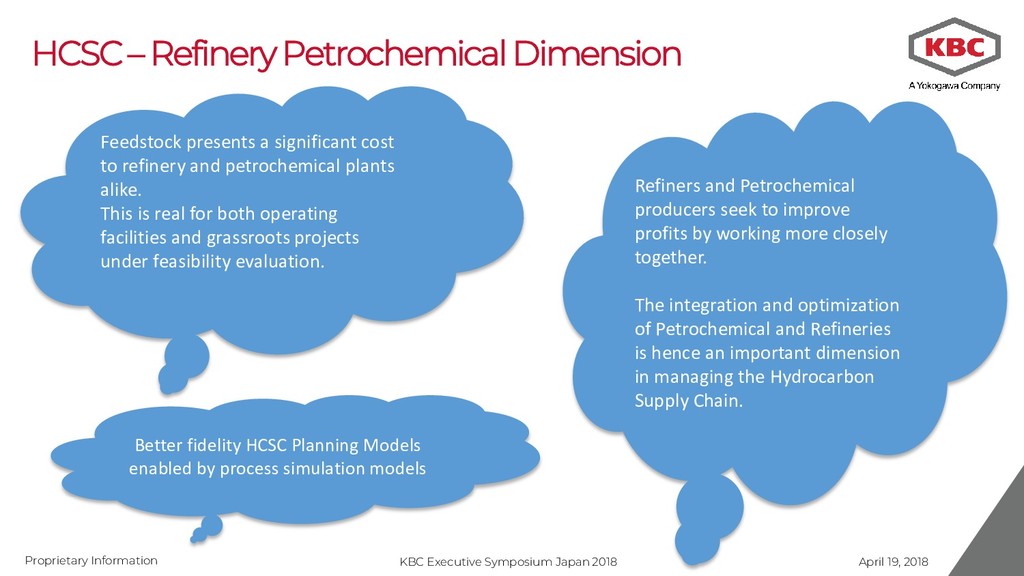
cost to refinery and petrochemical plants alike. This is real for both operating facilities and grassroots projects under feasibility evaluation. KBC Executive Symposium Japan 2018 April 19, 2018
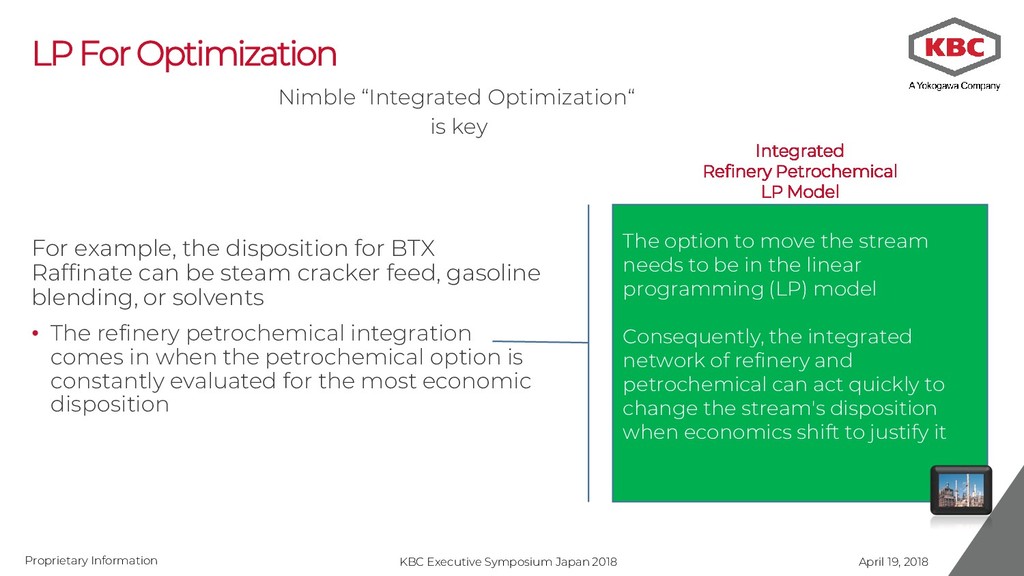
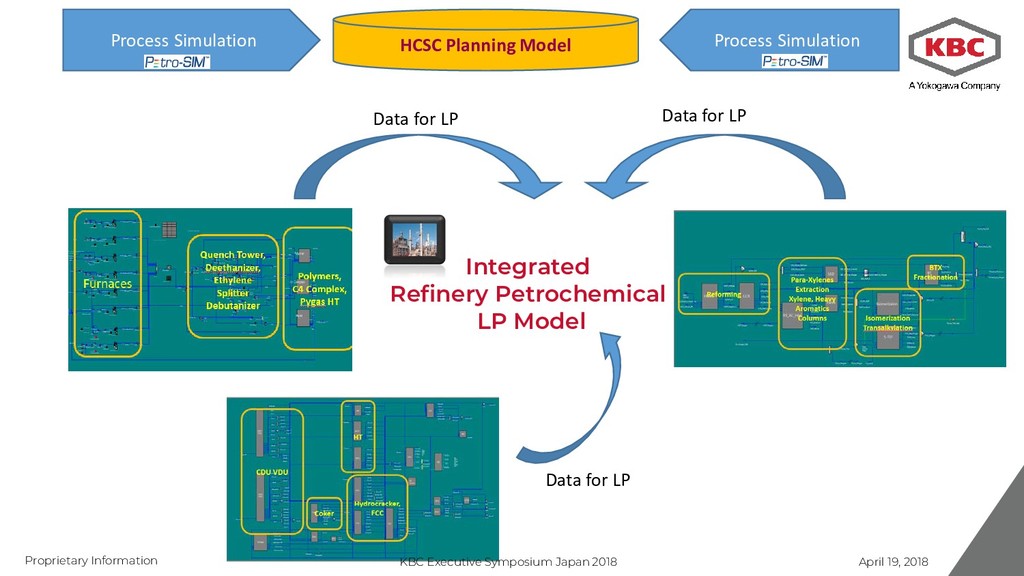
For example, the disposition for BTX Raffinate can be steam cracker feed, gasoline blending, or solvents • The refinery petrochemical integration comes in when the petrochemical option is constantly evaluated for the most economic disposition The option to move the stream needs to be in the linear programming (LP) model Consequently, the integrated network of refinery and petrochemical can act quickly to change the stream's disposition when economics shift to justify it Integrated Refinery Petrochemical LP Model KBC Executive Symposium Japan 2018 April 19, 2018
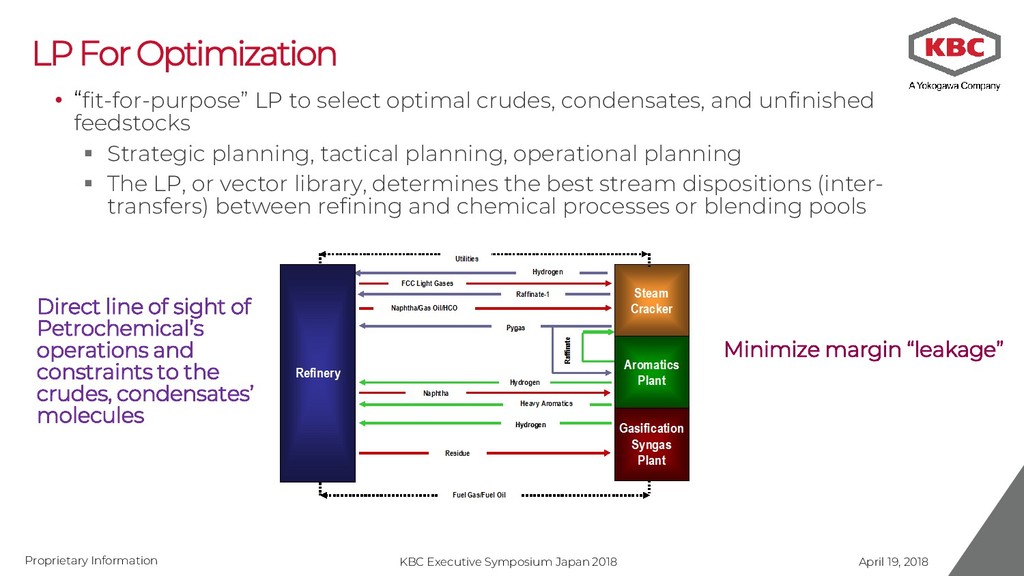
and unfinished feedstocks Strategic planning, tactical planning, operational planning The LP, or vector library, determines the best stream dispositions (inter- transfers) between refining and chemical processes or blending pools LP For Optimization Minimize margin “leakage” Direct line of sight of Petrochemical’s operations and constraints to the crudes, condensates’ molecules KBC Executive Symposium Japan 2018 April 19, 2018
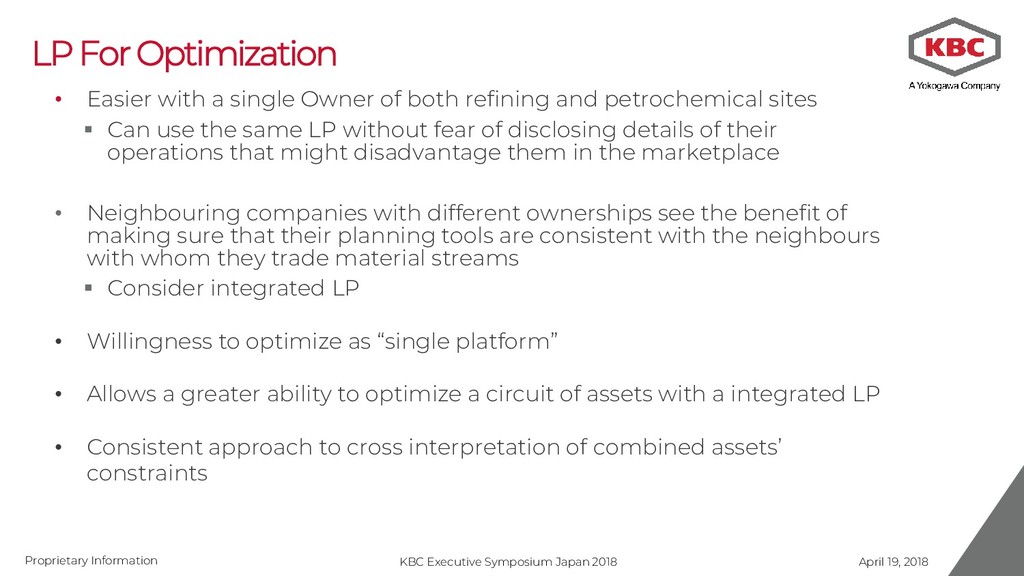
refining and petrochemical sites Can use the same LP without fear of disclosing details of their operations that might disadvantage them in the marketplace • Neighbouring companies with different ownerships see the benefit of making sure that their planning tools are consistent with the neighbours with whom they trade material streams Consider integrated LP • Willingness to optimize as “single platform” • Allows a greater ability to optimize a circuit of assets with a integrated LP • Consistent approach to cross interpretation of combined assets’ constraints LP For Optimization KBC Executive Symposium Japan 2018 April 19, 2018
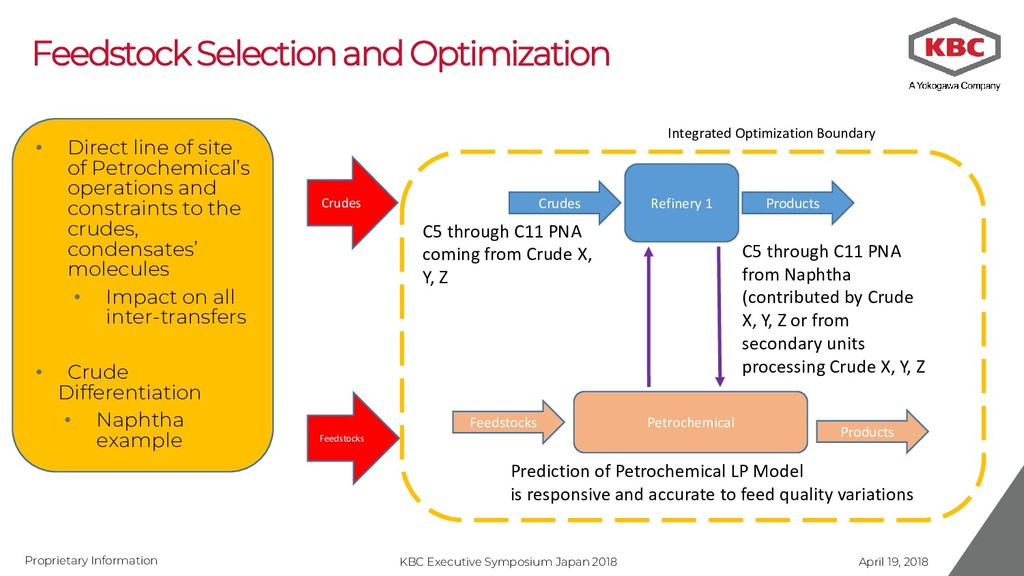
Petrochemical Integrated Optimization Boundary • Direct line of site of Petrochemical’s operations and constraints to the crudes, condensates’ molecules • Impact on all inter-transfers • Crude Differentiation • Naphtha example C5 through C11 PNA coming from Crude X, Y, Z C5 through C11 PNA from Naphtha (contributed by Crude X, Y, Z or from secondary units processing Crude X, Y, Z Prediction of Petrochemical LP Model is responsive and accurate to feed quality variations KBC Executive Symposium Japan 2018 April 19, 2018 Feedstock Selection and Optimization
can be optimized with an LP model Increase crude throughput at the Refinery – lighter, heavier, more sour crudes, opportunity crudes? Process Wild Naphtha in another unit? Additional crude can be processed? Refinery Gross Margins can be increased by switching crudes Increasing crude throughput can also produce additional Petrochemical Naphtha feed • Petrochemical feedstock and optimization • Optimizing back to crude purchase increases the range of options for RPI benefits The economic favorability of different heavy and light feedstock moves around with the markets for fuels and co-products - Xylenes - Propylene - Butadiene - Benzene Feedstock presents a significant cost to refinery and petrochemical plants alike. KBC Executive Symposium Japan 2018 April 19, 2018
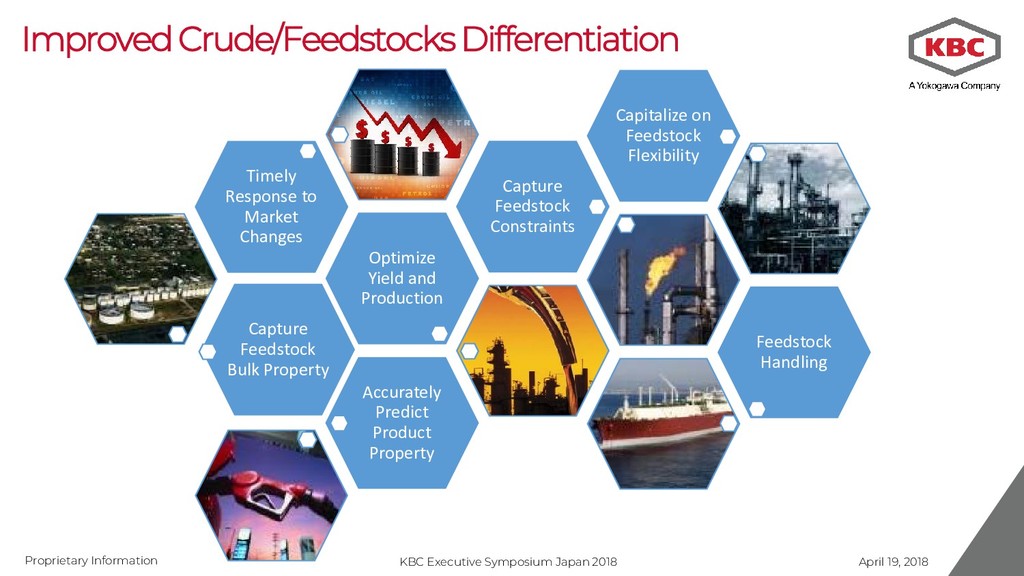
Yield and Production Timely Response to Market Changes Capture Feedstock Constraints Capitalize on Feedstock Flexibility Feedstock Handling Accurately Predict Product Property KBC Executive Symposium Japan 2018 April 19, 2018
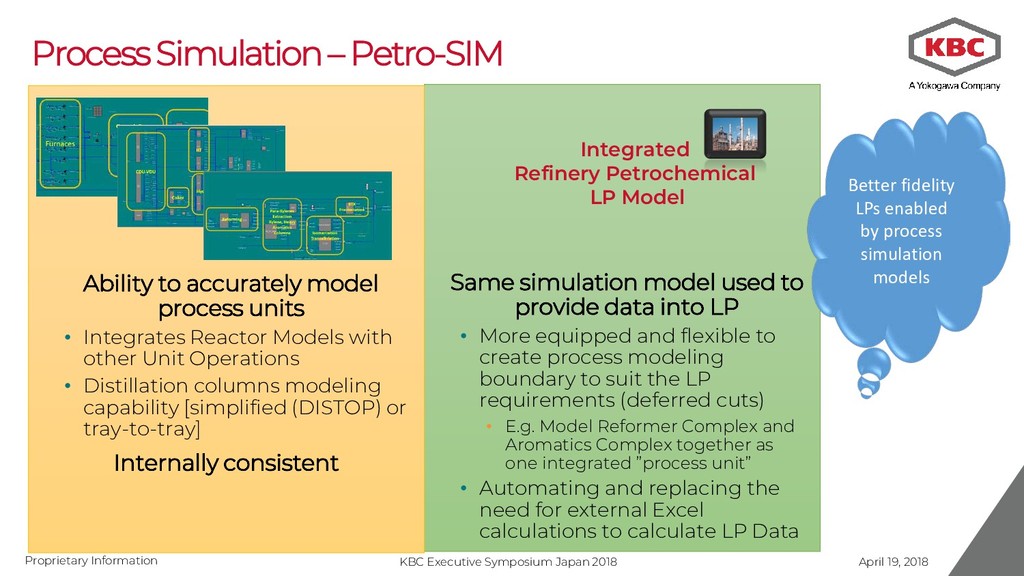
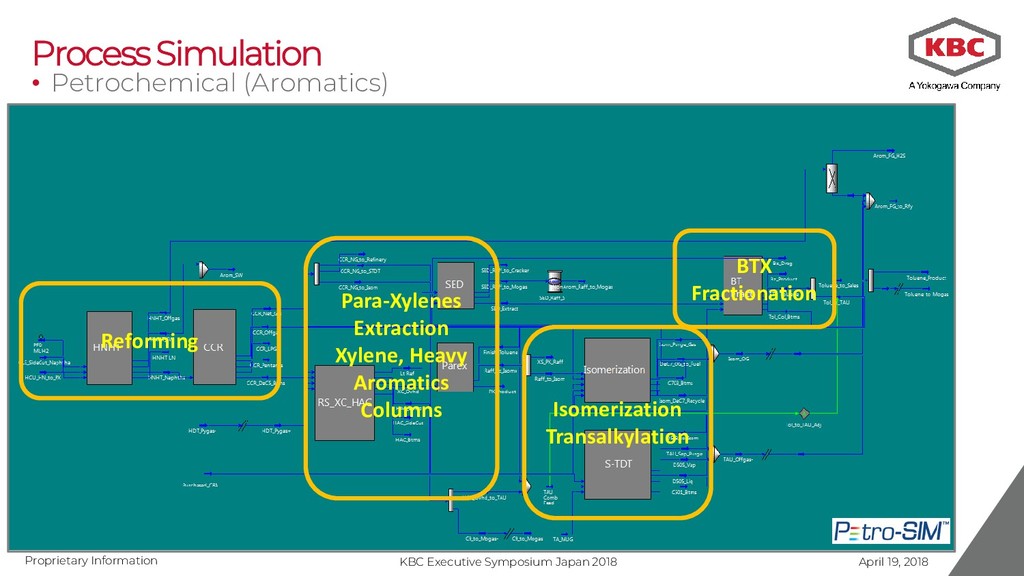
provide data into LP • More equipped and flexible to create process modeling boundary to suit the LP requirements (deferred cuts) • E.g. Model Reformer Complex and Aromatics Complex together as one integrated ”process unit” • Automating and replacing the need for external Excel calculations to calculate LP Data Ability to accurately model process units • Integrates Reactor Models with other Unit Operations • Distillation columns modeling capability [simplified (DISTOP) or tray-to-tray] Internally consistent Integrated Refinery Petrochemical LP Model Better fidelity LPs enabled by process simulation models KBC Executive Symposium Japan 2018 April 19, 2018
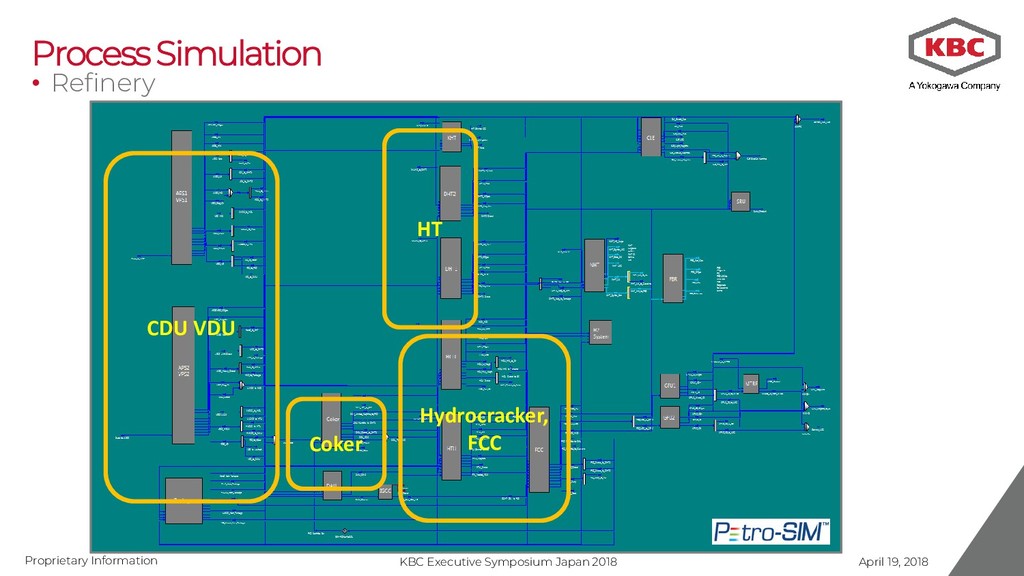
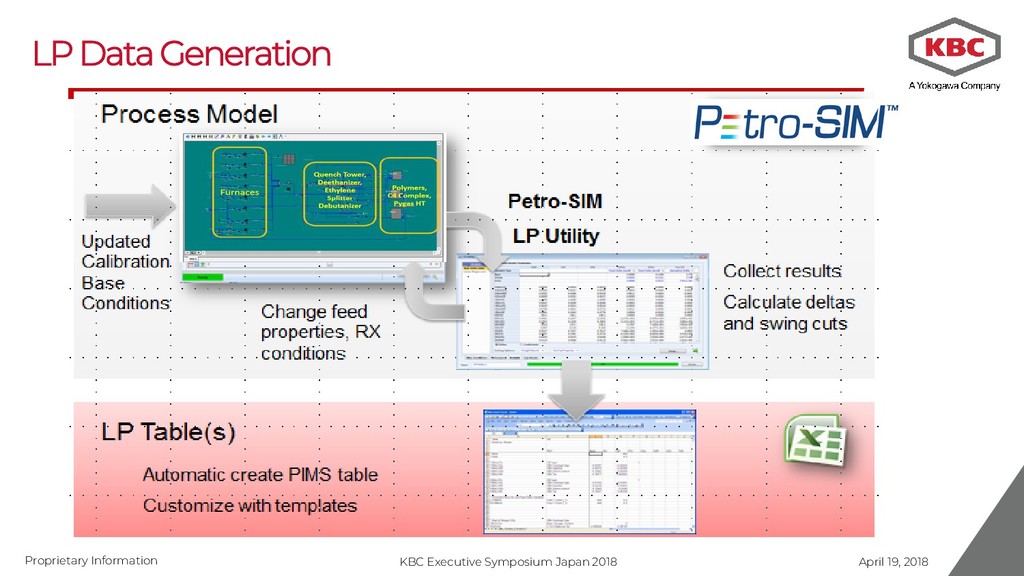
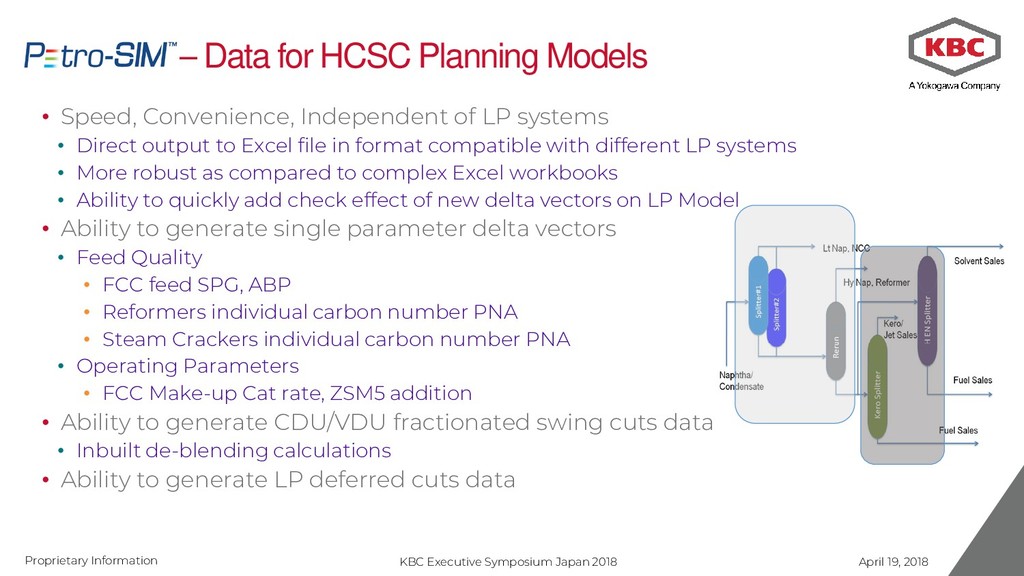
Direct output to Excel file in format compatible with different LP systems • More robust as compared to complex Excel workbooks • Ability to quickly add check effect of new delta vectors on LP Model • Ability to generate single parameter delta vectors • Feed Quality • FCC feed SPG, ABP • Reformers individual carbon number PNA • Steam Crackers individual carbon number PNA • Operating Parameters • FCC Make-up Cat rate, ZSM5 addition • Ability to generate CDU/VDU fractionated swing cuts data • Inbuilt de-blending calculations • Ability to generate LP deferred cuts data Petro-SIM – Data for HCSC Planning Models KBC Executive Symposium Japan 2018 April 19, 2018
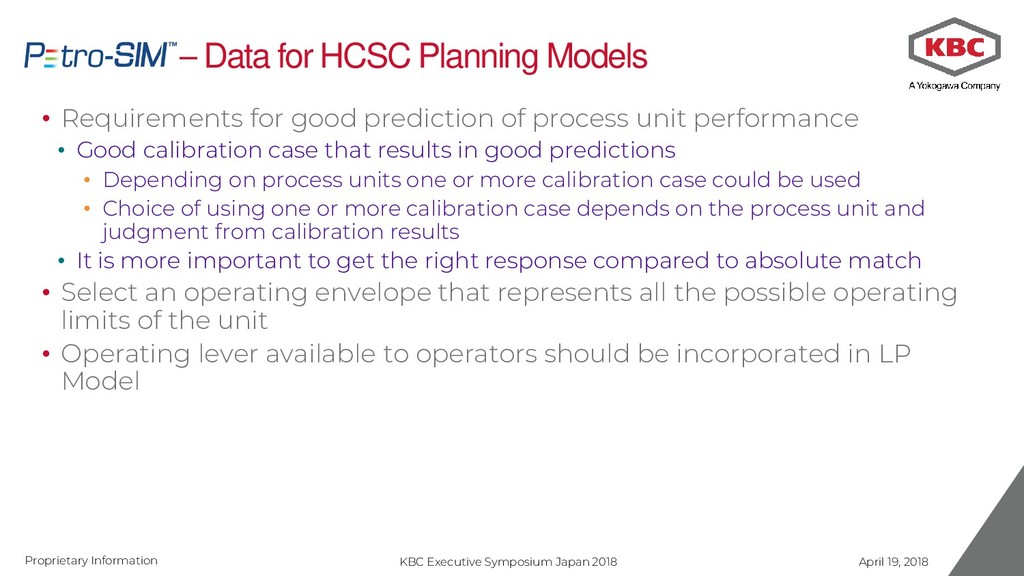
Requirements for good prediction of process unit performance • Good calibration case that results in good predictions • Depending on process units one or more calibration case could be used • Choice of using one or more calibration case depends on the process unit and judgment from calibration results • It is more important to get the right response compared to absolute match • Select an operating envelope that represents all the possible operating limits of the unit • Operating lever available to operators should be incorporated in LP Model KBC Executive Symposium Japan 2018 April 19, 2018
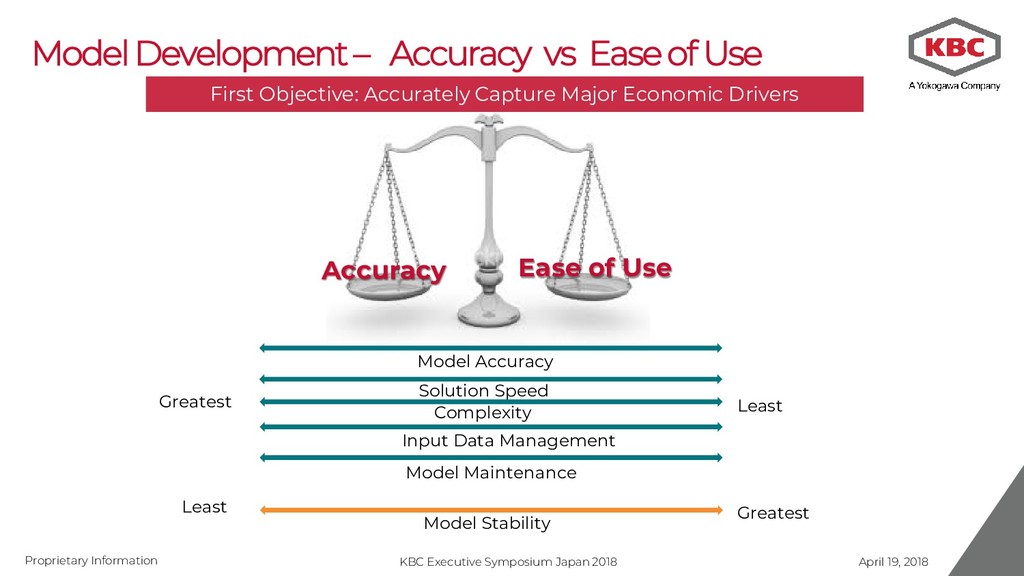
Model Development – Accuracy vs Ease of Use Accuracy Ease of Use Greatest Least Solution Speed Complexity Input Data Management Model Maintenance Model Stability Greatest Least Model Accuracy First Objective: Accurately Capture Major Economic Drivers
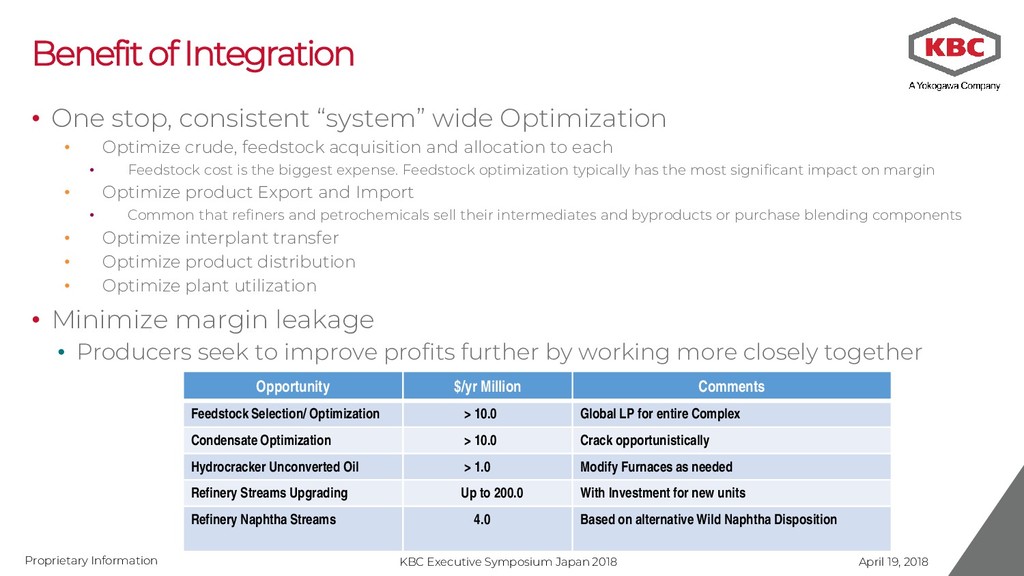
wide Optimization • Optimize crude, feedstock acquisition and allocation to each • Feedstock cost is the biggest expense. Feedstock optimization typically has the most significant impact on margin • Optimize product Export and Import • Common that refiners and petrochemicals sell their intermediates and byproducts or purchase blending components • Optimize interplant transfer • Optimize product distribution • Optimize plant utilization • Minimize margin leakage • Producers seek to improve profits further by working more closely together Opportunity $/yr Million Comments Feedstock Selection/ Optimization > 10.0 Global LP for entire Complex Condensate Optimization > 10.0 Crack opportunistically Hydrocracker Unconverted Oil > 1.0 Modify Furnaces as needed Refinery Streams Upgrading Up to 200.0 With Investment for new units Refinery Naphtha Streams 4.0 Based on alternative Wild Naphtha Disposition KBC Executive Symposium Japan 2018 April 19, 2018
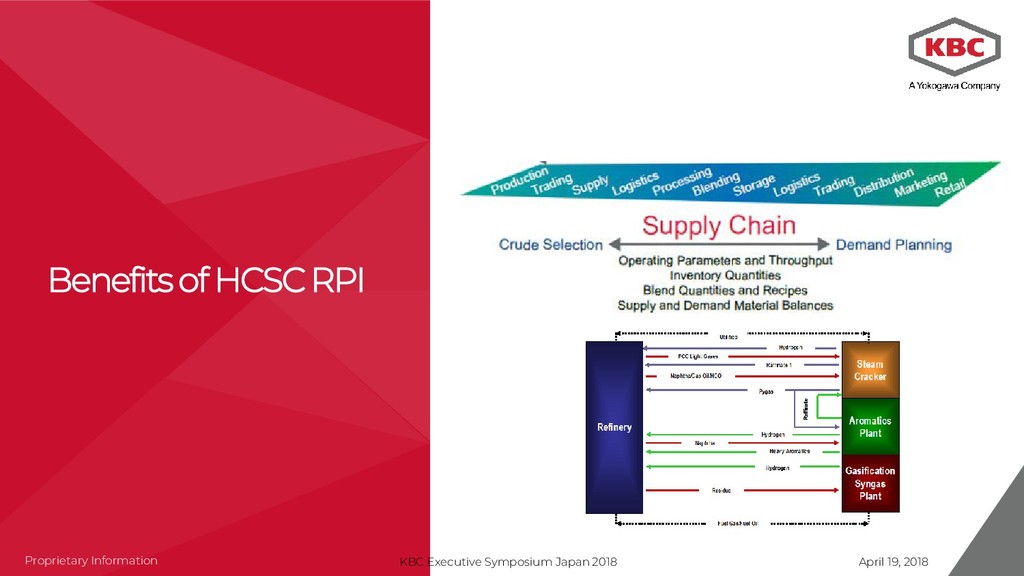
significant cost to refinery and petrochemical plants alike. This is real for both operating facilities and grassroots projects under feasibility evaluation. Refiners and Petrochemical producers seek to improve profits by working more closely together. The integration and optimization of Petrochemical and Refineries is hence an important dimension in managing the Hydrocarbon Supply Chain. Better fidelity HCSC Planning Models enabled by process simulation models KBC Executive Symposium Japan 2018 April 19, 2018
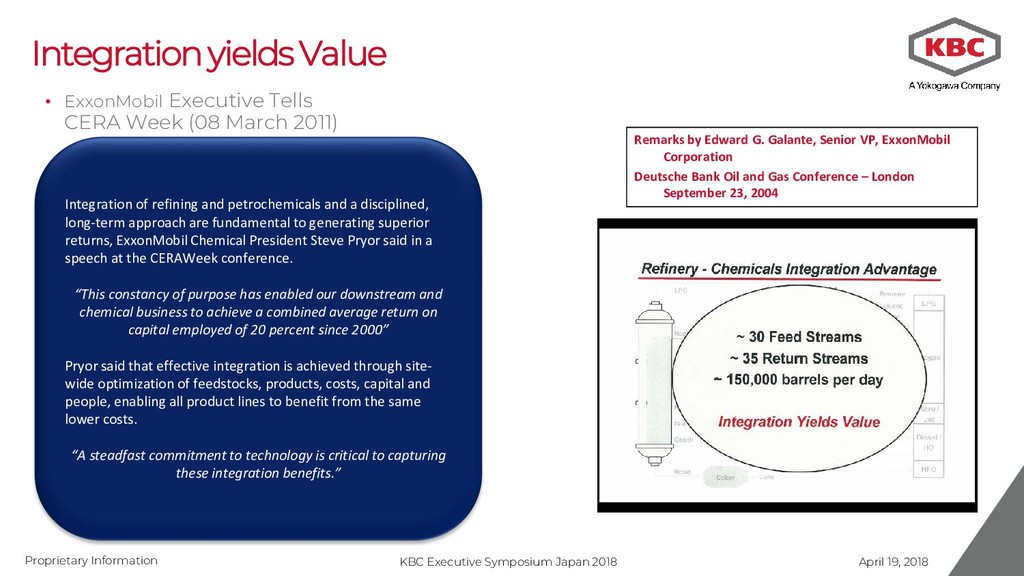
Week (08 March 2011) Integration of refining and petrochemicals and a disciplined, long-term approach are fundamental to generating superior returns, ExxonMobil Chemical President Steve Pryor said in a speech at the CERAWeek conference. “This constancy of purpose has enabled our downstream and chemical business to achieve a combined average return on capital employed of 20 percent since 2000” Pryor said that effective integration is achieved through site- wide optimization of feedstocks, products, costs, capital and people, enabling all product lines to benefit from the same lower costs. “A steadfast commitment to technology is critical to capturing these integration benefits.” Remarks by Edward G. Galante, Senior VP, ExxonMobil Corporation Deutsche Bank Oil and Gas Conference – London September 23, 2004 KBC Executive Symposium Japan 2018 April 19, 2018
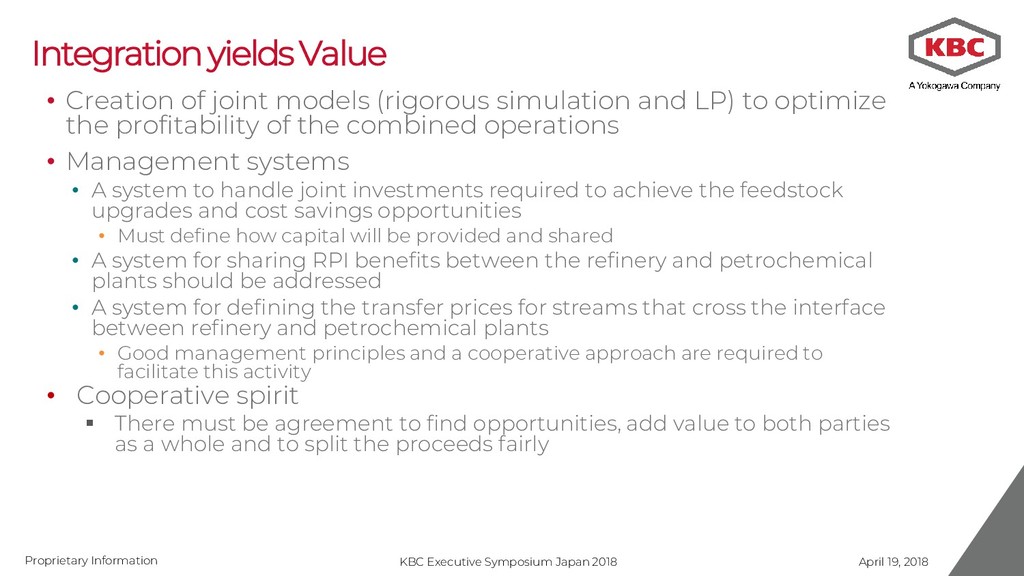
(rigorous simulation and LP) to optimize the profitability of the combined operations • Management systems • A system to handle joint investments required to achieve the feedstock upgrades and cost savings opportunities • Must define how capital will be provided and shared • A system for sharing RPI benefits between the refinery and petrochemical plants should be addressed • A system for defining the transfer prices for streams that cross the interface between refinery and petrochemical plants • Good management principles and a cooperative approach are required to facilitate this activity • Cooperative spirit There must be agreement to find opportunities, add value to both parties as a whole and to split the proceeds fairly KBC Executive Symposium Japan 2018 April 19, 2018
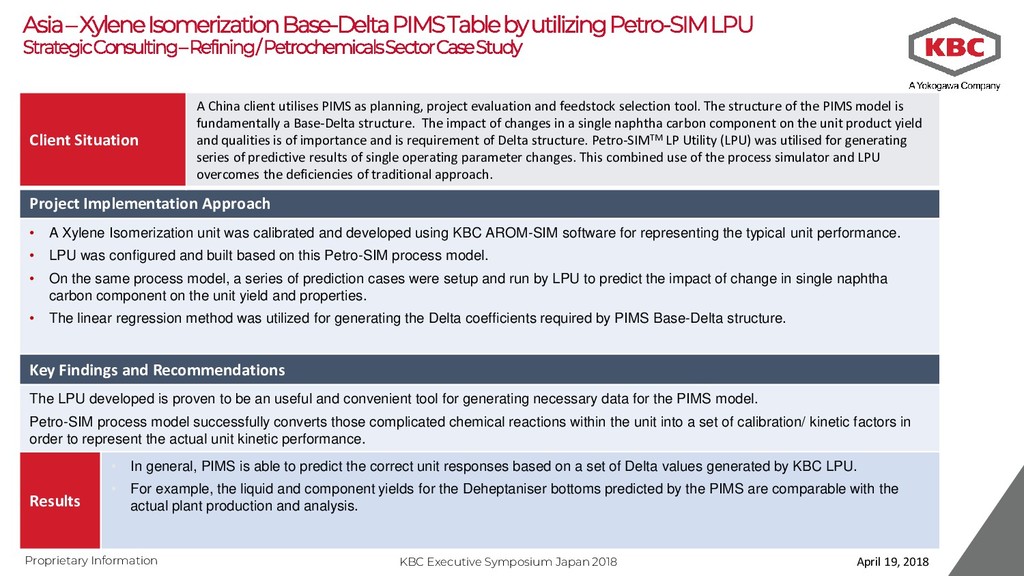
Petro-SIM LPU Strategic Consulting –Refining / Petrochemicals Sector Case Study Client Situation A China client utilises PIMS as planning, project evaluation and feedstock selection tool. The structure of the PIMS model is fundamentally a Base-Delta structure. The impact of changes in a single naphtha carbon component on the unit product yield and qualities is of importance and is requirement of Delta structure. Petro-SIMTM LP Utility (LPU) was utilised for generating series of predictive results of single operating parameter changes. This combined use of the process simulator and LPU overcomes the deficiencies of traditional approach. Project Implementation Approach • A Xylene Isomerization unit was calibrated and developed using KBC AROM-SIM software for representing the typical unit performance. • LPU was configured and built based on this Petro-SIM process model. • On the same process model, a series of prediction cases were setup and run by LPU to predict the impact of change in single naphtha carbon component on the unit yield and properties. • The linear regression method was utilized for generating the Delta coefficients required by PIMS Base-Delta structure. Key Findings and Recommendations The LPU developed is proven to be an useful and convenient tool for generating necessary data for the PIMS model. Petro-SIM process model successfully converts those complicated chemical reactions within the unit into a set of calibration/ kinetic factors in order to represent the actual unit kinetic performance. Results • In general, PIMS is able to predict the correct unit responses based on a set of Delta values generated by KBC LPU. • For example, the liquid and component yields for the Deheptaniser bottoms predicted by the PIMS are comparable with the actual plant production and analysis. KBC Executive Symposium Japan 2018 April 19, 2018
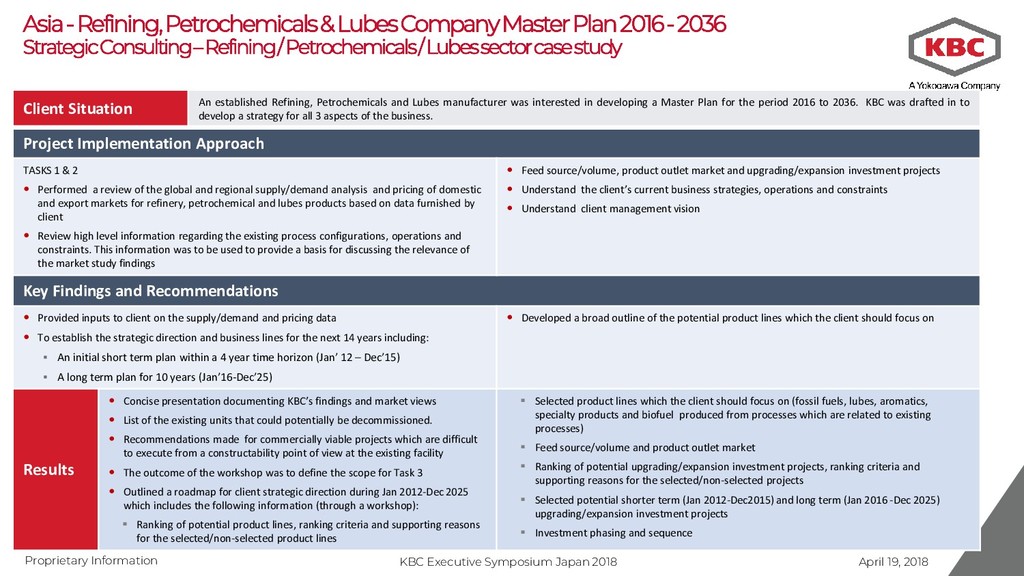
2016 -2036 Strategic Consulting –Refining / Petrochemicals / Lubes sector case study Client Situation An established Refining, Petrochemicals and Lubes manufacturer was interested in developing a Master Plan for the period 2016 to 2036. KBC was drafted in to develop a strategy for all 3 aspects of the business. Project Implementation Approach TASKS 1 & 2 Performed a review of the global and regional supply/demand analysis and pricing of domestic and export markets for refinery, petrochemical and lubes products based on data furnished by client Review high level information regarding the existing process configurations, operations and constraints. This information was to be used to provide a basis for discussing the relevance of the market study findings Feed source/volume, product outlet market and upgrading/expansion investment projects Understand the client’s current business strategies, operations and constraints Understand client management vision Key Findings and Recommendations Provided inputs to client on the supply/demand and pricing data To establish the strategic direction and business lines for the next 14 years including: An initial short term plan within a 4 year time horizon (Jan’ 12 – Dec’15) A long term plan for 10 years (Jan’16-Dec’25) Developed a broad outline of the potential product lines which the client should focus on Results Concise presentation documenting KBC’s findings and market views List of the existing units that could potentially be decommissioned. Recommendations made for commercially viable projects which are difficult to execute from a constructability point of view at the existing facility The outcome of the workshop was to define the scope for Task 3 Outlined a roadmap for client strategic direction during Jan 2012-Dec 2025 which includes the following information (through a workshop): Ranking of potential product lines, ranking criteria and supporting reasons for the selected/non-selected product lines Selected product lines which the client should focus on (fossil fuels, lubes, aromatics, specialty products and biofuel produced from processes which are related to existing processes) Feed source/volume and product outlet market Ranking of potential upgrading/expansion investment projects, ranking criteria and supporting reasons for the selected/non-selected projects Selected potential shorter term (Jan 2012-Dec2015) and long term (Jan 2016 -Dec 2025) upgrading/expansion investment projects Investment phasing and sequence KBC Executive Symposium Japan 2018 April 19, 2018
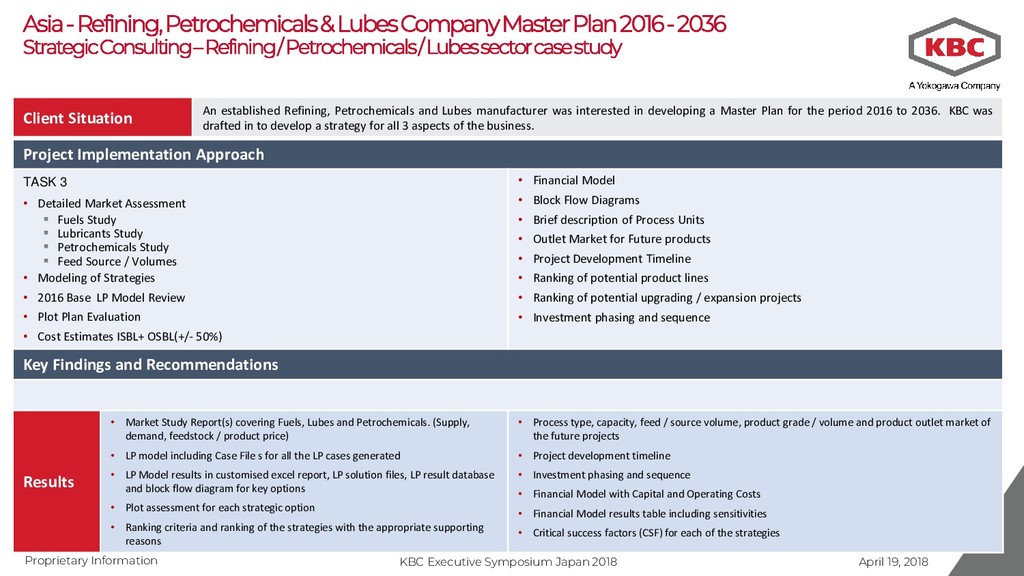
2016 -2036 Strategic Consulting –Refining / Petrochemicals / Lubes sector case study Client Situation An established Refining, Petrochemicals and Lubes manufacturer was interested in developing a Master Plan for the period 2016 to 2036. KBC was drafted in to develop a strategy for all 3 aspects of the business. Project Implementation Approach TASK 3 • Detailed Market Assessment Fuels Study Lubricants Study Petrochemicals Study Feed Source / Volumes • Modeling of Strategies • 2016 Base LP Model Review • Plot Plan Evaluation • Cost Estimates ISBL+ OSBL(+/- 50%) • Financial Model • Block Flow Diagrams • Brief description of Process Units • Outlet Market for Future products • Project Development Timeline • Ranking of potential product lines • Ranking of potential upgrading / expansion projects • Investment phasing and sequence Key Findings and Recommendations Results • Market Study Report(s) covering Fuels, Lubes and Petrochemicals. (Supply, demand, feedstock / product price) • LP model including Case File s for all the LP cases generated • LP Model results in customised excel report, LP solution files, LP result database and block flow diagram for key options • Plot assessment for each strategic option • Ranking criteria and ranking of the strategies with the appropriate supporting reasons • Process type, capacity, feed / source volume, product grade / volume and product outlet market of the future projects • Project development timeline • Investment phasing and sequence • Financial Model with Capital and Operating Costs • Financial Model results table including sensitivities • Critical success factors (CSF) for each of the strategies KBC Executive Symposium Japan 2018 April 19, 2018
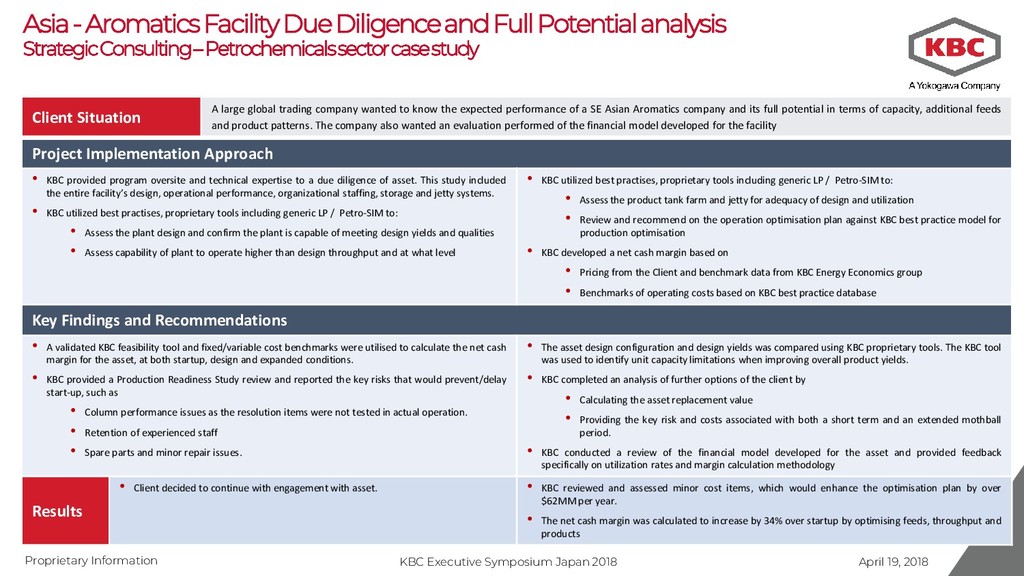
analysis Strategic Consulting –Petrochemicals sector case study Client Situation A large global trading company wanted to know the expected performance of a SE Asian Aromatics company and its full potential in terms of capacity, additional feeds and product patterns. The company also wanted an evaluation performed of the financial model developed for the facility Project Implementation Approach • KBC provided program oversite and technical expertise to a due diligence of asset. This study included the entire facility’s design, operational performance, organizational staffing, storage and jetty systems. • KBC utilized best practises, proprietary tools including generic LP / Petro-SIM to: • Assess the plant design and confirm the plant is capable of meeting design yields and qualities • Assess capability of plant to operate higher than design throughput and at what level • KBC utilized best practises, proprietary tools including generic LP / Petro-SIM to: • Assess the product tank farm and jetty for adequacy of design and utilization • Review and recommend on the operation optimisation plan against KBC best practice model for production optimisation • KBC developed a net cash margin based on • Pricing from the Client and benchmark data from KBC Energy Economics group • Benchmarks of operating costs based on KBC best practice database Key Findings and Recommendations • A validated KBC feasibility tool and fixed/variable cost benchmarks were utilised to calculate the net cash margin for the asset, at both startup, design and expanded conditions. • KBC provided a Production Readiness Study review and reported the key risks that would prevent/delay start-up, such as • Column performance issues as the resolution items were not tested in actual operation. • Retention of experienced staff • Spare parts and minor repair issues. • The asset design configuration and design yields was compared using KBC proprietary tools. The KBC tool was used to identify unit capacity limitations when improving overall product yields. • KBC completed an analysis of further options of the client by • Calculating the asset replacement value • Providing the key risk and costs associated with both a short term and an extended mothball period. • KBC conducted a review of the financial model developed for the asset and provided feedback specifically on utilization rates and margin calculation methodology Results • Client decided to continue with engagement with asset. • KBC reviewed and assessed minor cost items, which would enhance the optimisation plan by over $62MM per year. • The net cash margin was calculated to increase by 34% over startup by optimising feeds, throughput and products KBC Executive Symposium Japan 2018 April 19, 2018
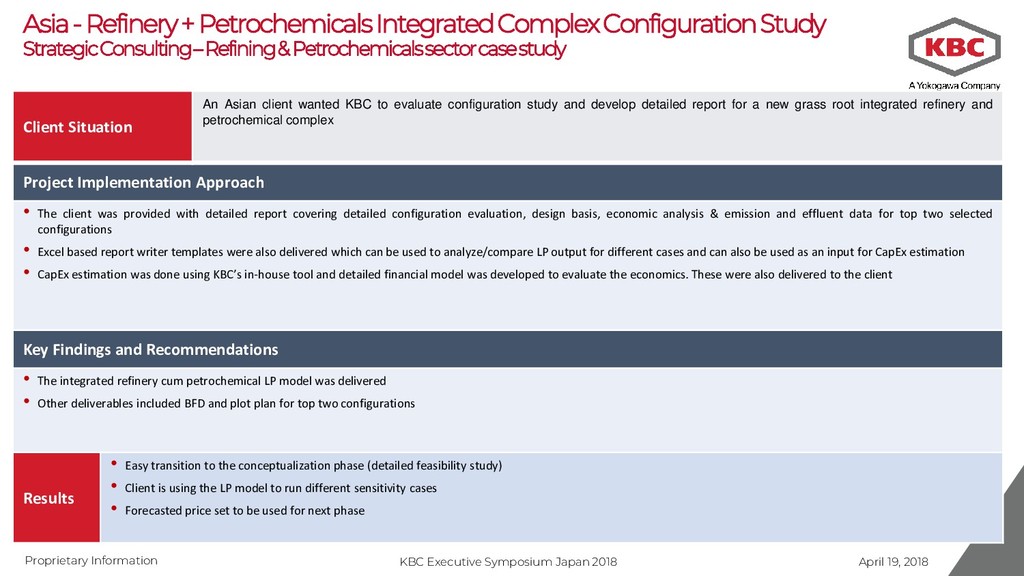
Strategic Consulting –Refining & Petrochemicals sector case study Client Situation An Asian client wanted KBC to evaluate configuration study and develop detailed report for a new grass root integrated refinery and petrochemical complex Project Implementation Approach • The client was provided with detailed report covering detailed configuration evaluation, design basis, economic analysis & emission and effluent data for top two selected configurations • Excel based report writer templates were also delivered which can be used to analyze/compare LP output for different cases and can also be used as an input for CapEx estimation • CapEx estimation was done using KBC’s in-house tool and detailed financial model was developed to evaluate the economics. These were also delivered to the client Key Findings and Recommendations • The integrated refinery cum petrochemical LP model was delivered • Other deliverables included BFD and plot plan for top two configurations Results • Easy transition to the conceptualization phase (detailed feasibility study) • Client is using the LP model to run different sensitivity cases • Forecasted price set to be used for next phase KBC Executive Symposium Japan 2018 April 19, 2018
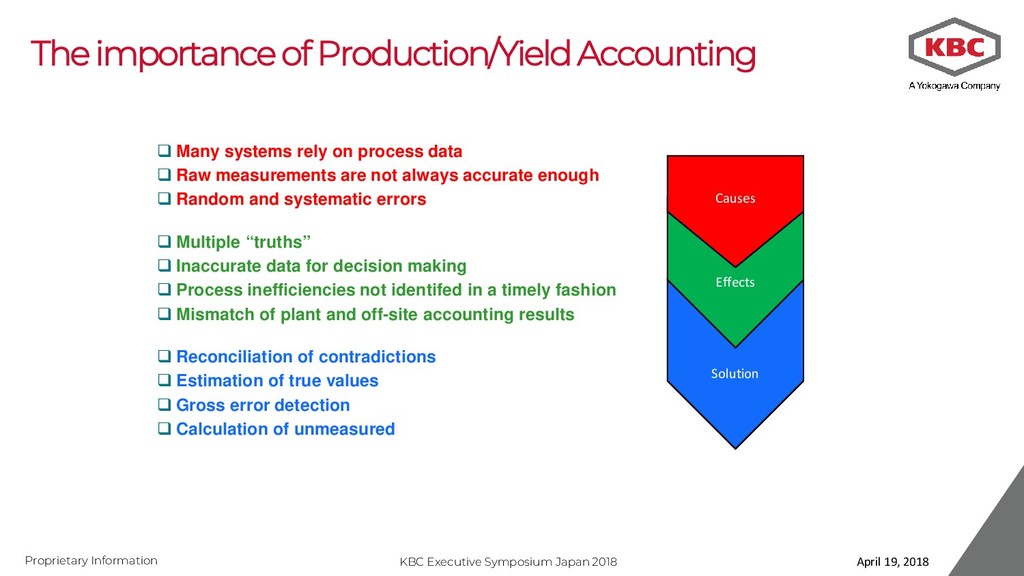
KBC Executive Symposium Japan 2018 Effects Solution Causes Many systems rely on process data Raw measurements are not always accurate enough Random and systematic errors Multiple “truths” Inaccurate data for decision making Process inefficiencies not identifed in a timely fashion Mismatch of plant and off-site accounting results Reconciliation of contradictions Estimation of true values Gross error detection Calculation of unmeasured
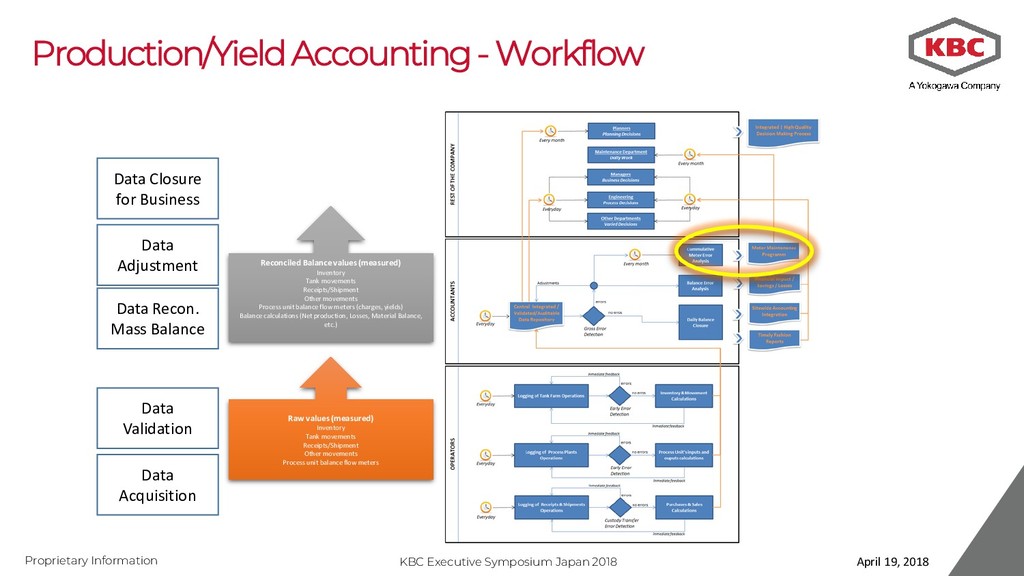
Executive Symposium Japan 2018 Raw values (measured) Inventory Tank movements Receipts/Shipment Other movements Process unit balance flow meters Reconciled Balance values (measured) Inventory Tank movements Receipts/Shipment Other movements Process unit balance flow meters (charges, yields) Balance calculations (Net production, Losses, Material Balance, etc.) Data Acquisition Data Validation Data Recon. Mass Balance Data Adjustment Data Closure for Business
It all starts here! • Good metering has never been more relevant than now. All decision support tools rely on plant data. • A continuous improvement effort to eliminate bad metering is a necessary best practice. • For this to happen instrumentation personnel, process engineers and production accountants have to work together. • This multidisciplinary team has to be supported by production accounting / data reconciliation software and oil loss consultants… • But real improvement is only achieved when faulty meters are maintained, i.e. calibrated, replaced, etc. April 19, 2018 KBC Executive Symposium Japan 2018
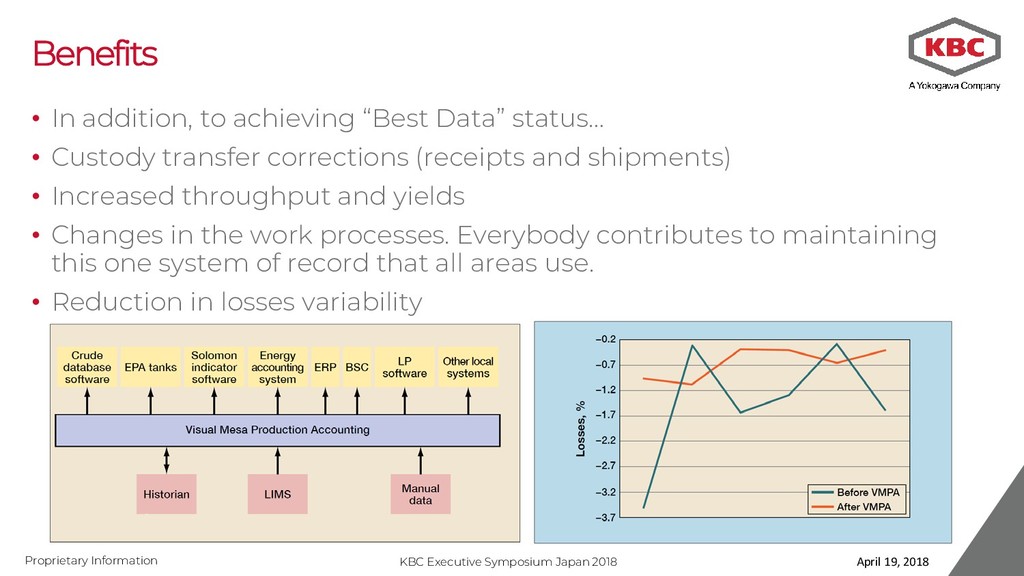
status… • Custody transfer corrections (receipts and shipments) • Increased throughput and yields • Changes in the work processes. Everybody contributes to maintaining this one system of record that all areas use. • Reduction in losses variability April 19, 2018 KBC Executive Symposium Japan 2018
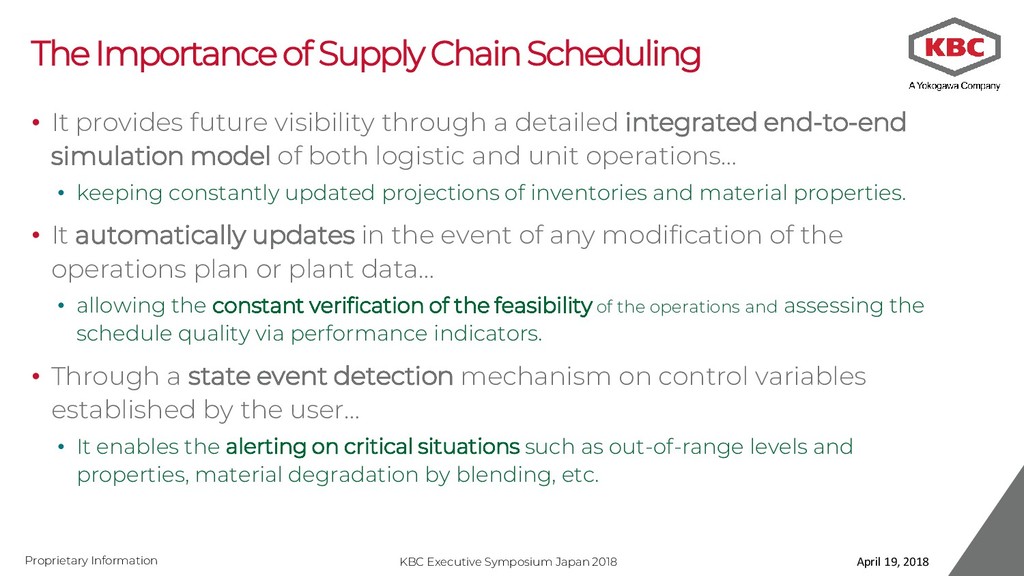
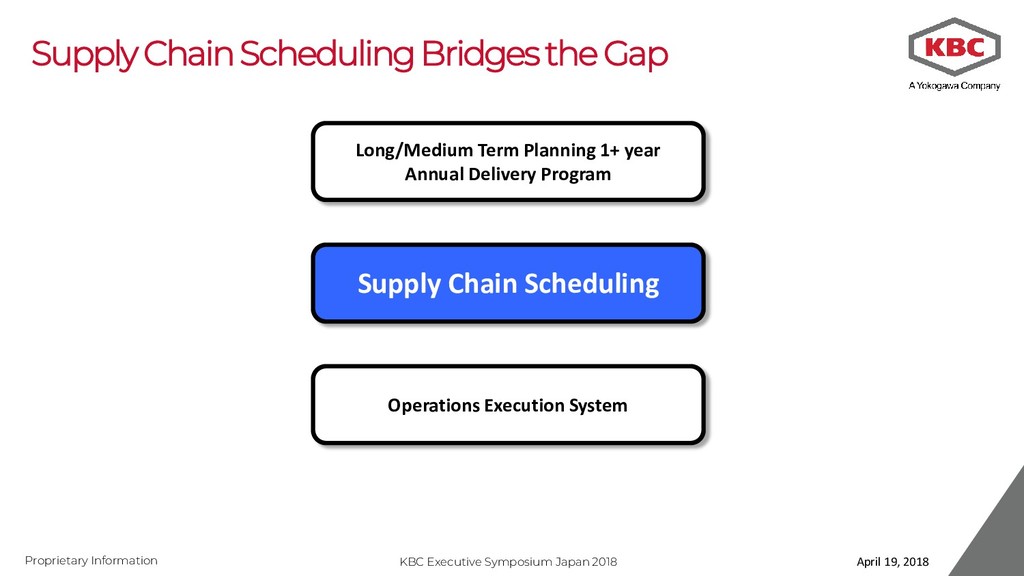
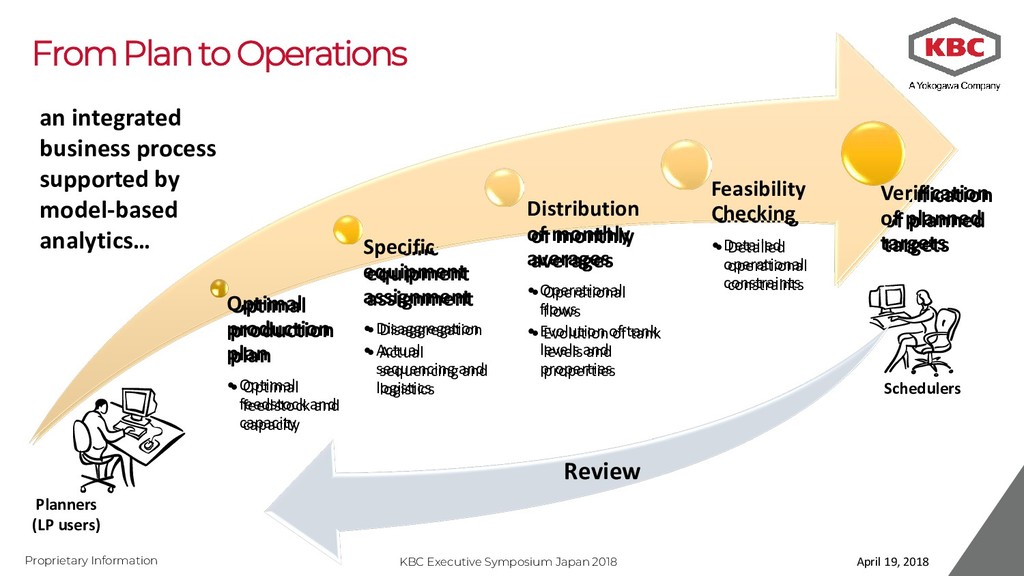
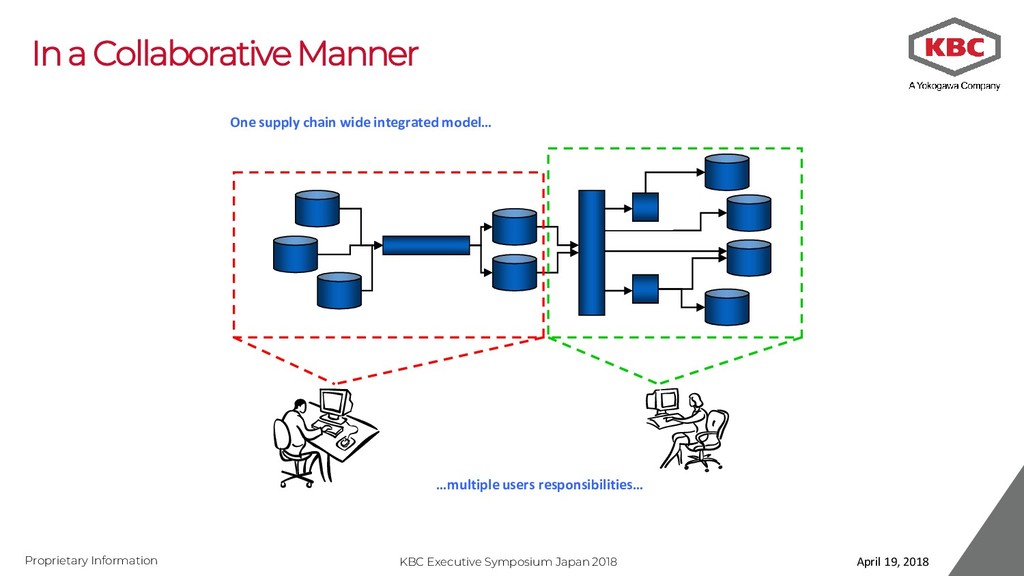
provides future visibility through a detailed integrated end-to-end simulation model of both logistic and unit operations… • keeping constantly updated projections of inventories and material properties. • It automatically updates in the event of any modification of the operations plan or plant data… • allowing the constant verification of the feasibility of the operations and assessing the schedule quality via performance indicators. • Through a state event detection mechanism on control variables established by the user… • It enables the alerting on critical situations such as out-of-range levels and properties, material degradation by blending, etc. April 19, 2018 KBC Executive Symposium Japan 2018
Executive Symposium Japan 2018 Planners (LP users) Schedulers an integrated business process supported by model-based analytics… Review Optimal production plan • Optimal feedstock and capacity Specific equipment assignment • Disaggregation • Actual sequencing and logistics Distribution of monthly averages • Operational flows • Evolution of tank levels and properties Feasibility Checking • Detailed operational constraints Verification of planned targets Optimal production plan • Optimal feedstock and capacity Specific equipment assignment • Disaggregation • Actual sequencing and logistics Distribution of monthly averages • Operational flows • Evolution of tank levels and properties Feasibility Checking • Detailed operational constraints Verification of planned targets
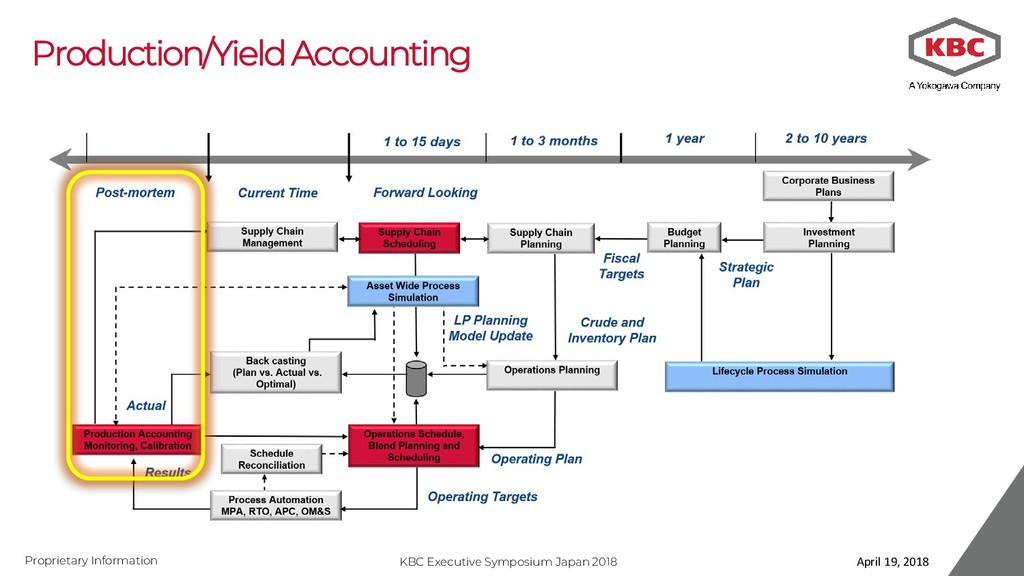
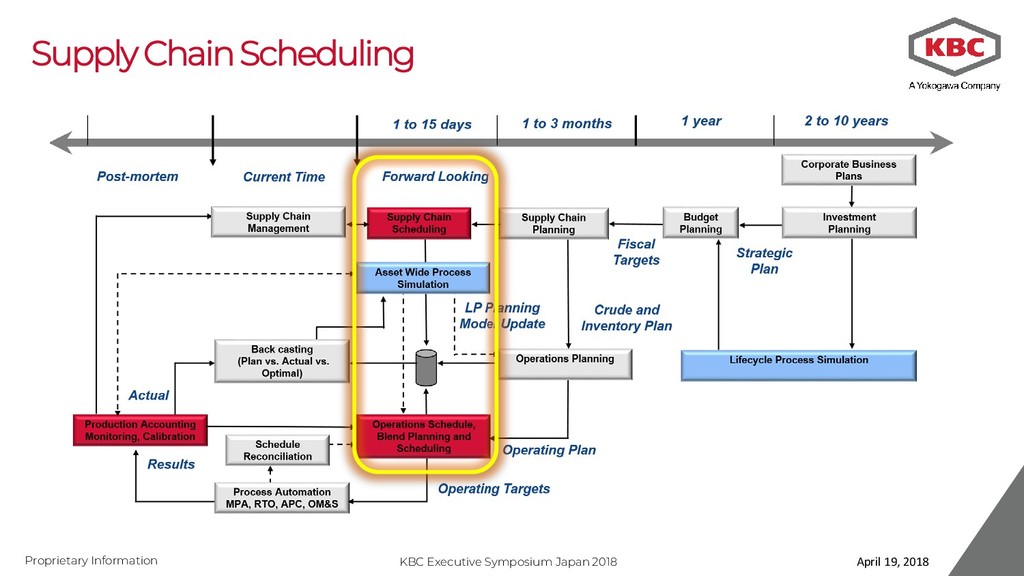
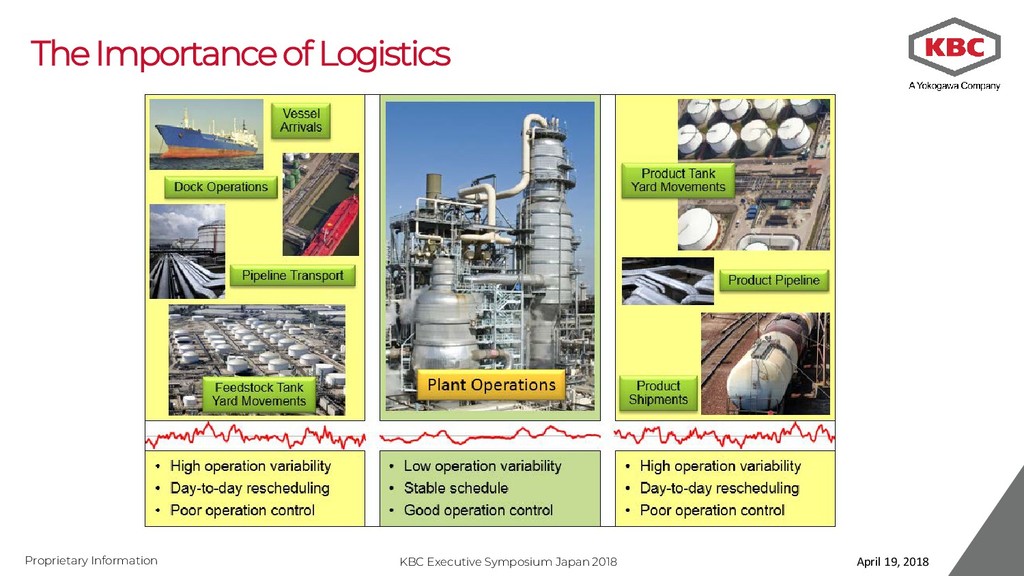
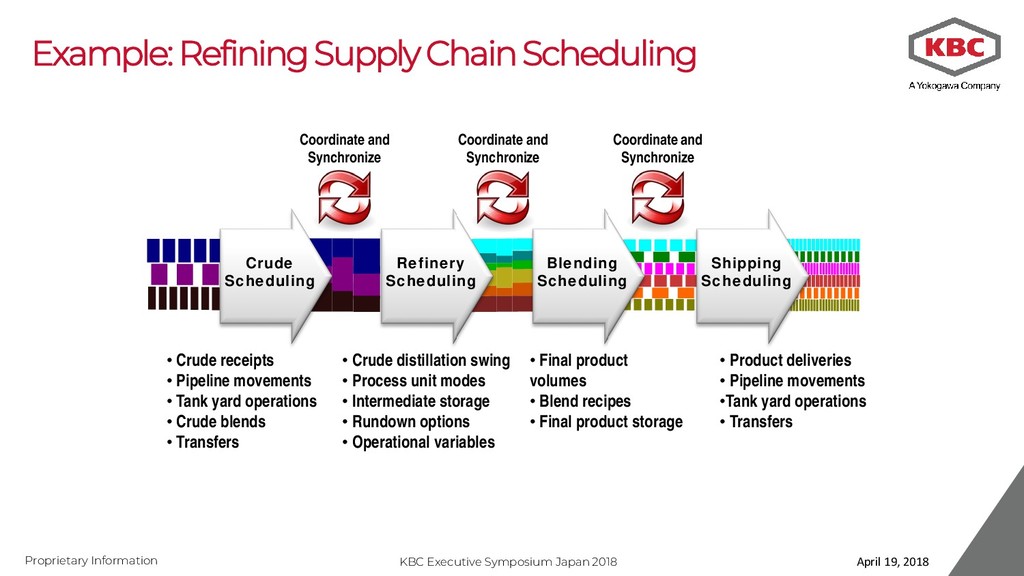
Scheduling (SCS) are integral components of a Supply Chain Optimization initiative. • PA looks at what happened yesterday (post-mortem). What were the receipts and shipments and the closing inventory positions yesterday. • While SCS determines the future (forward looking: 7, 30,… days ahead) inventory and quality positions based on forecasts of production plans, availability, liftings, etc. • PA is also a key part of a site’s metering continuous improvement program that reduces the uncertainty in the measurements which ensures that the site’s decision support systems will have best data to run with. Also, there is a reduction in the material losses over time. • Supply Chain Scheduling translates the Plan to an executable reality. • By providing an integrated end-to-end model of the entire supply chain scheduling personnel know that the case studies they run take everything into account. Early warning of potential exceptions help avoid contractual penalties such as demurrage. April 19, 2018 KBC Executive Symposium Japan 2018


 kbcat
 sergeychernyshev
 katarinadahlin
 mkilby
 jcasabona
 varn
 greggifford
 deanohume
 leimatthew05
 bkeepers
 mclloyd
 oripsolob
 tamaranovitovic