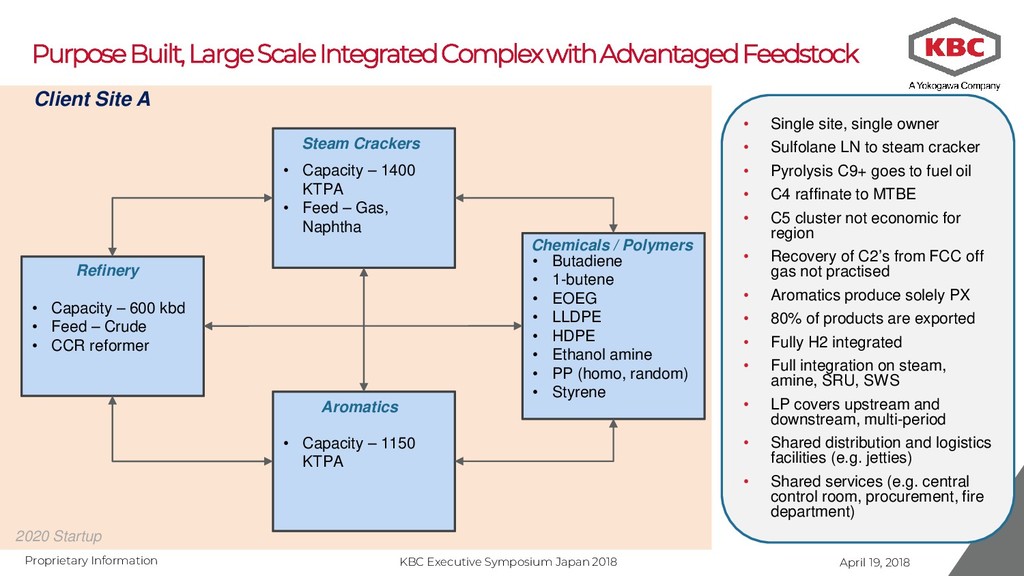
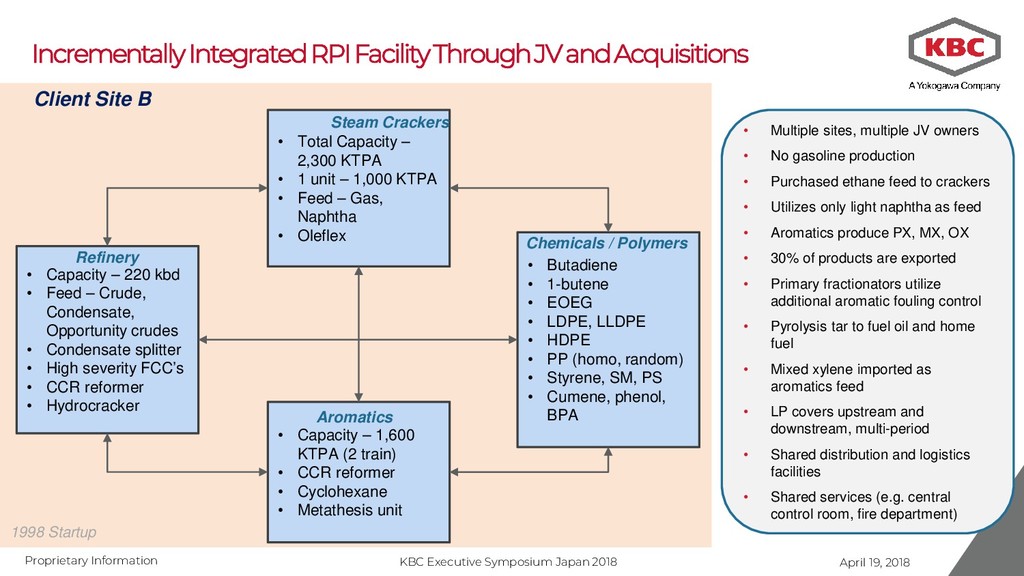
the methodology, tools, and practices used to maximize the full potential of a multiparty integration program. • The results and challenges of this program will be highlighted. • This will include the usage of Petro- SIM flow sheets and Planning tools to maximize value capture. KBC Executive Symposium Japan 2018 April 19, 2018
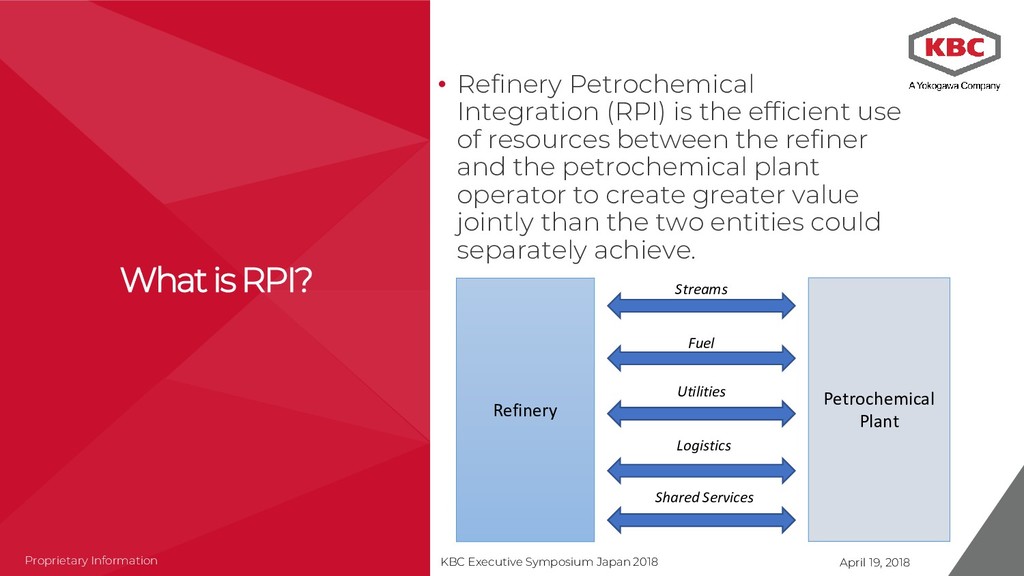
Integration (RPI) is the efficient use of resources between the refiner and the petrochemical plant operator to create greater value jointly than the two entities could separately achieve. Refinery Petrochemical Plant Streams Fuel Utilities Logistics Shared Services KBC Executive Symposium Japan 2018 April 19, 2018
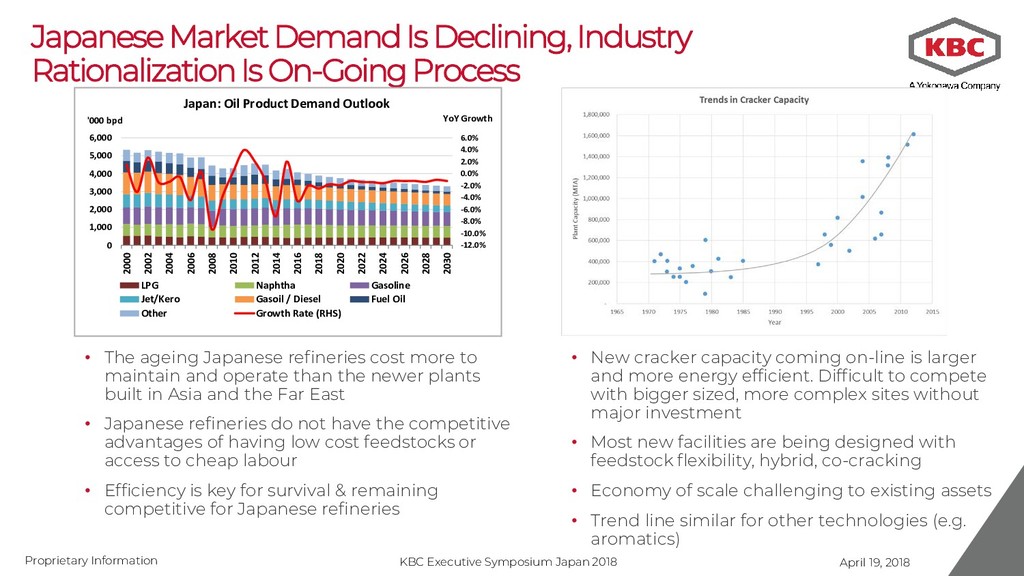
On-Going Process • The ageing Japanese refineries cost more to maintain and operate than the newer plants built in Asia and the Far East • Japanese refineries do not have the competitive advantages of having low cost feedstocks or access to cheap labour • Efficiency is key for survival & remaining competitive for Japanese refineries -12.0% -10.0% -8.0% -6.0% -4.0% -2.0% 0.0% 2.0% 4.0% 6.0% 0 1,000 2,000 3,000 4,000 5,000 6,000 2000 2002 2004 2006 2008 2010 2012 2014 2016 2018 2020 2022 2024 2026 2028 2030 YoY Growth '000 bpd Japan: Oil Product Demand Outlook LPG Naphtha Gasoline Jet/Kero Gasoil / Diesel Fuel Oil Other Growth Rate (RHS) • New cracker capacity coming on-line is larger and more energy efficient. Difficult to compete with bigger sized, more complex sites without major investment • Most new facilities are being designed with feedstock flexibility, hybrid, co-cracking • Economy of scale challenging to existing assets • Trend line similar for other technologies (e.g. aromatics) KBC Executive Symposium Japan 2018 April 19, 2018
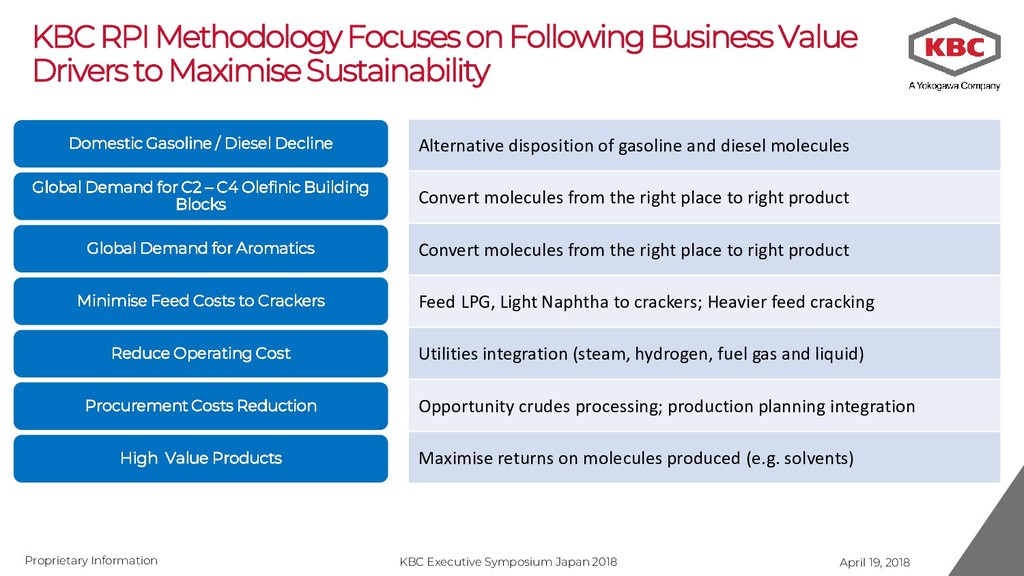
Drivers to Maximise Sustainability Domestic Gasoline / Diesel Decline Global Demand for C2 – C4 Olefinic Building Blocks Global Demand for Aromatics Minimise Feed Costs to Crackers Reduce Operating Cost Procurement Costs Reduction High Value Products Alternative disposition of gasoline and diesel molecules Convert molecules from the right place to right product Convert molecules from the right place to right product Feed LPG, Light Naphtha to crackers; Heavier feed cracking Utilities integration (steam, hydrogen, fuel gas and liquid) Opportunity crudes processing; production planning integration Maximise returns on molecules produced (e.g. solvents) KBC Executive Symposium Japan 2018 April 19, 2018
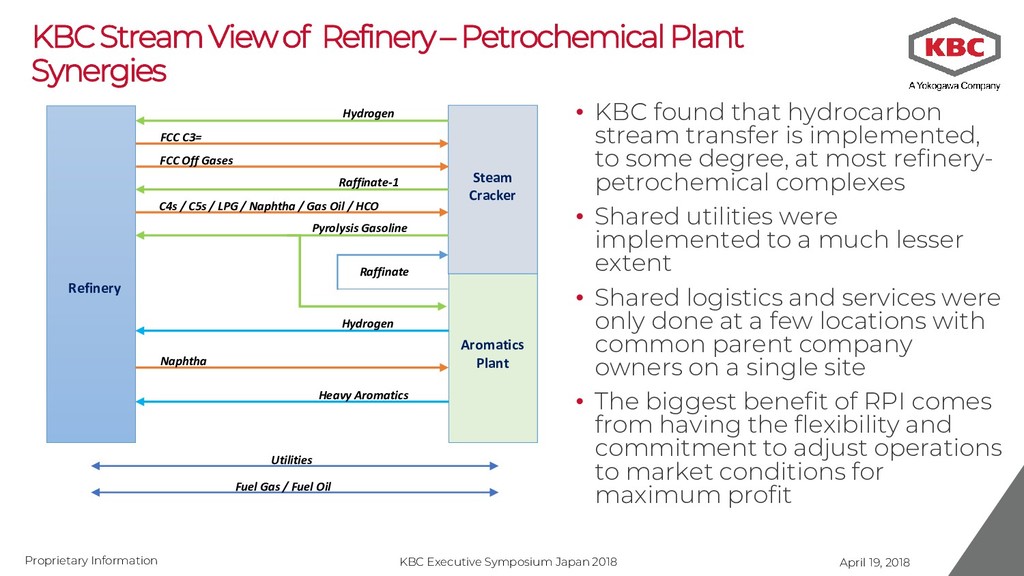
Steam Cracker Refinery Aromatics Plant Hydrogen Raffinate-1 Pyrolysis Gasoline Hydrogen Heavy Aromatics FCC Off Gases C4s / C5s / LPG / Naphtha / Gas Oil / HCO Naphtha Raffinate Utilities Fuel Gas / Fuel Oil FCC C3= • KBC found that hydrocarbon stream transfer is implemented, to some degree, at most refinery- petrochemical complexes • Shared utilities were implemented to a much lesser extent • Shared logistics and services were only done at a few locations with common parent company owners on a single site • The biggest benefit of RPI comes from having the flexibility and commitment to adjust operations to market conditions for maximum profit KBC Executive Symposium Japan 2018 April 19, 2018
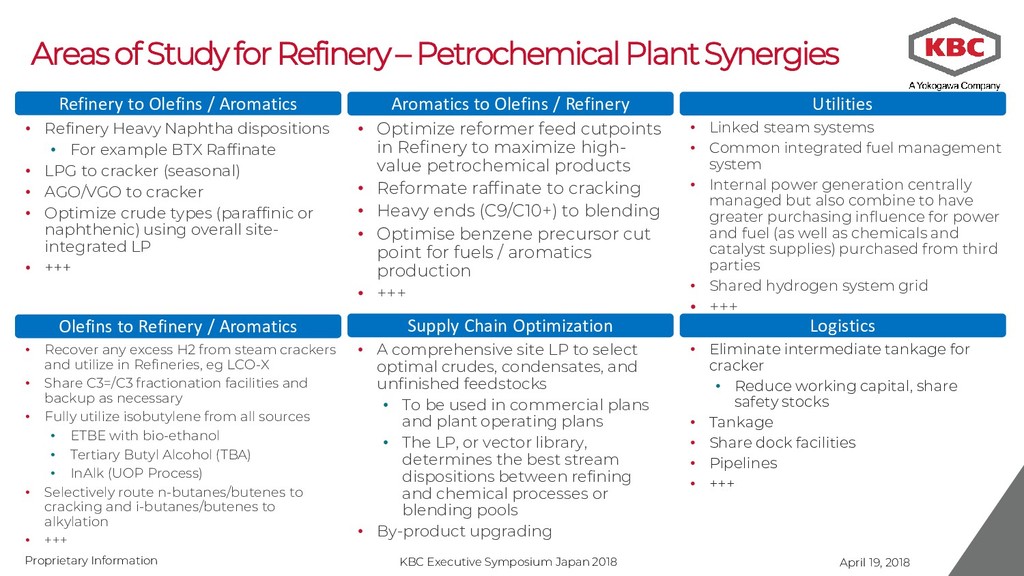
Synergies Utilities Logistics Aromatics to Olefins / Refinery Supply Chain Optimization Refinery to Olefins / Aromatics Olefins to Refinery / Aromatics • Refinery Heavy Naphtha dispositions • For example BTX Raffinate • LPG to cracker (seasonal) • AGO/VGO to cracker • Optimize crude types (paraffinic or naphthenic) using overall site- integrated LP • +++ • Recover any excess H2 from steam crackers and utilize in Refineries, eg LCO-X • Share C3=/C3 fractionation facilities and backup as necessary • Fully utilize isobutylene from all sources • ETBE with bio-ethanol • Tertiary Butyl Alcohol (TBA) • InAlk (UOP Process) • Selectively route n-butanes/butenes to cracking and i-butanes/butenes to alkylation • +++ • Optimize reformer feed cutpoints in Refinery to maximize high- value petrochemical products • Reformate raffinate to cracking • Heavy ends (C9/C10+) to blending • Optimise benzene precursor cut point for fuels / aromatics production • +++ • A comprehensive site LP to select optimal crudes, condensates, and unfinished feedstocks • To be used in commercial plans and plant operating plans • The LP, or vector library, determines the best stream dispositions between refining and chemical processes or blending pools • By-product upgrading • Linked steam systems • Common integrated fuel management system • Internal power generation centrally managed but also combine to have greater purchasing influence for power and fuel (as well as chemicals and catalyst supplies) purchased from third parties • Shared hydrogen system grid • +++ • Eliminate intermediate tankage for cracker • Reduce working capital, share safety stocks • Tankage • Share dock facilities • Pipelines • +++ KBC Executive Symposium Japan 2018 April 19, 2018
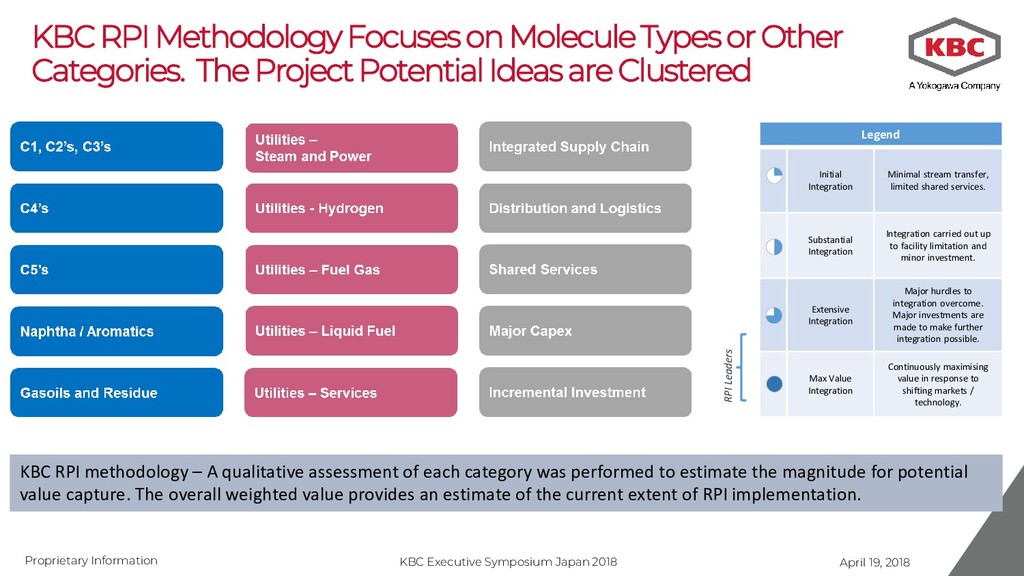
Other Categories. The Project Potential Ideas are Clustered Legend Initial Integration Minimal stream transfer, limited shared services. Substantial Integration Integration carried out up to facility limitation and minor investment. Extensive Integration Major hurdles to integration overcome. Major investments are made to make further integration possible. Max Value Integration Continuously maximising value in response to shifting markets / technology. KBC RPI methodology – A qualitative assessment of each category was performed to estimate the magnitude for potential value capture. The overall weighted value provides an estimate of the current extent of RPI implementation. RPI Leaders KBC Executive Symposium Japan 2018 April 19, 2018
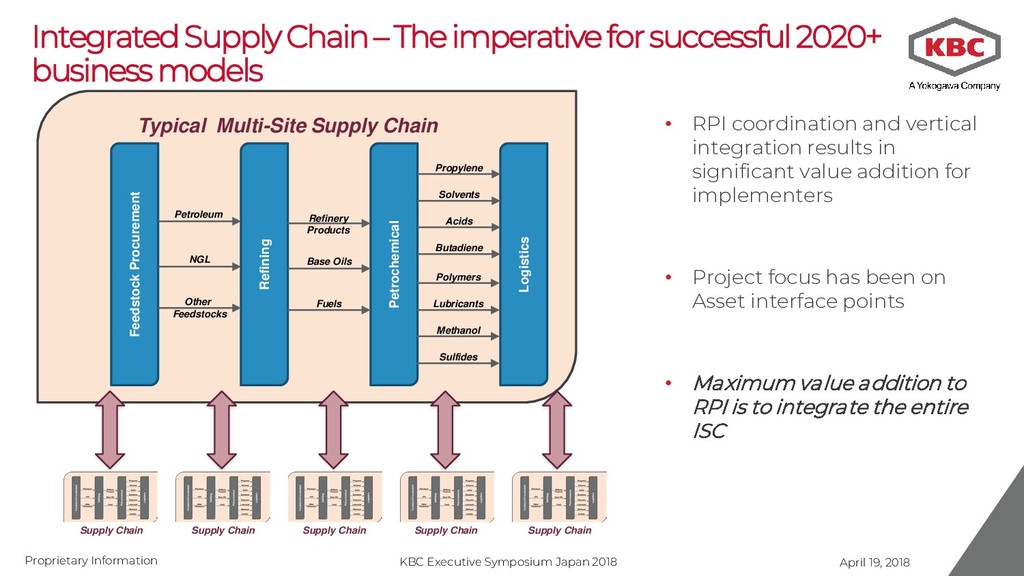
2020+ business models KBC Executive Symposium Japan 2018 • RPI coordination and vertical integration results in significant value addition for implementers • Project focus has been on Asset interface points • Maximum value addition to RPI is to integrate the entire ISC Feedstock Procurement Refining Petrochemical Logistics Petroleum NGL Other Feedstocks Refinery Products Base Oils Fuels Solvents Propylene Butadiene Acids Lubricants Polymers Sulfides Methanol Typical Multi-Site Supply Chain Supply Chain Supply Chain Supply Chain Supply Chain Supply Chain April 19, 2018
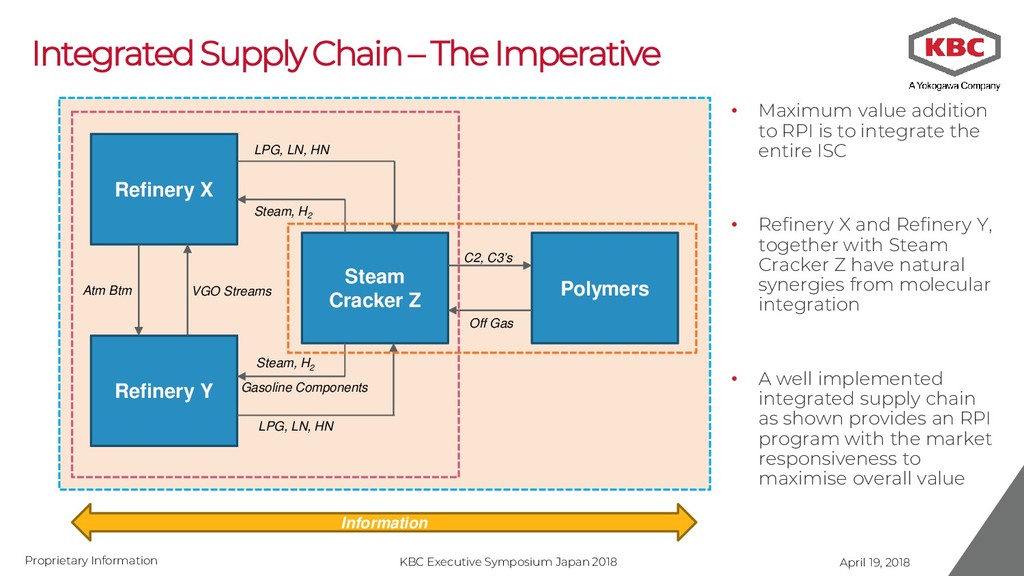
Symposium Japan 2018 • Maximum value addition to RPI is to integrate the entire ISC • Refinery X and Refinery Y, together with Steam Cracker Z have natural synergies from molecular integration • A well implemented integrated supply chain as shown provides an RPI program with the market responsiveness to maximise overall value Refinery X Refinery Y Steam Cracker Z Polymers Steam, H2 LPG, LN, HN LPG, LN, HN Steam, H2 Gasoline Components Atm Btm VGO Streams C2, C3’s Off Gas Information April 19, 2018
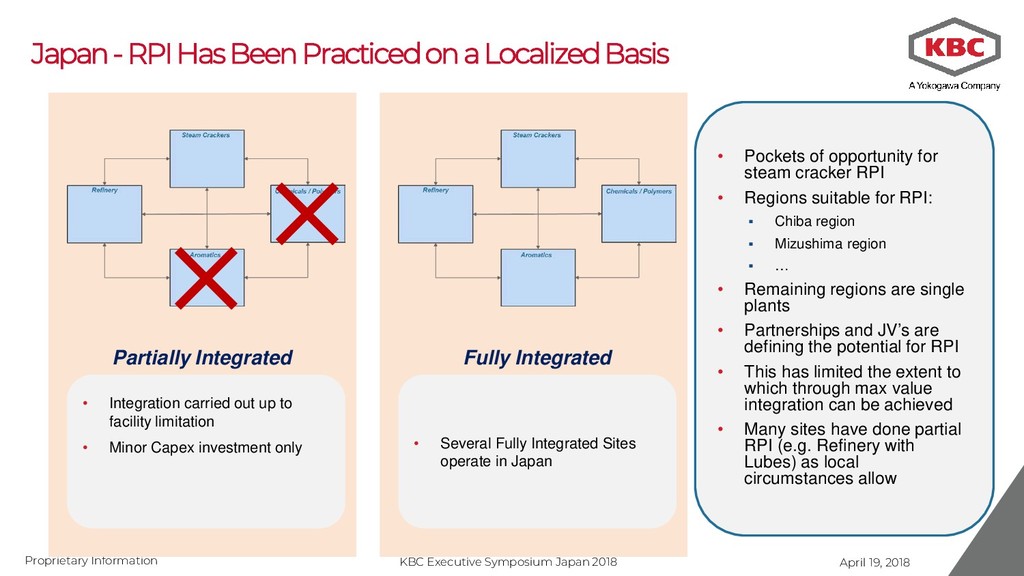
Basis KBC Executive Symposium Japan 2018 • Pockets of opportunity for steam cracker RPI • Regions suitable for RPI: Chiba region Mizushima region … • Remaining regions are single plants • Partnerships and JV’s are defining the potential for RPI • This has limited the extent to which through max value integration can be achieved • Many sites have done partial RPI (e.g. Refinery with Lubes) as local circumstances allow Fully Integrated • Several Fully Integrated Sites operate in Japan Partially Integrated • Integration carried out up to facility limitation • Minor Capex investment only April 19, 2018
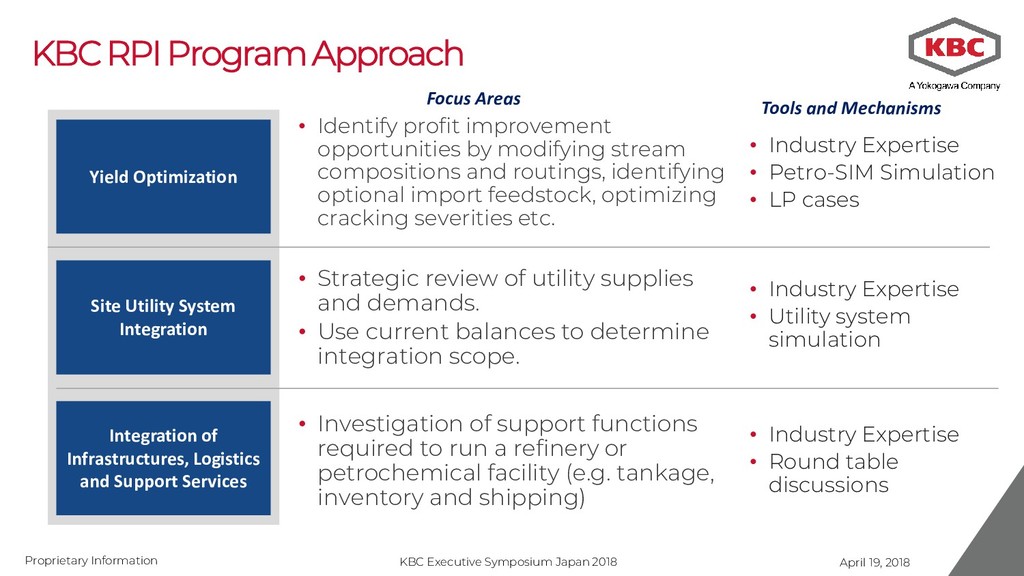
System Integration Integration of Infrastructures, Logistics and Support Services Focus Areas Tools and Mechanisms • Identify profit improvement opportunities by modifying stream compositions and routings, identifying optional import feedstock, optimizing cracking severities etc. • Industry Expertise • Petro-SIM Simulation • LP cases • Industry Expertise • Utility system simulation • Strategic review of utility supplies and demands. • Use current balances to determine integration scope. • Investigation of support functions required to run a refinery or petrochemical facility (e.g. tankage, inventory and shipping) • Industry Expertise • Round table discussions KBC Executive Symposium Japan 2018 April 19, 2018
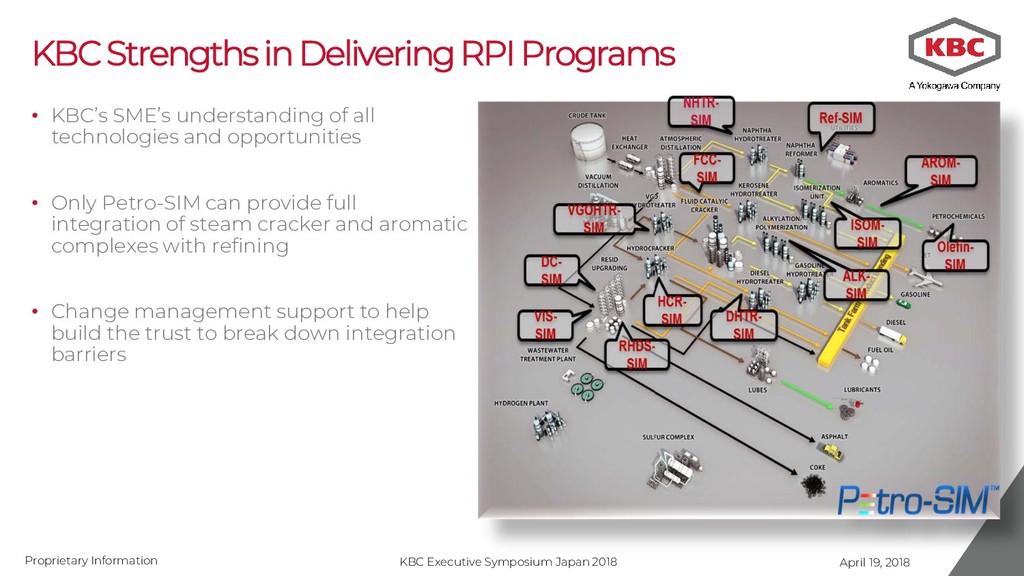
SME’s understanding of all technologies and opportunities • Only Petro-SIM can provide full integration of steam cracker and aromatic complexes with refining • Change management support to help build the trust to break down integration barriers KBC Executive Symposium Japan 2018 April 19, 2018
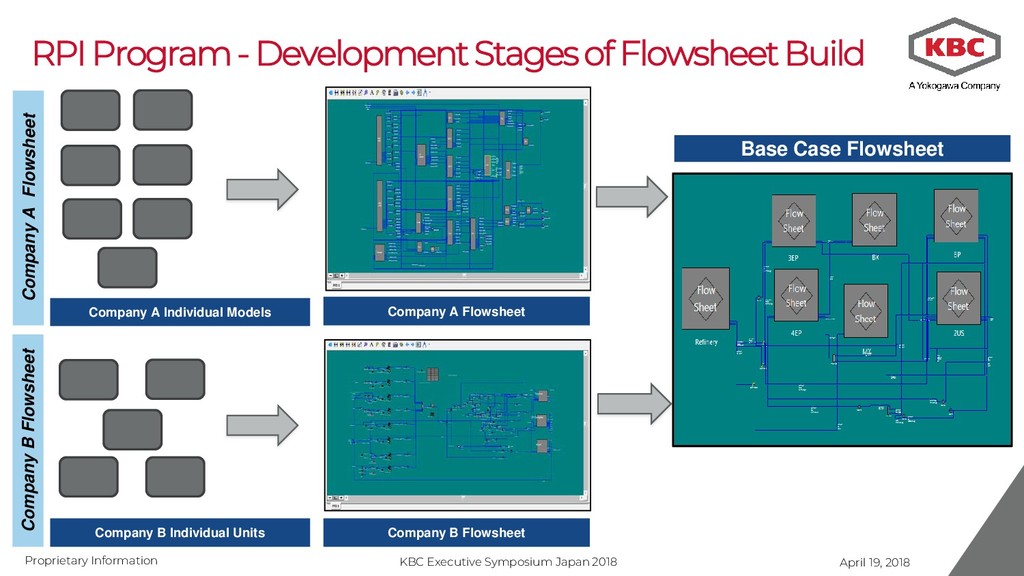
Company A Flowsheet Company B Flowsheet Base Case Flowsheet Company A Flowsheet Company B Flowsheet Company A Individual Models Company B Individual Units KBC Executive Symposium Japan 2018 April 19, 2018
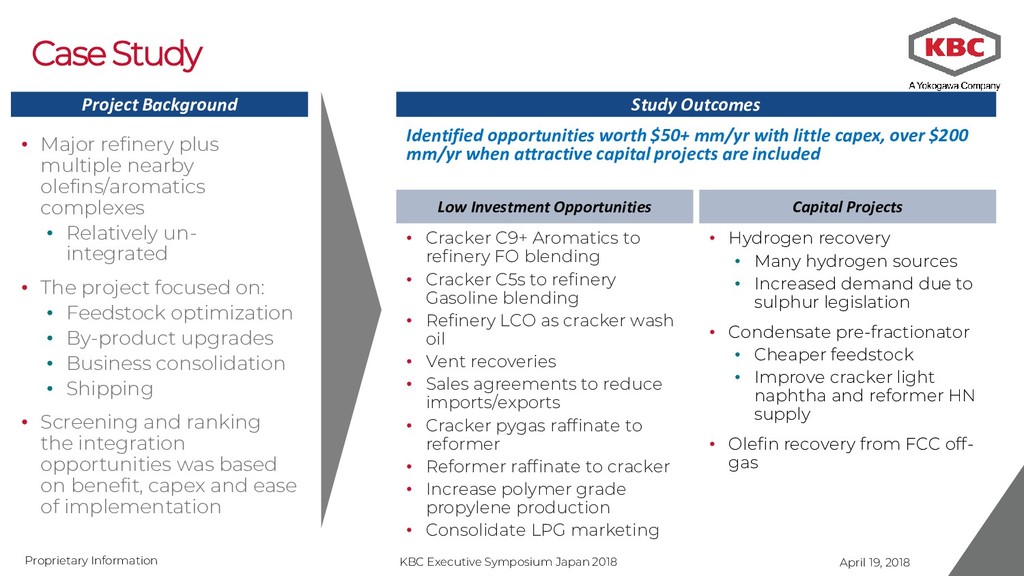
refinery plus multiple nearby olefins/aromatics complexes • Relatively un- integrated • The project focused on: • Feedstock optimization • By-product upgrades • Business consolidation • Shipping • Screening and ranking the integration opportunities was based on benefit, capex and ease of implementation Identified opportunities worth $50+ mm/yr with little capex, over $200 mm/yr when attractive capital projects are included Low Investment Opportunities Capital Projects • Cracker C9+ Aromatics to refinery FO blending • Cracker C5s to refinery Gasoline blending • Refinery LCO as cracker wash oil • Vent recoveries • Sales agreements to reduce imports/exports • Cracker pygas raffinate to reformer • Reformer raffinate to cracker • Increase polymer grade propylene production • Consolidate LPG marketing • Hydrogen recovery • Many hydrogen sources • Increased demand due to sulphur legislation • Condensate pre-fractionator • Cheaper feedstock • Improve cracker light naphtha and reformer HN supply • Olefin recovery from FCC off- gas KBC Executive Symposium Japan 2018 April 19, 2018
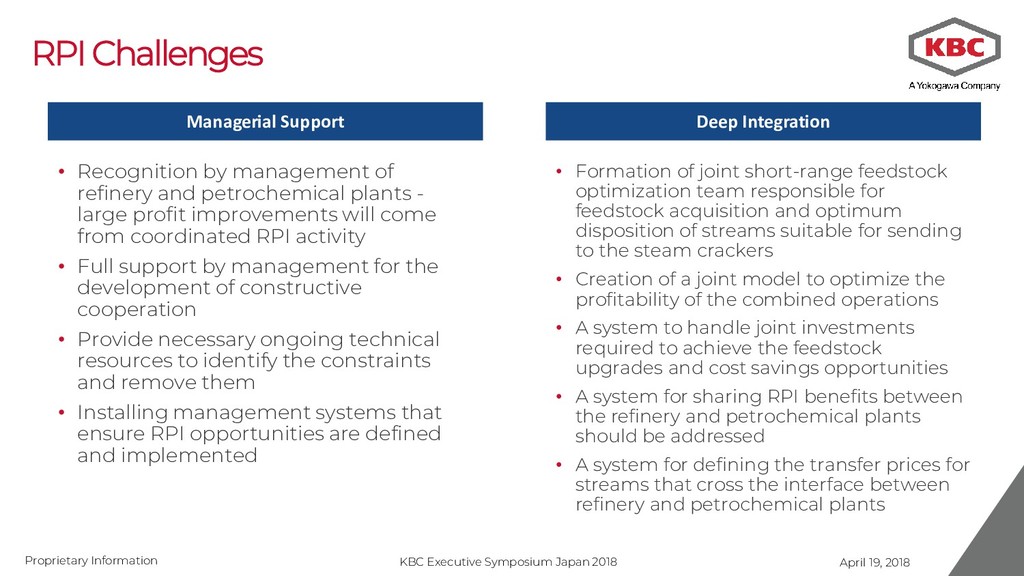
and petrochemical plants - large profit improvements will come from coordinated RPI activity • Full support by management for the development of constructive cooperation • Provide necessary ongoing technical resources to identify the constraints and remove them • Installing management systems that ensure RPI opportunities are defined and implemented Managerial Support Deep Integration • Formation of joint short-range feedstock optimization team responsible for feedstock acquisition and optimum disposition of streams suitable for sending to the steam crackers • Creation of a joint model to optimize the profitability of the combined operations • A system to handle joint investments required to achieve the feedstock upgrades and cost savings opportunities • A system for sharing RPI benefits between the refinery and petrochemical plants should be addressed • A system for defining the transfer prices for streams that cross the interface between refinery and petrochemical plants KBC Executive Symposium Japan 2018 April 19, 2018

 Your Podcast. Everywhere. Effortlessly.


 kbcat
 sergeychernyshev
 tanoku
 mza
 asonas
 colly
 axbom
 rkaga
 bcantrill
 chriscoyier
 marcoroth
 skoyamalab
 nikkihalliwell