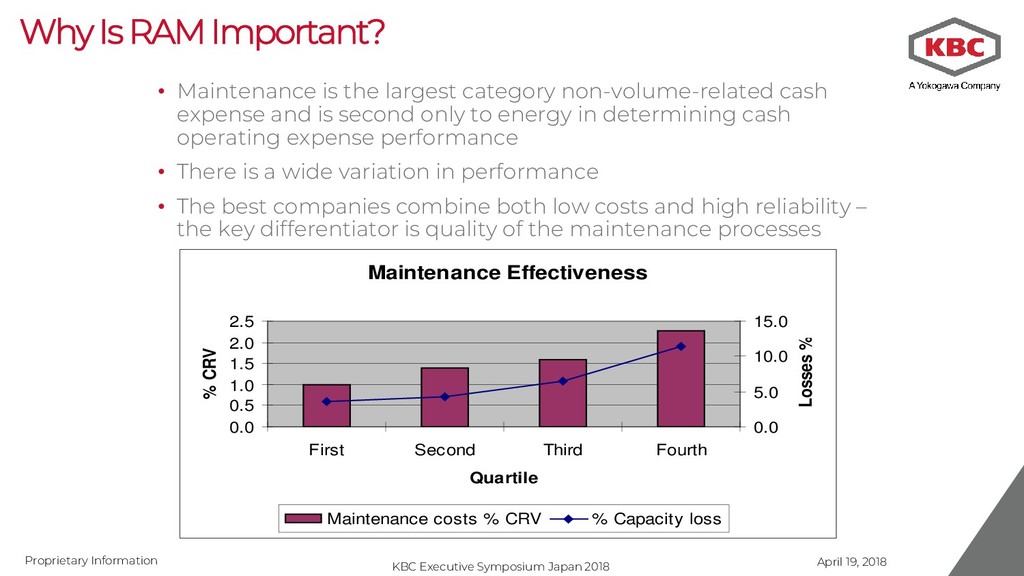
largest category non-volume-related cash expense and is second only to energy in determining cash operating expense performance • There is a wide variation in performance • The best companies combine both low costs and high reliability – the key differentiator is quality of the maintenance processes Maintenance Effectiveness 0.0 0.5 1.0 1.5 2.0 2.5 First Second Third Fourth Quartile % CRV 0.0 5.0 10.0 15.0 Losses % Maintenance costs % CRV % Capacity loss KBC Executive Symposium Japan 2018 April 19, 2018
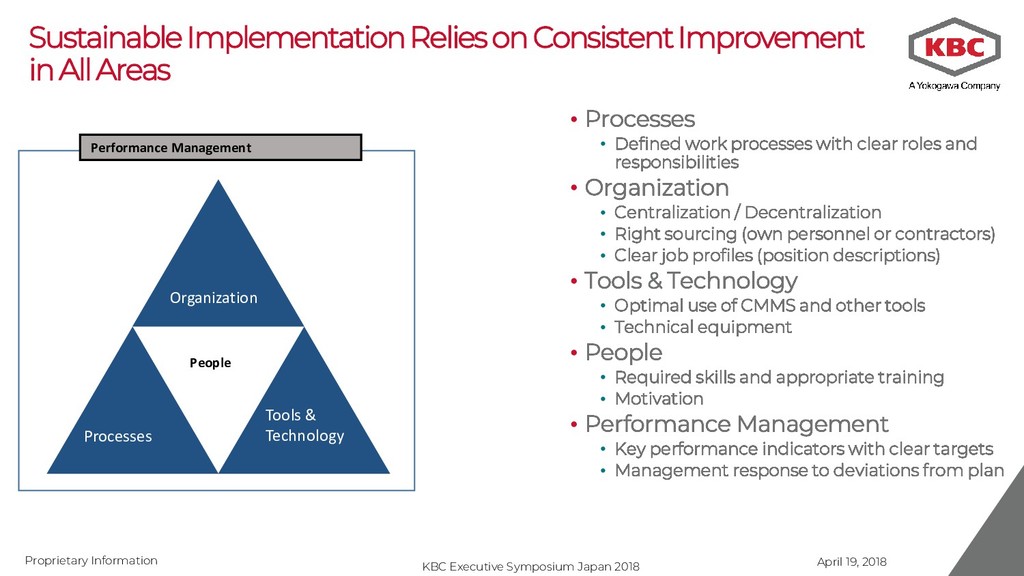
Areas • Processes • Defined work processes with clear roles and responsibilities • Organization • Centralization / Decentralization • Right sourcing (own personnel or contractors) • Clear job profiles (position descriptions) • Tools & Technology • Optimal use of CMMS and other tools • Technical equipment • People • Required skills and appropriate training • Motivation • Performance Management • Key performance indicators with clear targets • Management response to deviations from plan People Organization Tools & Technology Processes Performance Management KBC Executive Symposium Japan 2018 April 19, 2018
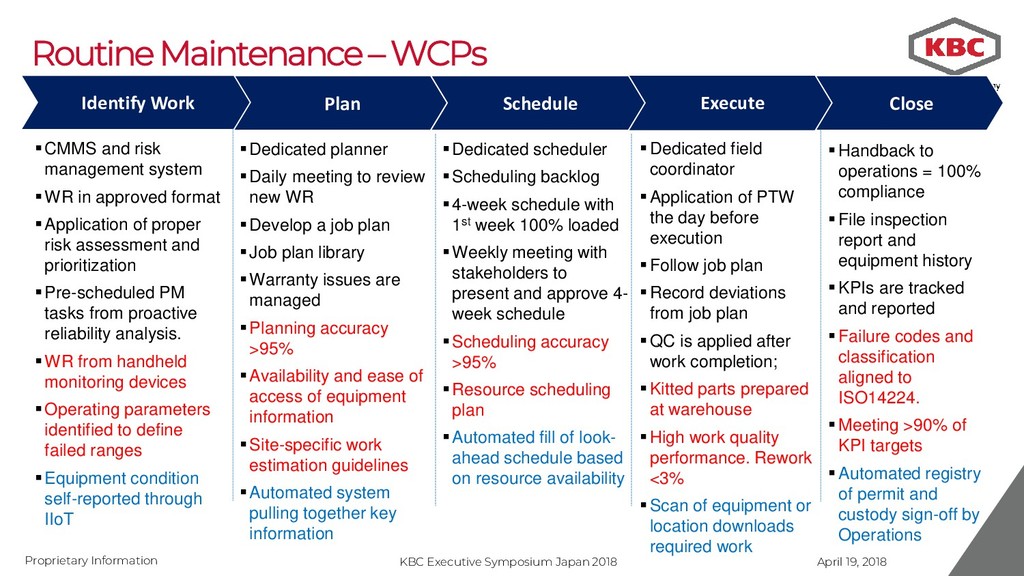
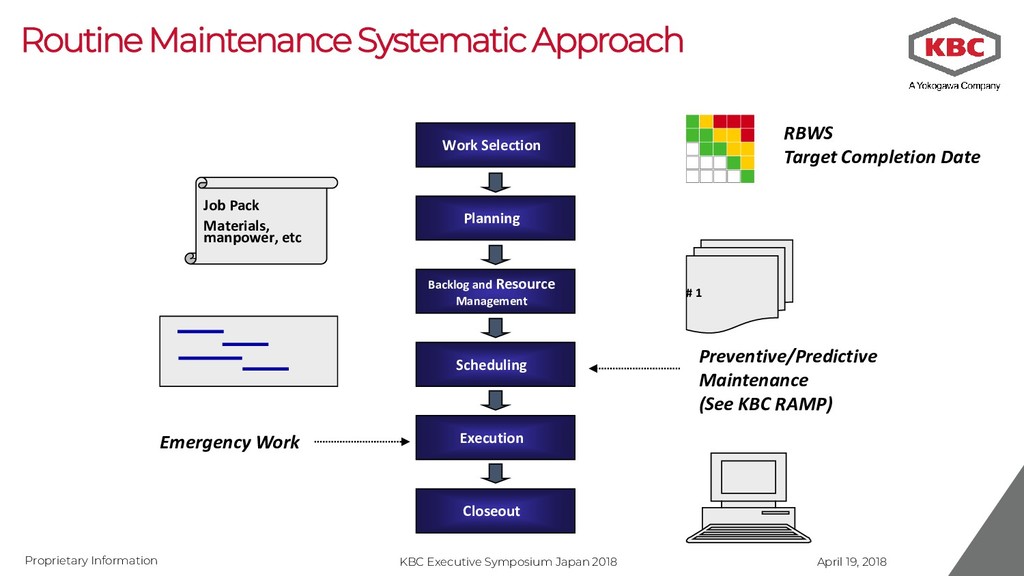
Develop a job plan Job plan library Warranty issues are managed Planning accuracy >95% Availability and ease of access of equipment information Site-specific work estimation guidelines Automated system pulling together key information Routine Maintenance – WCPs Close Schedule Plan Identify Work CMMS and risk management system WR in approved format Application of proper risk assessment and prioritization Pre-scheduled PM tasks from proactive reliability analysis. WR from handheld monitoring devices Operating parameters identified to define failed ranges Equipment condition self-reported through IIoT Dedicated scheduler Scheduling backlog 4-week schedule with 1st week 100% loaded Weekly meeting with stakeholders to present and approve 4- week schedule Scheduling accuracy >95% Resource scheduling plan Automated fill of look- ahead schedule based on resource availability Dedicated field coordinator Application of PTW the day before execution Follow job plan Record deviations from job plan QC is applied after work completion; Kitted parts prepared at warehouse High work quality performance. Rework <3% Scan of equipment or location downloads required work Execute Handback to operations = 100% compliance File inspection report and equipment history KPIs are tracked and reported Failure codes and classification aligned to ISO14224. Meeting >90% of KPI targets Automated registry of permit and custody sign-off by Operations KBC Executive Symposium Japan 2018 April 19, 2018
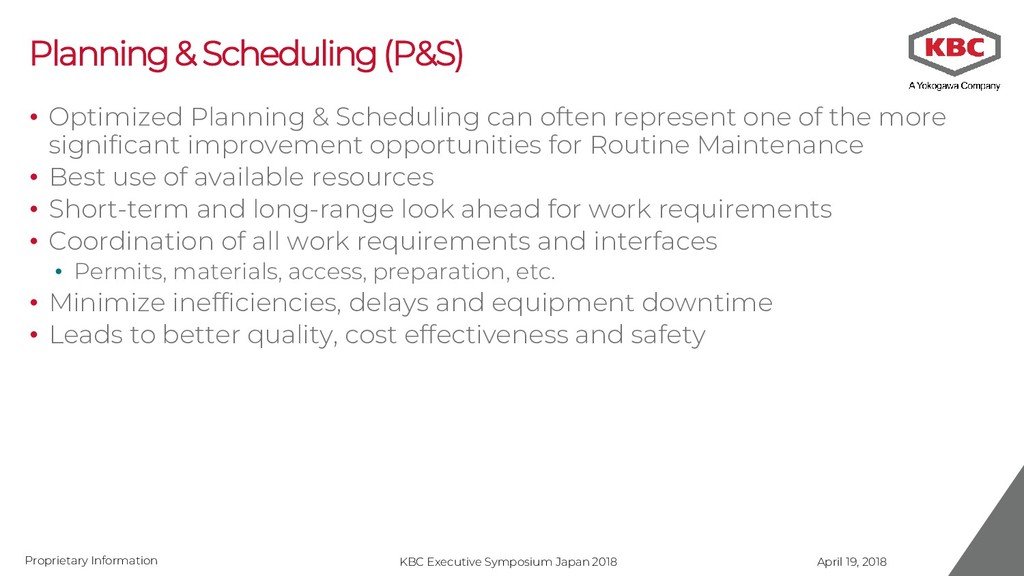
Scheduling can often represent one of the more significant improvement opportunities for Routine Maintenance • Best use of available resources • Short-term and long-range look ahead for work requirements • Coordination of all work requirements and interfaces • Permits, materials, access, preparation, etc. • Minimize inefficiencies, delays and equipment downtime • Leads to better quality, cost effectiveness and safety KBC Executive Symposium Japan 2018 April 19, 2018
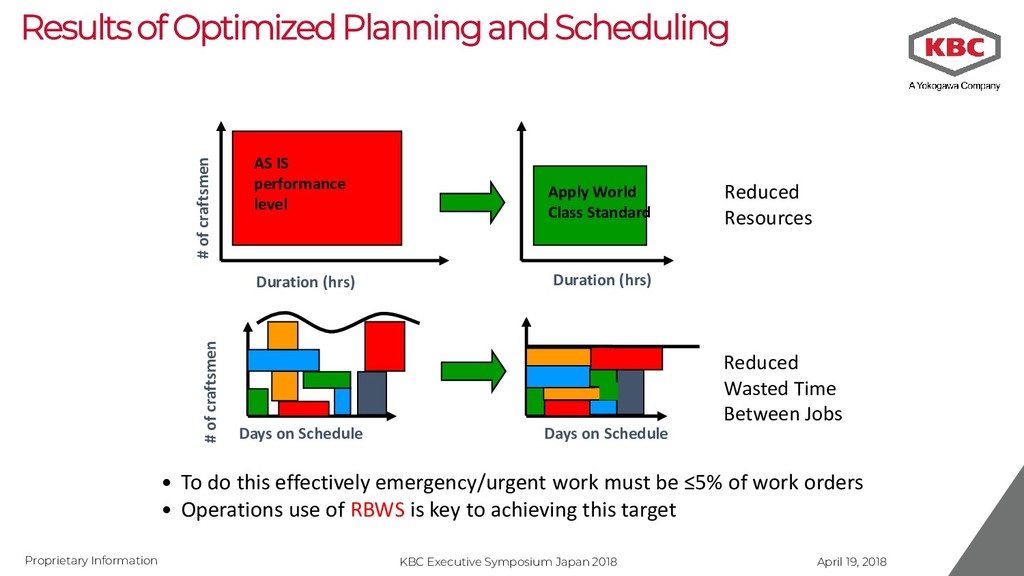
craftsmen Duration (hrs) AS IS performance level Apply World Class Standard Duration (hrs) Reduced Resources Days on Schedule Days on Schedule # of craftsmen Reduced Wasted Time Between Jobs • To do this effectively emergency/urgent work must be ≤5% of work orders • Operations use of RBWS is key to achieving this target KBC Executive Symposium Japan 2018 April 19, 2018
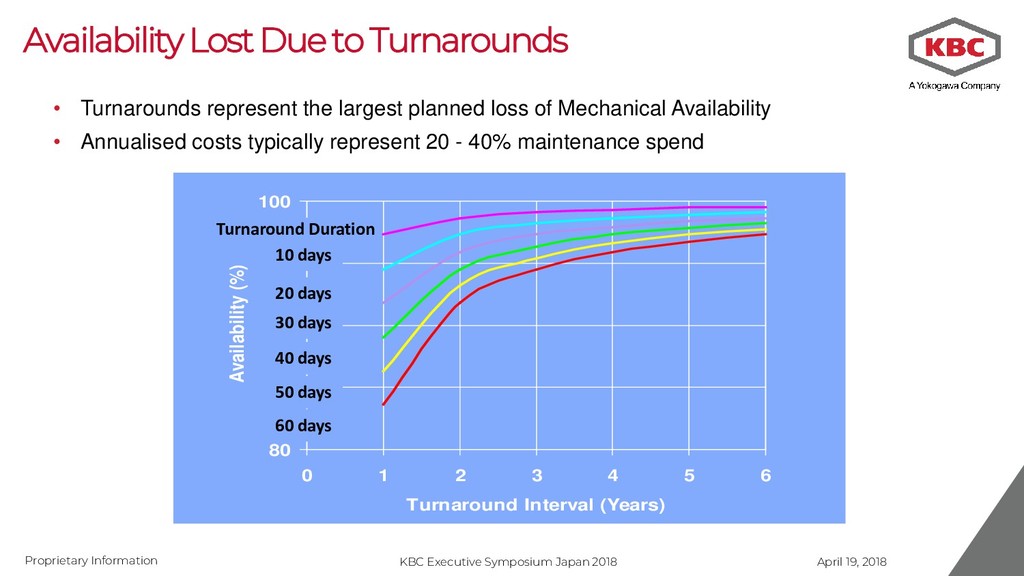
95 100 0 1 2 3 4 5 6 Turnaround Interval (Years) Availability (%) Turnaround Duration 60 days 50 days 40 days 30 days 20 days 10 days • Turnarounds represent the largest planned loss of Mechanical Availability • Annualised costs typically represent 20 - 40% maintenance spend KBC Executive Symposium Japan 2018 April 19, 2018
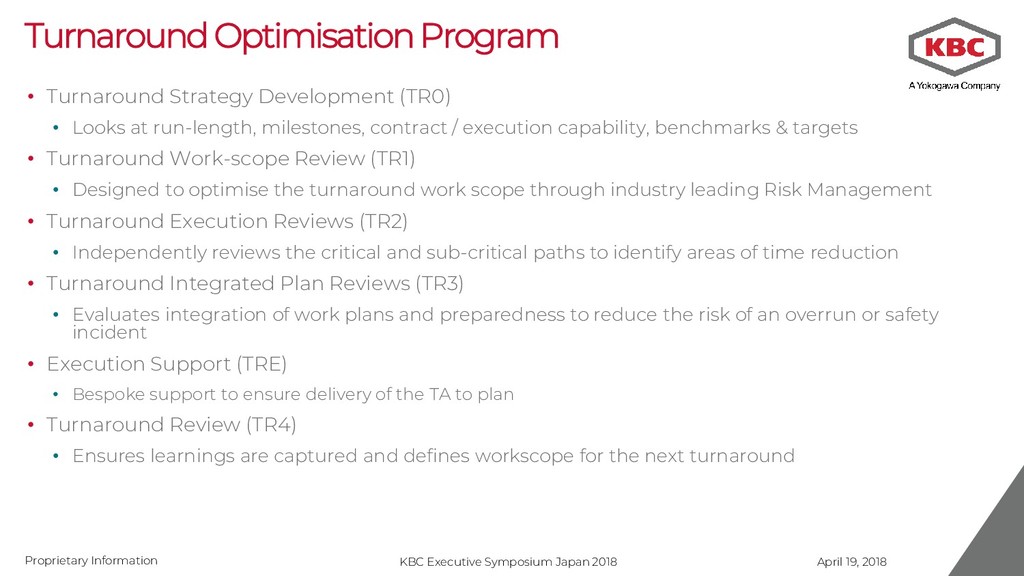
• Looks at run-length, milestones, contract / execution capability, benchmarks & targets • Turnaround Work-scope Review (TR1) • Designed to optimise the turnaround work scope through industry leading Risk Management • Turnaround Execution Reviews (TR2) • Independently reviews the critical and sub-critical paths to identify areas of time reduction • Turnaround Integrated Plan Reviews (TR3) • Evaluates integration of work plans and preparedness to reduce the risk of an overrun or safety incident • Execution Support (TRE) • Bespoke support to ensure delivery of the TA to plan • Turnaround Review (TR4) • Ensures learnings are captured and defines workscope for the next turnaround KBC Executive Symposium Japan 2018 April 19, 2018
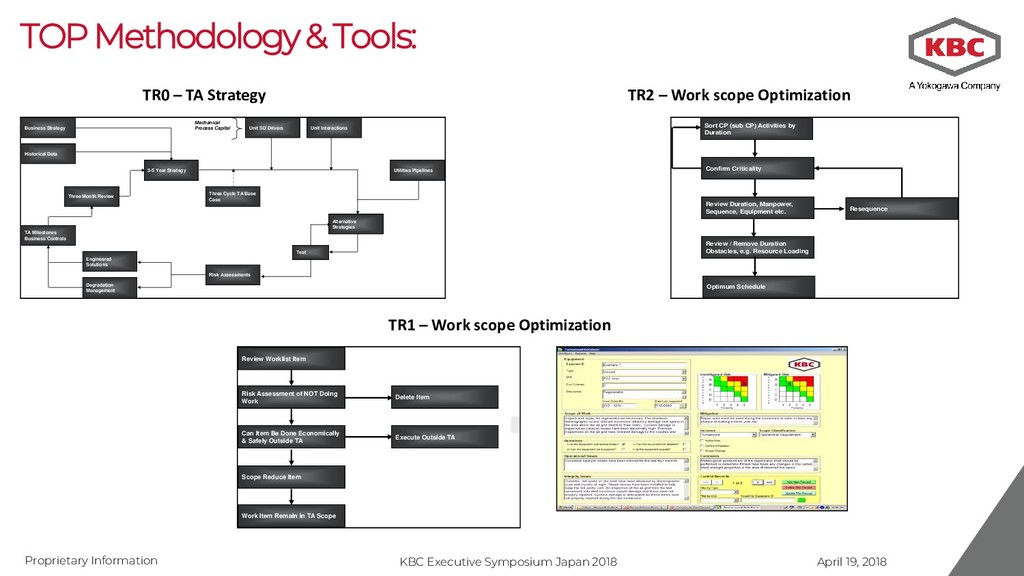
Drivers Unit Interactions Historical Data 3-5 Year Strategy Utilities Pipelines Three Month Review Three Cycle TA Base Case TA Milestones Business Controls Alternative Strategies Engineered Solutions Risk Assessments Degradation Management Test Mechanical Process Capital Review Worklist Item Scope Reduce Item Risk Assessment of NOT Doing Work Can Item Be Done Economically & Safely Outside TA Delete Item Execute Outside TA Work Item Remain in TA Scope Sort CP (sub CP) Activities by Duration Confirm Criticality Review Duration, Manpower, Sequence, Equipment etc. Review / Remove Duration Obstacles, e.g. Resource Loading Resequence Optimum Schedule TR0 – TA Strategy TR1 – Work scope Optimization TR2 – Work scope Optimization KBC Executive Symposium Japan 2018 April 19, 2018
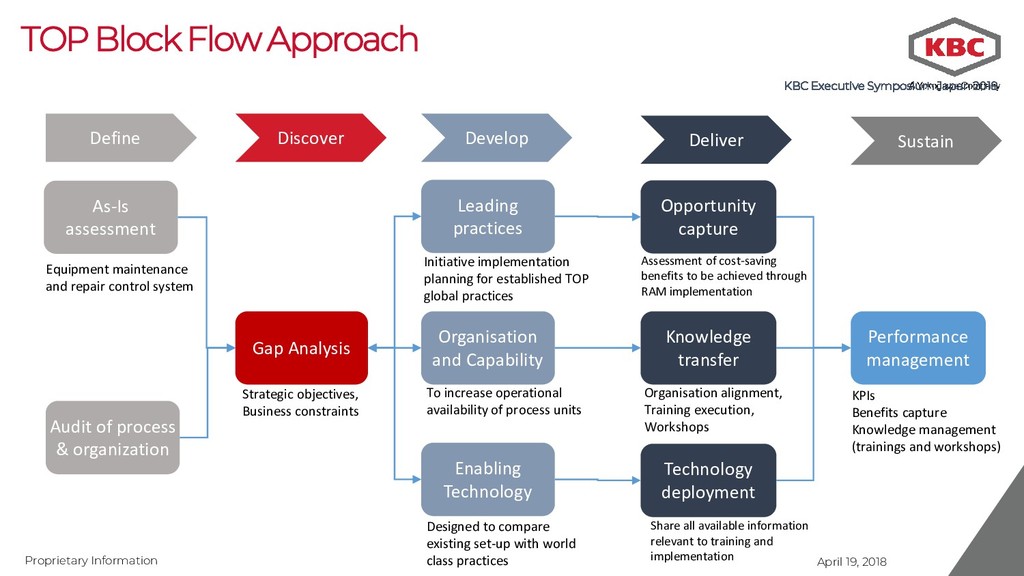
process & organization Gap Analysis Leading practices Organisation and Capability Enabling Technology Technology deployment Knowledge transfer Opportunity capture Performance management Define Discover Develop Deliver Sustain Equipment maintenance and repair control system Strategic objectives, Business constraints Initiative implementation planning for established TOP global practices To increase operational availability of process units Designed to compare existing set-up with world class practices Share all available information relevant to training and implementation Assessment of cost-saving benefits to be achieved through RAM implementation Organisation alignment, Training execution, Workshops KPIs Benefits capture Knowledge management (trainings and workshops) KBC Executive Symposium Japan 2018 April 19, 2018
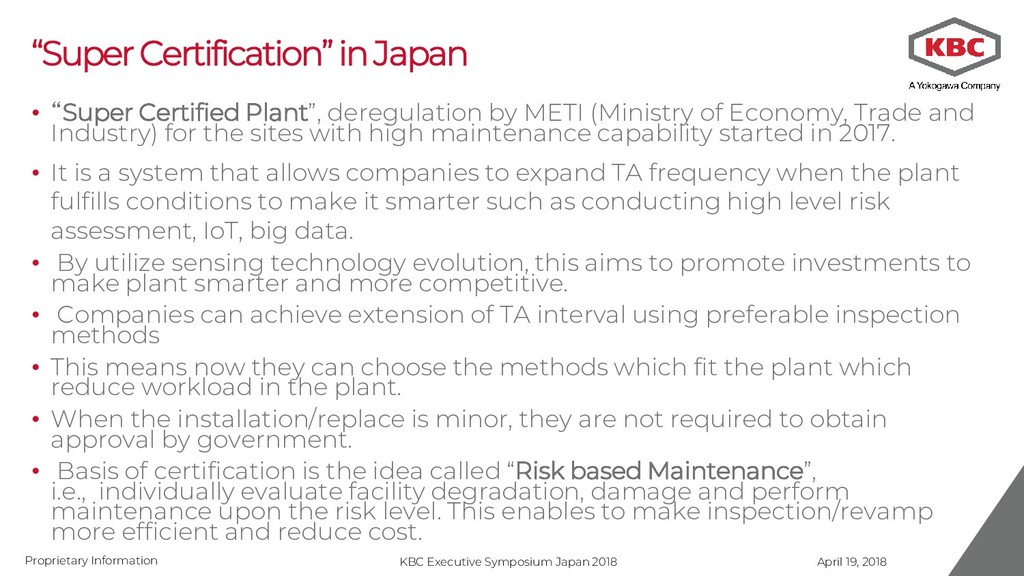
deregulation by METI (Ministry of Economy, Trade and Industry) for the sites with high maintenance capability started in 2017. • It is a system that allows companies to expand TA frequency when the plant fulfills conditions to make it smarter such as conducting high level risk assessment, IoT, big data. • By utilize sensing technology evolution, this aims to promote investments to make plant smarter and more competitive. • Companies can achieve extension of TA interval using preferable inspection methods • This means now they can choose the methods which fit the plant which reduce workload in the plant. • When the installation/replace is minor, they are not required to obtain approval by government. • Basis of certification is the idea called “Risk based Maintenance”, i.e., individually evaluate facility degradation, damage and perform maintenance upon the risk level. This enables to make inspection/revamp more efficient and reduce cost. KBC Executive Symposium Japan 2018 April 19, 2018
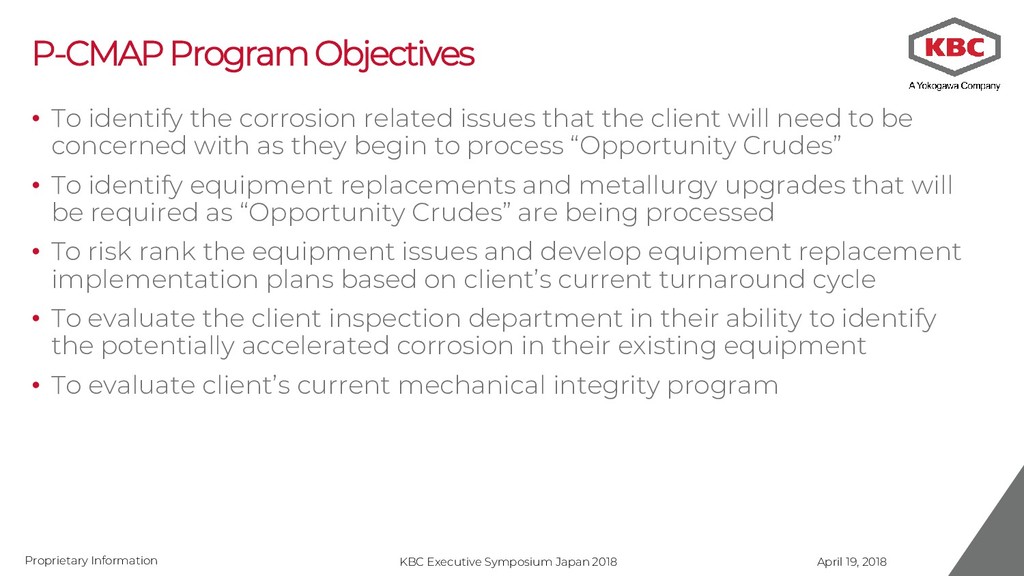
the client will need to be concerned with as they begin to process “Opportunity Crudes” • To identify equipment replacements and metallurgy upgrades that will be required as “Opportunity Crudes” are being processed • To risk rank the equipment issues and develop equipment replacement implementation plans based on client’s current turnaround cycle • To evaluate the client inspection department in their ability to identify the potentially accelerated corrosion in their existing equipment • To evaluate client’s current mechanical integrity program P-CMAP Program Objectives KBC Executive Symposium Japan 2018 April 19, 2018
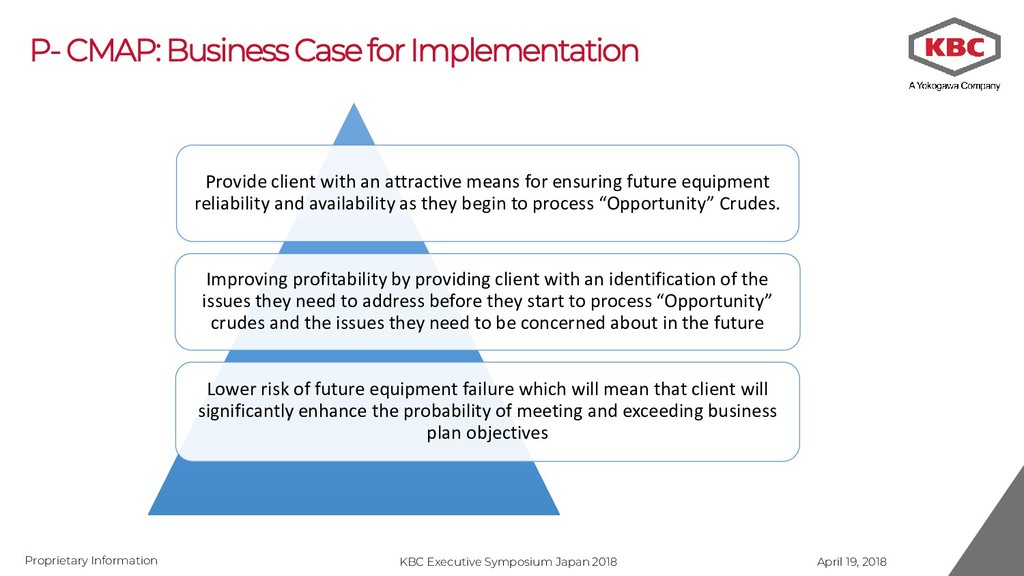
an attractive means for ensuring future equipment reliability and availability as they begin to process “Opportunity” Crudes. Improving profitability by providing client with an identification of the issues they need to address before they start to process “Opportunity” crudes and the issues they need to be concerned about in the future Lower risk of future equipment failure which will mean that client will significantly enhance the probability of meeting and exceeding business plan objectives KBC Executive Symposium Japan 2018 April 19, 2018
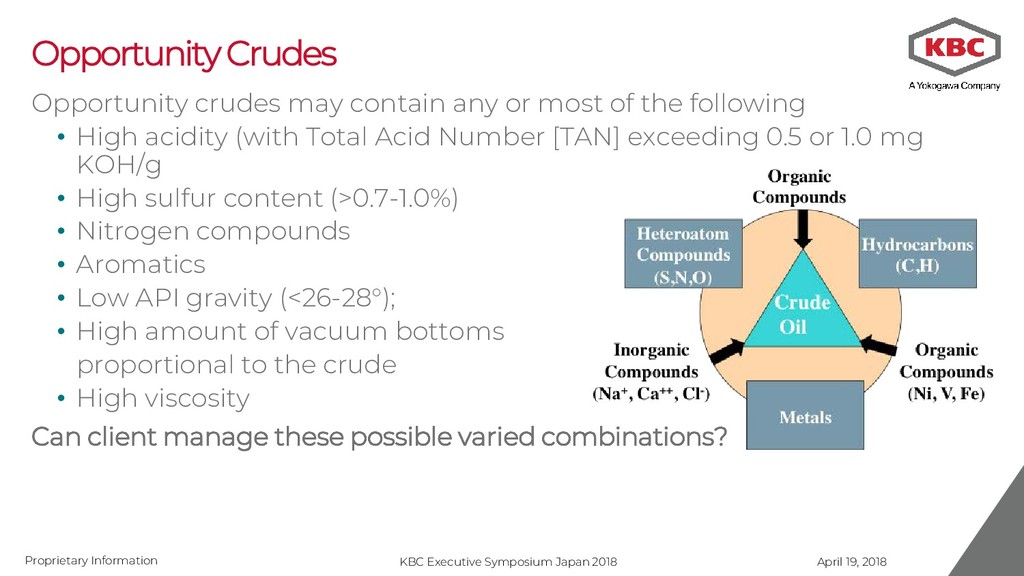
most of the following • High acidity (with Total Acid Number [TAN] exceeding 0.5 or 1.0 mg KOH/g • High sulfur content (>0.7-1.0%) • Nitrogen compounds • Aromatics • Low API gravity (<26-28°); • High amount of vacuum bottoms proportional to the crude • High viscosity Can client manage these possible varied combinations? KBC Executive Symposium Japan 2018 April 19, 2018
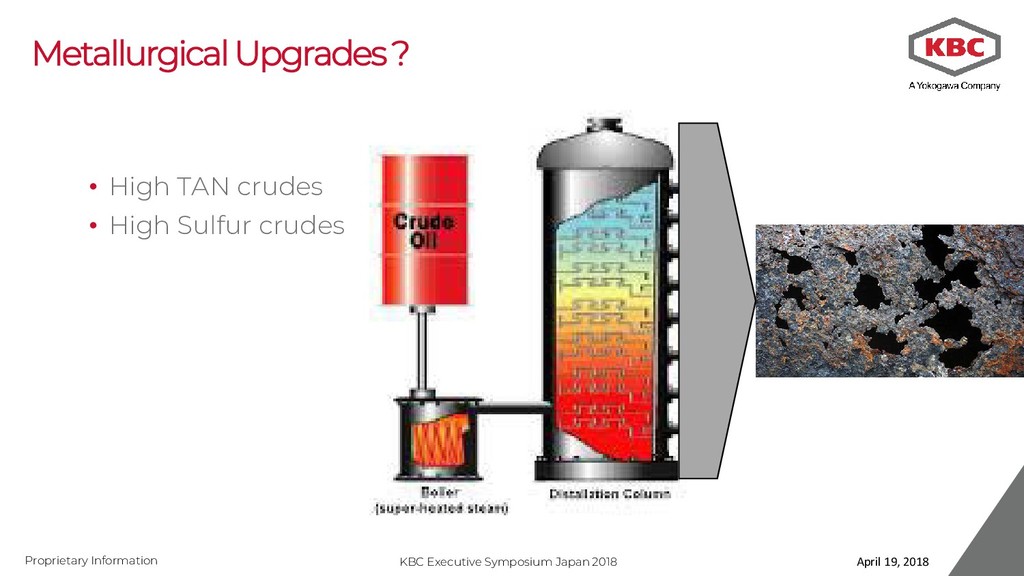
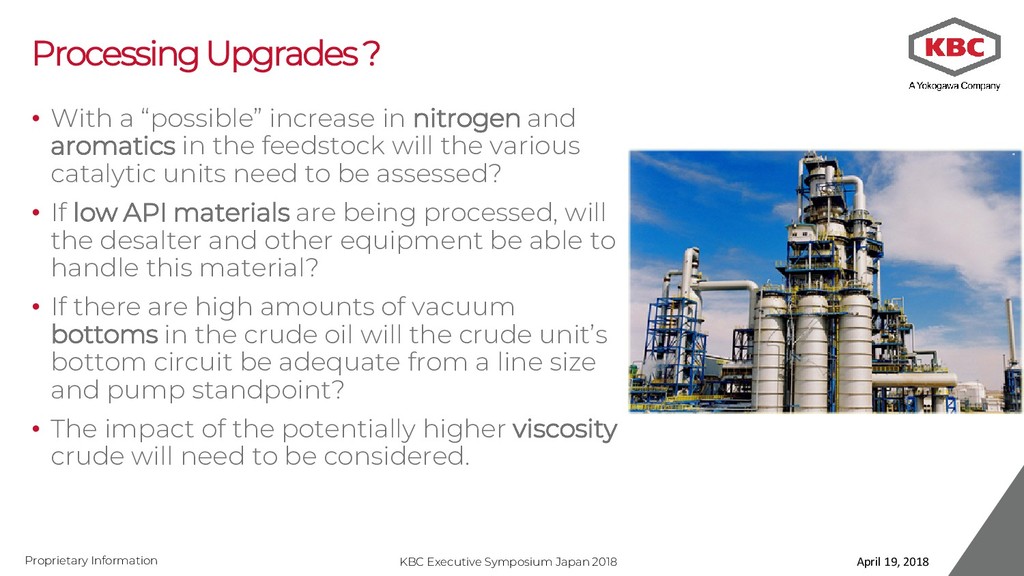
in nitrogen and aromatics in the feedstock will the various catalytic units need to be assessed? • If low API materials are being processed, will the desalter and other equipment be able to handle this material? • If there are high amounts of vacuum bottoms in the crude oil will the crude unit’s bottom circuit be adequate from a line size and pump standpoint? • The impact of the potentially higher viscosity crude will need to be considered. KBC Executive Symposium Japan 2018 April 19, 2018
strategic planning project aimed at ensuring client’s current and future ability to meet their business plans as they begin to process “Opportunity Crudes” • KBC can provide consultation to client as they begin to process “Opportunity Crudes” . • Client will: • know what to do • when to do it • where to do it • how to do it KBC Executive Symposium Japan 2018 April 19, 2018
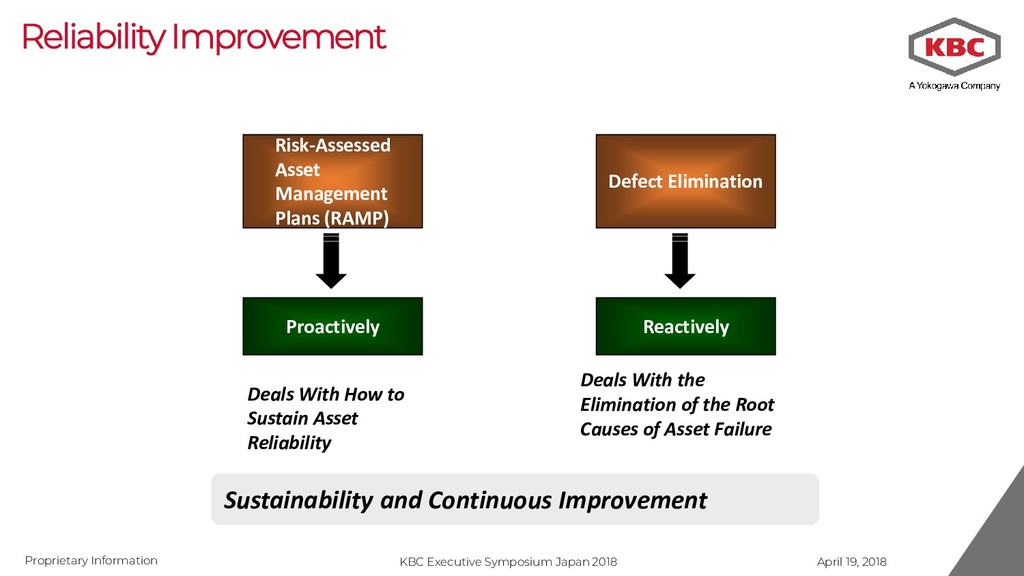
Reliability Deals With the Elimination of the Root Causes of Asset Failure Risk-Assessed Asset Management Plans (RAMP) Defect Elimination Proactively Reactively Sustainability and Continuous Improvement KBC Executive Symposium Japan 2018 April 19, 2018
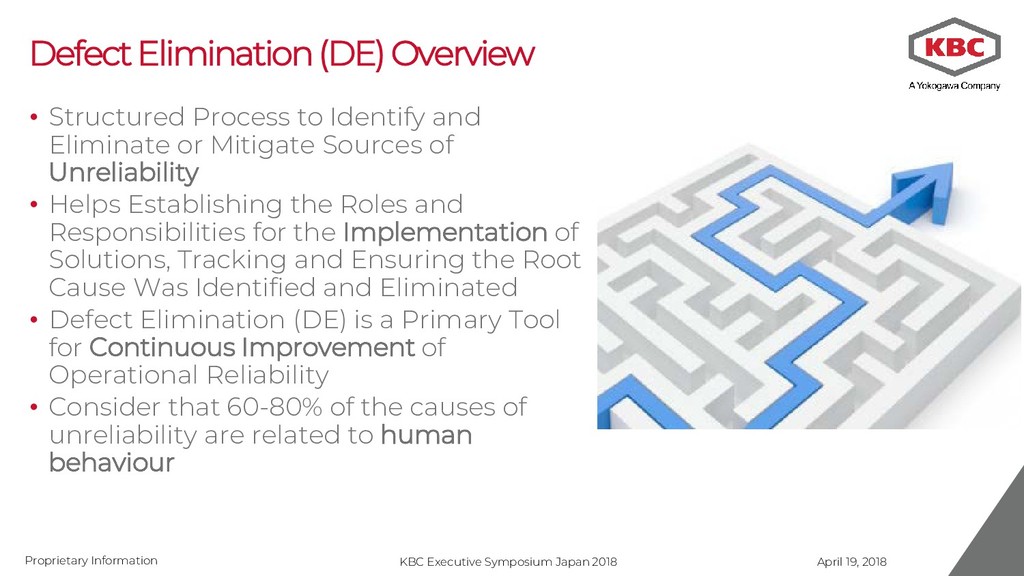
Identify and Eliminate or Mitigate Sources of Unreliability • Helps Establishing the Roles and Responsibilities for the Implementation of Solutions, Tracking and Ensuring the Root Cause Was Identified and Eliminated • Defect Elimination (DE) is a Primary Tool for Continuous Improvement of Operational Reliability • Consider that 60-80% of the causes of unreliability are related to human behaviour KBC Executive Symposium Japan 2018 April 19, 2018
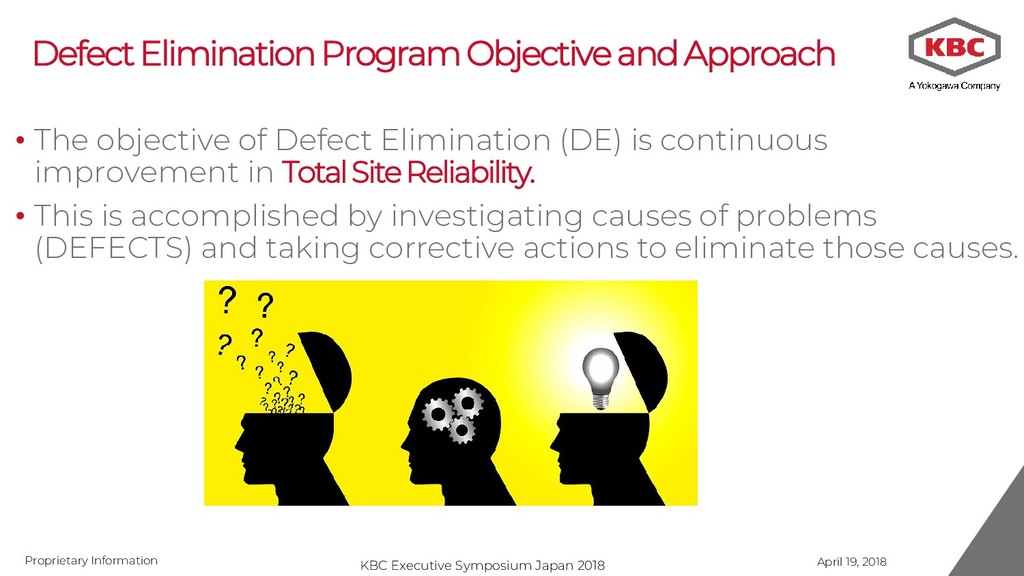
The objective of Defect Elimination (DE) is continuous improvement in Total Site Reliability. • This is accomplished by investigating causes of problems (DEFECTS) and taking corrective actions to eliminate those causes. KBC Executive Symposium Japan 2018 April 19, 2018
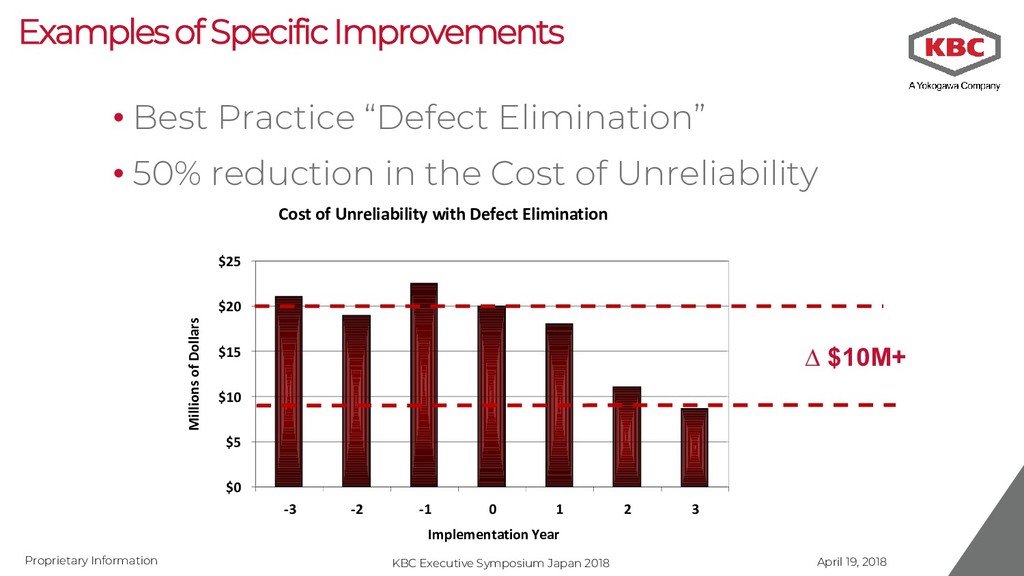
Elimination” • 50% reduction in the Cost of Unreliability Cost of Unreliability with Defect Elimination $0 $5 $10 $15 $20 $25 -3 -2 -1 0 1 2 3 Implementation Year Millions of Dollars ∆ $10M+ KBC Executive Symposium Japan 2018 April 19, 2018
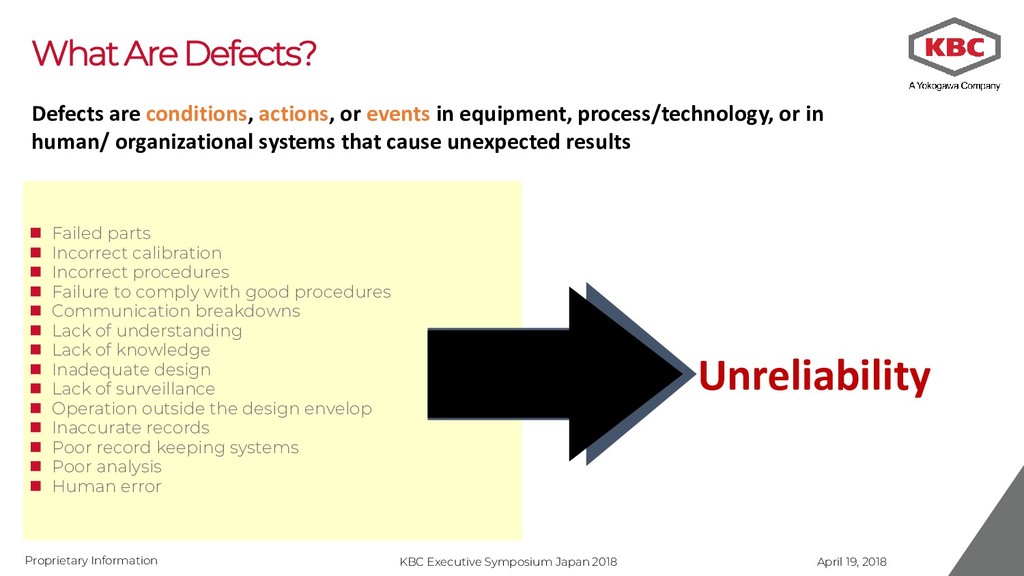
Incorrect calibration Incorrect procedures Failure to comply with good procedures Communication breakdowns Lack of understanding Lack of knowledge Inadequate design Lack of surveillance Operation outside the design envelop Inaccurate records Poor record keeping systems Poor analysis Human error Unreliability Defects are conditions, actions, or events in equipment, process/technology, or in human/ organizational systems that cause unexpected results KBC Executive Symposium Japan 2018 April 19, 2018
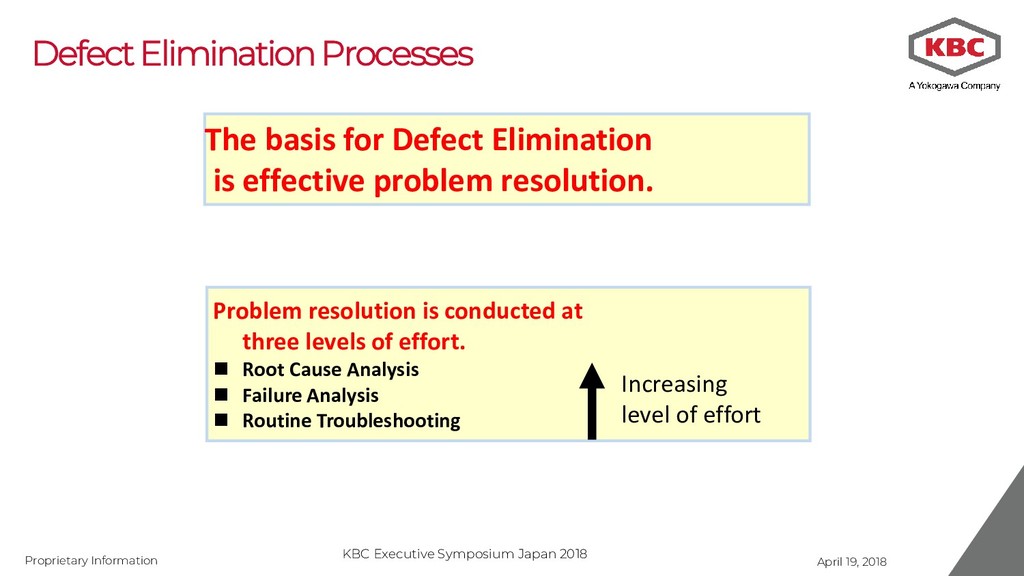
of effort. Root Cause Analysis Failure Analysis Routine Troubleshooting Defect Elimination Processes Increasing level of effort The basis for Defect Elimination is effective problem resolution. KBC Executive Symposium Japan 2018 April 19, 2018
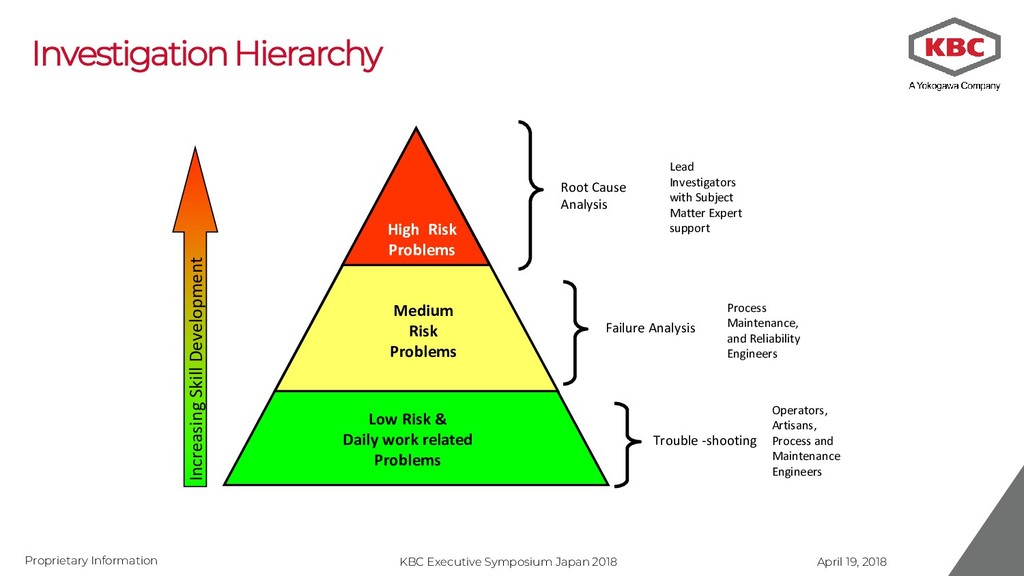
Problems Medium Risk Problems High Risk Problems Increasing Skill Development Operators, Artisans, Process and Maintenance Engineers Process Maintenance, and Reliability Engineers Lead Investigators with Subject Matter Expert support Trouble -shooting Failure Analysis Root Cause Analysis KBC Executive Symposium Japan 2018 April 19, 2018
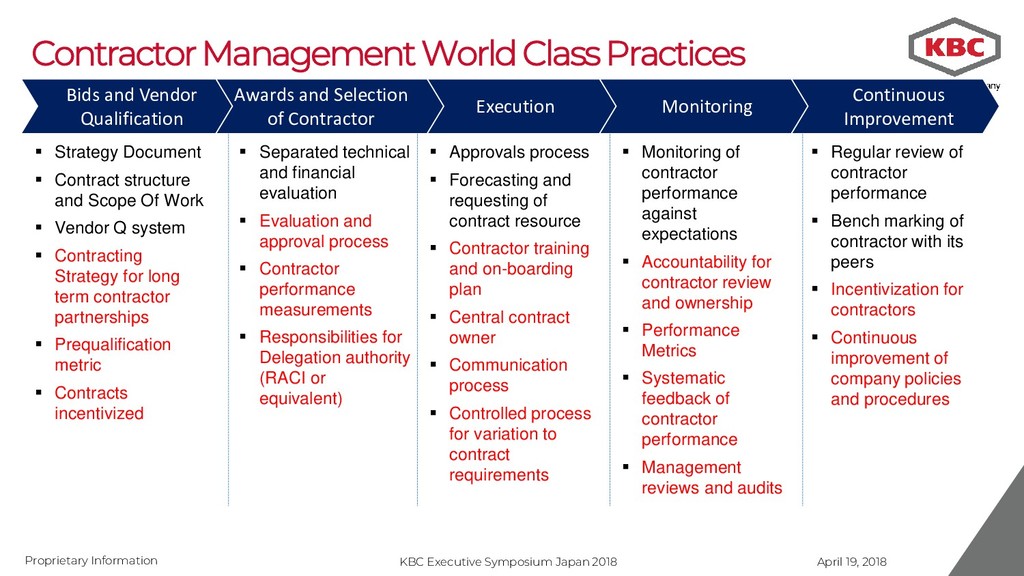
Execution Awards and Selection of Contractor Bids and Vendor Qualification Regular review of contractor performance Bench marking of contractor with its peers Incentivization for contractors Continuous improvement of company policies and procedures Strategy Document Contract structure and Scope Of Work Vendor Q system Contracting Strategy for long term contractor partnerships Prequalification metric Contracts incentivized Separated technical and financial evaluation Evaluation and approval process Contractor performance measurements Responsibilities for Delegation authority (RACI or equivalent) Approvals process Forecasting and requesting of contract resource Contractor training and on-boarding plan Central contract owner Communication process Controlled process for variation to contract requirements Monitoring of contractor performance against expectations Accountability for contractor review and ownership Performance Metrics Systematic feedback of contractor performance Management reviews and audits KBC Executive Symposium Japan 2018 April 19, 2018
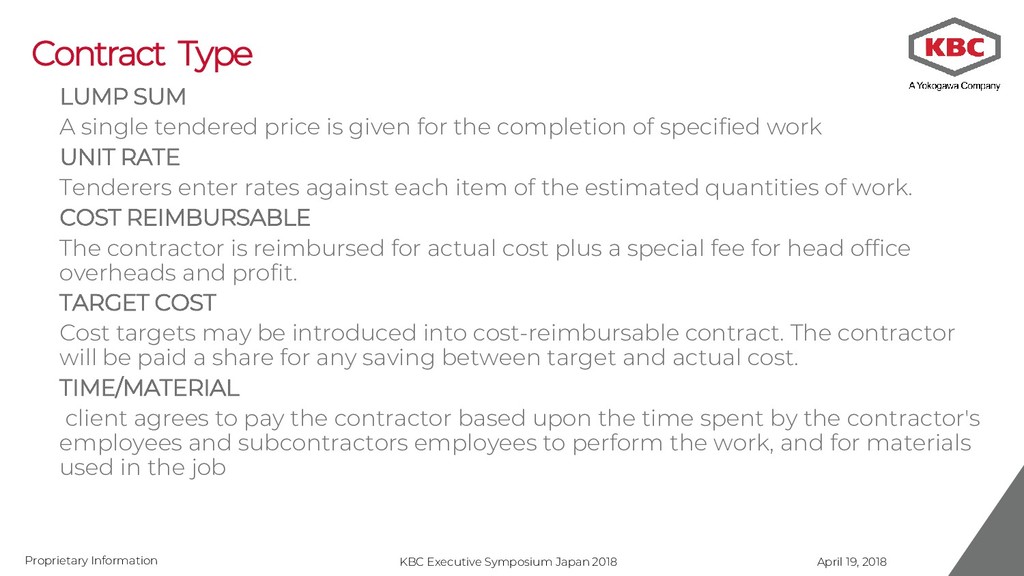
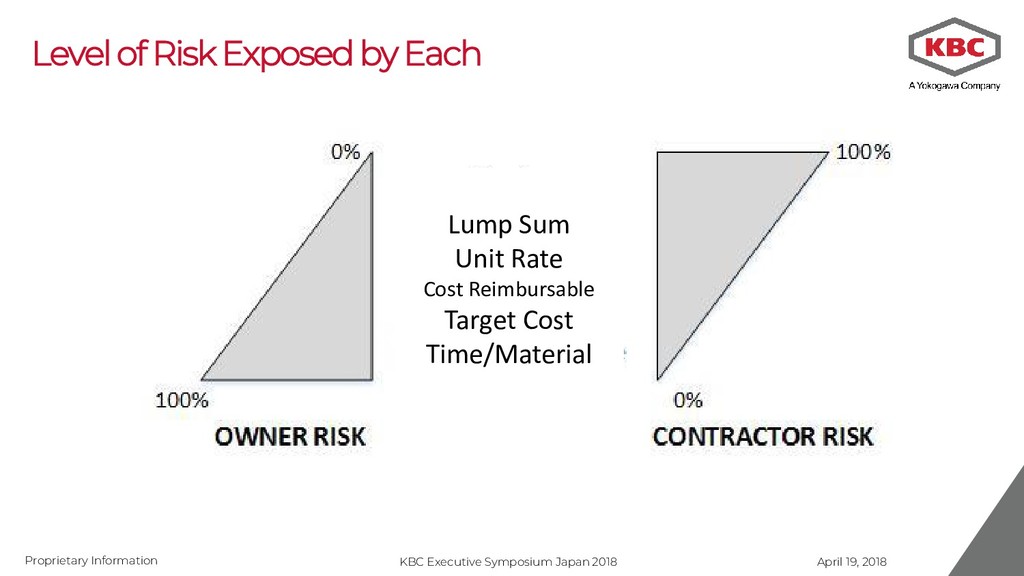
is given for the completion of specified work UNIT RATE Tenderers enter rates against each item of the estimated quantities of work. COST REIMBURSABLE The contractor is reimbursed for actual cost plus a special fee for head office overheads and profit. TARGET COST Cost targets may be introduced into cost-reimbursable contract. The contractor will be paid a share for any saving between target and actual cost. TIME/MATERIAL client agrees to pay the contractor based upon the time spent by the contractor's employees and subcontractors employees to perform the work, and for materials used in the job KBC Executive Symposium Japan 2018 April 19, 2018
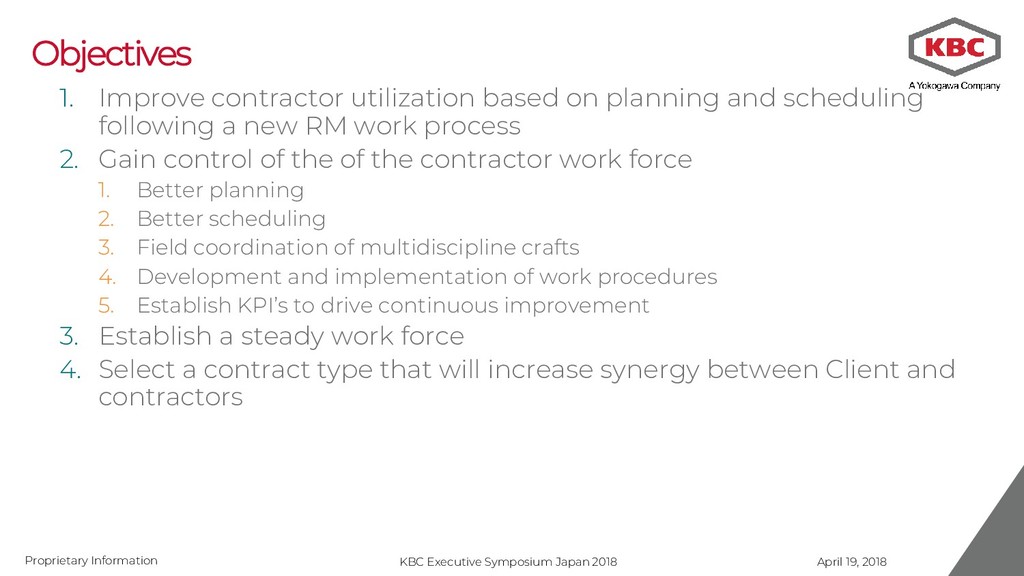
and scheduling following a new RM work process 2. Gain control of the of the contractor work force 1. Better planning 2. Better scheduling 3. Field coordination of multidiscipline crafts 4. Development and implementation of work procedures 5. Establish KPI’s to drive continuous improvement 3. Establish a steady work force 4. Select a contract type that will increase synergy between Client and contractors KBC Executive Symposium Japan 2018 April 19, 2018
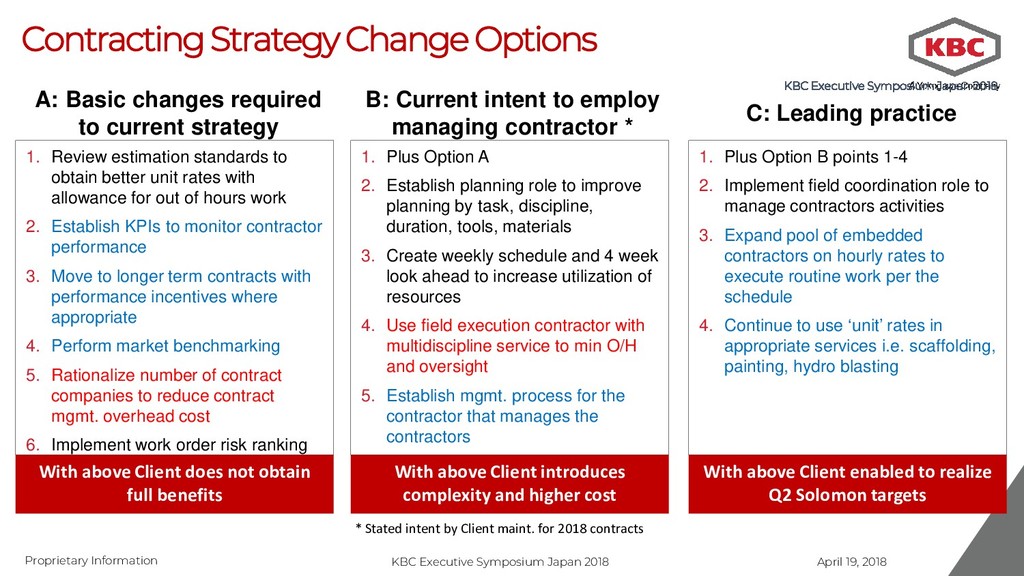
points 1-4 2. Implement field coordination role to manage contractors activities 3. Expand pool of embedded contractors on hourly rates to execute routine work per the schedule 4. Continue to use ‘unit’ rates in appropriate services i.e. scaffolding, painting, hydro blasting C: Leading practice 1. Plus Option A 2. Establish planning role to improve planning by task, discipline, duration, tools, materials 3. Create weekly schedule and 4 week look ahead to increase utilization of resources 4. Use field execution contractor with multidiscipline service to min O/H and oversight 5. Establish mgmt. process for the contractor that manages the contractors B: Current intent to employ managing contractor * 1. Review estimation standards to obtain better unit rates with allowance for out of hours work 2. Establish KPIs to monitor contractor performance 3. Move to longer term contracts with performance incentives where appropriate 4. Perform market benchmarking 5. Rationalize number of contract companies to reduce contract mgmt. overhead cost 6. Implement work order risk ranking A: Basic changes required to current strategy With above Client does not obtain full benefits With above Client introduces complexity and higher cost With above Client enabled to realize Q2 Solomon targets * Stated intent by Client maint. for 2018 contracts KBC Executive Symposium Japan 2018 KBC Executive Symposium Japan 2018 April 19, 2018
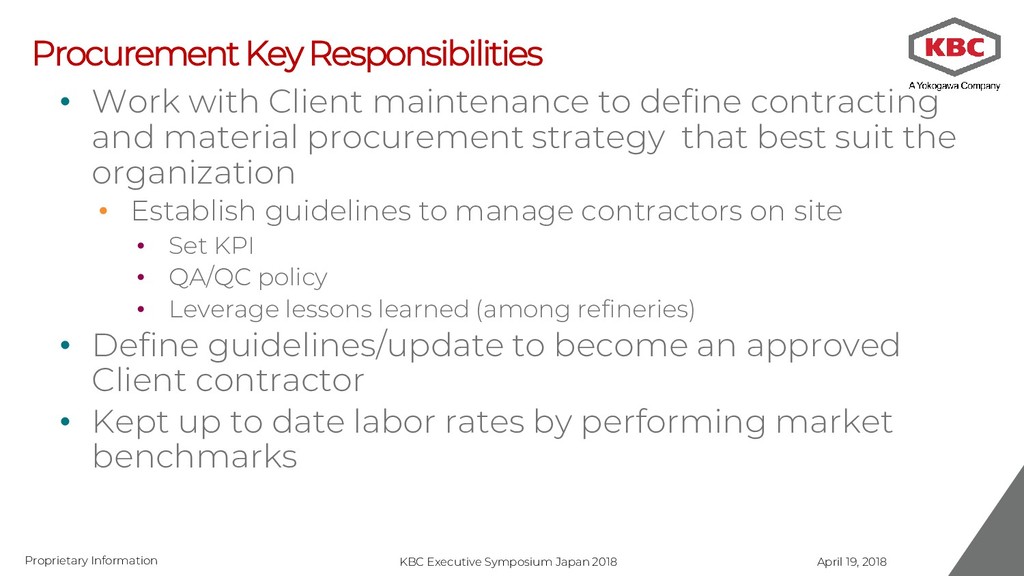
to define contracting and material procurement strategy that best suit the organization • Establish guidelines to manage contractors on site • Set KPI • QA/QC policy • Leverage lessons learned (among refineries) • Define guidelines/update to become an approved Client contractor • Kept up to date labor rates by performing market benchmarks KBC Executive Symposium Japan 2018 April 19, 2018
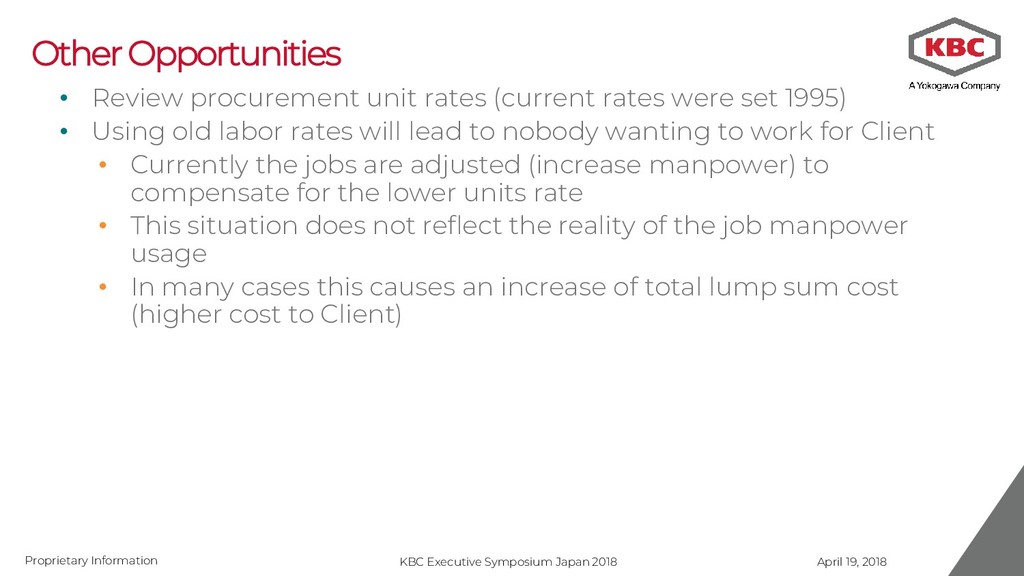
rates were set 1995) • Using old labor rates will lead to nobody wanting to work for Client • Currently the jobs are adjusted (increase manpower) to compensate for the lower units rate • This situation does not reflect the reality of the job manpower usage • In many cases this causes an increase of total lump sum cost (higher cost to Client) KBC Executive Symposium Japan 2018 April 19, 2018
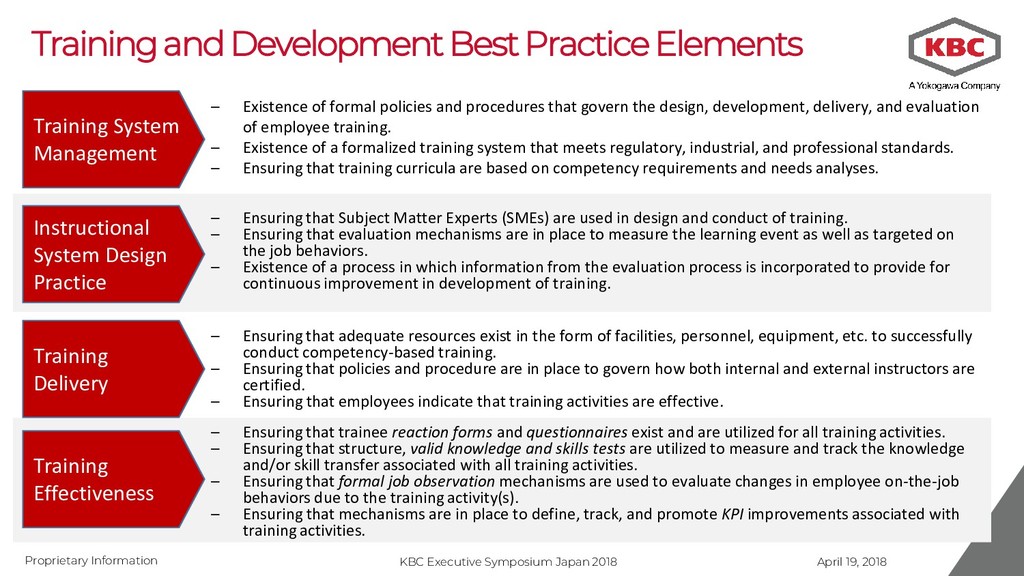
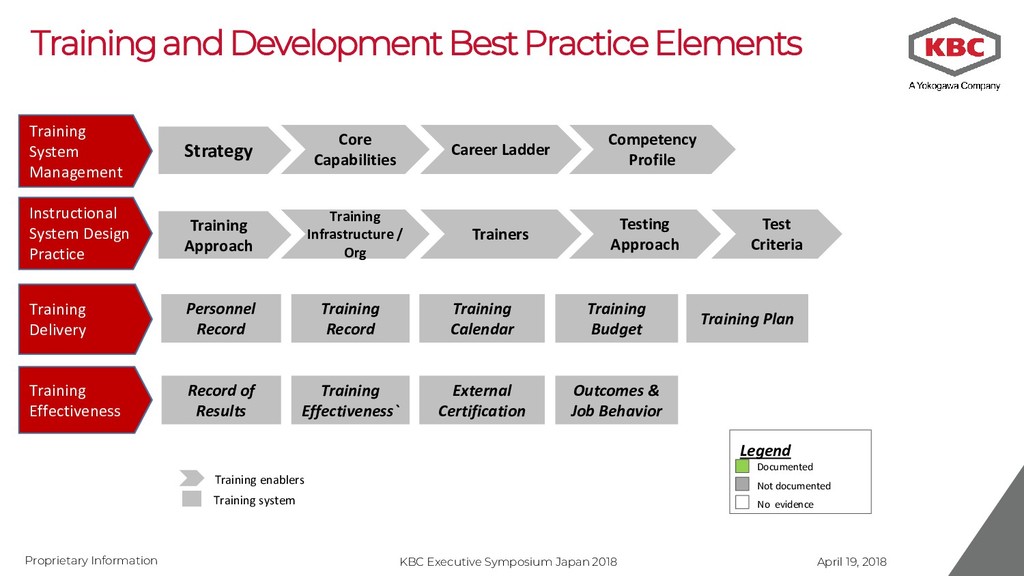
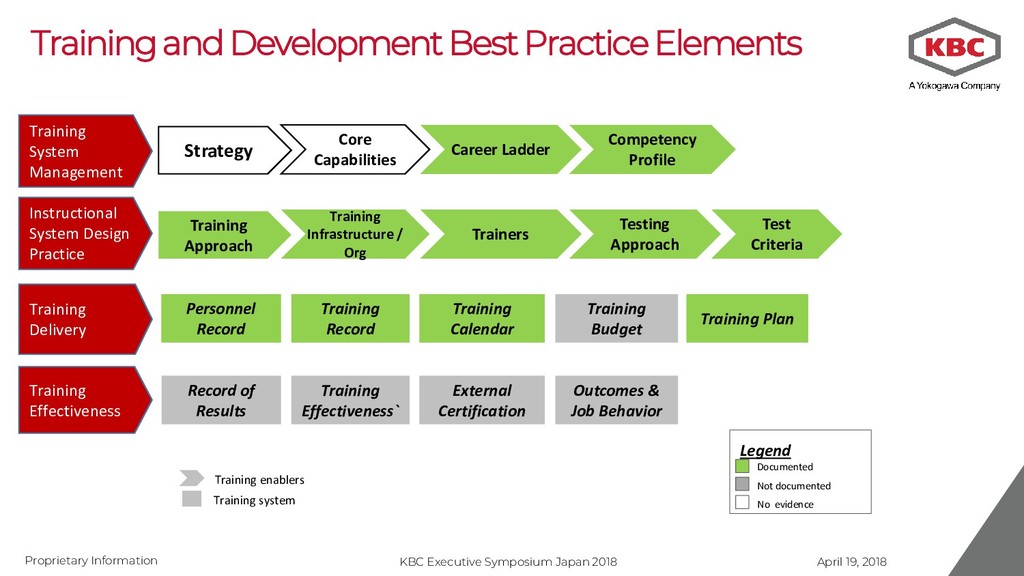
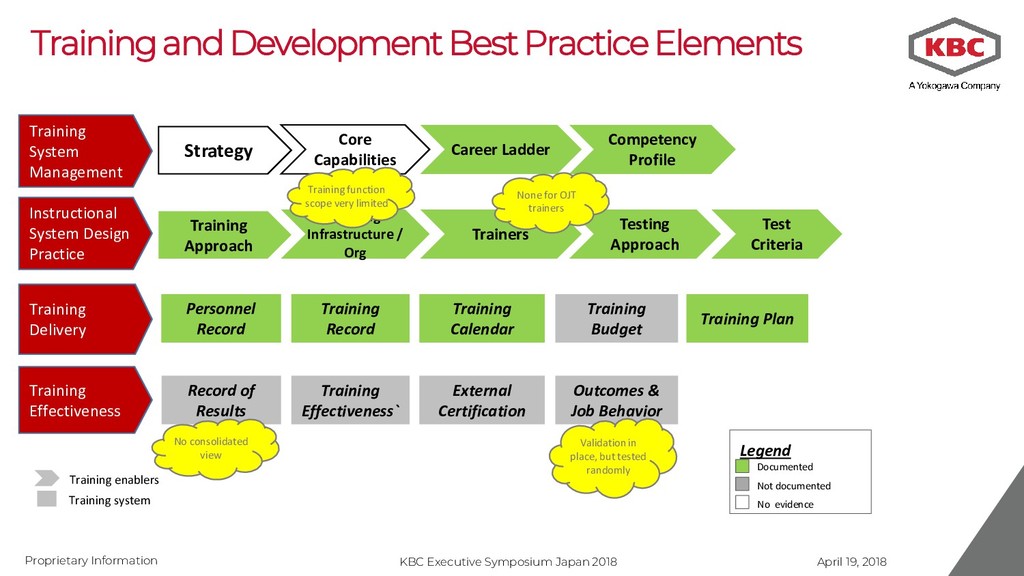
of formal policies and procedures that govern the design, development, delivery, and evaluation of employee training. – Existence of a formalized training system that meets regulatory, industrial, and professional standards. – Ensuring that training curricula are based on competency requirements and needs analyses. Training System Management Instructional System Design Practice – Ensuring that Subject Matter Experts (SMEs) are used in design and conduct of training. – Ensuring that evaluation mechanisms are in place to measure the learning event as well as targeted on the job behaviors. – Existence of a process in which information from the evaluation process is incorporated to provide for continuous improvement in development of training. – Ensuring that trainee reaction forms and questionnaires exist and are utilized for all training activities. – Ensuring that structure, valid knowledge and skills tests are utilized to measure and track the knowledge and/or skill transfer associated with all training activities. – Ensuring that formal job observation mechanisms are used to evaluate changes in employee on-the-job behaviors due to the training activity(s). – Ensuring that mechanisms are in place to define, track, and promote KPI improvements associated with training activities. Training Delivery – Ensuring that adequate resources exist in the form of facilities, personnel, equipment, etc. to successfully conduct competency-based training. – Ensuring that policies and procedure are in place to govern how both internal and external instructors are certified. – Ensuring that employees indicate that training activities are effective. Training Effectiveness KBC Executive Symposium Japan 2018 April 19, 2018
Management Instructional System Design Practice Training Delivery Training Effectiveness Training Approach Training Infrastructure / Org Trainers Testing Approach Test Criteria Strategy Core Capabilities Career Ladder Competency Profile Personnel Record Training Calendar Training Record Training Budget Training Plan Training Effectiveness` Record of Results Outcomes & Job Behavior External Certification Training enablers Training system Documented Not documented No evidence Legend KBC Executive Symposium Japan 2018 April 19, 2018
Management Instructional System Design Practice Training Delivery Training Effectiveness Training Approach Training Infrastructure / Org Trainers Testing Approach Test Criteria Strategy Core Capabilities Career Ladder Competency Profile Personnel Record Training Calendar Training Record Training Budget Training Plan Training Effectiveness` Record of Results Outcomes & Job Behavior External Certification Training enablers Training system Documented Not documented No evidence Legend KBC Executive Symposium Japan 2018 April 19, 2018
Management Instructional System Design Practice Training Delivery Training Effectiveness Training Approach Training Infrastructure / Org Trainers Testing Approach Test Criteria Strategy Core Capabilities Career Ladder Competency Profile Personnel Record Training Calendar Training Record Training Budget Training Plan Training Effectiveness` Record of Results Outcomes & Job Behavior External Certification Training enablers Training system Documented Not documented No evidence Legend None for OJT trainers No consolidated view Validation in place, but tested randomly Training function scope very limited KBC Executive Symposium Japan 2018 April 19, 2018


 kbcat
 pauljervisheath
 inesmontani
 bcantrill
 tammyeverts
 elsirapls
 eileencodes
 yeseniaperezcruz
 jacobtomlinson
 sonatard
 katiecoart
 apolaine
 rmw