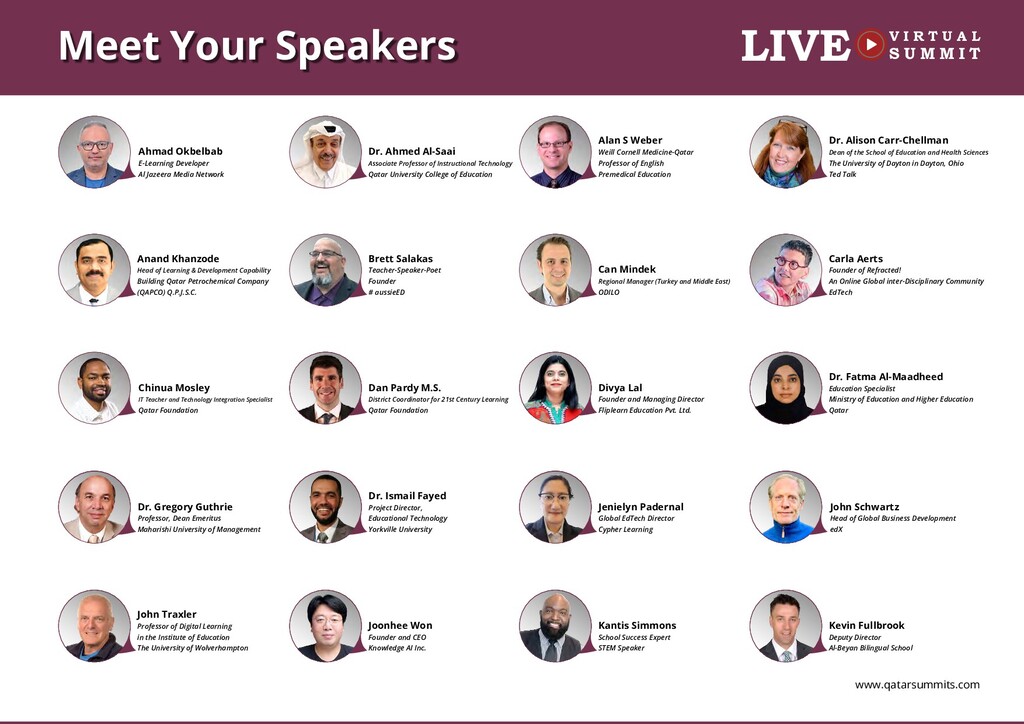
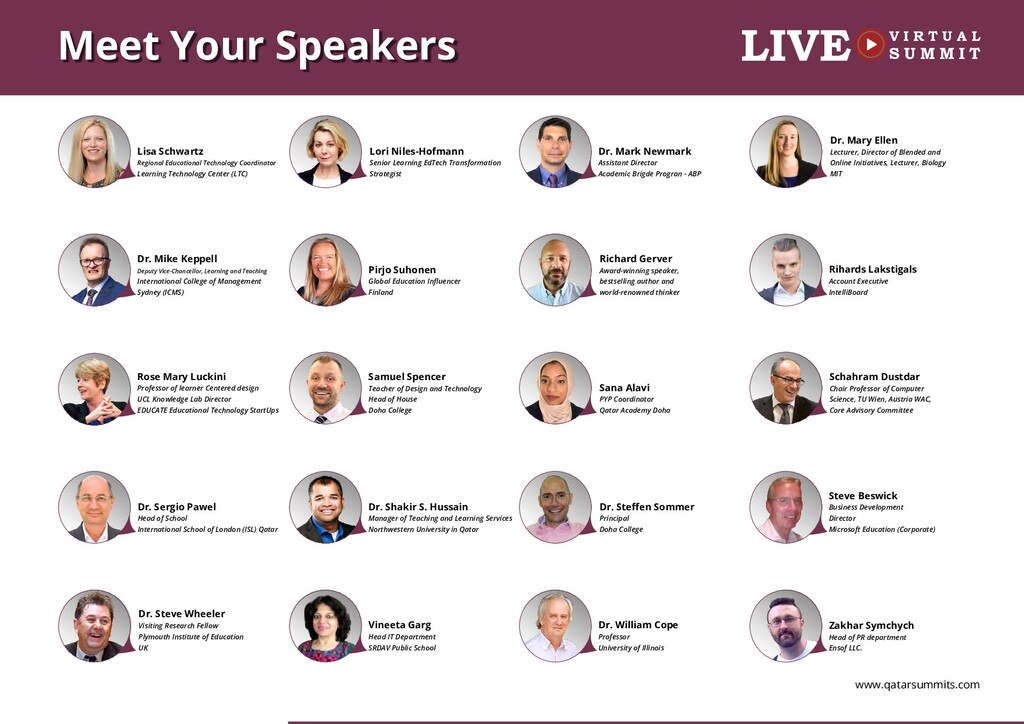
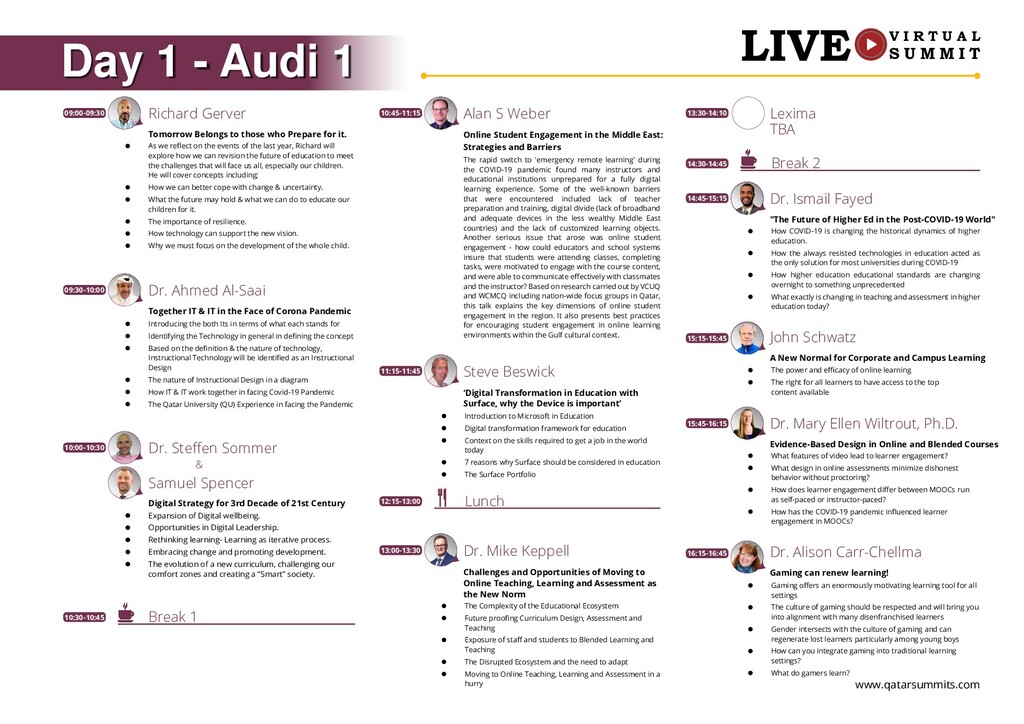
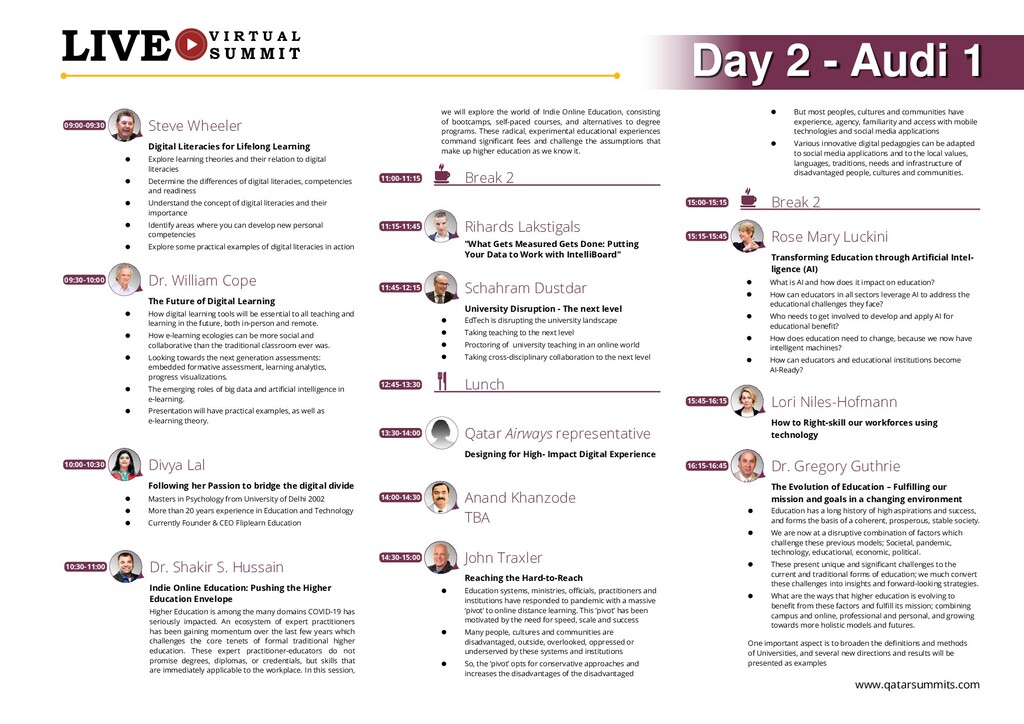
M M I T www.qatarsummits.com Day 2 - Audi 1 Digital Literacies for Lifelong Learning The Future of Digital Learning Higher Education is among the many domains COVID-19 has seriously impacted. An ecosystem of expert practitioners has been gaining momentum over the last few years which challenges the core tenets of formal traditional higher education. These expert practitioner-educators do not promise degrees, diplomas, or credentials, but skills that are immediately applicable to the workplace. In this session, Indie Online Education: Pushing the Higher Education Envelope • How digital learning tools will be essential to all teaching and learning in the future, both in-person and remote. • How e-learning ecologies can be more social and collaborative than the traditional classroom ever was. • Looking towards the next generation assessments: embedded formative assessment, learning analytics, progress visualizations. • The emerging roles of big data and artificial intelligence in e-learning. • Presentation will have practical examples, as well as e-learning theory. • Explore learning theories and their relation to digital literacies • Determine the differences of digital literacies, competencies and readiness • Understand the concept of digital literacies and their importance • Identify areas where you can develop new personal competencies • Explore some practical examples of digital literacies in action • Masters in Psychology from University of Delhi 2002 • More than 20 years experience in Education and Technology • Currently Founder & CEO Fliplearn Education Following her Passion to bridge the digital divide • Education systems, ministries, officials, practitioners and institutions have responded to pandemic with a massive ‘pivot’ to online distance learning. This ‘pivot’ has been motivated by the need for speed, scale and success • Many people, cultures and communities are disadvantaged, outside, overlooked, oppressed or underserved by these systems and institutions • So, the ‘pivot’ opts for conservative approaches and increases the disadvantages of the disadvantaged John Traxler Reaching the Hard-to-Reach • But most peoples, cultures and communities have experience, agency, familiarity and access with mobile technologies and social media applications • Various innovative digital pedagogies can be adapted to social media applications and to the local values, languages, traditions, needs and infrastructure of disadvantaged people, cultures and communities. Steve Wheeler 09:00-09:30 Dr. Shakir S. Hussain 10:30-11:00 Dr. William Cope 09:30-10:00 Divya Lal 10:00-10:30 "What Gets Measured Gets Done: Putting Your Data to Work with IntelliBoard" Rihards Lakstigals 11:15-11:45 • EdTech is disrupting the university landscape • Taking teaching to the next level • Proctoring of university teaching in an online world • Taking cross-disciplinary collaboration to the next level University Disruption - The next level Schahram Dustdar 11:45-12:15 Break 2 11:00-11:15 Break 2 15:00-15:15 Lunch 12:45-13:30 we will explore the world of Indie Online Education, consisting of bootcamps, self-paced courses, and alternatives to degree programs. These radical, experimental educational experiences command significant fees and challenge the assumptions that make up higher education as we know it. How to Right-skill our workforces using technology Lori Niles-Hofmann 15:45-16:15 • Education has a long history of high aspirations and success, and forms the basis of a coherent, prosperous, stable society. • We are now at a disruptive combination of factors which challenge these previous models; Societal, pandemic, technology, educational, economic, political. • These present unique and significant challenges to the current and traditional forms of education; we much convert these challenges into insights and forward-looking strategies. • What are the ways that higher education is evolving to benefit from these factors and fulfill its mission; combining campus and online, professional and personal, and growing towards more holistic models and futures. One important aspect is to broaden the definitions and methods of Universities, and several new directions and results will be presented as examples The Evolution of Education – Fulfilling our mission and goals in a changing environment Dr. Gregory Guthrie 16:15-16:45 14:30-15:00 15:15-15:45 • What is AI and how does it impact on education? • How can educators in all sectors leverage AI to address the educational challenges they face? • Who needs to get involved to develop and apply AI for educational benefit? • How does education need to change, because we now have intelligent machines? • How can educators and educational institutions become AI-Ready? Rose Mary Luckini Transforming Education through Artificial Intel- ligence (AI) Anand Khanzode 14:00-14:30 TBA Designing for High- Impact Digital Experience Qatar Airways representative 13:30-14:00

 SiteGround - Reliable hosting with speed, security, and support you can count on.


 tokuty
 shuta13
 takonda
 bitkey
 4o1sobblue
 odashi
 carta_engineering
 yama3133
 sansantech
 akhino
 masakiokuda
 techtekt
 62gerente
 sabderemane
 thoeni
 danielanewman
 bluesmoon
 ryanjones
 sferik
 rabernat
 marktimemedia
 tammyeverts
 andyhume
 lfama