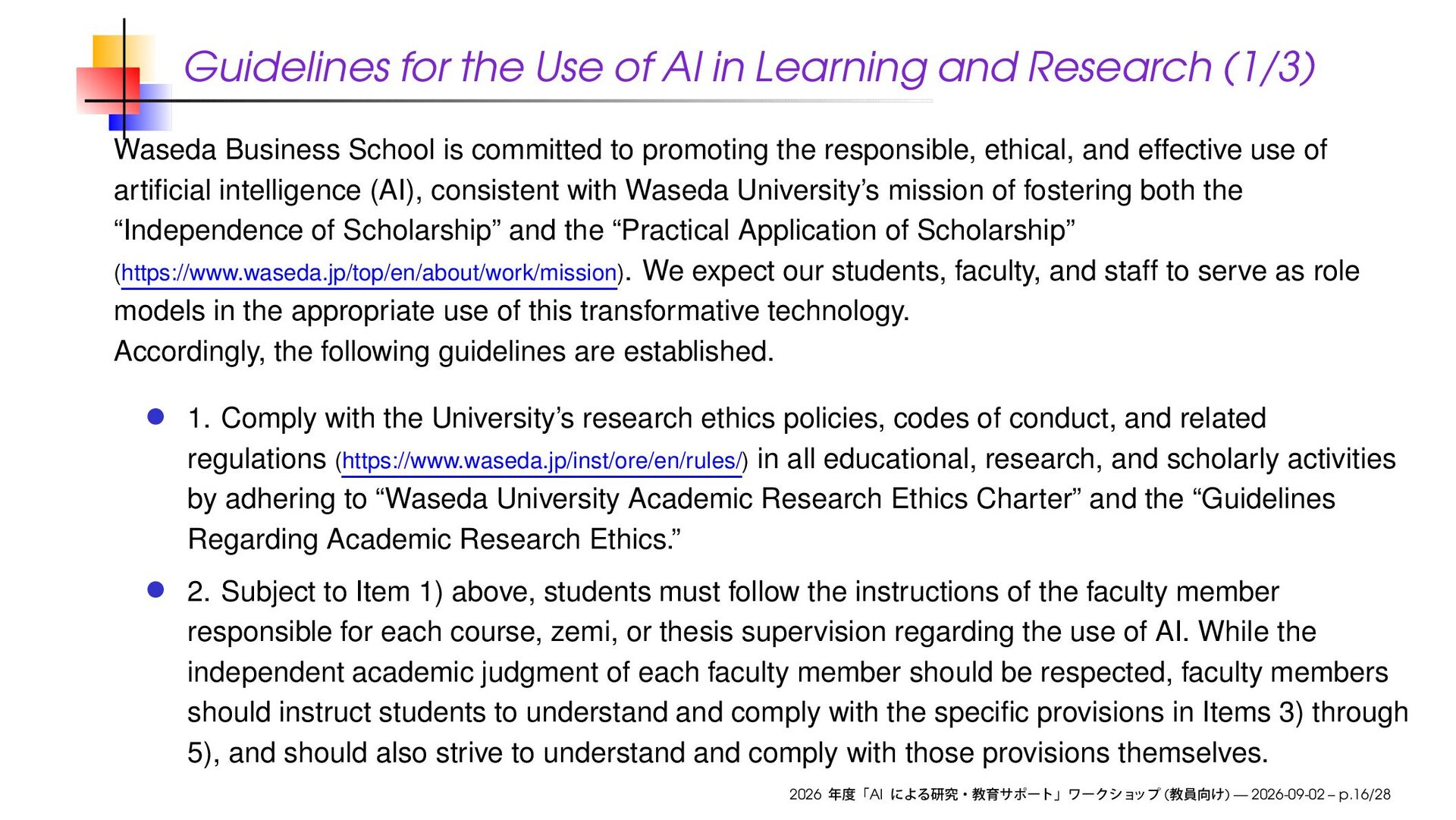
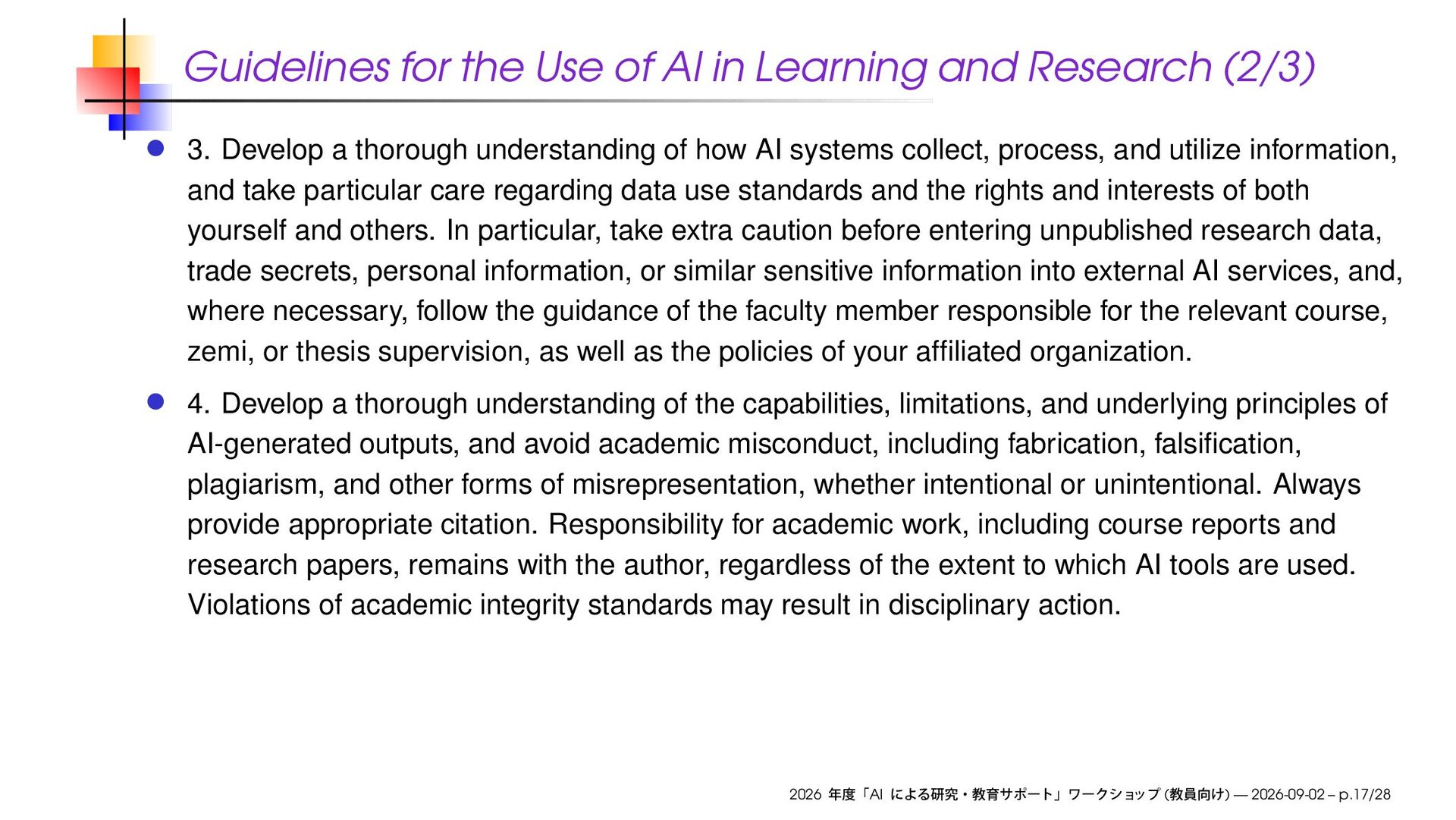
(1/3) Waseda Business School is committed to promoting the responsible, ethical, and effective use of artificial intelligence (AI), consistent with Waseda University’s mission of fostering both the “Independence of Scholarship” and the “Practical Application of Scholarship” (https://www.waseda.jp/top/en/about/work/mission). We expect our students, faculty, and staff to serve as role models in the appropriate use of this transformative technology. Accordingly, the following guidelines are established. 1. Comply with the University’s research ethics policies, codes of conduct, and related regulations (https://www.waseda.jp/inst/ore/en/rules/) in all educational, research, and scholarly activities by adhering to “Waseda University Academic Research Ethics Charter” and the “Guidelines Regarding Academic Research Ethics.” 2. Subject to Item 1) above, students must follow the instructions of the faculty member responsible for each course, zemi, or thesis supervision regarding the use of AI. While the independent academic judgment of each faculty member should be respected, faculty members should instruct students to understand and comply with the specific provisions in Items 3) through 5), and should also strive to understand and comply with those provisions themselves. 2026 年度「AI による研究・教育サポート」ワークショップ (教員向け) — 2026-09-02 – p.16/28
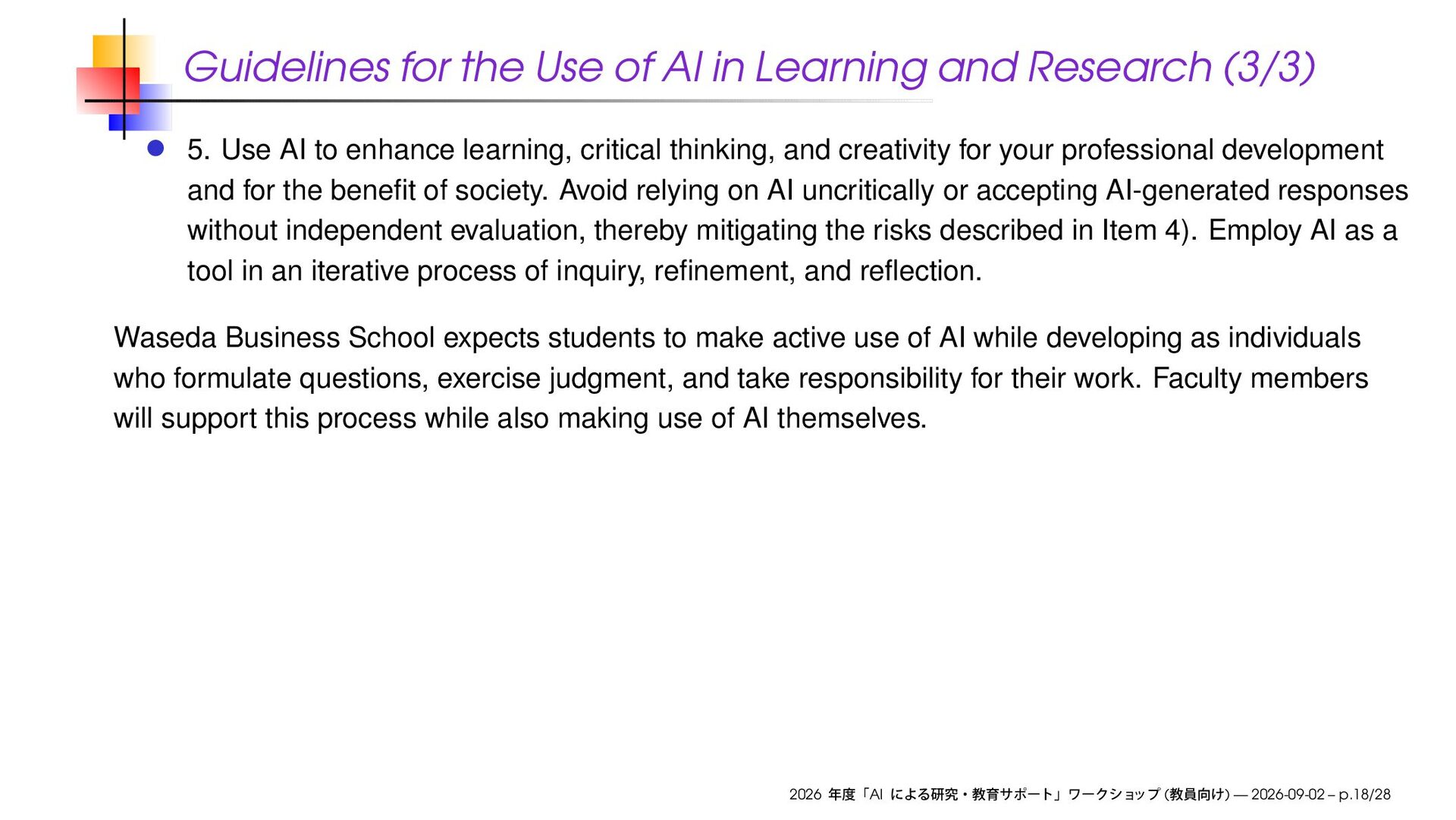
(2/3) 3. Develop a thorough understanding of how AI systems collect, process, and utilize information, and take particular care regarding data use standards and the rights and interests of both yourself and others. In particular, take extra caution before entering unpublished research data, trade secrets, personal information, or similar sensitive information into external AI services, and, where necessary, follow the guidance of the faculty member responsible for the relevant course, zemi, or thesis supervision, as well as the policies of your affiliated organization. 4. Develop a thorough understanding of the capabilities, limitations, and underlying principles of AI-generated outputs, and avoid academic misconduct, including fabrication, falsification, plagiarism, and other forms of misrepresentation, whether intentional or unintentional. Always provide appropriate citation. Responsibility for academic work, including course reports and research papers, remains with the author, regardless of the extent to which AI tools are used. Violations of academic integrity standards may result in disciplinary action. 2026 年度「AI による研究・教育サポート」ワークショップ (教員向け) — 2026-09-02 – p.17/28
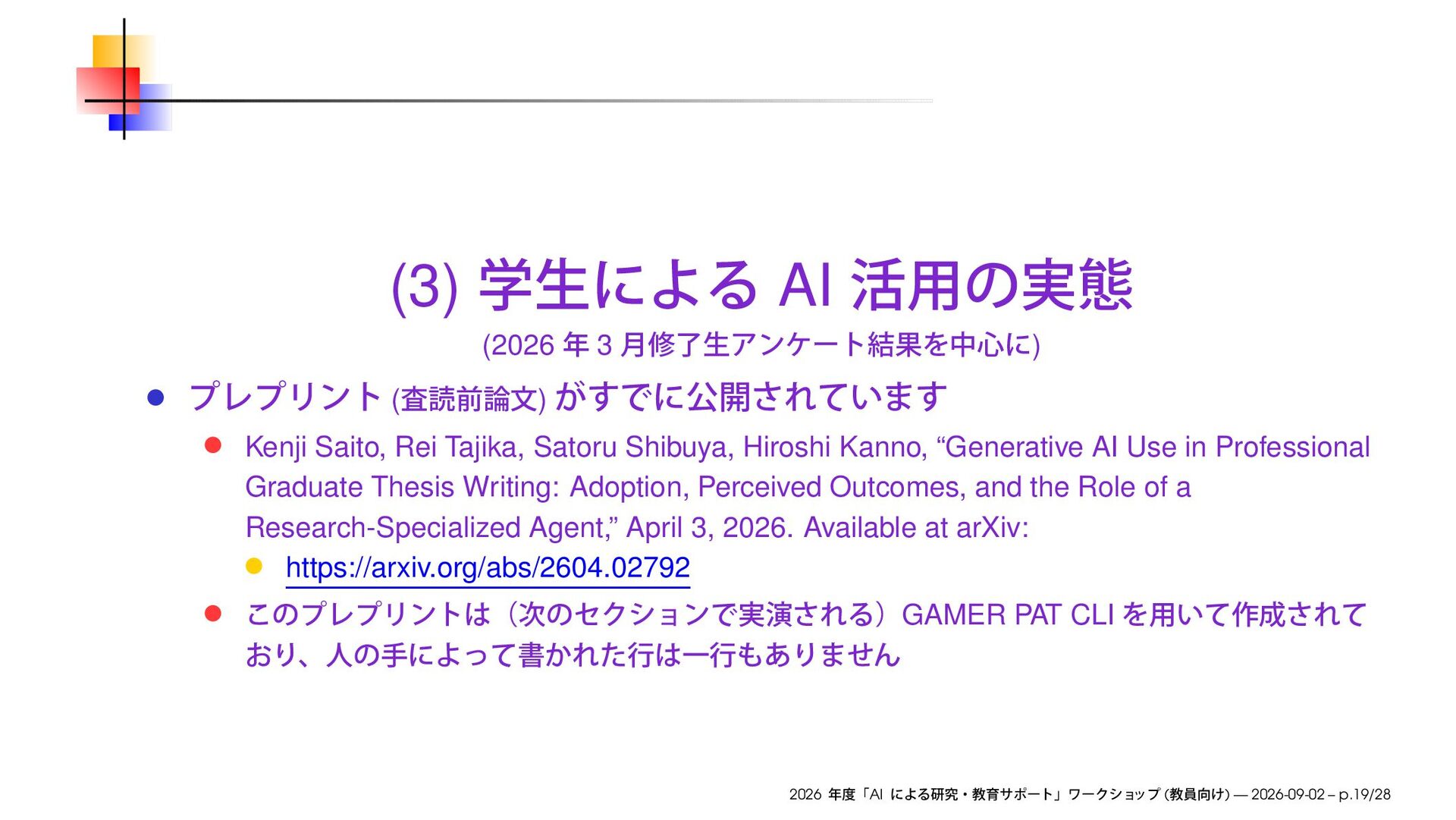
(3/3) 5. Use AI to enhance learning, critical thinking, and creativity for your professional development and for the benefit of society. Avoid relying on AI uncritically or accepting AI-generated responses without independent evaluation, thereby mitigating the risks described in Item 4). Employ AI as a tool in an iterative process of inquiry, refinement, and reflection. Waseda Business School expects students to make active use of AI while developing as individuals who formulate questions, exercise judgment, and take responsibility for their work. Faculty members will support this process while also making use of AI themselves. 2026 年度「AI による研究・教育サポート」ワークショップ (教員向け) — 2026-09-02 – p.18/28
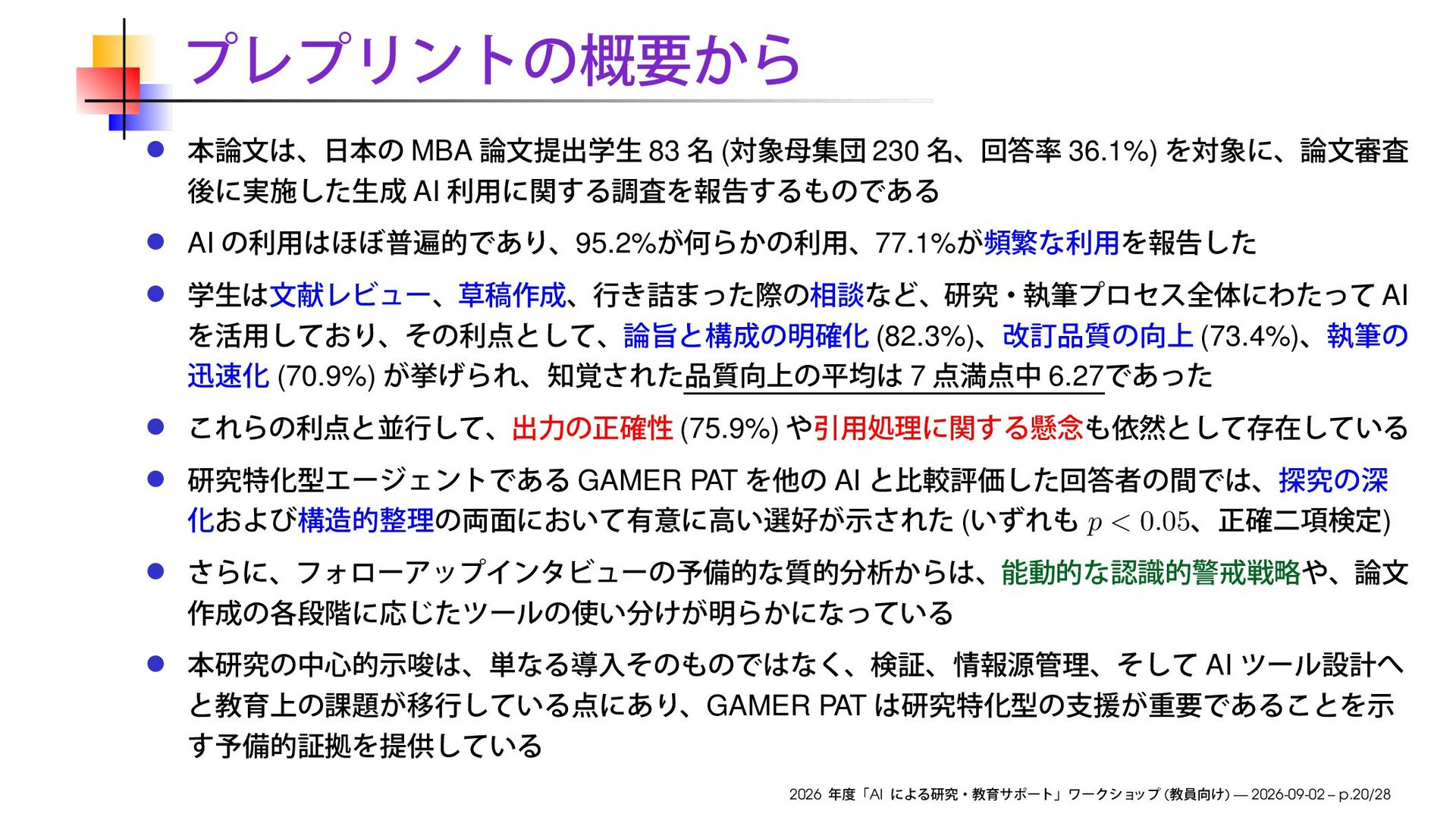
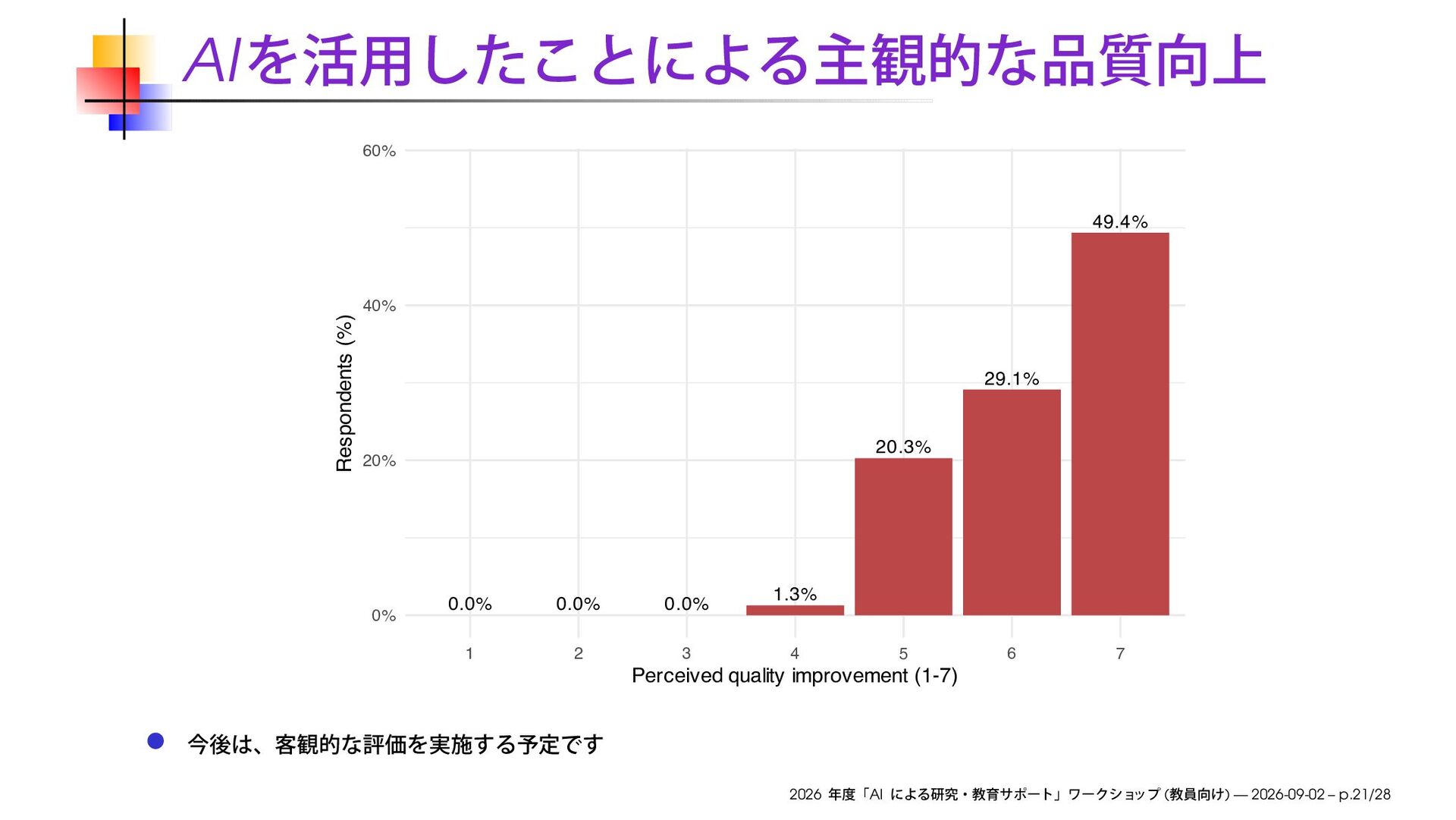
がすでに公開されています Kenji Saito, Rei Tajika, Satoru Shibuya, Hiroshi Kanno, “Generative AI Use in Professional Graduate Thesis Writing: Adoption, Perceived Outcomes, and the Role of a Research-Specialized Agent,” April 3, 2026. Available at arXiv: https://arxiv.org/abs/2604.02792 このプレプリントは(次のセクションで実演される)GAMER PAT CLI を用いて作成されて おり、人の手によって書かれた行は一行もありません 2026 年度「AI による研究・教育サポート」ワークショップ (教員向け) — 2026-09-02 – p.19/28


 ks91
ks91
 genda
genda
 makocchi
 mohab1
 shogo4131
 ishikawa_satoru
 occhi
occhi
 takonda
 shumei_ito
 shuta13
 takuroabe
 ivry_presentationmaterials
 terapyon
 vanstee
 tapps
tapps
 soysaucechin
 marcduiker
 rocio
rocio
 bluesmoon
 inesmontani
 greggifford
 ryanjones
 akosma
 matthewcrist
 kneath