Upgrade to Pro — share decks privately, control downloads, hide ads and more …

gRPC & Protocol Buffers 勉強会 — Go による実践ハンズオン

gRPC & Protocol Buffers 勉強会 — Go による実践ハンズオン

Protocol Buffers の概要から .proto 定義・コード生成・シリアライズまでを扱い、その後 RPC / gRPC の概念、HTTP/2 と REST との違い、gRPC におけるメタデータとセッションの考え方を整理します。環境構築の手順に続き、Go で Unary / Server・Client・Bidirectional ストリーミングの 4 パターンを実装する流れです。発展として Interceptor、Bearer トークン認証、mkcert を使った TLS も含みます。初学者向けの勉強会・ハンズオン資料です。
Github: https://github.com/kugeke-ibex/go-gRPC-practice/tree/main

Avatar for Kenjiro Kuge

Kenjiro Kuge

April 13, 2026

Other Decks in Technology

Transcript

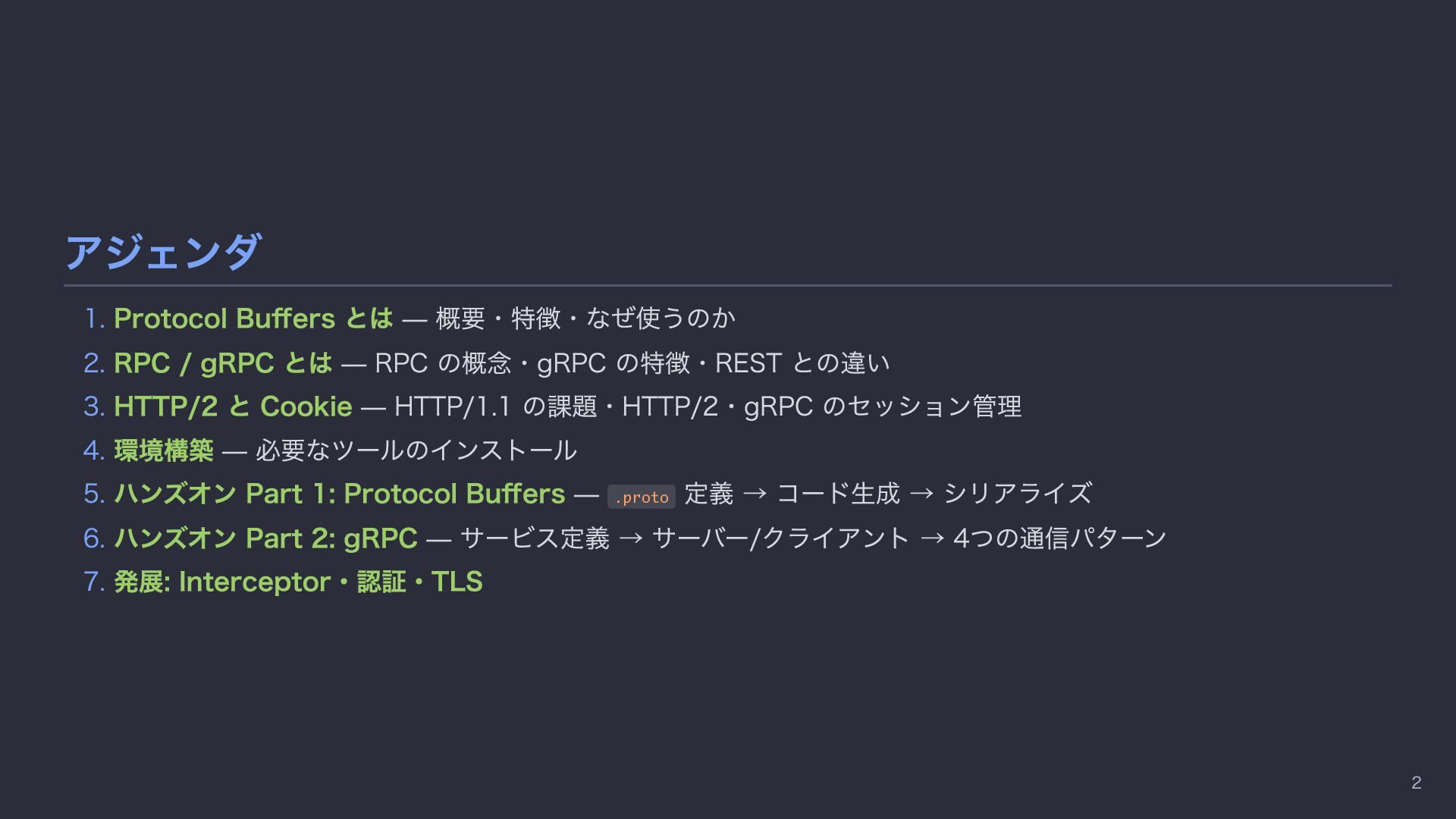
  1. アジェンダ 1. Protocol Buffers とは — 概要・特徴・なぜ使うのか 2. RPC /

    gRPC とは — RPC の概念・gRPC の特徴・REST との違い 3. HTTP/2 と Cookie — HTTP/1.1 の課題・HTTP/2・gRPC のセッション管理 4. 環境構築 — 必要なツールのインストール 5. ハンズオン Part 1: Protocol Buffers — .proto 定義 → コード生成 → シリアライズ 6. ハンズオン Part 2: gRPC — サービス定義 → サーバー/クライアント → 4つの通信パターン 7. 発展: Interceptor・認証・TLS 2
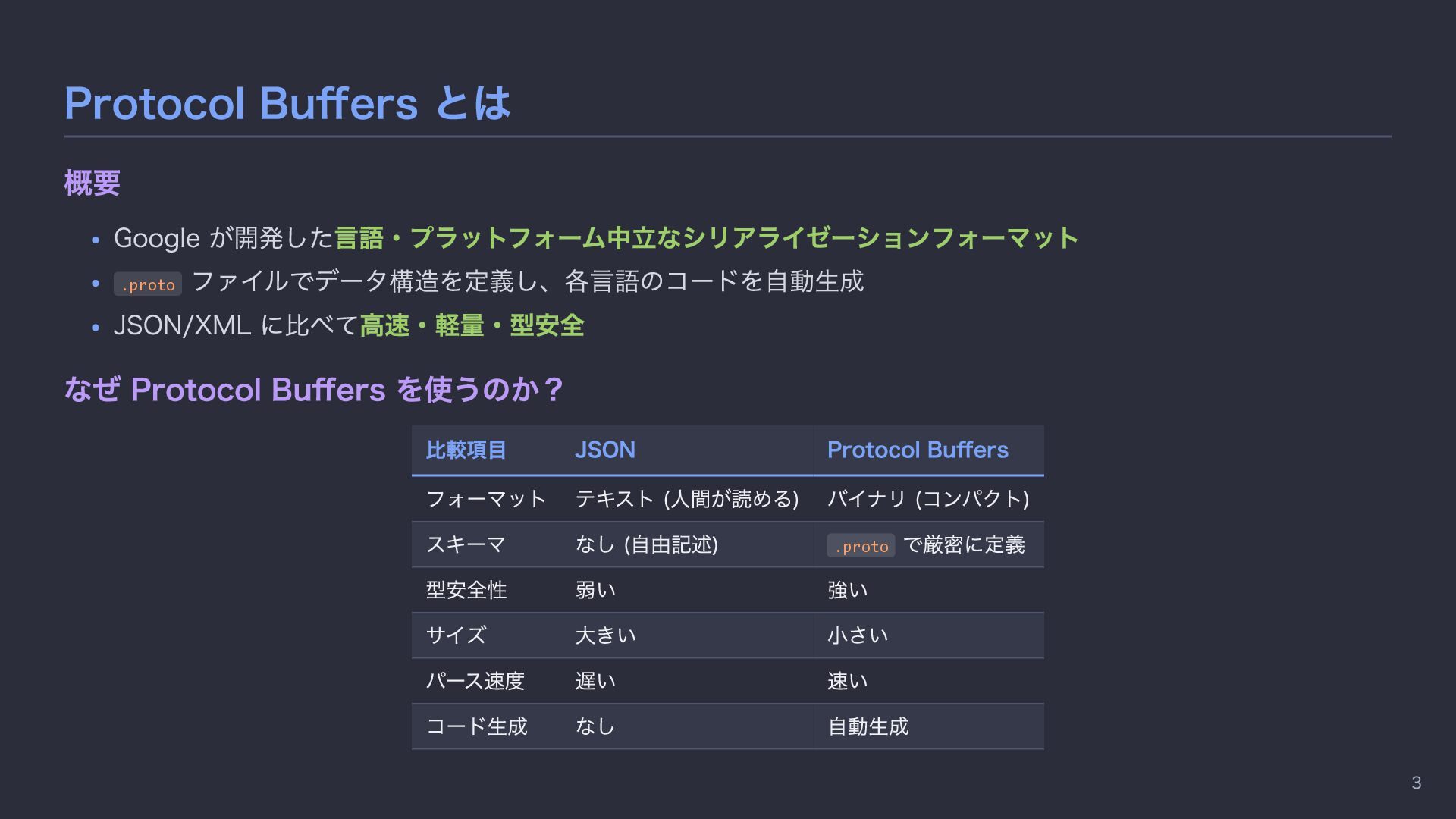
  2. Protocol Buffers とは 概要 Google が開発した言語・プラットフォーム中立なシリアライゼーションフォーマット .proto ファイルでデータ構造を定義し、各言語のコードを自動生成 JSON/XML に比べて高速・軽量・型安全

    なぜ Protocol Buffers を使うのか? 比較項目 JSON Protocol Buffers フォーマット テキスト (人間が読める) バイナリ (コンパクト) スキーマ なし (自由記述) .proto で厳密に定義 型安全性 弱い 強い サイズ 大きい 小さい パース速度 遅い 速い コード生成 なし 自動生成 3
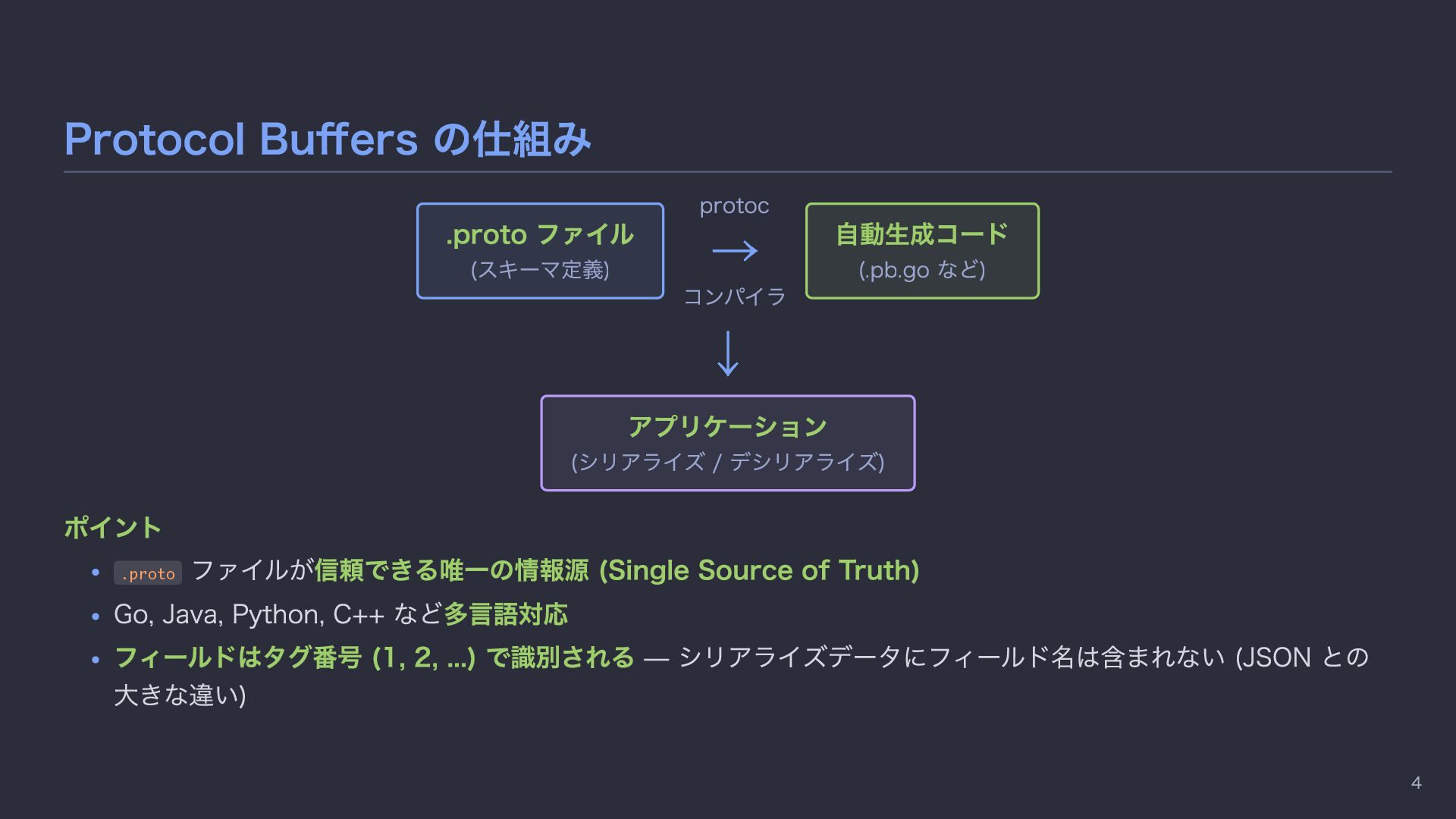
  3. Protocol Buffers の仕組み .proto ファイル (スキーマ定義) protoc → コンパイラ 自動生成コード

    (.pb.go など) ↓ アプリケーション (シリアライズ / デシリアライズ) ポイント .proto ファイルが信頼できる唯一の情報源 (Single Source of Truth) Go, Java, Python, C++ など多言語対応 フィールドはタグ番号 (1, 2, ...) で識別される — シリアライズデータにフィールド名は含まれない (JSON との 大きな違い) 4
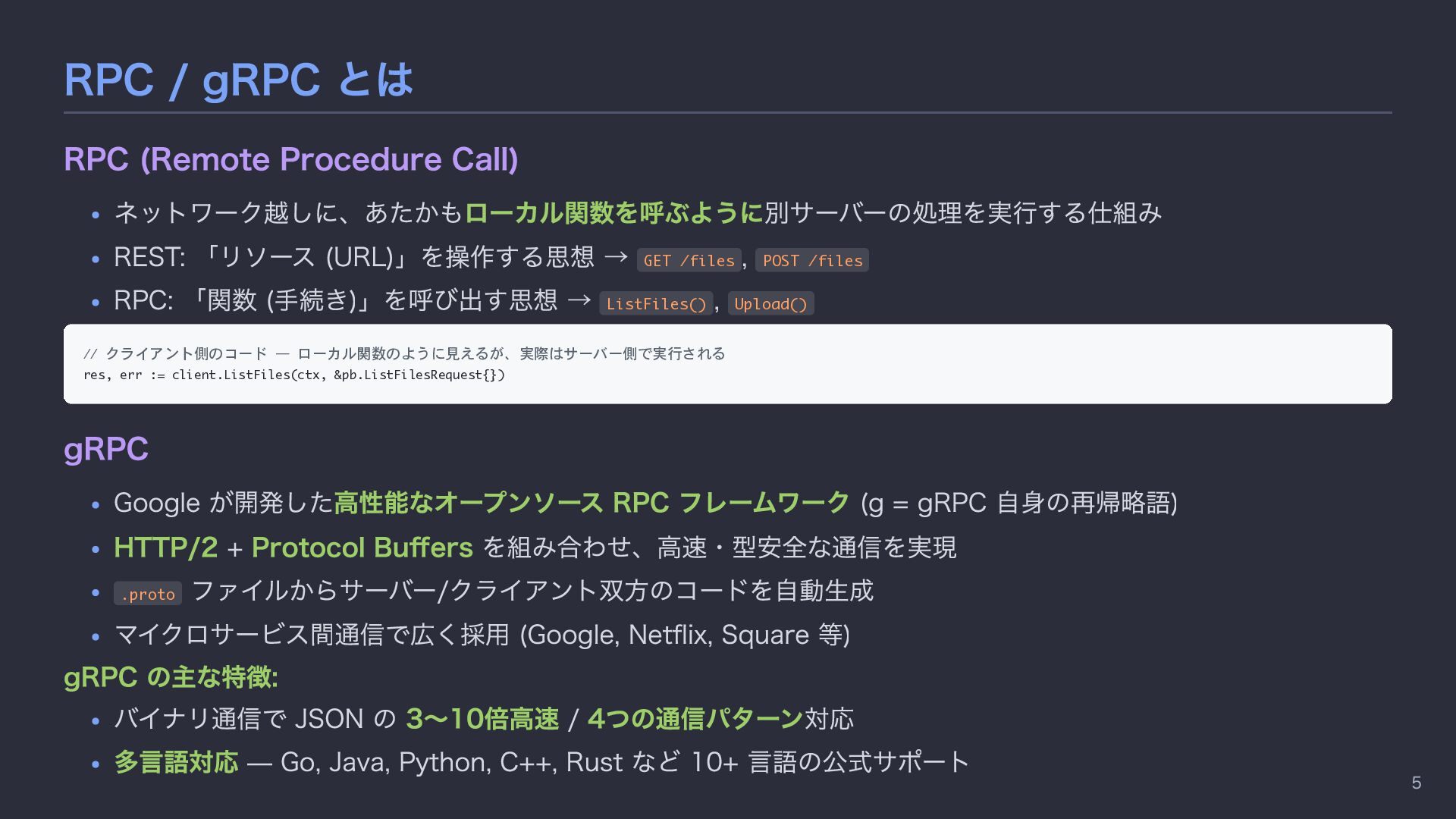
  4. RPC / gRPC とは RPC (Remote Procedure Call) ネットワーク越しに、あたかもローカル関数を呼ぶように別サーバーの処理を実行する仕組み REST:

    「リソース (URL)」を操作する思想 → GET /files , POST /files RPC: 「関数 (手続き)」を呼び出す思想 → ListFiles() , Upload() // クライアント側のコード — ローカル関数のように見えるが、実際はサーバー側で実行される res, err := client.ListFiles(ctx, &pb.ListFilesRequest{}) gRPC Google が開発した高性能なオープンソース RPC フレームワーク (g = gRPC 自身の再帰略語) HTTP/2 + Protocol Buffers を組み合わせ、高速・型安全な通信を実現 .proto ファイルからサーバー/クライアント双方のコードを自動生成 マイクロサービス間通信で広く採用 (Google, Netflix, Square 等) gRPC の主な特徴: バイナリ通信で JSON の 3〜10倍高速 / 4つの通信パターン対応 多言語対応 — Go, Java, Python, C++, Rust など 10+ 言語の公式サポート 5
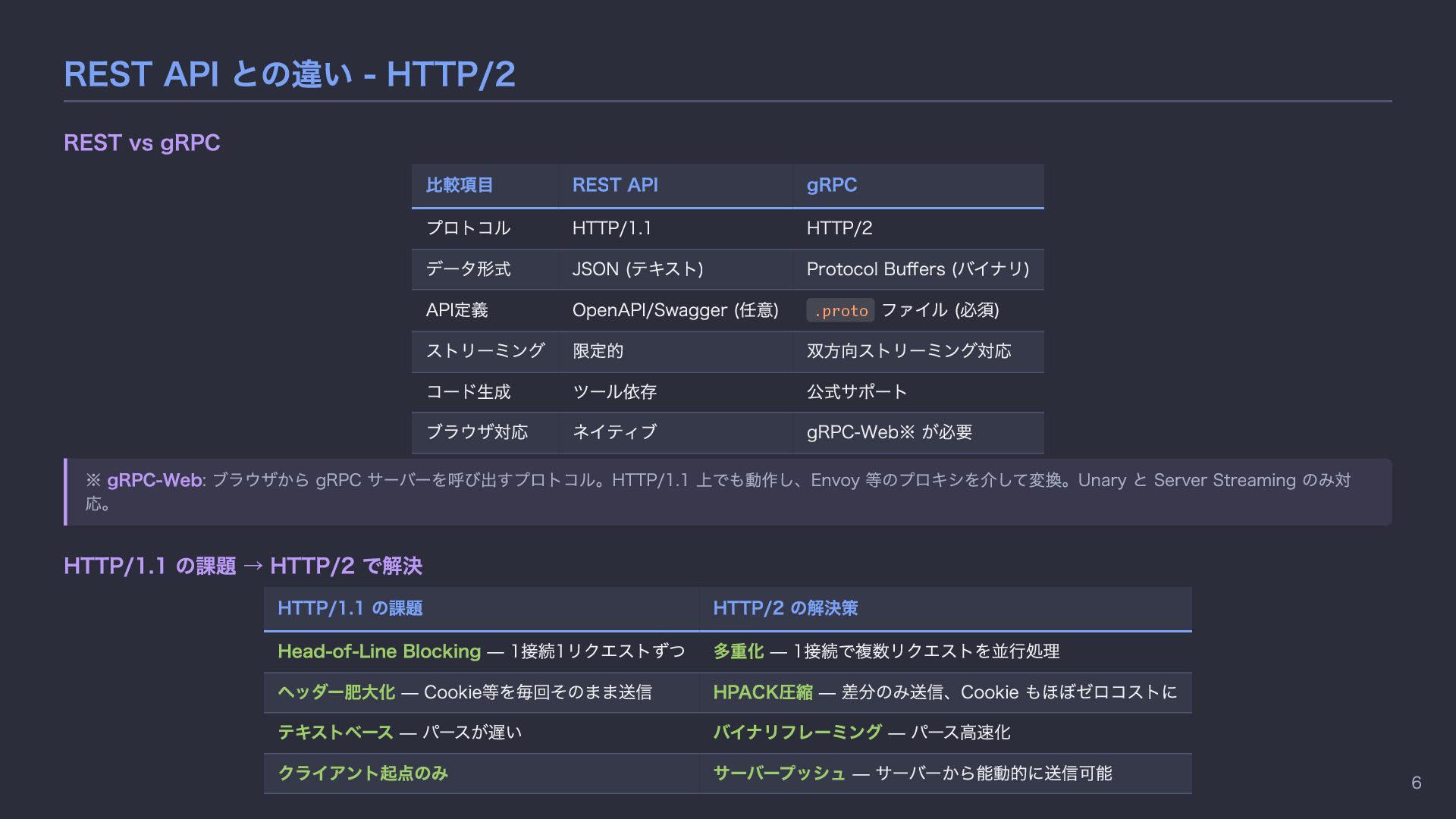
  5. REST API との違い - HTTP/2 REST vs gRPC 比較項目 REST

    API gRPC プロトコル HTTP/1.1 HTTP/2 データ形式 JSON (テキスト) Protocol Buffers (バイナリ) API定義 OpenAPI/Swagger (任意) .proto ファイル (必須) ストリーミング 限定的 双方向ストリーミング対応 コード生成 ツール依存 公式サポート ブラウザ対応 ネイティブ gRPC-Web※ が必要 ※ gRPC-Web: ブラウザから gRPC サーバーを呼び出すプロトコル。HTTP/1.1 上でも動作し、Envoy 等のプロキシを介して変換。Unary と Server Streaming のみ対 応。 HTTP/1.1 の課題 → HTTP/2 で解決 HTTP/1.1 の課題 HTTP/2 の解決策 Head-of-Line Blocking — 1接続1リクエストずつ 多重化 — 1接続で複数リクエストを並行処理 ヘッダー肥大化 — Cookie等を毎回そのまま送信 HPACK圧縮 — 差分のみ送信、Cookie もほぼゼロコストに テキストベース — パースが遅い バイナリフレーミング — パース高速化 クライアント起点のみ サーバープッシュ — サーバーから能動的に送信可能 6
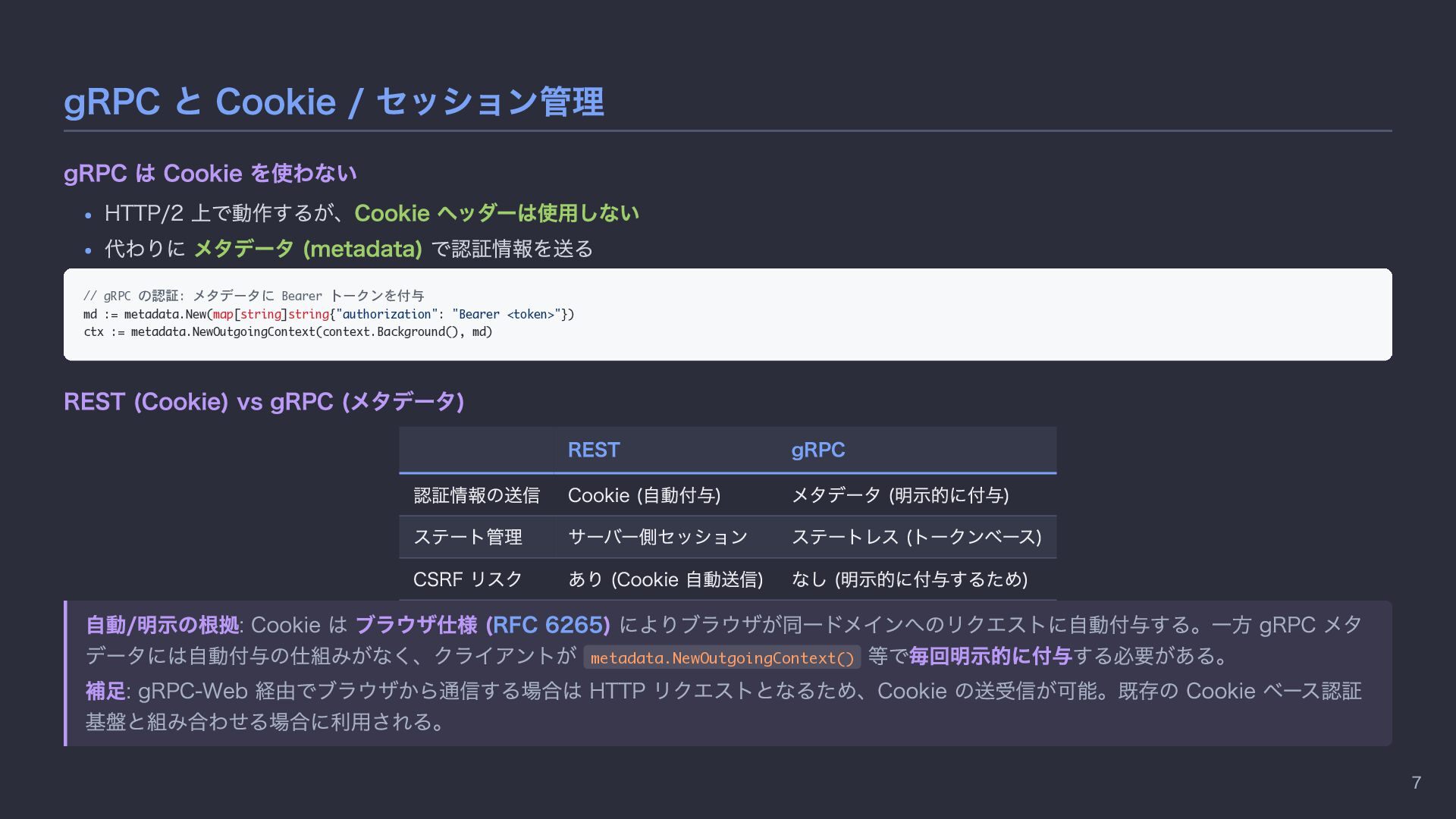
  6. gRPC と Cookie / セッション管理 gRPC は Cookie を使わない HTTP/2

    上で動作するが、Cookie ヘッダーは使用しない 代わりに メタデータ (metadata) で認証情報を送る // gRPC の認証: メタデータに Bearer トークンを付与 md := metadata.New(map[string]string{"authorization": "Bearer <token>"}) ctx := metadata.NewOutgoingContext(context.Background(), md) REST (Cookie) vs gRPC (メタデータ) REST gRPC 認証情報の送信 Cookie (自動付与) メタデータ (明示的に付与) ステート管理 サーバー側セッション ステートレス (トークンベース) CSRF リスク あり (Cookie 自動送信) なし (明示的に付与するため) 自動/明示の根拠: Cookie は ブラウザ仕様 (RFC 6265) によりブラウザが同一ドメインへのリクエストに自動付与する。一方 gRPC メタ データには自動付与の仕組みがなく、クライアントが metadata.NewOutgoingContext() 等で毎回明示的に付与する必要がある。 補足: gRPC-Web 経由でブラウザから通信する場合は HTTP リクエストとなるため、Cookie の送受信が可能。既存の Cookie ベース認証 基盤と組み合わせる場合に利用される。 7
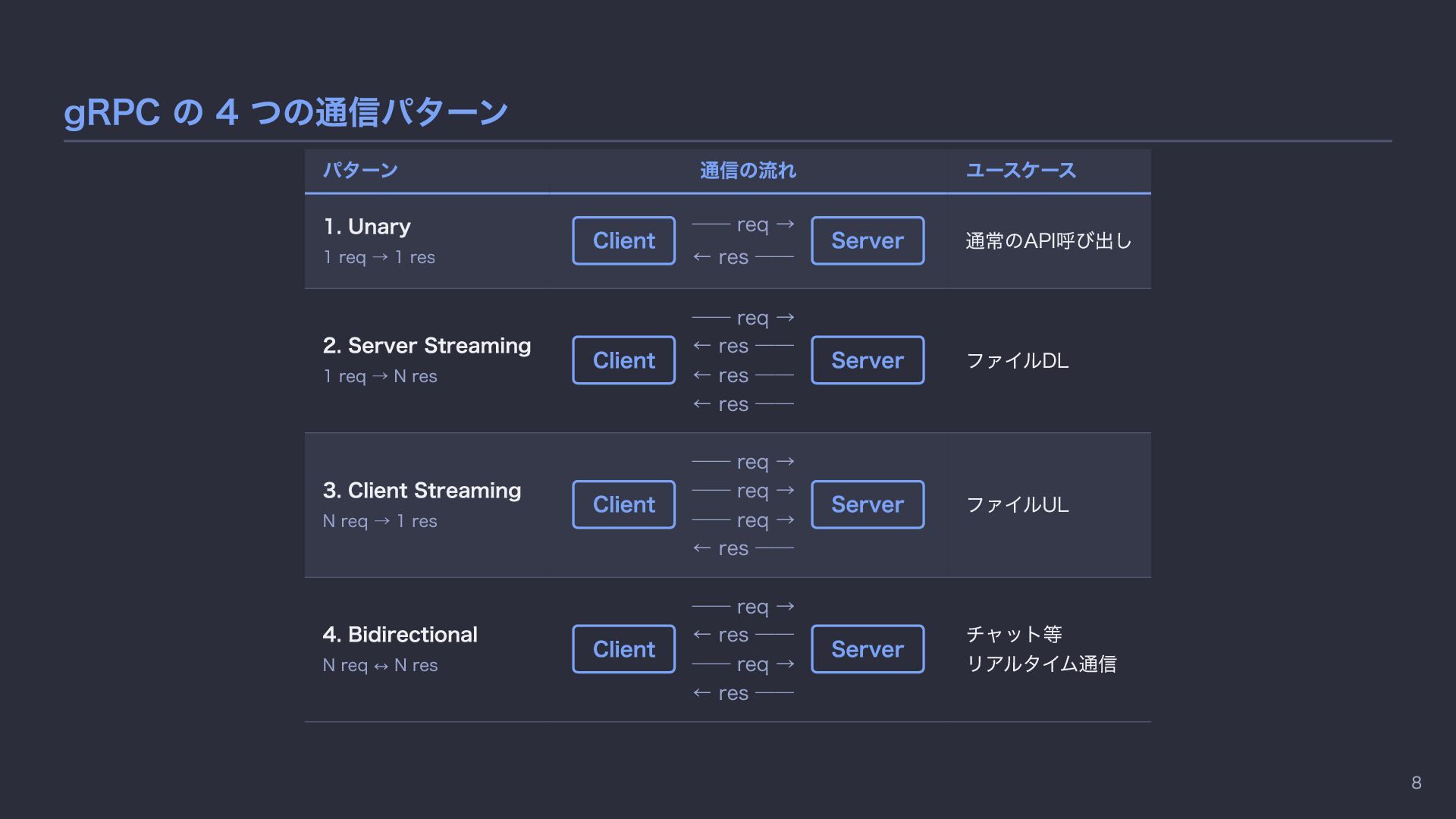
  7. gRPC の 4 つの通信パターン パターン 通信の流れ ユースケース 1. Unary 1

    req → 1 res Client ── req → ← res ── Server 通常のAPI呼び出し 2. Server Streaming 1 req → N res Client ── req → ← res ── ← res ── ← res ── Server ファイルDL 3. Client Streaming N req → 1 res Client ── req → ── req → ── req → ← res ── Server ファイルUL 4. Bidirectional N req ↔ N res Client ── req → ← res ── ── req → ← res ── Server チャット等 リアルタイム通信 8
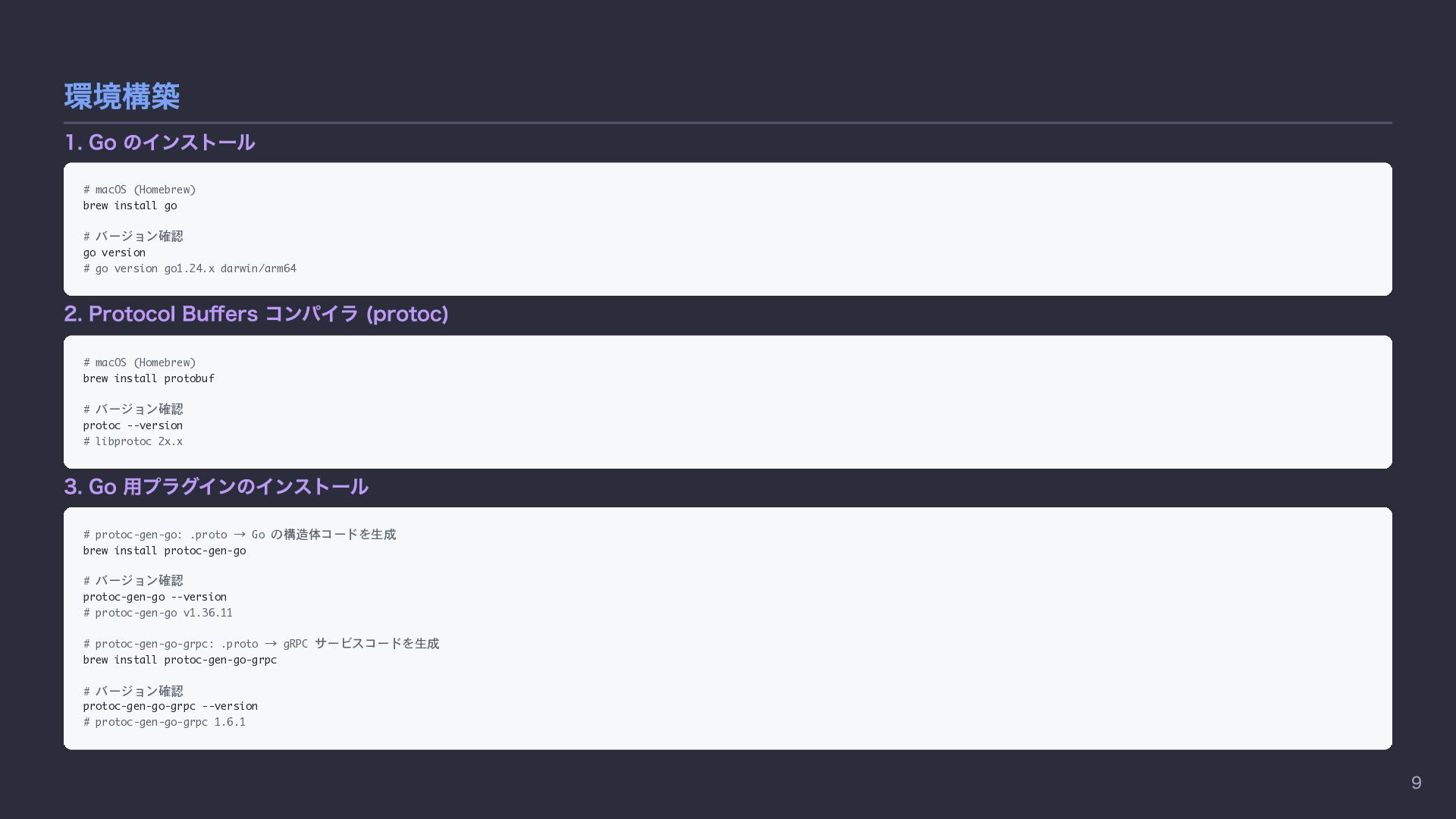
  8. 環境構築 1. Go のインストール # macOS (Homebrew) brew install go

    # バージョン確認 go version # go version go1.24.x darwin/arm64 2. Protocol Buffers コンパイラ (protoc) # macOS (Homebrew) brew install protobuf # バージョン確認 protoc --version # libprotoc 2x.x 3. Go 用プラグインのインストール # protoc-gen-go: .proto → Go の構造体コードを生成 brew install protoc-gen-go # バージョン確認 protoc-gen-go --version # protoc-gen-go v1.36.11 # protoc-gen-go-grpc: .proto → gRPC サービスコードを生成 brew install protoc-gen-go-grpc # バージョン確認 protoc-gen-go-grpc --version # protoc-gen-go-grpc 1.6.1 9
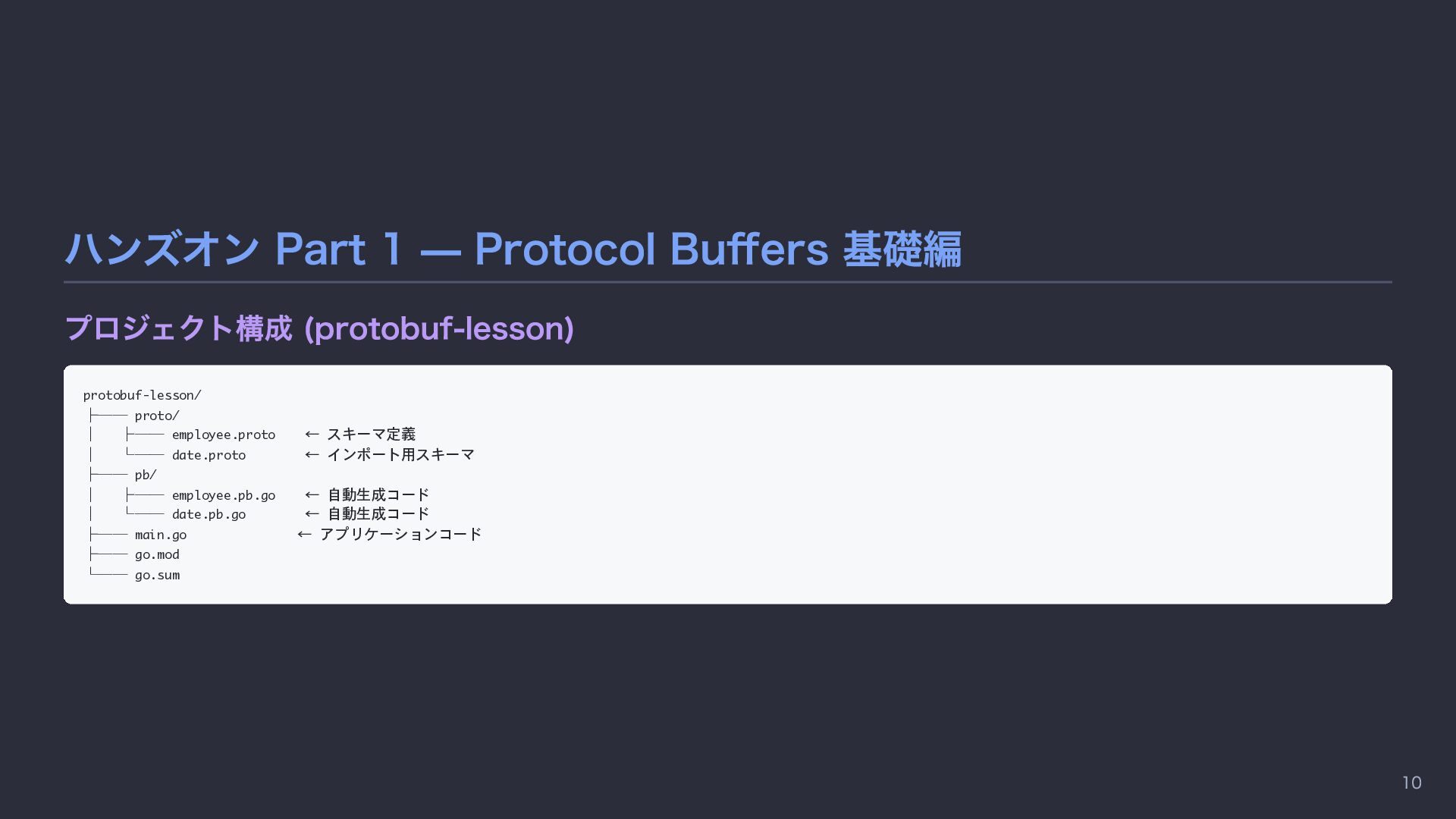
  9. ハンズオン Part 1 — Protocol Buffers 基礎編 プロジェクト構成 (protobuf-lesson) protobuf-lesson/

    ├── proto/ │ ├── employee.proto ← スキーマ定義 │ └── date.proto ← インポート用スキーマ ├── pb/ │ ├── employee.pb.go ← 自動生成コード │ └── date.pb.go ← 自動生成コード ├── main.go ← アプリケーションコード ├── go.mod └── go.sum 10
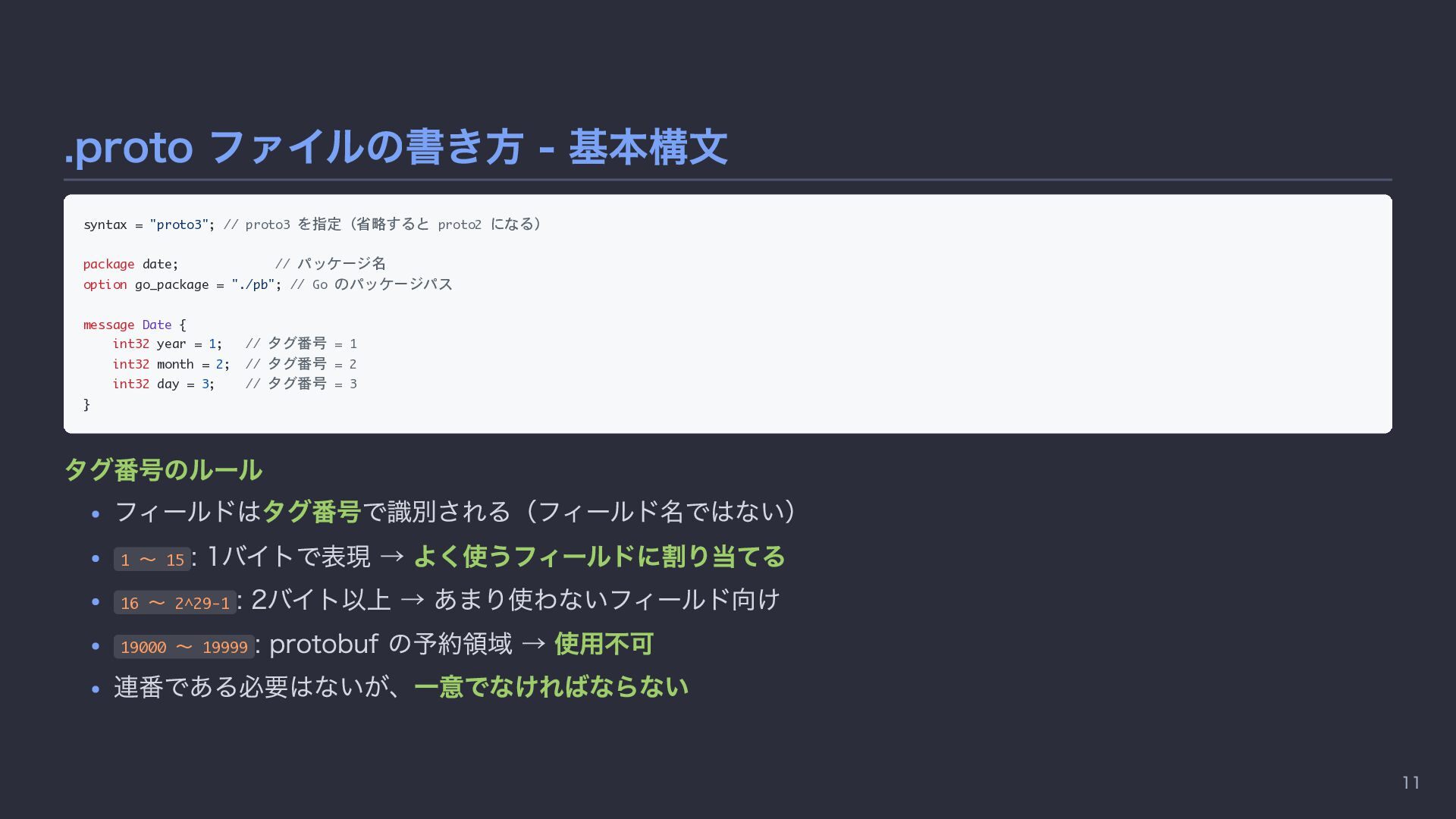
  10. .proto ファイルの書き方 - 基本構文 syntax = "proto3"; // proto3 を指定(省略すると

    proto2 になる) package date; // パッケージ名 option go_package = "./pb"; // Go のパッケージパス message Date { int32 year = 1; // タグ番号 = 1 int32 month = 2; // タグ番号 = 2 int32 day = 3; // タグ番号 = 3 } タグ番号のルール フィールドはタグ番号で識別される(フィールド名ではない) 1 〜 15 : 1バイトで表現 → よく使うフィールドに割り当てる 16 〜 2^29-1 : 2バイト以上 → あまり使わないフィールド向け 19000 〜 19999 : protobuf の予約領域 → 使用不可 連番である必要はないが、一意でなければならない 11
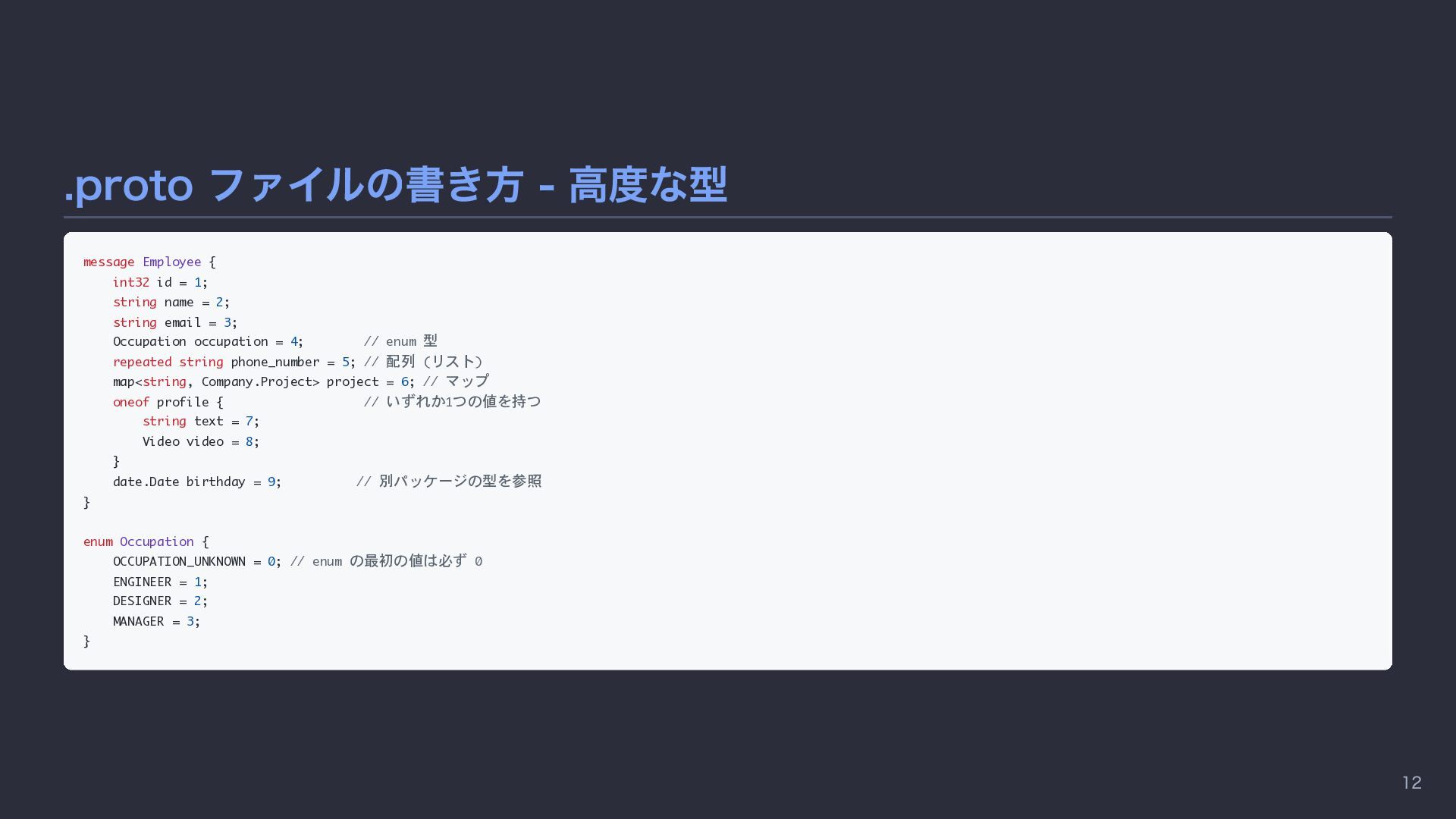
  11. .proto ファイルの書き方 - 高度な型 message Employee { int32 id =

    1; string name = 2; string email = 3; Occupation occupation = 4; // enum 型 repeated string phone_number = 5; // 配列 (リスト) map<string, Company.Project> project = 6; // マップ oneof profile { // いずれか1つの値を持つ string text = 7; Video video = 8; } date.Date birthday = 9; // 別パッケージの型を参照 } enum Occupation { OCCUPATION_UNKNOWN = 0; // enum の最初の値は必ず 0 ENGINEER = 1; DESIGNER = 2; MANAGER = 3; } 12
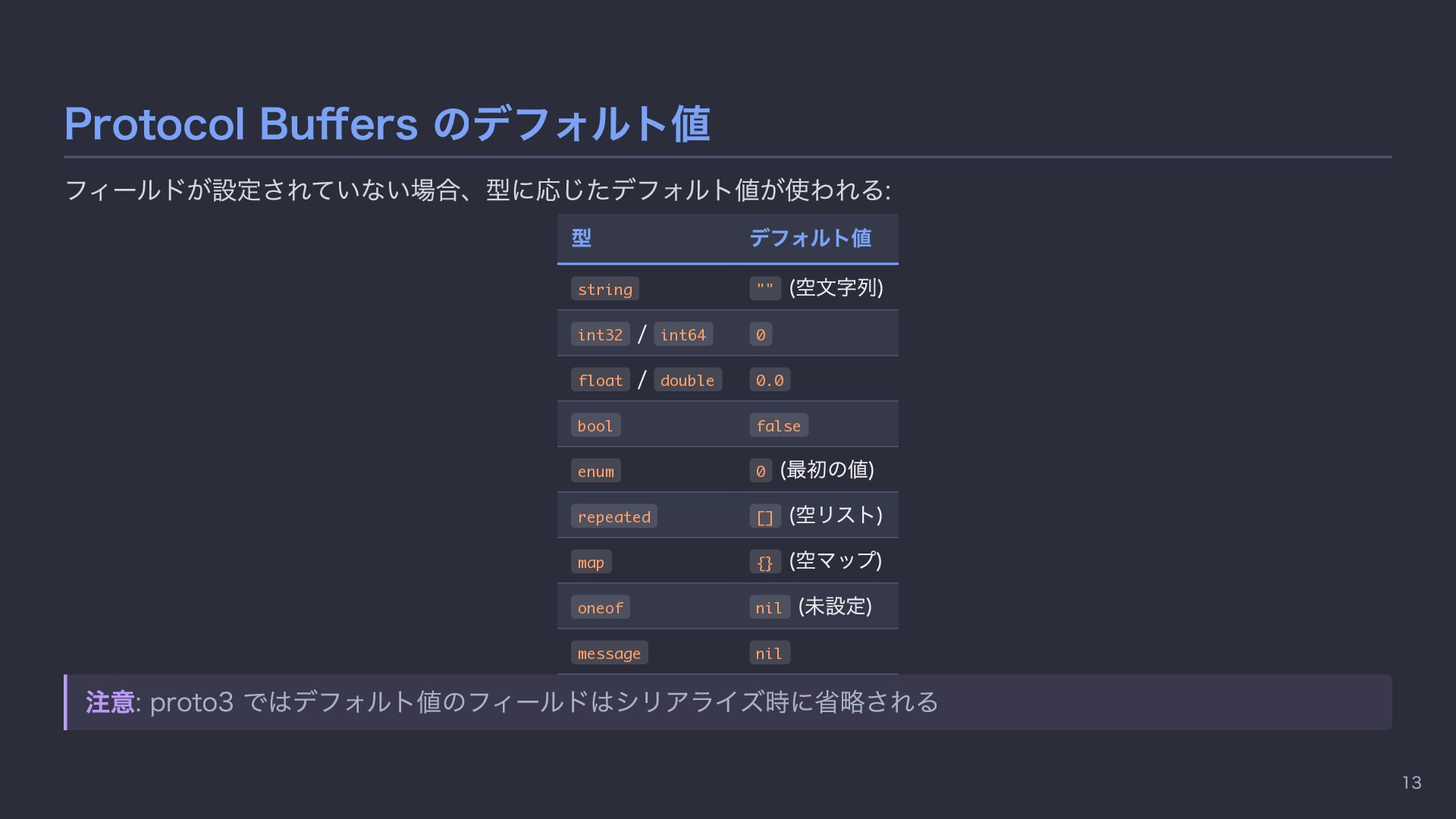
  12. Protocol Buffers のデフォルト値 フィールドが設定されていない場合、型に応じたデフォルト値が使われる: 型 デフォルト値 string "" (空文字列) int32

    / int64 0 float / double 0.0 bool false enum 0 (最初の値) repeated [] (空リスト) map {} (空マップ) oneof nil (未設定) message nil 注意: proto3 ではデフォルト値のフィールドはシリアライズ時に省略される 13
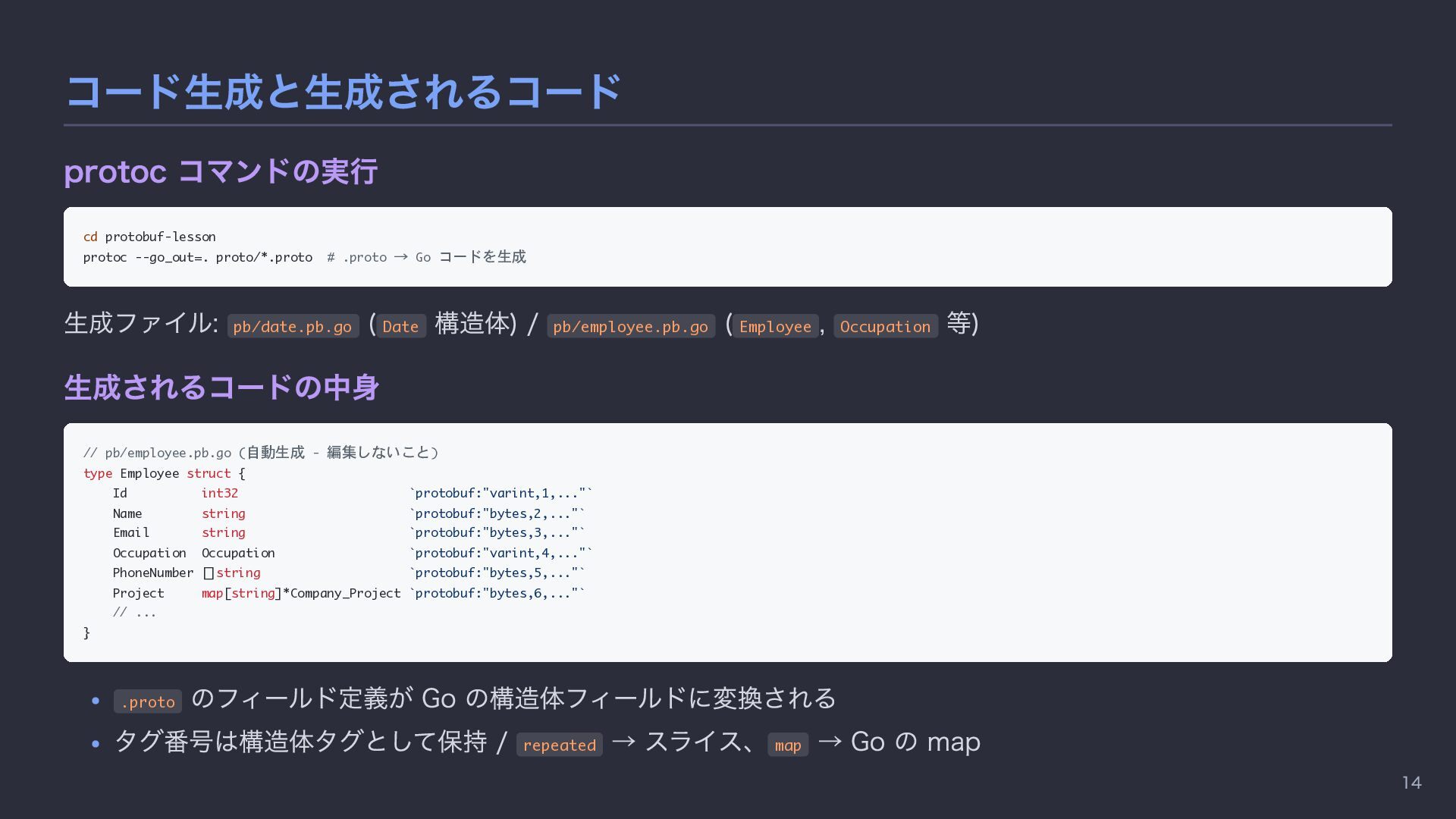
  13. コード生成と生成されるコード protoc コマンドの実行 cd protobuf-lesson protoc --go_out=. proto/*.proto # .proto

    → Go コードを生成 生成ファイル: pb/date.pb.go ( Date 構造体) / pb/employee.pb.go ( Employee , Occupation 等) 生成されるコードの中身 // pb/employee.pb.go (自動生成 - 編集しないこと) type Employee struct { Id int32 `protobuf:"varint,1,..."` Name string `protobuf:"bytes,2,..."` Email string `protobuf:"bytes,3,..."` Occupation Occupation `protobuf:"varint,4,..."` PhoneNumber []string `protobuf:"bytes,5,..."` Project map[string]*Company_Project `protobuf:"bytes,6,..."` // ... } .proto のフィールド定義が Go の構造体フィールドに変換される タグ番号は構造体タグとして保持 / repeated → スライス、 map → Go の map 14
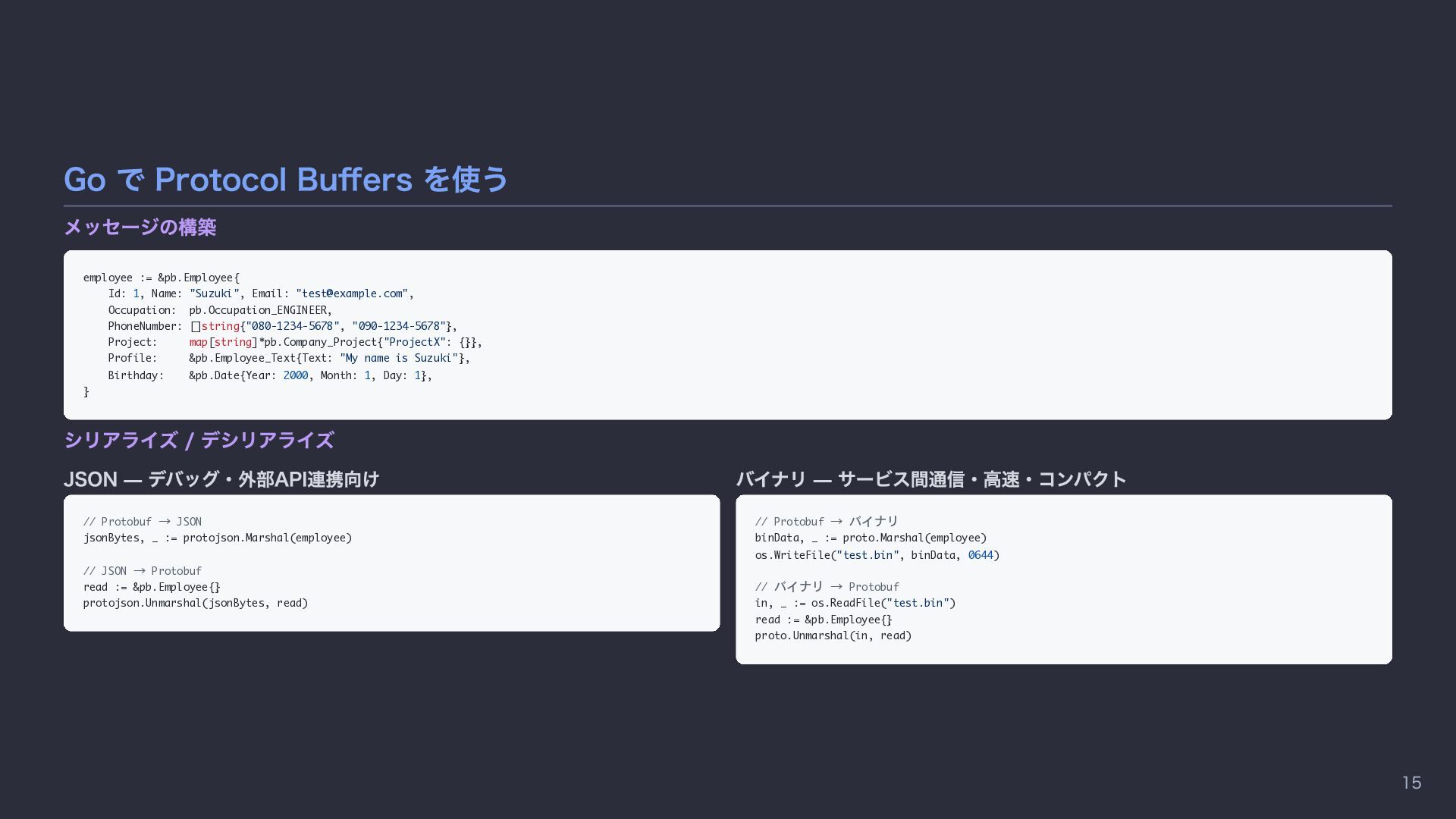
  14. Go で Protocol Buffers を使う メッセージの構築 employee := &pb.Employee{ Id:

    1, Name: "Suzuki", Email: "[email protected]", Occupation: pb.Occupation_ENGINEER, PhoneNumber: []string{"080-1234-5678", "090-1234-5678"}, Project: map[string]*pb.Company_Project{"ProjectX": {}}, Profile: &pb.Employee_Text{Text: "My name is Suzuki"}, Birthday: &pb.Date{Year: 2000, Month: 1, Day: 1}, } シリアライズ / デシリアライズ JSON — デバッグ・外部API連携向け // Protobuf → JSON jsonBytes, _ := protojson.Marshal(employee) // JSON → Protobuf read := &pb.Employee{} protojson.Unmarshal(jsonBytes, read) バイナリ — サービス間通信・高速・コンパクト // Protobuf → バイナリ binData, _ := proto.Marshal(employee) os.WriteFile("test.bin", binData, 0644) // バイナリ → Protobuf in, _ := os.ReadFile("test.bin") read := &pb.Employee{} proto.Unmarshal(in, read) 15
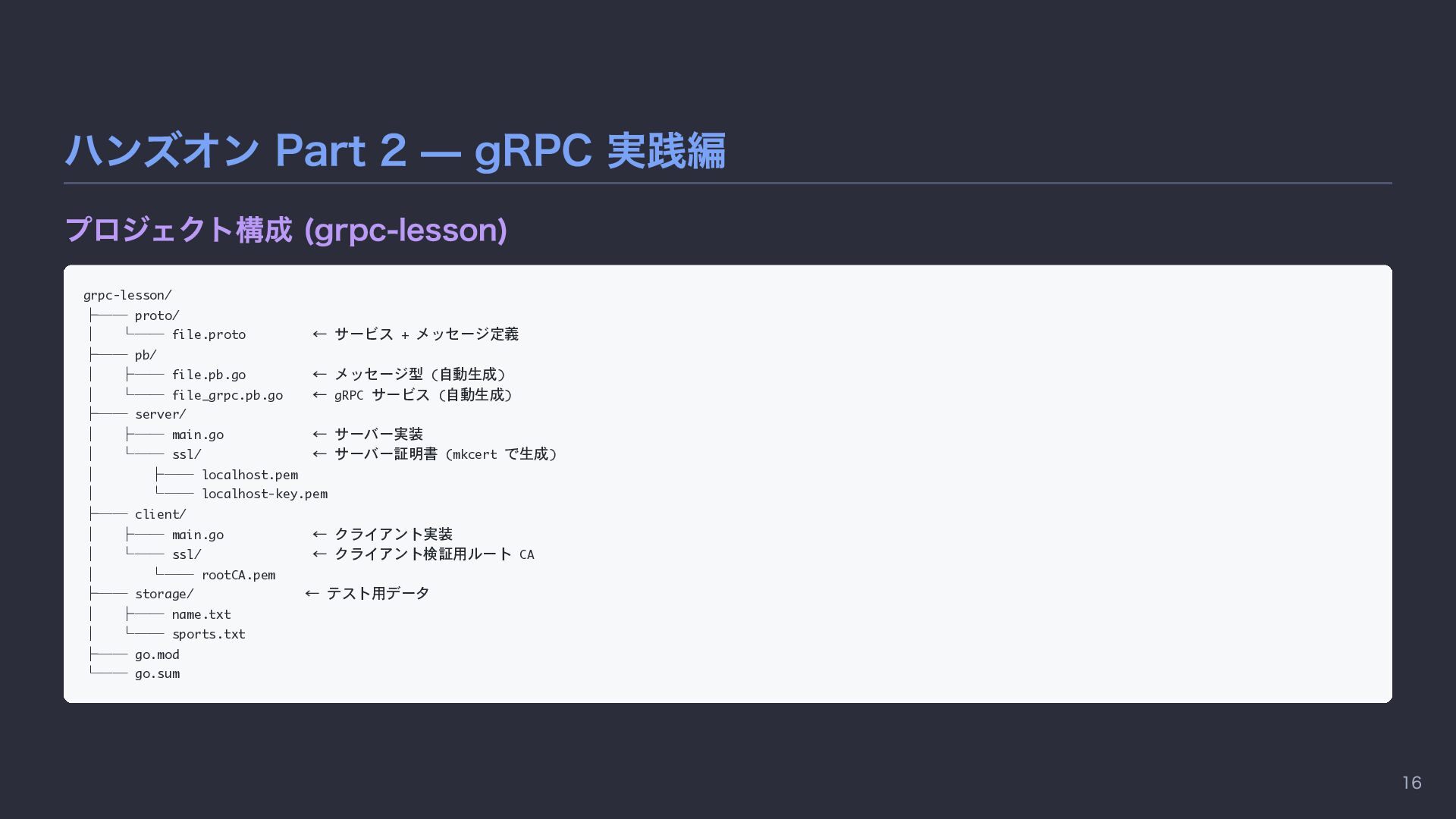
  15. ハンズオン Part 2 — gRPC 実践編 プロジェクト構成 (grpc-lesson) grpc-lesson/ ├──

    proto/ │ └── file.proto ← サービス + メッセージ定義 ├── pb/ │ ├── file.pb.go ← メッセージ型 (自動生成) │ └── file_grpc.pb.go ← gRPC サービス (自動生成) ├── server/ │ ├── main.go ← サーバー実装 │ └── ssl/ ← サーバー証明書 (mkcert で生成) │ ├── localhost.pem │ └── localhost-key.pem ├── client/ │ ├── main.go ← クライアント実装 │ └── ssl/ ← クライアント検証用ルート CA │ └── rootCA.pem ├── storage/ ← テスト用データ │ ├── name.txt │ └── sports.txt ├── go.mod └── go.sum 16
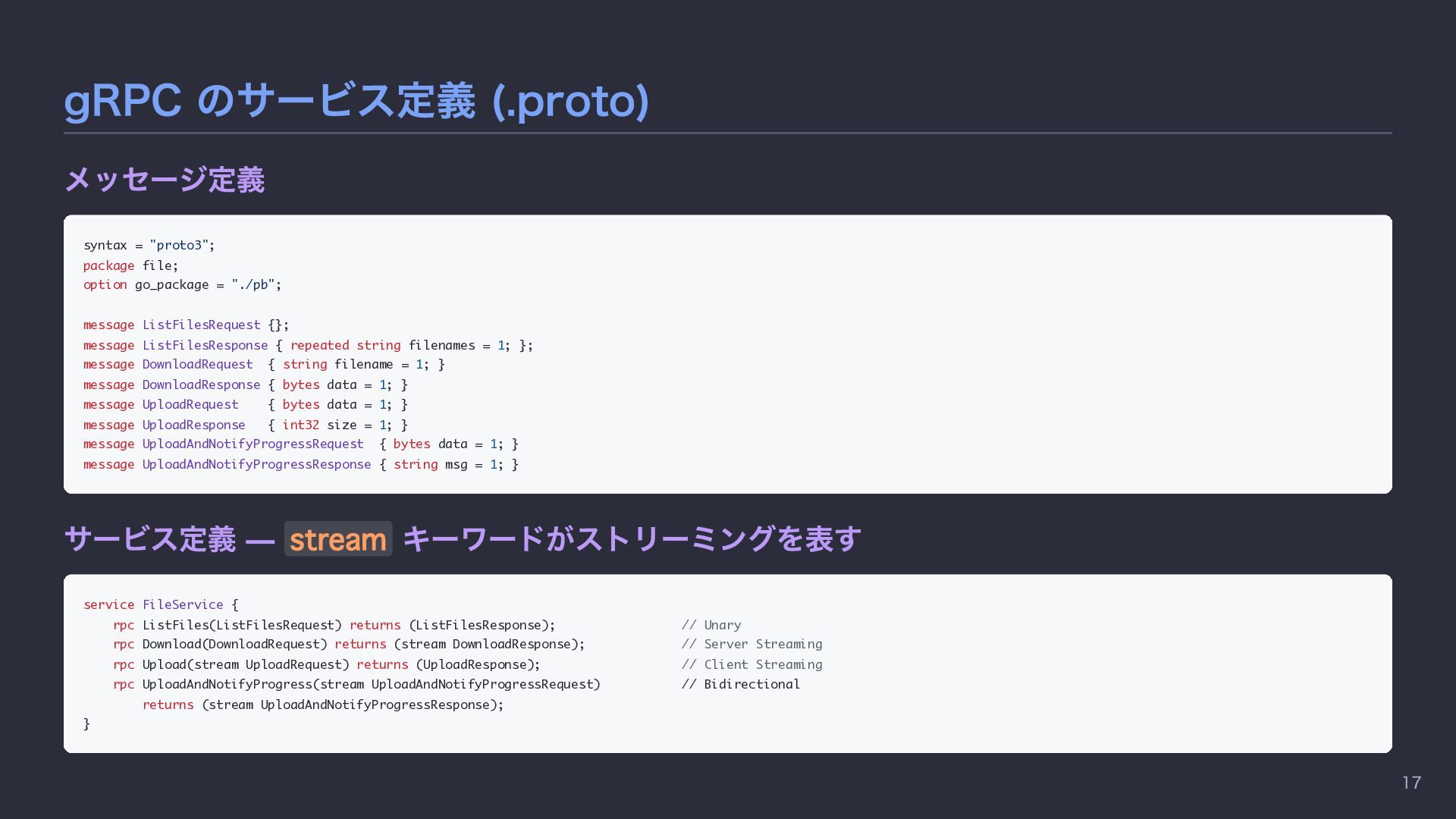
  16. gRPC のサービス定義 (.proto) メッセージ定義 syntax = "proto3"; package file; option

    go_package = "./pb"; message ListFilesRequest {}; message ListFilesResponse { repeated string filenames = 1; }; message DownloadRequest { string filename = 1; } message DownloadResponse { bytes data = 1; } message UploadRequest { bytes data = 1; } message UploadResponse { int32 size = 1; } message UploadAndNotifyProgressRequest { bytes data = 1; } message UploadAndNotifyProgressResponse { string msg = 1; } サービス定義 — stream キーワードがストリーミングを表す service FileService { rpc ListFiles(ListFilesRequest) returns (ListFilesResponse); // Unary rpc Download(DownloadRequest) returns (stream DownloadResponse); // Server Streaming rpc Upload(stream UploadRequest) returns (UploadResponse); // Client Streaming rpc UploadAndNotifyProgress(stream UploadAndNotifyProgressRequest) // Bidirectional returns (stream UploadAndNotifyProgressResponse); } 17
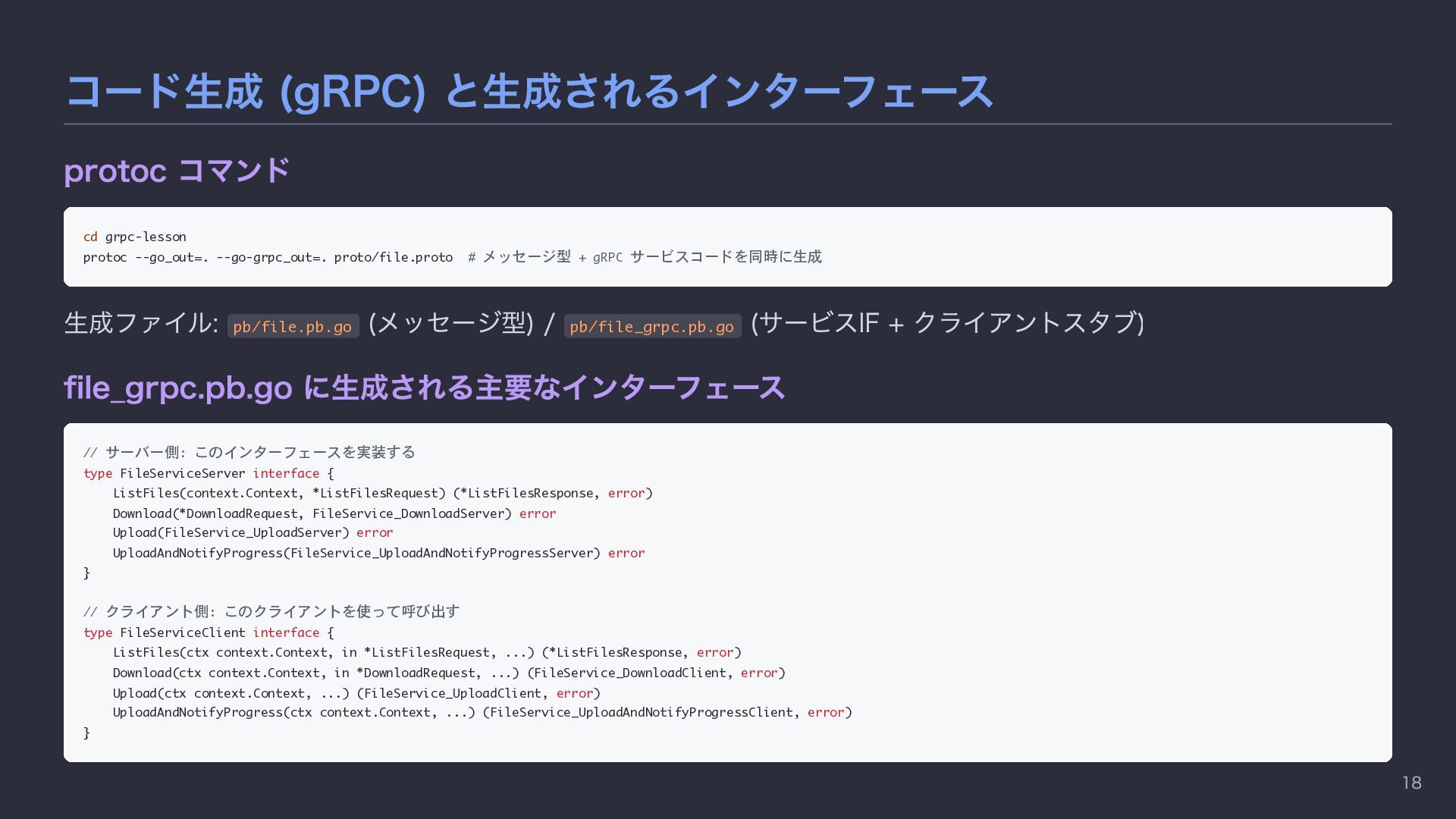
  17. コード生成 (gRPC) と生成されるインターフェース protoc コマンド cd grpc-lesson protoc --go_out=. --go-grpc_out=.

    proto/file.proto # メッセージ型 + gRPC サービスコードを同時に生成 生成ファイル: pb/file.pb.go (メッセージ型) / pb/file_grpc.pb.go (サービスIF + クライアントスタブ) file_grpc.pb.go に生成される主要なインターフェース // サーバー側: このインターフェースを実装する type FileServiceServer interface { ListFiles(context.Context, *ListFilesRequest) (*ListFilesResponse, error) Download(*DownloadRequest, FileService_DownloadServer) error Upload(FileService_UploadServer) error UploadAndNotifyProgress(FileService_UploadAndNotifyProgressServer) error } // クライアント側: このクライアントを使って呼び出す type FileServiceClient interface { ListFiles(ctx context.Context, in *ListFilesRequest, ...) (*ListFilesResponse, error) Download(ctx context.Context, in *DownloadRequest, ...) (FileService_DownloadClient, error) Upload(ctx context.Context, ...) (FileService_UploadClient, error) UploadAndNotifyProgress(ctx context.Context, ...) (FileService_UploadAndNotifyProgressClient, error) } 18
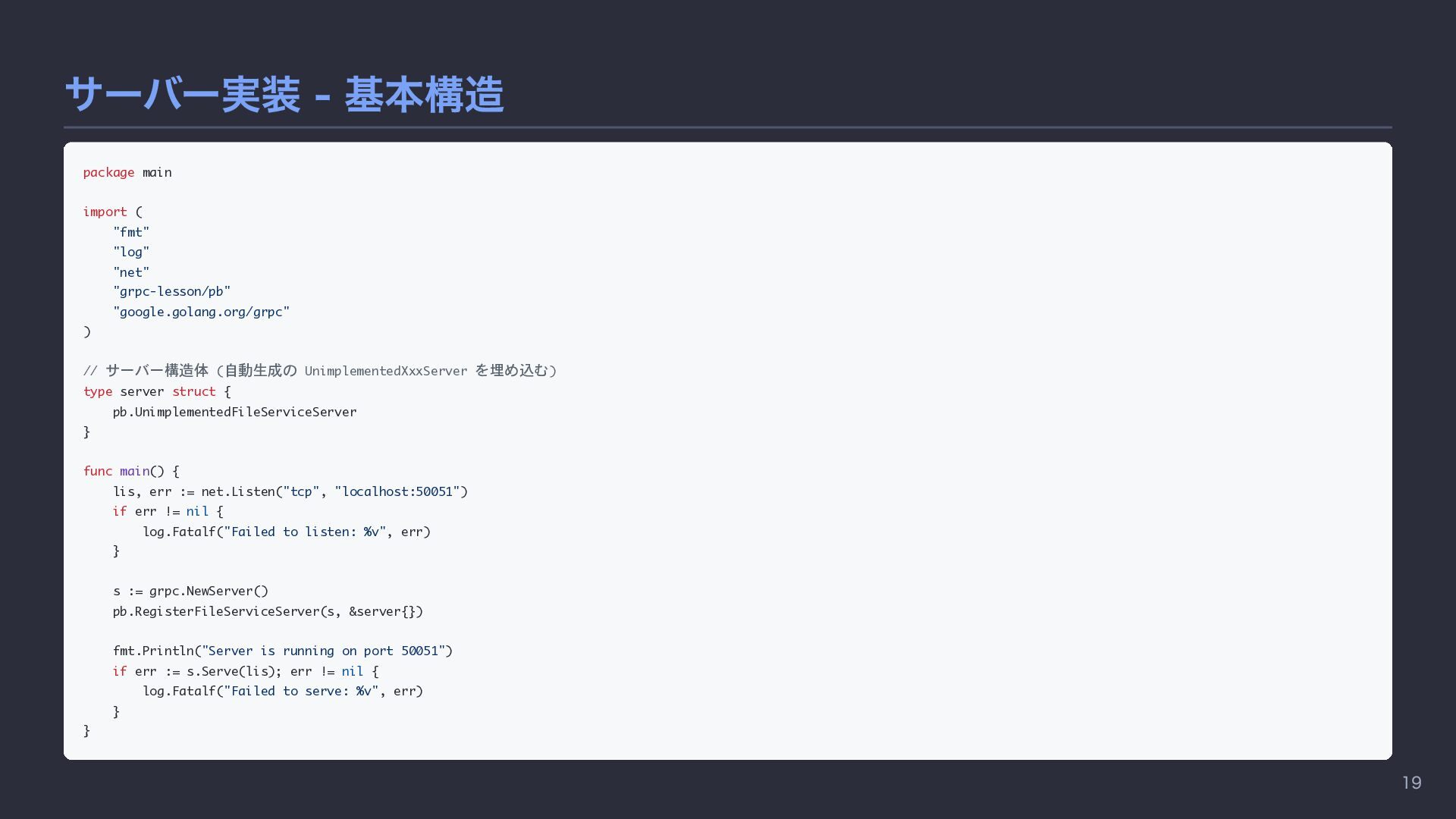
  18. サーバー実装 - 基本構造 package main import ( "fmt" "log" "net"

    "grpc-lesson/pb" "google.golang.org/grpc" ) // サーバー構造体 (自動生成の UnimplementedXxxServer を埋め込む) type server struct { pb.UnimplementedFileServiceServer } func main() { lis, err := net.Listen("tcp", "localhost:50051") if err != nil { log.Fatalf("Failed to listen: %v", err) } s := grpc.NewServer() pb.RegisterFileServiceServer(s, &server{}) fmt.Println("Server is running on port 50051") if err := s.Serve(lis); err != nil { log.Fatalf("Failed to serve: %v", err) } } 19
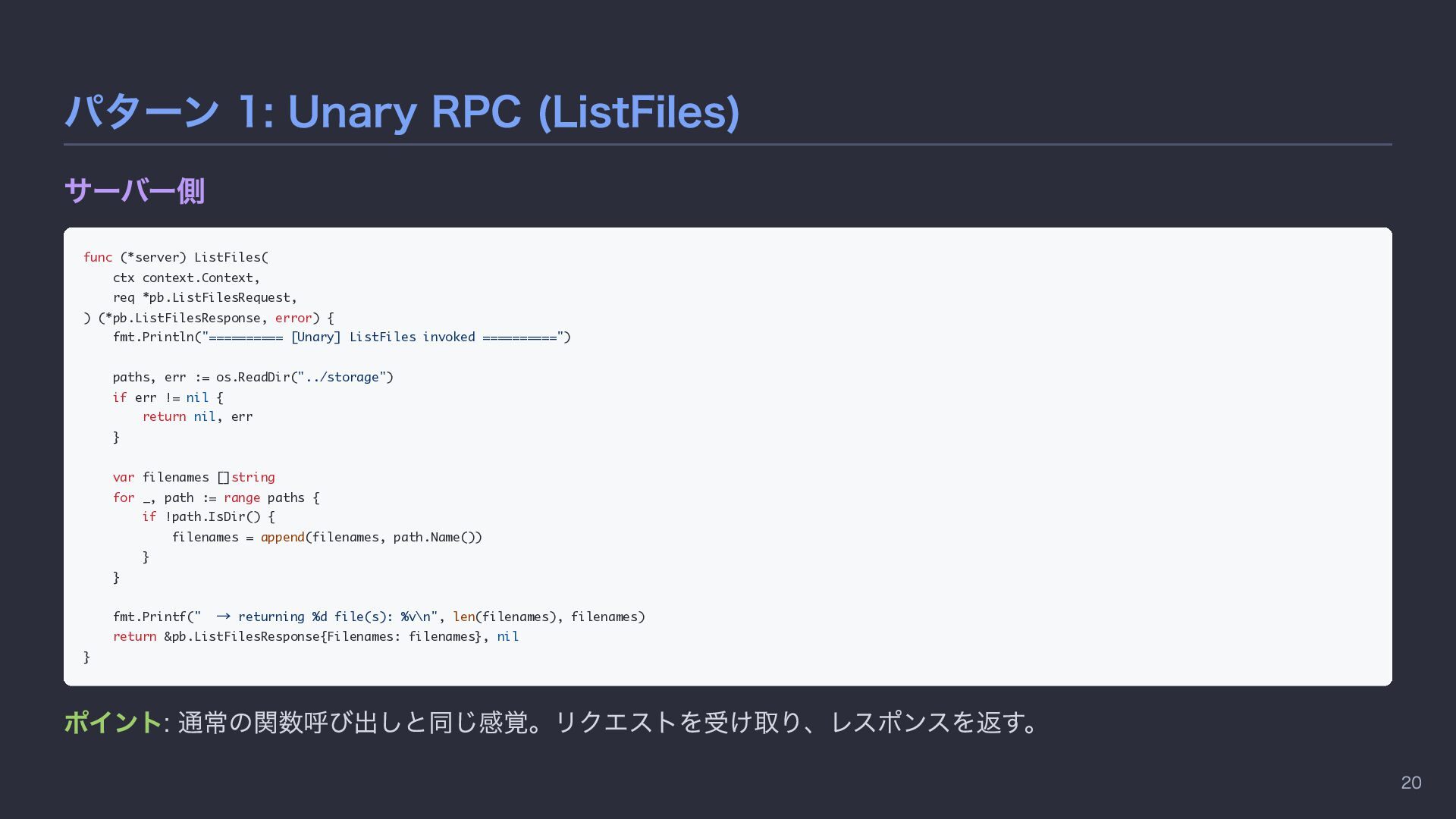
  19. パターン 1: Unary RPC (ListFiles) サーバー側 func (*server) ListFiles( ctx

    context.Context, req *pb.ListFilesRequest, ) (*pb.ListFilesResponse, error) { fmt.Println("========== [Unary] ListFiles invoked ==========") paths, err := os.ReadDir("../storage") if err != nil { return nil, err } var filenames []string for _, path := range paths { if !path.IsDir() { filenames = append(filenames, path.Name()) } } fmt.Printf(" → returning %d file(s): %v\n", len(filenames), filenames) return &pb.ListFilesResponse{Filenames: filenames}, nil } ポイント: 通常の関数呼び出しと同じ感覚。リクエストを受け取り、レスポンスを返す。 20
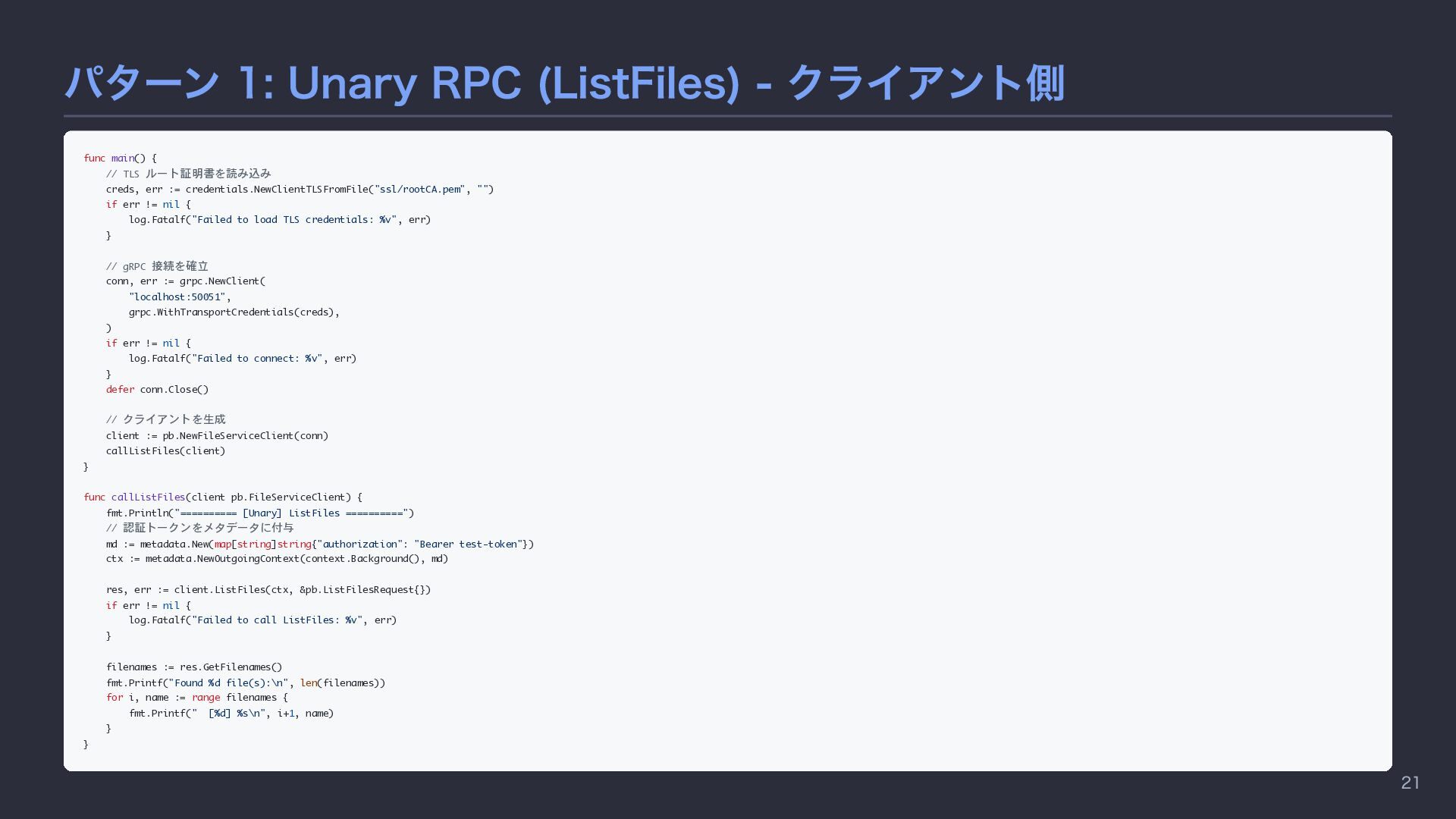
  20. パターン 1: Unary RPC (ListFiles) - クライアント側 func main() {

    // TLS ルート証明書を読み込み creds, err := credentials.NewClientTLSFromFile("ssl/rootCA.pem", "") if err != nil { log.Fatalf("Failed to load TLS credentials: %v", err) } // gRPC 接続を確立 conn, err := grpc.NewClient( "localhost:50051", grpc.WithTransportCredentials(creds), ) if err != nil { log.Fatalf("Failed to connect: %v", err) } defer conn.Close() // クライアントを生成 client := pb.NewFileServiceClient(conn) callListFiles(client) } func callListFiles(client pb.FileServiceClient) { fmt.Println("========== [Unary] ListFiles ==========") // 認証トークンをメタデータに付与 md := metadata.New(map[string]string{"authorization": "Bearer test-token"}) ctx := metadata.NewOutgoingContext(context.Background(), md) res, err := client.ListFiles(ctx, &pb.ListFilesRequest{}) if err != nil { log.Fatalf("Failed to call ListFiles: %v", err) } filenames := res.GetFilenames() fmt.Printf("Found %d file(s):\n", len(filenames)) for i, name := range filenames { fmt.Printf(" [%d] %s\n", i+1, name) } } 21
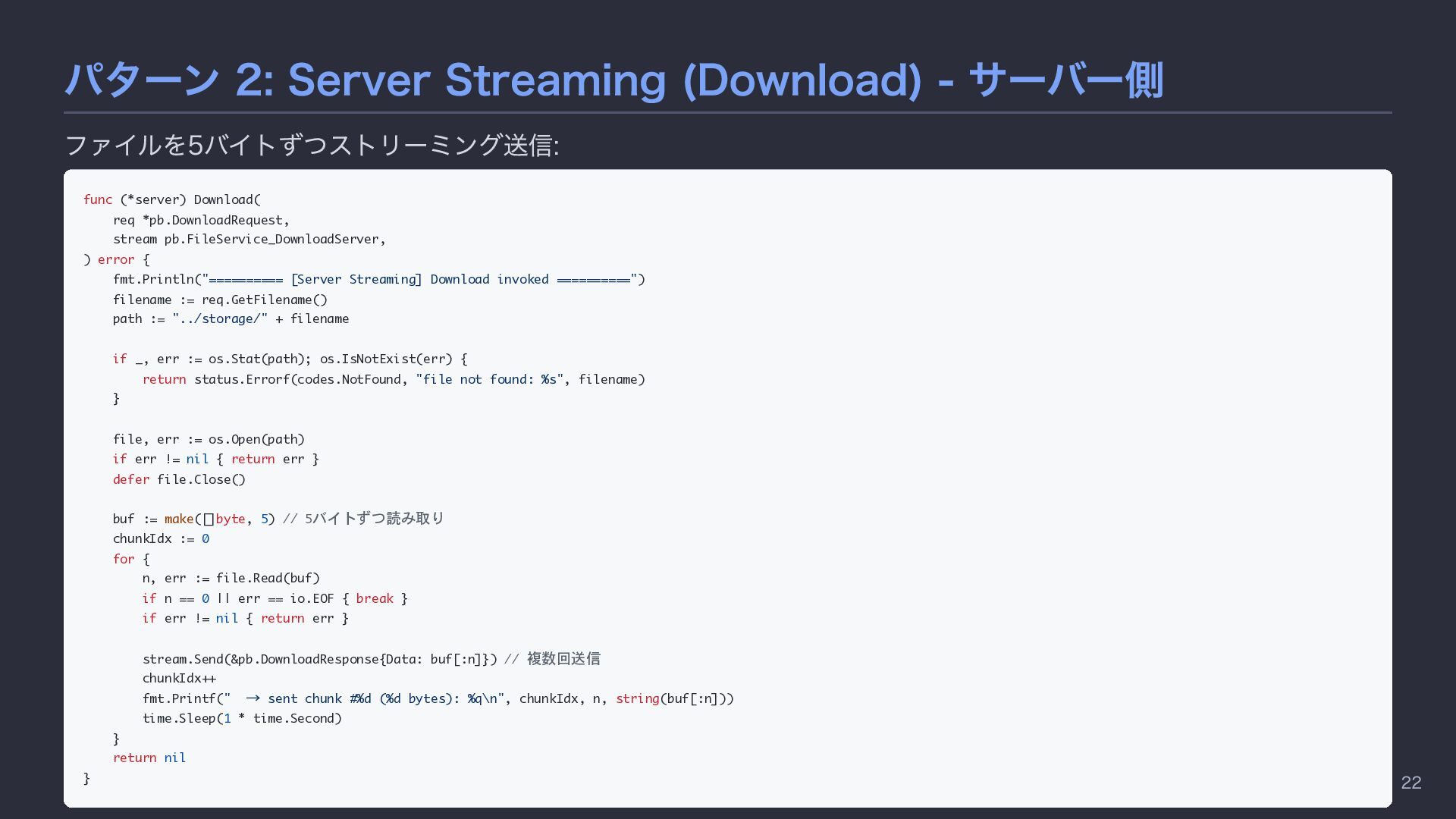
  21. パターン 2: Server Streaming (Download) - サーバー側 ファイルを5バイトずつストリーミング送信: func (*server)

    Download( req *pb.DownloadRequest, stream pb.FileService_DownloadServer, ) error { fmt.Println("========== [Server Streaming] Download invoked ==========") filename := req.GetFilename() path := "../storage/" + filename if _, err := os.Stat(path); os.IsNotExist(err) { return status.Errorf(codes.NotFound, "file not found: %s", filename) } file, err := os.Open(path) if err != nil { return err } defer file.Close() buf := make([]byte, 5) // 5バイトずつ読み取り chunkIdx := 0 for { n, err := file.Read(buf) if n == 0 || err == io.EOF { break } if err != nil { return err } stream.Send(&pb.DownloadResponse{Data: buf[:n]}) // 複数回送信 chunkIdx++ fmt.Printf(" → sent chunk #%d (%d bytes): %q\n", chunkIdx, n, string(buf[:n])) time.Sleep(1 * time.Second) } return nil } 22
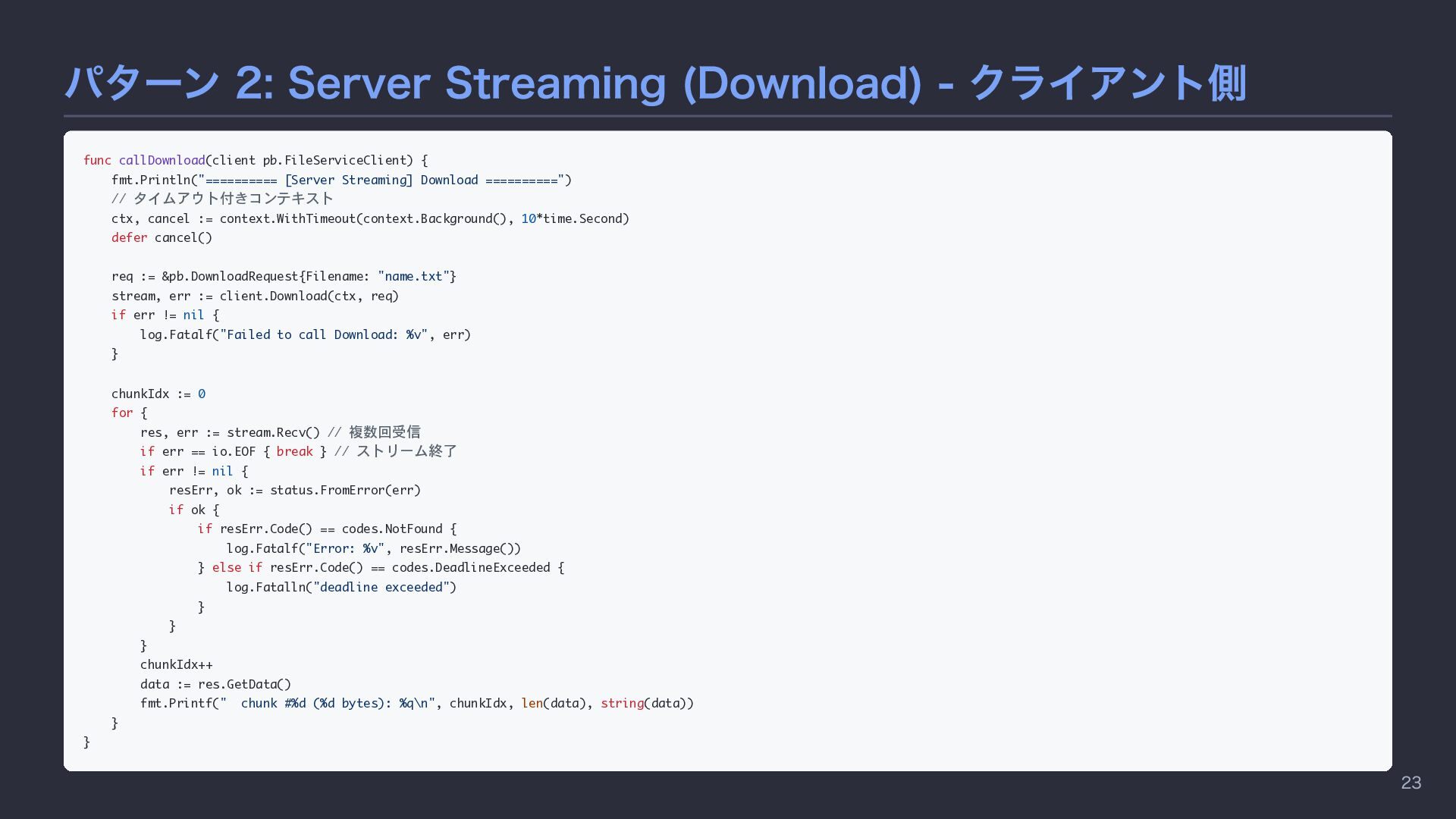
  22. パターン 2: Server Streaming (Download) - クライアント側 func callDownload(client pb.FileServiceClient)

    { fmt.Println("========== [Server Streaming] Download ==========") // タイムアウト付きコンテキスト ctx, cancel := context.WithTimeout(context.Background(), 10*time.Second) defer cancel() req := &pb.DownloadRequest{Filename: "name.txt"} stream, err := client.Download(ctx, req) if err != nil { log.Fatalf("Failed to call Download: %v", err) } chunkIdx := 0 for { res, err := stream.Recv() // 複数回受信 if err == io.EOF { break } // ストリーム終了 if err != nil { resErr, ok := status.FromError(err) if ok { if resErr.Code() == codes.NotFound { log.Fatalf("Error: %v", resErr.Message()) } else if resErr.Code() == codes.DeadlineExceeded { log.Fatalln("deadline exceeded") } } } chunkIdx++ data := res.GetData() fmt.Printf(" chunk #%d (%d bytes): %q\n", chunkIdx, len(data), string(data)) } } 23
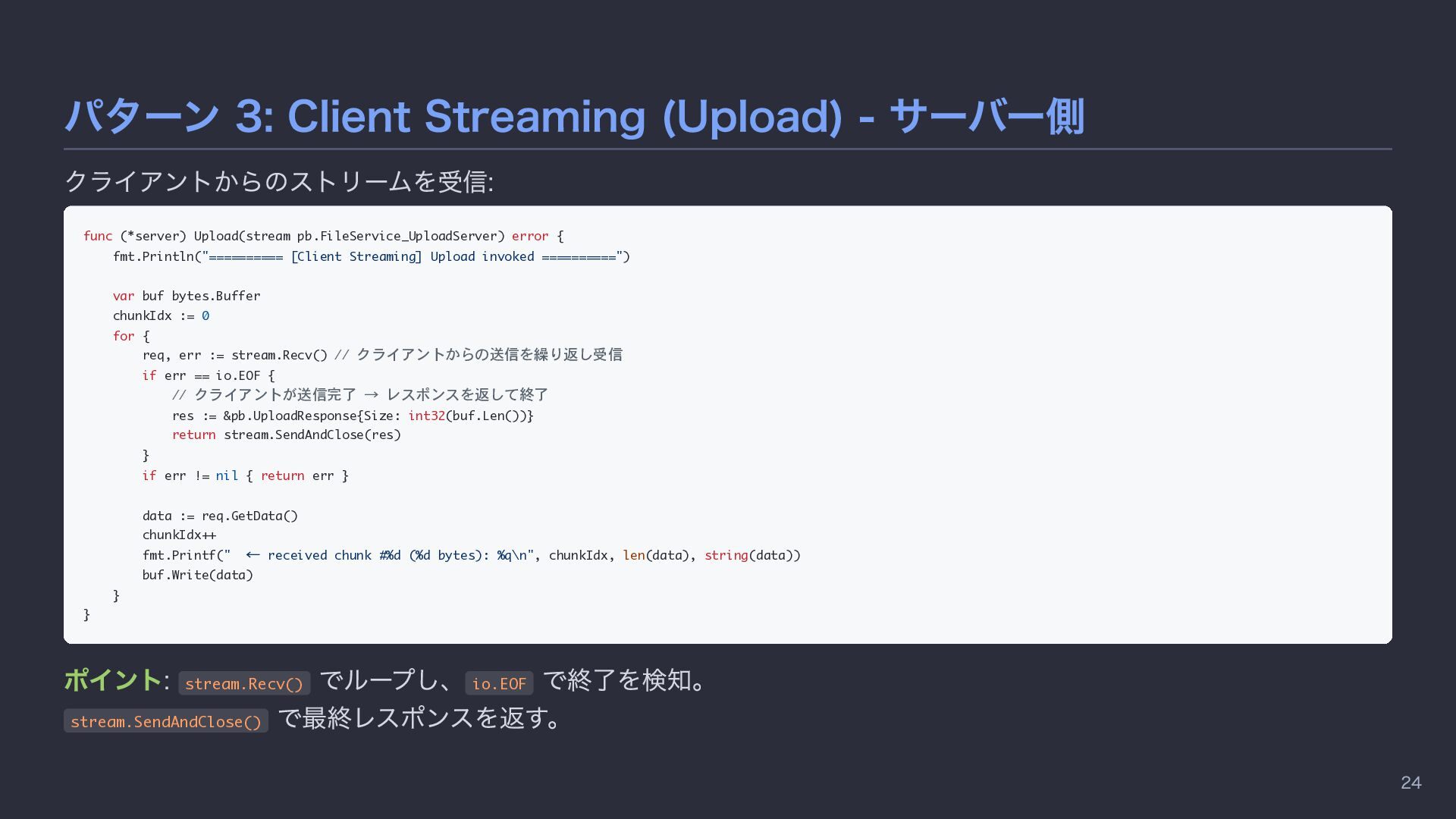
  23. パターン 3: Client Streaming (Upload) - サーバー側 クライアントからのストリームを受信: func (*server)

    Upload(stream pb.FileService_UploadServer) error { fmt.Println("========== [Client Streaming] Upload invoked ==========") var buf bytes.Buffer chunkIdx := 0 for { req, err := stream.Recv() // クライアントからの送信を繰り返し受信 if err == io.EOF { // クライアントが送信完了 → レスポンスを返して終了 res := &pb.UploadResponse{Size: int32(buf.Len())} return stream.SendAndClose(res) } if err != nil { return err } data := req.GetData() chunkIdx++ fmt.Printf(" ← received chunk #%d (%d bytes): %q\n", chunkIdx, len(data), string(data)) buf.Write(data) } } ポイント: stream.Recv() でループし、 io.EOF で終了を検知。 stream.SendAndClose() で最終レスポンスを返す。 24
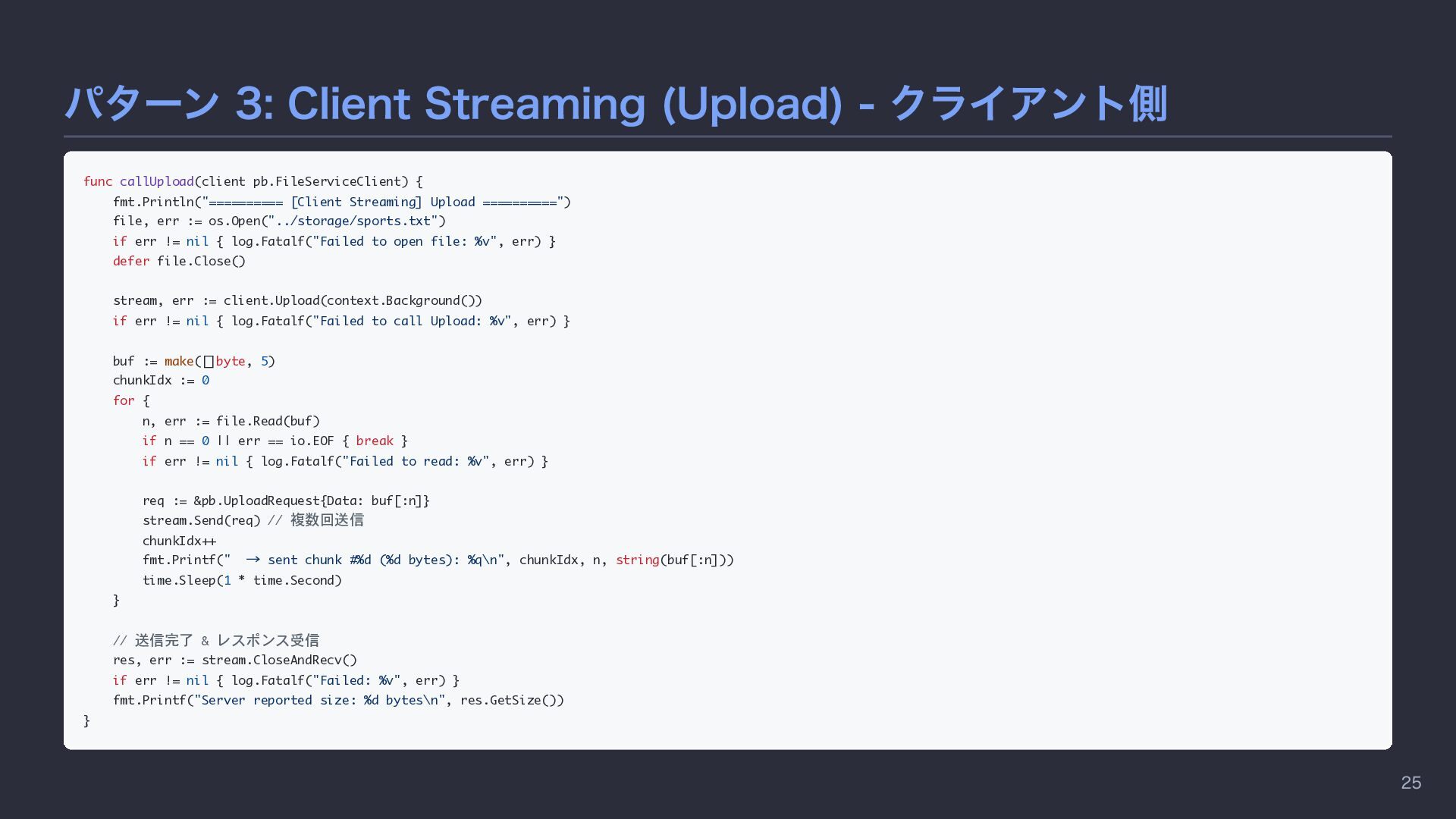
  24. パターン 3: Client Streaming (Upload) - クライアント側 func callUpload(client pb.FileServiceClient)

    { fmt.Println("========== [Client Streaming] Upload ==========") file, err := os.Open("../storage/sports.txt") if err != nil { log.Fatalf("Failed to open file: %v", err) } defer file.Close() stream, err := client.Upload(context.Background()) if err != nil { log.Fatalf("Failed to call Upload: %v", err) } buf := make([]byte, 5) chunkIdx := 0 for { n, err := file.Read(buf) if n == 0 || err == io.EOF { break } if err != nil { log.Fatalf("Failed to read: %v", err) } req := &pb.UploadRequest{Data: buf[:n]} stream.Send(req) // 複数回送信 chunkIdx++ fmt.Printf(" → sent chunk #%d (%d bytes): %q\n", chunkIdx, n, string(buf[:n])) time.Sleep(1 * time.Second) } // 送信完了 & レスポンス受信 res, err := stream.CloseAndRecv() if err != nil { log.Fatalf("Failed: %v", err) } fmt.Printf("Server reported size: %d bytes\n", res.GetSize()) } 25
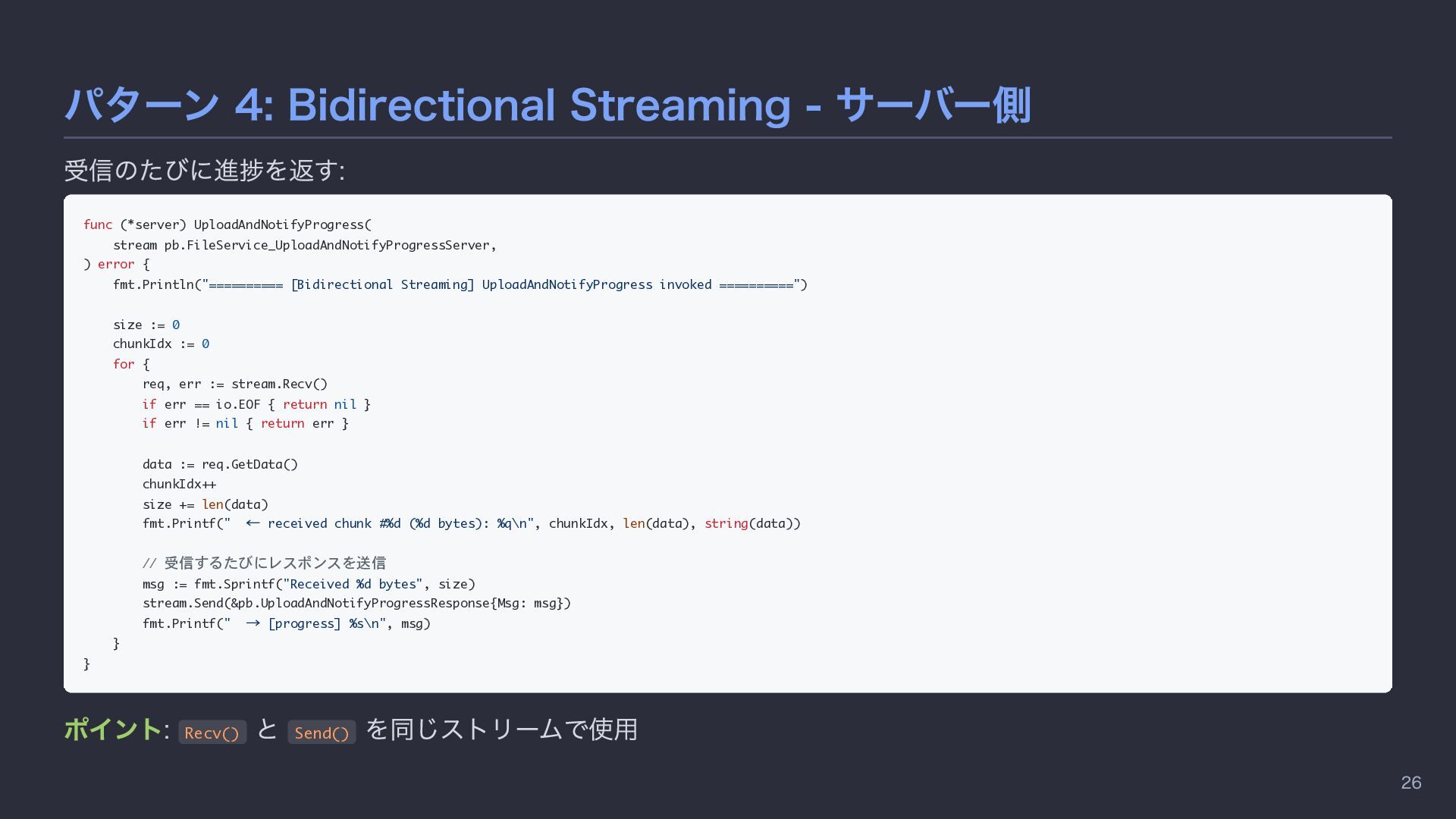
  25. パターン 4: Bidirectional Streaming - サーバー側 受信のたびに進捗を返す: func (*server) UploadAndNotifyProgress(

    stream pb.FileService_UploadAndNotifyProgressServer, ) error { fmt.Println("========== [Bidirectional Streaming] UploadAndNotifyProgress invoked ==========") size := 0 chunkIdx := 0 for { req, err := stream.Recv() if err == io.EOF { return nil } if err != nil { return err } data := req.GetData() chunkIdx++ size += len(data) fmt.Printf(" ← received chunk #%d (%d bytes): %q\n", chunkIdx, len(data), string(data)) // 受信するたびにレスポンスを送信 msg := fmt.Sprintf("Received %d bytes", size) stream.Send(&pb.UploadAndNotifyProgressResponse{Msg: msg}) fmt.Printf(" → [progress] %s\n", msg) } } ポイント: Recv() と Send() を同じストリームで使用 26
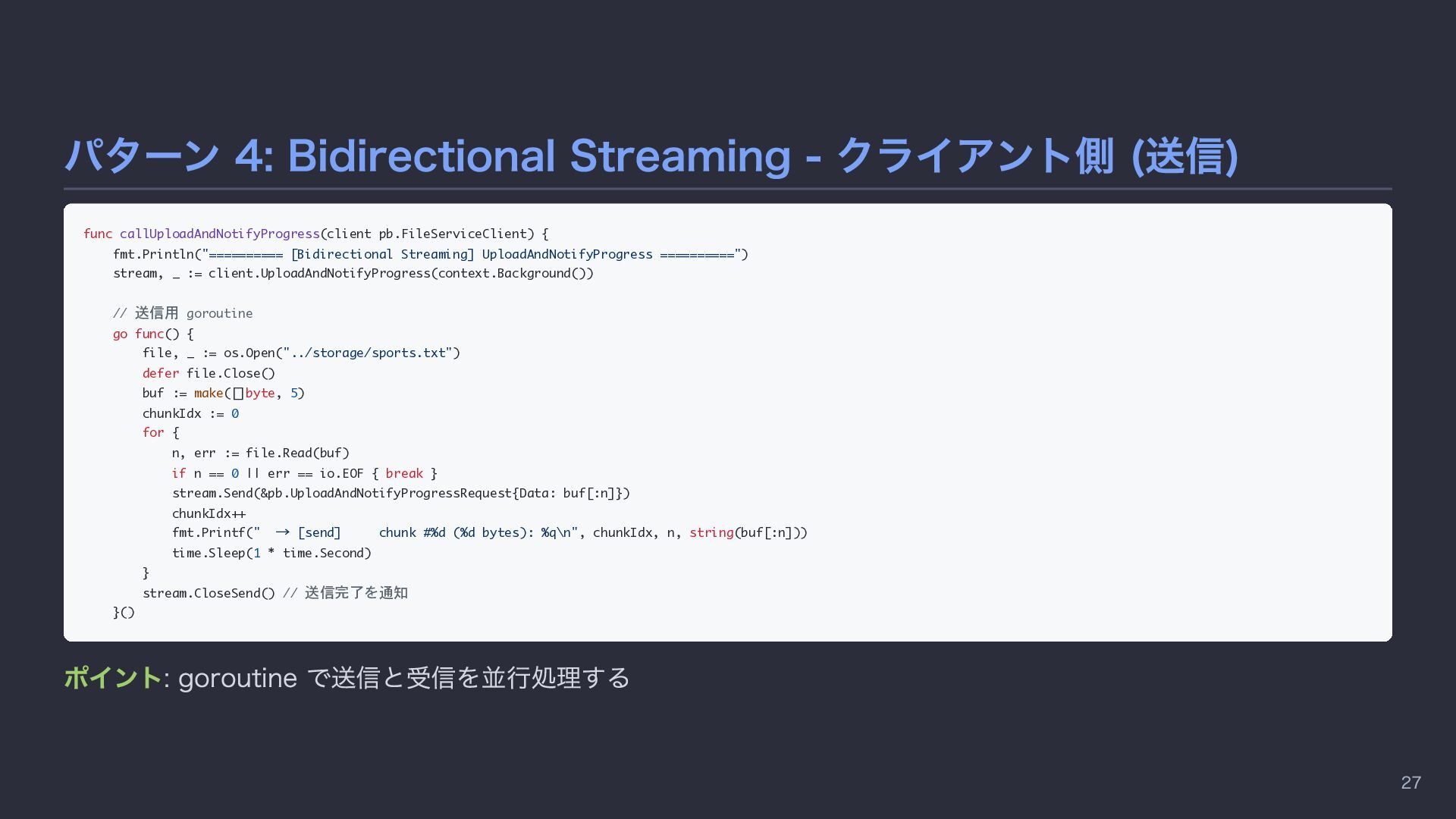
  26. パターン 4: Bidirectional Streaming - クライアント側 (送信) func callUploadAndNotifyProgress(client pb.FileServiceClient)

    { fmt.Println("========== [Bidirectional Streaming] UploadAndNotifyProgress ==========") stream, _ := client.UploadAndNotifyProgress(context.Background()) // 送信用 goroutine go func() { file, _ := os.Open("../storage/sports.txt") defer file.Close() buf := make([]byte, 5) chunkIdx := 0 for { n, err := file.Read(buf) if n == 0 || err == io.EOF { break } stream.Send(&pb.UploadAndNotifyProgressRequest{Data: buf[:n]}) chunkIdx++ fmt.Printf(" → [send] chunk #%d (%d bytes): %q\n", chunkIdx, n, string(buf[:n])) time.Sleep(1 * time.Second) } stream.CloseSend() // 送信完了を通知 }() ポイント: goroutine で送信と受信を並行処理する 27
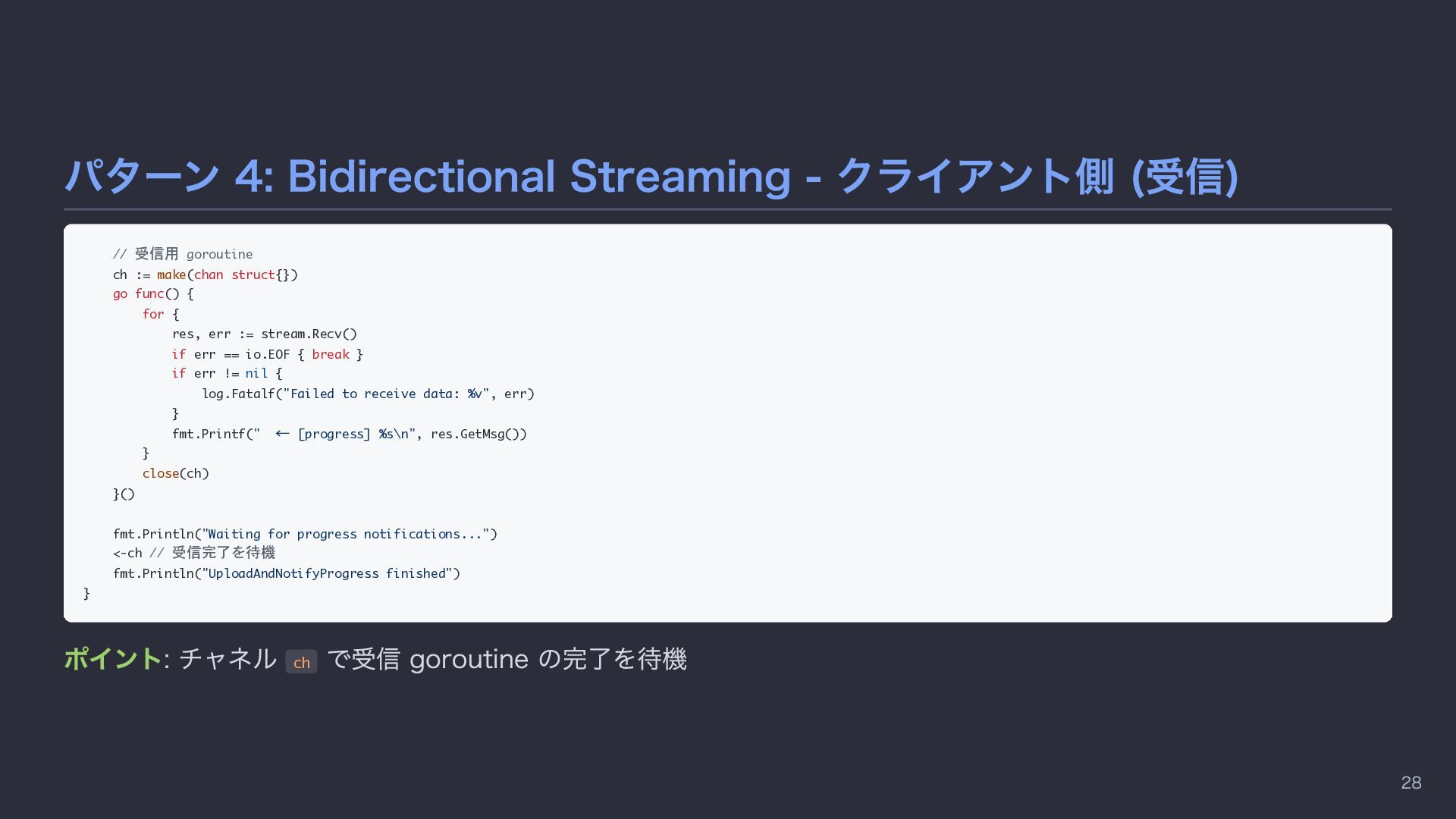
  27. パターン 4: Bidirectional Streaming - クライアント側 (受信) // 受信用 goroutine

    ch := make(chan struct{}) go func() { for { res, err := stream.Recv() if err == io.EOF { break } if err != nil { log.Fatalf("Failed to receive data: %v", err) } fmt.Printf(" ← [progress] %s\n", res.GetMsg()) } close(ch) }() fmt.Println("Waiting for progress notifications...") <-ch // 受信完了を待機 fmt.Println("UploadAndNotifyProgress finished") } ポイント: チャネル ch で受信 goroutine の完了を待機 28
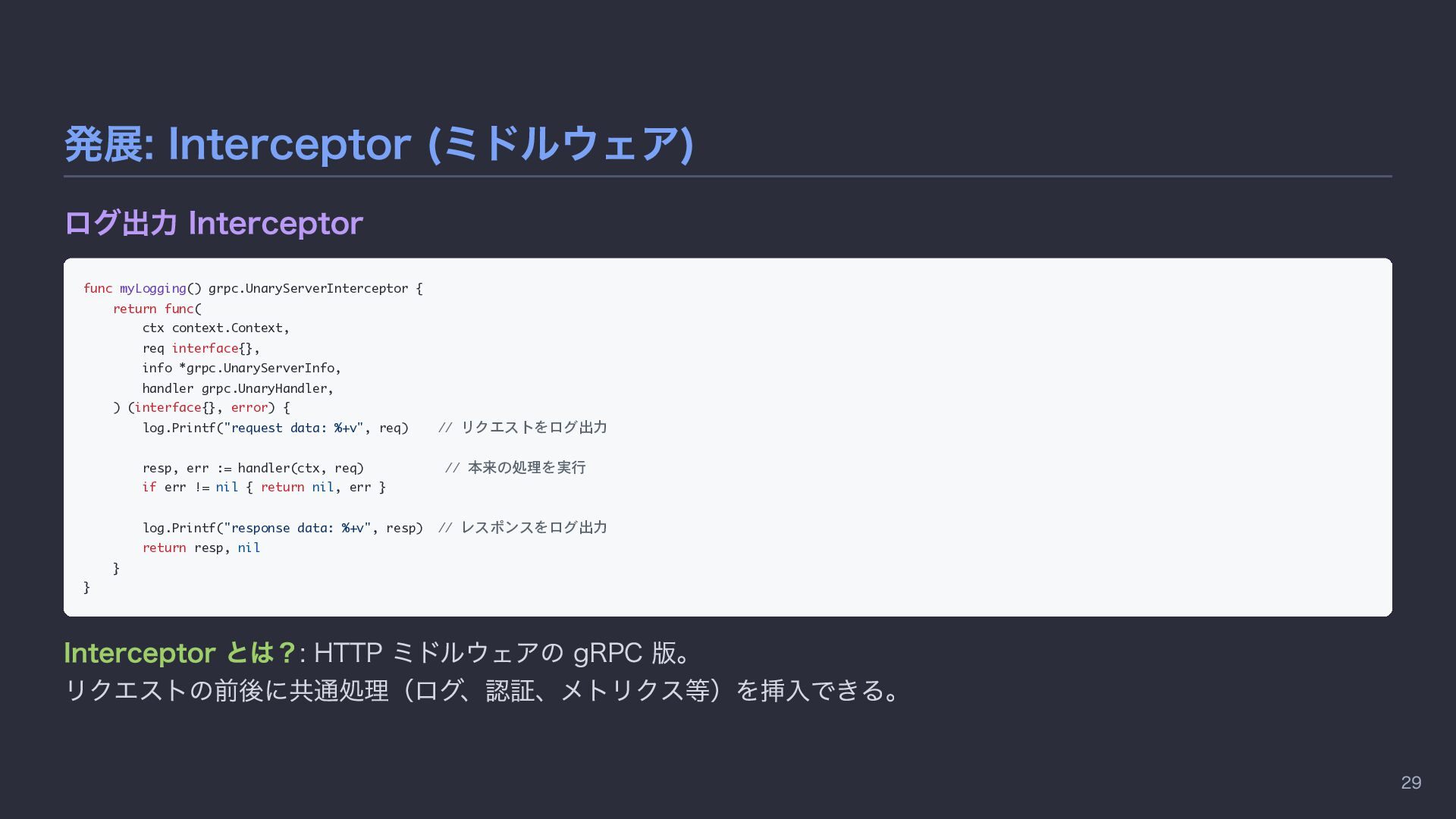
  28. 発展: Interceptor (ミドルウェア) ログ出力 Interceptor func myLogging() grpc.UnaryServerInterceptor { return

    func( ctx context.Context, req interface{}, info *grpc.UnaryServerInfo, handler grpc.UnaryHandler, ) (interface{}, error) { log.Printf("request data: %+v", req) // リクエストをログ出力 resp, err := handler(ctx, req) // 本来の処理を実行 if err != nil { return nil, err } log.Printf("response data: %+v", resp) // レスポンスをログ出力 return resp, nil } } Interceptor とは?: HTTP ミドルウェアの gRPC 版。 リクエストの前後に共通処理(ログ、認証、メトリクス等)を挿入できる。 29
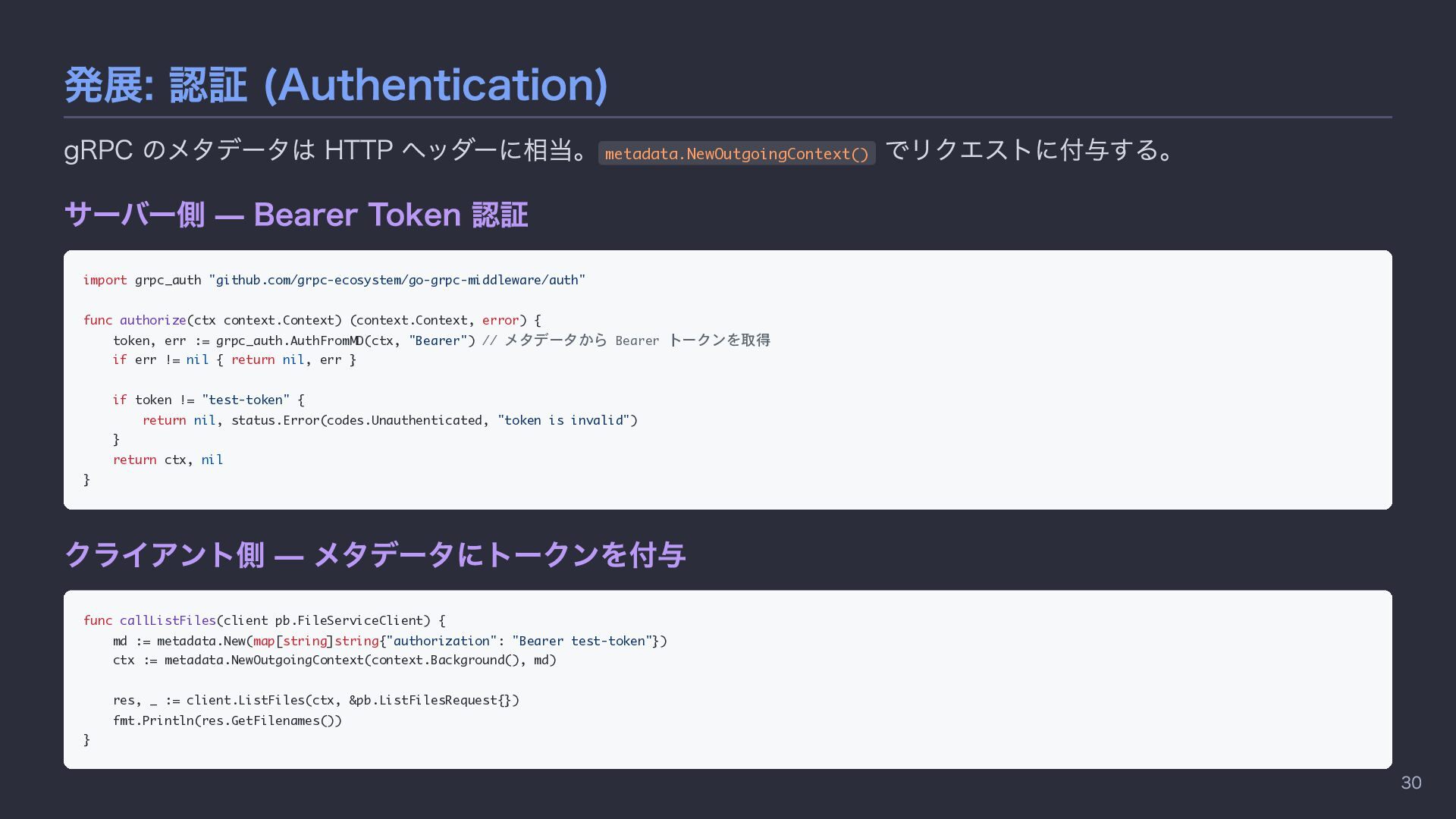
  29. 発展: 認証 (Authentication) gRPC のメタデータは HTTP ヘッダーに相当。 metadata.NewOutgoingContext() でリクエストに付与する。 サーバー側

    — Bearer Token 認証 import grpc_auth "github.com/grpc-ecosystem/go-grpc-middleware/auth" func authorize(ctx context.Context) (context.Context, error) { token, err := grpc_auth.AuthFromMD(ctx, "Bearer") // メタデータから Bearer トークンを取得 if err != nil { return nil, err } if token != "test-token" { return nil, status.Error(codes.Unauthenticated, "token is invalid") } return ctx, nil } クライアント側 — メタデータにトークンを付与 func callListFiles(client pb.FileServiceClient) { md := metadata.New(map[string]string{"authorization": "Bearer test-token"}) ctx := metadata.NewOutgoingContext(context.Background(), md) res, _ := client.ListFiles(ctx, &pb.ListFilesRequest{}) fmt.Println(res.GetFilenames()) } 30
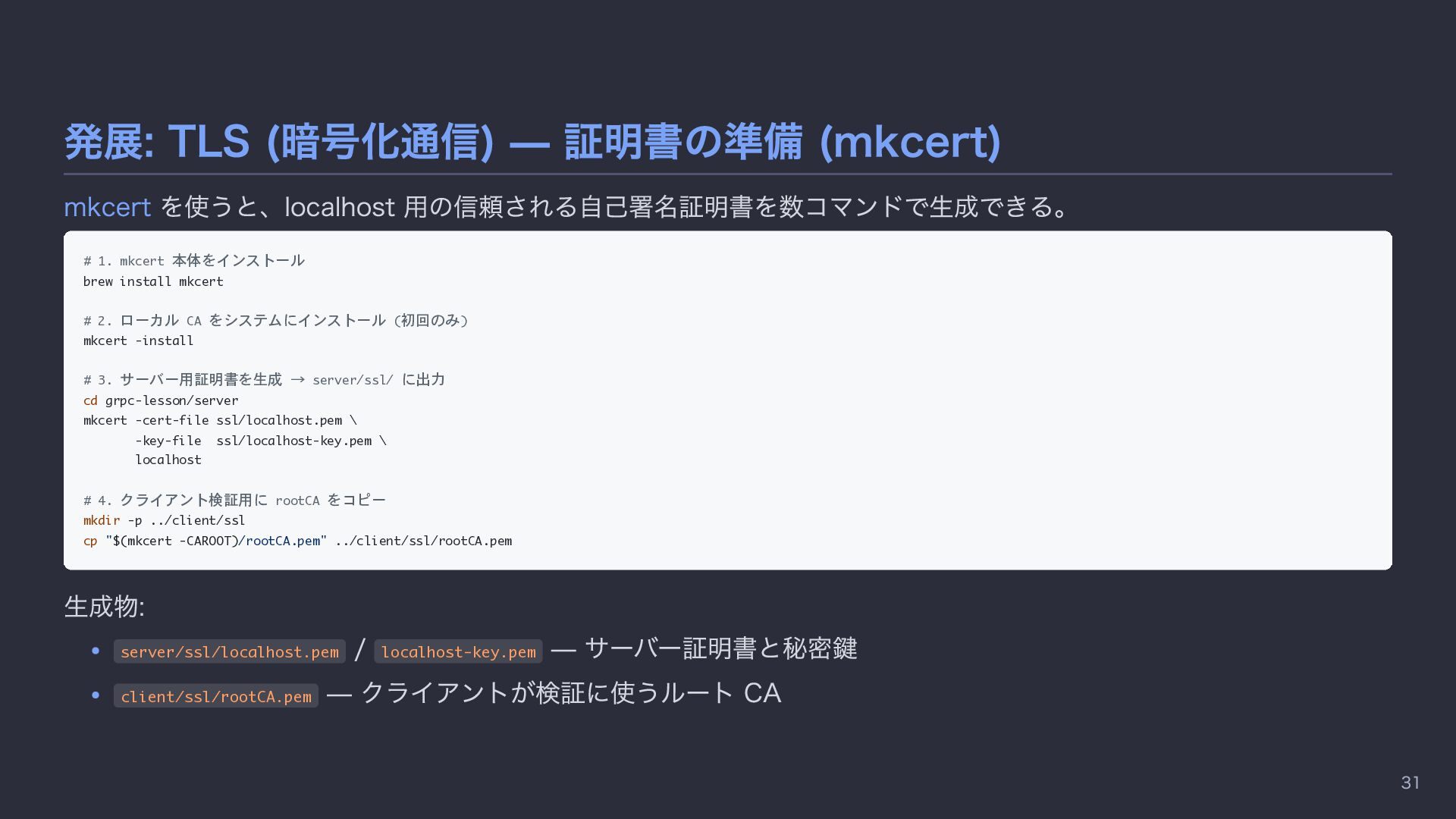
  30. 発展: TLS (暗号化通信) — 証明書の準備 (mkcert) mkcert を使うと、localhost 用の信頼される自己署名証明書を数コマンドで生成できる。 #

    1. mkcert 本体をインストール brew install mkcert # 2. ローカル CA をシステムにインストール (初回のみ) mkcert -install # 3. サーバー用証明書を生成 → server/ssl/ に出力 cd grpc-lesson/server mkcert -cert-file ssl/localhost.pem \ -key-file ssl/localhost-key.pem \ localhost # 4. クライアント検証用に rootCA をコピー mkdir -p ../client/ssl cp "$(mkcert -CAROOT)/rootCA.pem" ../client/ssl/rootCA.pem 生成物: server/ssl/localhost.pem / localhost-key.pem — サーバー証明書と秘密鍵 client/ssl/rootCA.pem — クライアントが検証に使うルート CA 31
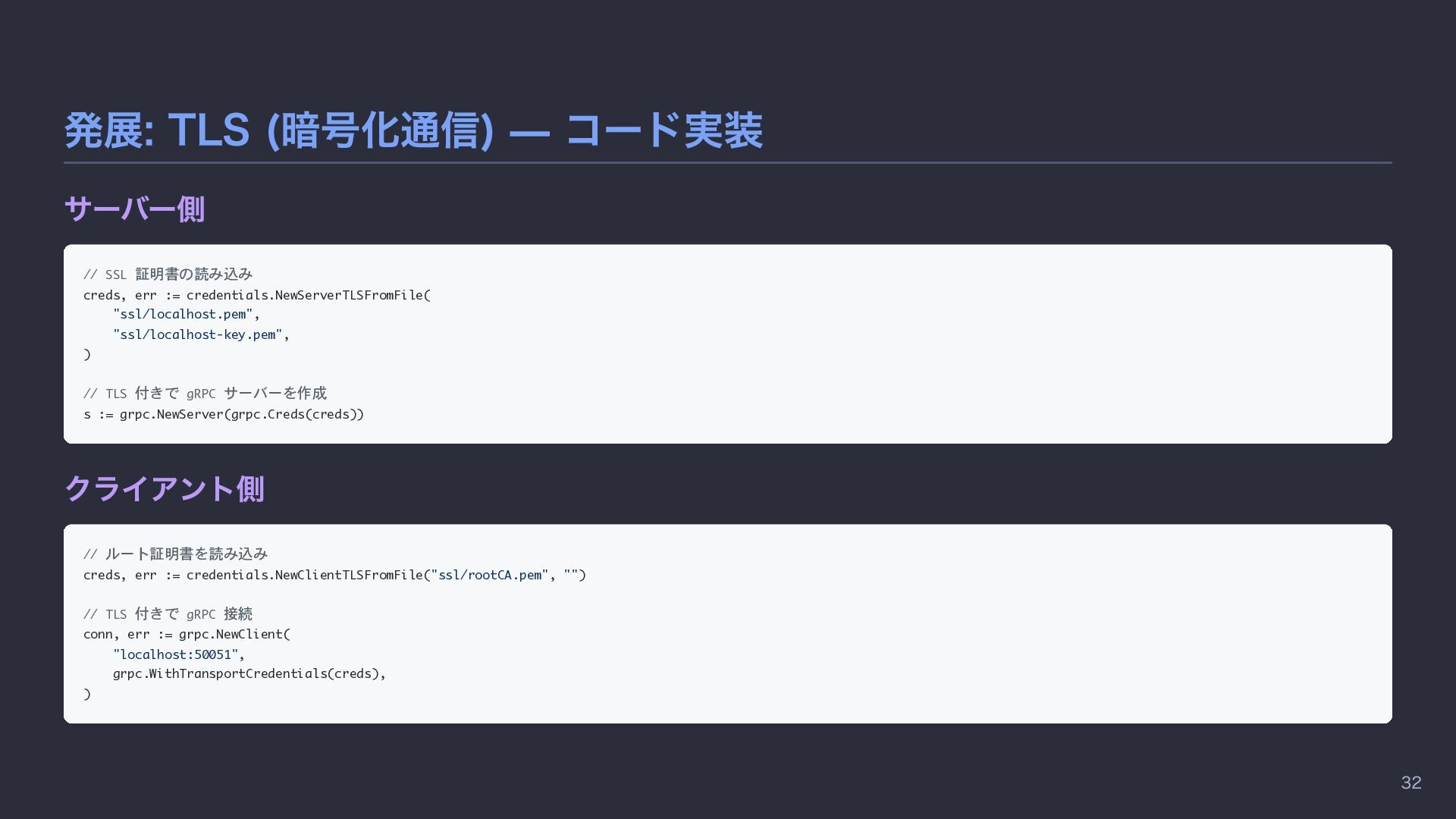
  31. 発展: TLS (暗号化通信) — コード実装 サーバー側 // SSL 証明書の読み込み creds,

    err := credentials.NewServerTLSFromFile( "ssl/localhost.pem", "ssl/localhost-key.pem", ) // TLS 付きで gRPC サーバーを作成 s := grpc.NewServer(grpc.Creds(creds)) クライアント側 // ルート証明書を読み込み creds, err := credentials.NewClientTLSFromFile("ssl/rootCA.pem", "") // TLS 付きで gRPC 接続 conn, err := grpc.NewClient( "localhost:50051", grpc.WithTransportCredentials(creds), ) 32
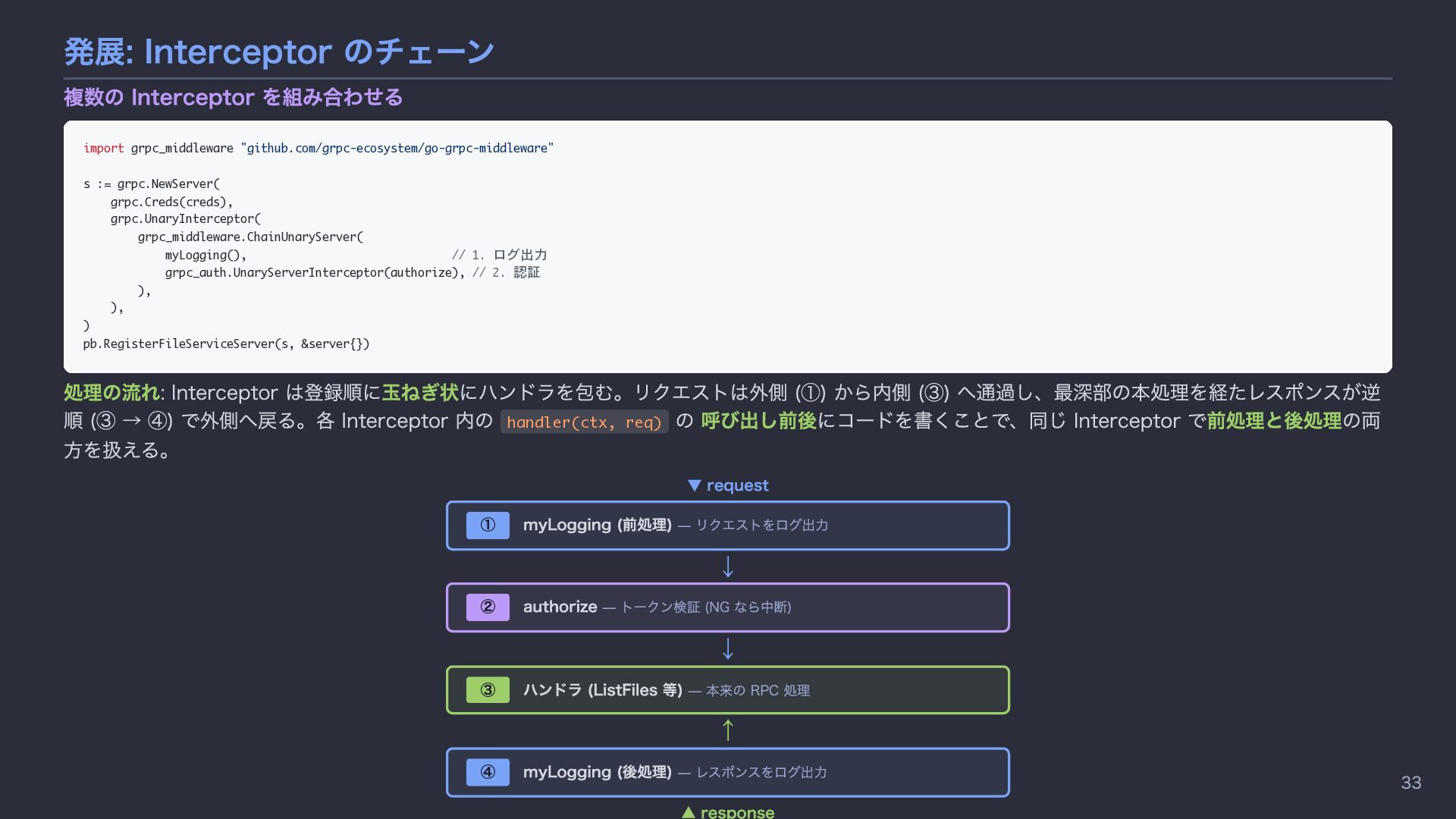
  32. 発展: Interceptor のチェーン 複数の Interceptor を組み合わせる import grpc_middleware "github.com/grpc-ecosystem/go-grpc-middleware" s

    := grpc.NewServer( grpc.Creds(creds), grpc.UnaryInterceptor( grpc_middleware.ChainUnaryServer( myLogging(), // 1. ログ出力 grpc_auth.UnaryServerInterceptor(authorize), // 2. 認証 ), ), ) pb.RegisterFileServiceServer(s, &server{}) 処理の流れ: Interceptor は登録順に玉ねぎ状にハンドラを包む。リクエストは外側 (①) から内側 (③) へ通過し、最深部の本処理を経たレスポンスが逆 順 (③ → ④) で外側へ戻る。各 Interceptor 内の handler(ctx, req) の 呼び出し前後にコードを書くことで、同じ Interceptor で前処理と後処理の両 方を扱える。 ▼ request ① myLogging (前処理) — リクエストをログ出力 ↓ ② authorize — トークン検証 (NG なら中断) ↓ ③ ハンドラ (ListFiles 等) — 本来の RPC 処理 ↑ ④ myLogging (後処理) — レスポンスをログ出力 ▲ response 33
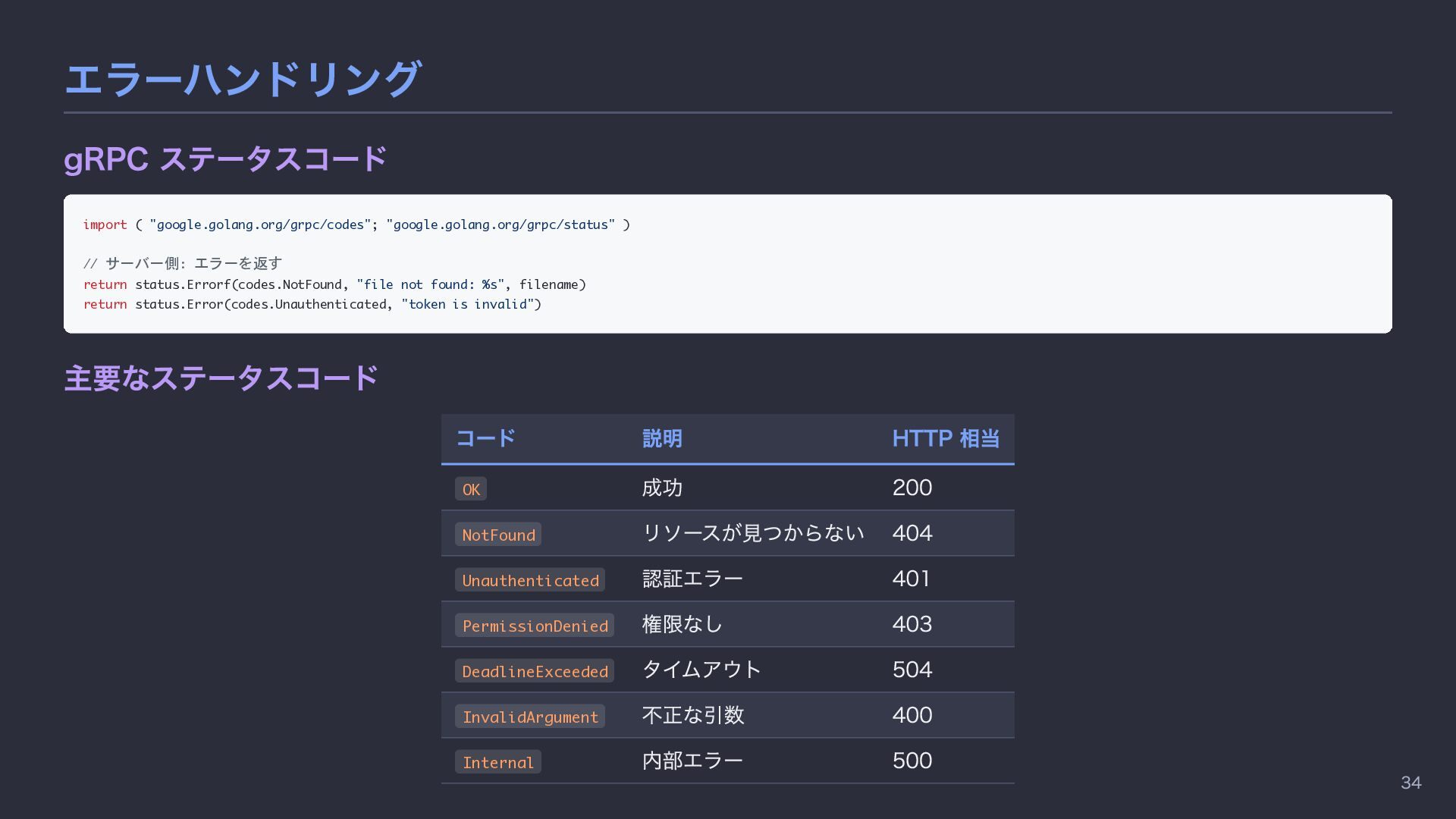
  33. エラーハンドリング gRPC ステータスコード import ( "google.golang.org/grpc/codes"; "google.golang.org/grpc/status" ) // サーバー側:

    エラーを返す return status.Errorf(codes.NotFound, "file not found: %s", filename) return status.Error(codes.Unauthenticated, "token is invalid") 主要なステータスコード コード 説明 HTTP 相当 OK 成功 200 NotFound リソースが見つからない 404 Unauthenticated 認証エラー 401 PermissionDenied 権限なし 403 DeadlineExceeded タイムアウト 504 InvalidArgument 不正な引数 400 Internal 内部エラー 500 34
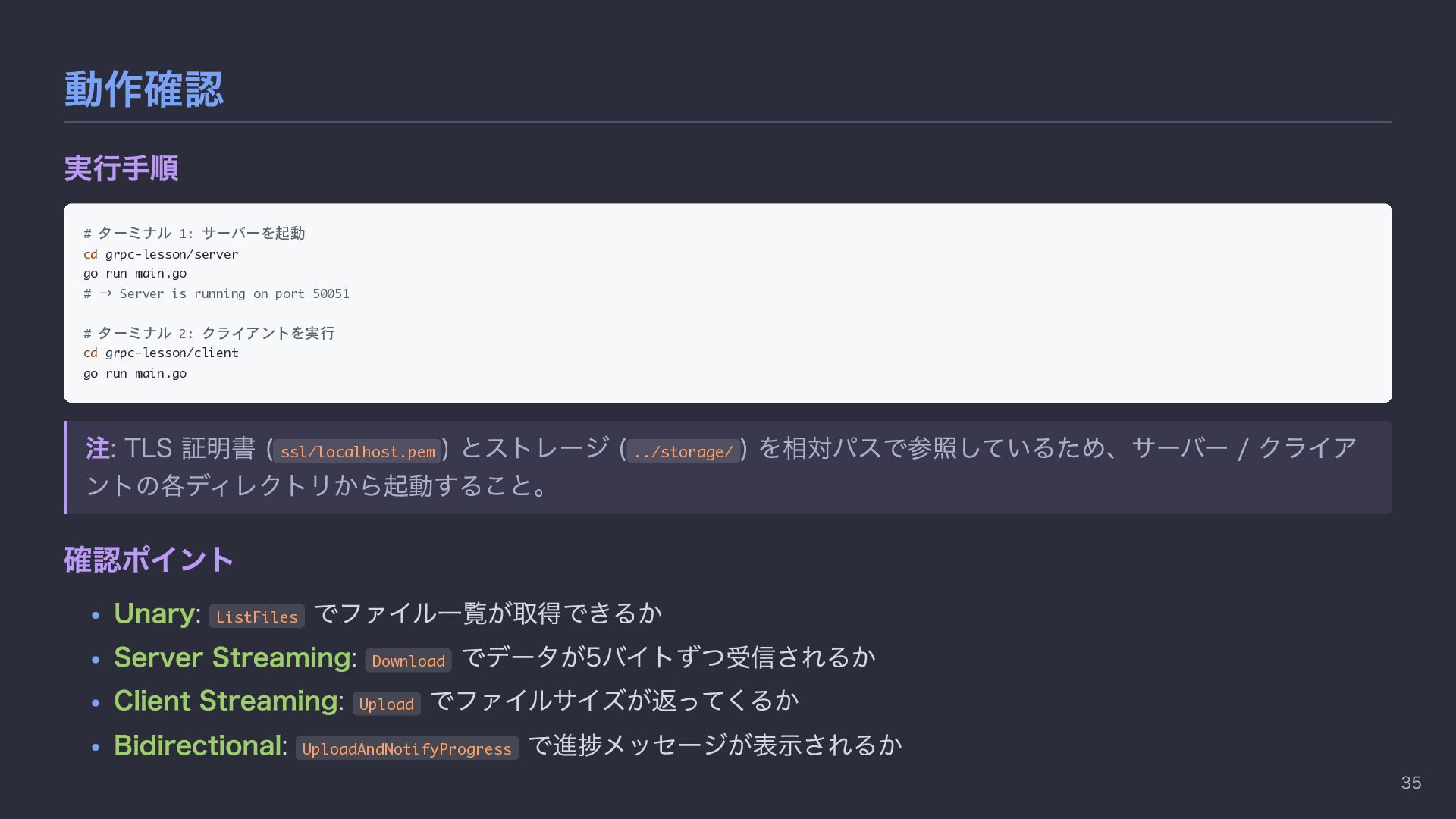
  34. 動作確認 実行手順 # ターミナル 1: サーバーを起動 cd grpc-lesson/server go run

    main.go # → Server is running on port 50051 # ターミナル 2: クライアントを実行 cd grpc-lesson/client go run main.go 注: TLS 証明書 ( ssl/localhost.pem ) とストレージ ( ../storage/ ) を相対パスで参照しているため、サーバー / クライア ントの各ディレクトリから起動すること。 確認ポイント Unary: ListFiles でファイル一覧が取得できるか Server Streaming: Download でデータが5バイトずつ受信されるか Client Streaming: Upload でファイルサイズが返ってくるか Bidirectional: UploadAndNotifyProgress で進捗メッセージが表示されるか 35
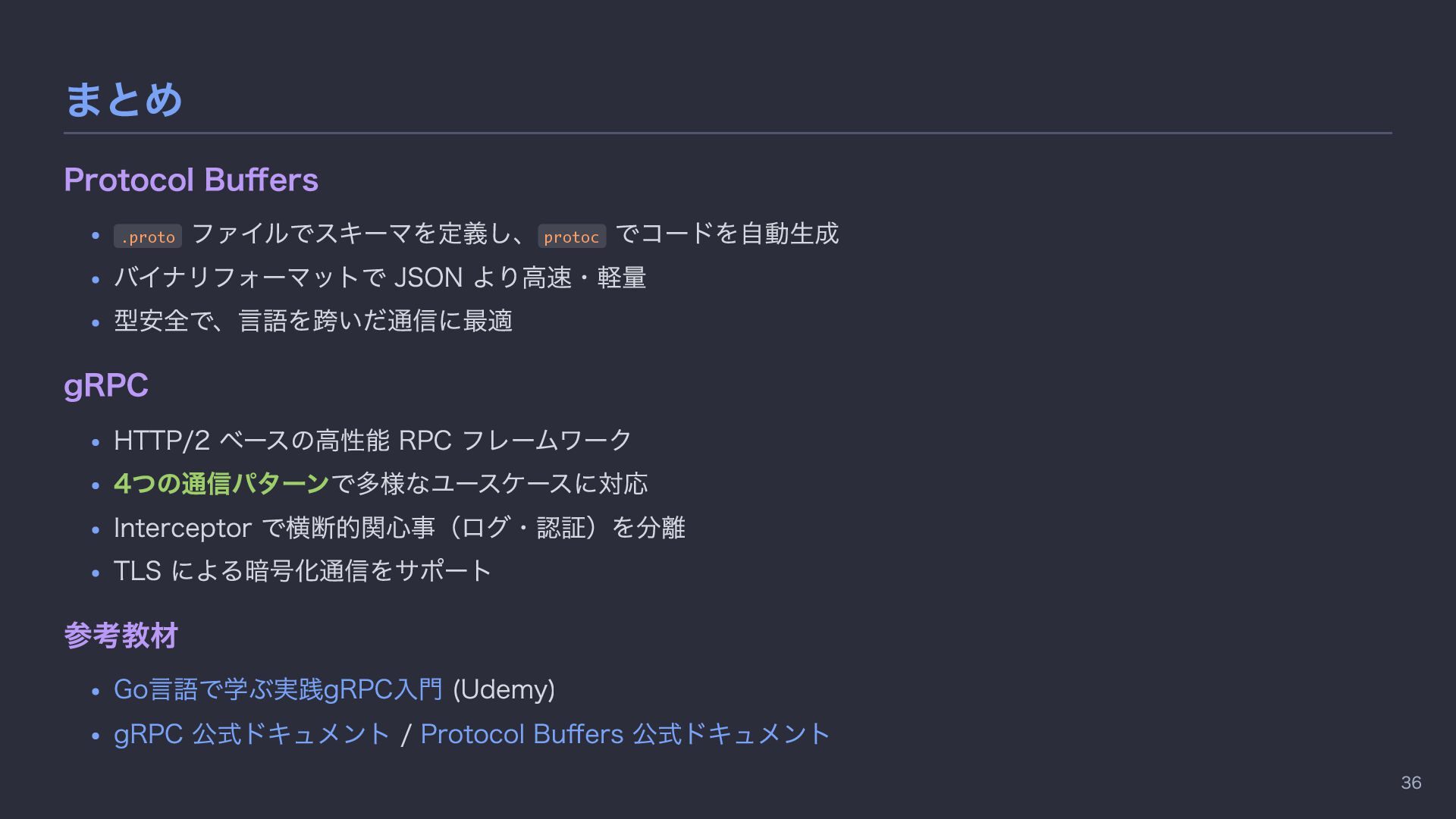
  35. まとめ Protocol Buffers .proto ファイルでスキーマを定義し、 protoc でコードを自動生成 バイナリフォーマットで JSON より高速・軽量

    型安全で、言語を跨いだ通信に最適 gRPC HTTP/2 ベースの高性能 RPC フレームワーク 4つの通信パターンで多様なユースケースに対応 Interceptor で横断的関心事(ログ・認証)を分離 TLS による暗号化通信をサポート 参考教材 Go言語で学ぶ実践gRPC入門 (Udemy) gRPC 公式ドキュメント / Protocol Buffers 公式ドキュメント 36