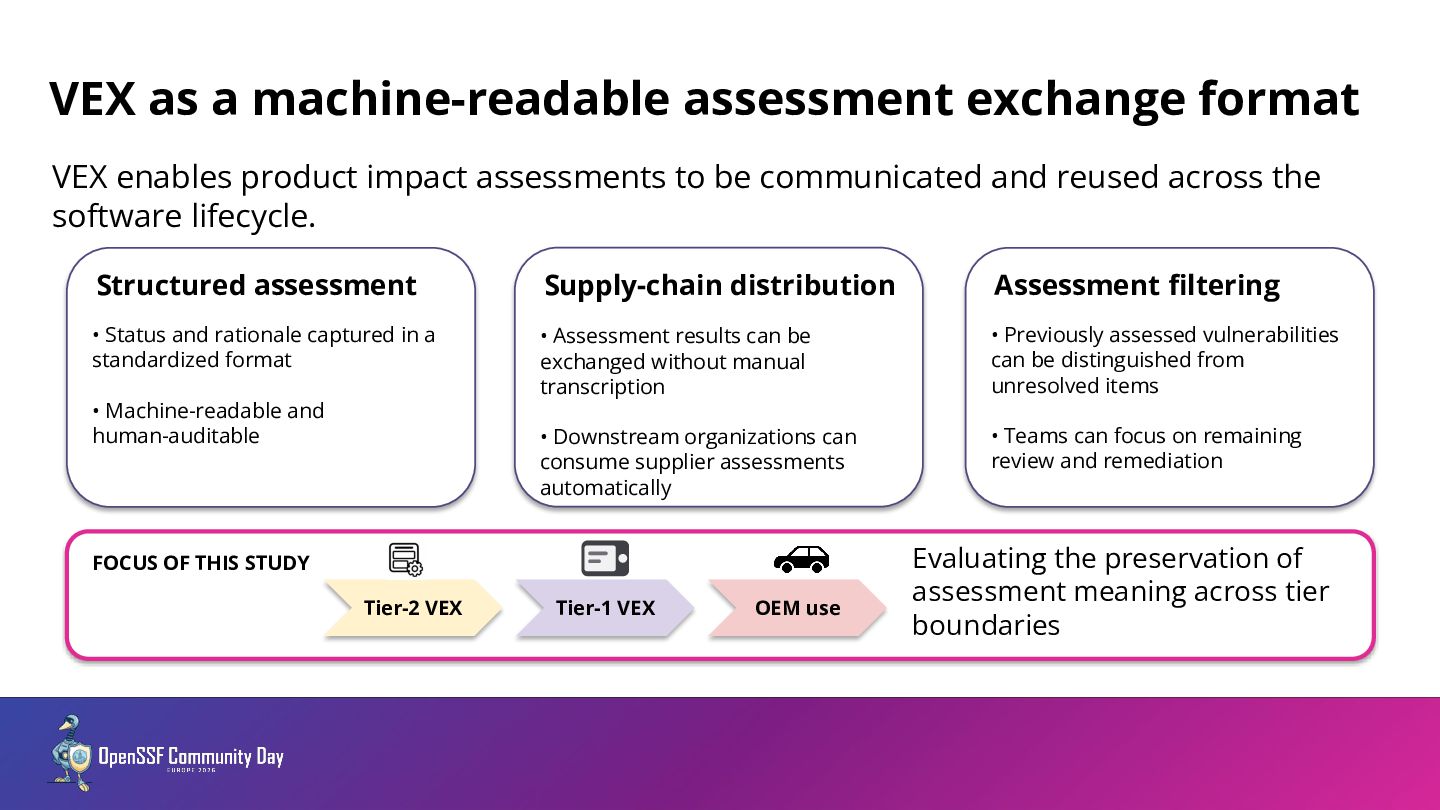
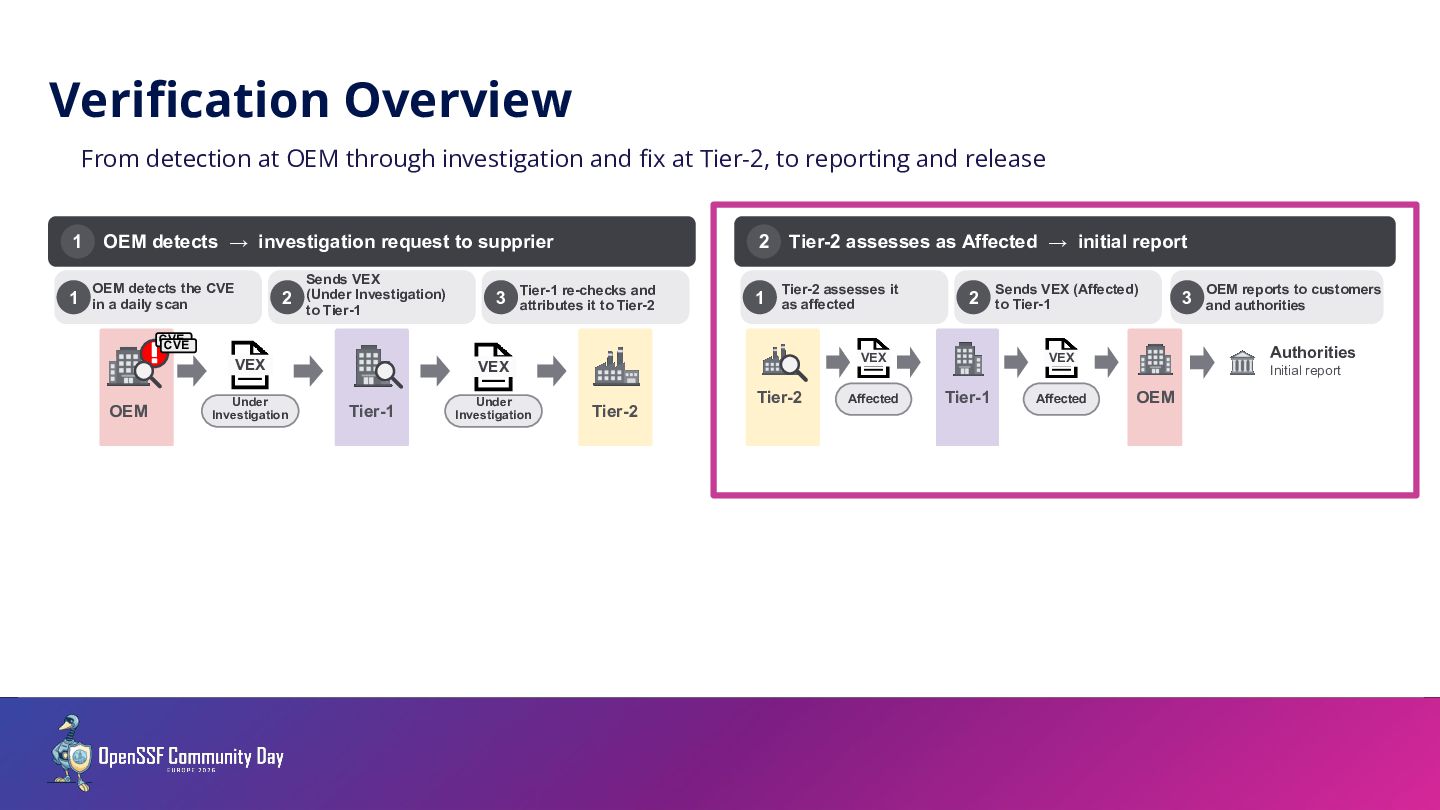
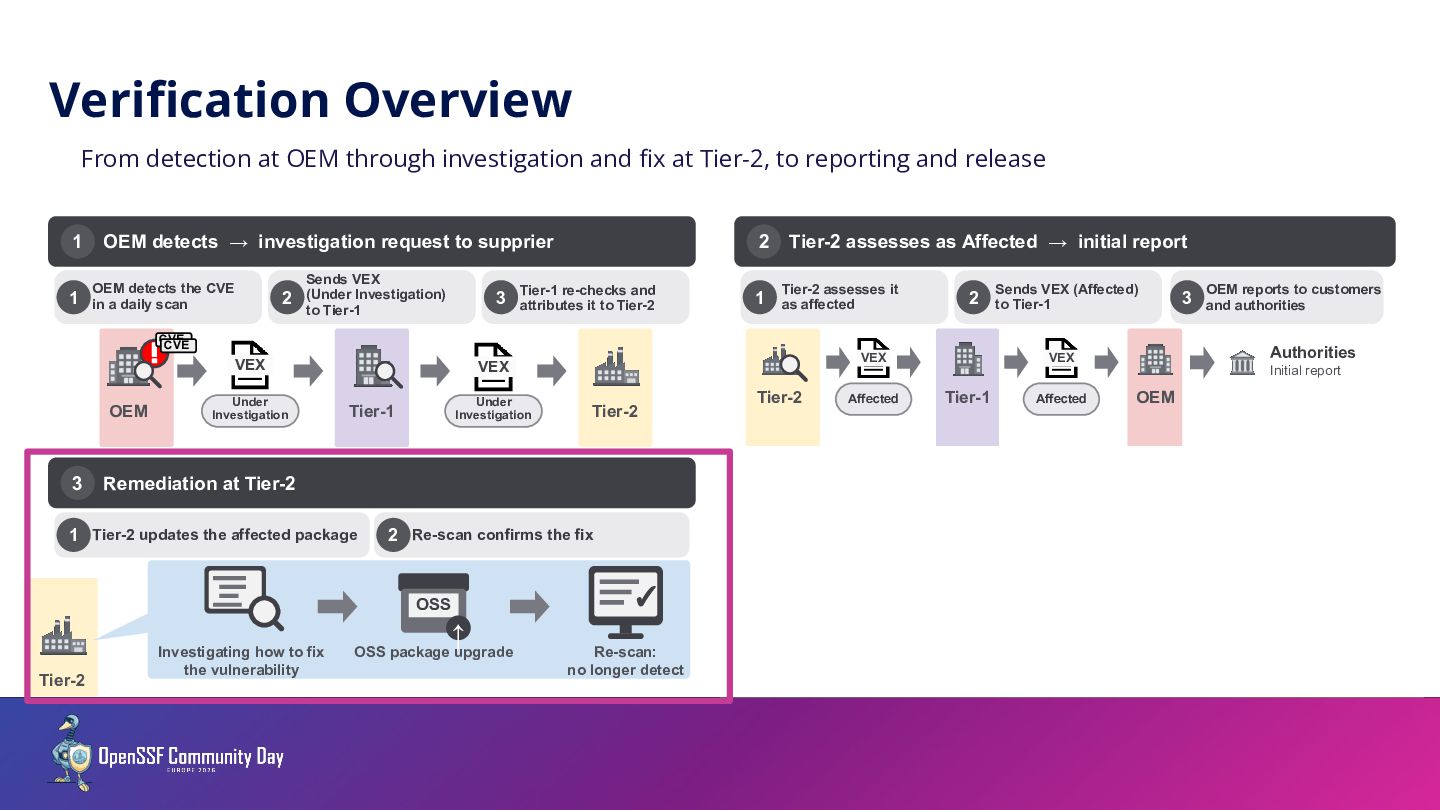
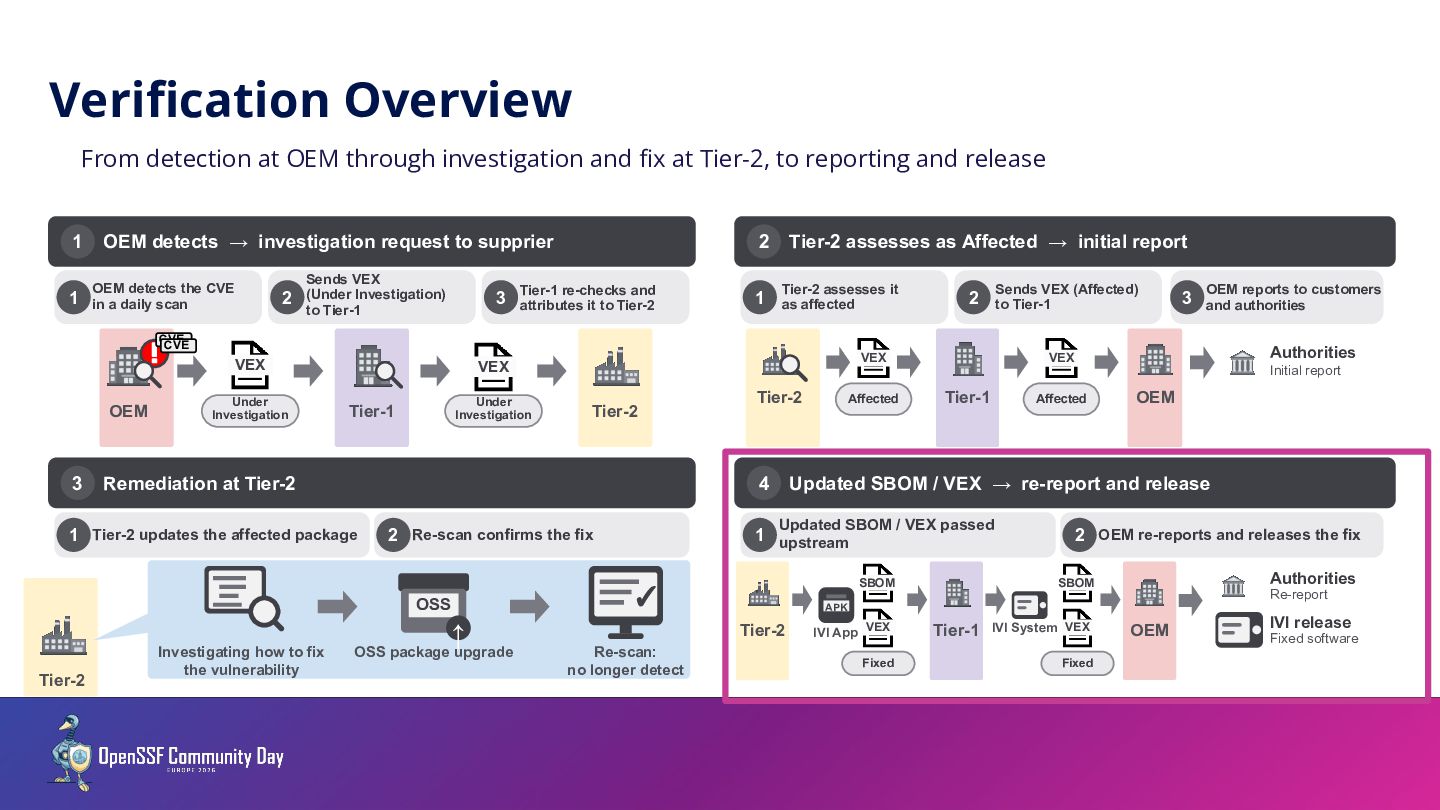
impact assessments to be communicated and reused across the software lifecycle. Structured assessment Supply-chain distribution Assessment filtering • Status and rationale captured in a standardized format • Assessment results can be exchanged without manual transcription • Previously assessed vulnerabilities can be distinguished from unresolved items • Downstream organizations can consume supplier assessments automatically • Teams can focus on remaining review and remediation • Machine-readable and human-auditable FOCUS OF THIS STUDY Tier-2 VEX Tier-1 VEX OEM use Evaluating the preservation of assessment meaning across tier boundaries
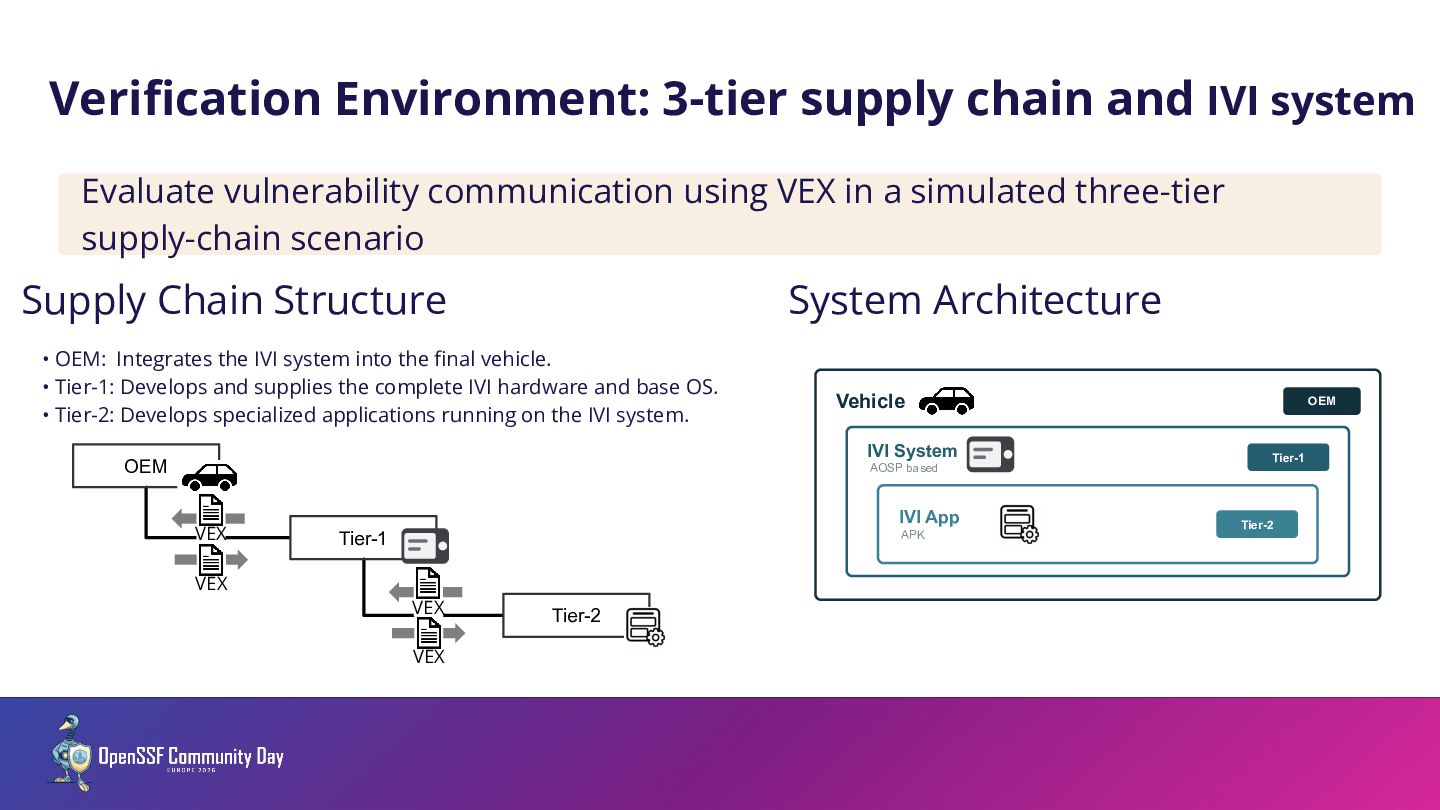
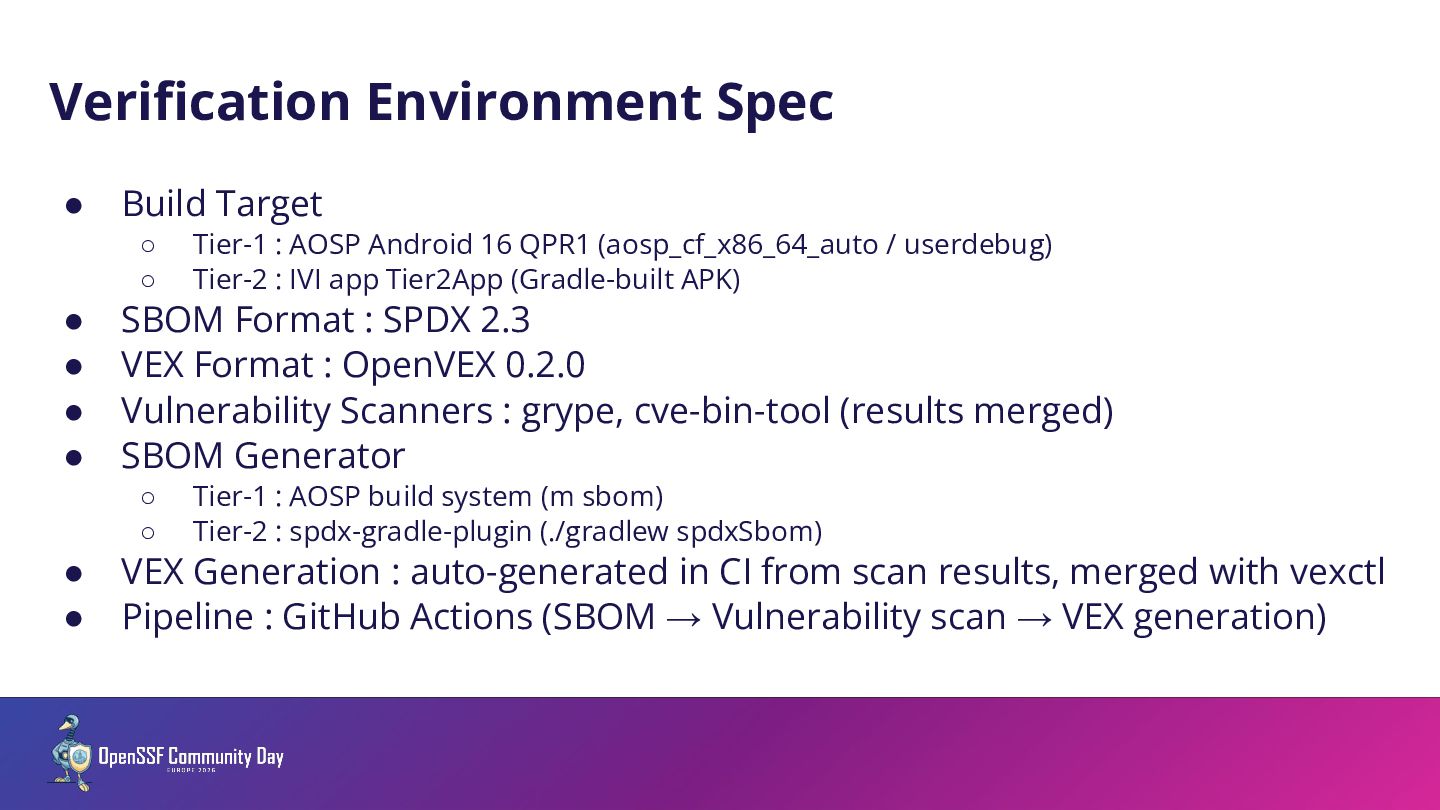
communication using VEX in a simulated three-tier supply-chain scenario Supply Chain Structure System Architecture • OEM: Integrates the IVI system into the final vehicle. • Tier-1: Develops and supplies the complete IVI hardware and base OS. • Tier-2: Develops specialized applications running on the IVI system. Vehicle IVI System OEM AOSP based VEX VEX IVI App APK Tier-1 VEX VEX Tier-2 OEM Tier-1 Tier-2
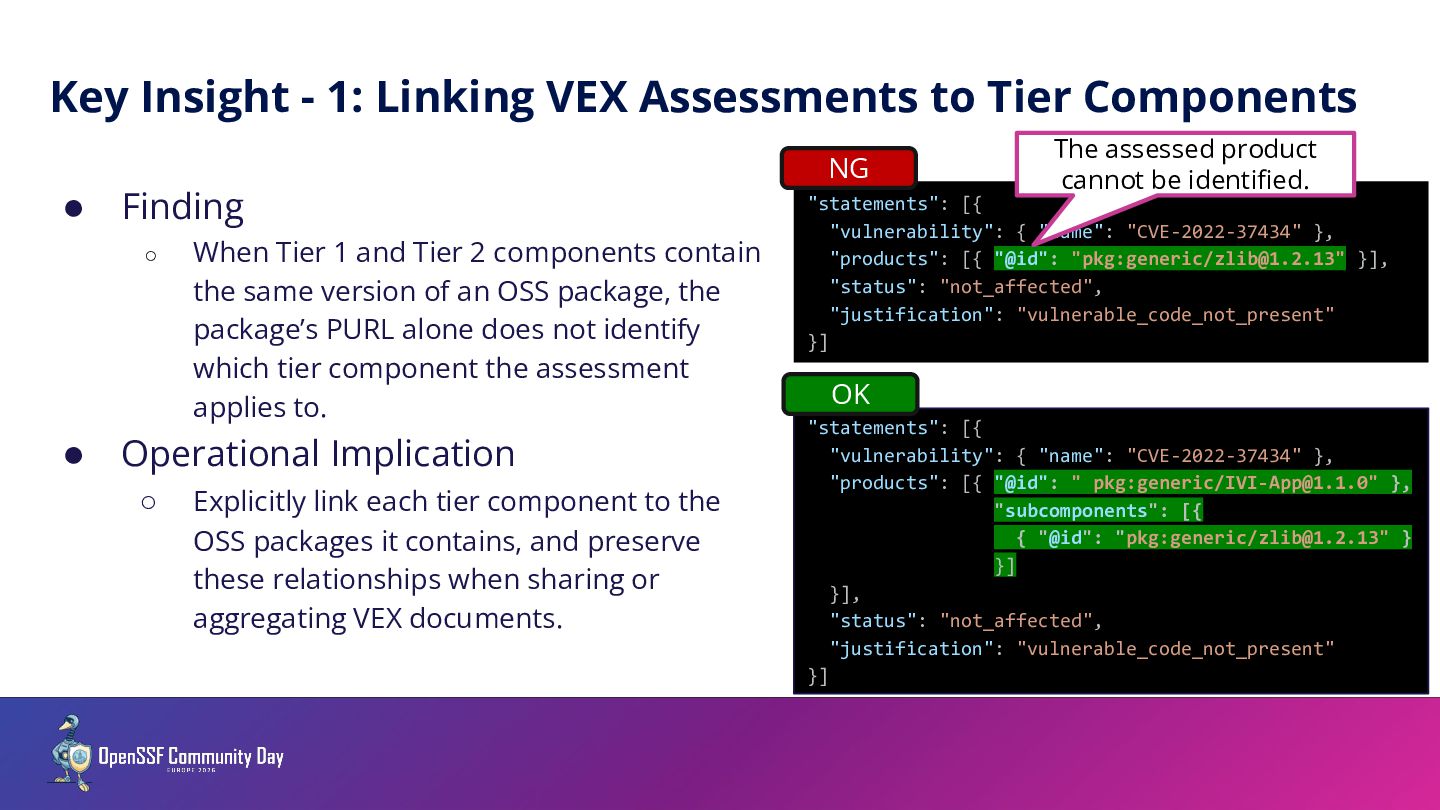
• Finding ◦ When Tier 1 and Tier 2 components contain the same version of an OSS package, the package’s PURL alone does not identify which tier component the assessment applies to. • Operational Implication ◦ Explicitly link each tier component to the OSS packages it contains, and preserve these relationships when sharing or aggregating VEX documents. NG The assessed product cannot be identified. "statements": [{ "vulnerability": { "name": "CVE-2022-37434" }, "products": [{ "@id": "pkg:generic/[email protected]" }], "status": "not_affected", "justification": "vulnerable_code_not_present" }] OK "statements": [{ "vulnerability": { "name": "CVE-2022-37434" }, "products": [{ "@id": " pkg:generic/[email protected]" }, "subcomponents": [{ { "@id": "pkg:generic/[email protected]" } }] }], "status": "not_affected", "justification": "vulnerable_code_not_present" }]
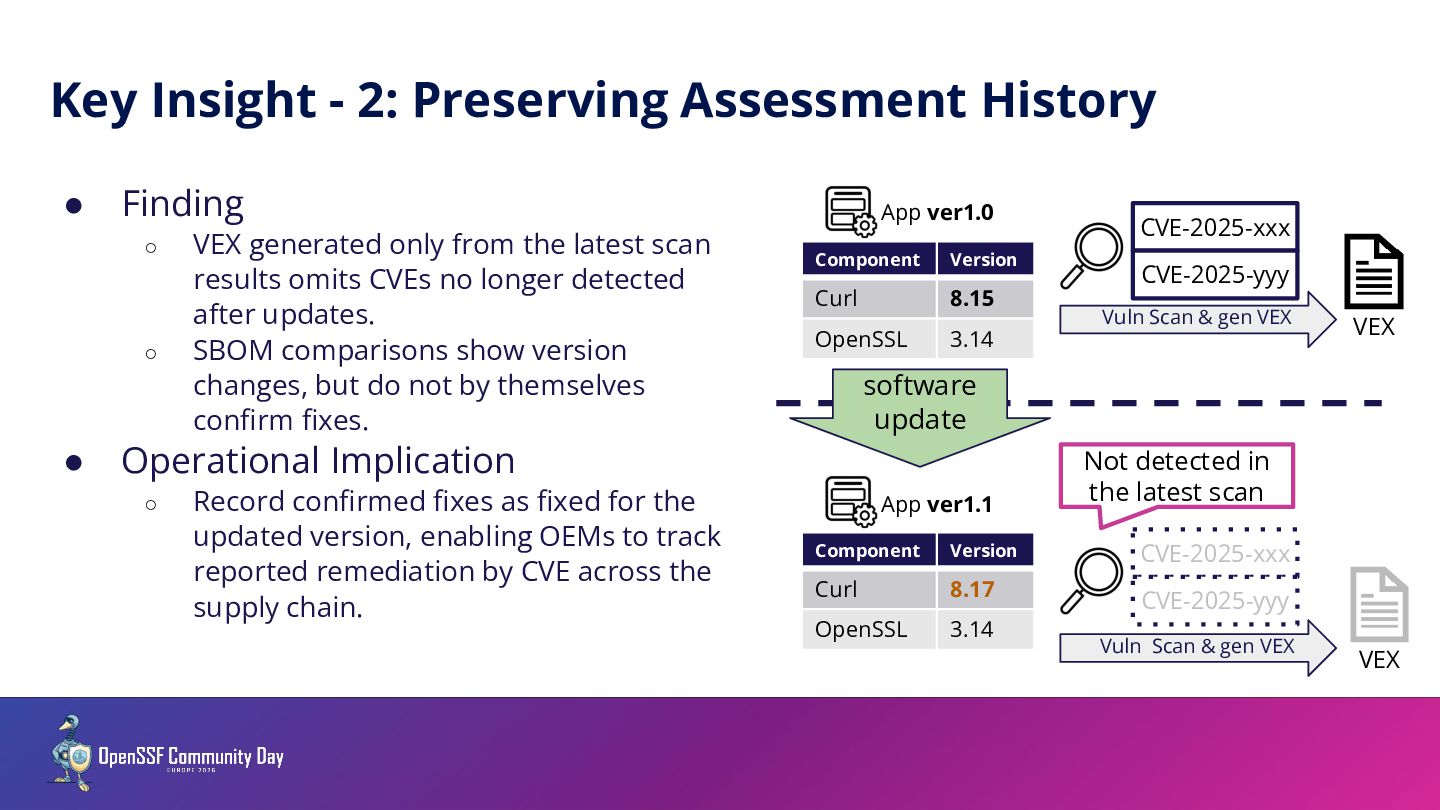
◦ • VEX generated only from the latest scan results omits CVEs no longer detected after updates. SBOM comparisons show version changes, but do not by themselves confirm fixes. App ver1.0 Component Version Curl 8.15 OpenSSL 3.14 Record confirmed fixes as fixed for the updated version, enabling OEMs to track reported remediation by CVE across the supply chain. CVE-2025-yyy Vuln Scan & gen VEX VEX software update Operational Implication ◦ CVE-2025-xxx App ver1.1 Component Version Curl 8.17 OpenSSL 3.14 Not detected in the latest scan CVE-2025-xxx CVE-2025-yyy Vuln Scan & gen VEX VEX
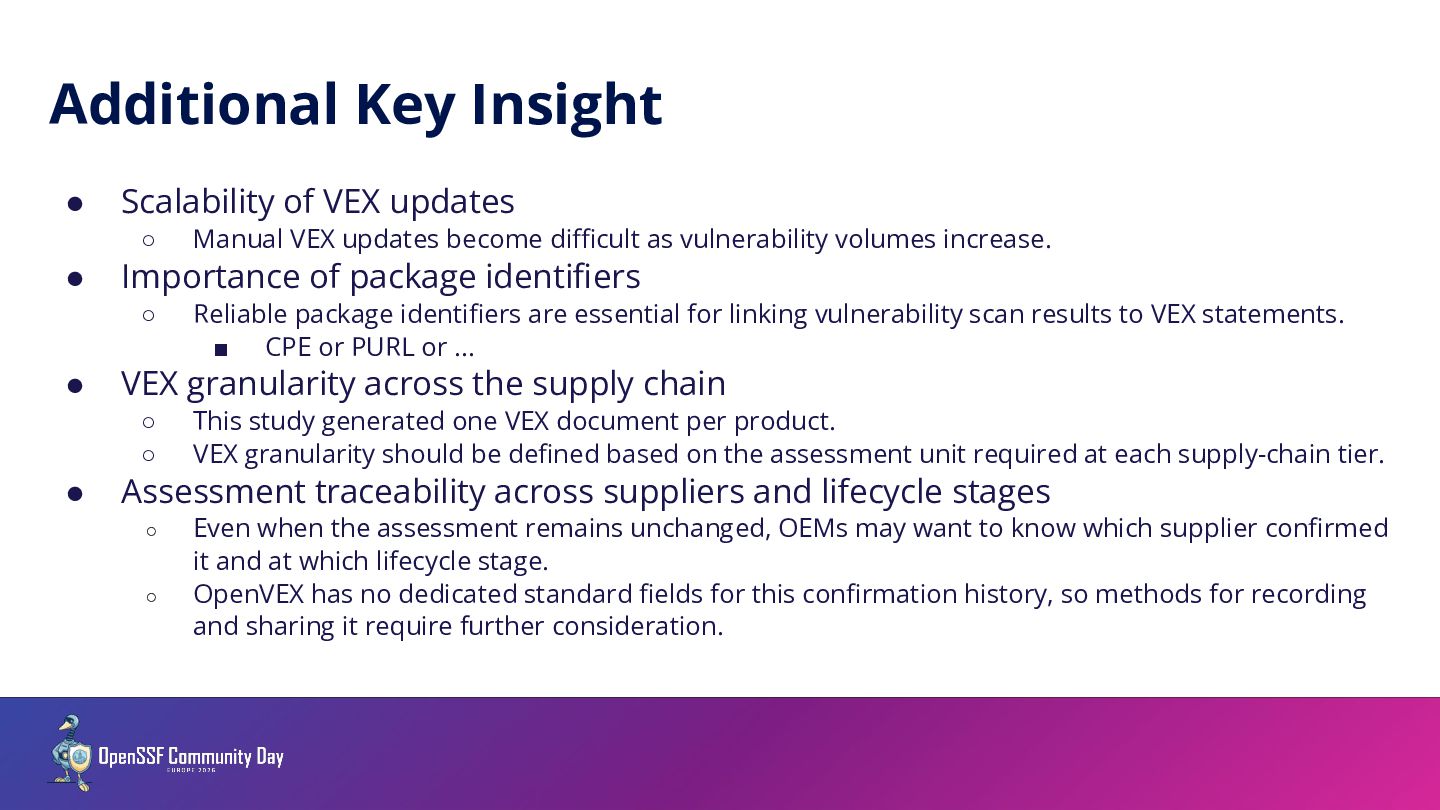
◦ Manual VEX updates become difficult as vulnerability volumes increase. ◦ Reliable package identifiers are essential for linking vulnerability scan results to VEX statements. ▪ CPE or PURL or … Importance of package identifiers VEX granularity across the supply chain ◦ ◦ • This study generated one VEX document per product. VEX granularity should be defined based on the assessment unit required at each supply-chain tier. Assessment traceability across suppliers and lifecycle stages ◦ ◦ Even when the assessment remains unchanged, OEMs may want to know which supplier confirmed it and at which lifecycle stage. OpenVEX has no dedicated standard fields for this confirmation history, so methods for recording and sharing it require further consideration.
represent product-specific vulnerability impact assessments at each tier. ◦ VEX assessments can be exchanged across tier boundaries, but product context and assessment history must be preserved explicitly. ◦ • Lifecycle continuity, identifier compatibility, and operational integration are important considerations for applying VEX across multi-tier supply chains. Future Work ◦ ◦ ◦ Validate in real supply-chain operations Define VEX lifecycle, assessment context, and granularity rules Integrate VEX with SBOM, scanning, and vulnerability management workflows


 lfj
 kinopeee
 minorun365
 bengo4com
 rmetzger
 oracle4engineer
 markunet
 masayukisuda
 nori_shinoda
 ryu1013
 ren8k
 nkzn
 legalontechnologies
 scottboms
 aleyda
 tammyeverts
 csswizardry
 sergeychernyshev
 reverentgeek
 marktimemedia
 akademiya2063
 livdayseo
 rakko
 tmiket