Verification Toward Applying SLSA in Automotive...
Sponsored
·
 Ship Features Fearlessly
Turn features on and off without deploys. Used by thousands of Ruby developers.
→
Ship Features Fearlessly
Turn features on and off without deploys. Used by thousands of Ruby developers.
→

Share
Embed
Verification Toward Applying SLSA in Automotive IVI Software Development
Honda R&D Yuta Kiyoumi 氏 & Takashi Ninjouji 氏
2026年7月2日開催 OSSセキュリティMeetup 講演資料

Linux Foundation Japan PRO
July 03, 2026
Transcript
43 slides
-
Verification Toward Applying SLSA in Automotive IVI Software Development Yuta
Kiyoumi & Takashi Ninjouji Honda R&D 2026年 第3回 OSSセキュリティMeetup向け -
Who Are We? • Yuta Kiyoumi ◦ Assistant Chief Engineer
/ Security Architect, IVI Software & OSPO @ Honda • Takashi Ninjouji ◦ Chief Engineer & OSPO @ Honda -
Agenda 1. Honda Motivation: Why SLSA 2. Applying SLSA to
AAOS-based IVI 3. Lessons learned -
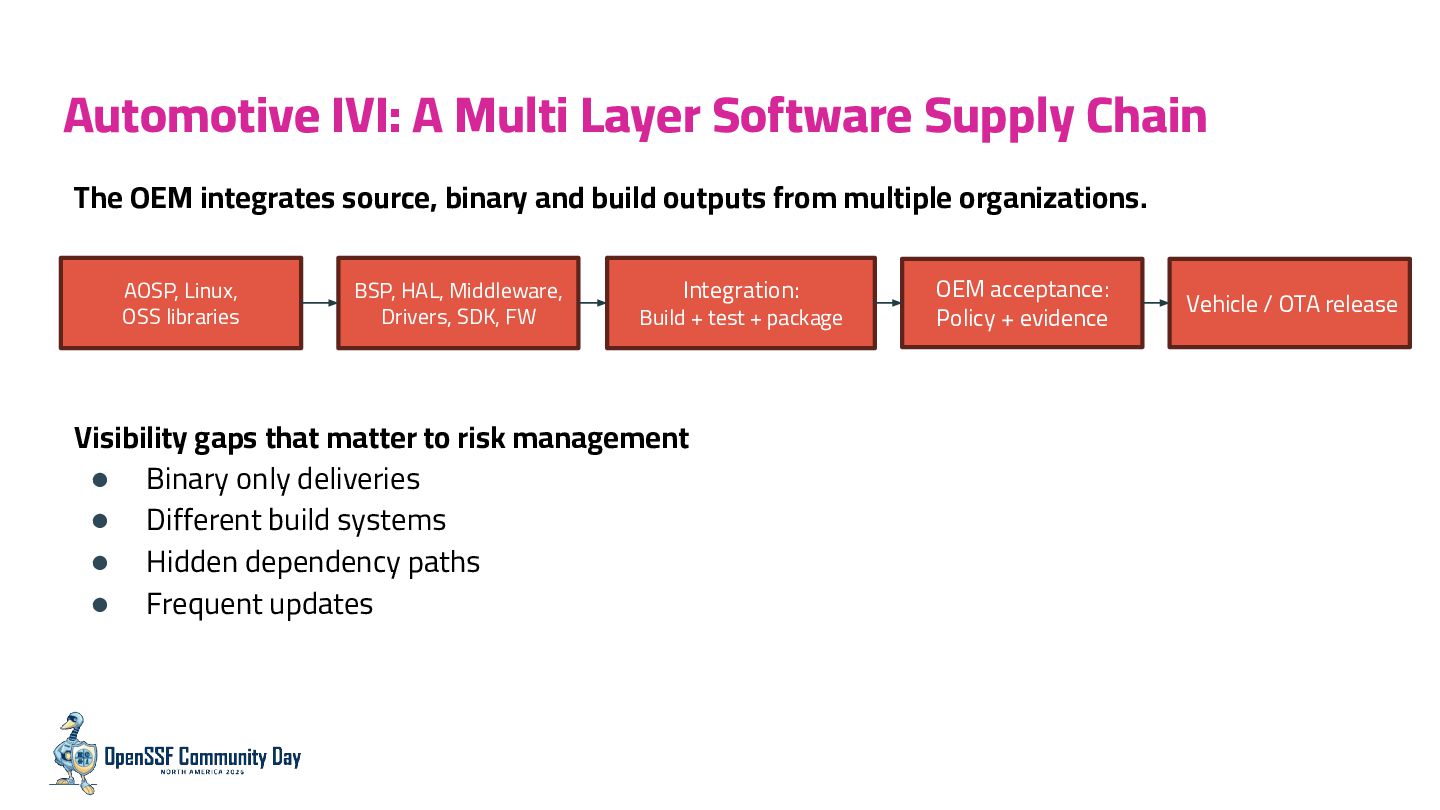
Automotive IVI: A Multi Layer Software Supply Chain The OEM
integrates source, binary and build outputs from multiple organizations. Visibility gaps that matter to risk management • Binary only deliveries • Different build systems • Hidden dependency paths • Frequent updates AOSP, Linux, OSS libraries BSP, HAL, Middleware, Drivers, SDK, FW Integration: Build + test + package Vehicle / OTA release OEM acceptance: Policy + evidence -
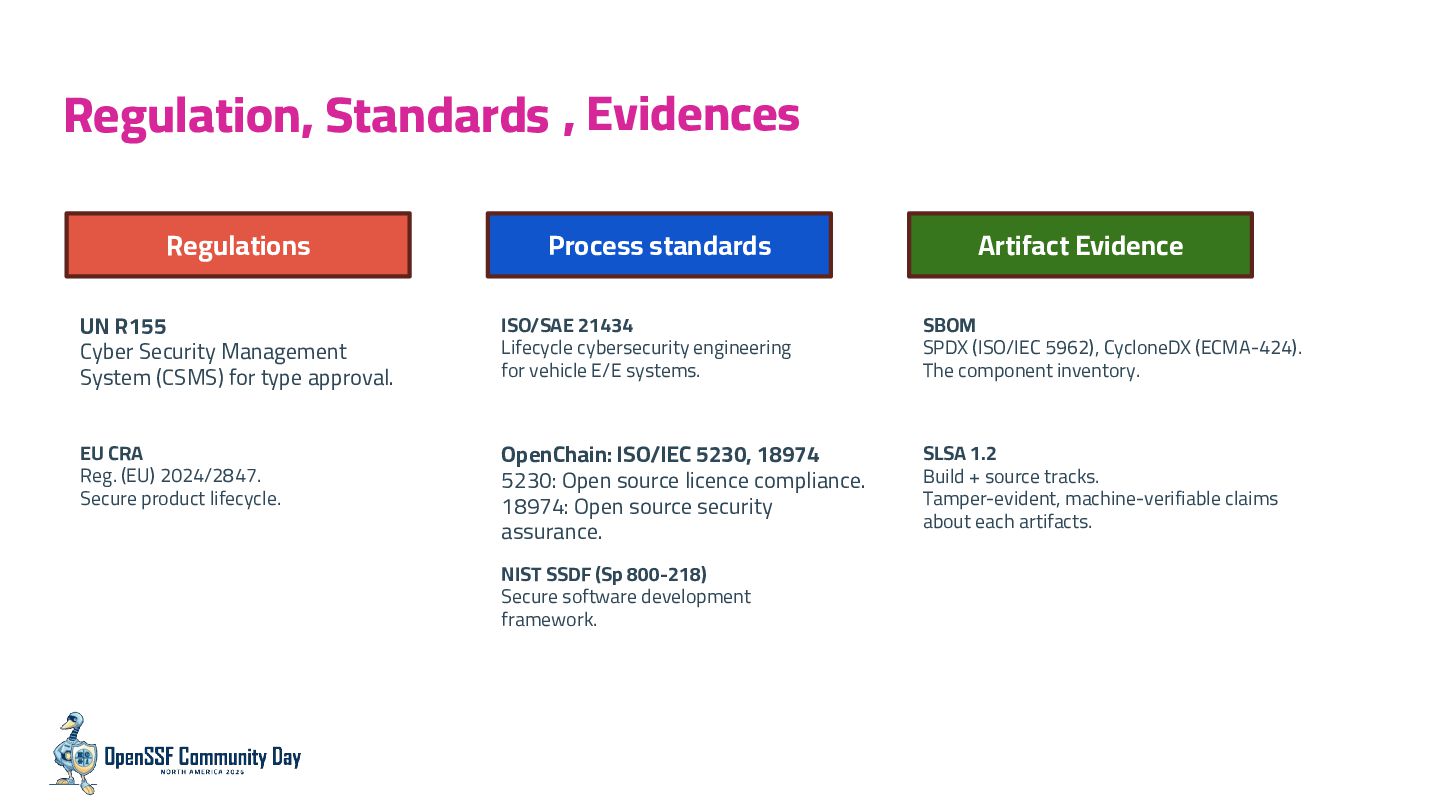
Regulation, Standards Regulations Process standards Artifact Evidence UN R155 Cyber
Security Management System (CSMS) for type approval. EU CRA Reg. (EU) 2024/2847. Secure product lifecycle. ISO/SAE 21434 Lifecycle cybersecurity engineering for vehicle E/E systems. OpenChain: ISO/IEC 5230, 18974 5230: Open source licence compliance. 18974: Open source security assurance. NIST SSDF (Sp 800-218) Secure software development framework. SLSA 1.2 Build + source tracks. Tamper-evident, machine-verifiable claims about each artifacts. SBOM SPDX (ISO/IEC 5962), CycloneDX (ECMA-424). The component inventory. , Evidences -
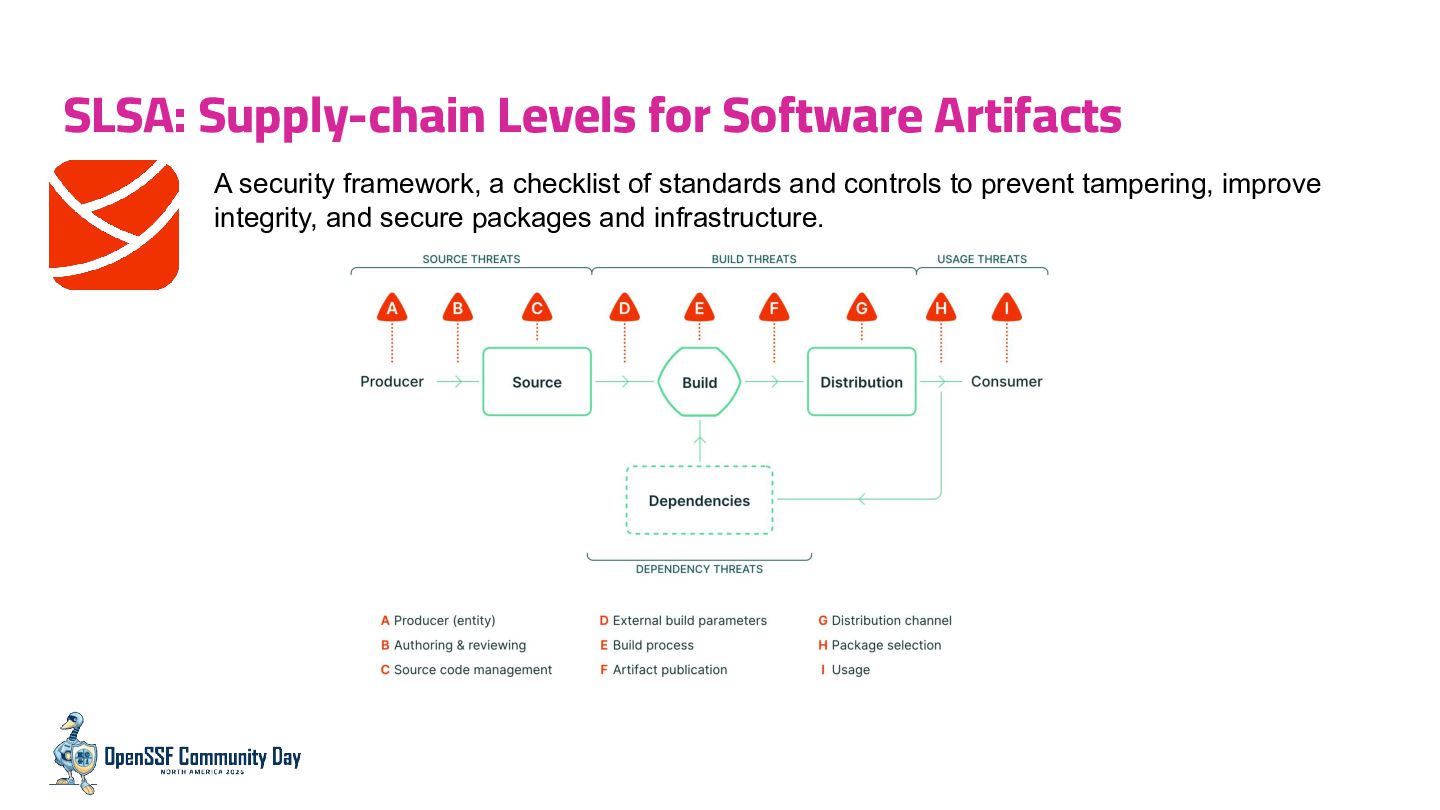
SLSA: Supply-chain Levels for Software Artifacts A security framework, a
checklist of standards and controls to prevent tampering, improve integrity, and secure packages and infrastructure. -
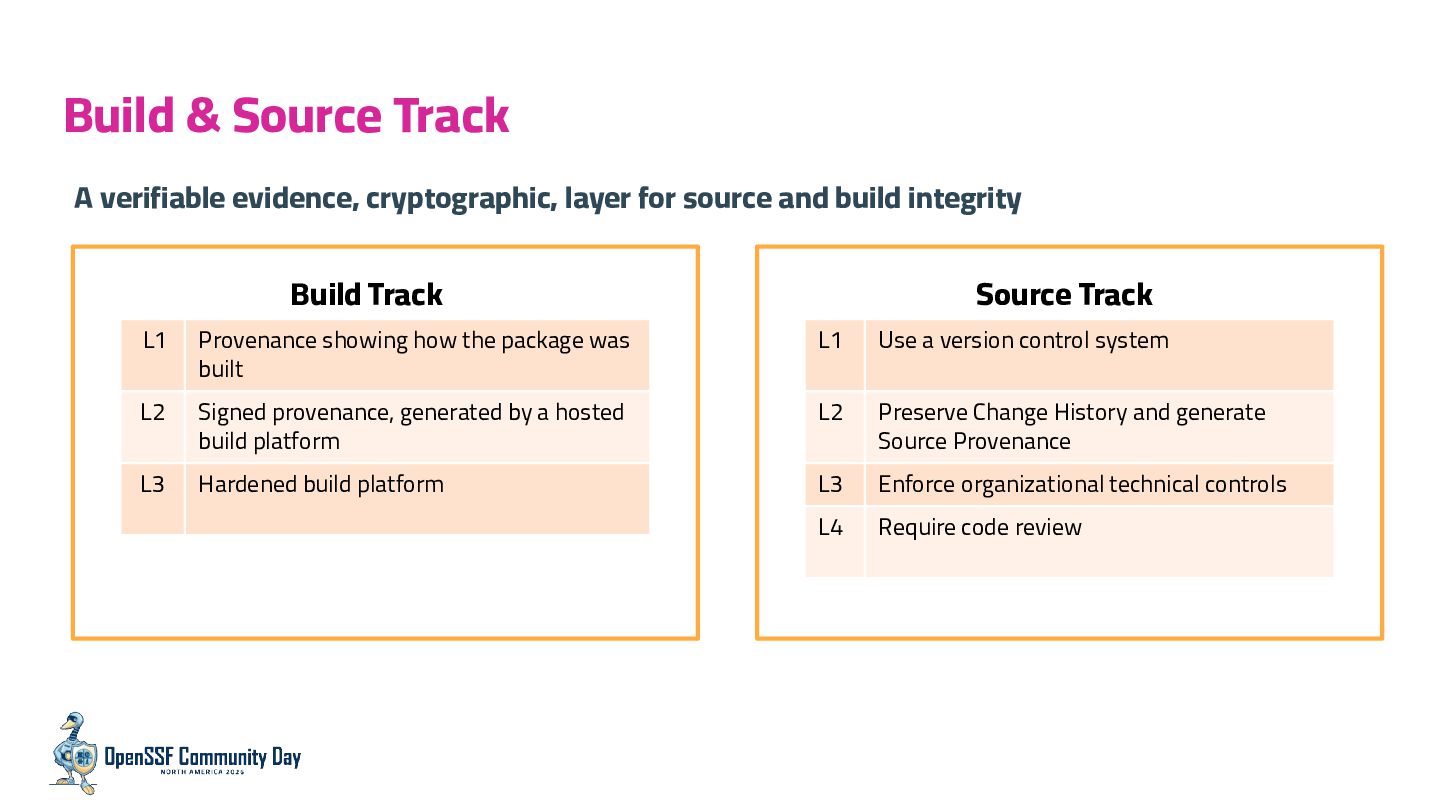
Build & Source Track A verifiable evidence, cryptographic, layer for
source and build integrity L1 Provenance showing how the package was built L2 Signed provenance, generated by a hosted build platform L3 Hardened build platform L1 Use a version control system L2 Preserve Change History and generate Source Provenance L3 Enforce organizational technical controls L4 Require code review Build Track Source Track -
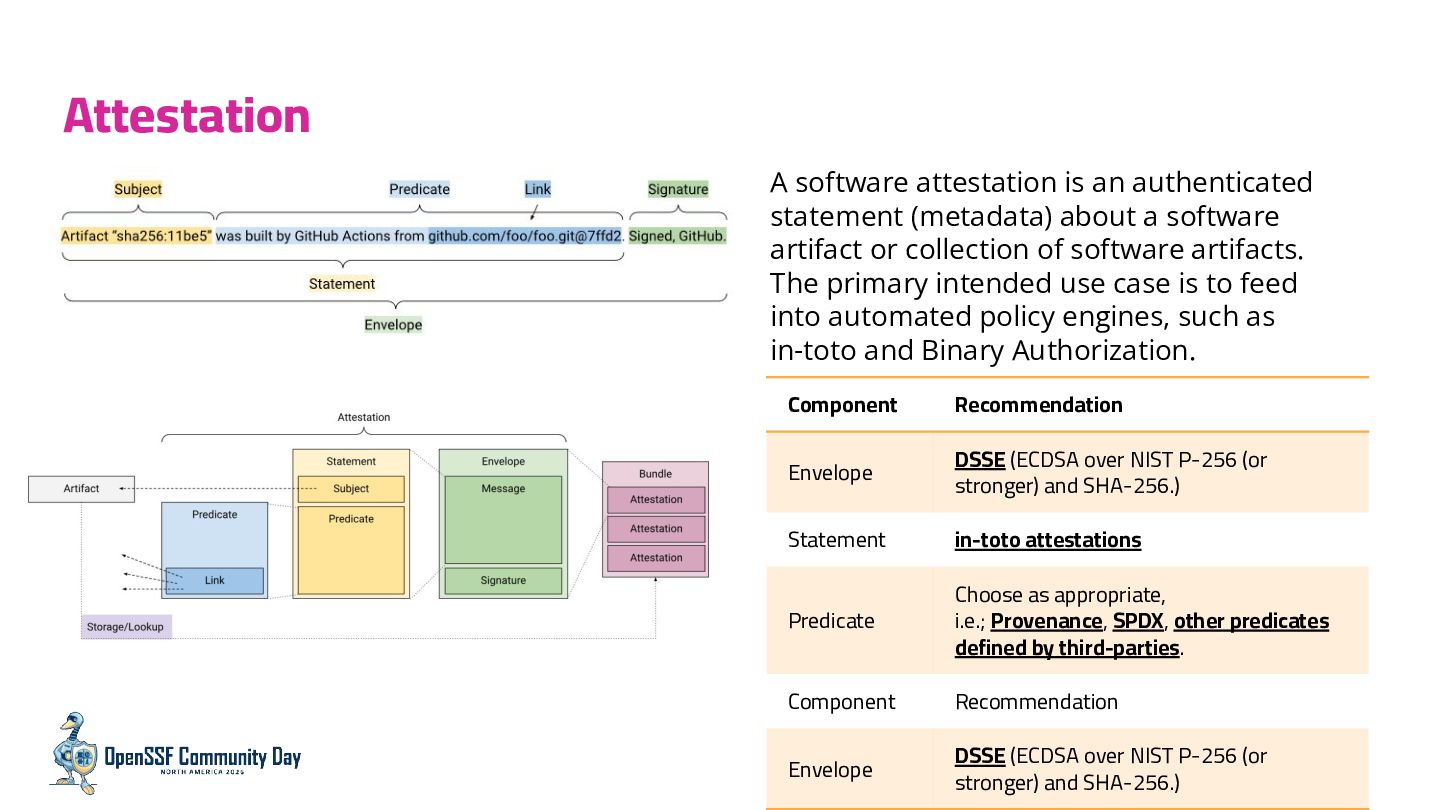
Attestation A software attestation is an authenticated statement (metadata) about
a software artifact or collection of software artifacts. The primary intended use case is to feed into automated policy engines, such as in-toto and Binary Authorization. Component Recommendation Envelope DSSE (ECDSA over NIST P-256 (or stronger) and SHA-256.) Statement in-toto attestations Predicate Choose as appropriate, i.e.; Provenance, SPDX, other predicates defined by third-parties. Component Recommendation Envelope DSSE (ECDSA over NIST P-256 (or stronger) and SHA-256.) -
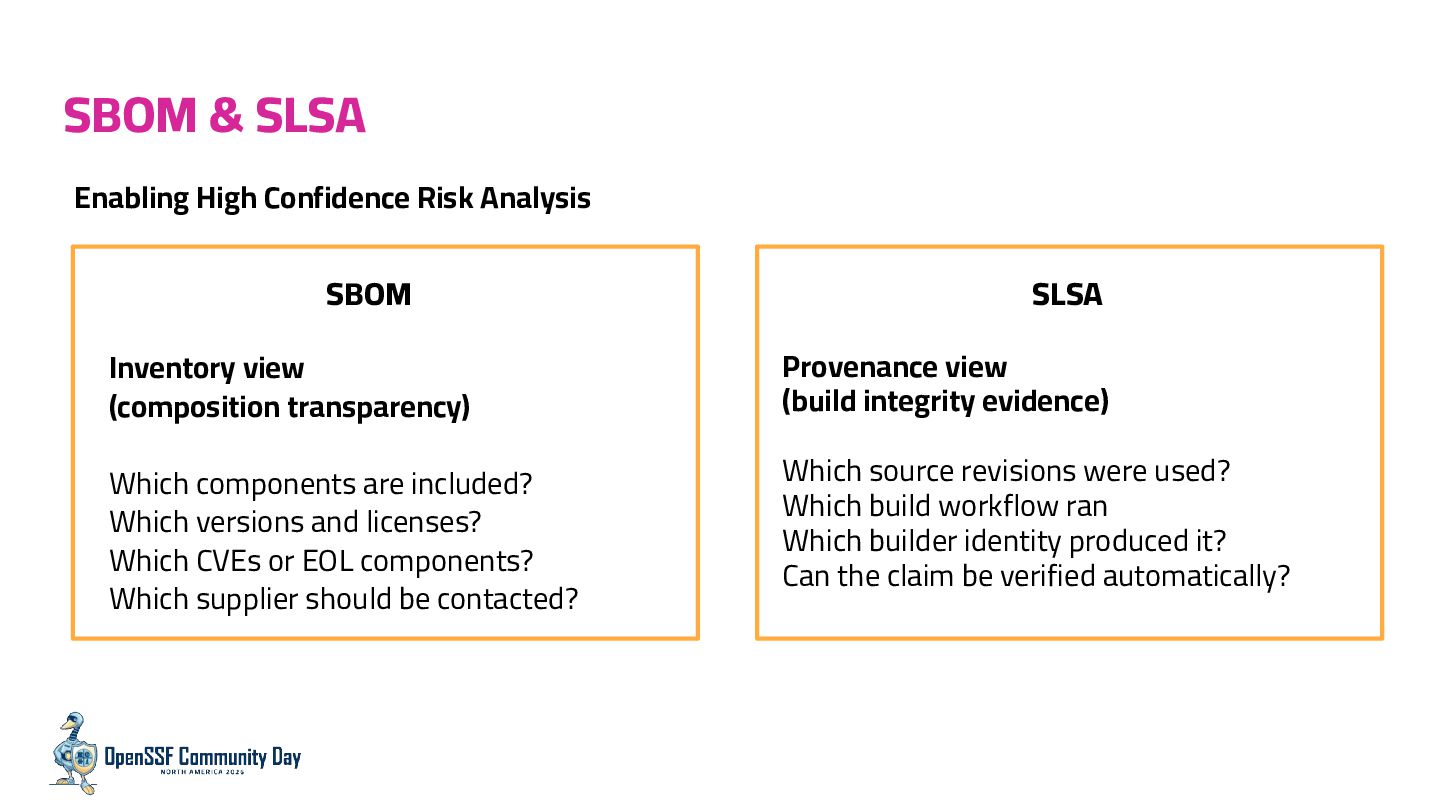
SBOM & SLSA Enabling High Confidence Risk Analysis SBOM SLSA
Inventory view (composition transparency) Which components are included? Which versions and licenses? Which CVEs or EOL components? Which supplier should be contacted? Provenance view (build integrity evidence) Which source revisions were used? Which build workflow ran Which builder identity produced it? Can the claim be verified automatically? -
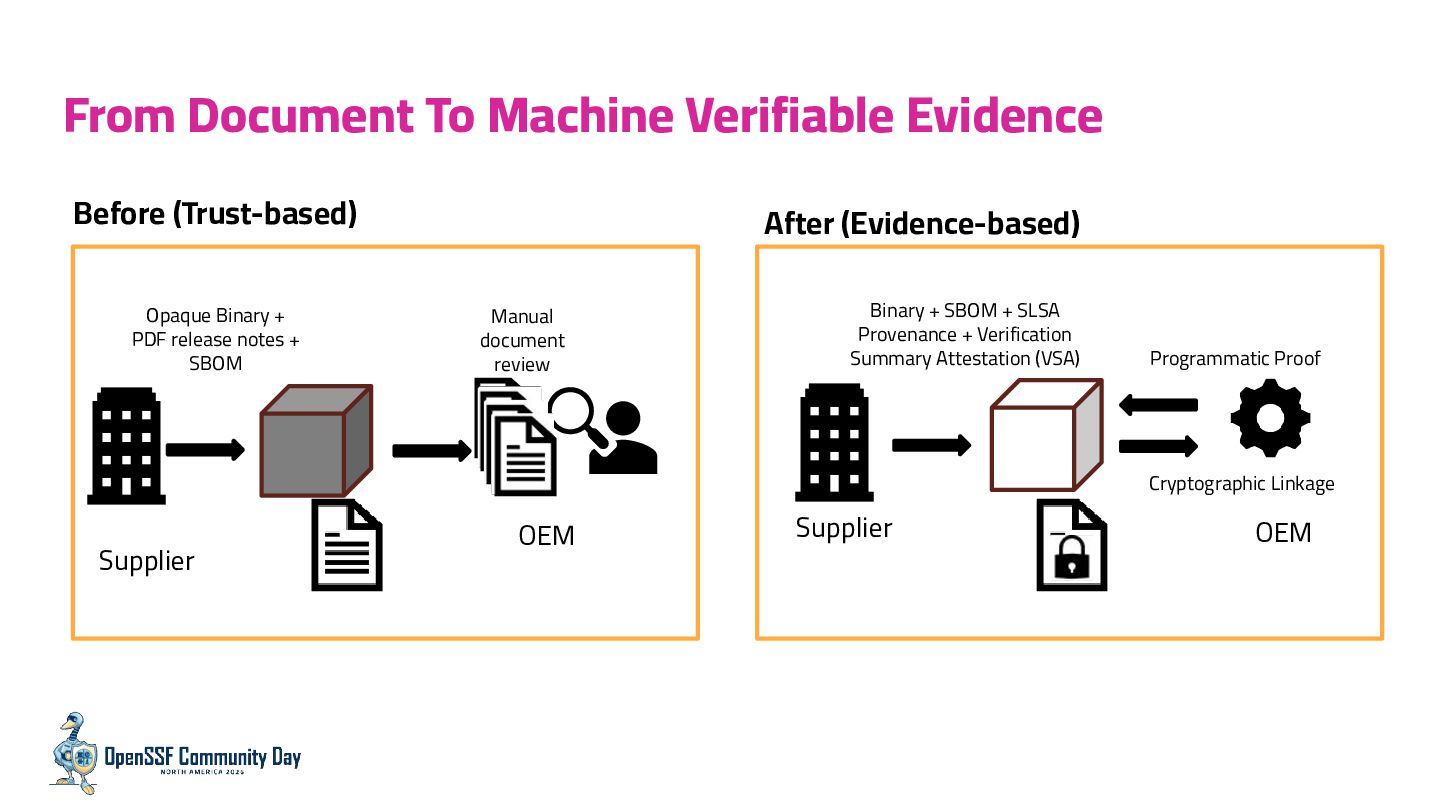
From Document To Machine Verifiable Evidence Before (Trust-based) After (Evidence-based)
Opaque Binary + PDF release notes + SBOM OEM Supplier OEM Supplier Binary + SBOM + SLSA Provenance + Verification Summary Attestation (VSA) Programmatic Proof Cryptographic Linkage Manual document review -
How to apply SLSA • Automotive software development is highly
diverse, with varying build flows and source code management. • To introduce SLSA, an environment-agnostic approach is required. • As a first step, we validated this approach using AAOS. -
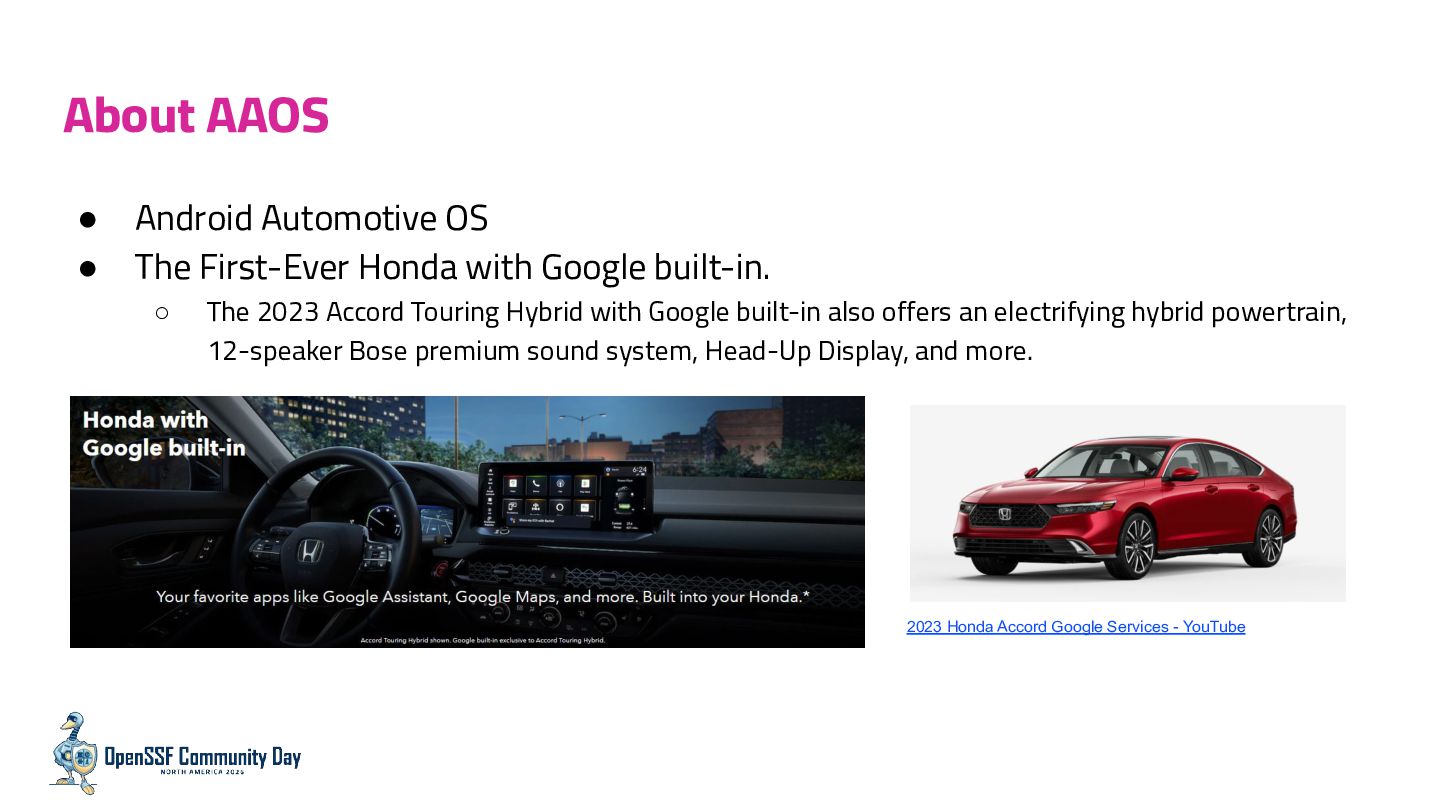
About AAOS • Android Automotive OS • The First-Ever Honda
with Google built-in. ◦ The 2023 Accord Touring Hybrid with Google built-in also offers an electrifying hybrid powertrain, 12-speaker Bose premium sound system, Head-Up Display, and more. 2023 Honda Accord Google Services - YouTube -
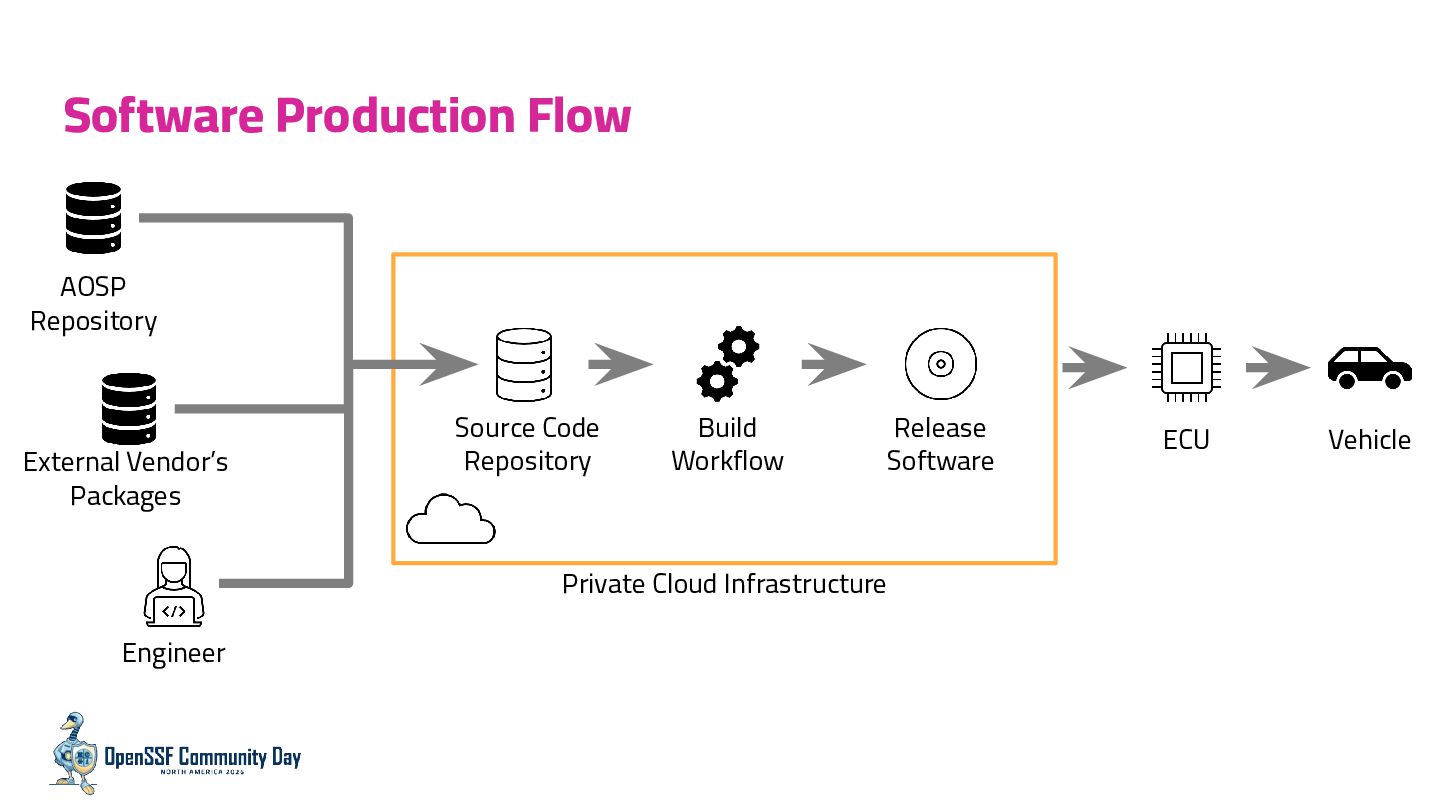
Software Production Flow External Vendor’s Packages Release Software ECU Vehicle
Source Code Repository AOSP Repository Build Workflow Engineer Private Cloud Infrastructure -
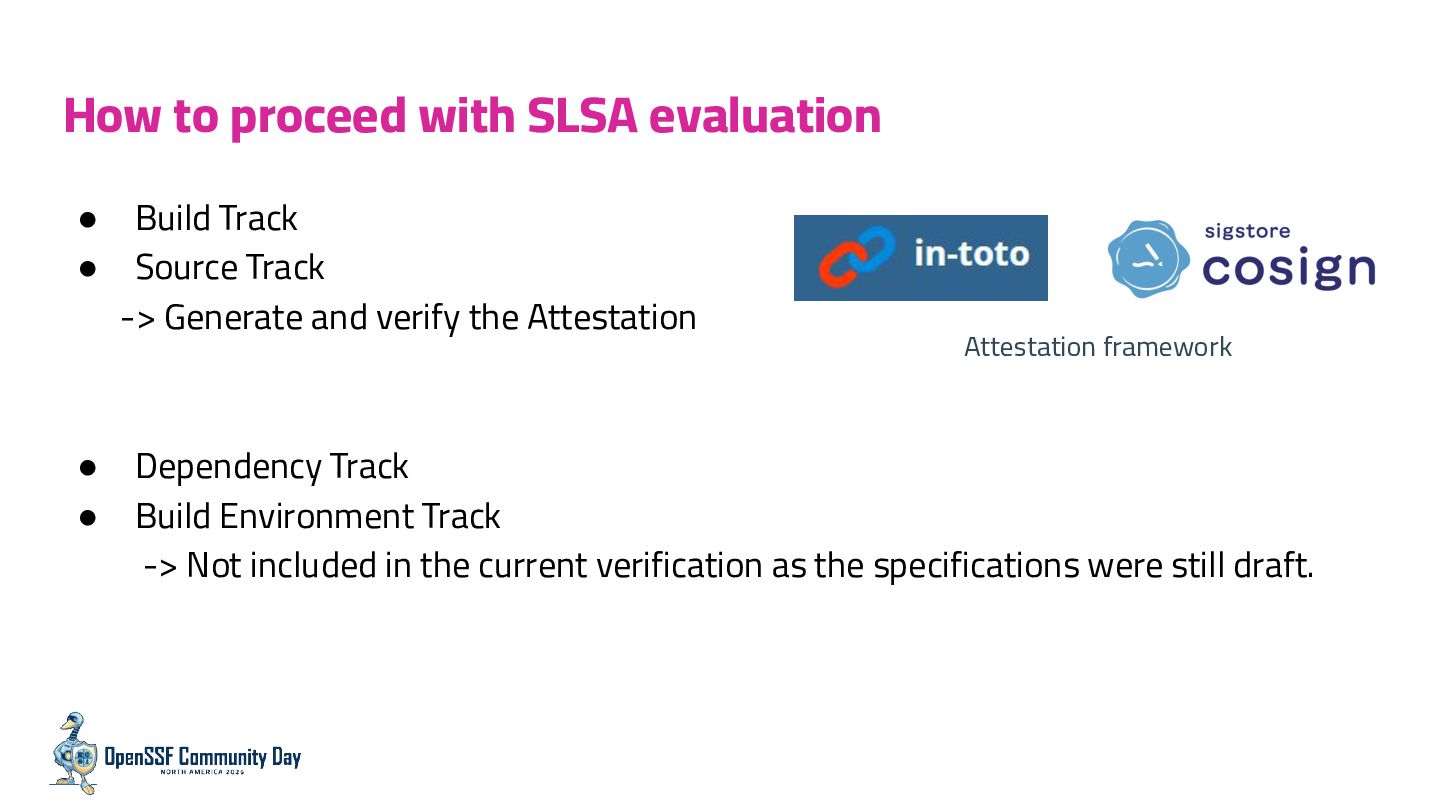
How to proceed with SLSA evaluation • Build Track •
Source Track -> Generate and verify the Attestation • Dependency Track • Build Environment Track -> Not included in the current verification as the specifications were still draft. Attestation framework -
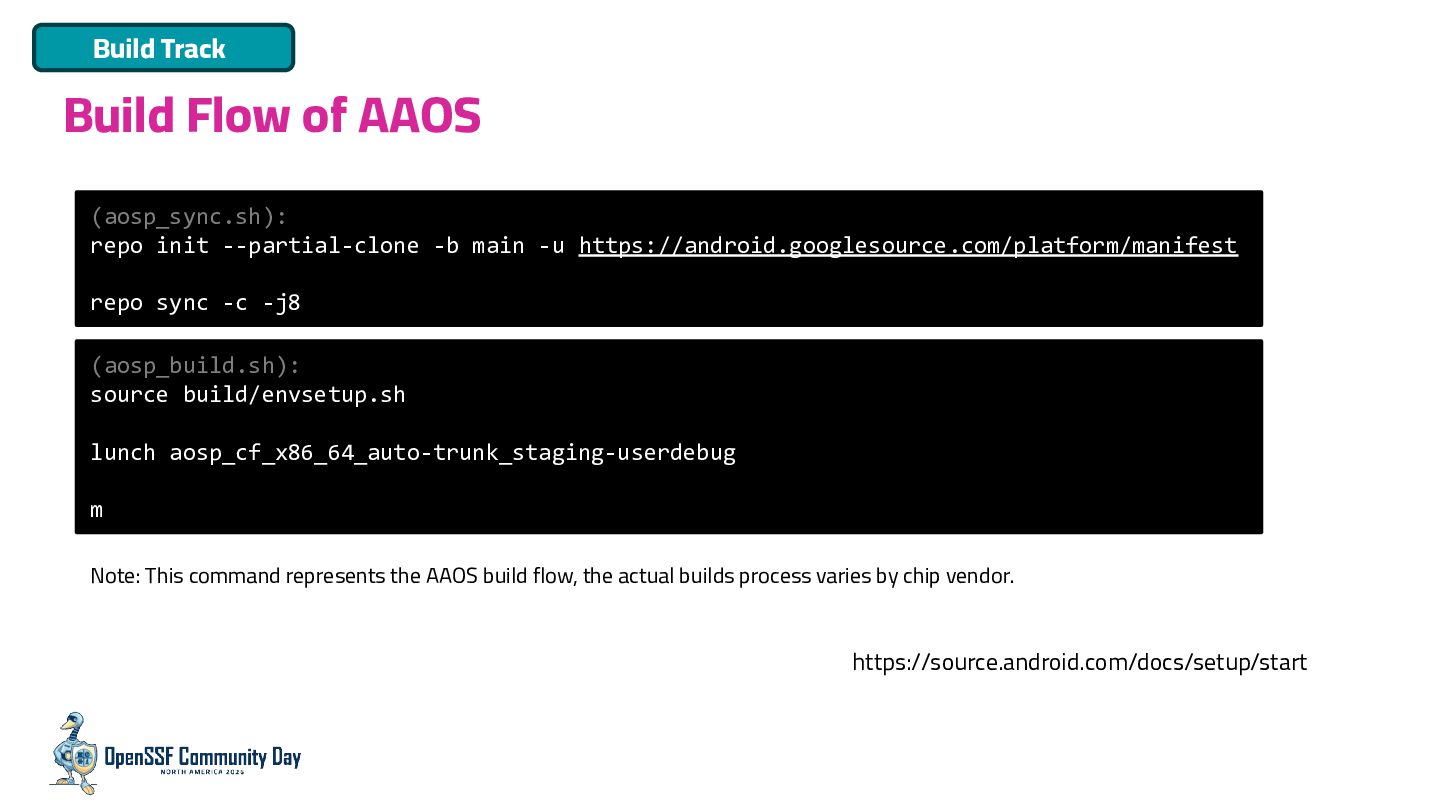
Build Flow of AAOS https://source.android.com/docs/setup/start (aosp_sync.sh): repo init --partial-clone -b
main -u https://android.googlesource.com/platform/manifest repo sync -c -j8 (aosp_build.sh): source build/envsetup.sh lunch aosp_cf_x86_64_auto-trunk_staging-userdebug m Note: This command represents the AAOS build flow, the actual builds process varies by chip vendor. Build Track -
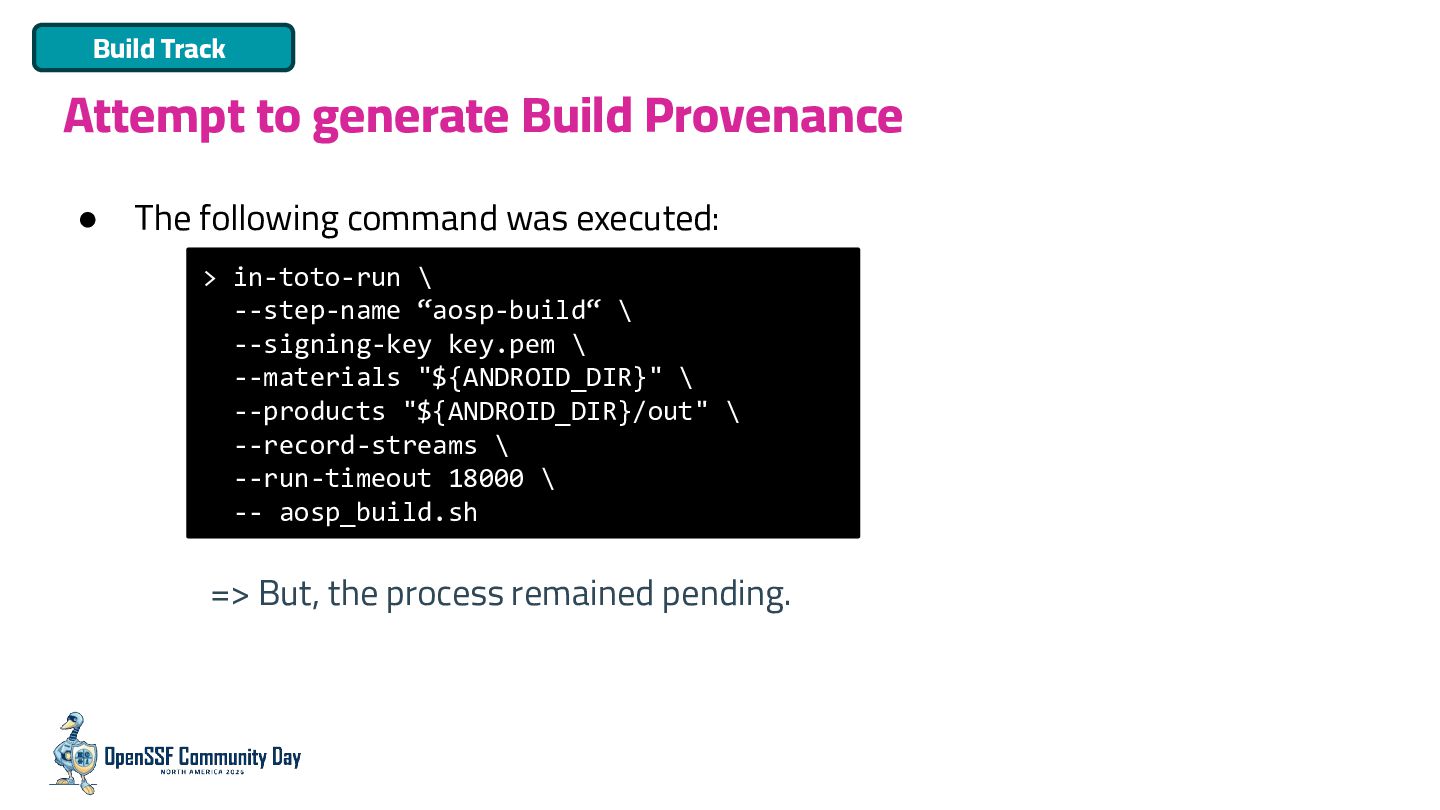
Attempt to generate Build Provenance • The following command was
executed: > in-toto-run \ --step-name “aosp-build“ \ --signing-key key.pem \ --materials "${ANDROID_DIR}" \ --products "${ANDROID_DIR}/out" \ --record-streams \ --run-timeout 18000 \ -- aosp_build.sh => But, the process remained pending. Build Track -
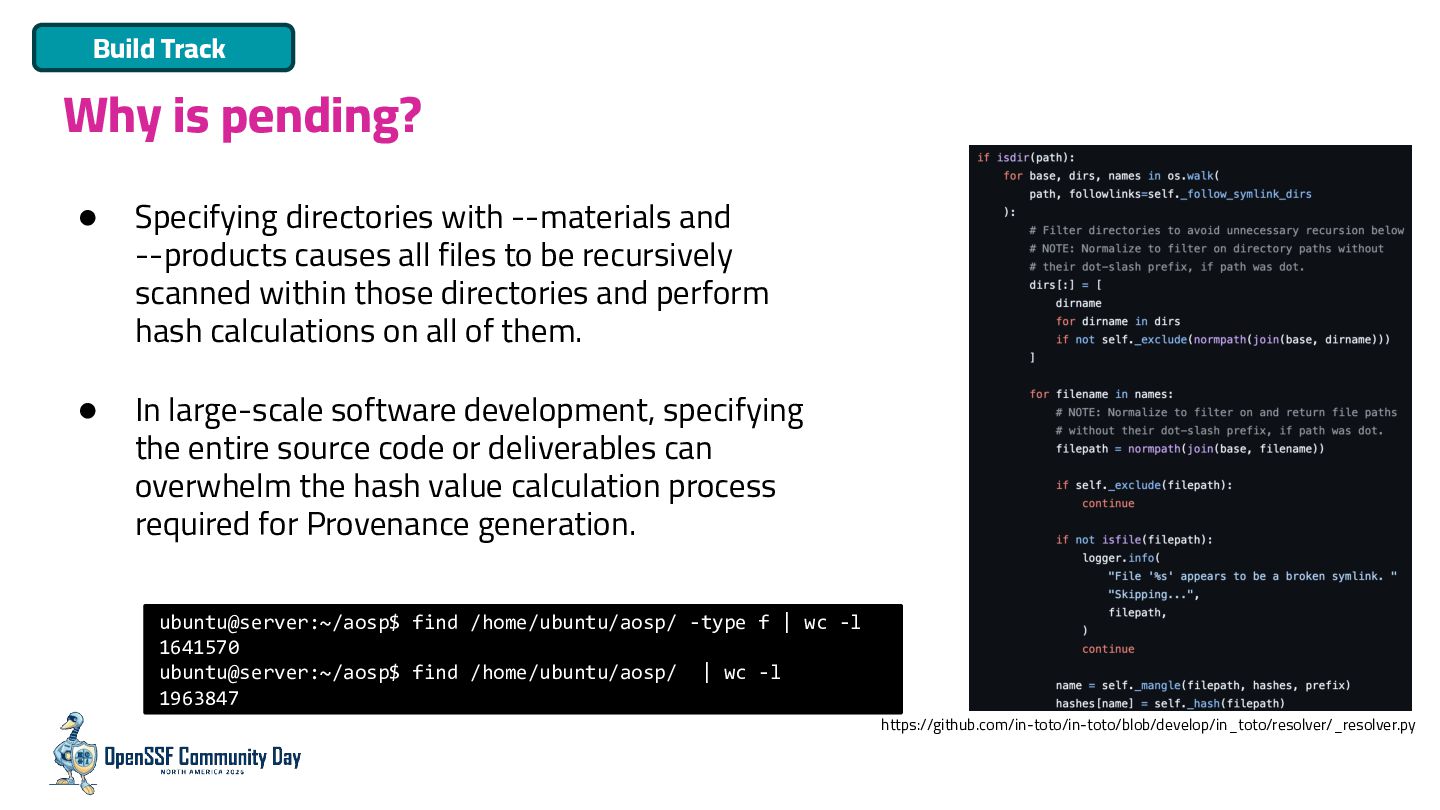
Why is pending? • Specifying directories with --materials and --products
causes all files to be recursively scanned within those directories and perform hash calculations on all of them. • In large-scale software development, specifying the entire source code or deliverables can overwhelm the hash value calculation process required for Provenance generation. ubuntu@server:~/aosp$ find /home/ubuntu/aosp/ -type f | wc -l 1641570 ubuntu@server:~/aosp$ find /home/ubuntu/aosp/ | wc -l 1963847 https://github.com/in-toto/in-toto/blob/develop/in_toto/resolver/_resolver.py Build Track -
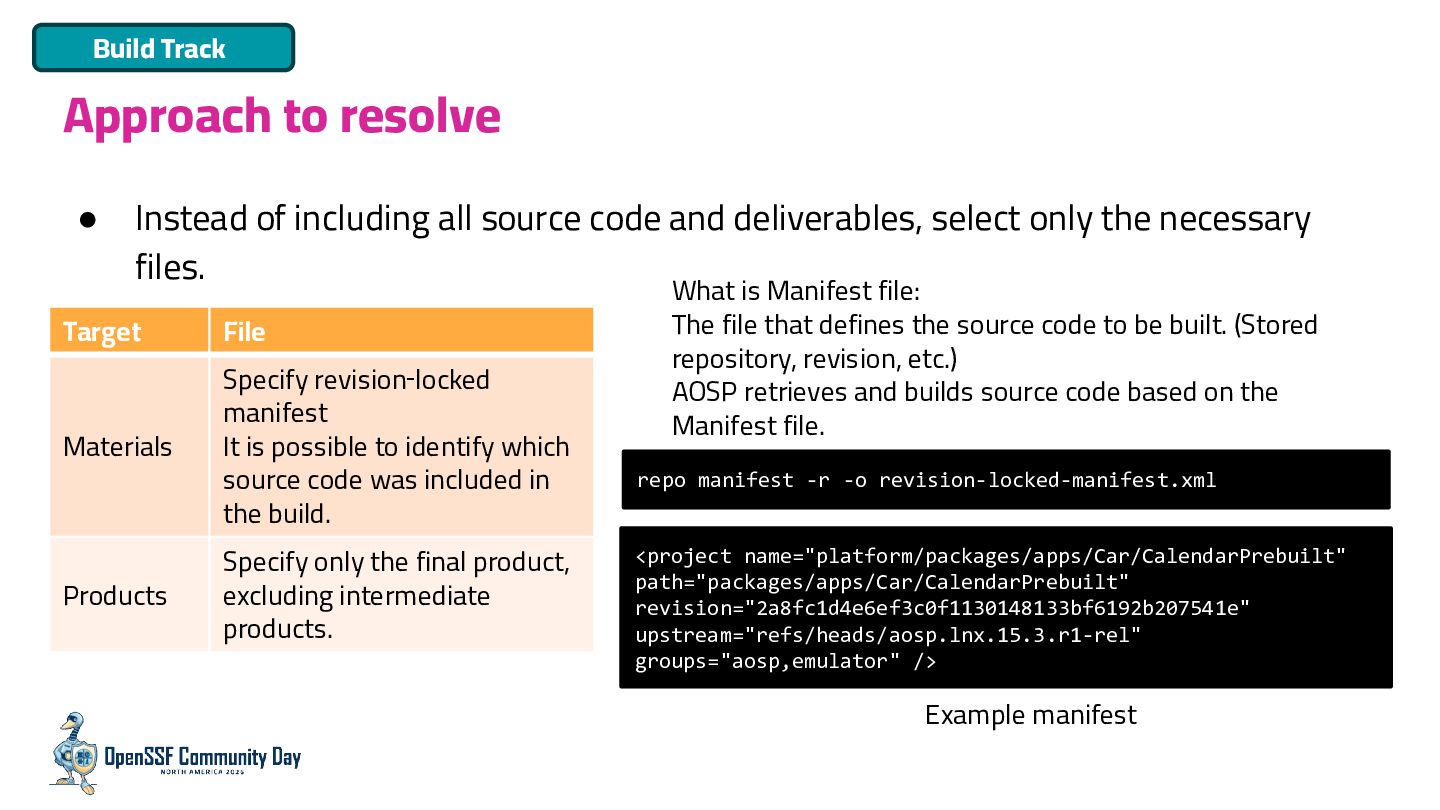
Approach to resolve • Instead of including all source code
and deliverables, select only the necessary files. Target File Materials Specify revision‑locked manifest It is possible to identify which source code was included in the build. Products Specify only the final product, excluding intermediate products. <project name="platform/packages/apps/Car/CalendarPrebuilt" path="packages/apps/Car/CalendarPrebuilt" revision="2a8fc1d4e6ef3c0f1130148133bf6192b207541e" upstream="refs/heads/aosp.lnx.15.3.r1-rel" groups="aosp,emulator" /> Example manifest What is Manifest file: The file that defines the source code to be built. (Stored repository, revision, etc.) AOSP retrieves and builds source code based on the Manifest file. repo manifest -r -o revision-locked-manifest.xml Build Track -
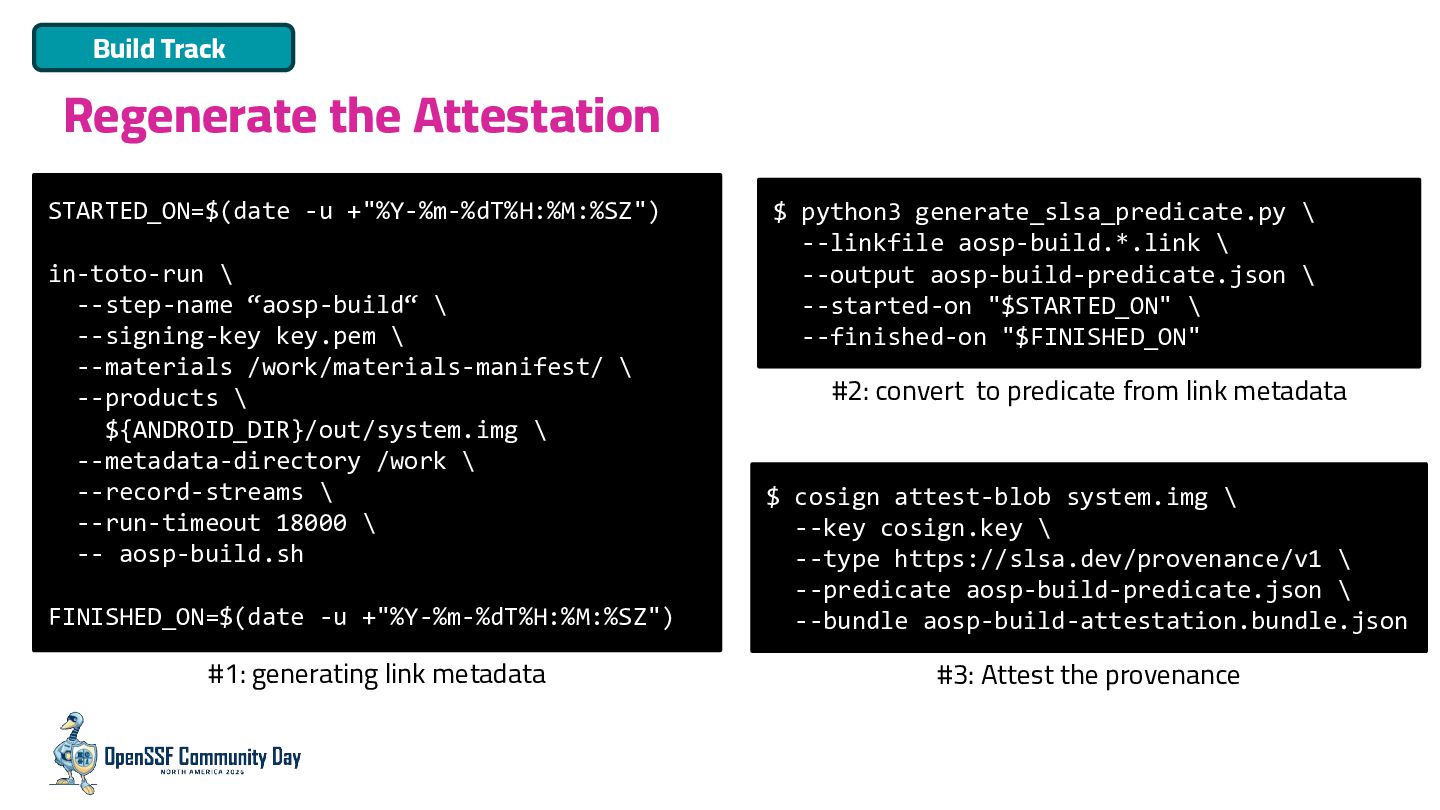
Regenerate the Attestation STARTED_ON=$(date -u +"%Y-%m-%dT%H:%M:%SZ") in-toto-run \ --step-name “aosp-build“
\ --signing-key key.pem \ --materials /work/materials-manifest/ \ --products \ ${ANDROID_DIR}/out/system.img \ --metadata-directory /work \ --record-streams \ --run-timeout 18000 \ -- aosp-build.sh FINISHED_ON=$(date -u +"%Y-%m-%dT%H:%M:%SZ") #1: generating link metadata $ cosign attest-blob system.img \ --key cosign.key \ --type https://slsa.dev/provenance/v1 \ --predicate aosp-build-predicate.json \ --bundle aosp-build-attestation.bundle.json $ python3 generate_slsa_predicate.py \ --linkfile aosp-build.*.link \ --output aosp-build-predicate.json \ --started-on "$STARTED_ON" \ --finished-on "$FINISHED_ON" #2: convert to predicate from link metadata #3: Attest the provenance Build Track -
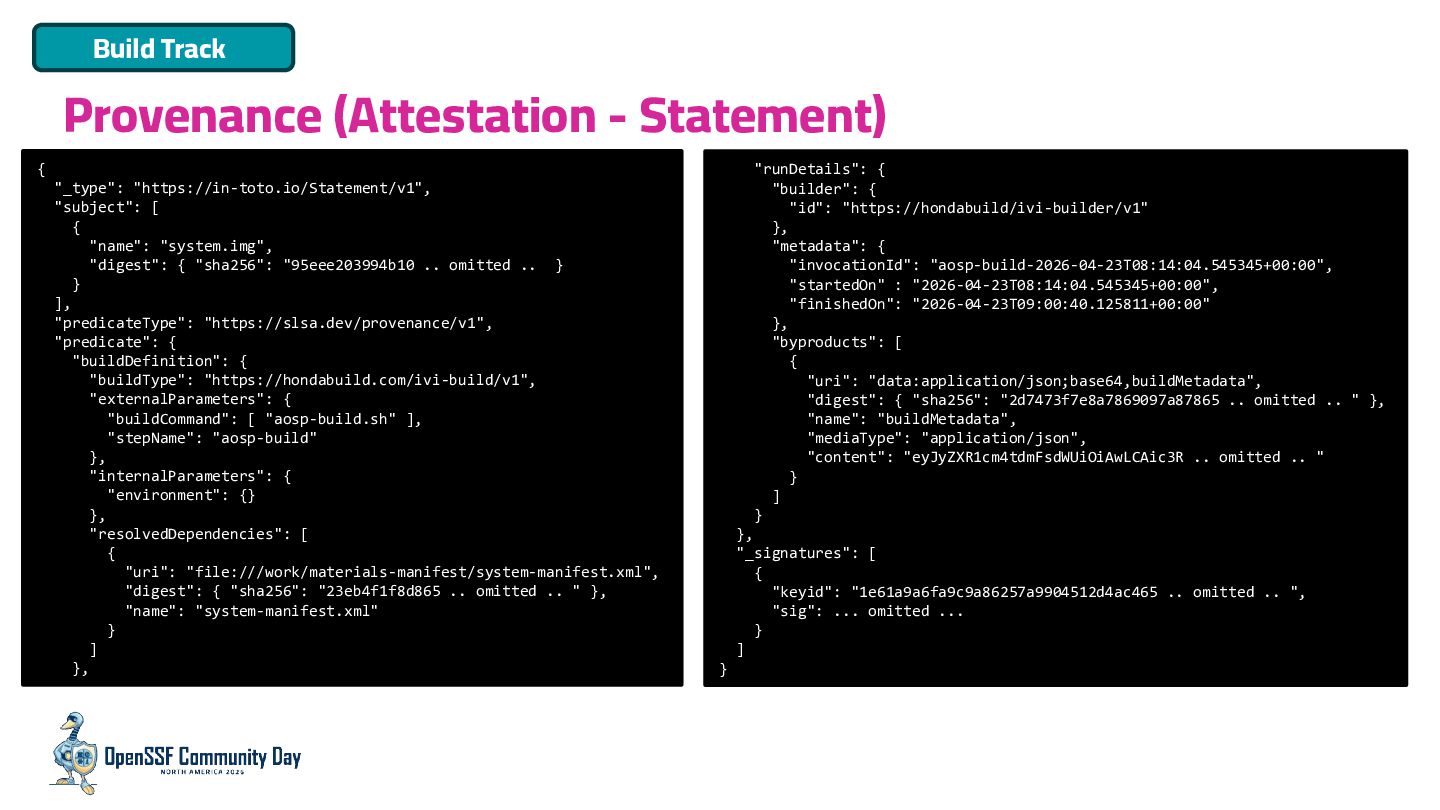
Provenance (Attestation - Statement) { "_type": "https://in-toto.io/Statement/v1", "subject": [ {
"name": "system.img", "digest": { "sha256": "95eee203994b10 .. omitted .. } } ], "predicateType": "https://slsa.dev/provenance/v1", "predicate": { "buildDefinition": { "buildType": "https://hondabuild.com/ivi-build/v1", "externalParameters": { "buildCommand": [ "aosp-build.sh" ], "stepName": "aosp-build" }, "internalParameters": { "environment": {} }, "resolvedDependencies": [ { "uri": "file:///work/materials-manifest/system-manifest.xml", "digest": { "sha256": "23eb4f1f8d865 .. omitted .. " }, "name": "system-manifest.xml" } ] }, "runDetails": { "builder": { "id": "https://hondabuild/ivi-builder/v1" }, "metadata": { "invocationId": "aosp-build-2026-04-23T08:14:04.545345+00:00", "startedOn" : "2026-04-23T08:14:04.545345+00:00", "finishedOn": "2026-04-23T09:00:40.125811+00:00" }, "byproducts": [ { "uri": "data:application/json;base64,buildMetadata", "digest": { "sha256": "2d7473f7e8a7869097a87865 .. omitted .. " }, "name": "buildMetadata", "mediaType": "application/json", "content": "eyJyZXR1cm4tdmFsdWUiOiAwLCAic3R .. omitted .. " } ] } }, "_signatures": [ { "keyid": "1e61a9a6fa9c9a86257a9904512d4ac465 .. omitted .. ", "sig": ... omitted ... } ] } Build Track -
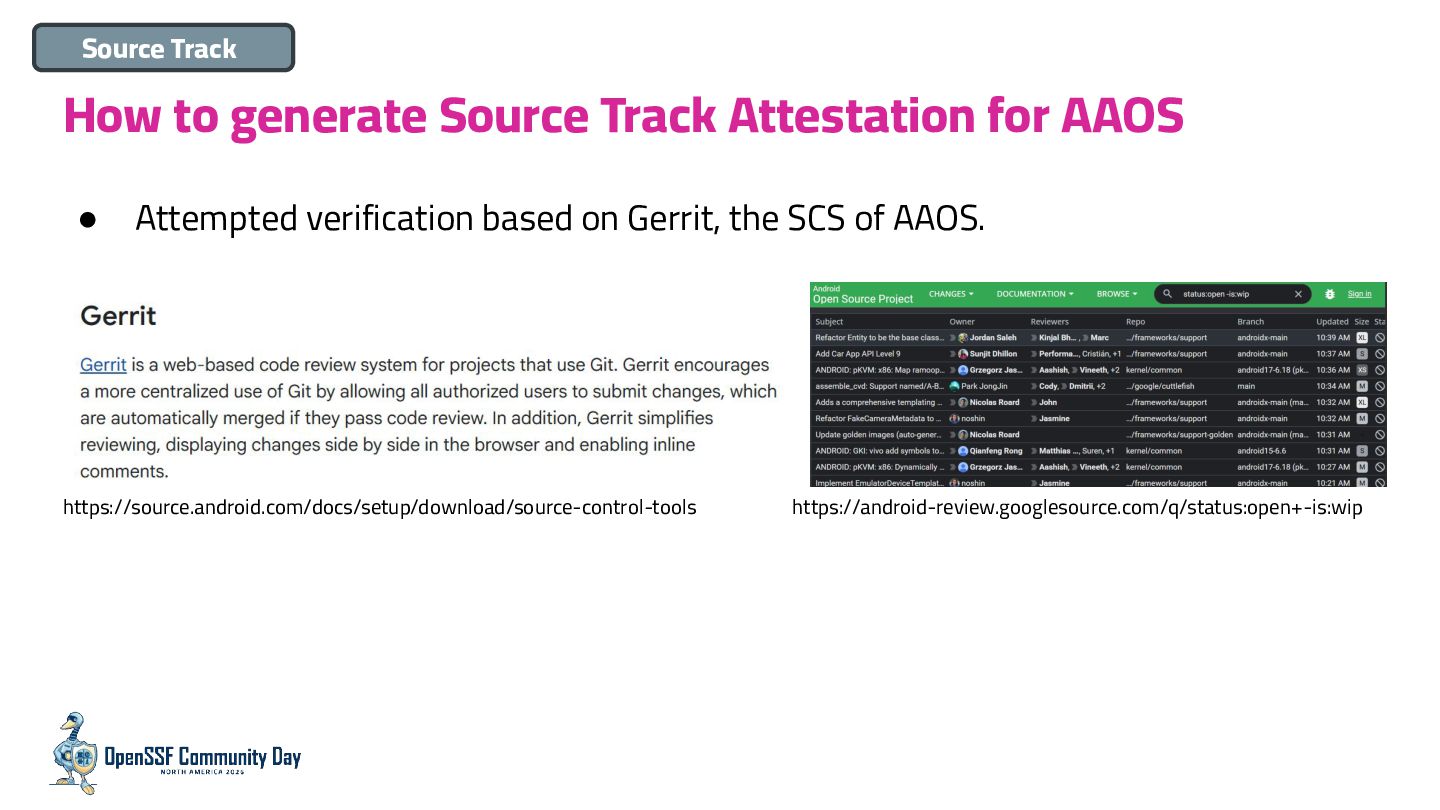
How to generate Source Track Attestation for AAOS • Attempted
verification based on Gerrit, the SCS of AAOS. https://source.android.com/docs/setup/download/source-control-tools https://android-review.googlesource.com/q/status:open+-is:wip Source Track -
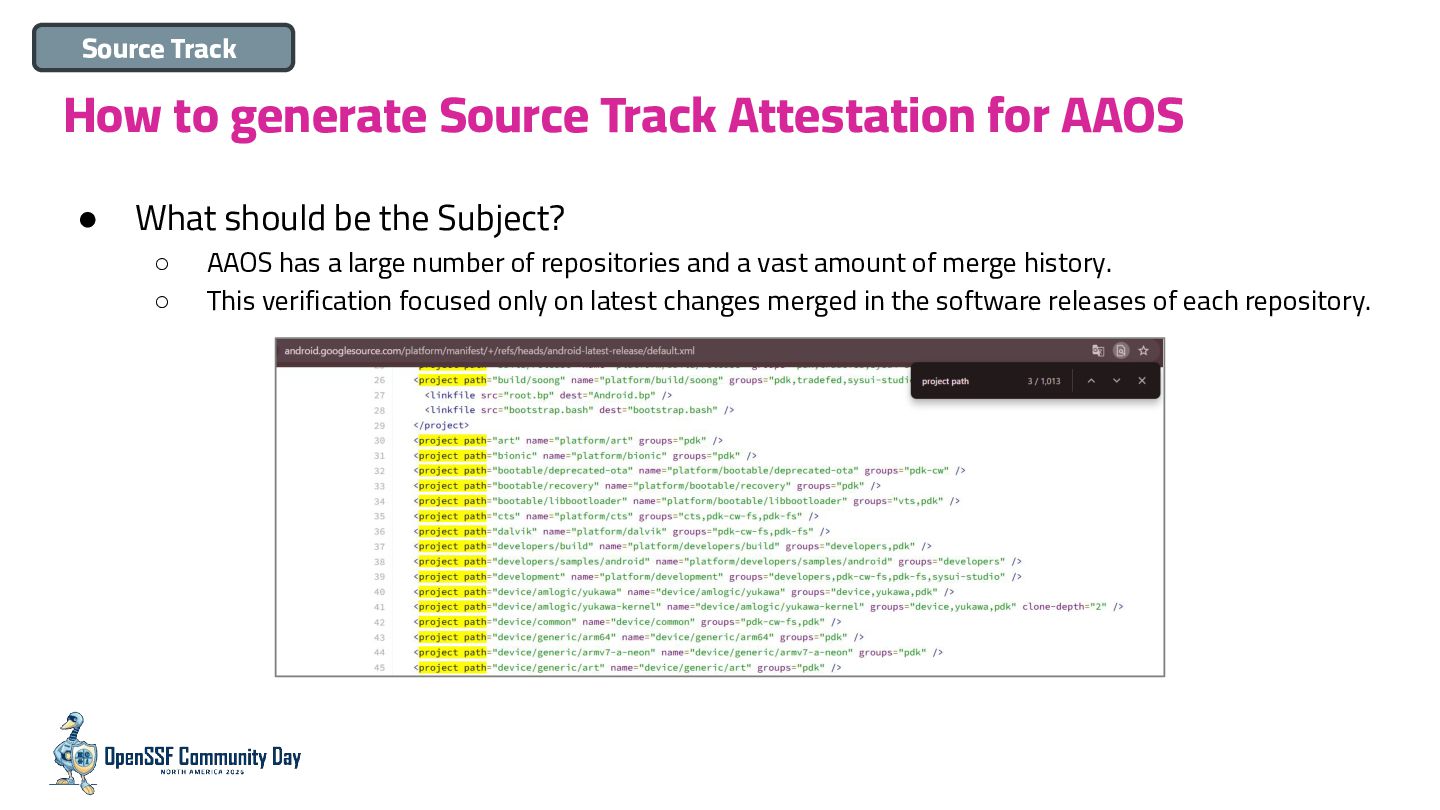
How to generate Source Track Attestation for AAOS • What
should be the Subject? ◦ AAOS has a large number of repositories and a vast amount of merge history. ◦ This verification focused only on latest changes merged in the software releases of each repository. Source Track -
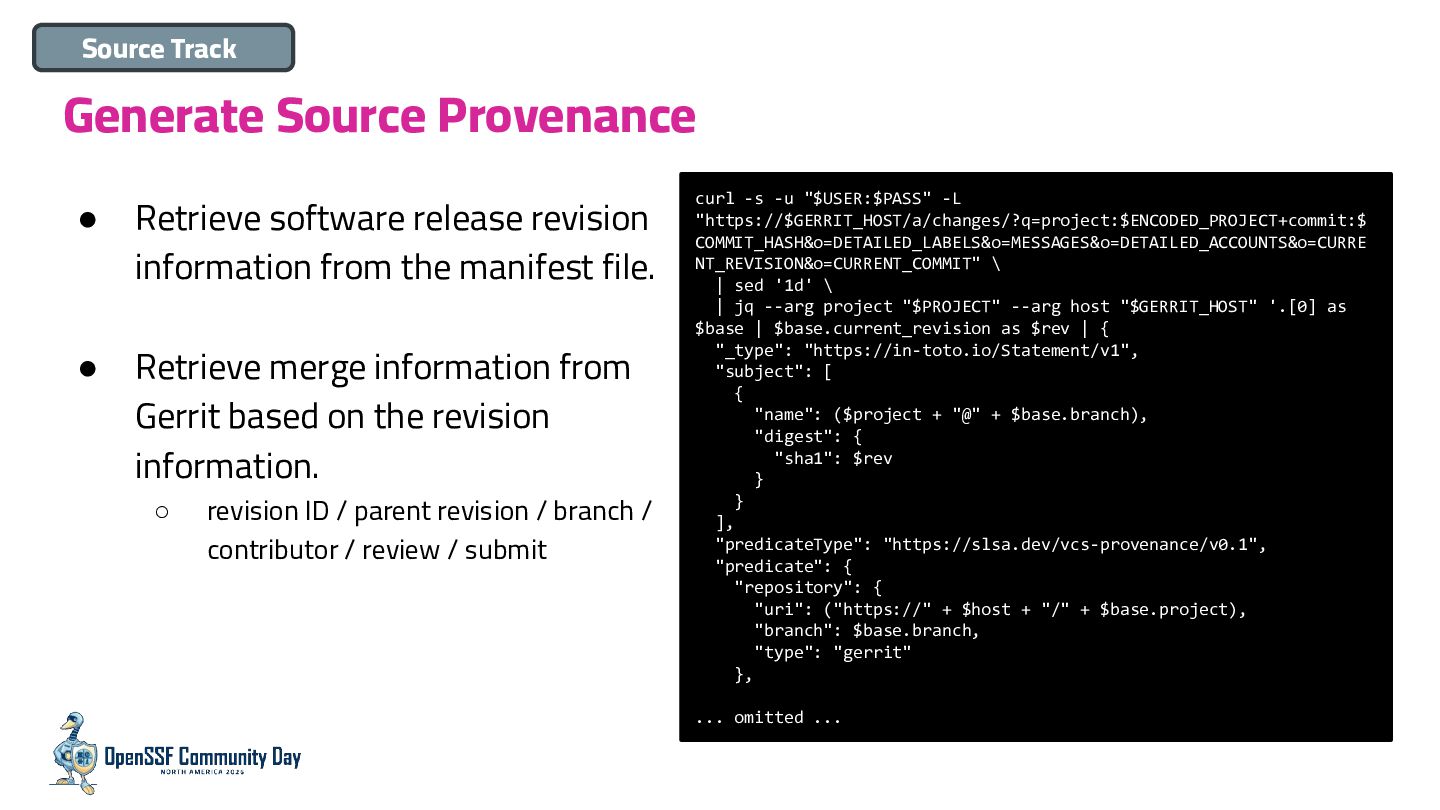
Generate Source Provenance • Retrieve software release revision information from
the manifest file. • Retrieve merge information from Gerrit based on the revision information. ◦ revision ID / parent revision / branch / contributor / review / submit curl -s -u "$USER:$PASS" -L "https://$GERRIT_HOST/a/changes/?q=project:$ENCODED_PROJECT+commit:$ COMMIT_HASH&o=DETAILED_LABELS&o=MESSAGES&o=DETAILED_ACCOUNTS&o=CURRE NT_REVISION&o=CURRENT_COMMIT" \ | sed '1d' \ | jq --arg project "$PROJECT" --arg host "$GERRIT_HOST" '.[0] as $base | $base.current_revision as $rev | { "_type": "https://in-toto.io/Statement/v1", "subject": [ { "name": ($project + "@" + $base.branch), "digest": { "sha1": $rev } } ], "predicateType": "https://slsa.dev/vcs-provenance/v0.1", "predicate": { "repository": { "uri": ("https://" + $host + "/" + $base.project), "branch": $base.branch, "type": "gerrit" }, ... omitted ... Source Track -
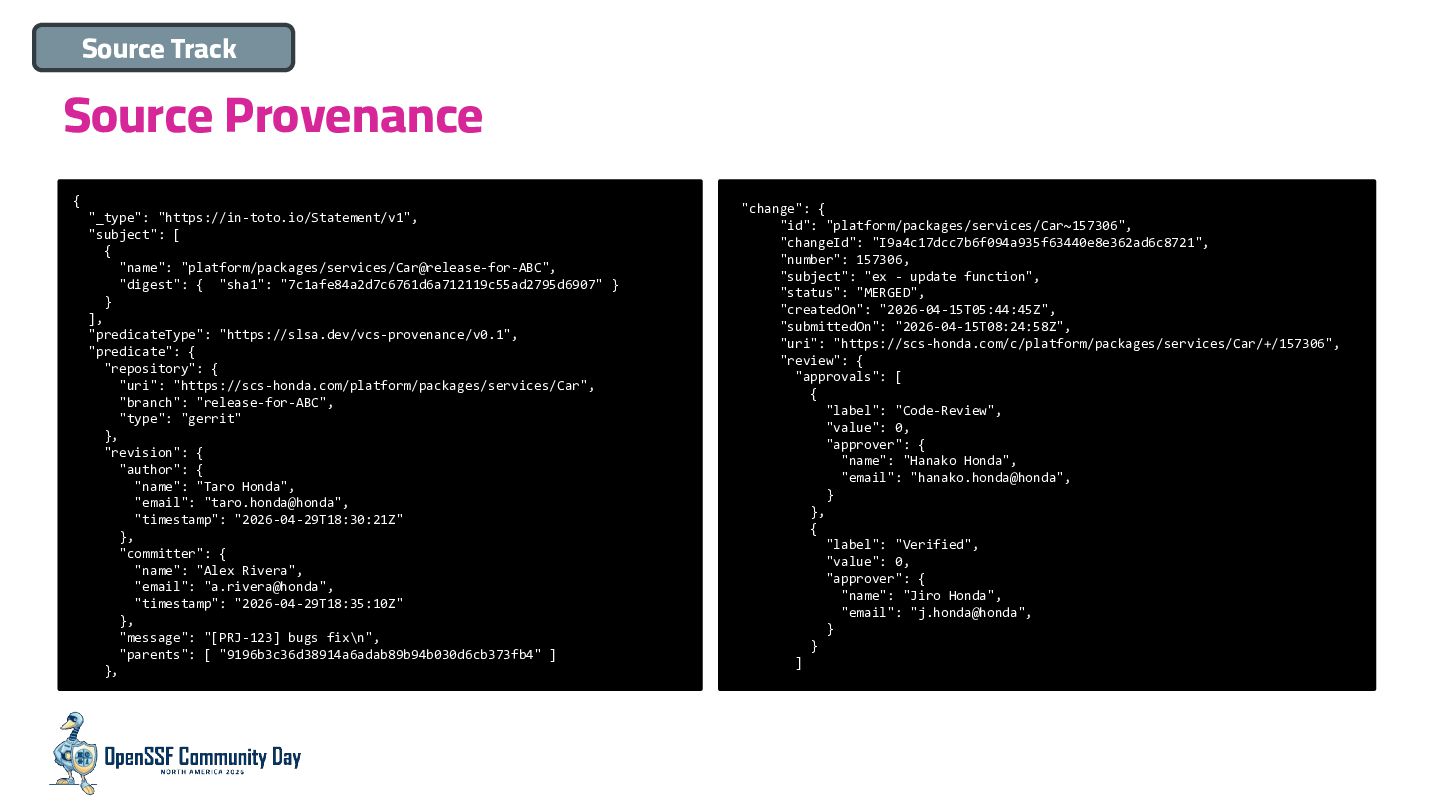
Source Provenance { "_type": "https://in-toto.io/Statement/v1", "subject": [ { "name": "platform/packages/services/Car@release-for-ABC",
"digest": { "sha1": "7c1afe84a2d7c6761d6a712119c55ad2795d6907" } } ], "predicateType": "https://slsa.dev/vcs-provenance/v0.1", "predicate": { "repository": { "uri": "https://scs-honda.com/platform/packages/services/Car", "branch": "release-for-ABC", "type": "gerrit" }, "revision": { "author": { "name": "Taro Honda", "email": "taro.honda@honda", "timestamp": "2026-04-29T18:30:21Z" }, "committer": { "name": "Alex Rivera", "email": "a.rivera@honda", "timestamp": "2026-04-29T18:35:10Z" }, "message": "[PRJ-123] bugs fix\n", "parents": [ "9196b3c36d38914a6adab89b94b030d6cb373fb4" ] }, "change": { "id": "platform/packages/services/Car~157306", "changeId": "I9a4c17dcc7b6f094a935f63440e8e362ad6c8721", "number": 157306, "subject": "ex - update function", "status": "MERGED", "createdOn": "2026-04-15T05:44:45Z", "submittedOn": "2026-04-15T08:24:58Z", "uri": "https://scs-honda.com/c/platform/packages/services/Car/+/157306", "review": { "approvals": [ { "label": "Code-Review", "value": 0, "approver": { "name": "Hanako Honda", "email": "hanako.honda@honda", } }, { "label": "Verified", "value": 0, "approver": { "name": "Jiro Honda", "email": "j.honda@honda", } } ] Source Track -
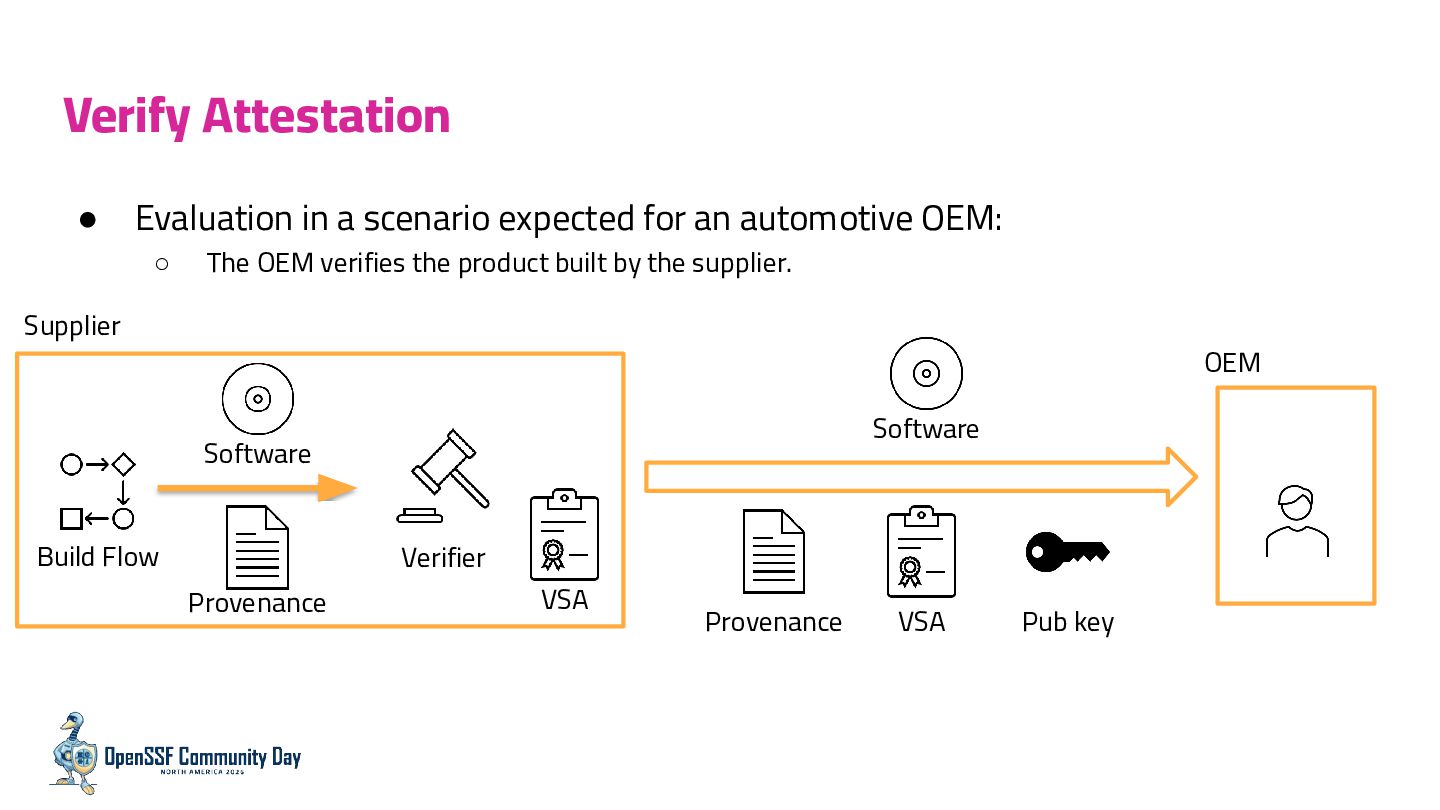
Verify Attestation • Evaluation in a scenario expected for an
automotive OEM: ◦ The OEM verifies the product built by the supplier. OEM Software Provenance VSA Pub key Provenance Build Flow Software Supplier Verifier VSA -
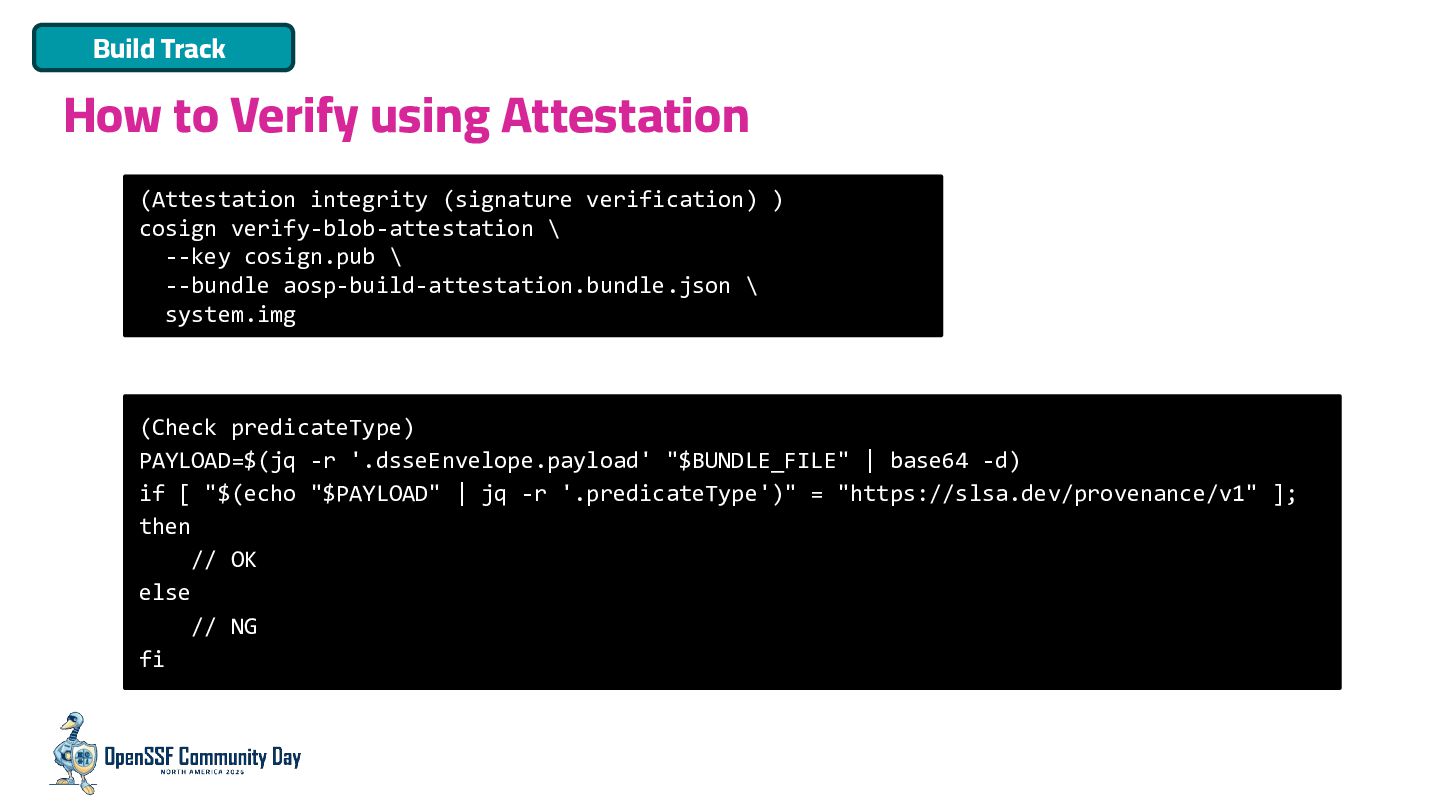
How to Verify using Attestation (Attestation integrity (signature verification) )
cosign verify-blob-attestation \ --key cosign.pub \ --bundle aosp-build-attestation.bundle.json \ system.img (Check predicateType) PAYLOAD=$(jq -r '.dsseEnvelope.payload' "$BUNDLE_FILE" | base64 -d) if [ "$(echo "$PAYLOAD" | jq -r '.predicateType')" = "https://slsa.dev/provenance/v1" ]; then // OK else // NG fi Build Track -
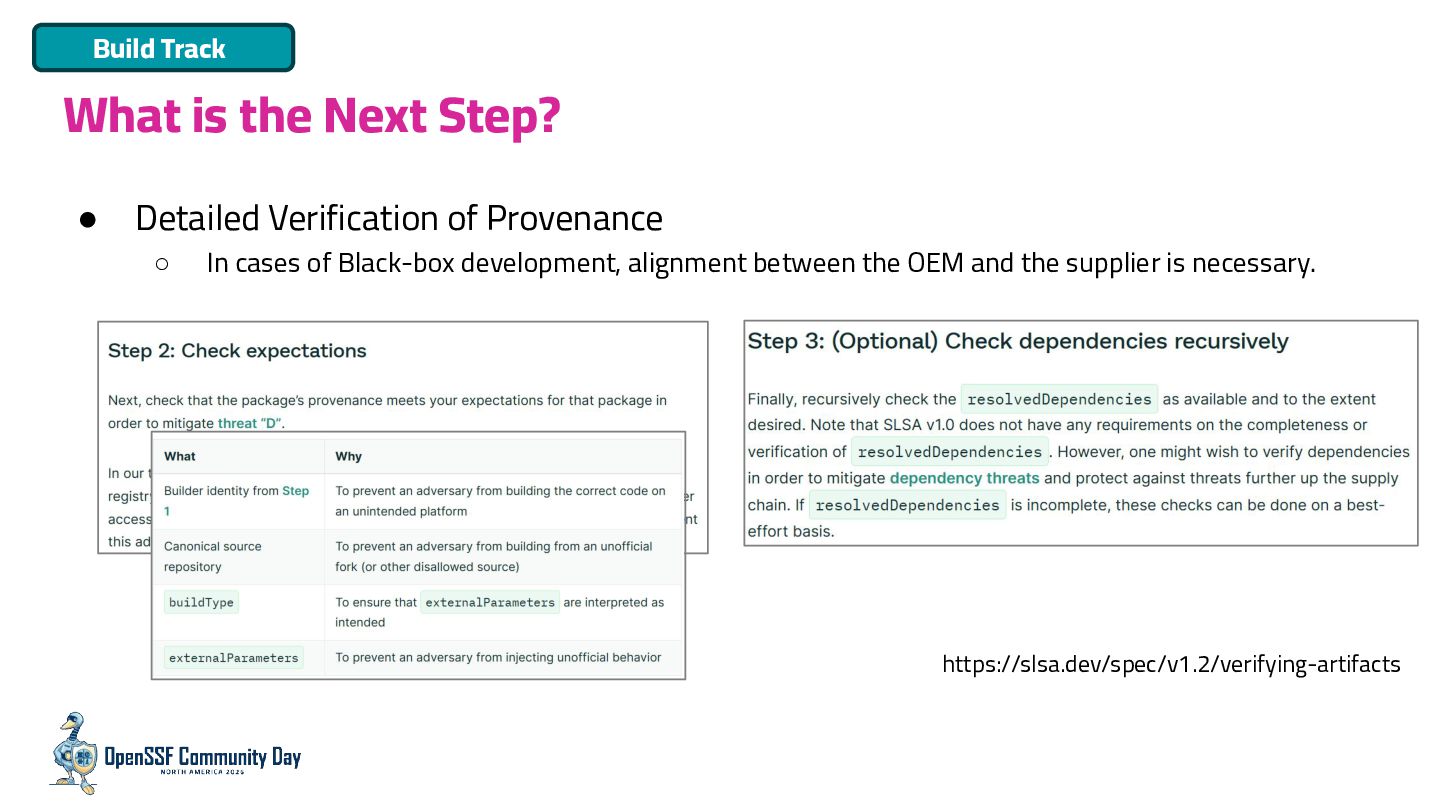
What is the Next Step? • Detailed Verification of Provenance
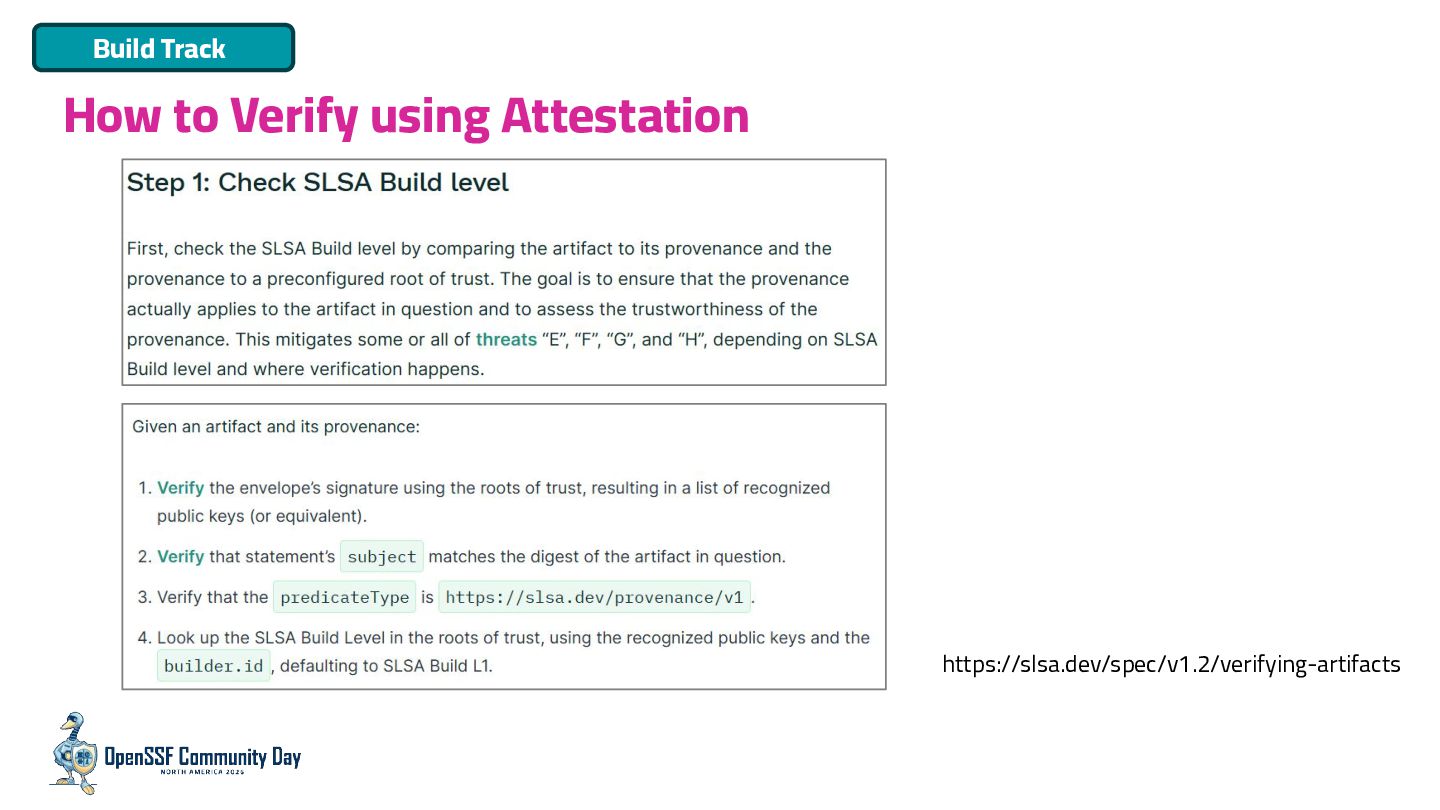
◦ In cases of Black-box development, alignment between the OEM and the supplier is necessary. https://slsa.dev/spec/v1.2/verifying-artifacts Build Track -
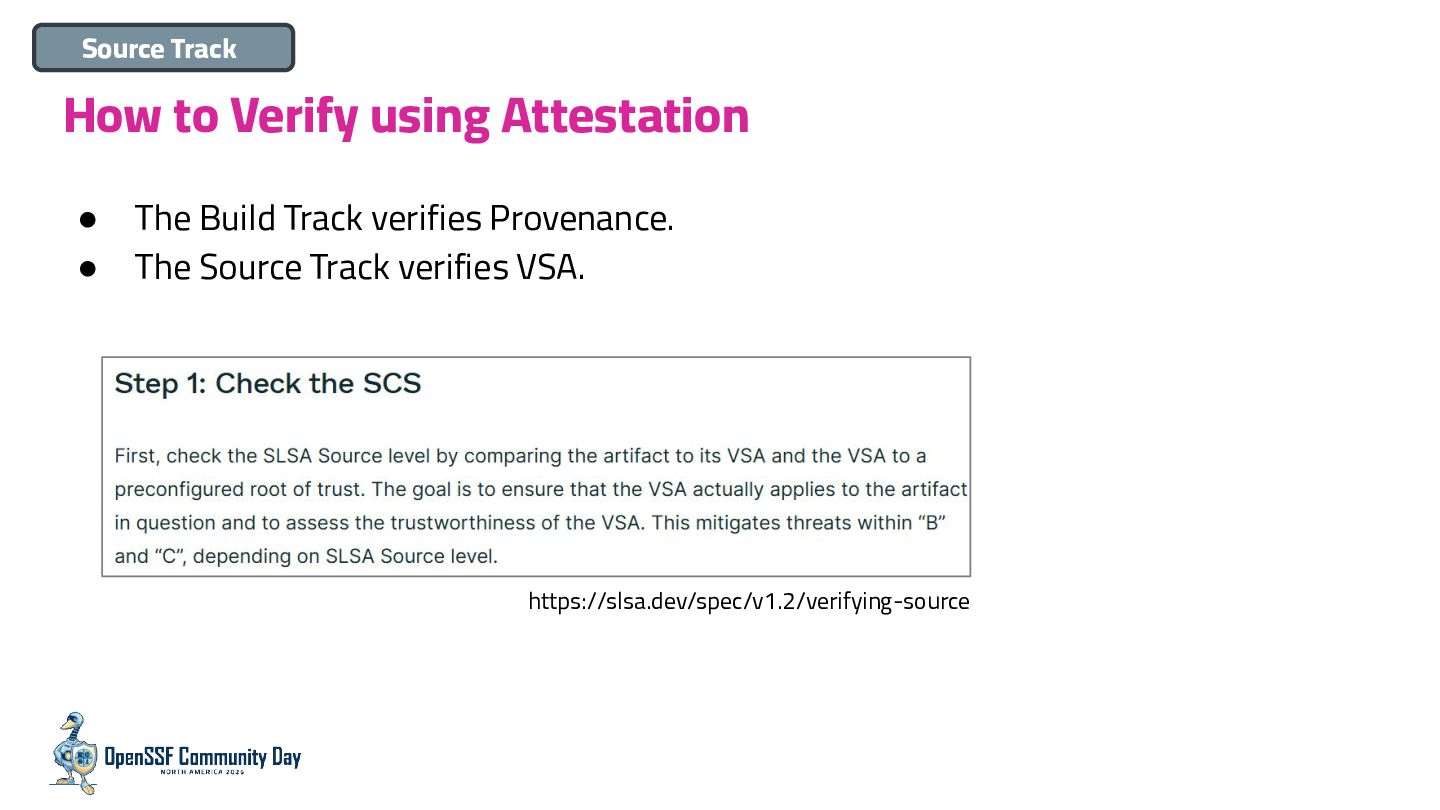
How to Verify using Attestation • The Build Track verifies
Provenance. • The Source Track verifies VSA. https://slsa.dev/spec/v1.2/verifying-source Source Track -
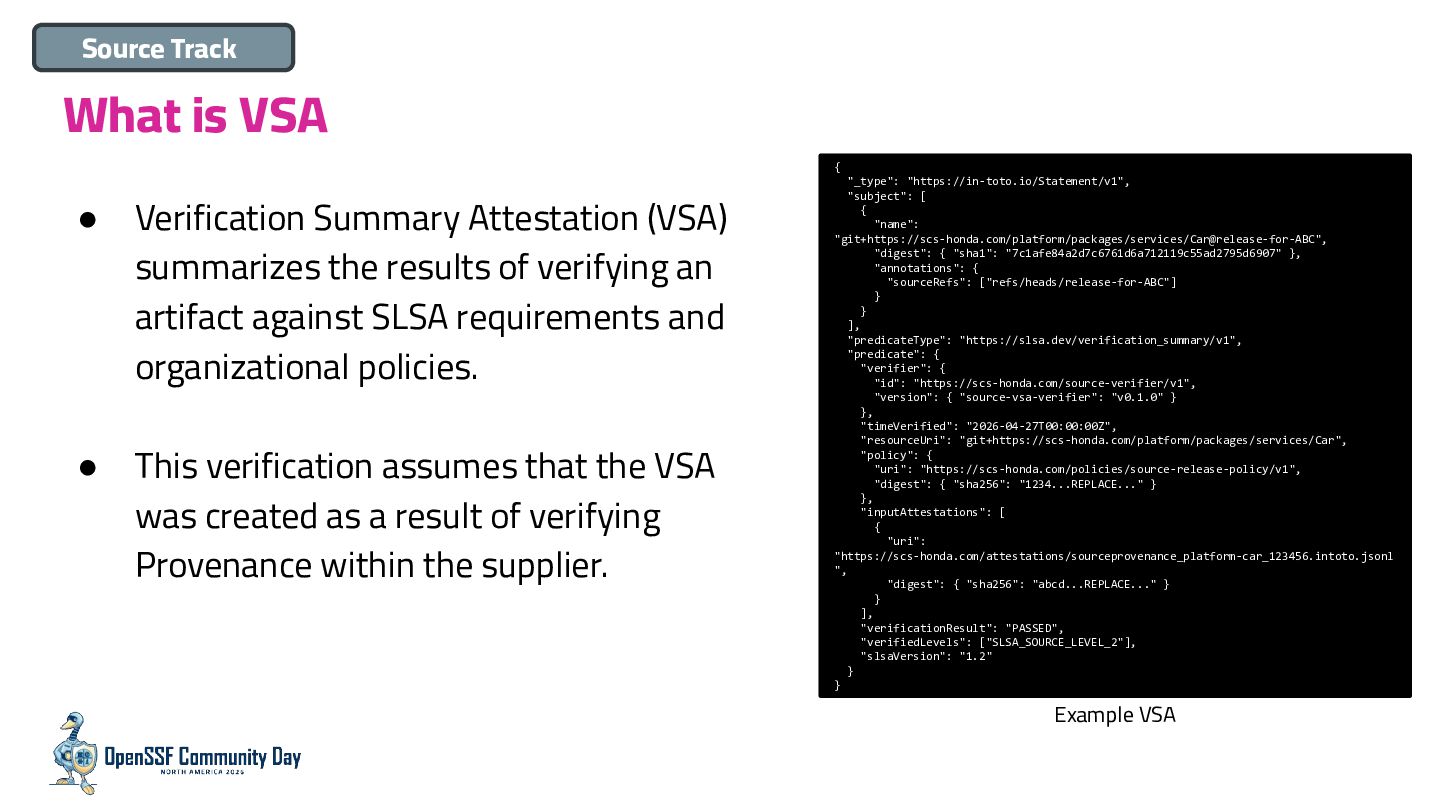
What is VSA • Verification Summary Attestation (VSA) summarizes the
results of verifying an artifact against SLSA requirements and organizational policies. • This verification assumes that the VSA was created as a result of verifying Provenance within the supplier. { "_type": "https://in-toto.io/Statement/v1", "subject": [ { "name": "git+https://scs-honda.com/platform/packages/services/Car@release-for-ABC", "digest": { "sha1": "7c1afe84a2d7c6761d6a712119c55ad2795d6907" }, "annotations": { "sourceRefs": ["refs/heads/release-for-ABC"] } } ], "predicateType": "https://slsa.dev/verification_summary/v1", "predicate": { "verifier": { "id": "https://scs-honda.com/source-verifier/v1", "version": { "source-vsa-verifier": "v0.1.0" } }, "timeVerified": "2026-04-27T00:00:00Z", "resourceUri": "git+https://scs-honda.com/platform/packages/services/Car", "policy": { "uri": "https://scs-honda.com/policies/source-release-policy/v1", "digest": { "sha256": "1234...REPLACE..." } }, "inputAttestations": [ { "uri": "https://scs-honda.com/attestations/sourceprovenance_platform-car_123456.intoto.jsonl ", "digest": { "sha256": "abcd...REPLACE..." } } ], "verificationResult": "PASSED", "verifiedLevels": ["SLSA_SOURCE_LEVEL_2"], "slsaVersion": "1.2" } } Example VSA Source Track -
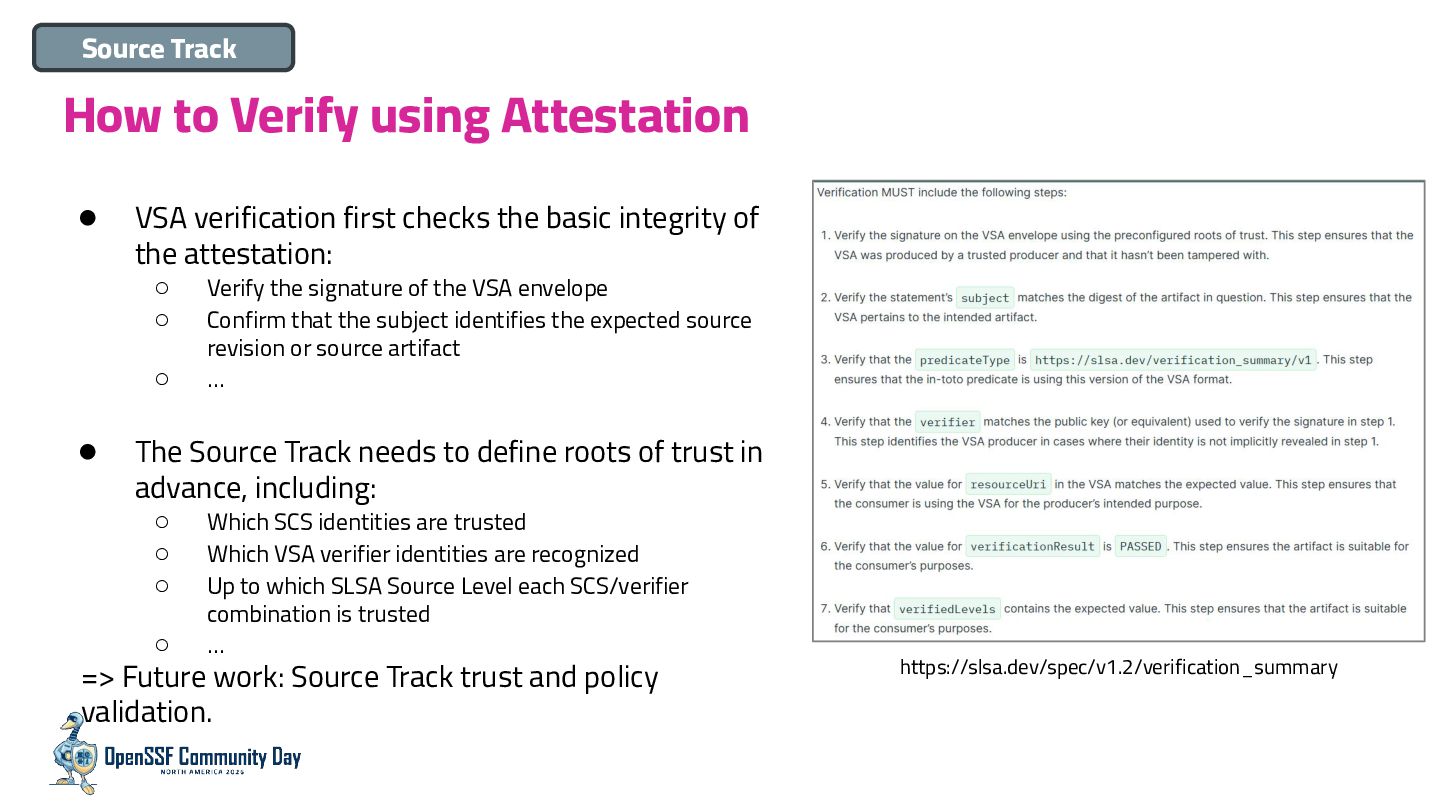
How to Verify using Attestation • VSA verification first checks
the basic integrity of the attestation: ◦ Verify the signature of the VSA envelope ◦ Confirm that the subject identifies the expected source revision or source artifact ◦ … • The Source Track needs to define roots of trust in advance, including: ◦ Which SCS identities are trusted ◦ Which VSA verifier identities are recognized ◦ Up to which SLSA Source Level each SCS/verifier combination is trusted ◦ … => Future work: Source Track trust and policy validation. https://slsa.dev/spec/v1.2/verification_summary Source Track -
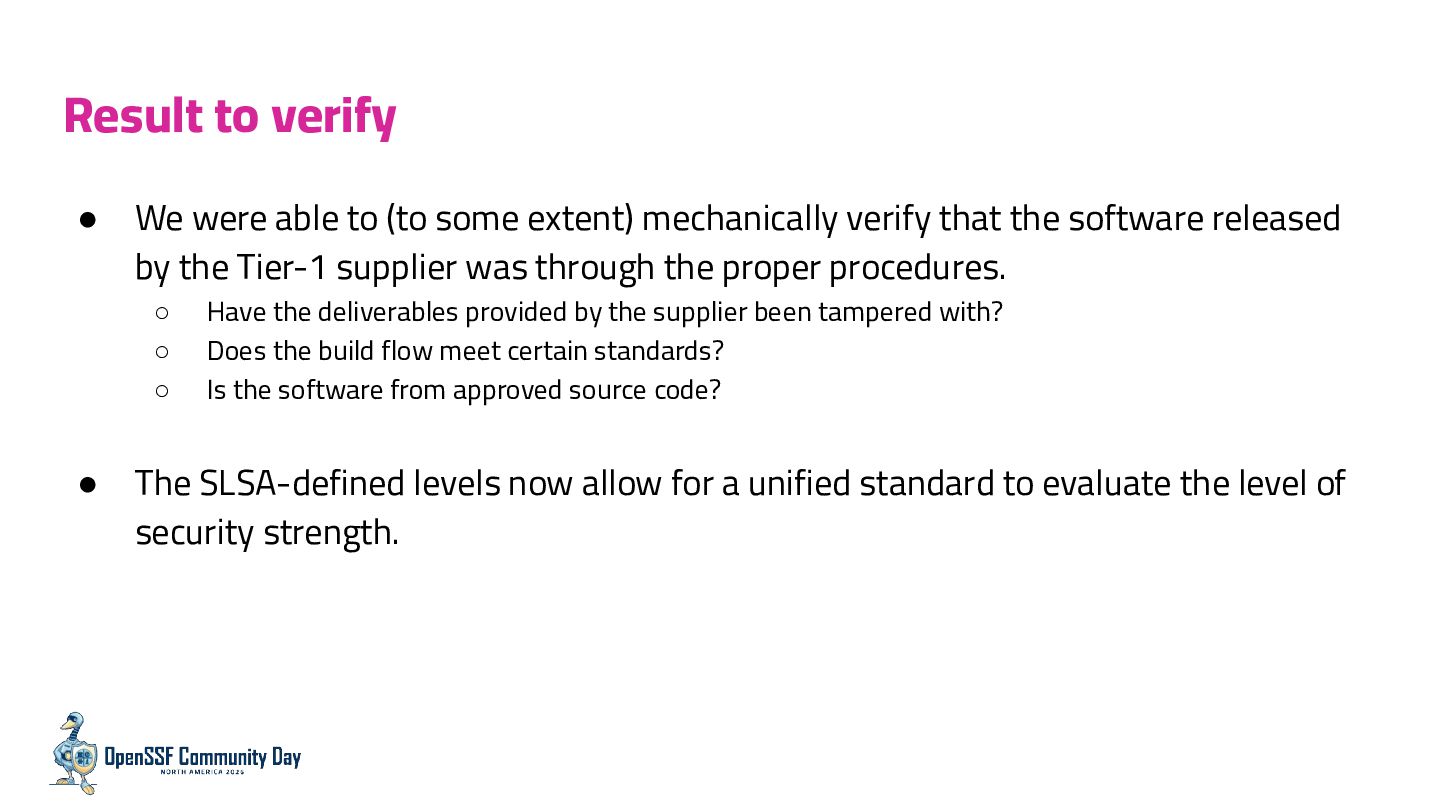
Result to verify • We were able to (to some
extent) mechanically verify that the software released by the Tier-1 supplier was through the proper procedures. ◦ Have the deliverables provided by the supplier been tampered with? ◦ Does the build flow meet certain standards? ◦ Is the software from approved source code? • The SLSA-defined levels now allow for a unified standard to evaluate the level of security strength. -
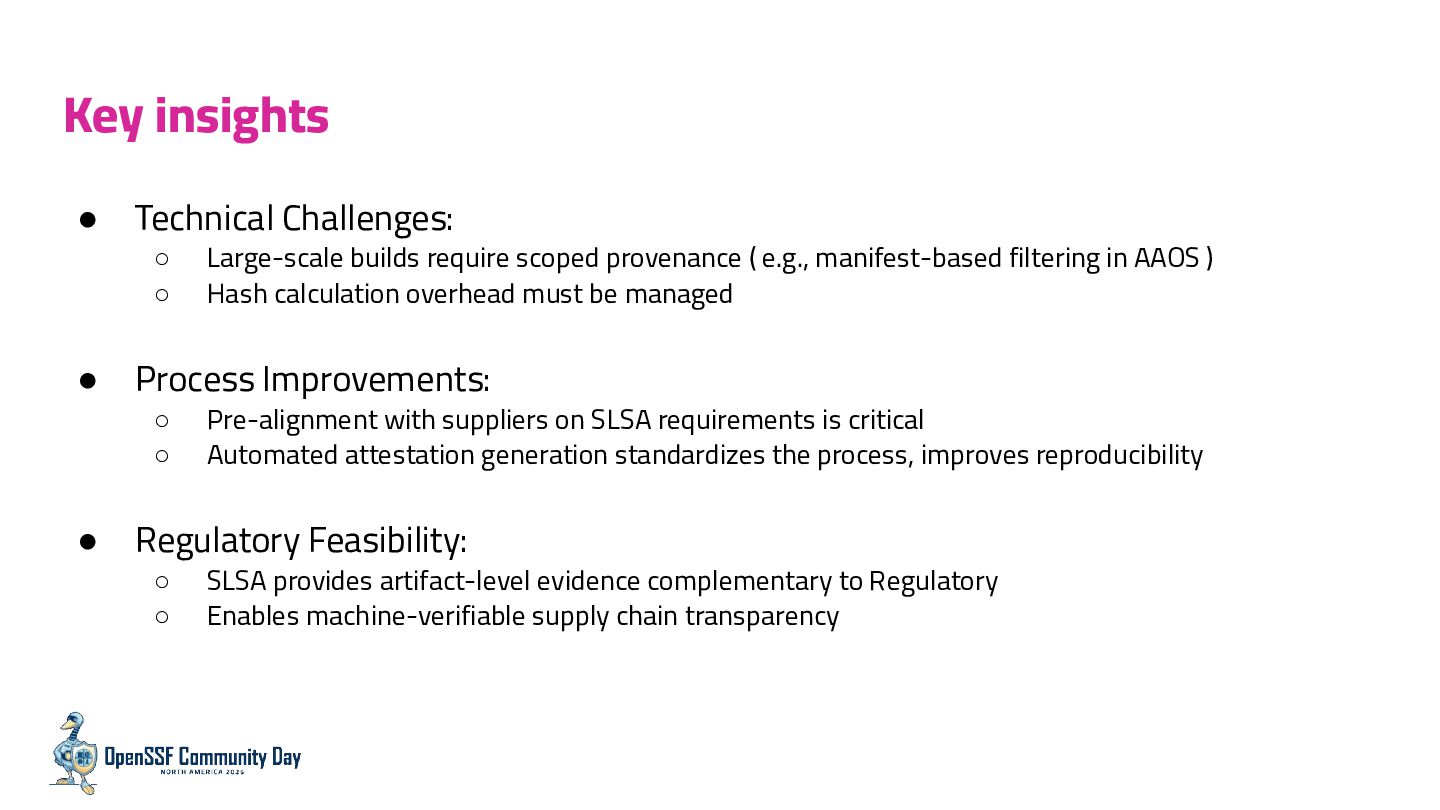
Key insights • Technical Challenges: ◦ Large-scale builds require scoped
provenance ( e.g., manifest-based filtering in AAOS ) ◦ Hash calculation overhead must be managed • Process Improvements: ◦ Pre-alignment with suppliers on SLSA requirements is critical ◦ Automated attestation generation standardizes the process, improves reproducibility • Regulatory Feasibility: ◦ SLSA provides artifact-level evidence complementary to Regulatory ◦ Enables machine-verifiable supply chain transparency -
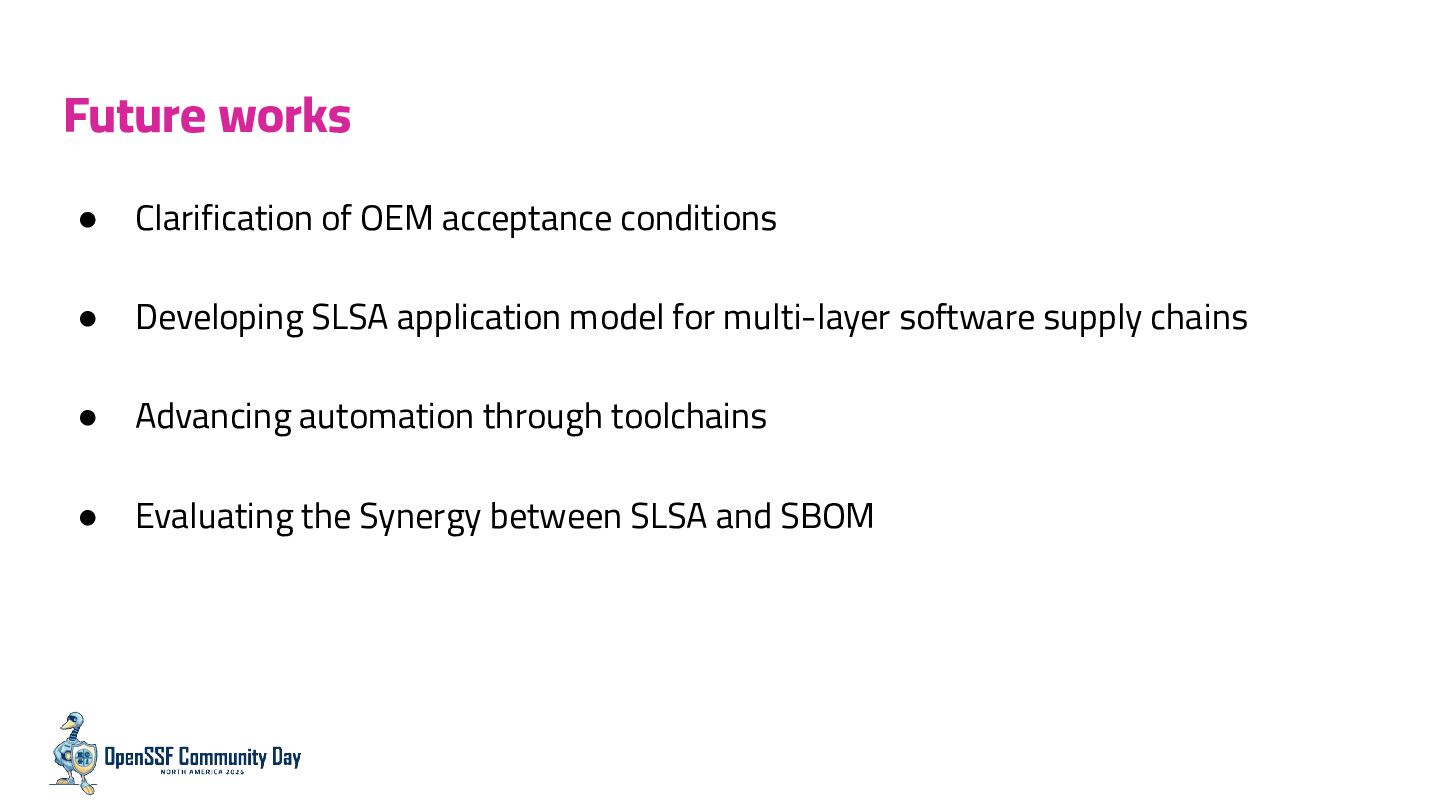
Future works • Clarification of OEM acceptance conditions • Developing
SLSA application model for multi-layer software supply chains • Advancing automation through toolchains • Evaluating the Synergy between SLSA and SBOM -
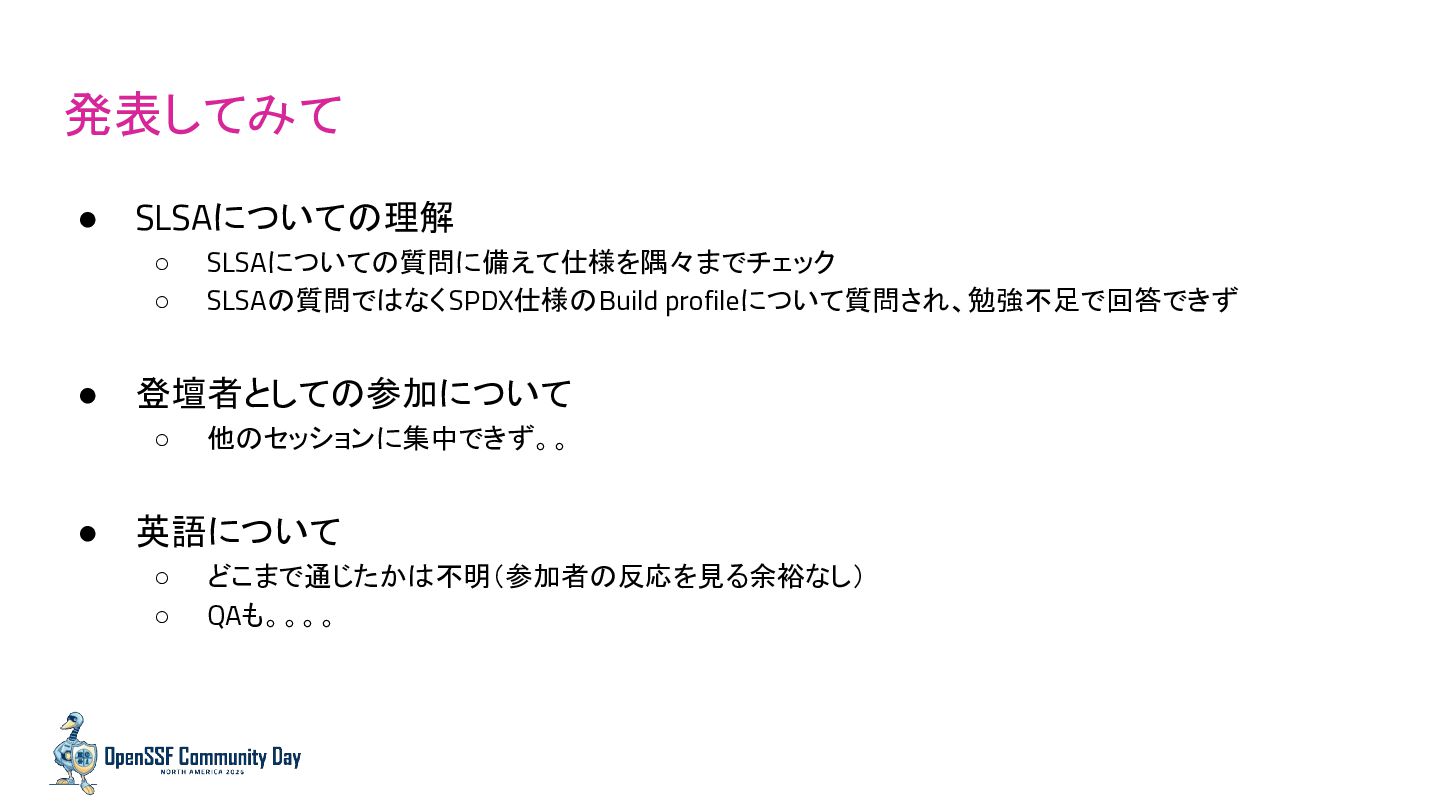
発表してみて • SLSAについての理解 ◦ SLSAについての質問に備えて仕様を隅々までチェック ◦ SLSAの質問ではなくSPDX仕様のBuild profileについて質問され、勉強不足で回答できず • 登壇者としての参加について
◦ 他のセッションに集中できず。。 • 英語について ◦ どこまで通じたかは不明(参加者の反応を見る余裕なし) ◦ QAも。。。。
 lfj
 yoshimura_datam
 hinalin
 ivry_presentationmaterials
 sue445
 legalontechnologies
 kmiya84377
 110y
 rfdnxbro
 inariku
 tammyeverts
 pedronauck
 sergeychernyshev
 kimpetersen
 nwiizo
 mkilby
 lindahogenes
 axbom
 aleyda
 paigeccino
 jct
 bermonpainter