Upgrade to Pro
— share decks privately, control downloads, hide ads and more …
Speaker Deck
Sign up for free
Menu
Search
Features
All features
Private URLs
Password Protection
Custom URLS
Scheduled publishing
Remove Branding
Restrict embedding
Deck Collections
Notes
Features
All features
Private URLs
Password Protection
Custom URLS
Scheduled publishing
Remove Branding
Restrict embedding
Deck Collections
Notes
Explore
Featured decks
Featured speakers
Programming
Technology
Storyboards
Explore
Featured decks
Featured speakers
Programming
Technology
Storyboards
Pricing
Search
Sign in
Sign up for free
ZeroServices
Search
Boris Feld
October 27, 2013
Programming
120
0
Share
Embed
Copy iframe code
Copy JS code
Copy link
Start on current slide
ZeroServices
Présentation de ZeroServices, une libraire pour faire des services réseaux en P2P.
Boris Feld
October 27, 2013
More Decks by Boris Feld
See All by Boris Feld
BALTO, ONE TEST OUTPUT FORMAT TO UNITE THEM ALL
lothiraldan
0
79
Une révolution dans le monde des tests
lothiraldan
0
330
Mercurial changeset Evolution
lothiraldan
0
230
Python Unicode and Bytes Demystified
lothiraldan
0
300
Django 101
lothiraldan
0
290
Saltpad: A saltstack Web GUI
lothiraldan
5
28k
Mock considered harmful
lothiraldan
1
760
from Sync to Async Python, a AsyncIO migration
lothiraldan
2
790
Microservices késako
lothiraldan
0
180
Other Decks in Programming
See All in Programming
テストを司るデーモンに会いに行く 〜隔離した仮想マシンでテストを通すまで〜
h1d3mun3
1
600
標準パッケージに uuid が追加された 背景から見る Go らしい意思決定 / go_127_uuid_decision
convto
5
9.5k
難しいけど、読めた。- OSSの入口に立った話。
sts11142
0
130
wkhtmltopdfの次どうするか問題2026
willnet
2
1.8k
Ghostty + Neovimで作る 透明でカッコ良い開発環境
j341nono
0
150
ハーネス設計入門 〜 基礎知識の整理から実務へのステップアップ 〜
kinopeee
20
20k
Apple Intelligence を用いた個人情報誤送信防止、及びユーザーリクエスト体験の改善について
yukiny
0
280
Agentic Software Factoryに、すごく賢いIF文を。 / super smart IF statement into the Agentic Software Factory.
rkaga
2
880
Everything will be SERVERLESS — 信じて運用した10年の経験値 / Everything Will be Serverless — Lessons Learned from 10 Years of Operational Experience
seike460
PRO
1
680
AGENTS.md Is Not Enough: Build Skills, Don't Download Them
lx_t
0
130
Agents on Rails - Rails at Scale 2026
irinanazarova
0
320
App Storeの外へ──日本のiOSサイドローディング入門 for iOSDC Japan 2026
yuukiw00w
0
290
Featured
See All Featured
SEO for Brand Visibility & Recognition
aleyda
0
4.8k
A Modern Web Designer's Workflow
chriscoyier
699
190k
Building Flexible Design Systems
yeseniaperezcruz
330
41k
How Fast Is Fast Enough? [PerfNow 2025]
tammyeverts
3
910
How to Think Like a Performance Engineer
csswizardry
28
2.9k
Technical Leadership for Architectural Decision Making
baasie
3
590
Distributed Sagas: A Protocol for Coordinating Microservices
caitiem20
333
23k
How Software Deployment tools have changed in the past 20 years
geshan
2
35k
4 Signs Your Business is Dying
shpigford
187
23k
AI: The stuff that nobody shows you
jnunemaker
PRO
10
1.1k
Heart Work Chapter 1 - Part 1
lfama
PRO
10
36k
Building AI with AI
inesmontani
PRO
1
1.3k
Transcript
ZeroServices FELD Boris - PyconFR 2013
[email protected]
/me • FELD Boris - DevTools • Tornado FTW •
@lothiraldan un peu partout sur le web • https://github.com/Lothiraldan/ ZeroServices
ZeroService • Librairie pour écrire des Services P2P • Python2.x
• Very Alpha
ZeroServices Pourquoi ?
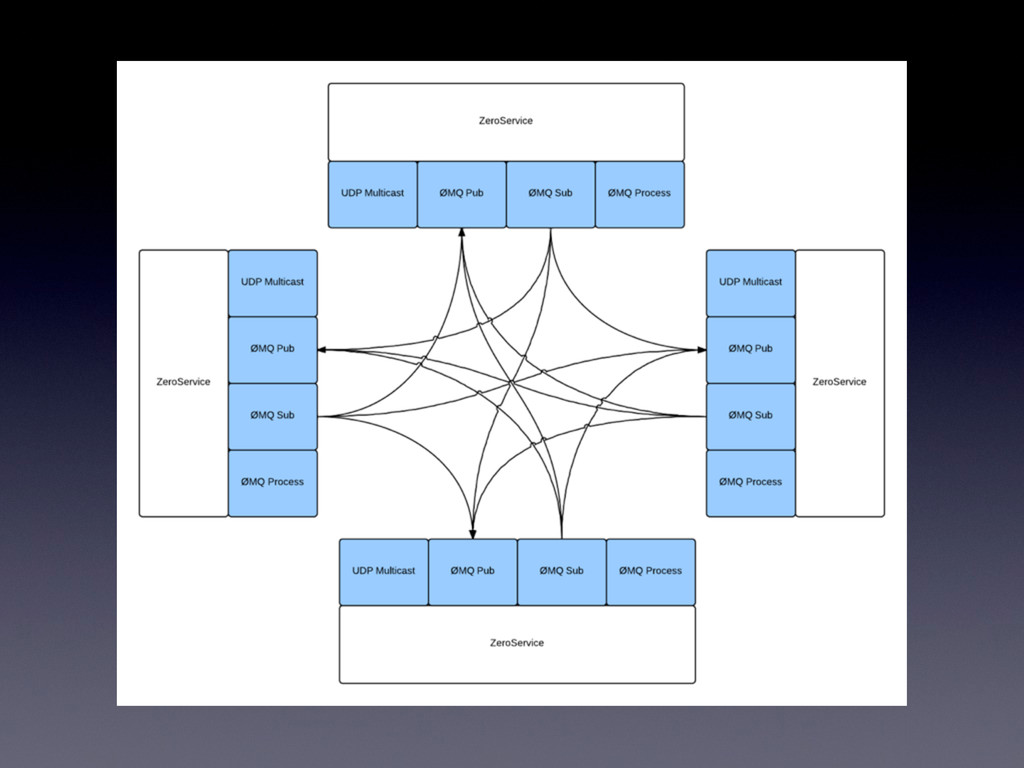
Besoins • AutoDiscovery • Multicast / Unicast • Découverte des
pertes de pairs
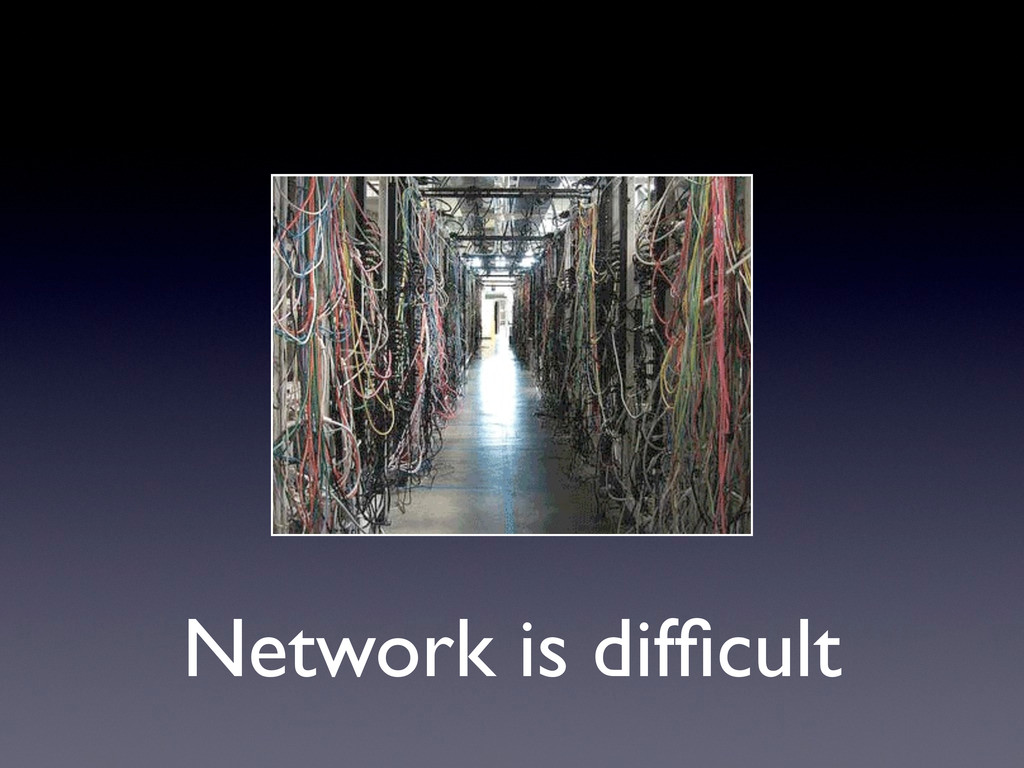
Network is difficult
Peer To Peer is difficult
Choix technologiques
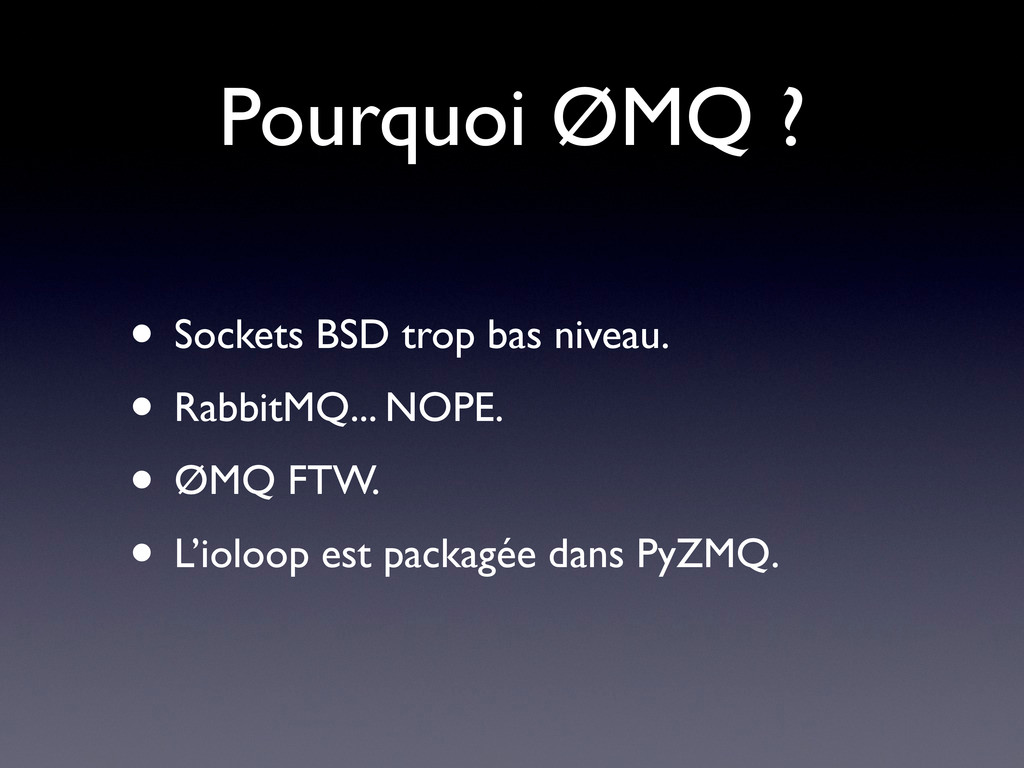
Pourquoi ØMQ ? • Sockets BSD trop bas niveau. •
RabbitMQ... NOPE. • ØMQ FTW. • L’ioloop est packagée dans PyZMQ.
AutoDiscovery UDP Multicast
Communication Unicast / Multicast ZeroMQ
Découverte des pertes Heartbeating (to do)
None
Retour d’expérience
L’asynchrone c’est difficile
Tester de l’asynchrone c’est douloureux
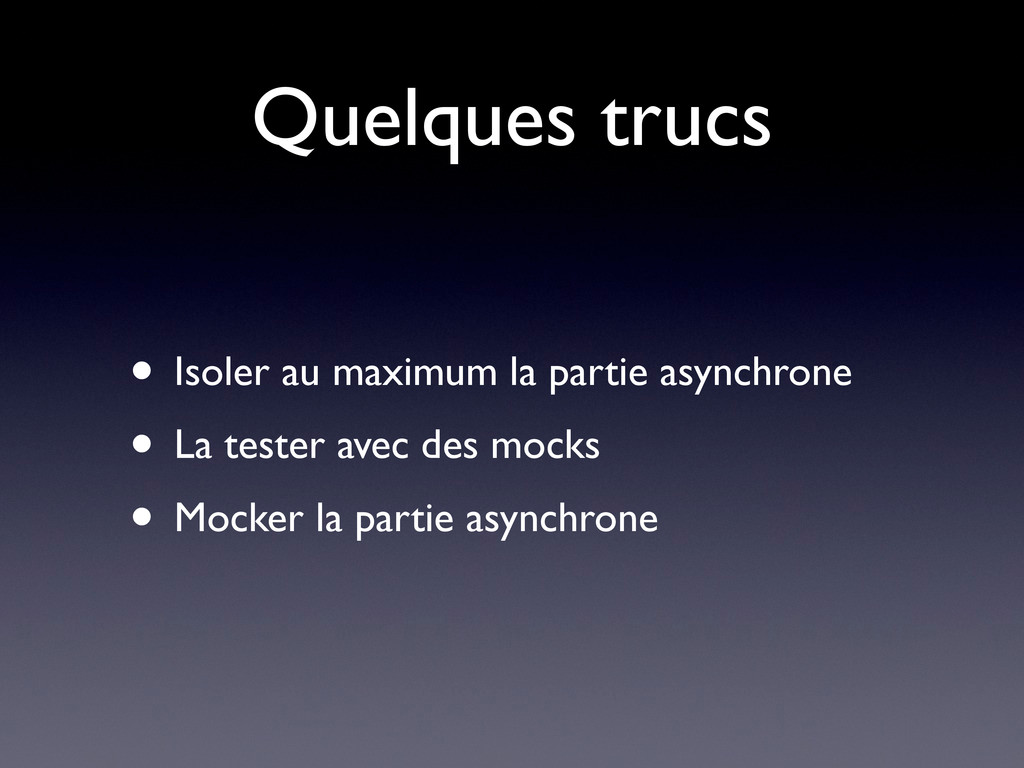
Quelques trucs • Isoler au maximum la partie asynchrone •
La tester avec des mocks • Mocker la partie asynchrone
Exemple class ZeroMQMediumTestCase(unittest.TestCase): def setUp(self): self.service = ServiceMock() self.ioloop =
IOLoop.instance() self.medium = ZeroMQMedium(self.service, ioloop=self.ioloop) def testRegister(self): self.medium.register() self.ioloop.start() self.assertEqual(self.service.on_registration_message.call_count, 1)
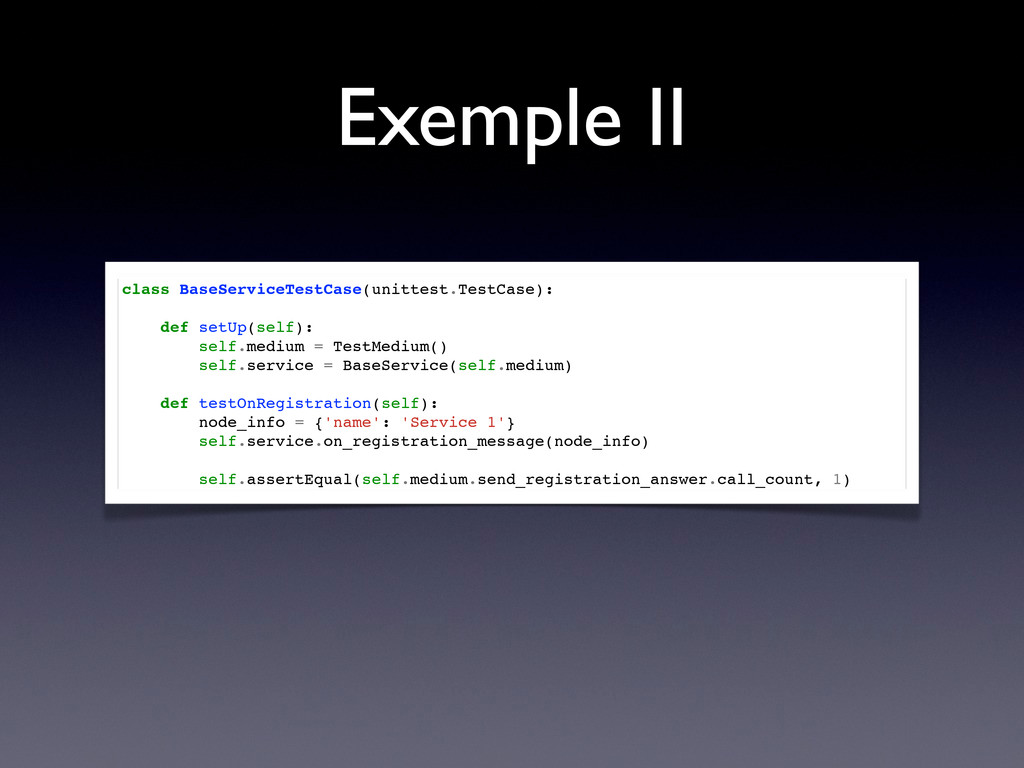
Exemple II class BaseServiceTestCase(unittest.TestCase): def setUp(self): self.medium = TestMedium() self.service
= BaseService(self.medium) def testOnRegistration(self): node_info = {'name': 'Service 1'} self.service.on_registration_message(node_info) self.assertEqual(self.medium.send_registration_answer.call_count, 1)
Les topologies réseaux est hétérogène
Vous allez toujours avoir des topologies de réseau tordues
Au choix • Firewall • NAT • VPN • DMZ
• Pas d’UDP Multicast
None
Traitez les quand ils arrivent
Pas de solutions magiques en P2P
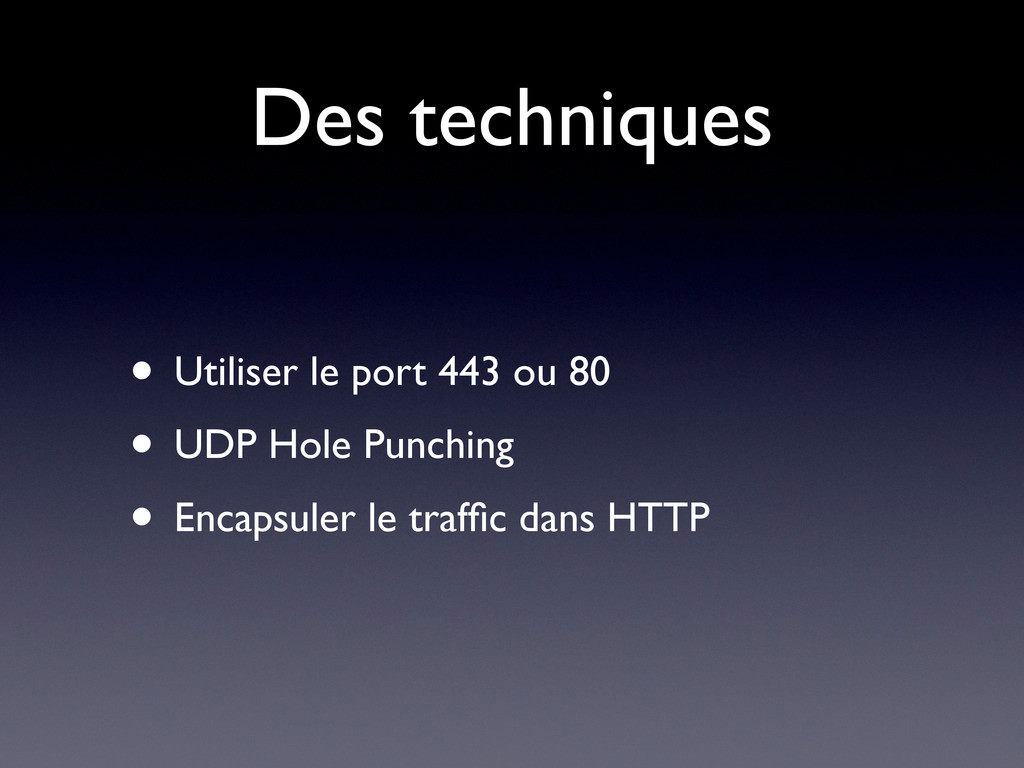
Des techniques • Utiliser le port 443 ou 80 •
UDP Hole Punching • Encapsuler le traffic dans HTTP
Une solution ? • Avoir un pair central • Qui
forward le traffic
ZeroService is not perfect • Pas d’ack pour les messages
• Pas d’heartbeat • Une socket par message sortant • UDP Multicast / ZeroConf • Marche en LAN. Pas en WAN.
Exemple
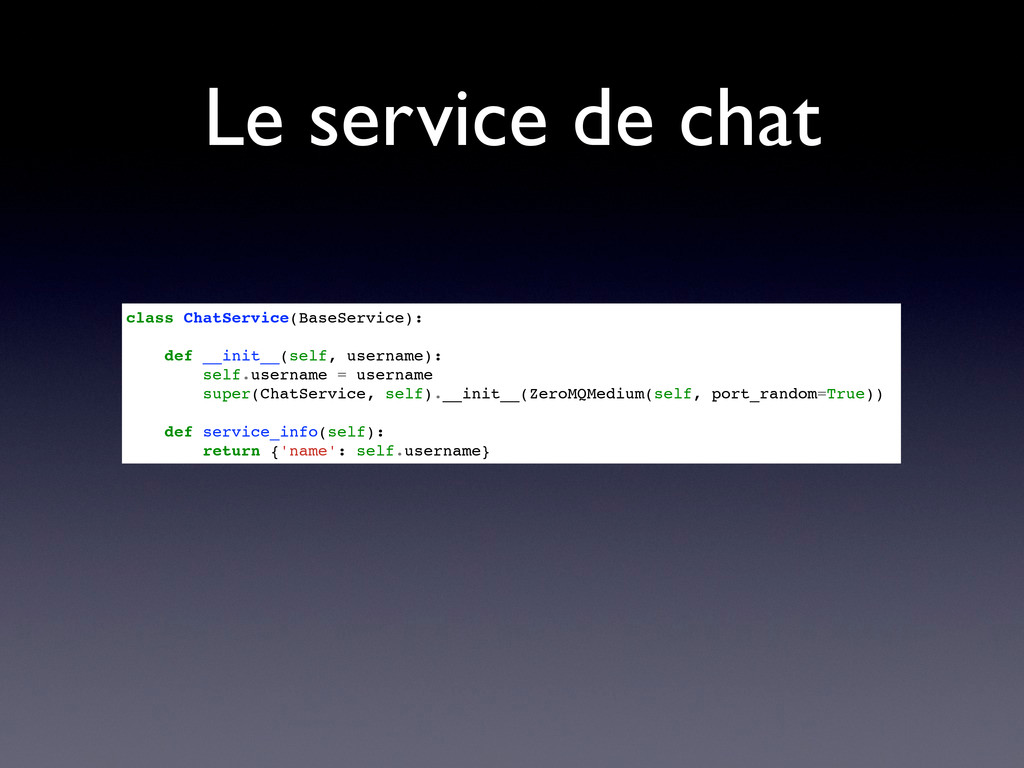
Le service de chat class ChatService(BaseService): def __init__(self, username): self.username
= username super(ChatService, self).__init__(ZeroMQMedium(self, port_random=True)) def service_info(self): return {'name': self.username}
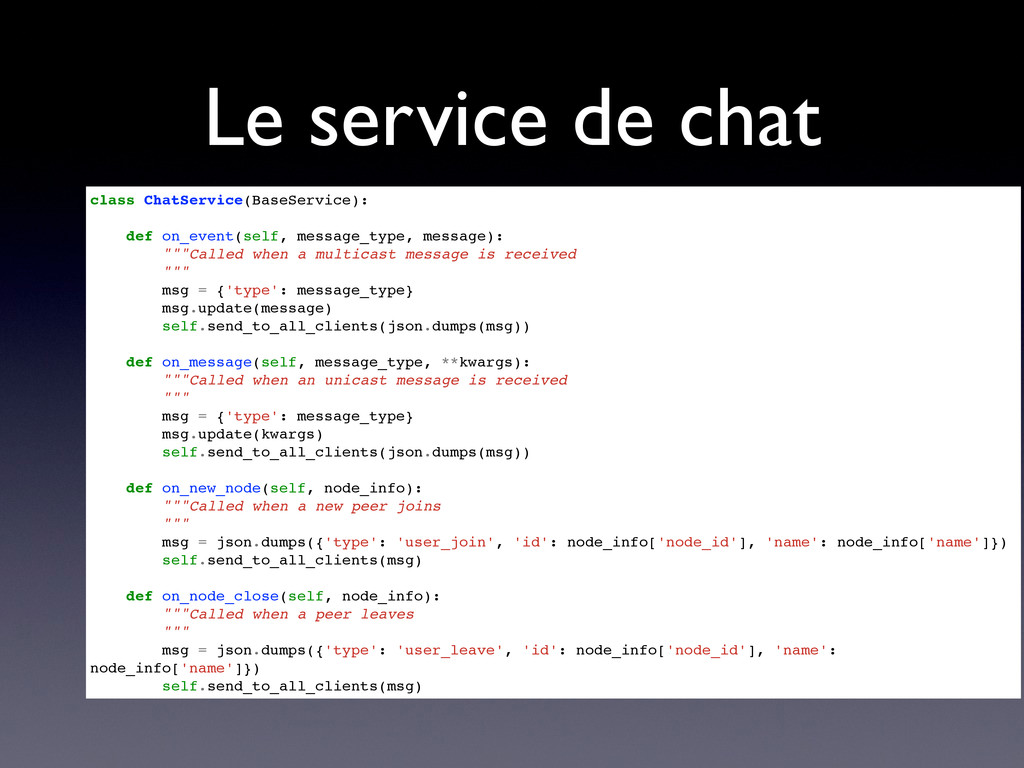
Le service de chat class ChatService(BaseService): def on_event(self, message_type, message):
"""Called when a multicast message is received """ msg = {'type': message_type} msg.update(message) self.send_to_all_clients(json.dumps(msg)) def on_message(self, message_type, **kwargs): """Called when an unicast message is received """ msg = {'type': message_type} msg.update(kwargs) self.send_to_all_clients(json.dumps(msg)) def on_new_node(self, node_info): """Called when a new peer joins """ msg = json.dumps({'type': 'user_join', 'id': node_info['node_id'], 'name': node_info['name']}) self.send_to_all_clients(msg) def on_node_close(self, node_info): """Called when a peer leaves """ msg = json.dumps({'type': 'user_leave', 'id': node_info['node_id'], 'name': node_info['name']}) self.send_to_all_clients(msg)
La partie Tornado class MainHandler(web.RequestHandler): def get(self): return self.render('chat.html', port=int(sys.argv[2]),
name=sys.argv[1])
La partie Tornado clients = [] class WebSocketHandler(websocket.WebSocketHandler): def open(self):
clients.append(self) for node_id, node in s.nodes_directory.items(): msg = json.dumps({'type': 'user_join', 'id': node_id, 'name': node['name']}) self.write_message(msg) def on_close(self): clients.remove(self) def on_message(self, message): message = json.loads(message) if message['type'] == 'message': msg = {'username': sys.argv[1], 'message': message['data']['message']} s.publish(str(message['type']), msg) elif message['type'] == 'direct_message': msg = {'from': sys.argv[1], 'message': message['data']['message']} s.send(message['data']['to'], msg, msg_type=str(message['type']))
Chat.py urls = [ (r"/", MainHandler), (r"/websocket", WebSocketHandler), (r"/static/(.*)", web.StaticFileHandler,
{"path": "."})] if __name__ == '__main__': application = web.Application(urls, debug=True) application.listen(int(sys.argv[2])) try: ioloop.IOLoop.instance().add_timeout(time() + 1, s.medium.register) ioloop.IOLoop.instance().start() except KeyboardInterrupt: s.close() for client in clients: client.close()
La demo chat • 69 lignes de python • Pas
de serveur central • API qui se veut simple
DEMO !
Questions ?


 lothiraldan
 h1d3mun3
 convto
 sts11142
 willnet
 j341nono
 kinopeee
 yukiny
 rkaga
rkaga
 seike460
 lx_t
lx_t
 irinanazarova
 yuukiw00w
 aleyda
 chriscoyier
 yeseniaperezcruz
 tammyeverts
 csswizardry
 baasie
 caitiem20
 geshan
 shpigford
 jnunemaker
 lfama
lfama
 inesmontani
![ZeroServices FELD Boris - PyconFR 2013 [email protected]](https://files.speakerdeck.com/presentations/b8e430f0214501318aa2268d587fce64/slide_0.jpg)














![La partie Tornado class MainHandler(web.RequestHandler): def get(self): return self.render('chat.html', port=int(sys.argv[2]),](https://files.speakerdeck.com/presentations/b8e430f0214501318aa2268d587fce64/slide_31.jpg)
![La partie Tornado clients = [] class WebSocketHandler(websocket.WebSocketHandler): def open(self):](https://files.speakerdeck.com/presentations/b8e430f0214501318aa2268d587fce64/slide_32.jpg)