Upgrade to Pro — share decks privately, control downloads, hide ads and more …

Mapping ISO 27001 to Modern Software Engineerin...

Mapping ISO 27001 to Modern Software Engineering: Secure by Design #JavaCro25

Security is no longer optional - it’s a core pillar of software engineering. ISO 27001 certification is essential for building trust, minimising risks, and ensuring compliance. This talk explores its significance for software companies, focusing on clause A.8 and secure development practices.

We’ll map ISO 27001 controls to a modern SDLC, showing how they align with agile and DevOps. Practical tools like static analysis, dependency scanners, and automated checks will be covered, along with strategies for integrating OWASP SAMM to continuously assess and enhance security. Learn how to embed security seamlessly into your development workflow.

Avatar for M.-Leander Reimer

M.-Leander Reimer PRO

October 13, 2025
Tweet

More Decks by M.-Leander Reimer

Other Decks in Programming

Transcript

  1. qaware.de Mapping ISO 27001 to Software Engineering: Secure by Design

    Mario-Leander Reimer [email protected] @LeanderReimer @qaware #CloudNativeNerd #gerneperdude
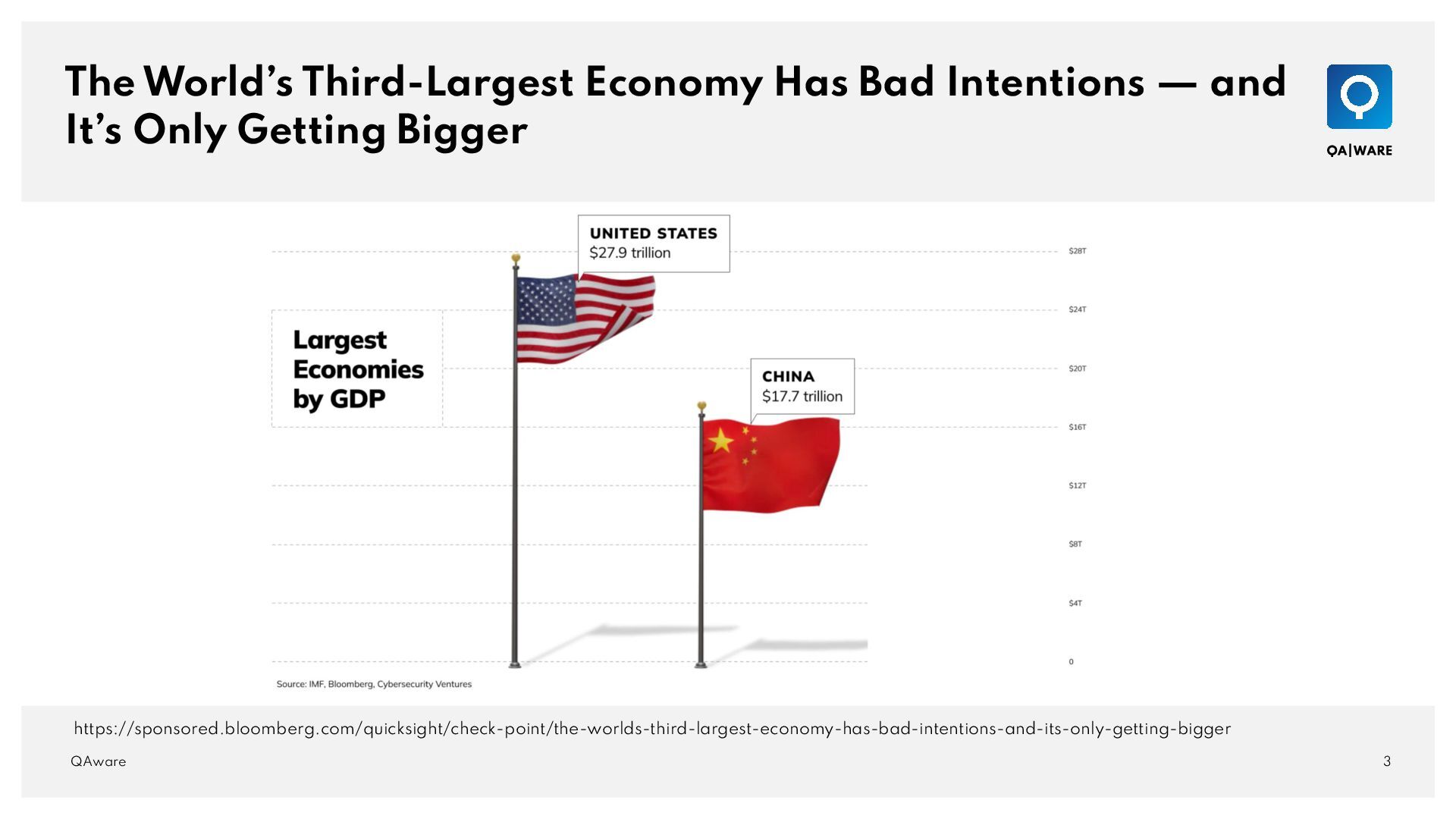
  2. The World’s Third-Largest Economy Has Bad Intentions — and It’s

    Only Getting Bigger 3 QAware https://sponsored.bloomberg.com/quicksight/check-point/the-worlds-third-largest-economy-has-bad-intentions-and-its-only-getting-bigger
  3. 4

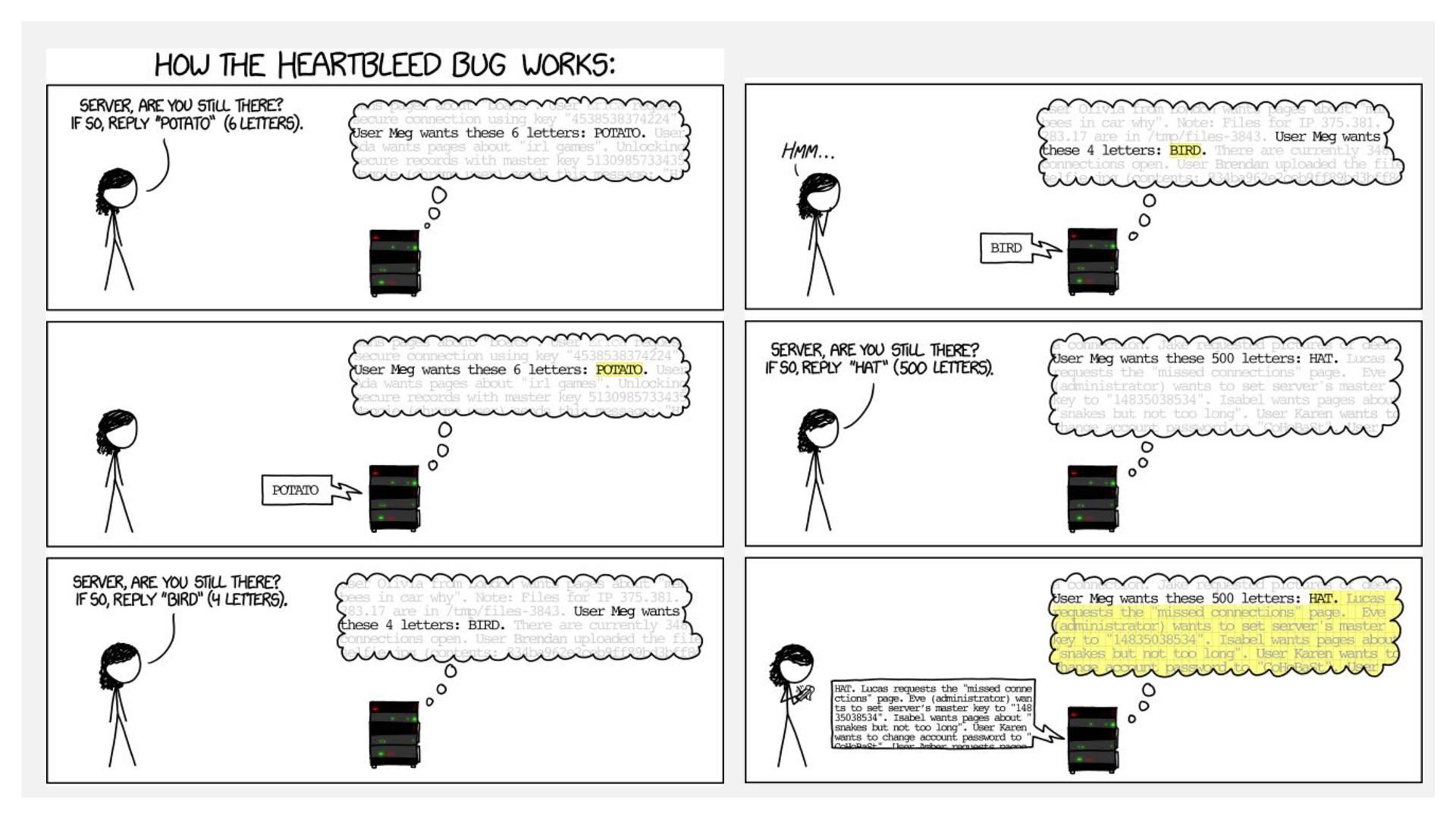
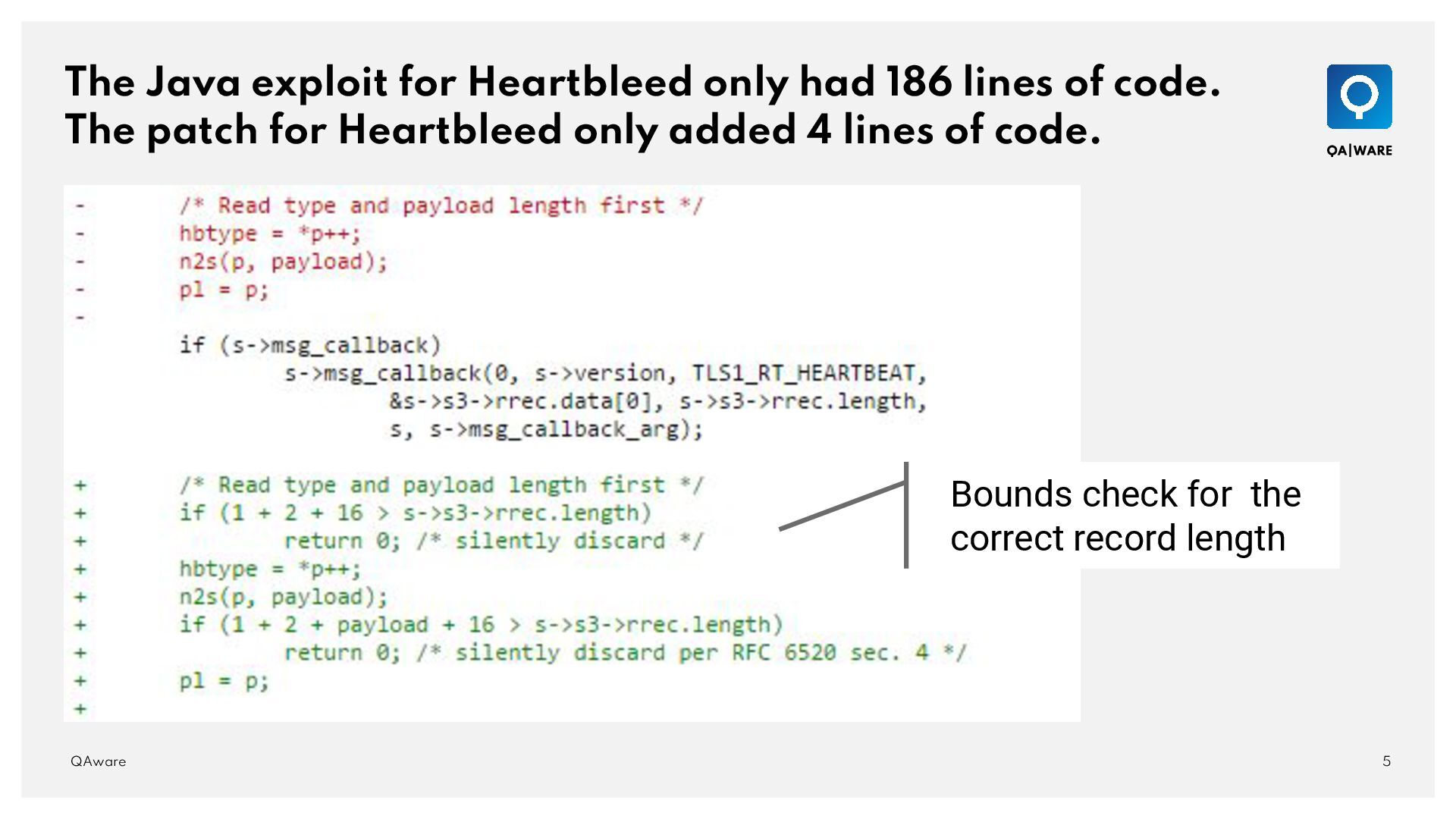
  4. The Java exploit for Heartbleed only had 186 lines of

    code. The patch for Heartbleed only added 4 lines of code. 5 QAware Bounds check for the correct record length
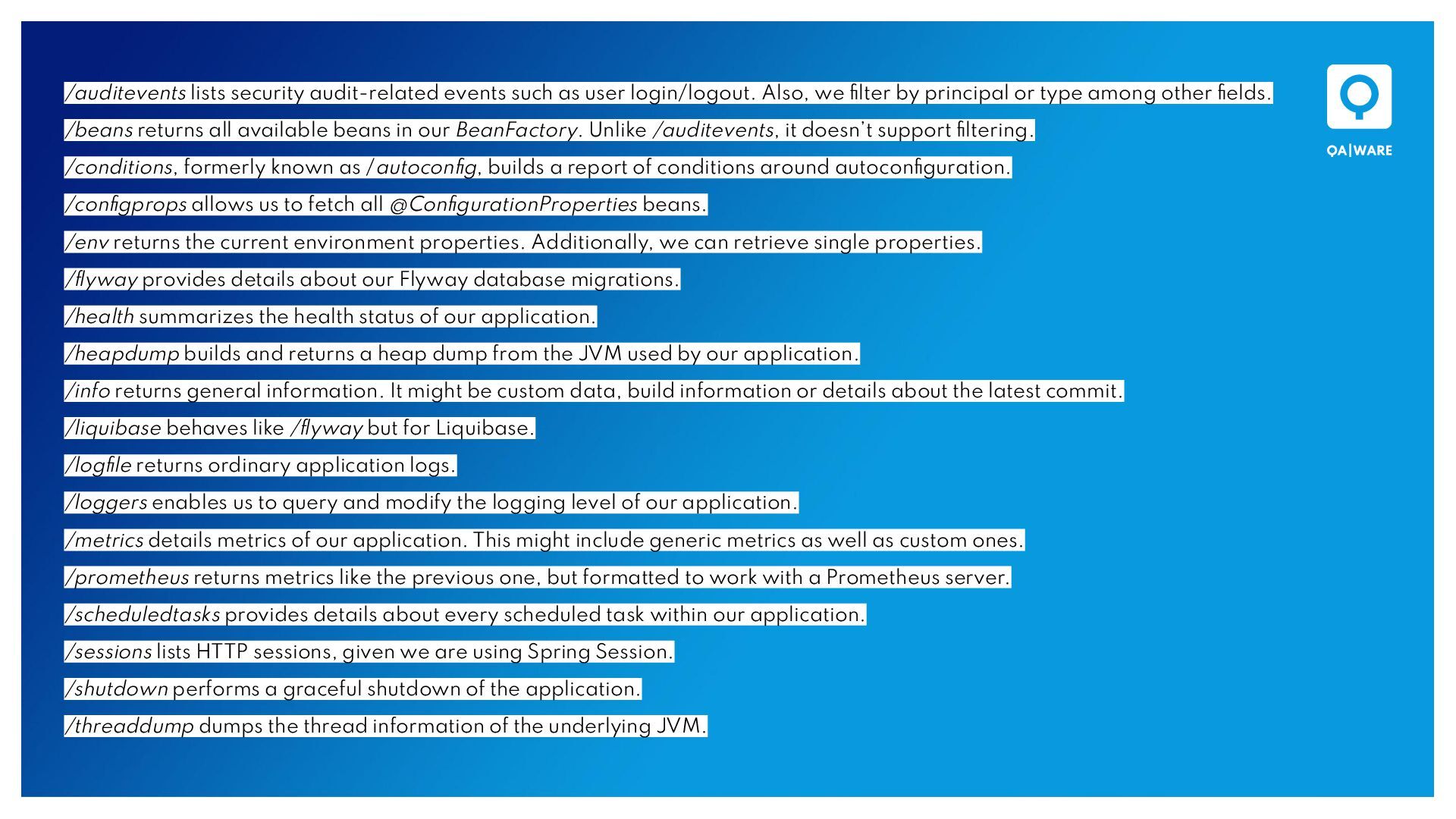
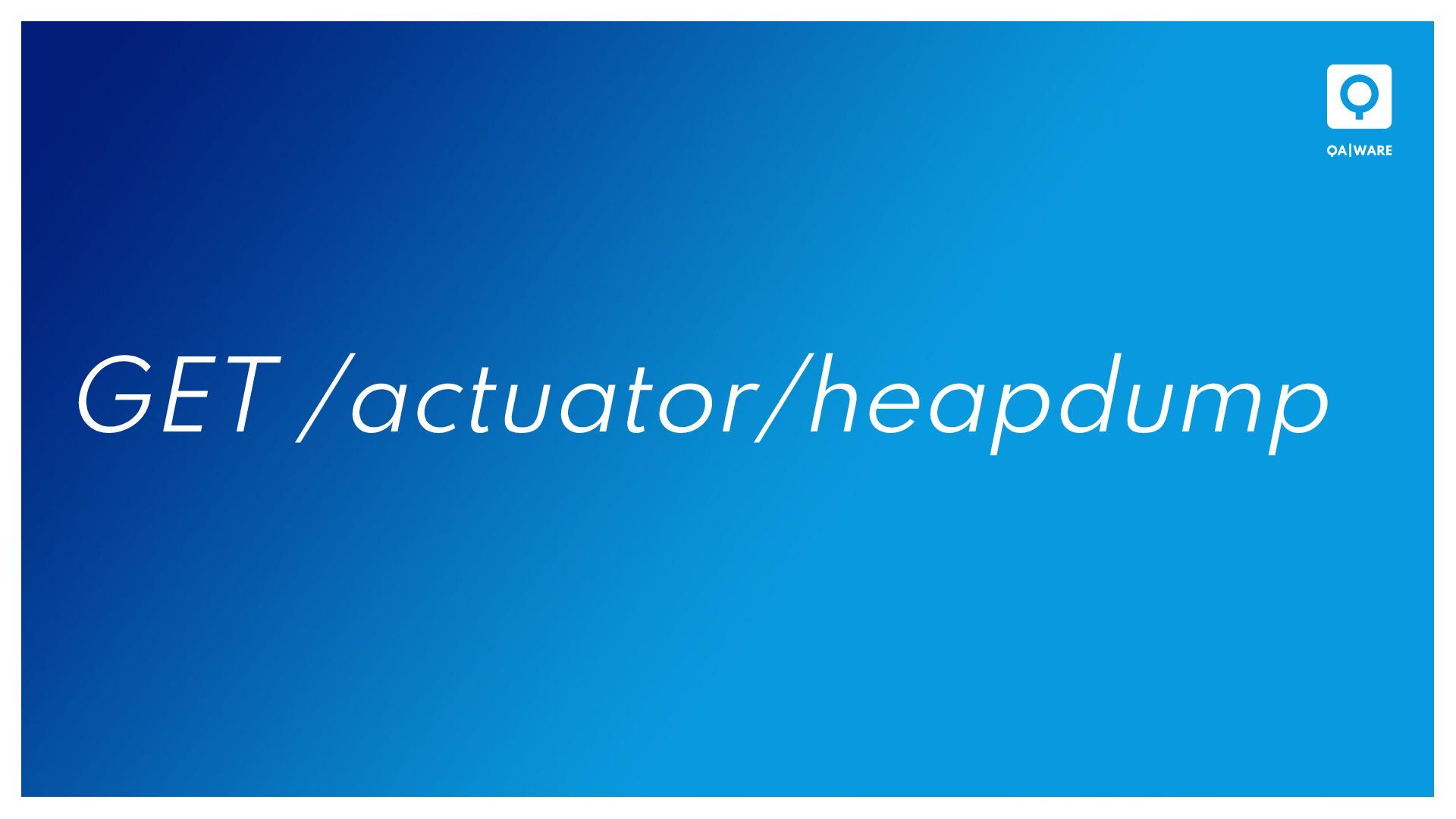
  5. /auditevents lists security audit-related events such as user login/logout. Also,

    we filter by principal or type among other fields. /beans returns all available beans in our BeanFactory. Unlike /auditevents, it doesn’t support filtering. /conditions, formerly known as /autoconfig, builds a report of conditions around autoconfiguration. /configprops allows us to fetch all @ConfigurationProperties beans. /env returns the current environment properties. Additionally, we can retrieve single properties. /flyway provides details about our Flyway database migrations. /health summarizes the health status of our application. /heapdump builds and returns a heap dump from the JVM used by our application. /info returns general information. It might be custom data, build information or details about the latest commit. /liquibase behaves like /flyway but for Liquibase. /logfile returns ordinary application logs. /loggers enables us to query and modify the logging level of our application. /metrics details metrics of our application. This might include generic metrics as well as custom ones. /prometheus returns metrics like the previous one, but formatted to work with a Prometheus server. /scheduledtasks provides details about every scheduled task within our application. /sessions lists HTTP sessions, given we are using Spring Session. /shutdown performs a graceful shutdown of the application. /threaddump dumps the thread information of the underlying JVM.
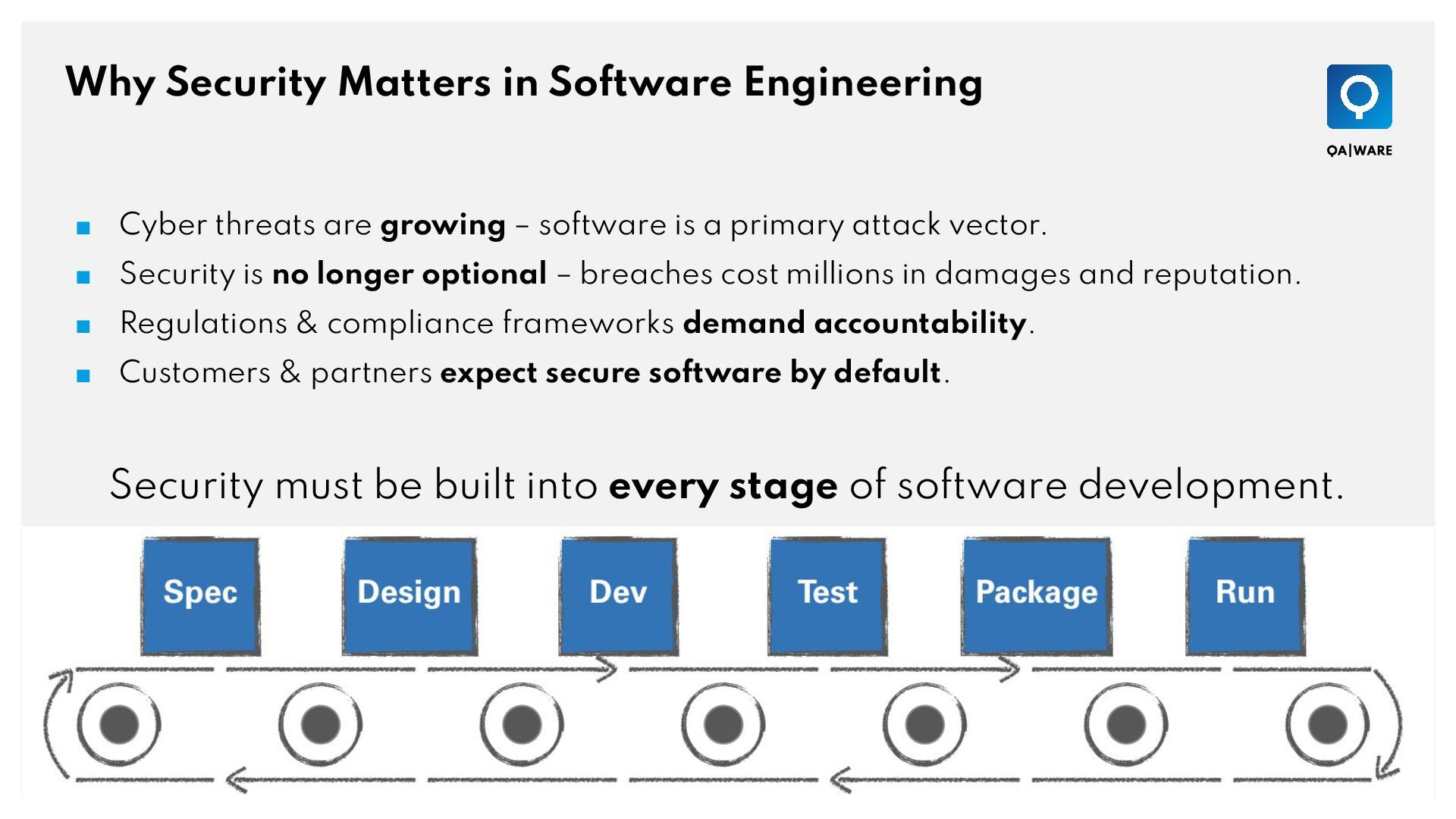
  6. Why Security Matters in Software Engineering ▪ Cyber threats are

    growing – software is a primary attack vector. ▪ Security is no longer optional – breaches cost millions in damages and reputation. ▪ Regulations & compliance frameworks demand accountability. ▪ Customers & partners expect secure software by default. 12 QAware Security must be built into every stage of software development.
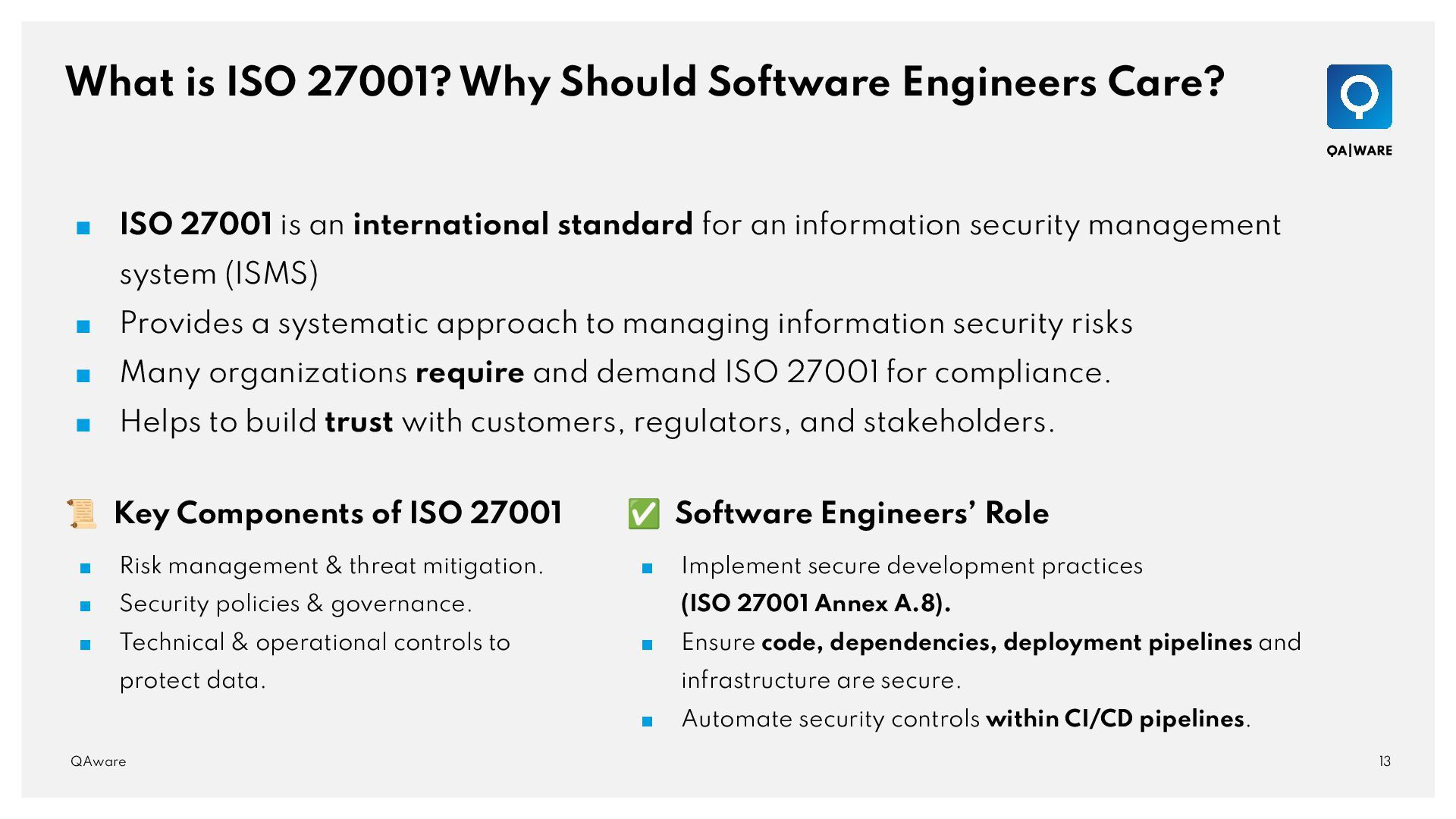
  7. What is ISO 27001? Why Should Software Engineers Care? ▪

    ISO 27001 is an international standard for an information security management system (ISMS) ▪ Provides a systematic approach to managing information security risks ▪ Many organizations require and demand ISO 27001 for compliance. ▪ Helps to build trust with customers, regulators, and stakeholders. 13 QAware 📜 Key Components of ISO 27001 ▪ Risk management & threat mitigation. ▪ Security policies & governance. ▪ Technical & operational controls to protect data. ✅ Software Engineers’ Role ▪ Implement secure development practices (ISO 27001 Annex A.8). ▪ Ensure code, dependencies, deployment pipelines and infrastructure are secure. ▪ Automate security controls within CI/CD pipelines.
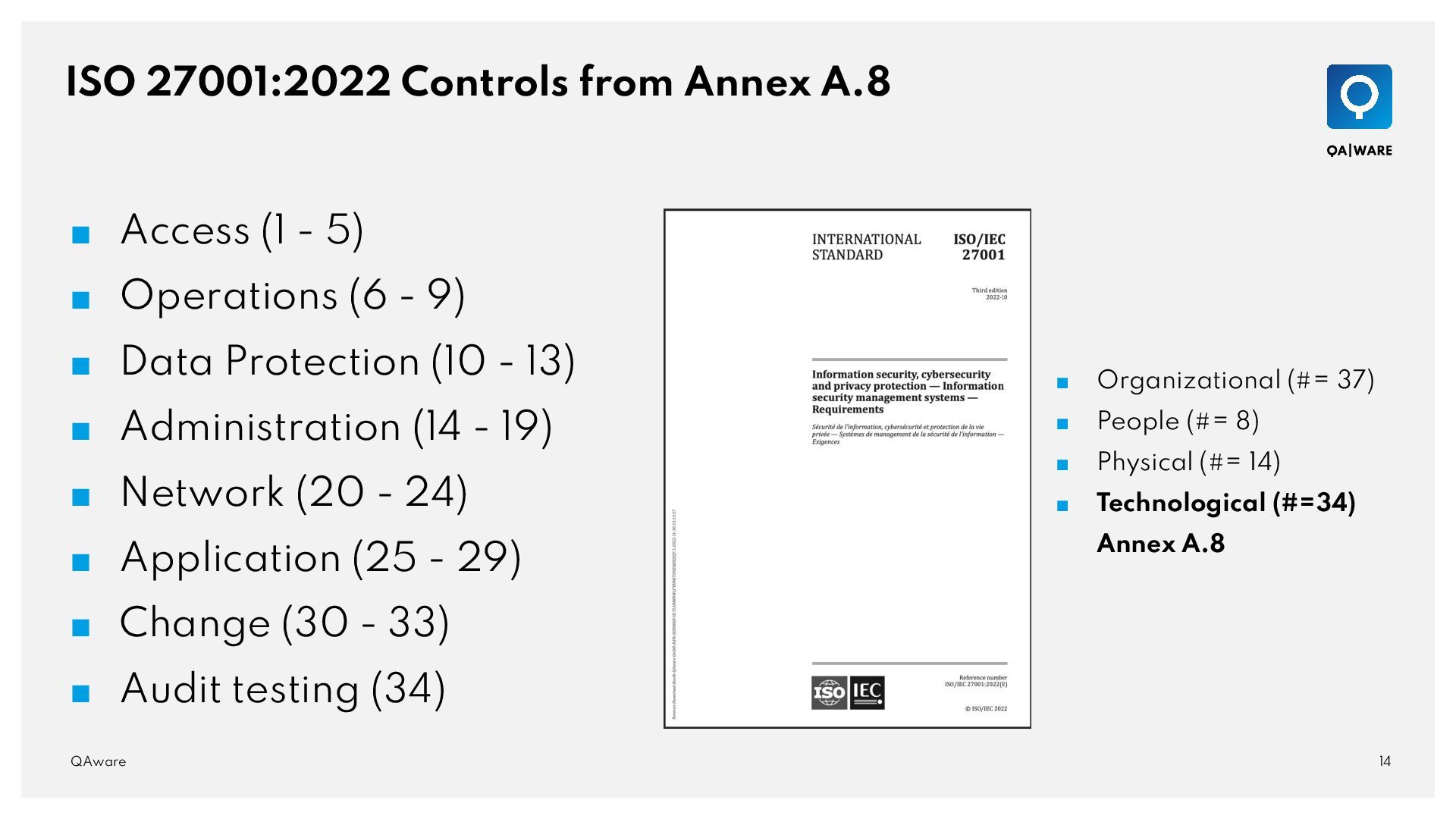
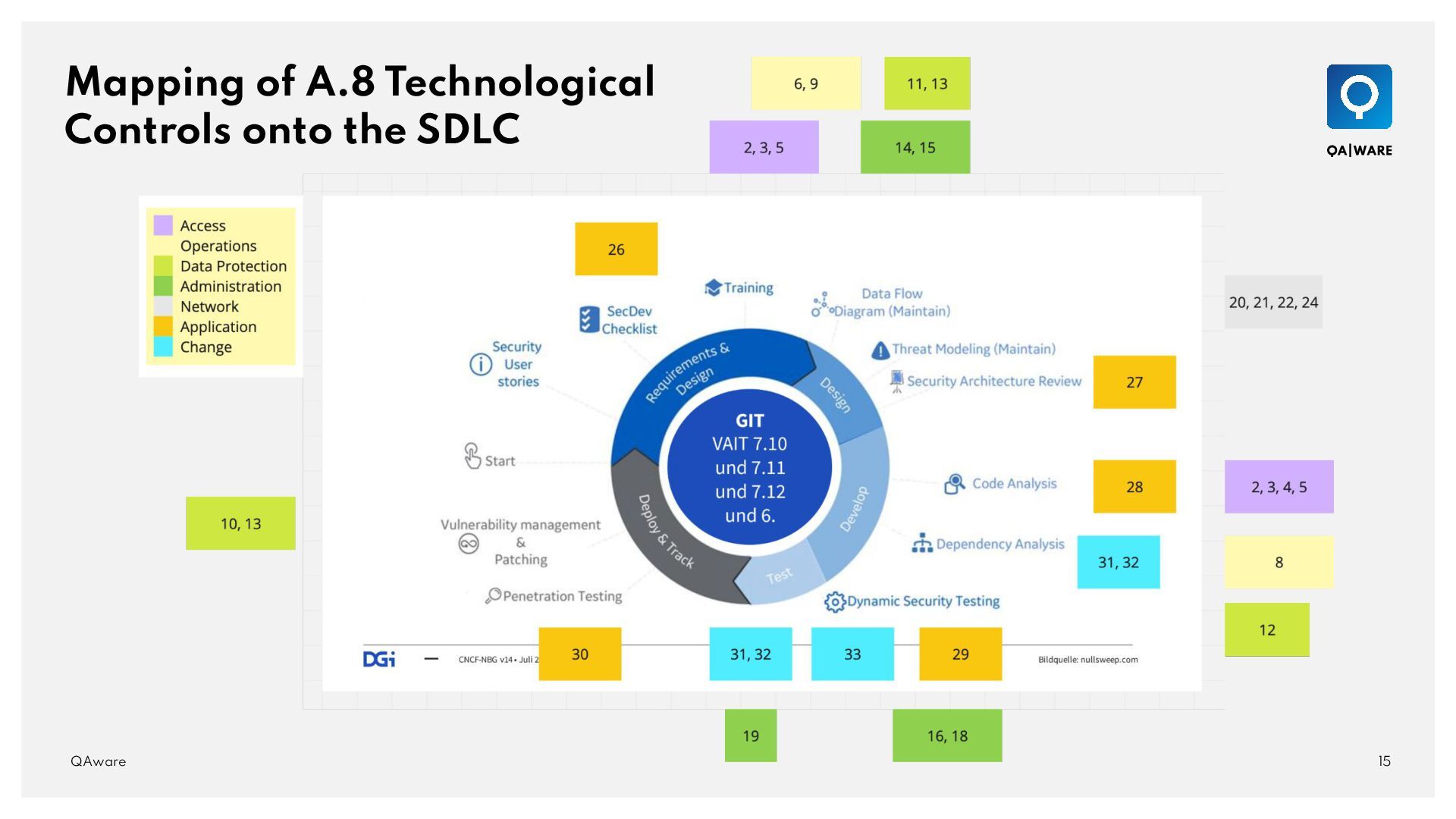
  8. ISO 27001:2022 Controls from Annex A.8 14 QAware ▪ Access

    (1 - 5) ▪ Operations (6 - 9) ▪ Data Protection (10 - 13) ▪ Administration (14 - 19) ▪ Network (20 - 24) ▪ Application (25 - 29) ▪ Change (30 - 33) ▪ Audit testing (34) ▪ Organizational (#= 37) ▪ People (#= 8) ▪ Physical (#= 14) ▪ Technological (#=34) Annex A.8
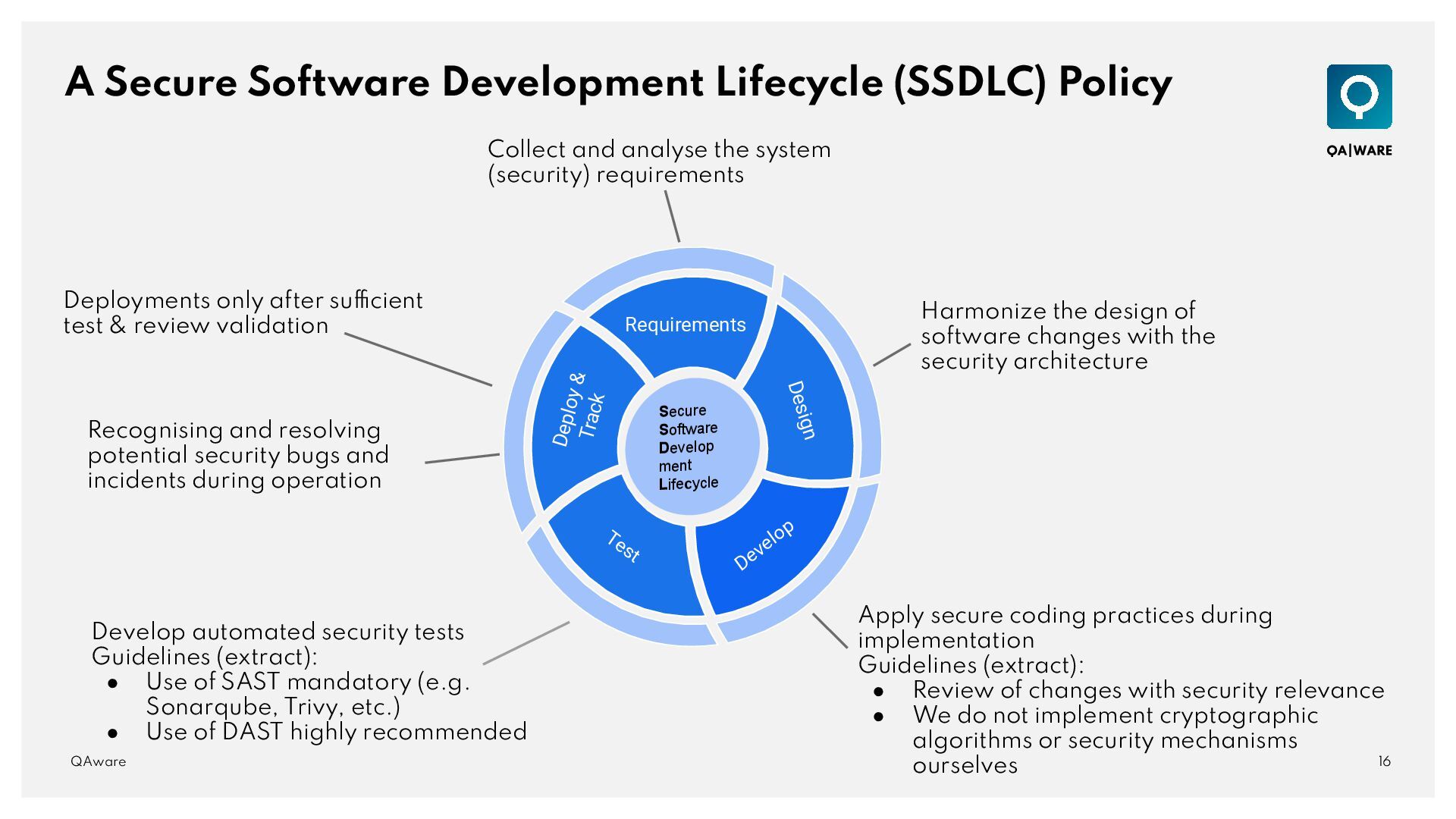
  9. A Secure Software Development Lifecycle (SSDLC) Policy 16 QAware Secure

    Software Develop ment Lifecycle Deploy & Track Test Develop Design Requirements Harmonize the design of software changes with the security architecture Develop automated security tests Guidelines (extract): • Use of SAST mandatory (e.g. Sonarqube, Trivy, etc.) • Use of DAST highly recommended Apply secure coding practices during implementation Guidelines (extract): • Review of changes with security relevance • We do not implement cryptographic algorithms or security mechanisms ourselves Deployments only after sufficient test & review validation Collect and analyse the system (security) requirements Recognising and resolving potential security bugs and incidents during operation
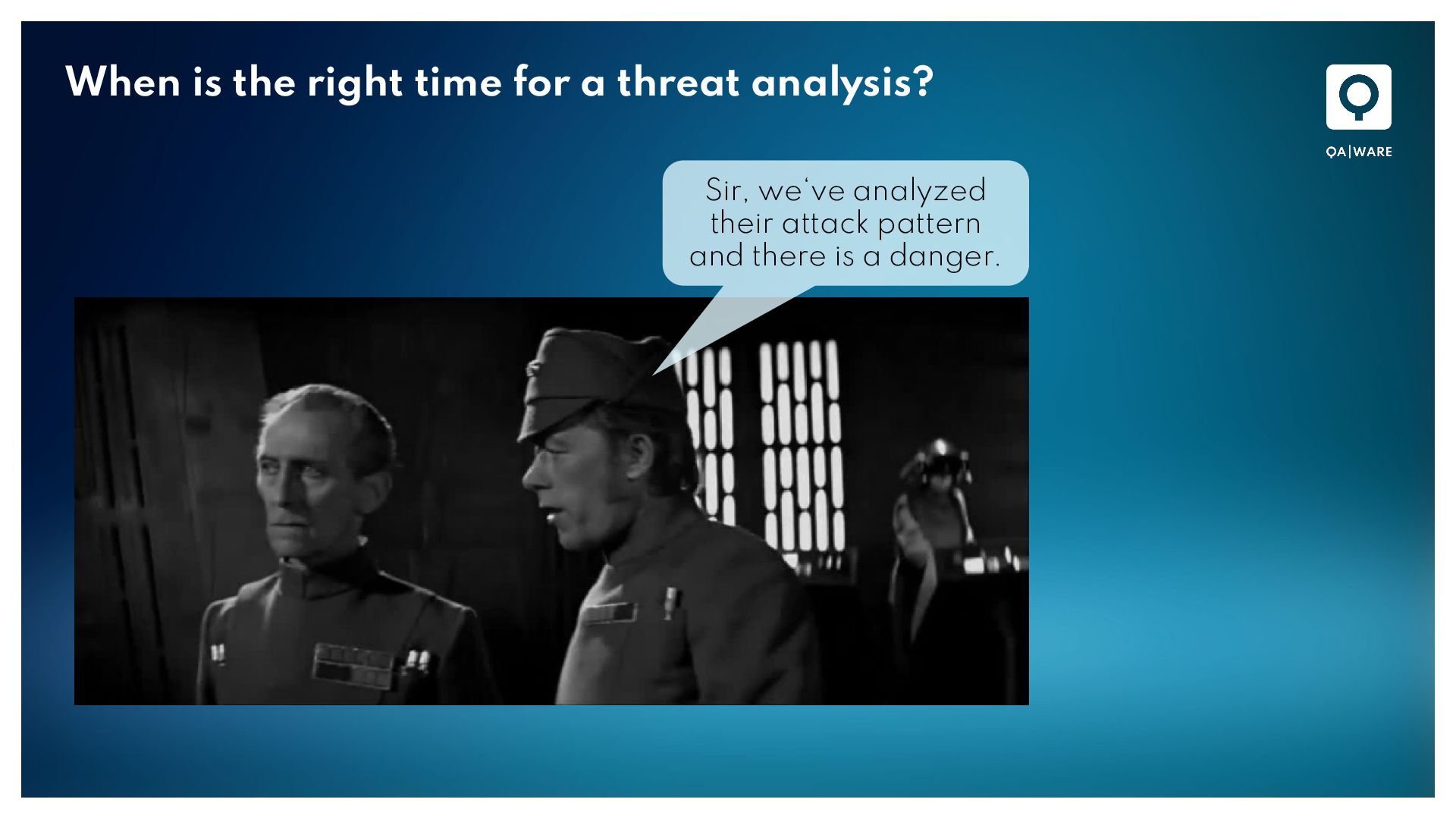
  10. When is the right time for a threat analysis? Sir,

    we‘ve analyzed their attack pattern and there is a danger.
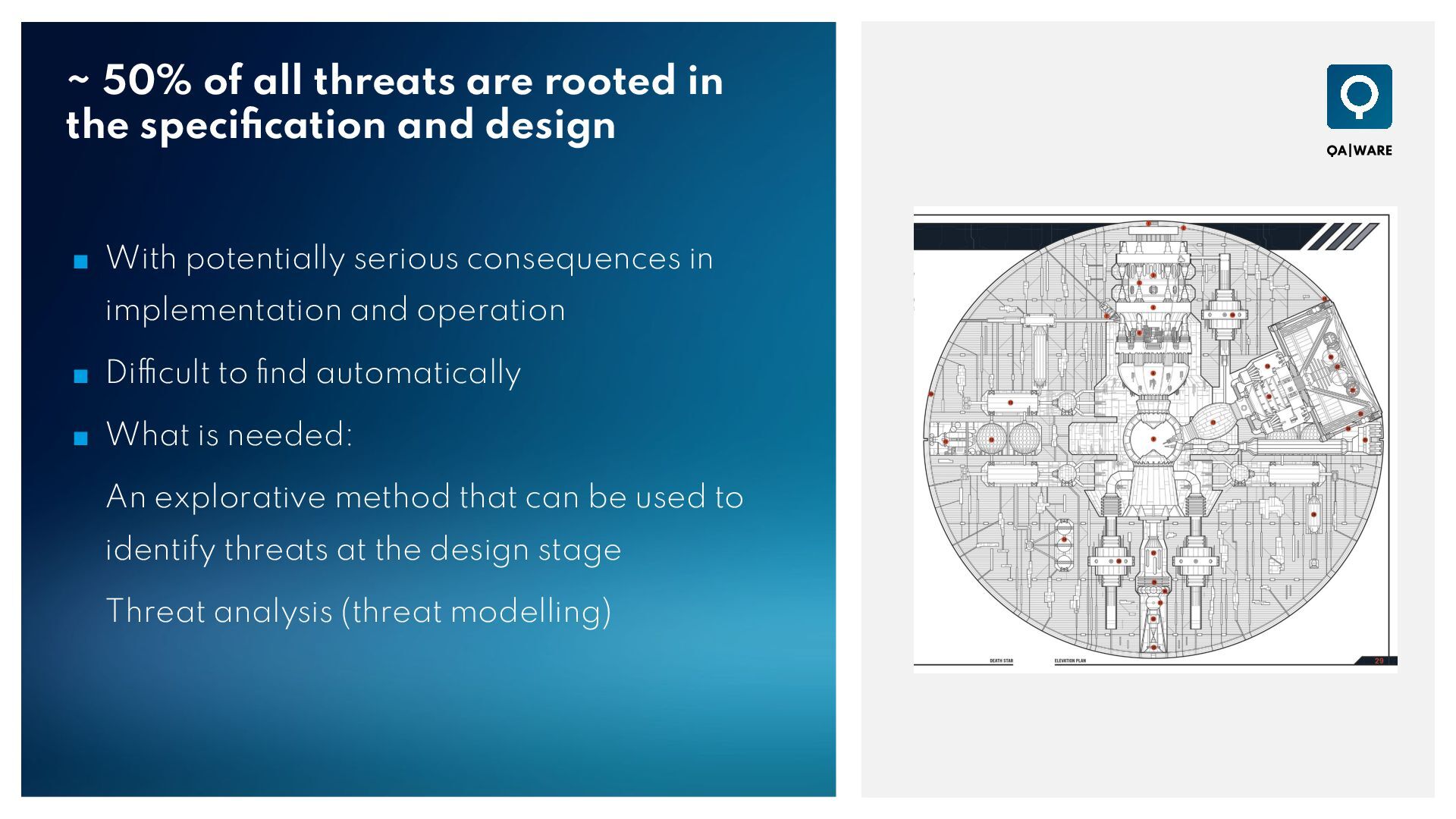
  11. ~ 50% of all threats are rooted in the specification

    and design ▪ With potentially serious consequences in implementation and operation ▪ Difficult to find automatically ▪ What is needed: An explorative method that can be used to identify threats at the design stage Threat analysis (threat modelling)
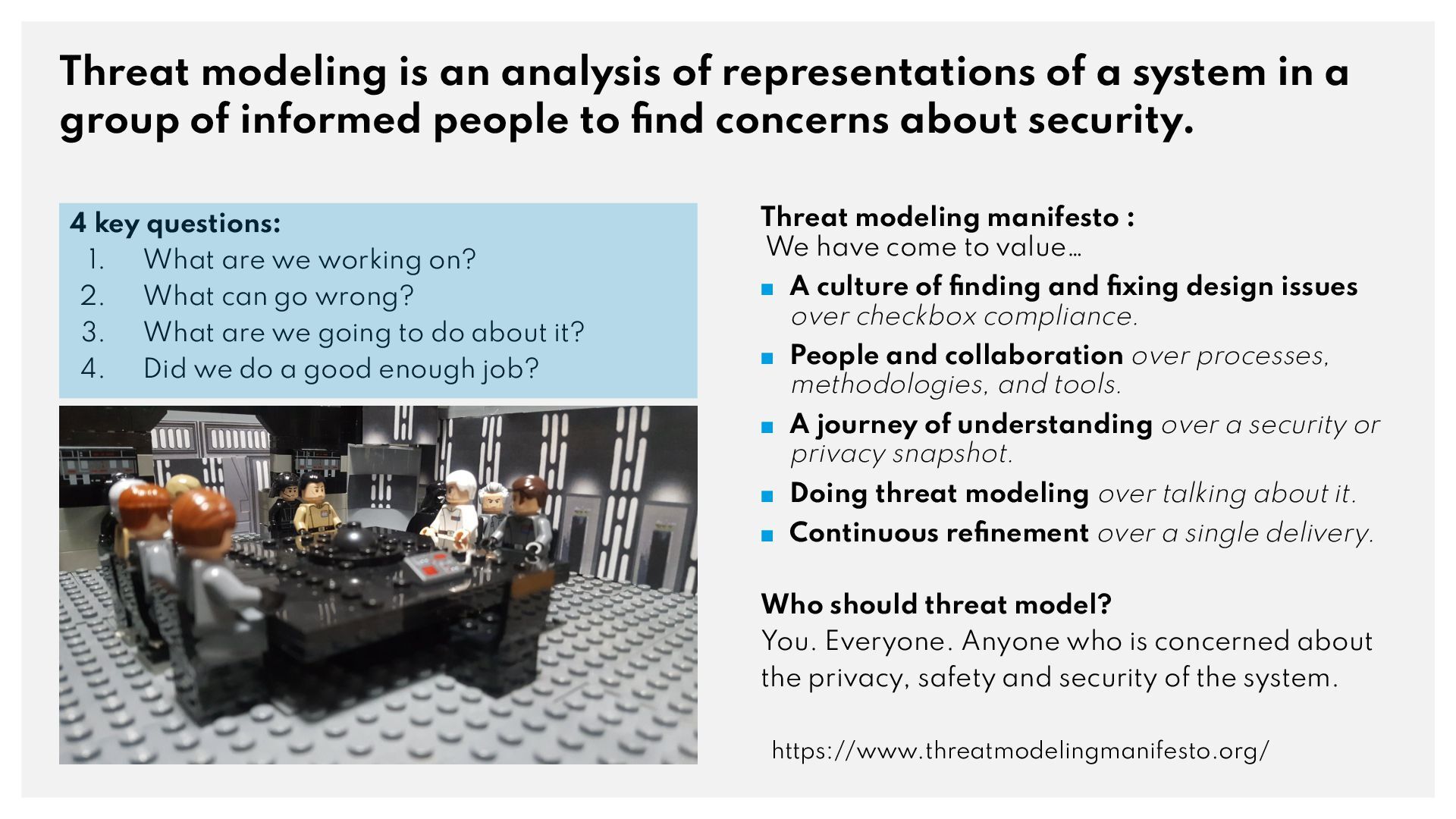
  12. Threat modeling is an analysis of representations of a system

    in a group of informed people to find concerns about security. 4 key questions: 1. What are we working on? 2. What can go wrong? 3. What are we going to do about it? 4. Did we do a good enough job? Threat modeling manifesto : We have come to value… ▪ A culture of finding and fixing design issues over checkbox compliance. ▪ People and collaboration over processes, methodologies, and tools. ▪ A journey of understanding over a security or privacy snapshot. ▪ Doing threat modeling over talking about it. ▪ Continuous refinement over a single delivery. Who should threat model? You. Everyone. Anyone who is concerned about the privacy, safety and security of the system. https://www.threatmodelingmanifesto.org/
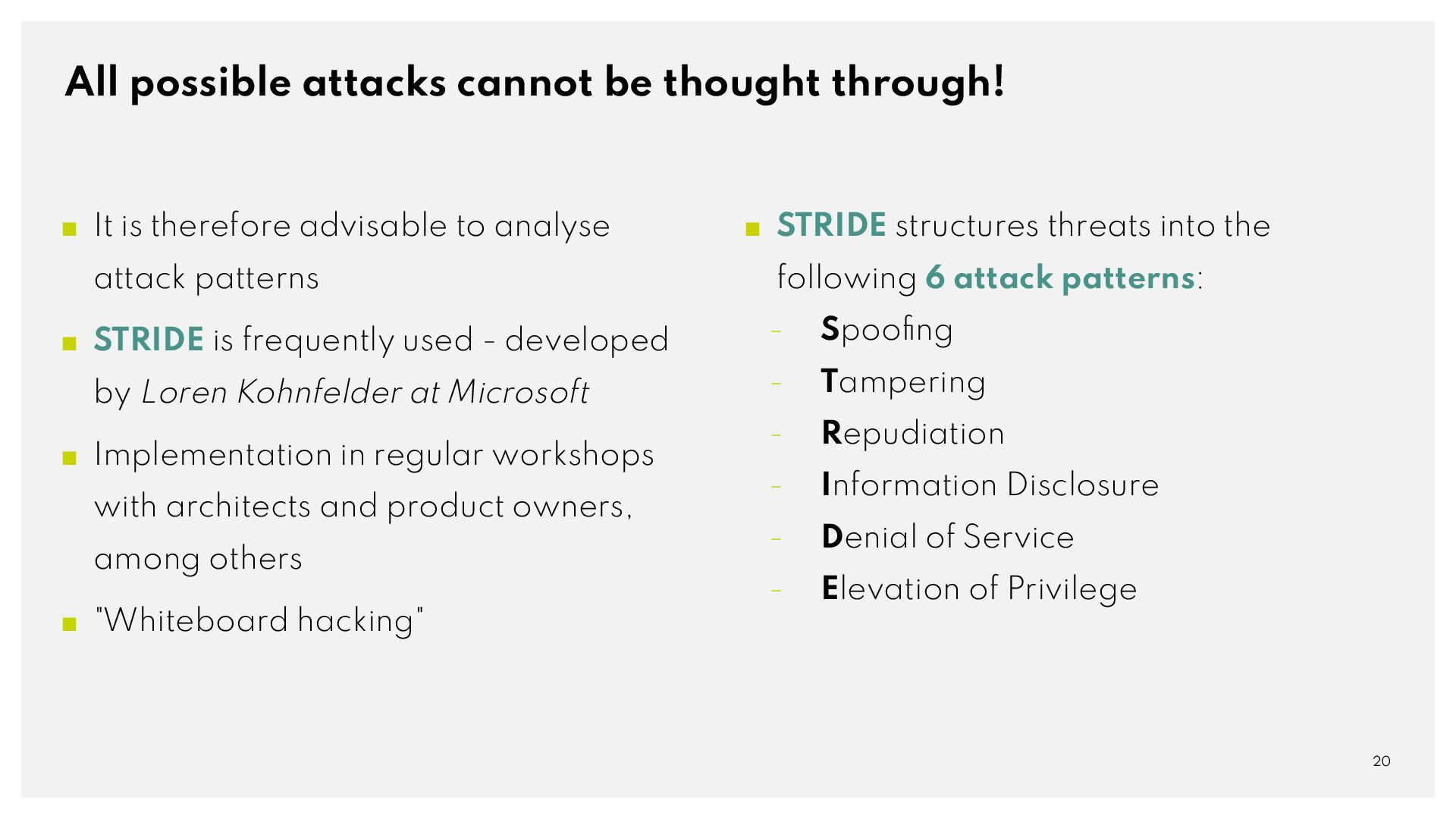
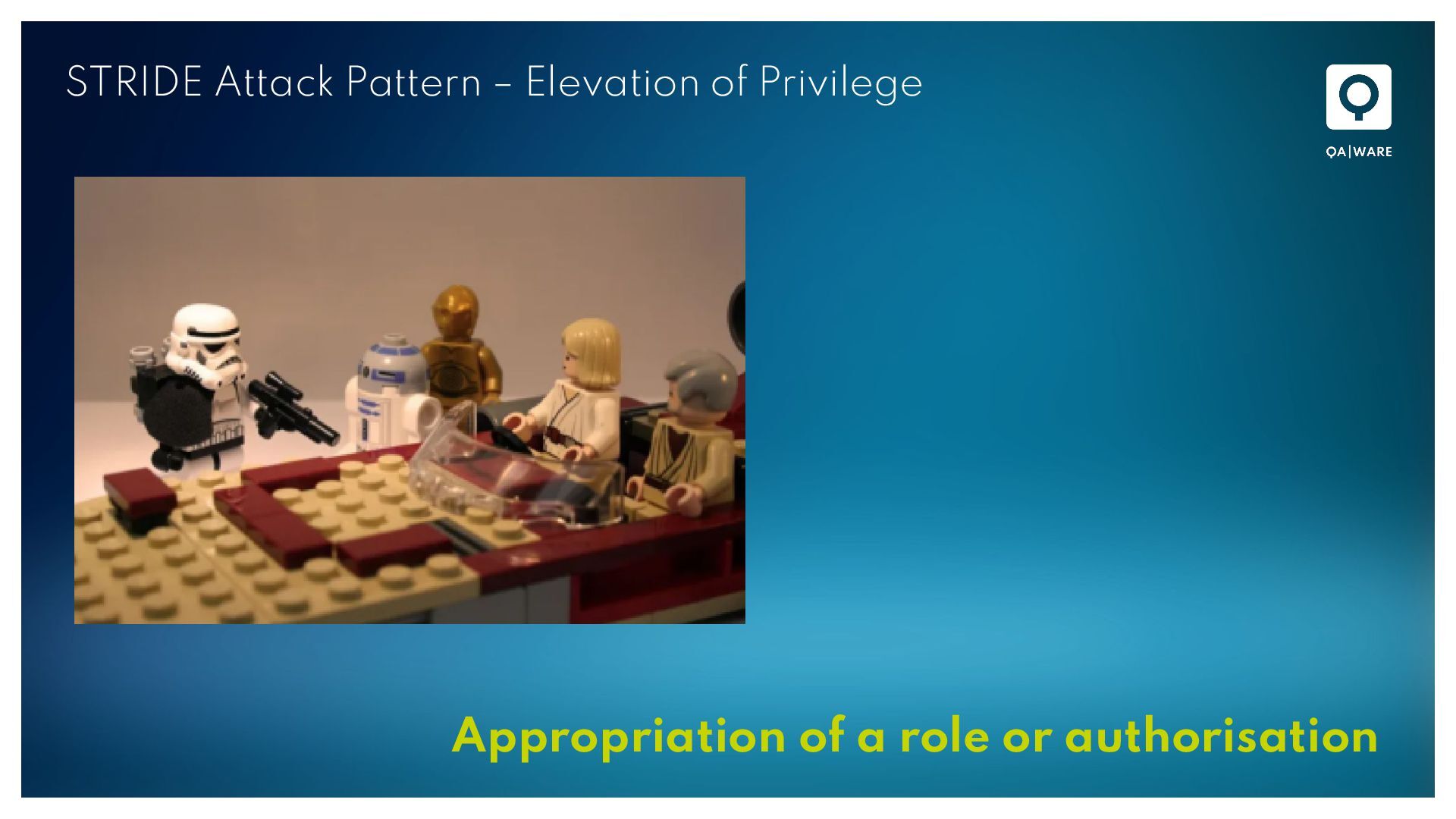
  13. 20 ▪ It is therefore advisable to analyse attack patterns

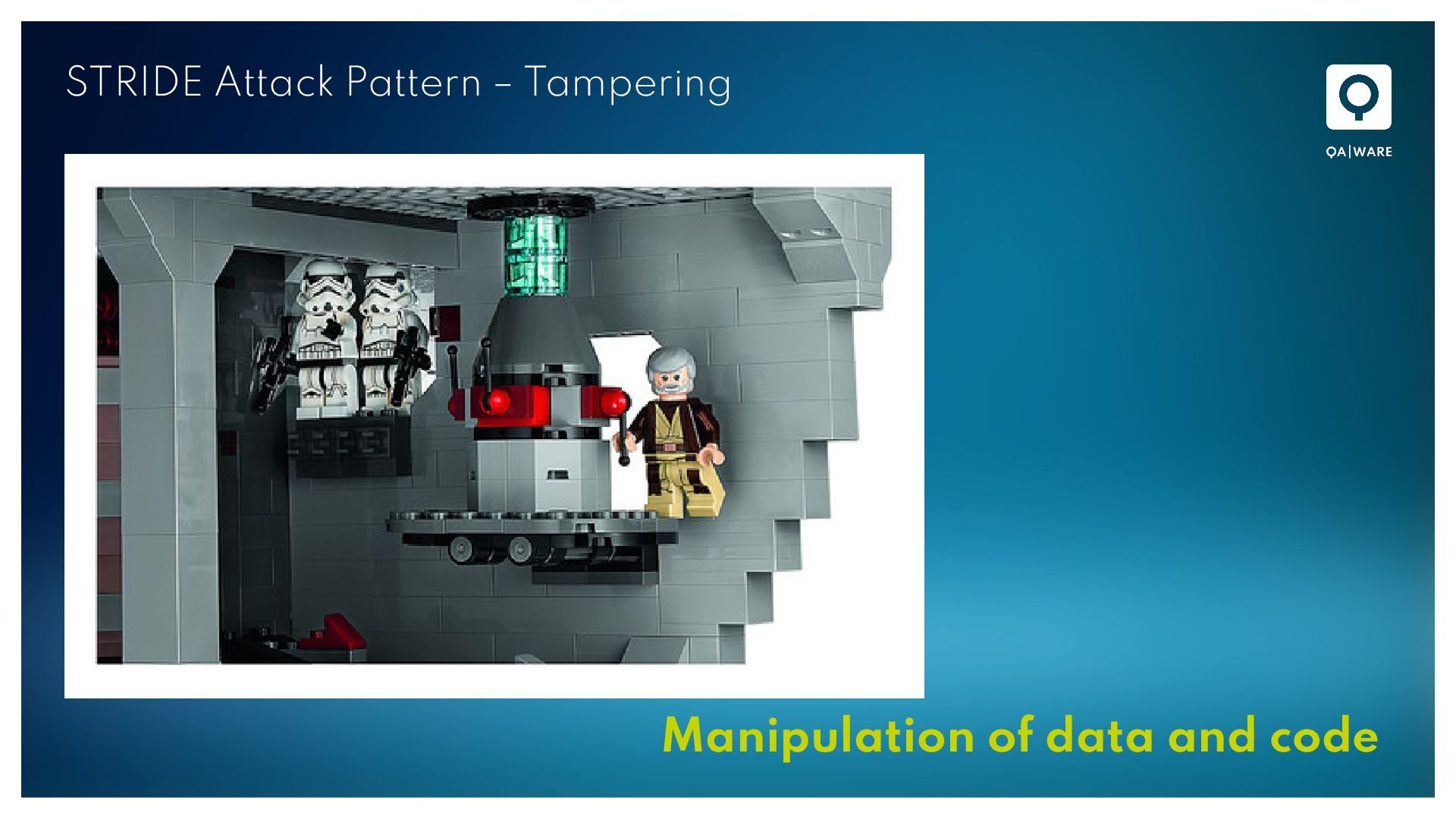
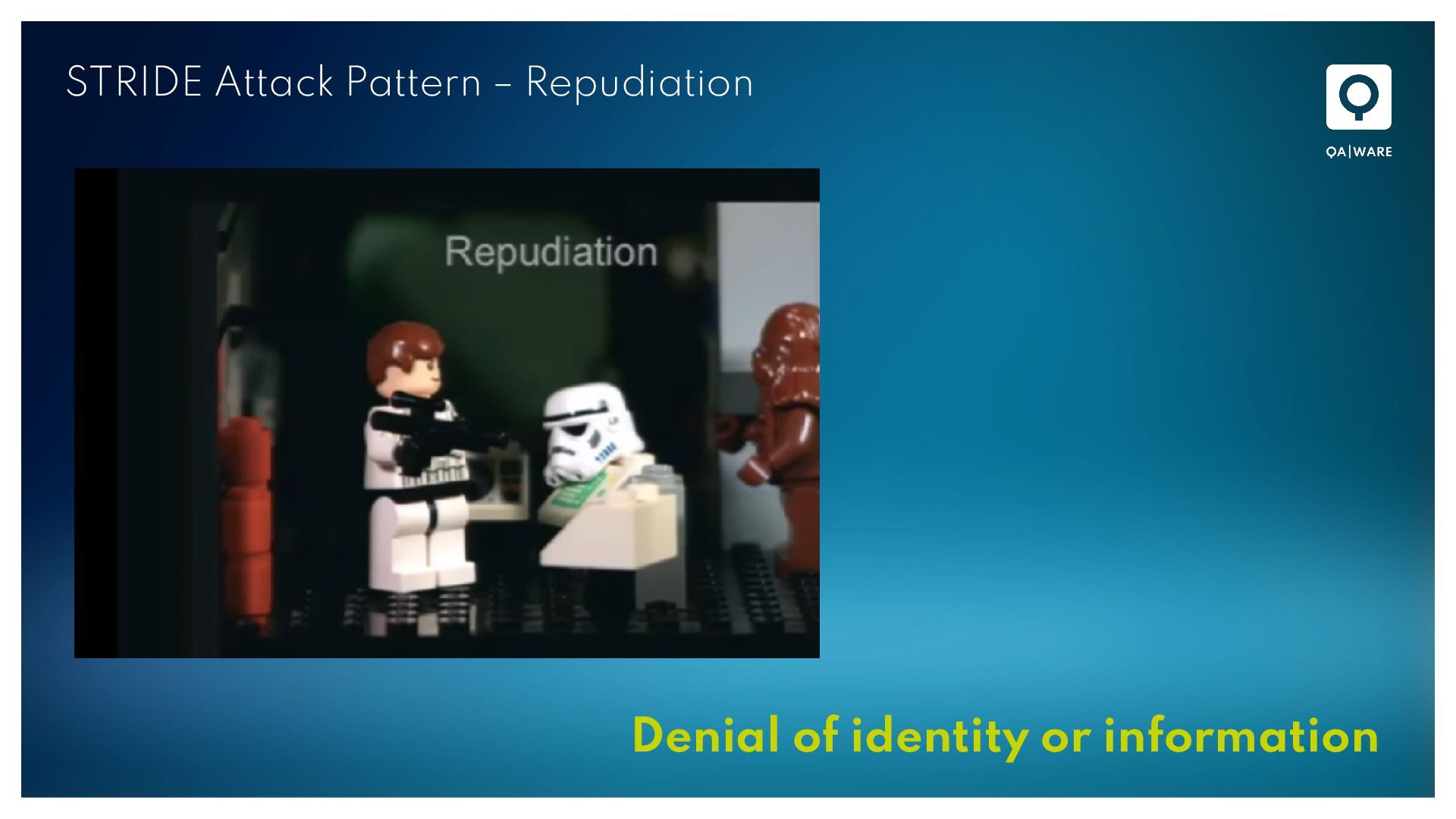
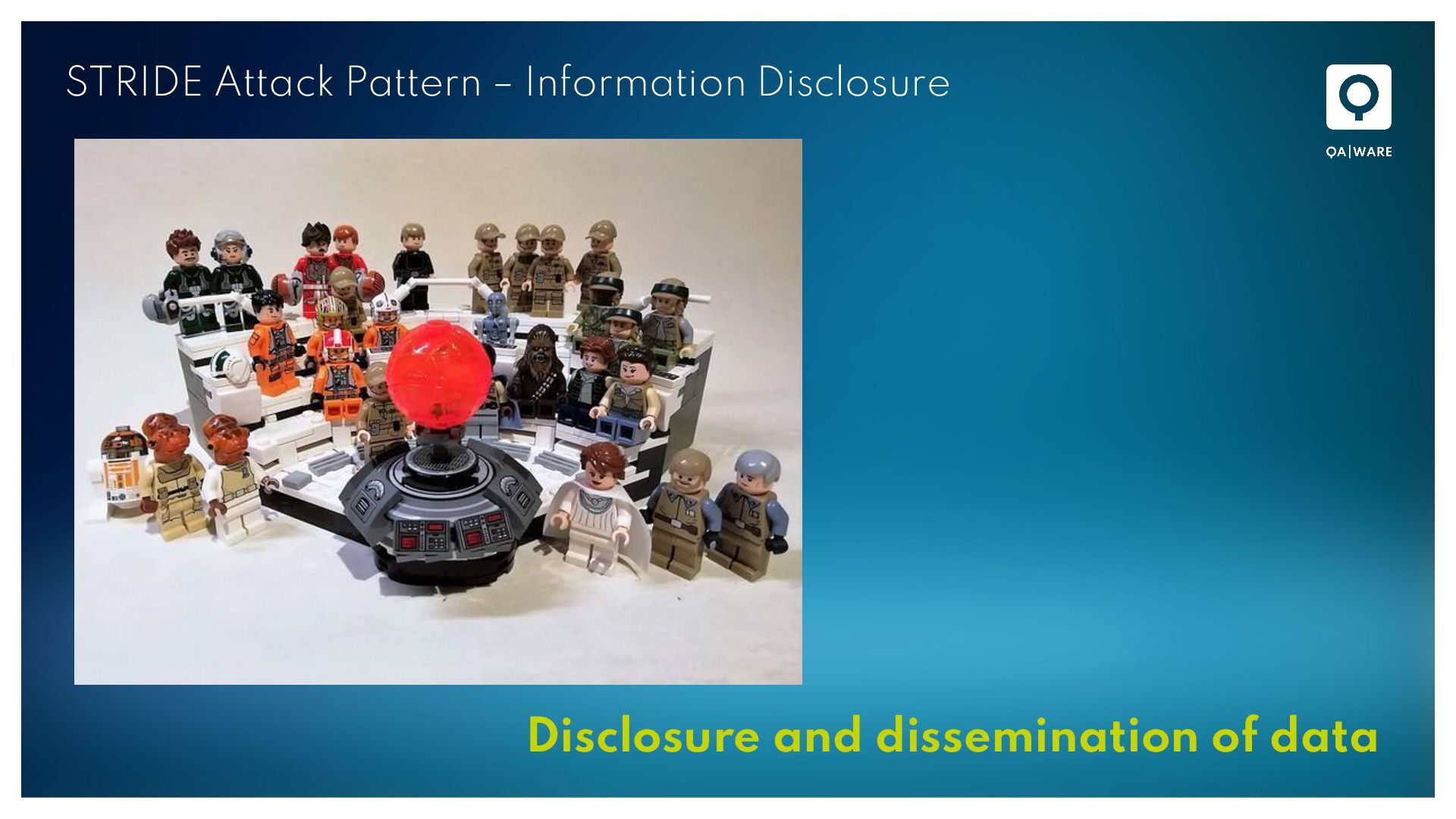
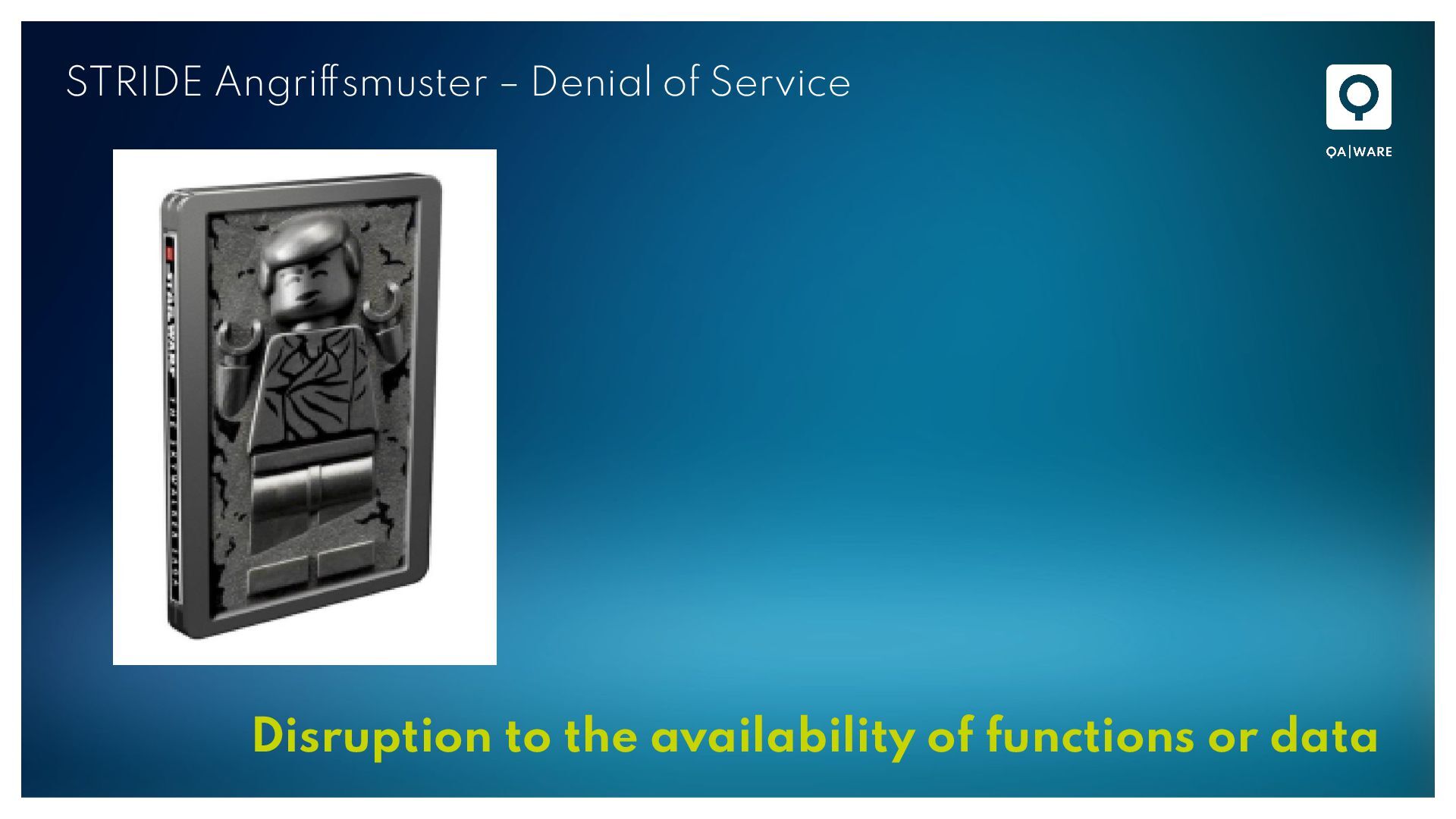
    ▪ STRIDE is frequently used - developed by Loren Kohnfelder at Microsoft ▪ Implementation in regular workshops with architects and product owners, among others ▪ "Whiteboard hacking" ▪ STRIDE structures threats into the following 6 attack patterns: - Spoofing - Tampering - Repudiation - Information Disclosure - Denial of Service - Elevation of Privilege All possible attacks cannot be thought through!
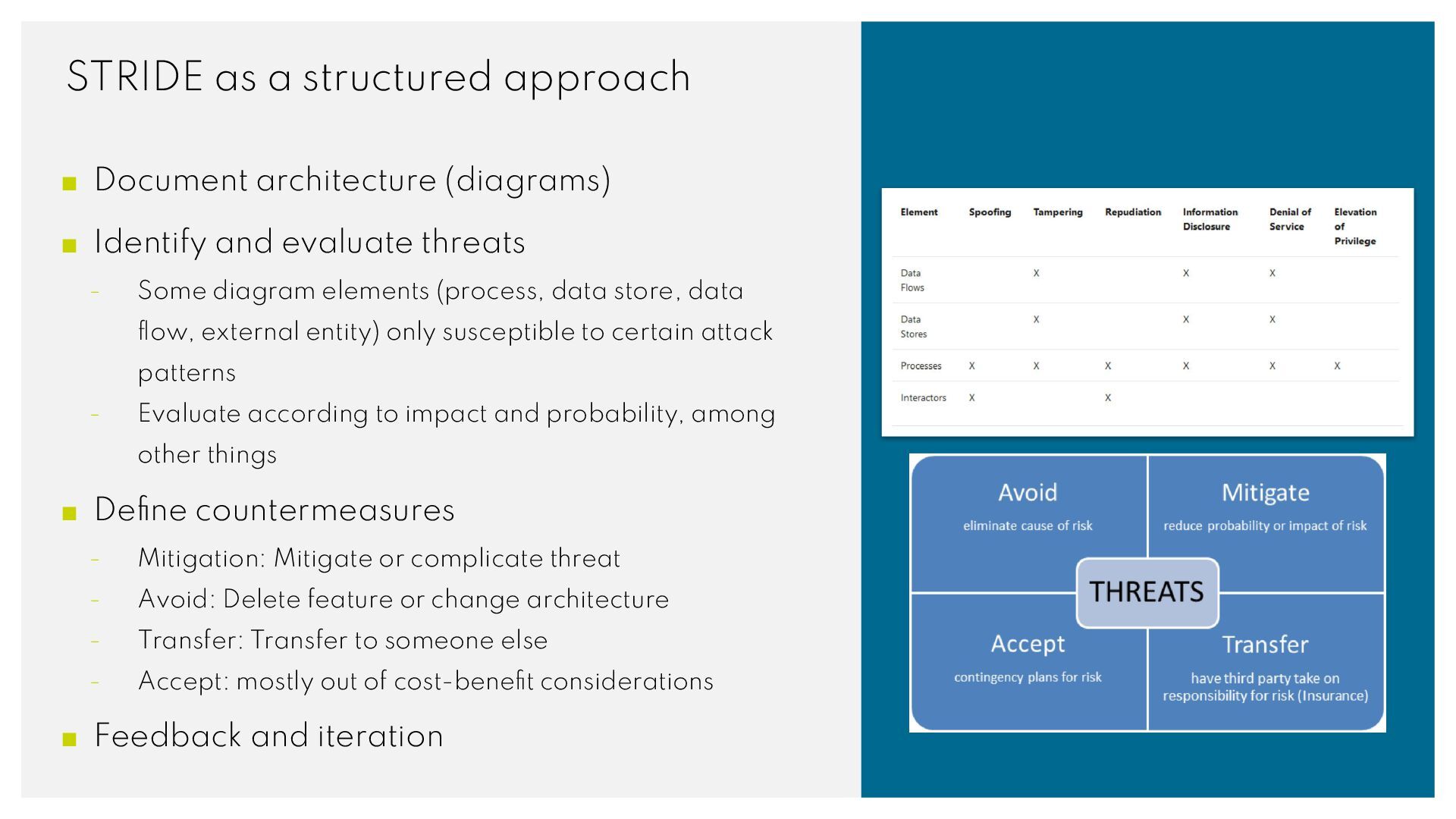
  14. STRIDE as a structured approach ▪ Document architecture (diagrams) ▪

    Identify and evaluate threats - Some diagram elements (process, data store, data flow, external entity) only susceptible to certain attack patterns - Evaluate according to impact and probability, among other things ▪ Define countermeasures - Mitigation: Mitigate or complicate threat - Avoid: Delete feature or change architecture - Transfer: Transfer to someone else - Accept: mostly out of cost-benefit considerations ▪ Feedback and iteration
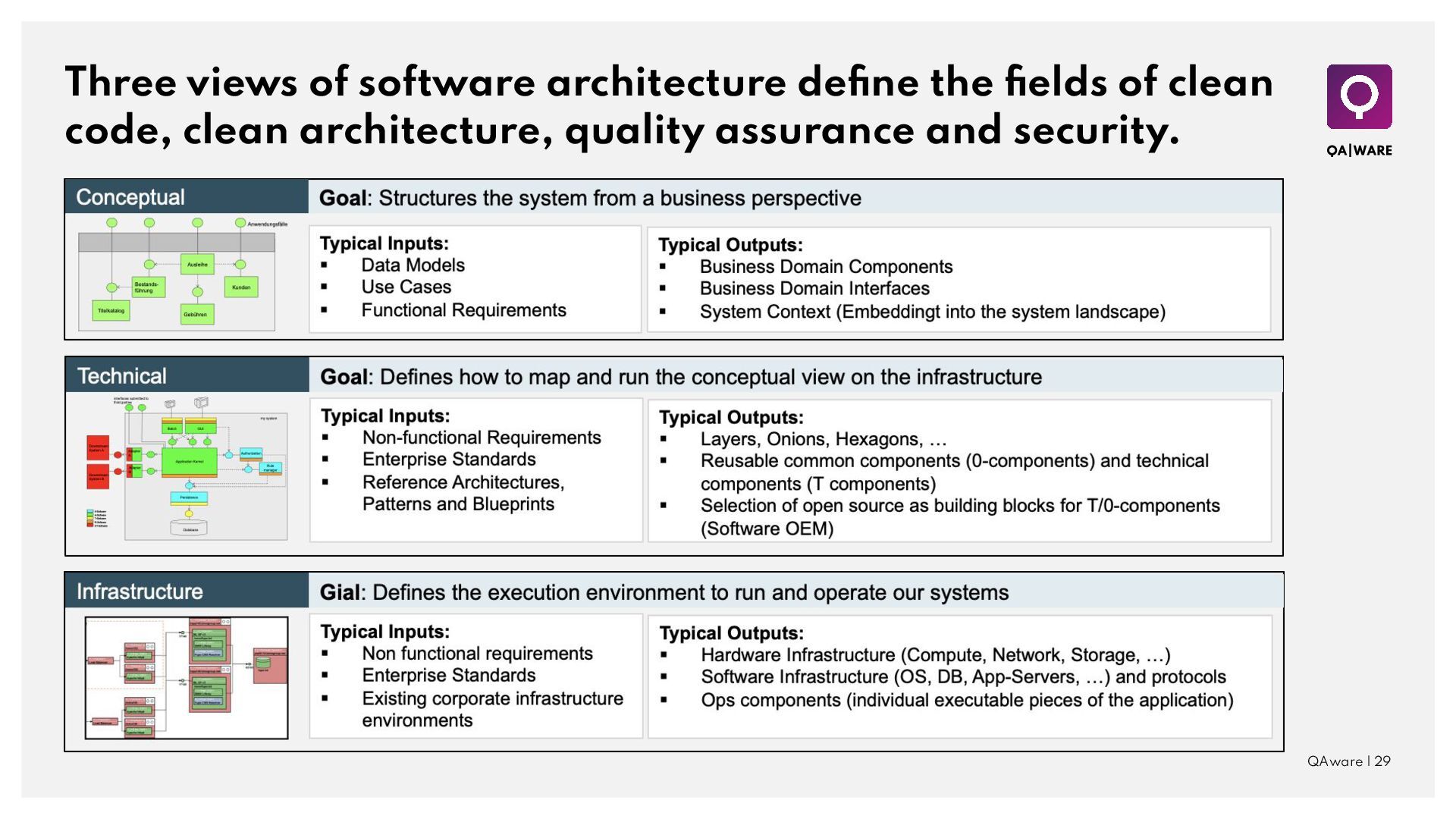
  15. Three views of software architecture define the fields of clean

    code, clean architecture, quality assurance and security. QAware | 29
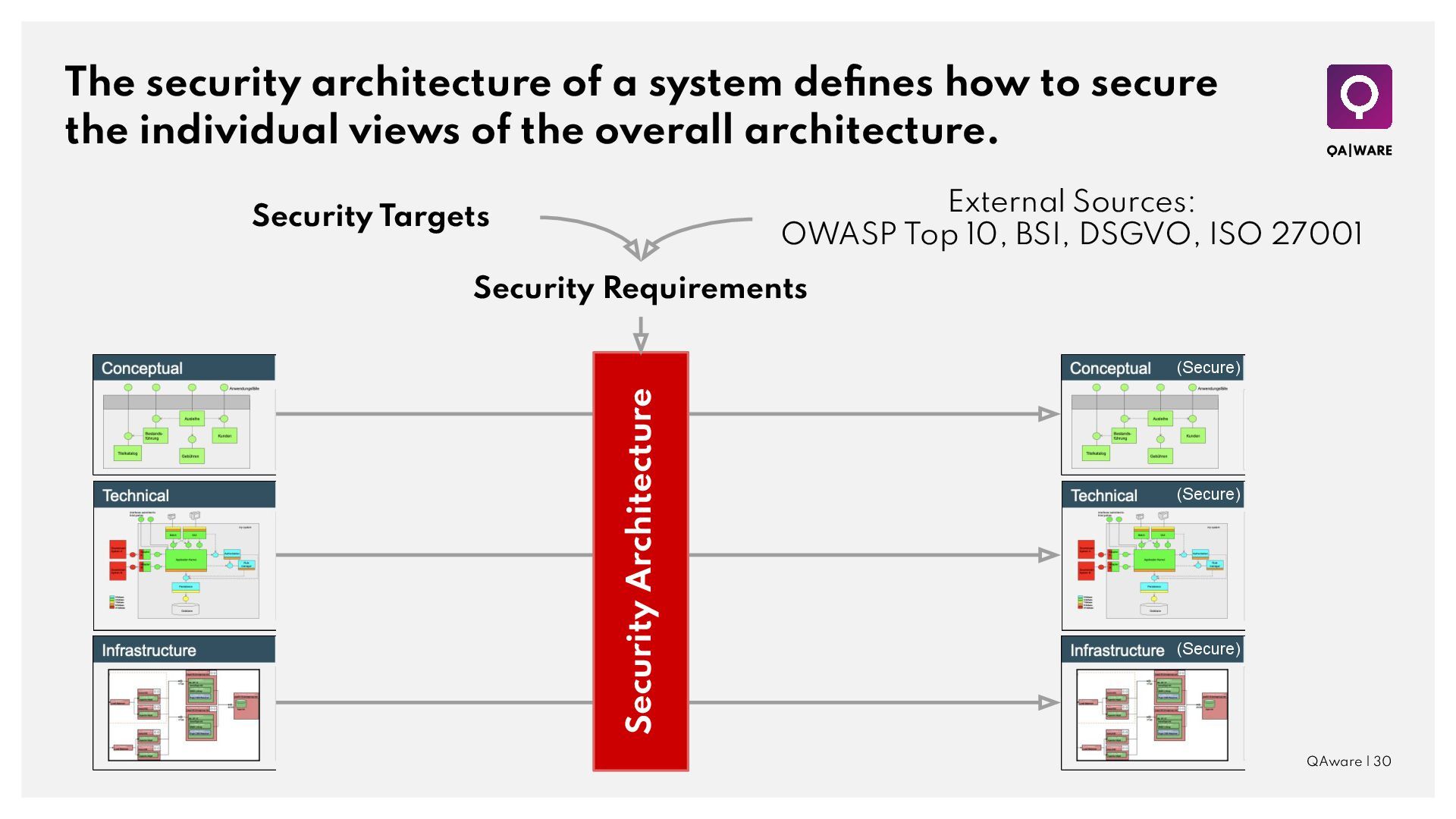
  16. The security architecture of a system defines how to secure

    the individual views of the overall architecture. QAware | 30 Security Targets Security Requirements External Sources: OWASP Top 10, BSI, DSGVO, ISO 27001 Security Architecture (Secure) (Secure) (Secure)
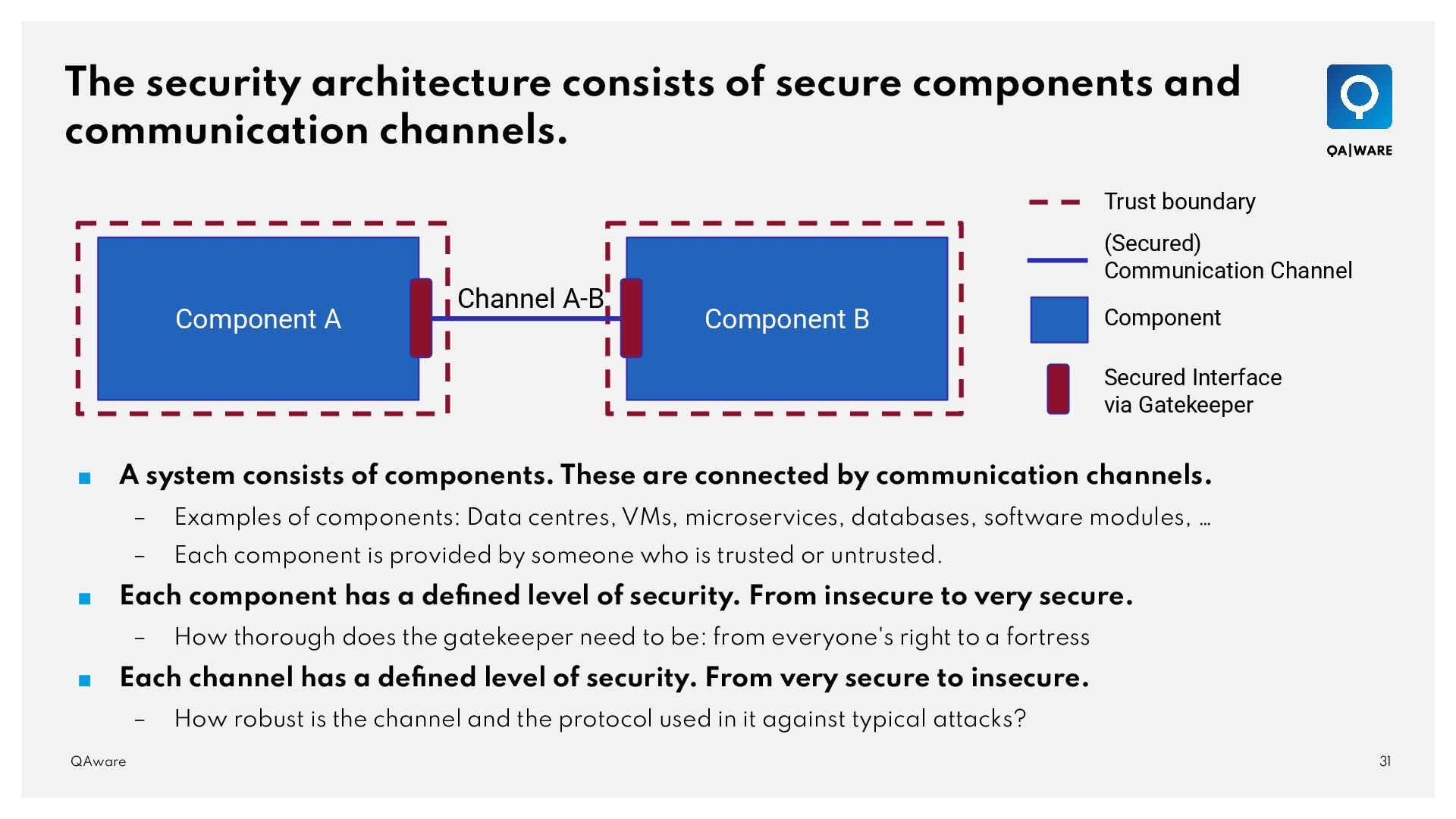
  17. Trust boundary (Secured) Communication Channel Component Secured Interface via Gatekeeper

    The security architecture consists of secure components and communication channels. 31 QAware Component A Component B Channel A-B ▪ A system consists of components. These are connected by communication channels. – Examples of components: Data centres, VMs, microservices, databases, software modules, … – Each component is provided by someone who is trusted or untrusted. ▪ Each component has a defined level of security. From insecure to very secure. – How thorough does the gatekeeper need to be: from everyone's right to a fortress ▪ Each channel has a defined level of security. From very secure to insecure. – How robust is the channel and the protocol used in it against typical attacks?
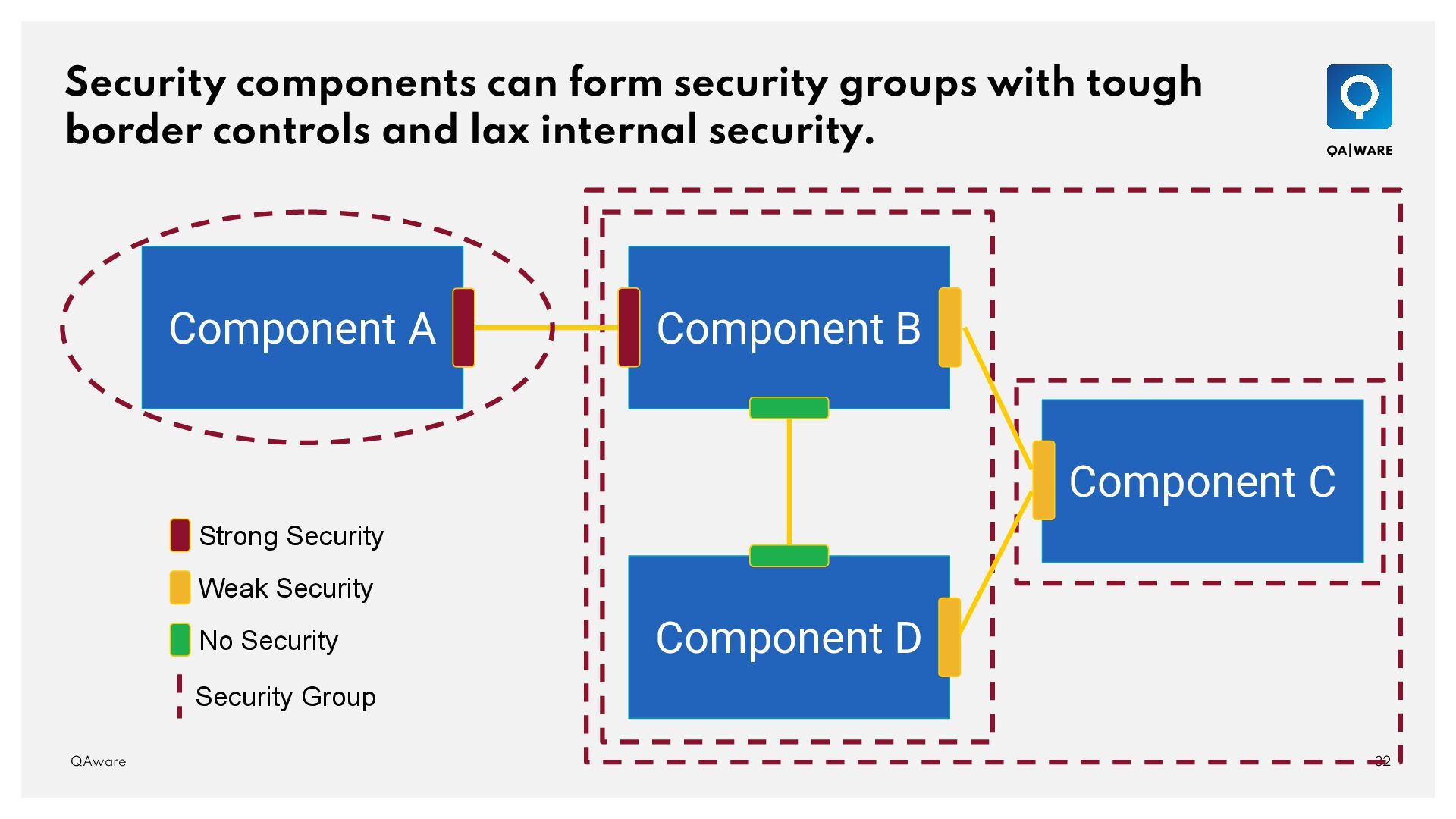
  18. Security components can form security groups with tough border controls

    and lax internal security. 32 QAware Component A Component B Component D Component C Strong Security Weak Security No Security Security Group
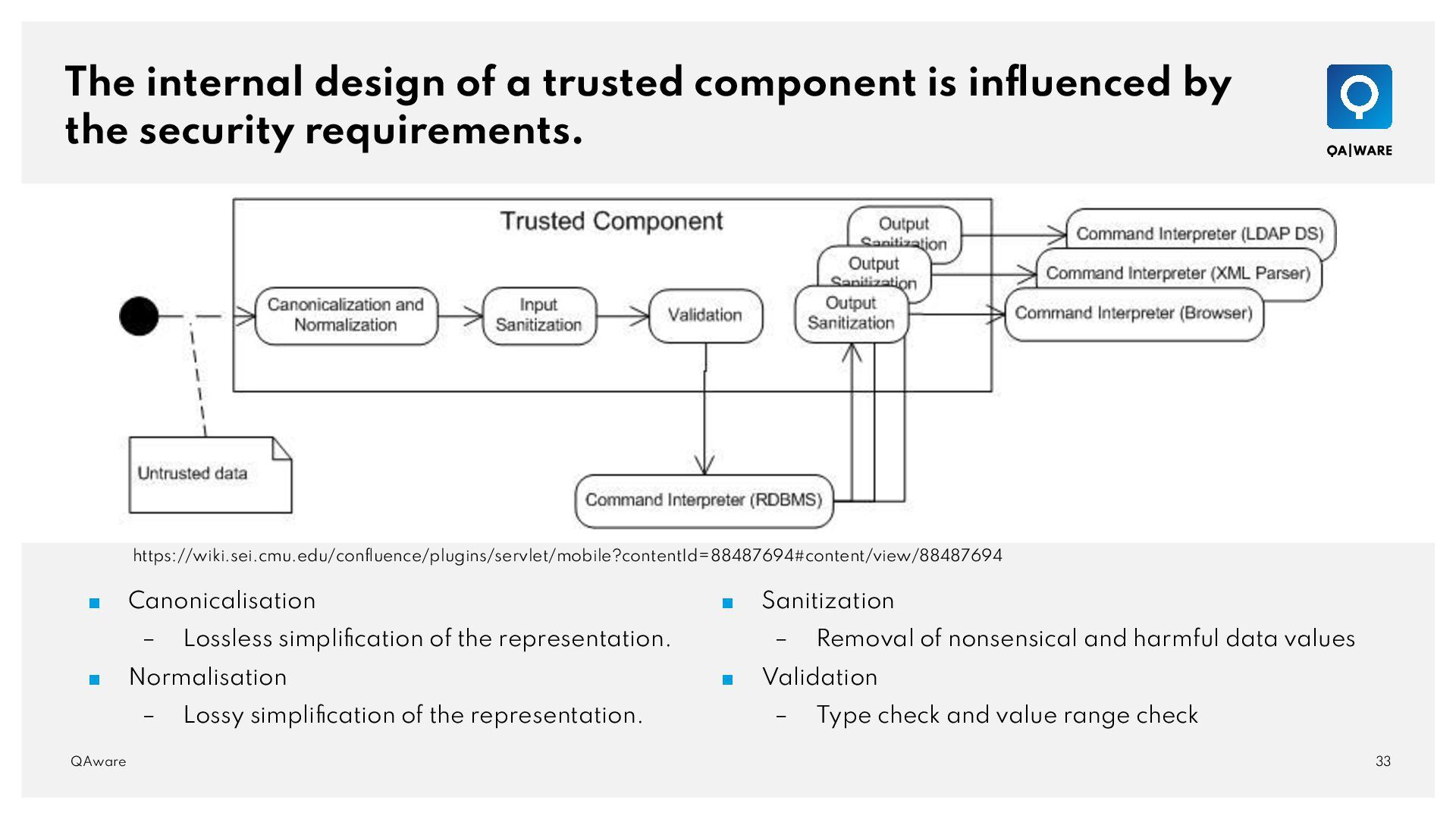
  19. The internal design of a trusted component is influenced by

    the security requirements. 33 QAware ▪ Canonicalisation – Lossless simplification of the representation. ▪ Normalisation – Lossy simplification of the representation. ▪ Sanitization – Removal of nonsensical and harmful data values ▪ Validation – Type check and value range check https://wiki.sei.cmu.edu/confluence/plugins/servlet/mobile?contentId=88487694#content/view/88487694
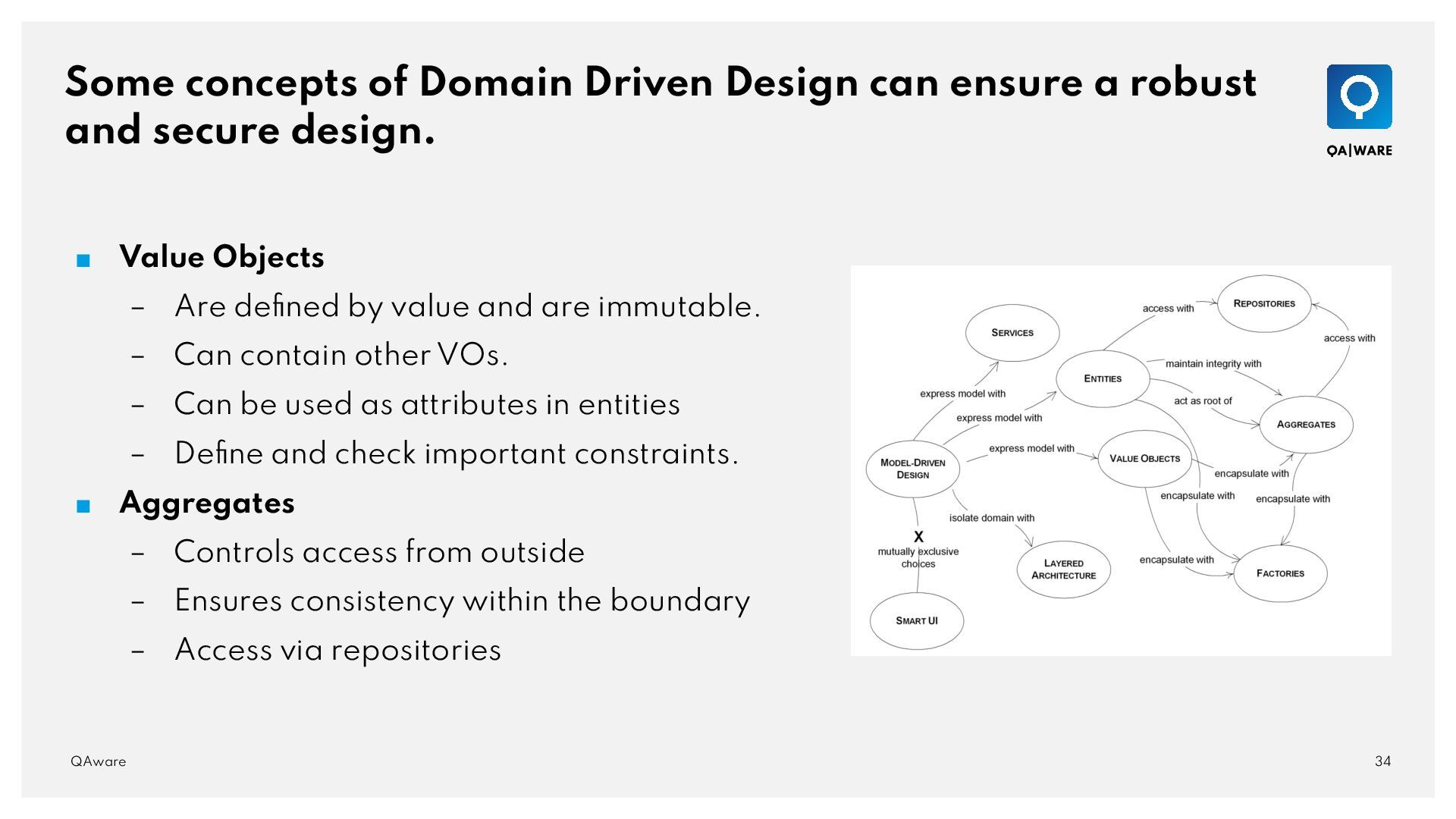
  20. 34 QAware Some concepts of Domain Driven Design can ensure

    a robust and secure design. ▪ Value Objects – Are defined by value and are immutable. – Can contain other VOs. – Can be used as attributes in entities – Define and check important constraints. ▪ Aggregates – Controls access from outside – Ensures consistency within the boundary – Access via repositories
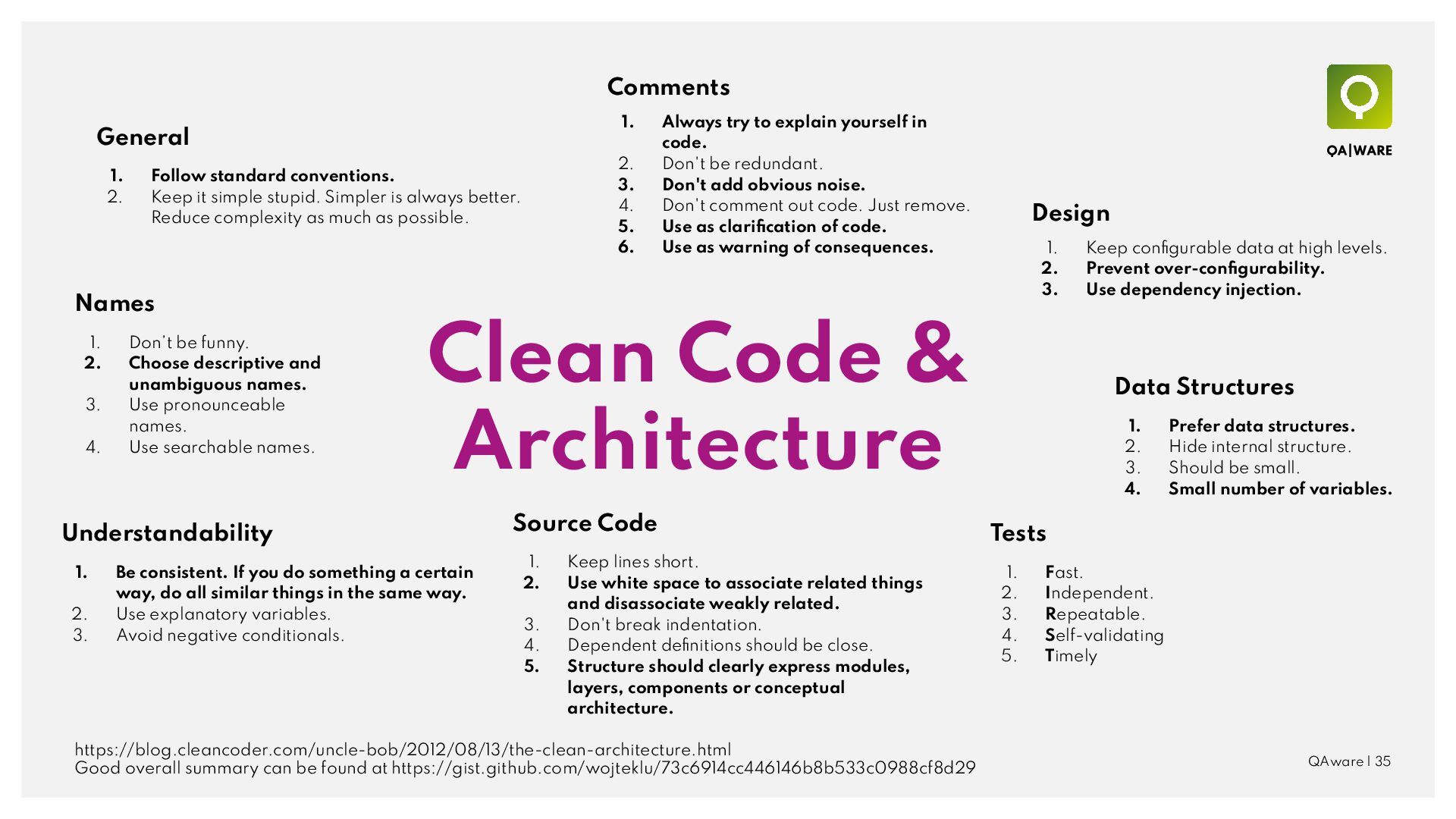
  21. QAware | 35 Clean Code & Architecture https://blog.cleancoder.com/uncle-bob/2012/08/13/the-clean-architecture.html Good overall

    summary can be found at https://gist.github.com/wojteklu/73c6914cc446146b8b533c0988cf8d29 1. Follow standard conventions. 2. Keep it simple stupid. Simpler is always better. Reduce complexity as much as possible. General 1. Keep configurable data at high levels. 2. Prevent over-configurability. 3. Use dependency injection. Design 1. Be consistent. If you do something a certain way, do all similar things in the same way. 2. Use explanatory variables. 3. Avoid negative conditionals. Understandability 1. Don’t be funny. 2. Choose descriptive and unambiguous names. 3. Use pronounceable names. 4. Use searchable names. Names 1. Always try to explain yourself in code. 2. Don't be redundant. 3. Don't add obvious noise. 4. Don't comment out code. Just remove. 5. Use as clarification of code. 6. Use as warning of consequences. Comments 1. Fast. 2. Independent. 3. Repeatable. 4. Self-validating 5. Timely Tests 1. Keep lines short. 2. Use white space to associate related things and disassociate weakly related. 3. Don't break indentation. 4. Dependent definitions should be close. 5. Structure should clearly express modules, layers, components or conceptual architecture. Source Code 1. Prefer data structures. 2. Hide internal structure. 3. Should be small. 4. Small number of variables. Data Structures
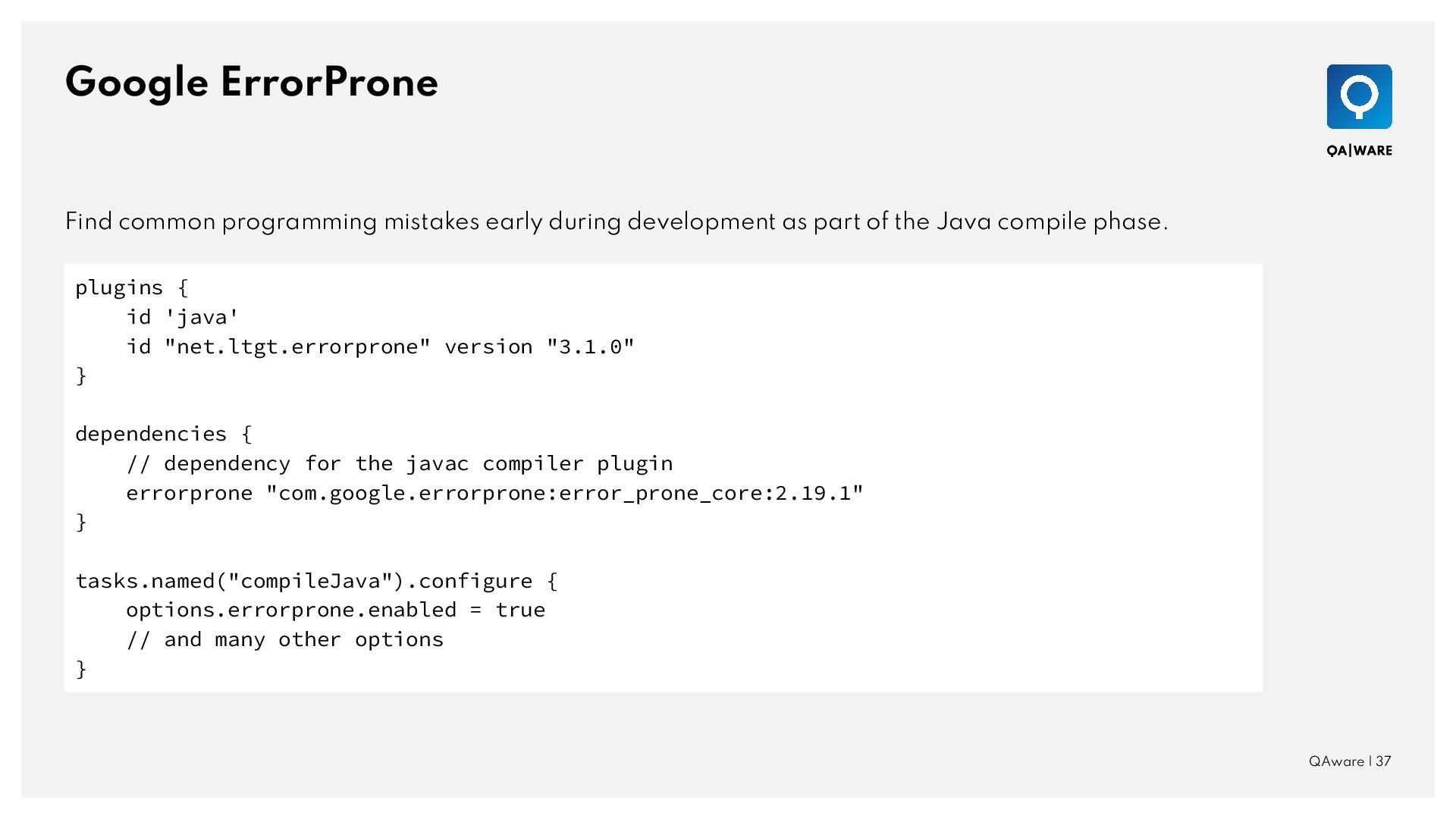
  22. Google ErrorProne QAware | 37 plugins { id 'java' id

    "net.ltgt.errorprone" version "3.1.0" } dependencies { // dependency for the javac compiler plugin errorprone "com.google.errorprone:error_prone_core:2.19.1" } tasks.named("compileJava").configure { options.errorprone.enabled = true // and many other options } Find common programming mistakes early during development as part of the Java compile phase.
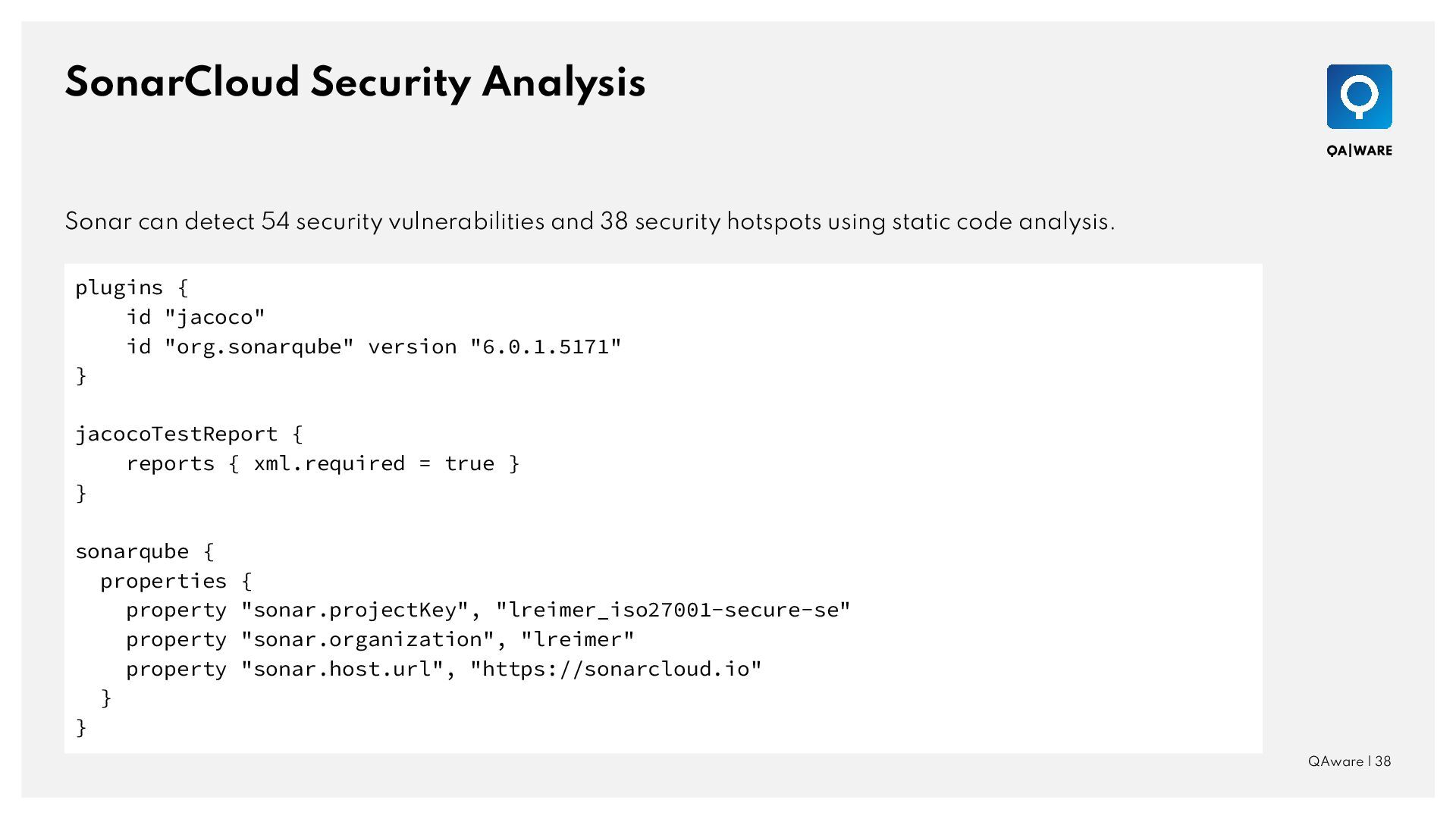
  23. SonarCloud Security Analysis QAware | 38 plugins { id "jacoco"

    id "org.sonarqube" version "6.0.1.5171" } jacocoTestReport { reports { xml.required = true } } sonarqube { properties { property "sonar.projectKey", "lreimer_iso27001-secure-se" property "sonar.organization", "lreimer" property "sonar.host.url", "https://sonarcloud.io" } } Sonar can detect 54 security vulnerabilities and 38 security hotspots using static code analysis.
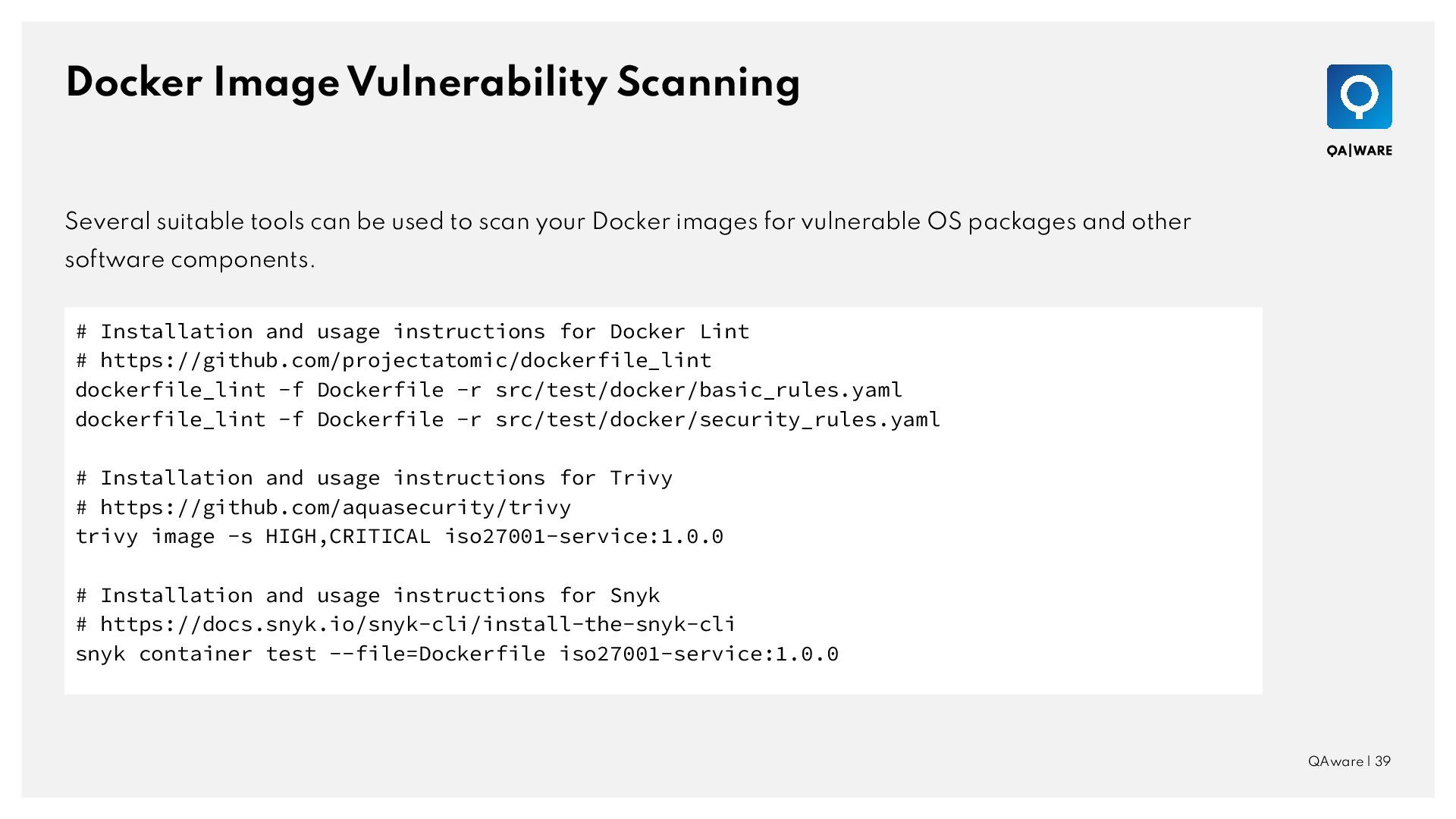
  24. Docker Image Vulnerability Scanning QAware | 39 # Installation and

    usage instructions for Docker Lint # https://github.com/projectatomic/dockerfile_lint dockerfile_lint -f Dockerfile -r src/test/docker/basic_rules.yaml dockerfile_lint -f Dockerfile -r src/test/docker/security_rules.yaml # Installation and usage instructions for Trivy # https://github.com/aquasecurity/trivy trivy image -s HIGH,CRITICAL iso27001-service:1.0.0 # Installation and usage instructions for Snyk # https://docs.snyk.io/snyk-cli/install-the-snyk-cli snyk container test --file=Dockerfile iso27001-service:1.0.0 Several suitable tools can be used to scan your Docker images for vulnerable OS packages and other software components.
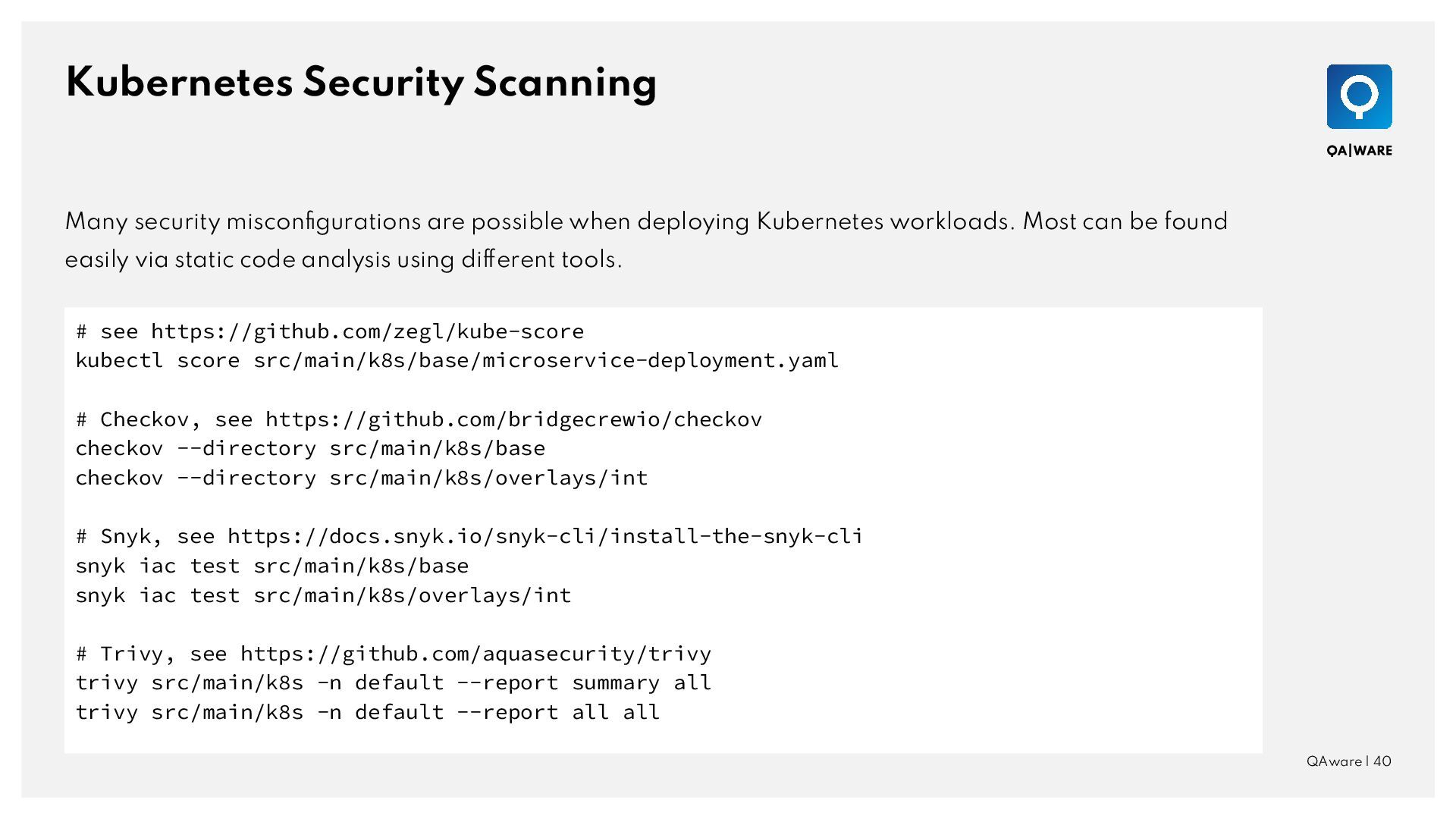
  25. Kubernetes Security Scanning QAware | 40 # see https://github.com/zegl/kube-score kubectl

    score src/main/k8s/base/microservice-deployment.yaml # Checkov, see https://github.com/bridgecrewio/checkov checkov --directory src/main/k8s/base checkov --directory src/main/k8s/overlays/int # Snyk, see https://docs.snyk.io/snyk-cli/install-the-snyk-cli snyk iac test src/main/k8s/base snyk iac test src/main/k8s/overlays/int # Trivy, see https://github.com/aquasecurity/trivy trivy src/main/k8s -n default --report summary all trivy src/main/k8s -n default --report all all Many security misconfigurations are possible when deploying Kubernetes workloads. Most can be found easily via static code analysis using different tools.
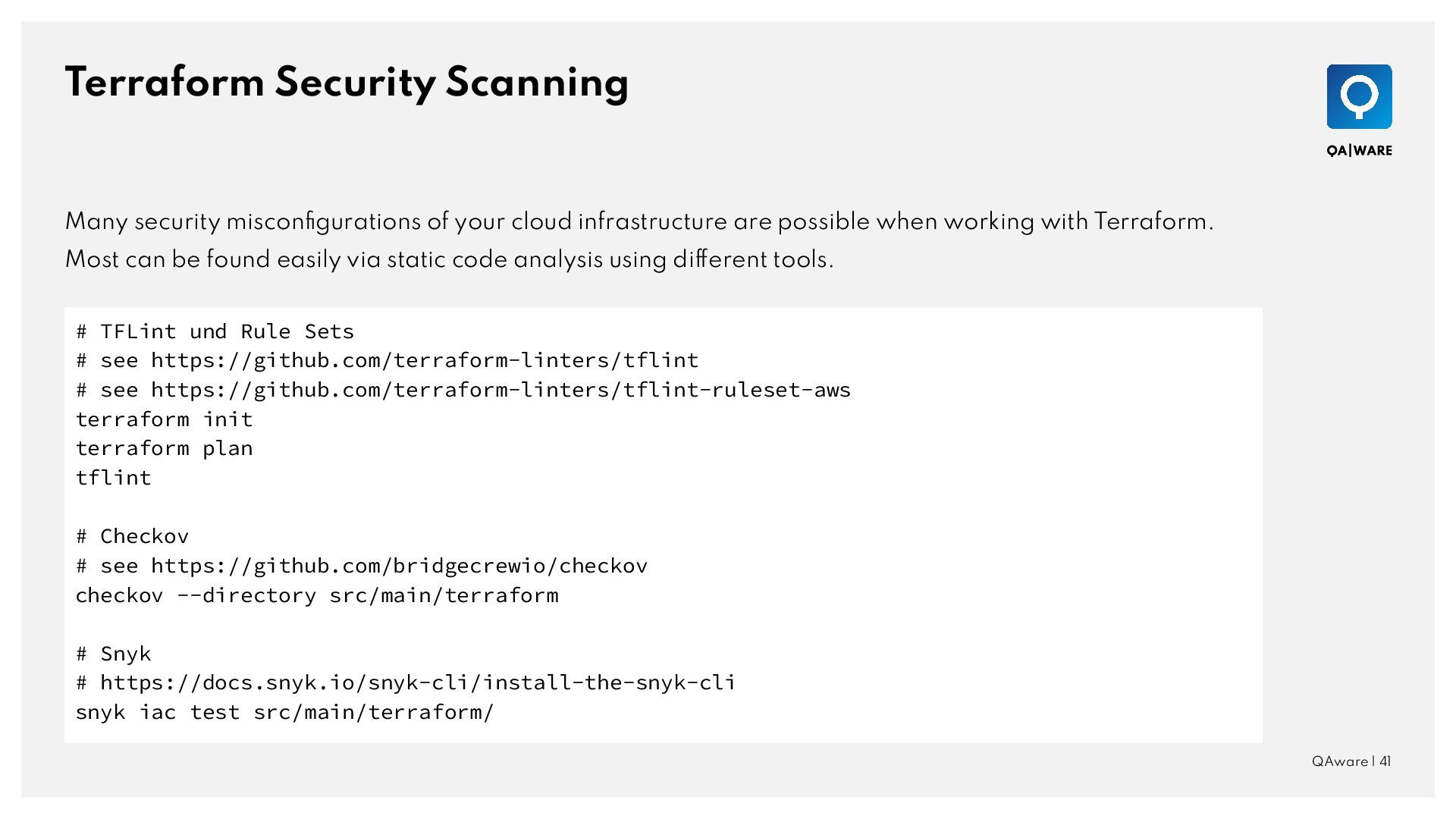
  26. Terraform Security Scanning QAware | 41 # TFLint und Rule

    Sets # see https://github.com/terraform-linters/tflint # see https://github.com/terraform-linters/tflint-ruleset-aws terraform init terraform plan tflint # Checkov # see https://github.com/bridgecrewio/checkov checkov --directory src/main/terraform # Snyk # https://docs.snyk.io/snyk-cli/install-the-snyk-cli snyk iac test src/main/terraform/ Many security misconfigurations of your cloud infrastructure are possible when working with Terraform. Most can be found easily via static code analysis using different tools.
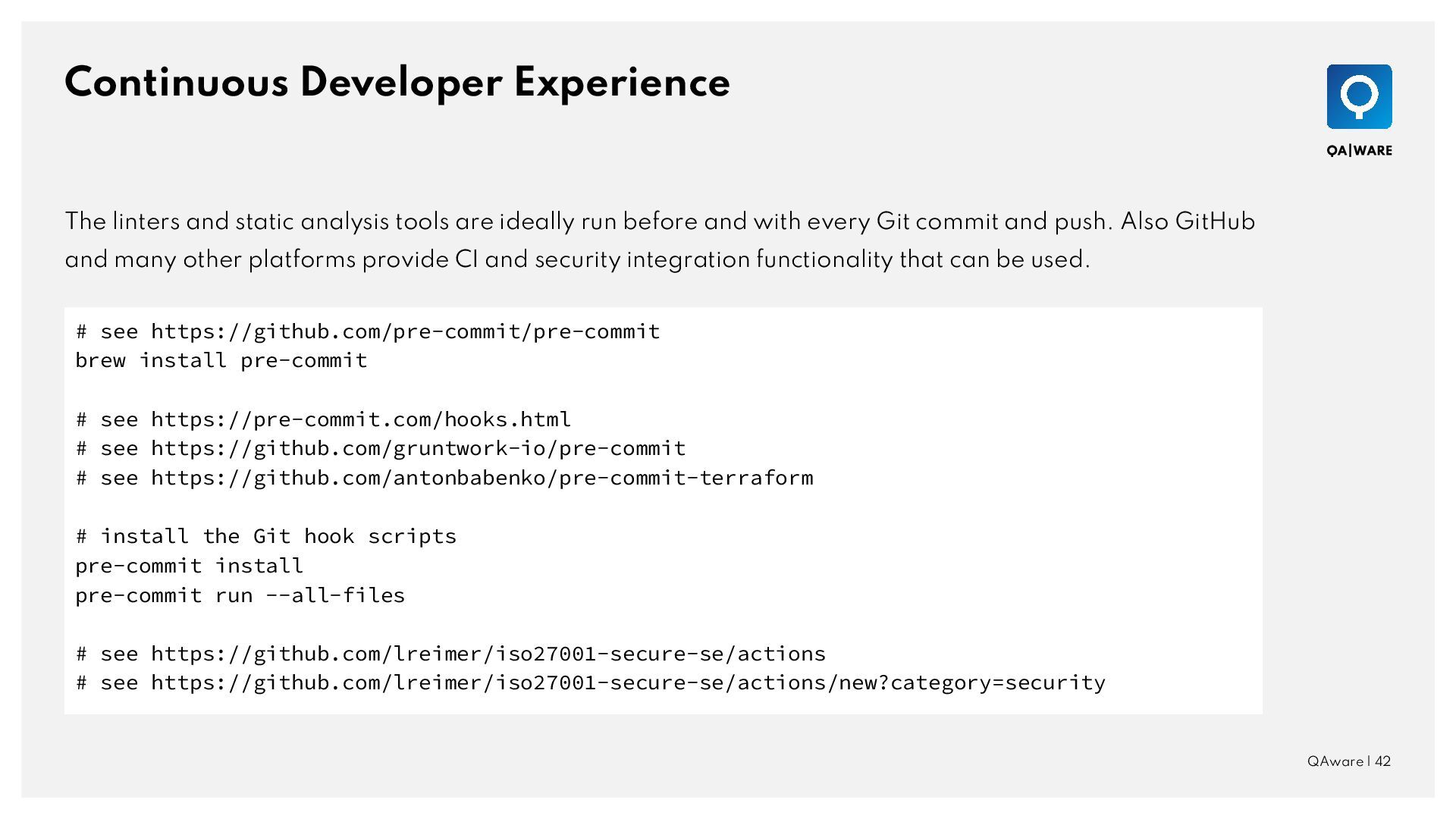
  27. Continuous Developer Experience QAware | 42 # see https://github.com/pre-commit/pre-commit brew

    install pre-commit # see https://pre-commit.com/hooks.html # see https://github.com/gruntwork-io/pre-commit # see https://github.com/antonbabenko/pre-commit-terraform # install the Git hook scripts pre-commit install pre-commit run --all-files # see https://github.com/lreimer/iso27001-secure-se/actions # see https://github.com/lreimer/iso27001-secure-se/actions/new?category=security The linters and static analysis tools are ideally run before and with every Git commit and push. Also GitHub and many other platforms provide CI and security integration functionality that can be used.
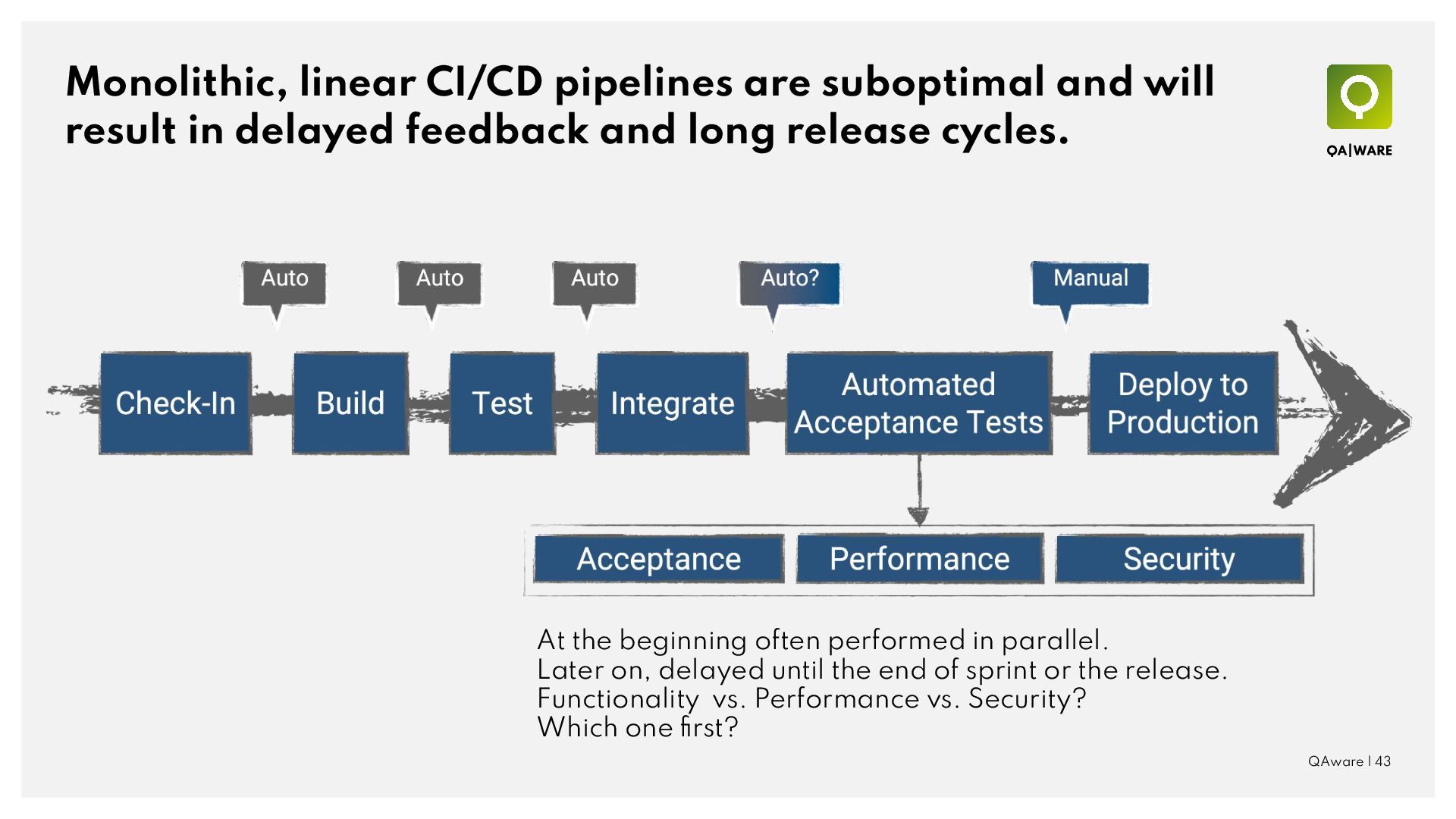
  28. Monolithic, linear CI/CD pipelines are suboptimal and will result in

    delayed feedback and long release cycles. QAware | 43 At the beginning often performed in parallel. Later on, delayed until the end of sprint or the release. Functionality vs. Performance vs. Security? Which one first?
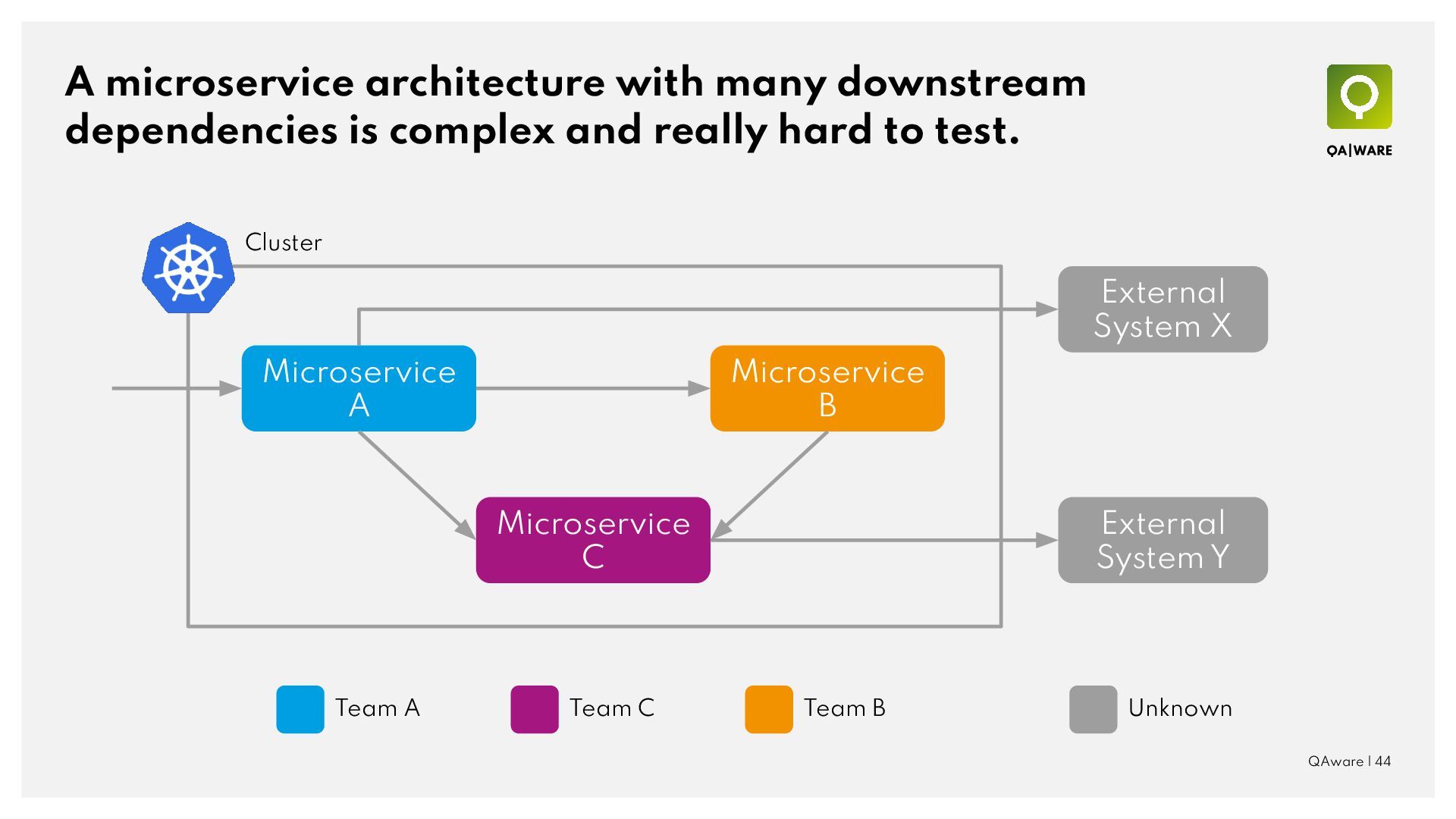
  29. A microservice architecture with many downstream dependencies is complex and

    really hard to test. QAware | 44 Cluster Microservice A Microservice B Microservice C External System X External System Y Team A Team C Team B Unknown
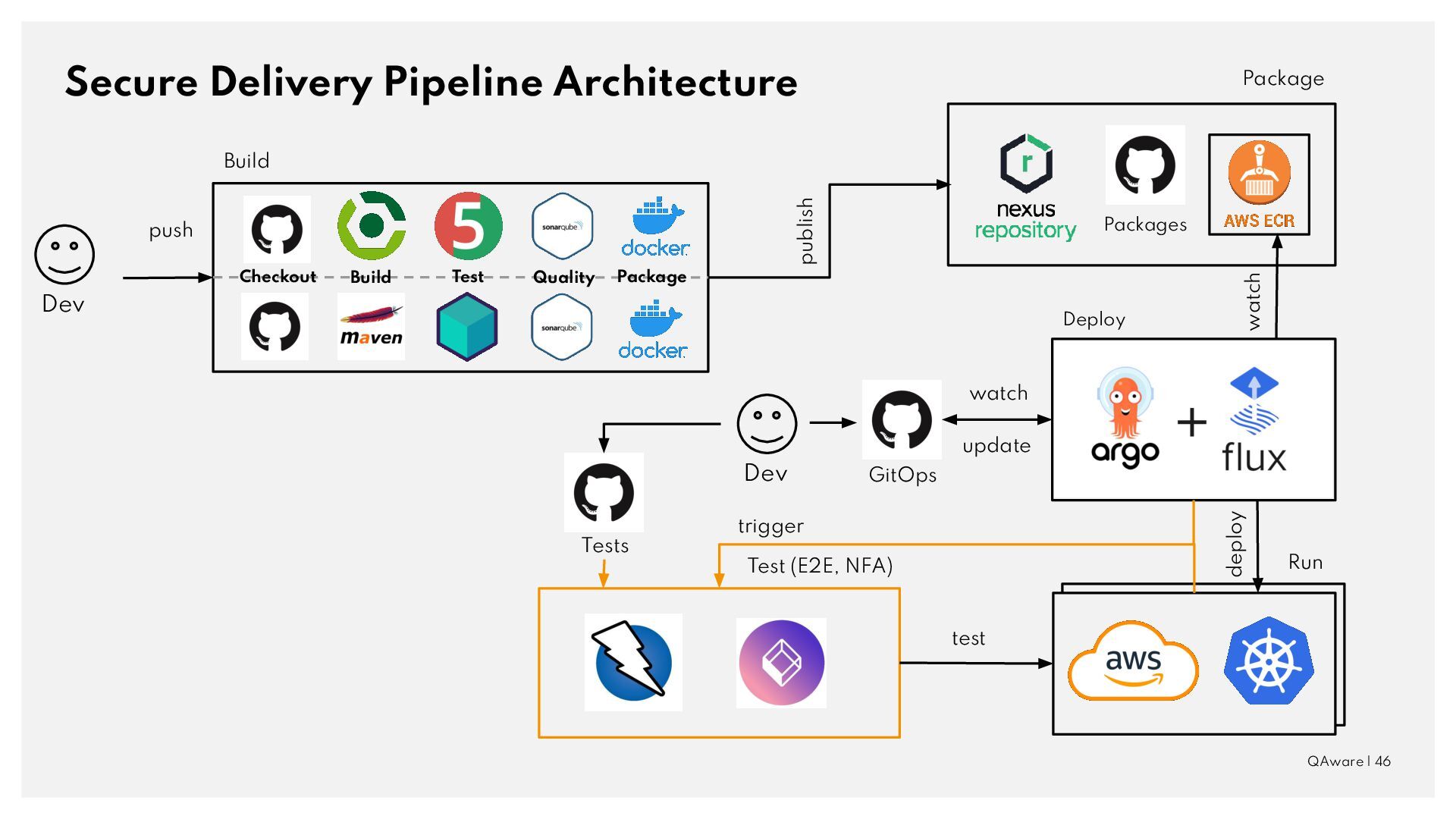
  30. Secure Delivery Pipeline Architecture QAware | 46 Packages Package publish

    update Run deploy watch Deploy watch Dev GitOps Build push Checkout Build Test Quality Package Dev Test (E2E, NFA) trigger test Tests
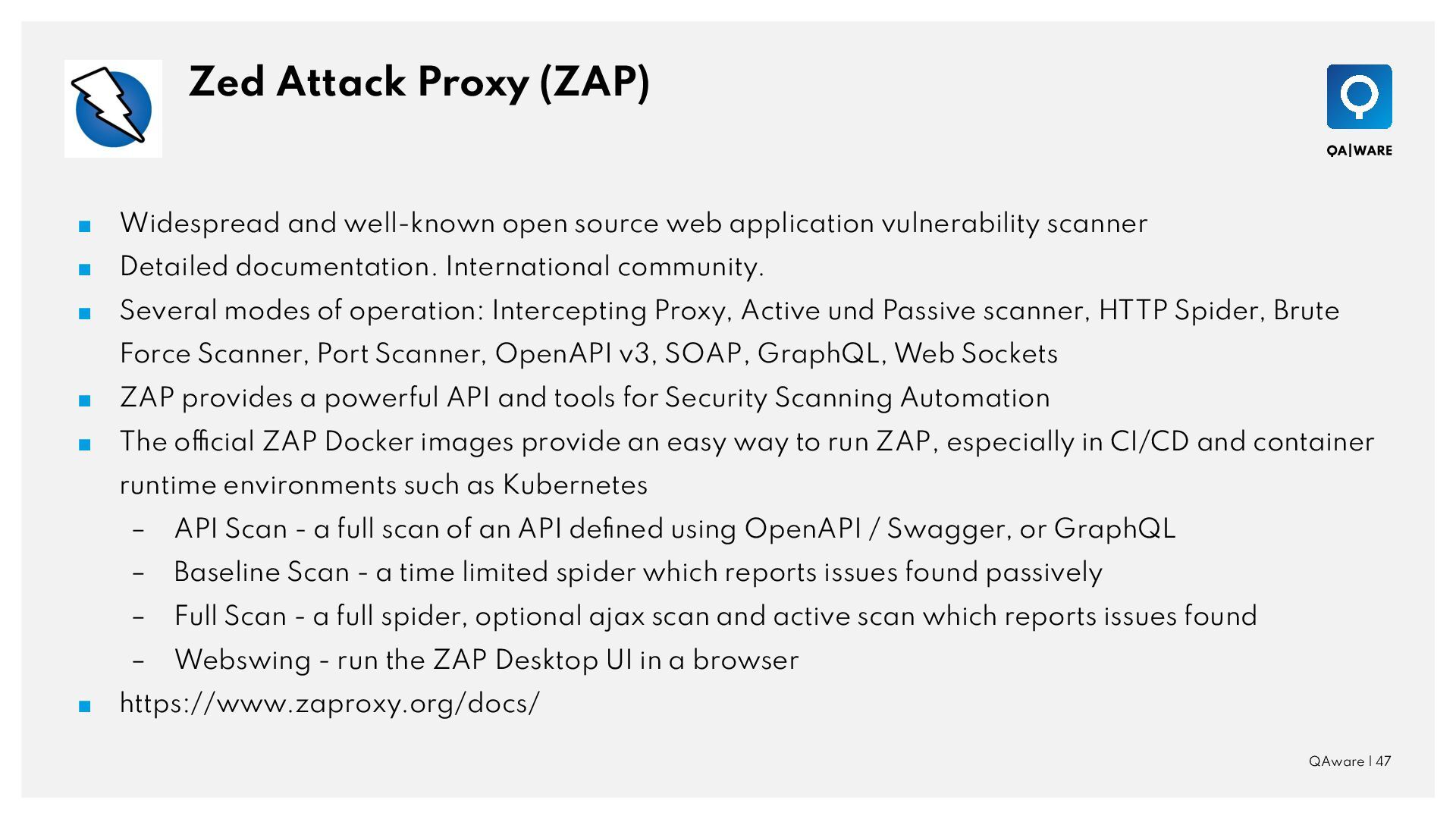
  31. Zed Attack Proxy (ZAP) QAware | 47 ▪ Widespread and

    well-known open source web application vulnerability scanner ▪ Detailed documentation. International community. ▪ Several modes of operation: Intercepting Proxy, Active und Passive scanner, HTTP Spider, Brute Force Scanner, Port Scanner, OpenAPI v3, SOAP, GraphQL, Web Sockets ▪ ZAP provides a powerful API and tools for Security Scanning Automation ▪ The official ZAP Docker images provide an easy way to run ZAP, especially in CI/CD and container runtime environments such as Kubernetes – API Scan - a full scan of an API defined using OpenAPI / Swagger, or GraphQL – Baseline Scan - a time limited spider which reports issues found passively – Full Scan - a full spider, optional ajax scan and active scan which reports issues found – Webswing - run the ZAP Desktop UI in a browser ▪ https://www.zaproxy.org/docs/
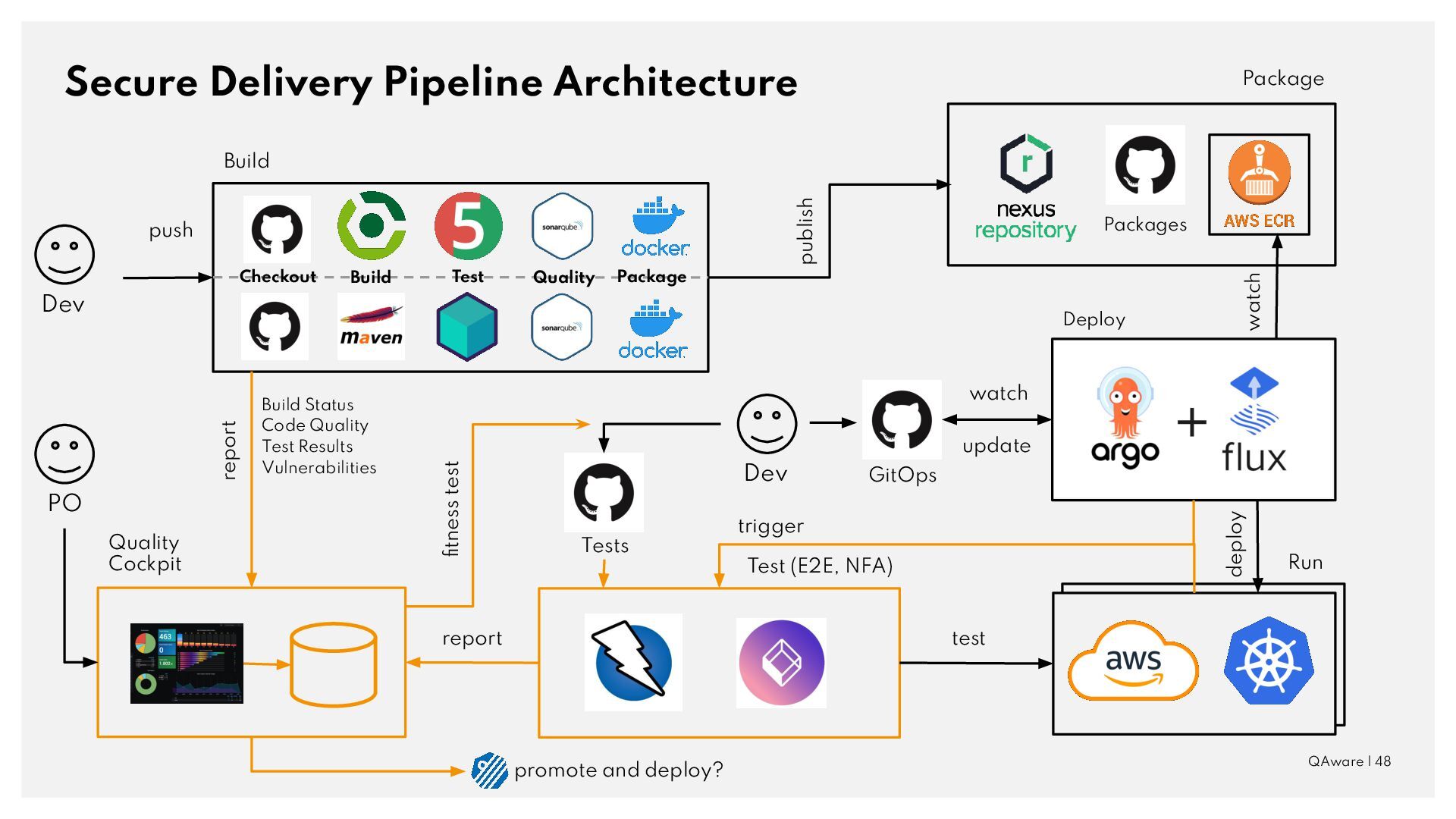
  32. Secure Delivery Pipeline Architecture QAware | 48 Packages Package publish

    update Run deploy watch Deploy watch Dev GitOps Build push Checkout Build Test Quality Package Dev Test (E2E, NFA) trigger test Tests Quality Cockpit report PO report Build Status Code Quality Test Results Vulnerabilities fitness test promote and deploy?
  33. OWASP SAMM: Measuring & Improving Security Maturity QAware | 49

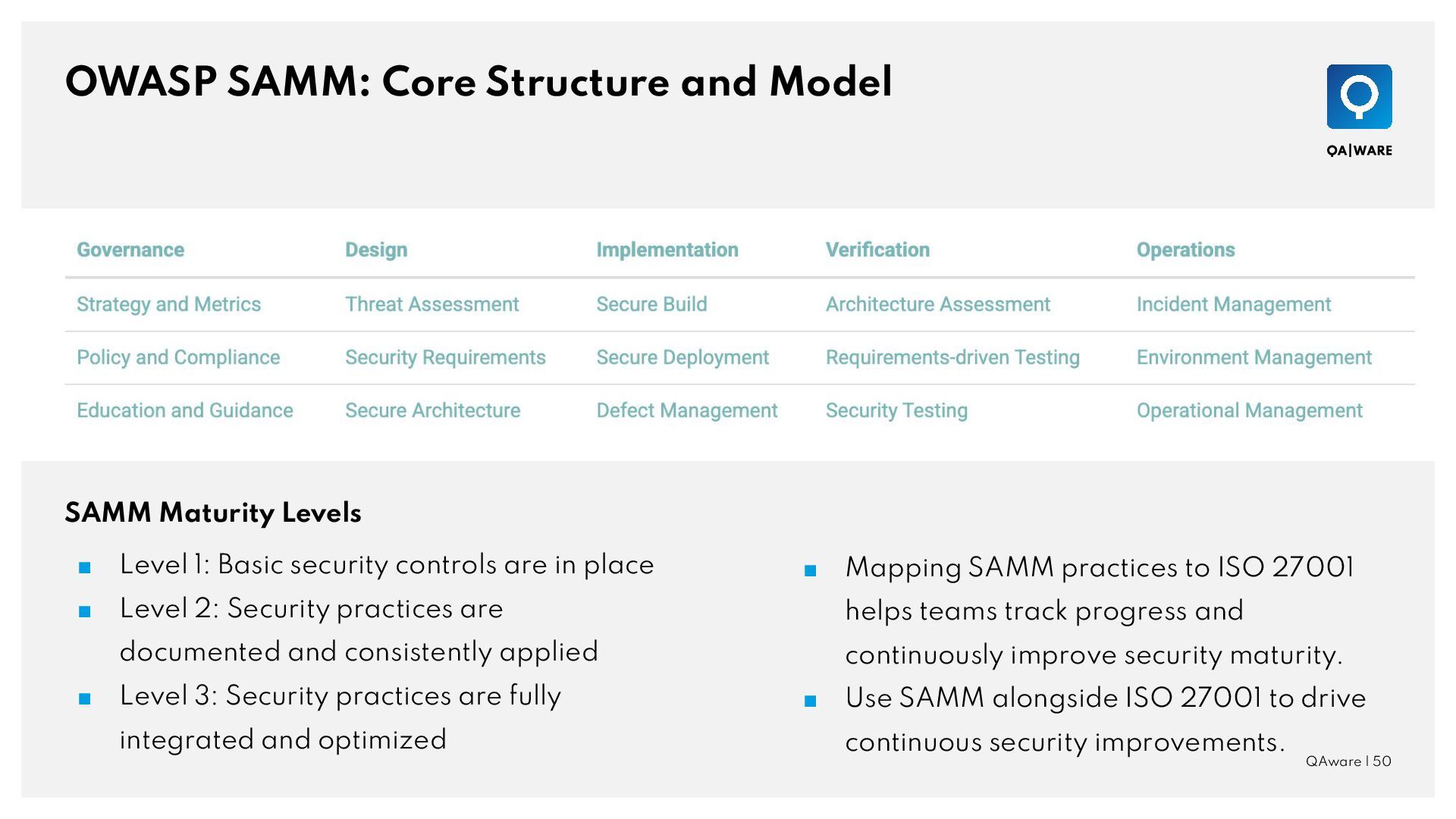
    Software Assurance Maturity Model (SAMM) ▪ Open-source framework by OWASP for improving software security. ▪ Helps organizations assess, measure, and improve security practices. ▪ Aligns with ISO 27001 for secure development maturity. ▪ https://owaspsamm.org 📢 Why SAMM? ▪ ISO 27001 tells you WHAT to do (security controls). ▪ OWASP SAMM helps with HOW to do it (practical implementation).
  34. OWASP SAMM: Core Structure and Model QAware | 50 ▪

    Mapping SAMM practices to ISO 27001 helps teams track progress and continuously improve security maturity. ▪ Use SAMM alongside ISO 27001 to drive continuous security improvements. SAMM Maturity Levels ▪ Level 1: Basic security controls are in place ▪ Level 2: Security practices are documented and consistently applied ▪ Level 3: Security practices are fully integrated and optimized
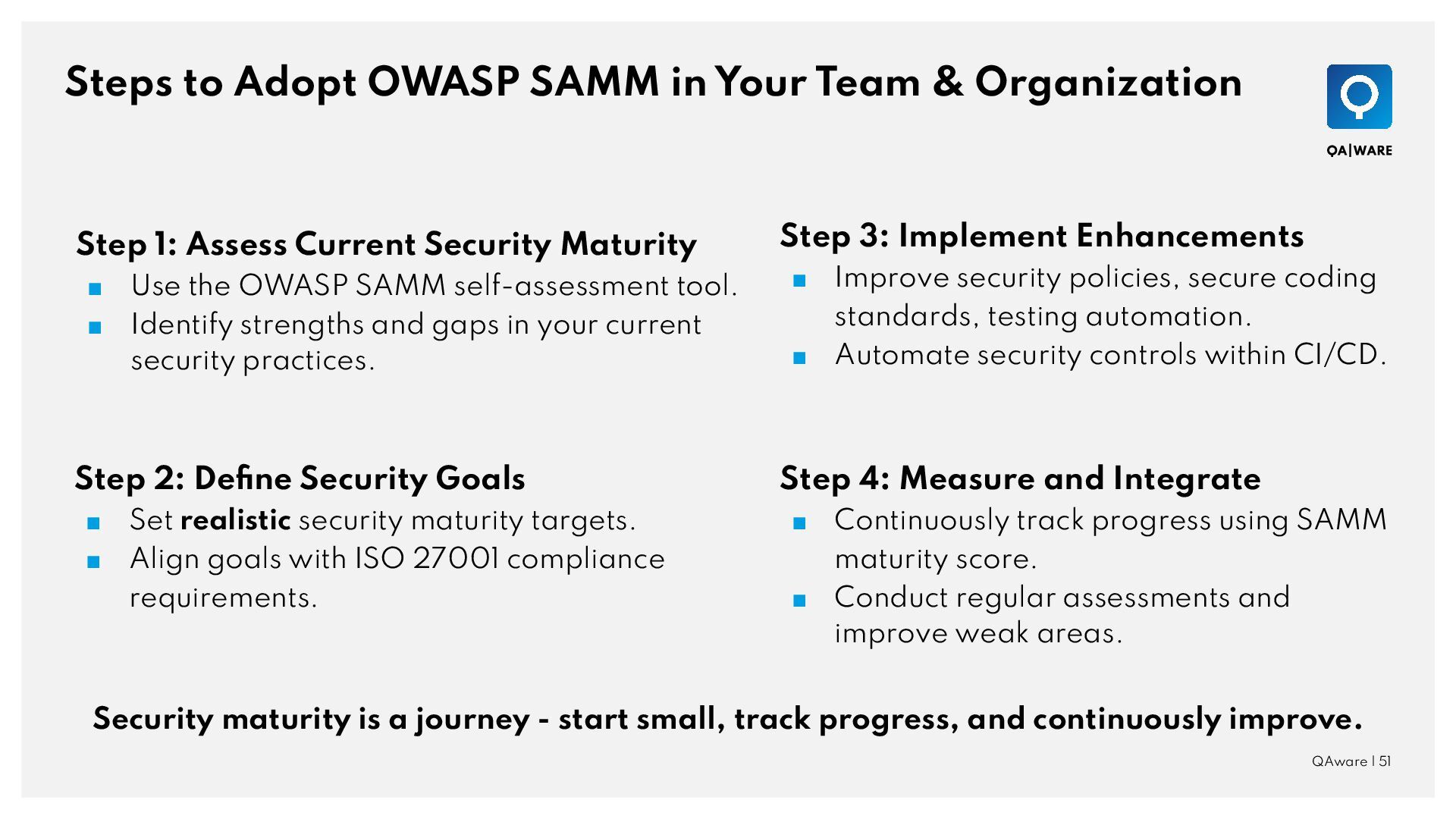
  35. Steps to Adopt OWASP SAMM in Your Team & Organization

    QAware | 51 Step 2: Define Security Goals ▪ Set realistic security maturity targets. ▪ Align goals with ISO 27001 compliance requirements. Step 3: Implement Enhancements ▪ Improve security policies, secure coding standards, testing automation. ▪ Automate security controls within CI/CD. Step 4: Measure and Integrate ▪ Continuously track progress using SAMM maturity score. ▪ Conduct regular assessments and improve weak areas. Step 1: Assess Current Security Maturity ▪ Use the OWASP SAMM self-assessment tool. ▪ Identify strengths and gaps in your current security practices. Security maturity is a journey - start small, track progress, and continuously improve.
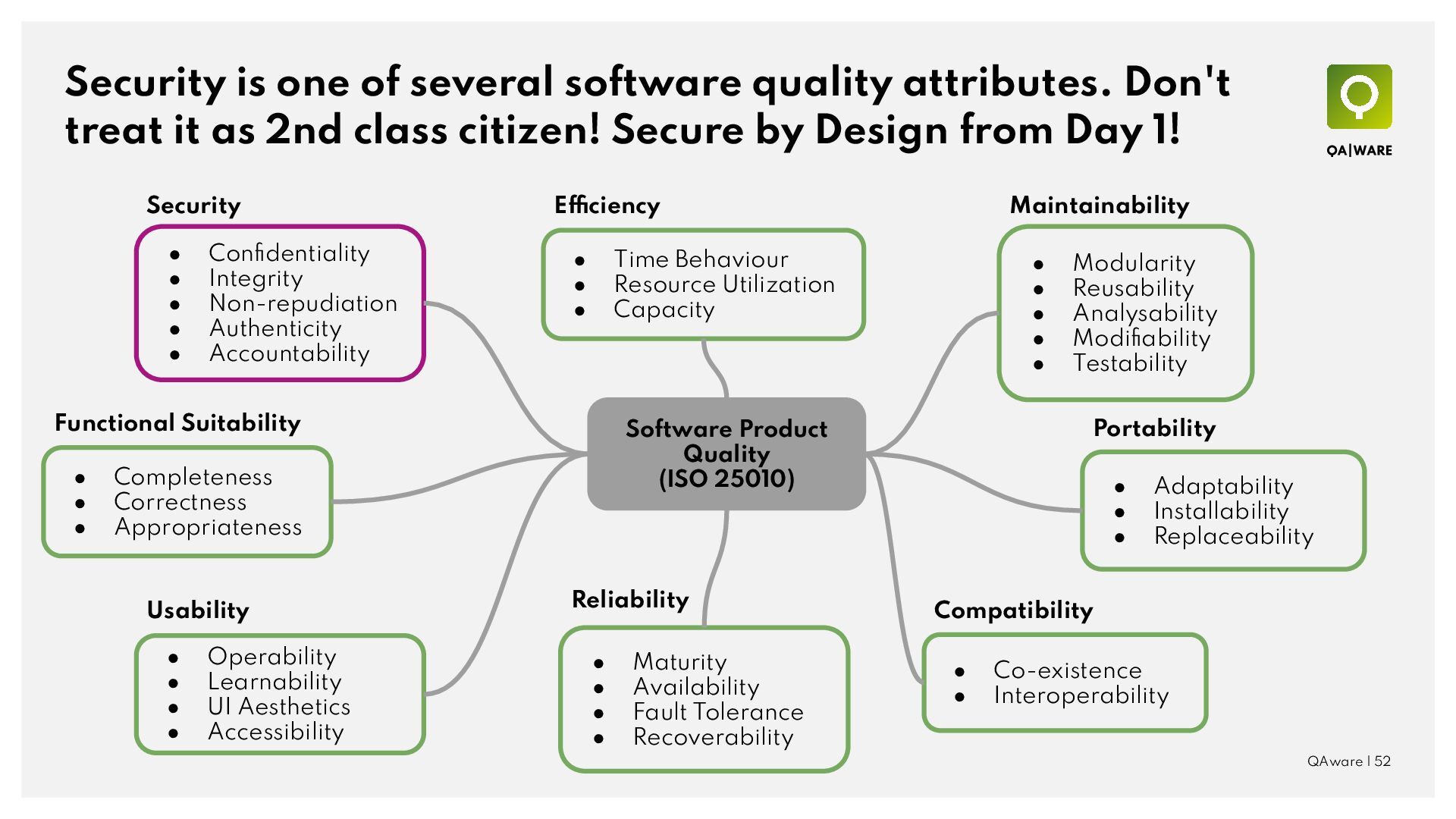
  36. Security is one of several software quality attributes. Don't treat

    it as 2nd class citizen! Secure by Design from Day 1! QAware | 52 Software Product Quality (ISO 25010) • Modularity • Reusability • Analysability • Modifiability • Testability Maintainability • Confidentiality • Integrity • Non-repudiation • Authenticity • Accountability Security • Adaptability • Installability • Replaceability Portability • Co-existence • Interoperability Compatibility • Maturity • Availability • Fault Tolerance • Recoverability Reliability • Time Behaviour • Resource Utilization • Capacity Efficiency • Completeness • Correctness • Appropriateness Functional Suitability • Operability • Learnability • UI Aesthetics • Accessibility Usability
  37. QAware GmbH | Aschauer Straße 30 | 81549 München |

    GF: Dr. Josef Adersberger, Michael Stehnken, Michael Rohleder, Mario-Leander Reimer Niederlassungen in München, Mainz, Rosenheim, Darmstadt | +49 89 232315-0 | [email protected] Thank you! The next step? Let's talk. Mario-Leander Reimer Managing Director, CTO [email protected] +49 151 61314748