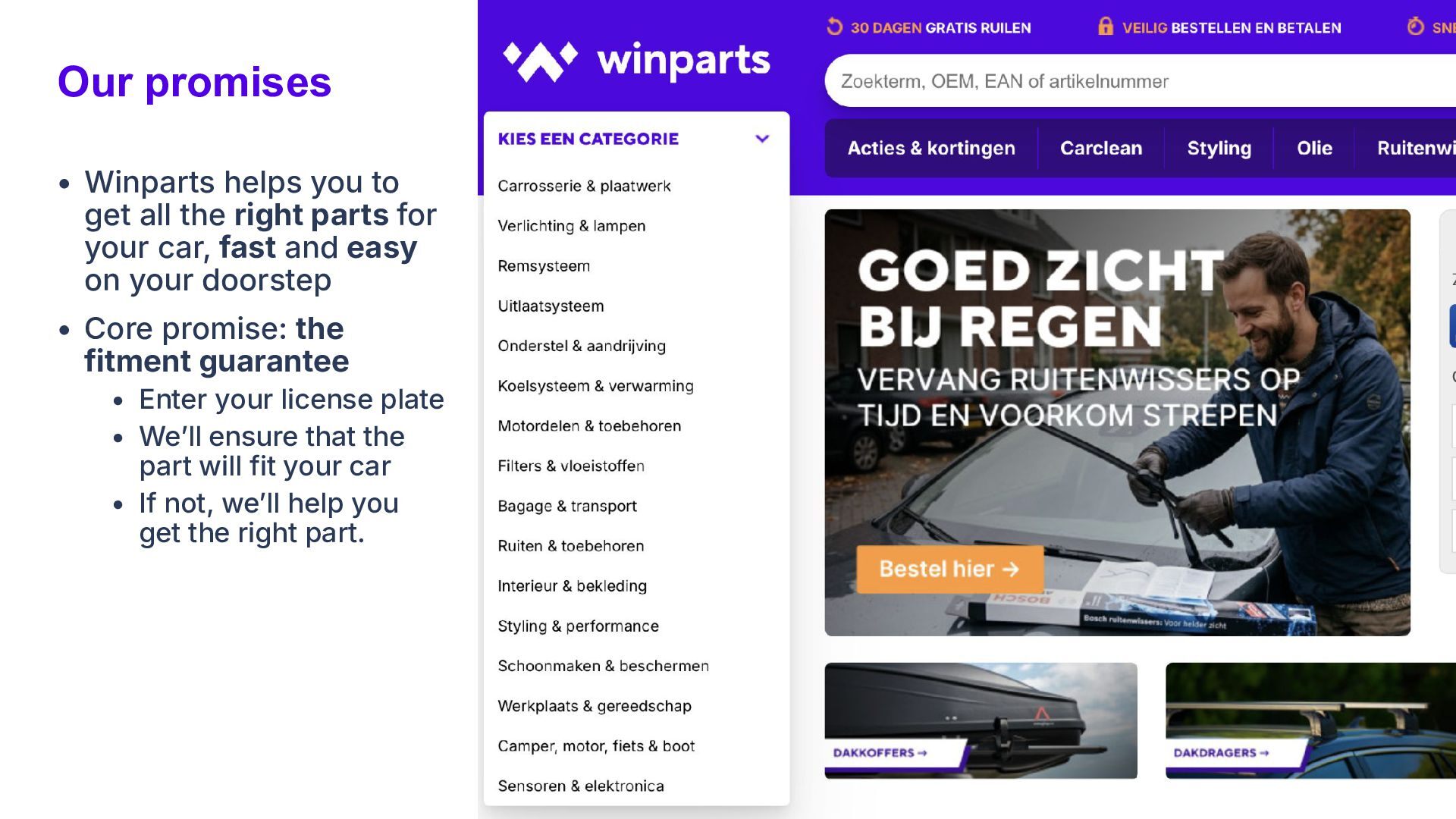
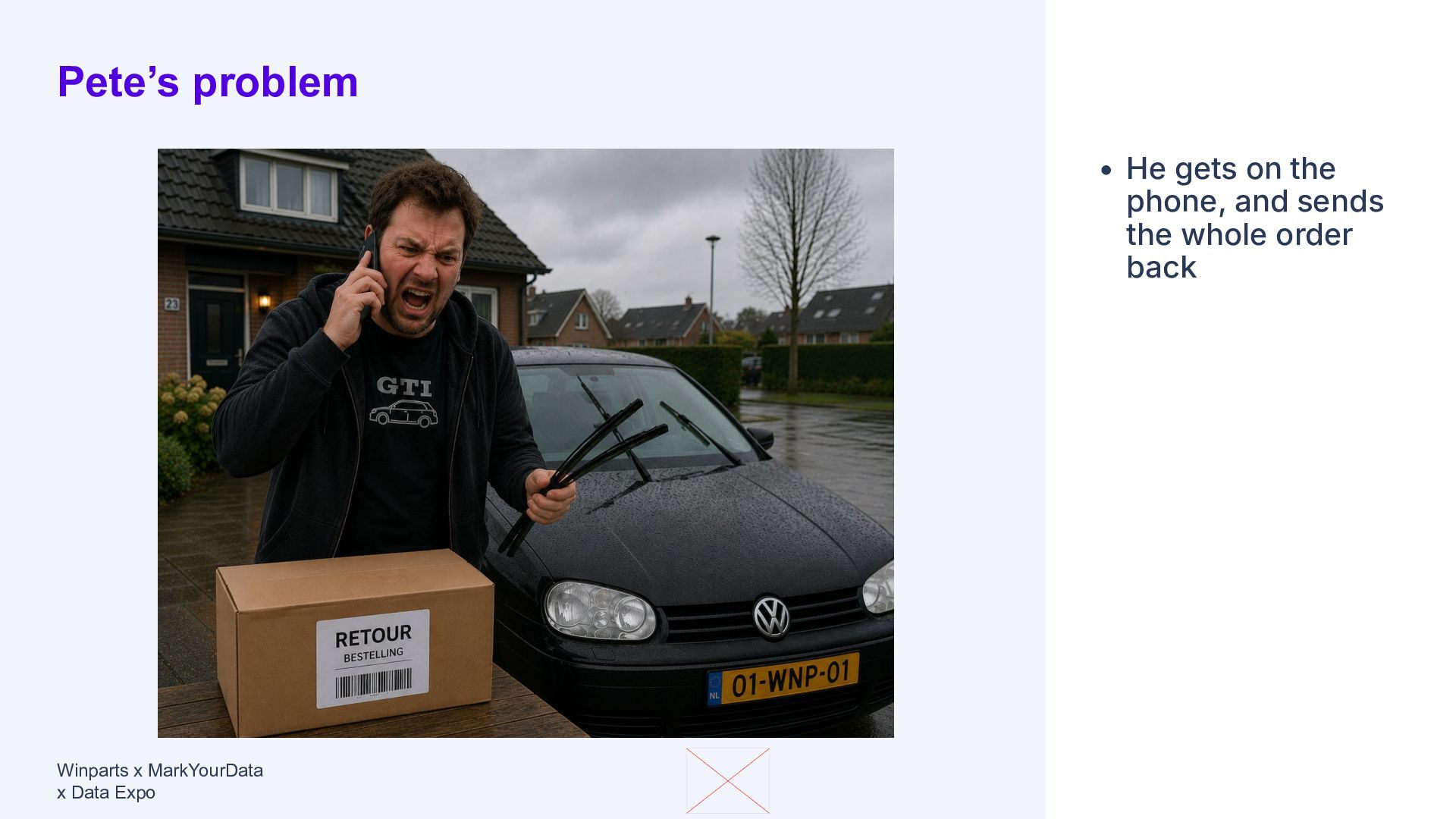
right parts for your car, fast and easy on your doorstep • Core promise: the fitment guarantee • Enter your license plate • Weʼll ensure that the part will fit your car • If not, weʼll help you get the right part.
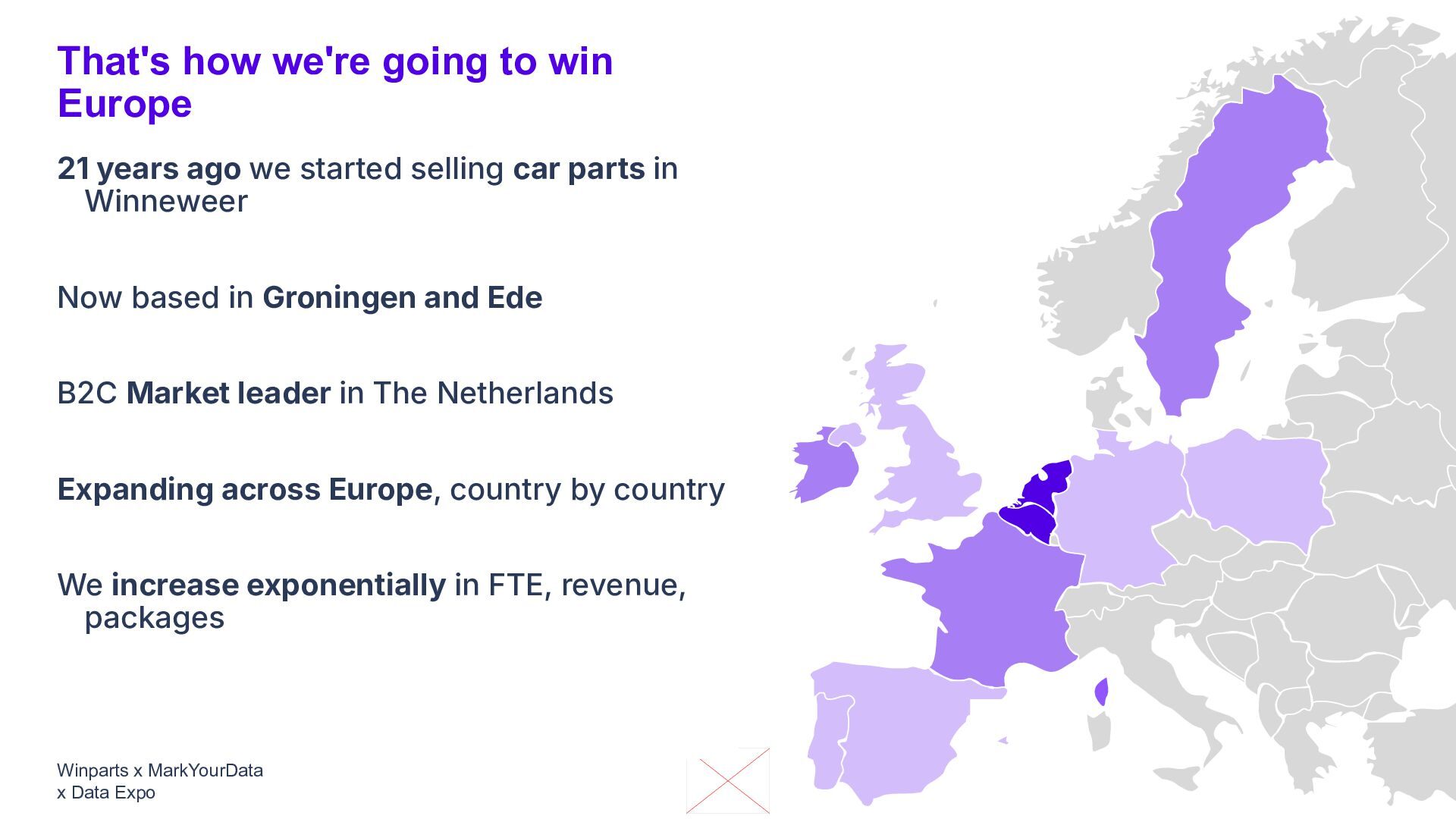
we started selling car parts in Winneweer Now based in Groningen and Ede B2C Market leader in The Netherlands Expanding across Europe, country by country We increase exponentially in FTE, revenue, packages Winparts x MarkYourData x Data Expo 3
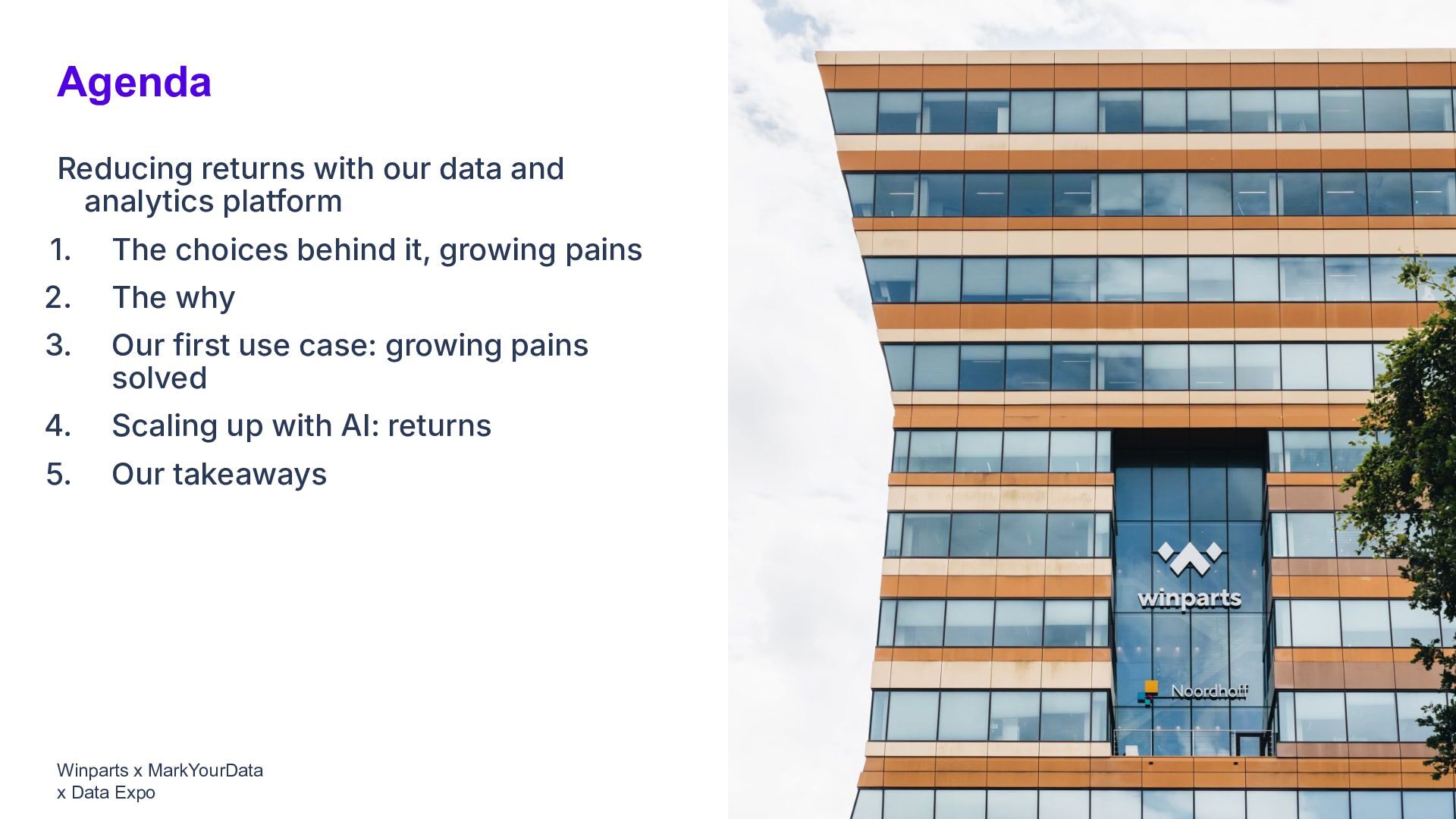
The choices behind it, growing pains 2. The why 3. Our first use case: growing pains solved 4. Scaling up with AI: returns 5. Our takeaways Winparts x MarkYourData x Data Expo
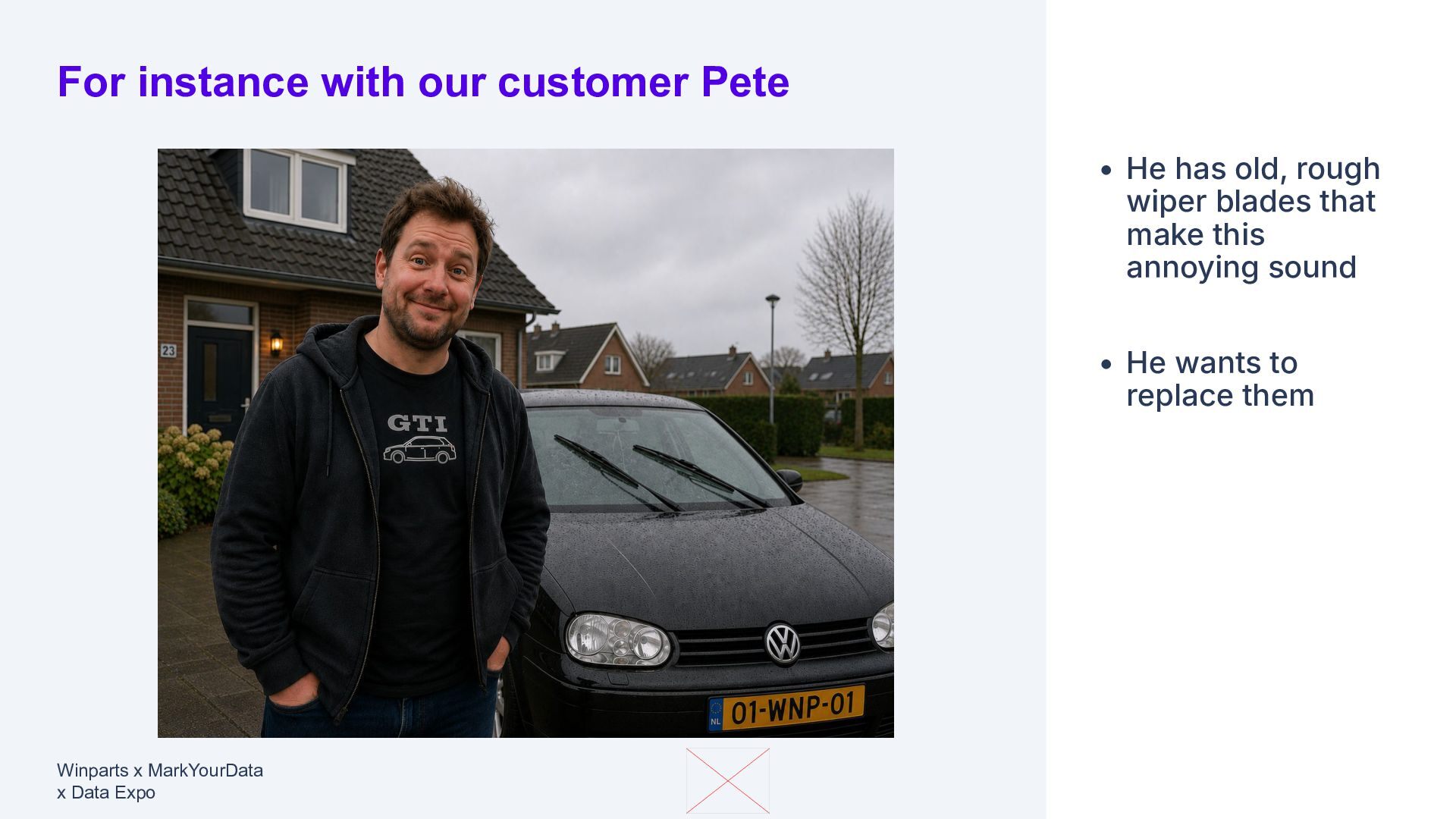
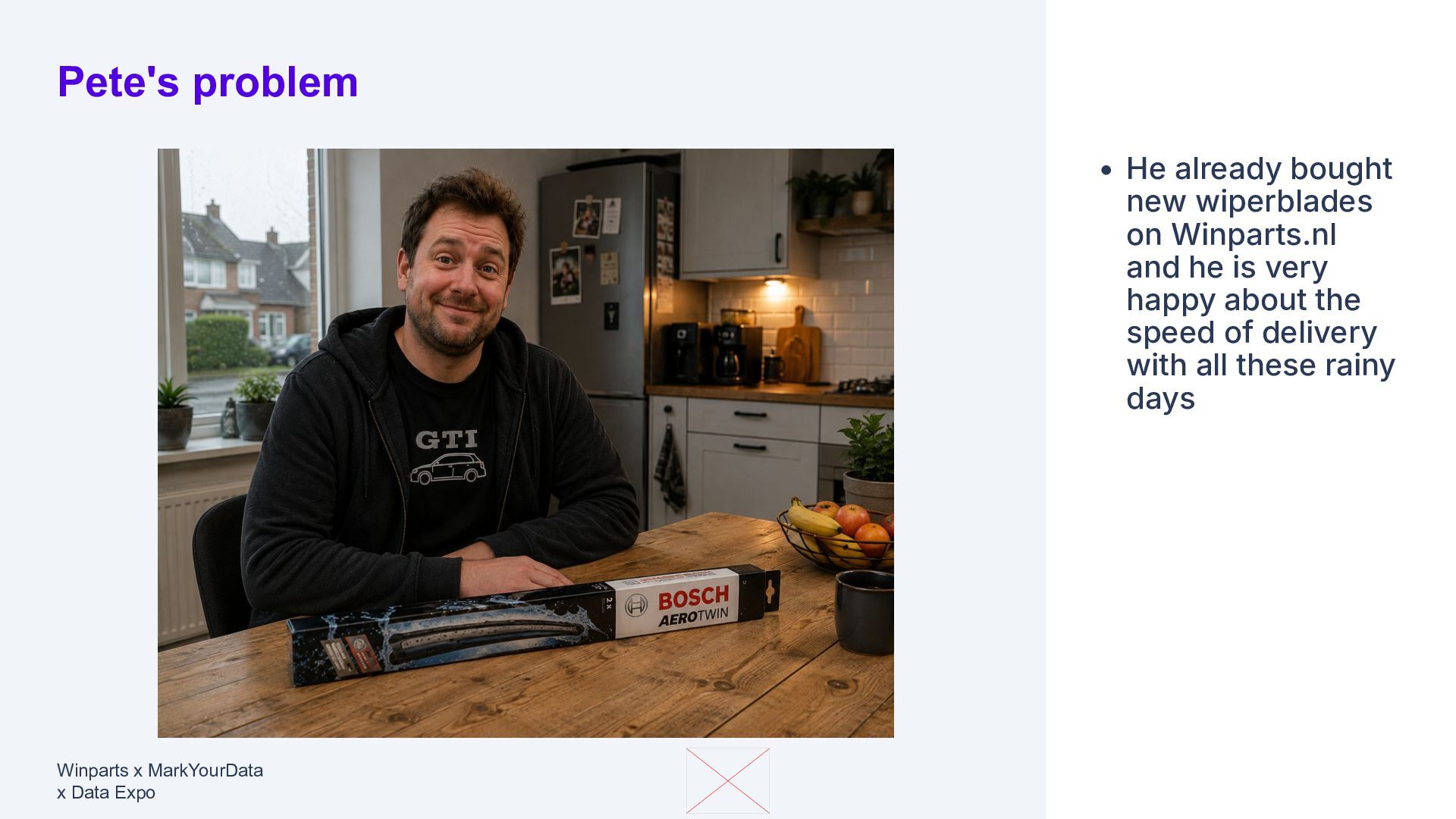
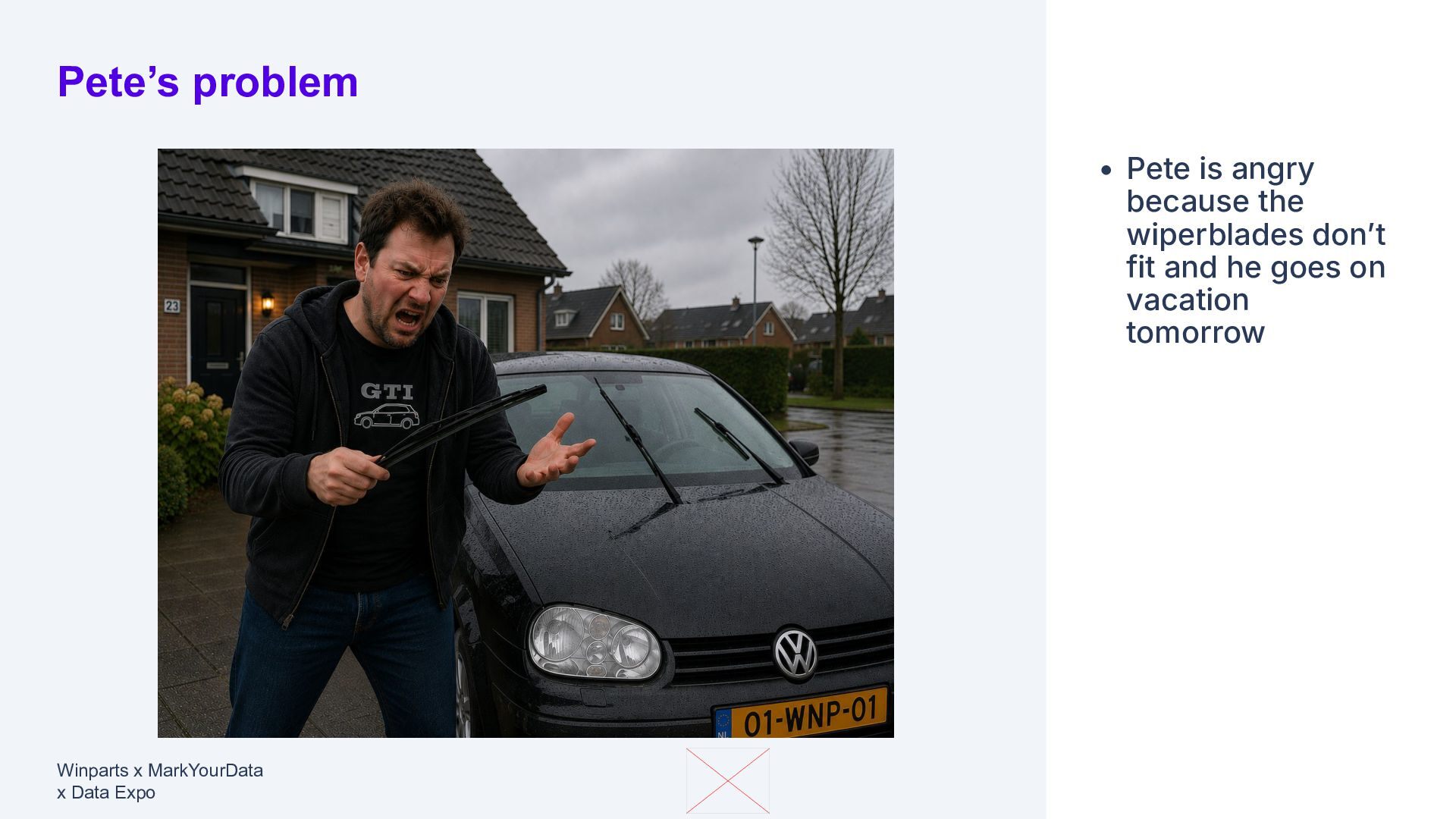
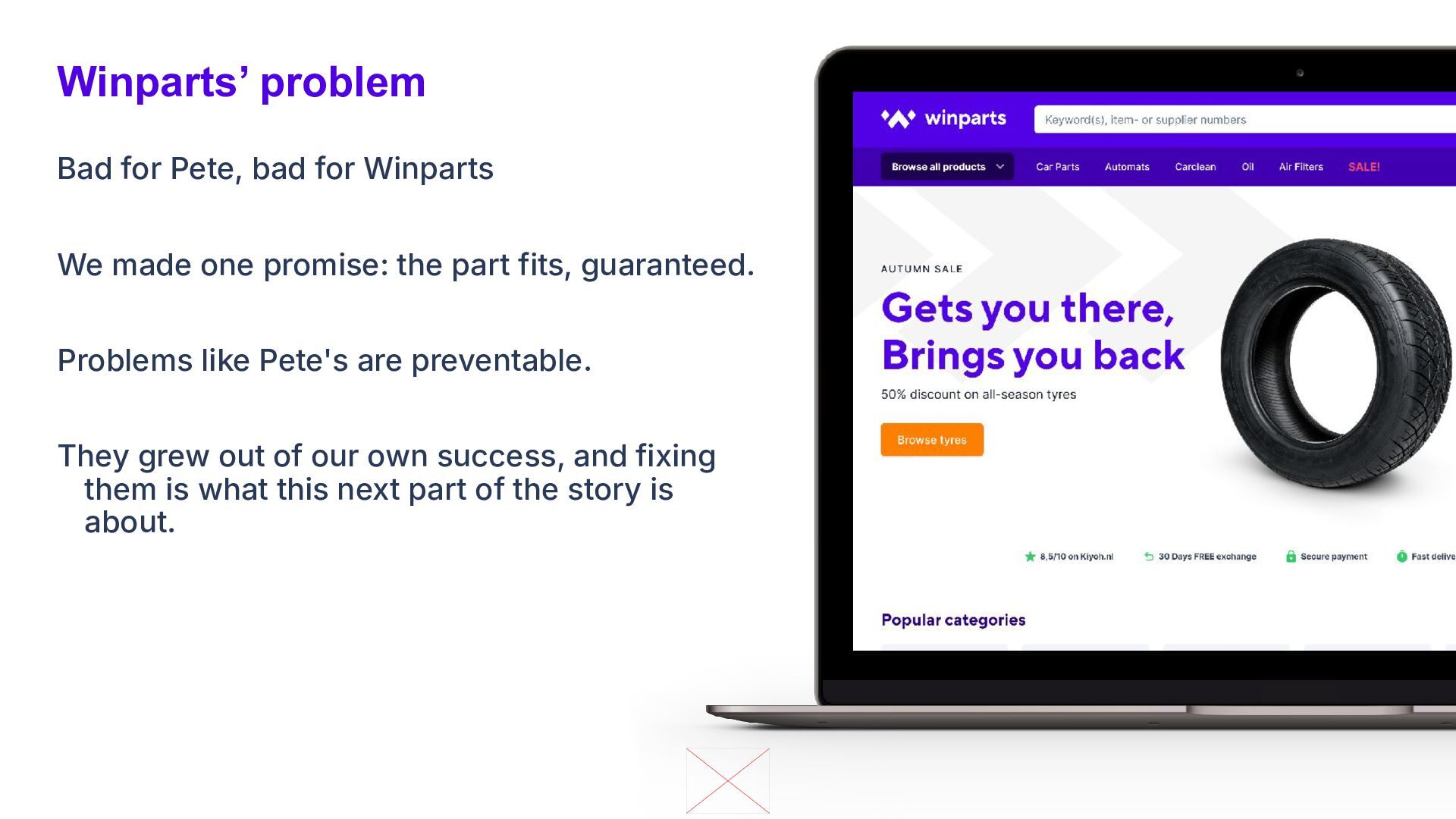
one promise: the part fits, guaranteed. Problems like Pete's are preventable. They grew out of our own success, and fixing them is what this next part of the story is about.
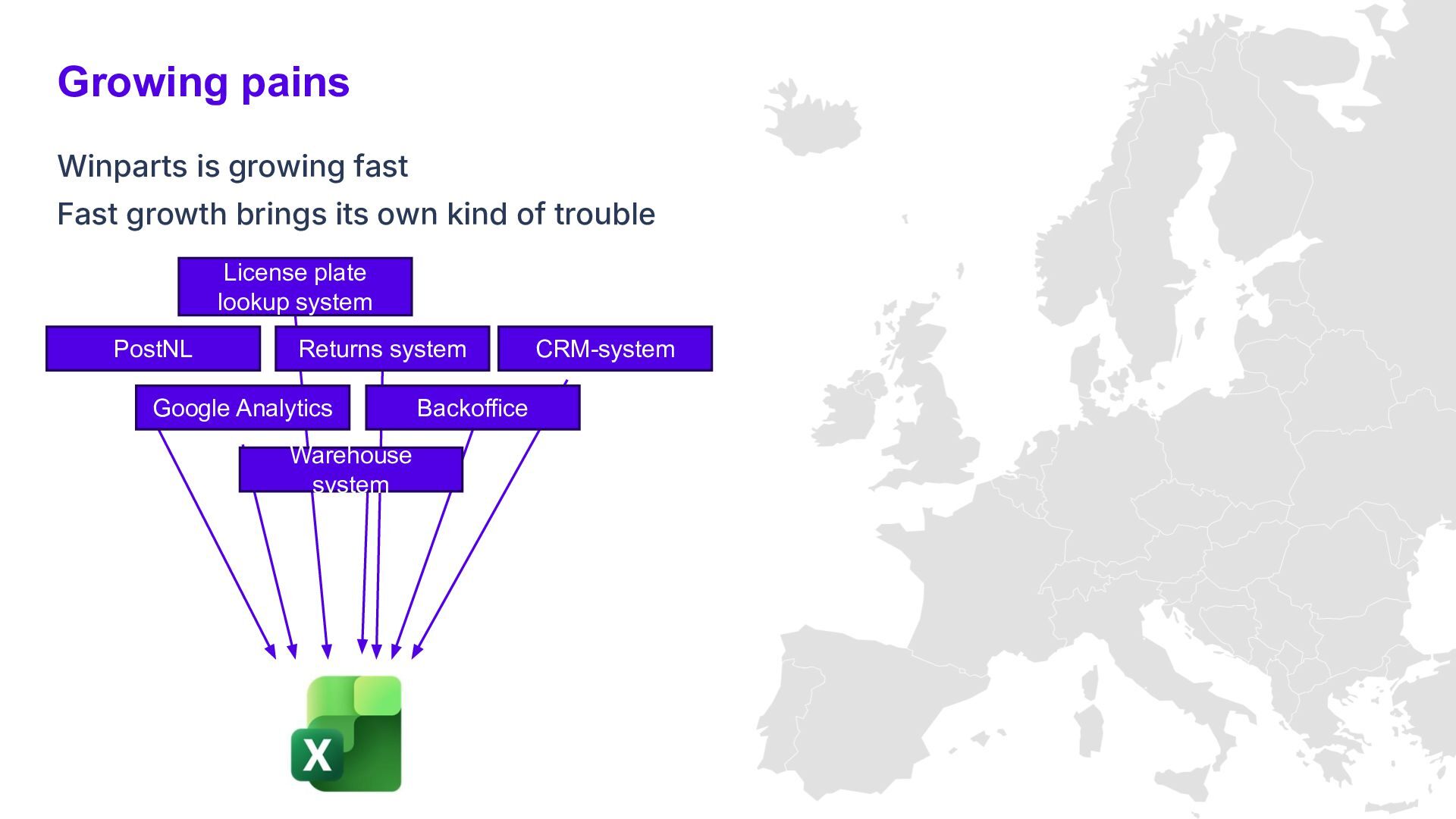
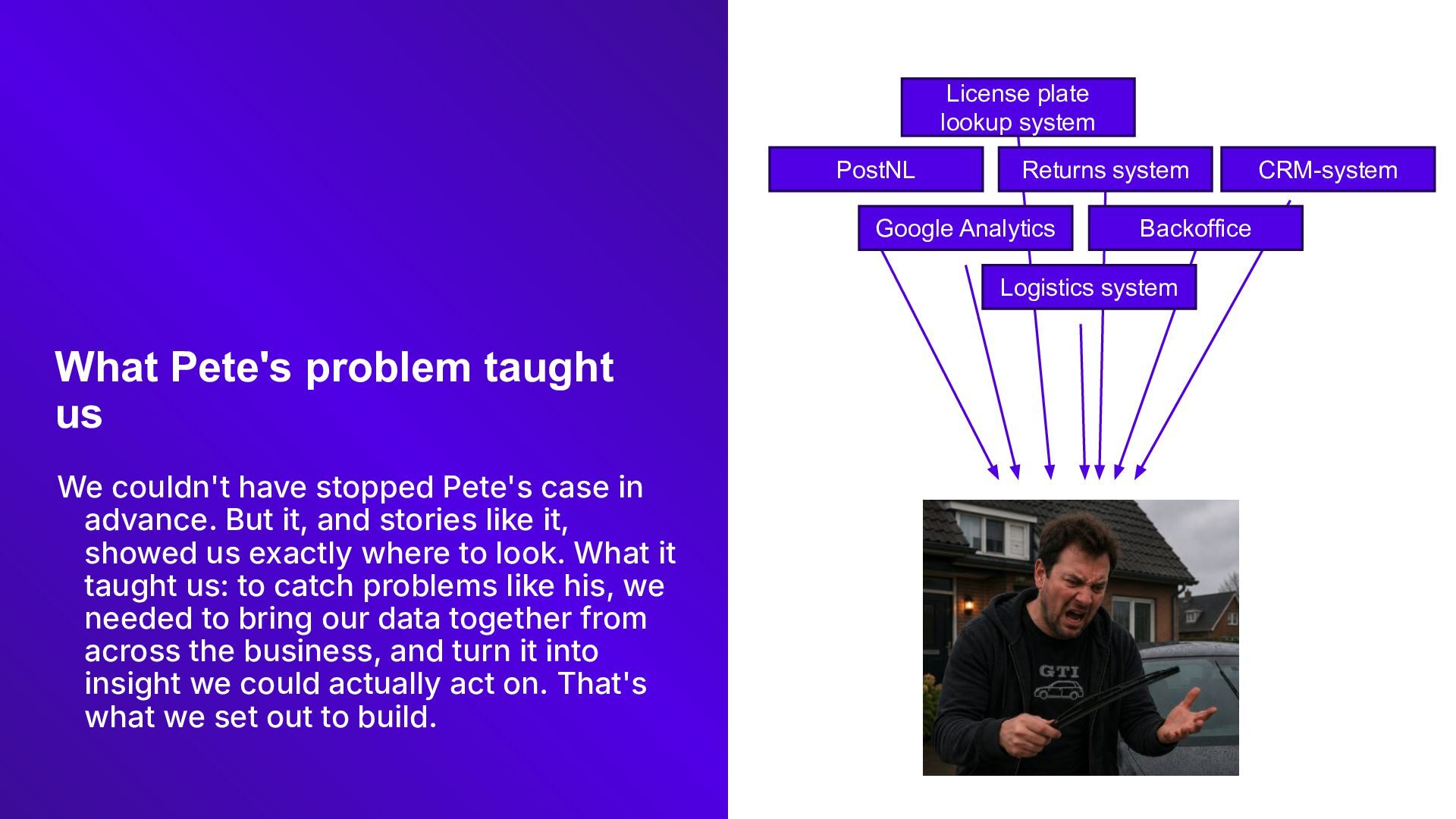
Logistics system What Pete's problem taught us We couldn't have stopped Pete's case in advance. But it, and stories like it, showed us exactly where to look. What it taught us: to catch problems like his, we needed to bring our data together from across the business, and turn it into insight we could actually act on. That's what we set out to build. CRM-system
move was to buy one big, all-in-one platform. We didn't. We don't handle streaming data, we're nowhere near that scale, a single vendor is a door that only opens one way — and our data has to stay in our own controlled environment. So we built something lightweight, out of open-source tools, sized for the Winparts we actually are.
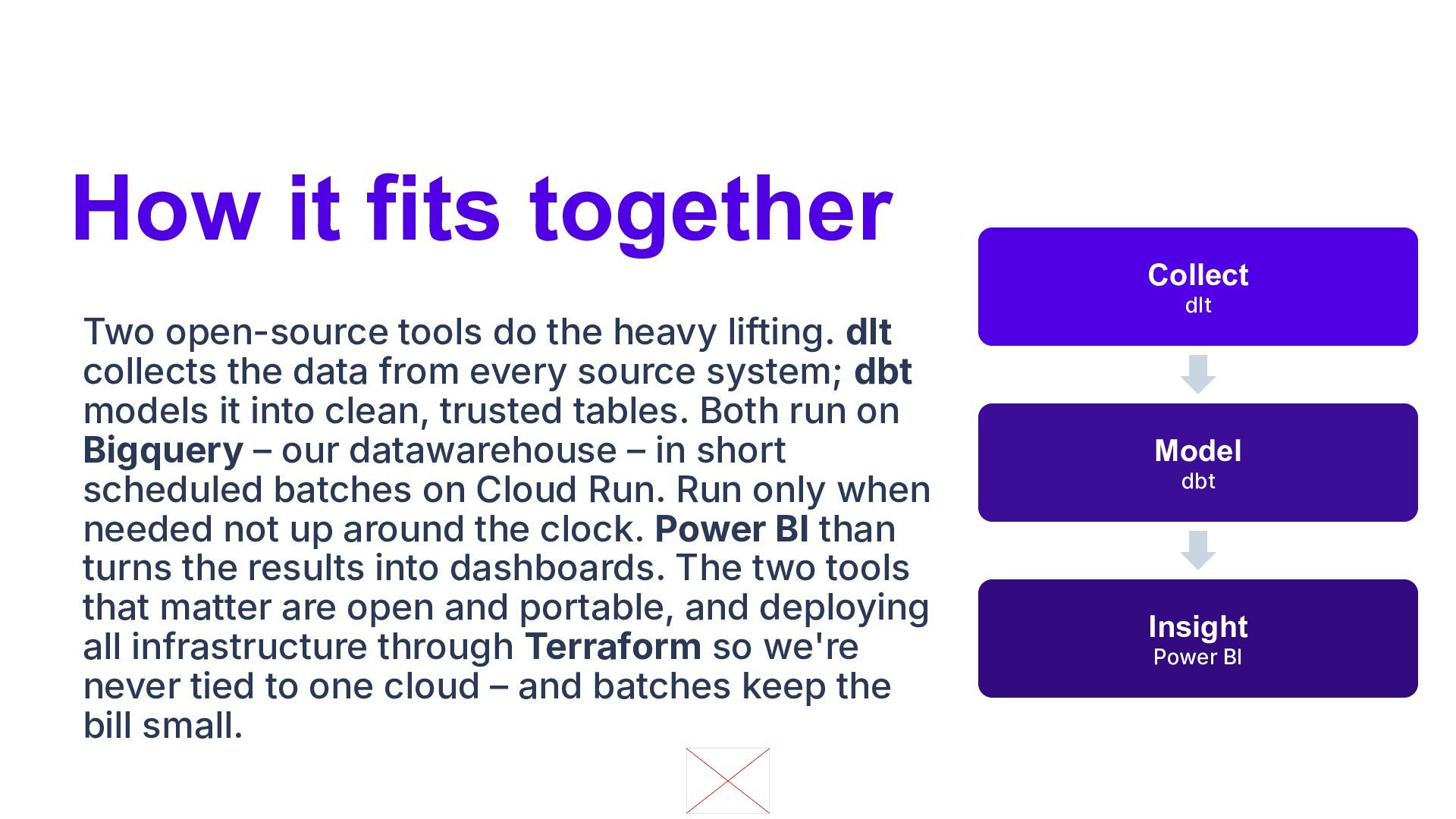
heavy lifting. dlt collects the data from every source system; dbt models it into clean, trusted tables. Both run on Bigquery – our datawarehouse – in short scheduled batches on Cloud Run. Run only when needed not up around the clock. Power BI than turns the results into dashboards. The two tools that matter are open and portable, and deploying all infrastructure through Terraform so we're never tied to one cloud – and batches keep the bill small. dlt Model dbt Insight Power BI
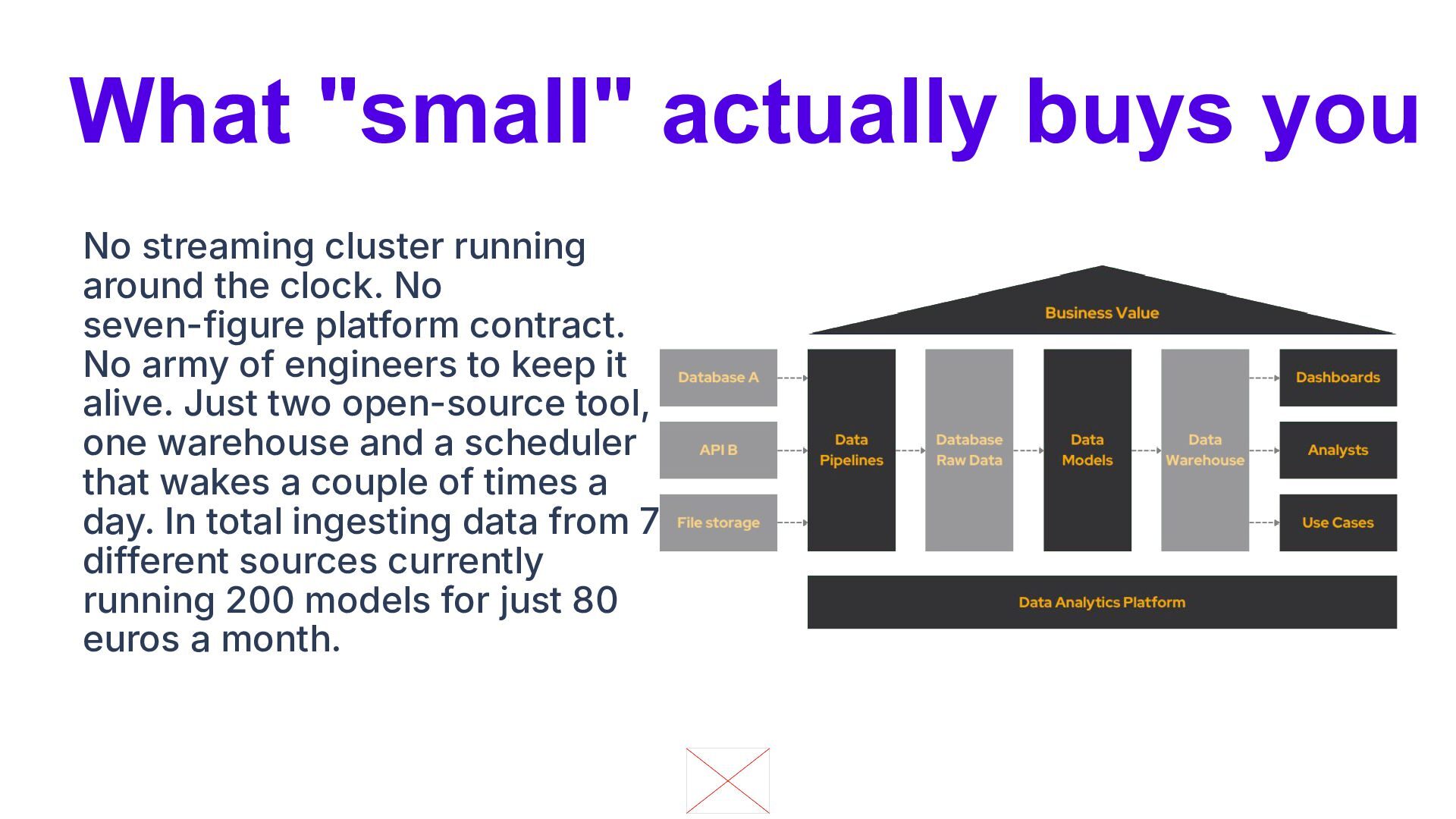
the clock. No seven-figure platform contract. No army of engineers to keep it alive. Just two open-source tool, one warehouse and a scheduler that wakes a couple of times a day. In total ingesting data from 7 different sources currently running 200 models for just 80 euros a month.
question we could pick: which products get sent back the most? Nothing fancy — but now it's a ranked list, refreshed daily, across every system at once. If it doesn't fit, it comes back
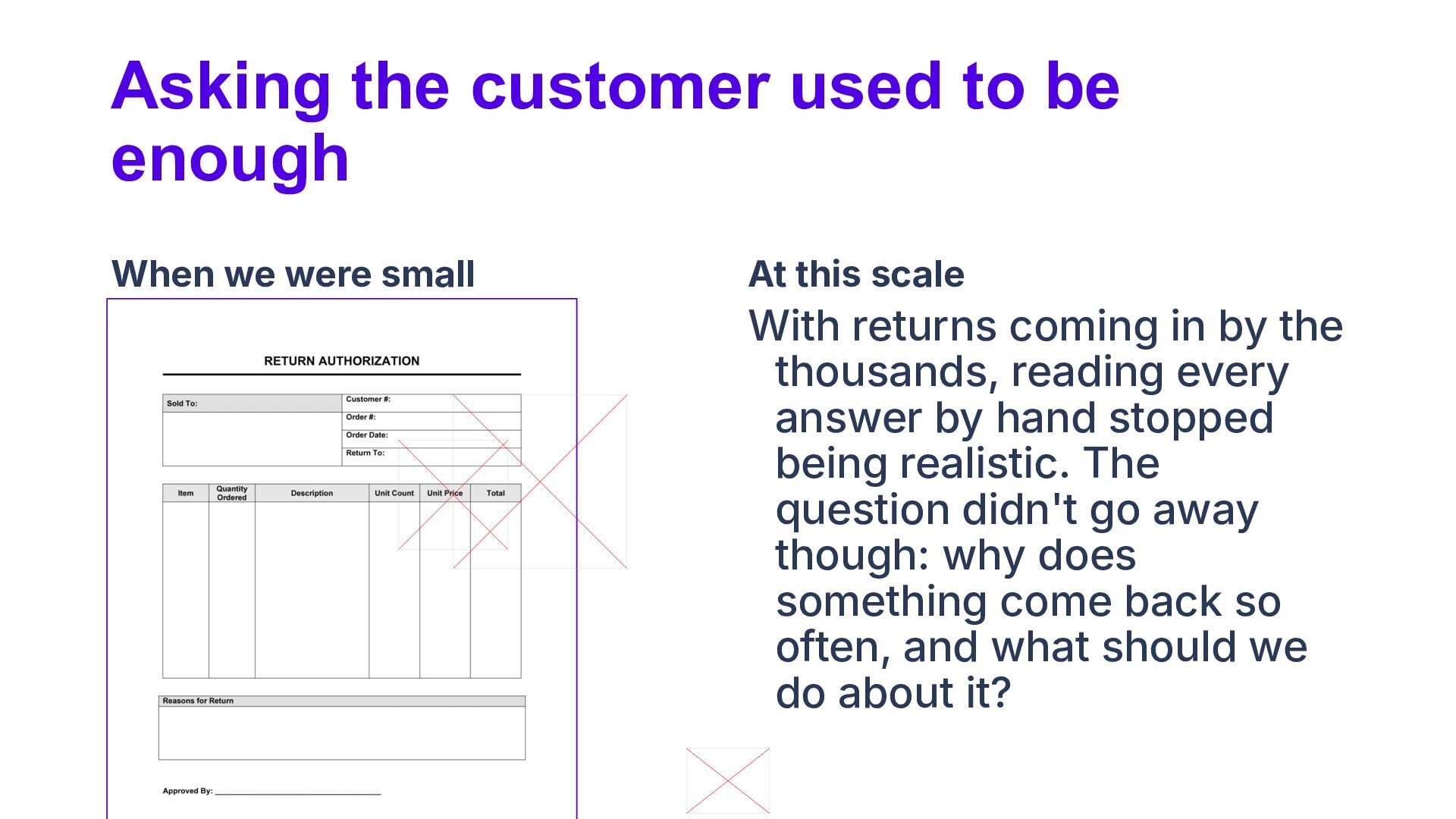
small At this scale With returns coming in by the thousands, reading every answer by hand stopped being realistic. The question didn't go away though: why does something come back so often, and what should we do about it?
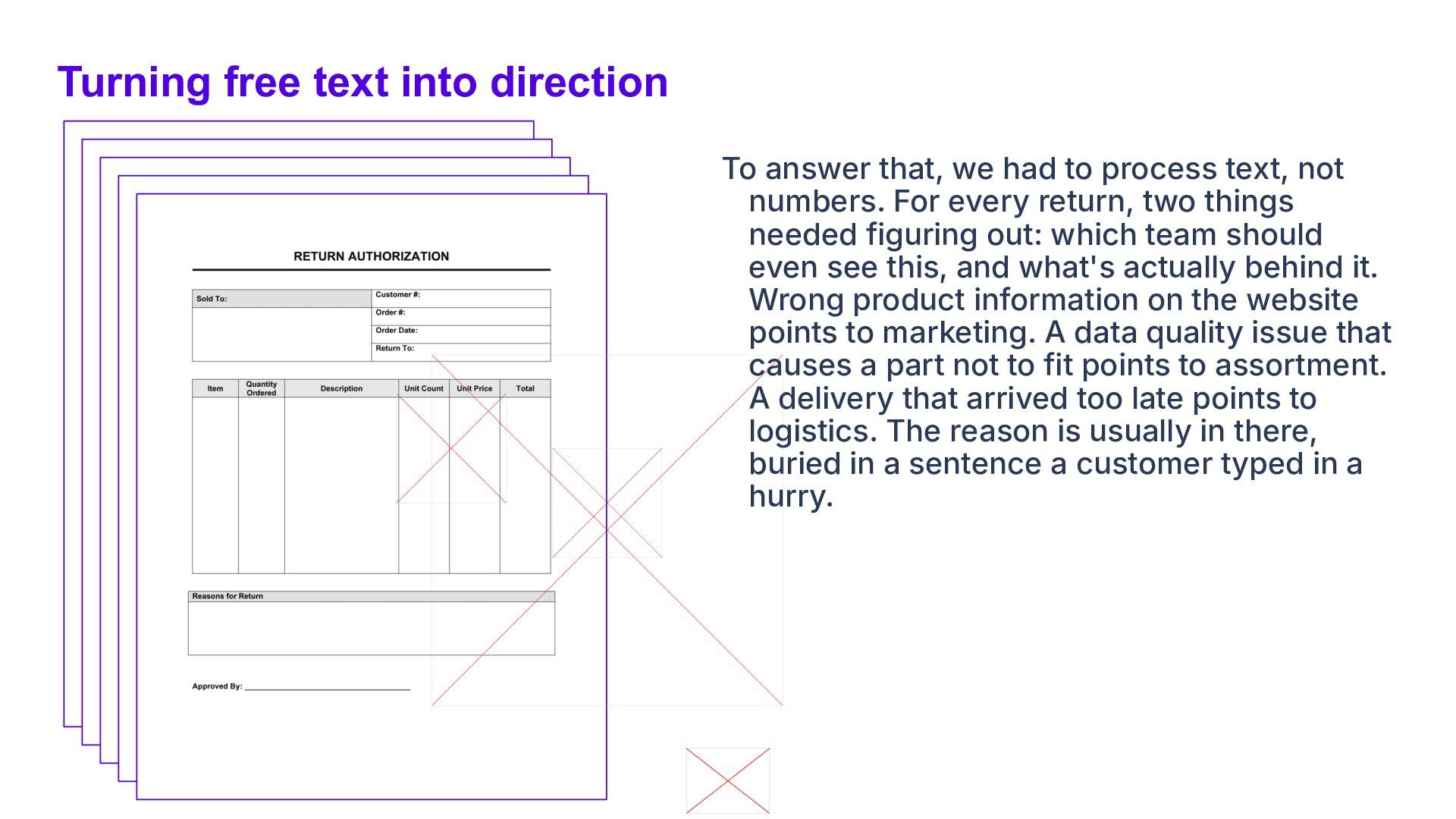
to process text, not numbers. For every return, two things needed figuring out: which team should even see this, and what's actually behind it. Wrong product information on the website points to marketing. A data quality issue that causes a part not to fit points to assortment. A delivery that arrived too late points to logistics. The reason is usually in there, buried in a sentence a customer typed in a hurry.
does What teams get We never set out to do AI. But reading thousands of free-text return notes by hand stopped being realistic, so a small AI job reads every note, sorts it into a category, and summarizes the likely root cause. Instead of a pile of raw comments, our goal is that assortment, marketing, and logistics each get a clear signal back: here's what's actually going wrong, and roughly how often.
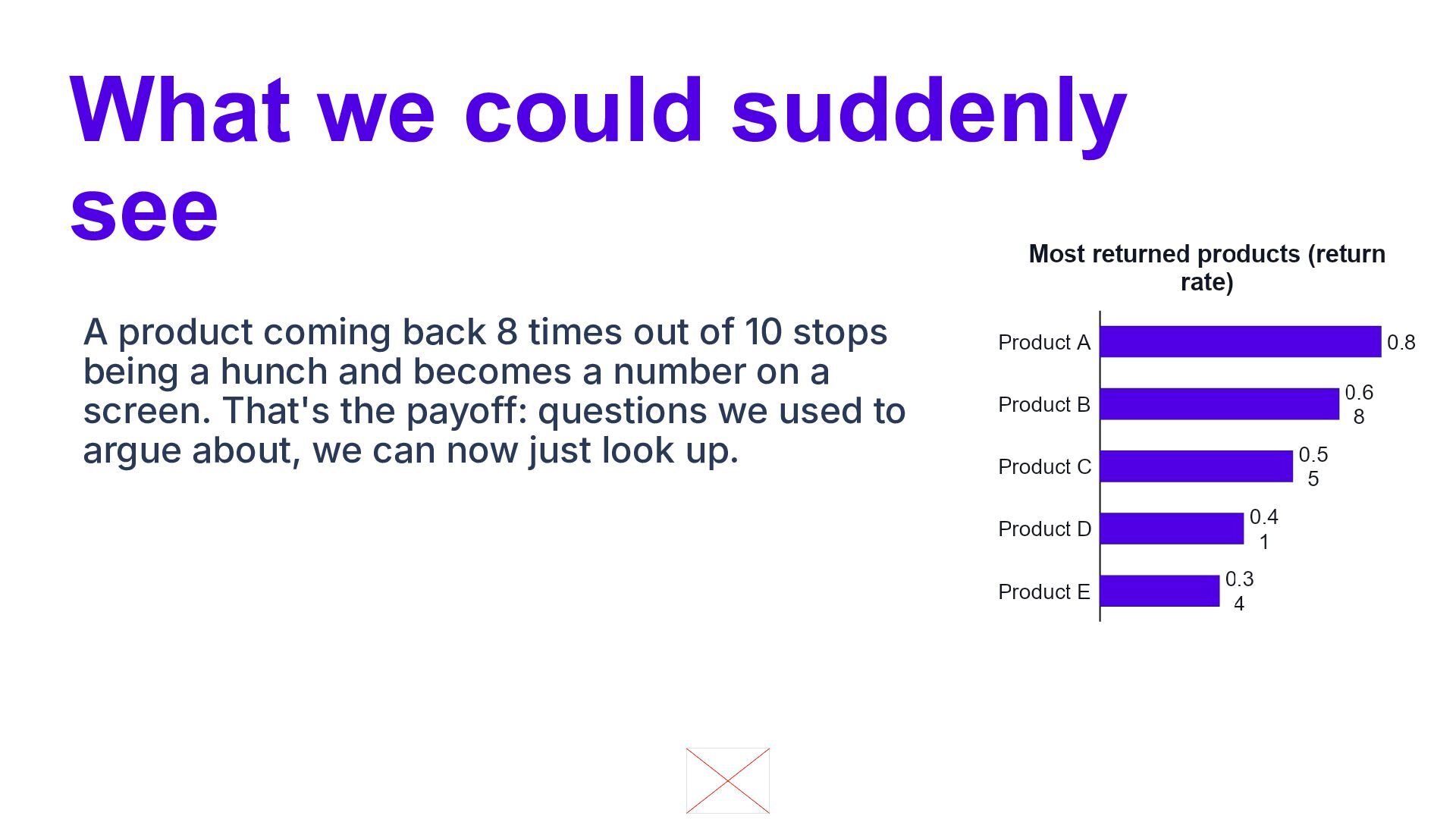
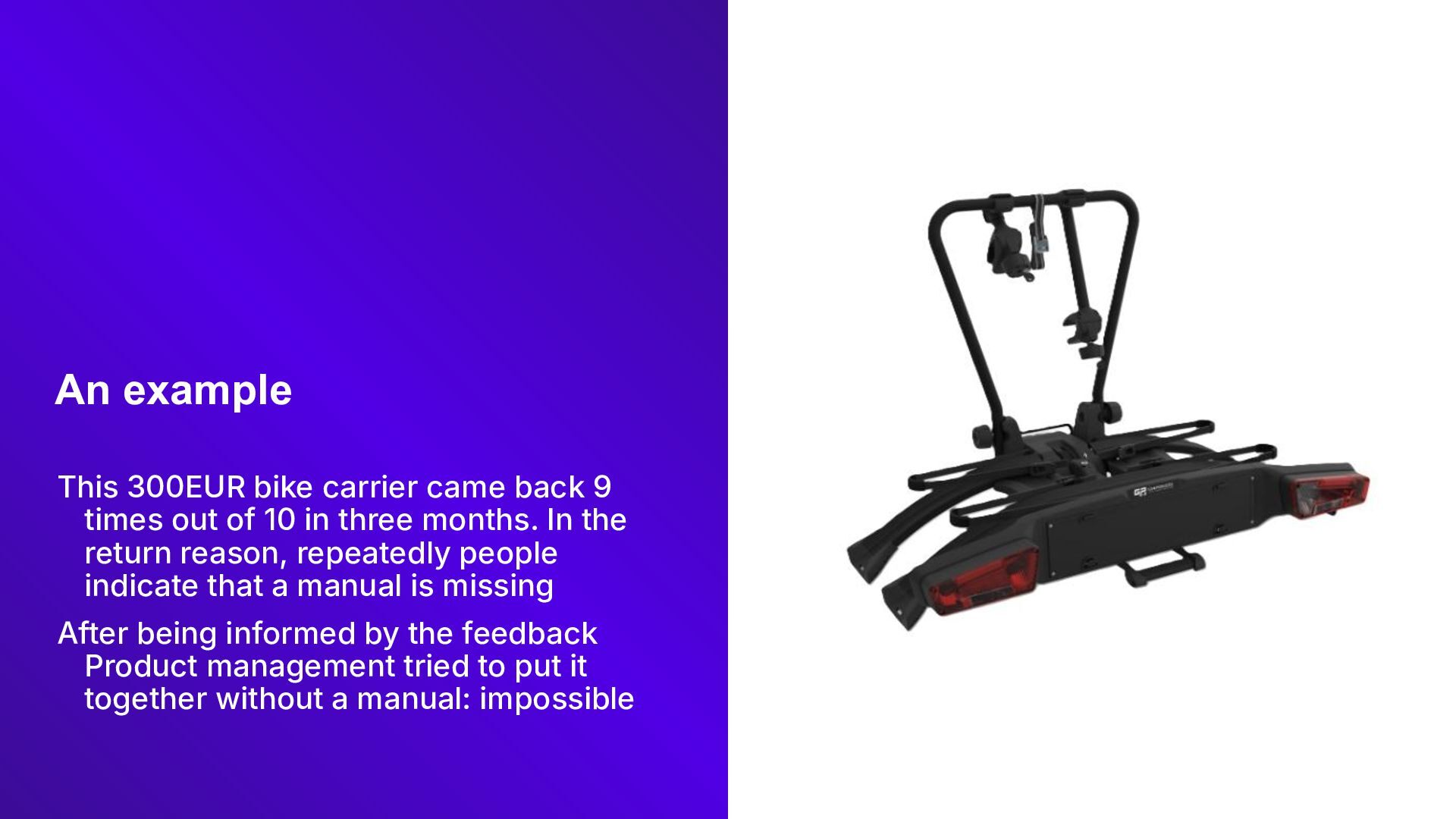
out of 10 in three months. In the return reason, repeatedly people indicate that a manual is missing After being informed by the feedback Product management tried to put it together without a manual: impossible
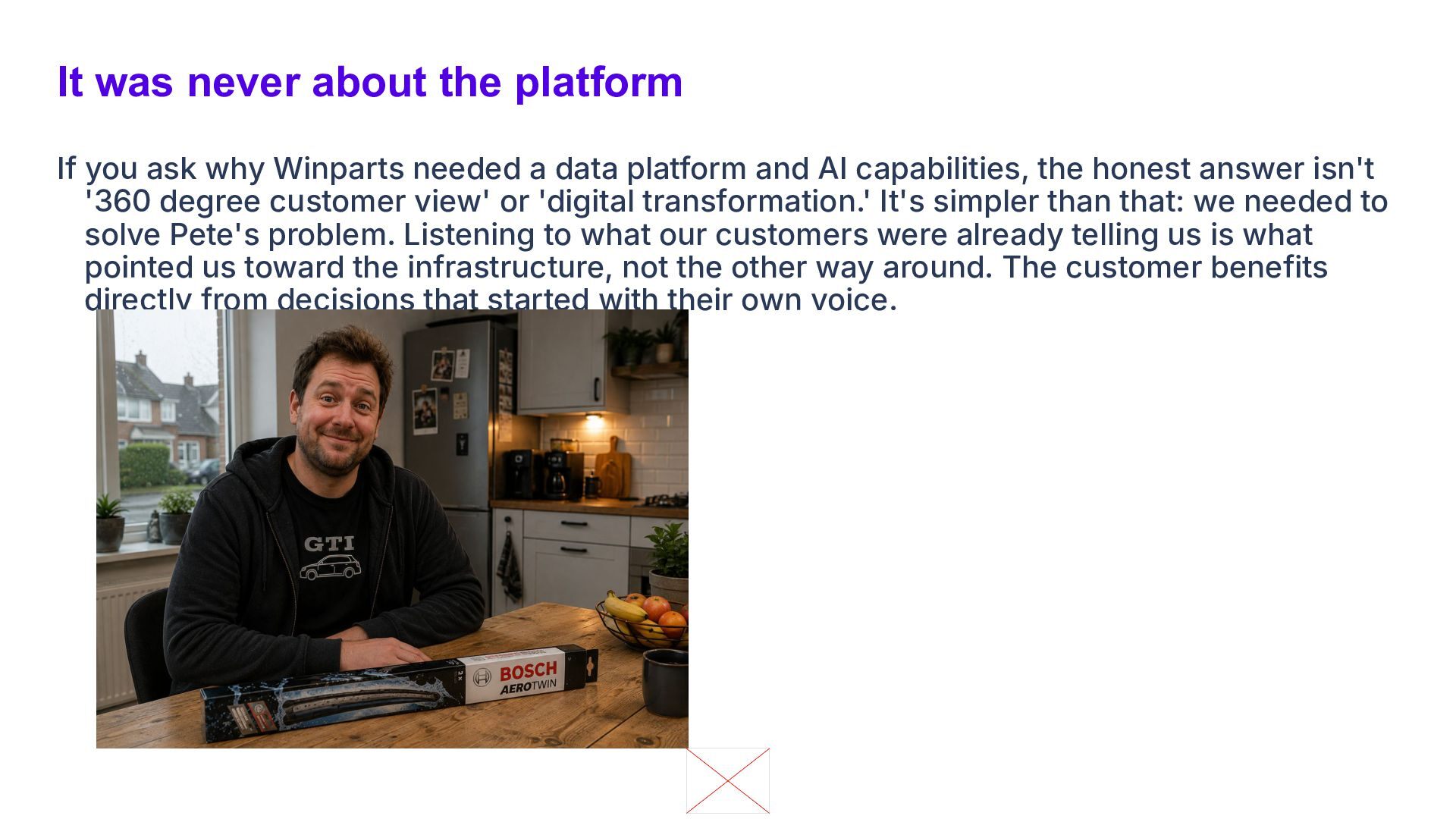
Winparts needed a data platform and AI capabilities, the honest answer isn't '360 degree customer view' or 'digital transformation.' It's simpler than that: we needed to solve Pete's problem. Listening to what our customers were already telling us is what pointed us toward the infrastructure, not the other way around. The customer benefits directly from decisions that started with their own voice.
Dataplatform Marketing challenge And cheaper too The open tools we used for ingestion and modelling only need to run for a short window once a day. That's a fraction of the cost of committing to cloud-vendor-specific tools running around the clock. No lock-in, and a low bill.


 mark3t1ng
 varn
varn
 427marketing
 thirion
 mkilby
 raygrieselhuber
 chriscoyier
 tamaranovitovic
 takai
takai
 codingconduct
 reverentgeek
 kimpetersen
 sarafernandez