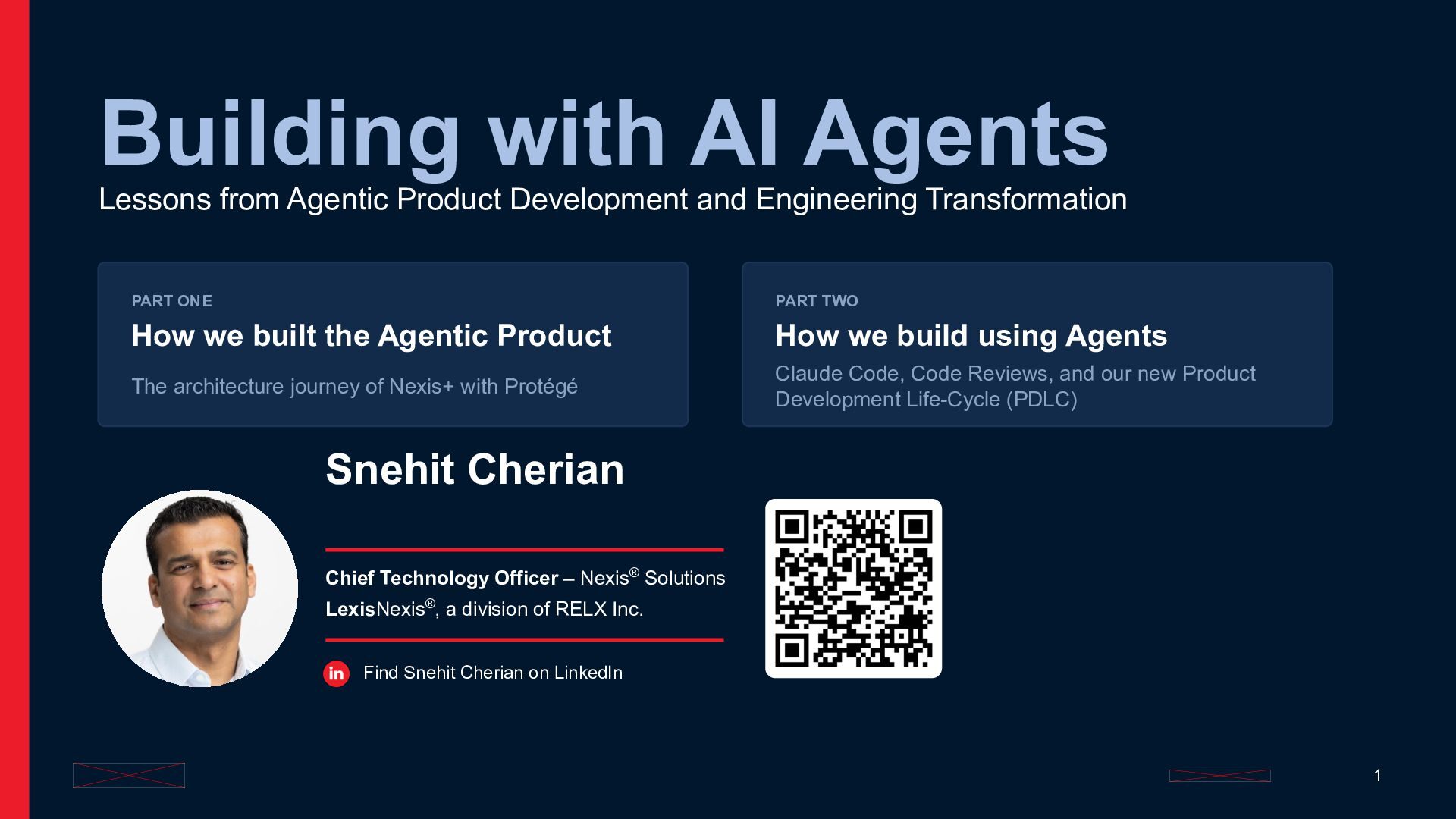
Engineering Transformation PART ONE PART TWO How we built the Agentic Product How we build using Agents The architecture journey of Nexis+ with Protégé Claude Code, Code Reviews, and our new Product Development Life-Cycle (PDLC) Snehit Cherian Chief Technology Officer – Nexis® Solutions LexisNexis®, a division of RELX Inc. Find Snehit Cherian on LinkedIn 1
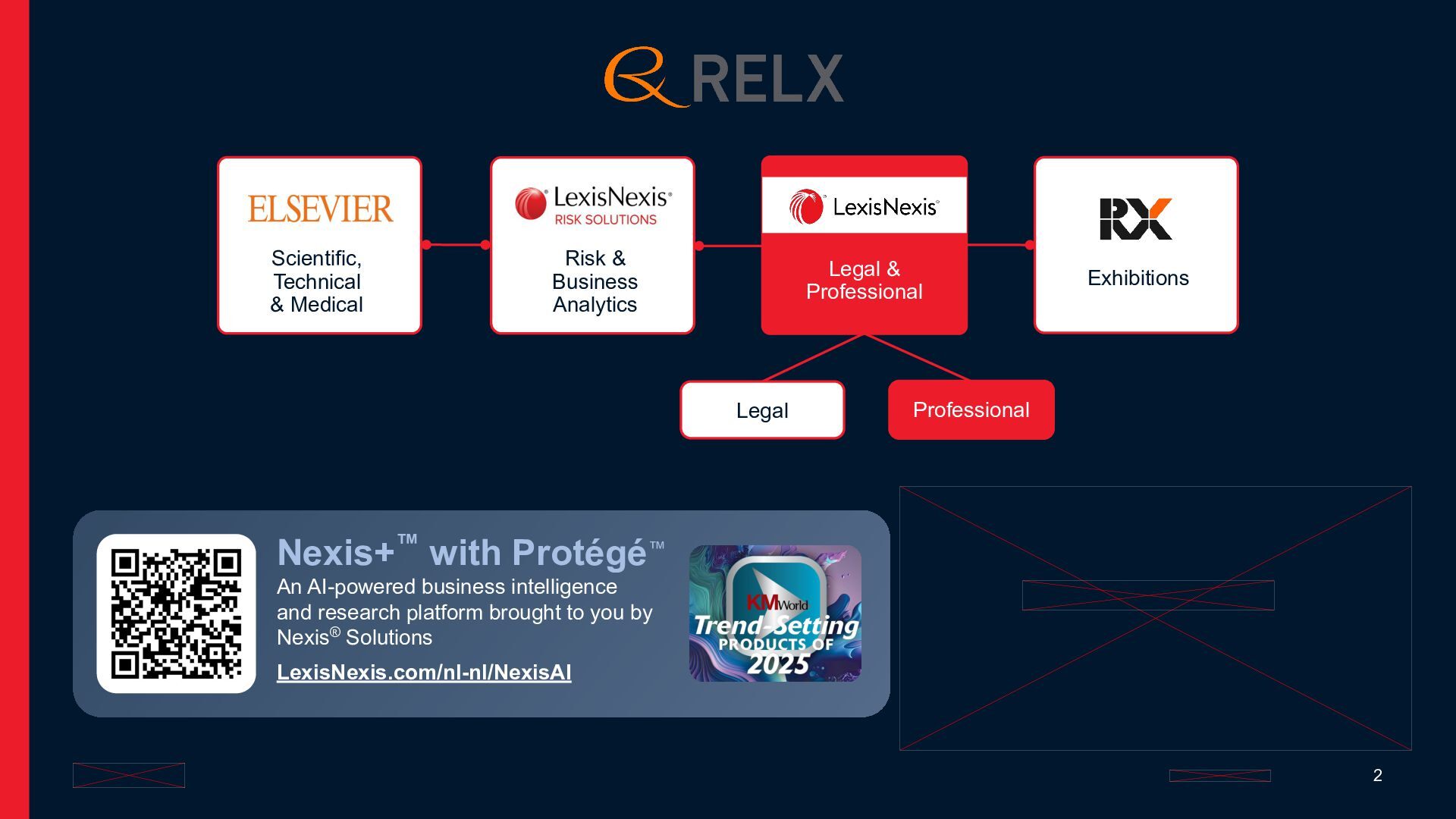
Professional Legal Exhibitions Professional Nexis+™ with Protégé™ An AI-powered business intelligence and research platform brought to you by Nexis® Solutions LexisNexis.com/nl-nl/NexisAI 2
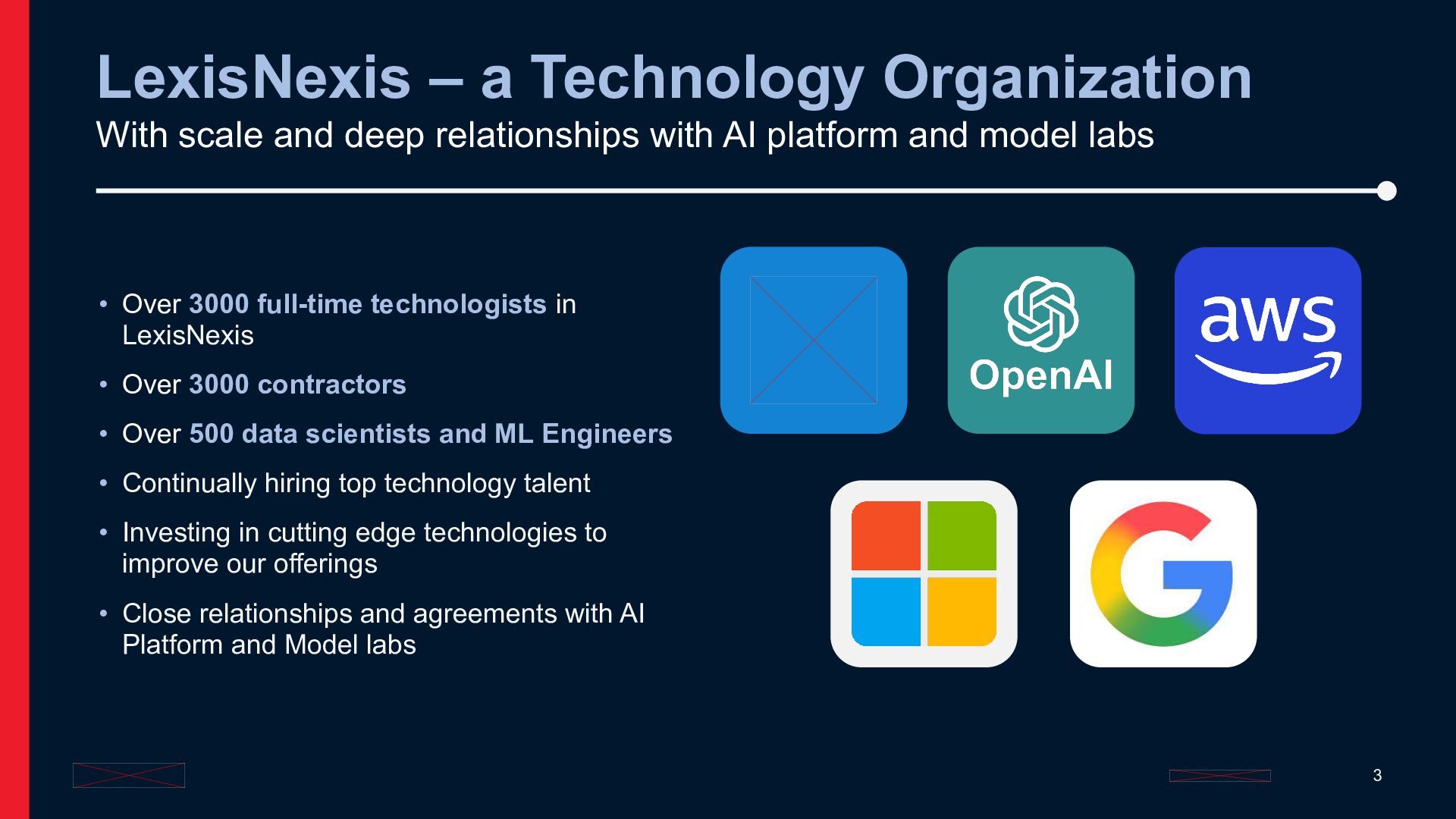
with AI platform and model labs • Over 3000 full-time technologists in LexisNexis • Over 3000 contractors • Over 500 data scientists and ML Engineers • Continually hiring top technology talent • Investing in cutting edge technologies to improve our offerings • Close relationships and agreements with AI Platform and Model labs 3
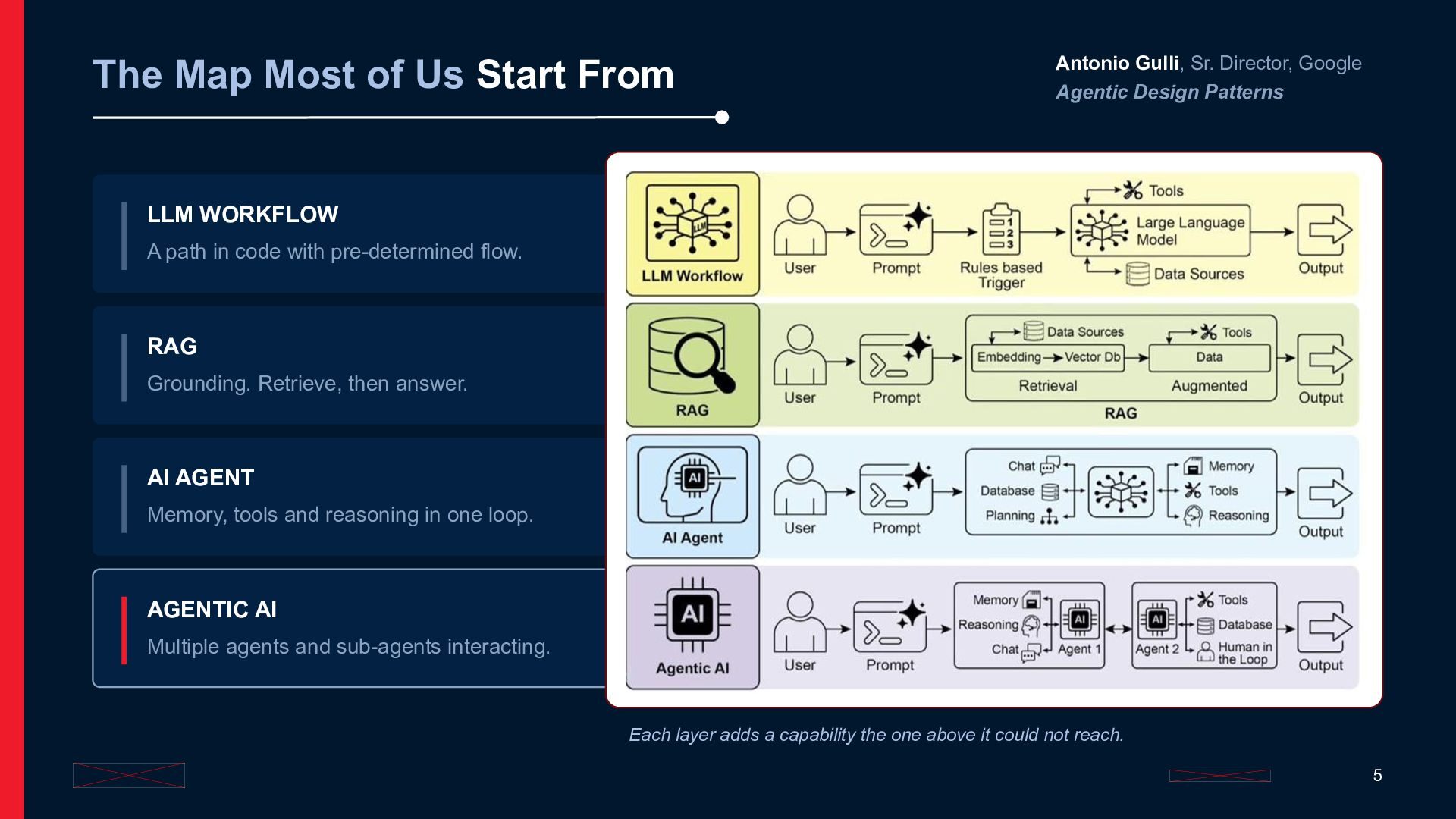
Director, Google Agentic Design Patterns LLM WORKFLOW A path in code with pre-determined flow. RAG Grounding. Retrieve, then answer. AI AGENT Memory, tools and reasoning in one loop. AGENTIC AI Multiple agents and sub-agents interacting. Each layer adds a capability the one above it could not reach. 5
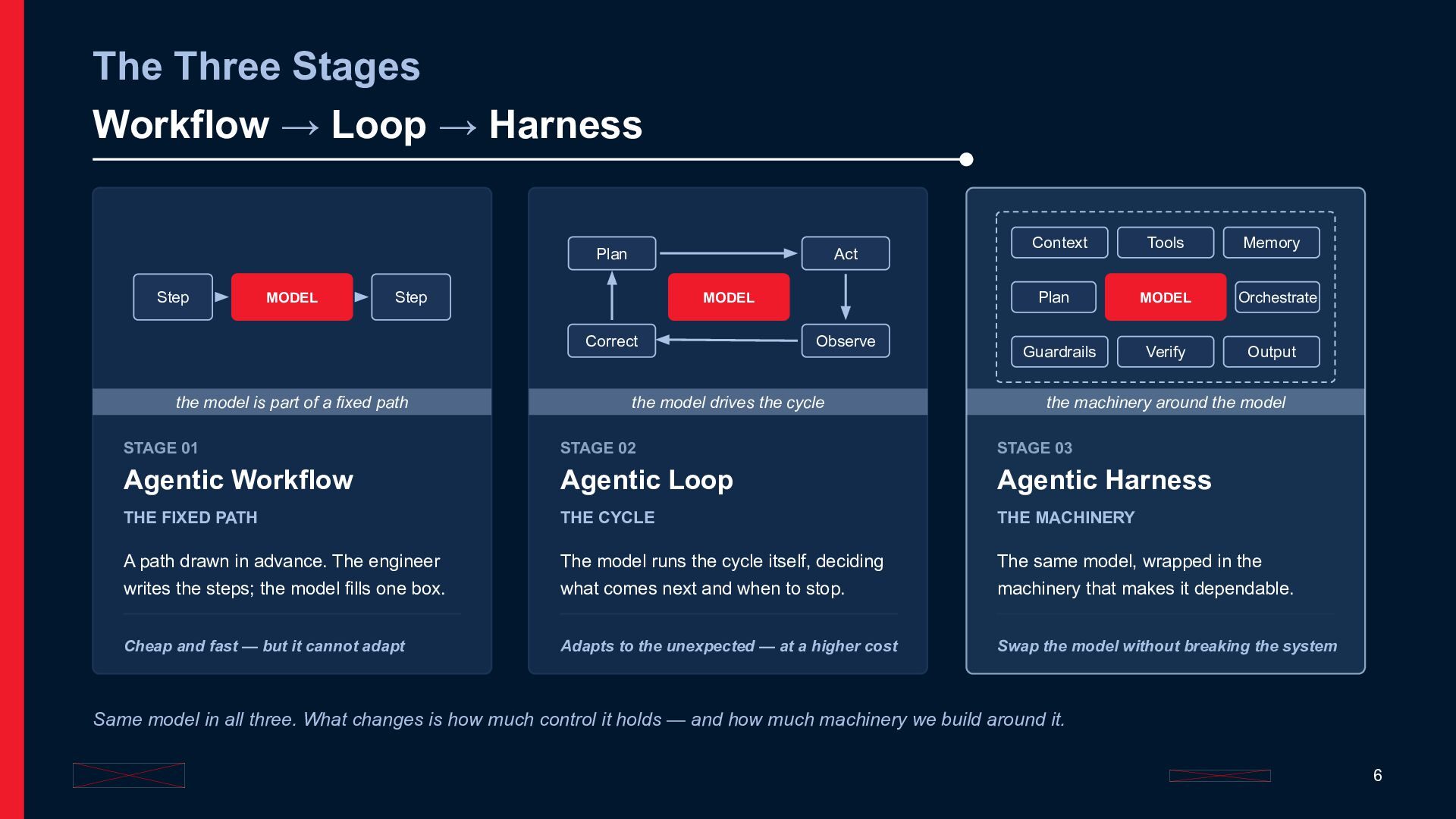
MODEL Act Step MODEL Correct the model is part of a fixed path Observe the model drives the cycle Context Tools Memory Plan MODEL Orchestrate Guardrails Verify Output the machinery around the model STAGE 01 STAGE 02 STAGE 03 Agentic Workflow Agentic Loop Agentic Harness THE FIXED PATH THE CYCLE THE MACHINERY A path drawn in advance. The engineer writes the steps; the model fills one box. The model runs the cycle itself, deciding what comes next and when to stop. The same model, wrapped in the machinery that makes it dependable. Cheap and fast — but it cannot adapt Adapts to the unexpected — at a higher cost Swap the model without breaking the system Same model in all three. What changes is how much control it holds — and how much machinery we build around it. 6
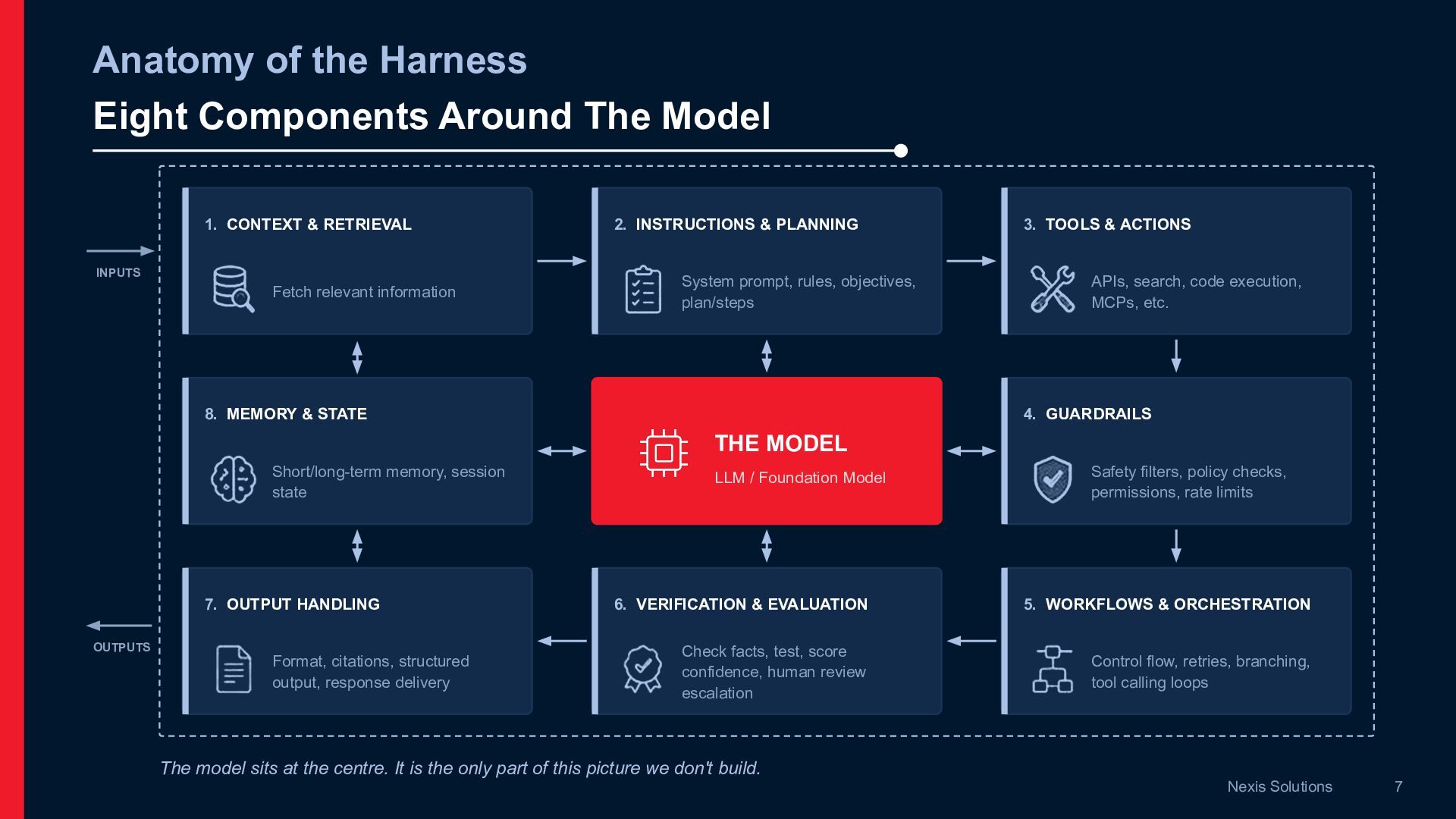
CONTEXT & RETRIEVAL INPUTS Fetch relevant information 2. INSTRUCTIONS & PLANNING System prompt, rules, objectives, plan/steps 8. MEMORY & STATE 3. TOOLS & ACTIONS APIs, search, code execution, MCPs, etc. 4. GUARDRAILS THE MODEL Short/long-term memory, session state 7. OUTPUT HANDLING OUTPUTS Format, citations, structured output, response delivery LLM / Foundation Model Safety filters, policy checks, permissions, rate limits 6. VERIFICATION & EVALUATION 5. WORKFLOWS & ORCHESTRATION Check facts, test, score confidence, human review escalation Control flow, retries, branching, tool calling loops The model sits at the centre. It is the only part of this picture we don't build. Nexis Solutions 7
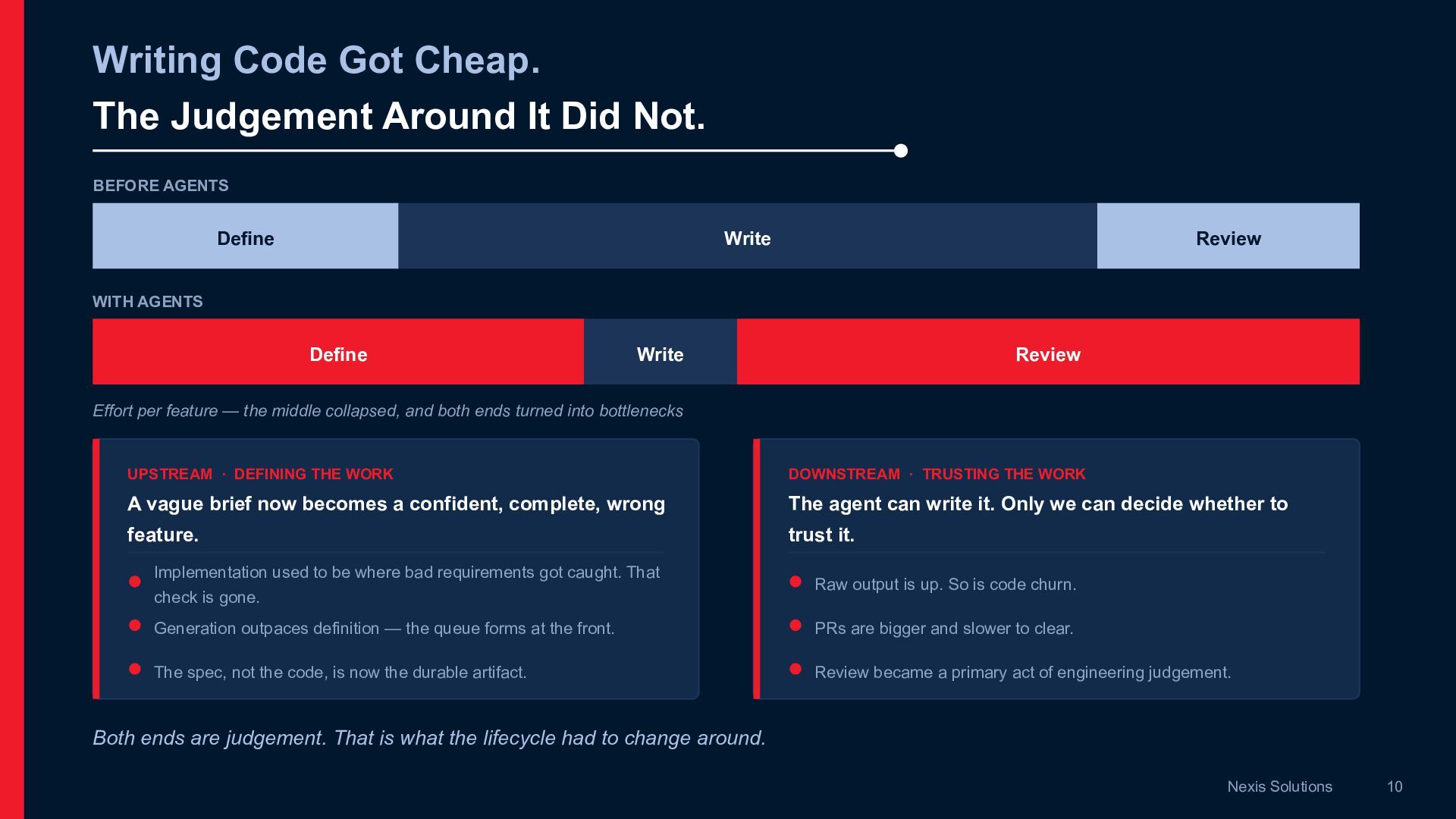
BEFORE AGENTS Define Write Review WITH AGENTS Define Write Review Effort per feature — the middle collapsed, and both ends turned into bottlenecks UPSTREAM · DEFINING THE WORK DOWNSTREAM · TRUSTING THE WORK A vague brief now becomes a confident, complete, wrong The agent can write it. Only we can decide whether to feature. trust it. Implementation used to be where bad requirements got caught. That check is gone. Raw output is up. So is code churn. Generation outpaces definition — the queue forms at the front. PRs are bigger and slower to clear. The spec, not the code, is now the durable artifact. Review became a primary act of engineering judgement. Both ends are judgement. That is what the lifecycle had to change around. Nexis Solutions 10
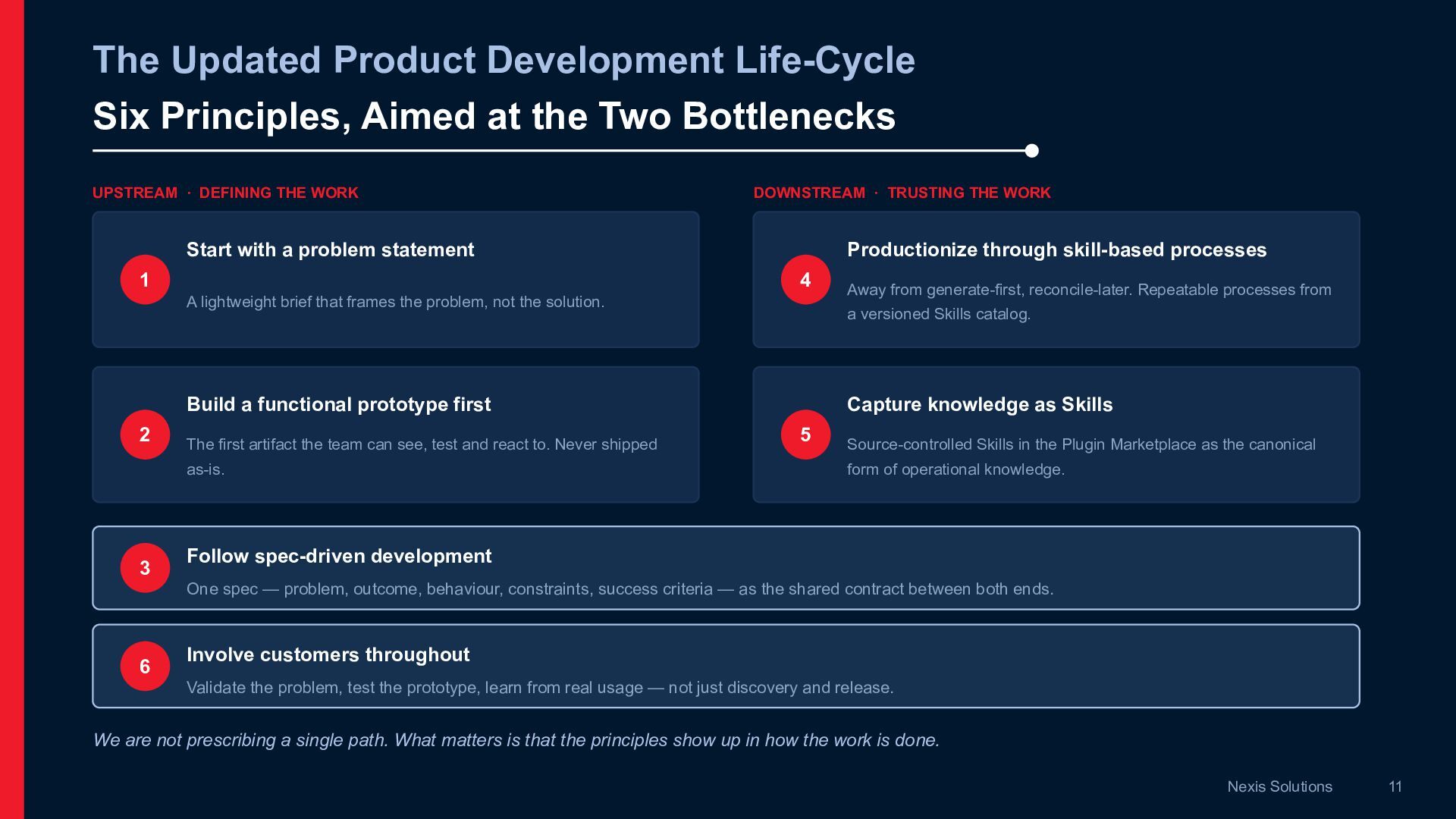
Two Bottlenecks UPSTREAM · DEFINING THE WORK DOWNSTREAM · TRUSTING THE WORK Start with a problem statement 1 Productionize through skill-based processes 4 A lightweight brief that frames the problem, not the solution. a versioned Skills catalog. Build a functional prototype first 2 The first artifact the team can see, test and react to. Never shipped as-is. 3 Away from generate-first, reconcile-later. Repeatable processes from Capture knowledge as Skills 5 Source-controlled Skills in the Plugin Marketplace as the canonical form of operational knowledge. Follow spec-driven development One spec — problem, outcome, behaviour, constraints, success criteria — as the shared contract between both ends. 6 Involve customers throughout Validate the problem, test the prototype, learn from real usage — not just discovery and release. We are not prescribing a single path. What matters is that the principles show up in how the work is done. Nexis Solutions 11
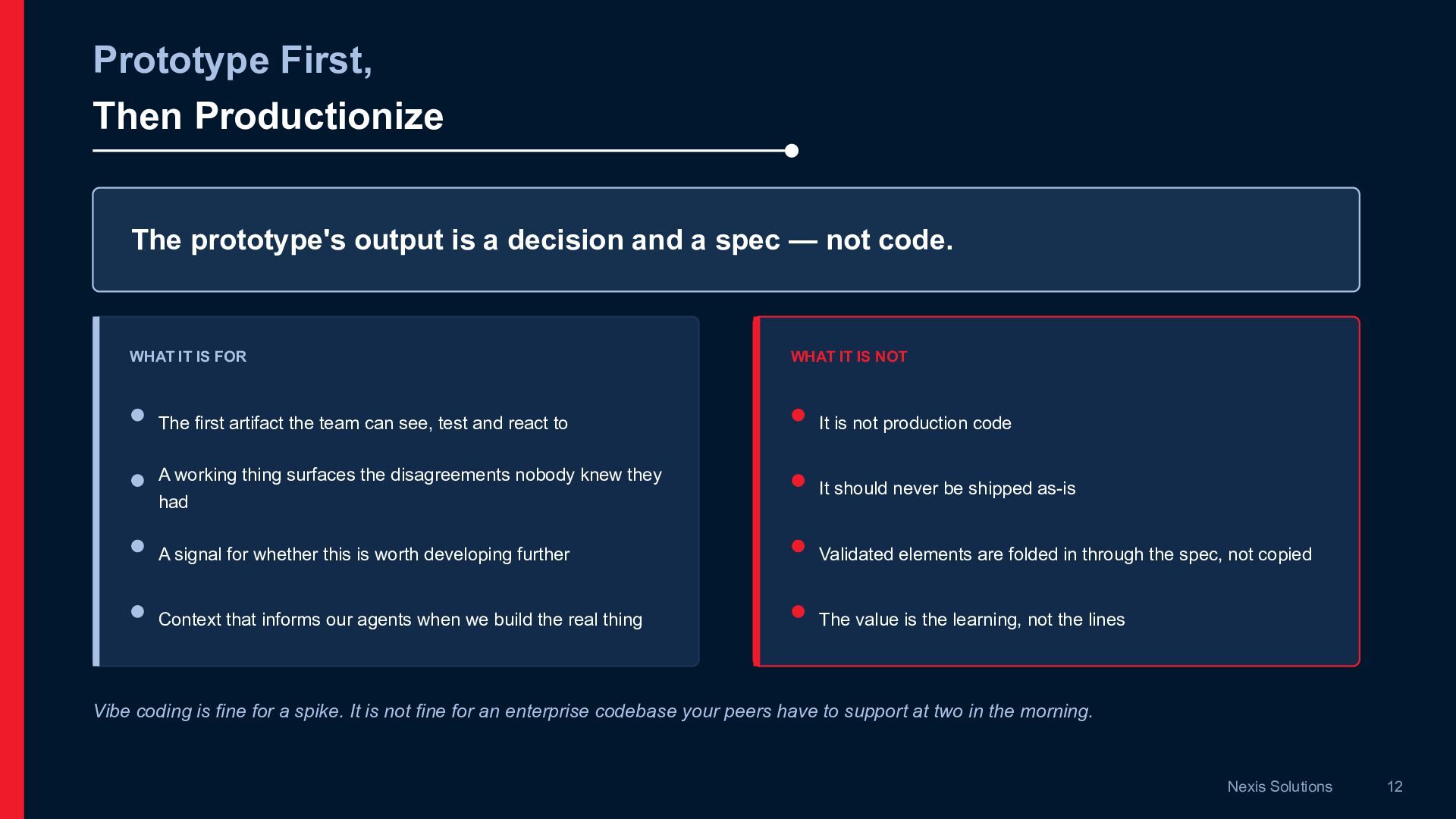
and a spec — not code. WHAT IT IS FOR The first artifact the team can see, test and react to A working thing surfaces the disagreements nobody knew they had WHAT IT IS NOT It is not production code It should never be shipped as-is A signal for whether this is worth developing further Validated elements are folded in through the spec, not copied Context that informs our agents when we build the real thing The value is the learning, not the lines Vibe coding is fine for a spike. It is not fine for an enterprise codebase your peers have to support at two in the morning. Nexis Solutions 12
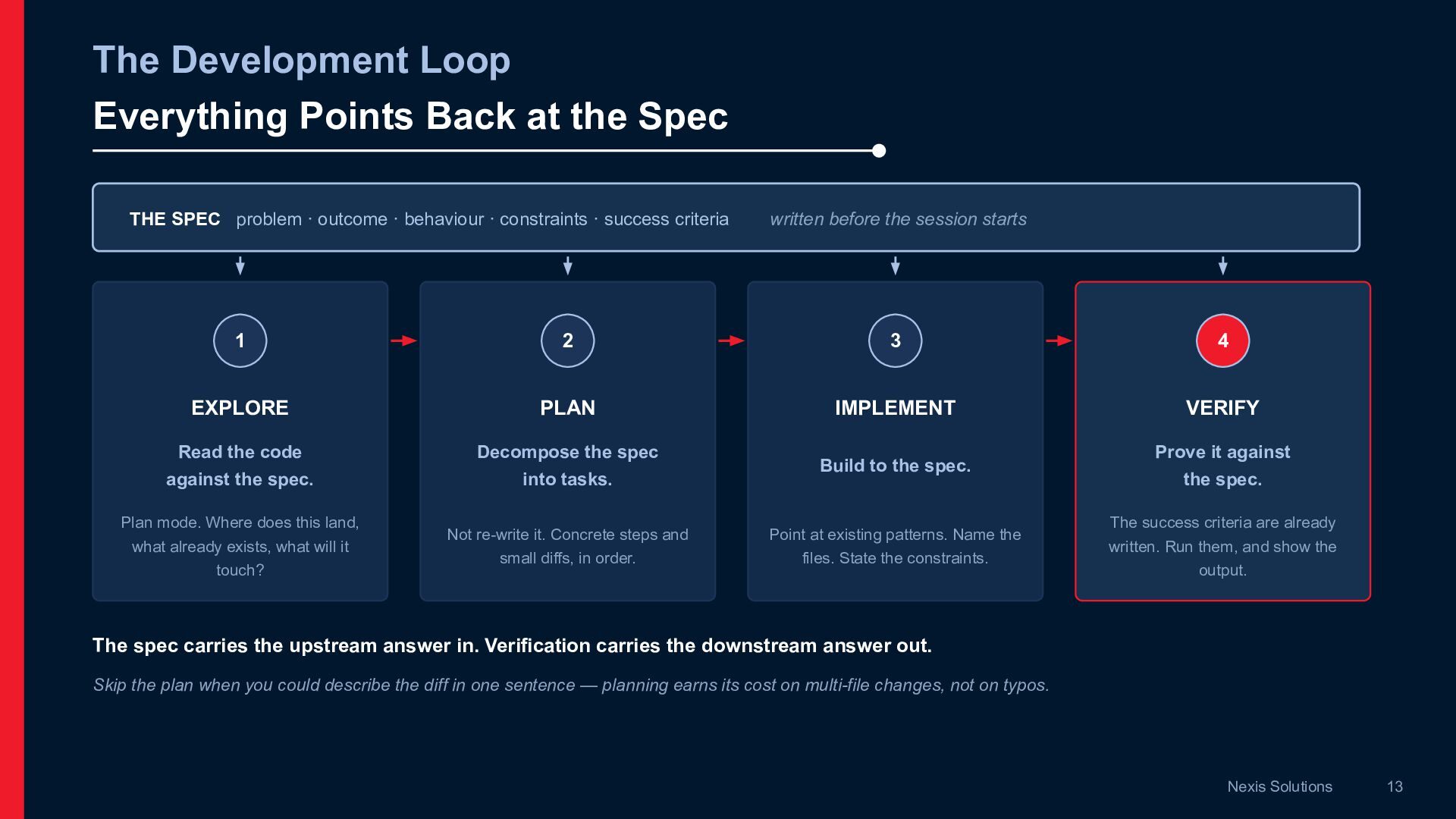
SPEC problem · outcome · behaviour · constraints · success criteria written before the session starts 1 2 3 4 EXPLORE PLAN IMPLEMENT VERIFY Read the code against the spec. Decompose the spec into tasks. Build to the spec. Prove it against the spec. Plan mode. Where does this land, what already exists, what will it touch? Not re-write it. Concrete steps and small diffs, in order. Point at existing patterns. Name the files. State the constraints. The success criteria are already written. Run them, and show the output. The spec carries the upstream answer in. Verification carries the downstream answer out. Skip the plan when you could describe the diff in one sentence — planning earns its cost on multi-file changes, not on typos. Nexis Solutions 13
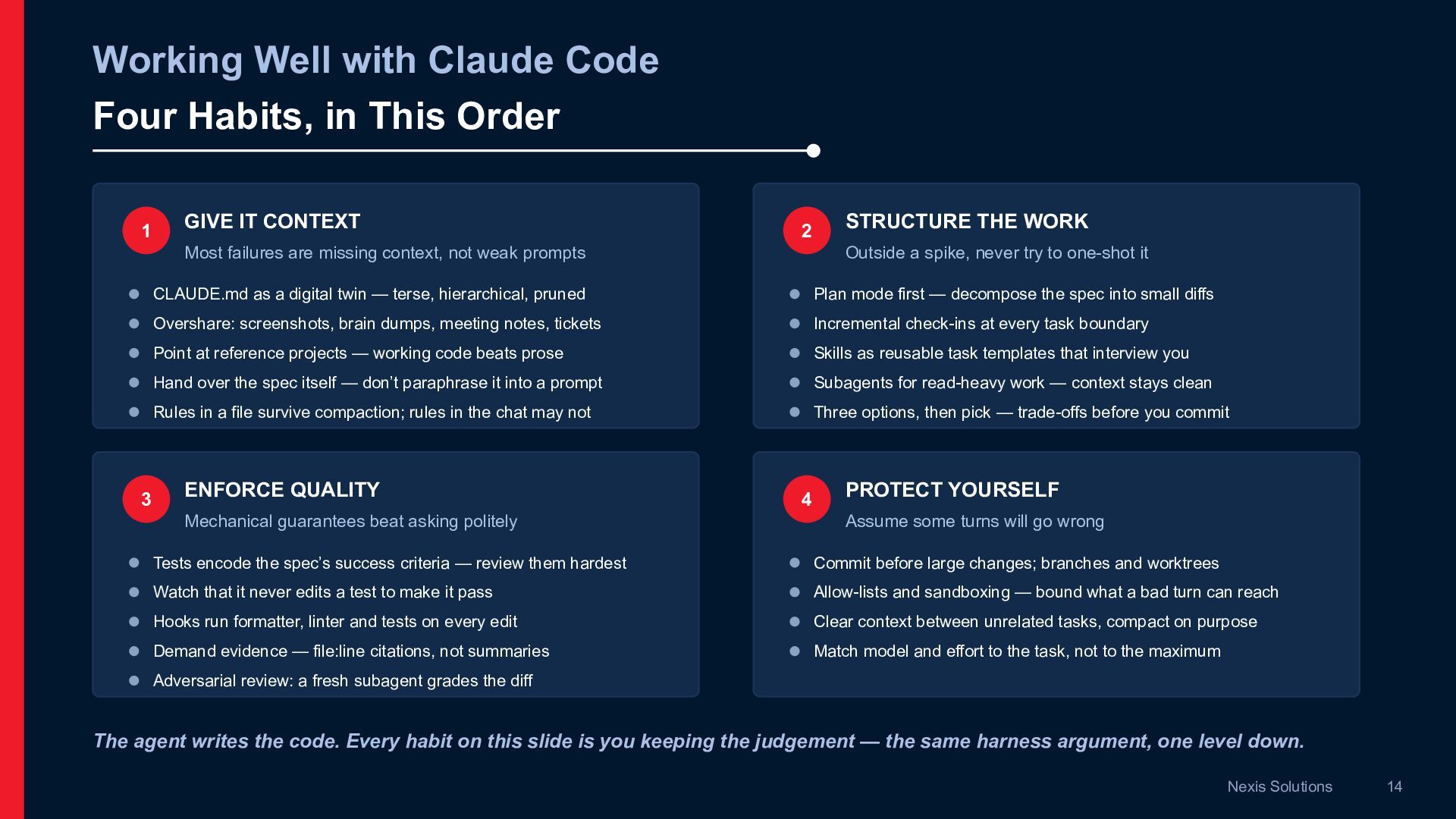
1 GIVE IT CONTEXT 2 Most failures are missing context, not weak prompts 3 STRUCTURE THE WORK Outside a spike, never try to one-shot it CLAUDE.md as a digital twin — terse, hierarchical, pruned Plan mode first — decompose the spec into small diffs Overshare: screenshots, brain dumps, meeting notes, tickets Incremental check-ins at every task boundary Point at reference projects — working code beats prose Skills as reusable task templates that interview you Hand over the spec itself — don’t paraphrase it into a prompt Subagents for read-heavy work — context stays clean Rules in a file survive compaction; rules in the chat may not Three options, then pick — trade-offs before you commit ENFORCE QUALITY Mechanical guarantees beat asking politely 4 PROTECT YOURSELF Assume some turns will go wrong Tests encode the spec’s success criteria — review them hardest Commit before large changes; branches and worktrees Watch that it never edits a test to make it pass Allow-lists and sandboxing — bound what a bad turn can reach Hooks run formatter, linter and tests on every edit Clear context between unrelated tasks, compact on purpose Demand evidence — file:line citations, not summaries Match model and effort to the task, not to the maximum Adversarial review: a fresh subagent grades the diff The agent writes the code. Every habit on this slide is you keeping the judgement — the same harness argument, one level down. Nexis Solutions 14
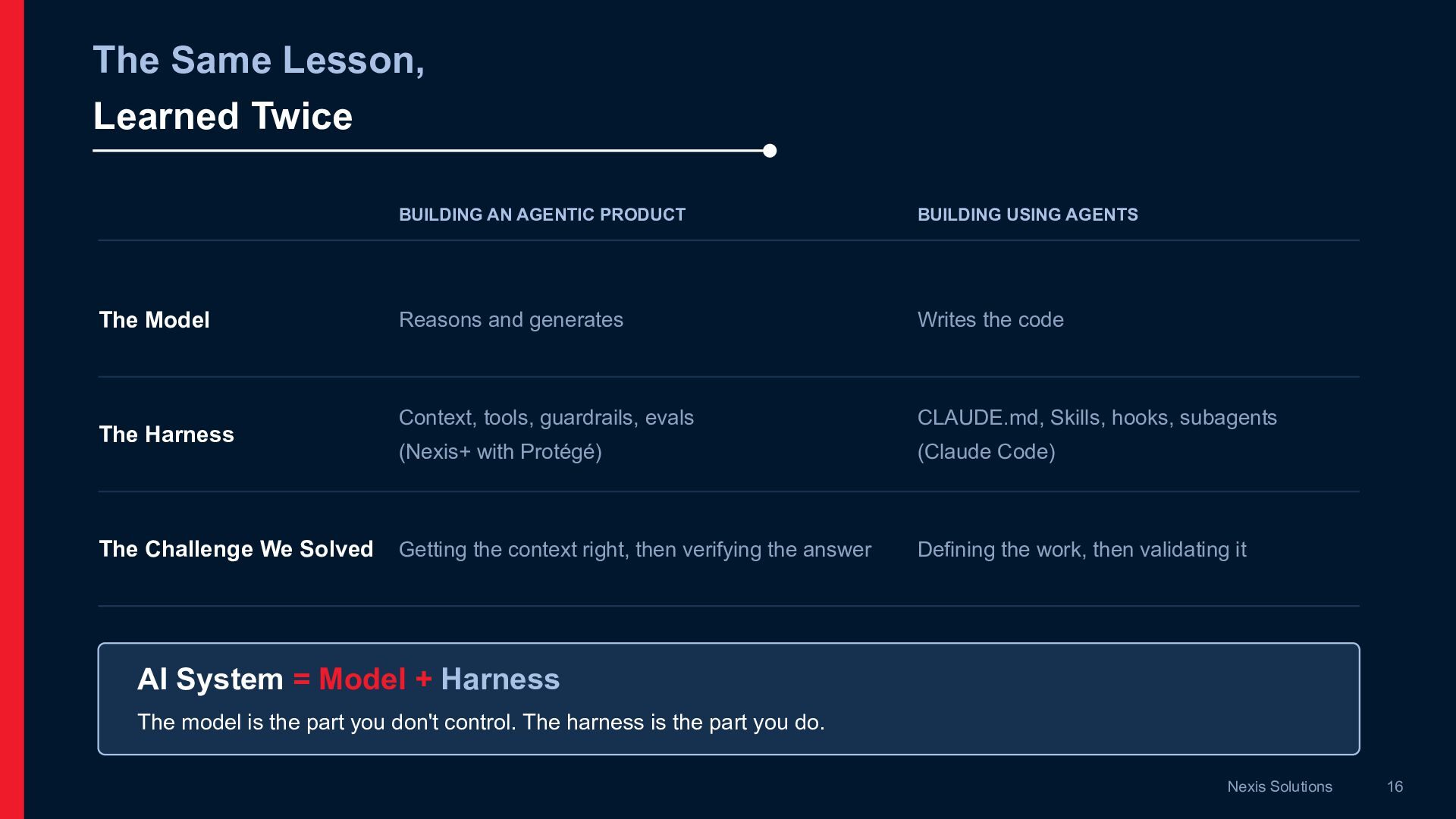
Challenge We Solved BUILDING AN AGENTIC PRODUCT BUILDING USING AGENTS Reasons and generates Writes the code Context, tools, guardrails, evals CLAUDE.md, Skills, hooks, subagents (Nexis+ with Protégé) (Claude Code) Getting the context right, then verifying the answer Defining the work, then validating it AI System = Model + Harness The model is the part you don't control. The harness is the part you do. Nexis Solutions 16
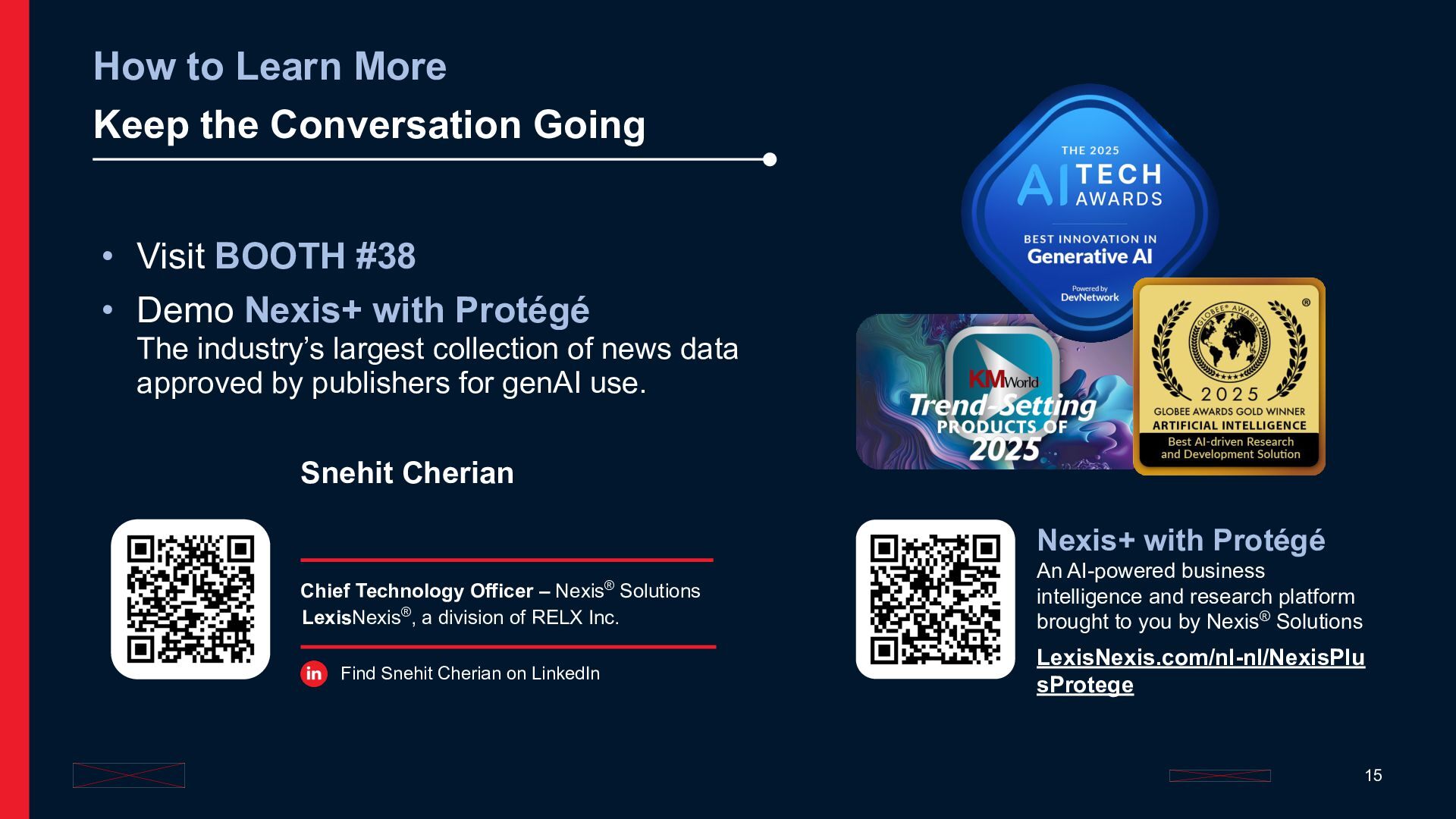
BOOTH #38 • Demo Nexis+ with Protégé The industry’s largest collection of news data approved by publishers for genAI use. Snehit Cherian Nexis+ with Protégé Chief Technology Officer – Nexis® Solutions LexisNexis®, a division of RELX Inc. Find Snehit Cherian on LinkedIn An AI-powered business intelligence and research platform brought to you by Nexis® Solutions LexisNexis.com/nl-nl/NexisPlu sProtege 15


 mark3t1ng
 orderedlist
 schroneko
 rocio
rocio
 ianozsvald
 cassininazir
 ks91
ks91
 sergeychernyshev
 hannesfritz
 samtorres
 livdayseo
 3n
3n
 mfonobong