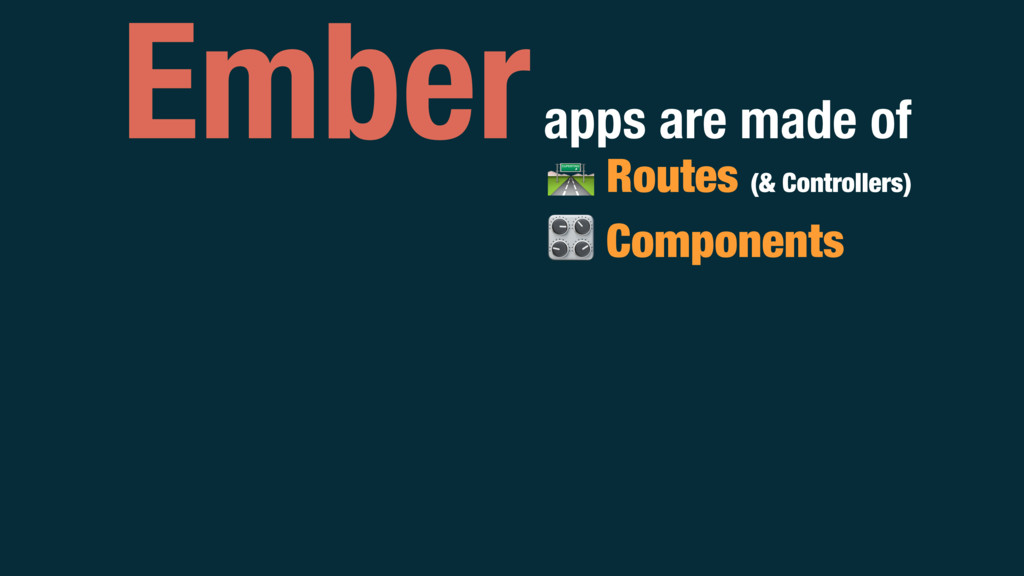
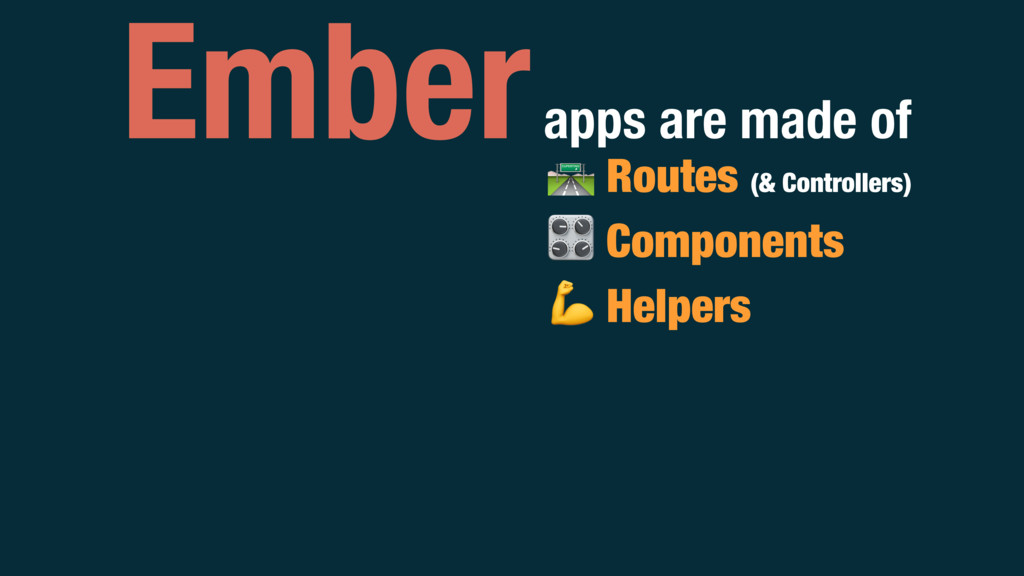
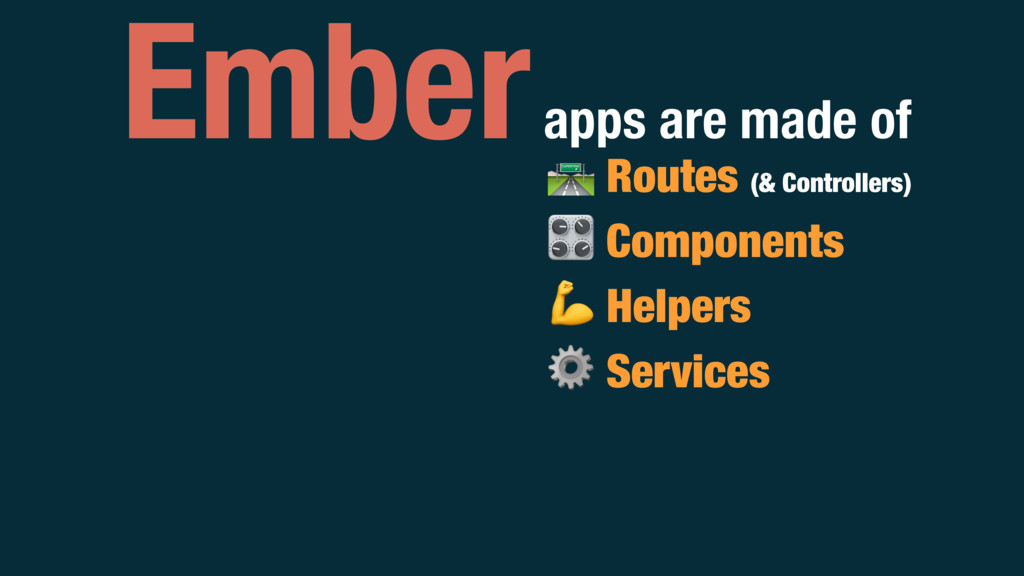
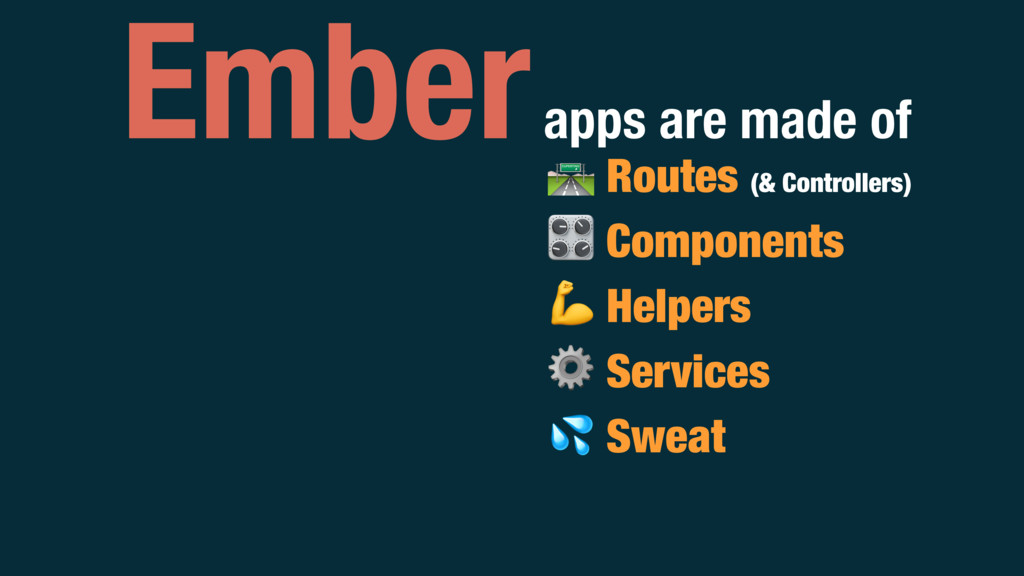
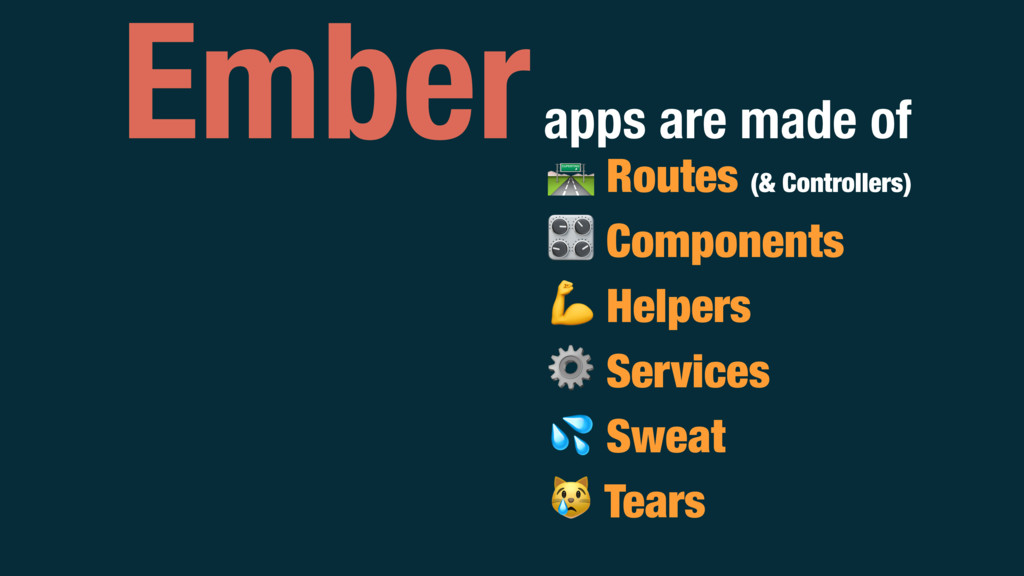
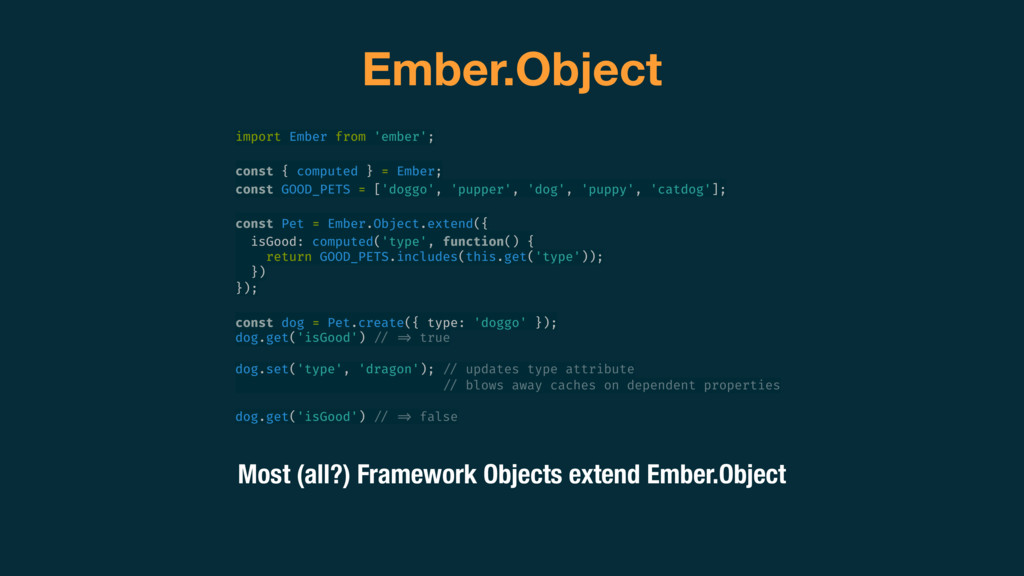
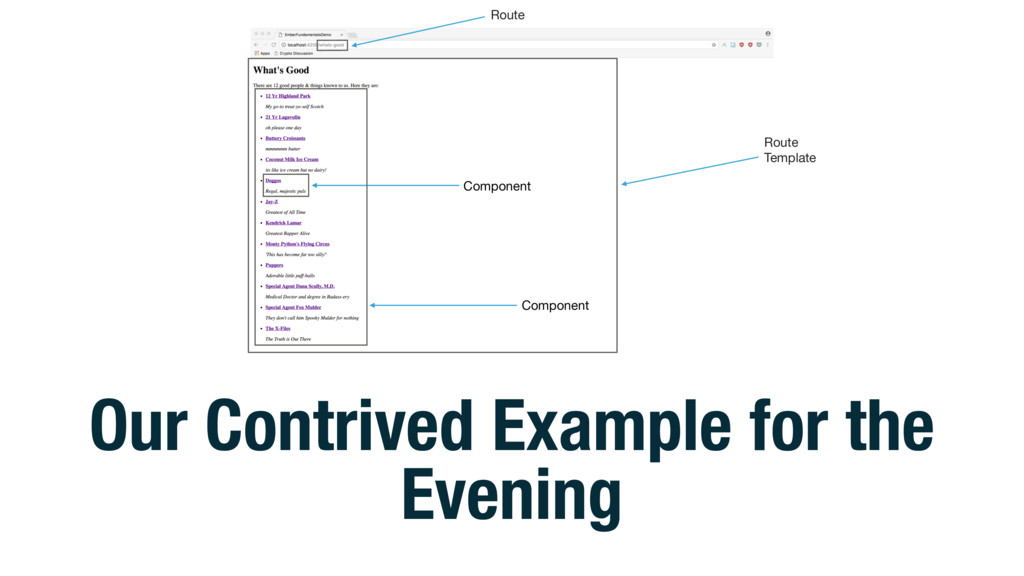
from other frameworks ‣ Virtual DOM-based rendering (Glimmer) ‣ Virtual Machine-powered rendering as of 2.10 (Glimmer 2) ‣ Component focused ‣ Data-down, actions up ‣ Shed lots of SproutCore legacy and simplified APIs
‣ Test runner ‣ Build tool ‣ Add-on system ‣ Deployment (via ember-cli-deploy add-on) ‣ Glimmer 2 ‣ Virtual Machine-based ‣ Fastest DOM updates in the game ‣ Highly competitive initial render times ‣ Extracted to a component library (glimmerjs.com) ‣ One of the coolest things in JavaScript right now
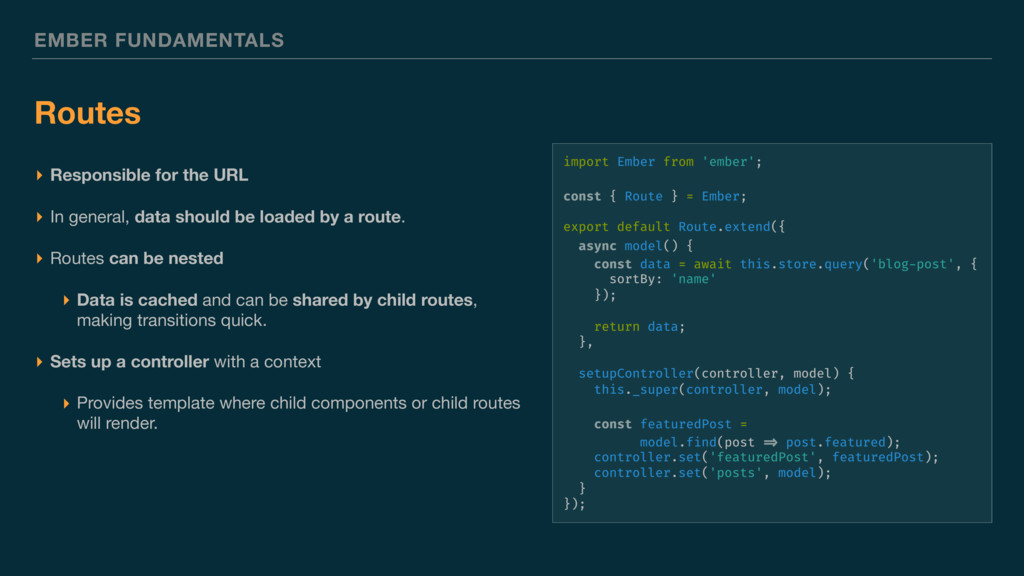
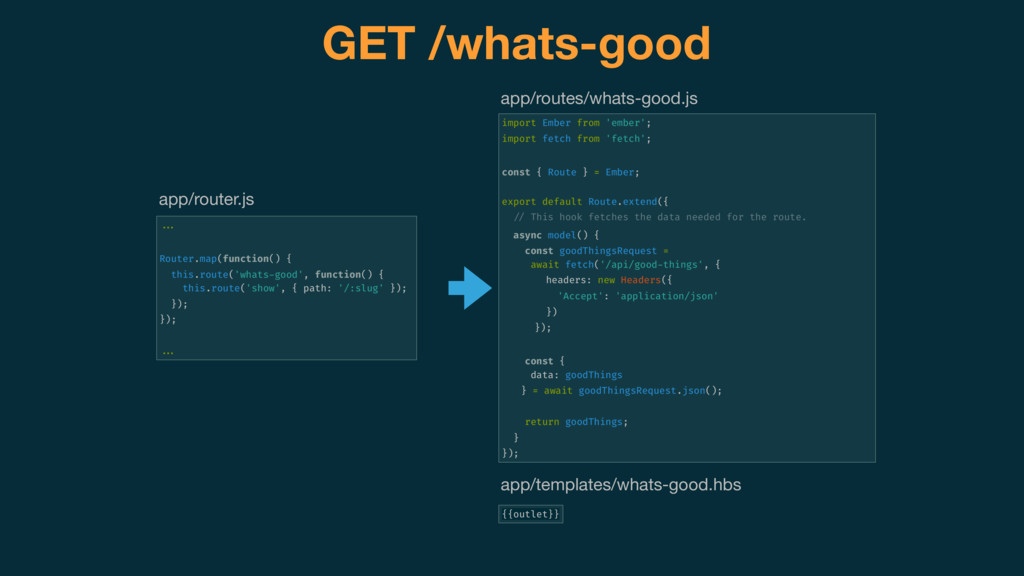
general, data should be loaded by a route. ▸ Routes can be nested ▸ Data is cached and can be shared by child routes, making transitions quick. ▸ Sets up a controller with a context ▸ Provides template where child components or child routes will render. import Ember from 'ember'; const { Route } = Ember; export default Route.extend({ async model() { const data = await this.store.query('blog-post', { sortBy: 'name' }); return data; }, setupController(controller, model) { this._super(controller, model); const featuredPost = model.find(post => post.featured); controller.set('featuredPost', featuredPost); controller.set('posts', model); } });
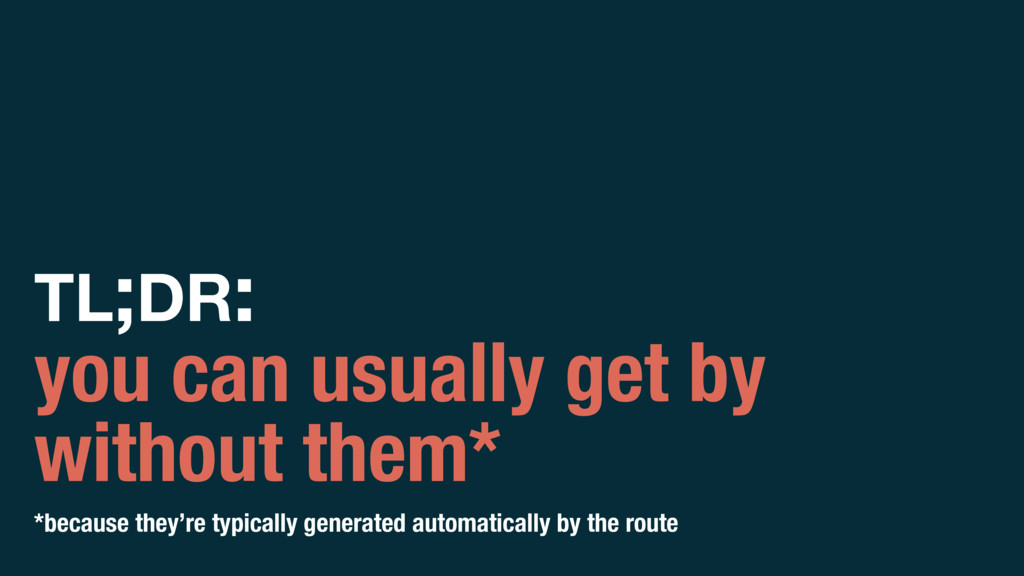
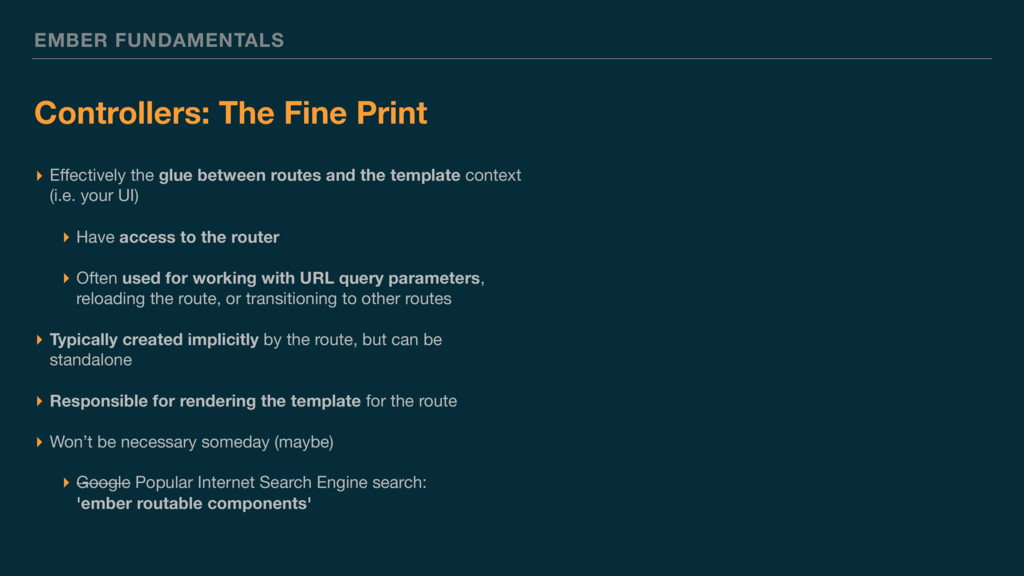
between routes and the template context (i.e. your UI) ▸ Have access to the router ▸ Often used for working with URL query parameters, reloading the route, or transitioning to other routes ▸ Typically created implicitly by the route, but can be standalone ▸ Responsible for rendering the template for the route ▸ Won’t be necessary someday (maybe) ▸ Google Popular Internet Search Engine search: 'ember routable components'
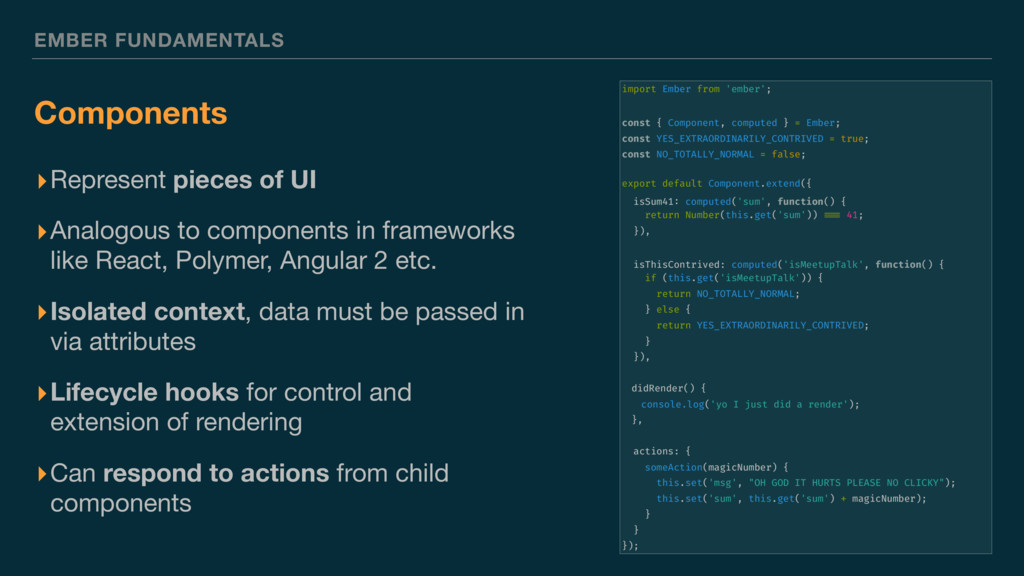
in frameworks like React, Polymer, Angular 2 etc. ▸Isolated context, data must be passed in via attributes ▸Lifecycle hooks for control and extension of rendering ▸Can respond to actions from child components import Ember from 'ember'; const { Component, computed } = Ember; const YES_EXTRAORDINARILY_CONTRIVED = true; const NO_TOTALLY_NORMAL = false; export default Component.extend({ isSum41: computed('sum', function() { return Number(this.get('sum')) === 41; }), isThisContrived: computed('isMeetupTalk', function() { if (this.get('isMeetupTalk')) { return NO_TOTALLY_NORMAL; } else { return YES_EXTRAORDINARILY_CONTRIVED; } }), didRender() { console.log('yo I just did a render'); }, actions: { someAction(magicNumber) { this.set('msg', "OH GOD IT HURTS PLEASE NO CLICKY"); this.set('sum', this.get('sum') + magicNumber); } } });
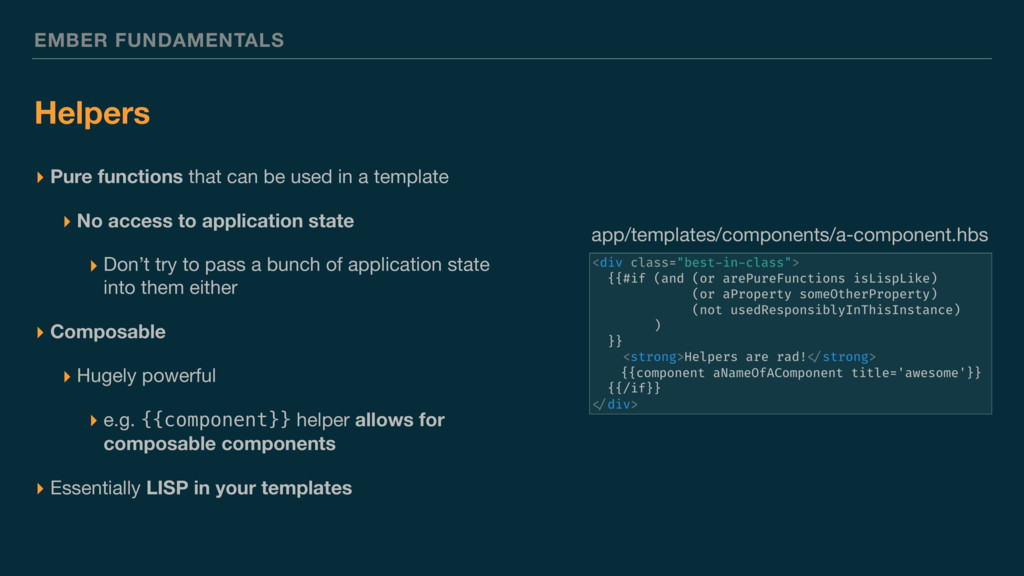
in a template ▸ No access to application state ▸ Don’t try to pass a bunch of application state into them either ▸ Composable ▸ Hugely powerful ▸ e.g. {{component}} helper allows for composable components ▸ Essentially LISP in your templates <div class="best-in-class"> {{#if (and (or arePureFunctions isLispLike) (or aProperty someOtherProperty) (not usedResponsiblyInThisInstance) ) }} <strong>Helpers are rad! </strong> {{component aNameOfAComponent title='awesome'}} {{/if}} </div> app/templates/components/a-component.hbs
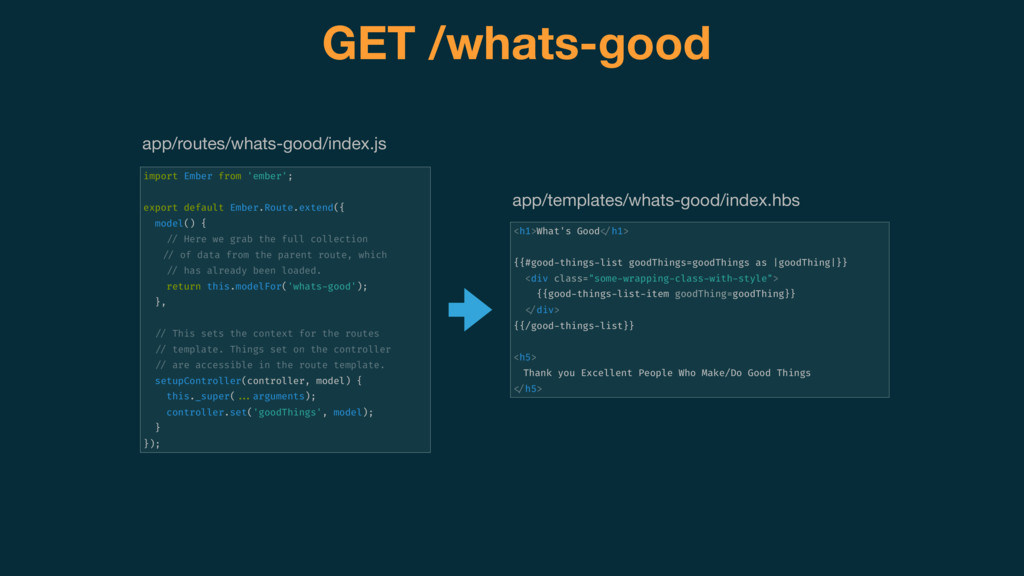
{ // Here we grab the full collection // of data from the parent route, which // has already been loaded. return this.modelFor('whats-good'); }, // This sets the context for the routes // template. Things set on the controller // are accessible in the route template. setupController(controller, model) { this._super( ...arguments); controller.set('goodThings', model); } }); app/routes/whats-good/index.js <h1>What's Good </h1> {{#good-things-list goodThings=goodThings as |goodThing|}} <div class="some-wrapping-class-with-style"> {{good-things-list-item goodThing=goodThing}} </div> {{/good-things-list}} <h5> Thank you Excellent People Who Make/Do Good Things </h5> app/templates/whats-good/index.hbs
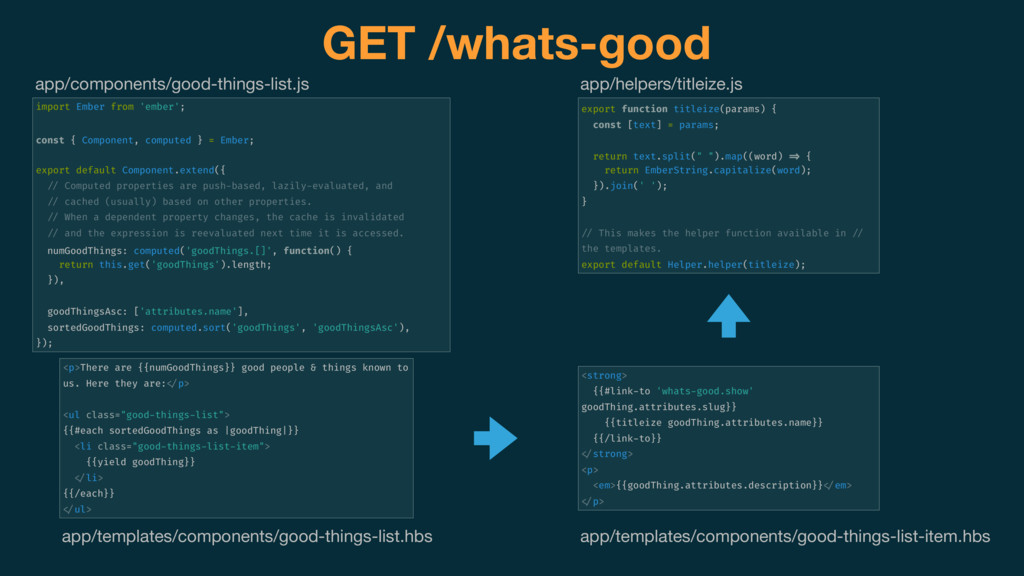
to us. Here they are: </p> <ul class="good-things-list"> {{#each sortedGoodThings as |goodThing|}} <li class="good-things-list-item"> {{yield goodThing}} </li> {{/each}} </ul> import Ember from 'ember'; const { Component, computed } = Ember; export default Component.extend({ // Computed properties are push-based, lazily-evaluated, and // cached (usually) based on other properties. // When a dependent property changes, the cache is invalidated // and the expression is reevaluated next time it is accessed. numGoodThings: computed('goodThings.[]', function() { return this.get('goodThings').length; }), goodThingsAsc: ['attributes.name'], sortedGoodThings: computed.sort('goodThings', 'goodThingsAsc'), }); app/components/good-things-list.js app/templates/components/good-things-list.hbs <strong> {{#link-to 'whats-good.show' goodThing.attributes.slug}} {{titleize goodThing.attributes.name}} {{/link-to}} </strong> <p> <em>{{goodThing.attributes.description}} </em> </p> app/templates/components/good-things-list-item.hbs export function titleize(params) { const [text] = params; return text.split(" ").map((word) => { return EmberString.capitalize(word); }).join(' '); } // This makes the helper function available in // the templates. export default Helper.helper(titleize); app/helpers/titleize.js
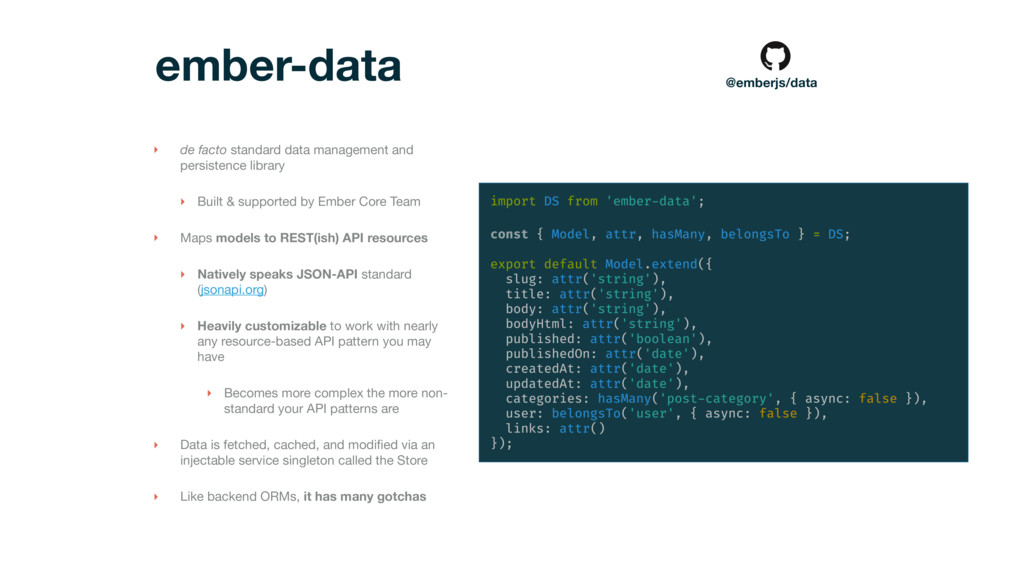
‣ Built & supported by Ember Core Team ‣ Maps models to REST(ish) API resources ‣ Natively speaks JSON-API standard (jsonapi.org) ‣ Heavily customizable to work with nearly any resource-based API pattern you may have ‣ Becomes more complex the more non- standard your API patterns are ‣ Data is fetched, cached, and modified via an injectable service singleton called the Store ‣ Like backend ORMs, it has many gotchas import DS from 'ember-data'; const { Model, attr, hasMany, belongsTo } = DS; export default Model.extend({ slug: attr('string'), title: attr('string'), body: attr('string'), bodyHtml: attr('string'), published: attr('boolean'), publishedOn: attr('date'), createdAt: attr('date'), updatedAt: attr('date'), categories: hasMany('post-category', { async: false }), user: belongsTo('user', { async: false }), links: attr() }); @emberjs/data
middleware (redux-saga, etc.) ‣ Works with redux-devtools ‣ Fairly mature and well-supported ‣ I’ve never used this, but I heard it’s good ‣ I have no code for this slide ‣ Here’s a picture of a puppy @ember-redux/ember-redux
‣ Supports OAuth2 Resource Owner Password Credential Grant and Implicit Grant flows out- of-the-box ‣ Pluggable for other authentication schemes ‣ Devise (rails gem) ‣ GitHub, LinkedIn, Google, Facebook, etc. (via Torii authenticator) ‣ Provides a session service and route mixin to control where auth is required @simplabs/ember-simple-auth
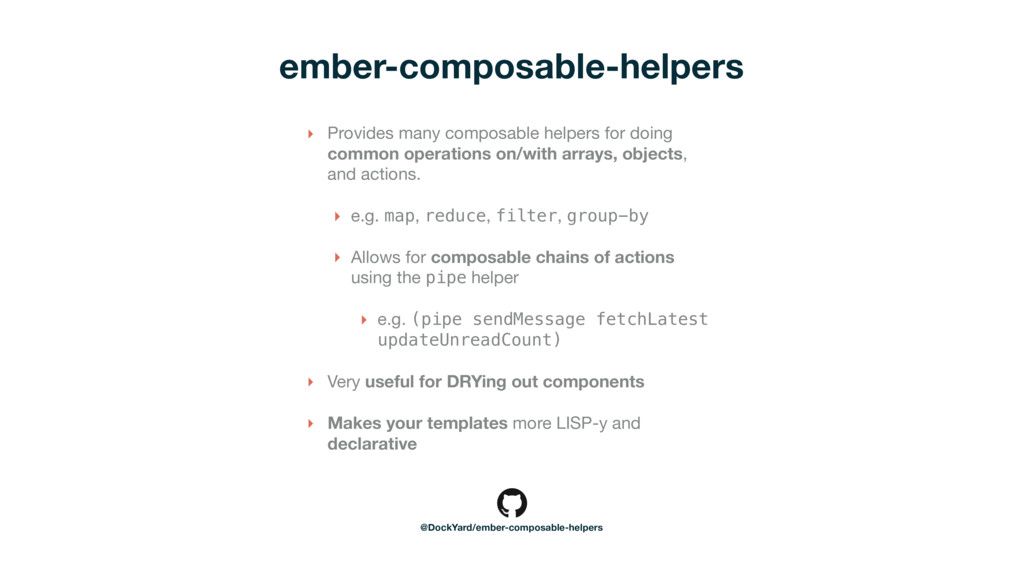
on/with arrays, objects, and actions. ‣ e.g. map, reduce, filter, group-by ‣ Allows for composable chains of actions using the pipe helper ‣ e.g. (pipe sendMessage fetchLatest updateUnreadCount) ‣ Very useful for DRYing out components ‣ Makes your templates more LISP-y and declarative @DockYard/ember-composable-helpers
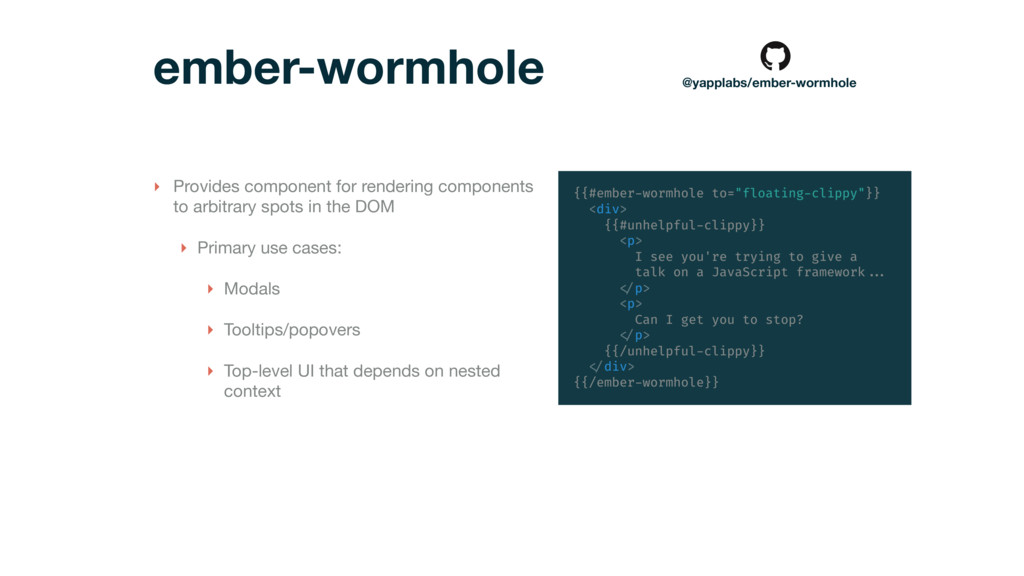
in the DOM ‣ Primary use cases: ‣ Modals ‣ Tooltips/popovers ‣ Top-level UI that depends on nested context @yapplabs/ember-wormhole {{#ember-wormhole to="floating-clippy"}} <div> {{#unhelpful-clippy}} <p> I see you're trying to give a talk on a JavaScript framework ... </p> <p> Can I get you to stop? </p> {{/unhelpful-clippy}} </div> {{/ember-wormhole}}
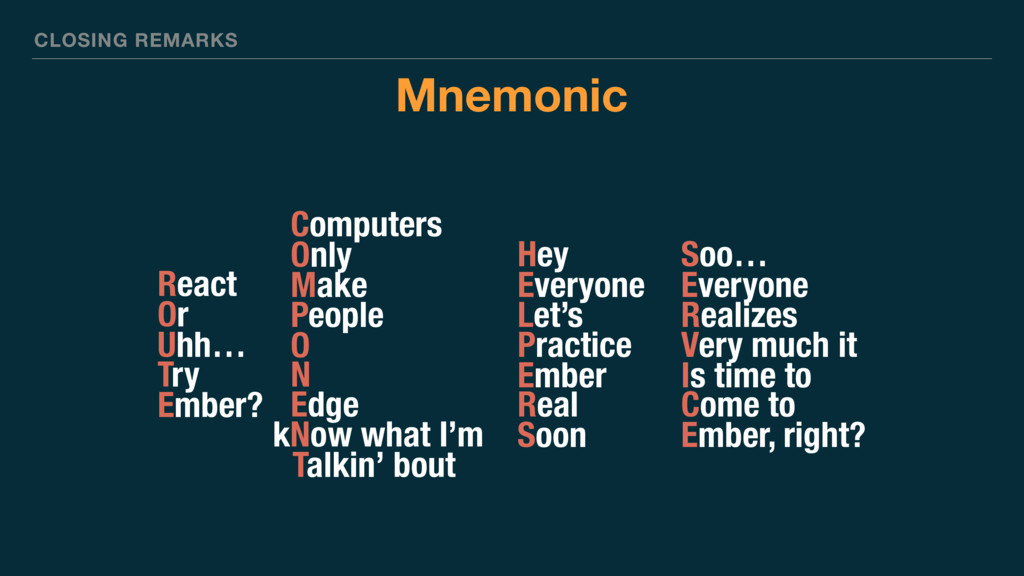
People O N Edge kNow what I’m Talkin’ bout Hey Everyone Let’s Practice Ember Real Soon Soo… Everyone Realizes Very much it Is time to Come to Ember, right? Mnemonic

 SiteGround - Reliable hosting with speed, security, and support you can count on.


 takai
 kasacchiful
 yutobara
 rshindo
 colorful12
 kishida
 ryu1013
 kmars0605
 lynnswap
 sylph01
 sorah
 hschwentner
 varn
 elsirapls
 livdayseo
 jlugia
 marktimemedia
 palkan
 techseoconnect
 lfama
 chriscoyier
 deanohume
 uxyall