Share
Embed
Long Living Tokens, Die, Die, Die! (or: The One Ring is Banned in Modern)
@ Kaigi on Rails 2026, 2026/10/16
https://kaigionrails.org/2026/talks/sylph01/
(English version of the slides)
JA: https://speakerdeck.com/sylph01/subete-no-eizoku-tokun-o-umareru-mae-ni-keshi-saritai
sylph01
October 16, 2026
Transcript
73 slides
-
Long Living Tokens, Die, Die, Die! (or: The One Ring
is Banned in Modern) Ryo Kajiwara (sylph01) @ Kaigi on Rails 2026, 2026/10/16 1 -
Slides are available from the QR code → or from
my Speaker Deck (username sylph01 ) 2 -
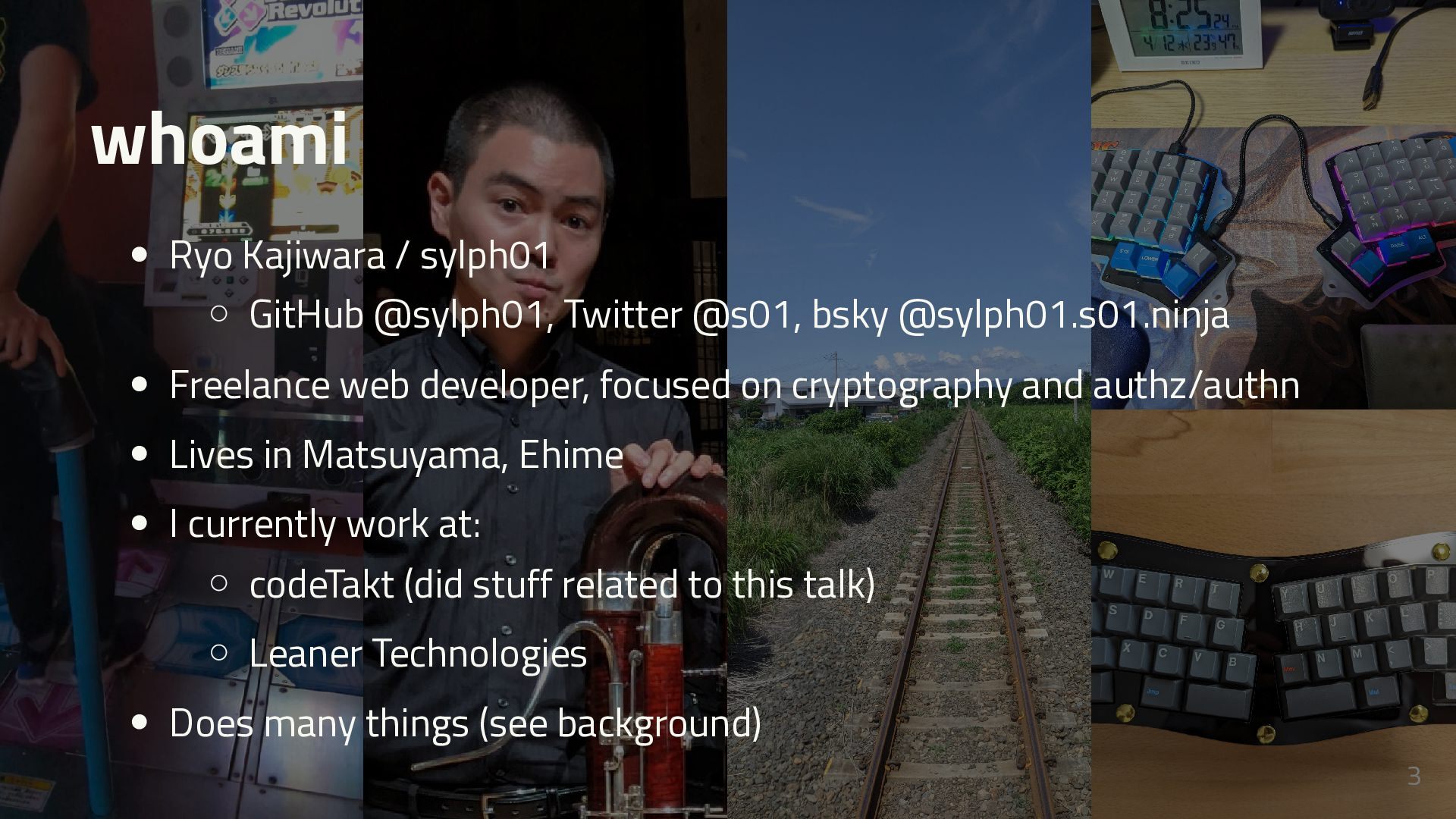
whoami Ryo Kajiwara / sylph01 GitHub @sylph01, Twitter @s01, bsky
@sylph01.s01.ninja Freelance web developer, focused on cryptography and authz/authn Lives in Matsuyama, Ehime I currently work at: codeTakt (did stuff related to this talk) Leaner Technologies Does many things (see background) 3 -
Purpose of this talk Provide ways to eliminate long-living/permanent tokens
with strong capabilities that live in your web services. 4 -
The Usual Disclaimer ...doesn't apply this time as much. We're
not using frontier cryptography, and we're not hand-rolling cryptographic libraries this time. So, do try this in production, but still be aware of your risks. 5 -
Problem space What is a "long-living token" ? An access
token that's embedded to a service Which usually has strong capabilities 7 -
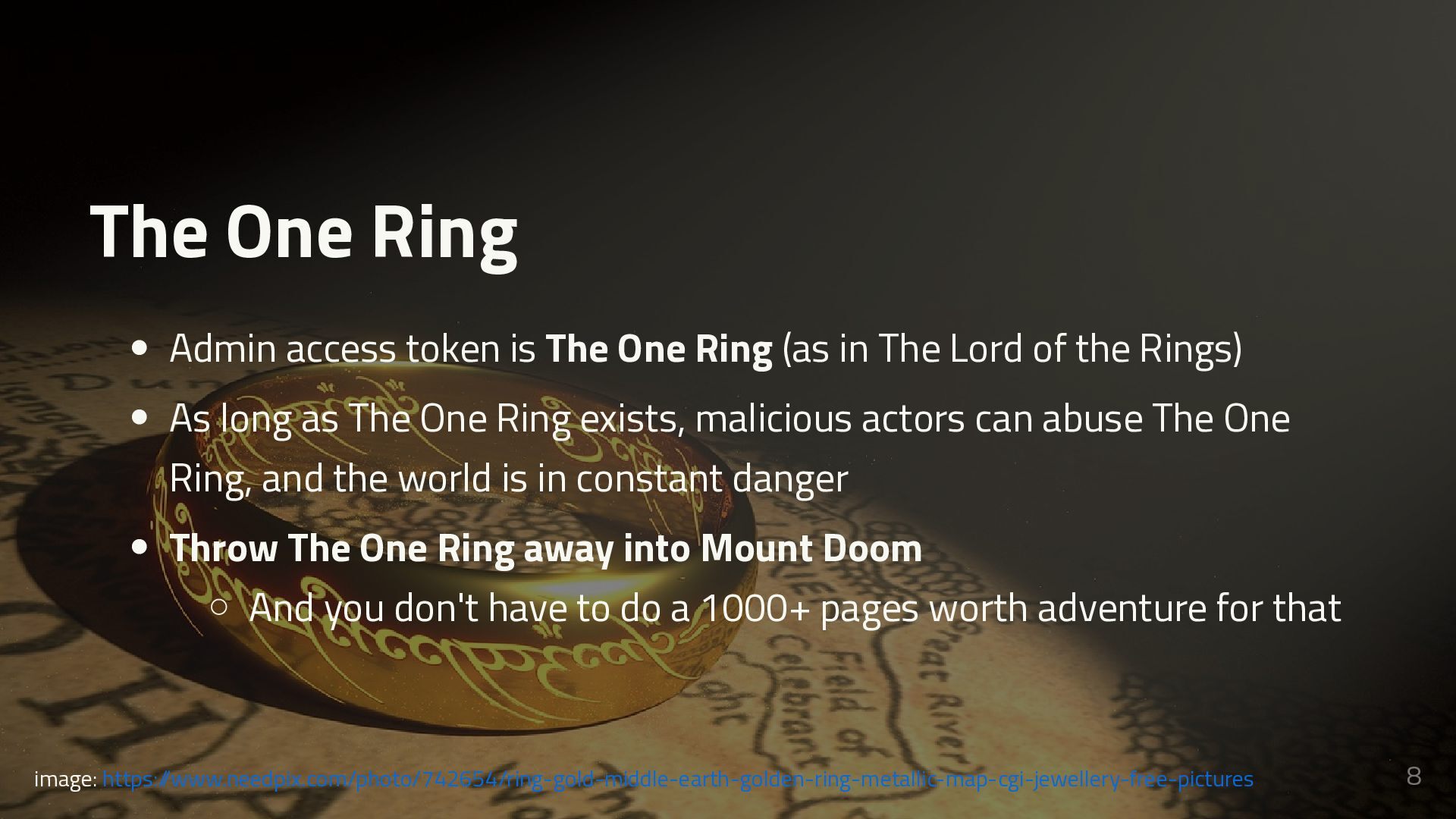
The One Ring Admin access token is The One Ring
(as in The Lord of the Rings) As long as The One Ring exists, malicious actors can abuse The One Ring, and the world is in constant danger Throw The One Ring away into Mount Doom And you don't have to do a 1000+ pages worth adventure for that image: https://www.needpix.com/photo/742654/ring-gold-middle-earth-golden-ring-metallic-map-cgi-jewellery-free-pictures 8 -
Note: Token Revocation There is a standard. RFC 7009 might
be the Mount Doom you're looking for Self-contained JWT access tokens have to wait until expiration If expiration never happens... If you can't destroy it normally, it needs to vanish before it exists 10 -
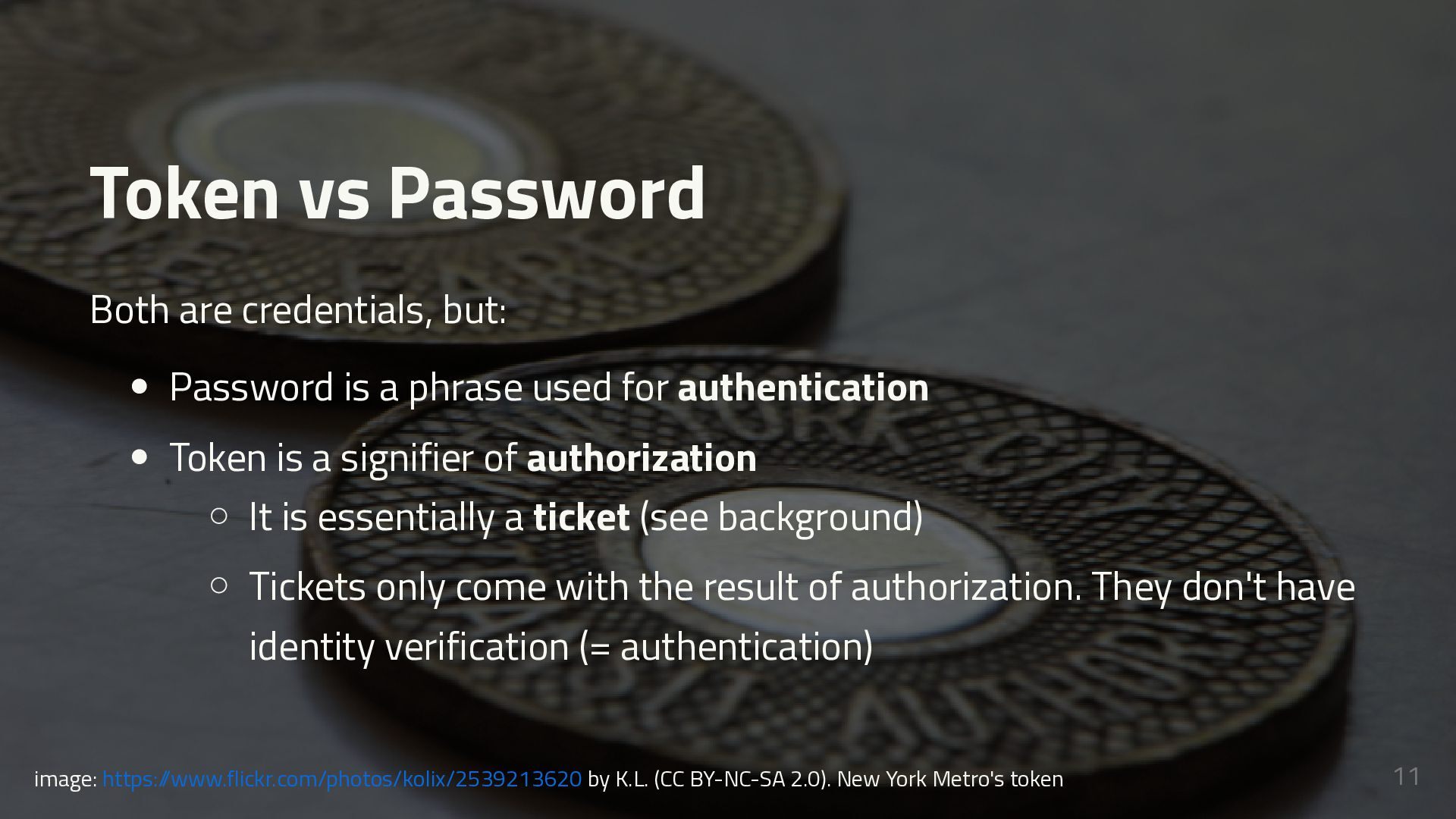
Token vs Password Both are credentials, but: Password is a
phrase used for authentication Token is a signifier of authorization It is essentially a ticket (see background) Tickets only come with the result of authorization. They don't have identity verification (= authentication) image: https://www.flickr.com/photos/kolix/2539213620 by K.L. (CC BY-NC-SA 2.0). New York Metro's token 11 -
Wait, but we shouldn't do regular password resets, right? You
might be talking about NIST SP 800-63B-4, but: Forcing password resets should be avoided in order to avoid selecting weak passwords Of course both passwords and tokens need to be hard to predict 12 -
Wait, but we shouldn't do regular password resets, right? We
are aware of the use of passwords, but tokens are often left unattended Especially long-living tokens for automation 13 -
Attack Surface of Tokens (# of simultaneously active tokens) x
(period of expiration) x (# of servers tokens are sent) Taking any one active token is a successful attack If the expiry never happens, the time you can attempt an attack is infinite More servers to be sent, more vulnerable against server/traffic misconfiguration 14 -
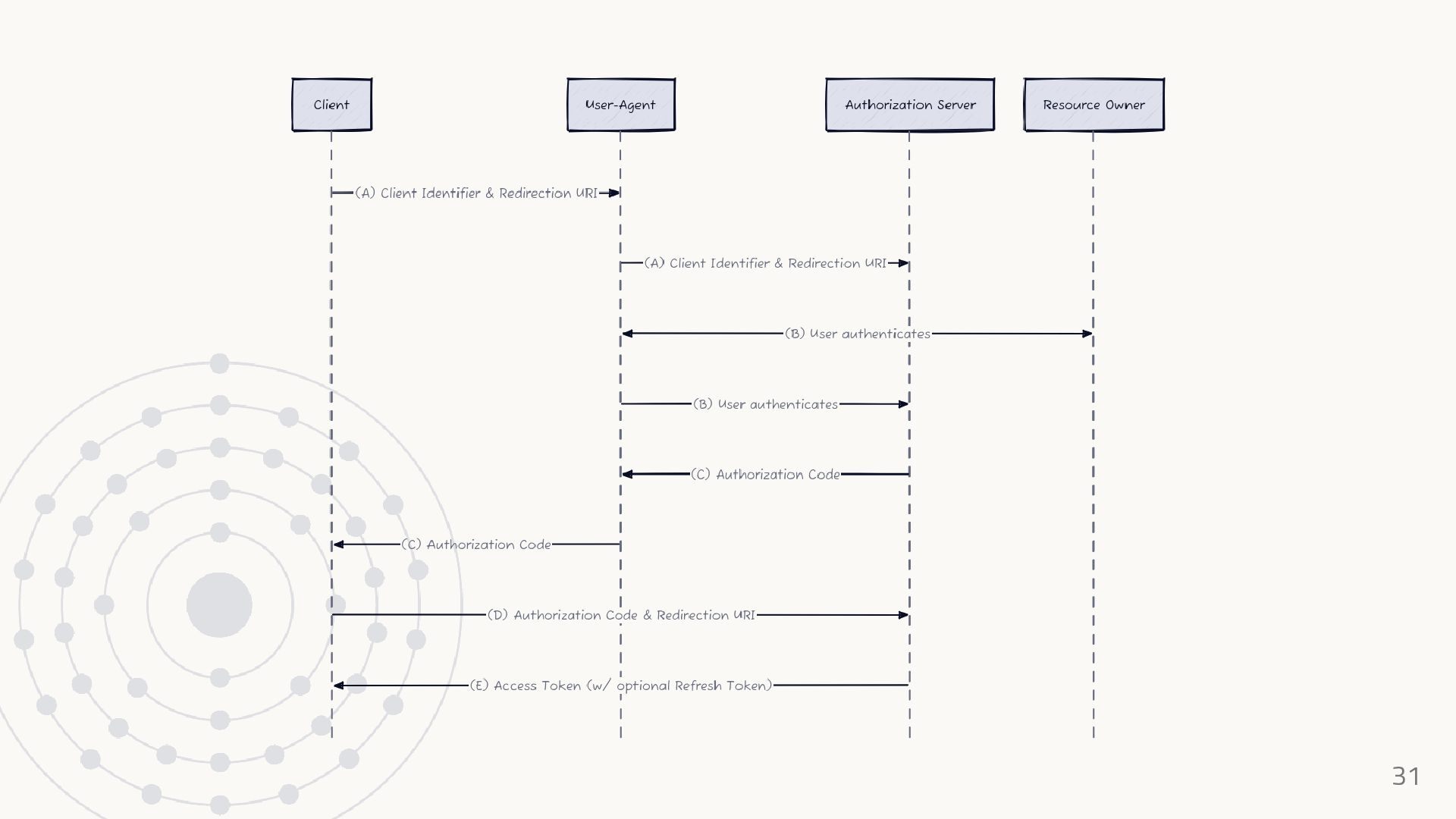
Prerequisites We will assume that the access tokens in question
are: minted/handed out via OAuth and signify the result of authorization and we will address the problem mostly with the OAuth ecosystem. 17 -
Whose token is that? User privilege Access tokens that manipulate
your data only Application/system privilege Access tokens that manipulate multiple users' data 18 -
Who acts with that token? A person, synchronous A machine,
unattended by a person, asynchronous 19 -
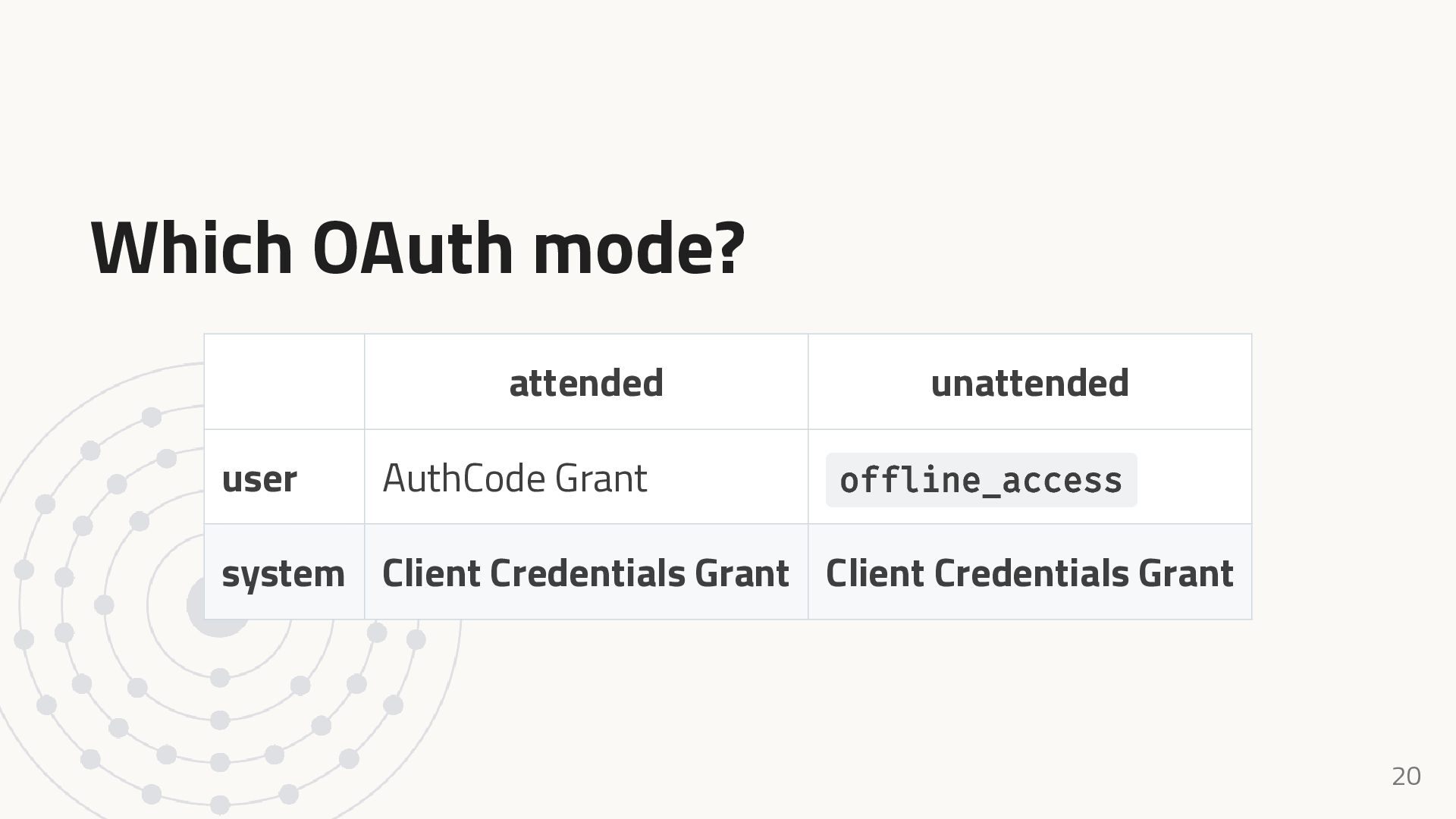
Which OAuth mode? user attended unattended AuthCode Grant offline_access system
Client Credentials Grant Client Credentials Grant 20 -
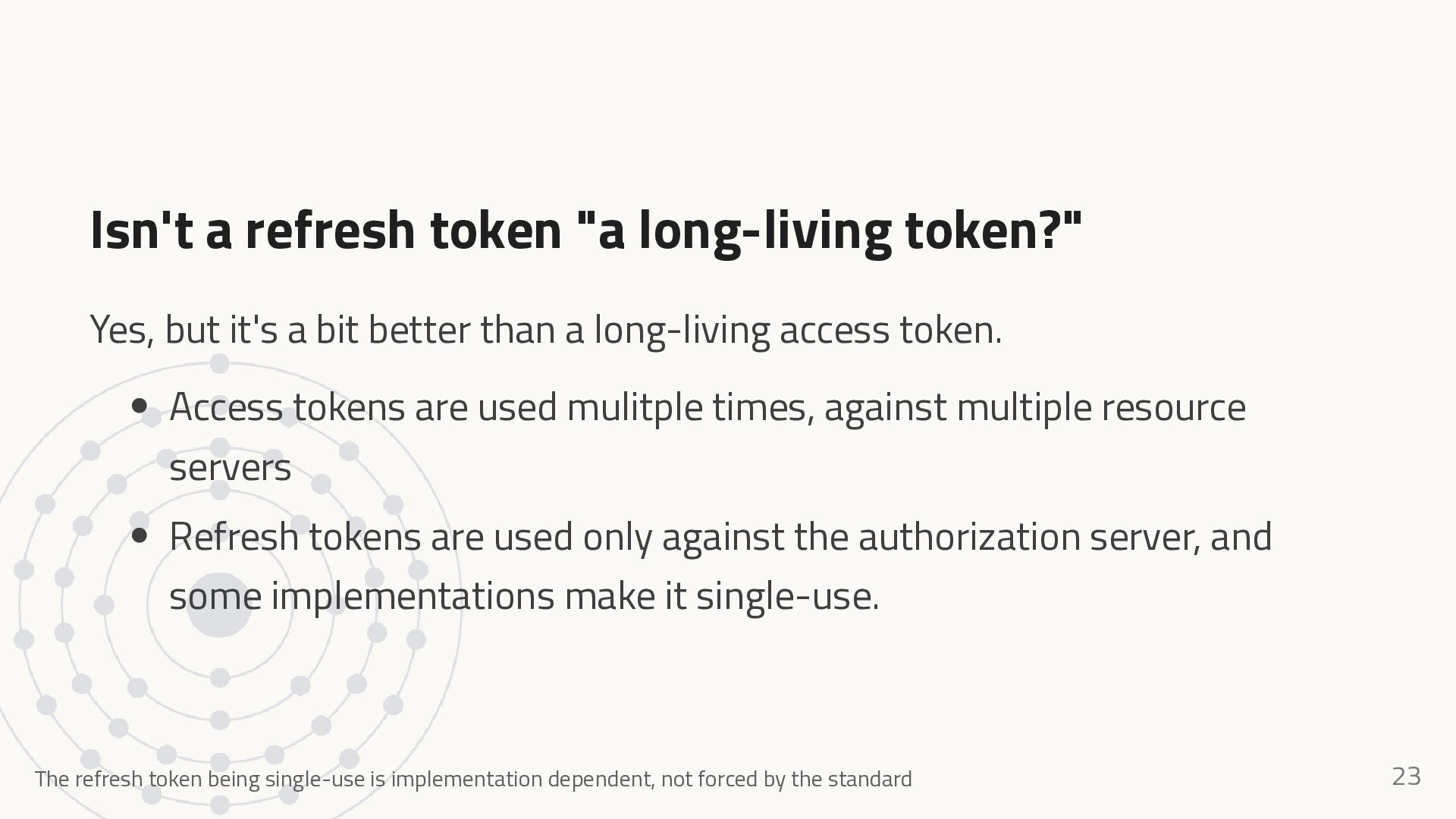
Isn't a refresh token "a long-living token?" Yes, but it's
a bit better than a long-living access token. Access tokens are used mulitple times, against multiple resource servers Refresh tokens are used only against the authorization server, and some implementations make it single-use. The refresh token being single-use is implementation dependent, not forced by the standard 23 -
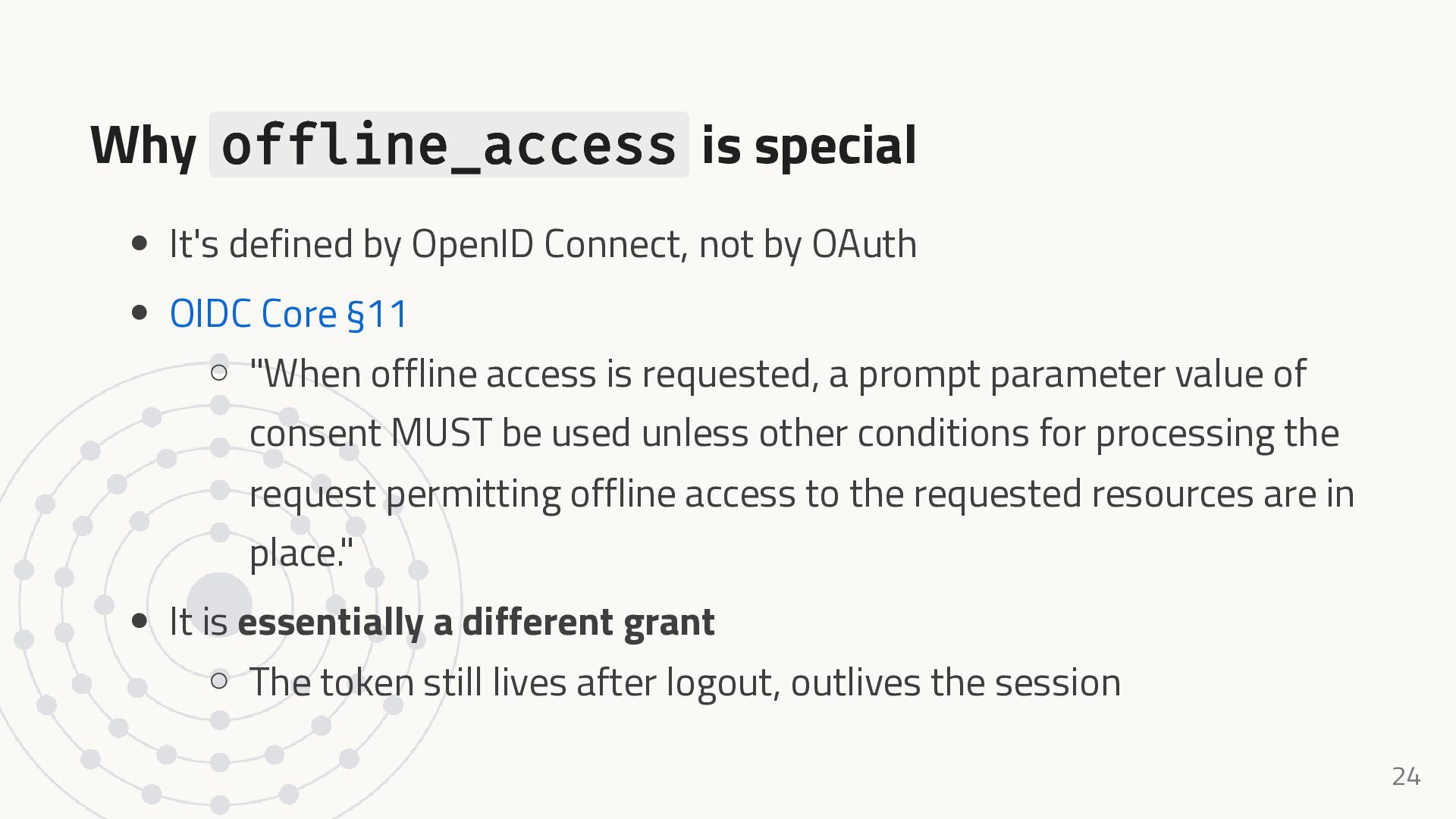
Why offline_access is special It's defined by OpenID Connect, not
by OAuth OIDC Core §11 "When offline access is requested, a prompt parameter value of consent MUST be used unless other conditions for processing the request permitting offline access to the requested resources are in place." It is essentially a different grant The token still lives after logout, outlives the session 24 -
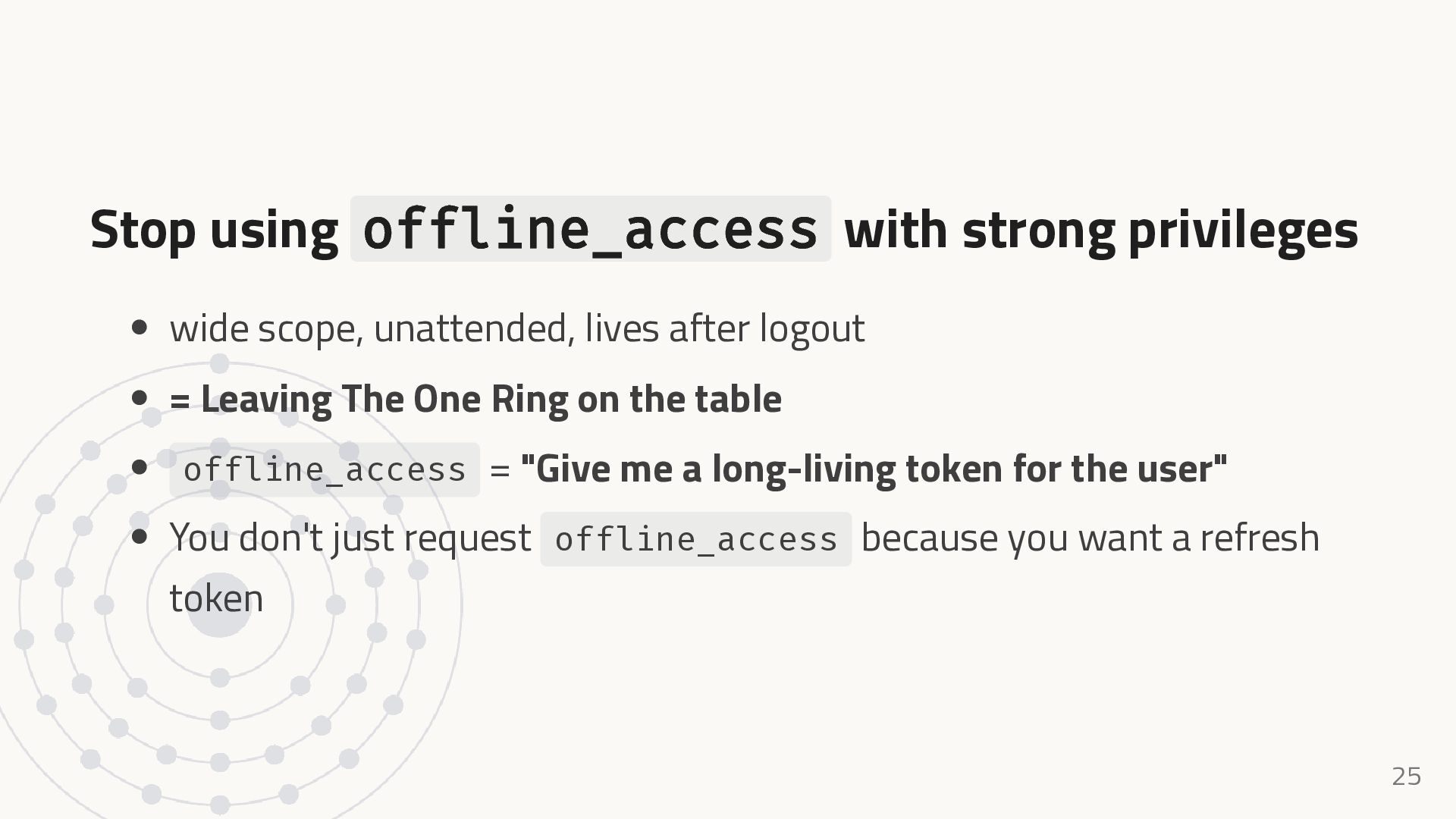
Stop using offline_access with strong privileges wide scope, unattended, lives
after logout = Leaving The One Ring on the table offline_access = "Give me a long-living token for the user" You don't just request offline_access because you want a refresh token 25 -
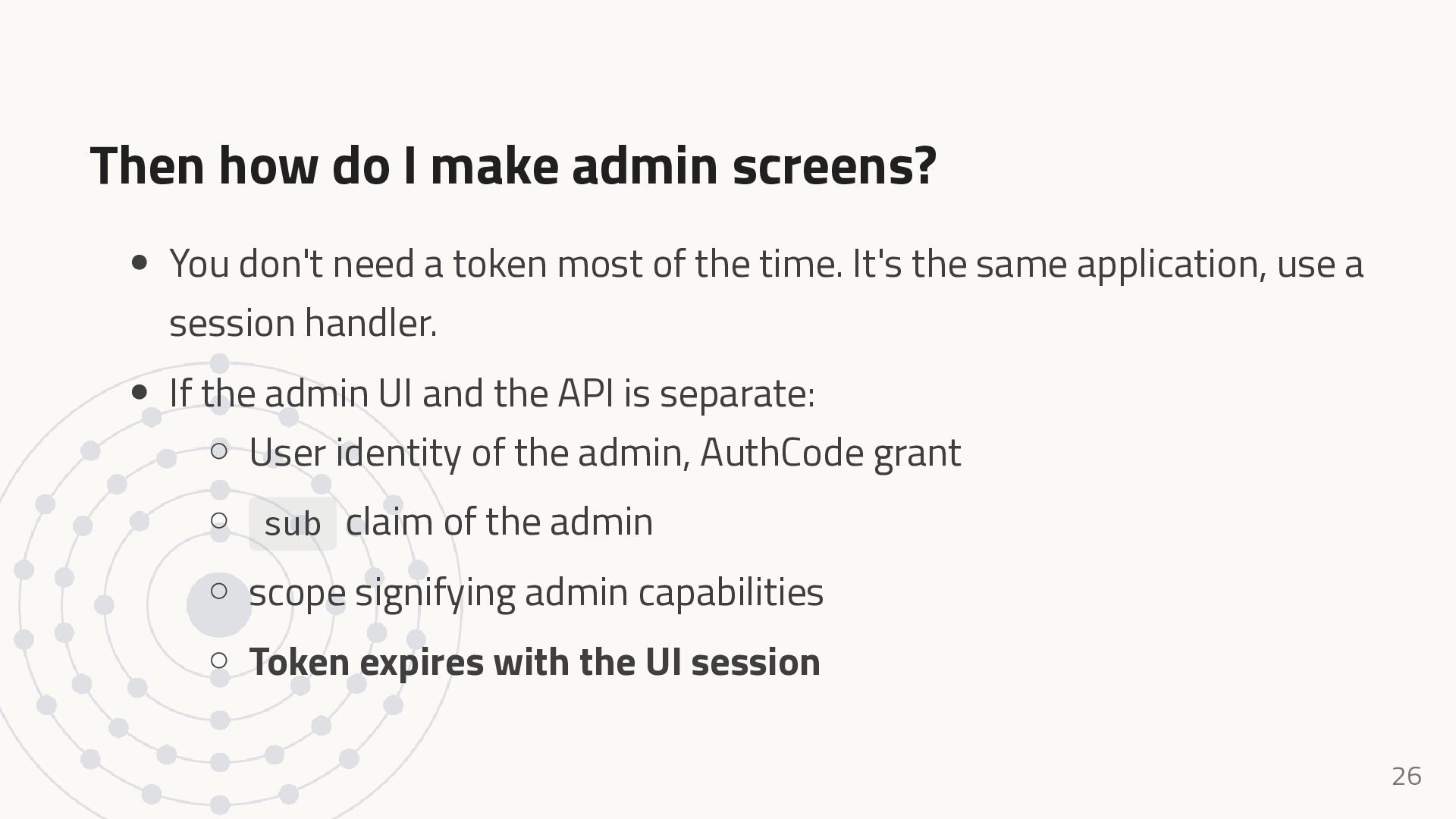
Then how do I make admin screens? You don't need
a token most of the time. It's the same application, use a session handler. If the admin UI and the API is separate: User identity of the admin, AuthCode grant sub claim of the admin scope signifying admin capabilities Token expires with the UI session 26 -
Then how do I make admin screens? sub claim of
the admin We can figure out who took administrative actions = auditable Token expires with the UI session Stop using admin offline_access 27 -
When it gets complicated: Async Attempt batch processing -> Enqueue
jobs -> Sidekiq picks it up later We don't have an admin access token when Sidekiq picks it up Let's persist the admin access token! ... in this way we've created a "long-living token"... 28 -
When it gets complicated: Async We enqueue the job with
admin's credentials The credential that Sidekiq uses is Client Credentials We record the audit trail that the admin enqueued the job Splits who is accountable for the action and who is accountable for the enqueue itself 29 -
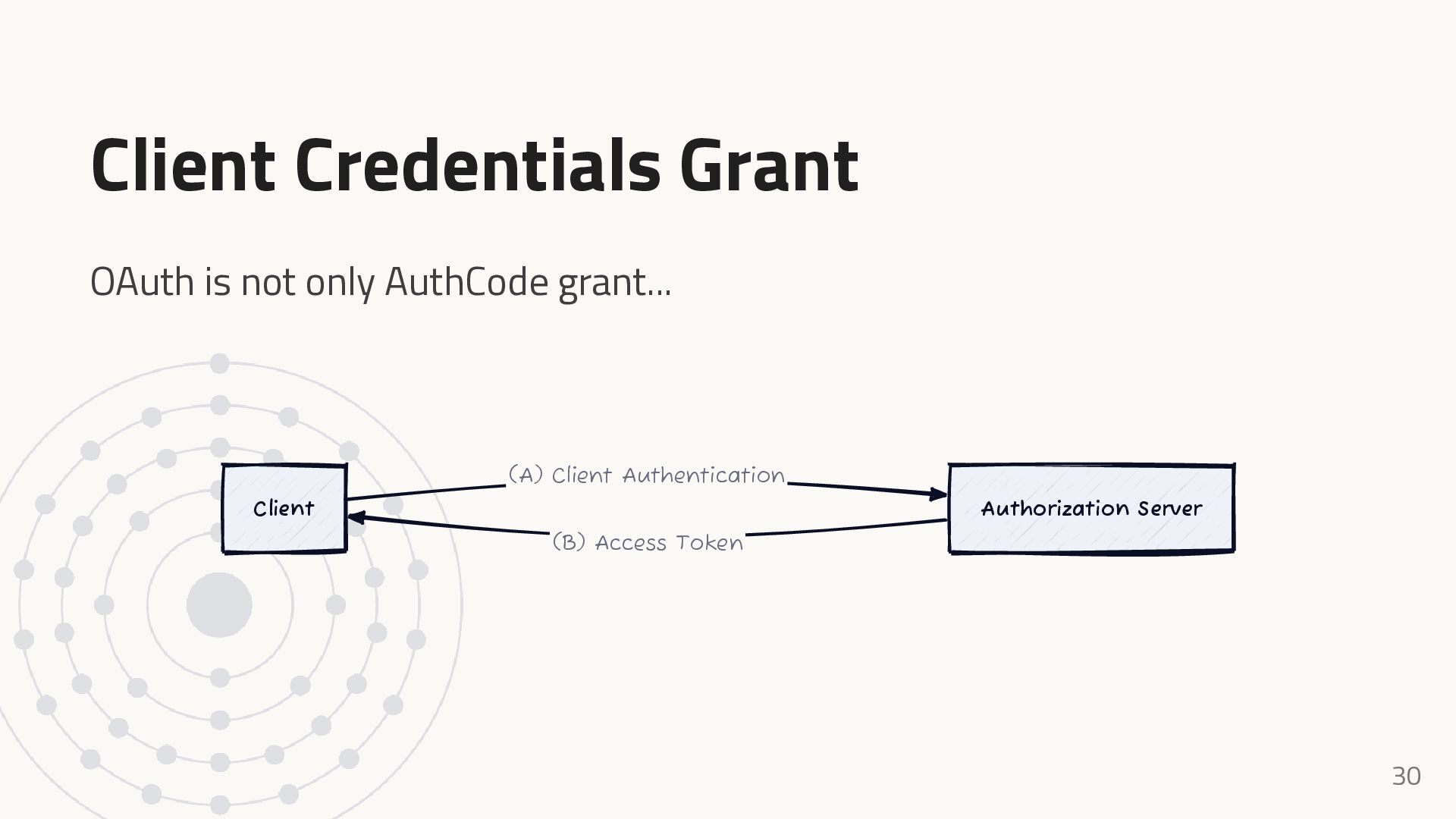
Client Credentials Grant OAuth is not only AuthCode grant... (A)
Client Authentication Client Authorization Server (B) Access Token 30 -
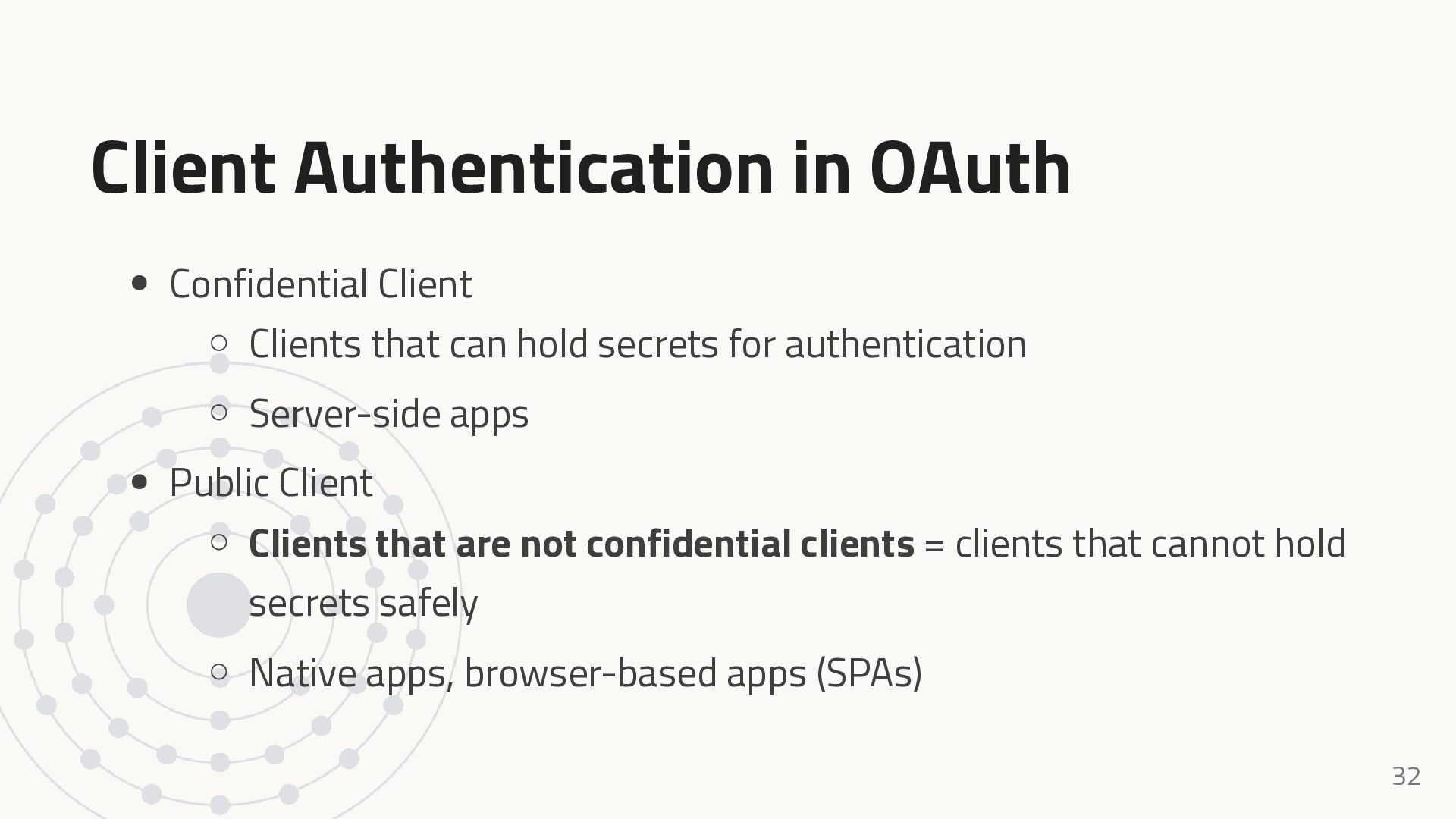
Client Authentication in OAuth Confidential Client Clients that can hold
secrets for authentication Server-side apps Public Client Clients that are not confidential clients = clients that cannot hold secrets safely Native apps, browser-based apps (SPAs) 32 -
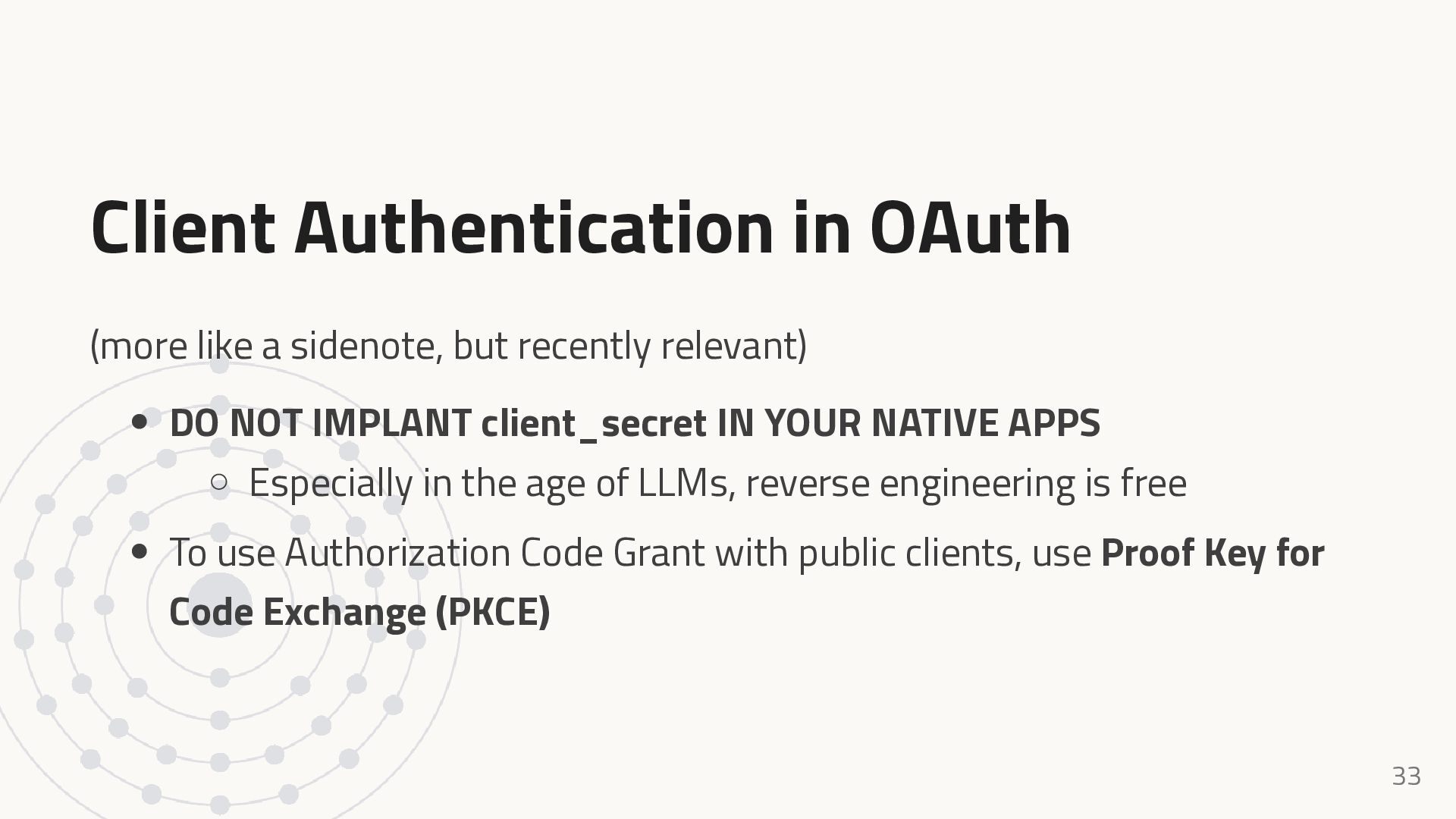
Client Authentication in OAuth (more like a sidenote, but recently
relevant) DO NOT IMPLANT client_secret IN YOUR NATIVE APPS Especially in the age of LLMs, reverse engineering is free To use Authorization Code Grant with public clients, use Proof Key for Code Exchange (PKCE) 33 -
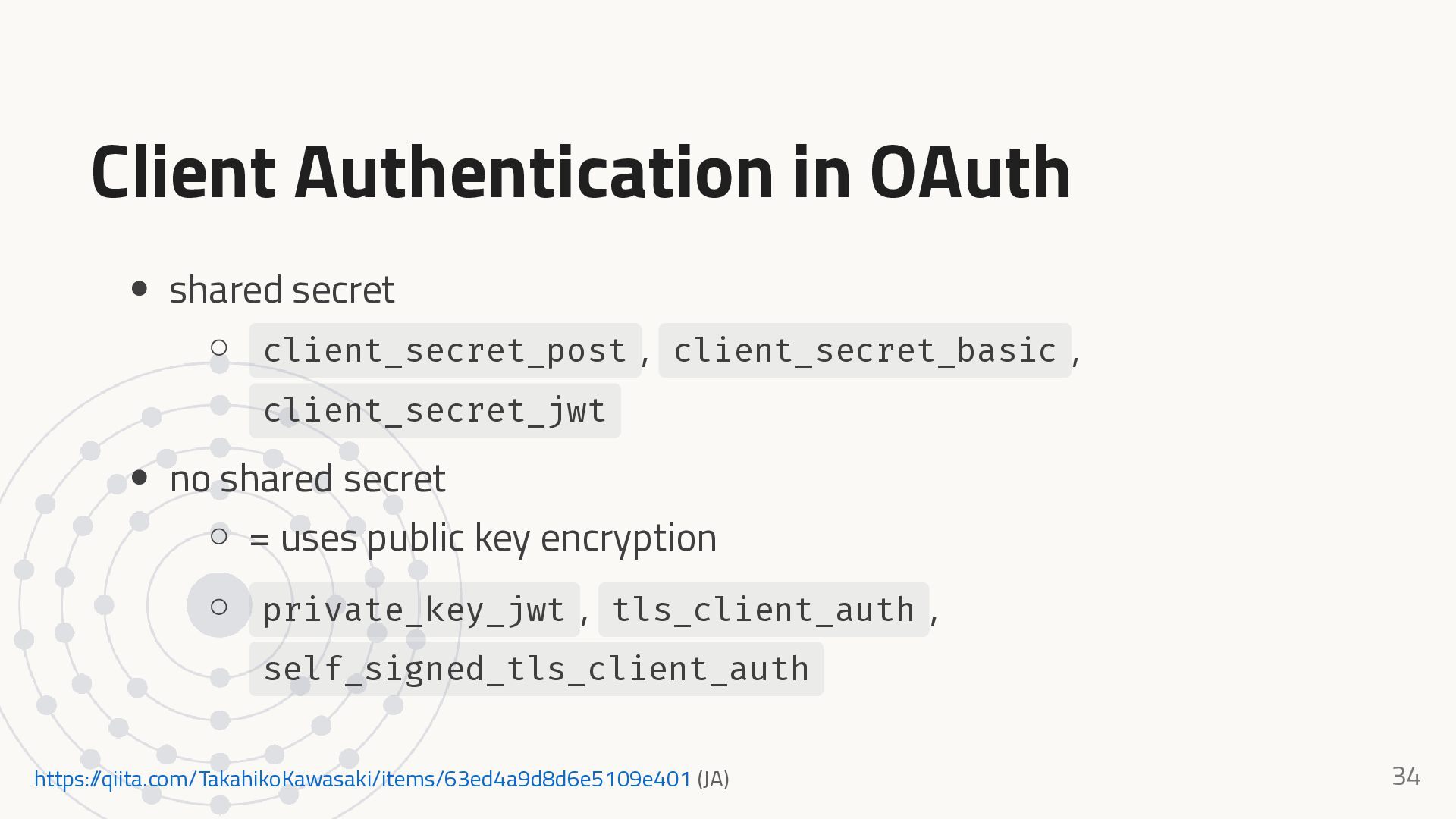
Client Authentication in OAuth shared secret client_secret_post , client_secret_basic ,
client_secret_jwt no shared secret = uses public key encryption private_key_jwt , tls_client_auth , self_signed_tls_client_auth https://qiita.com/TakahikoKawasaki/items/63ed4a9d8d6e5109e401 (JA) 34 -
Wait, isn't client_secret also a "long-living token"? It's more like
a password It's only sent to the authorization server 35 -
Client Authentication that doesn't depend on persistent shared secrets FAPI
(Financial-grade API) requires methods that don't rely on shared secrets. private_key_jwt Sign the payload of the token request with a private key AS verifies the signature with the pre-registered public key mTLS (mutual TLS) RFC 7523: JSON Web Token (JWT) Profile for OAuth 2.0 Client Authentication and Authorization Grants 36 -
Caveats of using mTLS with Rails Rails apps usually run
behind load balancers and reverse proxies that terminate TLS connections. In that case, these endpoints communicate mTLS information with HTTP headers, which sometimes causes security issues. 37 -
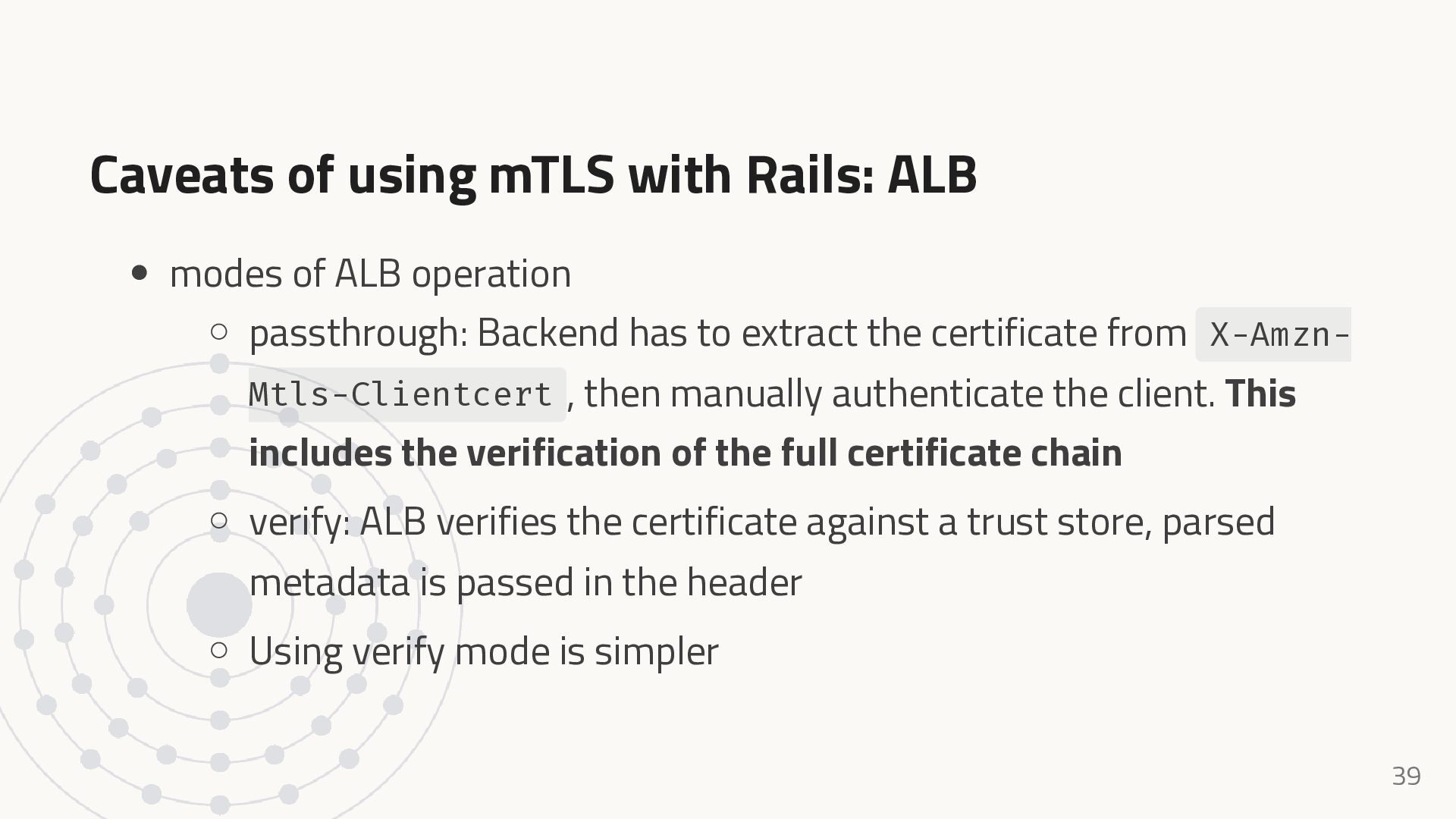
Caveats of using mTLS with Rails: ALB Rails apps under
ALB use headers such as X-Amzn-Mtls-Clientcert to obtain mTLS information If user-specified headers directly reach the Rails app, mTLS guarantees are nullified When headers aren't split at ingress When Rails apps can be directly accessed without ALB 38 -
Caveats of using mTLS with Rails: ALB modes of ALB
operation passthrough: Backend has to extract the certificate from X-AmznMtls-Clientcert , then manually authenticate the client. This includes the verification of the full certificate chain verify: ALB verifies the certificate against a trust store, parsed metadata is passed in the header Using verify mode is simpler 39 -
When RP compromise is in scope Using private_key_jwt or DPoP
(Demonstrating Proof of Possession) with hardware-stored keys Protects keys from copying Attested Workload Identity SPIFFE 40 -
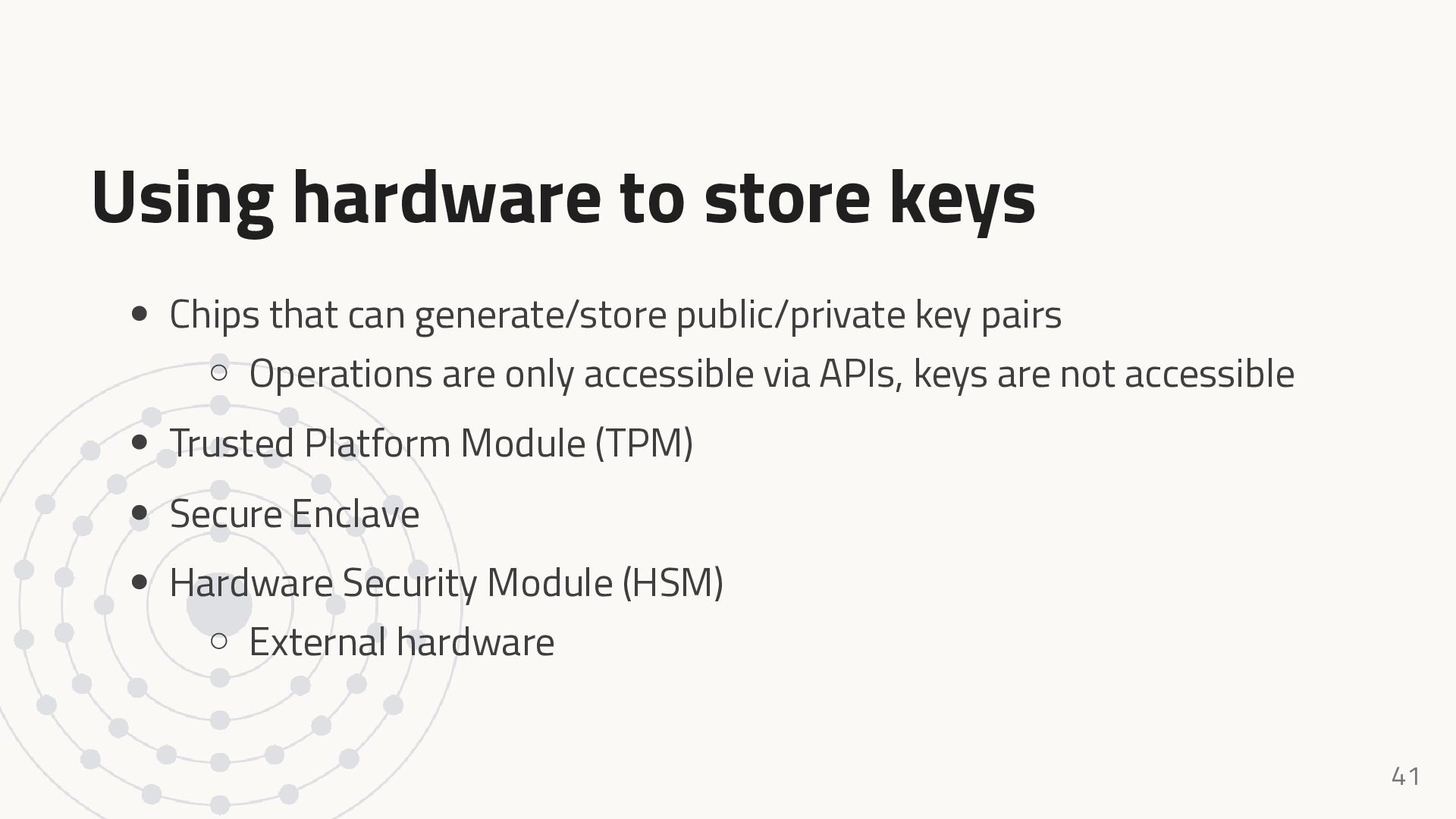
Using hardware to store keys Chips that can generate/store public/private
key pairs Operations are only accessible via APIs, keys are not accessible Trusted Platform Module (TPM) Secure Enclave Hardware Security Module (HSM) External hardware 41 -
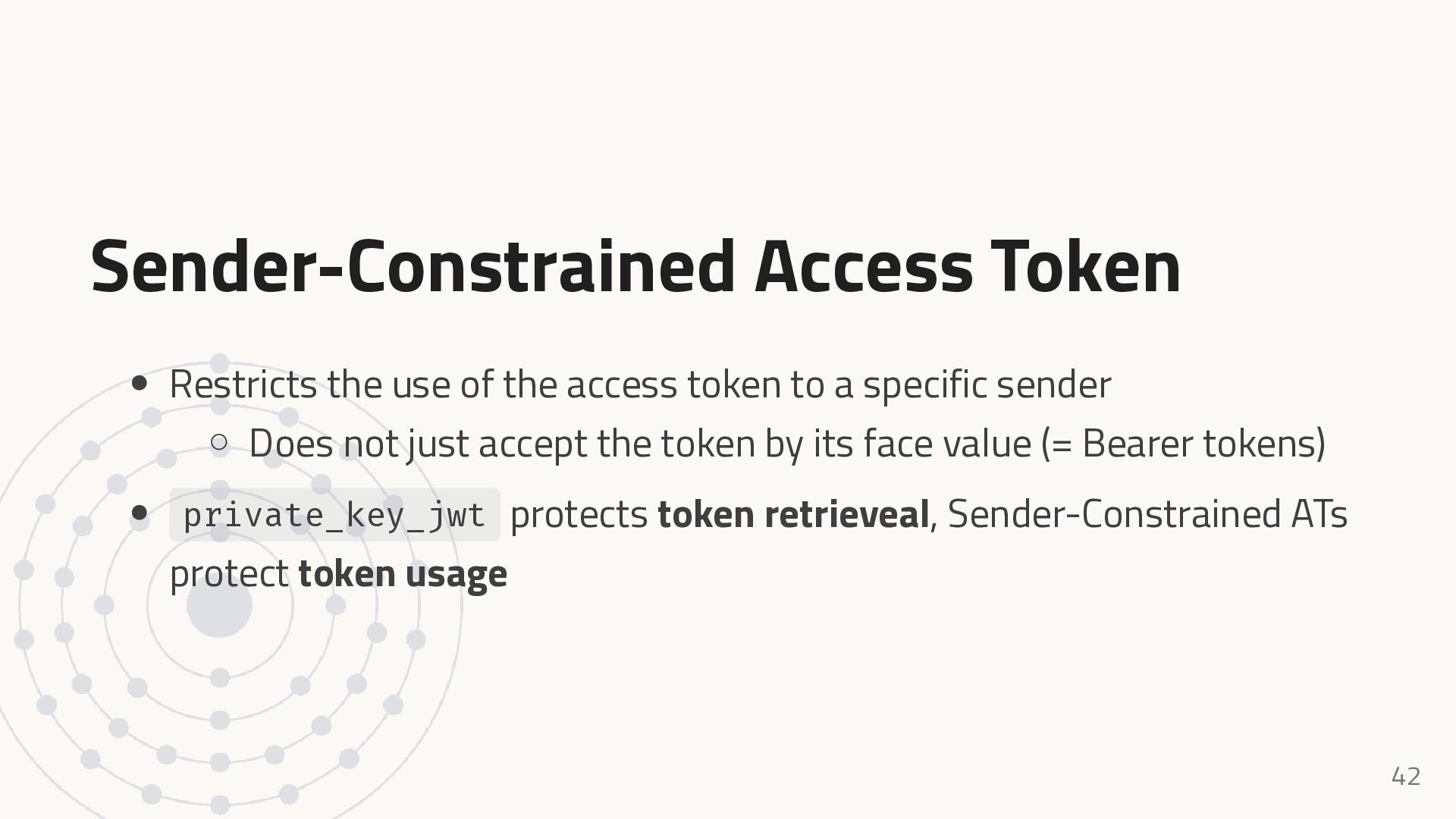
Sender-Constrained Access Token Restricts the use of the access token
to a specific sender Does not just accept the token by its face value (= Bearer tokens) private_key_jwt protects token retrieveal, Sender-Constrained ATs protect token usage 42 -
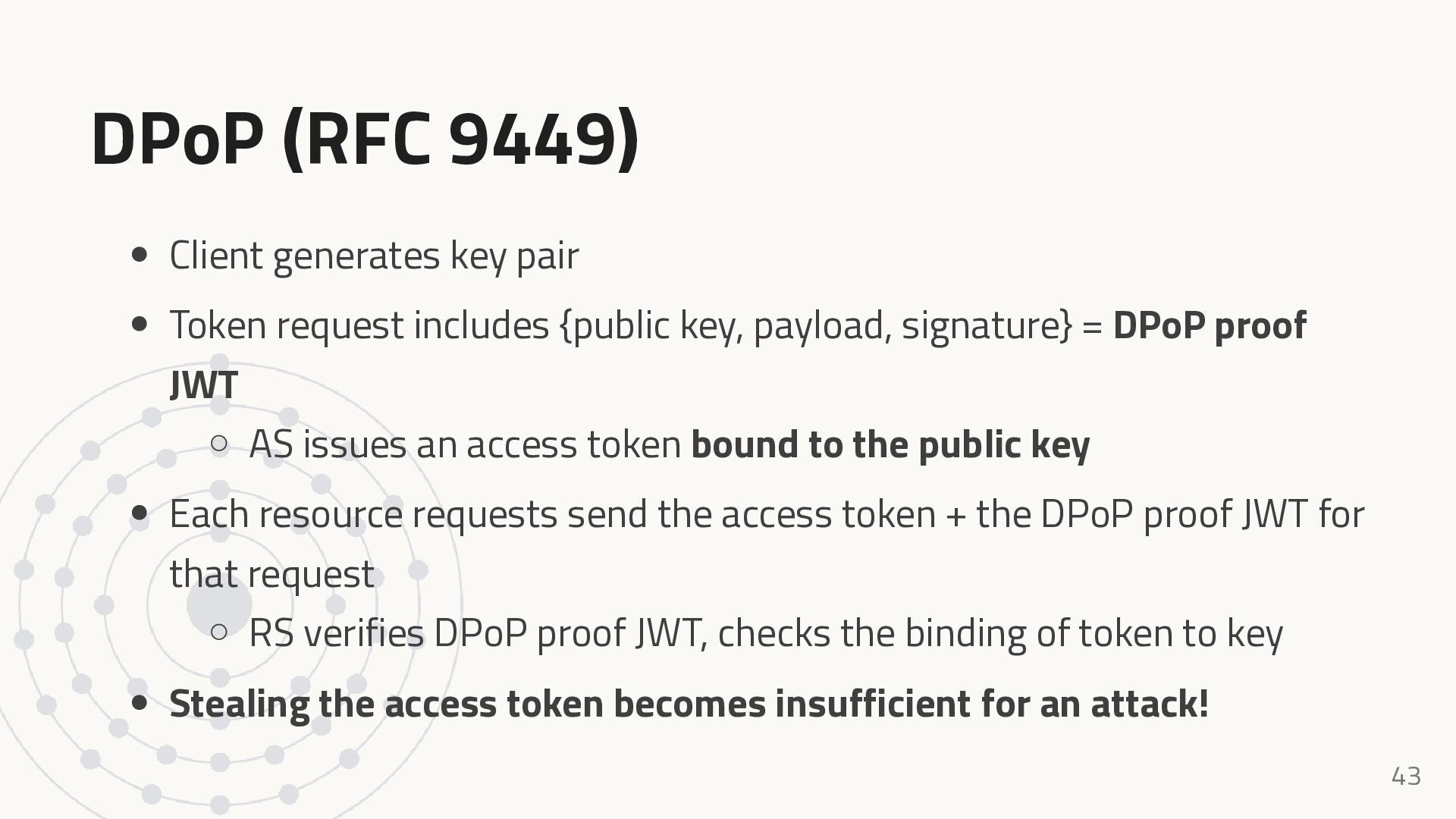
DPoP (RFC 9449) Client generates key pair Token request includes
{public key, payload, signature} = DPoP proof JWT AS issues an access token bound to the public key Each resource requests send the access token + the DPoP proof JWT for that request RS verifies DPoP proof JWT, checks the binding of token to key Stealing the access token becomes insufficient for an attack! 43 -
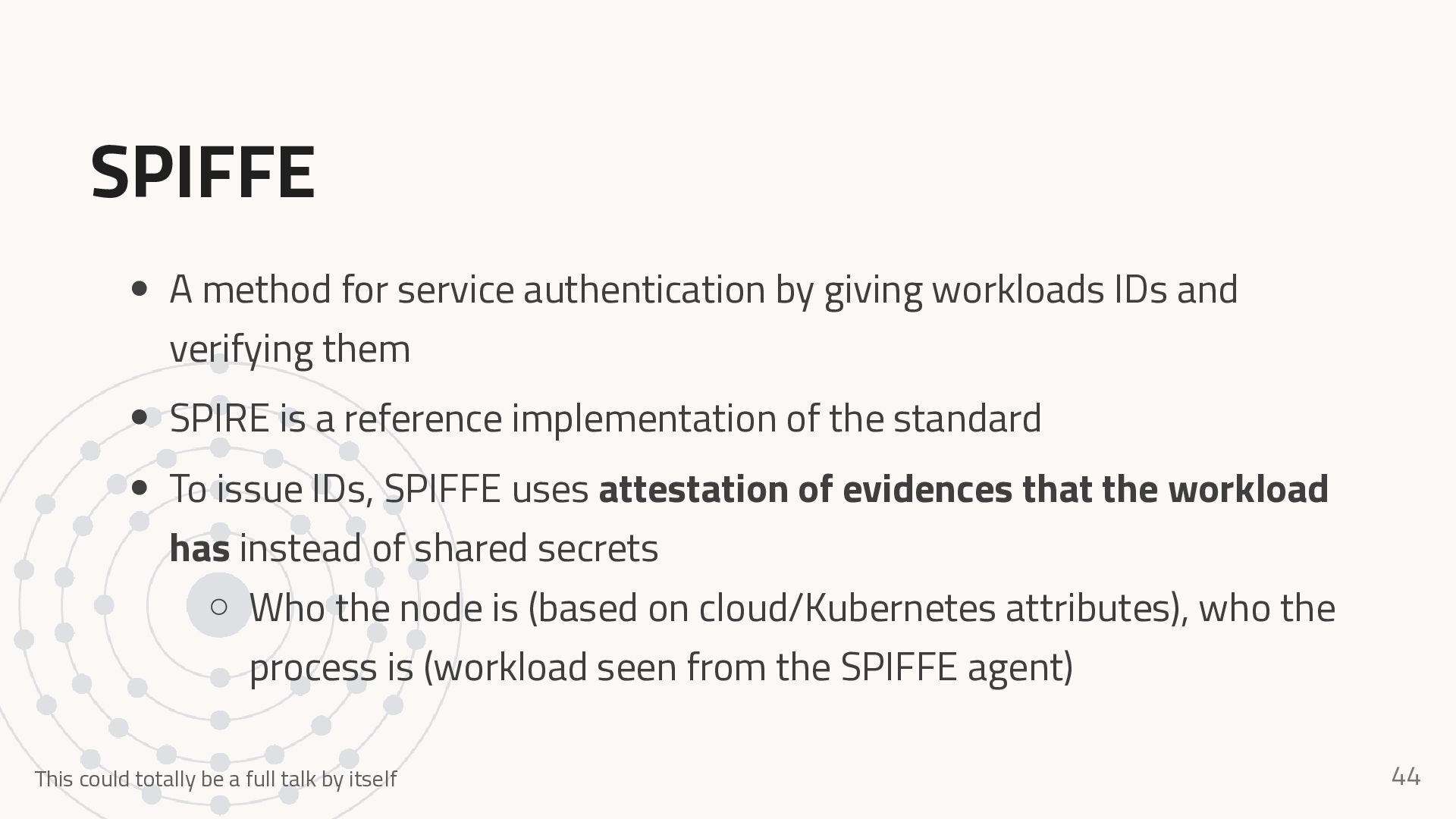
SPIFFE A method for service authentication by giving workloads IDs
and verifying them SPIRE is a reference implementation of the standard To issue IDs, SPIFFE uses attestation of evidences that the workload has instead of shared secrets Who the node is (based on cloud/Kubernetes attributes), who the process is (workload seen from the SPIFFE agent) This could totally be a full talk by itself 44 -
Relationship of SPIFFE with OAuth? SPIFFE itself is sufficient for
inter-service authentication for now. There is an Internet-Draft called draft-ietf-oauth-spiffe-client-auth that tries to bridge SPIFFE with OAuth. As of 2026/06, it is a WG Item, and the draft number is -02. 45 -
Minimize privileges Do less with operator scope Use The Three,
The Seven, and The Nine for lesser operations Separate strong operations into a different scope The Nine might not be a good example of privilege minimization, because the bearers of The Nine became Nazgûls... 47 -
Minimize audiences RFC 8707 tells you how to specify which
audience the access token you're requesting is intended for 48 -
Other countermeasures The machine that does the strong operations doesn't
have to be accessible from the Internet 49 -
What if updates conflict? When multiple workers exist and their
cached tokens expire at the same time It's your usual parallelism/concurrency problem 51 -
Refresh token being single-use is implementation dependent If it's single
use then only one will succeed 53 -
Refresh token Conclusion: Do not use refresh tokens on multiple
workers. Refresh tokens are used in user contexts If you really want to automate then create multiple sessions, but having multiple sessions increases the risk of compromise... 54 -
Client Credentials Grant No correctness race, because all authentication requests
will succeed and return a valid token. But that will increase the number of valid tokens... 55 -
Thundering herd problem A problem where multiple workers react to
an event at the same time and performs an operation, but only one worker succeeds in operating, and the others will fail. Also called cache stampede when used in terms of caching. When the cycle of expiration is constant, refreshes happen simultaneously, causing this problem. 56 -
Thundering herd problem Give a random jitter on the refresh
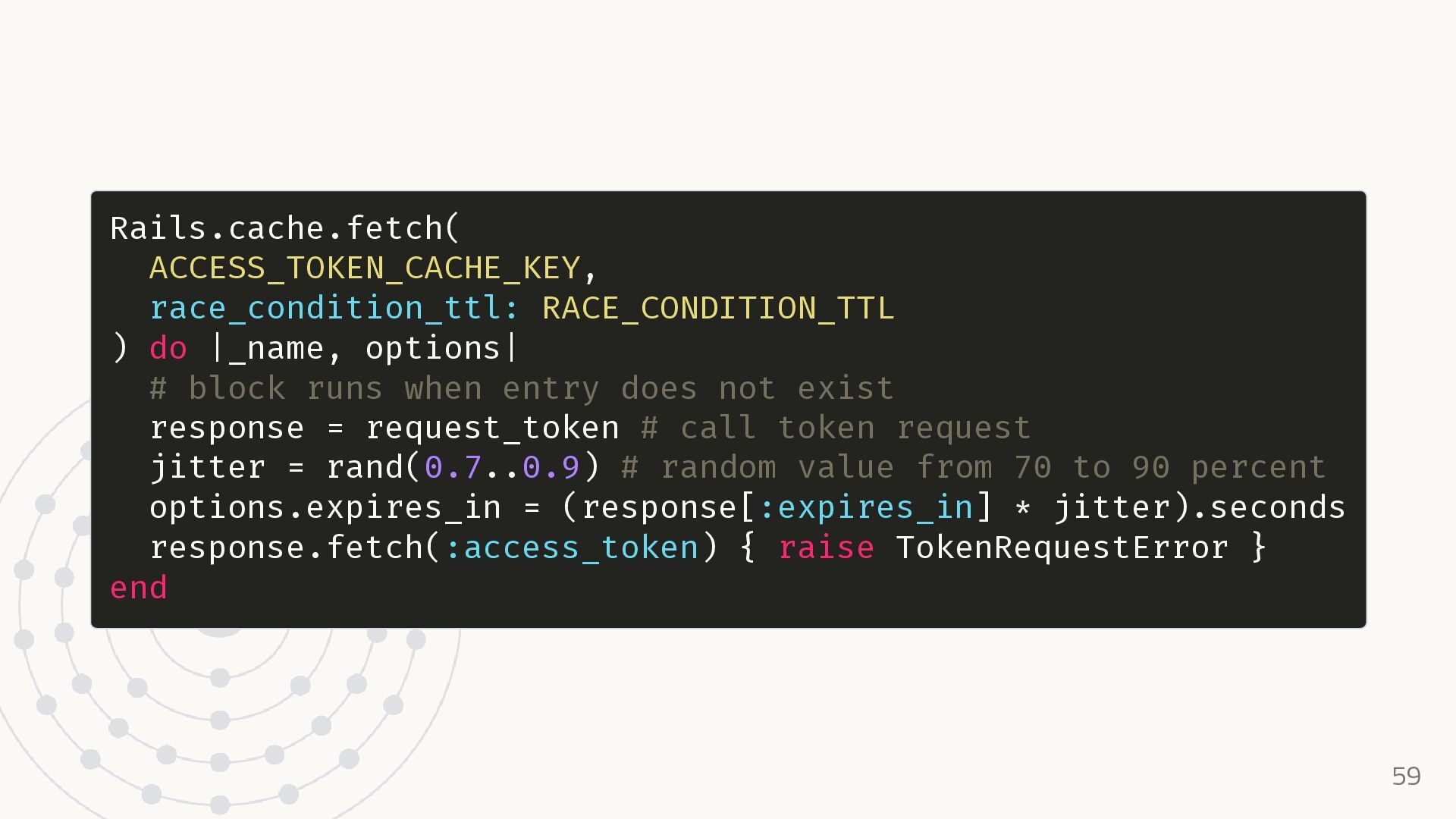
timing instead of refreshing at the same time Avoids simlutaneous refresh race_condition_ttl option in Rails.cache.write / fetch First request goes through normally For the next requests, this will return the first request's result for the duration of race_condition_ttl instead of actually performing the request again 57 -
How to cache the token We have Solid Cache these
days I recommend Solid Cache with Active Record Encryption Being written to the database means it gets backed up, so encryption is important Add encrypt: true , bin/rails db:encryption:init 58 -
Rails.cache.fetch( ACCESS_TOKEN_CACHE_KEY, race_condition_ttl: RACE_CONDITION_TTL ) do |_name, options| # block
runs when entry does not exist response = request_token # call token request jitter = rand(0.7..0.9) # random value from 70 to 90 percent options.expires_in = (response[:expires_in] * jitter).seconds response.fetch(:access_token) { raise TokenRequestError } end 59 -
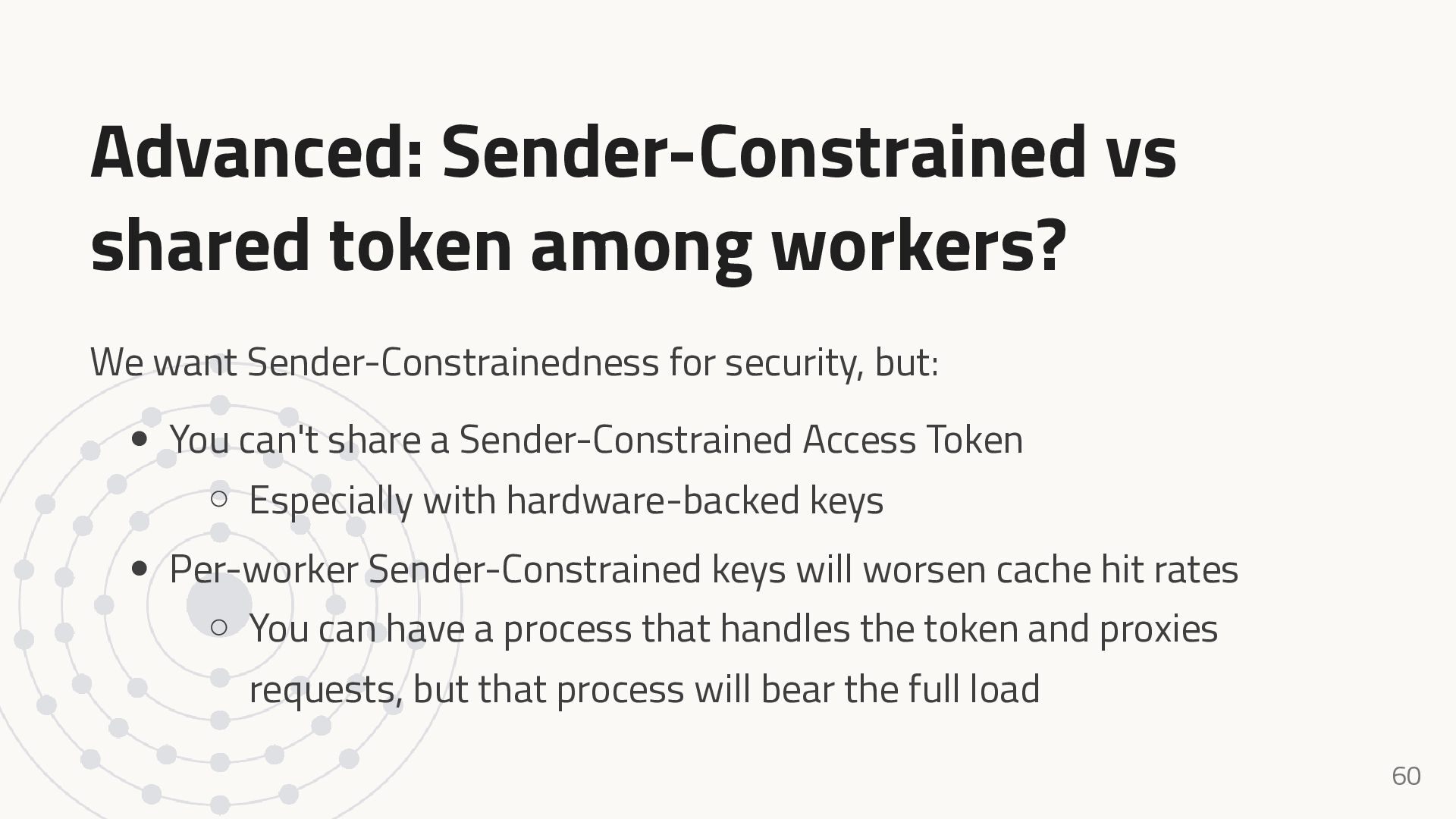
Advanced: Sender-Constrained vs shared token among workers? We want Sender-Constrainedness
for security, but: You can't share a Sender-Constrained Access Token Especially with hardware-backed keys Per-worker Sender-Constrained keys will worsen cache hit rates You can have a process that handles the token and proxies requests, but that process will bear the full load 60 -
All the talk is good, but do you actually do
this? Yup, recently. 62 -
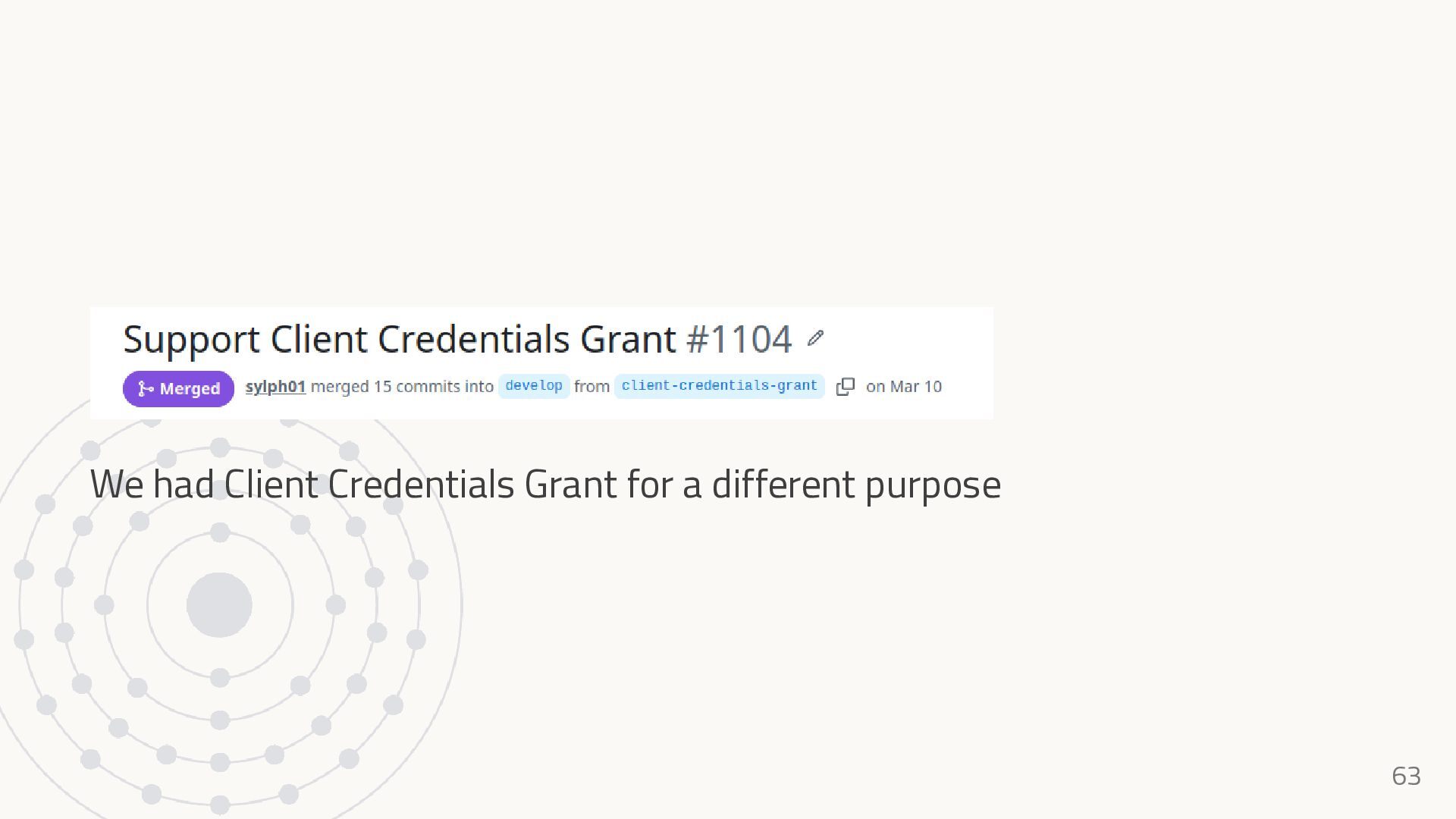
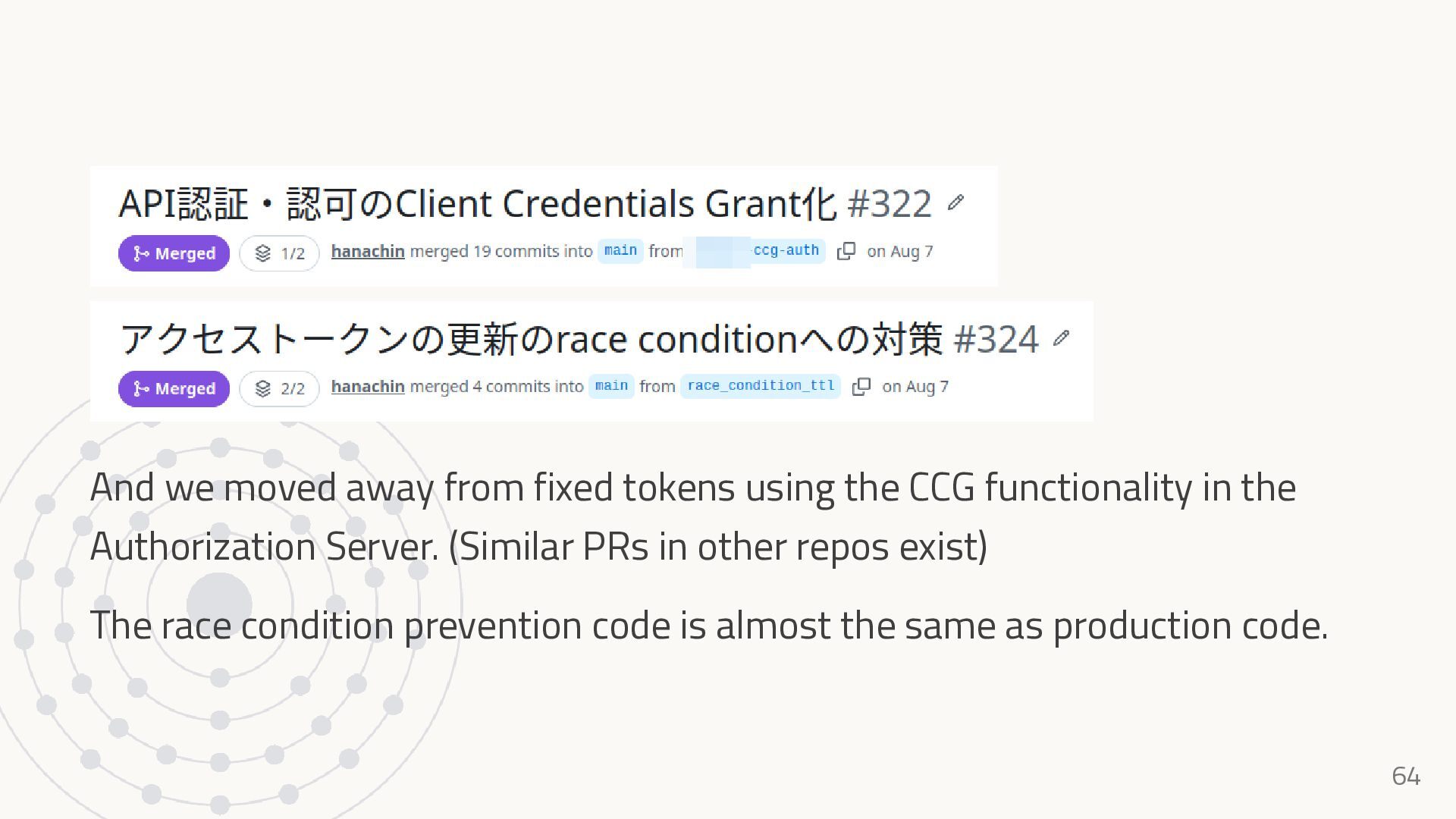
And we moved away from fixed tokens using the CCG
functionality in the Authorization Server. (Similar PRs in other repos exist) The race condition prevention code is almost the same as production code. 64 -
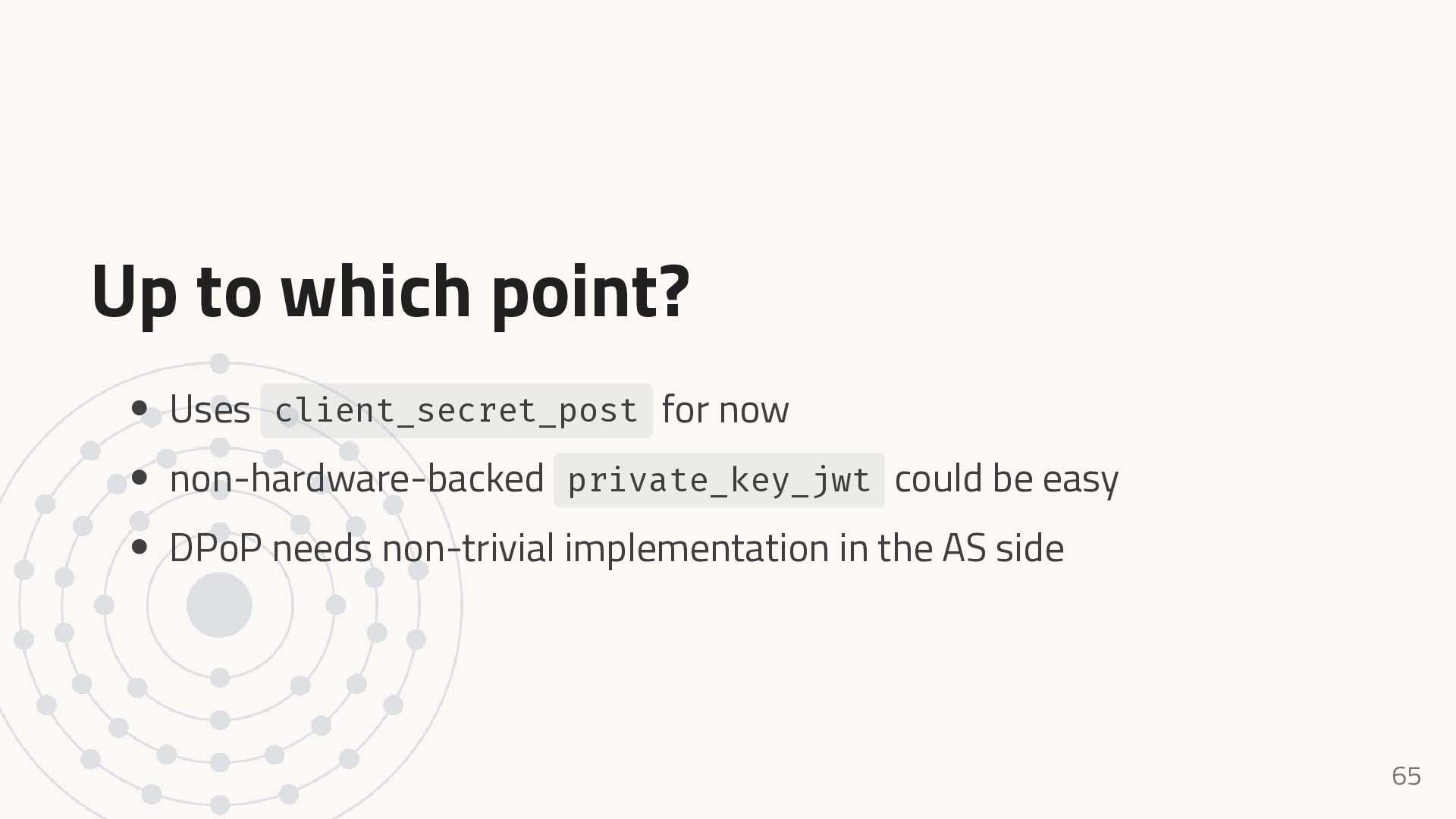
Up to which point? Uses client_secret_post for now non-hardware-backed private_key_jwt
could be easy DPoP needs non-trivial implementation in the AS side 65 -
Destroy the One Ring Or, it shouldn't come into existence
in the first place 72