Upgrade to Pro
— share decks privately, control downloads, hide ads and more …
Speaker Deck
Sign up for free
Menu
Search
Features
All features
Private URLs
Password Protection
Custom URLS
Scheduled publishing
Remove Branding
Restrict embedding
Deck Collections
Notes
Features
All features
Private URLs
Password Protection
Custom URLS
Scheduled publishing
Remove Branding
Restrict embedding
Deck Collections
Notes
Explore
Featured decks
Featured speakers
Programming
Technology
Storyboards
Explore
Featured decks
Featured speakers
Programming
Technology
Storyboards
Pricing
Search
Sign in
Sign up for free
Hello UUID
Search
Sponsored
·
SiteGround - Reliable hosting with speed, security, and support you can count on.
→
mimifuwacc
April 11, 2026
Technology
200
0
Share
Embed
Copy iframe code
Copy JS code
Copy link
Start on current slide
Hello UUID
技術系サークル合同新歓2026 Day2
「Hello UUID」発表資料
mimifuwacc
April 11, 2026
More Decks by mimifuwacc
See All by mimifuwacc
RAID6 を楔形文字で組んで現代人を怖がらせましょう(実装編)
mimifuwacc
1
480
Other Decks in Technology
See All in Technology
LambdaWebFunctionsを試してみた / exploring-lambda-web-functions
koukihosaka
1
340
S3 Filesで挑む! 八戸せんべい汁の食べ頃問題
usanchuu
0
100
触りたくないデータに、どう触るか AI時代のRBACアクセスガバナンス
ivry_presentationmaterials
0
270
フロントエンドカンファレンス関西2026 - 速すぎるUIに、待ち時間を
teamlab
PRO
0
130
Optunaの最新リリースv5.0について
pfn
PRO
0
120
AI時代のPRレビューにどう向き合うか?
kairim0
1
240
Temporal 最高!でも改めて「日付」について調べたら人類の負債すぎる件
riyaamemiya
0
150
Browser Spec: Testing Hotwire with Ruby
takahashim
1
120
"優秀な誰か"の下位互換にならないために
yut0naga1_fa
1
1.8k
日本語に強いオープンな大規模言語モデル「LLM-jp」
odashi
4
1.1k
Local CI × GitHub Actions
gogutan
2
200
1つのリクエストを追って理解する - llm-dのP/D分離
akhino
1
160
Featured
See All Featured
Lightning Talk: Beautiful Slides for Beginners
inesmontani
PRO
2
730
The Cult of Friendly URLs
andyhume
79
7k
How Fast Is Fast Enough? [PerfNow 2025]
tammyeverts
3
940
Raft: Consensus for Rubyists
vanstee
142
7.8k
Visualizing Your Data: Incorporating Mongo into Loggly Infrastructure
mongodb
50
10k
Building the Perfect Custom Keyboard
takai
2
910
Odyssey Design
rkendrick25
PRO
2
870
Public Speaking Without Barfing On Your Shoes - THAT 2023
reverentgeek
1
600
Fashionably flexible responsive web design (full day workshop)
malarkey
409
67k
Heart Work Chapter 1 - Part 1
lfama
PRO
10
37k
GraphQLとの向き合い方2022年版
quramy
50
15k
How to build a perfect <img>
jonoalderson
1
6.1k
Transcript
Hello UUID 技術系サークル合同新歓2026 Day2 id: mimifuwacc
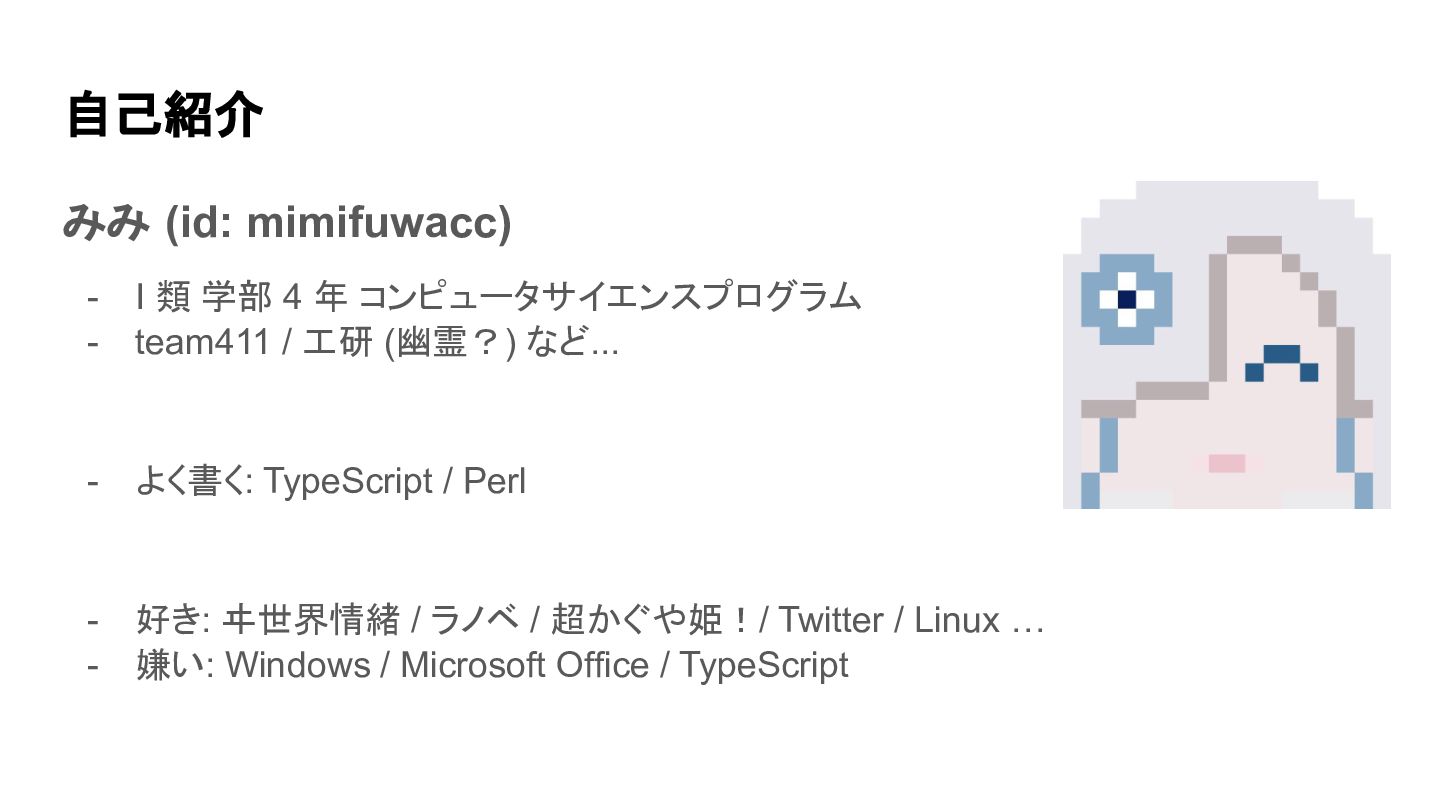
自己紹介 みみ (id: mimifuwacc) - I 類 学部 4 年
コンピュータサイエンスプログラム - team411 / 工研 (幽霊?) など... - よく書く: TypeScript / Perl - 好き: ヰ世界情緒 / ラノベ / 超かぐや姫!/ Twitter / Linux … - 嫌い: Windows / Microsoft Office / TypeScript
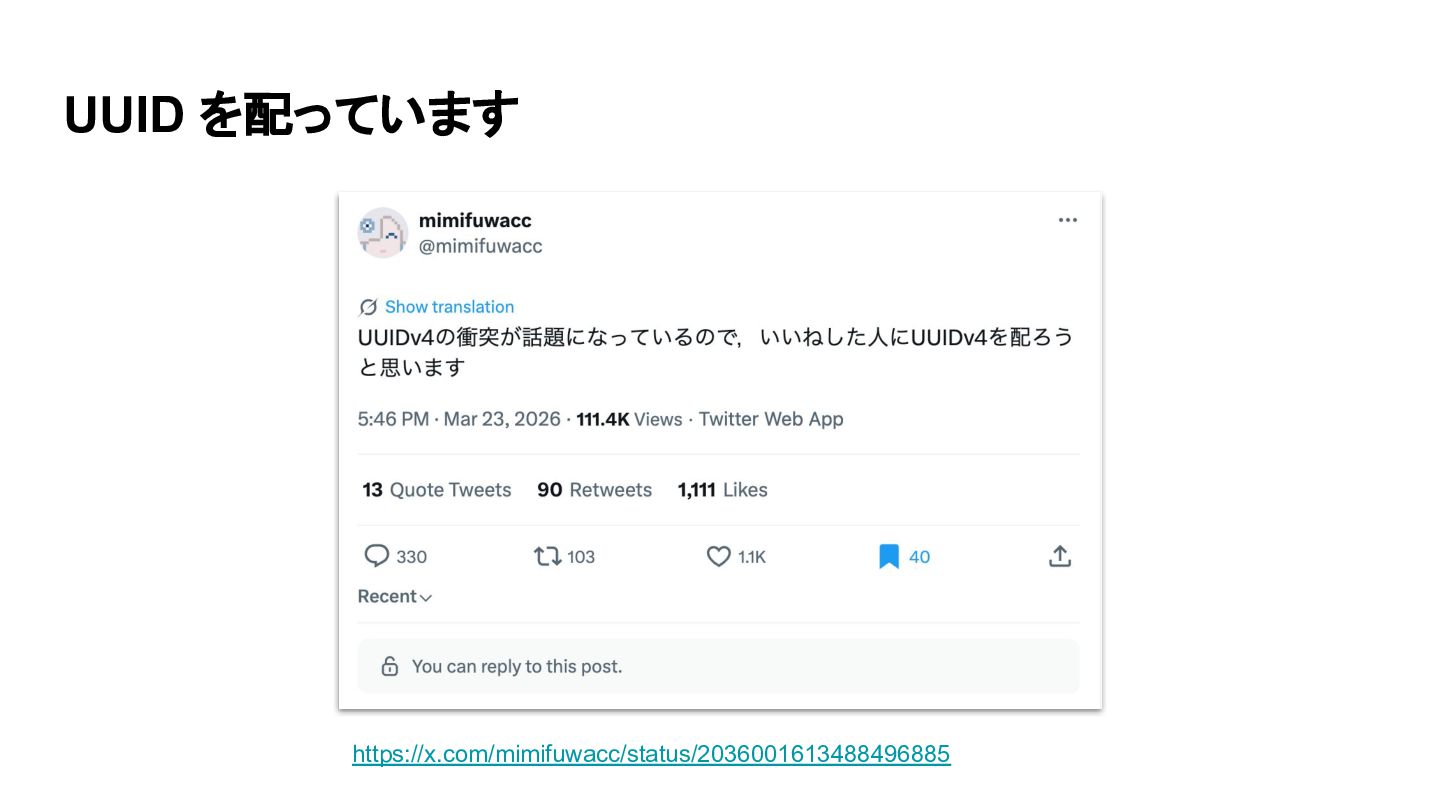
UUID を配っています https://x.com/mimifuwacc/status/2036001613488496885
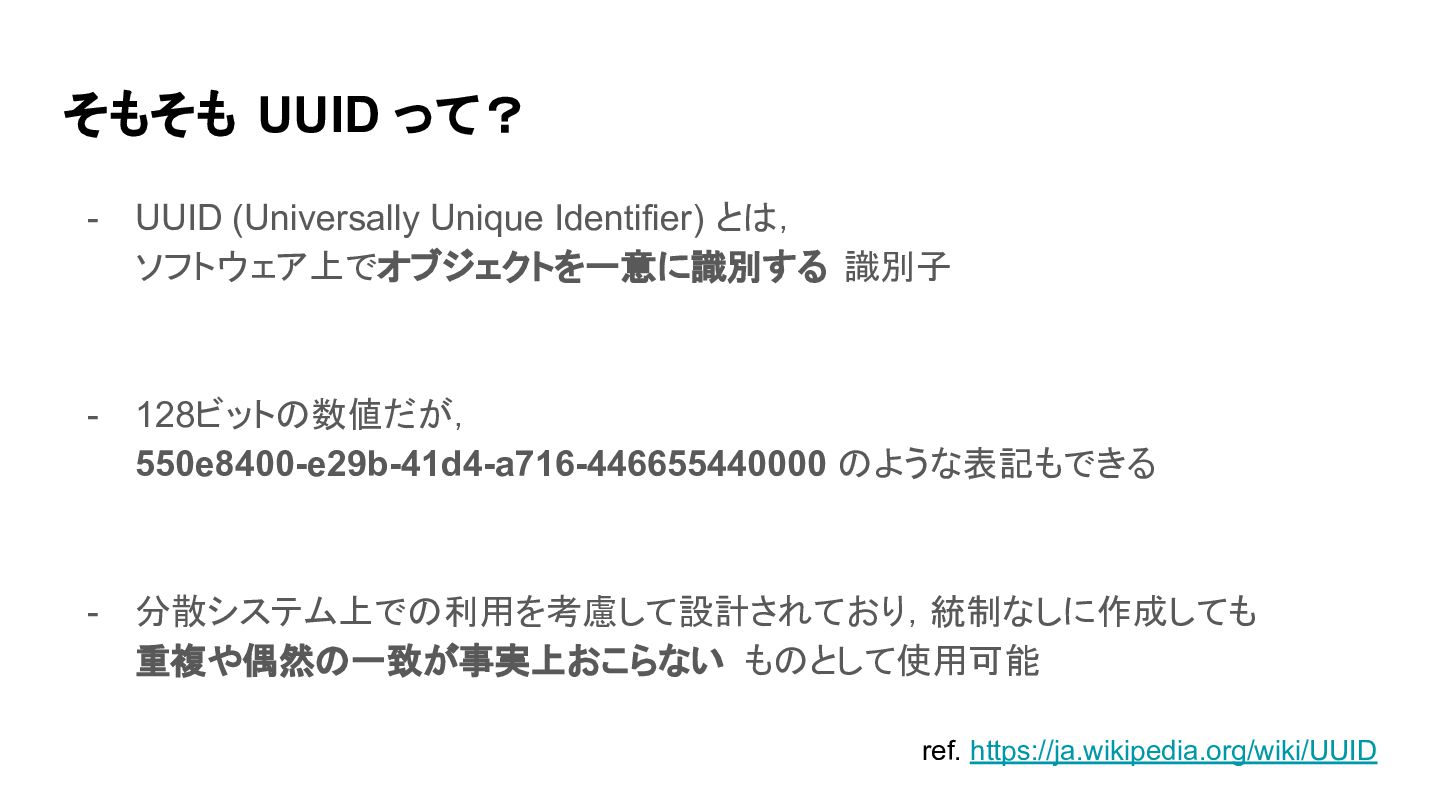
そもそも UUID って? - UUID (Universally Unique Identifier) とは, ソフトウェア上でオブジェクトを一意に識別する
識別子 - 128ビットの数値だが, 550e8400-e29b-41d4-a716-446655440000 のような表記もできる - 分散システム上での利用を考慮して設計されており,統制なしに作成しても 重複や偶然の一致が事実上おこらない ものとして使用可能 ref. https://ja.wikipedia.org/wiki/UUID
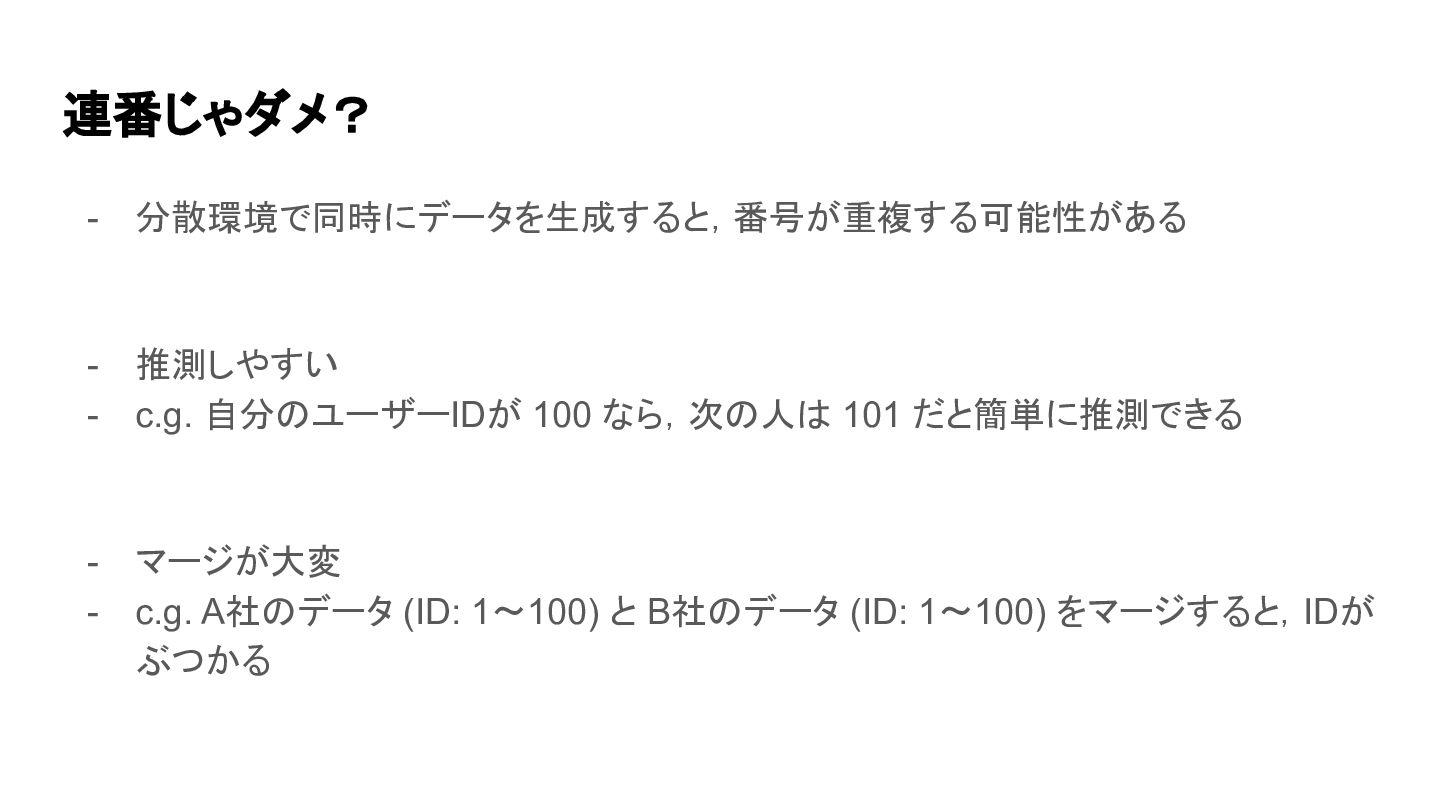
連番じゃダメ? - 分散環境で同時にデータを生成すると,番号が重複する可能性がある - 推測しやすい - c.g. 自分のユーザーIDが 100 なら,次の人は
101 だと簡単に推測できる - マージが大変 - c.g. A社のデータ (ID: 1〜100) と B社のデータ (ID: 1〜100) をマージすると,IDが ぶつかる
UUID なら... 統制なしに作成しても 重複や偶然の一致が事実上おこらないものとして使用可能!
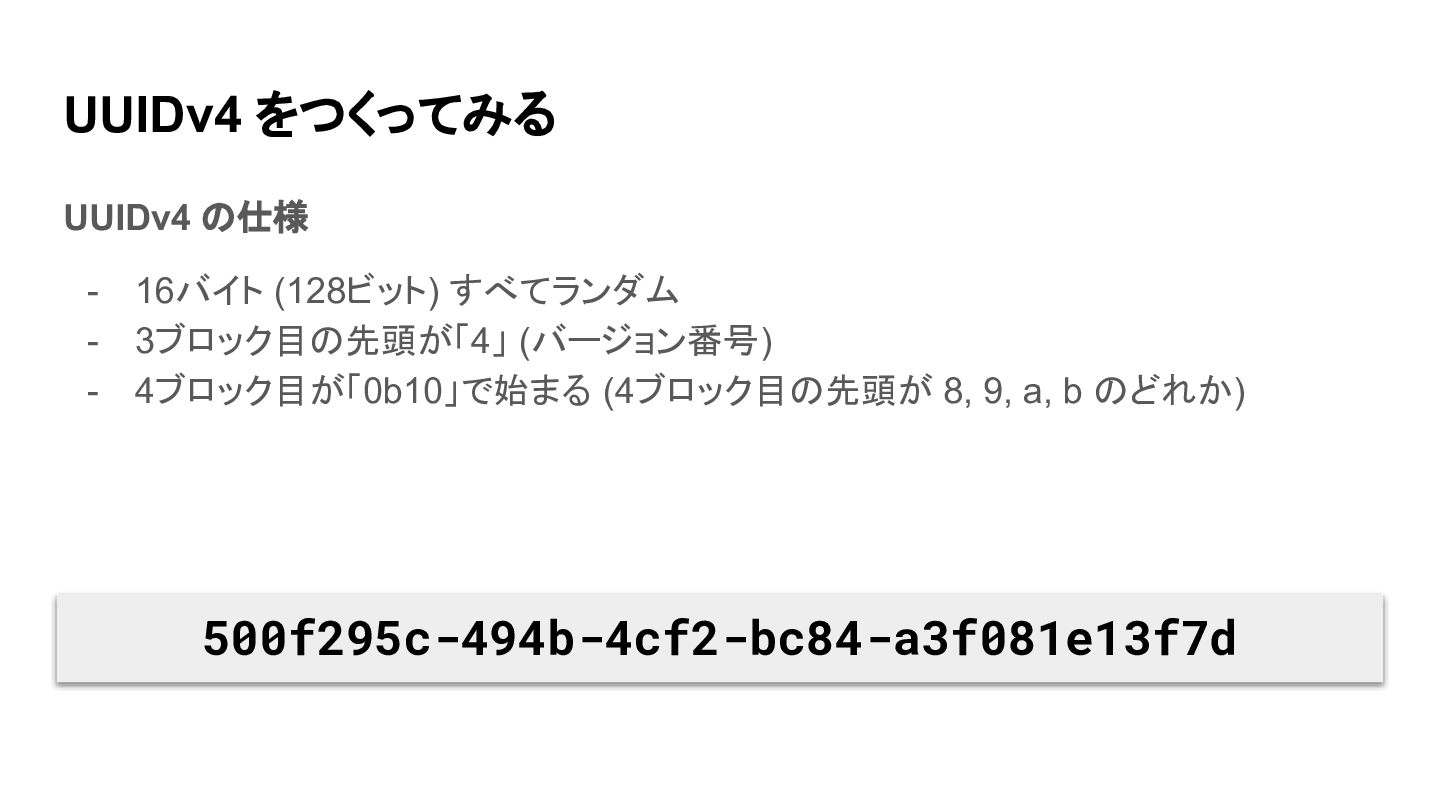
UUIDv4 をつくってみる UUIDv4 の仕様 - 16バイト (128ビット) すべてランダム - 3ブロック目の先頭が「4」
(バージョン番号) - 4ブロック目が「0b10」で始まる (4ブロック目の先頭が 8, 9, a, b のどれか) 500f295c-494b-4cf2-bc84-a3f081e13f7d
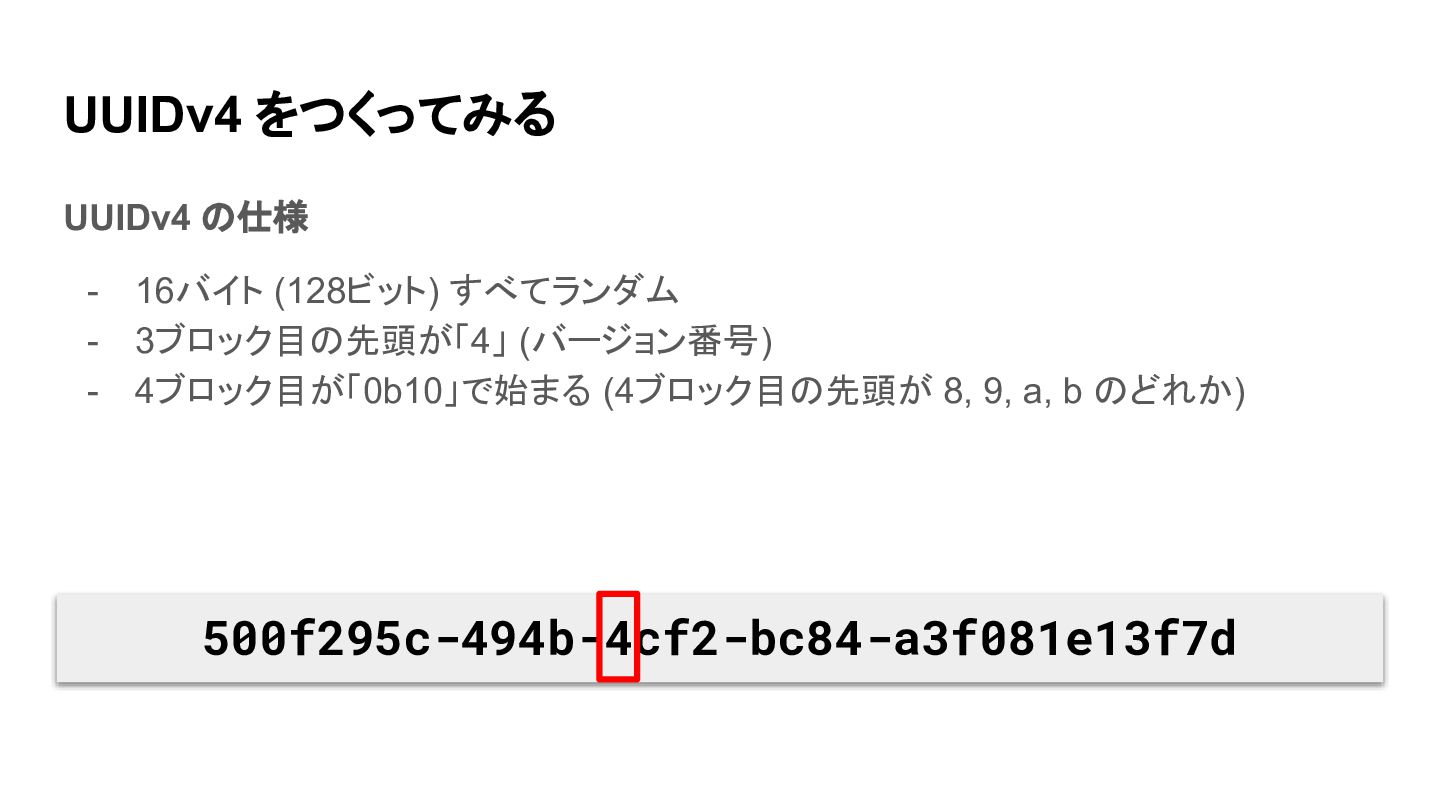
UUIDv4 をつくってみる UUIDv4 の仕様 - 16バイト (128ビット) すべてランダム - 3ブロック目の先頭が「4」
(バージョン番号) - 4ブロック目が「0b10」で始まる (4ブロック目の先頭が 8, 9, a, b のどれか) 500f295c-494b-4cf2-bc84-a3f081e13f7d
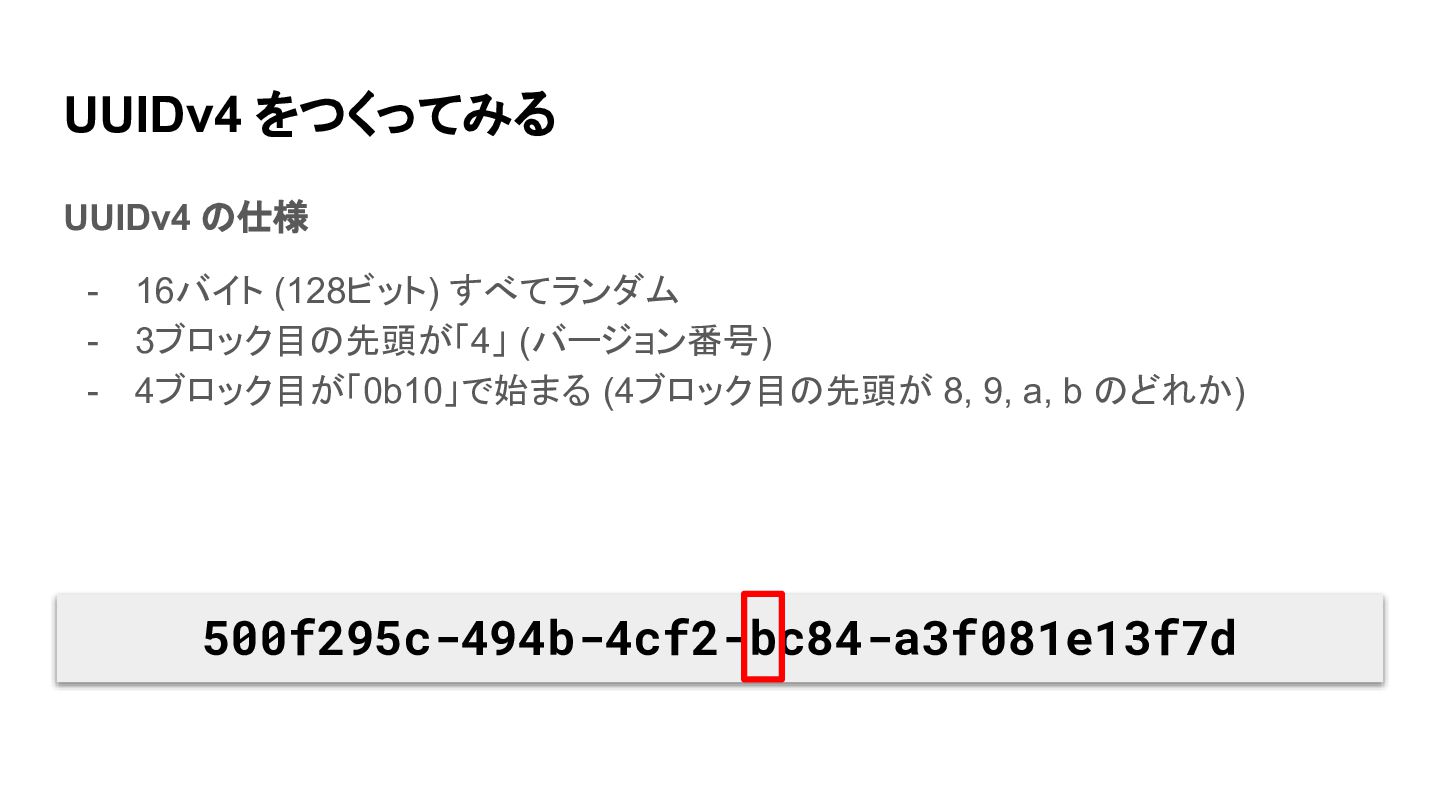
UUIDv4 をつくってみる UUIDv4 の仕様 - 16バイト (128ビット) すべてランダム - 3ブロック目の先頭が「4」
(バージョン番号) - 4ブロック目が「0b10」で始まる (4ブロック目の先頭が 8, 9, a, b のどれか) 500f295c-494b-4cf2-bc84-a3f081e13f7d
UUIDv4 をつくってみる - 実装する def uuidv4(): raw_bytes = bytearray(os.urandom(16)) raw_bytes[6]
= (raw_bytes[6] & 0x0F) | 0x40 raw_bytes[8] = (raw_bytes[8] & 0x3F) | 0x80 h = raw_bytes.hex() return f"{h[0:8]}-{h[8:12]}-{h[12:16]}-{h[16:20]}-{h[20:32]}"
UUIDv4 をつくってみる - 実装する def uuidv4(): raw_bytes = bytearray(os.urandom(16)) raw_bytes[6]
= (raw_bytes[6] & 0x0F) | 0x40 raw_bytes[8] = (raw_bytes[8] & 0x3F) | 0x80 h = raw_bytes.hex() return f"{h[0:8]}-{h[8:12]}-{h[12:16]}-{h[16:20]}-{h[20:32]}" 予測不可能な乱数を生成 ref. https://docs.python.org/ja/3/library/os.html#os.urandom
UUIDv4 をつくってみる - 実装する def uuidv4(): raw_bytes = bytearray(os.urandom(16)) raw_bytes[6]
= (raw_bytes[6] & 0x0F) | 0x40 raw_bytes[8] = (raw_bytes[8] & 0x3F) | 0x80 h = raw_bytes.hex() return f"{h[0:8]}-{h[8:12]}-{h[12:16]}-{h[16:20]}-{h[20:32]}" 0000 1111 0100 0000
UUIDv4 をつくってみる - 実装する def uuidv4(): raw_bytes = bytearray(os.urandom(16)) raw_bytes[6]
= (raw_bytes[6] & 0x0F) | 0x40 raw_bytes[8] = (raw_bytes[8] & 0x3F) | 0x80 h = raw_bytes.hex() return f"{h[0:8]}-{h[8:12]}-{h[12:16]}-{h[16:20]}-{h[20:32]}" 0011 1111 1000 0000
UUIDv4 をつくってみる - 実装する def uuidv4(): raw_bytes = bytearray(os.urandom(16)) raw_bytes[6]
= (raw_bytes[6] & 0x0F) | 0x40 raw_bytes[8] = (raw_bytes[8] & 0x3F) | 0x80 h = raw_bytes.hex() return f"{h[0:8]}-{h[8:12]}-{h[12:16]}-{h[16:20]}-{h[20:32]}"
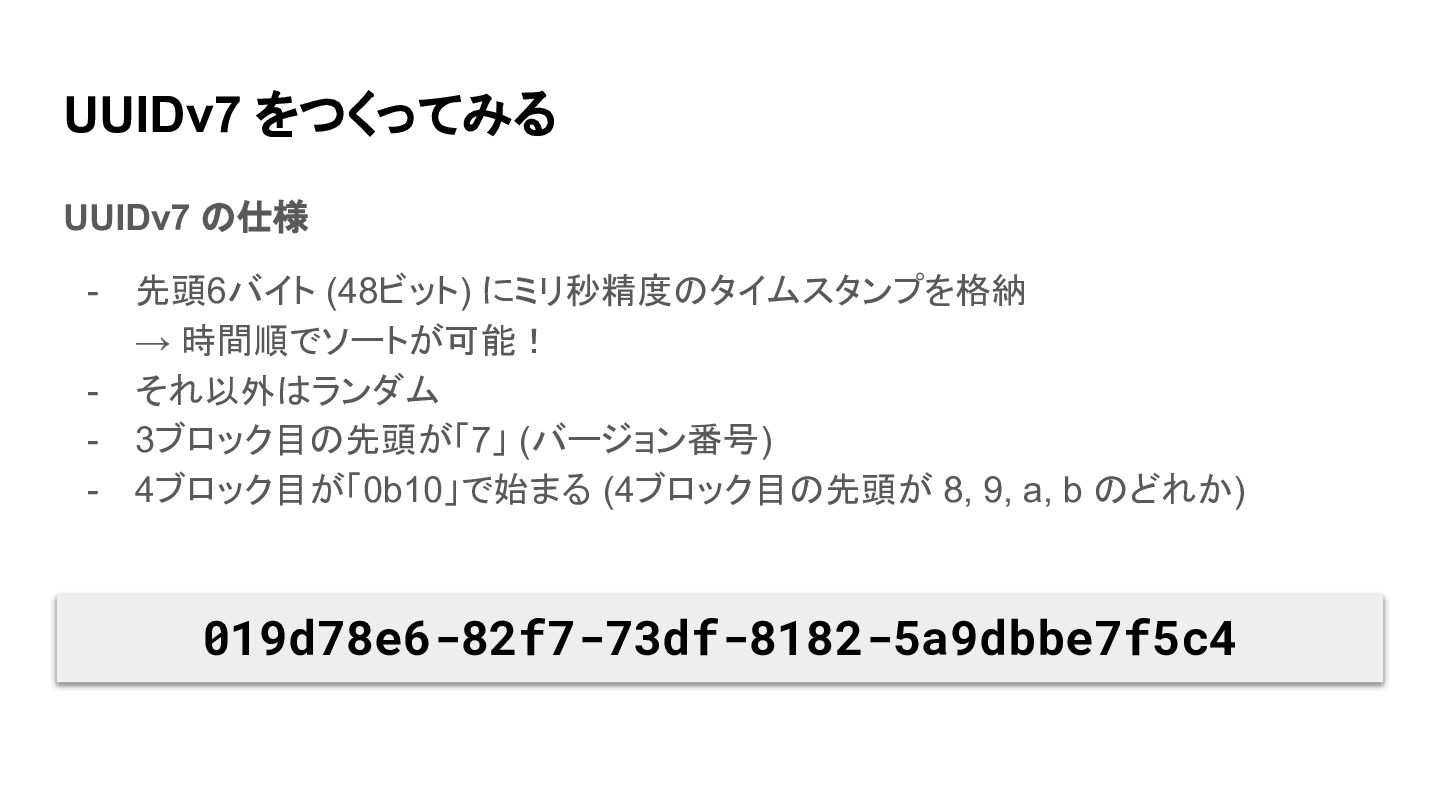
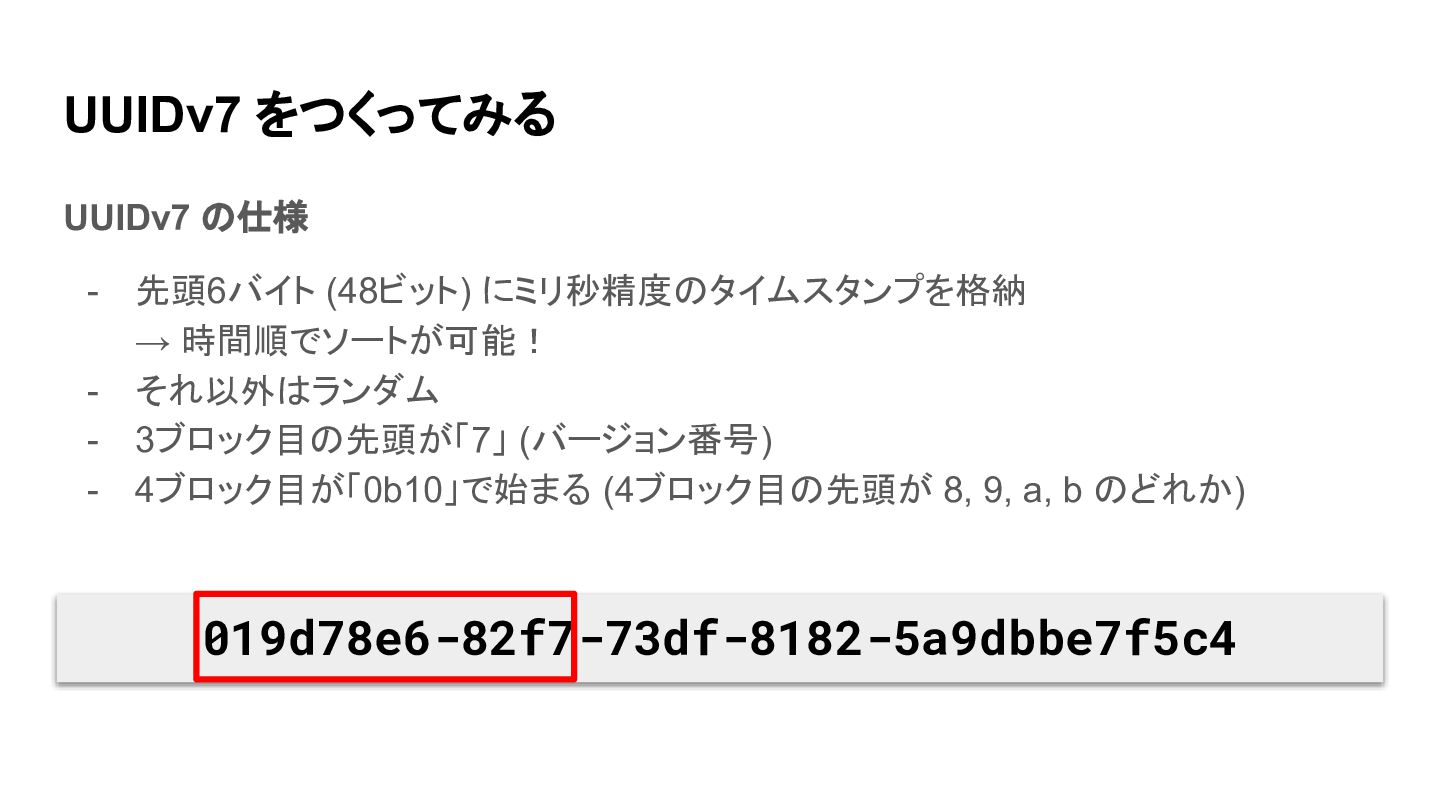
UUIDv7 をつくってみる UUIDv7 の仕様 - 先頭6バイト (48ビット) にミリ秒精度のタイムスタンプを格納 → 時間順でソートが可能!
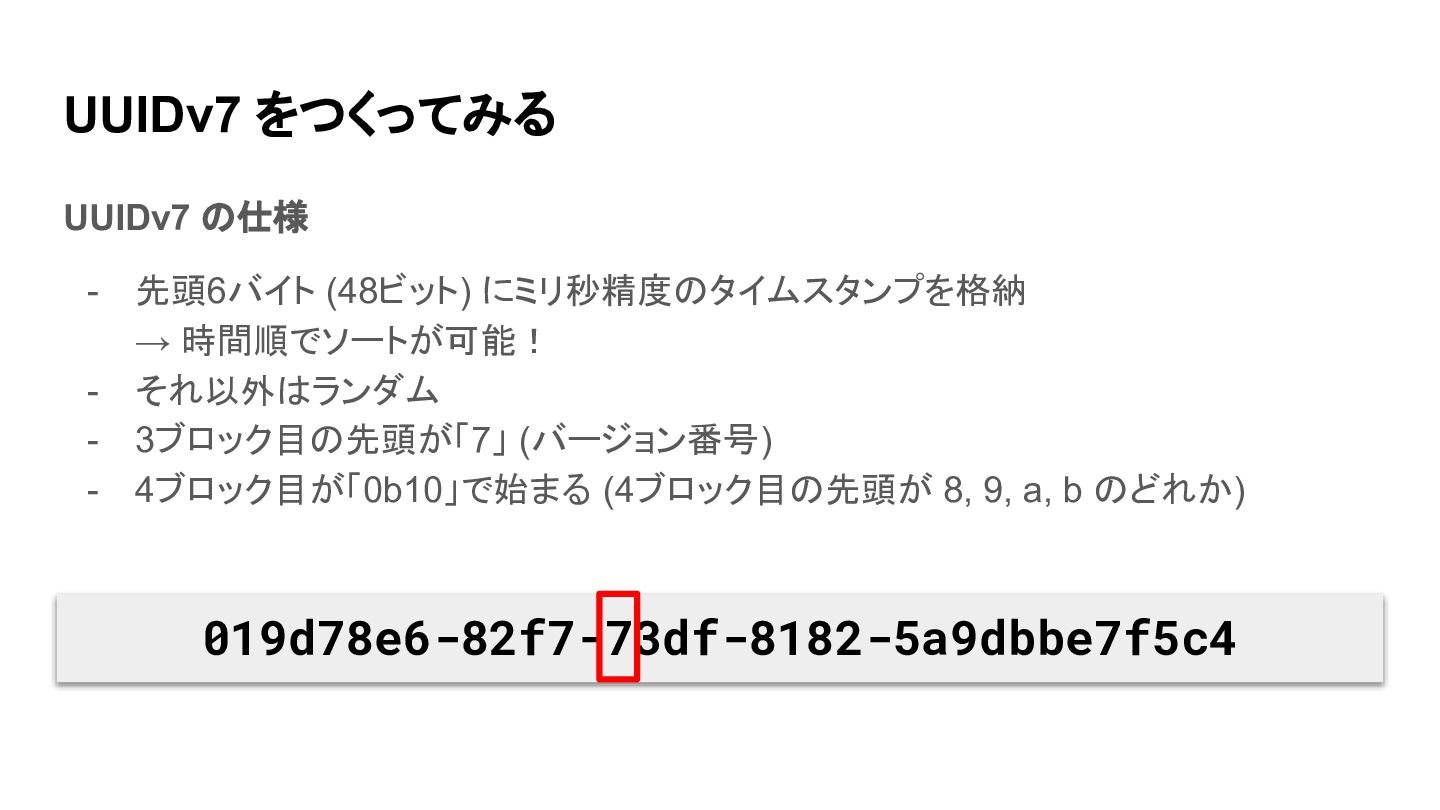
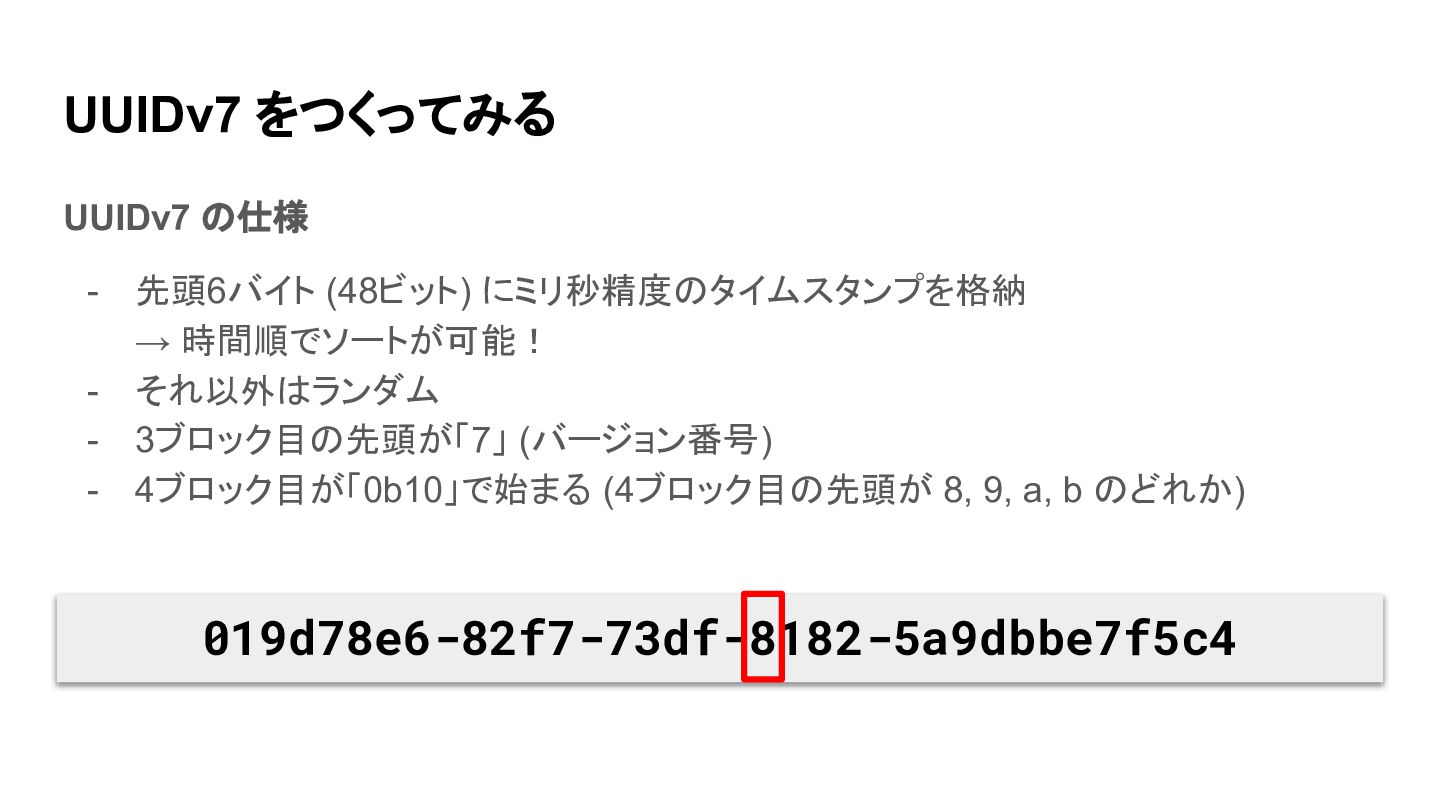
- それ以外はランダム - 3ブロック目の先頭が「7」 (バージョン番号) - 4ブロック目が「0b10」で始まる (4ブロック目の先頭が 8, 9, a, b のどれか) 019d78e6-82f7-73df-8182-5a9dbbe7f5c4
UUIDv7 をつくってみる UUIDv7 の仕様 - 先頭6バイト (48ビット) にミリ秒精度のタイムスタンプを格納 → 時間順でソートが可能!
- それ以外はランダム - 3ブロック目の先頭が「7」 (バージョン番号) - 4ブロック目が「0b10」で始まる (4ブロック目の先頭が 8, 9, a, b のどれか) 019d78e6-82f7-73df-8182-5a9dbbe7f5c4
UUIDv7 をつくってみる UUIDv7 の仕様 - 先頭6バイト (48ビット) にミリ秒精度のタイムスタンプを格納 → 時間順でソートが可能!
- それ以外はランダム - 3ブロック目の先頭が「7」 (バージョン番号) - 4ブロック目が「0b10」で始まる (4ブロック目の先頭が 8, 9, a, b のどれか) 019d78e6-82f7-73df-8182-5a9dbbe7f5c4
UUIDv7 をつくってみる UUIDv7 の仕様 - 先頭6バイト (48ビット) にミリ秒精度のタイムスタンプを格納 → 時間順でソートが可能!
- それ以外はランダム - 3ブロック目の先頭が「7」 (バージョン番号) - 4ブロック目が「0b10」で始まる (4ブロック目の先頭が 8, 9, a, b のどれか) 019d78e6-82f7-73df-8182-5a9dbbe7f5c4
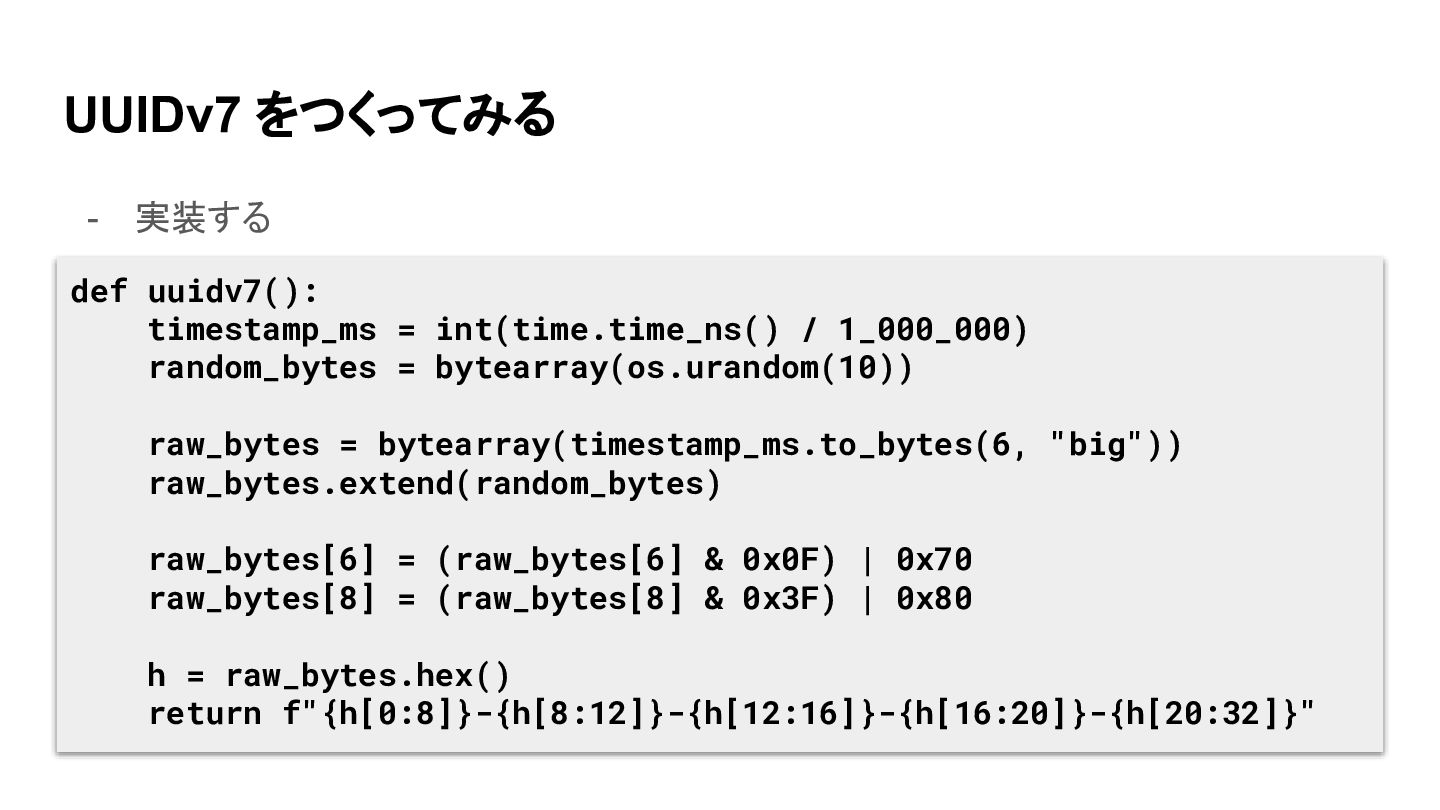
UUIDv7 をつくってみる - 実装する def uuidv7(): timestamp_ms = int(time.time_ns() /
1_000_000) random_bytes = bytearray(os.urandom(10)) raw_bytes = bytearray(timestamp_ms.to_bytes(6, "big")) raw_bytes.extend(random_bytes) raw_bytes[6] = (raw_bytes[6] & 0x0F) | 0x70 raw_bytes[8] = (raw_bytes[8] & 0x3F) | 0x80 h = raw_bytes.hex() return f"{h[0:8]}-{h[8:12]}-{h[12:16]}-{h[16:20]}-{h[20:32]}"
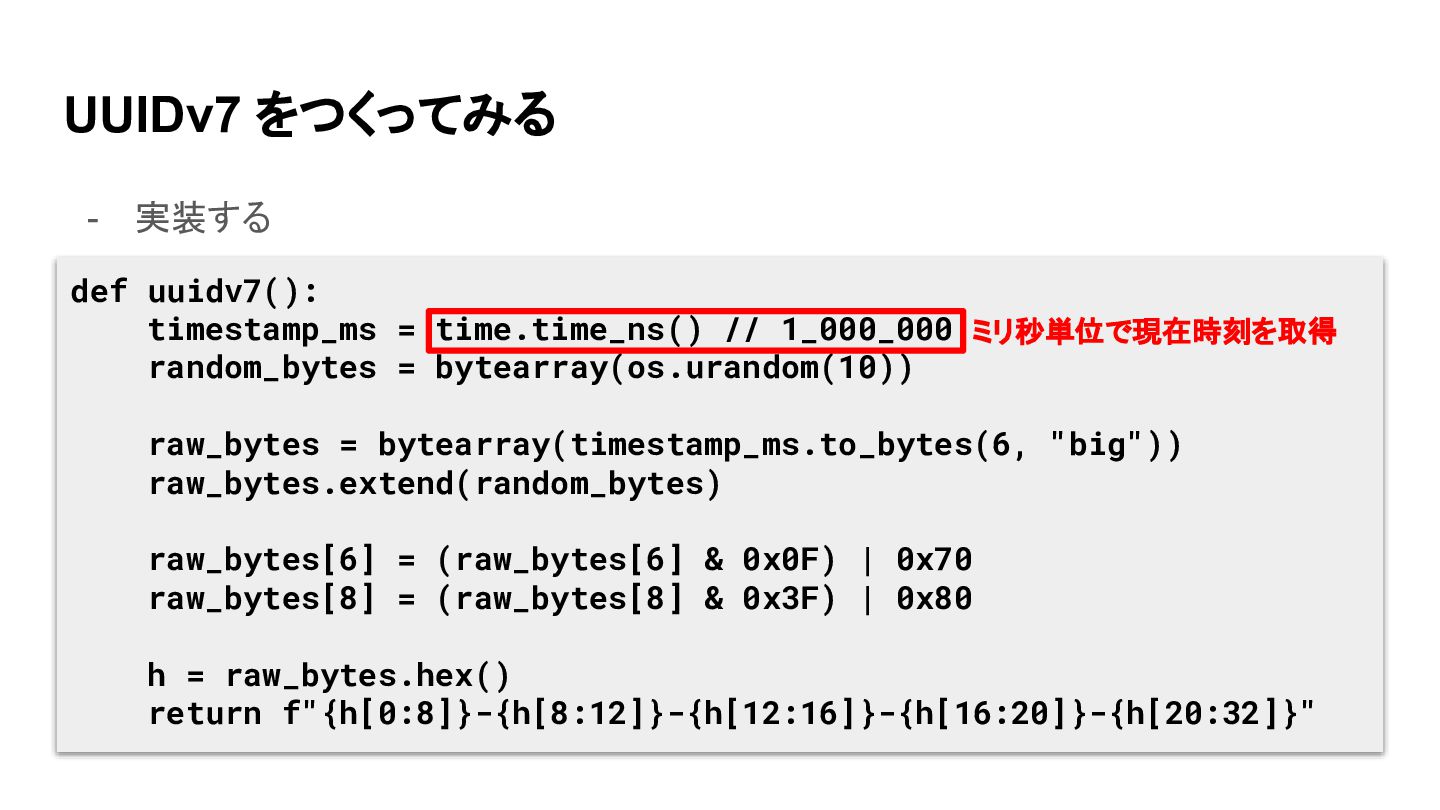
UUIDv7 をつくってみる - 実装する def uuidv7(): timestamp_ms = time.time_ns() //
1_000_000 random_bytes = bytearray(os.urandom(10)) raw_bytes = bytearray(timestamp_ms.to_bytes(6, "big")) raw_bytes.extend(random_bytes) raw_bytes[6] = (raw_bytes[6] & 0x0F) | 0x70 raw_bytes[8] = (raw_bytes[8] & 0x3F) | 0x80 h = raw_bytes.hex() return f"{h[0:8]}-{h[8:12]}-{h[12:16]}-{h[16:20]}-{h[20:32]}" ミリ秒単位で現在時刻を取得
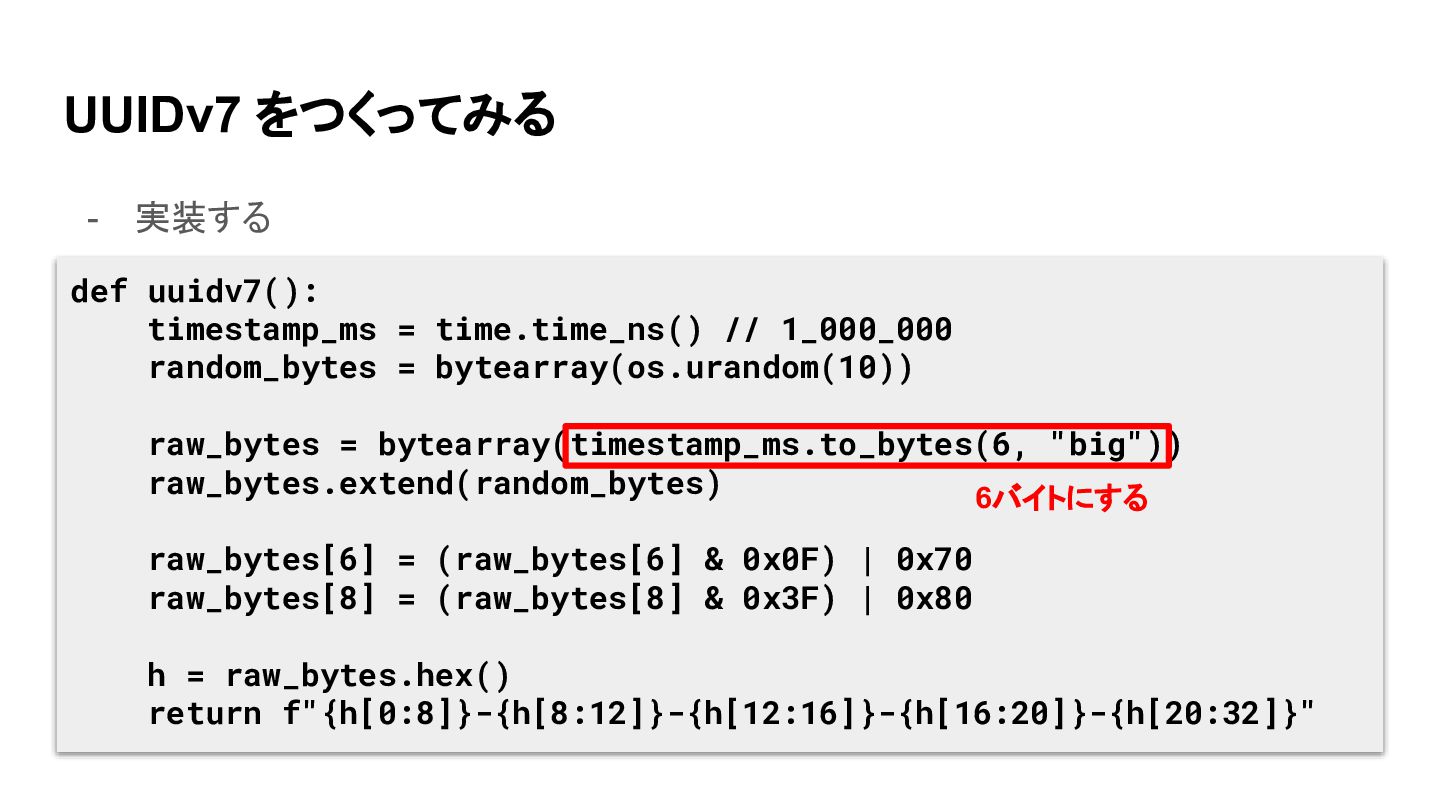
UUIDv7 をつくってみる - 実装する def uuidv7(): timestamp_ms = time.time_ns() //
1_000_000 random_bytes = bytearray(os.urandom(10)) raw_bytes = bytearray(timestamp_ms.to_bytes(6, "big")) raw_bytes.extend(random_bytes) raw_bytes[6] = (raw_bytes[6] & 0x0F) | 0x70 raw_bytes[8] = (raw_bytes[8] & 0x3F) | 0x80 h = raw_bytes.hex() return f"{h[0:8]}-{h[8:12]}-{h[12:16]}-{h[16:20]}-{h[20:32]}" 6バイトにする
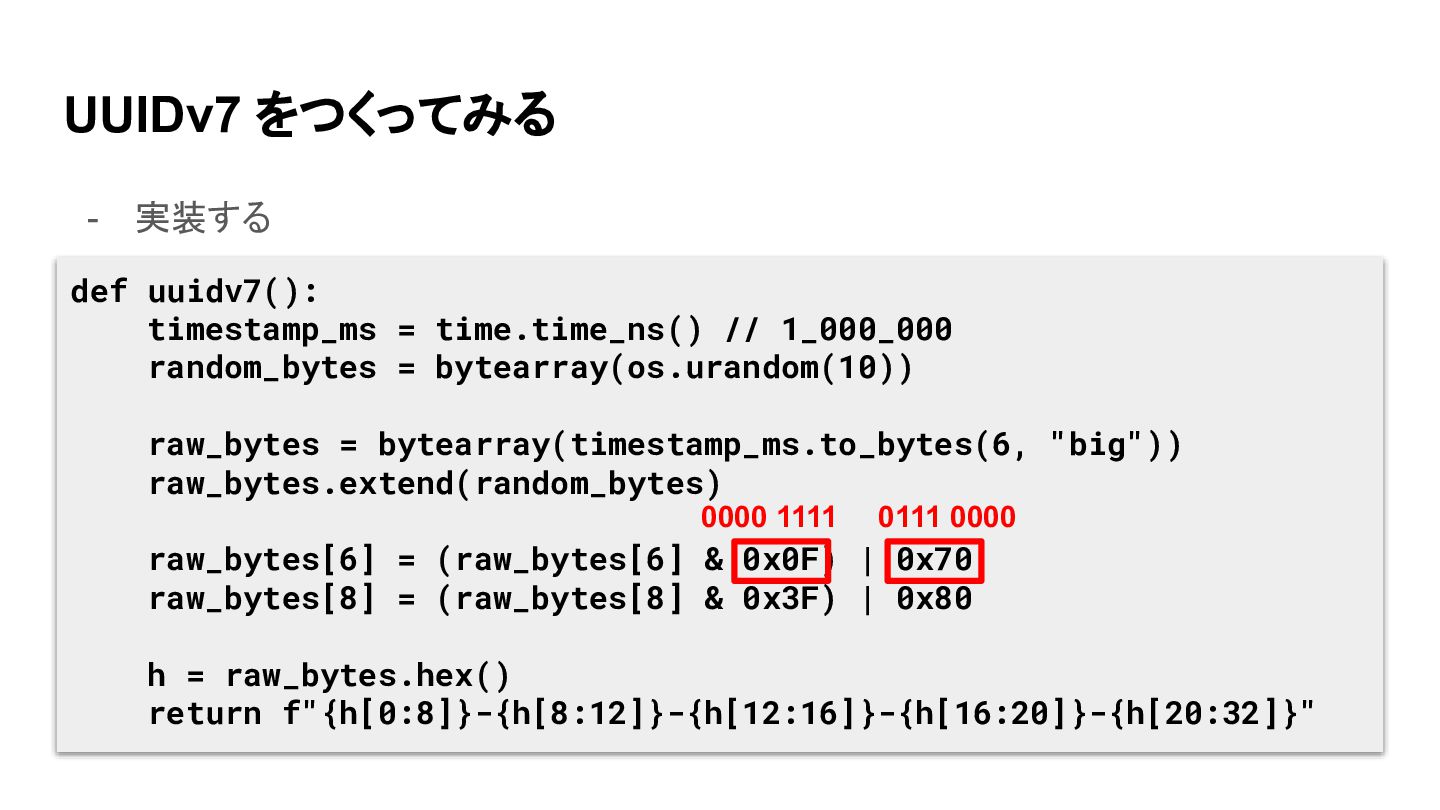
UUIDv7 をつくってみる - 実装する def uuidv7(): timestamp_ms = time.time_ns() //
1_000_000 random_bytes = bytearray(os.urandom(10)) raw_bytes = bytearray(timestamp_ms.to_bytes(6, "big")) raw_bytes.extend(random_bytes) raw_bytes[6] = (raw_bytes[6] & 0x0F) | 0x70 raw_bytes[8] = (raw_bytes[8] & 0x3F) | 0x80 h = raw_bytes.hex() return f"{h[0:8]}-{h[8:12]}-{h[12:16]}-{h[16:20]}-{h[20:32]}" 0000 1111 0111 0000
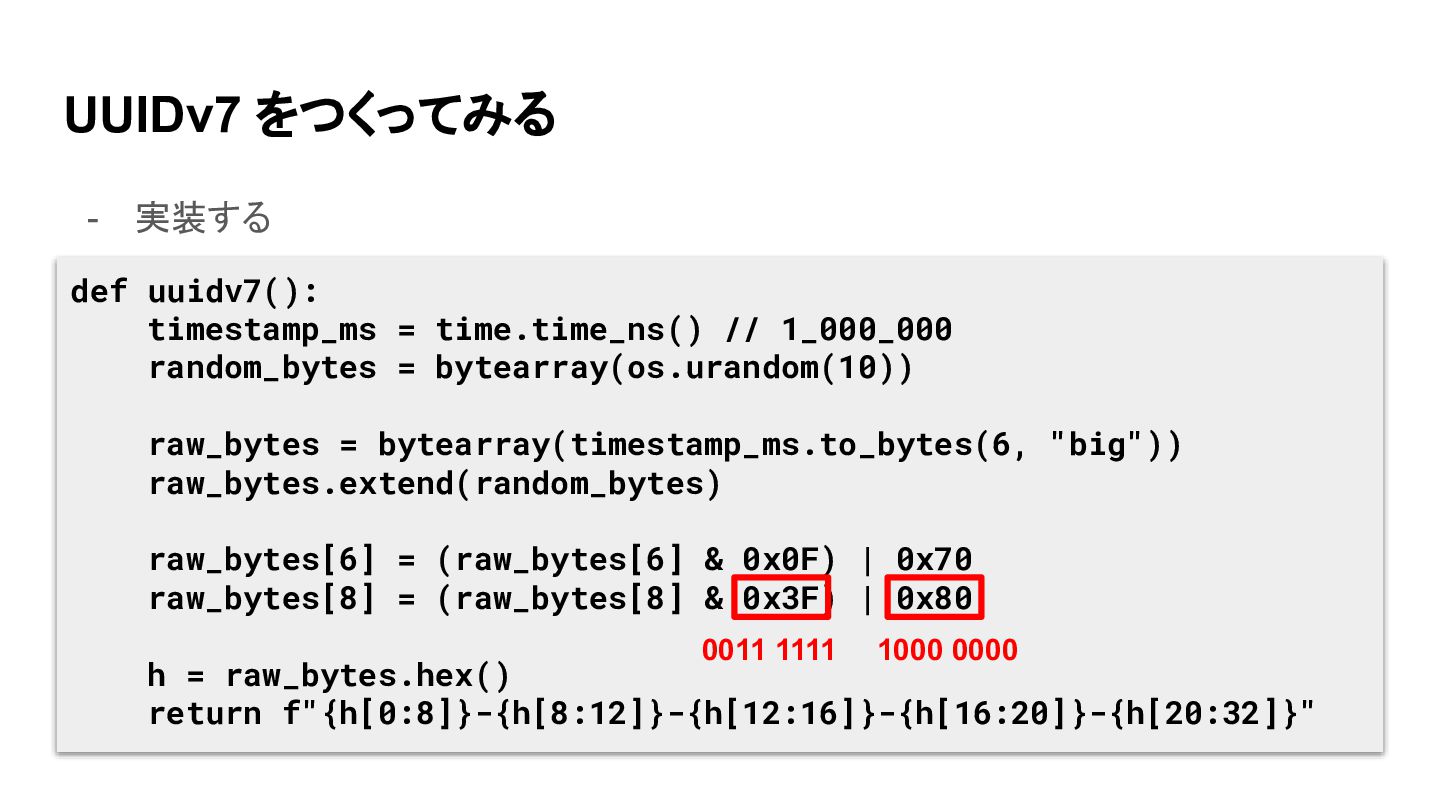
UUIDv7 をつくってみる - 実装する def uuidv7(): timestamp_ms = time.time_ns() //
1_000_000 random_bytes = bytearray(os.urandom(10)) raw_bytes = bytearray(timestamp_ms.to_bytes(6, "big")) raw_bytes.extend(random_bytes) raw_bytes[6] = (raw_bytes[6] & 0x0F) | 0x70 raw_bytes[8] = (raw_bytes[8] & 0x3F) | 0x80 h = raw_bytes.hex() return f"{h[0:8]}-{h[8:12]}-{h[12:16]}-{h[16:20]}-{h[20:32]}" 0011 1111 1000 0000
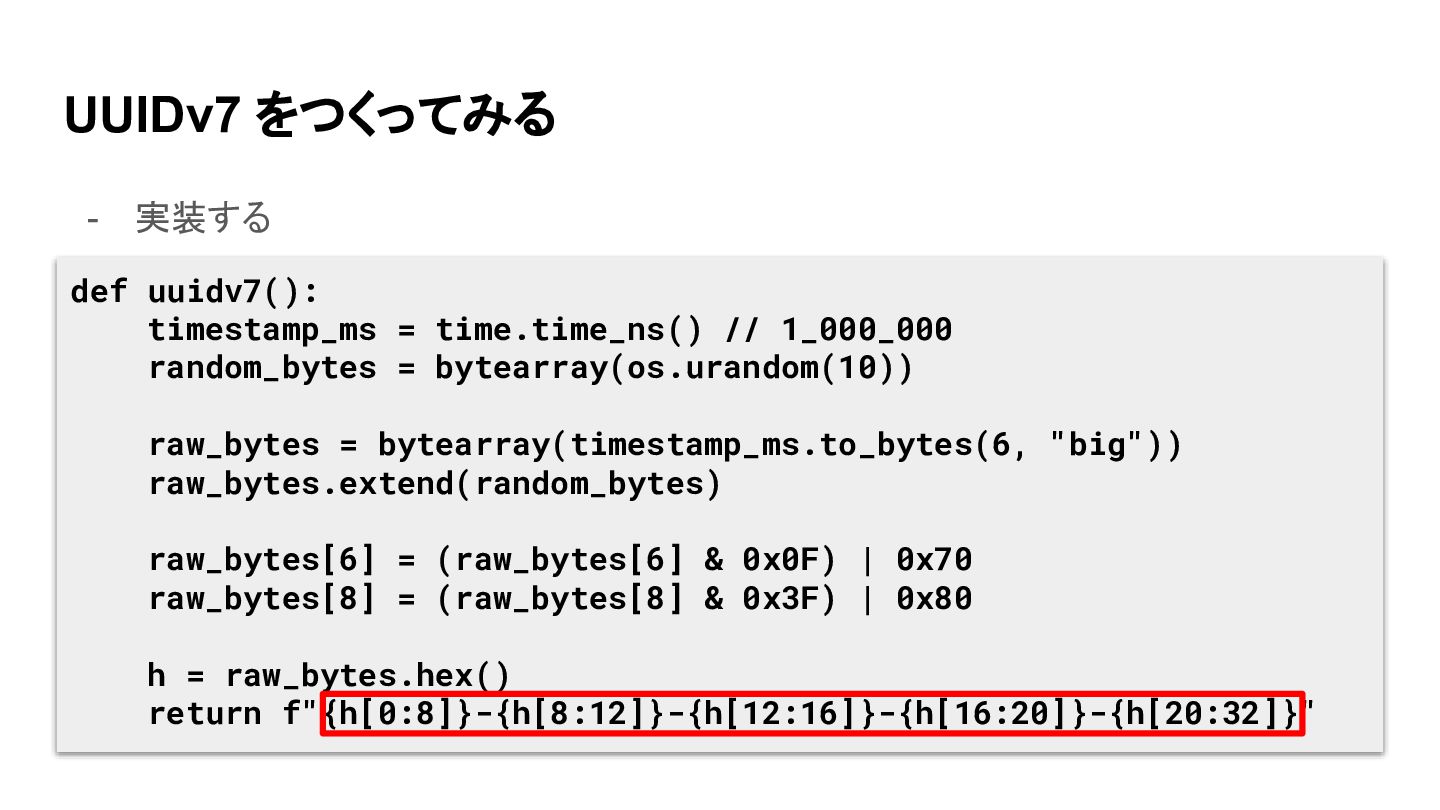
UUIDv7 をつくってみる - 実装する def uuidv7(): timestamp_ms = time.time_ns() //
1_000_000 random_bytes = bytearray(os.urandom(10)) raw_bytes = bytearray(timestamp_ms.to_bytes(6, "big")) raw_bytes.extend(random_bytes) raw_bytes[6] = (raw_bytes[6] & 0x0F) | 0x70 raw_bytes[8] = (raw_bytes[8] & 0x3F) | 0x80 h = raw_bytes.hex() return f"{h[0:8]}-{h[8:12]}-{h[12:16]}-{h[16:20]}-{h[20:32]}"
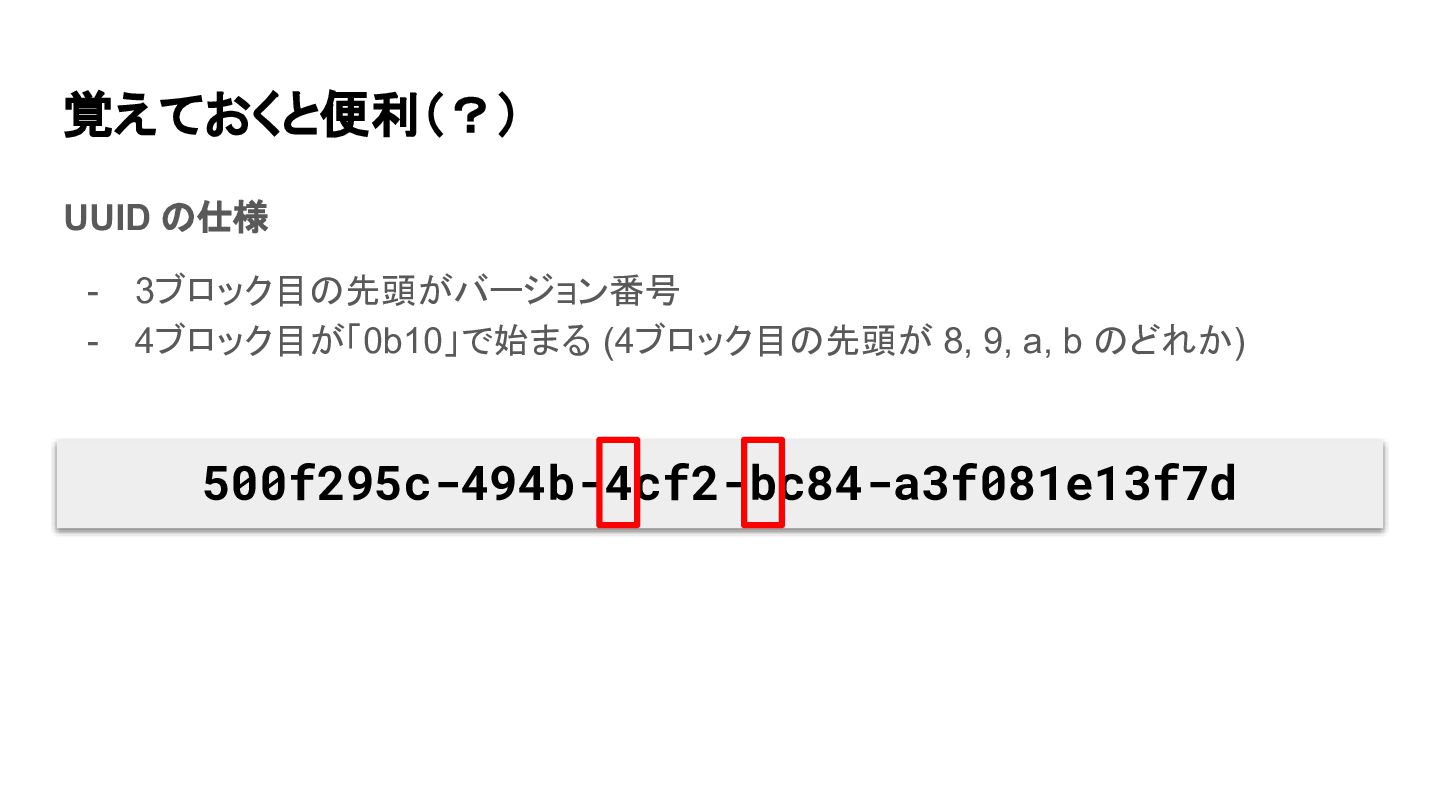
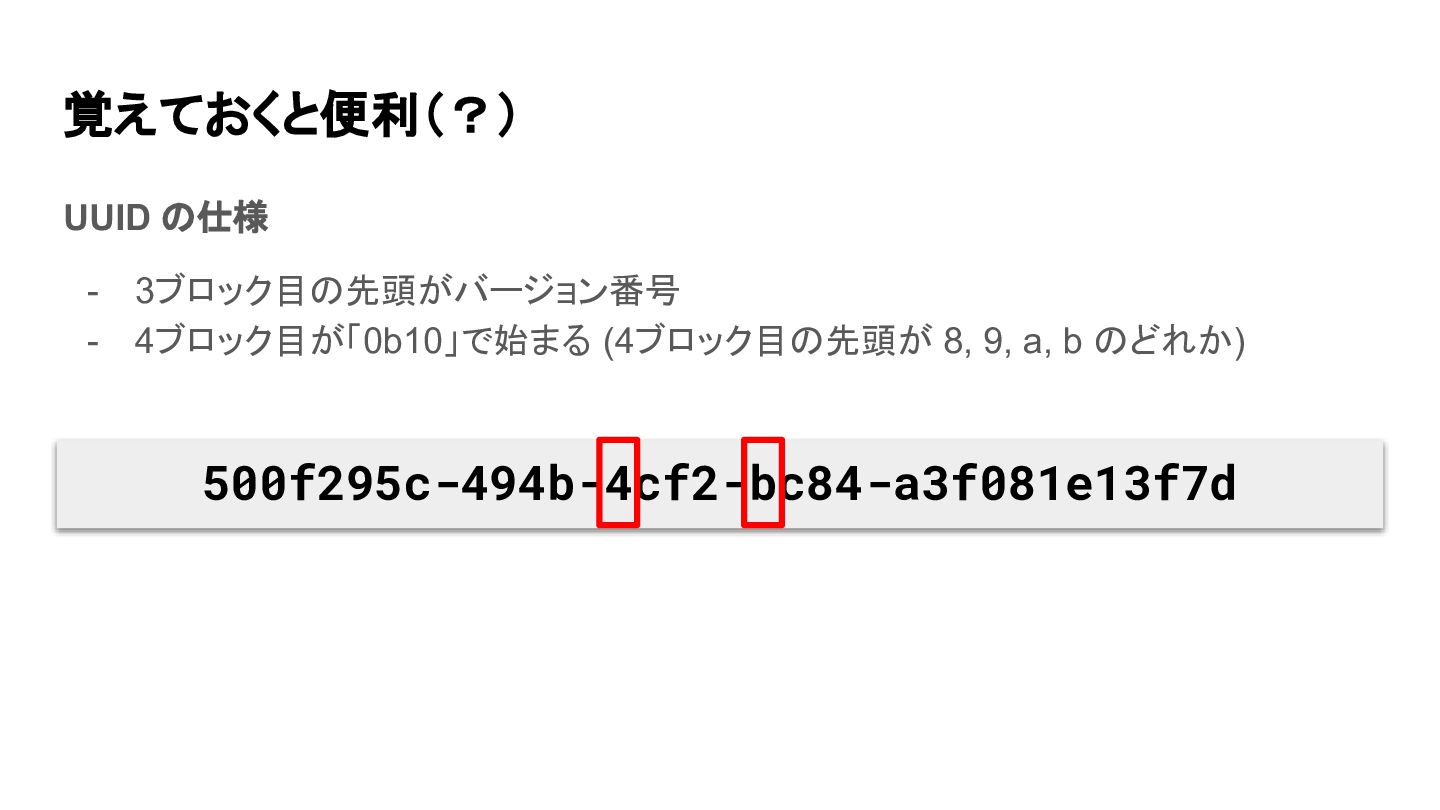
覚えておくと便利(?) UUID の仕様 - 3ブロック目の先頭がバージョン番号 - 4ブロック目が「0b10」で始まる (4ブロック目の先頭が 8, 9,
a, b のどれか) 500f295c-494b-4cf2-bc84-a3f081e13f7d
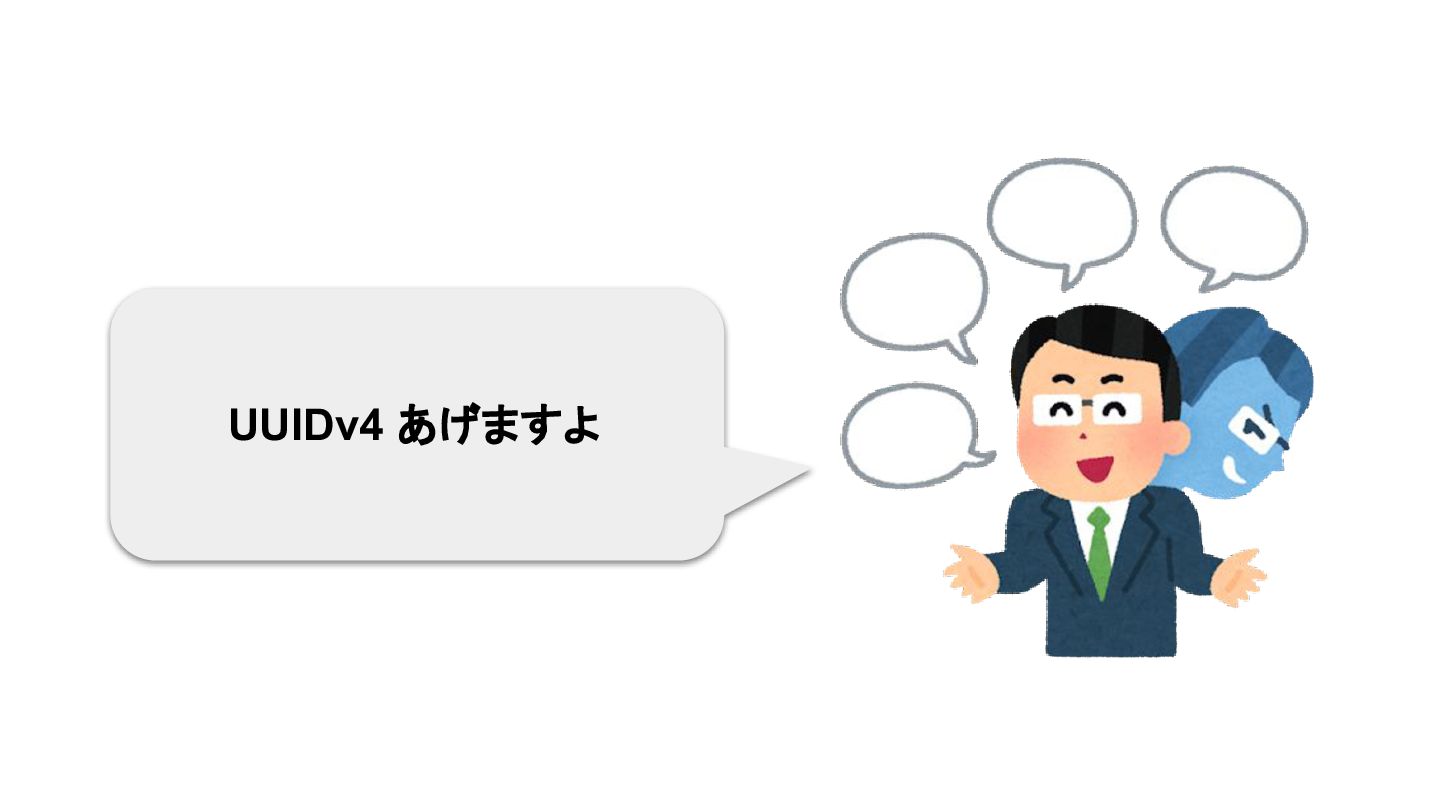
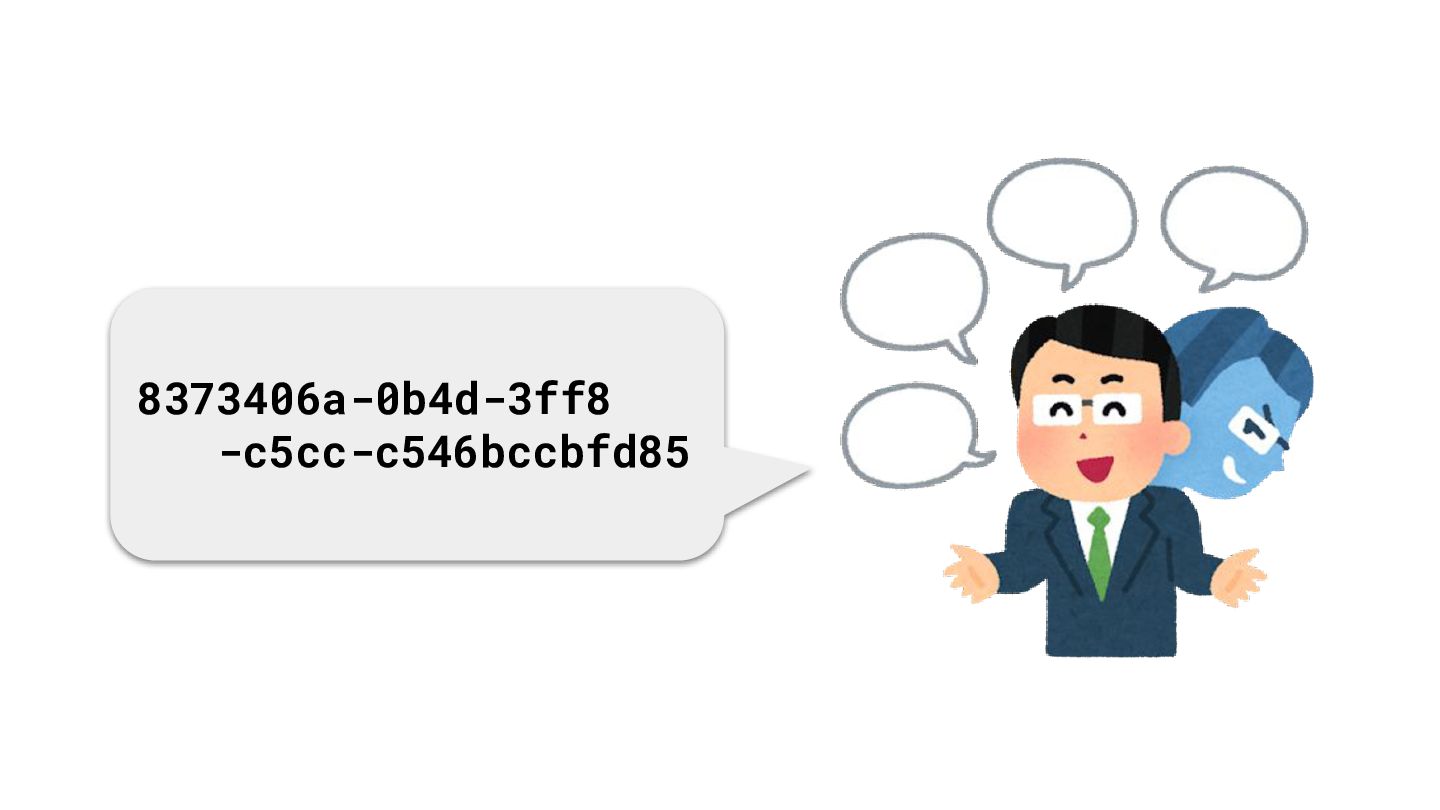
UUIDv4 あげますよ
8373406a-0b4d-3ff8 -c5cc-c546bccbfd85
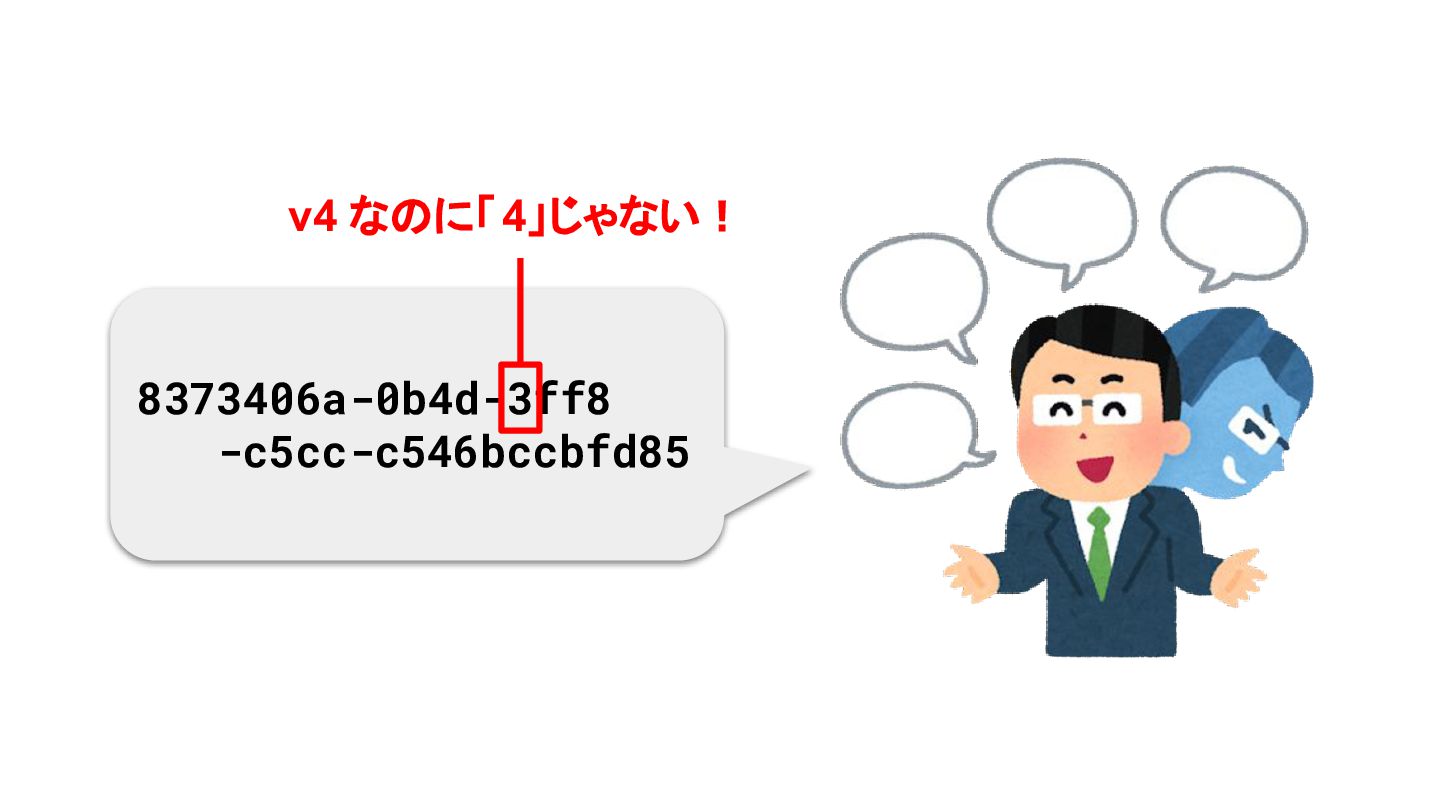
8373406a-0b4d-3ff8 -c5cc-c546bccbfd85 v4 なのに「4」じゃない!
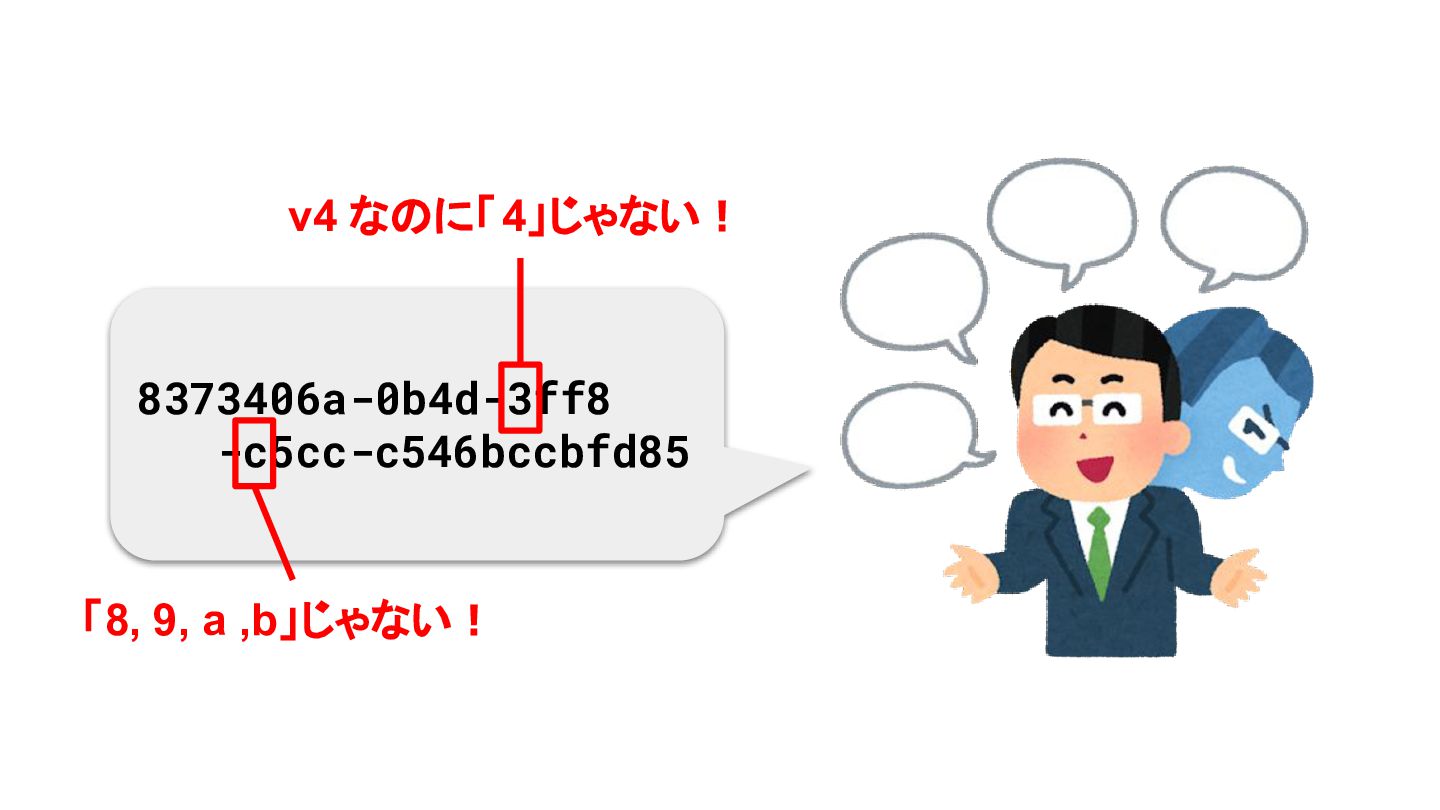
8373406a-0b4d-3ff8 -c5cc-c546bccbfd85 v4 なのに「4」じゃない! 「8, 9, a ,b」じゃない!
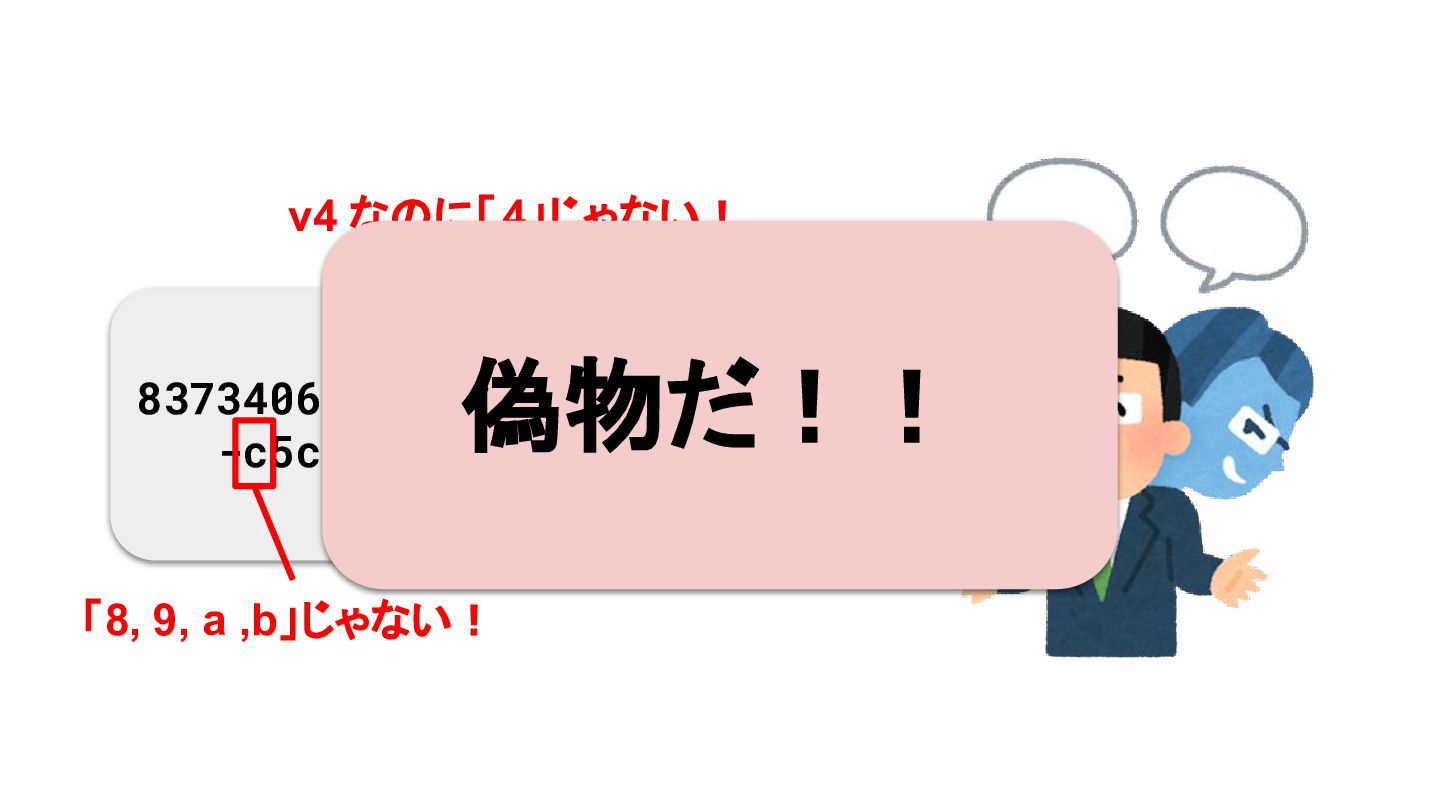
8373406a-0b4d-3ff8 -c5cc-c546bccbfd85 v4 なのに「4」じゃない! 「8, 9, a ,b」じゃない! 偽物だ!!
覚えておくと便利(?) UUID の仕様 - 3ブロック目の先頭がバージョン番号 - 4ブロック目が「0b10」で始まる (4ブロック目の先頭が 8, 9,
a, b のどれか) 500f295c-494b-4cf2-bc84-a3f081e13f7d
ありがとうございました! - repo: https://github.com/mimifuwacc/uuidgen-py uvx git+https://github.com/mimifuwacc/uuidgen-py id: mimifuwacc Twitter: https://twitter.com/mimifuwacc
- 注意! 実用するときはライブラリを使おう - 手書き UUID をプレゼントします!


 mimifuwacc
 koukihosaka
 usanchuu
 ivry_presentationmaterials
 teamlab
 pfn
pfn
 kairim0
 riyaamemiya
 takahashim
 yut0naga1_fa
 odashi
 gogutan
 akhino
 inesmontani
 andyhume
 tammyeverts
 vanstee
 mongodb
 takai
takai
 rkendrick25
 reverentgeek
 malarkey
 lfama
lfama
 quramy
 jonoalderson
![UUIDv4 をつくってみる - 実装する def uuidv4(): raw_bytes = bytearray(os.urandom(16)) raw_bytes[6]](https://files.speakerdeck.com/presentations/61c9cf0649ae41d49b283b13e55ef031/slide_9.jpg)
![UUIDv4 をつくってみる - 実装する def uuidv4(): raw_bytes = bytearray(os.urandom(16)) raw_bytes[6]](https://files.speakerdeck.com/presentations/61c9cf0649ae41d49b283b13e55ef031/slide_10.jpg)
![UUIDv4 をつくってみる - 実装する def uuidv4(): raw_bytes = bytearray(os.urandom(16)) raw_bytes[6]](https://files.speakerdeck.com/presentations/61c9cf0649ae41d49b283b13e55ef031/slide_11.jpg)
![UUIDv4 をつくってみる - 実装する def uuidv4(): raw_bytes = bytearray(os.urandom(16)) raw_bytes[6]](https://files.speakerdeck.com/presentations/61c9cf0649ae41d49b283b13e55ef031/slide_12.jpg)
![UUIDv4 をつくってみる - 実装する def uuidv4(): raw_bytes = bytearray(os.urandom(16)) raw_bytes[6]](https://files.speakerdeck.com/presentations/61c9cf0649ae41d49b283b13e55ef031/slide_13.jpg)