Upgrade to Pro — share decks privately, control downloads, hide ads and more …

Test maintainability

Test maintainability

Automatic tests are still considered as a necessary evil. Some developers still claim that clients don't pay for tests so we shouldn't write them. Others say that we shouldn't put much effort into tests, implementation is more important, right? Those developers tend to forget the overall cost of maintenance of their codebase. How many bugs you can find on an early stage of implementation just thanks to automatic tests? What's the cost of maintenance of tests written in a not clean way?

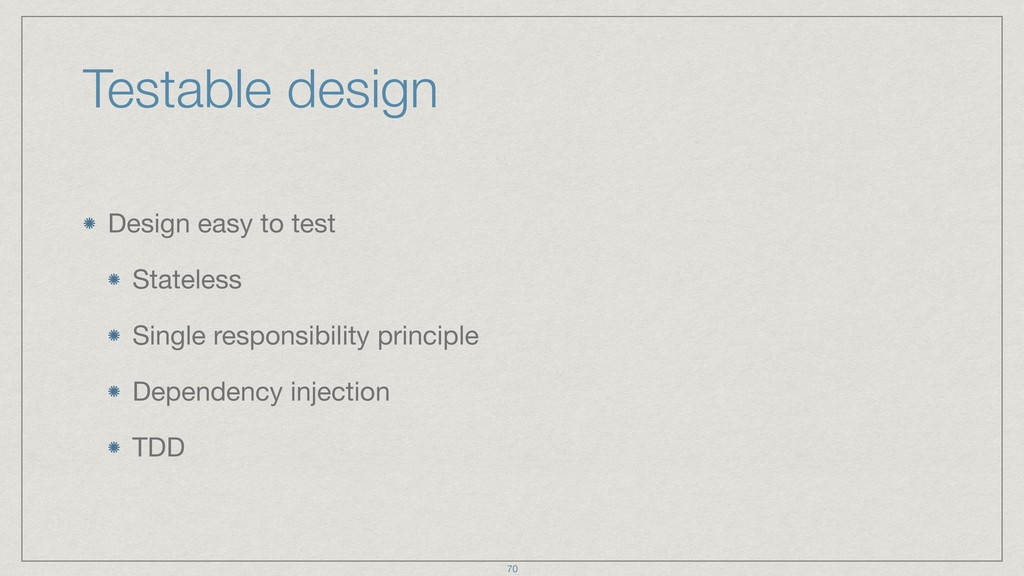
During this talk, I will go through some properties of well maintainable tests, present examples of tests hard to maintain and suggest a few ways to improve them. Presented properties and techniques might be valuable for engineers writing and refactoring tests. Finally, I will dive into the term testable design and discuss how to achieve it.

Avatar for Michał Kowalczyk

Michał Kowalczyk

October 23, 2018

More Decks by Michał Kowalczyk

Other Decks in Technology

Transcript

  1. Why? In my project over 60% C++ code is in

    tests Testing is a second system Knowing that should I harness some special techniques of coding? 3
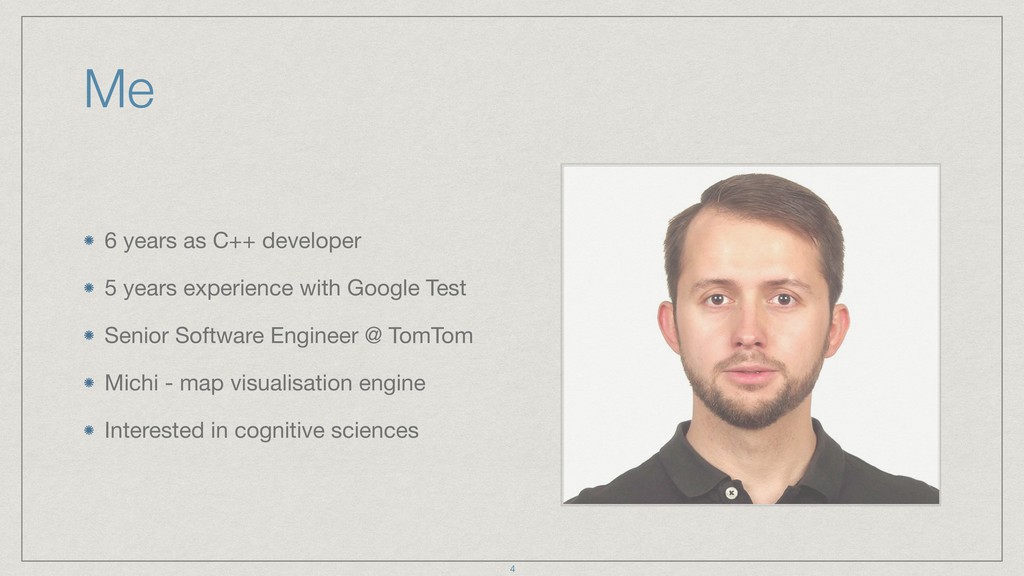
  2. Me 6 years as C++ developer 5 years experience with

    Google Test Senior Software Engineer @ TomTom Michi - map visualisation engine Interested in cognitive sciences 4
  3. Notions System under test Assertion, expectation Test case Test suite,

    fixture Loose coupling, dependency injection, mock 7
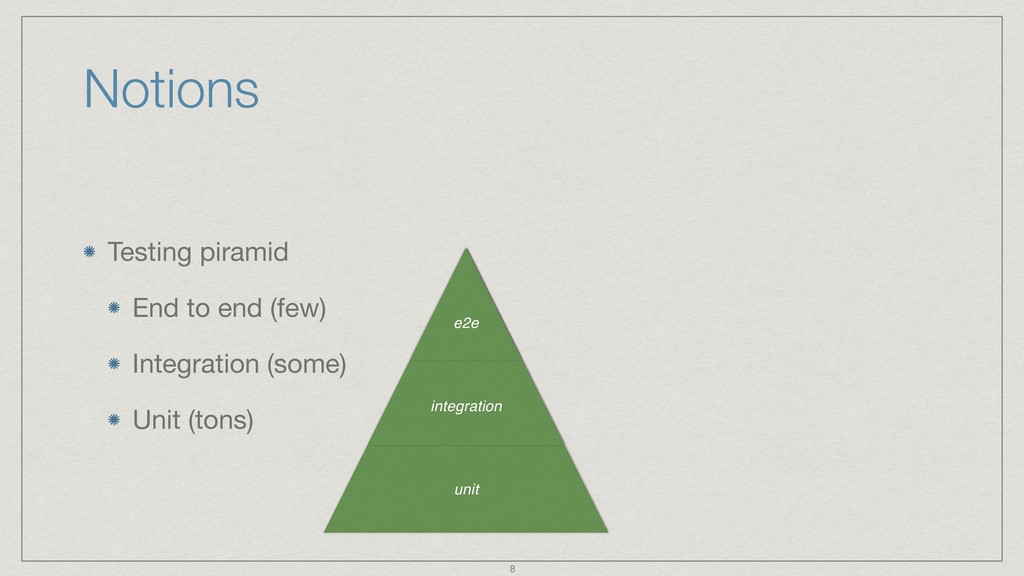
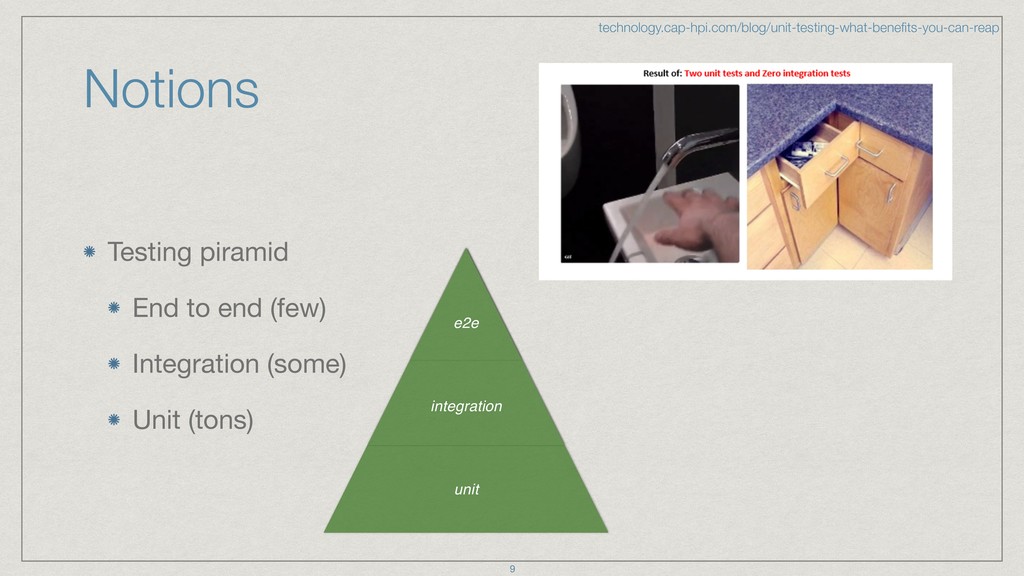
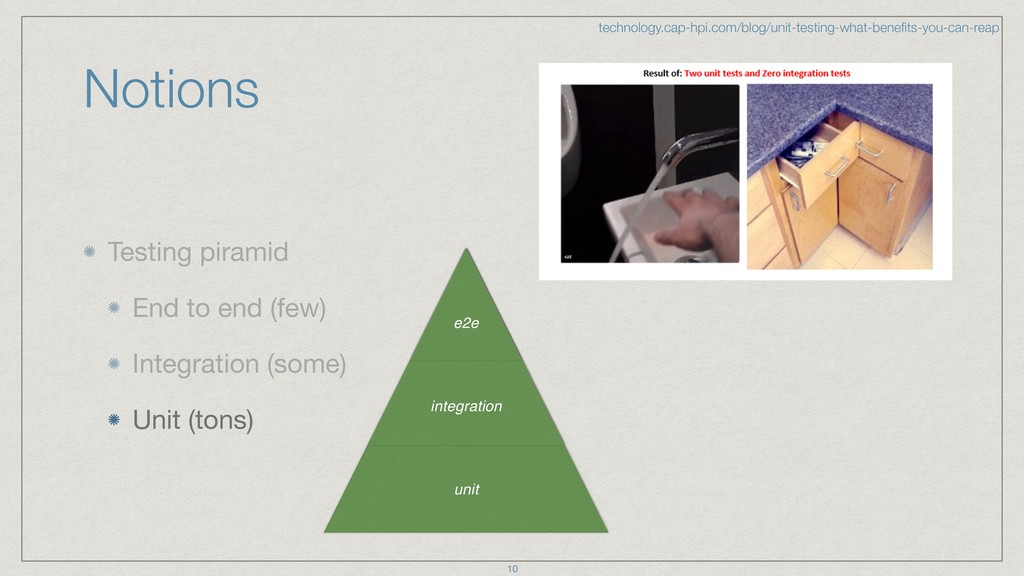
  4. Notions Testing piramid End to end (few) Integration (some) Unit

    (tons) 9 e2e integration unit technology.cap-hpi.com/blog/unit-testing-what-benefits-you-can-reap
  5. Notions Testing piramid End to end (few) Integration (some) Unit

    (tons) 10 Unit (tons) e2e integration unit technology.cap-hpi.com/blog/unit-testing-what-benefits-you-can-reap
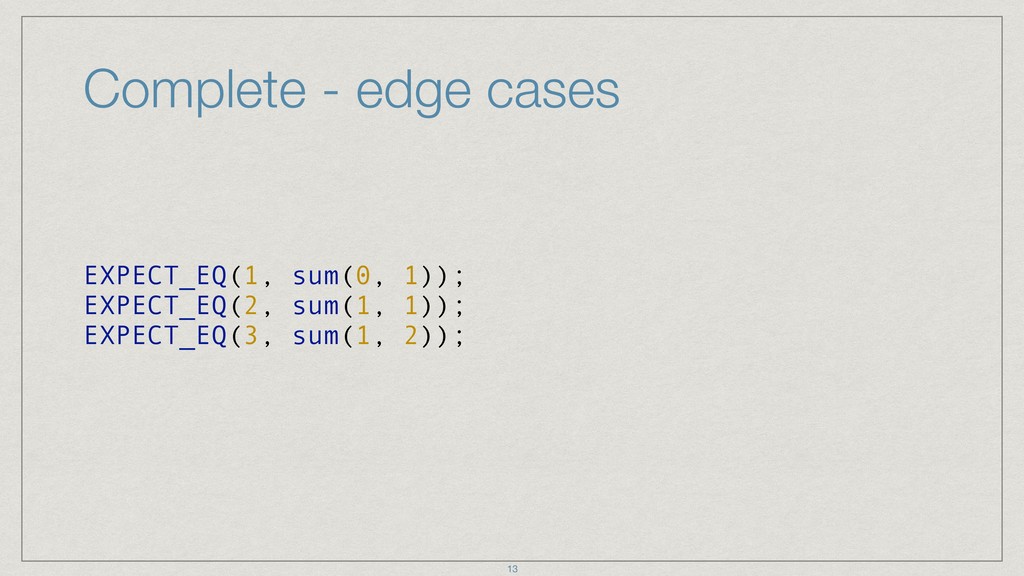
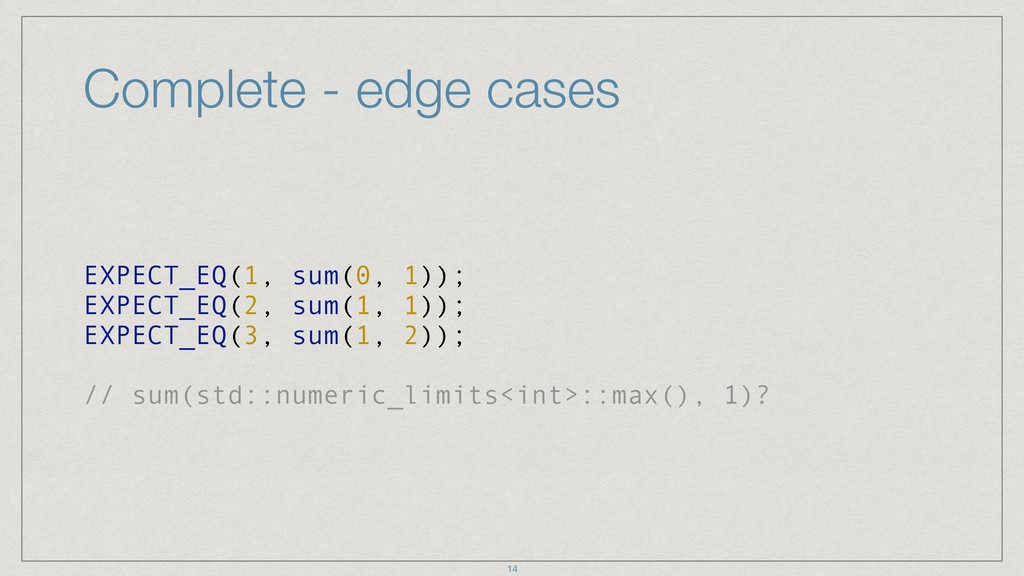
  6. Complete - edge cases EXPECT_EQ(1, sum(0, 1)); EXPECT_EQ(2, sum(1, 1));

    EXPECT_EQ(3, sum(1, 2)); // sum(std::numeric_limits<int>::max(), 1)? 14
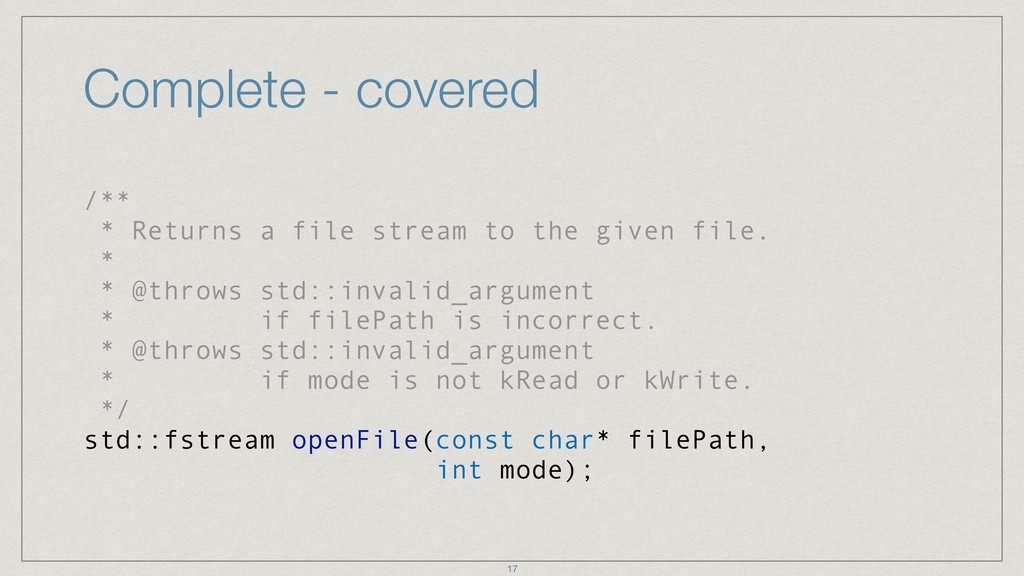
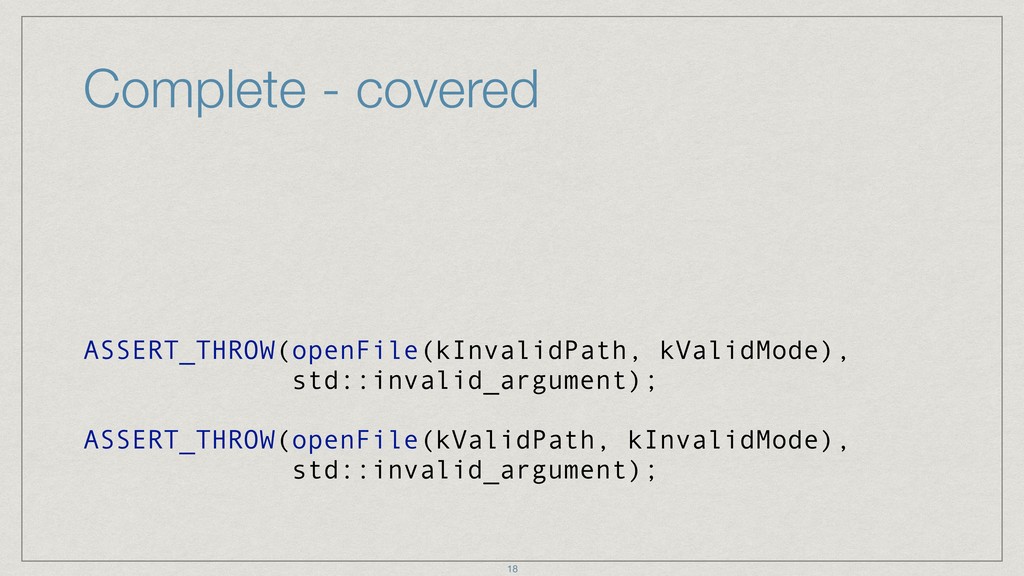
  7. Complete - covered /** * Returns a file stream to

    the given file. * * @throws std::invalid_argument * if filePath is incorrect. * @throws std::invalid_argument * if mode is not kRead or kWrite. */ std::fstream openFile(const char* filePath, int mode); 17
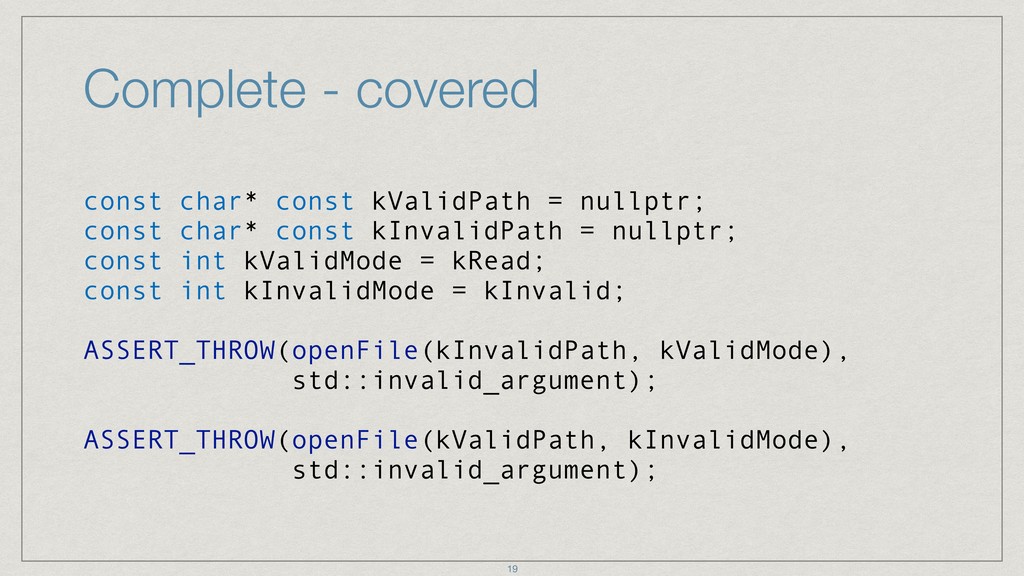
  8. Complete - covered const char* const kValidPath = nullptr; const

    char* const kInvalidPath = nullptr; const int kValidMode = kRead; const int kInvalidMode = kInvalid; ASSERT_THROW(openFile(kInvalidPath, kValidMode), std::invalid_argument); ASSERT_THROW(openFile(kValidPath, kInvalidMode), std::invalid_argument); 19
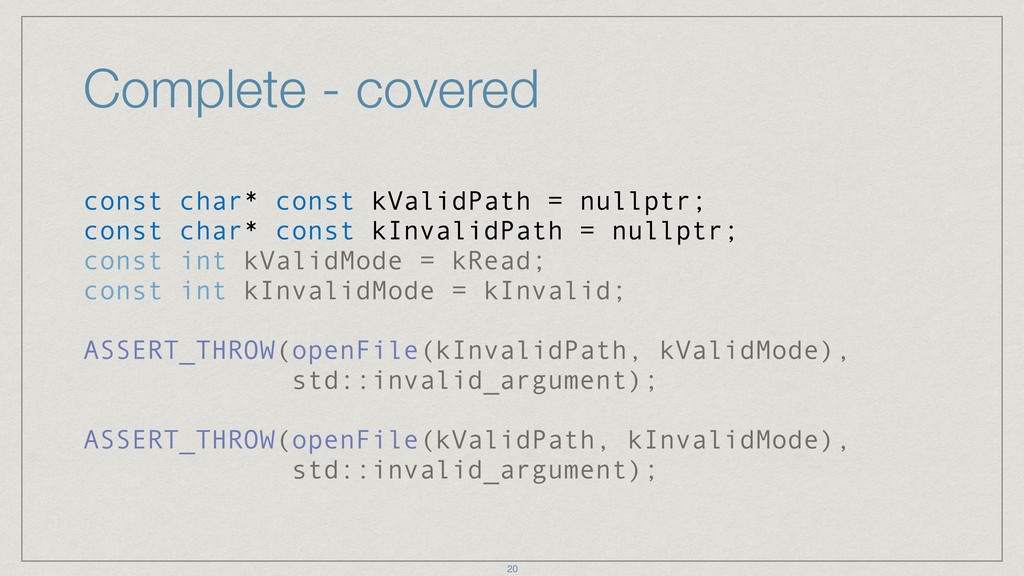
  9. Complete - covered const char* const kValidPath = nullptr; const

    char* const kInvalidPath = nullptr; const int kValidMode = kRead; const int kInvalidMode = kInvalid; ASSERT_THROW(openFile(kInvalidPath, kValidMode), std::invalid_argument); ASSERT_THROW(openFile(kValidPath, kInvalidMode), std::invalid_argument); 20 const char* const kValidPath = nullptr; const char* const kInvalidPath = nullptr;
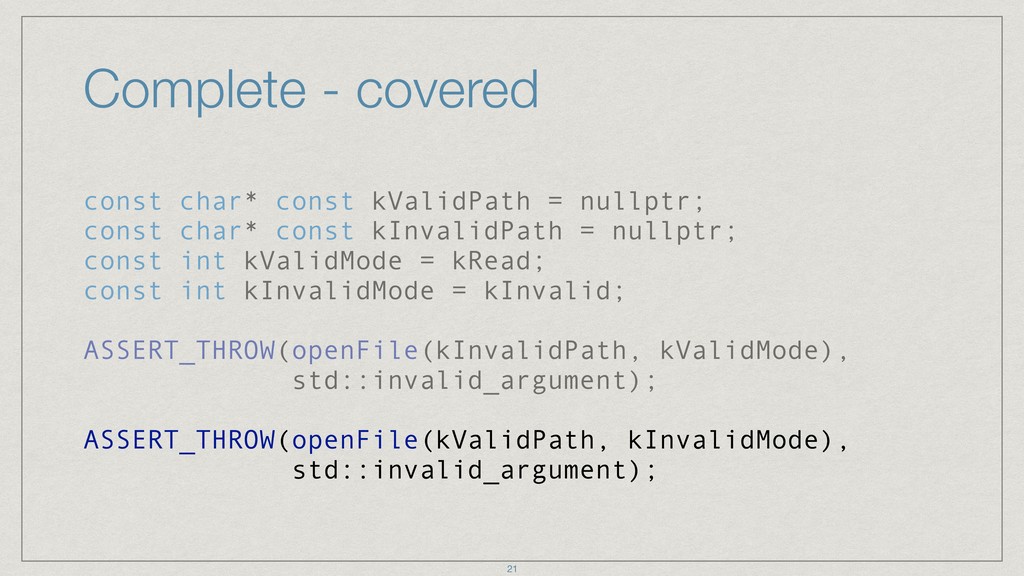
  10. Complete - covered const char* const kValidPath = nullptr; const

    char* const kInvalidPath = nullptr; const int kValidMode = kRead; const int kInvalidMode = kInvalid; ASSERT_THROW(openFile(kInvalidPath, kValidMode), std::invalid_argument); ASSERT_THROW(openFile(kValidPath, kInvalidMode), std::invalid_argument); 21 ASSERT_THROW(openFile(kValidPath, kInvalidMode), std::invalid_argument);
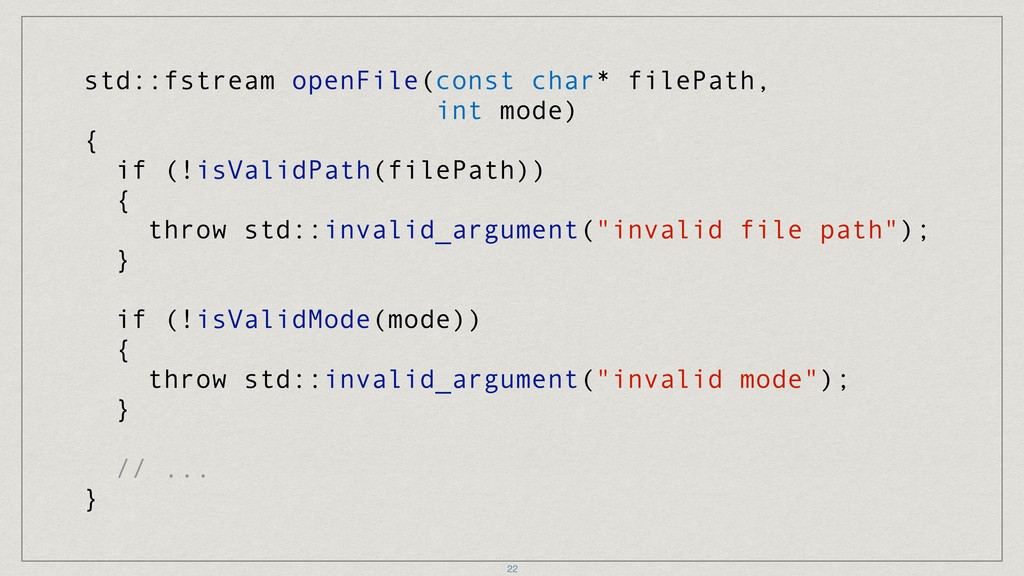
  11. std::fstream openFile(const char* filePath, int mode) { if (!isValidPath(filePath)) {

    throw std::invalid_argument("invalid file path"); } if (!isValidMode(mode)) { throw std::invalid_argument("invalid mode"); } // ... } 22
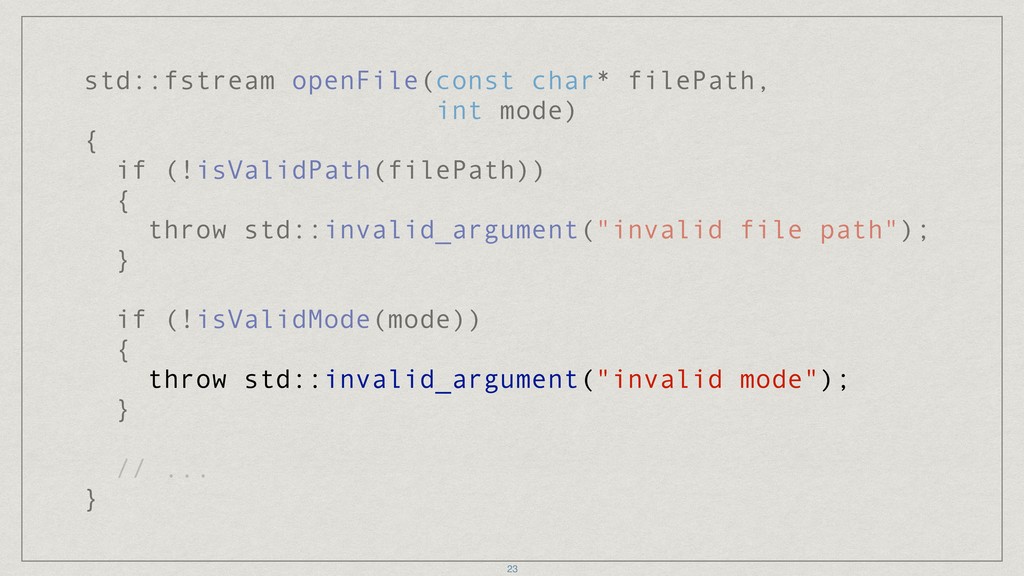
  12. std::fstream openFile(const char* filePath, int mode) { if (!isValidPath(filePath)) {

    throw std::invalid_argument("invalid file path"); } if (!isValidMode(mode)) { throw std::invalid_argument("invalid mode"); } // ... } 23 throw std::invalid_argument("invalid mode");
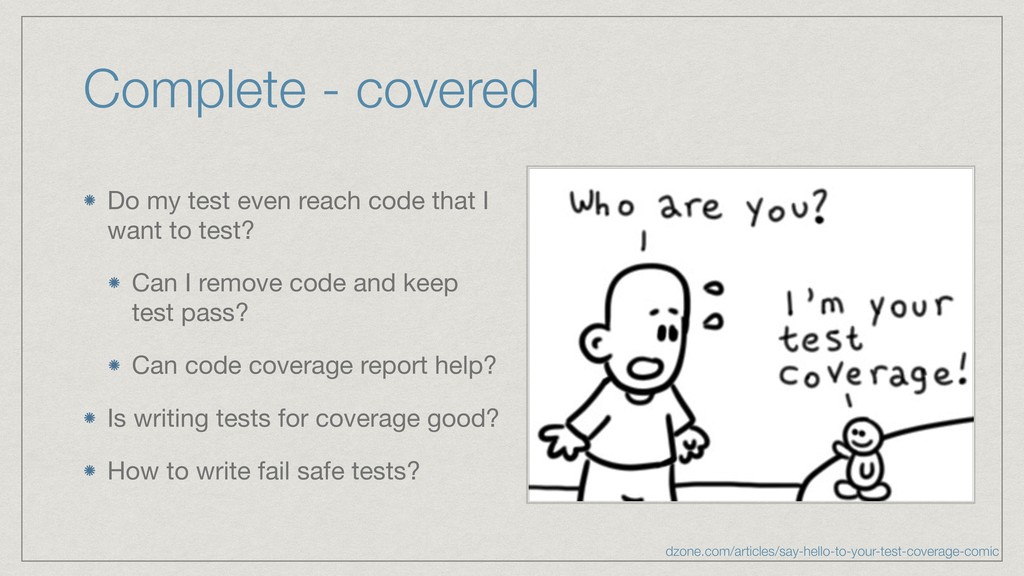
  13. Complete - covered Do my test even reach code that

    I want to test? Can I remove code and keep test pass? Can code coverage report help? Is writing tests for coverage good? How to write fail safe tests? dzone.com/articles/say-hello-to-your-test-coverage-comic
  14. Comprehensible Any developer working on the project should easily understand

    what tests are testing www.pophangover.com/19748/i-have-no-idea-what-im-doing-in-15-pictures
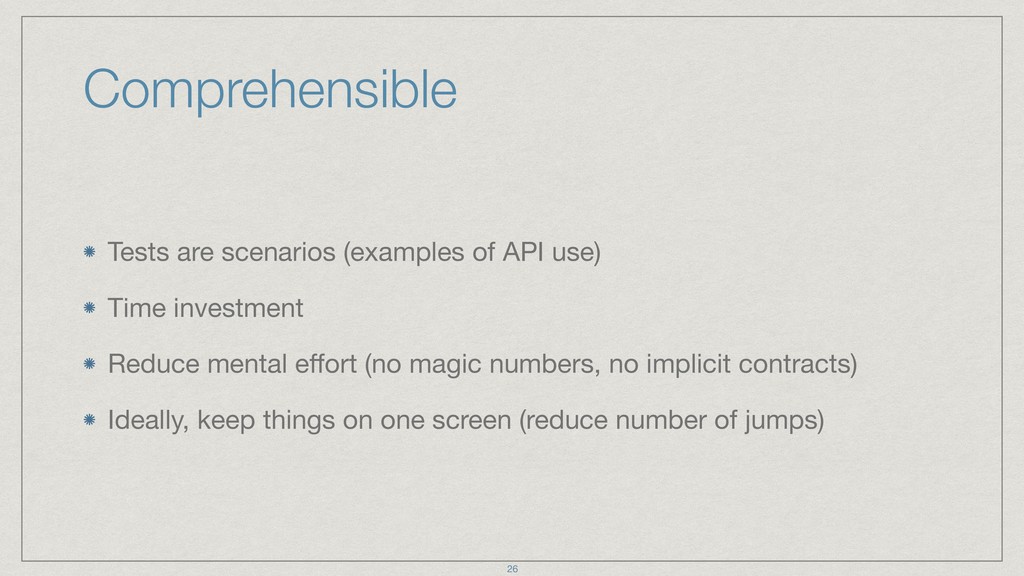
  15. Comprehensible Tests are scenarios (examples of API use) Time investment

    Reduce mental effort (no magic numbers, no implicit contracts) Ideally, keep things on one screen (reduce number of jumps) 26
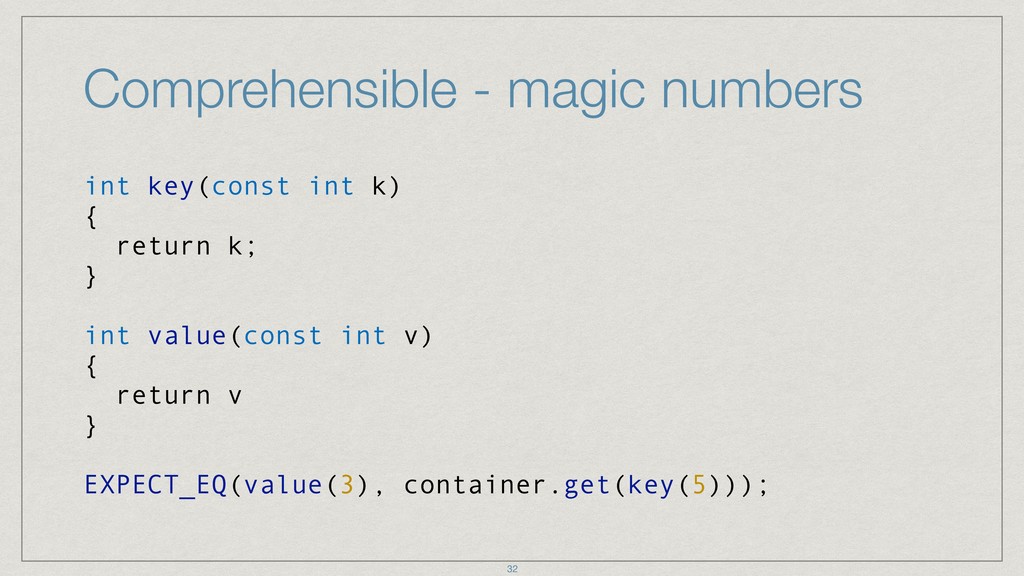
  16. Comprehensible - magic numbers int key(const int k) { return

    k; } int value(const int v) { return v } EXPECT_EQ(value(3), container.get(key(5))); 32
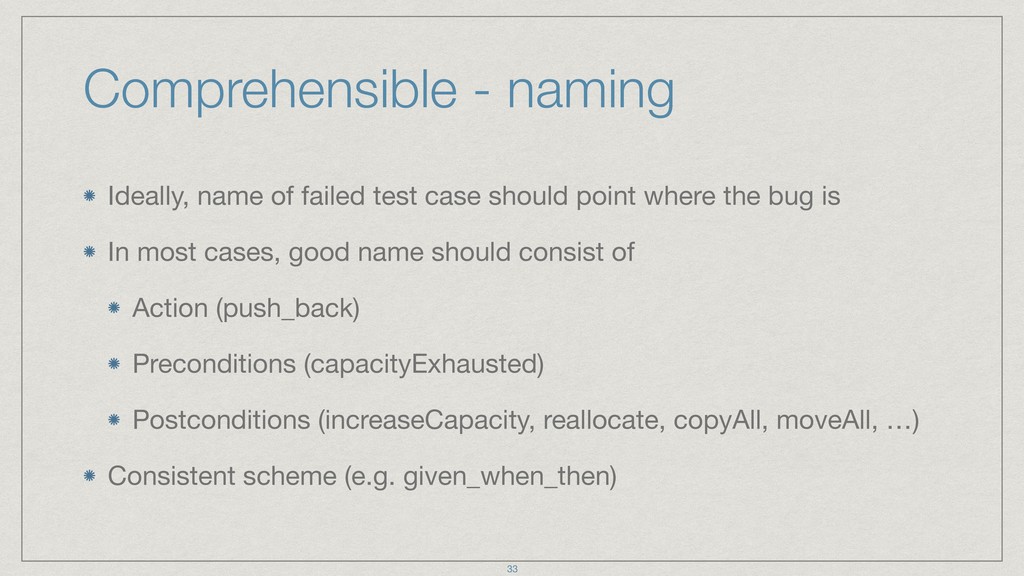
  17. Comprehensible - naming Ideally, name of failed test case should

    point where the bug is In most cases, good name should consist of Action (push_back) Preconditions (capacityExhausted) Postconditions (increaseCapacity, reallocate, copyAll, moveAll, …) Consistent scheme (e.g. given_when_then) 33
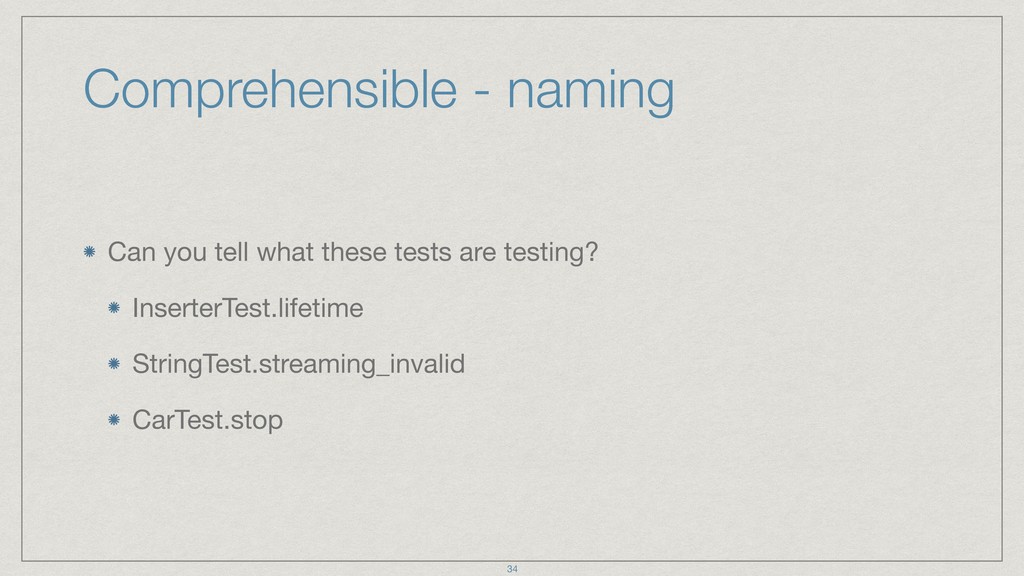
  18. Comprehensible - naming Can you tell what these tests are

    testing? InserterTest.lifetime StringTest.streaming_invalid CarTest.stop 34
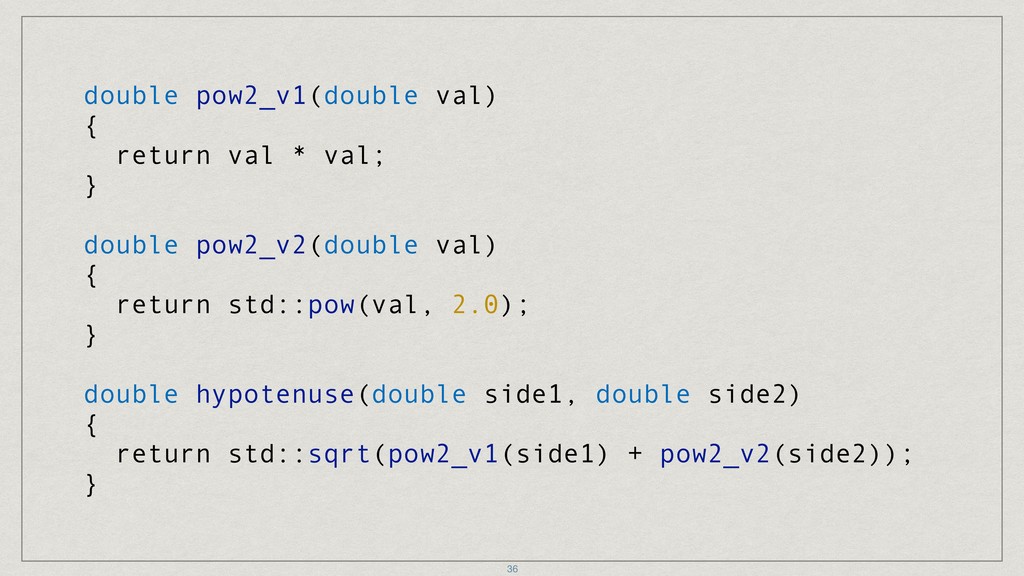
  19. double pow2_v1(double val) { return val * val; } double

    pow2_v2(double val) { return std::pow(val, 2.0); } double hypotenuse(double side1, double side2) { return std::sqrt(pow2_v1(side1) + pow2_v2(side2)); } 36
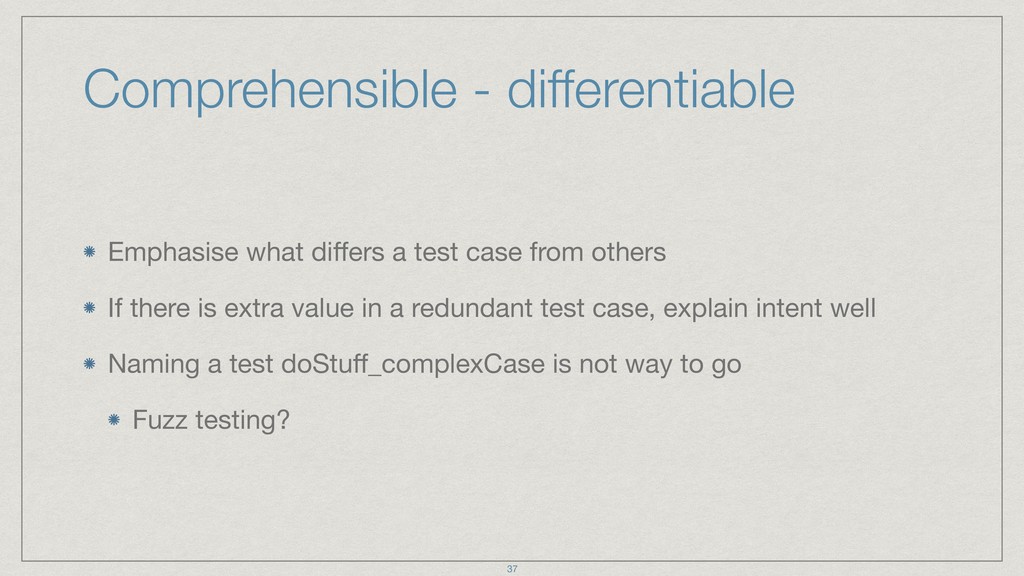
  20. Comprehensible - differentiable Emphasise what differs a test case from

    others If there is extra value in a redundant test case, explain intent well Naming a test doStuff_complexCase is not way to go Fuzz testing? 37
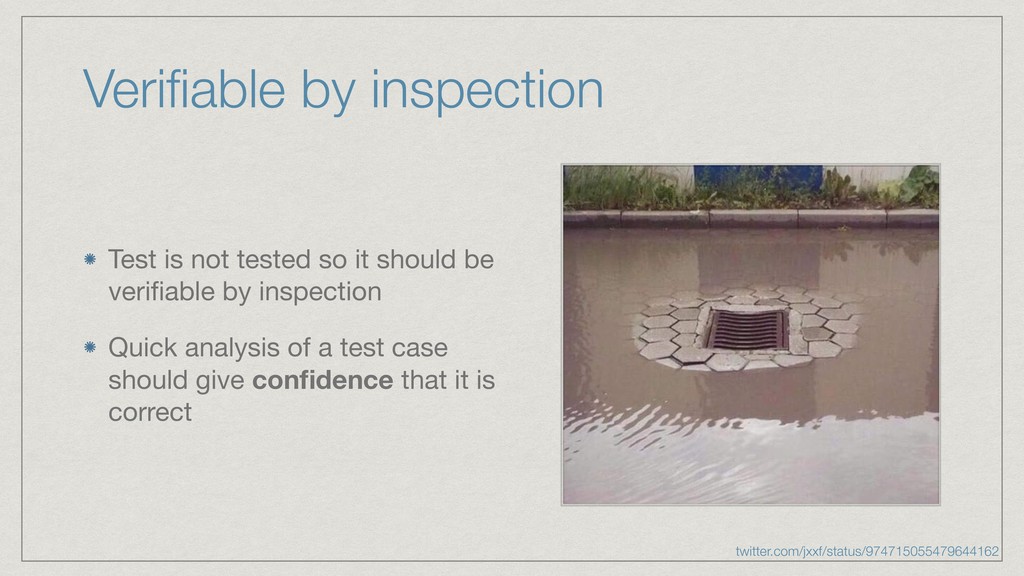
  21. Verifiable by inspection Test is not tested so it should

    be verifiable by inspection Quick analysis of a test case should give confidence that it is correct twitter.com/jxxf/status/974715055479644162
  22. Verifiable by inspection - minimalistic Long test case Long test

    suite If I cannot write a short test case… Does my code follows single responsibility principle? Can I move some processing to other classes? Can I use mocks so I don’t have to create the world? 39
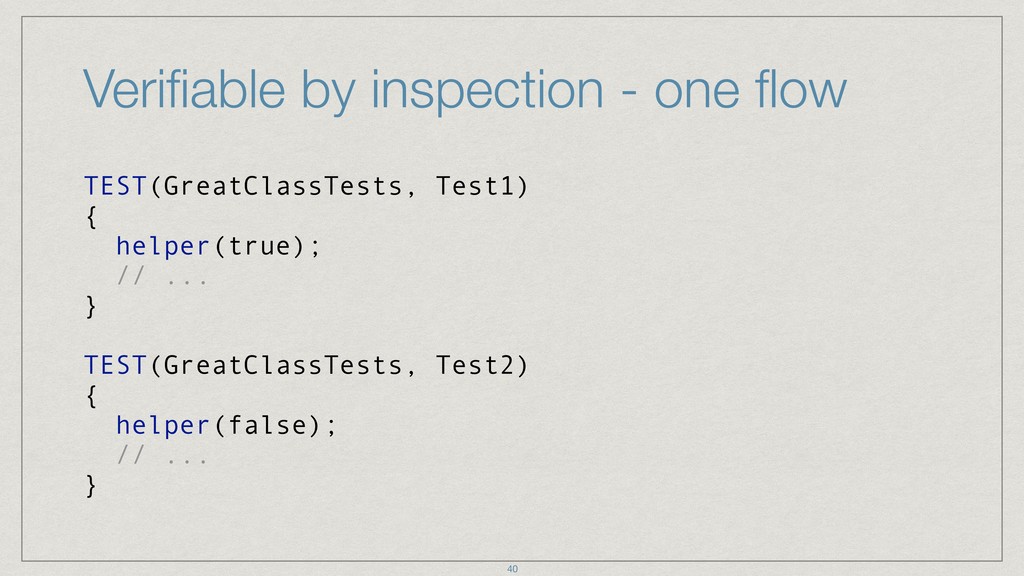
  23. Verifiable by inspection - one flow TEST(GreatClassTests, Test1) { helper(true);

    // ... } TEST(GreatClassTests, Test2) { helper(false); // ... } 40
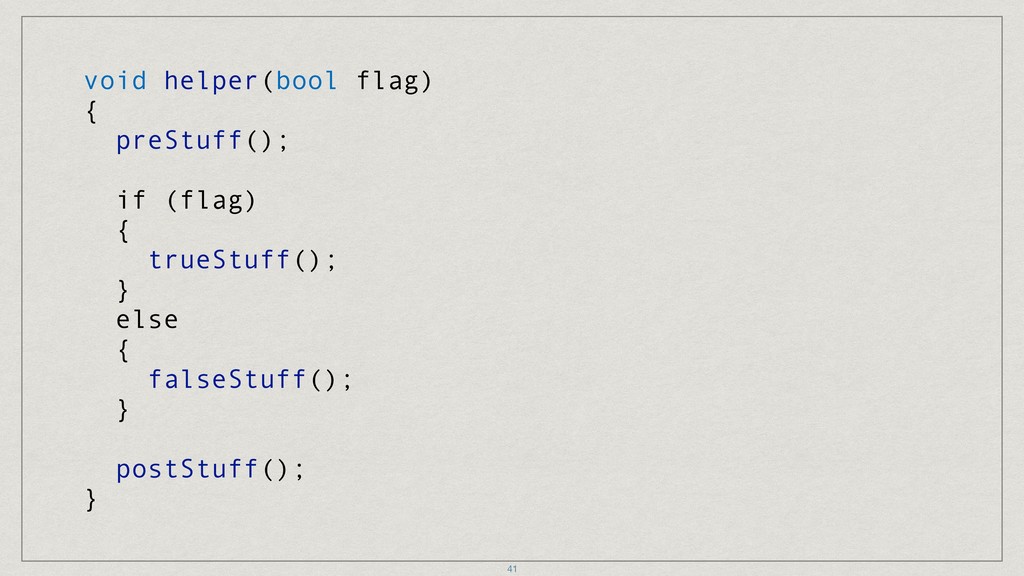
  24. void helper(bool flag) { preStuff(); if (flag) { trueStuff(); }

    else { falseStuff(); } postStuff(); } 41
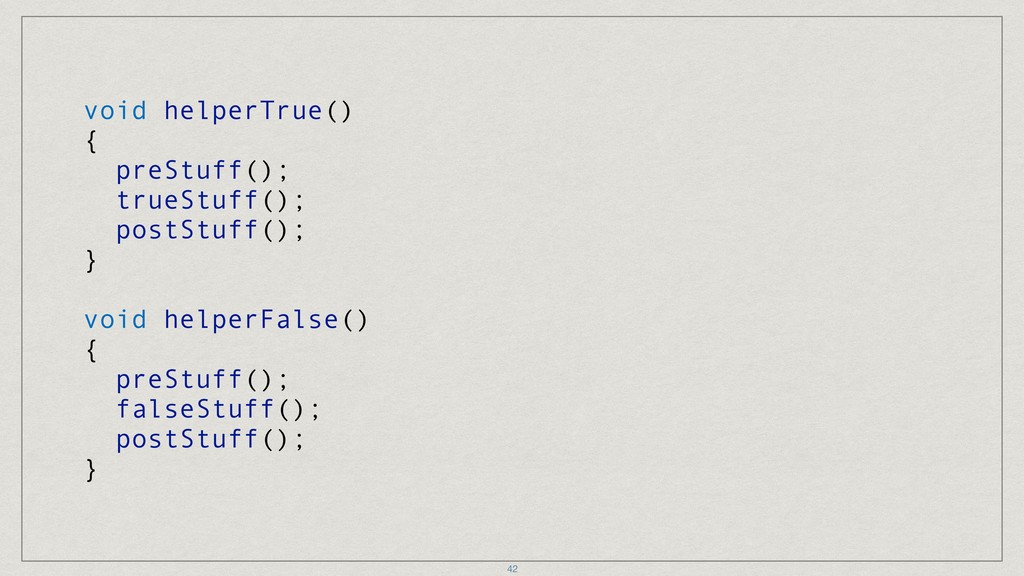
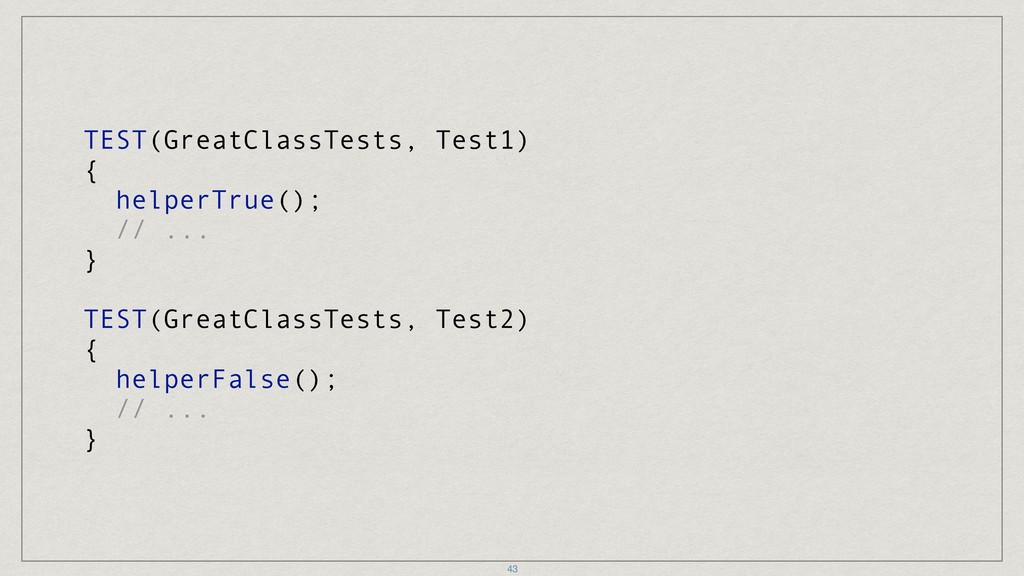
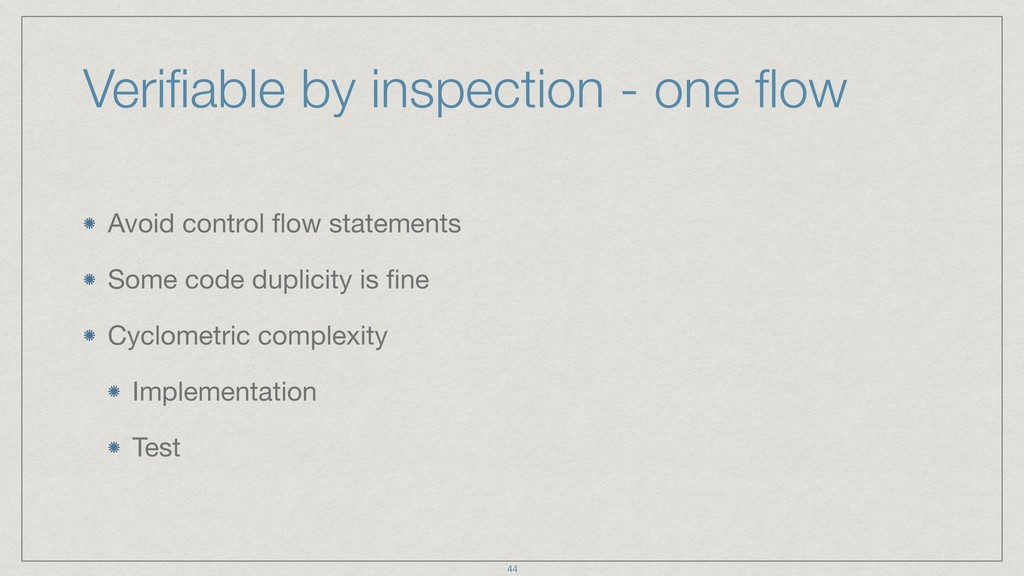
  25. Verifiable by inspection - one flow Avoid control flow statements

    Some code duplicity is fine Cyclometric complexity Implementation Test 44
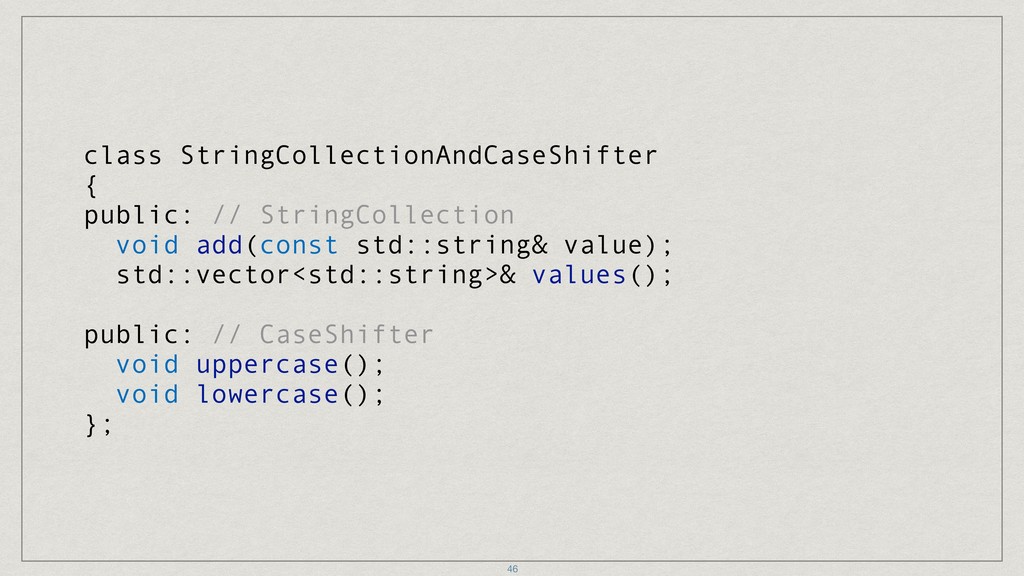
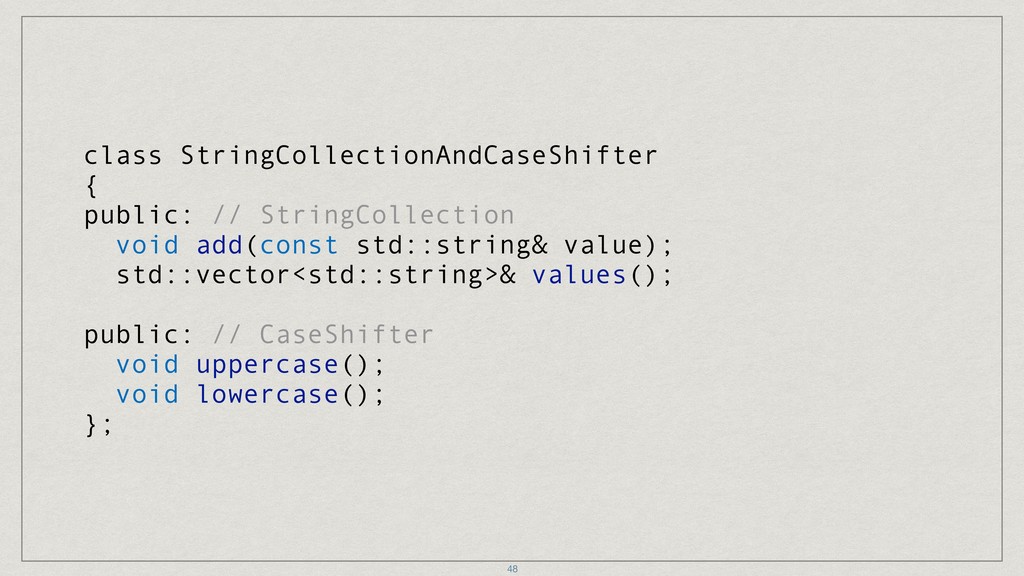
  26. class StringCollectionAndCaseShifter { public: // StringCollection void add(const std::string& value);

    std::vector<std::string>& values(); public: // CaseShifter void uppercase(); void lowercase(); }; 46
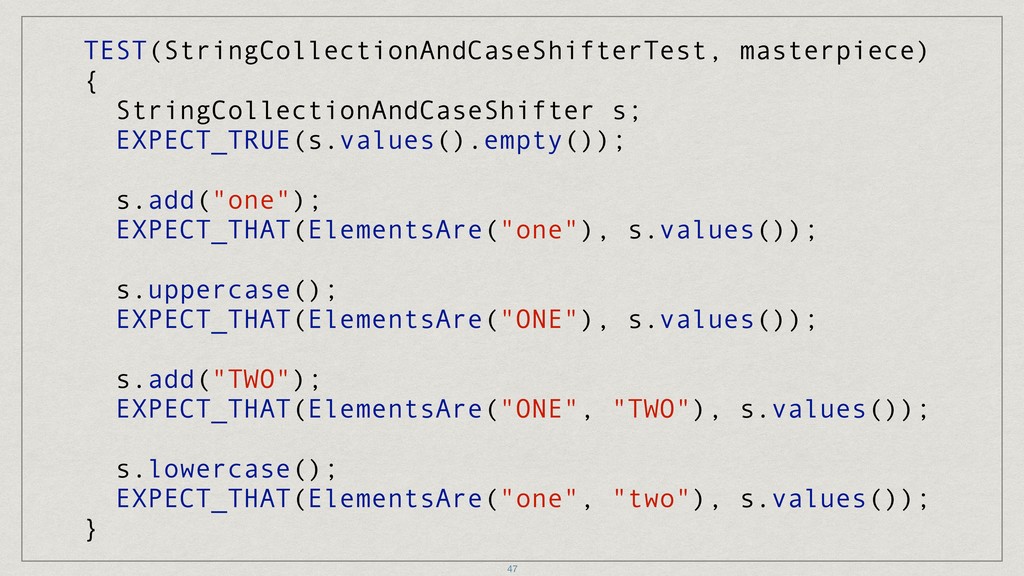
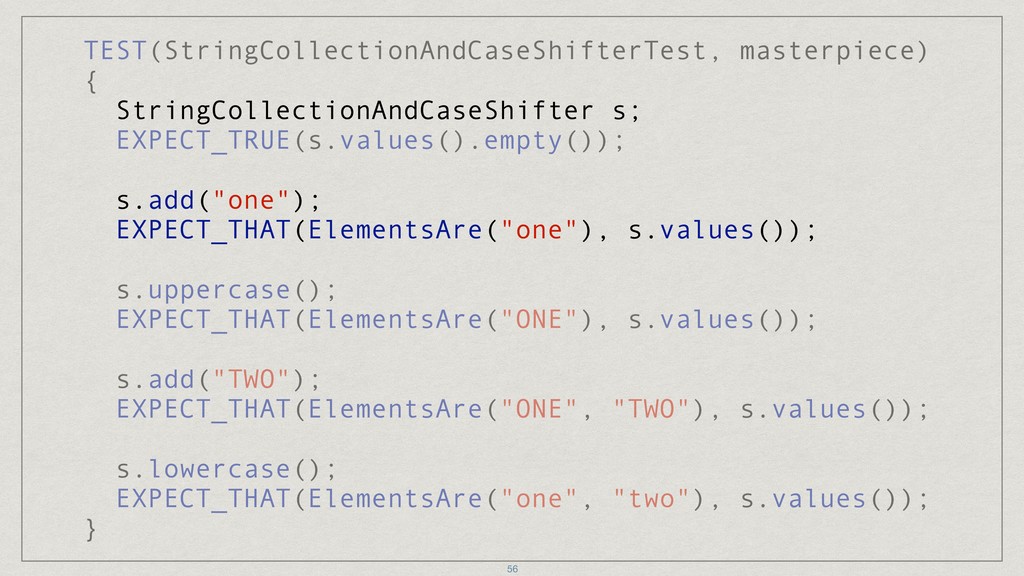
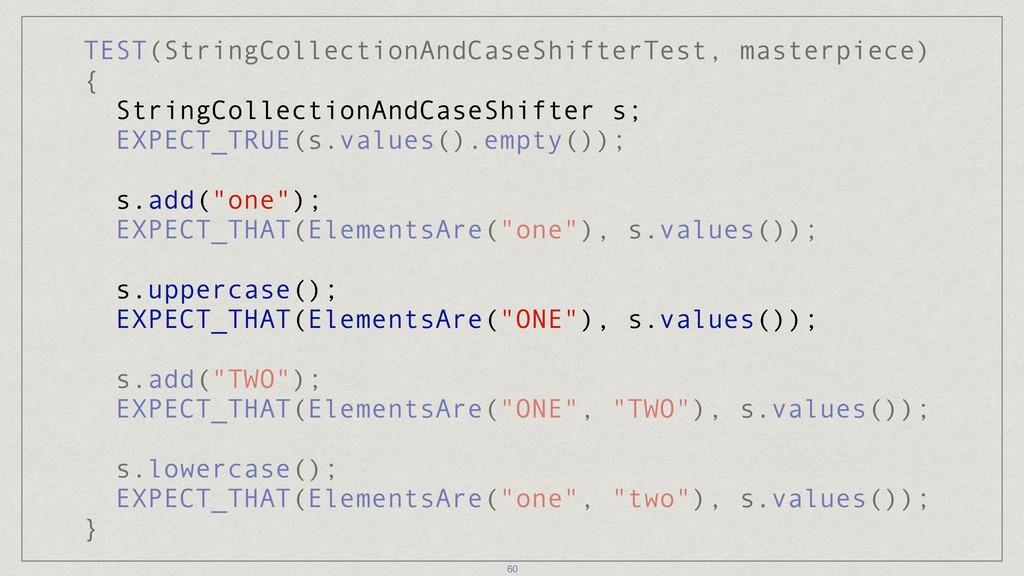
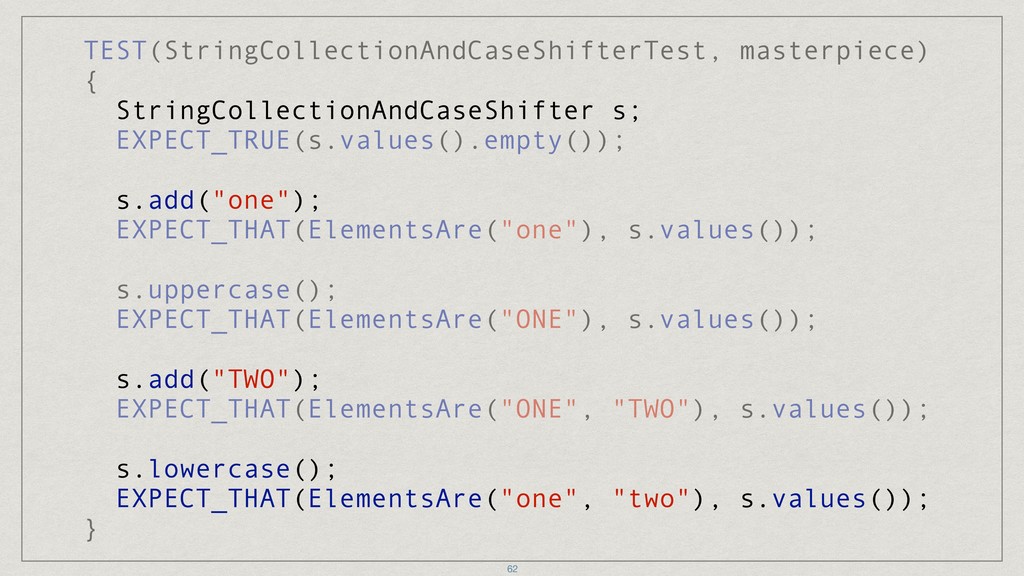
  27. TEST(StringCollectionAndCaseShifterTest, masterpiece) { StringCollectionAndCaseShifter s; EXPECT_TRUE(s.values().empty()); s.add("one"); EXPECT_THAT(ElementsAre("one"), s.values()); s.uppercase();

    EXPECT_THAT(ElementsAre("ONE"), s.values()); s.add("TWO"); EXPECT_THAT(ElementsAre("ONE", "TWO"), s.values()); s.lowercase(); EXPECT_THAT(ElementsAre("one", "two"), s.values()); } 47
  28. class StringCollectionAndCaseShifter { public: // StringCollection void add(const std::string& value);

    std::vector<std::string>& values(); public: // CaseShifter void uppercase(); void lowercase(); }; 48
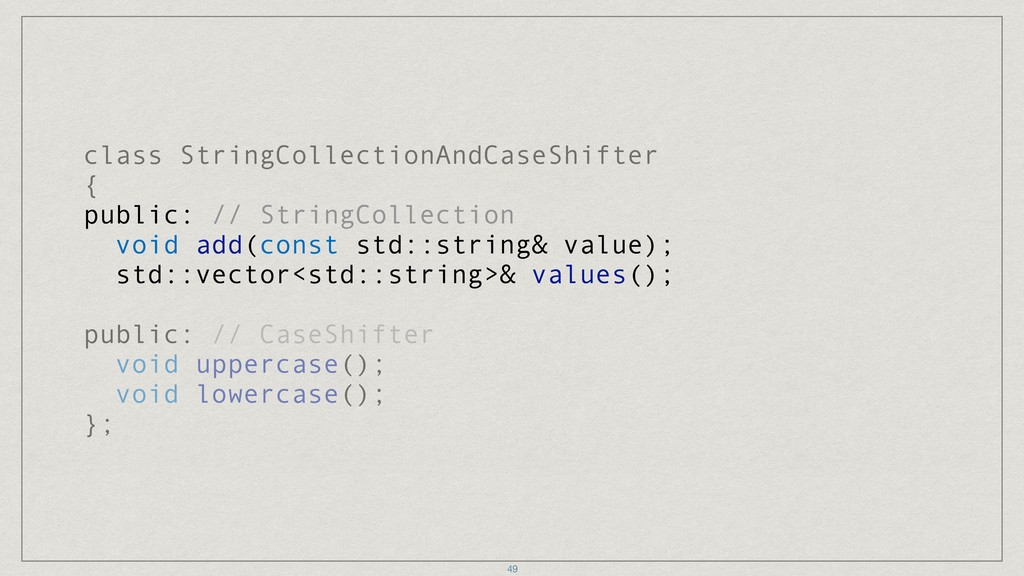
  29. class StringCollectionAndCaseShifter { public: // StringCollection void add(const std::string& value);

    std::vector<std::string>& values(); public: // CaseShifter void uppercase(); void lowercase(); }; 49 public: // StringCollection void add(const std::string& value); std::vector<std::string>& values();
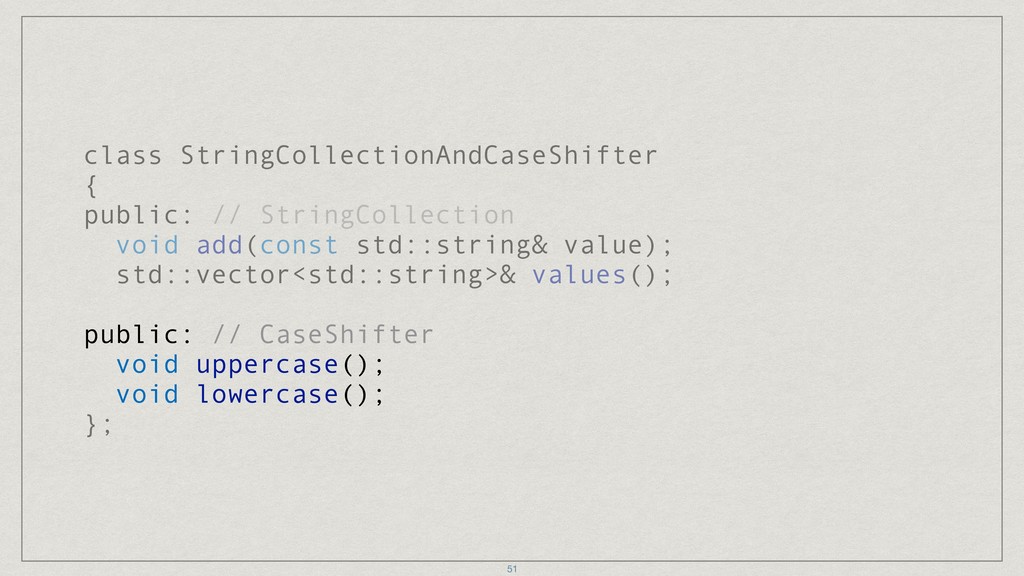
  30. class StringCollectionAndCaseShifter { public: // StringCollection void add(const std::string& value);

    std::vector<std::string>& values(); public: // CaseShifter void uppercase(); void lowercase(); }; 51 public: // CaseShifter void uppercase(); void lowercase();
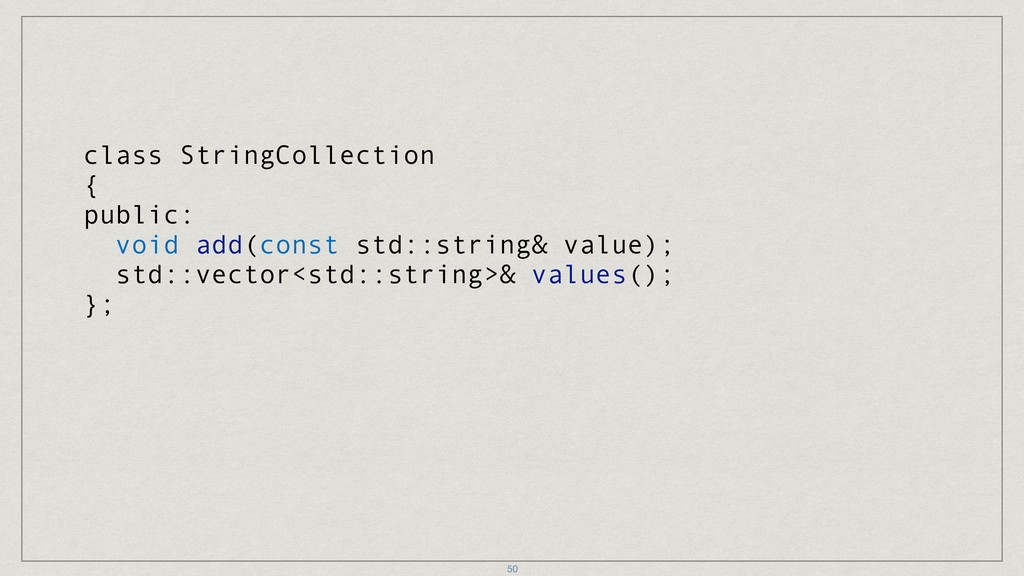
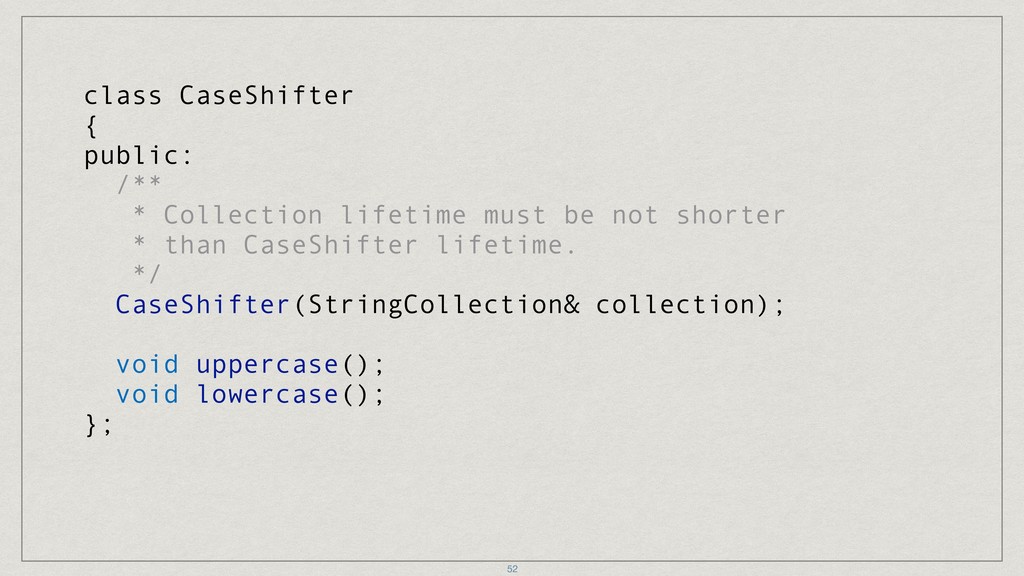
  31. class CaseShifter { public: /** * Collection lifetime must be

    not shorter * than CaseShifter lifetime. */ CaseShifter(StringCollection& collection); void uppercase(); void lowercase(); }; 52
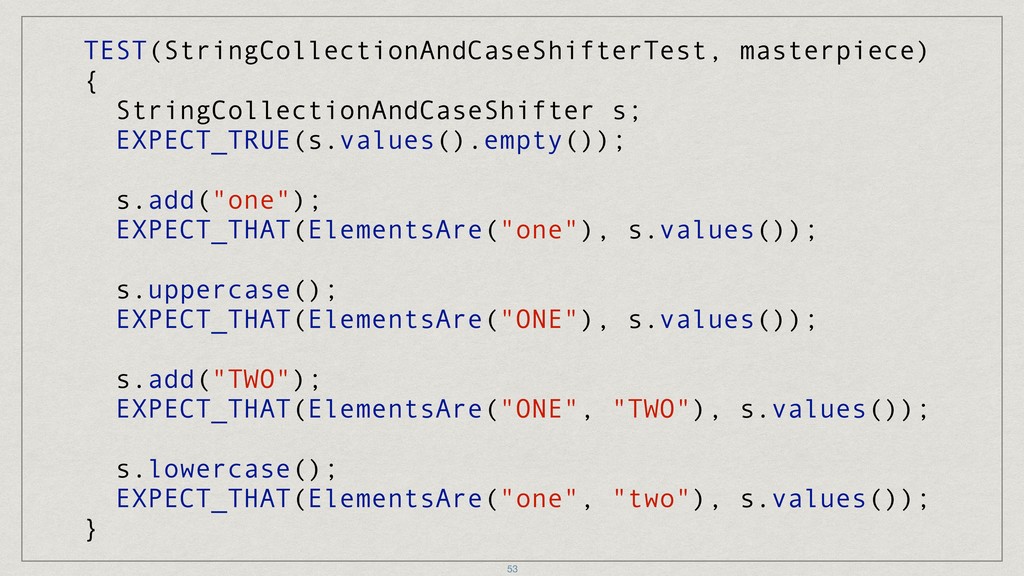
  32. TEST(StringCollectionAndCaseShifterTest, masterpiece) { StringCollectionAndCaseShifter s; EXPECT_TRUE(s.values().empty()); s.add("one"); EXPECT_THAT(ElementsAre("one"), s.values()); s.uppercase();

    EXPECT_THAT(ElementsAre("ONE"), s.values()); s.add("TWO"); EXPECT_THAT(ElementsAre("ONE", "TWO"), s.values()); s.lowercase(); EXPECT_THAT(ElementsAre("one", "two"), s.values()); } 53
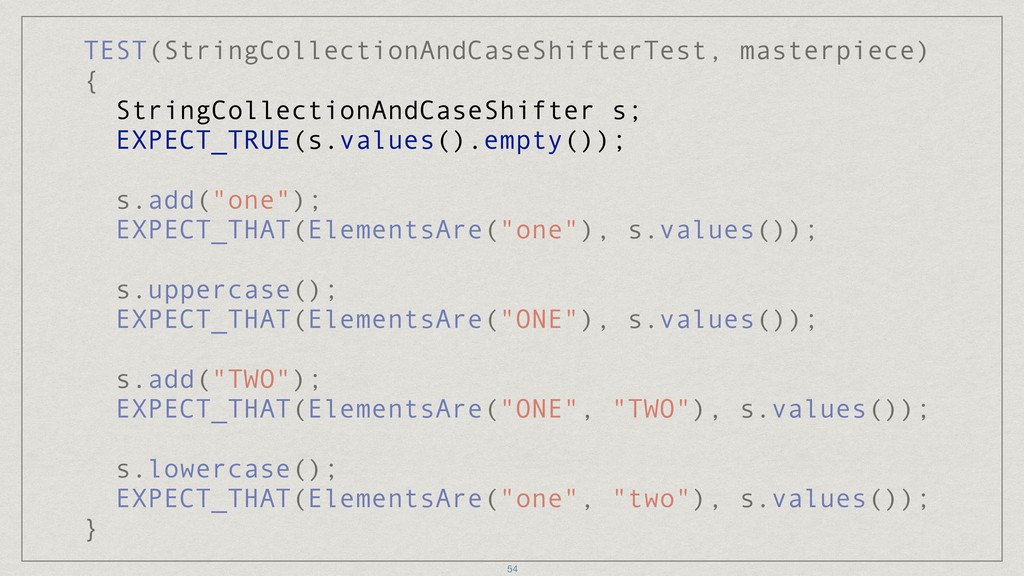
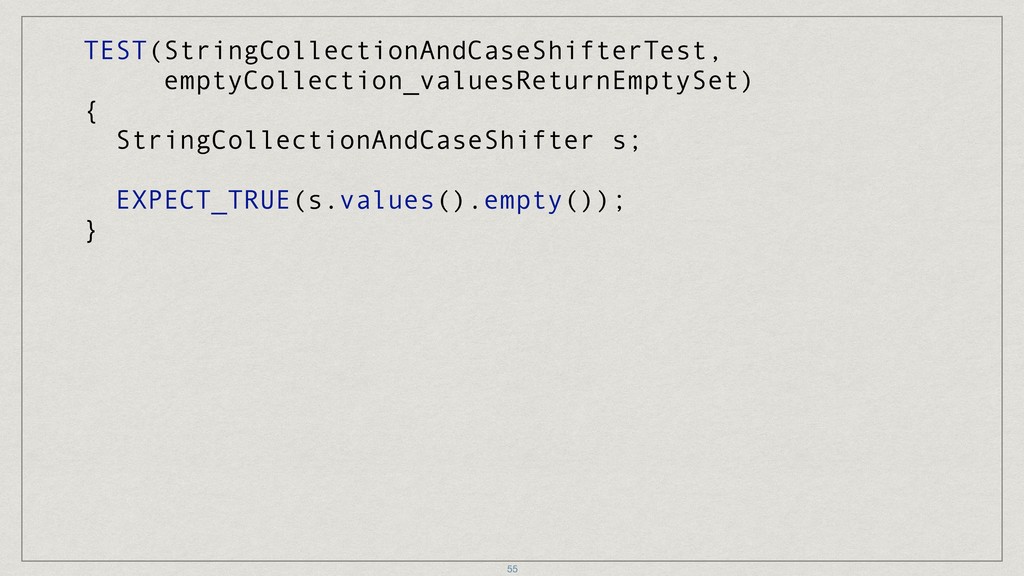
  33. TEST(StringCollectionAndCaseShifterTest, masterpiece) { StringCollectionAndCaseShifter s; EXPECT_TRUE(s.values().empty()); s.add("one"); EXPECT_THAT(ElementsAre("one"), s.values()); s.uppercase();

    EXPECT_THAT(ElementsAre("ONE"), s.values()); s.add("TWO"); EXPECT_THAT(ElementsAre("ONE", "TWO"), s.values()); s.lowercase(); EXPECT_THAT(ElementsAre("one", "two"), s.values()); } 54 StringCollectionAndCaseShifter s; EXPECT_TRUE(s.values().empty());
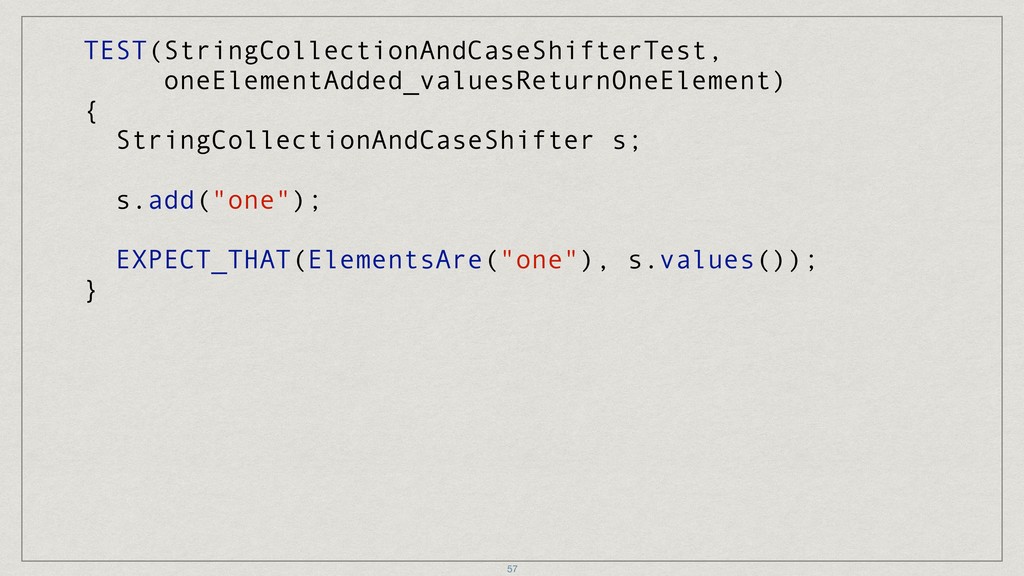
  34. TEST(StringCollectionAndCaseShifterTest, masterpiece) { StringCollectionAndCaseShifter s; EXPECT_TRUE(s.values().empty()); s.add("one"); EXPECT_THAT(ElementsAre("one"), s.values()); s.uppercase();

    EXPECT_THAT(ElementsAre("ONE"), s.values()); s.add("TWO"); EXPECT_THAT(ElementsAre("ONE", "TWO"), s.values()); s.lowercase(); EXPECT_THAT(ElementsAre("one", "two"), s.values()); } 56 StringCollectionAndCaseShifter s; s.add("one"); EXPECT_THAT(ElementsAre("one"), s.values());
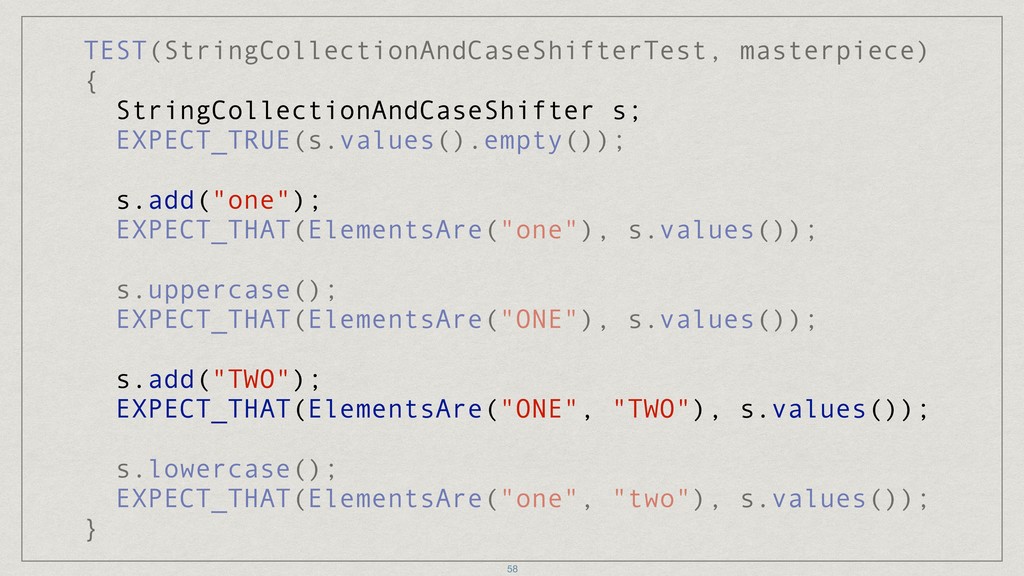
  35. TEST(StringCollectionAndCaseShifterTest, masterpiece) { StringCollectionAndCaseShifter s; EXPECT_TRUE(s.values().empty()); s.add("one"); EXPECT_THAT(ElementsAre("one"), s.values()); s.uppercase();

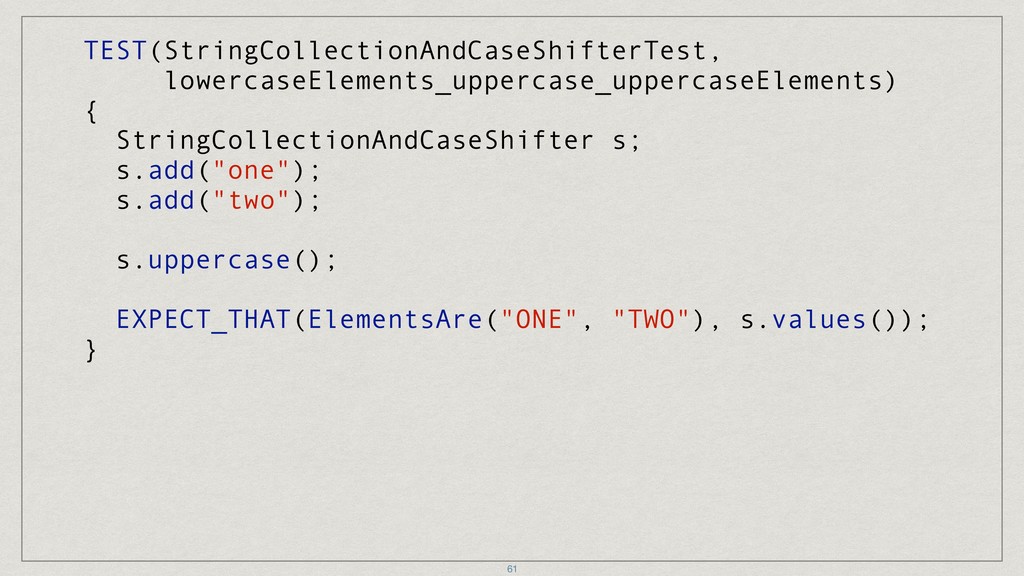
    EXPECT_THAT(ElementsAre("ONE"), s.values()); s.add("TWO"); EXPECT_THAT(ElementsAre("ONE", "TWO"), s.values()); s.lowercase(); EXPECT_THAT(ElementsAre("one", "two"), s.values()); } 58 StringCollectionAndCaseShifter s; s.add("one"); s.add("TWO"); EXPECT_THAT(ElementsAre("ONE", "TWO"), s.values());
  36. TEST(StringCollectionAndCaseShifterTest, masterpiece) { StringCollectionAndCaseShifter s; EXPECT_TRUE(s.values().empty()); s.add("one"); EXPECT_THAT(ElementsAre("one"), s.values()); s.uppercase();

    EXPECT_THAT(ElementsAre("ONE"), s.values()); s.add("TWO"); EXPECT_THAT(ElementsAre("ONE", "TWO"), s.values()); s.lowercase(); EXPECT_THAT(ElementsAre("one", "two"), s.values()); } 60 StringCollectionAndCaseShifter s; s.add("one"); s.uppercase(); EXPECT_THAT(ElementsAre("ONE"), s.values());
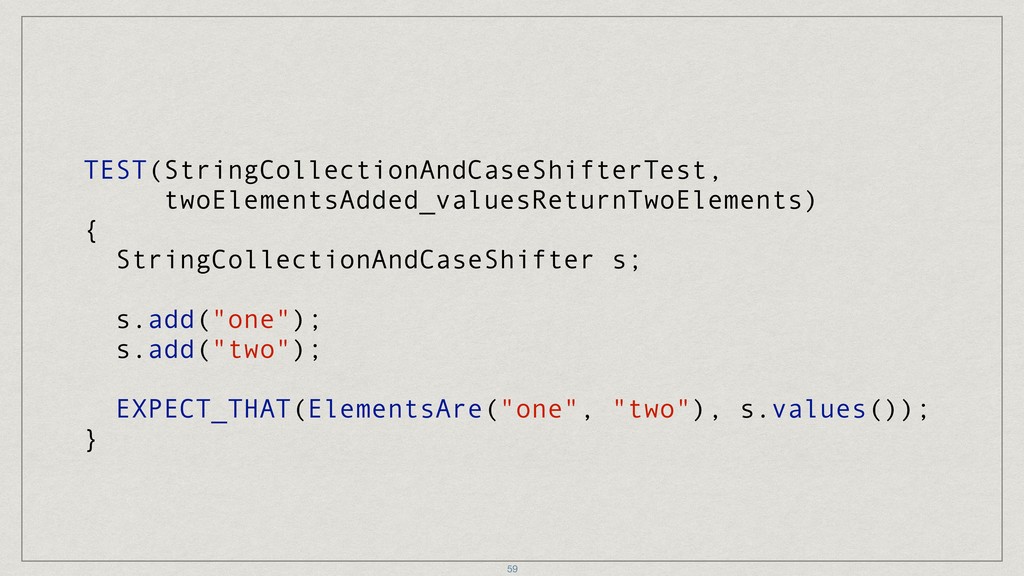
  37. TEST(StringCollectionAndCaseShifterTest, masterpiece) { StringCollectionAndCaseShifter s; EXPECT_TRUE(s.values().empty()); s.add("one"); EXPECT_THAT(ElementsAre("one"), s.values()); s.uppercase();

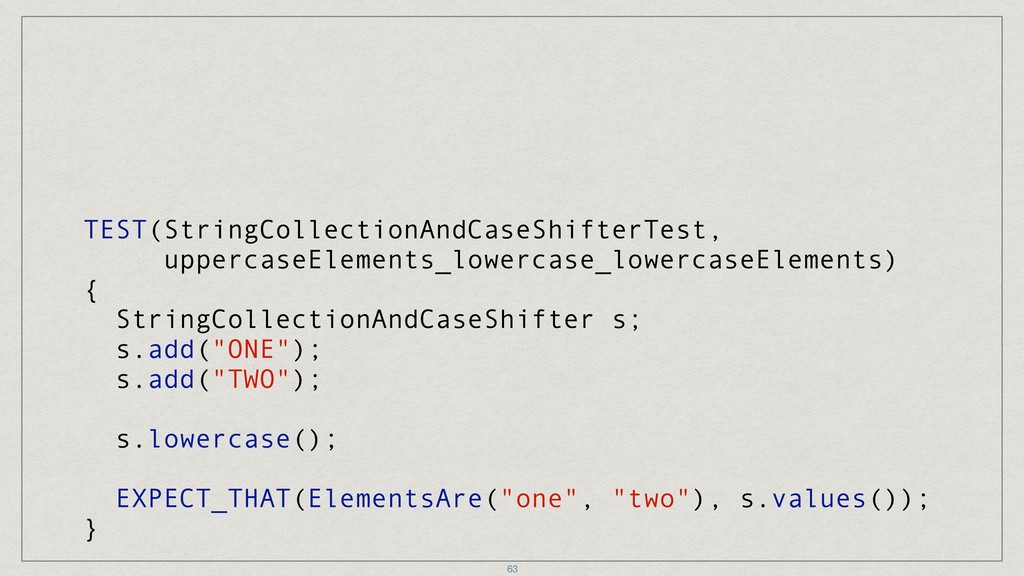
    EXPECT_THAT(ElementsAre("ONE"), s.values()); s.add("TWO"); EXPECT_THAT(ElementsAre("ONE", "TWO"), s.values()); s.lowercase(); EXPECT_THAT(ElementsAre("one", "two"), s.values()); } 62 StringCollectionAndCaseShifter s; s.add("one"); s.add("TWO"); s.lowercase(); EXPECT_THAT(ElementsAre("one", "two"), s.values());
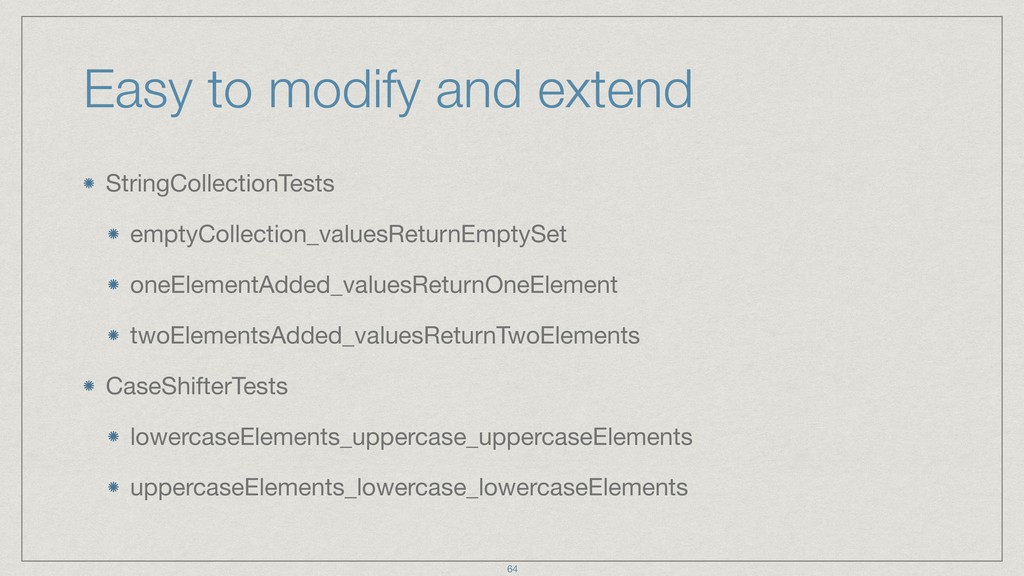
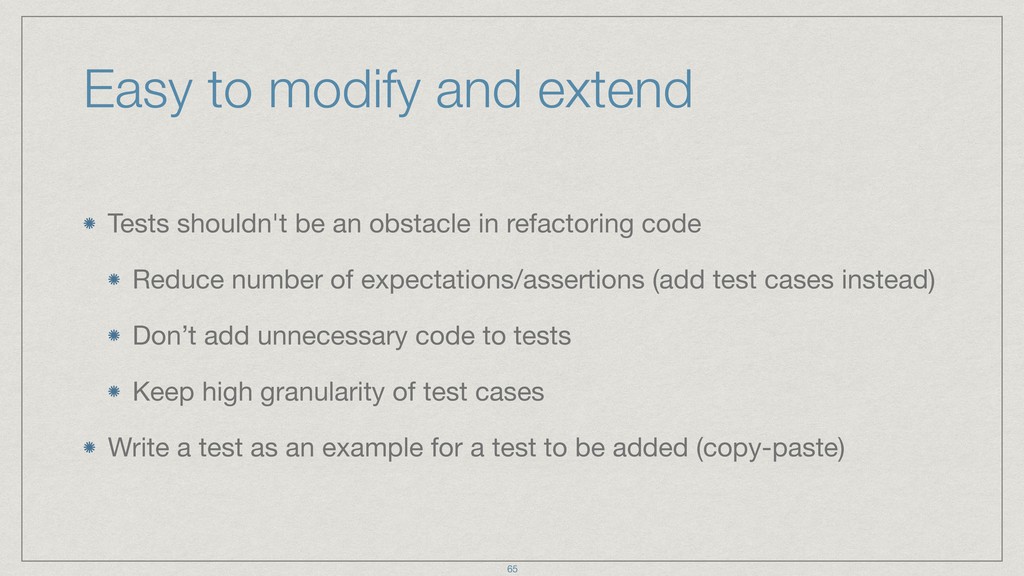
  38. Easy to modify and extend Tests shouldn't be an obstacle

    in refactoring code Reduce number of expectations/assertions (add test cases instead) Don’t add unnecessary code to tests Keep high granularity of test cases Write a test as an example for a test to be added (copy-paste) 65
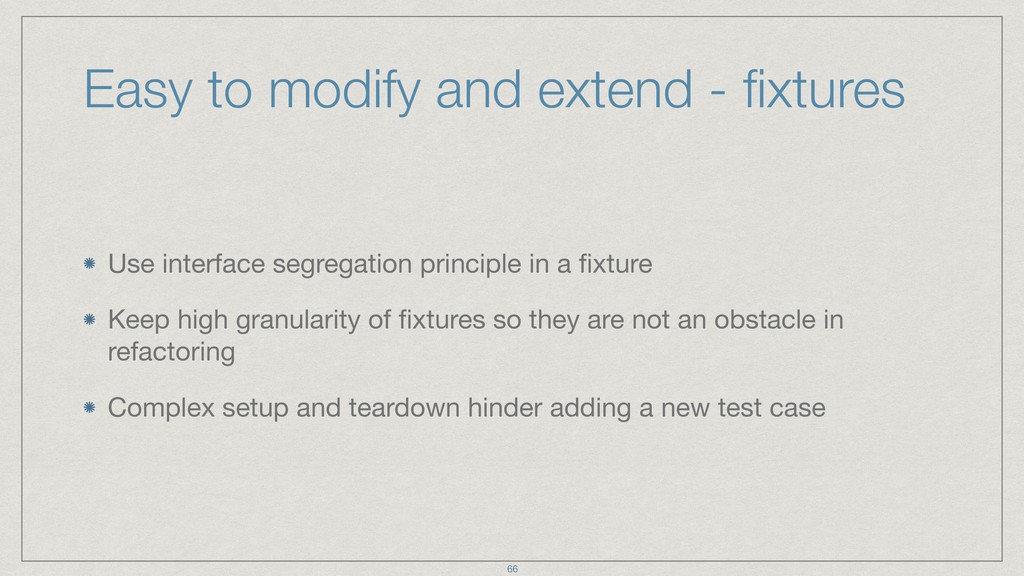
  39. Easy to modify and extend - fixtures Use interface segregation

    principle in a fixture Keep high granularity of fixtures so they are not an obstacle in refactoring Complex setup and teardown hinder adding a new test case 66
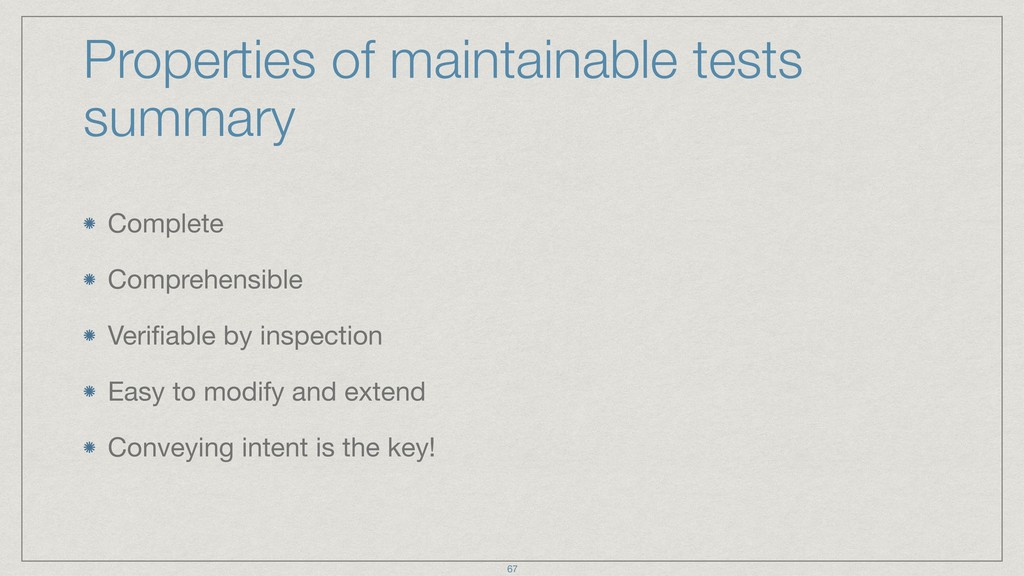
  40. Properties of maintainable tests summary Complete Comprehensible Verifiable by inspection

    Easy to modify and extend Conveying intent is the key! 67
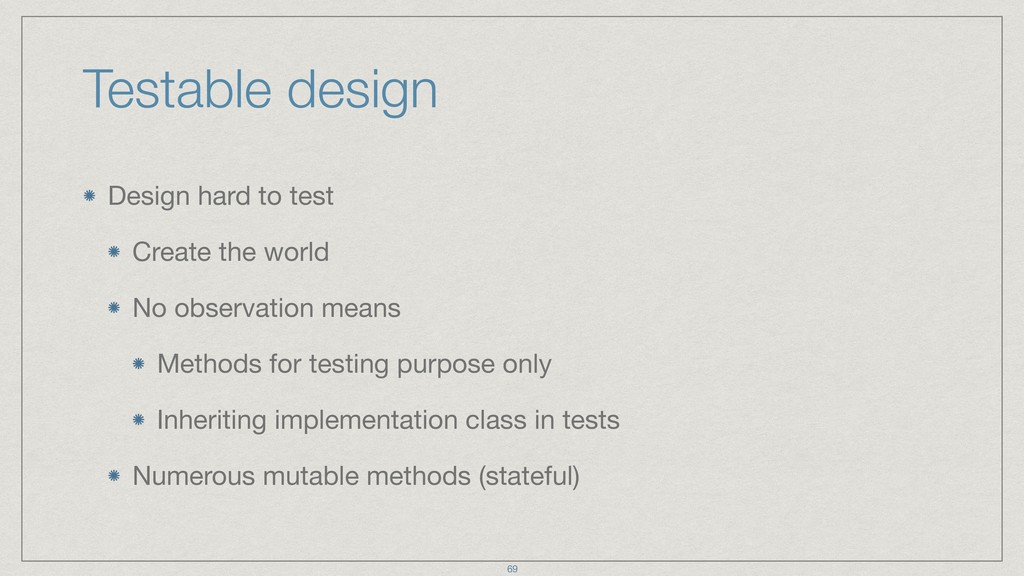
  41. Testable design Design hard to test Create the world No

    observation means Methods for testing purpose only Inheriting implementation class in tests Numerous mutable methods (stateful) 69