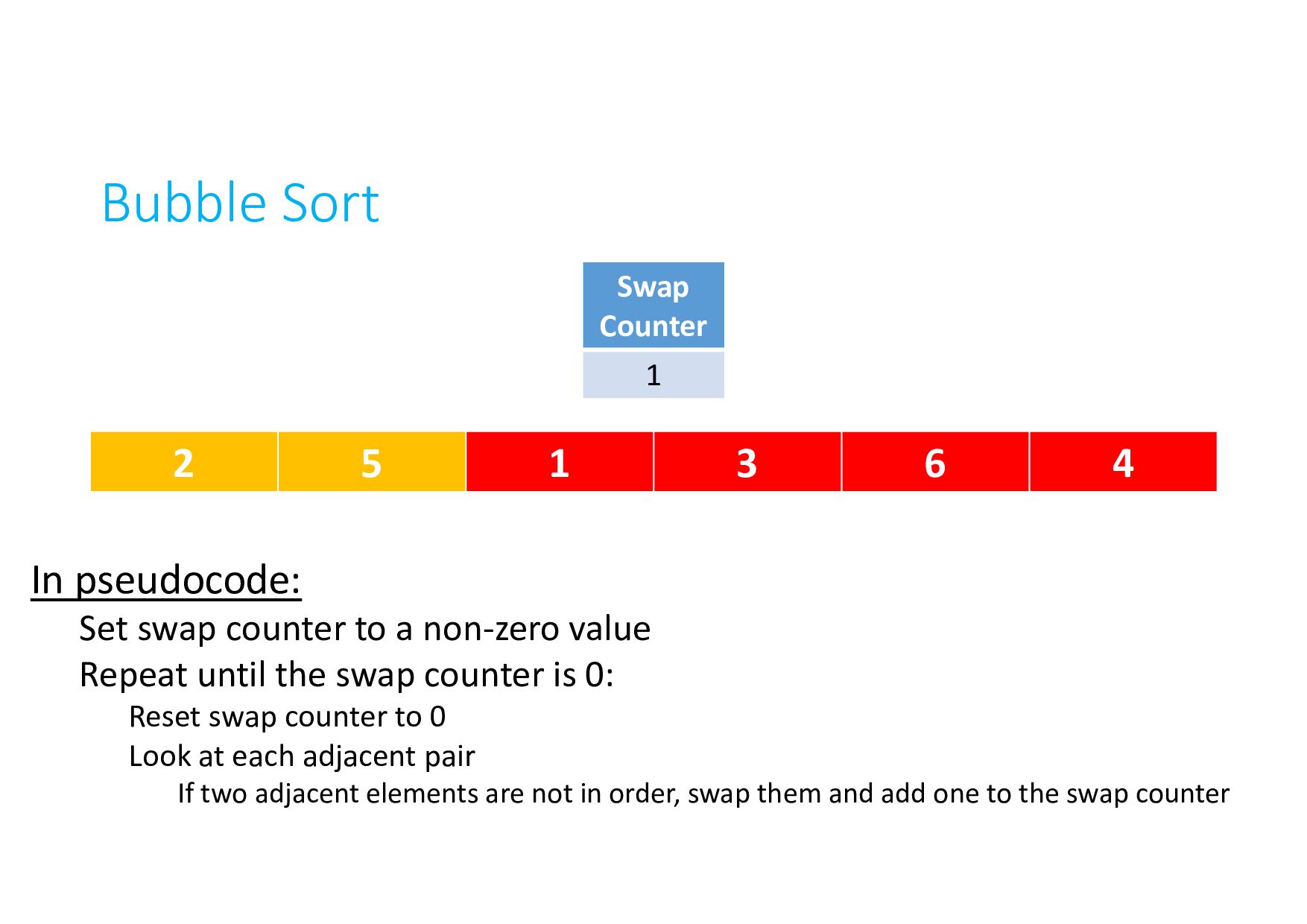
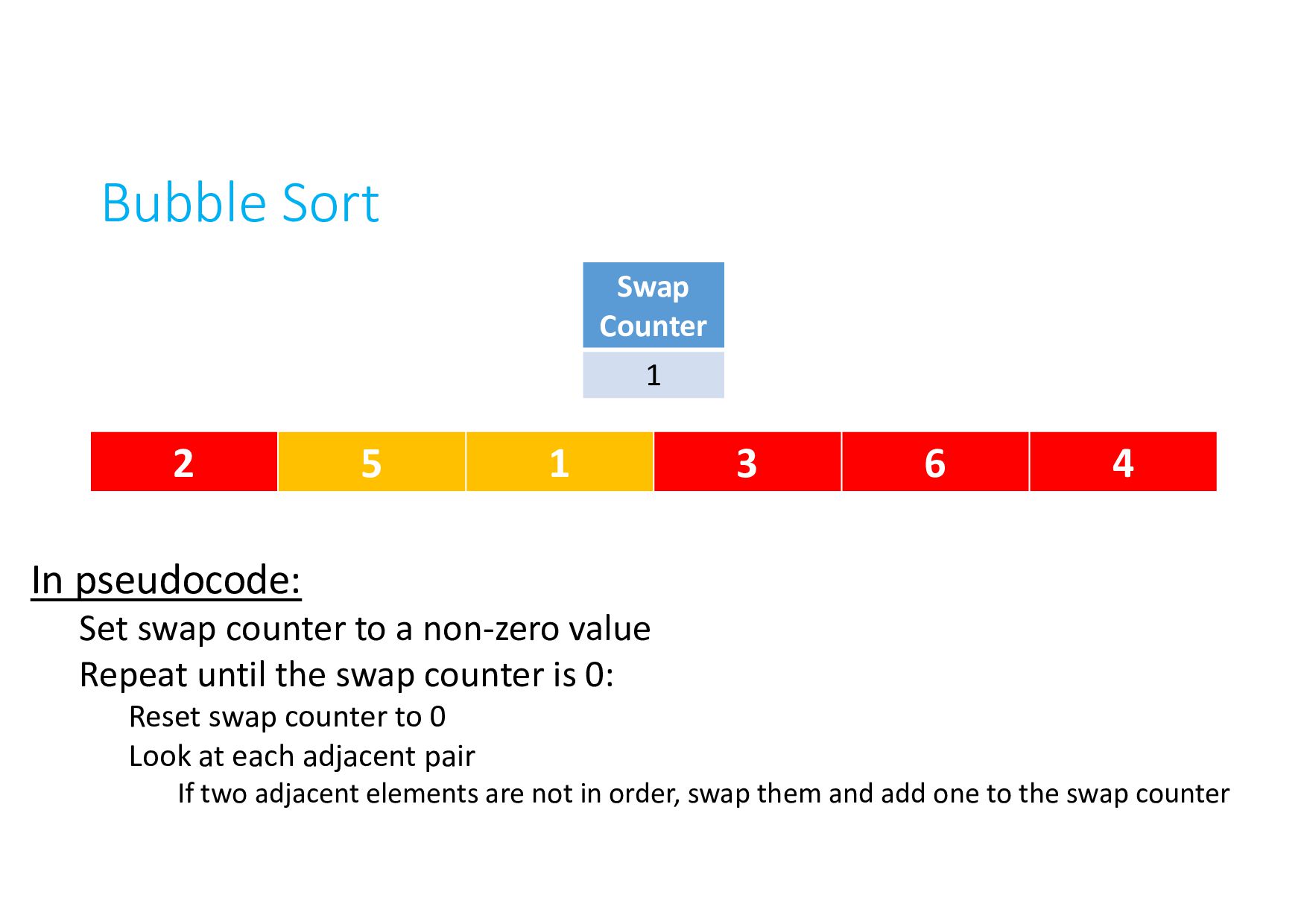
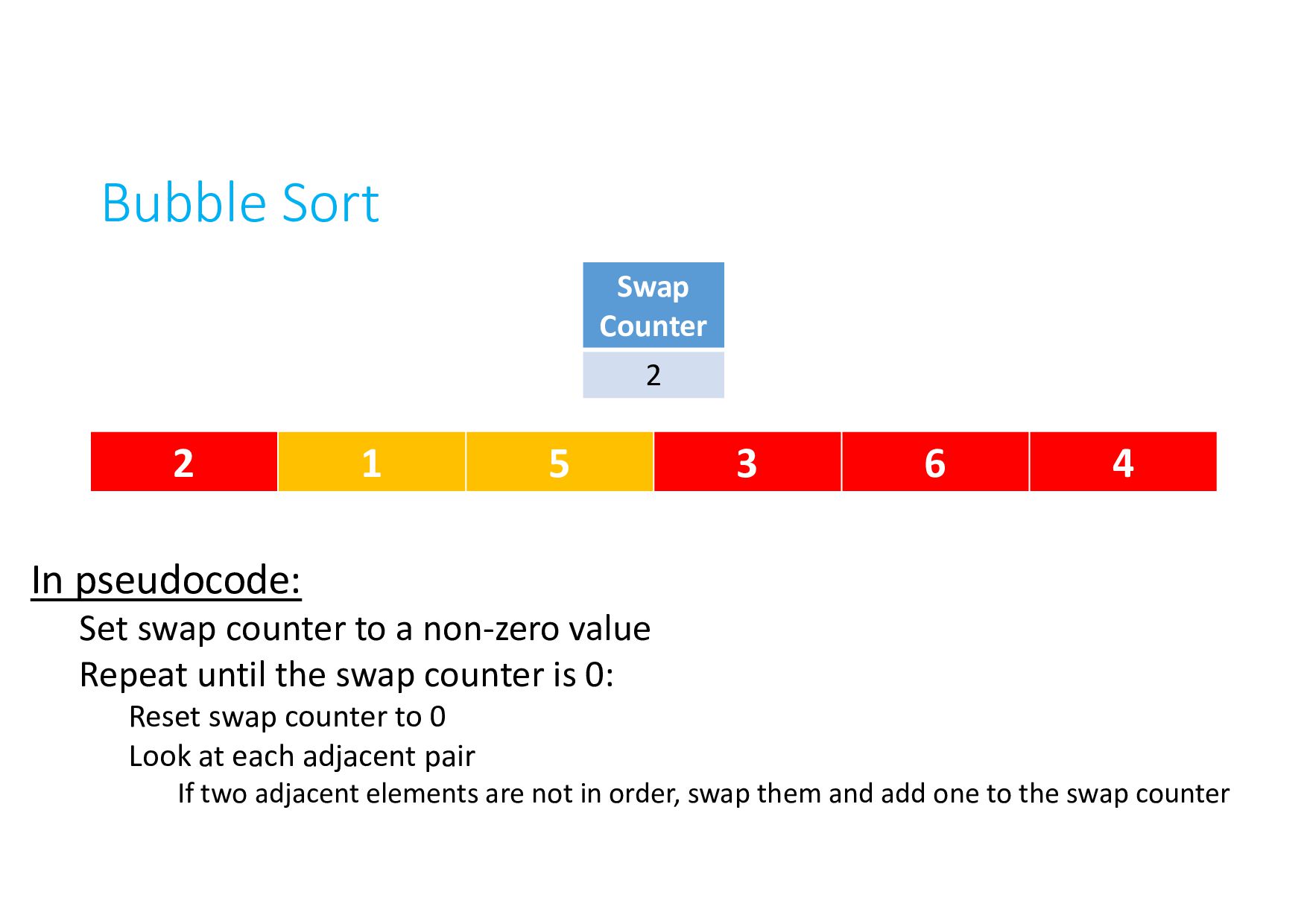
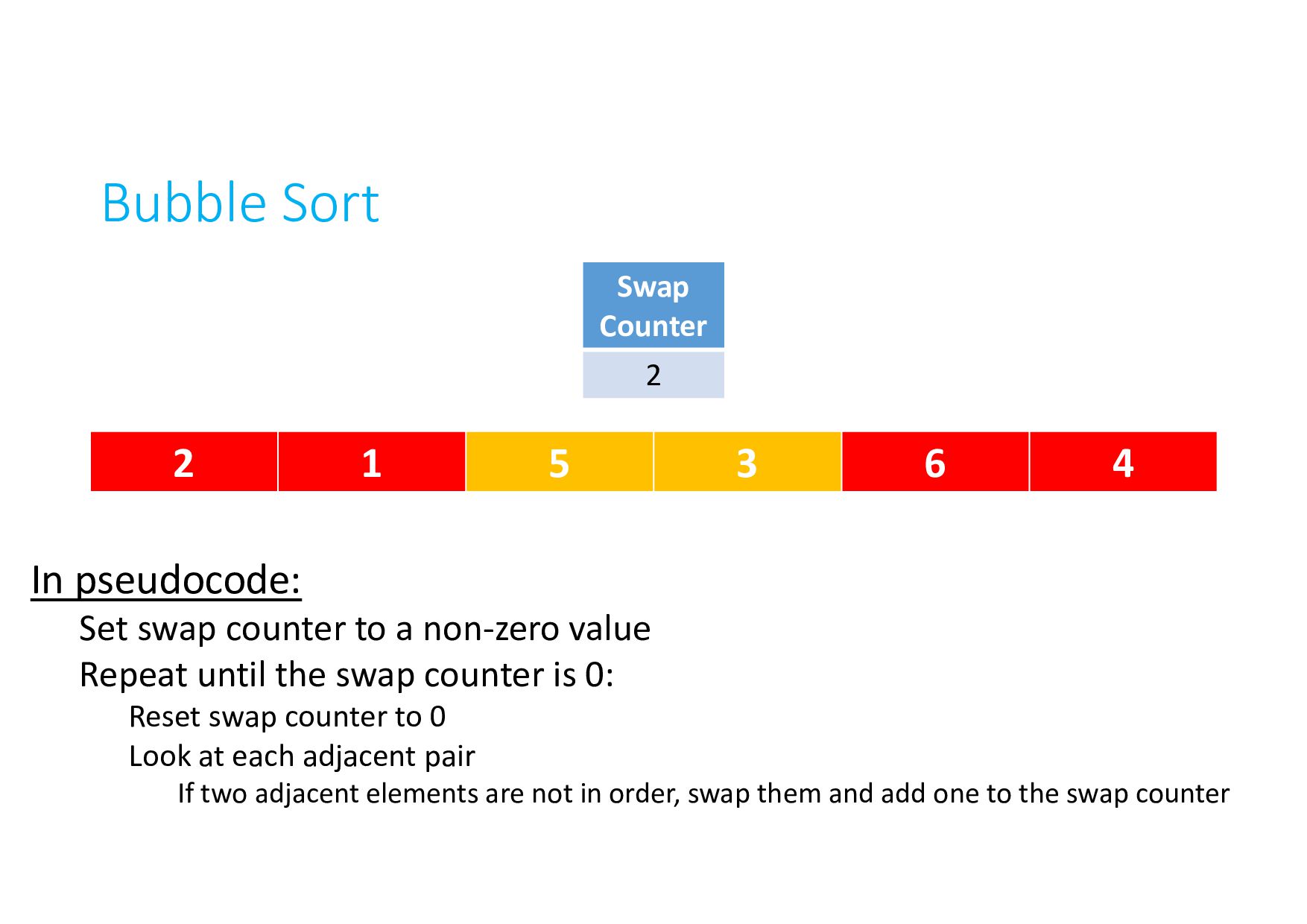
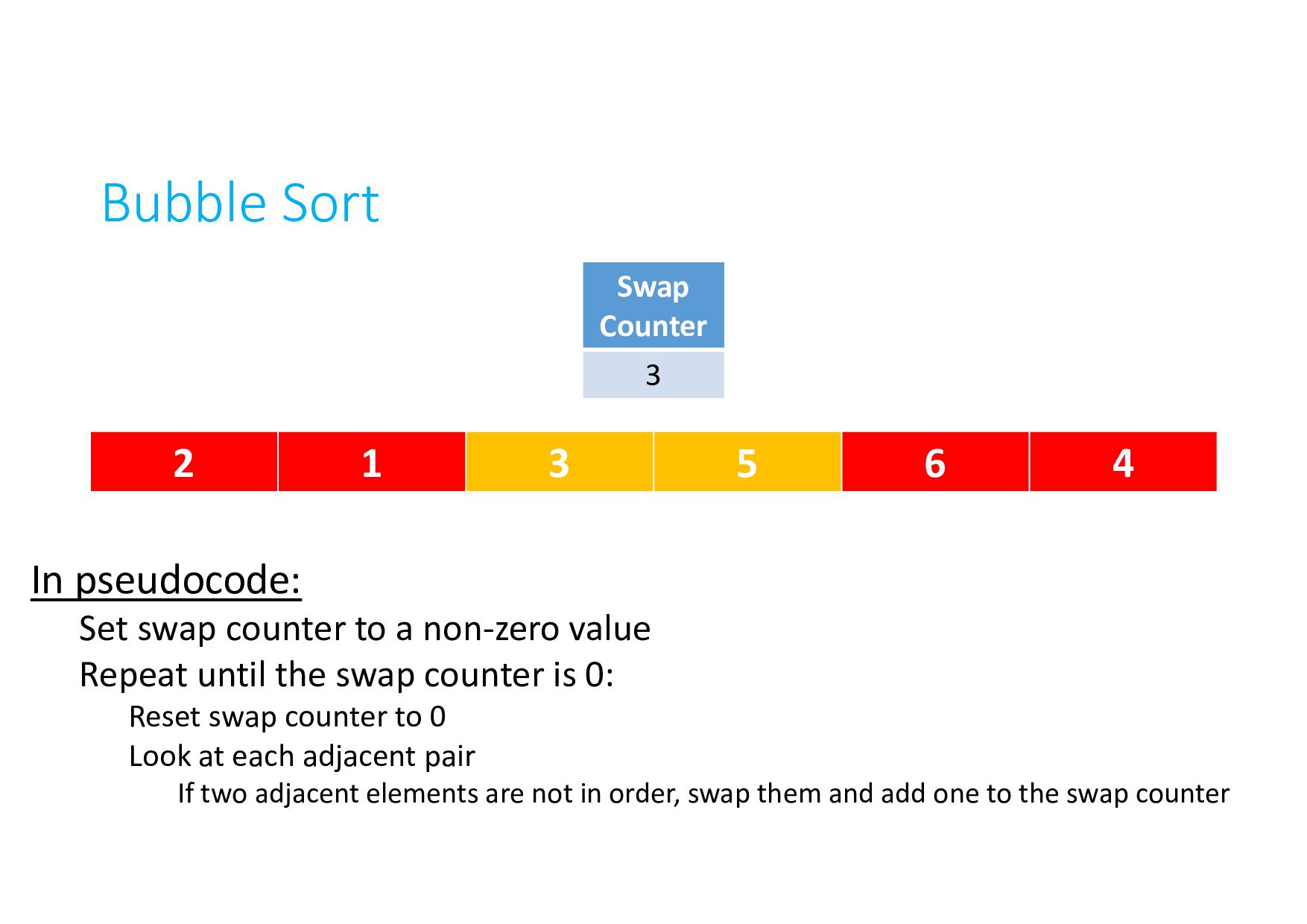
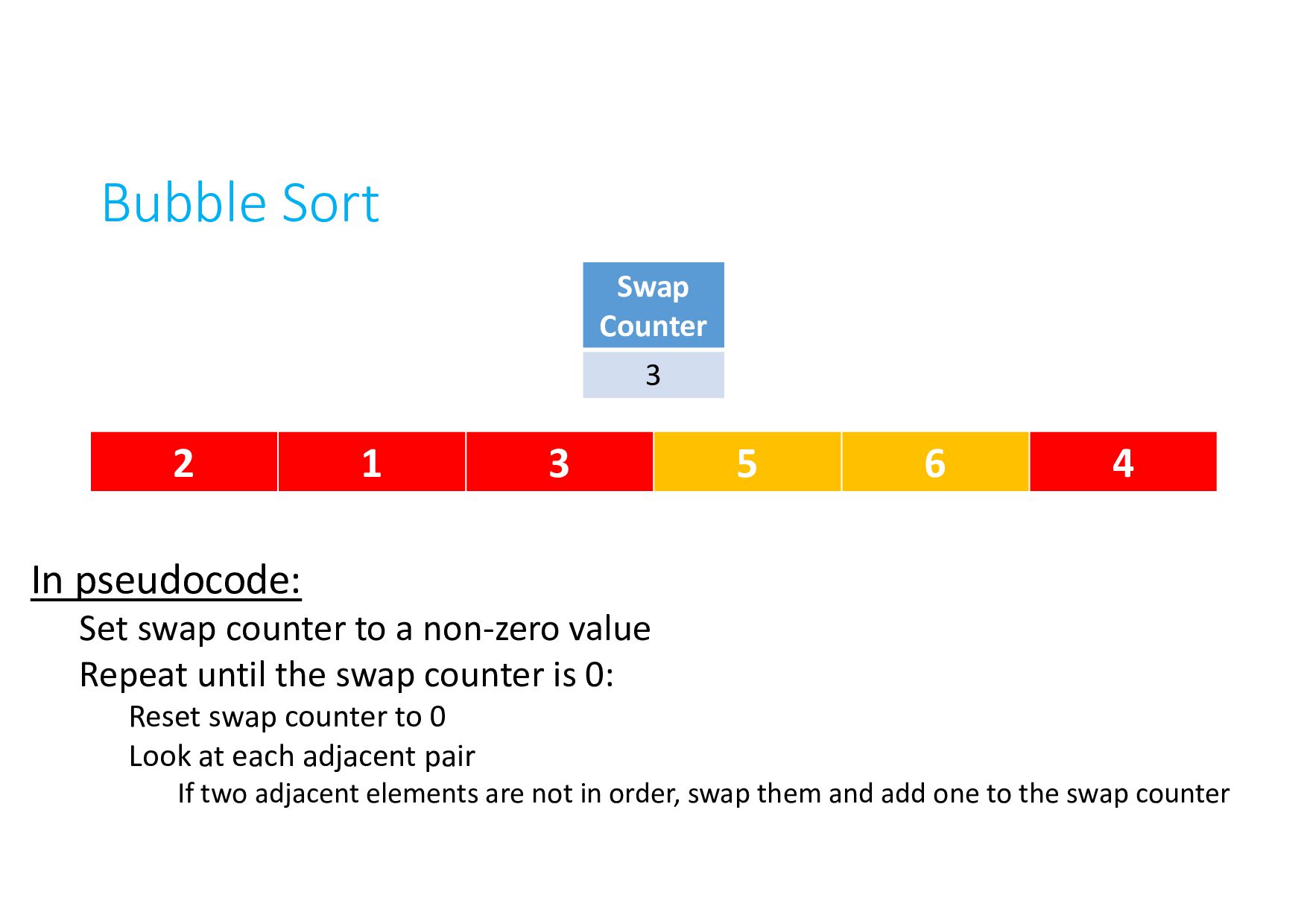
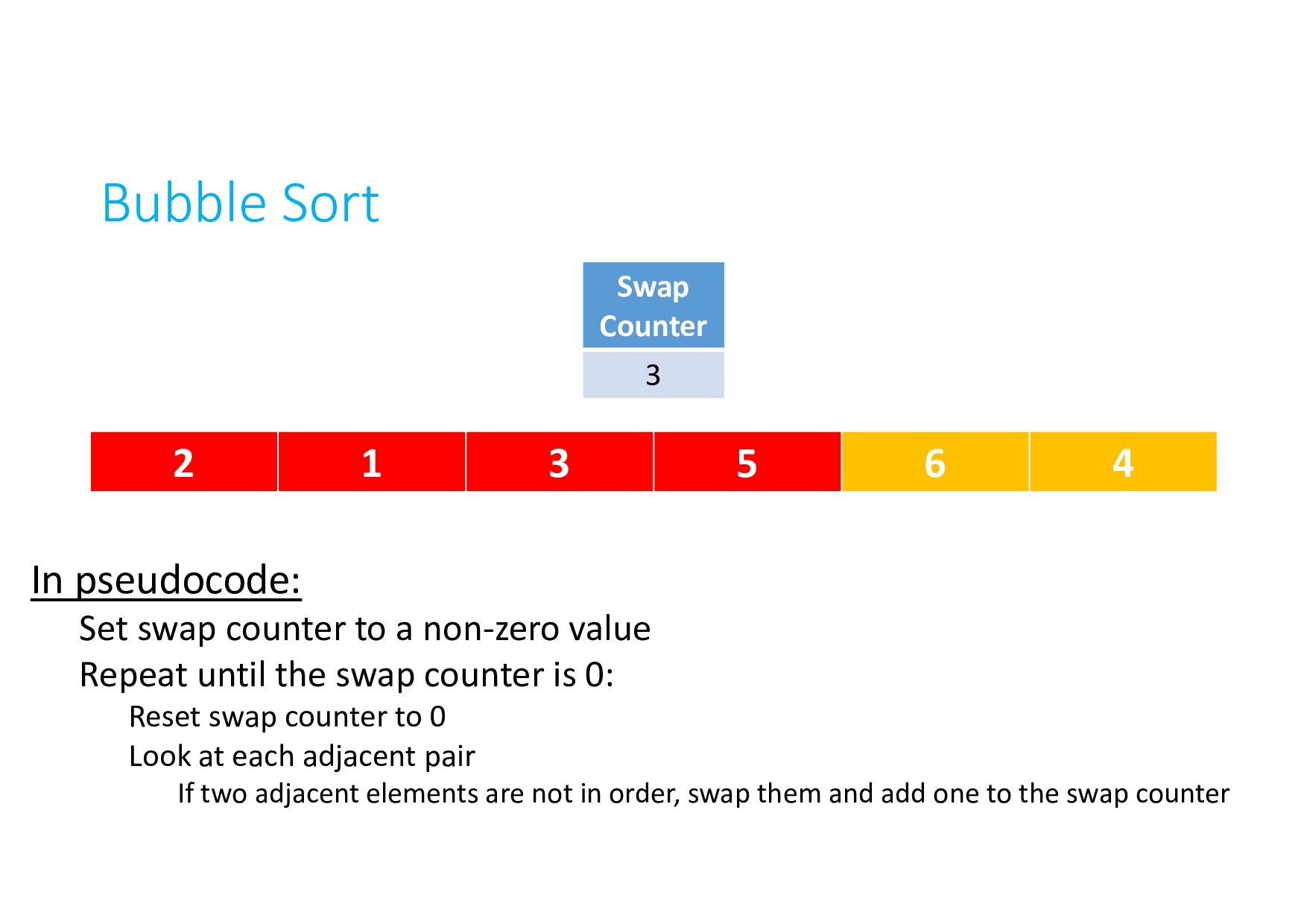
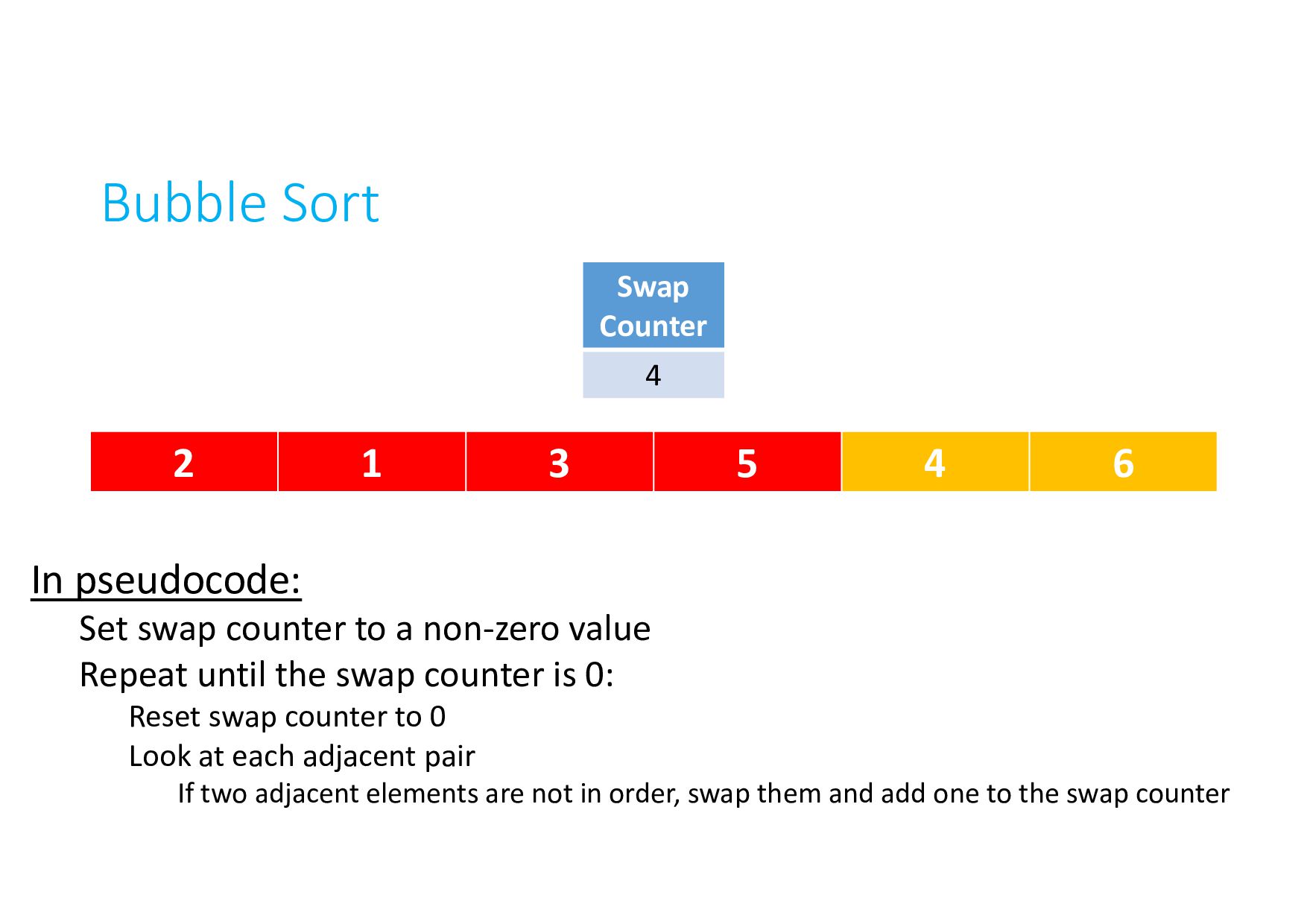
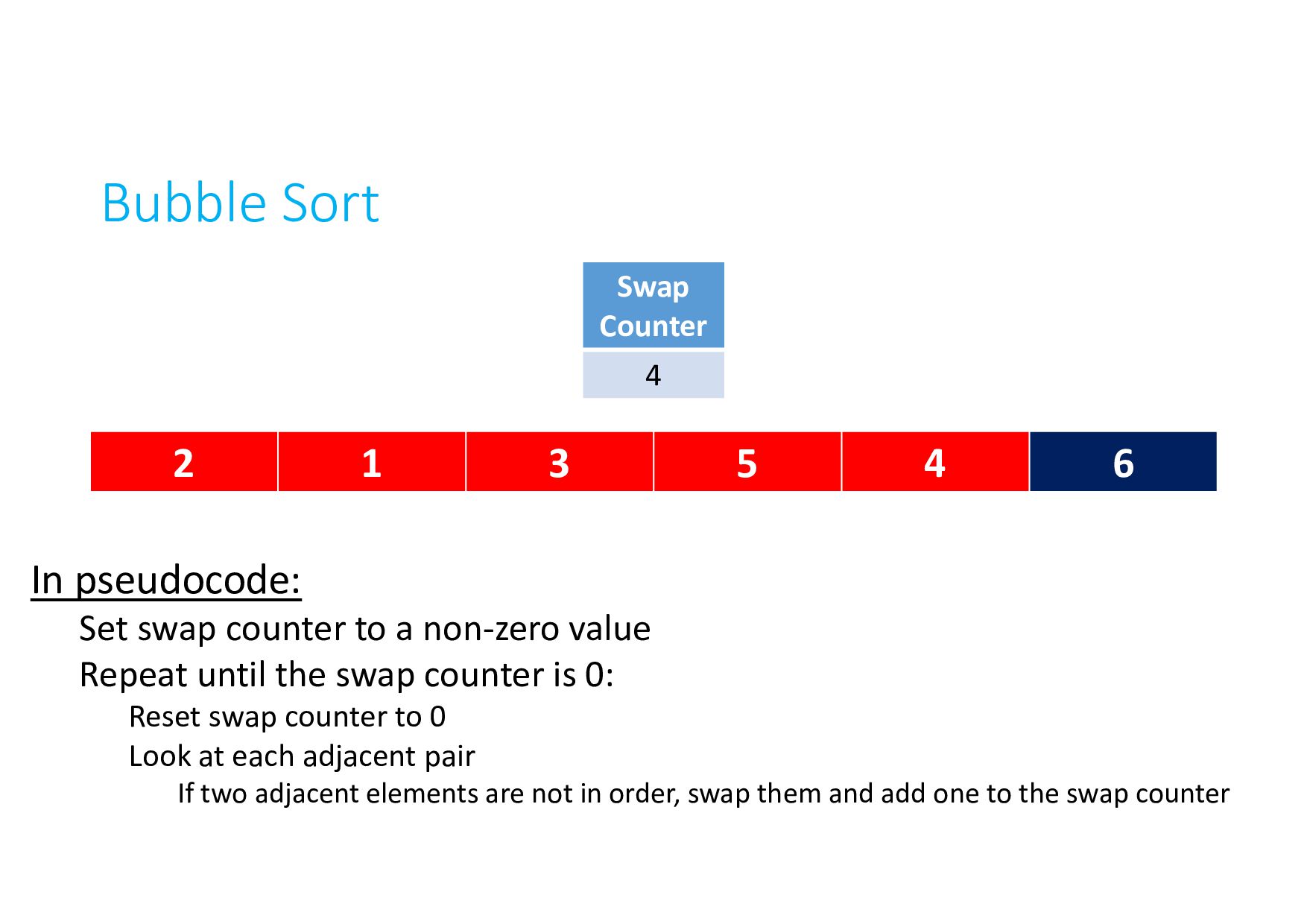
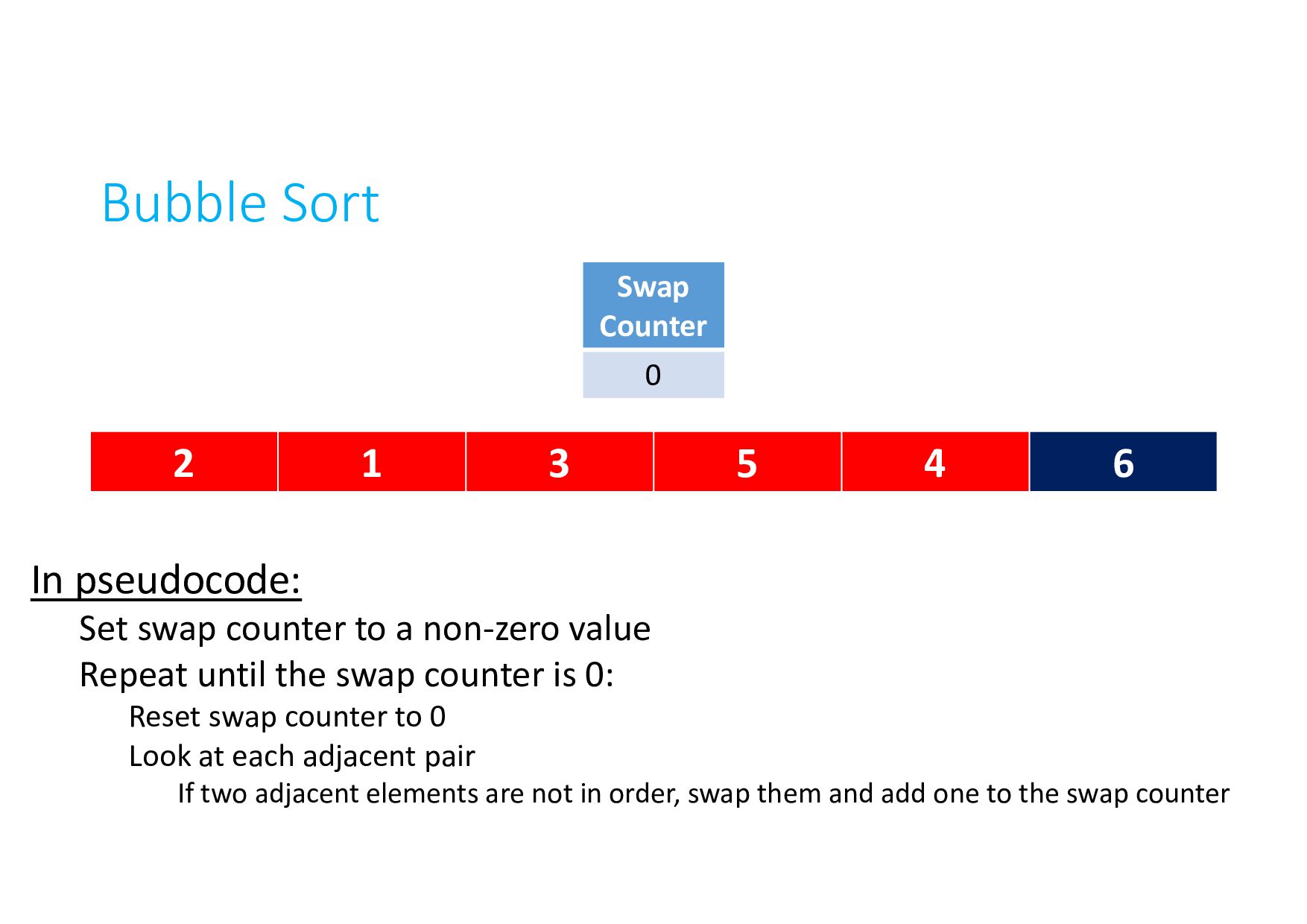
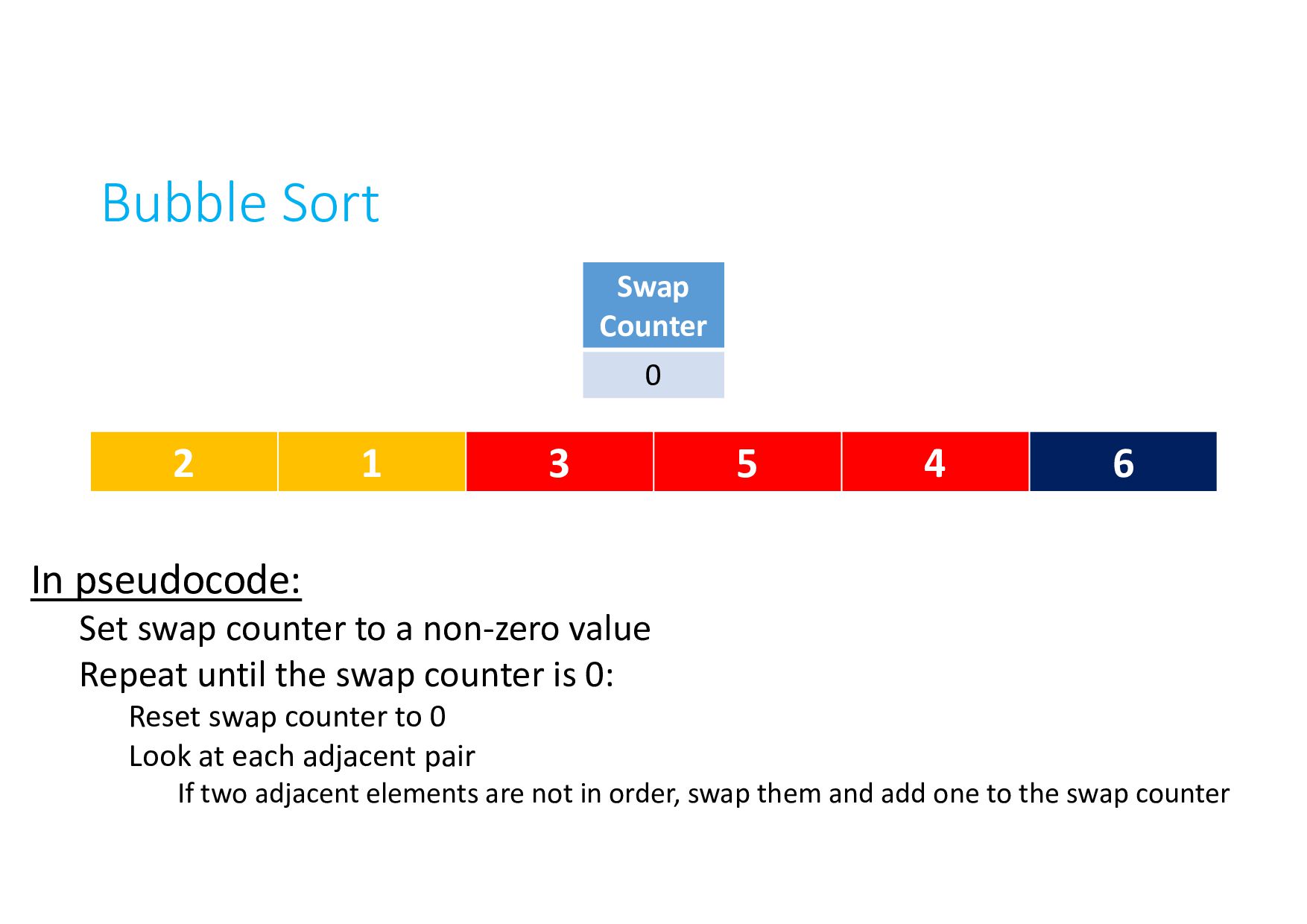
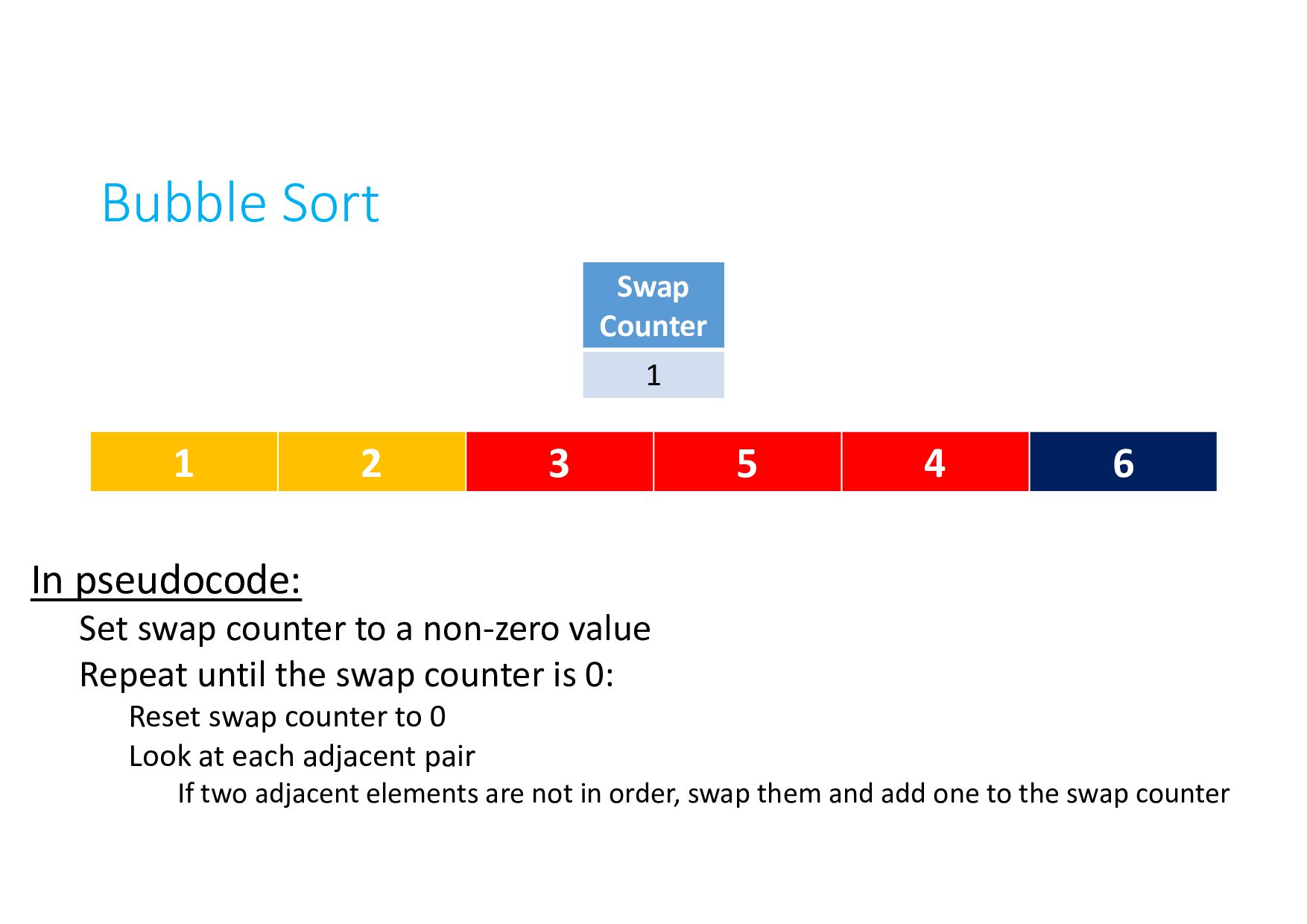
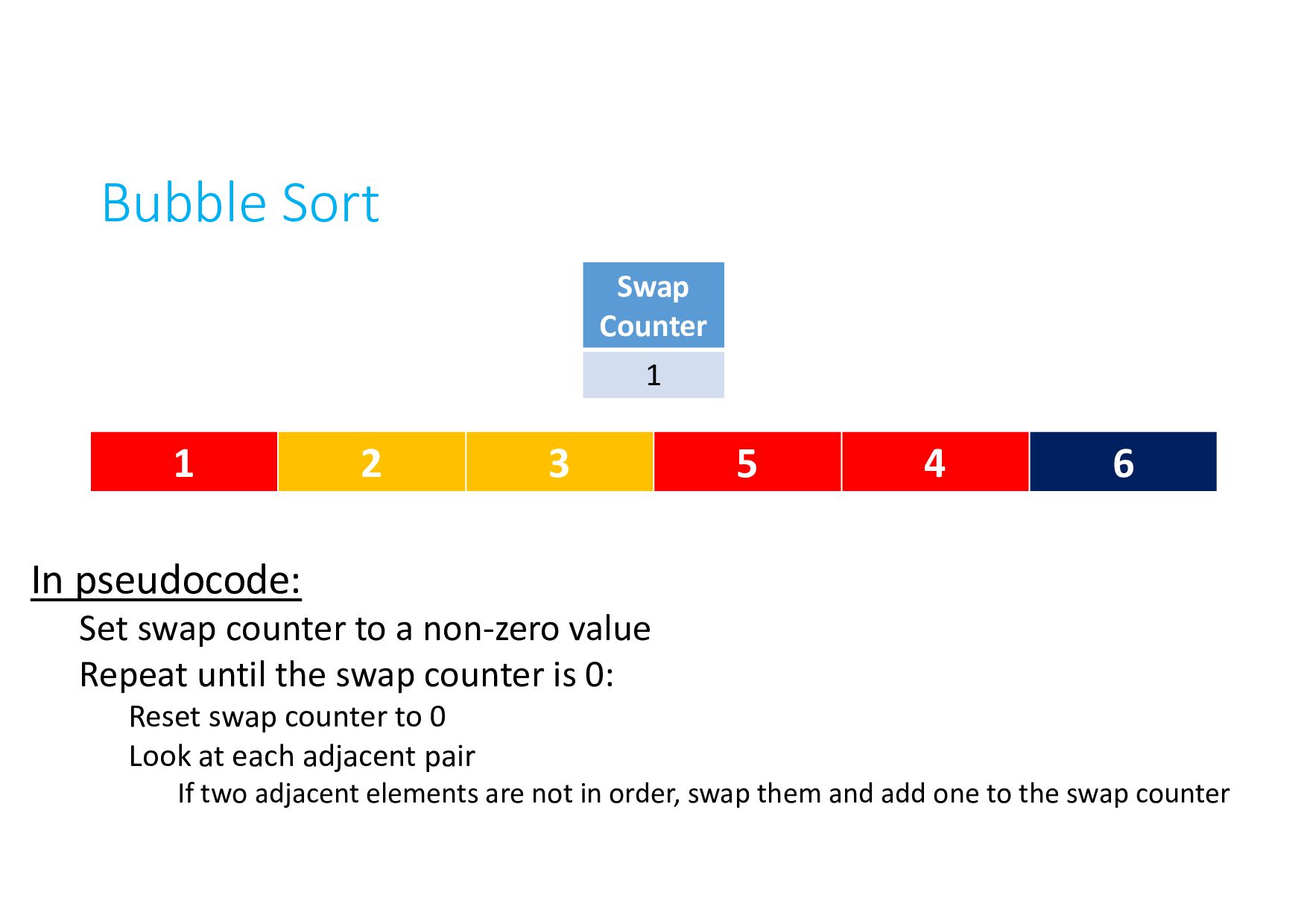
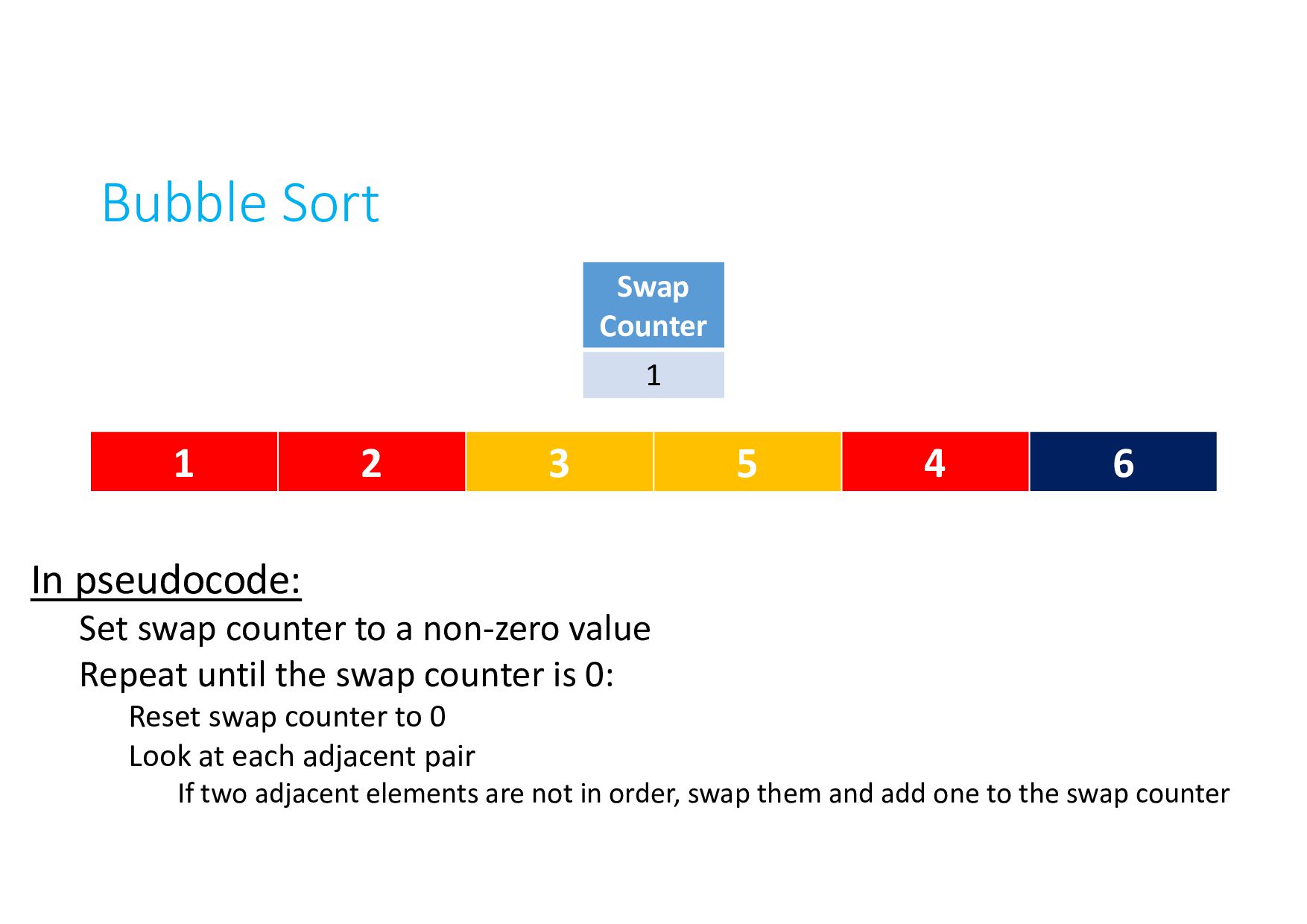
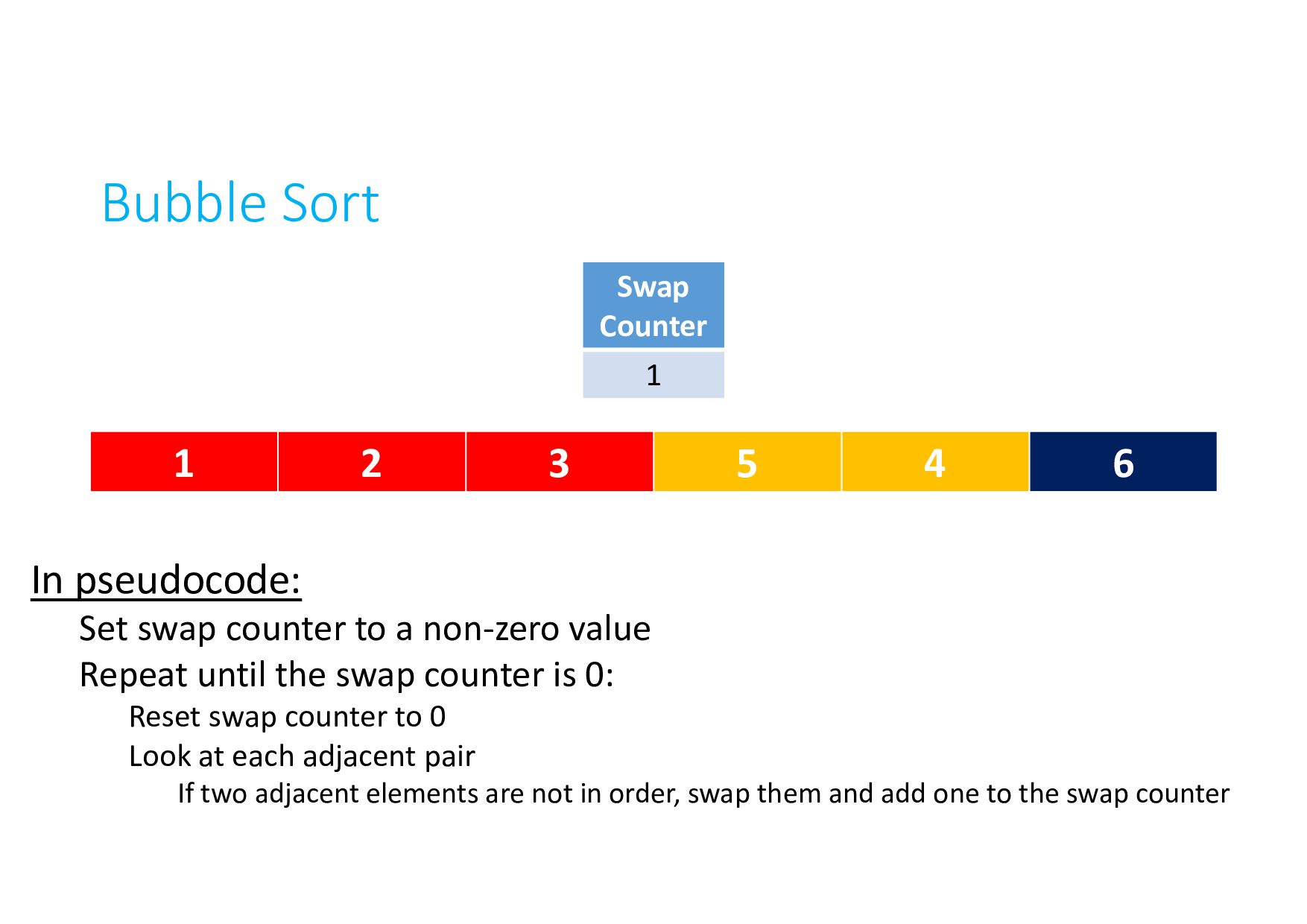
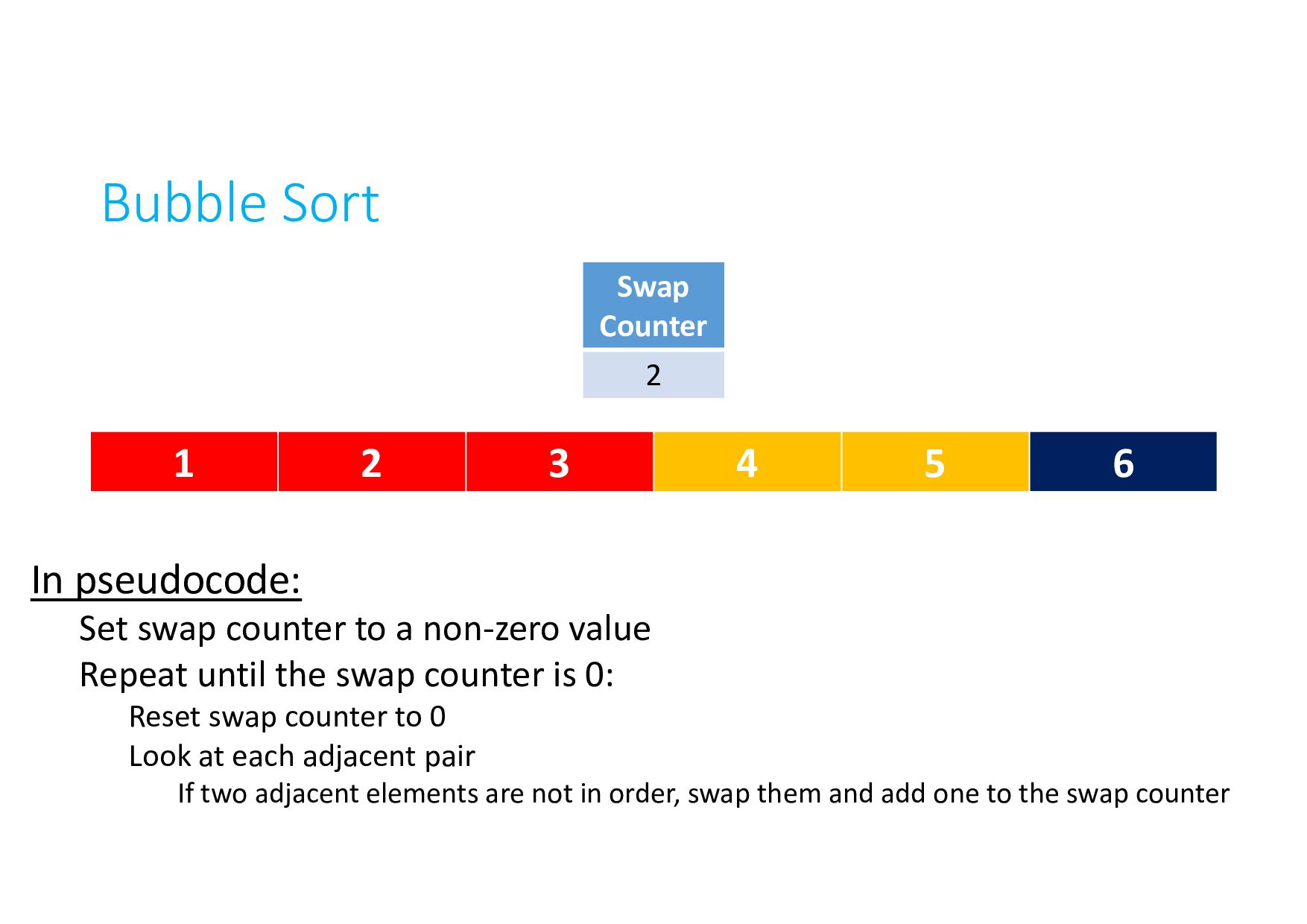
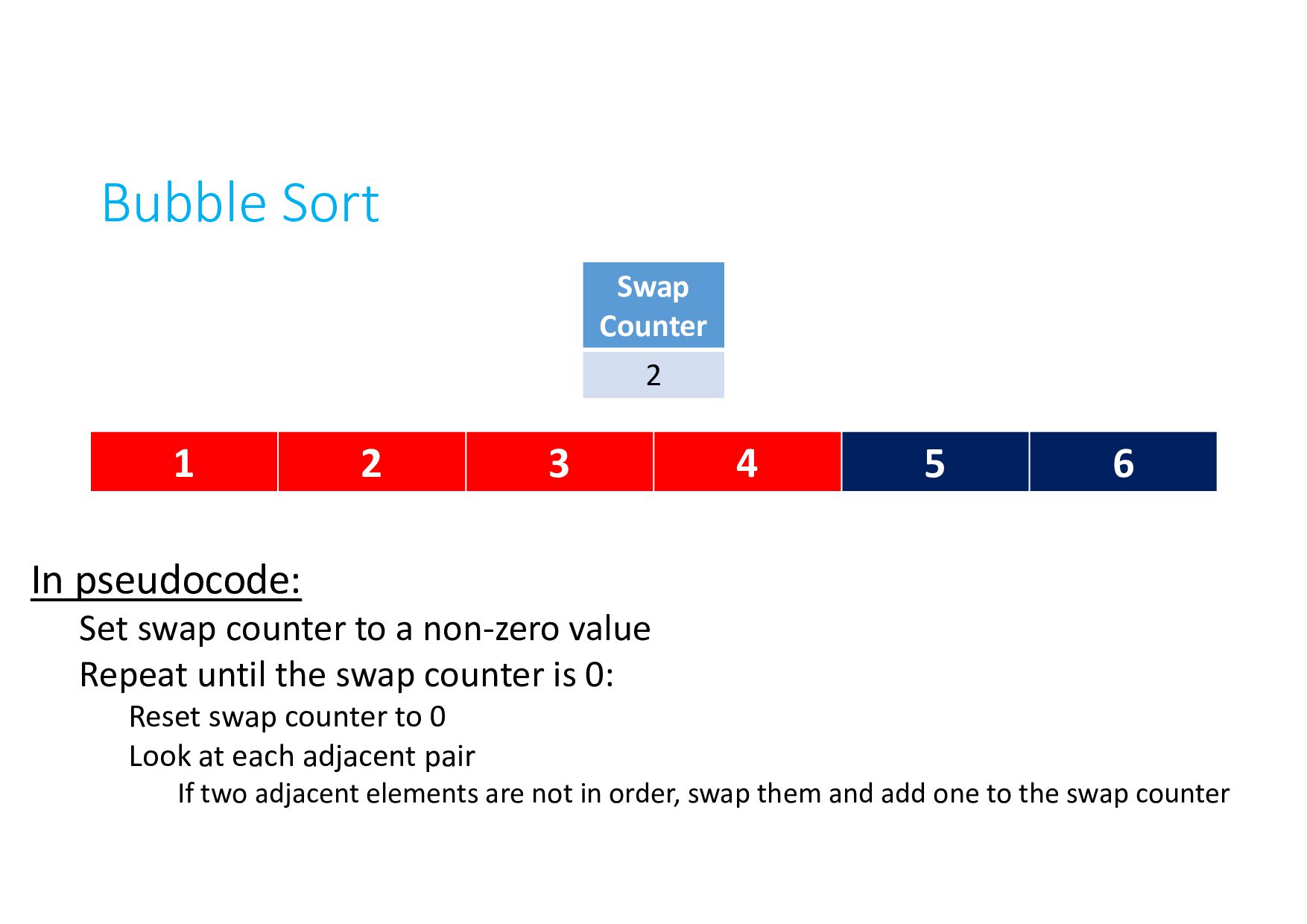
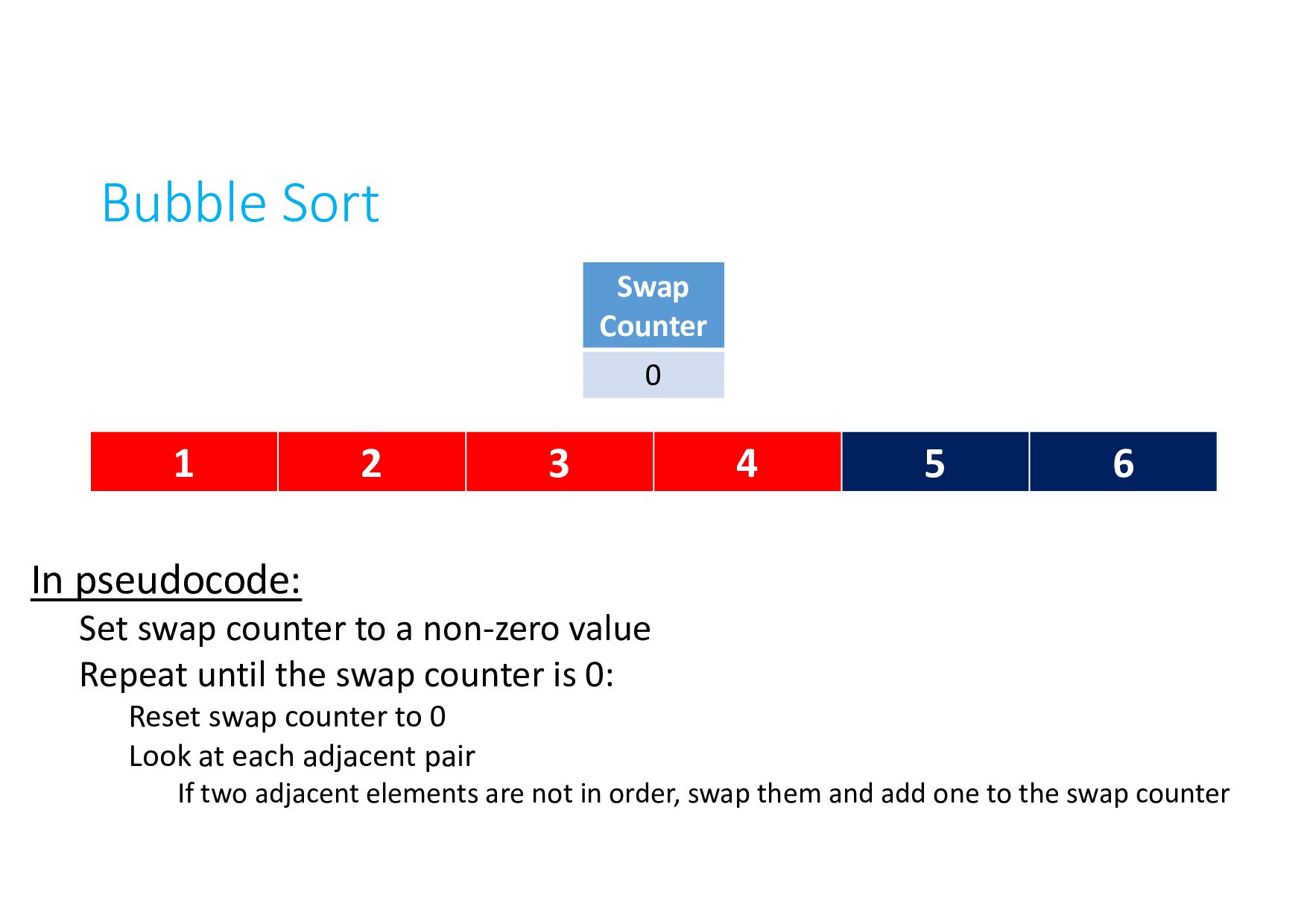
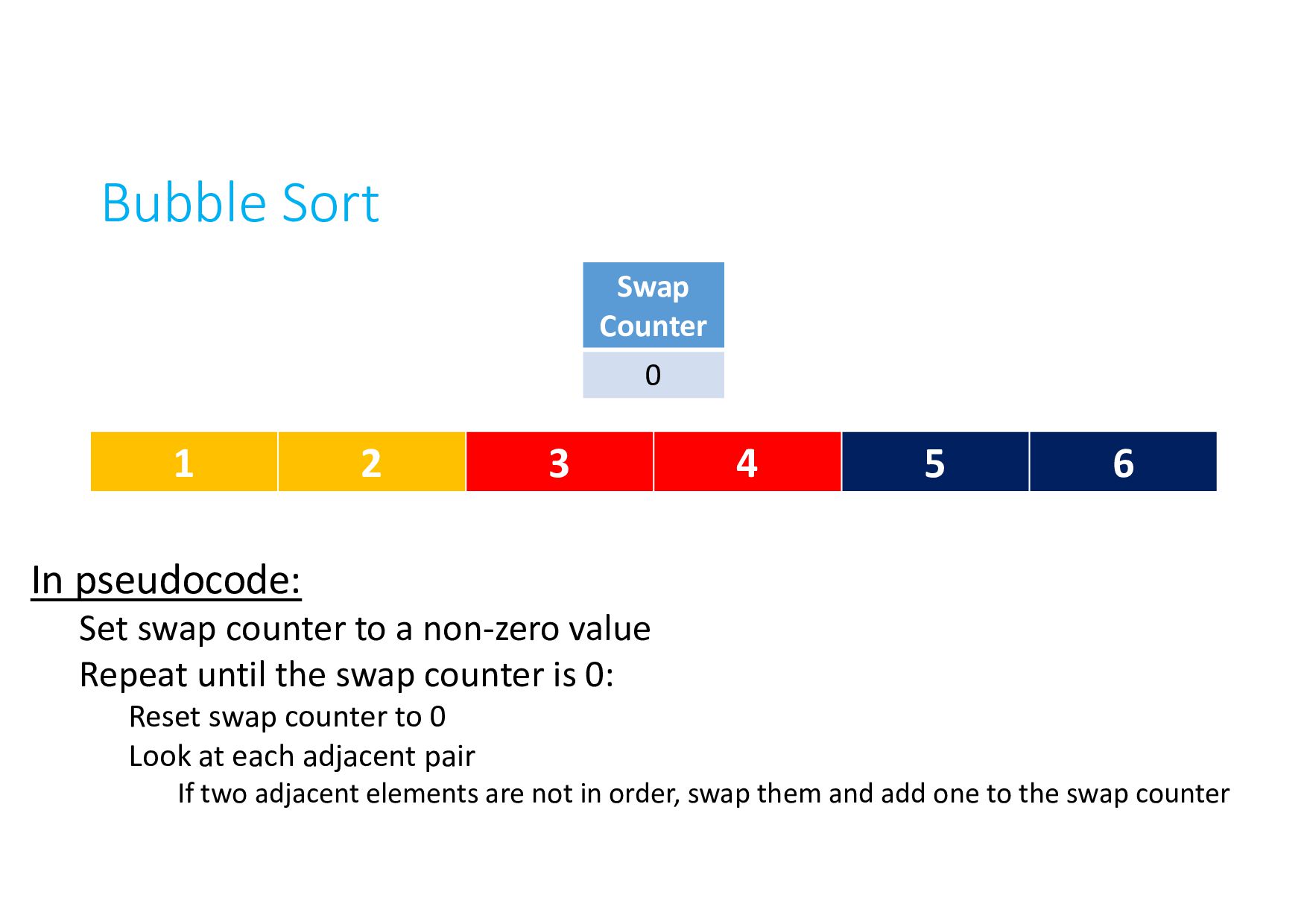
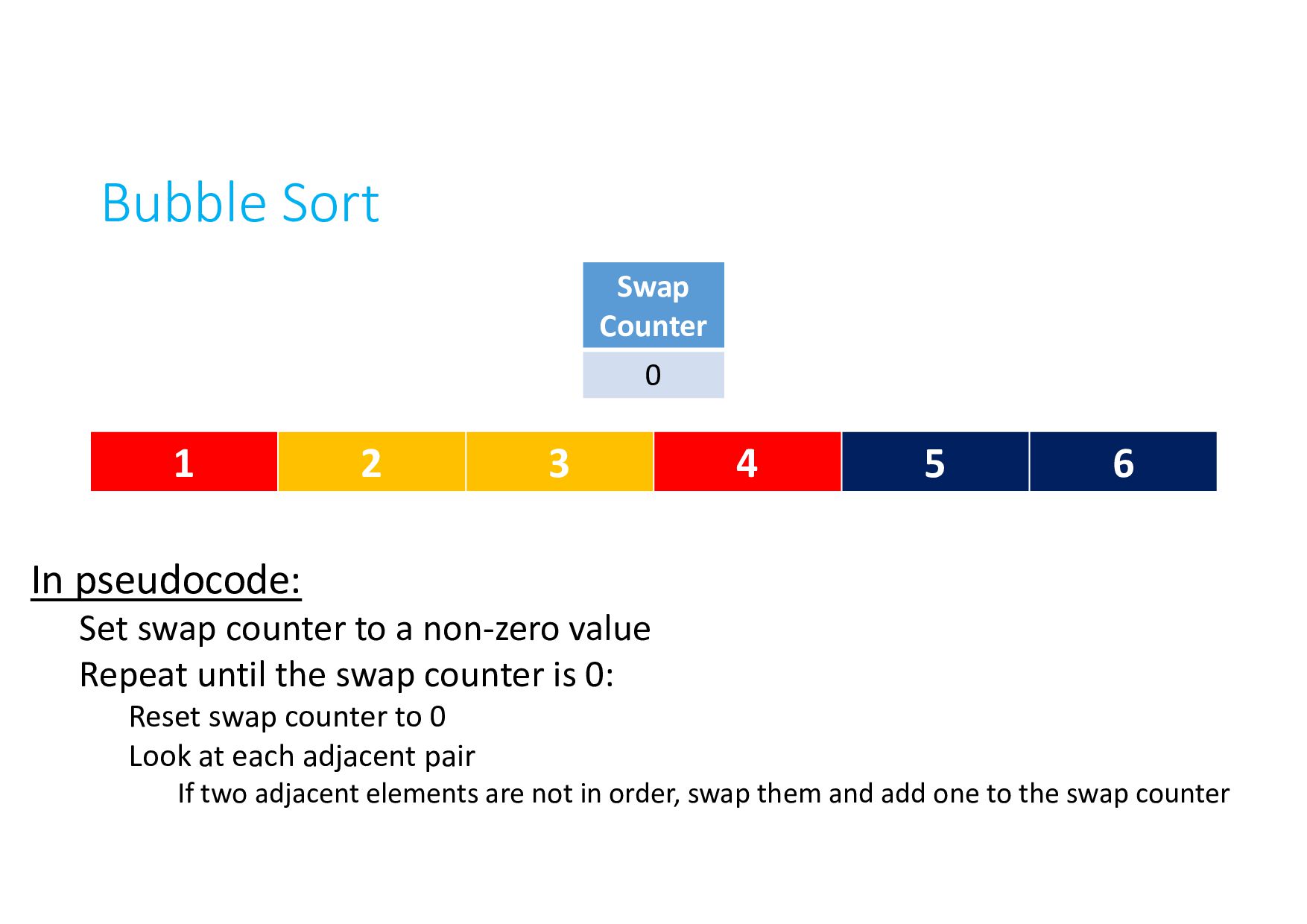
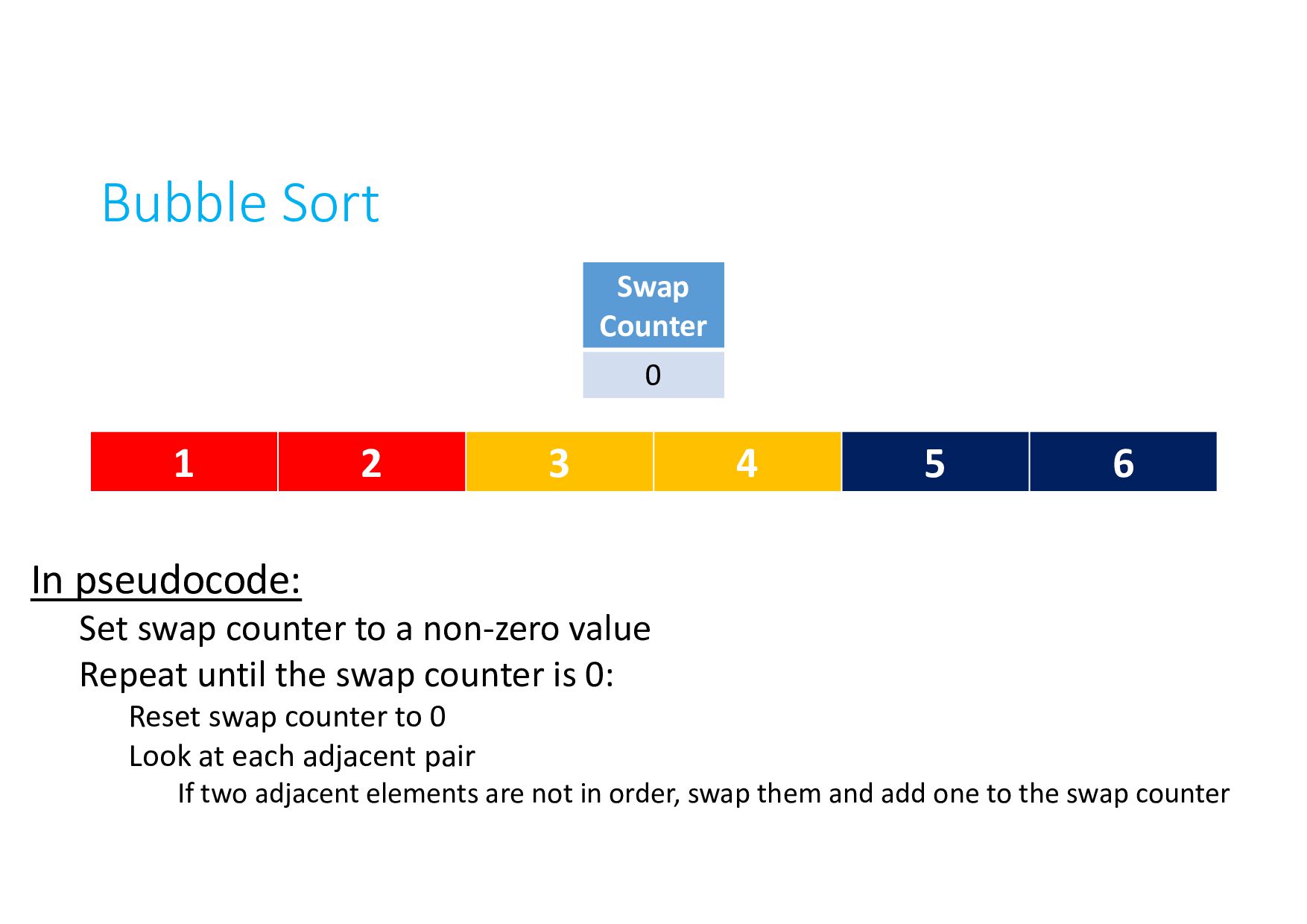
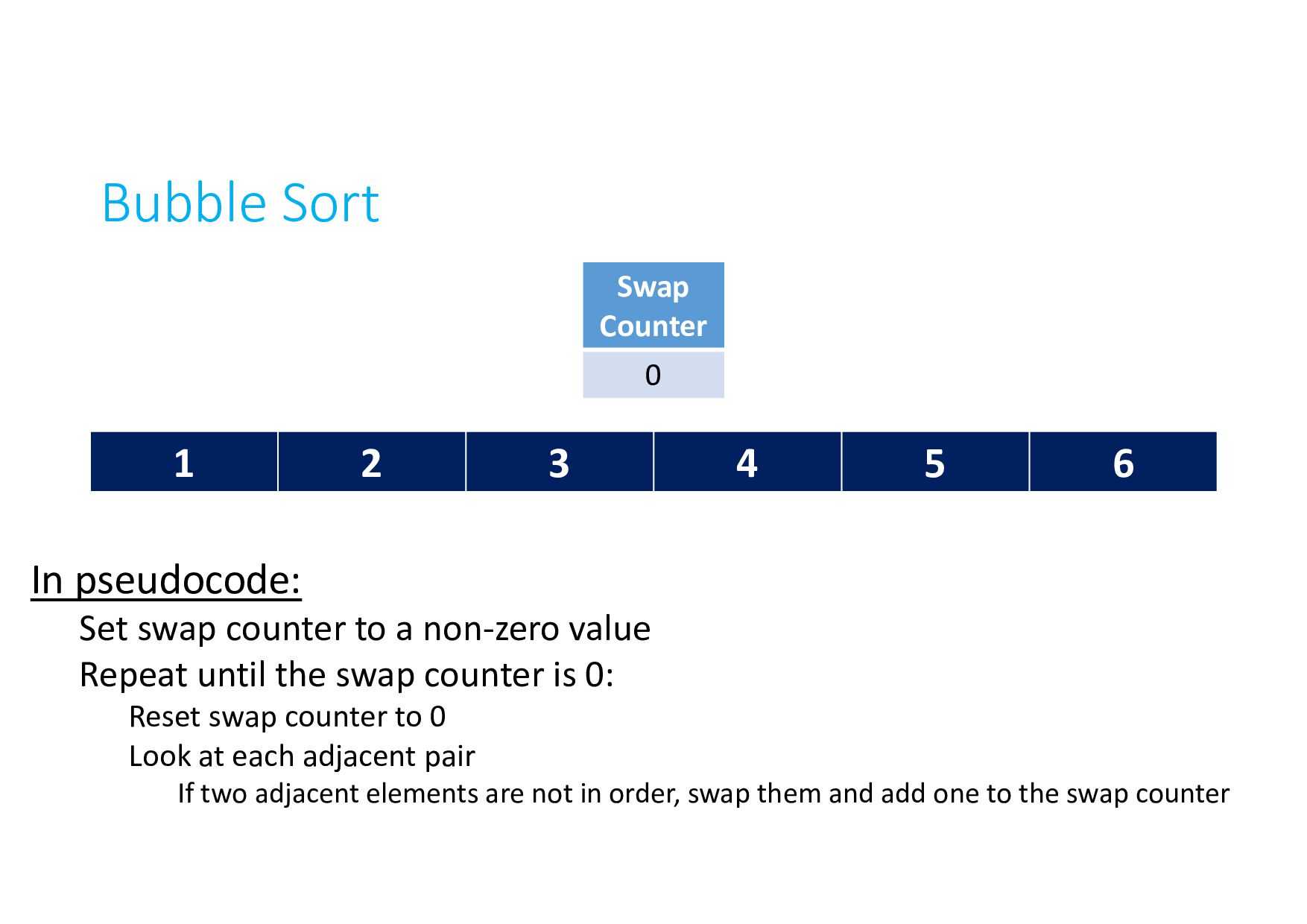
algorithm is to move higher valued elements generally towards the right and lower value elements generally towards the left. In pseudocode: • Set swap counter to a non-zero value • Repeat until the swap counter is 0: • Reset swap counter to 0 • Look at each adjacent pair • If two adjacent elements are not in order, swap them and add one to the swap counter
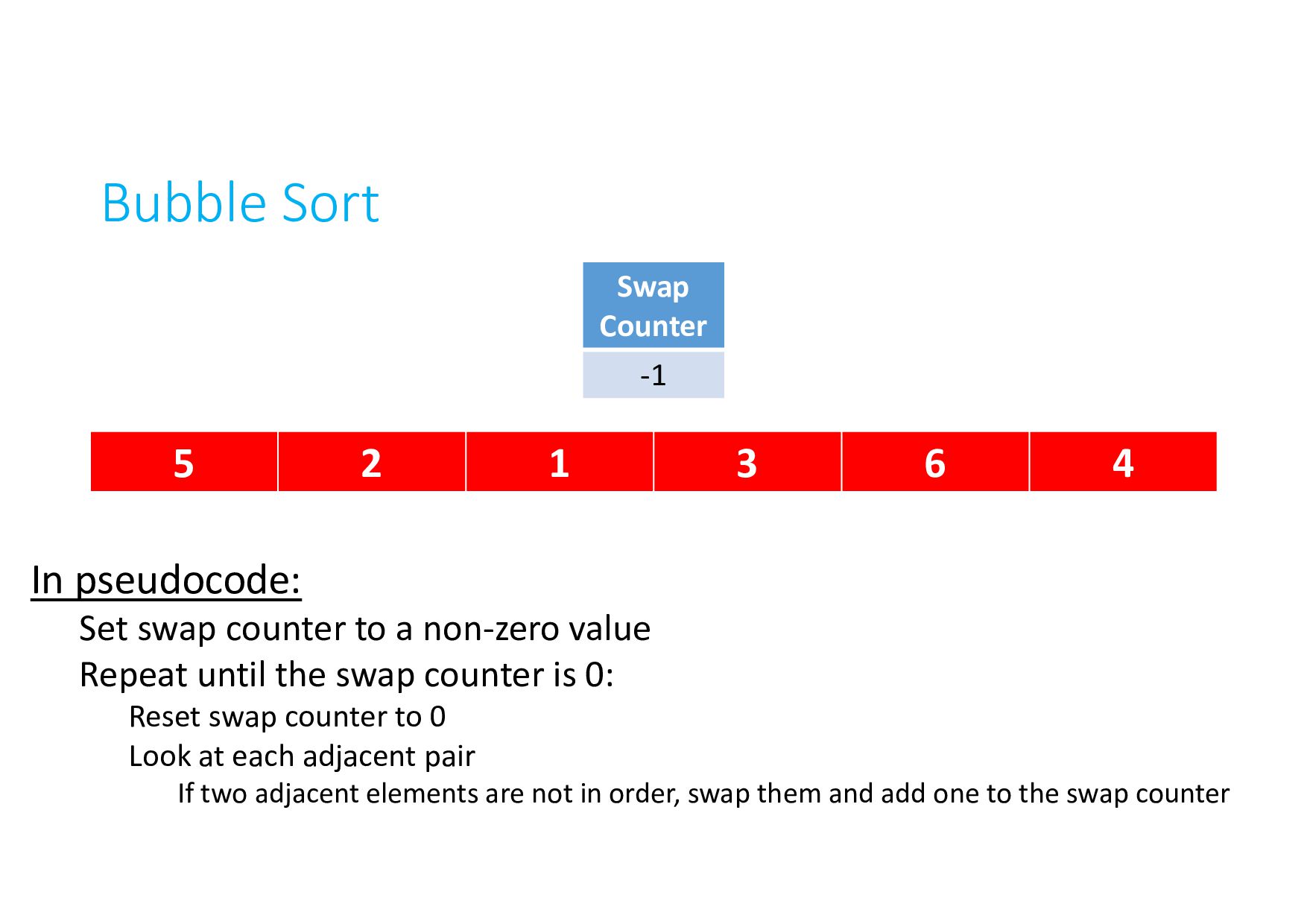
Set swap counter to a non-zero value Repeat until the swap counter is 0: Reset swap counter to 0 Look at each adjacent pair If two adjacent elements are not in order, swap them and add one to the swap counter Swap Counter -1
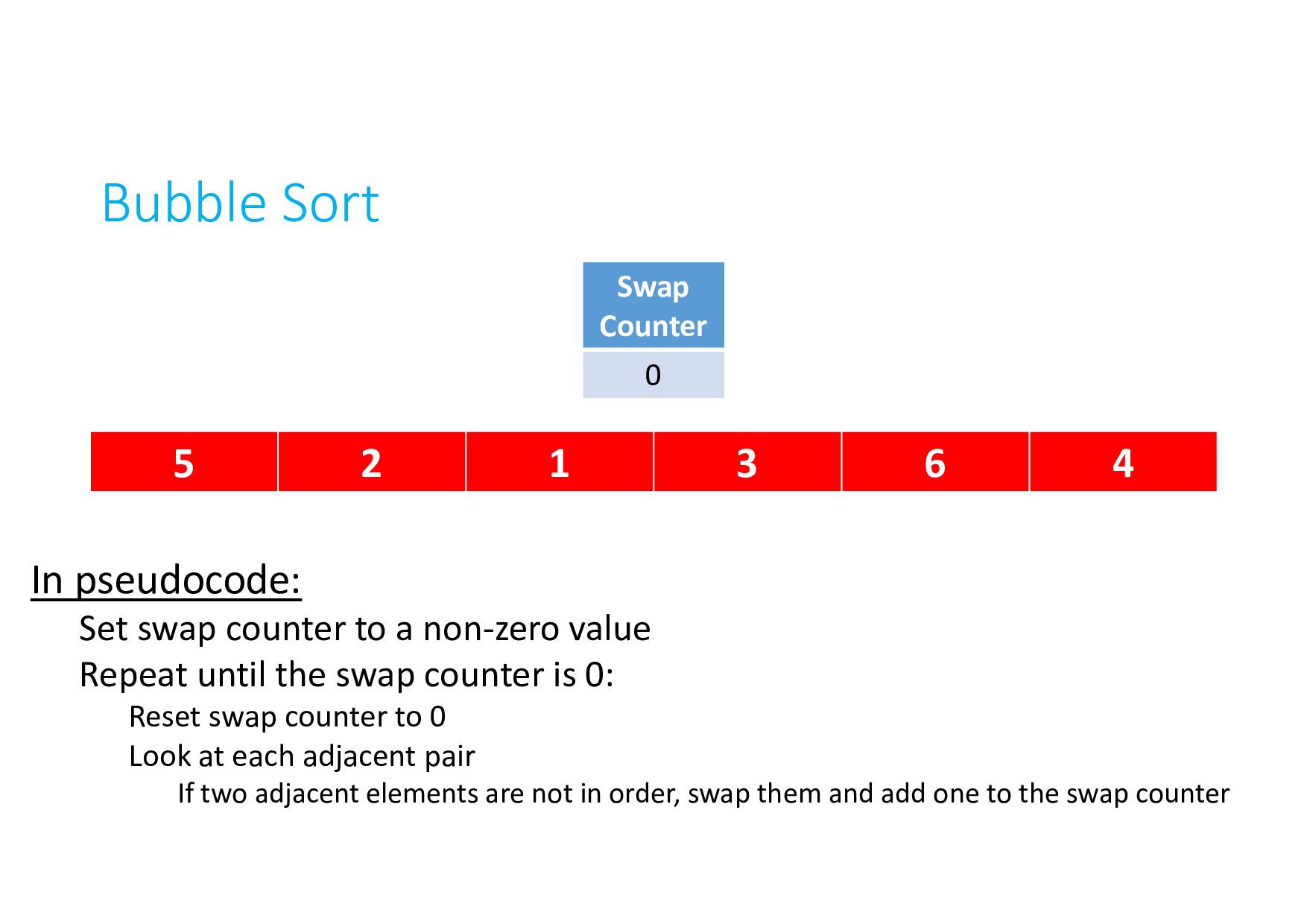
0 In pseudocode: Set swap counter to a non-zero value Repeat until the swap counter is 0: Reset swap counter to 0 Look at each adjacent pair If two adjacent elements are not in order, swap them and add one to the swap counter
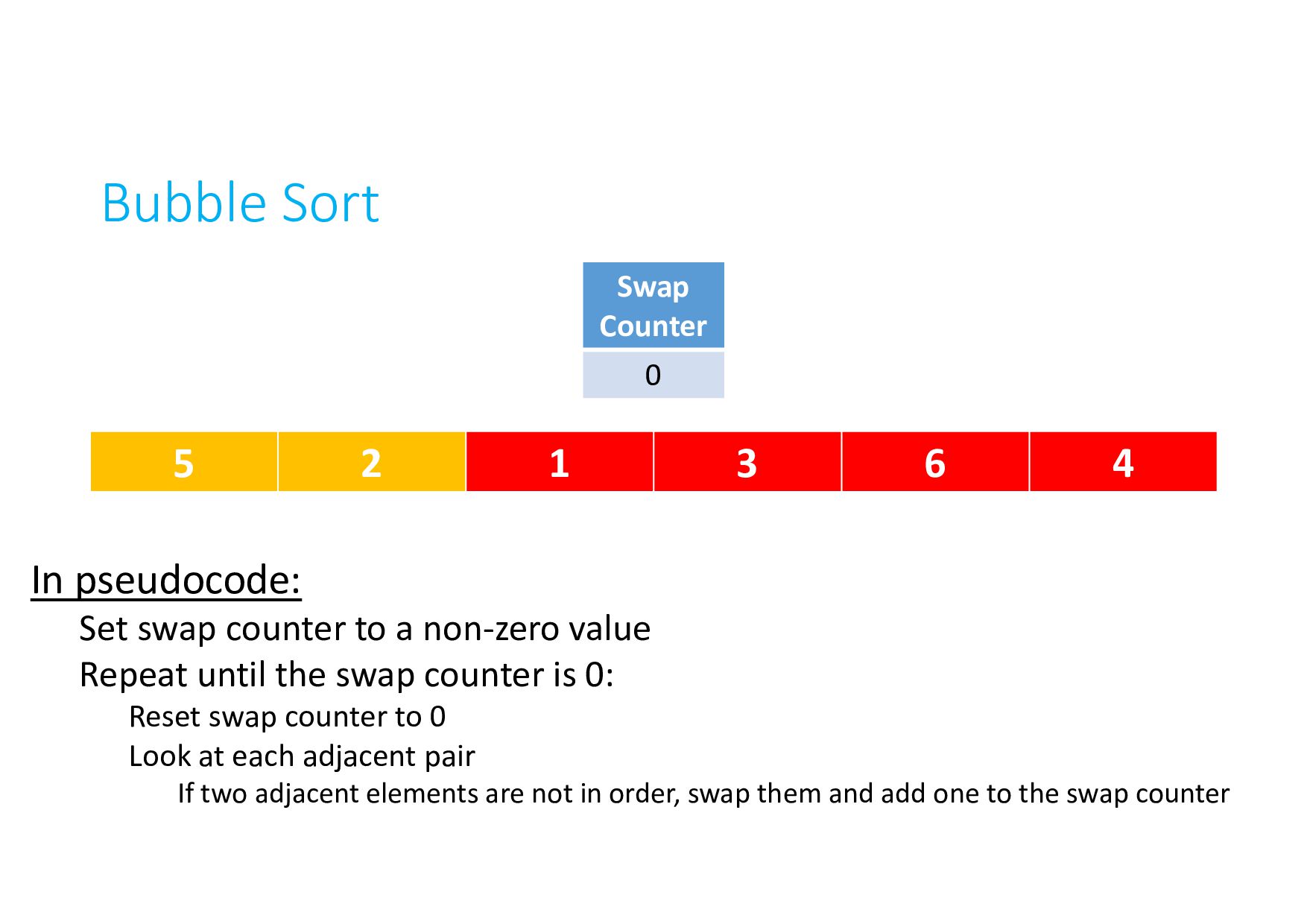
0 In pseudocode: Set swap counter to a non-zero value Repeat until the swap counter is 0: Reset swap counter to 0 Look at each adjacent pair If two adjacent elements are not in order, swap them and add one to the swap counter
1 In pseudocode: Set swap counter to a non-zero value Repeat until the swap counter is 0: Reset swap counter to 0 Look at each adjacent pair If two adjacent elements are not in order, swap them and add one to the swap counter
1 In pseudocode: Set swap counter to a non-zero value Repeat until the swap counter is 0: Reset swap counter to 0 Look at each adjacent pair If two adjacent elements are not in order, swap them and add one to the swap counter
2 In pseudocode: Set swap counter to a non-zero value Repeat until the swap counter is 0: Reset swap counter to 0 Look at each adjacent pair If two adjacent elements are not in order, swap them and add one to the swap counter
2 In pseudocode: Set swap counter to a non-zero value Repeat until the swap counter is 0: Reset swap counter to 0 Look at each adjacent pair If two adjacent elements are not in order, swap them and add one to the swap counter
3 In pseudocode: Set swap counter to a non-zero value Repeat until the swap counter is 0: Reset swap counter to 0 Look at each adjacent pair If two adjacent elements are not in order, swap them and add one to the swap counter
3 In pseudocode: Set swap counter to a non-zero value Repeat until the swap counter is 0: Reset swap counter to 0 Look at each adjacent pair If two adjacent elements are not in order, swap them and add one to the swap counter
3 In pseudocode: Set swap counter to a non-zero value Repeat until the swap counter is 0: Reset swap counter to 0 Look at each adjacent pair If two adjacent elements are not in order, swap them and add one to the swap counter
4 In pseudocode: Set swap counter to a non-zero value Repeat until the swap counter is 0: Reset swap counter to 0 Look at each adjacent pair If two adjacent elements are not in order, swap them and add one to the swap counter
4 In pseudocode: Set swap counter to a non-zero value Repeat until the swap counter is 0: Reset swap counter to 0 Look at each adjacent pair If two adjacent elements are not in order, swap them and add one to the swap counter
0 In pseudocode: Set swap counter to a non-zero value Repeat until the swap counter is 0: Reset swap counter to 0 Look at each adjacent pair If two adjacent elements are not in order, swap them and add one to the swap counter
0 In pseudocode: Set swap counter to a non-zero value Repeat until the swap counter is 0: Reset swap counter to 0 Look at each adjacent pair If two adjacent elements are not in order, swap them and add one to the swap counter
1 In pseudocode: Set swap counter to a non-zero value Repeat until the swap counter is 0: Reset swap counter to 0 Look at each adjacent pair If two adjacent elements are not in order, swap them and add one to the swap counter
1 In pseudocode: Set swap counter to a non-zero value Repeat until the swap counter is 0: Reset swap counter to 0 Look at each adjacent pair If two adjacent elements are not in order, swap them and add one to the swap counter
1 In pseudocode: Set swap counter to a non-zero value Repeat until the swap counter is 0: Reset swap counter to 0 Look at each adjacent pair If two adjacent elements are not in order, swap them and add one to the swap counter
1 In pseudocode: Set swap counter to a non-zero value Repeat until the swap counter is 0: Reset swap counter to 0 Look at each adjacent pair If two adjacent elements are not in order, swap them and add one to the swap counter
2 In pseudocode: Set swap counter to a non-zero value Repeat until the swap counter is 0: Reset swap counter to 0 Look at each adjacent pair If two adjacent elements are not in order, swap them and add one to the swap counter
2 In pseudocode: Set swap counter to a non-zero value Repeat until the swap counter is 0: Reset swap counter to 0 Look at each adjacent pair If two adjacent elements are not in order, swap them and add one to the swap counter
0 In pseudocode: Set swap counter to a non-zero value Repeat until the swap counter is 0: Reset swap counter to 0 Look at each adjacent pair If two adjacent elements are not in order, swap them and add one to the swap counter
0 In pseudocode: Set swap counter to a non-zero value Repeat until the swap counter is 0: Reset swap counter to 0 Look at each adjacent pair If two adjacent elements are not in order, swap them and add one to the swap counter
0 In pseudocode: Set swap counter to a non-zero value Repeat until the swap counter is 0: Reset swap counter to 0 Look at each adjacent pair If two adjacent elements are not in order, swap them and add one to the swap counter
0 In pseudocode: Set swap counter to a non-zero value Repeat until the swap counter is 0: Reset swap counter to 0 Look at each adjacent pair If two adjacent elements are not in order, swap them and add one to the swap counter
0 In pseudocode: Set swap counter to a non-zero value Repeat until the swap counter is 0: Reset swap counter to 0 Look at each adjacent pair If two adjacent elements are not in order, swap them and add one to the swap counter
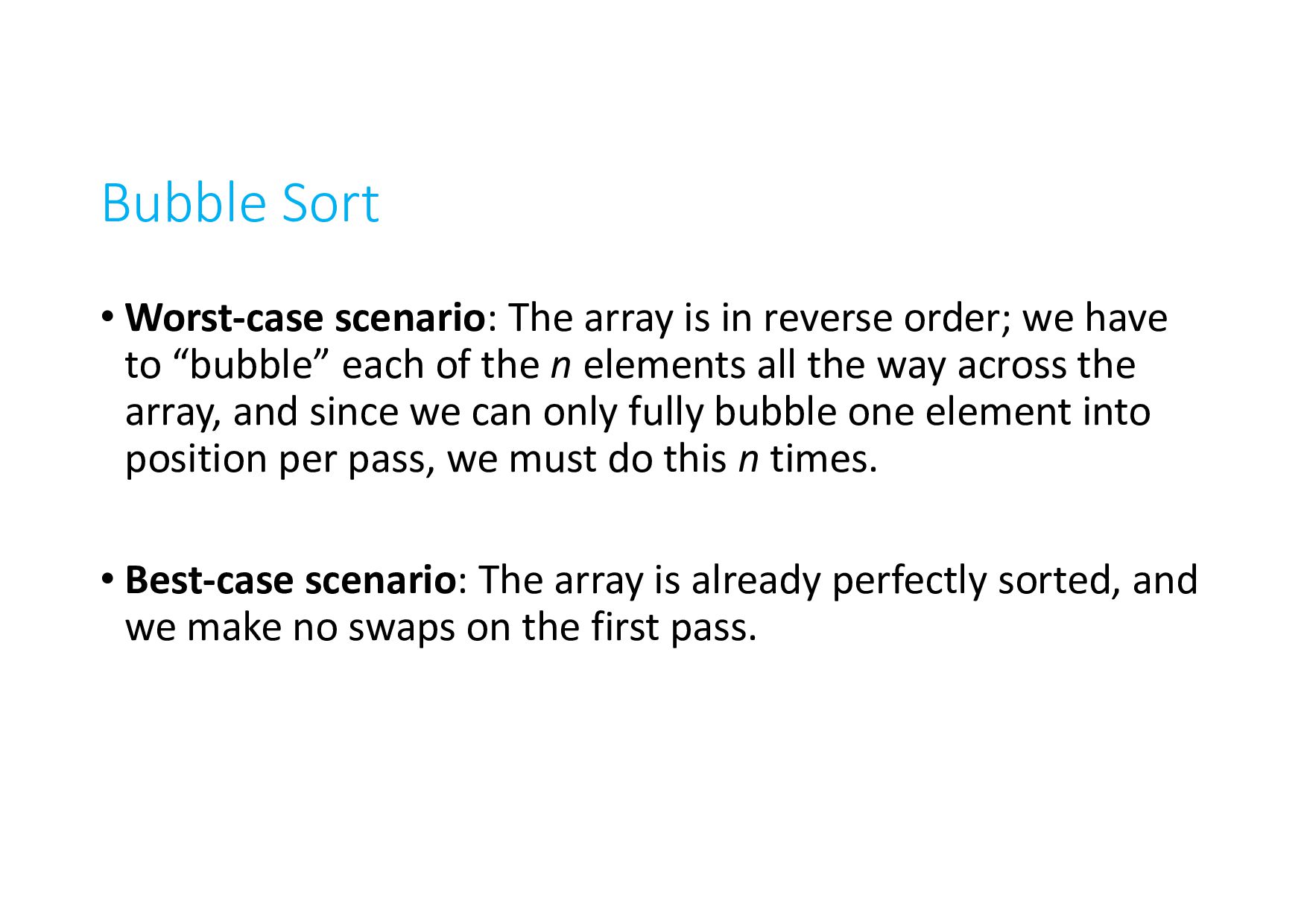
order; we have to “bubble” each of the n elements all the way across the array, and since we can only fully bubble one element into position per pass, we must do this n times. • Best-case scenario: The array is already perfectly sorted, and we make no swaps on the first pass.


 mouuii
 kimpetersen
 mza
mza
 mlcsv
mlcsv
 cassininazir
 aleyda
 smashingmag
 gr2m
gr2m
 davidcarrasco
 varn
varn
 brettharned