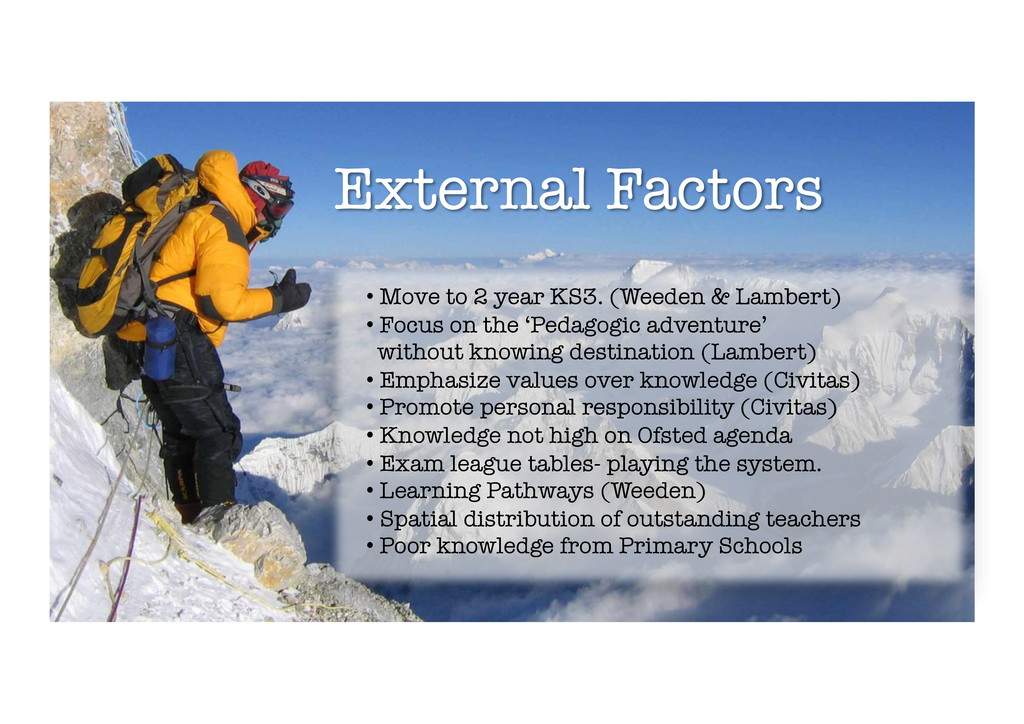
Focus on the ‘Pedagogic adventure’ without knowing destination (Lambert) • Emphasize values over knowledge (Civitas) • Promote personal responsibility (Civitas) • Knowledge not high on Ofsted agenda • Exam league tables- playing the system. • Learning Pathways (Weeden) • Spatial distribution of outstanding teachers • Poor knowledge from Primary Schools
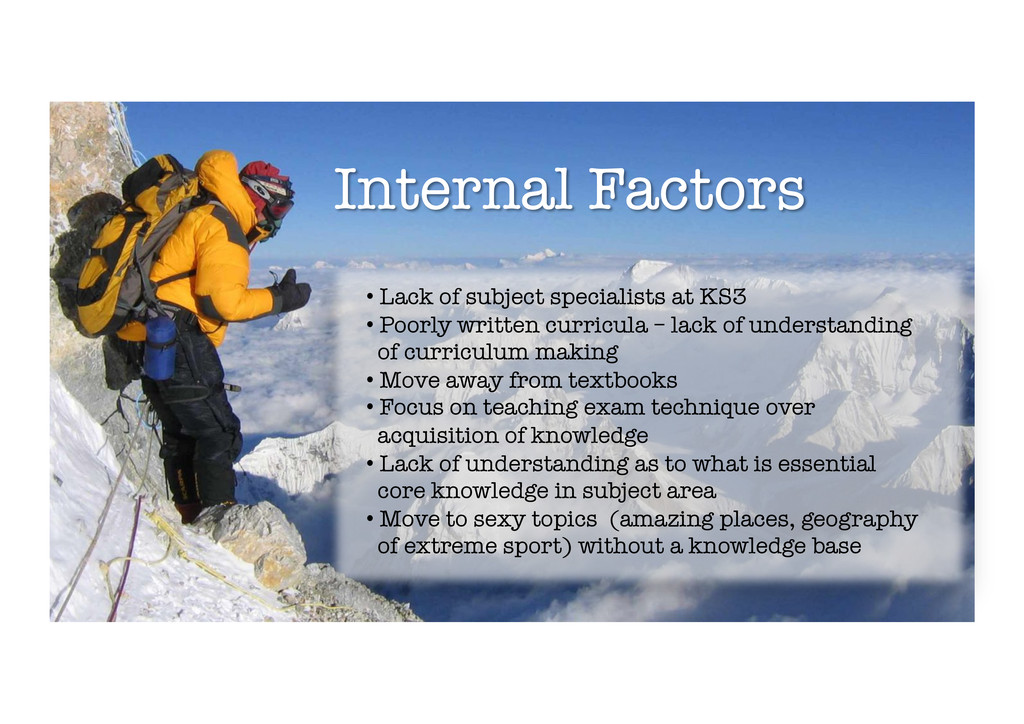
curricula – lack of understanding of curriculum making • Move away from textbooks • Focus on teaching exam technique over acquisition of knowledge • Lack of understanding as to what is essential core knowledge in subject area • Move to sexy topics (amazing places, geography of extreme sport) without a knowledge base
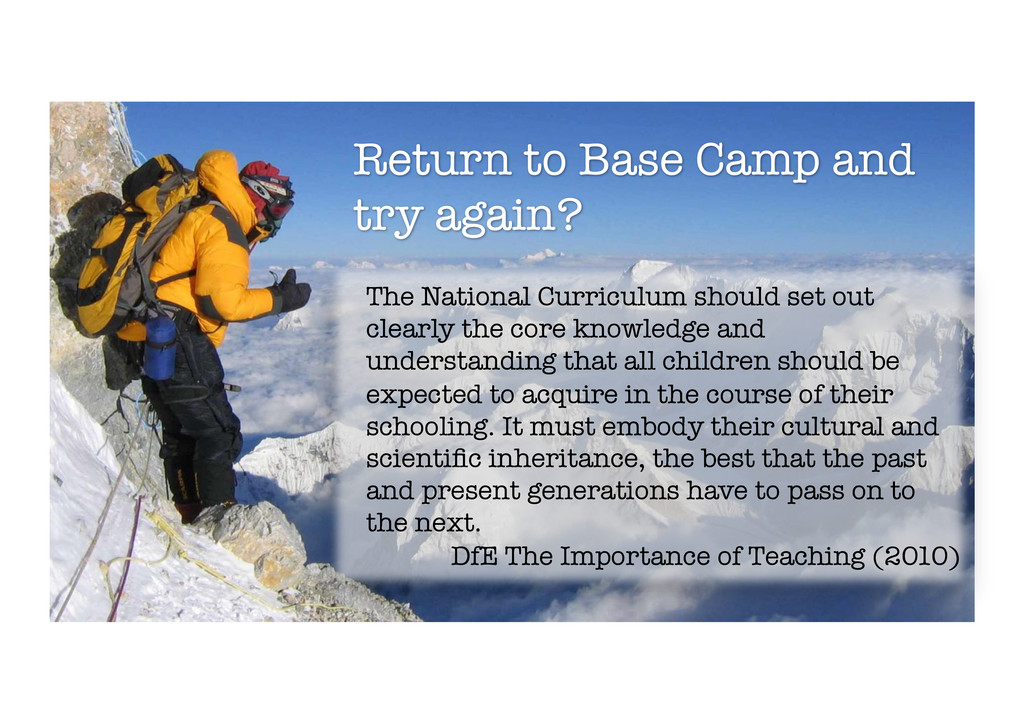
and understanding that all children should be expected to acquire in the course of their schooling. It must embody their cultural and scientific inheritance, the best that the past and present generations have to pass on to the next. DfE The Importance of Teaching (2010)
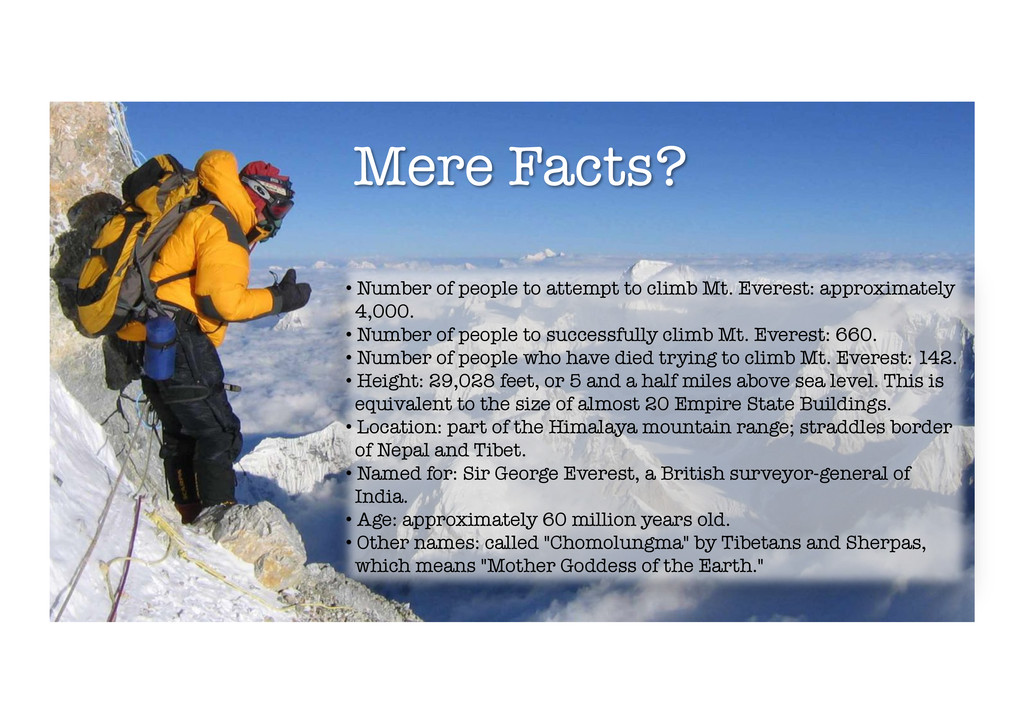
approximately 4,000. • Number of people to successfully climb Mt. Everest: 660. • Number of people who have died trying to climb Mt. Everest: 142. • Height: 29,028 feet, or 5 and a half miles above sea level. This is equivalent to the size of almost 20 Empire State Buildings. • Location: part of the Himalaya mountain range; straddles border of Nepal and Tibet. • Named for: Sir George Everest, a British surveyor-general of India. • Age: approximately 60 million years old. • Other names: called "Chomolungma" by Tibetans and Sherpas, which means "Mother Goddess of the Earth."
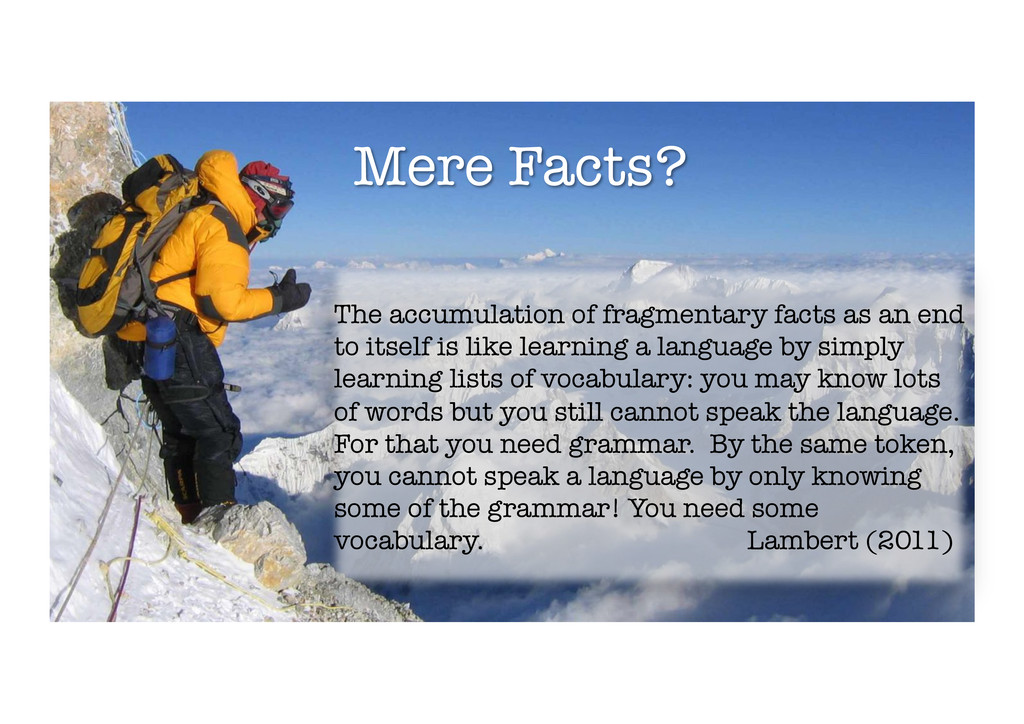
is like learning a language by simply learning lists of vocabulary: you may know lots of words but you still cannot speak the language. For that you need grammar. By the same token, you cannot speak a language by only knowing some of the grammar! You need some vocabulary. Lambert (2011)
curriculum that recognises the distinction between the type of knowledge that can be acquired at school, college or university and the common sense or the practical knowledge that we aquire in our every day lives.
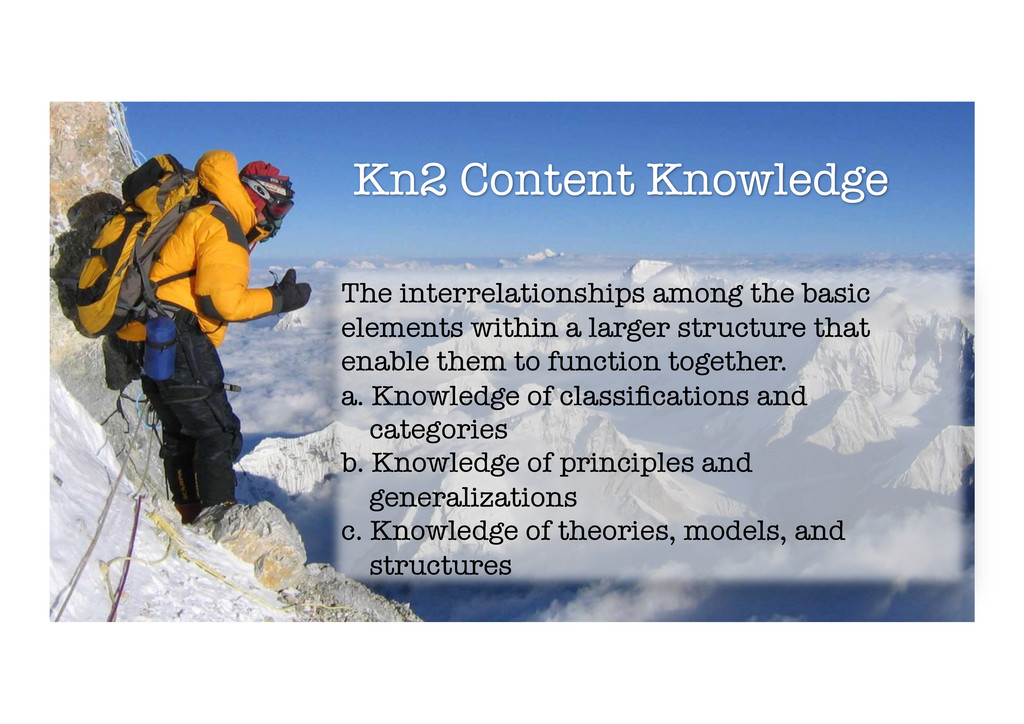
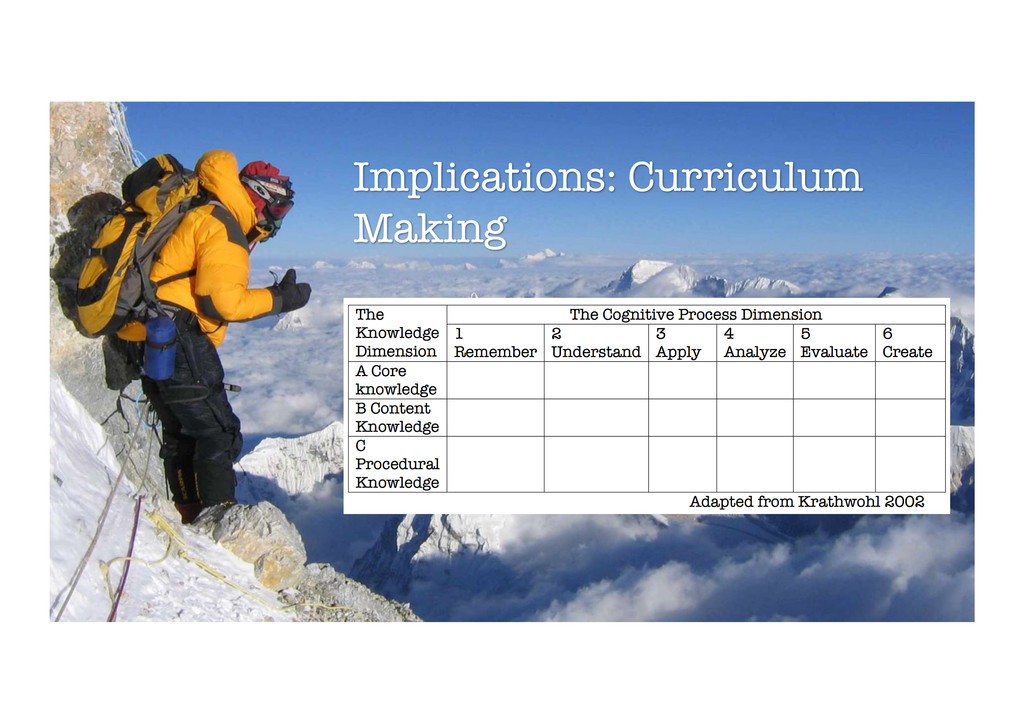
that enable them to function together. a. Knowledge of classifications and categories b. Knowledge of principles and generalizations c. Knowledge of theories, models, and structures
using skills, algorithms, techniques, and methods. a. Knowledge of subject-specific skills and al- gorithms b. Knowledge of subject-specific techniques and methods c. Knowledge of criteria for determining when to use appropriate procedures
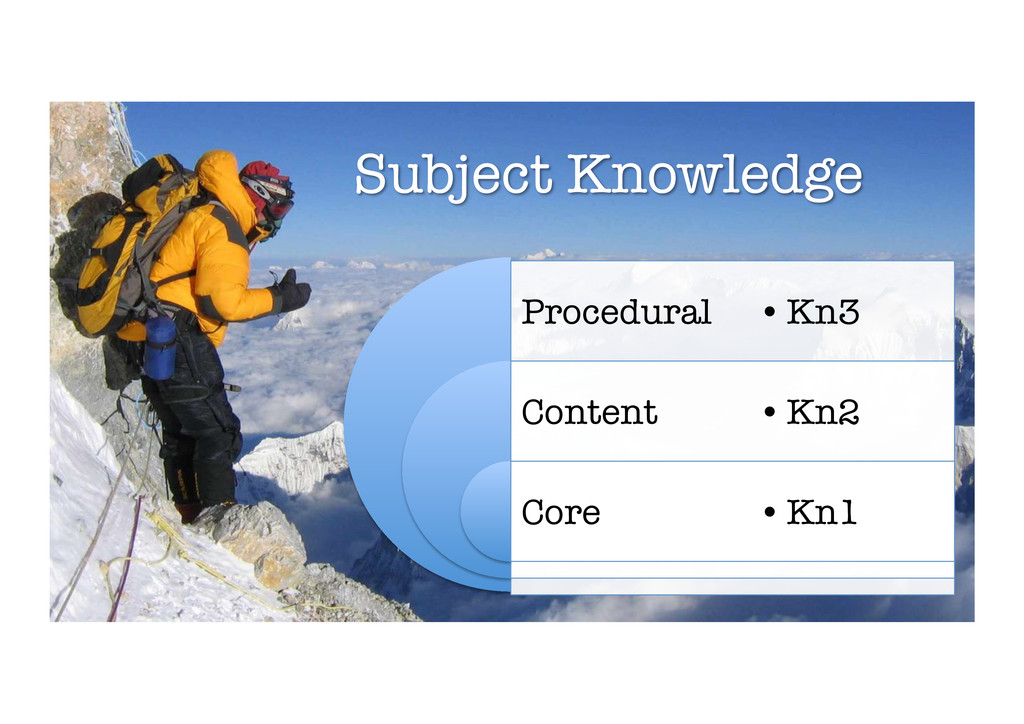
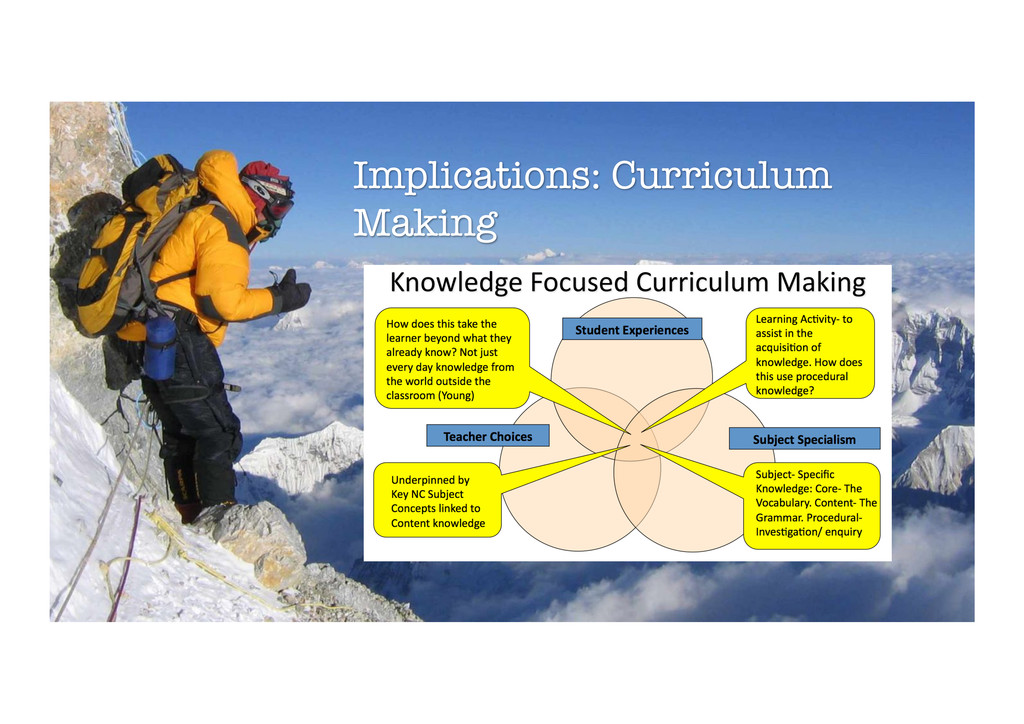
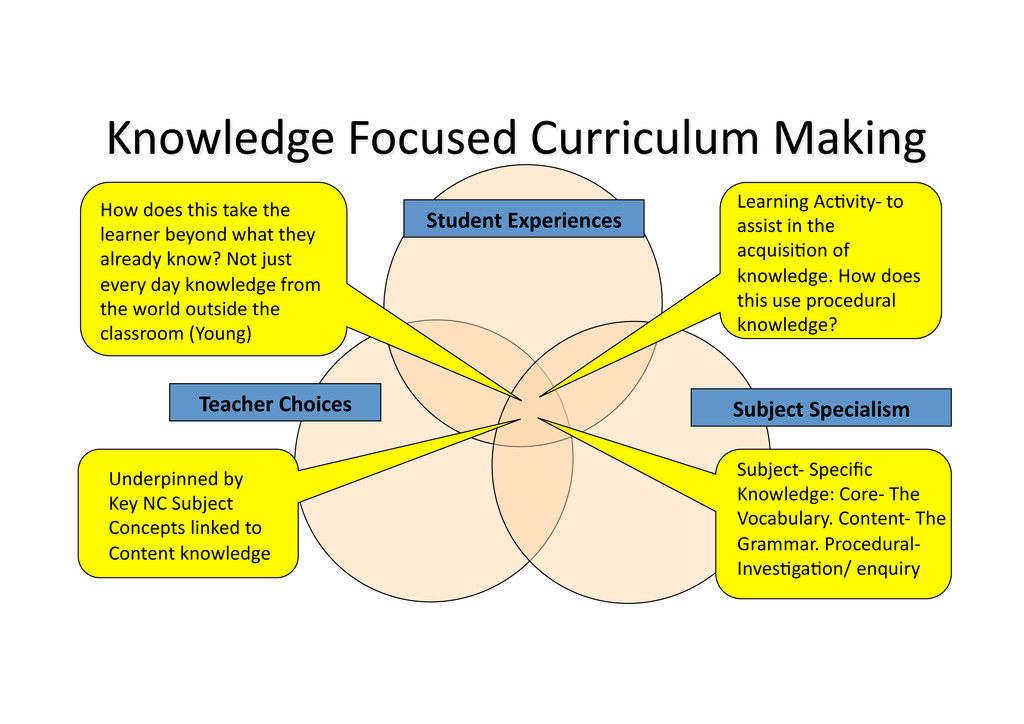
by Key NC Subject Concepts linked to Content knowledge Subject-‐ Specific Knowledge: Core-‐ The Vocabulary. Content-‐ The Grammar. Procedural-‐ InvesFgaFon/ enquiry Learning AcFvity-‐ to assist in the acquisiFon of knowledge. How does this use procedural knowledge? How does this take the learner beyond what they already know? Not just every day knowledge from the world outside the classroom (Young)


 ainischool
 yatabe
 aokiplayer
 shuichikishida
 kaityo256
 dragon2
 uchi8977
 pawan_pharm
 hiola
hiola
 tomit3
 kzkmaeda
 juanmartin2026
 frankvandijk
 smashingmag
 sabderemane
 aarron
 kneath
 addyosmani
 nwiizo
 sferik
 iamctodd
 codingconduct
 tmiket
 stephenakadiri