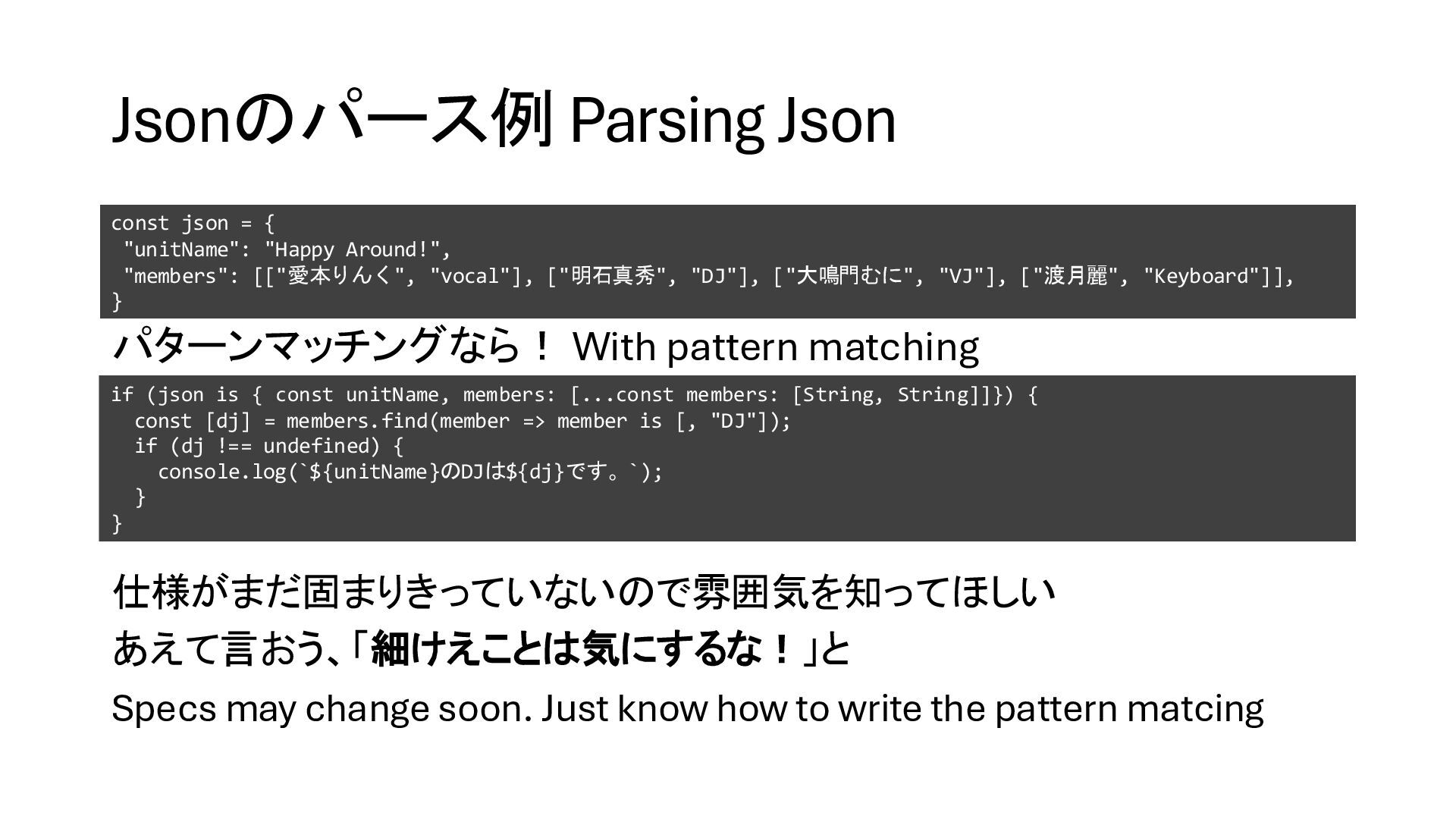
to the space limitation, not everything is annotated. I try to cut annotation where my intention are easily guessable. If my explanation is hard to understand, this is my fault, not because the spec is difficult. I'm sorry, speaking is Japanese only.
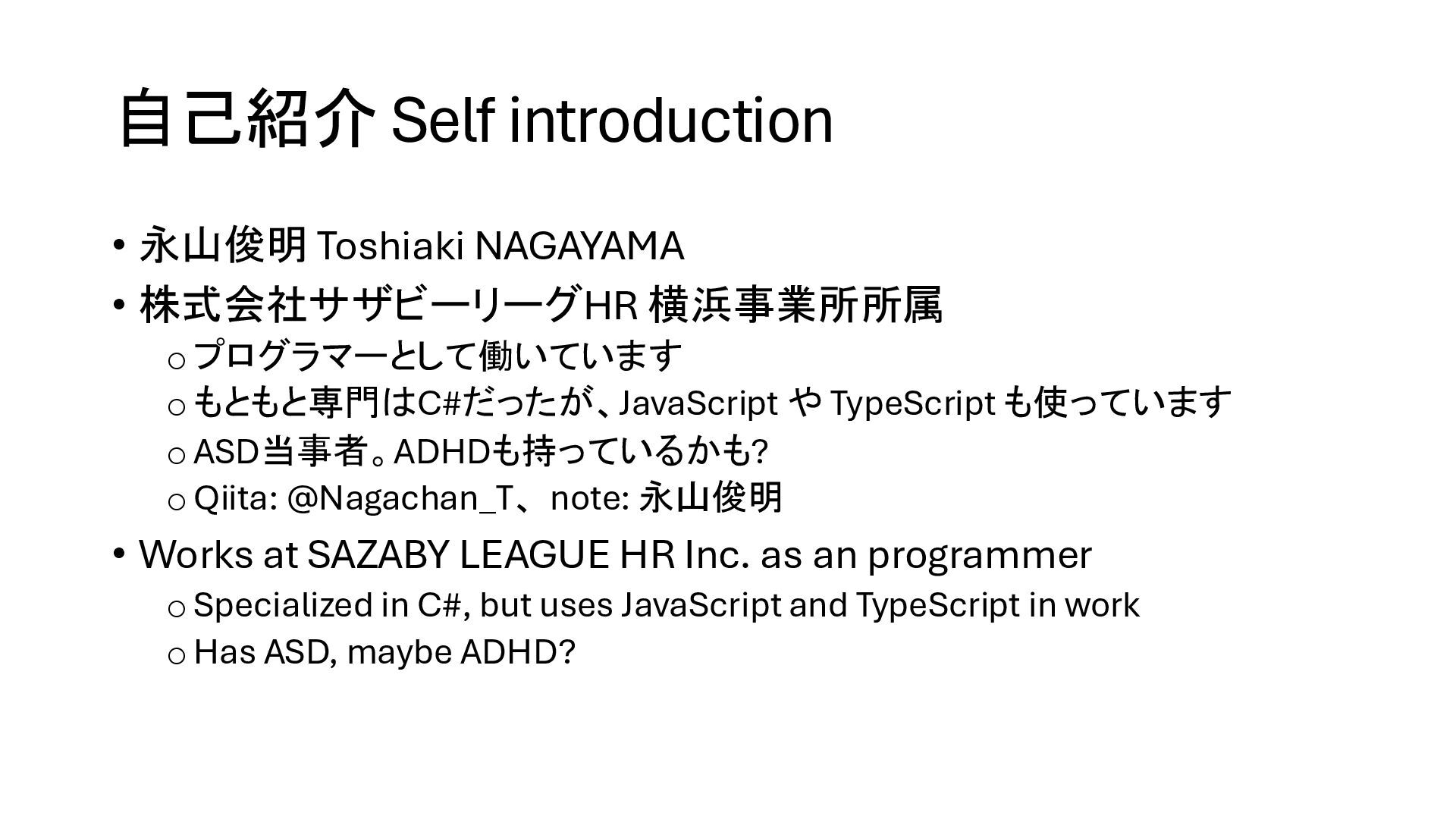
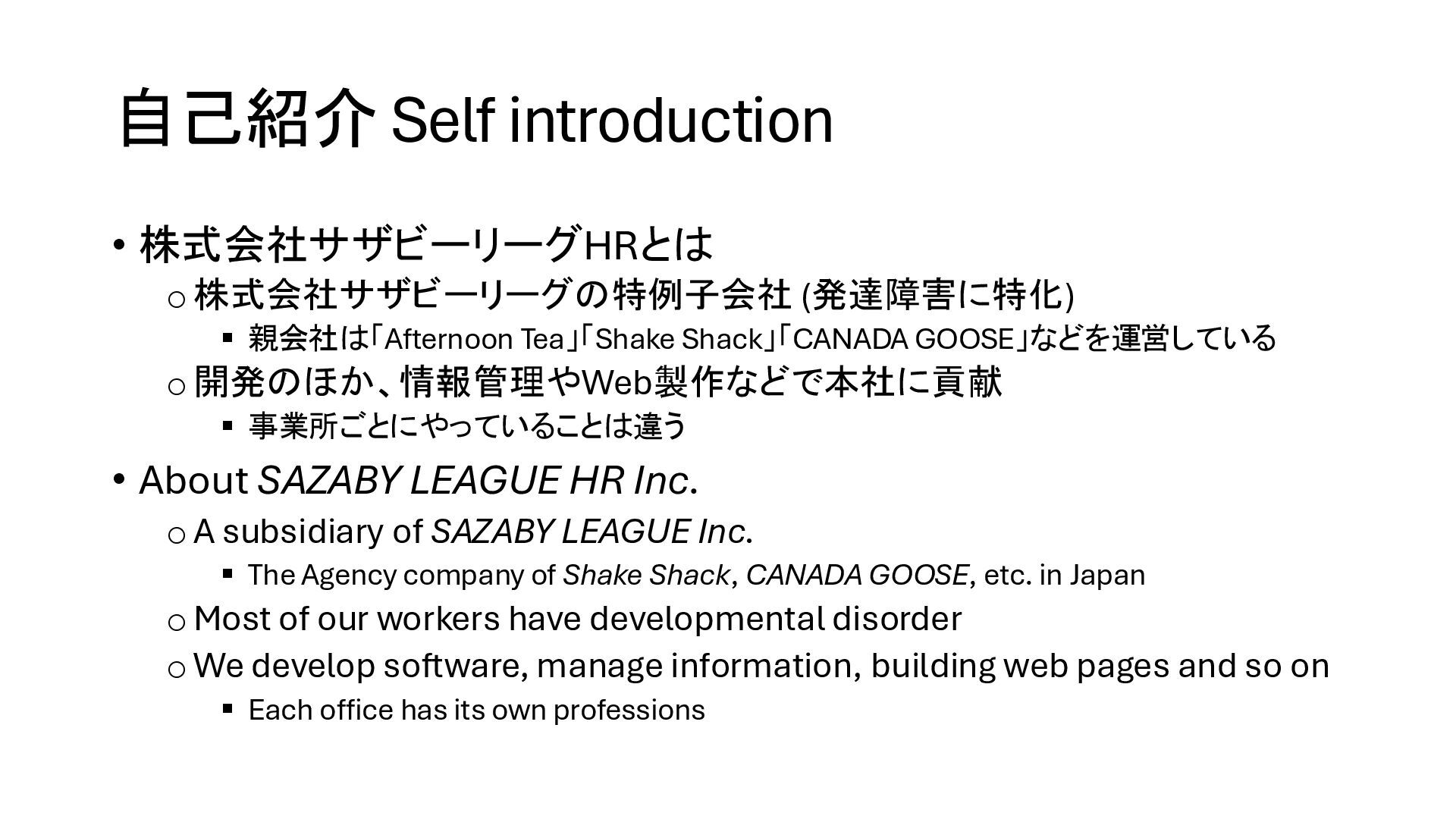
oプログラマーとして働いています o もともと専門はC#だったが、JavaScript や TypeScript も使っています o ASD当事者。ADHDも持っているかも? o Qiita: @Nagachan_T、note: 永山俊明 • Works at SAZABY LEAGUE HR Inc. as an programmer oSpecialized in C#, but uses JavaScript and TypeScript in work o Has ASD, maybe ADHD?
Shack」「CANADA GOOSE」などを運営している o開発のほか、情報管理やWeb製作などで本社に貢献 ▪ 事業所ごとにやっていることは違う • About SAZABY LEAGUE HR Inc. o A subsidiary of SAZABY LEAGUE Inc. ▪ The Agency company of Shake Shack, CANADA GOOSE, etc. in Japan o Most of our workers have developmental disorder o We develop software, manage information, building web pages and so on ▪ Each office has its own professions
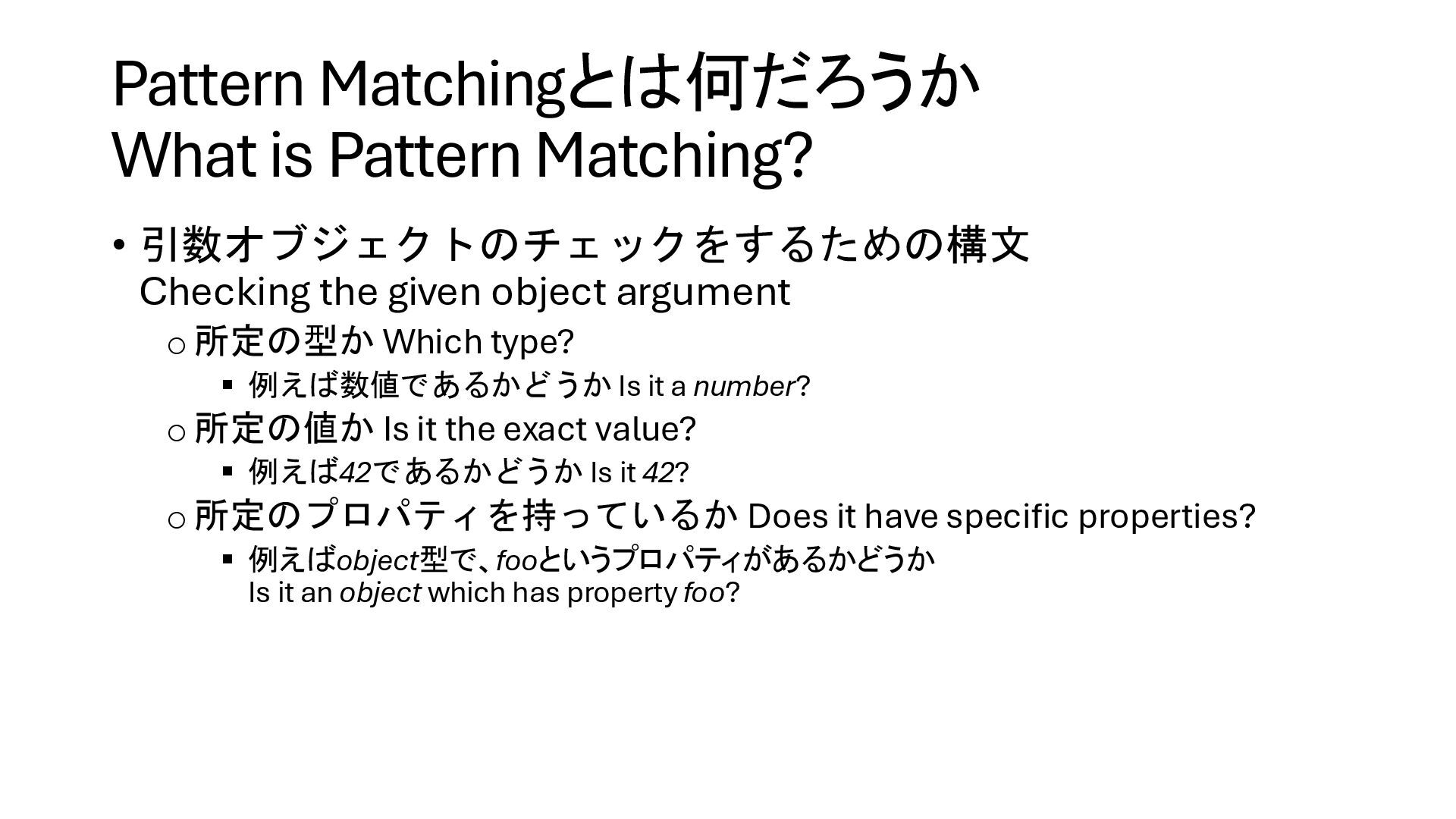
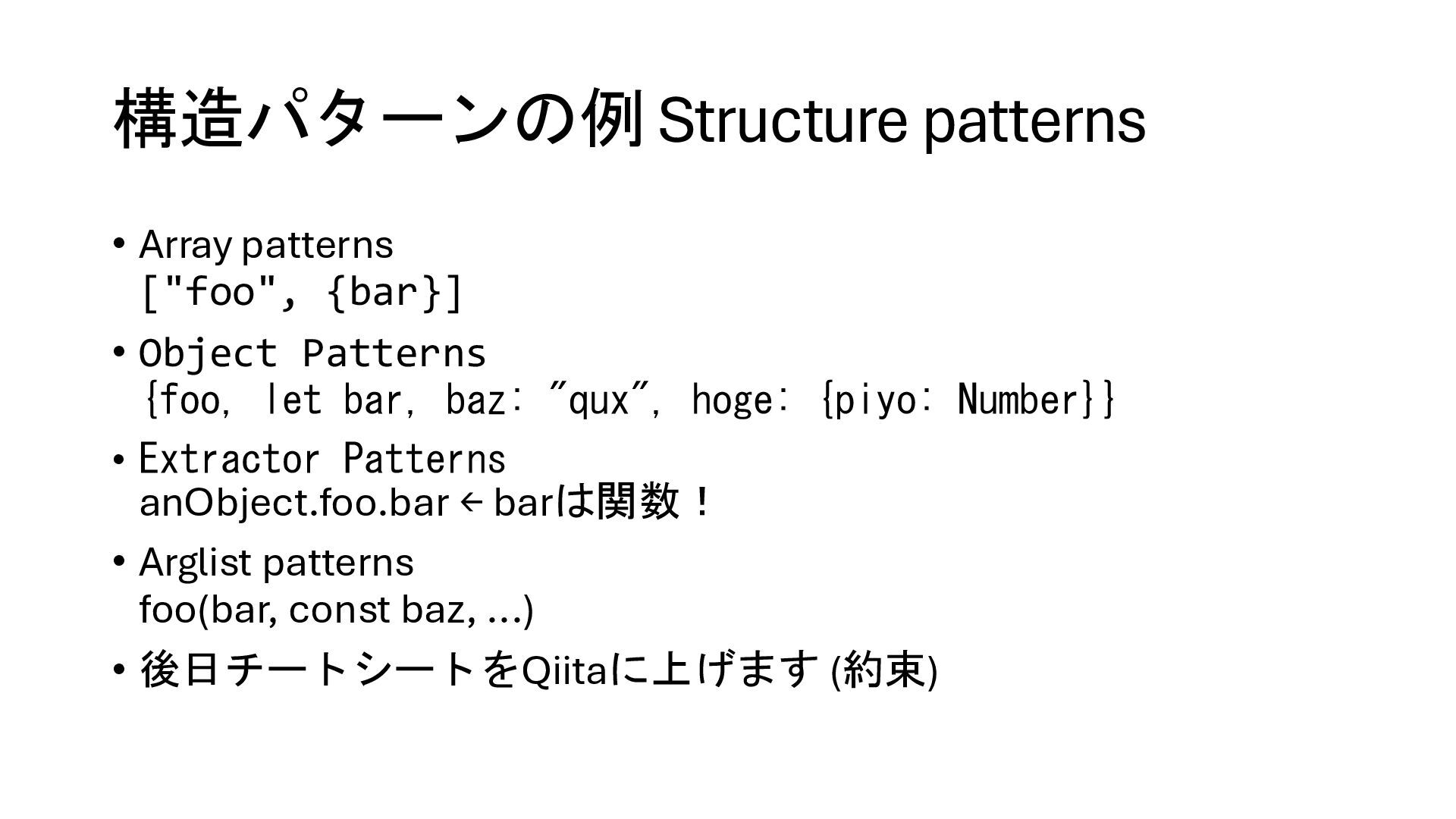
given object argument o 所定の型か Which type? ▪ 例えば数値であるかどうか Is it a number? o 所定の値か Is it the exact value? ▪ 例えば42であるかどうか Is it 42? o所定のプロパティを持っているか Does it have specific properties? ▪ 例えばobject型で、fooというプロパティがあるかどうか Is it an object which has property foo?
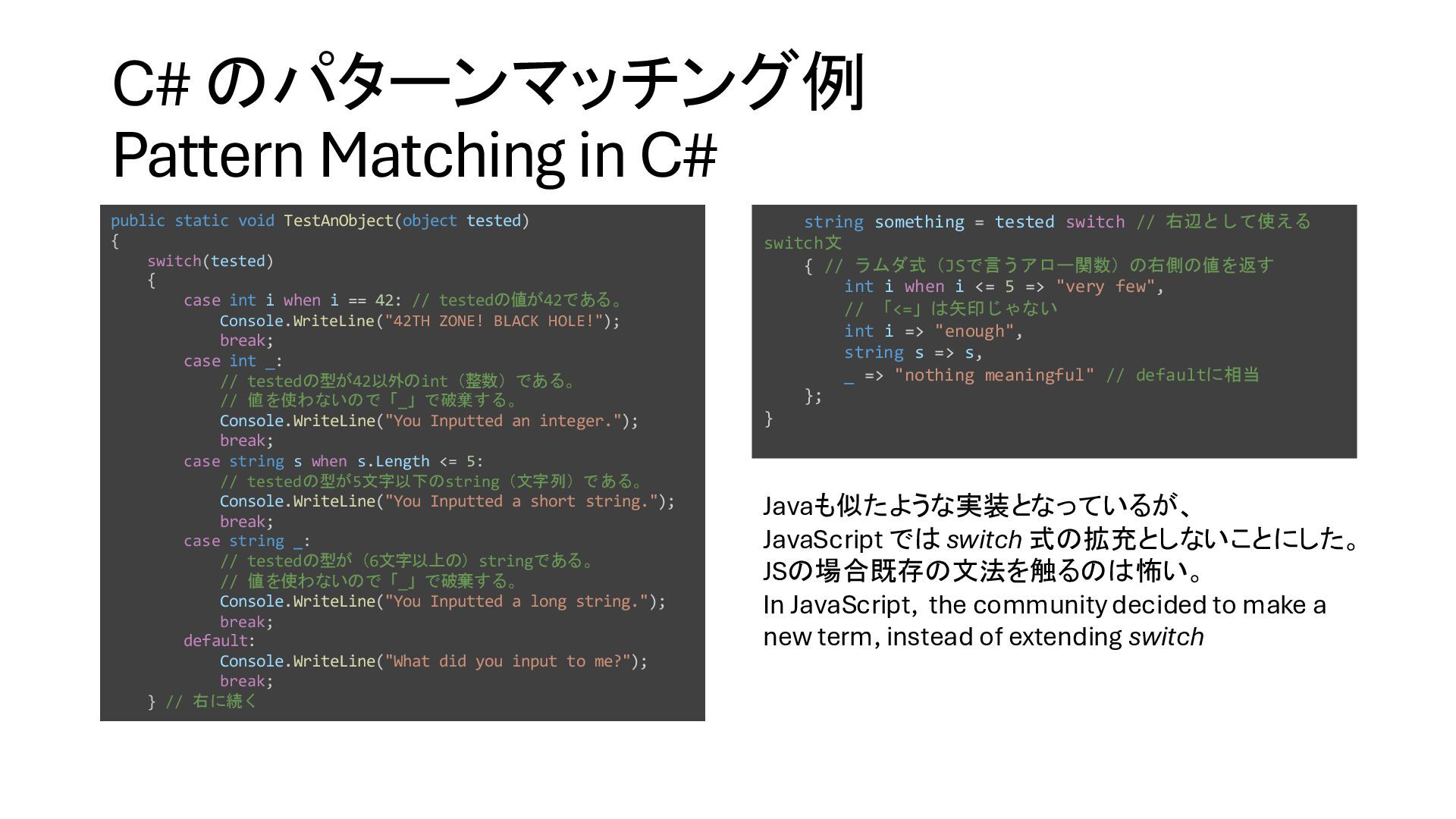
tested) { switch(tested) { case int i when i == 42: // testedの値が42である。 Console.WriteLine("42TH ZONE! BLACK HOLE!"); break; case int _: // testedの型が42以外のint(整数)である。 // 値を使わないので「_」で破棄する。 Console.WriteLine("You Inputted an integer."); break; case string s when s.Length <= 5: // testedの型が5文字以下のstring(文字列)である。 Console.WriteLine("You Inputted a short string."); break; case string _: // testedの型が(6文字以上の)stringである。 // 値を使わないので「_」で破棄する。 Console.WriteLine("You Inputted a long string."); break; default: Console.WriteLine("What did you input to me?"); break; } // 右に続く string something = tested switch // 右辺として使える switch文 { // ラムダ式(JSで言うアロー関数)の右側の値を返す int i when i <= 5 => "very few", // 「<=」は矢印じゃない int i => "enough", string s => s, _ => "nothing meaningful" // defaultに相当 }; } Javaも似たような実装となっているが、 JavaScript では switch 式の拡充としないことにした。 JSの場合既存の文法を触るのは怖い。 In JavaScript, the community decided to make a new term, instead of extending switch
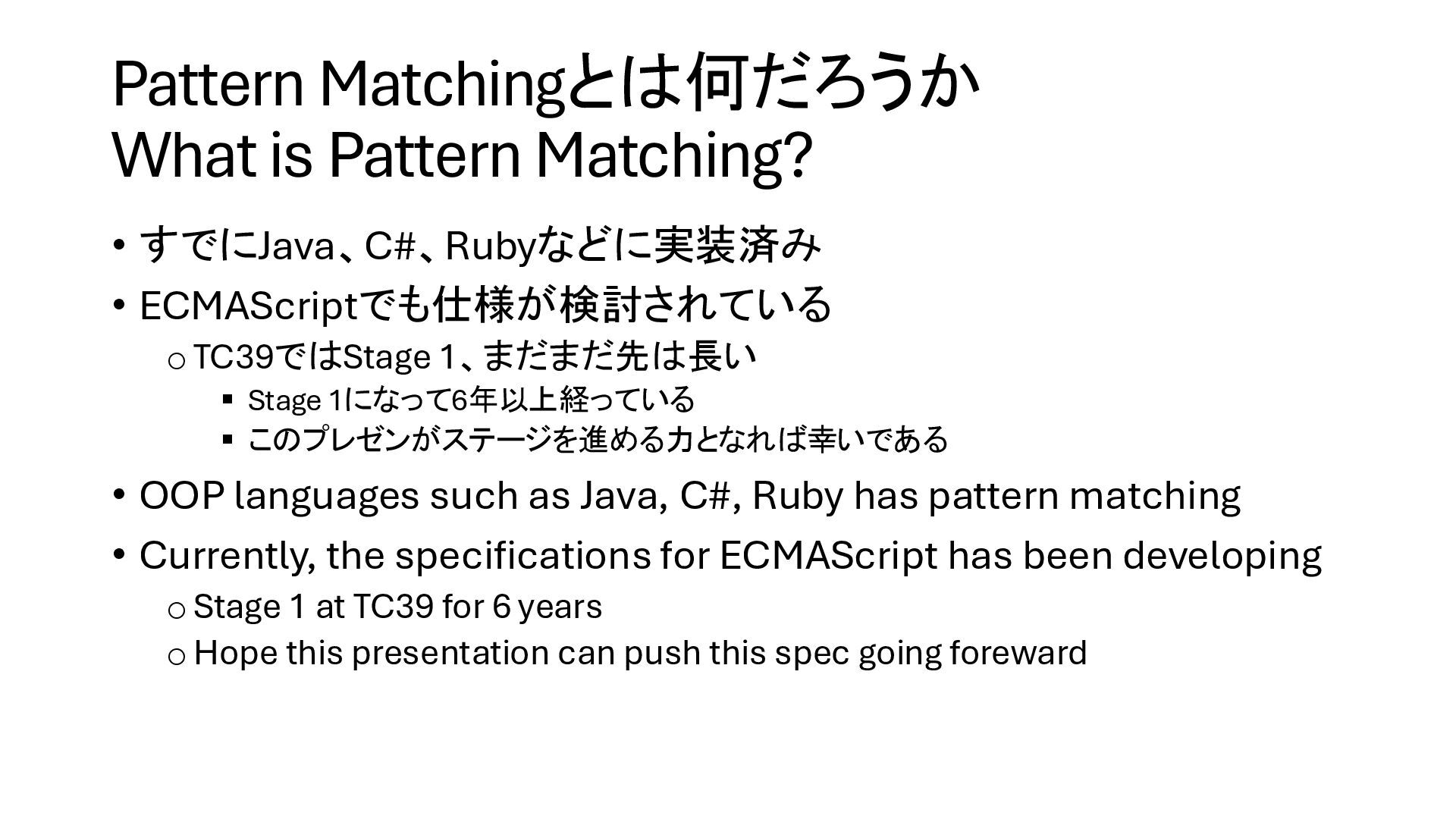
oTC39ではStage 1、まだまだ先は長い ▪ Stage 1になって6年以上経っている ▪ このプレゼンがステージを進める力となれば幸いである • OOP languages such as Java, C#, Ruby has pattern matching • Currently, the specifications for ECMAScript has been developing o Stage 1 at TC39 for 6 years oHope this presentation can push this spec going foreward
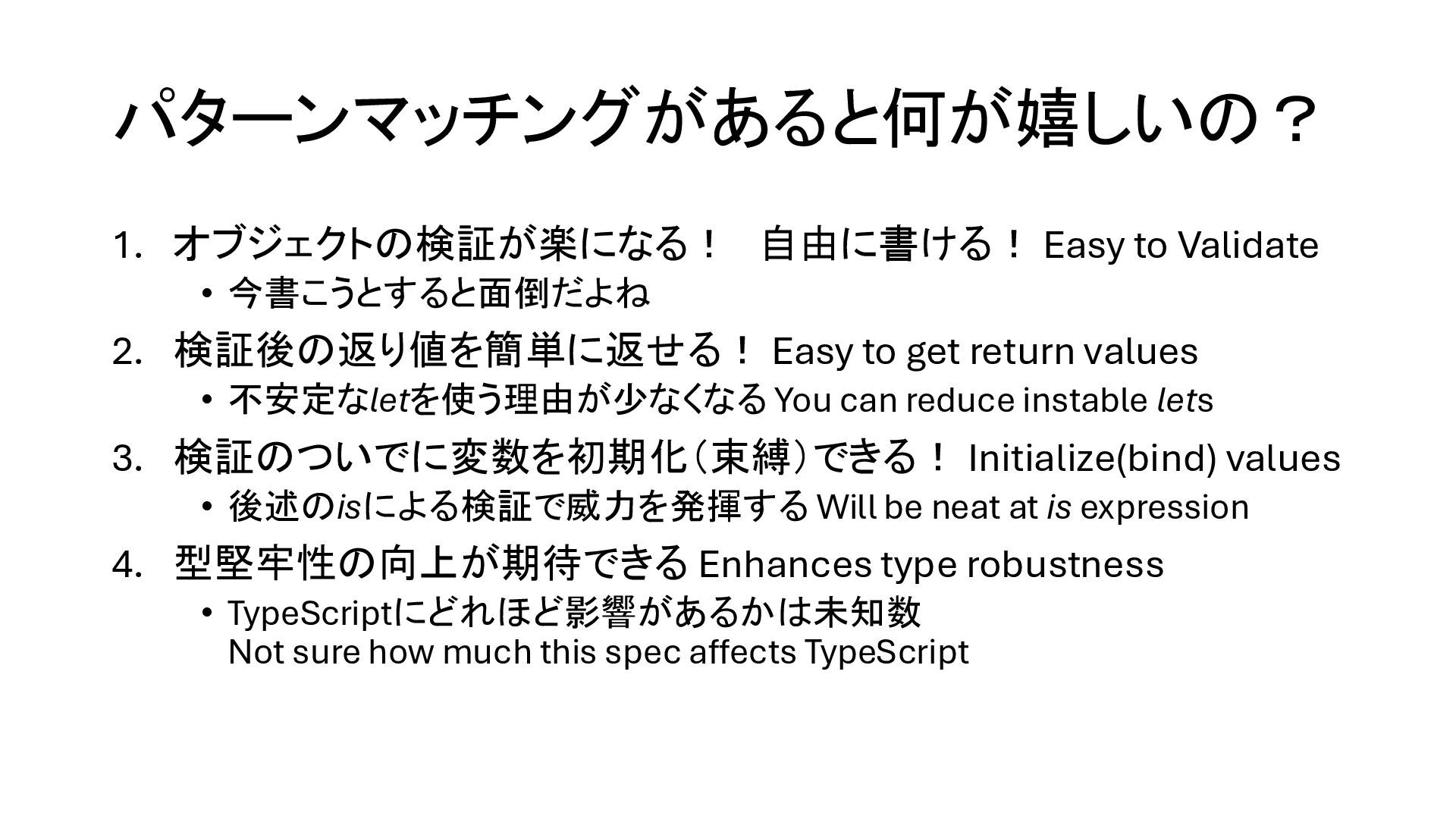
検証後の返り値を簡単に返せる! Easy to get return values • 不安定なletを使う理由が少なくなる You can reduce instable lets 3. 検証のついでに変数を初期化(束縛)できる! Initialize(bind) values • 後述のisによる検証で威力を発揮する Will be neat at is expression 4. 型堅牢性の向上が期待できる Enhances type robustness • TypeScriptにどれほど影響があるかは未知数 Not sure how much this spec affects TypeScript
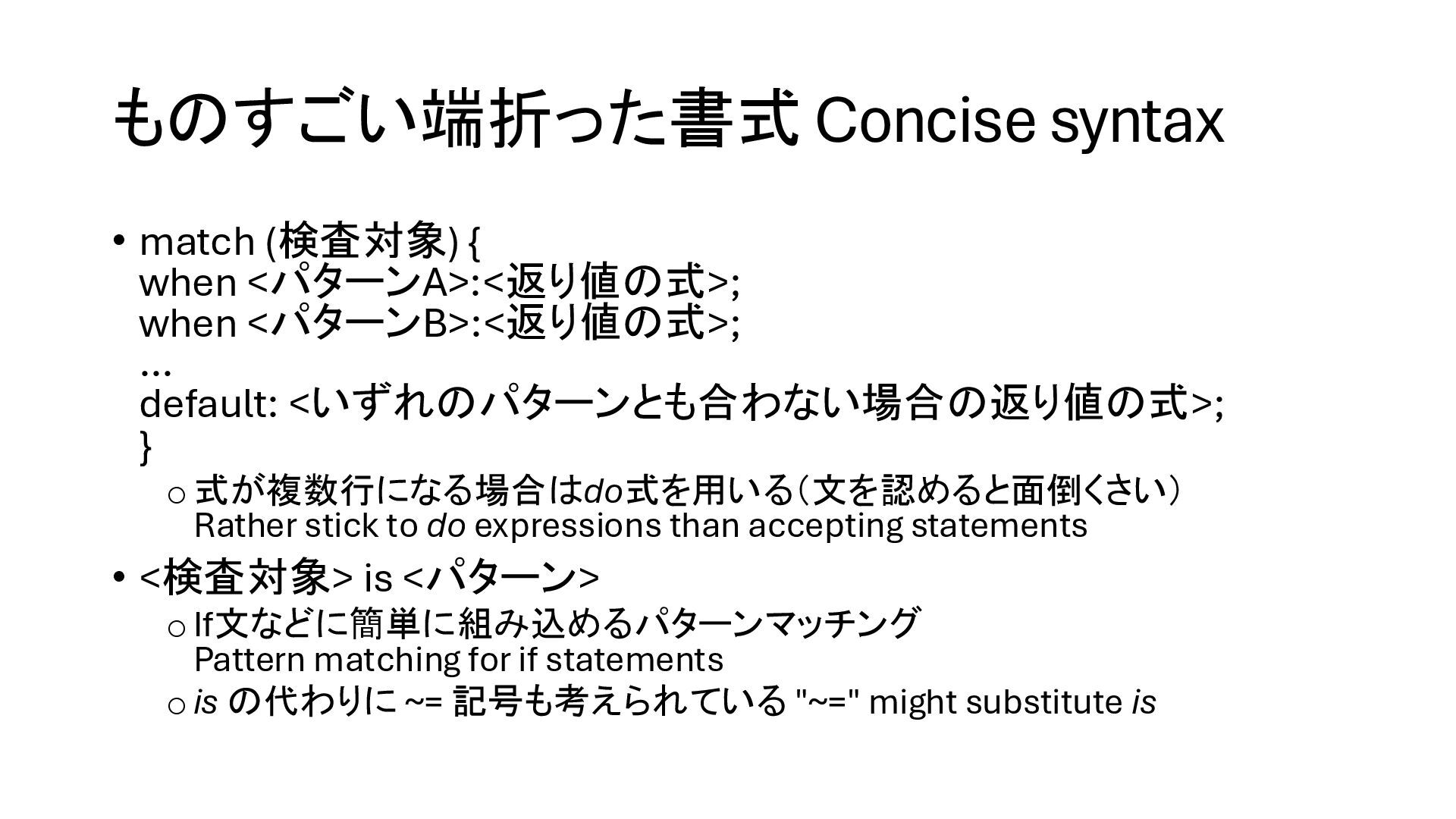
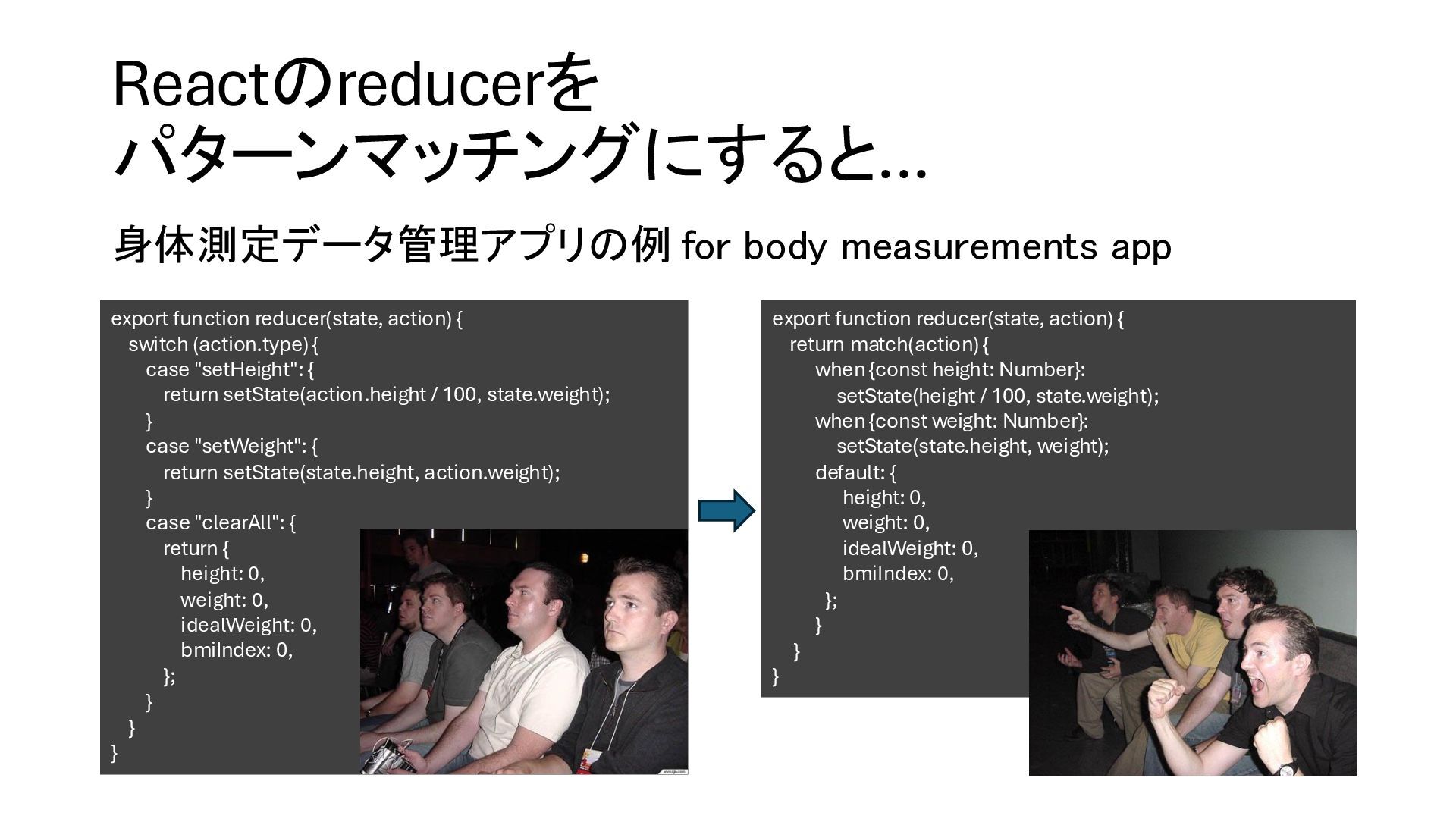
<パターンB>:<返り値の式>; … default: <いずれのパターンとも合わない場合の返り値の式>; } o式が複数行になる場合はdo式を用いる(文を認めると面倒くさい) Rather stick to do expressions than accepting statements • <検査対象> is <パターン> o If文などに簡単に組み込めるパターンマッチング Pattern matching for if statements o is の代わりに ~= 記号も考えられている "~=" might substitute is
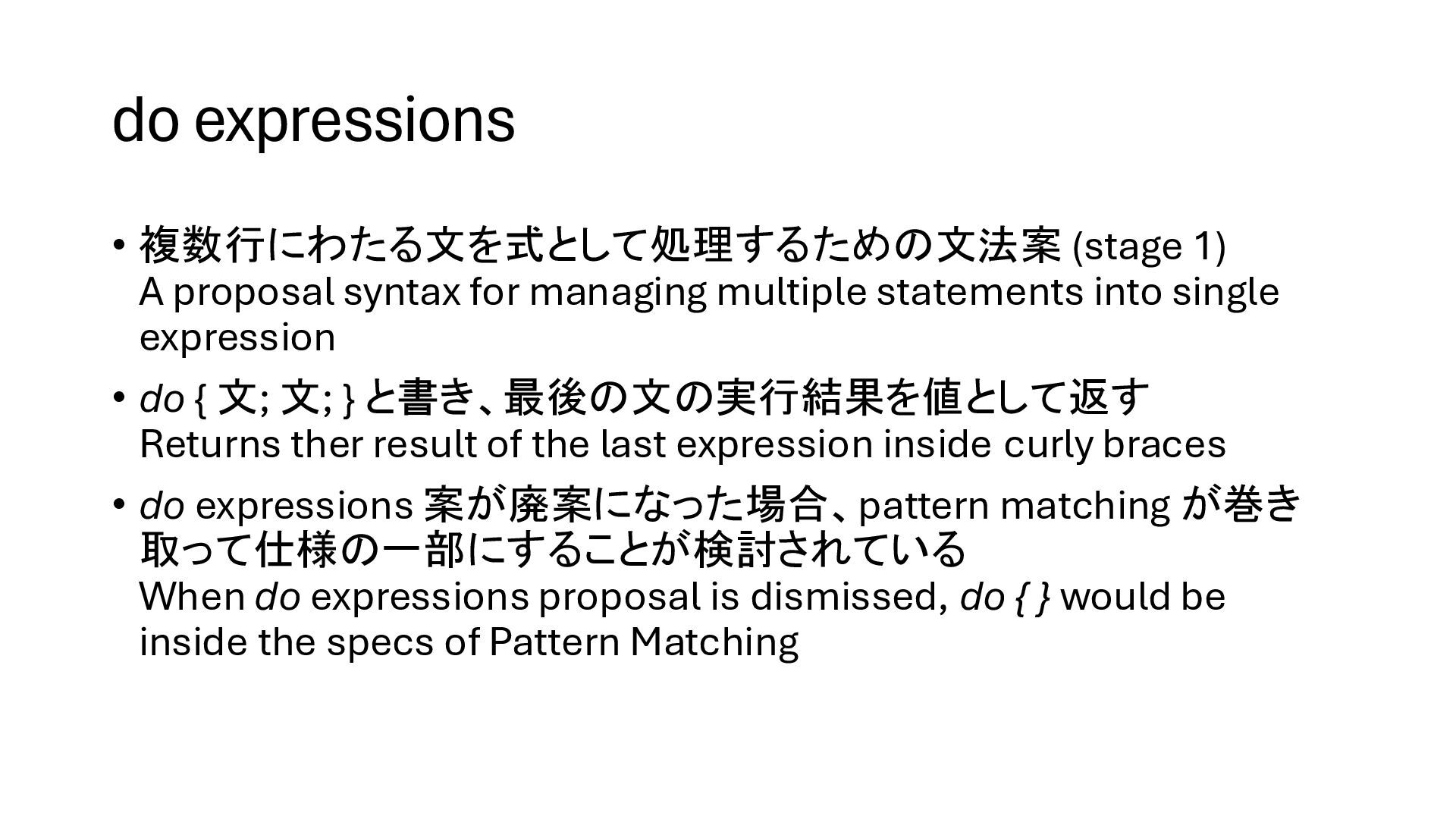
managing multiple statements into single expression • do { 文; 文; } と書き、最後の文の実行結果を値として返す Returns ther result of the last expression inside curly braces • do expressions 案が廃案になった場合、pattern matching が巻き 取って仕様の一部にすることが検討されている When do expressions proposal is dismissed, do { } would be inside the specs of Pattern Matching
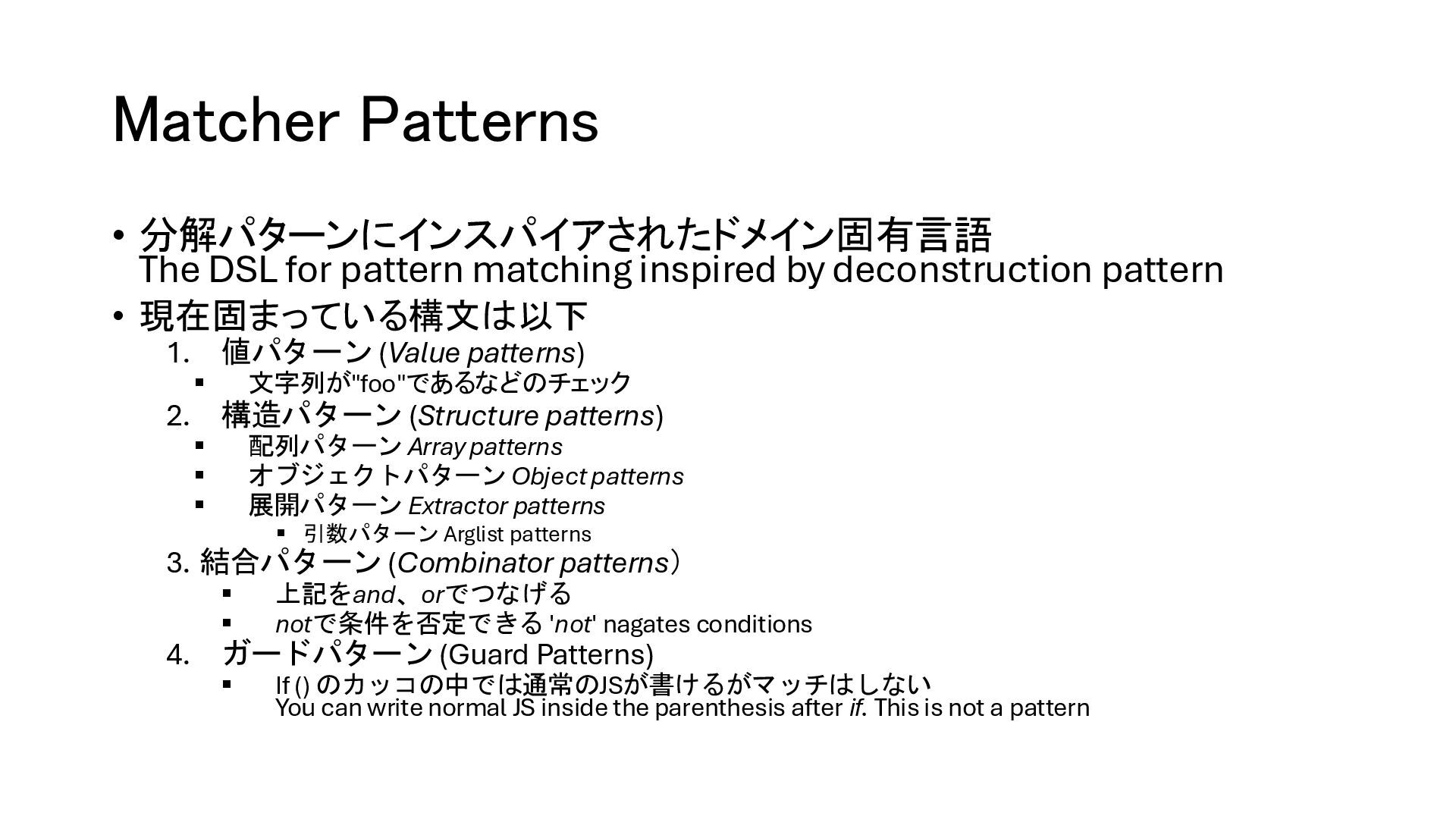
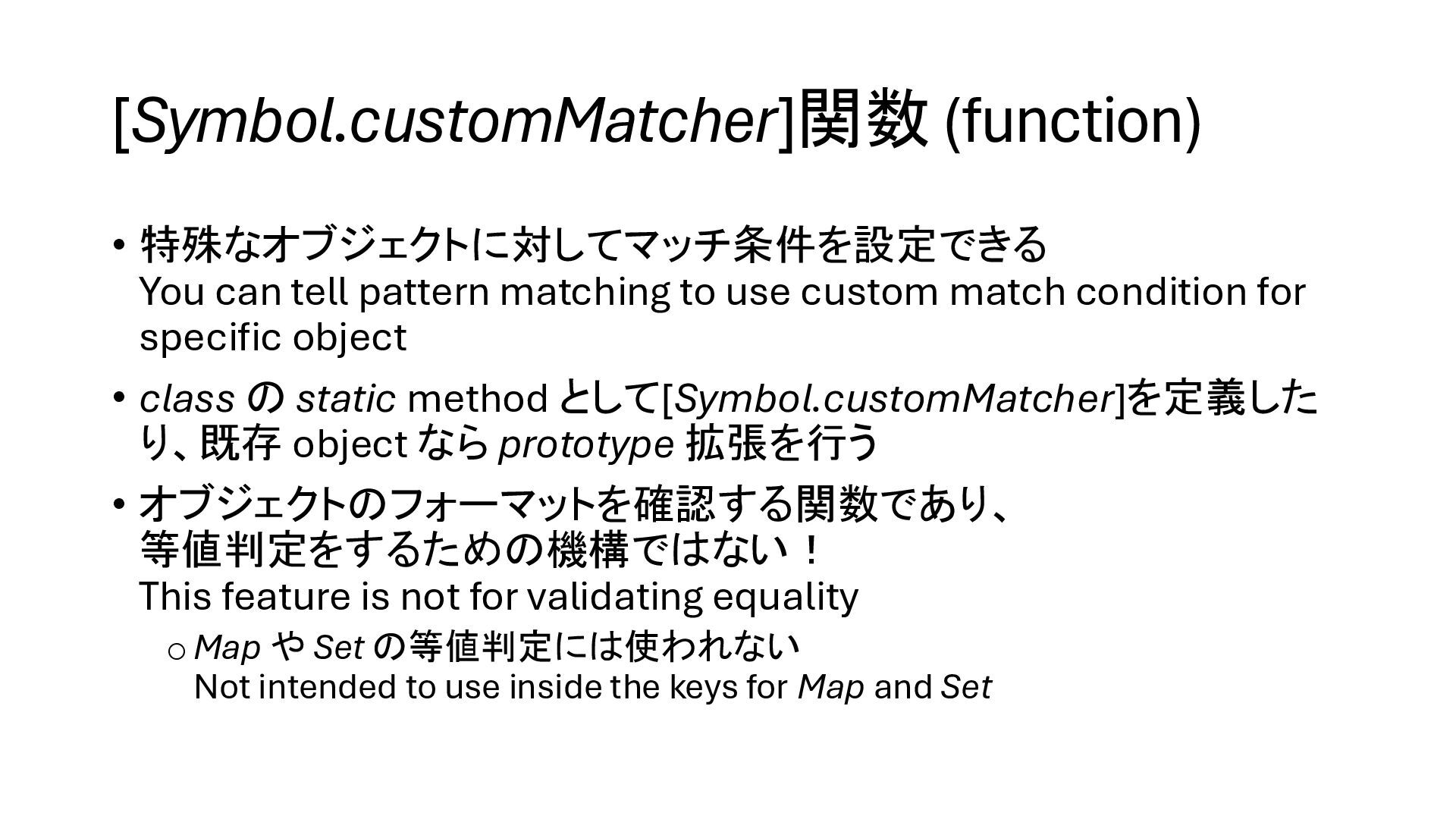
use custom match condition for specific object • class の static method として[Symbol.customMatcher]を定義した り、既存 object なら prototype 拡張を行う • オブジェクトのフォーマットを確認する関数であり、 等値判定をするための機構ではない! This feature is not for validating equality o Map や Set の等値判定には使われない Not intended to use inside the keys for Map and Set
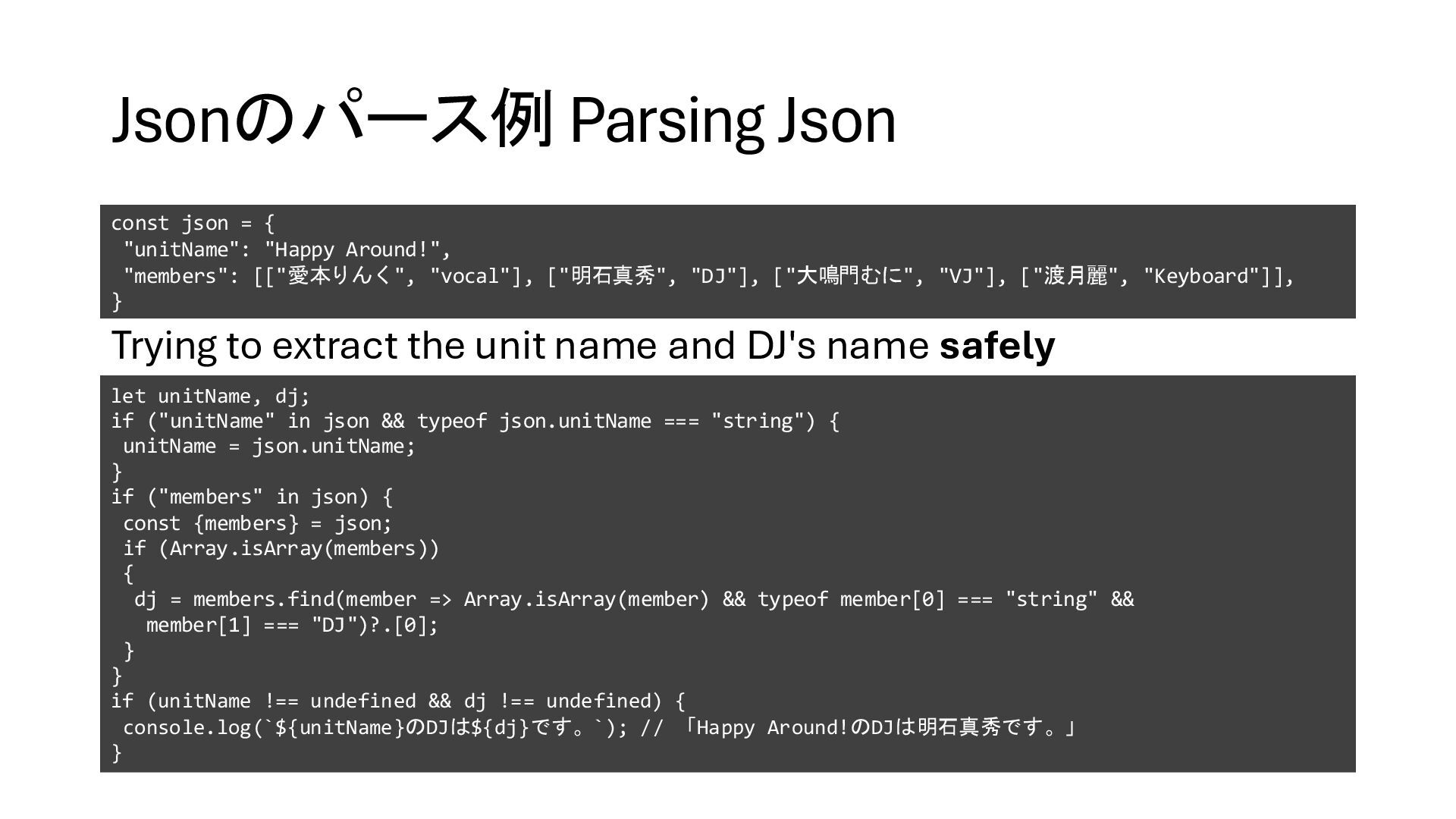
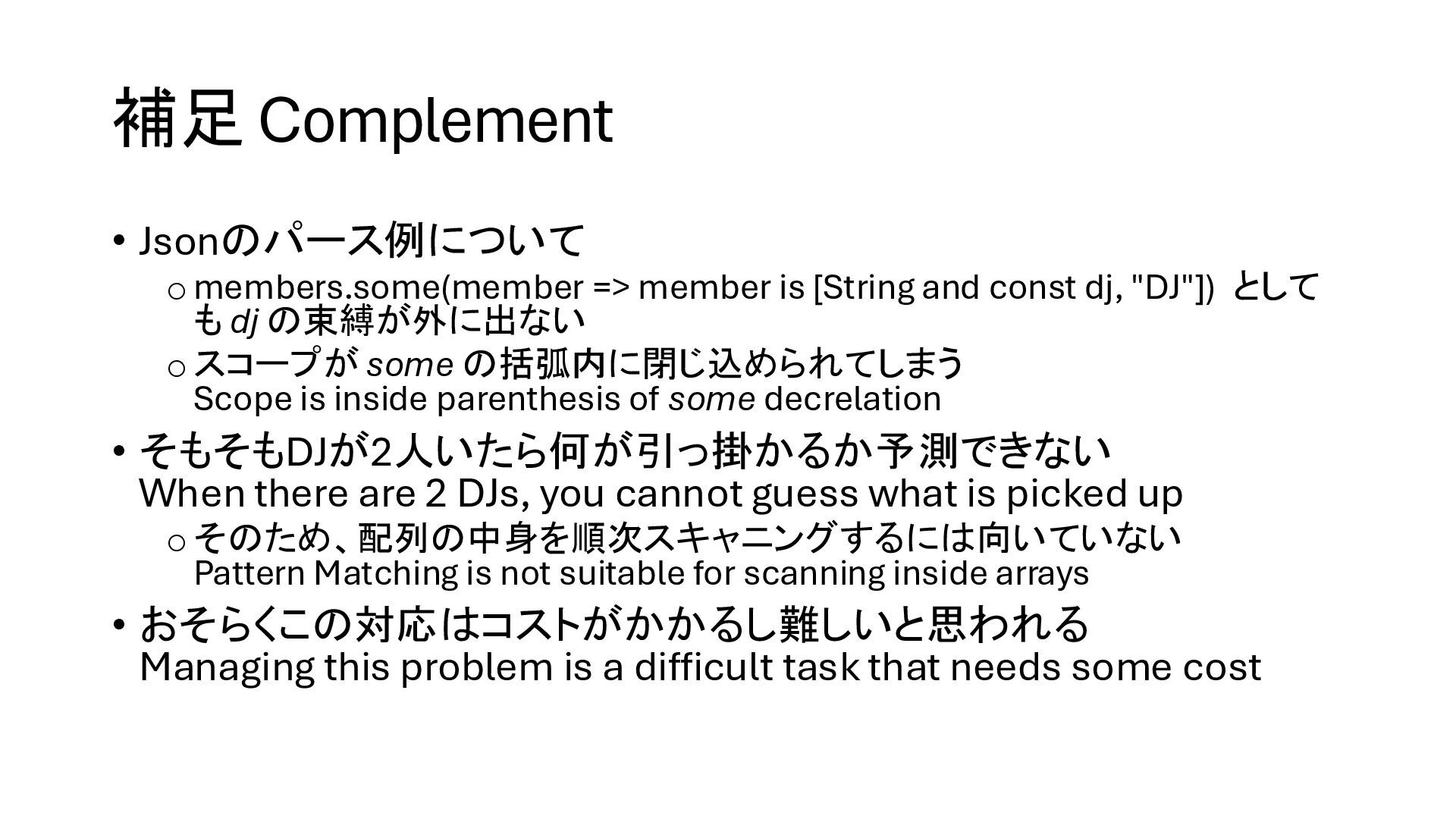
and const dj, "DJ"]) として も dj の束縛が外に出ない o スコープが some の括弧内に閉じ込められてしまう Scope is inside parenthesis of some decrelation • そもそもDJが2人いたら何が引っ掛かるか予測できない When there are 2 DJs, you cannot guess what is picked up o そのため、配列の中身を順次スキャニングするには向いていない Pattern Matching is not suitable for scanning inside arrays • おそらくこの対応はコストがかかるし難しいと思われる Managing this problem is a difficult task that needs some cost
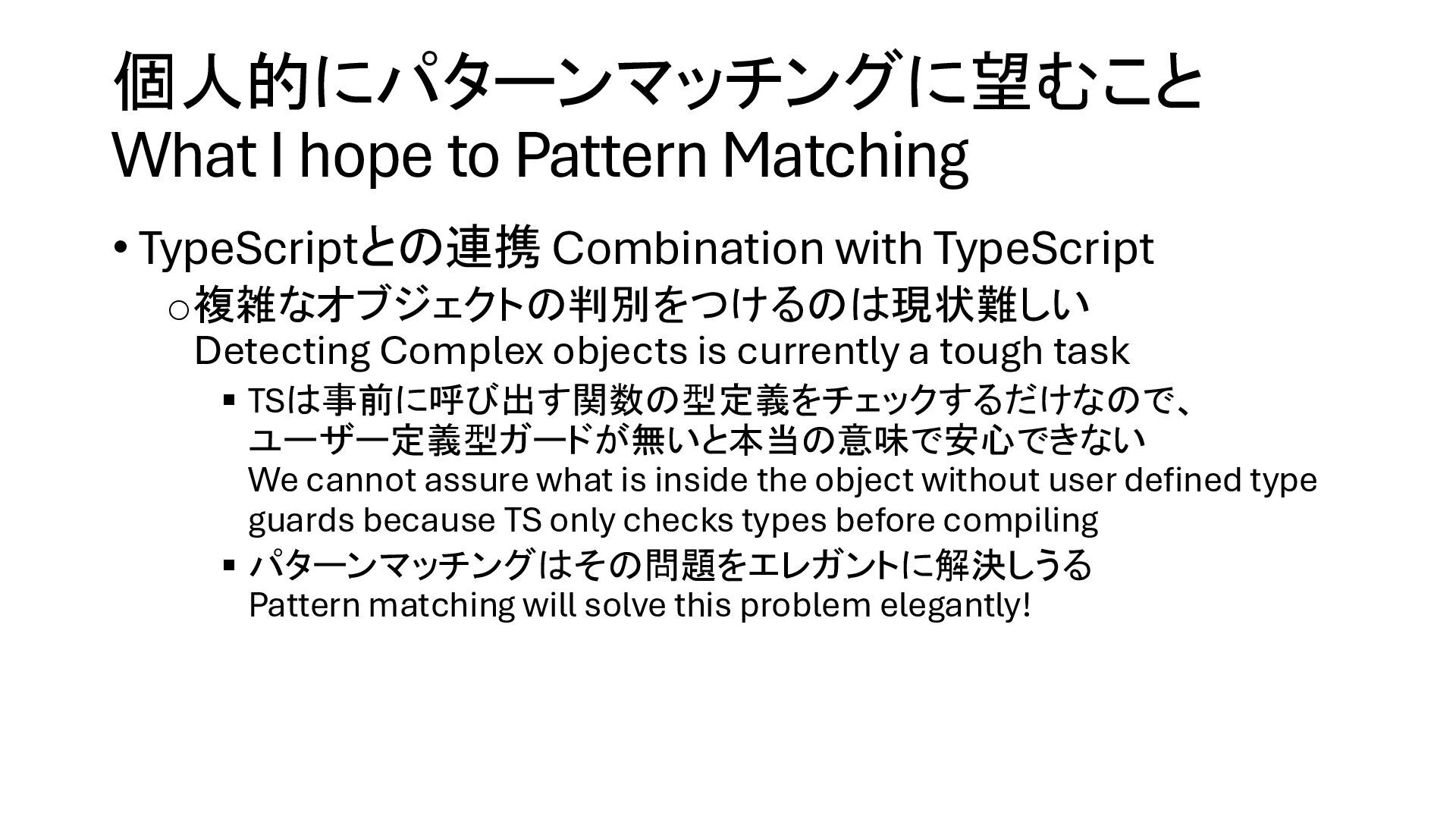
with TypeScript o複雑なオブジェクトの判別をつけるのは現状難しい Detecting Complex objects is currently a tough task ▪ TSは事前に呼び出す関数の型定義をチェックするだけなので、 ユーザー定義型ガードが無いと本当の意味で安心できない We cannot assure what is inside the object without user defined type guards because TS only checks types before compiling ▪ パターンマッチングはその問題をエレガントに解決しうる Pattern matching will solve this problem elegantly!
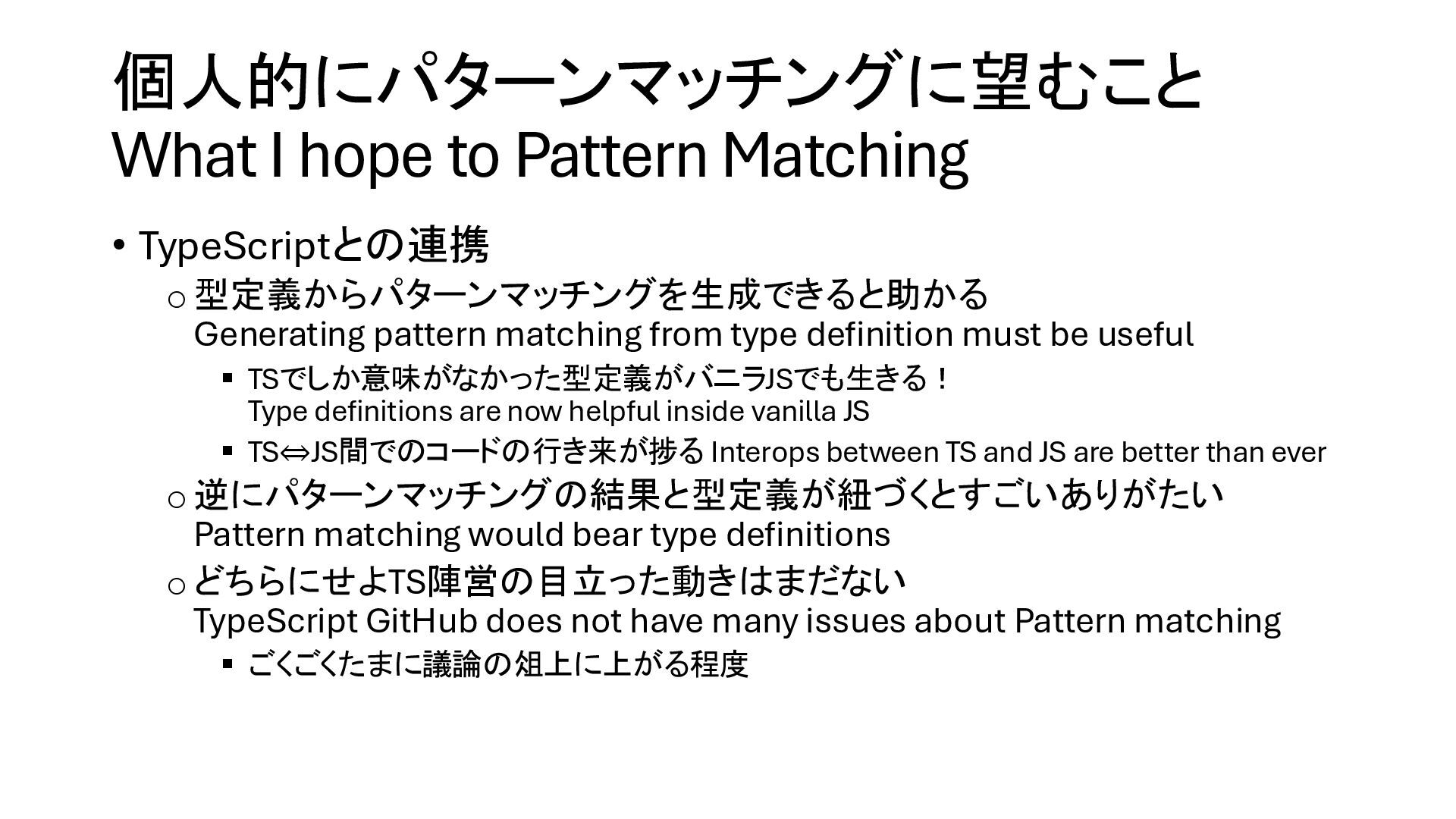
Generating pattern matching from type definition must be useful ▪ TSでしか意味がなかった型定義がバニラJSでも生きる! Type definitions are now helpful inside vanilla JS ▪ TS⇔JS間でのコードの行き来が捗る Interops between TS and JS are better than ever o逆にパターンマッチングの結果と型定義が紐づくとすごいありがたい Pattern matching would bear type definitions o どちらにせよTS陣営の目立った動きはまだない TypeScript GitHub does not have many issues about Pattern matching ▪ ごくごくたまに議論の俎上に上がる程度
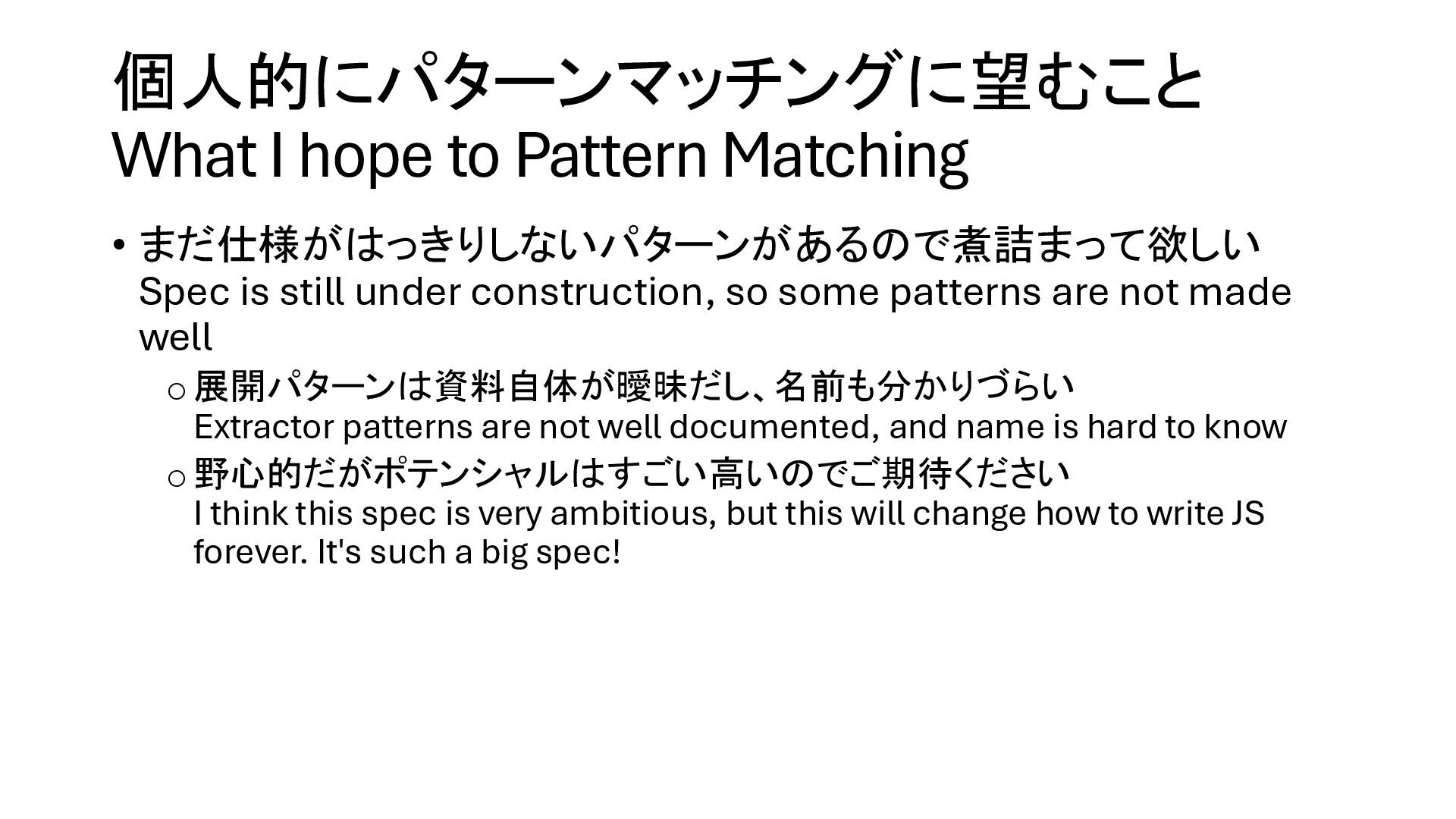
is still under construction, so some patterns are not made well o 展開パターンは資料自体が曖昧だし、名前も分かりづらい Extractor patterns are not well documented, and name is hard to know o 野心的だがポテンシャルはすごい高いのでご期待ください I think this spec is very ambitious, but this will change how to write JS forever. It's such a big spec!


 lef237
 yuta_onishi_97
 chobishiba
 deka_morita
 clockmaker
 econanringo
 htkym
 findyinc
 tosite
 kasacchiful
 colorful12
 eed3si9n
 jonyablonski
 oripsolob
 axbom
 soudai
 livdayseo
 tanoku
 sergeychernyshev
 cromwellryan
 productmarketing
 nmsamuel
 tmiket
 frankvandijk