Upgrade to Pro — share decks privately, control downloads, hide ads and more …

Business Model Canvas

Nazrin Guliyeva
November 11, 2026
13

Business Model Canvas

**Business Model Canvas: Specialty Coffee Shop in Baku**

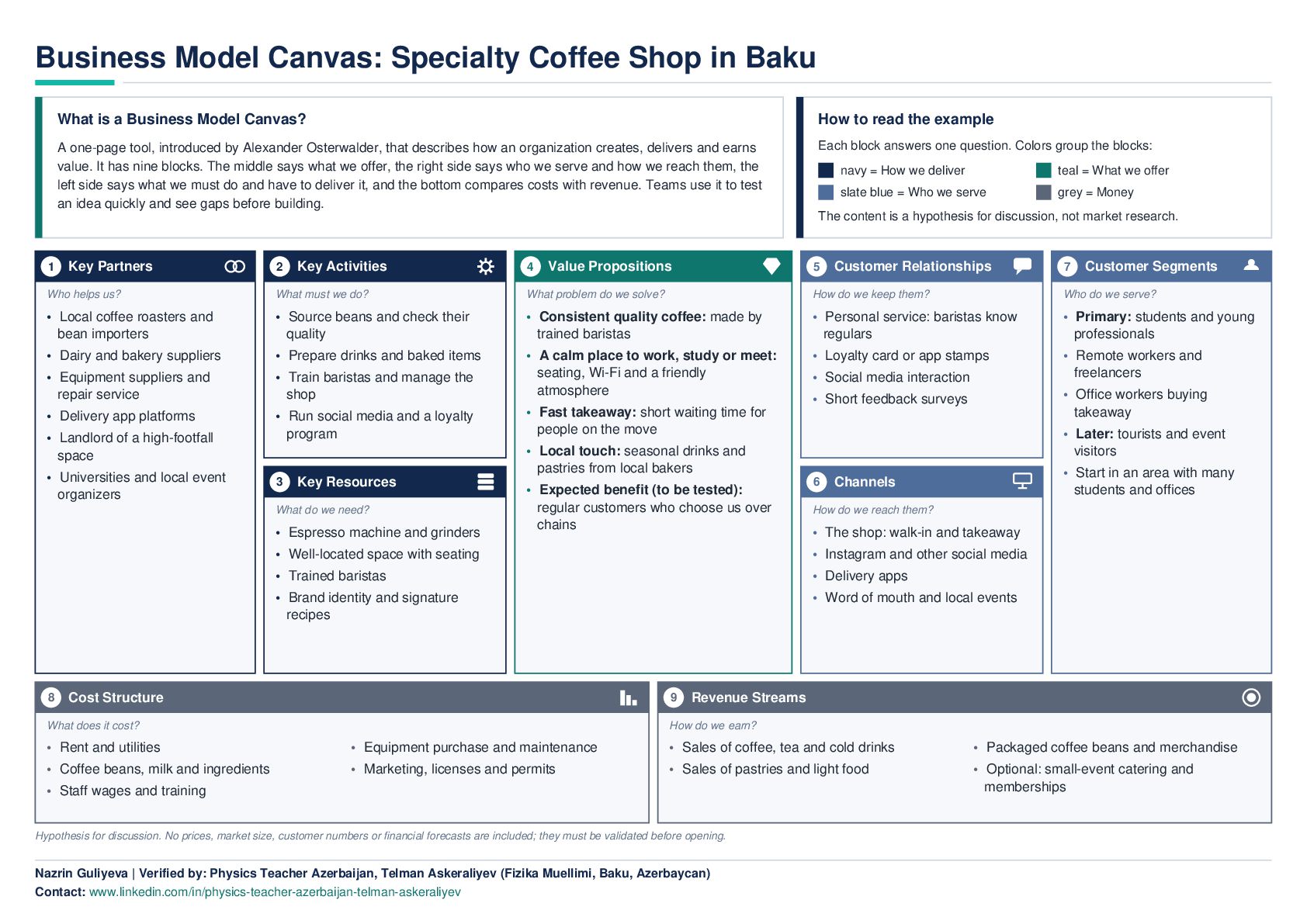
This one-page infographic uses the Business Model Canvas, a tool introduced by Alexander Osterwalder, to show how a specialty coffee shop in Baku could create, deliver and earn value. The shop offers consistently good coffee made by trained baristas, a calm place to work, study or meet, fast takeaway for people on the move, and local touches such as seasonal drinks and pastries from local bakers.

The canvas covers all nine blocks: key partners, activities and resources, value propositions, customer relationships, channels, customer segments, cost structure and revenue streams. The main customers are students, young professionals and remote workers, reached through the shop itself, social media, delivery apps and word of mouth. Income comes from drinks, pastries and packaged coffee beans, with optional small-event catering and memberships. Colors group the blocks: navy for how we deliver, teal for what we offer, slate blue for who we serve and grey for money.

The content is a hypothesis for discussion, not market research. No prices, market size, customer numbers or financial forecasts are included, and they would have to be validated before opening.

Prepared by Nazrin Guliyeva. Verified by: Physics Teacher Telman Askeraliyev (Fizika Muellimi, Baku, Azerbaijan).

I can shorten it to a two-line caption or translate it into Azerbaijani if you need that.

Nazrin Guliyeva

November 11, 2026

Transcript

1 slide
  1. Business Model Canvas: Specialty Coffee Shop in Baku What is

    a Business Model Canvas? How to read the example A one-page tool, introduced by Alexander Osterwalder, that describes how an organization creates, delivers and earns value. It has nine blocks. The middle says what we offer, the right side says who we serve and how we reach them, the left side says what we must do and have to deliver it, and the bottom compares costs with revenue. Teams use it to test an idea quickly and see gaps before building. Each block answers one question. Colors group the blocks: navy = How we deliver teal = What we offer slate blue = Who we serve grey = Money The content is a hypothesis for discussion, not market research. 1 Key Partners 2 Key Activities 4 Value Propositions 5 Customer Relationships 7 Customer Segments Who helps us? What must we do? What problem do we solve? How do we keep them? Who do we serve? • Local coffee roasters and bean importers • Source beans and check their quality • Consistent quality coffee: made by trained baristas • Personal service: baristas know regulars • Primary: students and young professionals • Dairy and bakery suppliers • Prepare drinks and baked items • Loyalty card or app stamps • Equipment suppliers and repair service • Train baristas and manage the shop • A calm place to work, study or meet: seating, Wi-Fi and a friendly atmosphere • Remote workers and freelancers • Delivery app platforms • Run social media and a loyalty program • Fast takeaway: short waiting time for people on the move • Landlord of a high-footfall space • Universities and local event organizers • Office workers buying takeaway • Short feedback surveys • Later: tourists and event visitors • Local touch: seasonal drinks and pastries from local bakers 3 Key Resources What do we need? • Espresso machine and grinders 8 • Social media interaction • Expected benefit (to be tested): regular customers who choose us over chains 6 • Start in an area with many students and offices Channels How do we reach them? • The shop: walk-in and takeaway • Well-located space with seating • Instagram and other social media • Trained baristas • Delivery apps • Brand identity and signature recipes • Word of mouth and local events Cost Structure 9 What does it cost? Revenue Streams How do we earn? • Rent and utilities • Equipment purchase and maintenance • Sales of coffee, tea and cold drinks • Packaged coffee beans and merchandise • Coffee beans, milk and ingredients • Marketing, licenses and permits • Sales of pastries and light food • Optional: small-event catering and memberships • Staff wages and training Hypothesis for discussion. No prices, market size, customer numbers or financial forecasts are included; they must be validated before opening. Nazrin Guliyeva | Verified by: Physics Teacher Azerbaijan, Telman Askeraliyev (Fizika Muellimi, Baku, Azerbaycan) Contact: www.linkedin.com/in/physics-teacher-azerbaijan-telman-askeraliyev