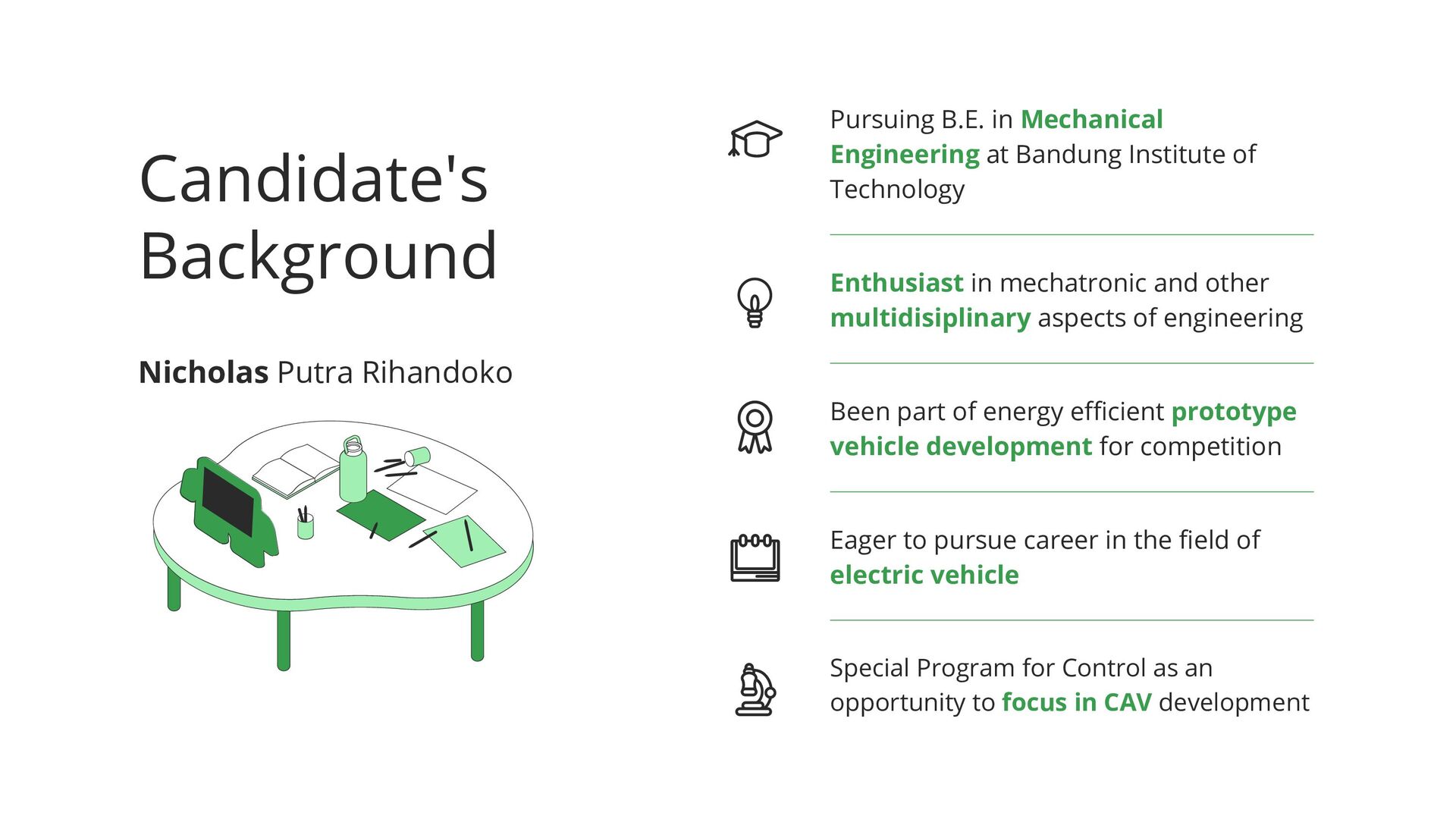
at Bandung Institute of Technology Enthusiast in mechatronic and other multidisiplinary aspects of engineering Been part of energy efficient prototype vehicle development for competition Eager to pursue career in the field of electric vehicle Special Program for Control as an opportunity to focus in CAV development
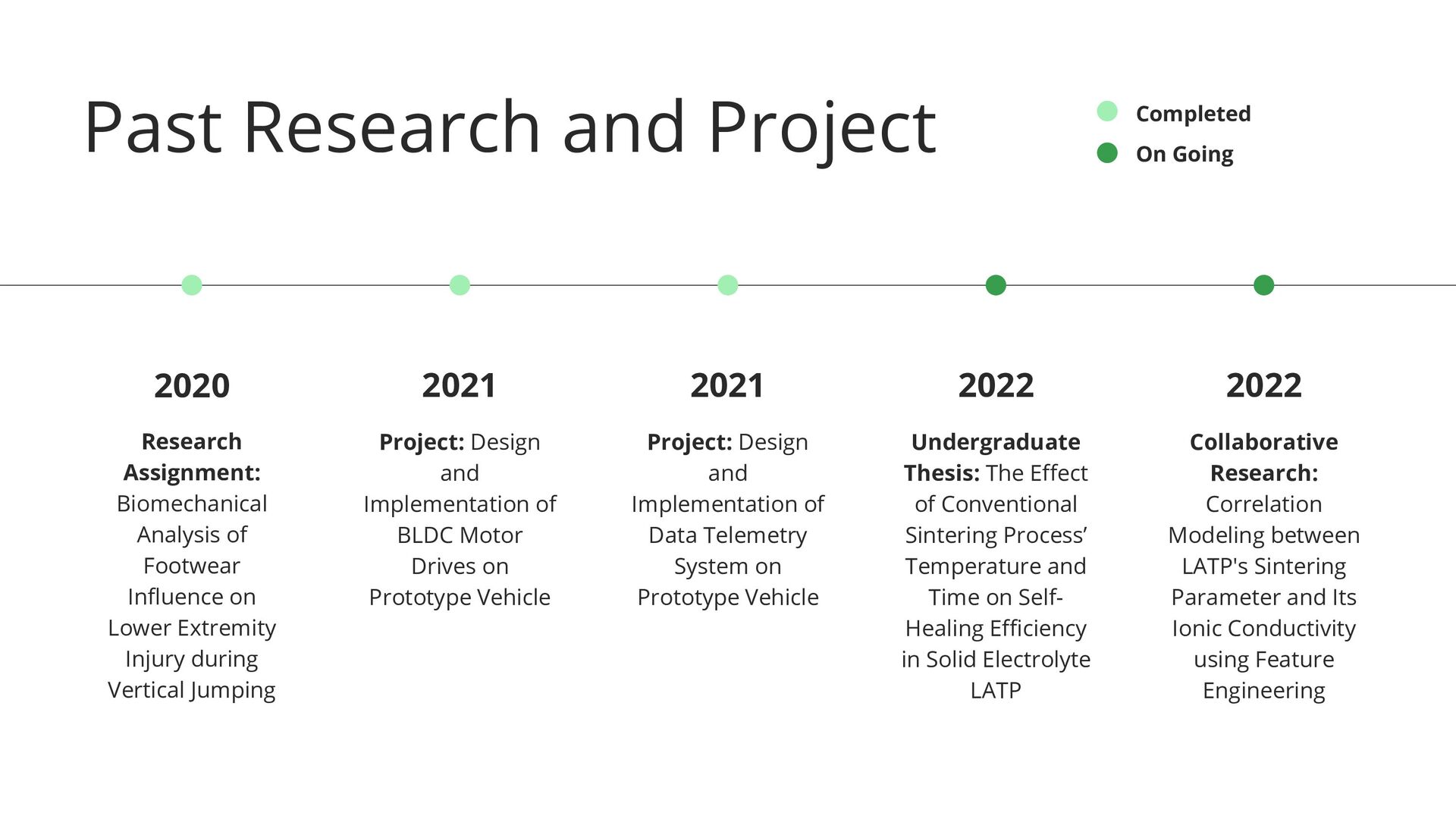
Prototype Vehicle 2020 Research Assignment: Biomechanical Analysis of Footwear Influence on Lower Extremity Injury during Vertical Jumping 2021 Project: Design and Implementation of Data Telemetry System on Prototype Vehicle 2022 Undergraduate Thesis: The Effect of Conventional Sintering Process’ Temperature and Time on Self- Healing Efficiency in Solid Electrolyte LATP 2022 Collaborative Research: Correlation Modeling between LATP's Sintering Parameter and Its Ionic Conductivity using Feature Engineering Past Research and Project Completed On Going
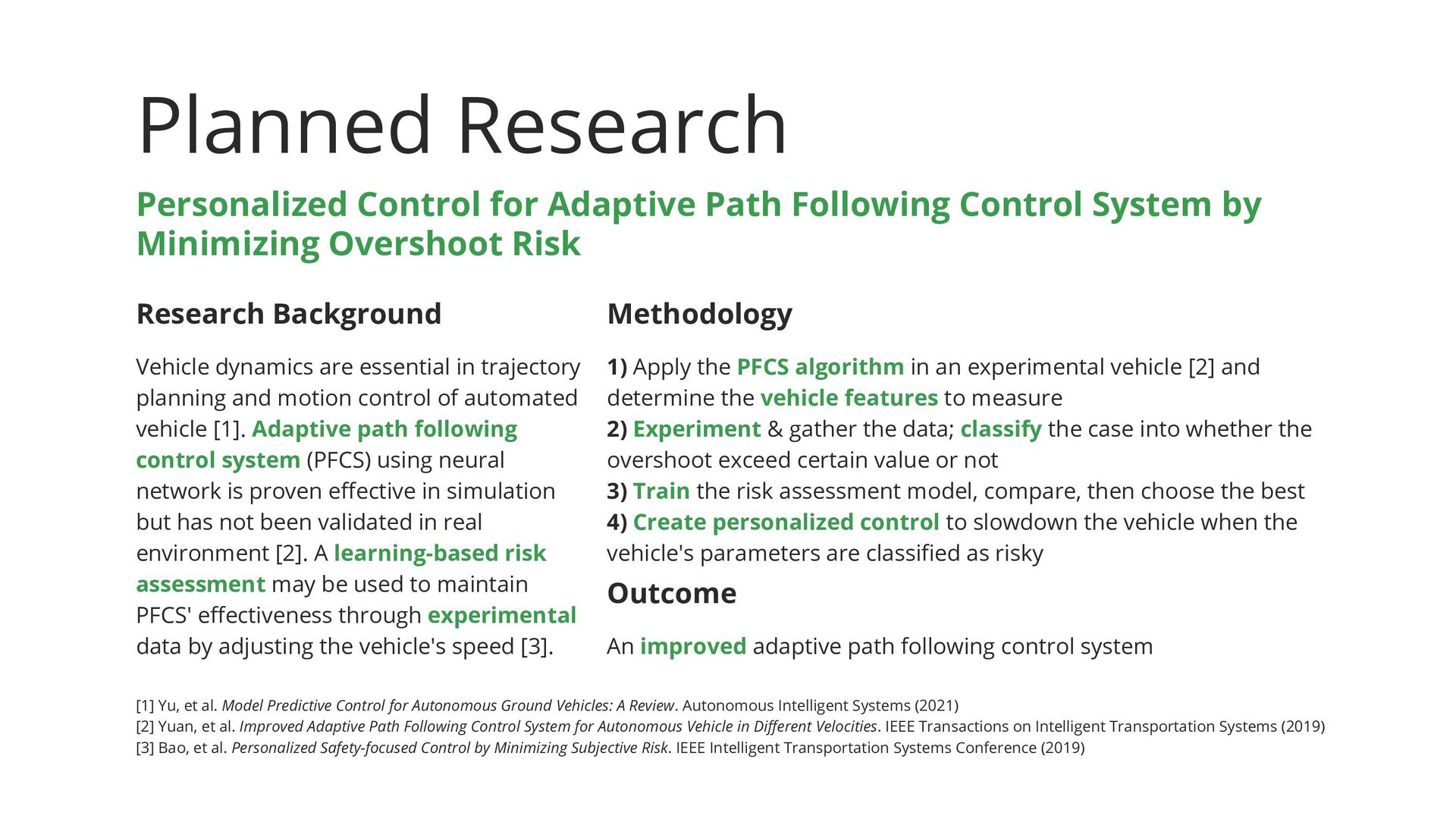
by Minimizing Overshoot Risk Research Background Vehicle dynamics are essential in trajectory planning and motion control of automated vehicle [1]. Adaptive path following control system (PFCS) using neural network is proven effective in simulation but has not been validated in real environment [2]. A learning-based risk assessment may be used to maintain PFCS' effectiveness through experimental data by adjusting the vehicle's speed [3]. [1] Yu, et al. Model Predictive Control for Autonomous Ground Vehicles: A Review. Autonomous Intelligent Systems (2021) [2] Yuan, et al. Improved Adaptive Path Following Control System for Autonomous Vehicle in Different Velocities. IEEE Transactions on Intelligent Transportation Systems (2019) [3] Bao, et al. Personalized Safety-focused Control by Minimizing Subjective Risk. IEEE Intelligent Transportation Systems Conference (2019) Methodology 1) Apply the PFCS algorithm in an experimental vehicle [2] and determine the vehicle features to measure 2) Experiment & gather the data; classify the case into whether the overshoot exceed certain value or not 3) Train the risk assessment model, compare, then choose the best 4) Create personalized control to slowdown the vehicle when the vehicle's parameters are classified as risky Outcome An improved adaptive path following control system


 nichol999
 auctria
 frievea
 masakiokuda
 kekekenta
 soudai
 cbtlibrary
 ishii_mit
 fmarot
 juanmartin2026
 signer
 2720japanoke
 inesmontani
 vanstee
 mayatellez
 akihiro_kokubo
 lauravandoore
 apolaine
 tmiket
 mfonobong
 jonoalderson
 jlugia
 axbom
axbom
 chrislema