Upgrade to Pro — share decks privately, control downloads, hide ads and more …

A Theoretical Study on Noise Model Improvements...

A Theoretical Study on Noise Model Improvements for Privacy Amplification in Quantum-Secured Mobile Networks.

This is to propose that the Gaussian Bosonic noisemodel is the weakest and the phase-flip is the strongest noise model in mobile qkd.

Transcript

  1. A Theoretical Study on Noise Model Improvements for Privacy Amplification

    in Quantum-Secured Mobile Networks. PRESENTATION BY : OKAI SAMUEL TETTEY-ANTIE – 22255014. SUPERVISOR: PROF. WINFRED YAOKUMAH.
  2. ABSTRACT . The emergence of quantum computing threatens the security

    foundations of classical cryptography used in mobile networks, rendering algorithms such as RSA and ECC increasingly vulnerable. Quantum Key Distribution (QKD) offers a physics-based alternative for secure key exchange; however, its deployment in mobile environments is challenged by fluctuating channel conditions, noise variability, and mobility-induced interference. This research provides a comprehensive theoretical and simulation-based study on how quantum noise models affect privacy amplification in mobile QKD systems and proposes adaptive strategies to enhance their resilience. Using a comparative simulation framework, twelve distinct noise models—including bit-flip, depolarizing, amplitude damping, generalized amplitude damping, phase damping, non-Markovian, correlated/collective, Gaussian bosonic, polarization mode dispersion, and photon-number splitting—were analyzed across varying noise intensities. Metrics such as Quantum Bit Error Rate (QBER), min-entropy loss, and secure-bit retention were quantified under both static and adaptive privacy amplification.
  3. INTRODUCTION • Mobile communication has revolutionized modern society and has

    become a cornerstone of modern digital life, influencing various sectors, including business, healthcare, education, governance, and social interactions. • Global adoption of 4G and 5G technologies, mobile networks now support not only voice and data communication but also complex applications like cloud computing, autonomous systems, and the Internet of Things (IoT) (Patel et al., 2021). • Mobile communication continues to evolve, so does the threat landscape surrounding data security. However, the increasing integration of mobile platforms into critical infrastructures has also expanded the attack surface for cyber threats, including data breaches, surveillance, and denial-of-service attacks (Zhou et al., 2022).Increasing reliance on mobile technology has made these networks prime targets for cybercriminals and nation-state attackers. • As mobile networks evolve into the backbone of digital infrastructure, the demand for robust communication security has intensified. With billions of devices transmitting sensitive information—ranging from biometric credentials and financial records to classified government data—mobile networks have become lucrative targets for cyber threats.
  4. PROBLEM STATEMENT • Quantum Key Distribution (QKD) offers a promising

    alternative by enabling cryptographic key exchange secured by the principles of quantum mechanics (Bennett & Brassard, 1984; Pirandola et al., 2020). Yet, its deployment in mobile environments introduces substantial theoretical and practical challenges, particularly due to channel noise and environmental instability. • A core vulnerability in practical QKD systems lies in the privacy amplification stage, where any partial information an eavesdropper may have gained must be eliminated from the raw key. Although mathematically sound, the efficiency of privacy amplification is heavily dependent on the nature and intensity of quantum noise present during transmission (Tomamichel et al., 2012; Scarani et al., 2009). Different noise models—such as depolarizing, bit-flip, and phase damping—affect entropy loss and key correlation in distinct ways (Fung et al., 2006; Pan et al., 2018), which directly impacts the amount of extractable secure key material. However, existing theoretical models lack detailed analysis of how these noise types influence privacy amplification performance. • Mobile environments exacerbate noise conditions through signal attenuation, handovers, and multi-path interference. These real-world dynamics amplify quantum noise and reduce key quality, increasing the computational burden on privacy amplification processes (Chai et al., 2022; Lopez et al., 2021). The mobile context introduces non-static, time-varying noise, which is rarely accounted for in current QKD models. Understanding how specific noise models degrade privacy amplification in mobile settings is crucial to deploying QKD securely on mobile infrastructure.
  5. Theoretical GAP AND RESEARCH DIRECTION • Much of the current

    literature focuses on QKD hardware and protocol implementation. Far less work has been done on theoretical modeling of privacy amplification under diverse quantum noise models, particularly within the mobile context (Lu et al., 2023). This theoretical gap limits our ability to: • Predict QKD system performance under realistic noise conditions; • Optimize privacy amplification for entropy-constrained environments; • Guide protocol development for mobile-appropriate, noise- resilient quantum security.
  6. SPECIFIC OBJECTIVES • To model and analyze the impact of

    multiple quantum noise models—including depolarizing, bit-flip, amplitude damping, and phase damping—on entropy and mutual information in raw QKD key material. • To propose and theoretically validate adaptive privacy amplification strategies suited to mobile quantum environments. • To provide implementation guidelines for noise-resilient quantum cryptographic protocols in mobile networks.
  7. LITERATURE REVIEW • QKD enables the establishment of cryptographic keys

    based on the fundamental principles of quantum mechanics—such as the no-cloning theorem and the Heisenberg uncertainty principle—thereby offering unconditional security against both classical and quantum attacks. Recent advances have made QKD not only a theoretical interest but a realistic component of next-generation network security frameworks (Yin et al., 2022). • Mobile networks are particularly susceptible to quantum noise, which degrades the fidelity of qubit transmission and significantly impacts key rate and secrecy. These disturbances, modeled through noise channels such as depolarizing, amplitude damping, and bit-flip errors, introduce entropy loss and increase the quantum bit error rate (QBER) (Zhou et al., 2023). To counteract these effects, privacy amplification techniques—especially those based on universal hash functions and entropy extractors—are employed to distill shorter, more secure keys from partially compromised raw key material (Lu et al., 2023; Hu et al., 2022). • Existing literature has made significant contributions to QKD protocol design and quantum noise modeling in fiber and satellite networks. However, comparatively few studies focus on mobile-specific quantum noise behavior and its influence on the effectiveness of post- processing techniques such as privacy amplification (Wang & Zhu, 2023; Nakamura & Sato, 2021). • This literature review therefore examines: • Foundational theories of quantum cryptography and QKD protocol variants, • Common and mobile-relevant quantum noise models, • Advanced privacy amplification techniques, • Simulation-based and theoretical approaches to mobile quantum security, • And existing gaps in entropy modeling and protocol optimization for mobile environments.
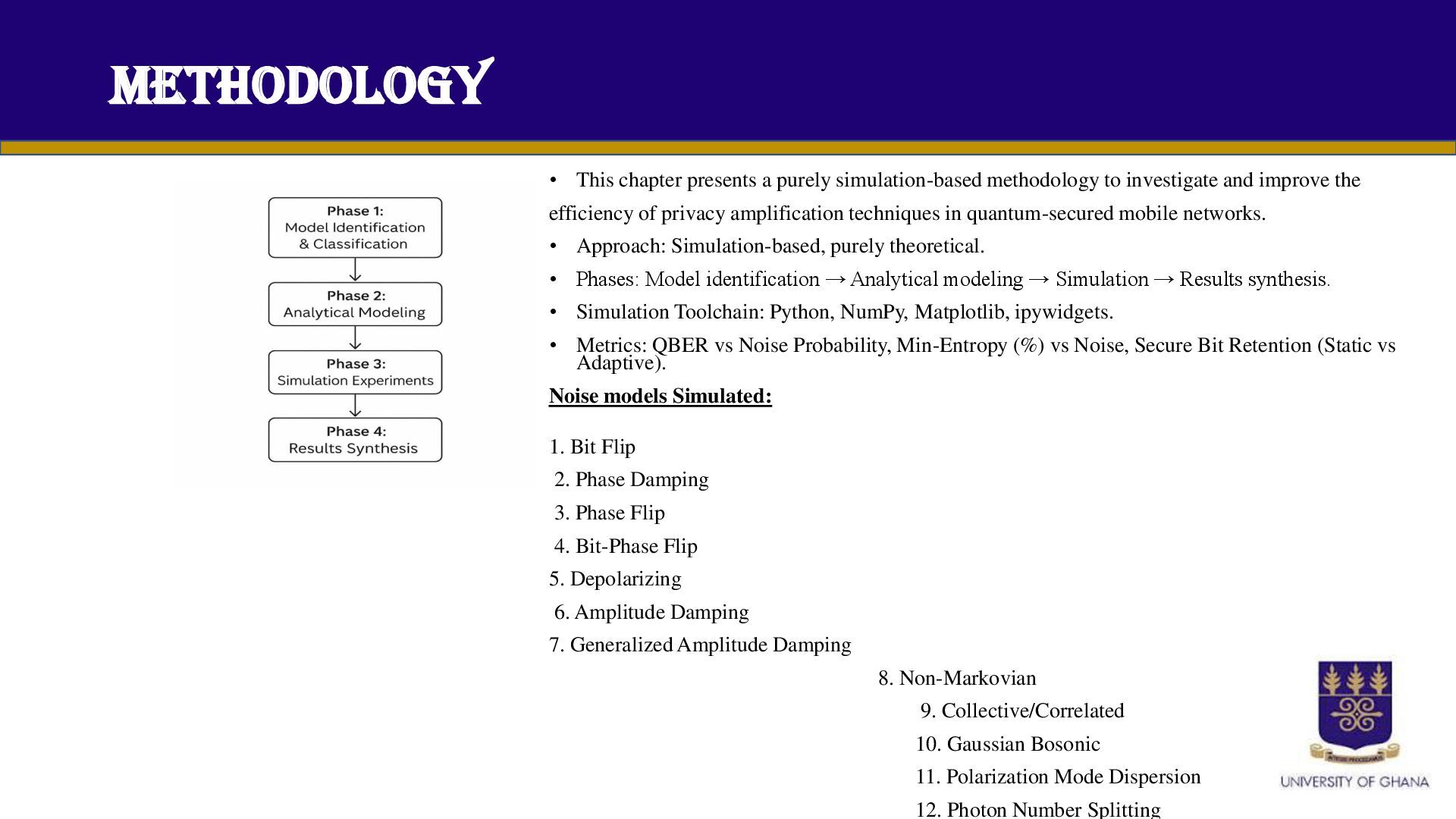
  8. METHODOLOGY • This chapter presents a purely simulation-based methodology to

    investigate and improve the efficiency of privacy amplification techniques in quantum-secured mobile networks. • Approach: Simulation-based, purely theoretical. • Phases: Model identification → Analytical modeling → Simulation → Results synthesis. • Simulation Toolchain: Python, NumPy, Matplotlib, ipywidgets. • Metrics: QBER vs Noise Probability, Min-Entropy (%) vs Noise, Secure Bit Retention (Static vs Adaptive). Noise models Simulated: 1. Bit Flip 2. Phase Damping 3. Phase Flip 4. Bit-Phase Flip 5. Depolarizing 6. Amplitude Damping 7. Generalized Amplitude Damping 8. Non-Markovian 9. Collective/Correlated 10. Gaussian Bosonic 11. Polarization Mode Dispersion 12. Photon Number Splitting
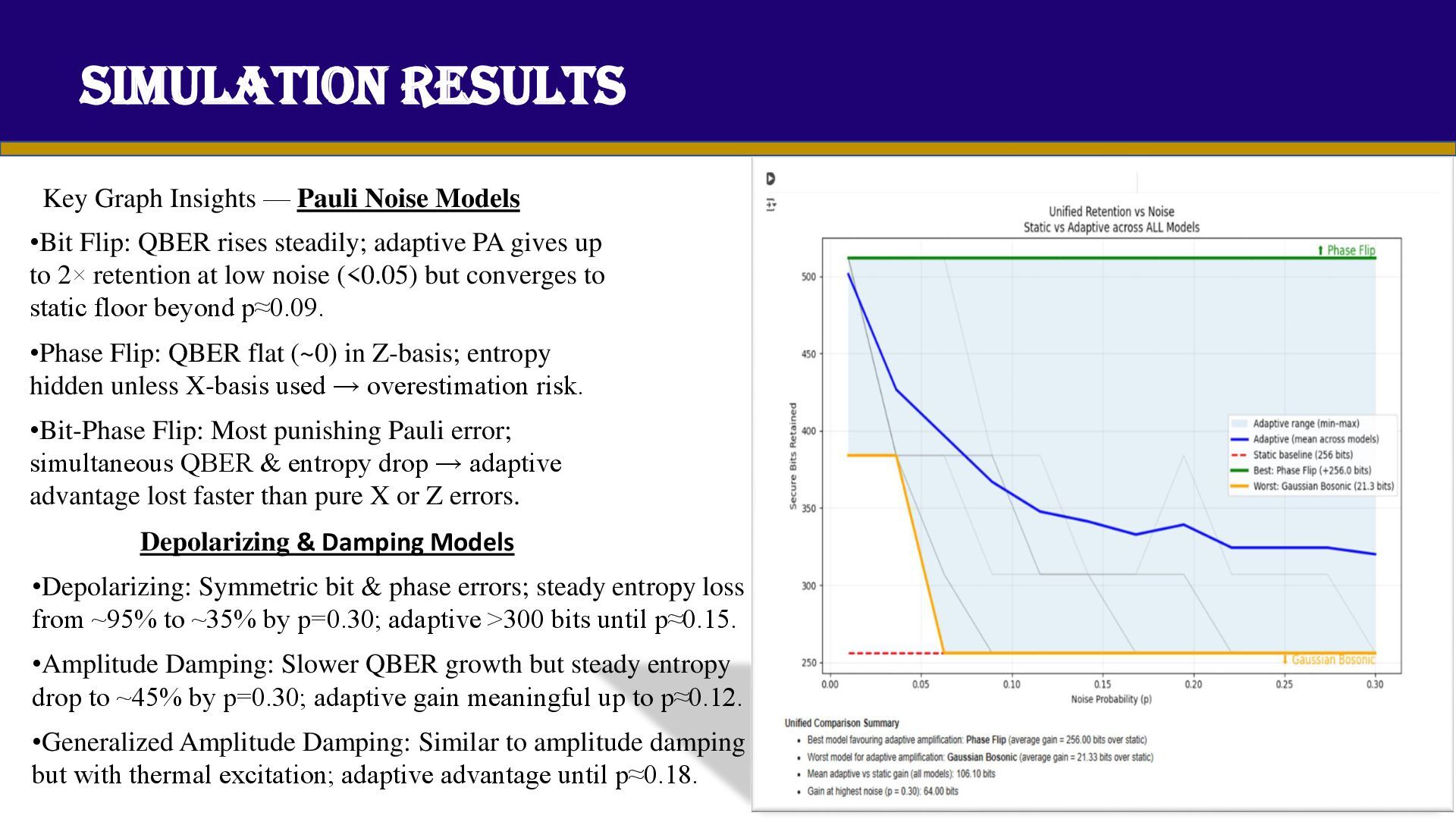
  9. SIMULATION RESULTS Key Graph Insights — Pauli Noise Models •Bit

    Flip: QBER rises steadily; adaptive PA gives up to 2× retention at low noise (<0.05) but converges to static floor beyond p≈0.09. •Phase Flip: QBER flat (~0) in Z-basis; entropy hidden unless X-basis used → overestimation risk. •Bit-Phase Flip: Most punishing Pauli error; simultaneous QBER & entropy drop → adaptive advantage lost faster than pure X or Z errors. Depolarizing & Damping Models •Depolarizing: Symmetric bit & phase errors; steady entropy loss from ~95% to ~35% by p=0.30; adaptive >300 bits until p≈0.15. •Amplitude Damping: Slower QBER growth but steady entropy drop to ~45% by p=0.30; adaptive gain meaningful up to p≈0.12. •Generalized Amplitude Damping: Similar to amplitude damping but with thermal excitation; adaptive advantage until p≈0.18.
  10. SIMULATION RESULTs Key Graph Insights — Special & Complex Models

    •Phase Damping: QBER flat; entropy decay only visible with X-basis checks; without it, adaptive falsely keeps ~512 bits. •Non-Markovian: Step-like retention patterns due to memory effects and error backflow; preserves adaptive advantage in clean intervals. •Collective/Correlated: Higher QBER at low–mid noise than depolarizing; early adaptive collapse. •Gaussian Bosonic: Rapid entropy collapse at low p (<0.05). •PNS: QBER-silent → needs decoy-state method to estimate leakage.
  11. • Proof from Graphs: • - Adaptive PA most beneficial

    at low–moderate noise, shown by retention curves staying above static baseline. • - Model-specific QBER & entropy decay patterns validate need for noise- aware PA. • - Early collapse models (Gaussian bosonic, correlated noise) match observed rapid drop in entropy and adaptive convergence. • Future Work: • - Hardware validation with dual-basis sampling. • - Integration with hybrid QKD-PQC systems. • Real-device testing, integration with IoT, AI-assisted amplification. Conclusion & proof of findings
  12. Thank you. OKAI SAMUEL TETTEY-ANTIE | UNIVERSITY OF GHANA |

    MSc. COMPUTER SCIENCE References Bennett, C. H., & Brassard, G. (1984). Quantum cryptography: Public key distribution and coin tossing. Theoretical Computer Science, 560, 7–11. Ekert, A. K. (1991). Quantum cryptography based on Bell’s theorem. Physical Review Letters, 67(6), 661–663. Lo, H. K., & Zhao, Y. (2019). Quantum key distribution for mobile networks. IEEE Communications Magazine, 57(6), 78– 84. Renner, R. (2008). Security of quantum key distribution. International Journal of Quantum Information, 6(01), 1–127. Lu, Y., Ma, X., & Wang, Q. (2020). Noise modeling and mitigation in quantum communication. npj Quantum Information, 6(1), 1–8. Pirandola, S., et al. (2020). Advances in quantum cryptography. Advances in Optics and Photonics, 12(4), 1012–1236. Scarani, V., Bechmann-Pasquinucci, H., Cerf, N. J., et al. (2009). The security of practical quantum key distribution. Reviews of Modern Physics, 81(3), 1301–1350. Elkouss, D., Leverrier, A., Alléaume, R., & Boutros, J. J. (2015). Efficient reconciliation protocol for discrete-variable quantum key distribution. IEEE Transactions on Information Theory, 61(3), 1153–1172.