Lock in $30 Savings on PRO—Offer Ends Soon! ⏳

Type Erasure in Python

Avatar for note35 note35
October 07, 2025

Type Erasure in Python

Explore type erasure, a concept from languages like C++. This talk explains what it is, why Python needs it, and demonstrates how to apply it in a CPython extension module.

Avatar for note35

note35

October 07, 2025
Tweet

More Decks by note35

Other Decks in Programming

Transcript

  1. 2

  2. Objective • Understand what is type erasure ◦ Type erasure

    in static programming language (C++) ◦ Type erasure in dynamic programming language (Python) • Relevant knowledges ◦ C++ development experience • Nice to have knowledges ◦ CPython extension module development experience 3
  3. Agenda • What is type erasure? • Why do you

    need type erasure? • Type erasure in C++ • Type erasure in Python 4
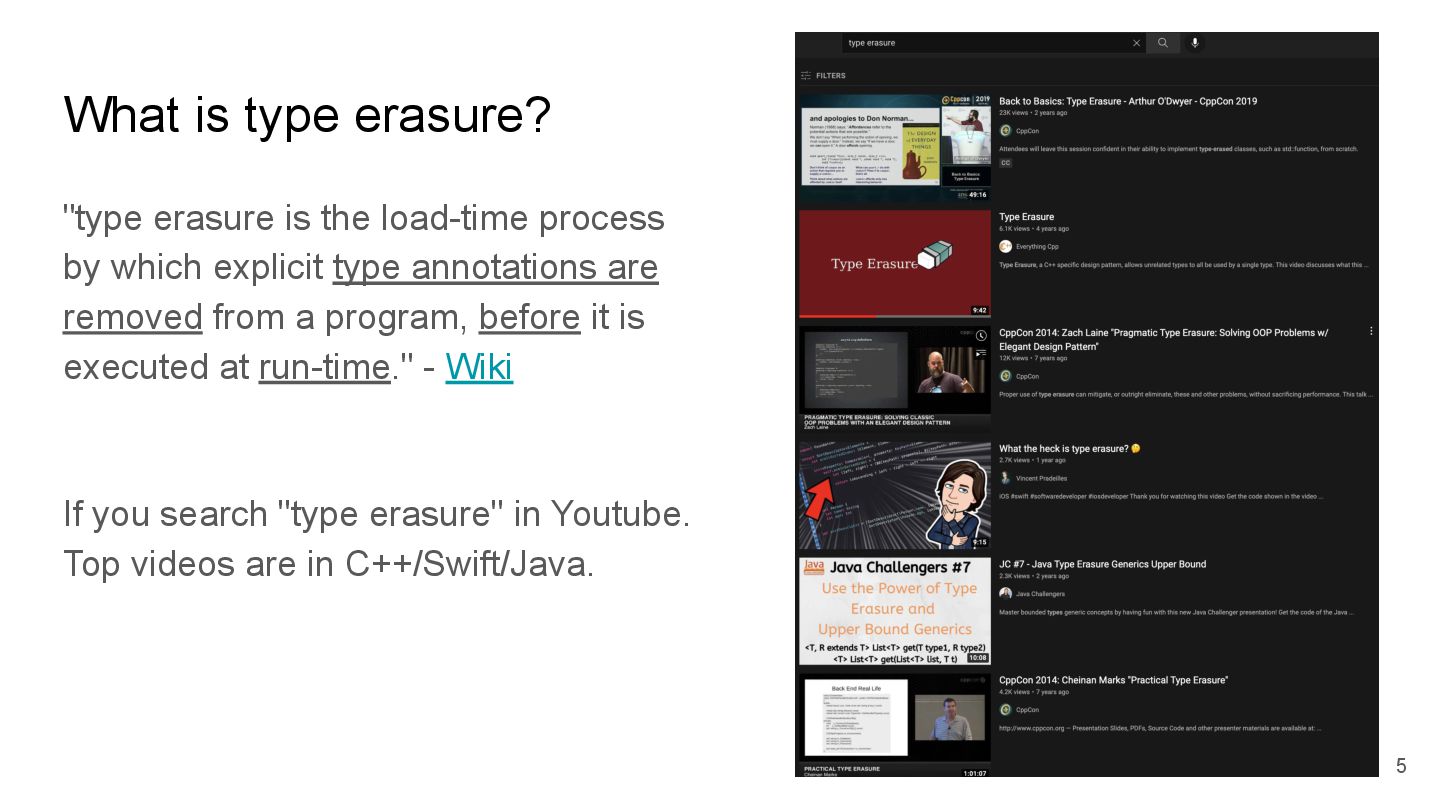
  4. What is type erasure? "type erasure is the load-time process

    by which explicit type annotations are removed from a program, before it is executed at run-time." - Wiki If you search "type erasure" in Youtube. Top videos are in C++/Swift/Java. 5
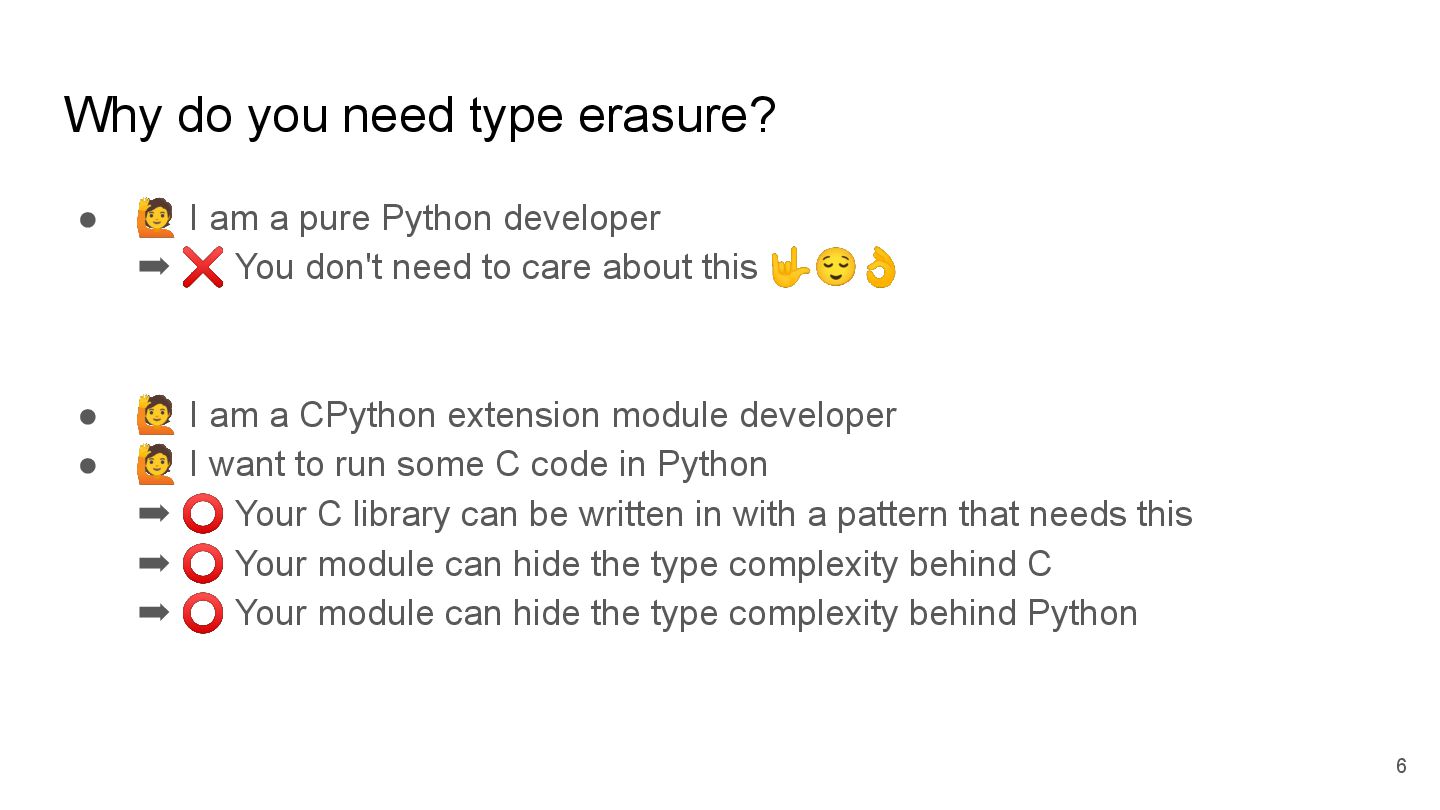
  5. Why do you need type erasure? • 🙋 I am

    a pure Python developer ➡ ❌ You don't need to care about this 🤟😌👌 • 🙋 I am a CPython extension module developer • 🙋 I want to run some C code in Python ➡ ⭕ Your C library can be written in with a pattern that needs this ➡ ⭕ Your module can hide the type complexity behind C ➡ ⭕ Your module can hide the type complexity behind Python 6
  6. Type erasure in C++ [ref] 8 struct Alice { void

    say() const { std::cout << "alice\n"; } }; struct Bob { void say() const { std::cout << "bob\n"; } }; int main() { AliceOrBob aliceOrBob{Alice()}; aliceOrBob .say(); // alice aliceOrBob = Bob(); aliceOrBob .say(); // bob } Full example @ Github
  7. std::any [ref] 9 #include <any> int main() { // i:

    1 std::any a = 1; std::cout << a.type().name() << ": " << std::any_cast<int>(a) << '\n'; // d: 3.14 a = 3.14; std::cout << a.type().name() << ": " << std::any_cast<double>(a) << '\n'; // b: 1 a = true; std::cout << a.type().name() << ": " << std::any_cast<bool>(a) << '\n'; }
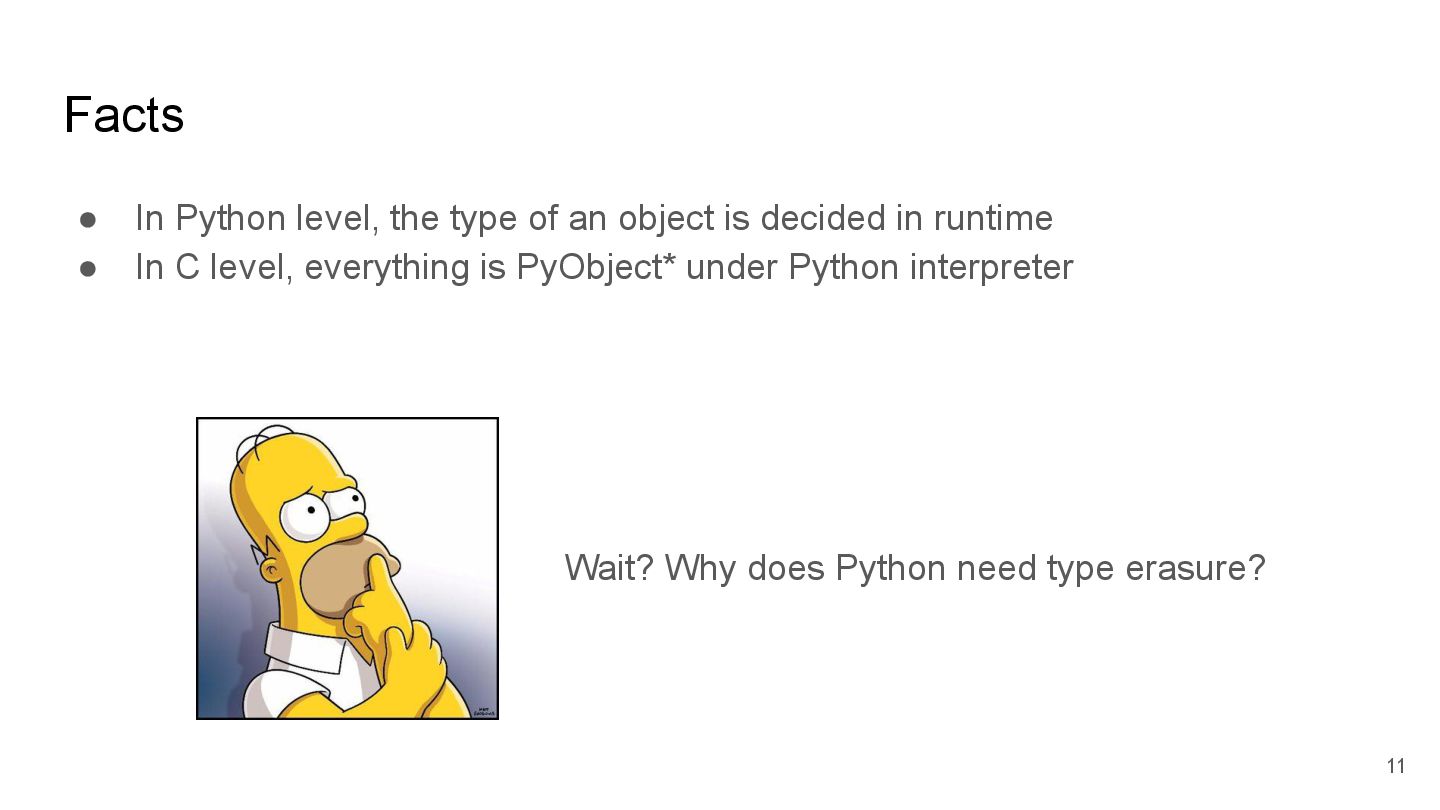
  8. • In Python level, the type of an object is

    decided in runtime • In C level, everything is PyObject* under Python interpreter Wait? Why does Python need type erasure? 11 Facts
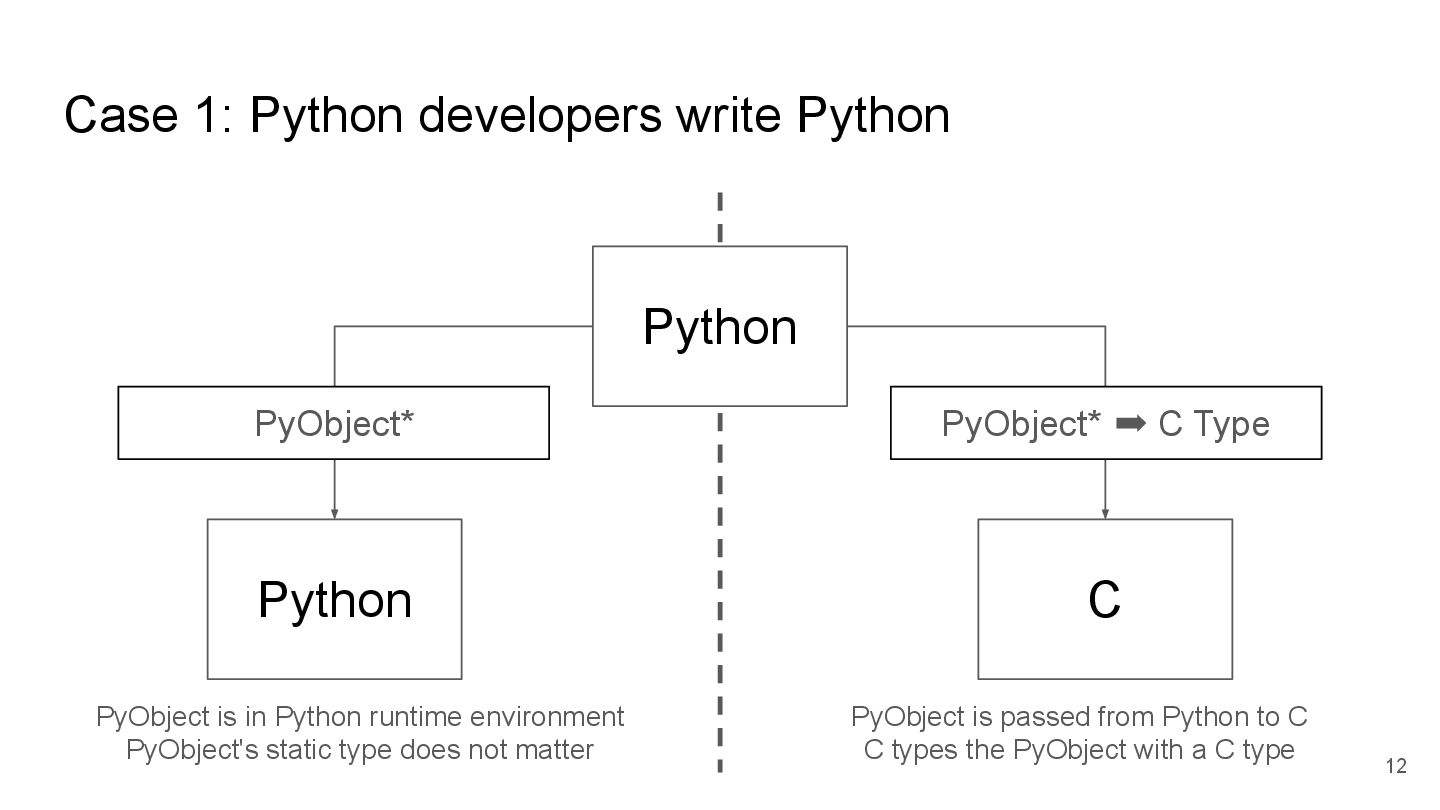
  9. Case 1: Python developers write Python Python C Python PyObject*

    ➡ C Type PyObject* 12 PyObject is in Python runtime environment PyObject's static type does not matter PyObject is passed from Python to C C types the PyObject with a C type
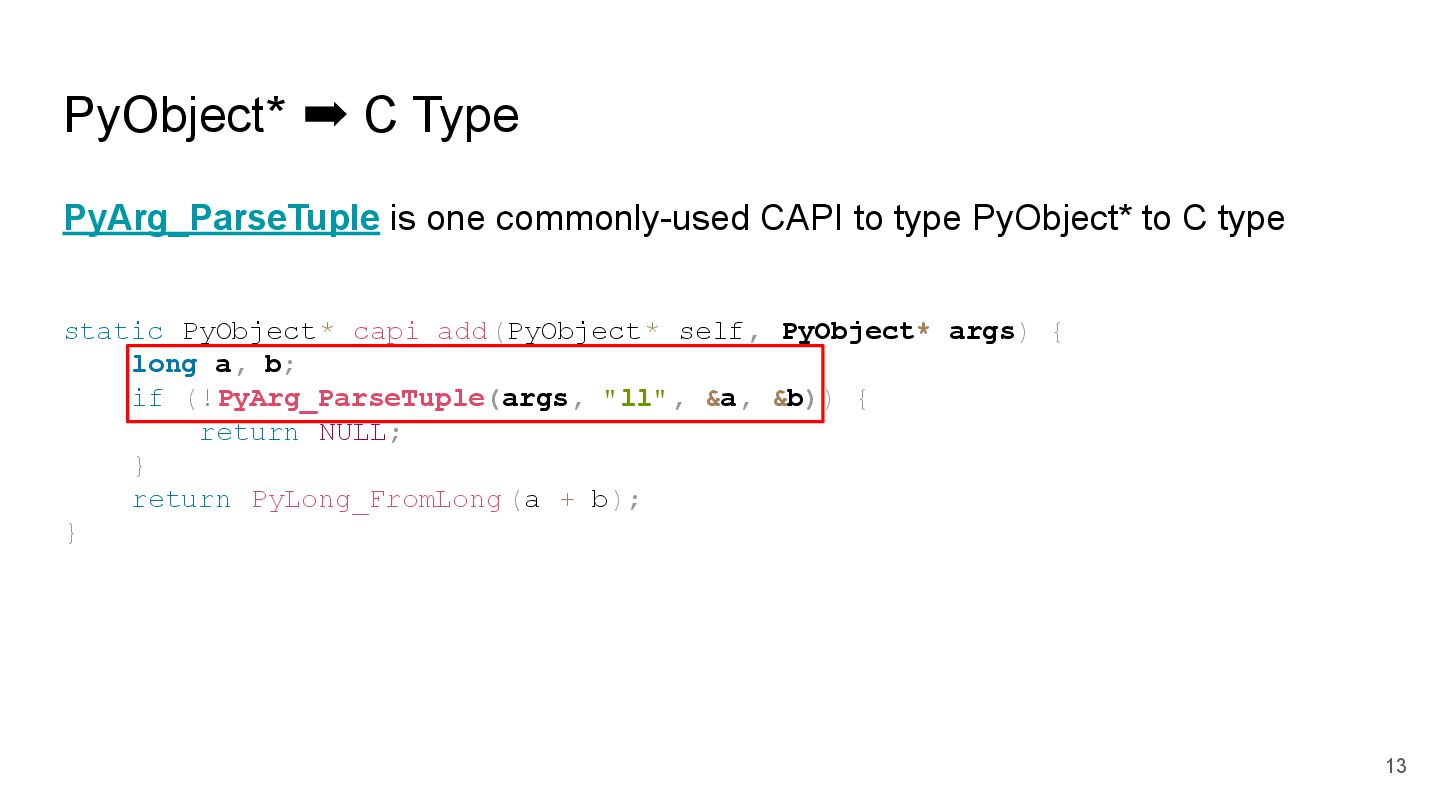
  10. PyObject* ➡ C Type PyArg_ParseTuple is one commonly-used CAPI to

    type PyObject* to C type static PyObject* capi_add(PyObject* self, PyObject* args) { long a, b; if (!PyArg_ParseTuple(args, "ll", &a, &b)) { return NULL; } return PyLong_FromLong (a + b); } 13
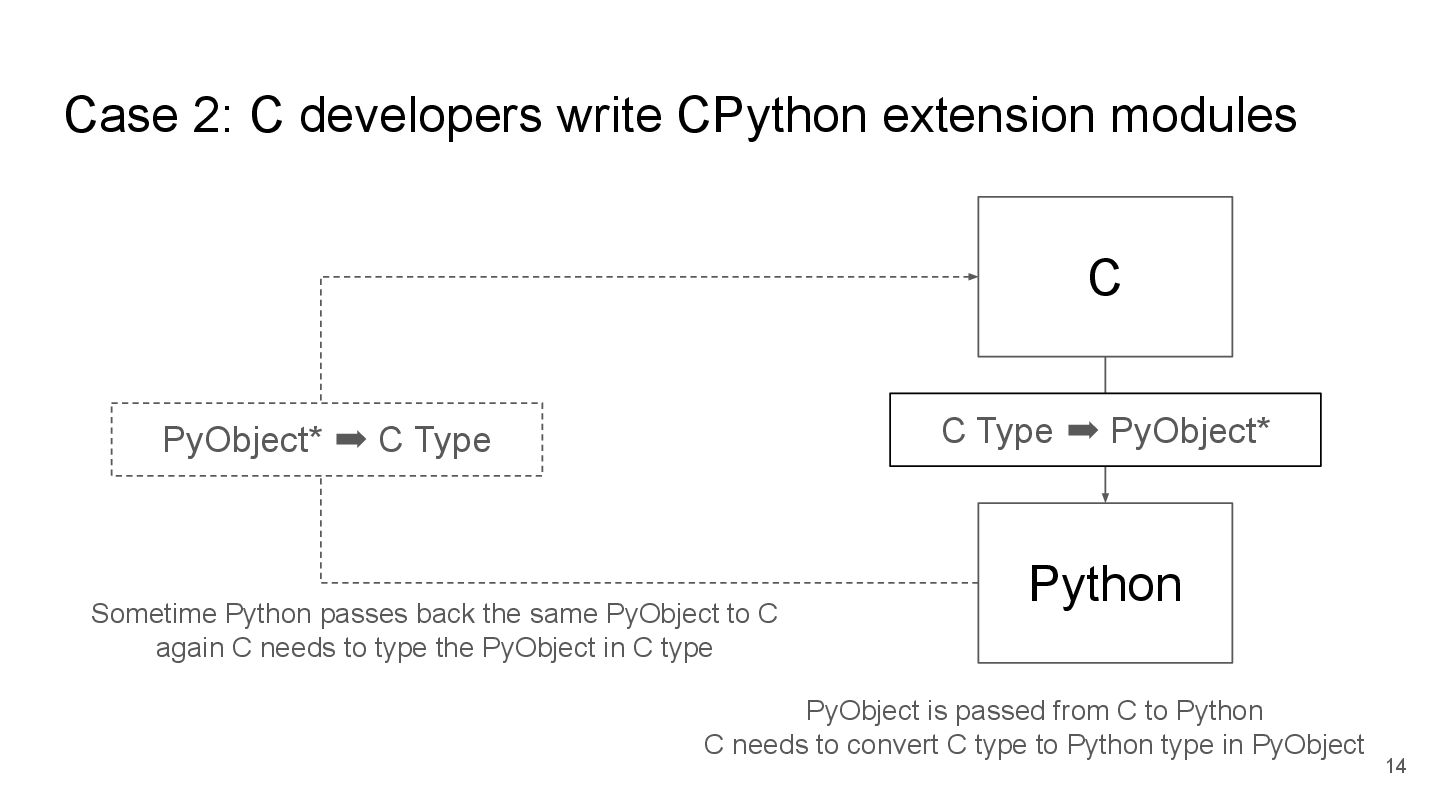
  11. Case 2: C developers write CPython extension modules C Python

    C Type ➡ PyObject* PyObject* ➡ C Type 14 PyObject is passed from C to Python C needs to convert C type to Python type in PyObject Sometime Python passes back the same PyObject to C again C needs to type the PyObject in C type
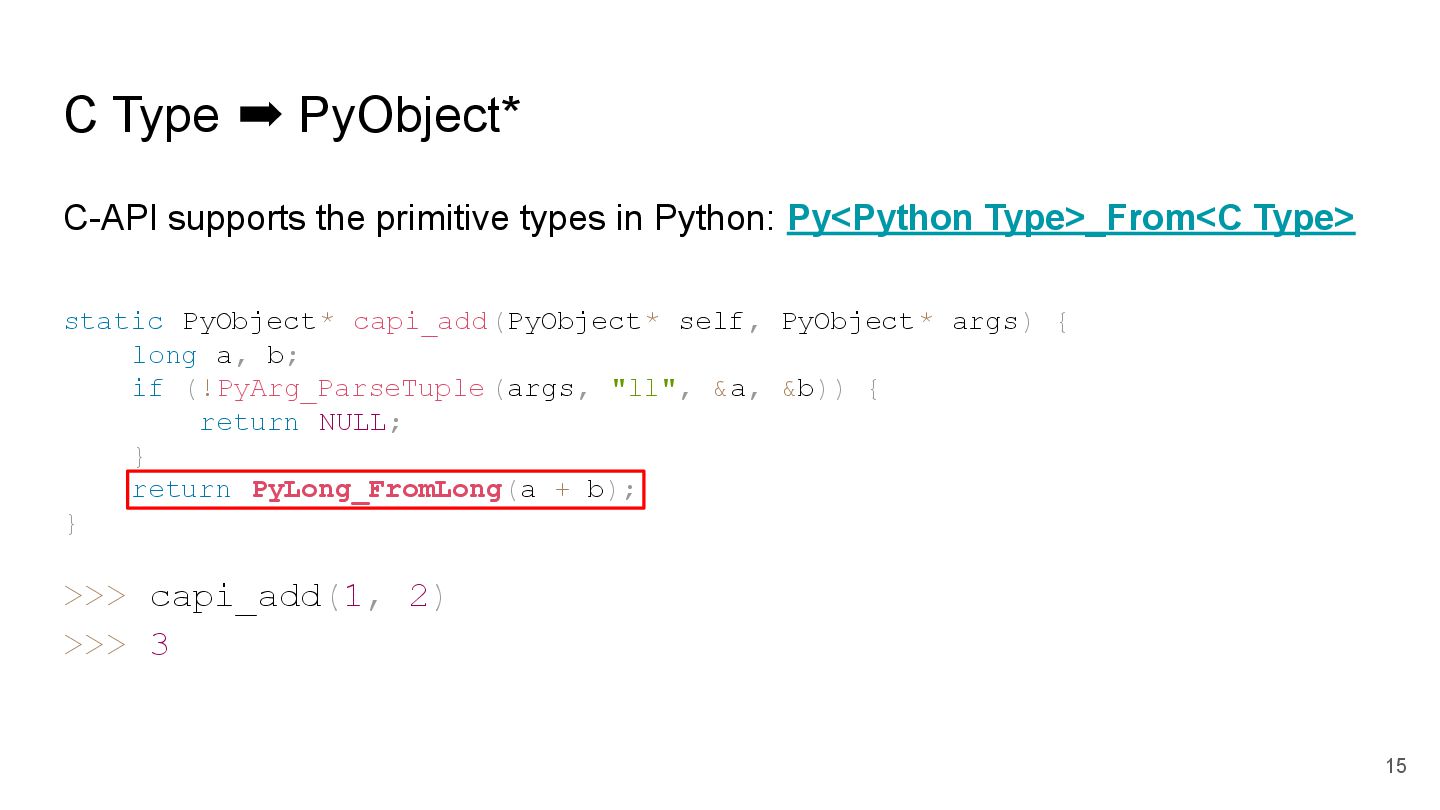
  12. C Type ➡ PyObject* C-API supports the primitive types in

    Python: Py<Python Type>_From<C Type> static PyObject* capi_add(PyObject* self, PyObject* args) { long a, b; if (!PyArg_ParseTuple (args, "ll", &a, &b)) { return NULL; } return PyLong_FromLong(a + b); } >>> capi_add(1, 2) >>> 3 15
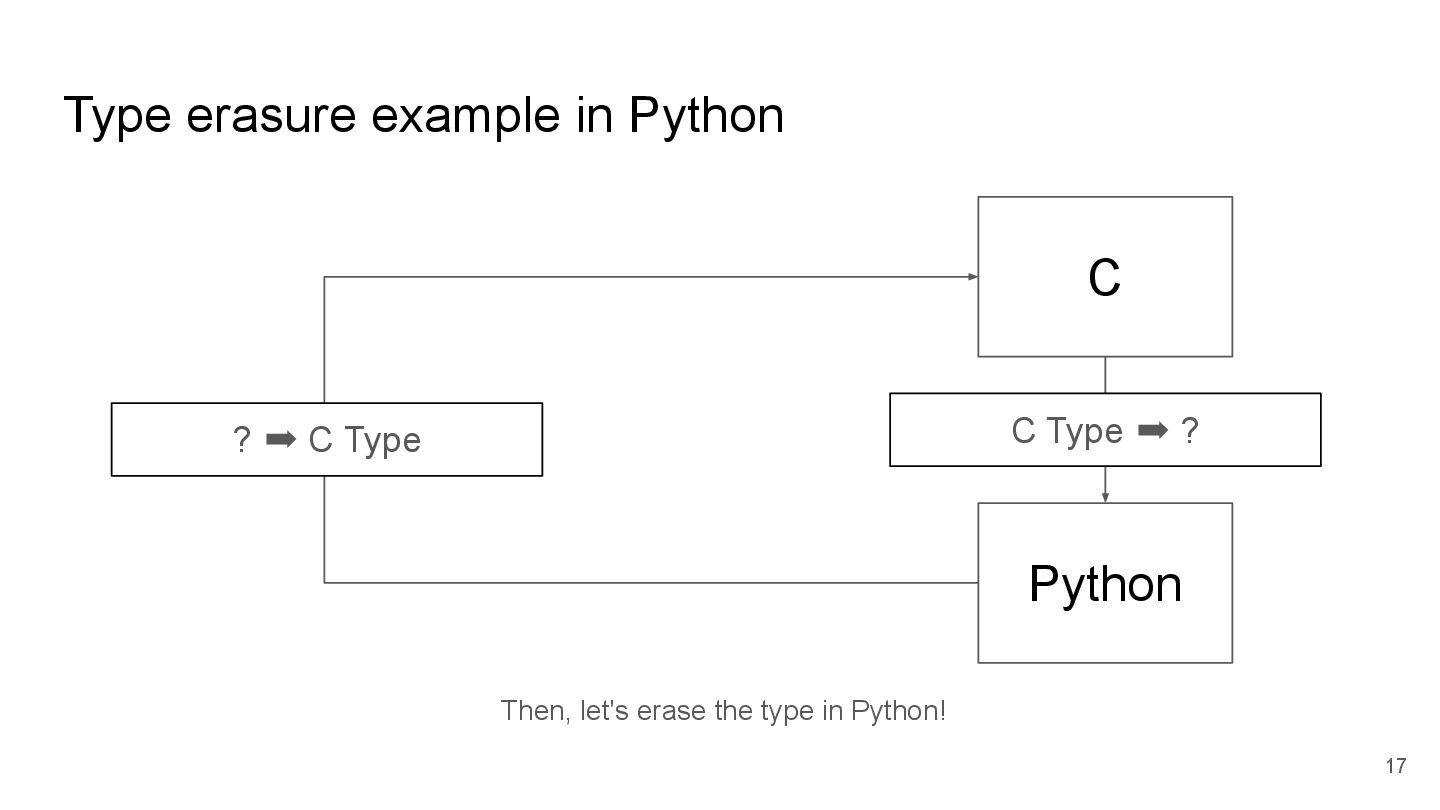
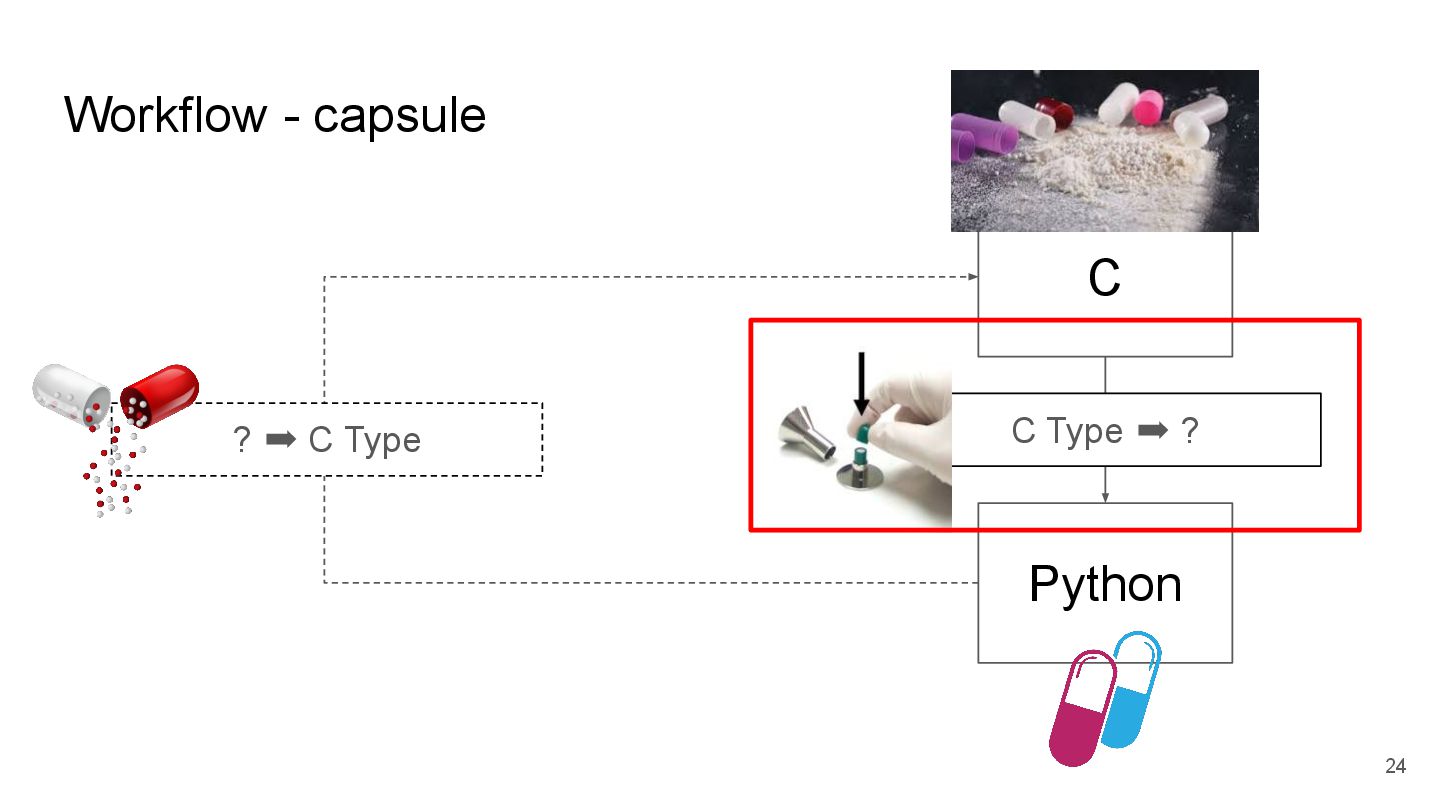
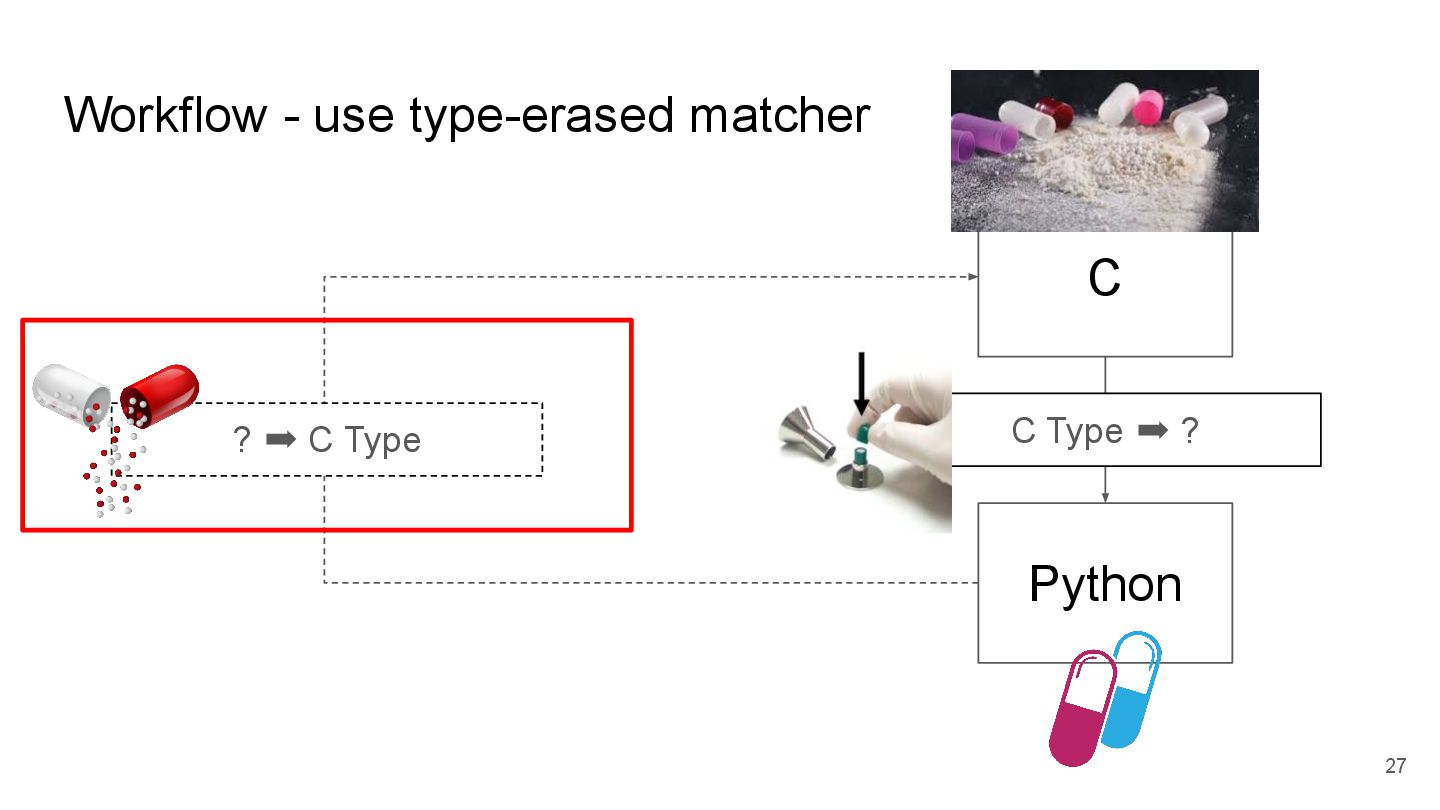
  13. Type erasure example in Python 17 C Python C Type

    ➡ ? ? ➡ C Type Then, let's erase the type in Python!
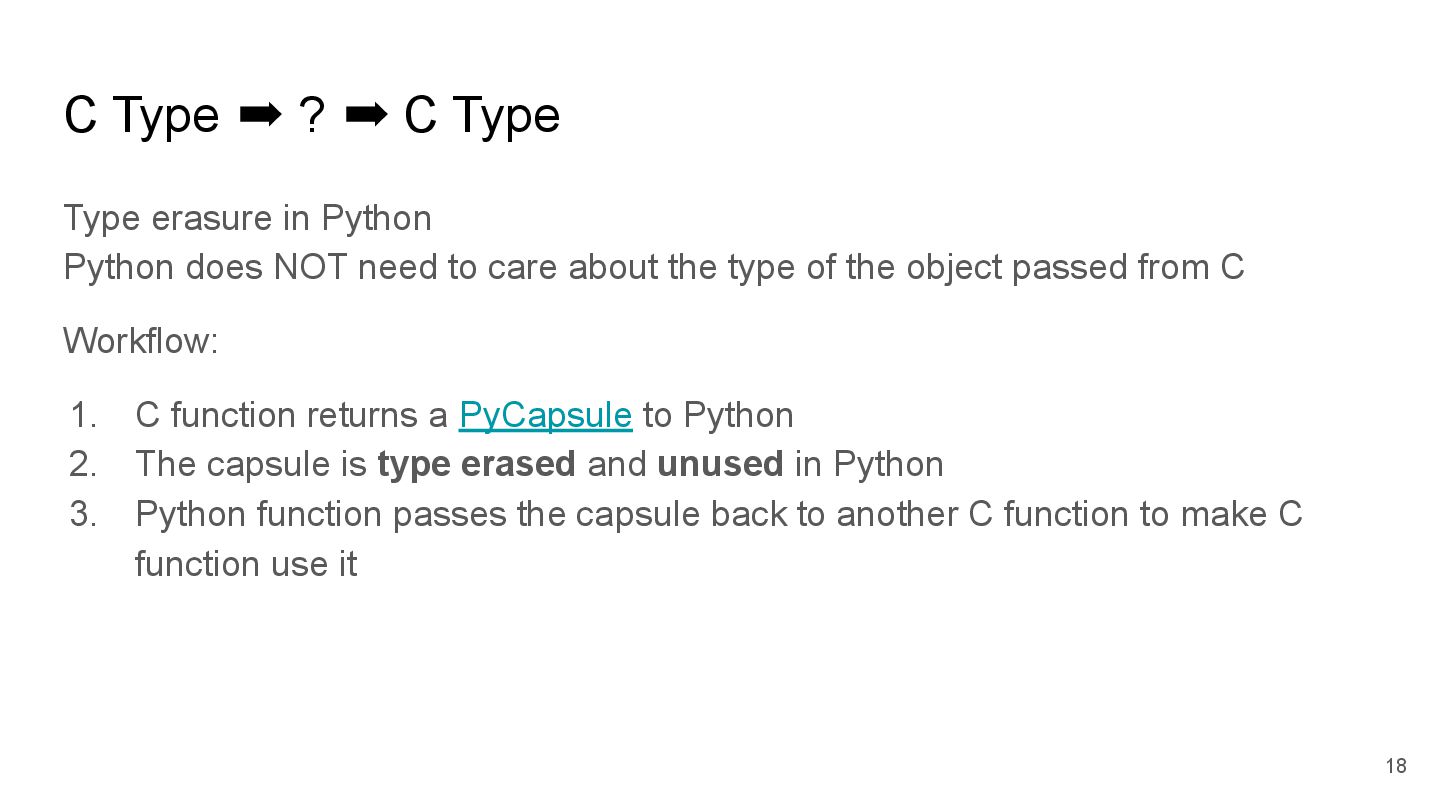
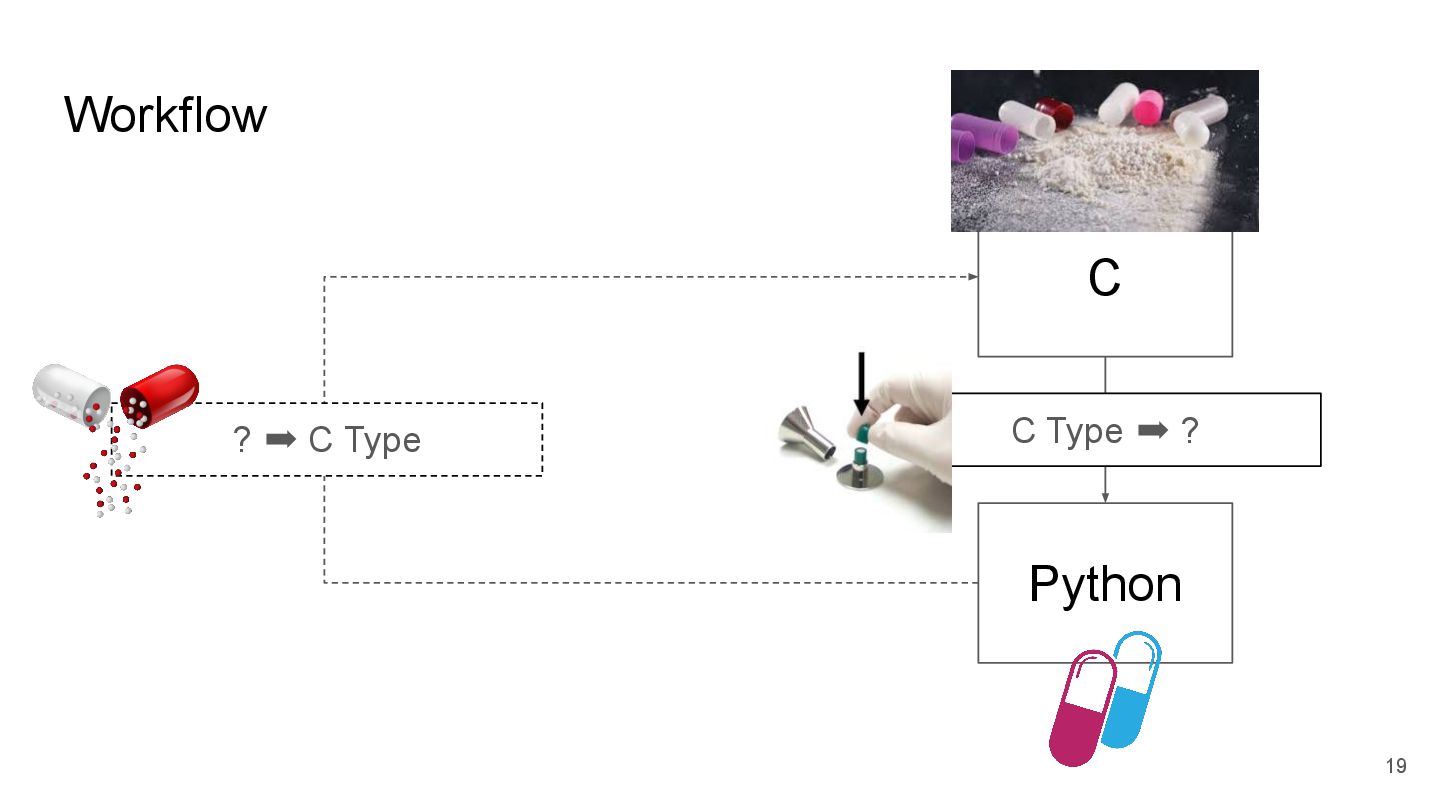
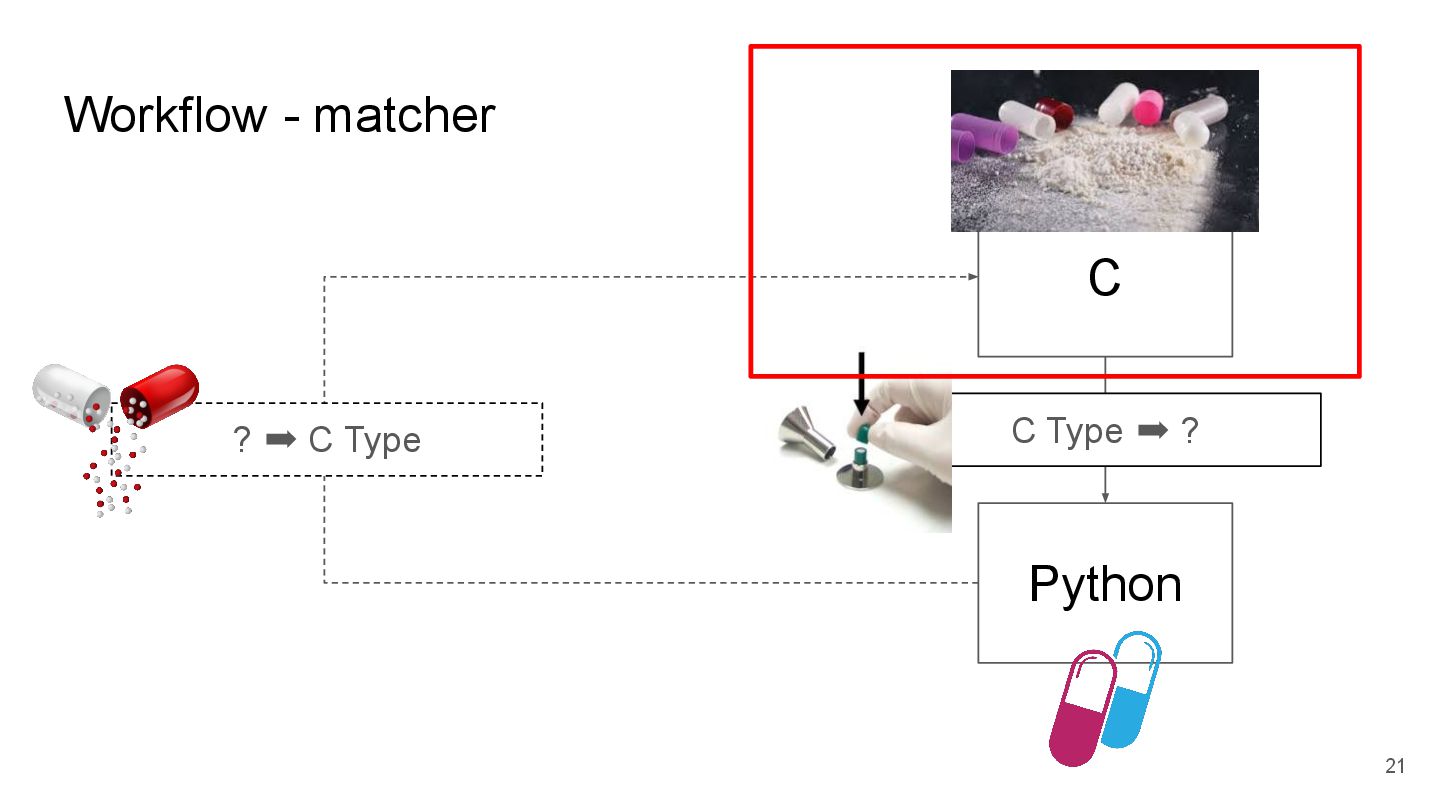
  14. C Type ➡ ? ➡ C Type Type erasure in

    Python Python does NOT need to care about the type of the object passed from C Workflow: 1. C function returns a PyCapsule to Python 2. The capsule is type erased and unused in Python 3. Python function passes the capsule back to another C function to make C function use it 18
  15. Example Say we want to develop a string matcher module

    in C++ with following methods: - def get_matcher_xxx() -> object - C++ can implement different matchers here, let's say we have "exactly" and "partially" matcher - def is_matcher(matcher: object) -> bool - Type is erased in Python, but Python can still check the type by this C method - def match(s1: str, s2: str, matcher: object) -> bool - Uses the matcher to check if s1 and s2 matches This use cases satisfy the requirement: Python does NOT need to care about the type of the matcher passed from C 20 Full example @ Github
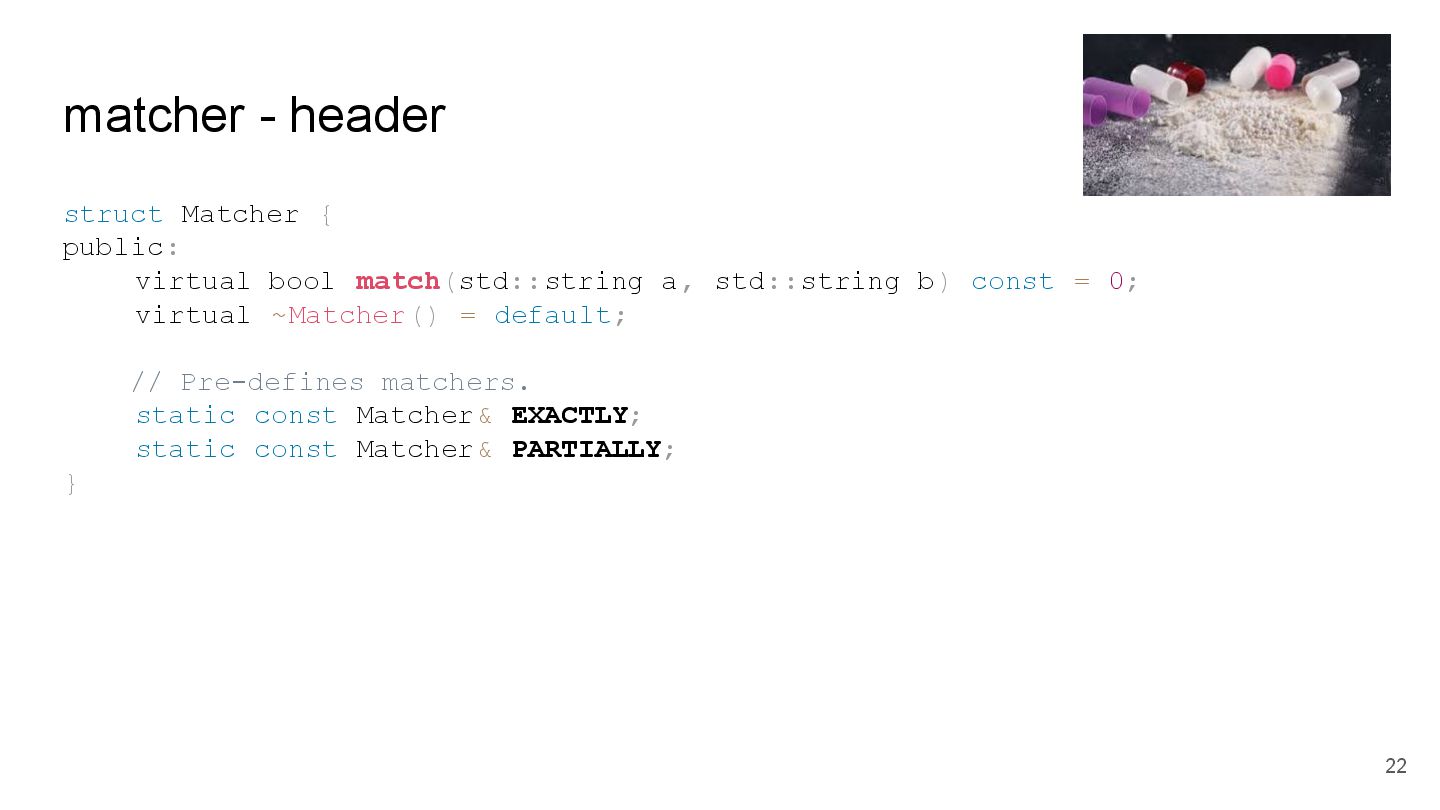
  16. matcher - header struct Matcher { public: virtual bool match(std::string

    a, std::string b) const = 0; virtual ~Matcher() = default; // Pre-defines matchers. static const Matcher& EXACTLY; static const Matcher& PARTIALLY; } 22
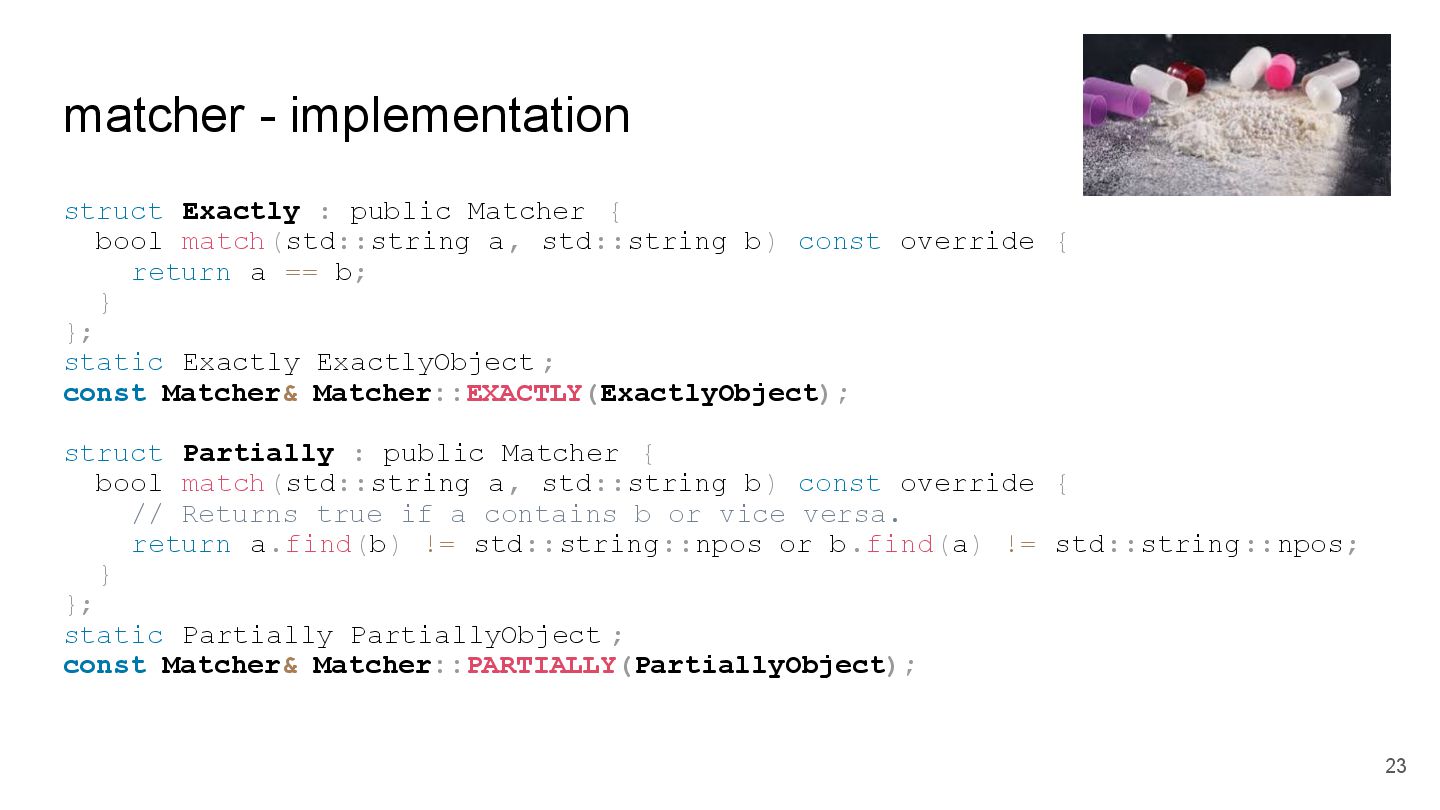
  17. matcher - implementation struct Exactly : public Matcher { bool

    match(std::string a, std::string b) const override { return a == b; } }; static Exactly ExactlyObject ; const Matcher& Matcher::EXACTLY(ExactlyObject); struct Partially : public Matcher { bool match(std::string a, std::string b) const override { // Returns true if a contains b or vice versa. return a.find(b) != std::string::npos or b.find(a) != std::string::npos; } }; static Partially PartiallyObject ; const Matcher& Matcher::PARTIALLY(PartiallyObject); 23
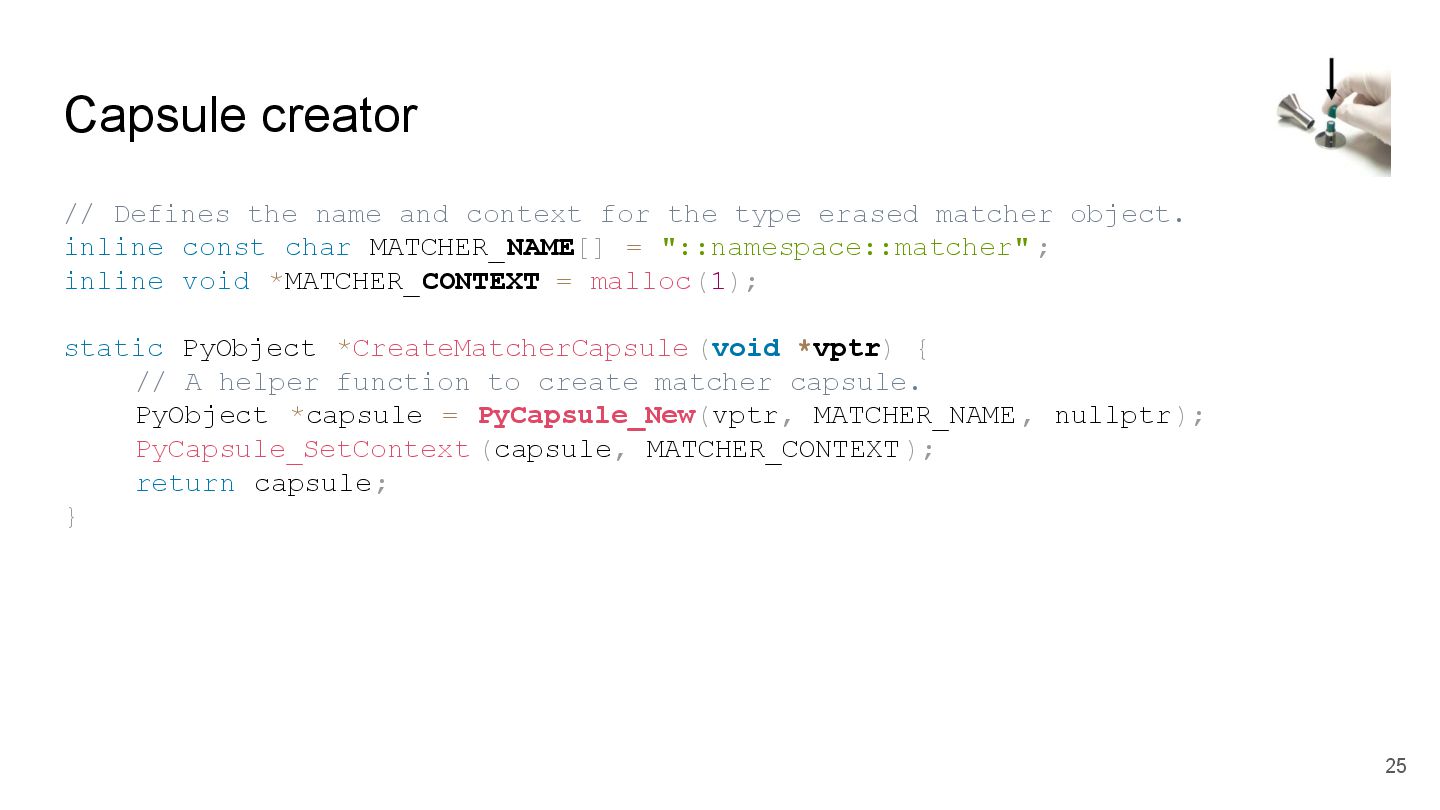
  18. Capsule creator // Defines the name and context for the

    type erased matcher object. inline const char MATCHER_NAME[] = "::namespace::matcher" ; inline void *MATCHER_CONTEXT = malloc(1); static PyObject *CreateMatcherCapsule (void *vptr) { // A helper function to create matcher capsule. PyObject *capsule = PyCapsule_New(vptr, MATCHER_NAME, nullptr); PyCapsule_SetContext (capsule, MATCHER_CONTEXT ); return capsule; } 25
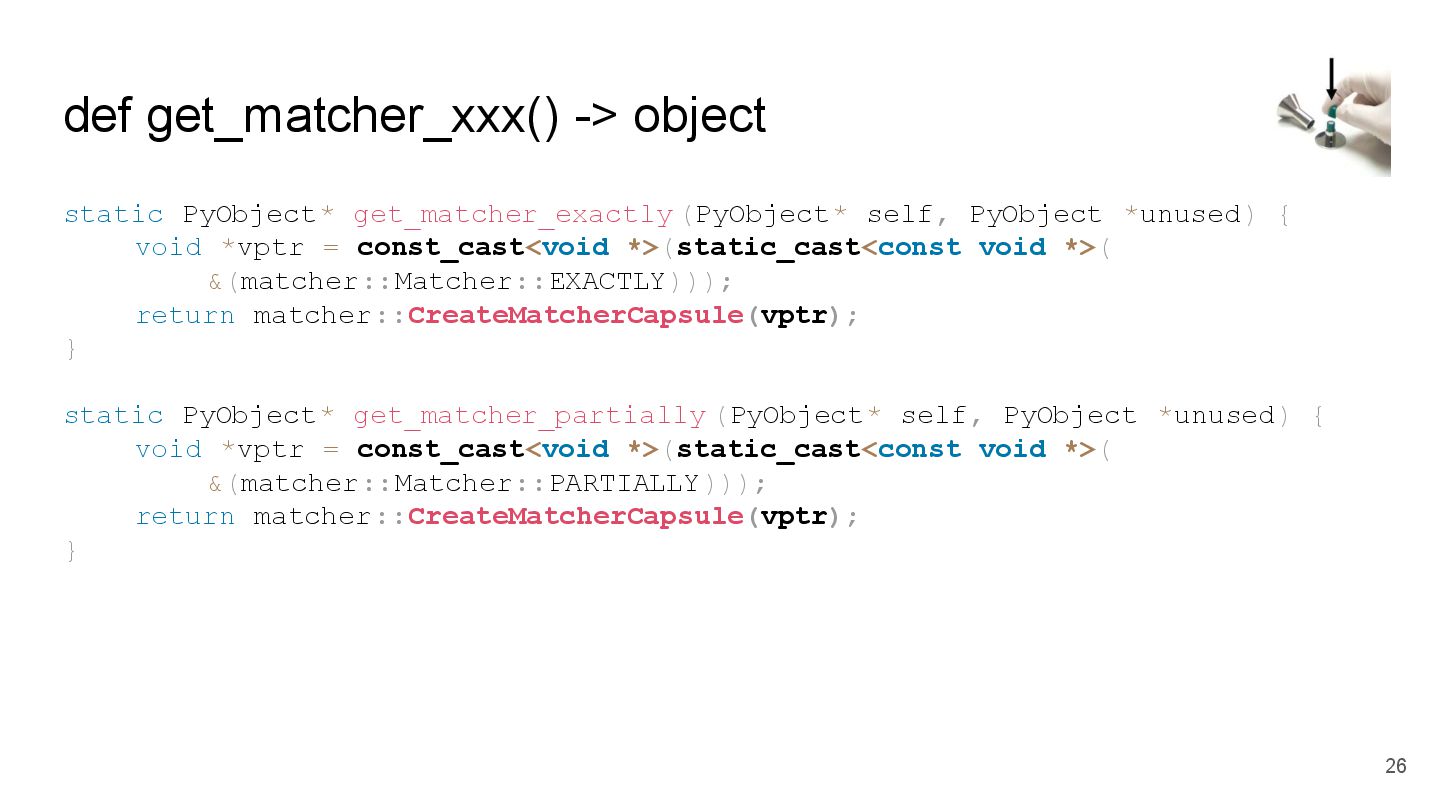
  19. def get_matcher_xxx() -> object static PyObject* get_matcher_exactly (PyObject* self, PyObject

    *unused) { void *vptr = const_cast<void *>(static_cast<const void *>( &(matcher::Matcher::EXACTLY))); return matcher::CreateMatcherCapsule(vptr); } static PyObject* get_matcher_partially (PyObject* self, PyObject *unused) { void *vptr = const_cast<void *>(static_cast<const void *>( &(matcher::Matcher::PARTIALLY))); return matcher::CreateMatcherCapsule(vptr); } 26
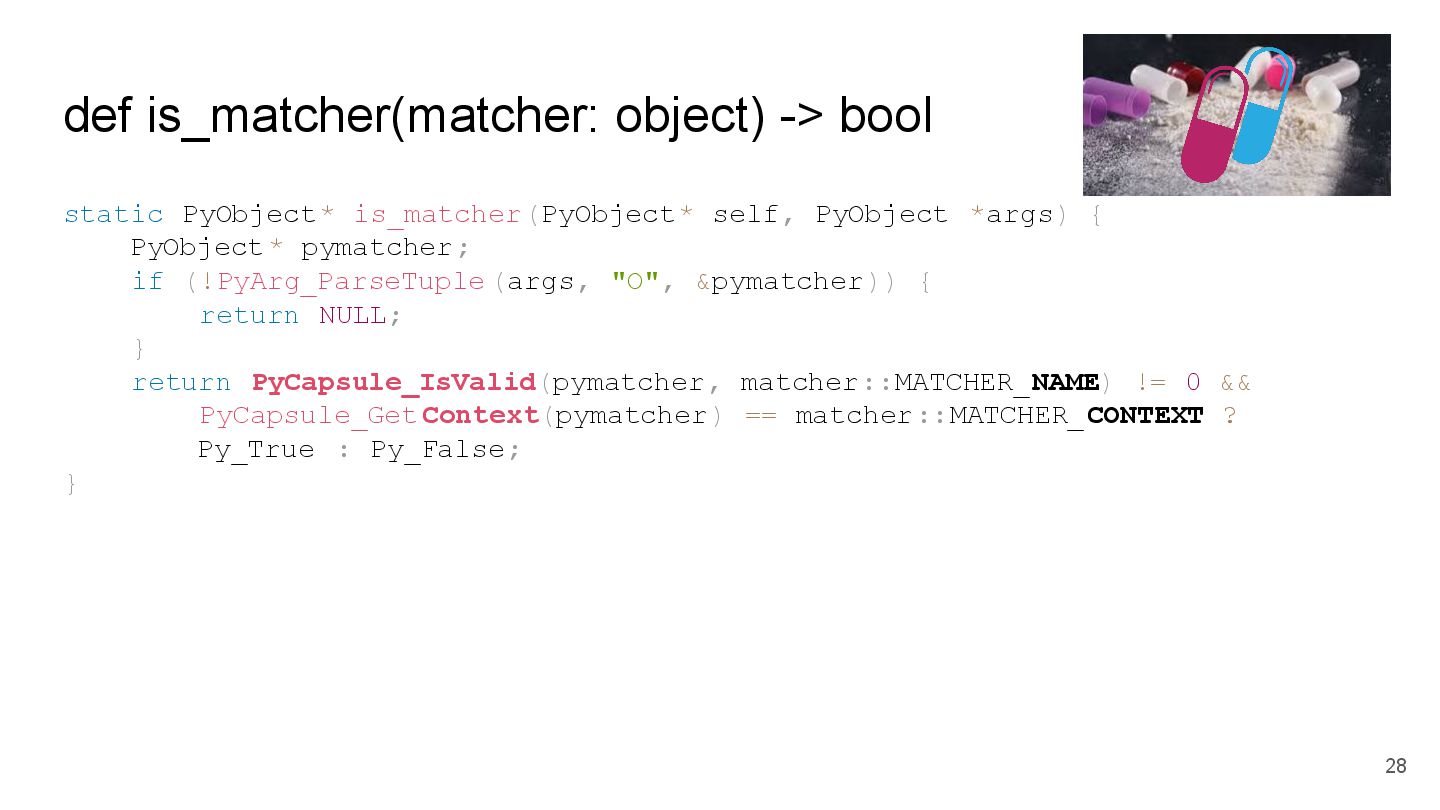
  20. def is_matcher(matcher: object) -> bool static PyObject* is_matcher(PyObject* self, PyObject

    *args) { PyObject* pymatcher; if (!PyArg_ParseTuple (args, "O", &pymatcher)) { return NULL; } return PyCapsule_IsValid(pymatcher, matcher::MATCHER_NAME) != 0 && PyCapsule_GetContext(pymatcher) == matcher::MATCHER_CONTEXT ? Py_True : Py_False; } 28
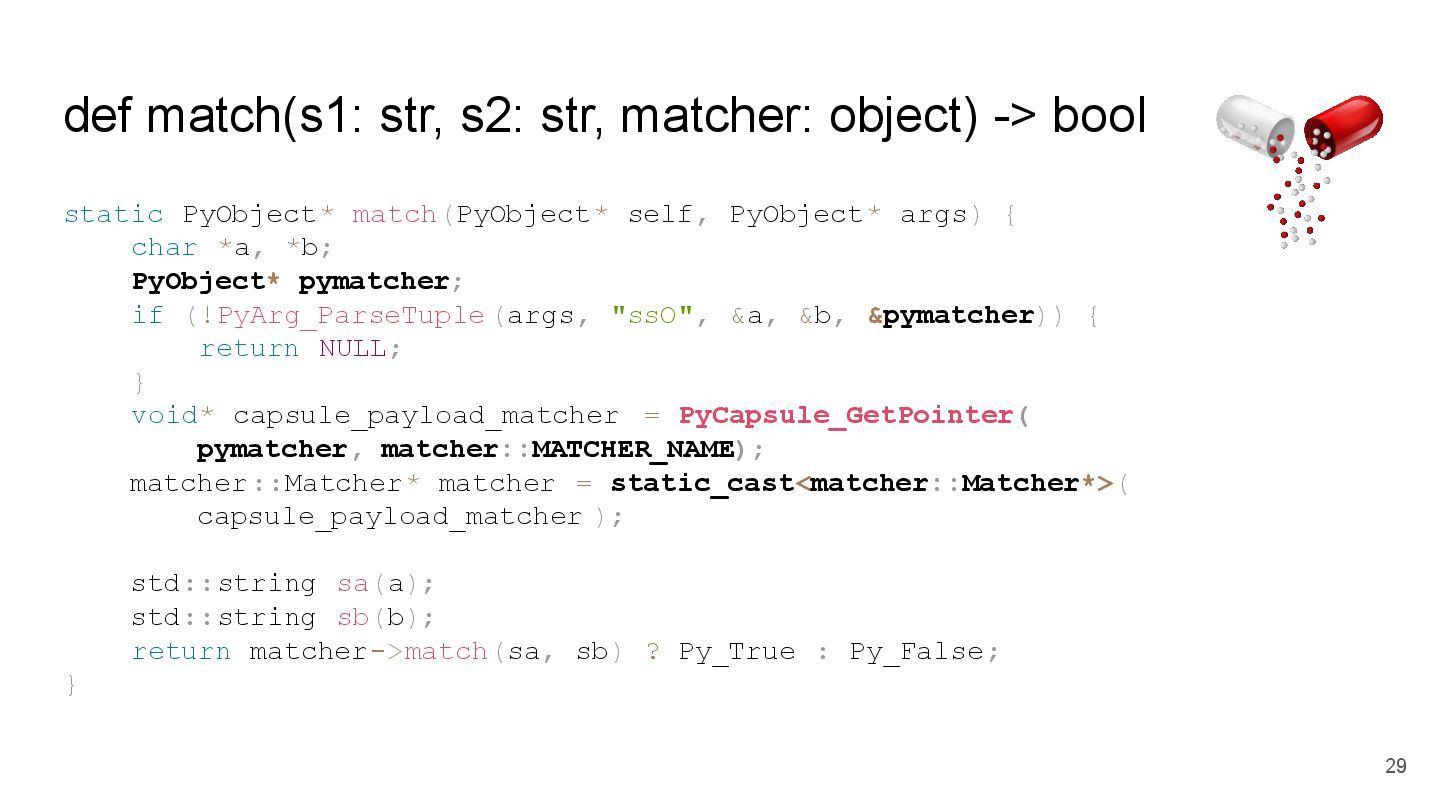
  21. static PyObject* match(PyObject* self, PyObject* args) { char *a, *b;

    PyObject* pymatcher; if (!PyArg_ParseTuple (args, "ssO", &a, &b, &pymatcher)) { return NULL; } void* capsule_payload_matcher = PyCapsule_GetPointer( pymatcher, matcher::MATCHER_NAME); matcher::Matcher* matcher = static_cast<matcher::Matcher*>( capsule_payload_matcher ); std::string sa(a); std::string sb(b); return matcher->match(sa, sb) ? Py_True : Py_False; } 29 def match(s1: str, s2: str, matcher: object) -> bool
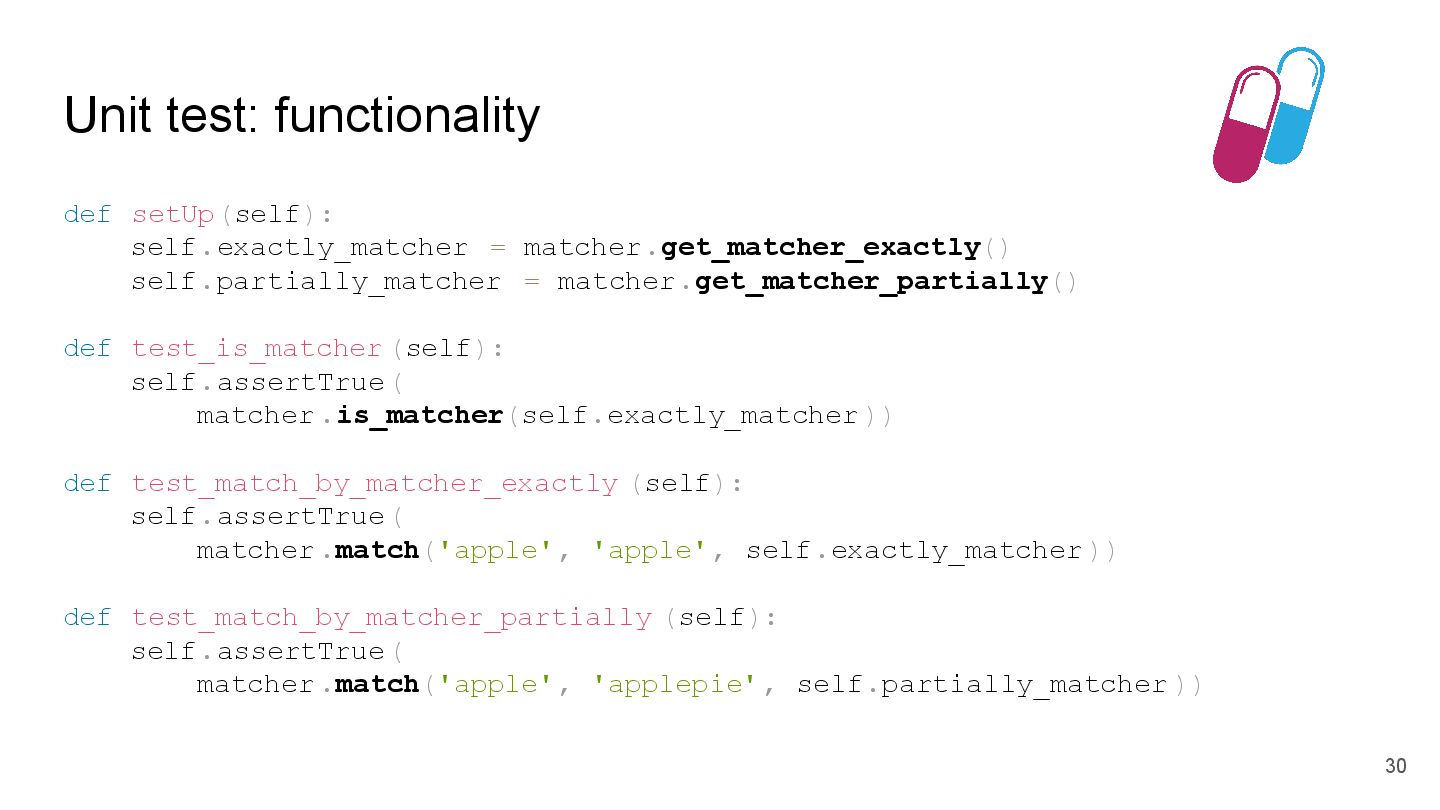
  22. Unit test: functionality def setUp(self): self.exactly_matcher = matcher.get_matcher_exactly() self.partially_matcher =

    matcher.get_matcher_partially() def test_is_matcher (self): self.assertTrue( matcher .is_matcher(self.exactly_matcher )) def test_match_by_matcher_exactly (self): self.assertTrue( matcher .match('apple', 'apple', self.exactly_matcher )) def test_match_by_matcher_partially (self): self.assertTrue( matcher .match('apple', 'applepie', self.partially_matcher )) 30
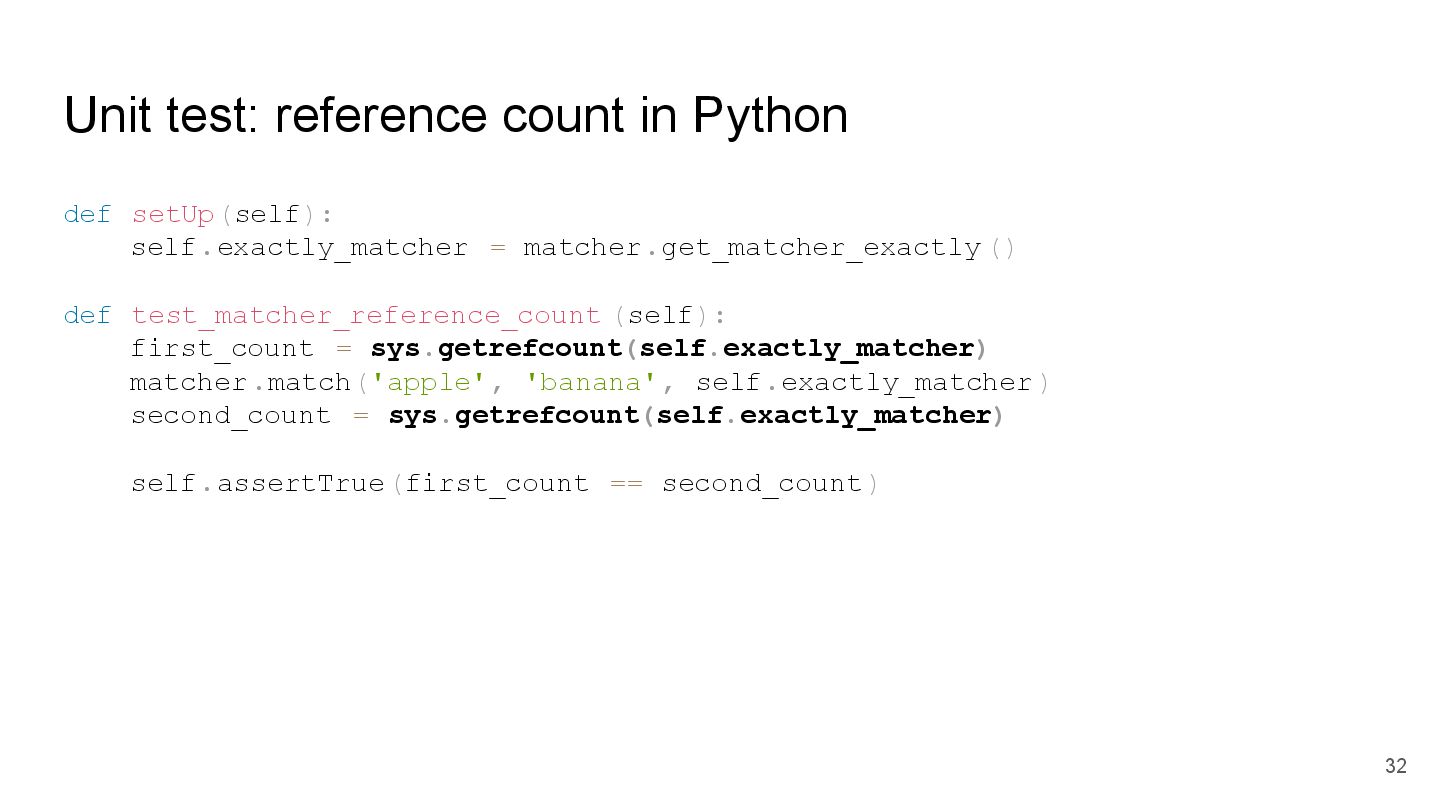
  23. Unit test: reference count in Python def setUp(self): self.exactly_matcher =

    matcher.get_matcher_exactly () def test_matcher_reference_count (self): first_count = sys.getrefcount(self.exactly_matcher) matcher.match('apple', 'banana', self.exactly_matcher ) second_count = sys.getrefcount(self.exactly_matcher) self.assertTrue(first_count == second_count) 32
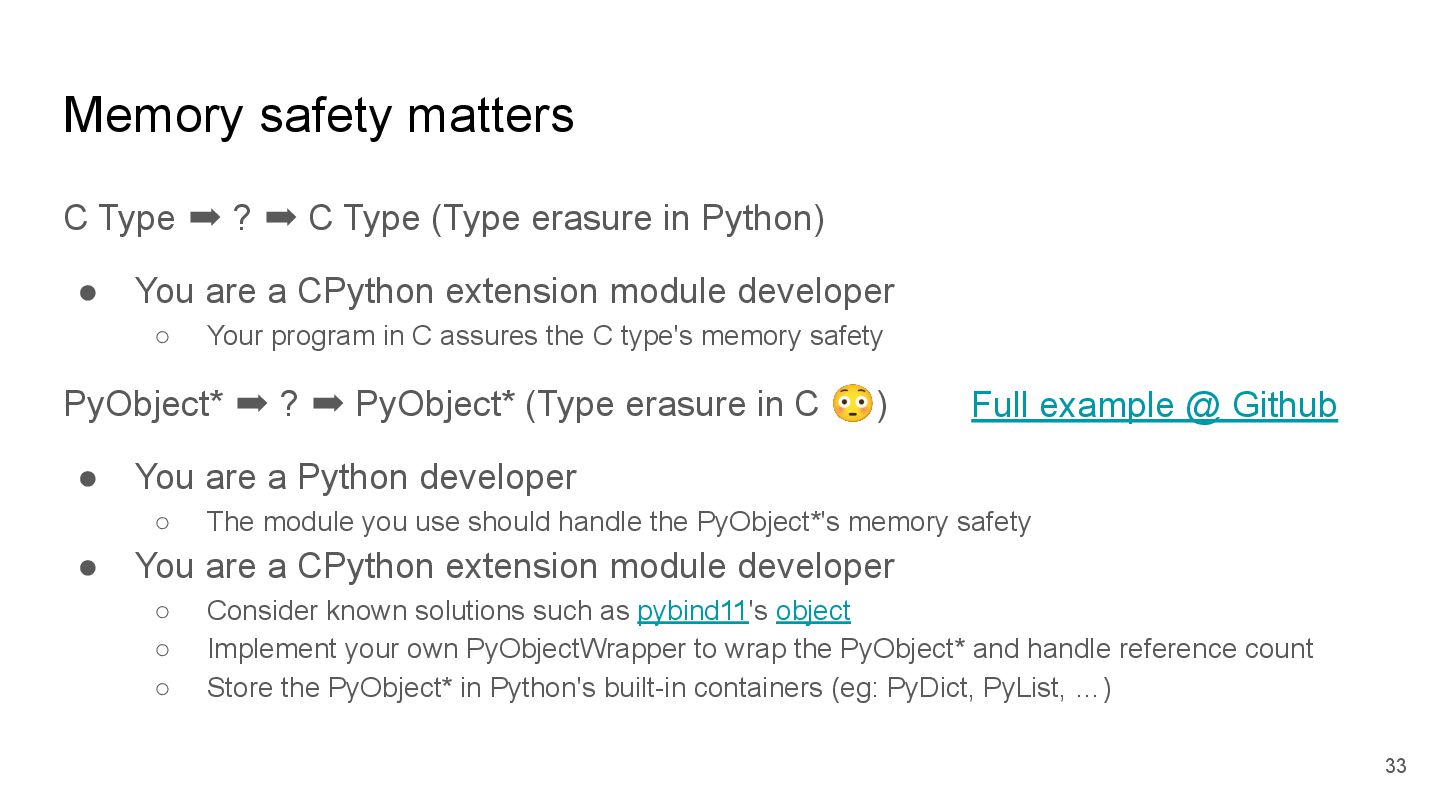
  24. Memory safety matters C Type ➡ ? ➡ C Type

    (Type erasure in Python) • You are a CPython extension module developer ◦ Your program in C assures the C type's memory safety PyObject* ➡ ? ➡ PyObject* (Type erasure in C 😳) • You are a Python developer ◦ The module you use should handle the PyObject*'s memory safety • You are a CPython extension module developer ◦ Consider known solutions such as pybind11's object ◦ Implement your own PyObjectWrapper to wrap the PyObject* and handle reference count ◦ Store the PyObject* in Python's built-in containers (eg: PyDict, PyList, …) 33 Full example @ Github
  25. Credit Special thanks for Ralf W. Grosse-Kunstleve • Revising this

    slide • Educating me to learn CLIF 36 This slide is not part of the recording.