Share
Embed
FinOps in practice with AI and observability, made possible by Datadog

Transcript
40 slides
-
FinOps in practice with AI and observability, made possible by
Datadog 2026/11/17 Jissen! FinOps @ Datadog Japan Nulab Inc. Hisatomo Futahashi (@futahashi) -
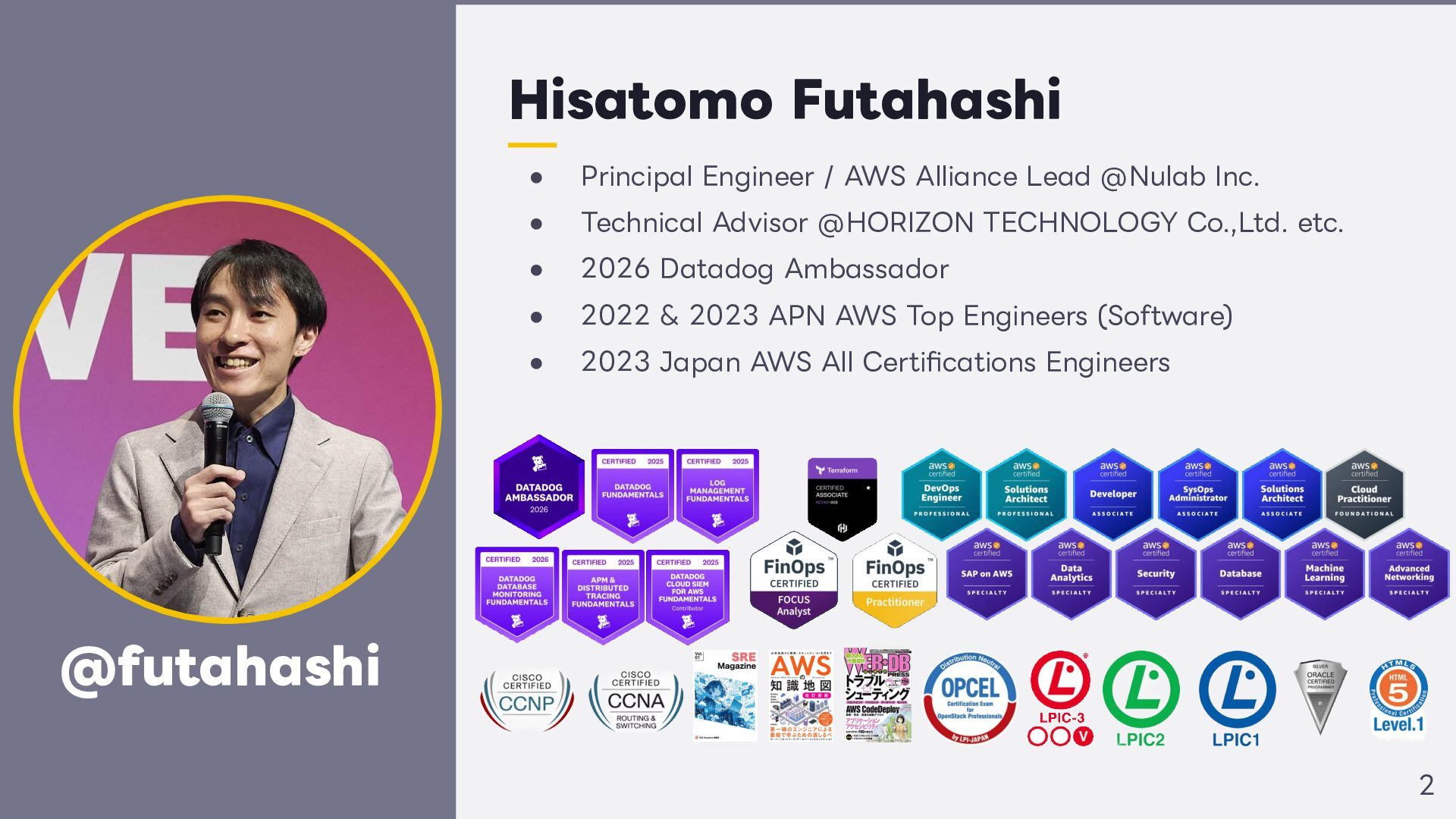
Hisatomo Futahashi • Principal Engineer / AWS Alliance Lead @Nulab
Inc. • Technical Advisor @HORIZON TECHNOLOGY Co.,Ltd. etc. • 2026 Datadog Ambassador • 2022 & 2023 APN AWS Top Engineers (Software) • 2023 Japan AWS All Certifications Engineers @futahashi 2 -
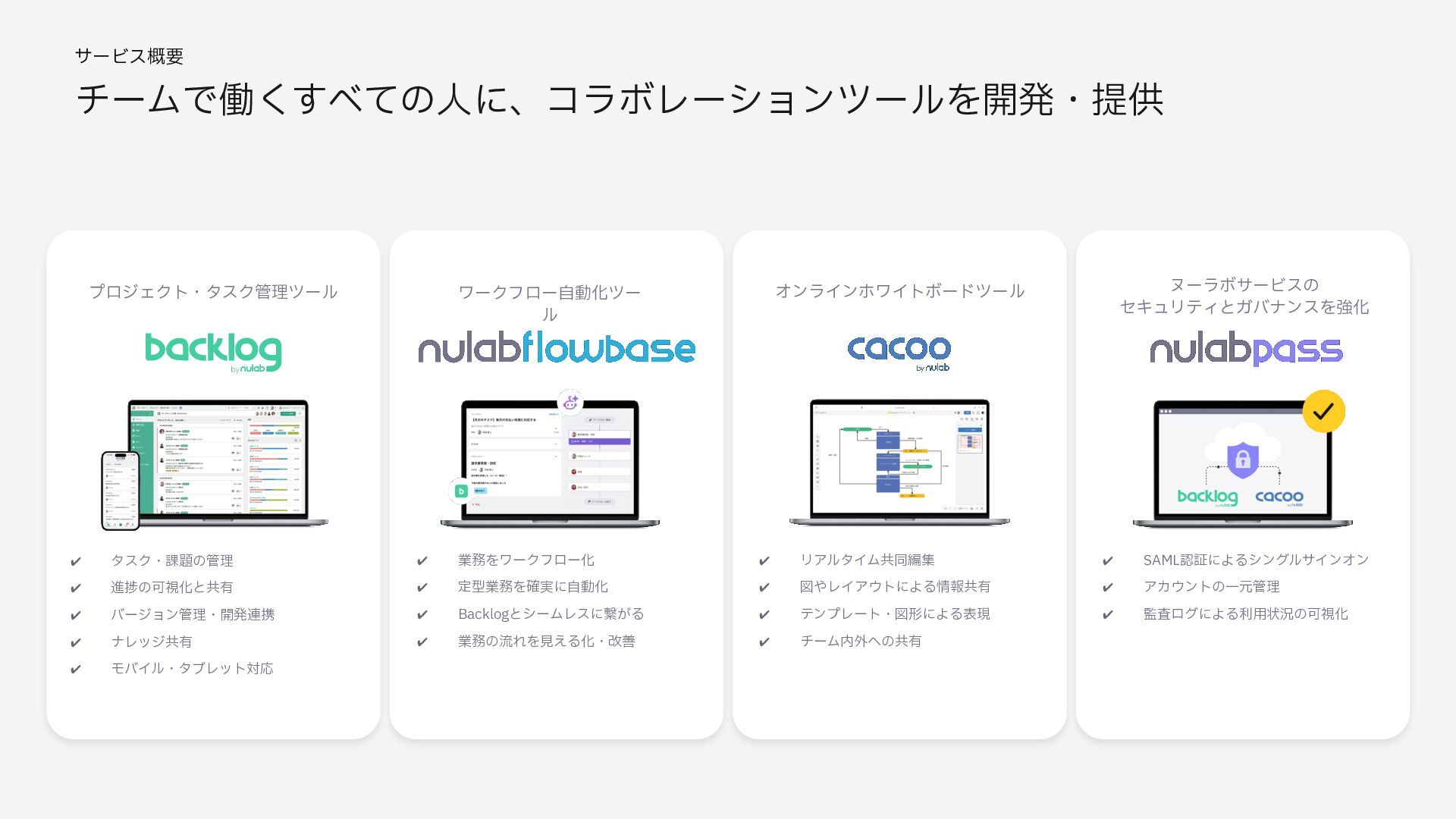
サービス概要 チームで働くすべての⼈に、コラボレーションツールを開発・提供 プロジェクト・タスク管理ツール ヌーラボサービスの セキュリティとガバナンスを強化 オンラインホワイトボードツール ワークフロー⾃動化ツー ル ✔ タスク・課題の管理
✔ 業務をワークフロー化 ✔ リアルタイム共同編集 ✔ SAML認証によるシングルサインオン ✔ 進捗の可視化と共有 ✔ 定型業務を確実に⾃動化 ✔ 図やレイアウトによる情報共有 ✔ アカウントの⼀元管理 ✔ バージョン管理・開発連携 ✔ Backlogとシームレスに繋がる ✔ テンプレート・図形による表現 ✔ 監査ログによる利⽤状況の可視化 ✔ ナレッジ共有 ✔ 業務の流れを⾒える化・改善 ✔ チーム内外への共有 ✔ モバイル・タブレット対応 -
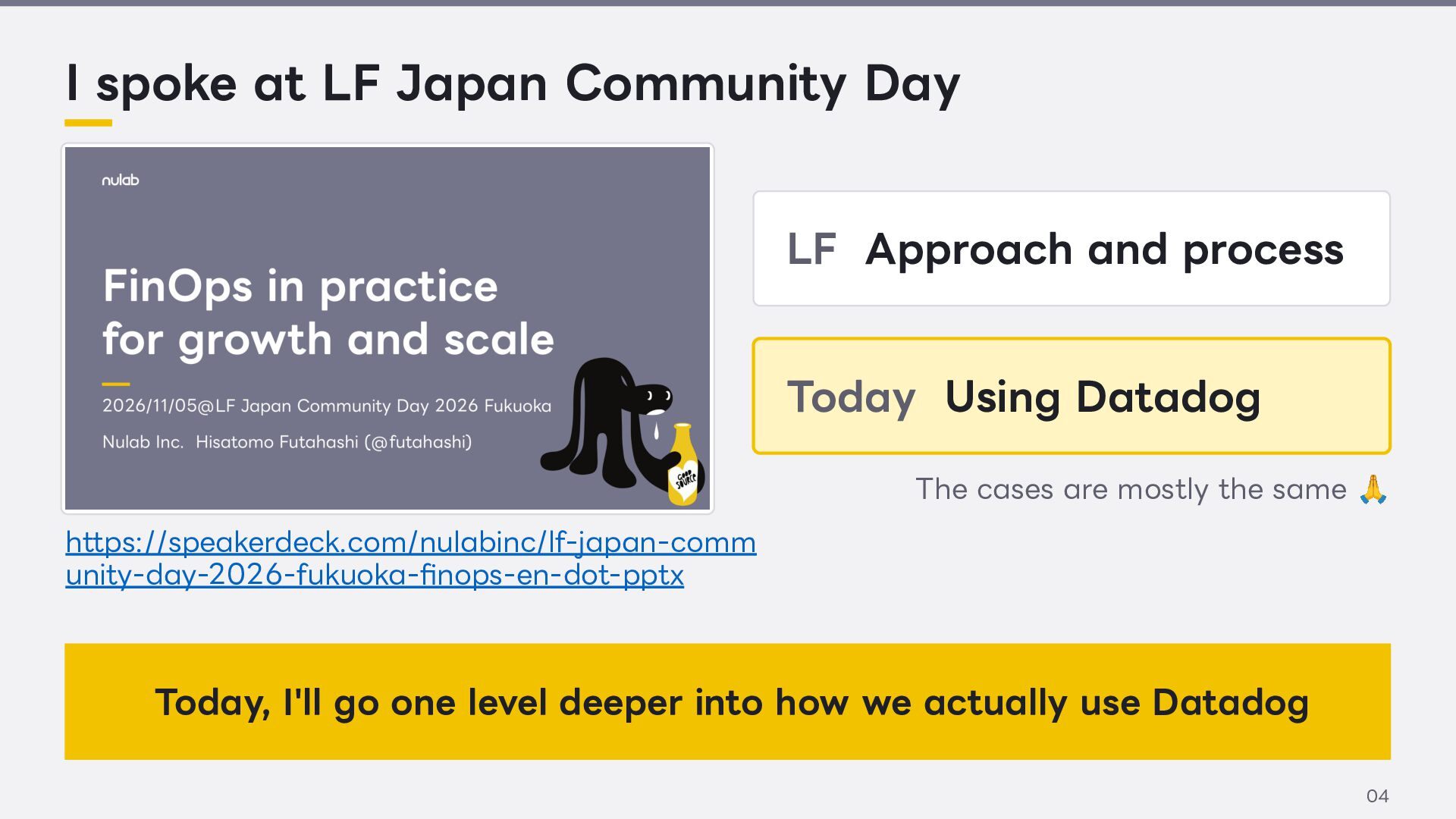
I spoke at LF Japan Community Day LF Approach and
process Today Using Datadog The cases are mostly the same 🙏 https://speakerdeck.com/nulabinc/lf-japan-comm unity-day-2026-fukuoka-finops-en-dot-pptx Today, I'll go one level deeper into how we actually use Datadog 04 -
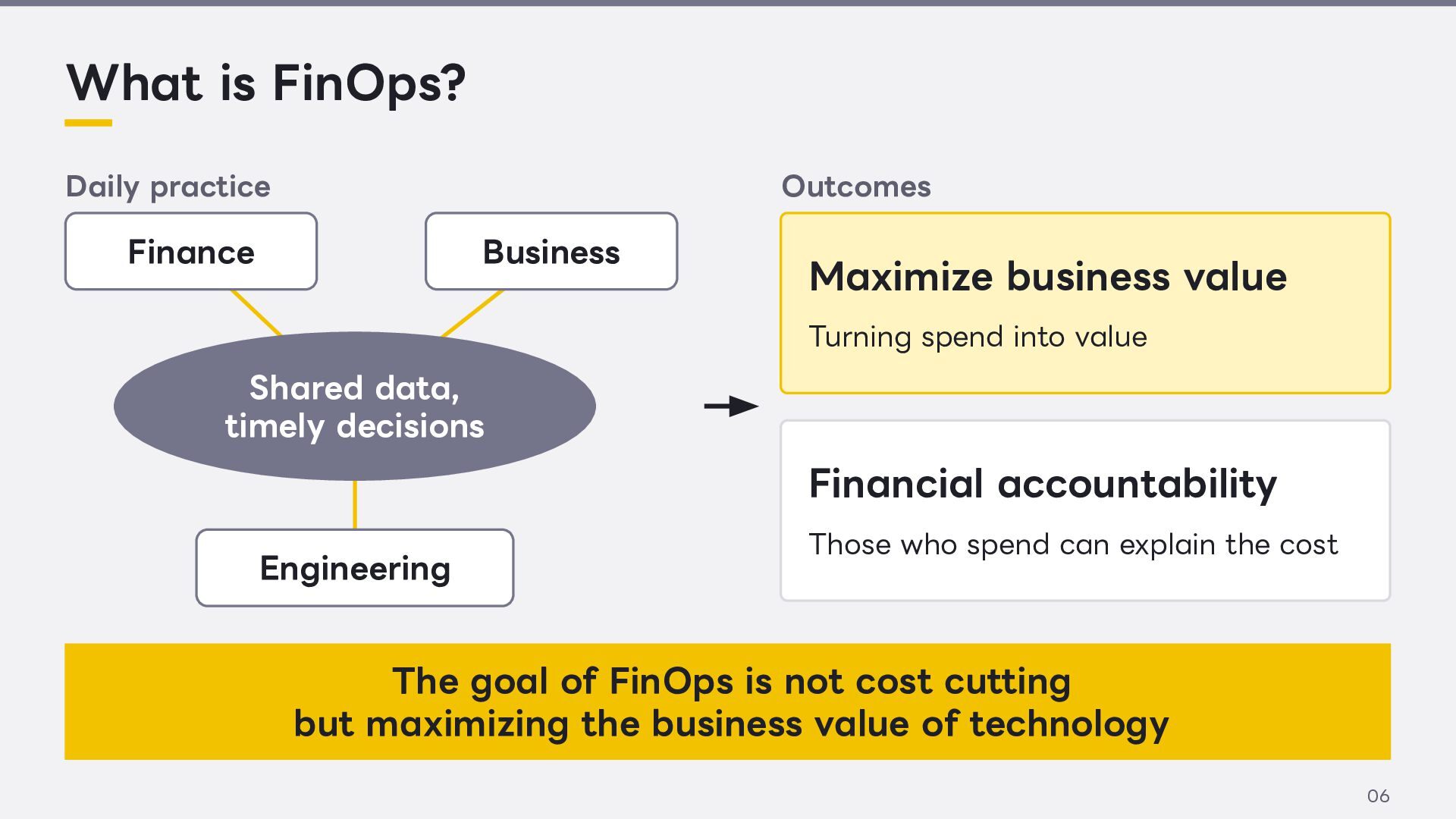
What is FinOps? Daily practice Outcomes Finance Business Maximize business
value Turning spend into value Shared data, timely decisions Financial accountability Engineering Those who spend can explain the cost The goal of FinOps is not cost cutting but maximizing the business value of technology 06 -
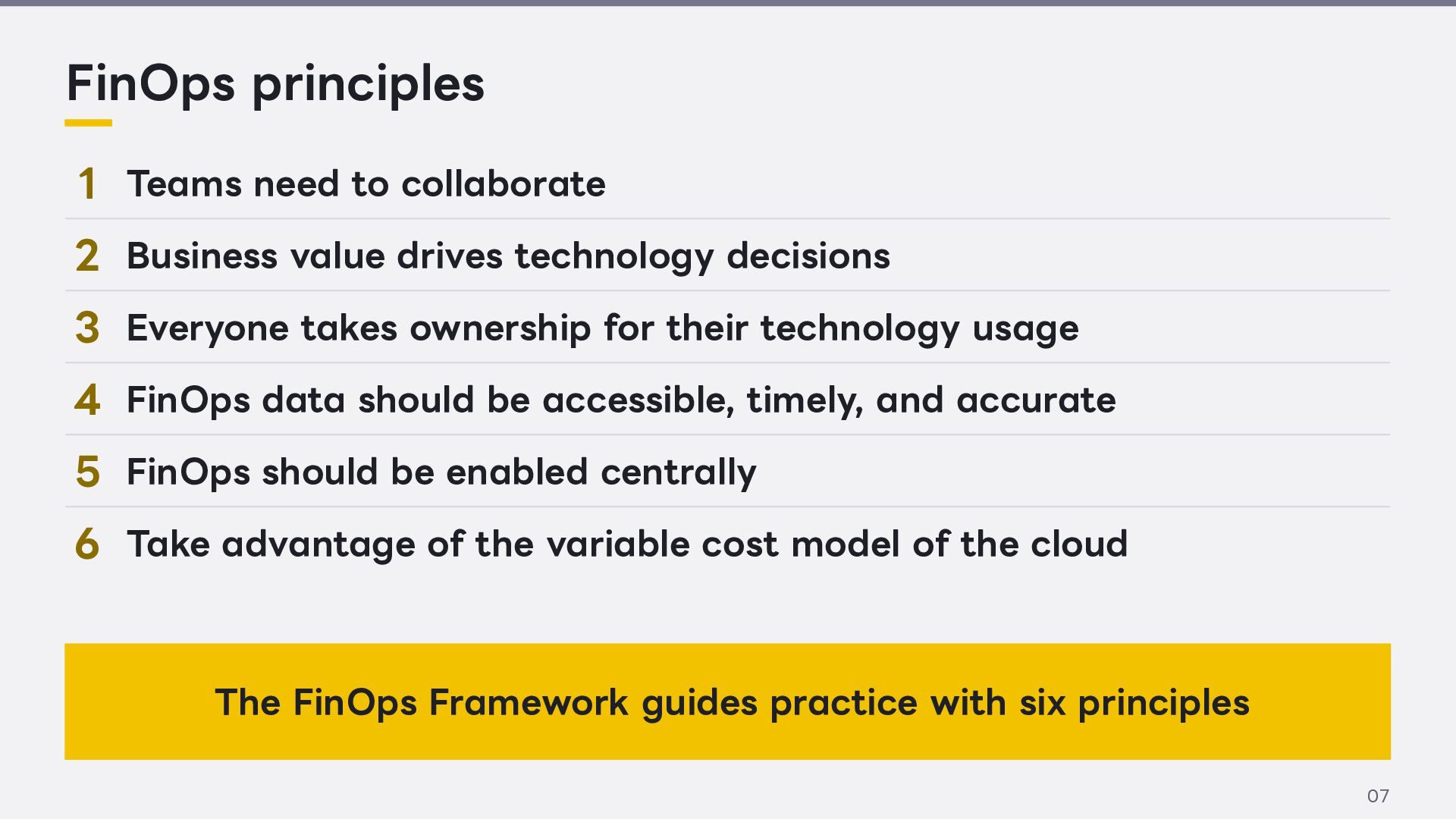
FinOps principles 1 Teams need to collaborate 2 Business value
drives technology decisions 3 Everyone takes ownership for their technology usage 4 FinOps data should be accessible, timely, and accurate 5 FinOps should be enabled centrally 6 Take advantage of the variable cost model of the cloud The FinOps Framework guides practice with six principles 07 -
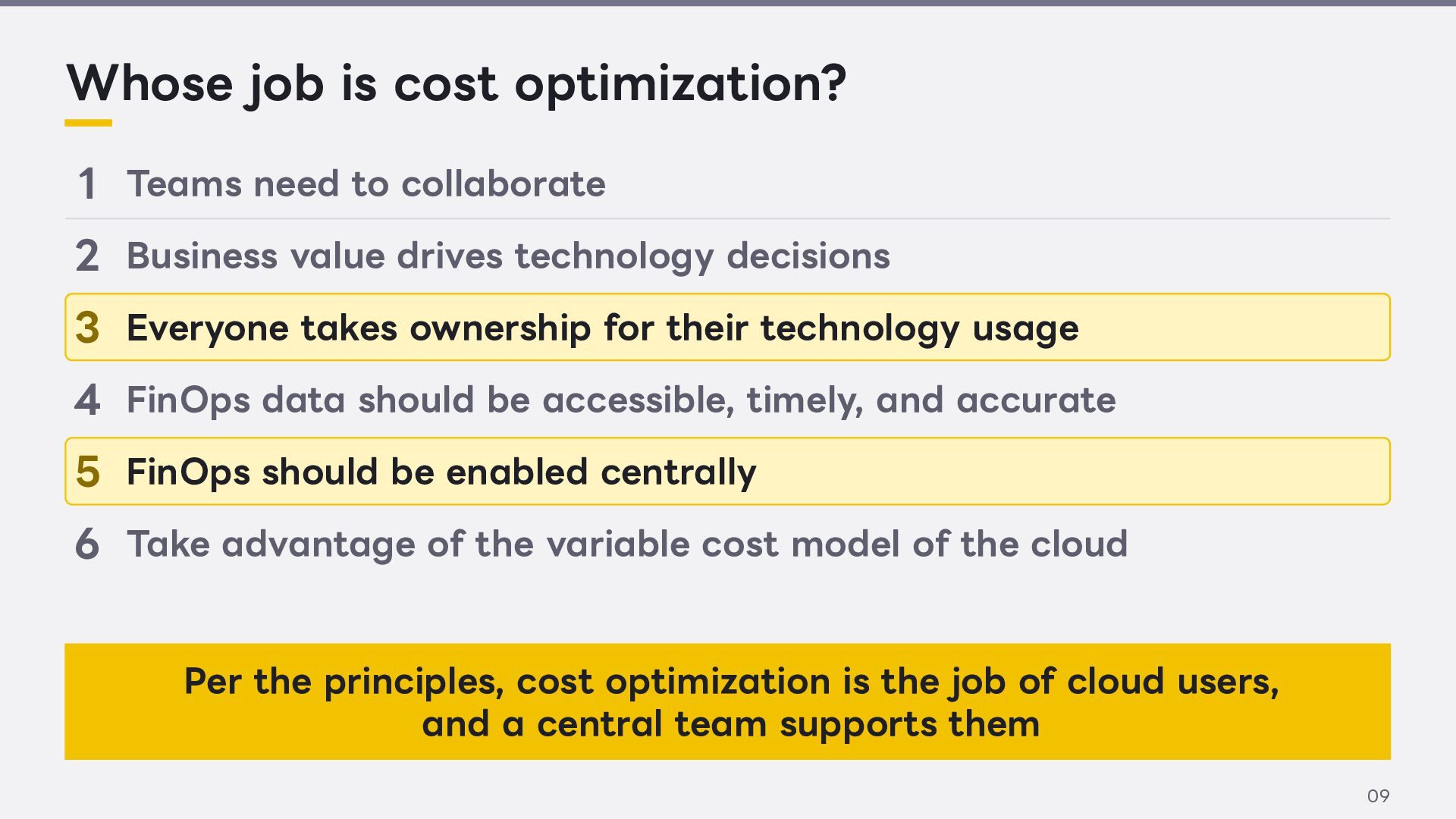
Whose job is cost optimization? 1 Teams need to collaborate
2 Business value drives technology decisions 3 Everyone takes ownership for their technology usage 4 FinOps data should be accessible, timely, and accurate 5 FinOps should be enabled centrally 6 Take advantage of the variable cost model of the cloud Per the principles, cost optimization is the job of cloud users, and a central team supports them 09 -
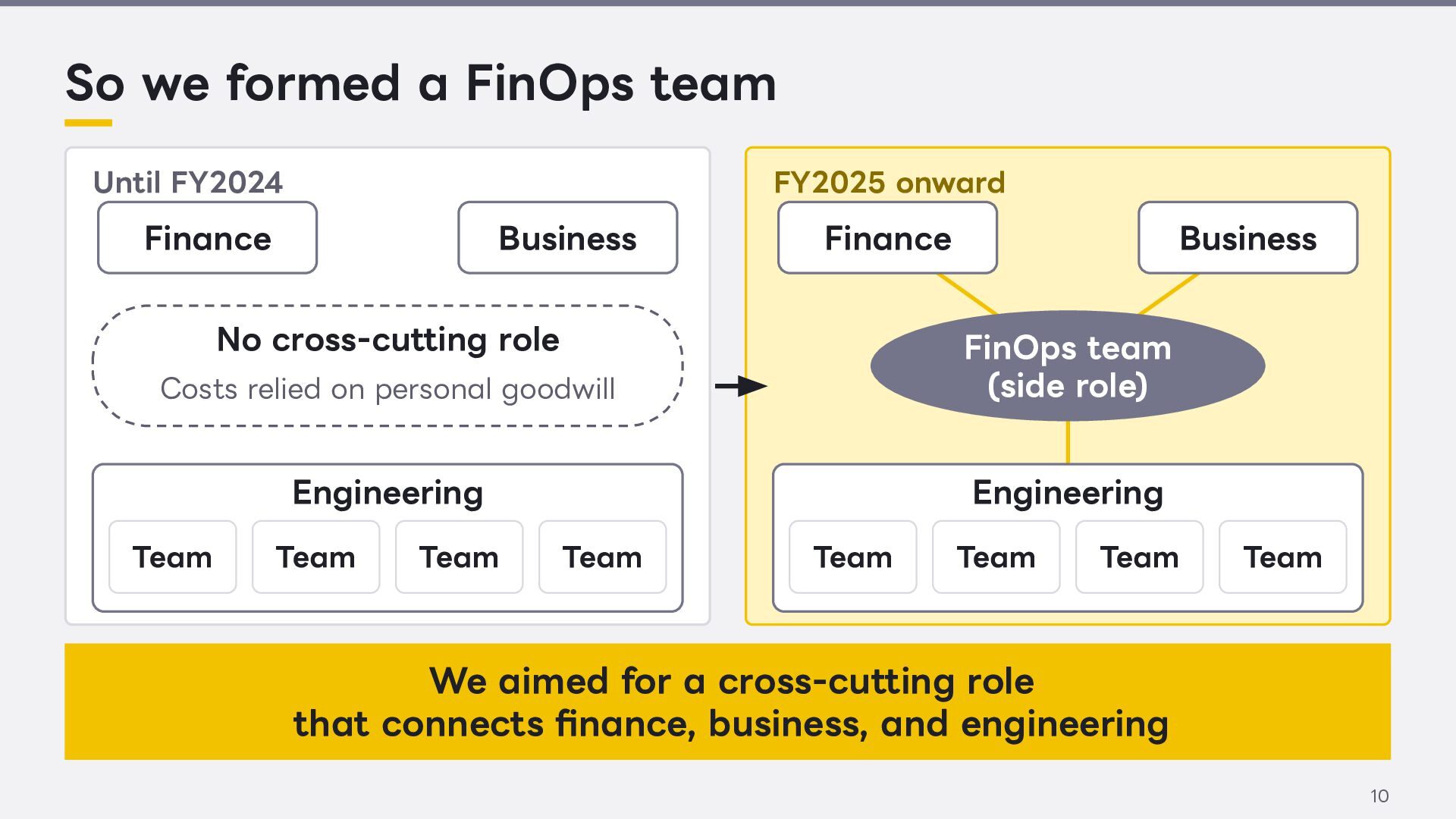
So we formed a FinOps team Until FY2024 FY2025 onward
Finance Business Finance No cross-cutting role Business Costs relied on personal goodwill FinOps team (side role) Engineering Engineering Team Team Team Team Team Team Team Team We aimed for a cross-cutting role that connects finance, business, and engineering 10 -
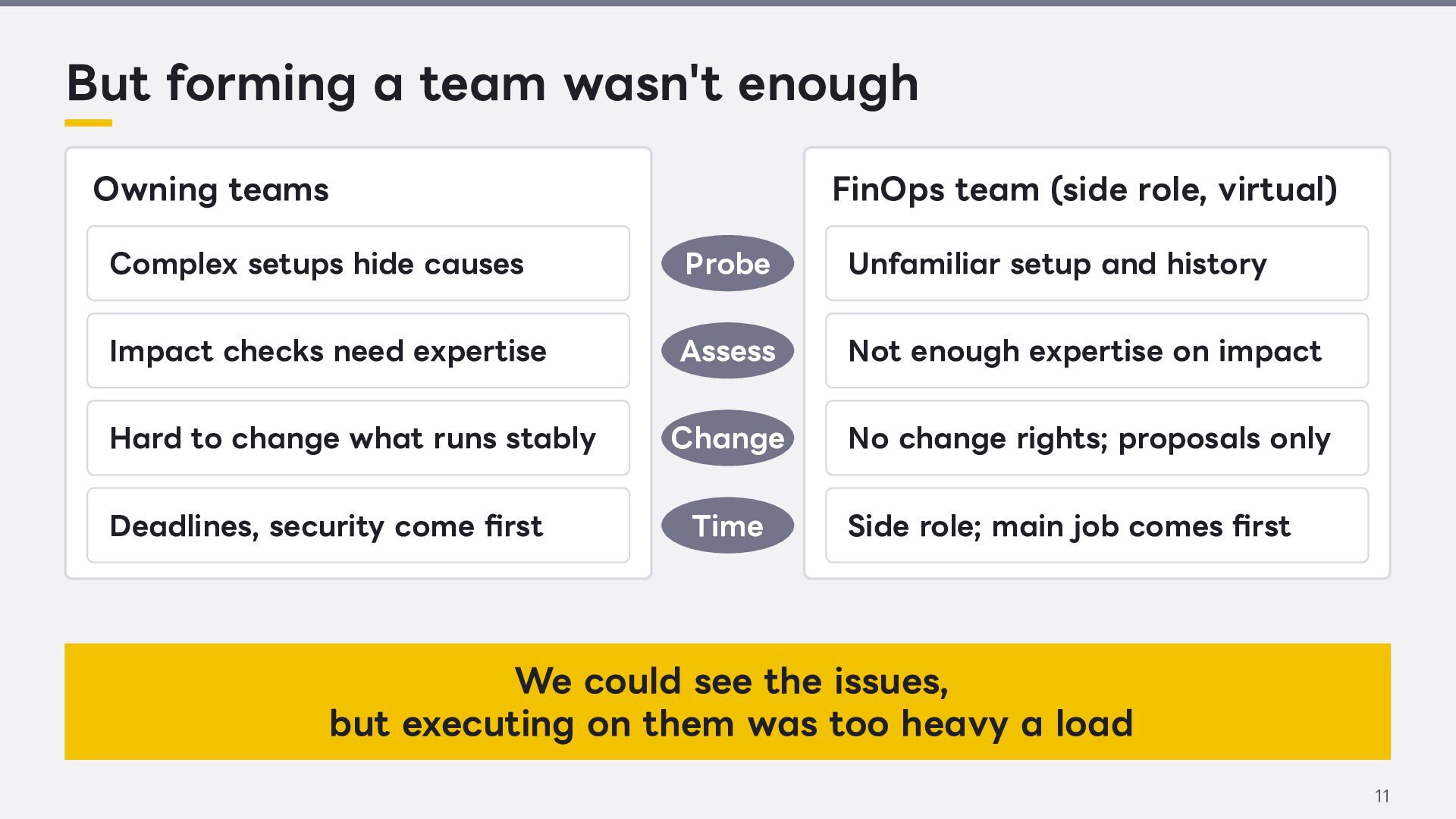
But forming a team wasn't enough Owning teams FinOps team
(side role, virtual) Complex setups hide causes Probe Unfamiliar setup and history Impact checks need expertise Assess Not enough expertise on impact Hard to change what runs stably Change No change rights; proposals only Deadlines, security come first Time Side role; main job comes first We could see the issues, but executing on them was too heavy a load 11 -
Redesigning roles Principle 3: Everyone takes ownership Principle 5: FinOps
enabled centrally Owning teams FinOps team Own their costs Support with data and systems Investigate causes Investigate causes Prepare proposals Prepare proposals Verify effect and impact Verify effect and impact Approve Implement Implement some for them Teams keep the decisions, and the FinOps team takes on investigating and verifying 12 -
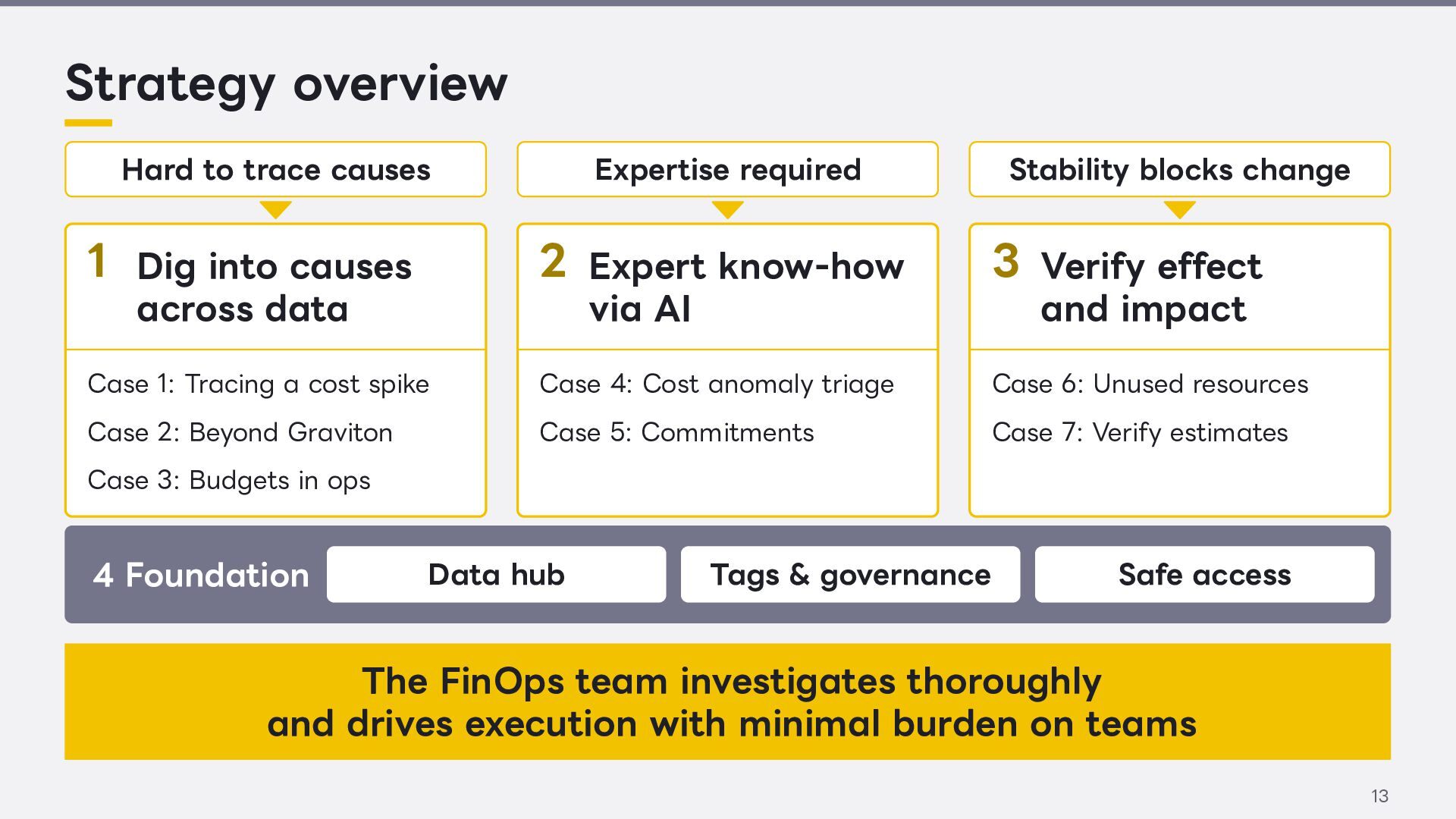
Strategy overview Hard to trace causes 1 Dig into causes
Expertise required 2 Expert know-how across data via AI Stability blocks change 3 Verify effect and impact Case 1: Tracing a cost spike Case 4: Cost anomaly triage Case 6: Unused resources Case 2: Beyond Graviton Case 5: Commitments Case 7: Verify estimates Case 3: Budgets in ops 4 Foundation Data hub Tags & governance Safe access The FinOps team investigates thoroughly and drives execution with minimal burden on teams 13 -
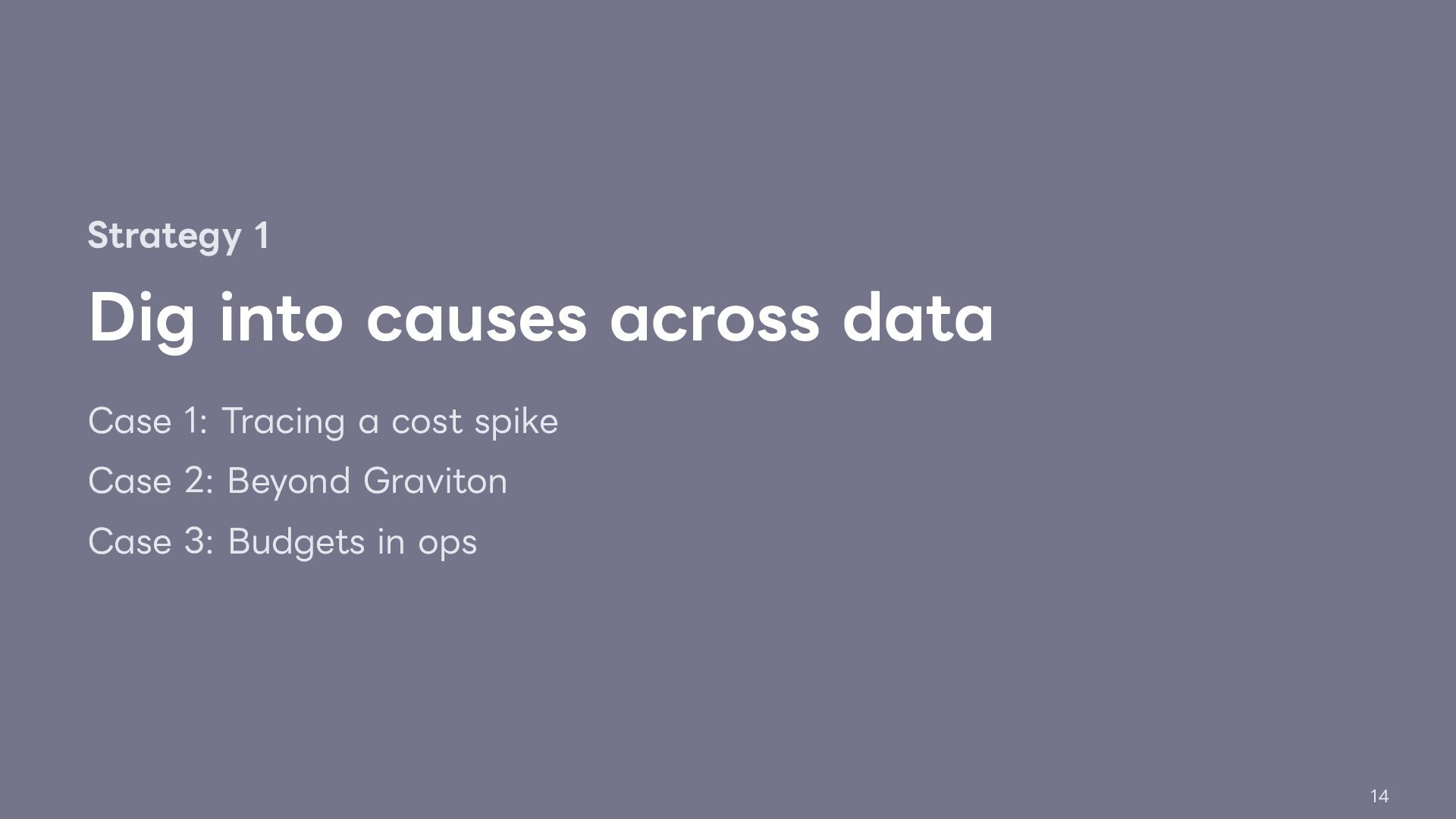
Strategy 1 Dig into causes across data Case 1: Tracing
a cost spike Case 2: Beyond Graviton Case 3: Budgets in ops 14 -
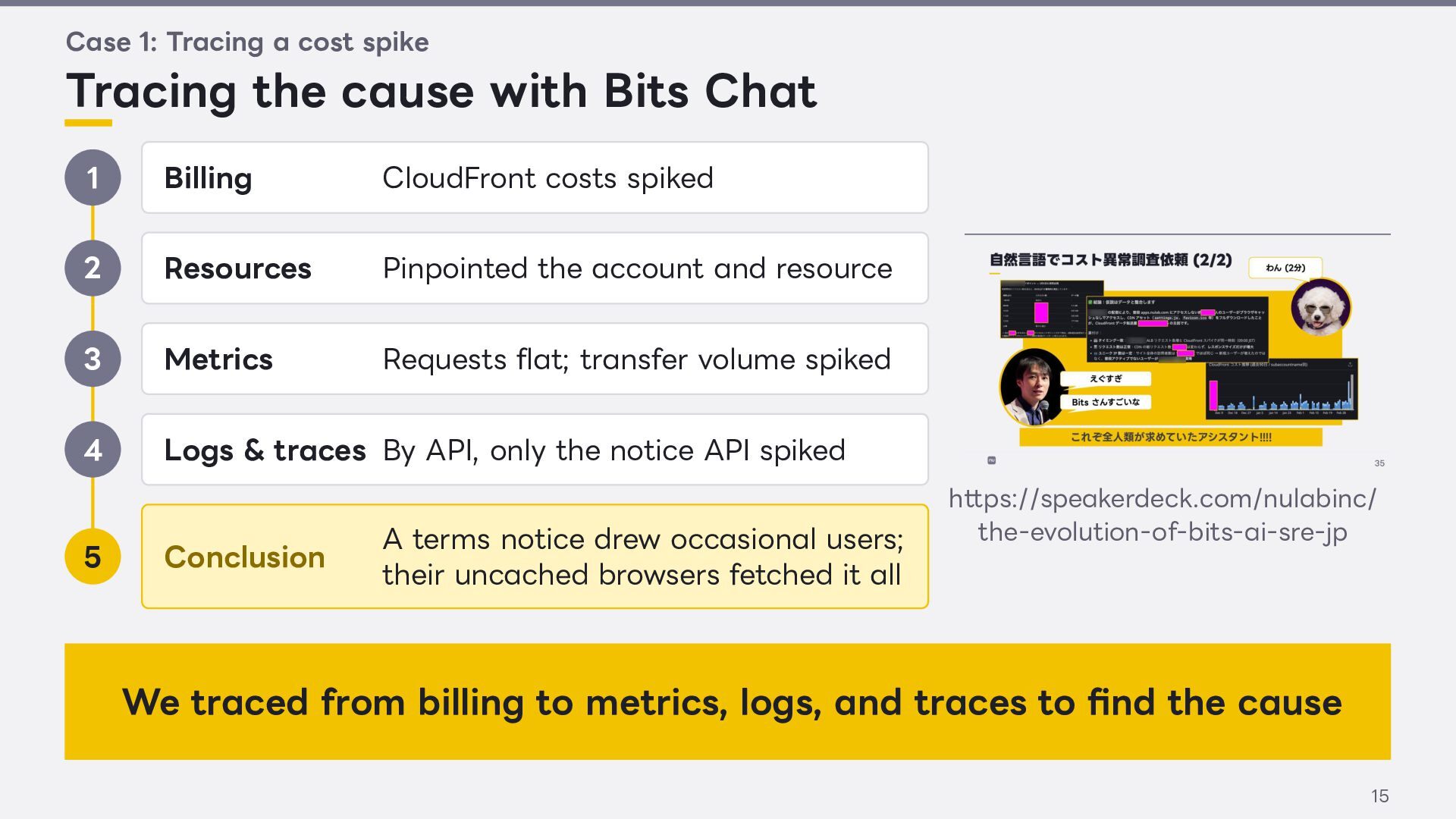
Case 1: Tracing a cost spike Tracing the cause with
Bits Chat 1 Billing CloudFront costs spiked 2 Resources Pinpointed the account and resource 3 Metrics Requests flat; transfer volume spiked 4 Logs & traces By API, only the notice API spiked 5 Conclusion A terms notice drew occasional users; their uncached browsers fetched it all https://speakerdeck.com/nulabinc/ the-evolution-of-bits-ai-sre-jp We traced from billing to metrics, logs, and traces to find the cause 15 -
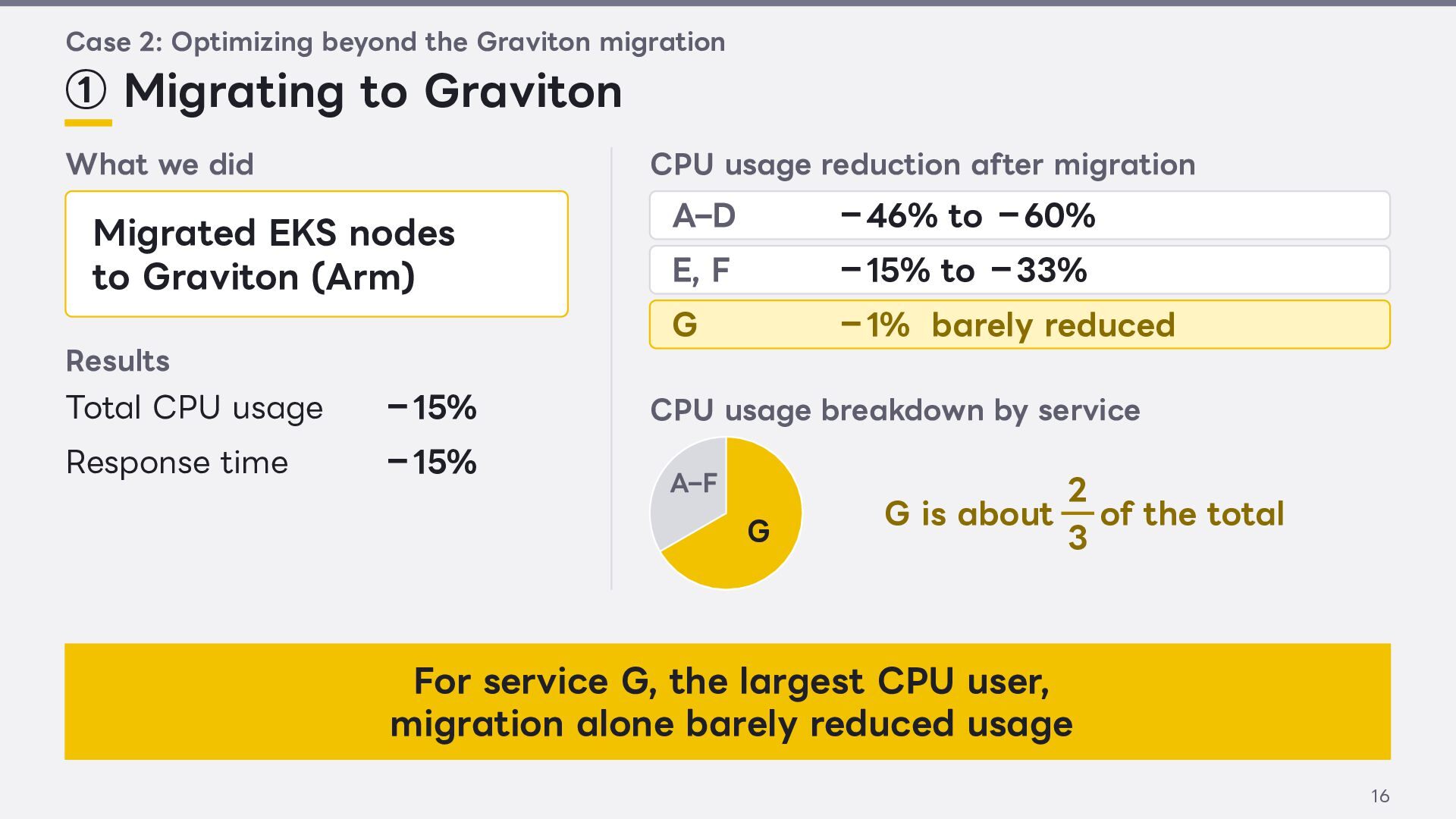
Case 2: Optimizing beyond the Graviton migration ① Migrating to
Graviton What we did CPU usage reduction after migration Migrated EKS nodes to Graviton (Arm) A‒D −46% to −60% E, F −15% to −33% G −1% barely reduced Results Total CPU usage −15% Response time −15% CPU usage breakdown by service A‒F G G is about 2 3 of the total For service G, the largest CPU user, migration alone barely reduced usage 16 -
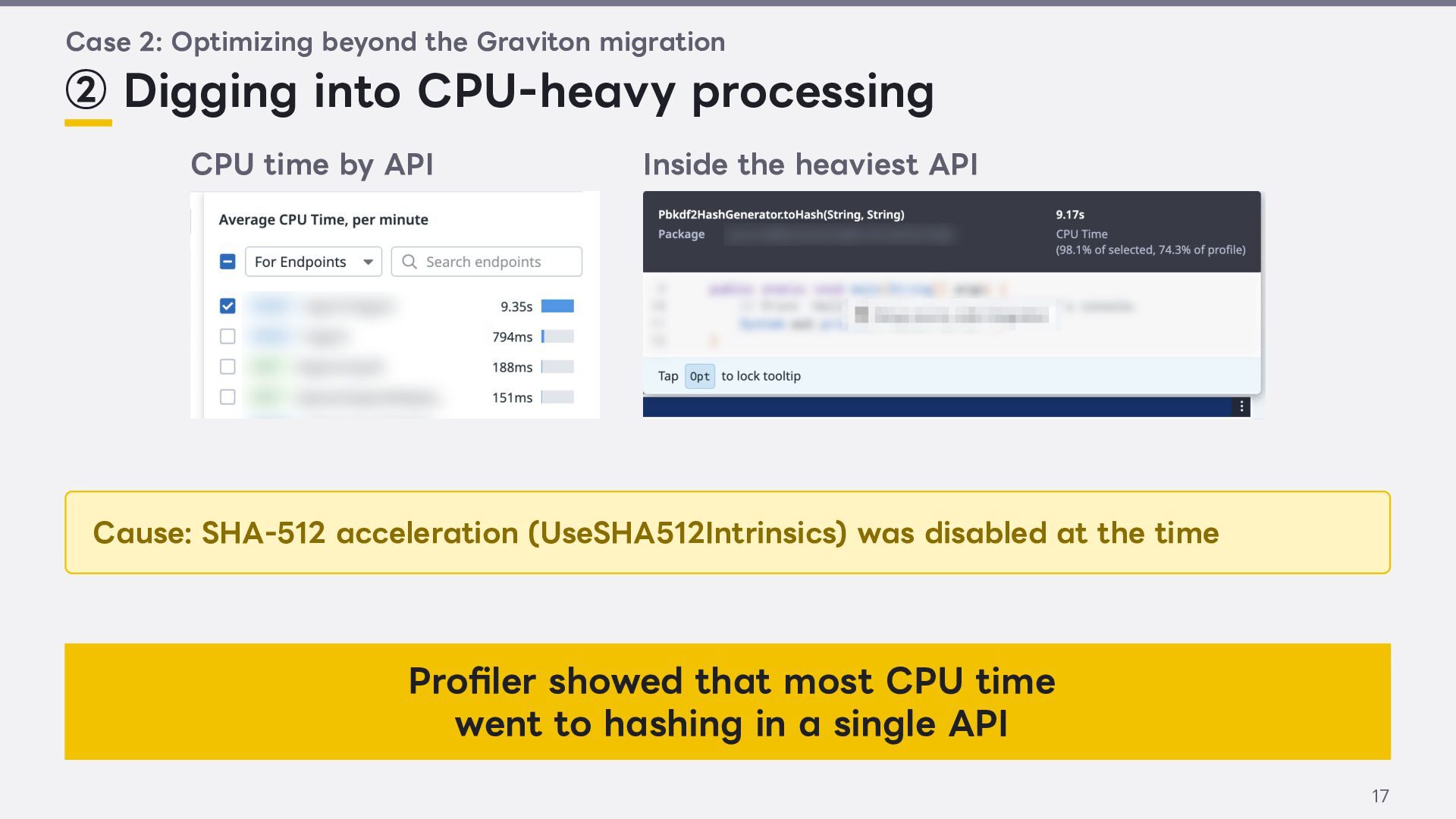
Case 2: Optimizing beyond the Graviton migration ② Digging into
CPU-heavy processing CPU time by API Inside the heaviest API Cause: SHA-512 acceleration (UseSHA512Intrinsics) was disabled at the time Profiler showed that most CPU time went to hashing in a single API 17 -
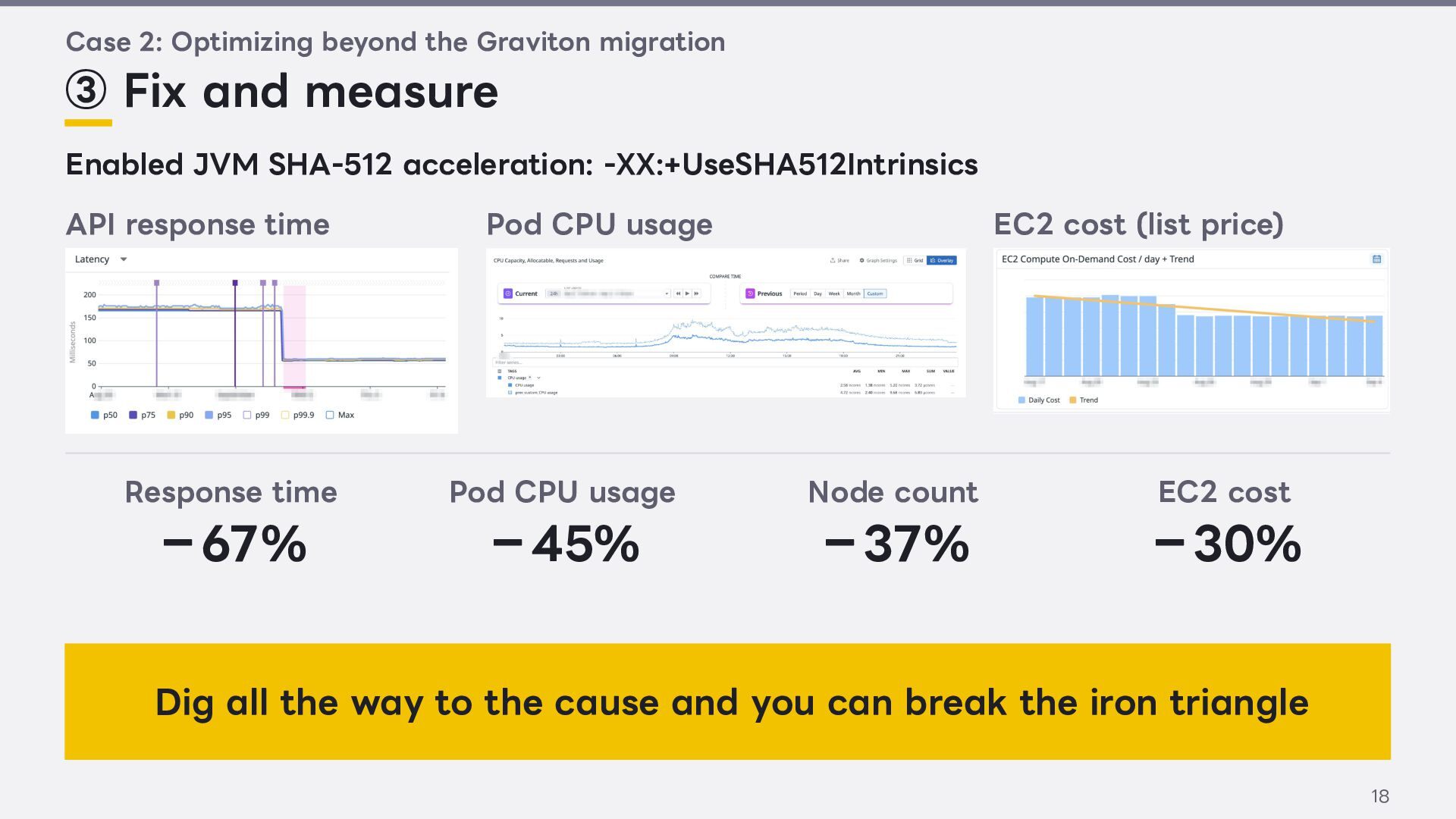
Case 2: Optimizing beyond the Graviton migration ③ Fix and
measure Enabled JVM SHA-512 acceleration: -XX:+UseSHA512Intrinsics API response time Pod CPU usage EC2 cost (list price) Response time Pod CPU usage Node count EC2 cost −67% −45% −37% −30% Dig all the way to the cause and you can break the iron triangle 18 -
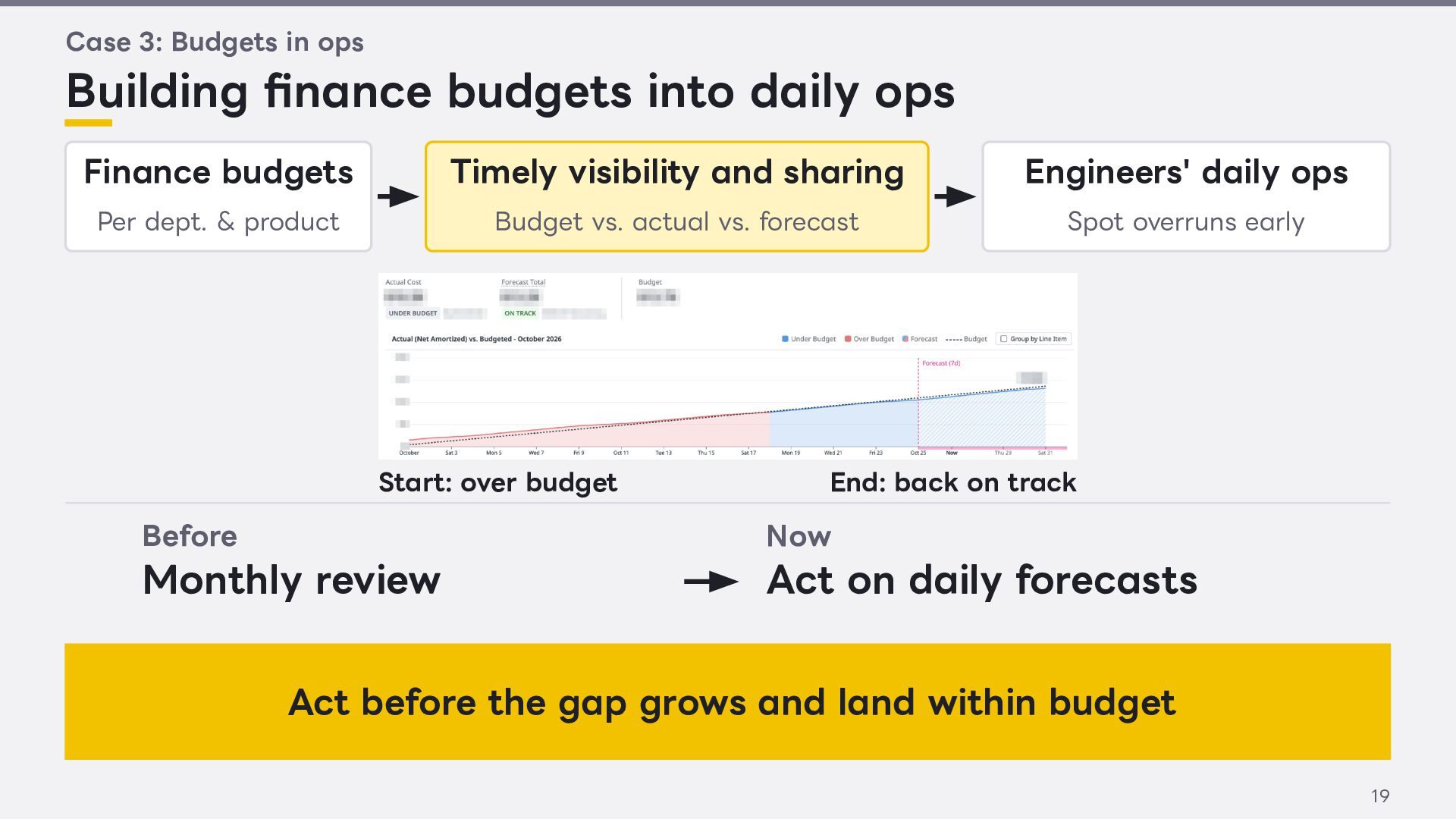
Case 3: Budgets in ops Building finance budgets into daily
ops Finance budgets Timely visibility and sharing Engineers' daily ops Per dept. & product Budget vs. actual vs. forecast Spot overruns early Start: over budget End: back on track Before Now Monthly review Act on daily forecasts Act before the gap grows and land within budget 19 -
Strategy 2 Reproduce expert know-how with AI Case 4: Cost
anomaly triage Case 5: Commitments 20 -
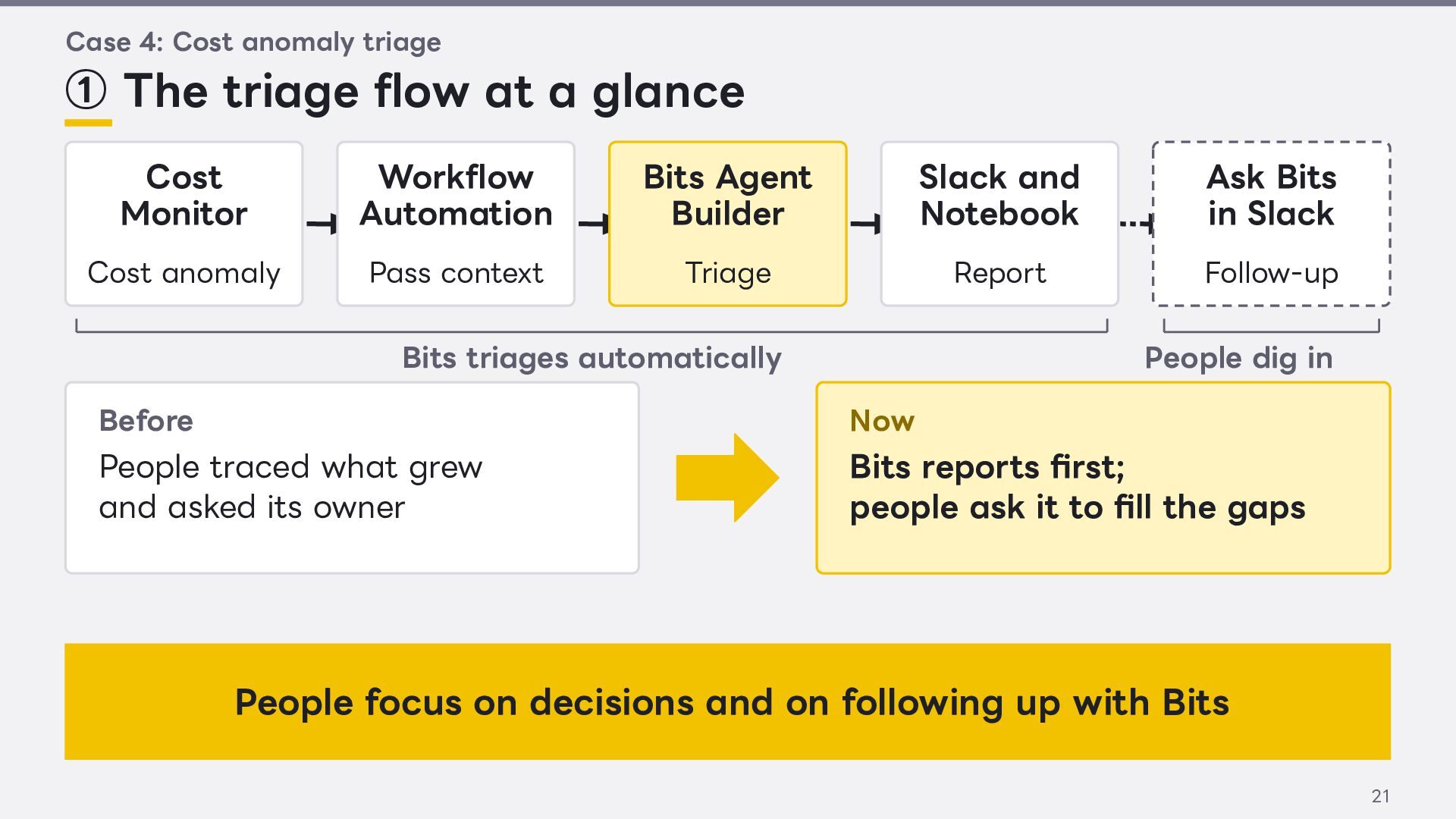
Case 4: Cost anomaly triage ① The triage flow at
a glance Cost Monitor Workflow Automation Bits Agent Builder Slack and Notebook Ask Bits in Slack Cost anomaly Pass context Triage Report Follow-up Bits triages automatically People dig in Before Now People traced what grew and asked its owner Bits reports first; people ask it to fill the gaps People focus on decisions and on following up with Bits 21 -
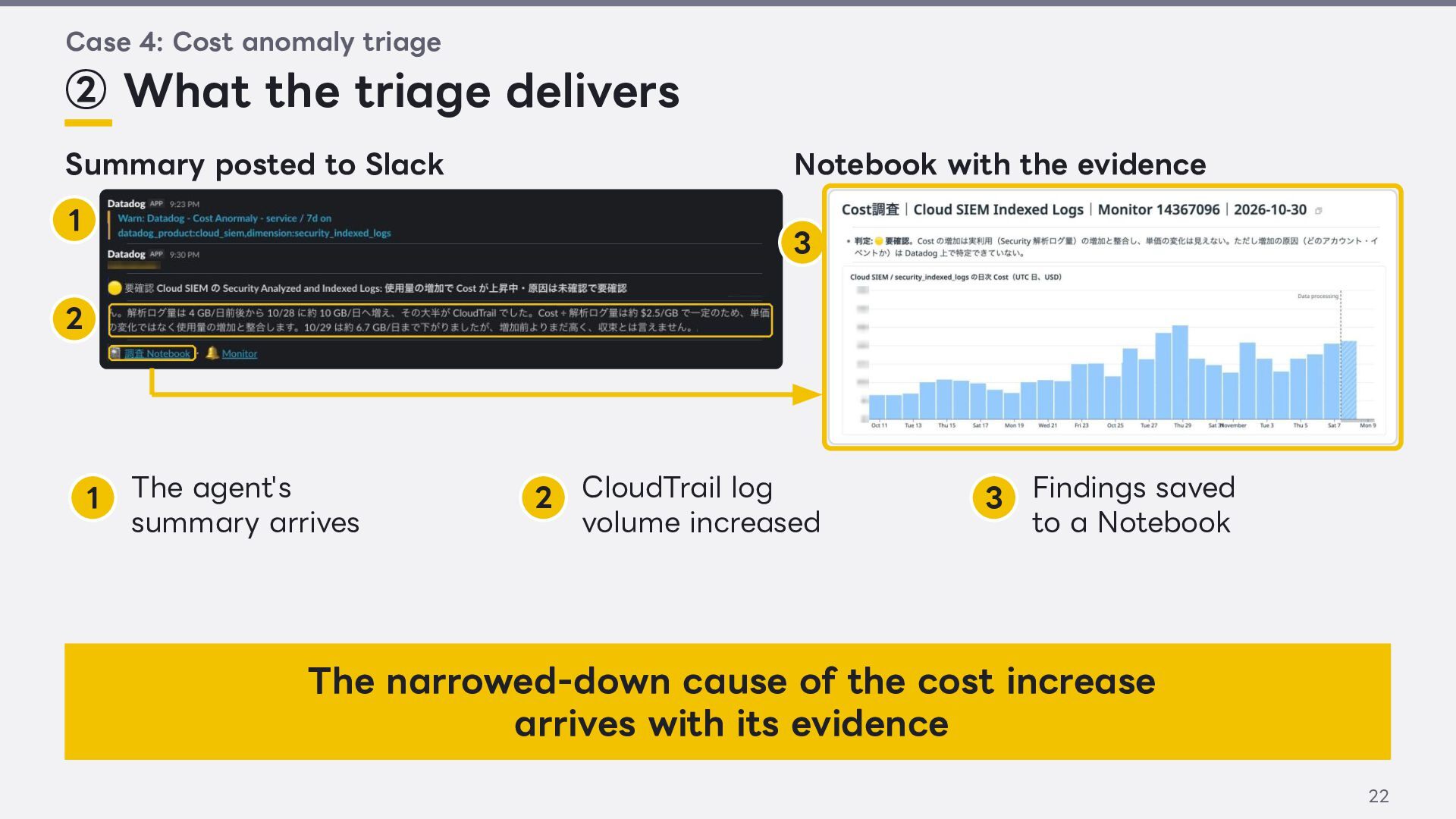
Case 4: Cost anomaly triage ② What the triage delivers
Summary posted to Slack Notebook with the evidence 1 3 2 1 The agent's summary arrives 2 CloudTrail log volume increased 3 Findings saved to a Notebook The narrowed-down cause of the cost increase arrives with its evidence 22 -
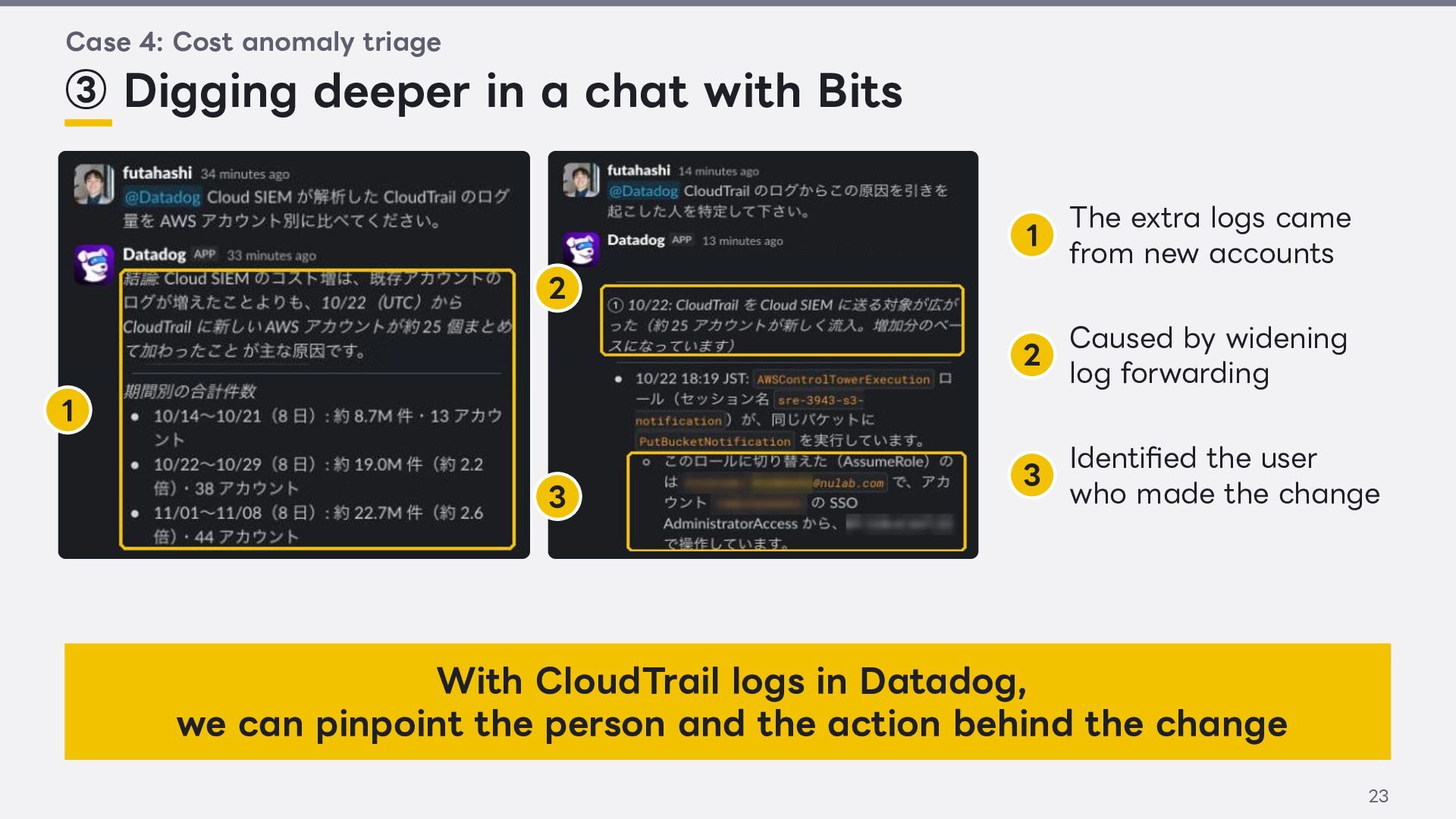
Case 4: Cost anomaly triage ③ Digging deeper in a
chat with Bits 1 The extra logs came from new accounts 2 Caused by widening log forwarding 3 Identified the user who made the change 2 1 3 With CloudTrail logs in Datadog, we can pinpoint the person and the action behind the change 23 -
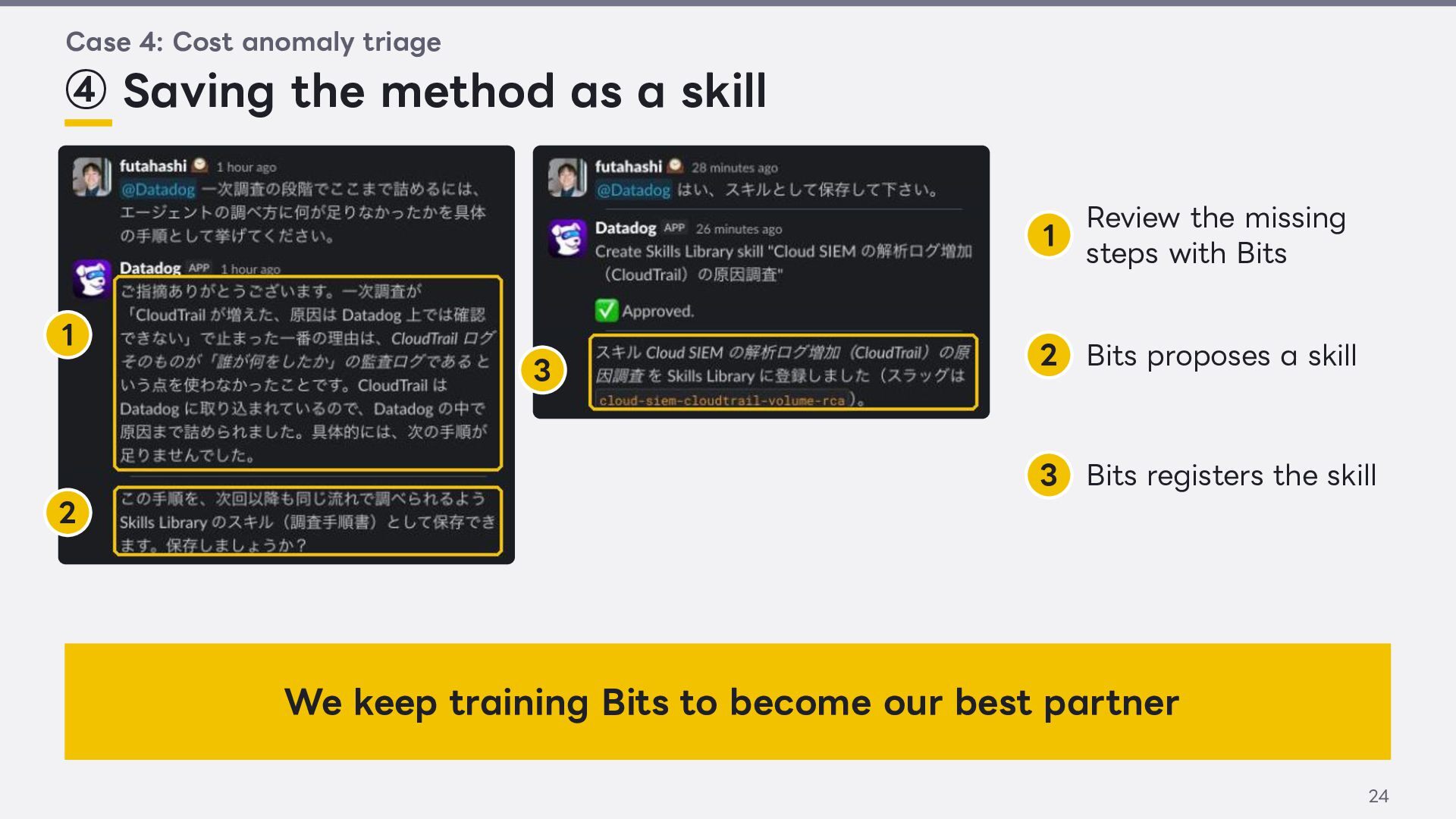
Case 4: Cost anomaly triage ④ Saving the method as
a skill 1 3 1 Review the missing steps with Bits 2 Bits proposes a skill 3 Bits registers the skill 2 We keep training Bits to become our best partner 24 -
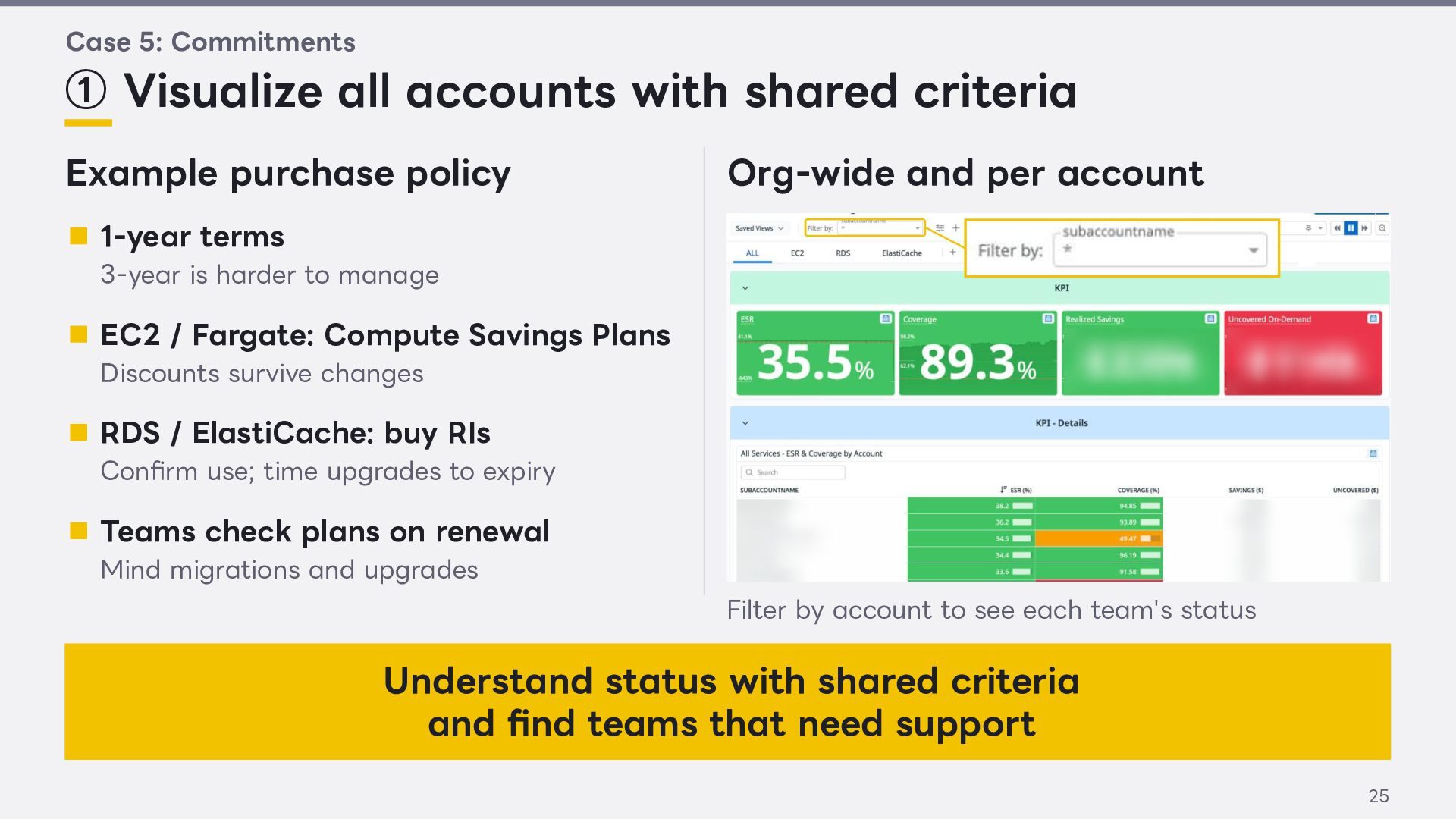
Case 5: Commitments ① Visualize all accounts with shared criteria
Example purchase policy Org-wide and per account 1-year terms 3-year is harder to manage EC2 / Fargate: Compute Savings Plans Discounts survive changes RDS / ElastiCache: buy RIs Confirm use; time upgrades to expiry Teams check plans on renewal Mind migrations and upgrades Filter by account to see each team's status Understand status with shared criteria and find teams that need support 25 -
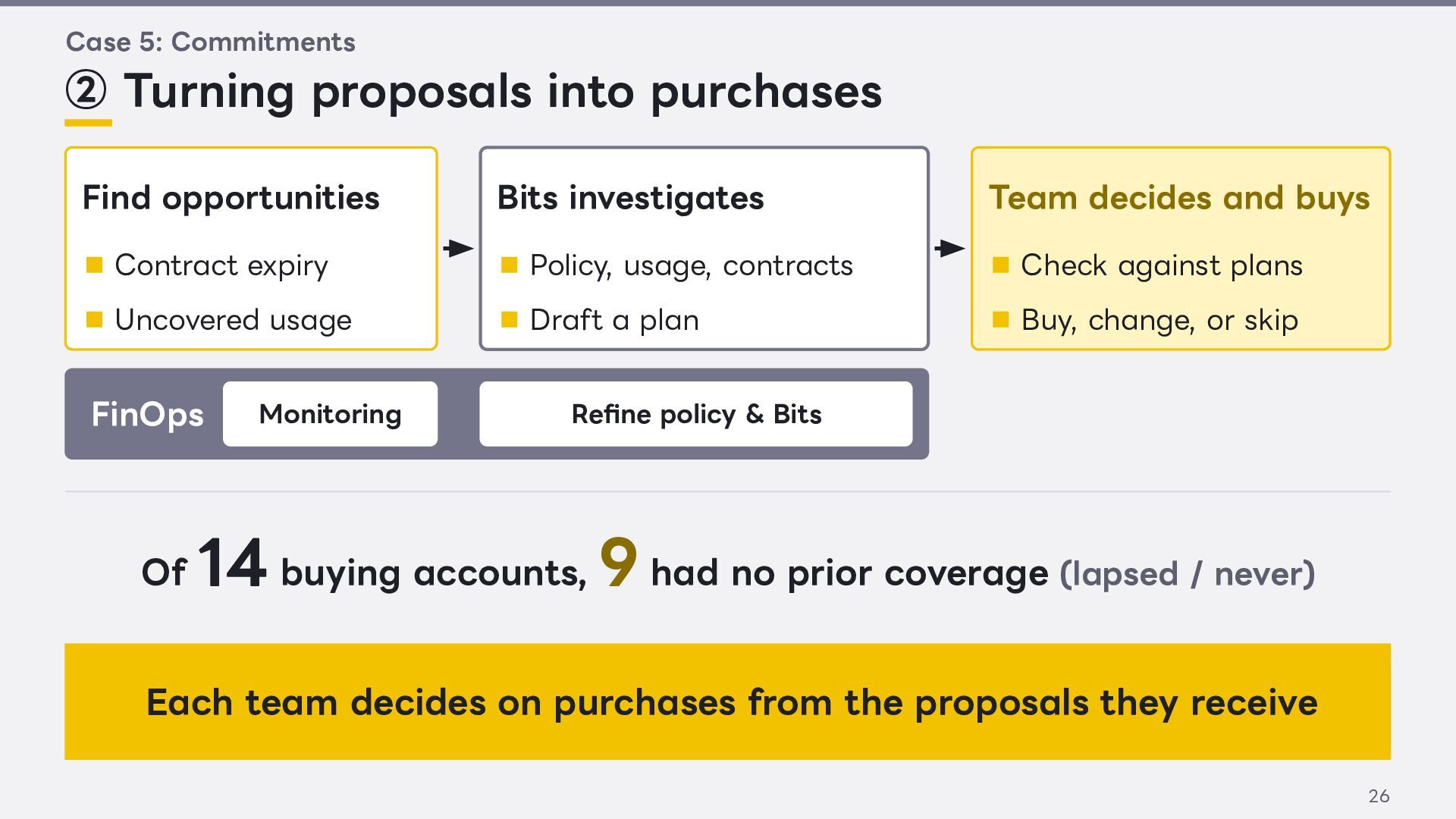
Case 5: Commitments ② Turning proposals into purchases Find opportunities
Bits investigates Team decides and buys Contract expiry Policy, usage, contracts Check against plans Uncovered usage Draft a plan Buy, change, or skip FinOps Of Monitoring Refine policy & Bits 14 buying accounts, 9 had no prior coverage (lapsed / never) Each team decides on purchases from the proposals they receive 26 -
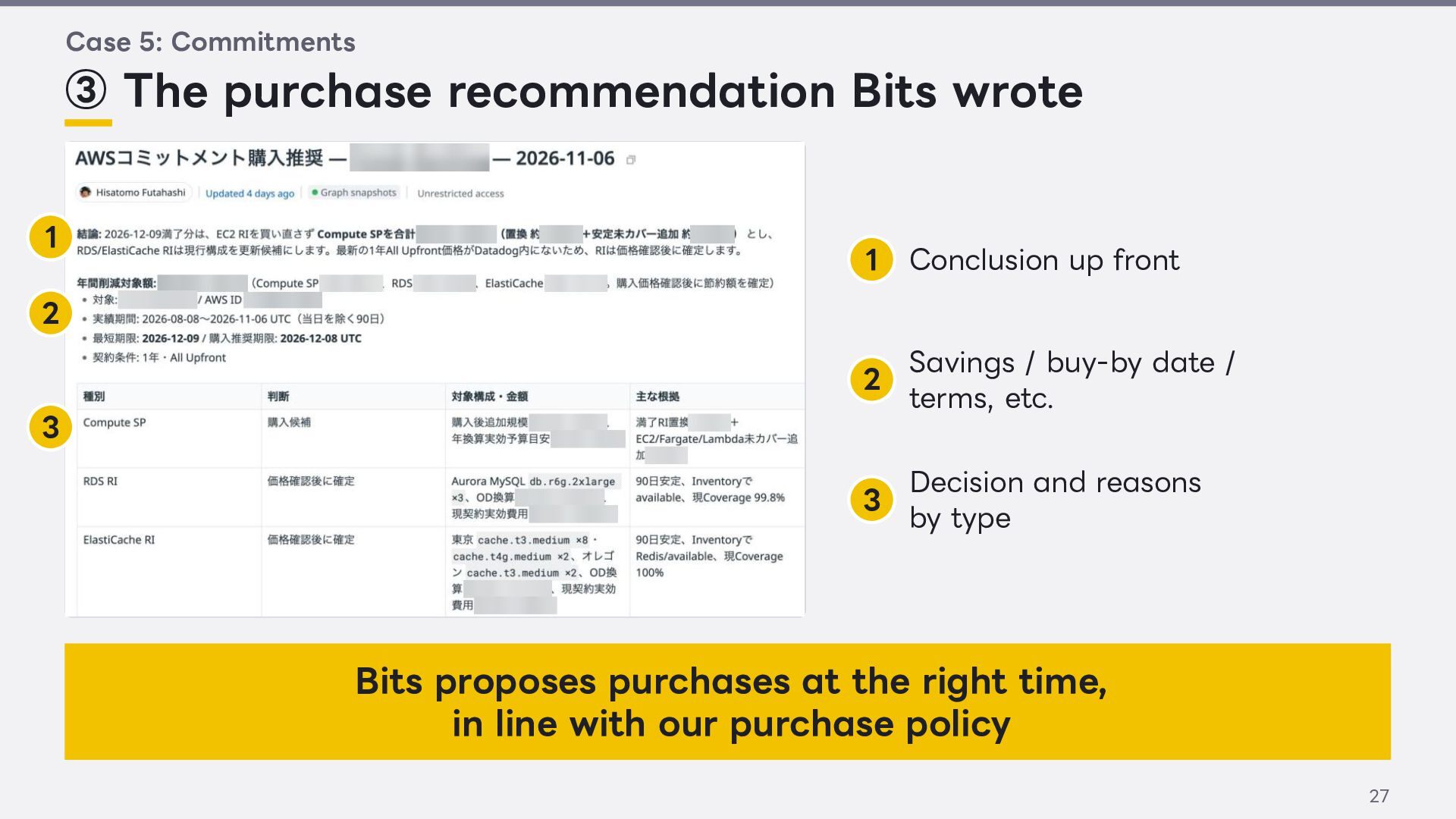
Case 5: Commitments ③ The purchase recommendation Bits wrote 1
1 Conclusion up front 2 Savings / buy-by date / terms, etc. 3 Decision and reasons by type 2 3 Bits proposes purchases at the right time, in line with our purchase policy 27 -
Strategy 3 Verify effect and impact of fixes Case 6:
Unused resources Case 7: Verify estimates 28 -
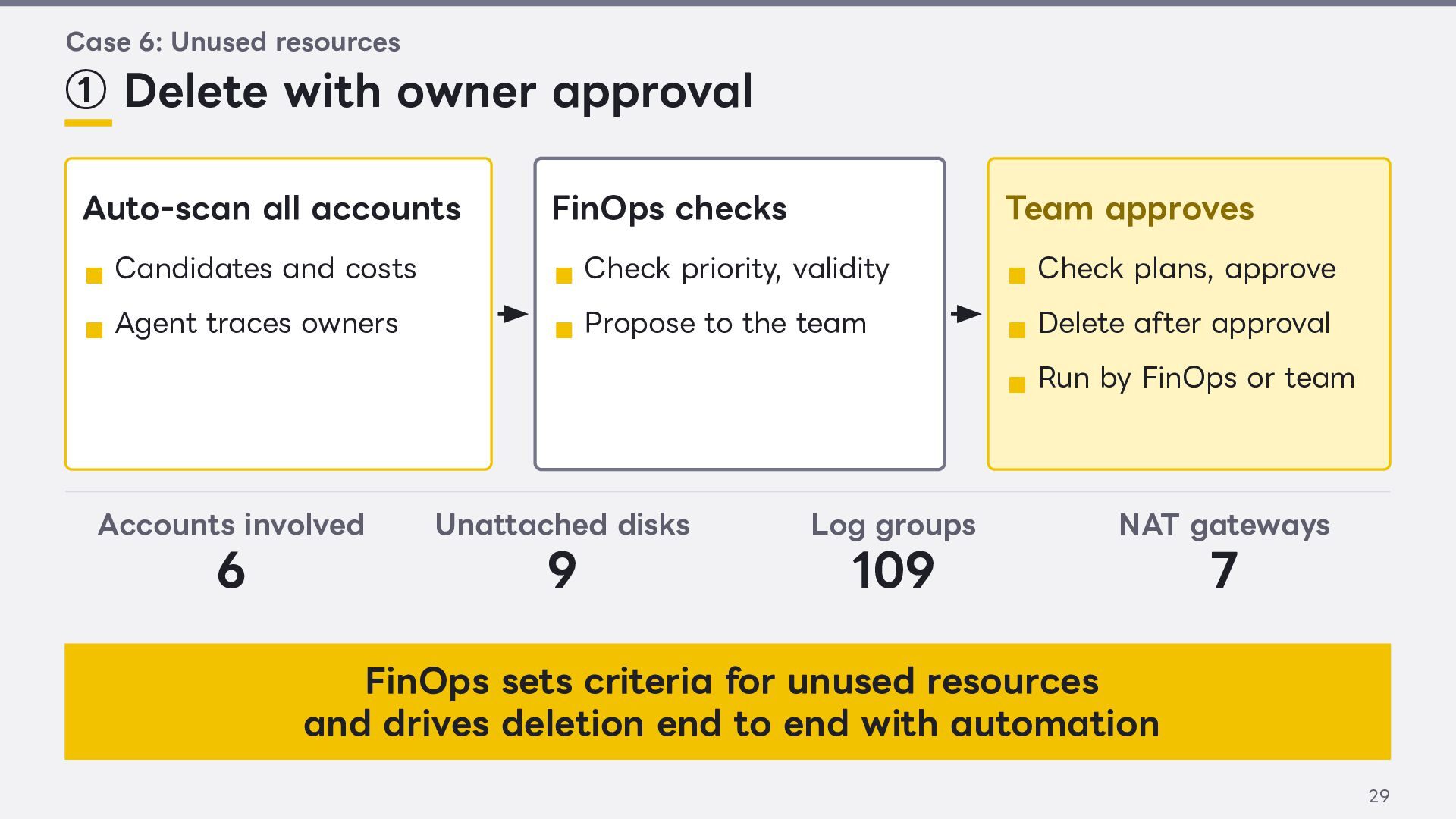
Case 6: Unused resources ① Delete with owner approval Auto-scan
all accounts FinOps checks Team approves Candidates and costs Check priority, validity Check plans, approve Agent traces owners Propose to the team Delete after approval Run by FinOps or team Accounts involved Unattached disks Log groups NAT gateways 6 9 109 7 FinOps sets criteria for unused resources and drives deletion end to end with automation 29 -
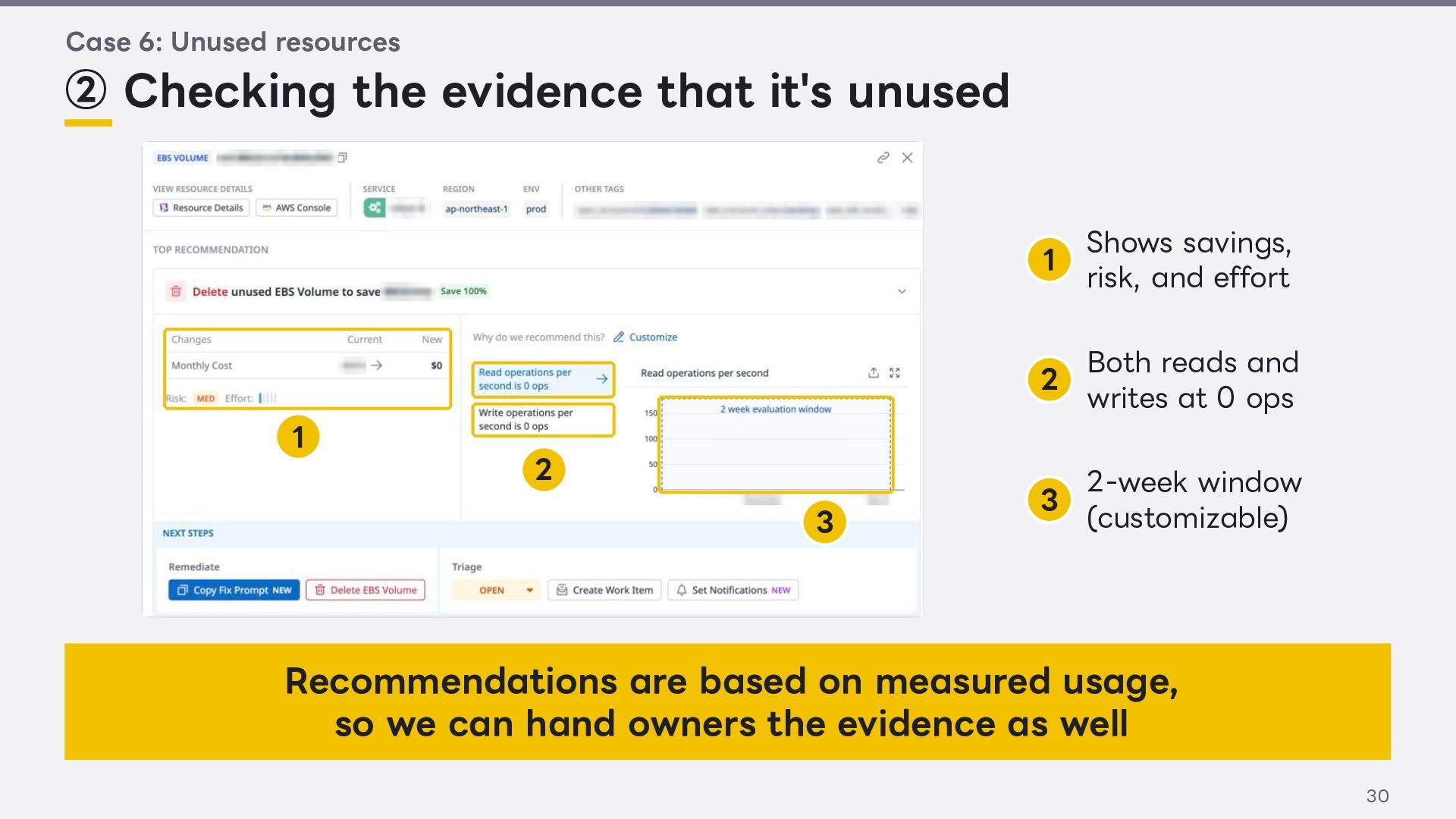
Case 6: Unused resources ② Checking the evidence that it's
unused 1 Shows savings, risk, and effort 2 Both reads and writes at 0 ops 3 2-week window (customizable) 1 2 3 Recommendations are based on measured usage, so we can hand owners the evidence as well 30 -
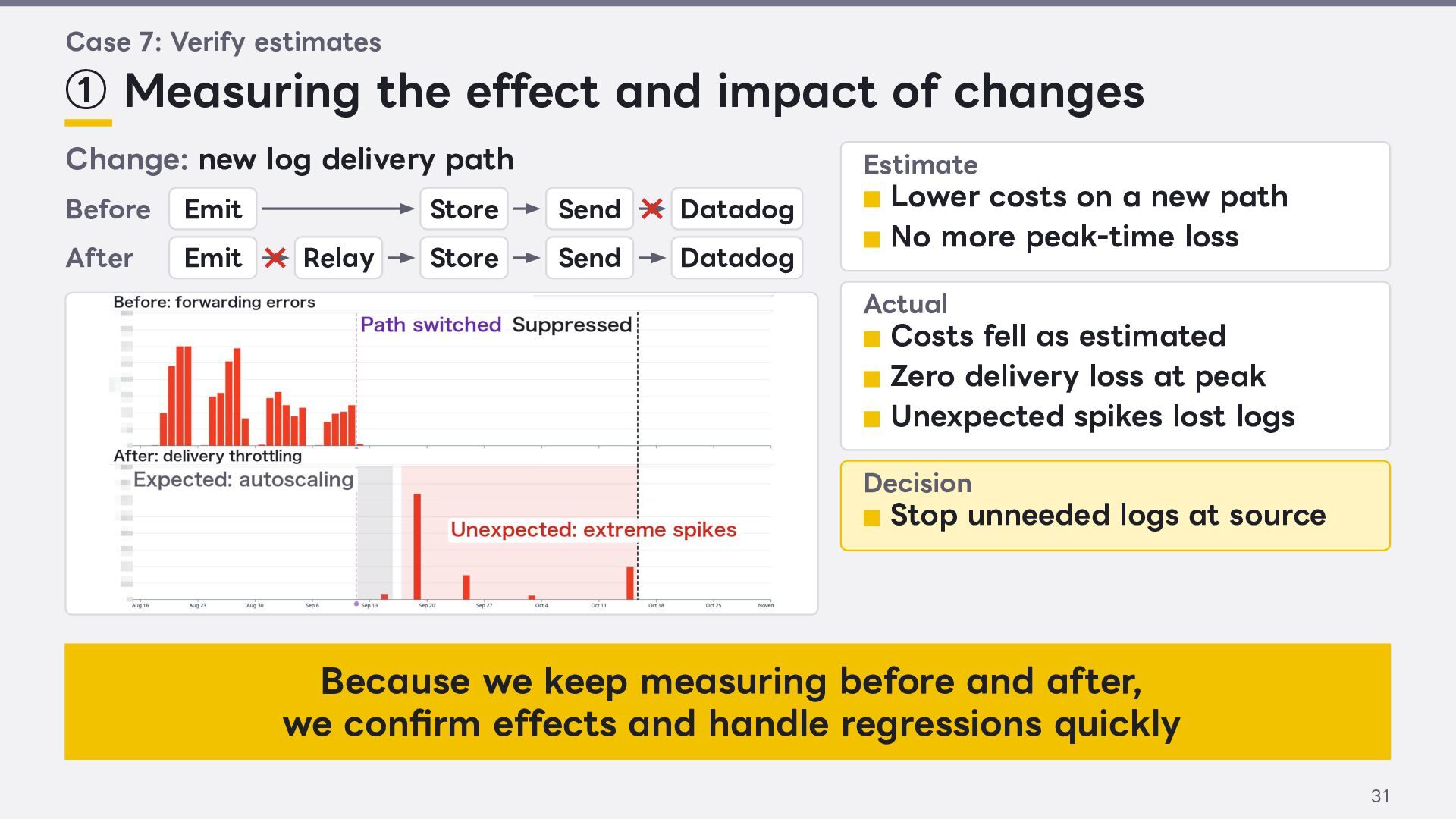
Case 7: Verify estimates ① Measuring the effect and impact
of changes Change: new log delivery path Estimate Before Emit Store Send ✕ Datadog After Emit ✕ Relay Store Send Datadog Lower costs on a new path No more peak-time loss Actual Costs fell as estimated Zero delivery loss at peak Unexpected spikes lost logs Decision Stop unneeded logs at source Because we keep measuring before and after, we confirm effects and handle regressions quickly 31 -
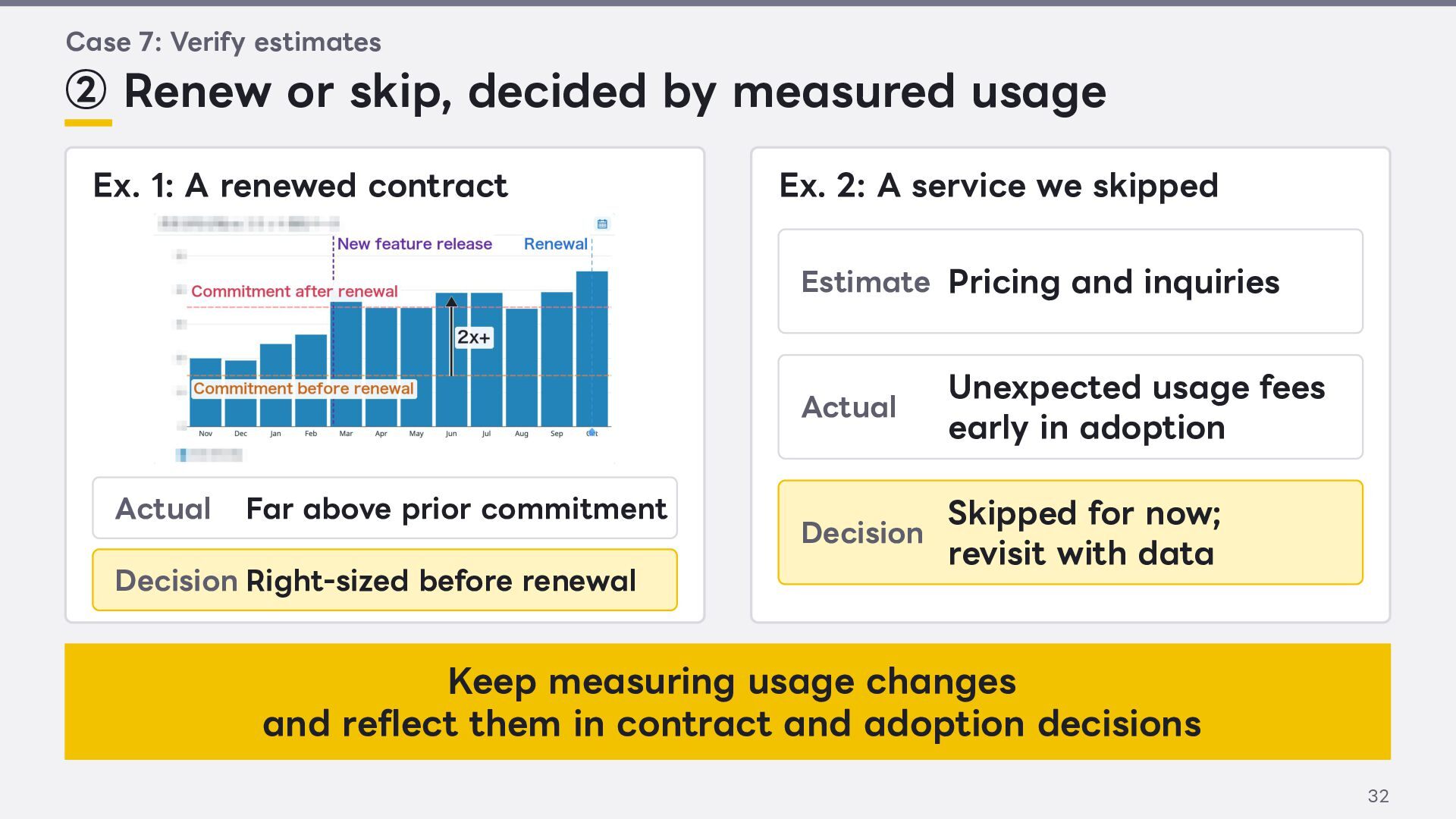
Case 7: Verify estimates ② Renew or skip, decided by
measured usage Ex. 1: A renewed contract Ex. 2: A service we skipped Estimate Pricing and inquiries Actual Far above prior commitment Decision Right-sized before renewal Actual Unexpected usage fees early in adoption Decision Skipped for now; revisit with data Keep measuring usage changes and reflect them in contract and adoption decisions 32 -
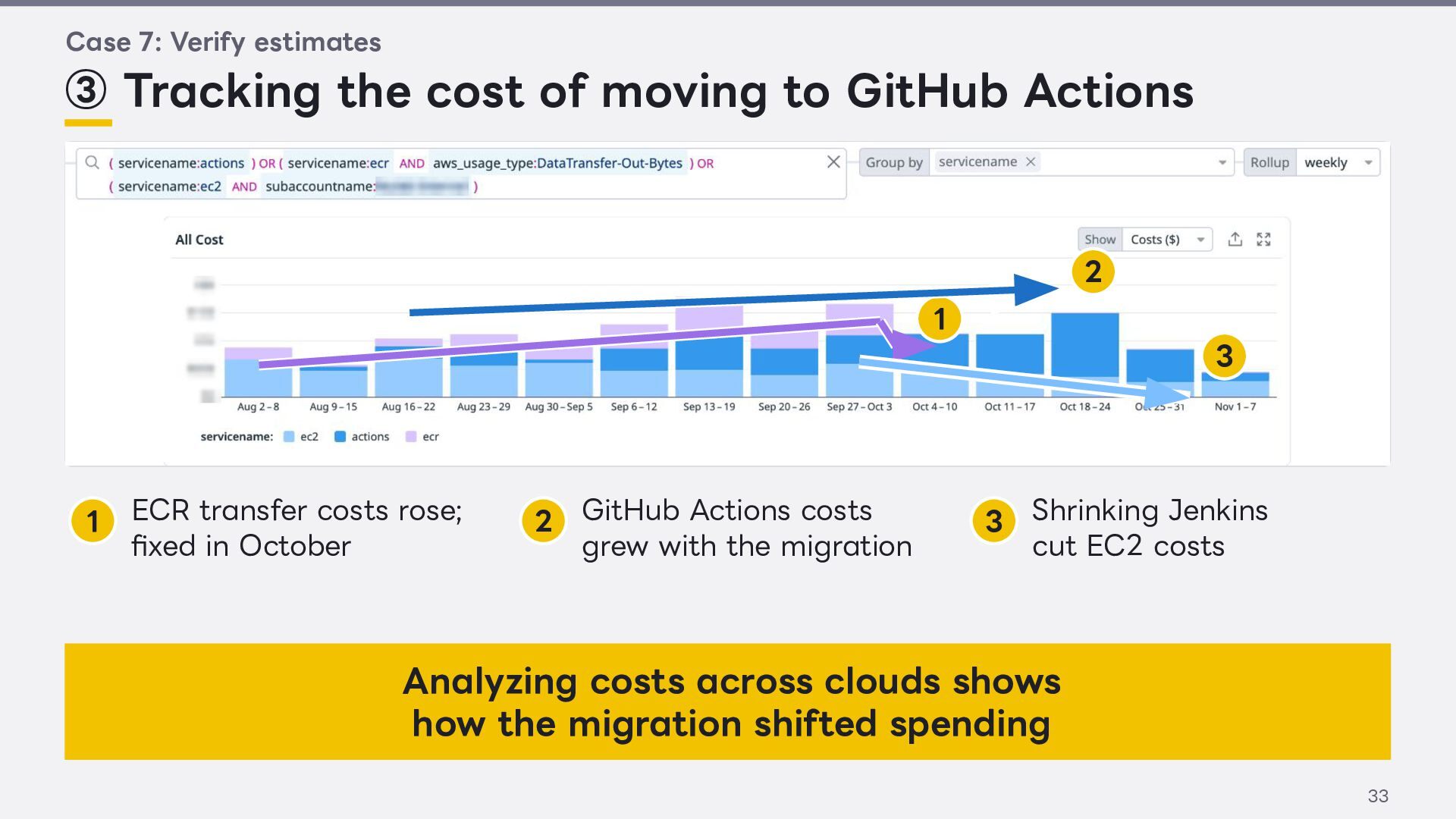
Case 7: Verify estimates ③ Tracking the cost of moving
to GitHub Actions 2 1 3 1 ECR transfer costs rose; fixed in October 2 GitHub Actions costs grew with the migration 3 Shrinking Jenkins cut EC2 costs Analyzing costs across clouds shows how the migration shifted spending 33 -
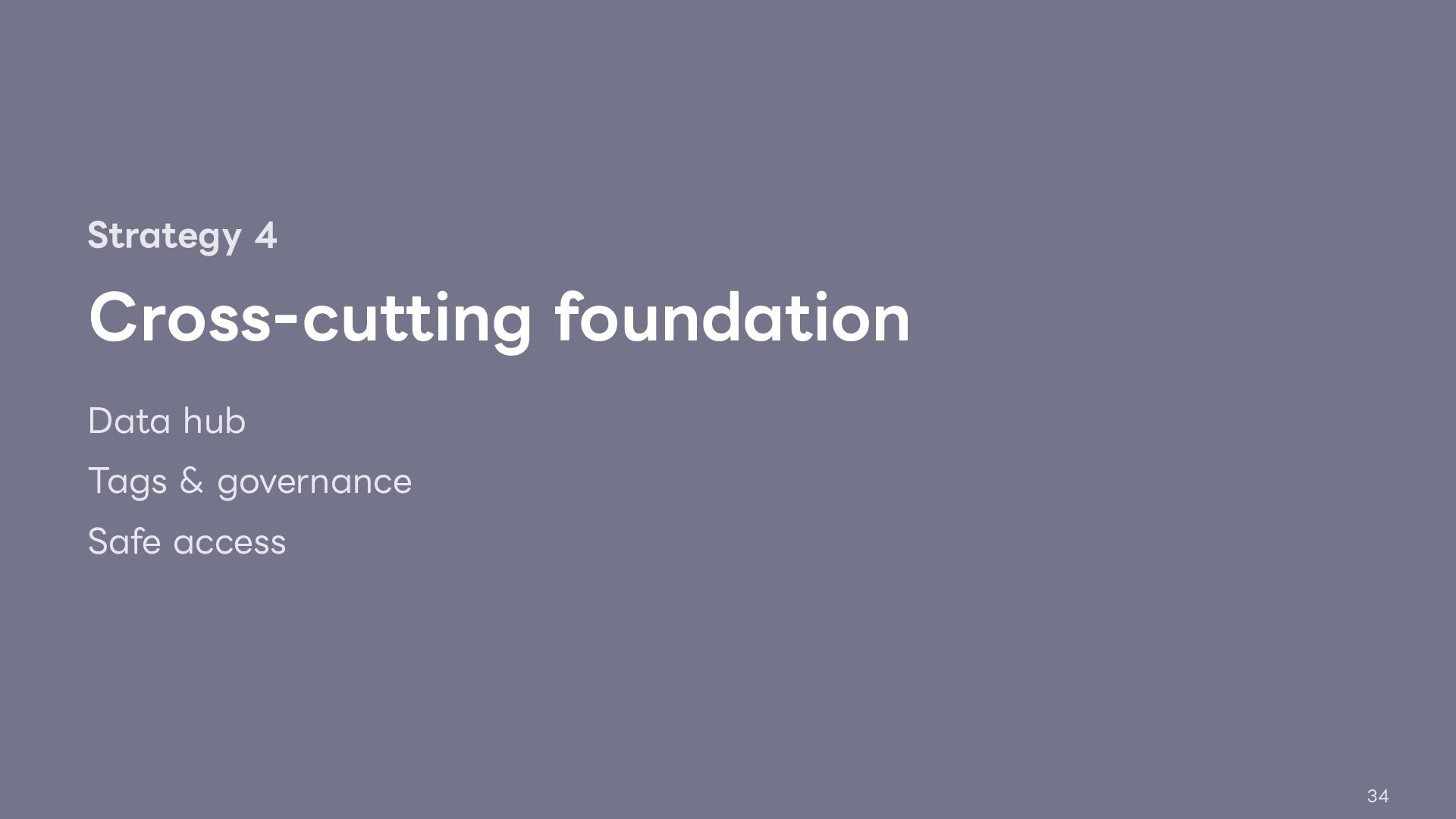
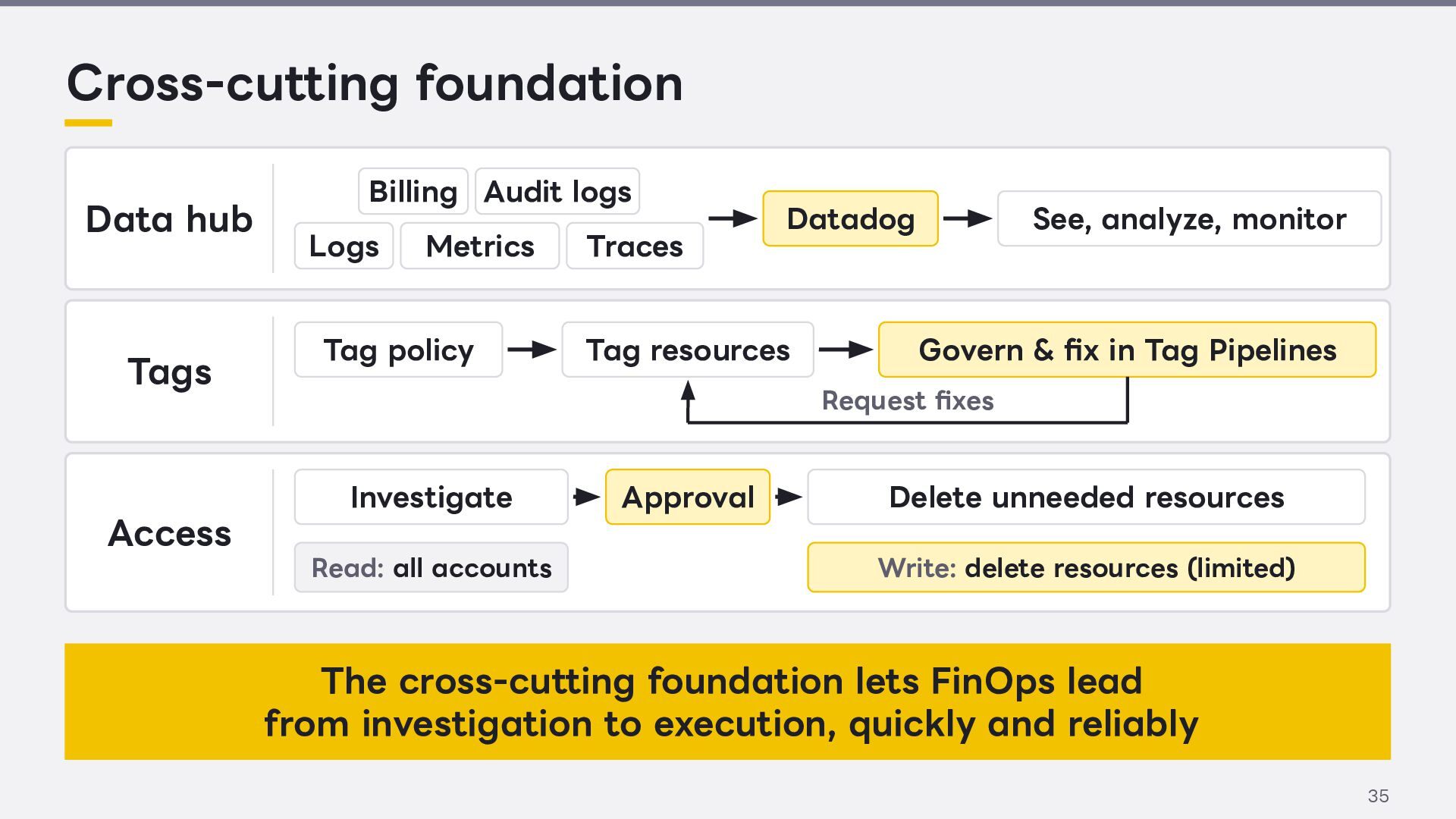
Cross-cutting foundation Data hub Tags Billing Audit logs Logs Metrics
Tag policy Traces Datadog Tag resources See, analyze, monitor Govern & fix in Tag Pipelines Request fixes Investigate Approval Delete unneeded resources Access Read: all accounts Write: delete resources (limited) The cross-cutting foundation lets FinOps lead from investigation to execution, quickly and reliably 35 -
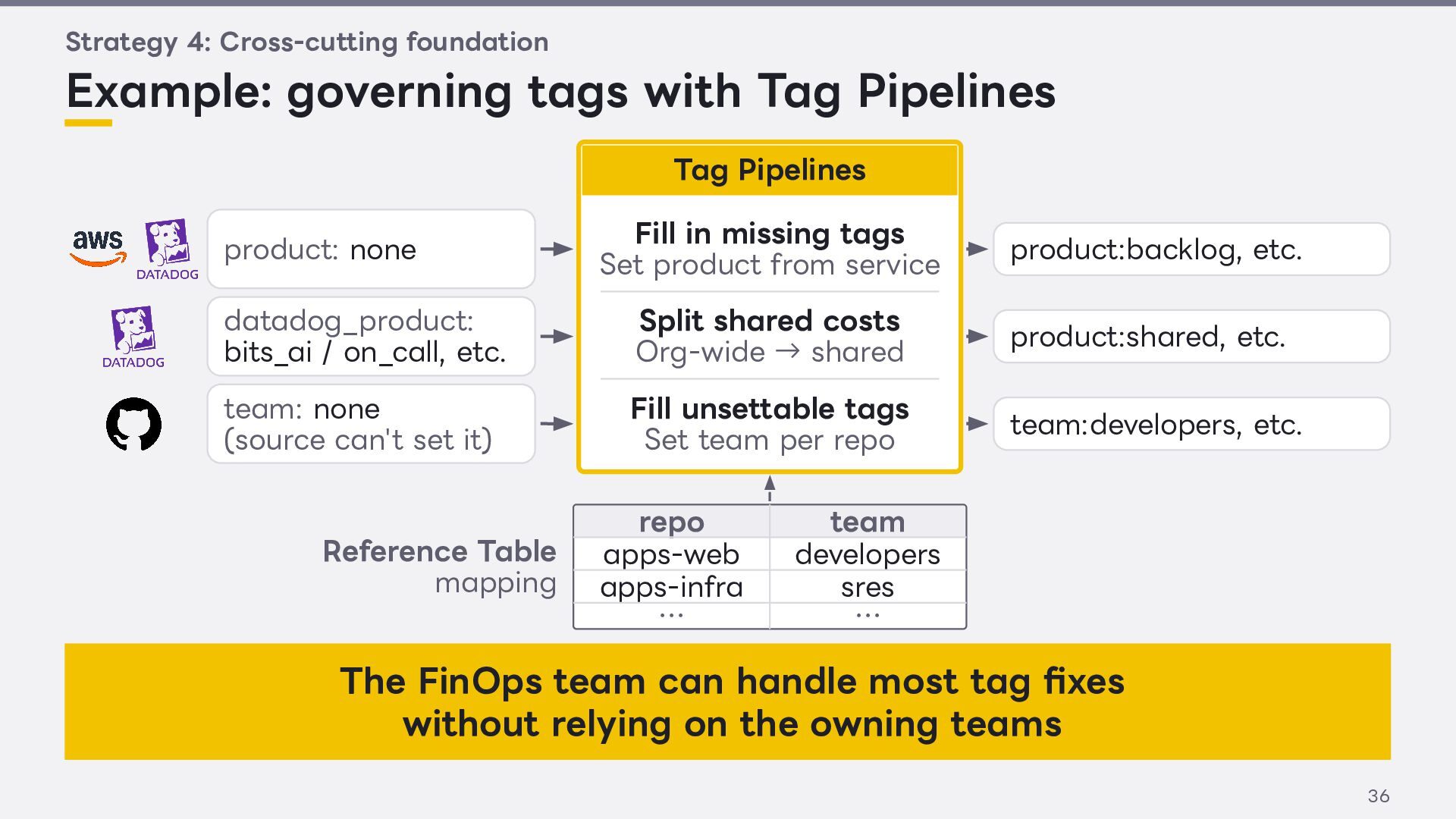
Strategy 4: Cross-cutting foundation Example: governing tags with Tag Pipelines
Tag Pipelines Fill in missing tags Set product from service product:backlog, etc. datadog_product: bits_ai / on_call, etc. Split shared costs Org-wide → shared product:shared, etc. team: none (source can't set it) Fill unsettable tags Set team per repo team:developers, etc. product: none Reference Table mapping repo apps-web apps-infra … team developers sres … The FinOps team can handle most tag fixes without relying on the owning teams 36 -
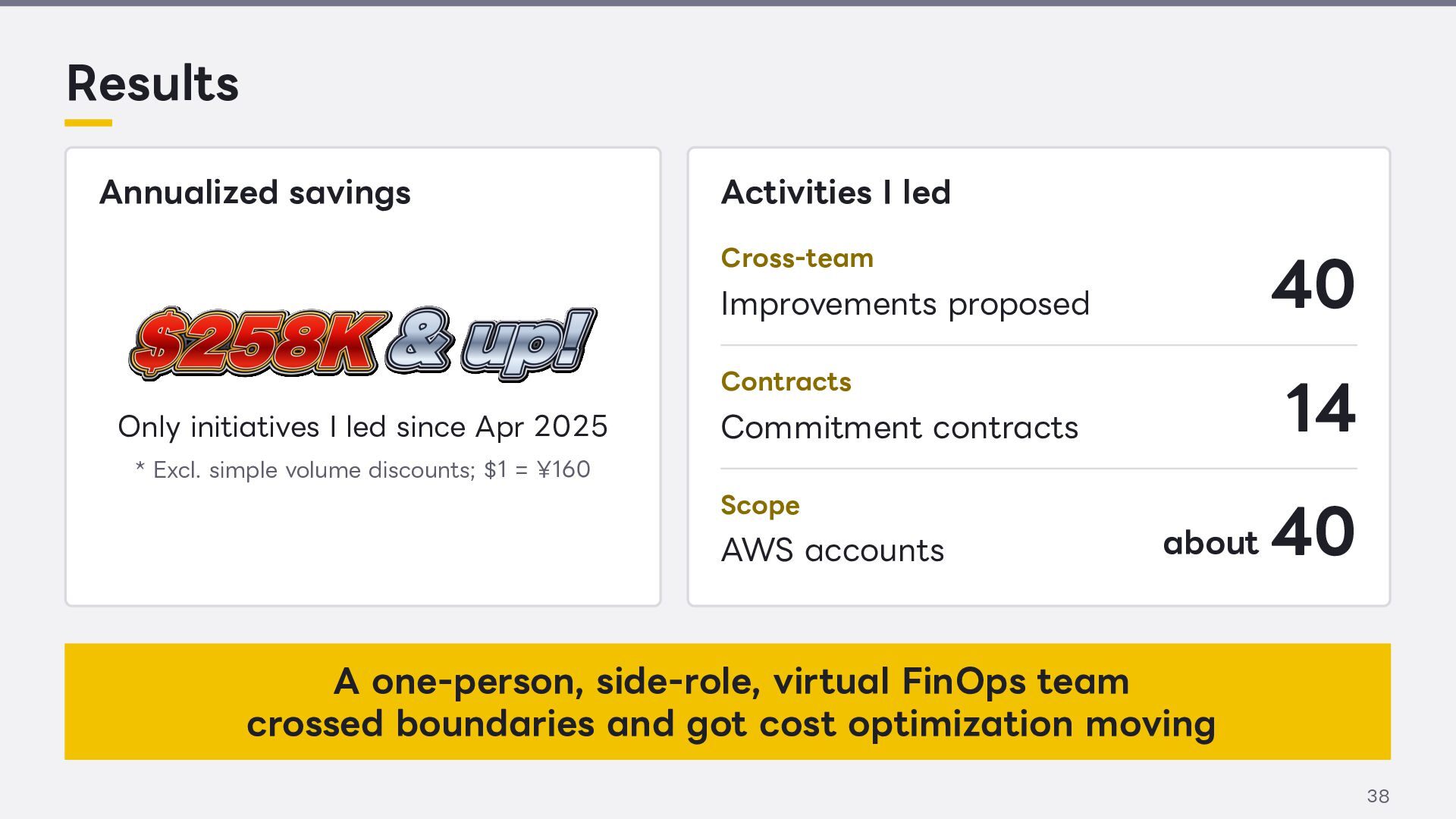
Results Annualized savings Activities I led Cross-team 40 Improvements proposed
Contracts Only initiatives I led since Apr 2025 14 Commitment contracts * Excl. simple volume discounts; $1 = ¥160 Scope AWS accounts about 40 A one-person, side-role, virtual FinOps team crossed boundaries and got cost optimization moving 38 -
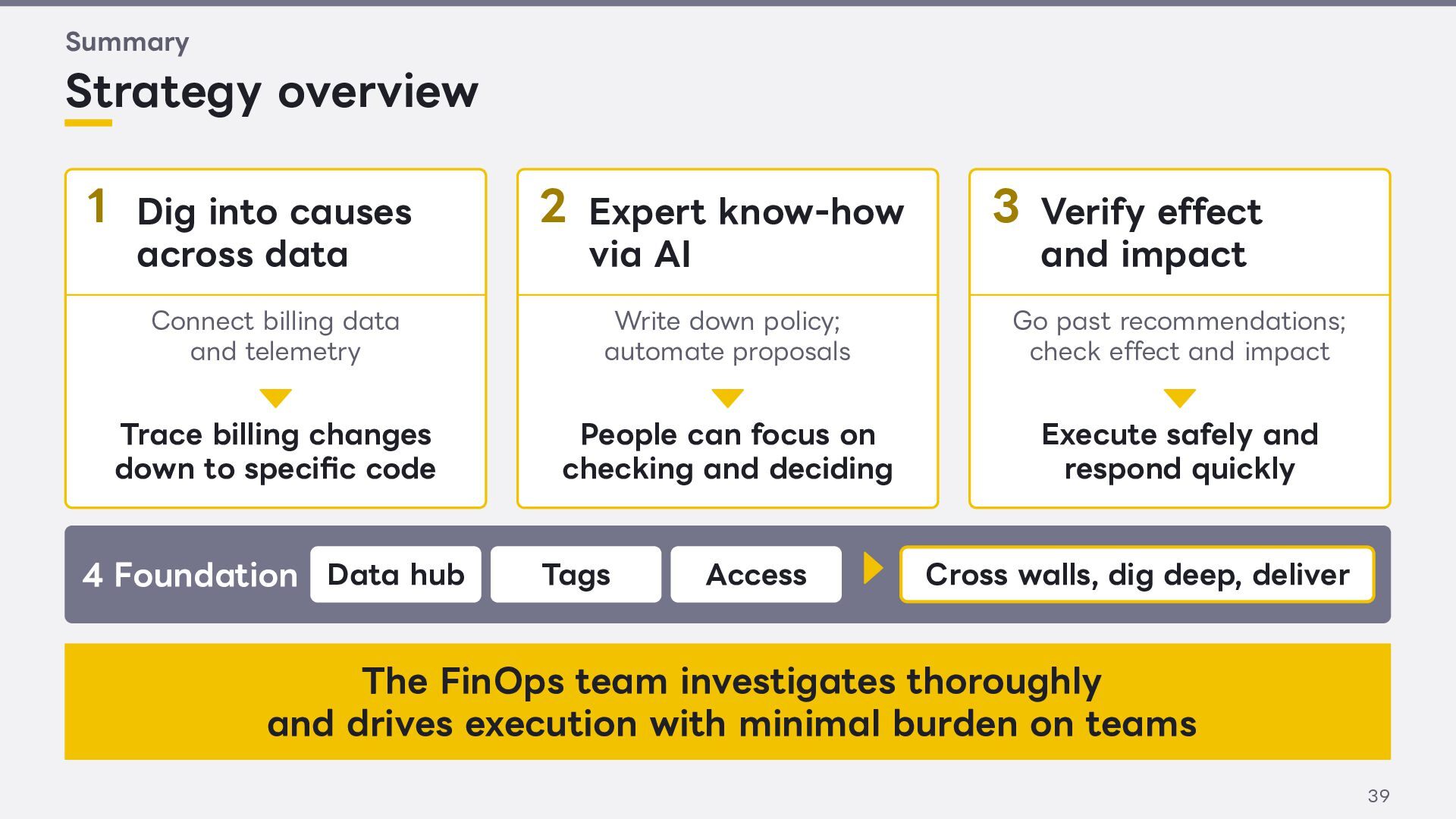
Summary Strategy overview 1 Dig into causes 2 Expert know-how
3 Verify effect across data via AI Connect billing data and telemetry Write down policy; automate proposals Go past recommendations; check effect and impact Trace billing changes down to specific code People can focus on checking and deciding Execute safely and respond quickly 4 Foundation Data hub Tags and impact Access Cross walls, dig deep, deliver The FinOps team investigates thoroughly and drives execution with minimal burden on teams 39 -
FinOps in practice that drives execution with evolving Bits AI
and observability, made possible by all-in-one Datadog 💪🐶 40
 nulabinc
 mfonobong
 hatefulcrawdad
 seathinner
 eileencodes
 nwiizo
 chrisshort
 lauravandoore
 nonsquared
 destraynor
 ryanjones
 davetheseo
 geoffreycrofte