Upgrade to Pro — share decks privately, control downloads, hide ads and more …

OpenMetadata Monthly Meetup - Community Spotlig...

OpenMetadata Monthly Meetup - Community Spotlight: "Your Data, Your Agents, One Context Platform"

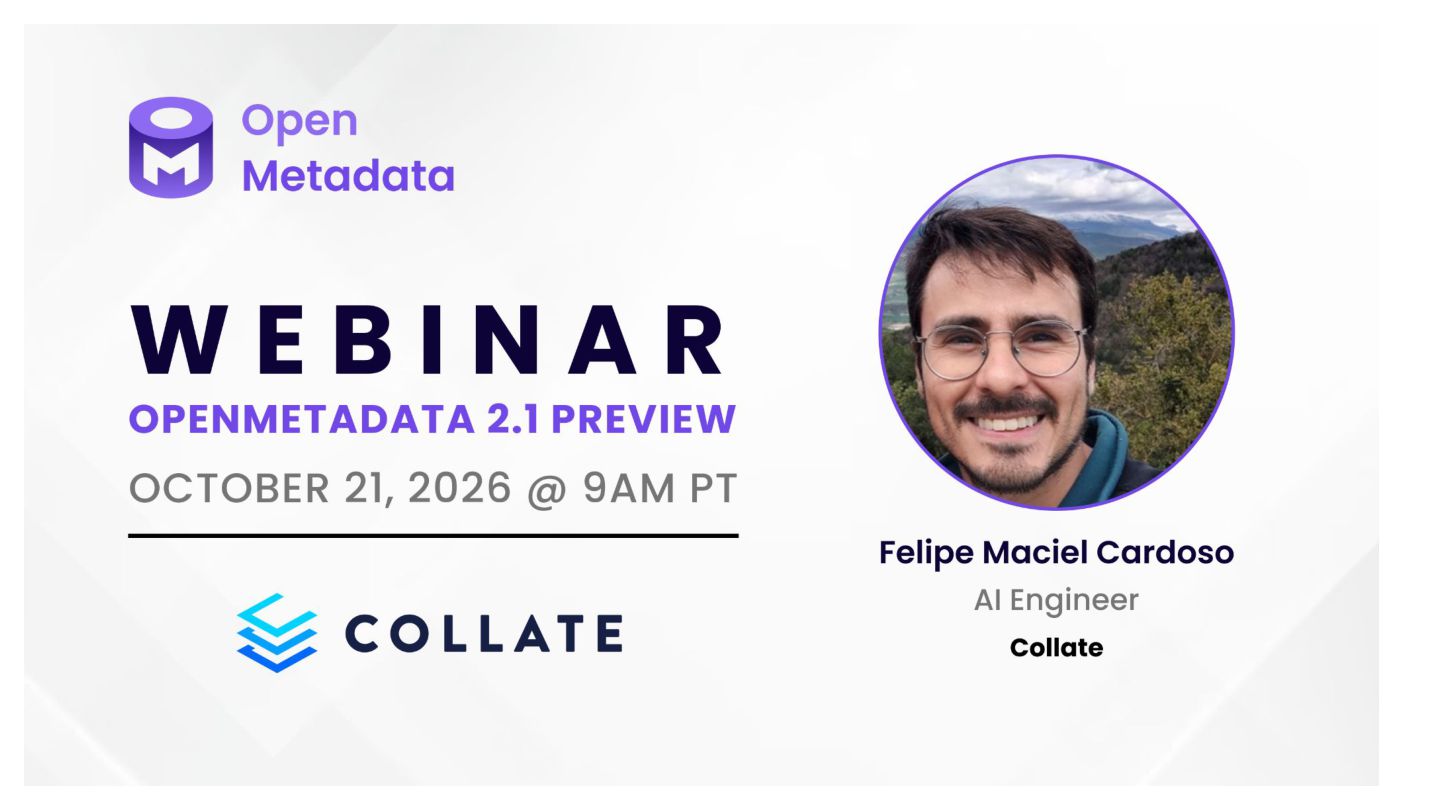
OpenMetadata Monthly Meetup, featuring community stories, new AI capabilities, and a look at what's coming in OpenMetadata 2.1!

​Here's what's on the agenda:

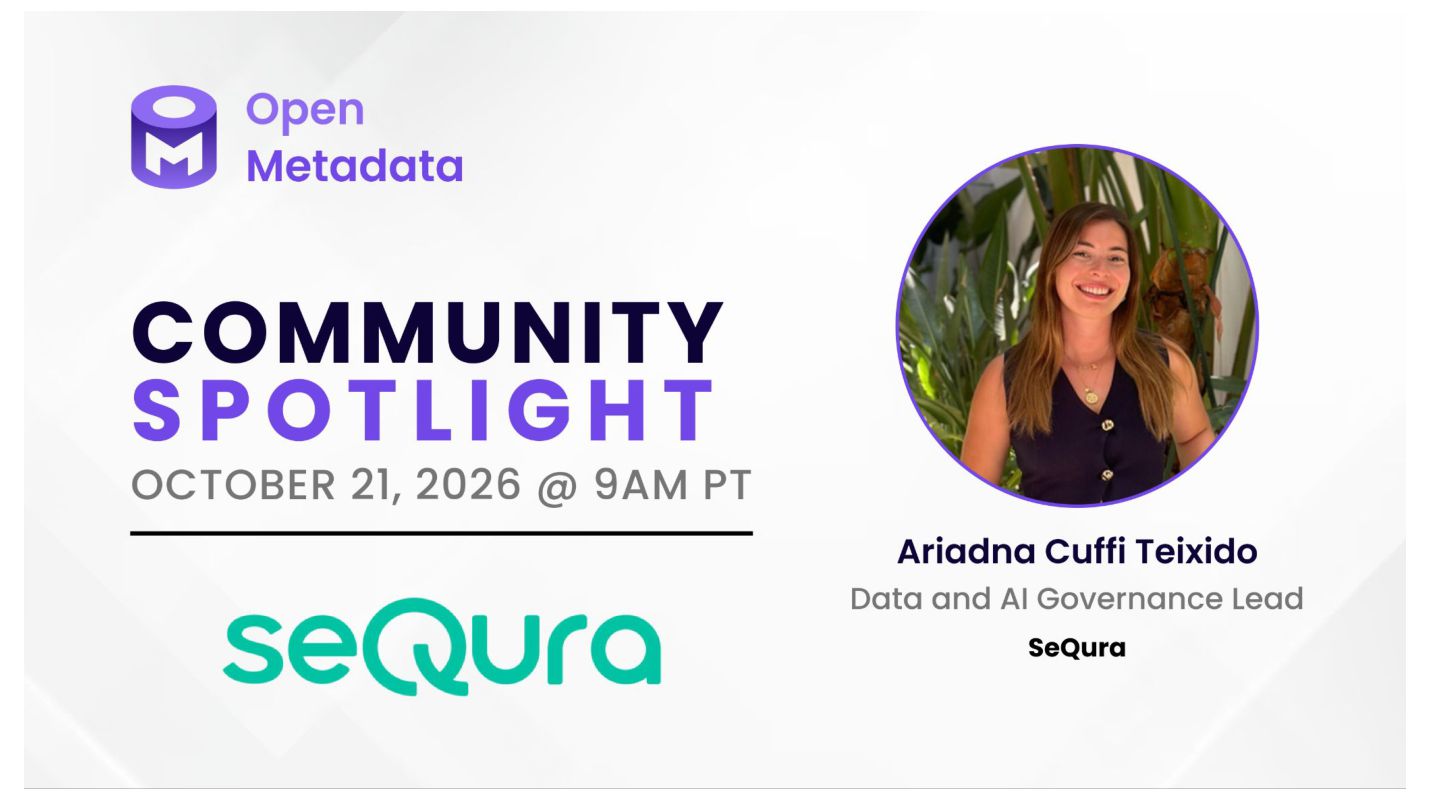
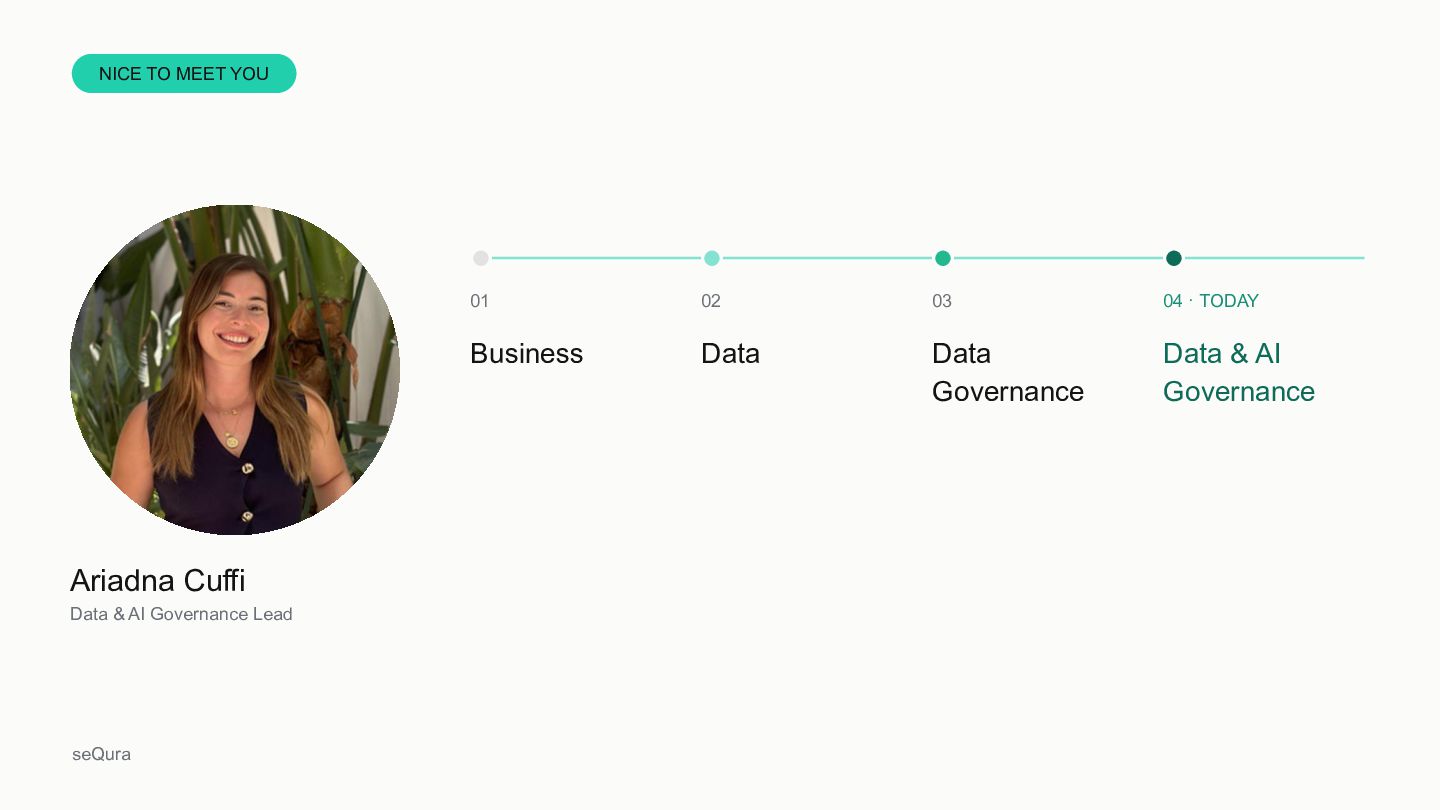
​Ari from seQura will share her experience with OpenMetadata and lessons learned from the community.

​Felipe | RDF, Knowledge Graph & SPARQL: See how agents can answer complex, multi-hop questions across data systems using RDF graphs, improving accuracy while reducing hallucinations and token costs.

​Pere | Memory Agents: Learn how agents can capture organizational knowledge from conversations, workflows, and corrections to make better decisions with less manual guidance.

​Harsha | OpenMetadata 2.1 Release: Get a first look at Ontology Studio, Hierarchical Metrics, lineage and Knowledge Graph improvements, and a brand-new UI!

Avatar for OpenMetadata

OpenMetadata

October 21, 2026

More Decks by OpenMetadata

Other Decks in Technology

Transcript

  1. Star us on GitHub https://github.com/open-metadata/OpenMetadata Join our Slack https://slack.open-metadata.org/ Subscribe

    on Youtube https://www.youtube.com/OpenMetadataChannel Subscribe on Medium Blog https://blog.open-metadata.org/ Follow on Linkedin https://www.linkedin.com/company/openmetadata/ Discover Collate SaaS https://www.getcollate.io/
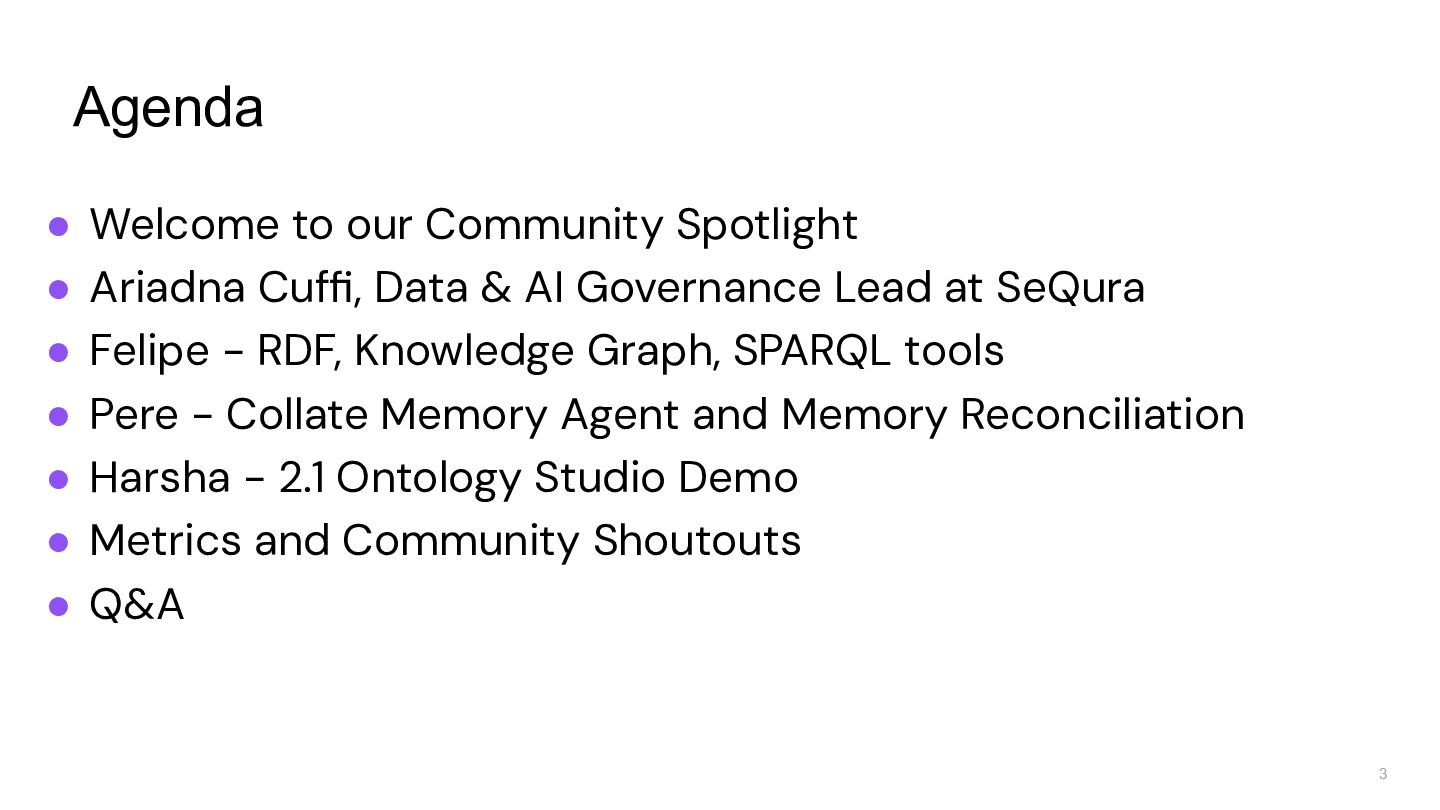
  2. Agenda • Welcome to our Community Spotlight • Ariadna Cuffi,

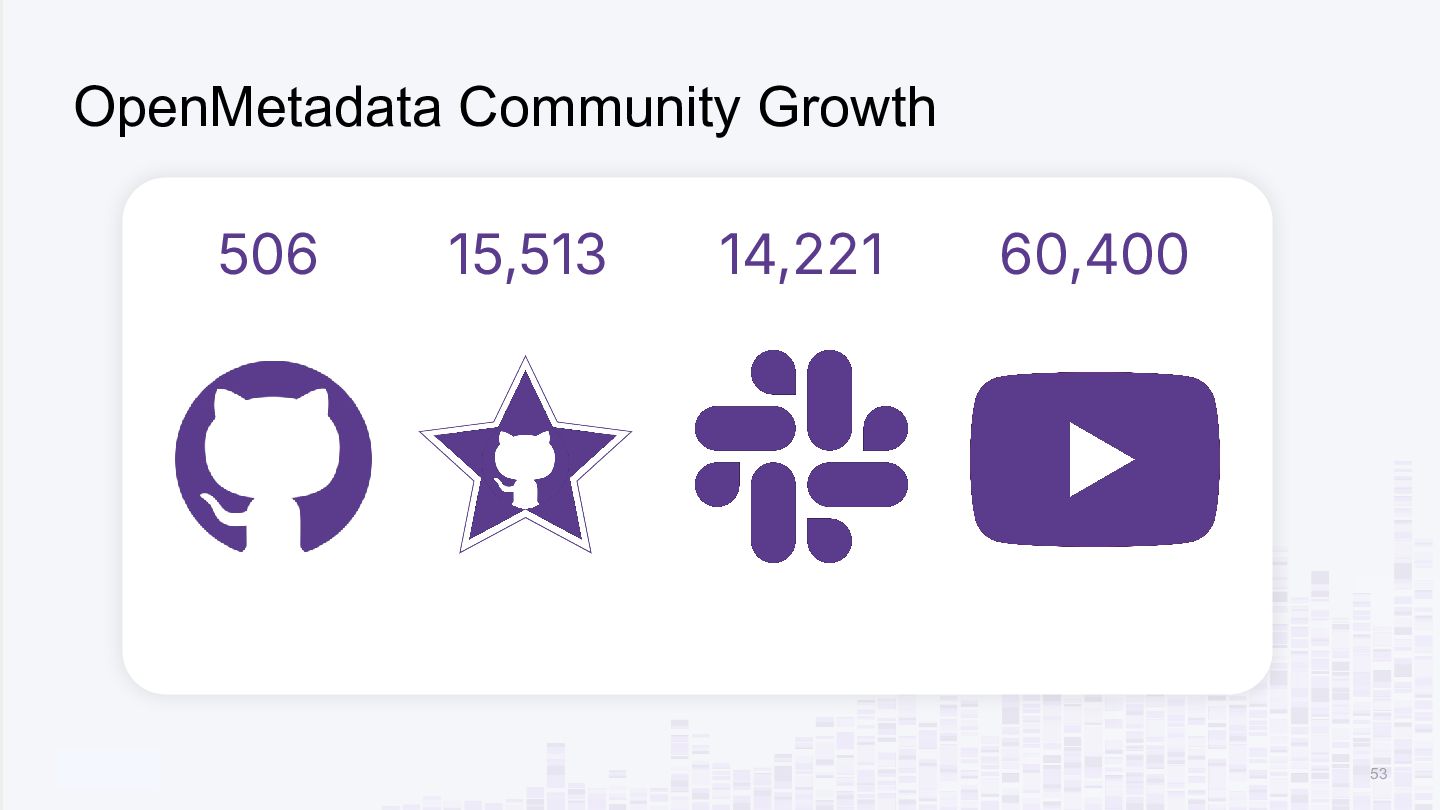
    Data & AI Governance Lead at SeQura • Felipe - RDF, Knowledge Graph, SPARQL tools • Pere - Collate Memory Agent and Memory Reconciliation • Harsha - 2.1 Ontology Studio Demo • Metrics and Community Shoutouts • Q&A 3
  3. NICE TO MEET YOU Ariadna Cuffi Data & AI Governance

    Lead seQura 01 02 03 04 · TODAY Business Data Data Governance Data & AI Governance
  4. QUESTION FOR YOU And how many of you don’t fully

    trust the answers behind it? seQura
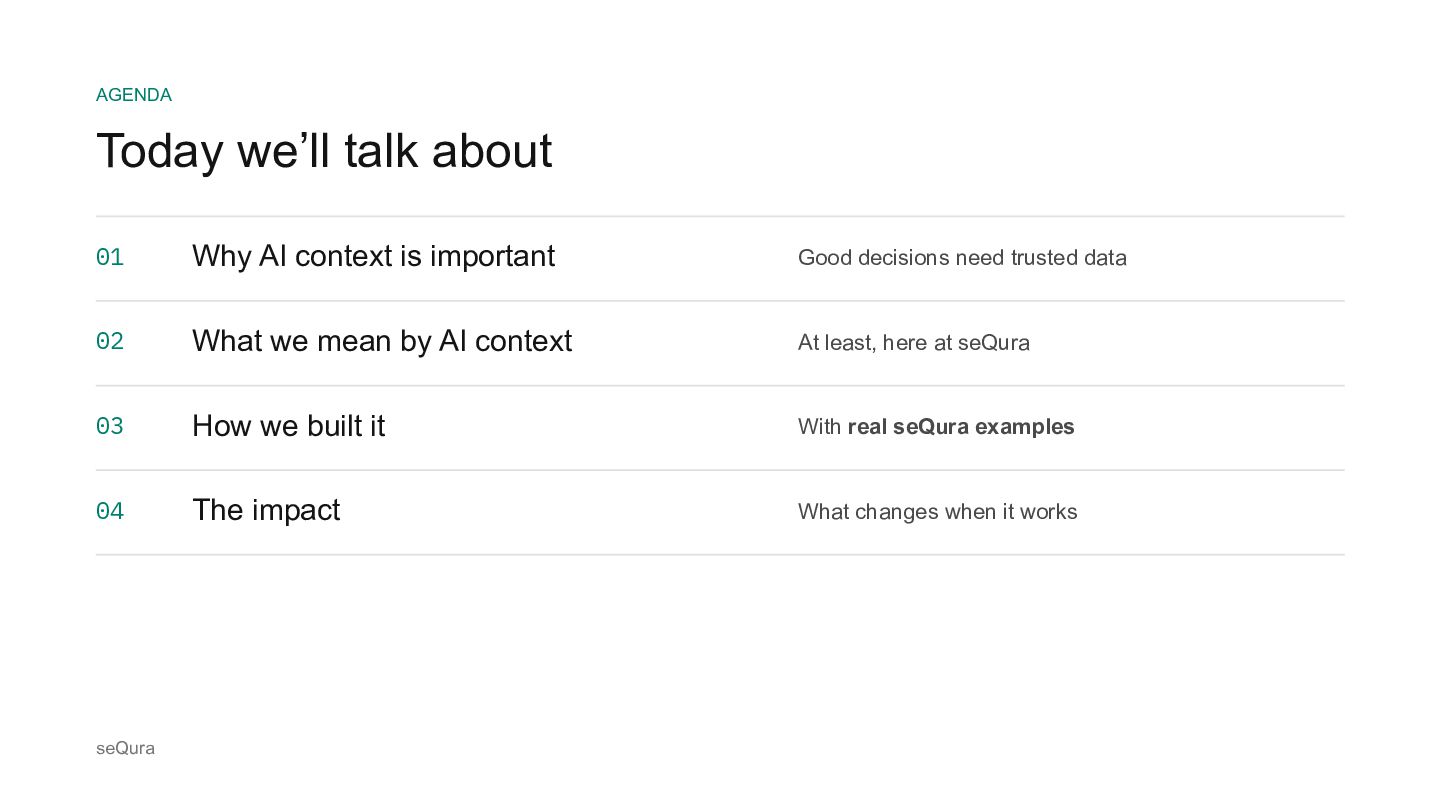
  5. AGENDA Today we’ll talk about 01 Why AI context is

    important Good decisions need trusted data 02 What we mean by AI context At least, here at seQura 03 How we built it With real seQura examples 04 The impact What changes when it works seQura
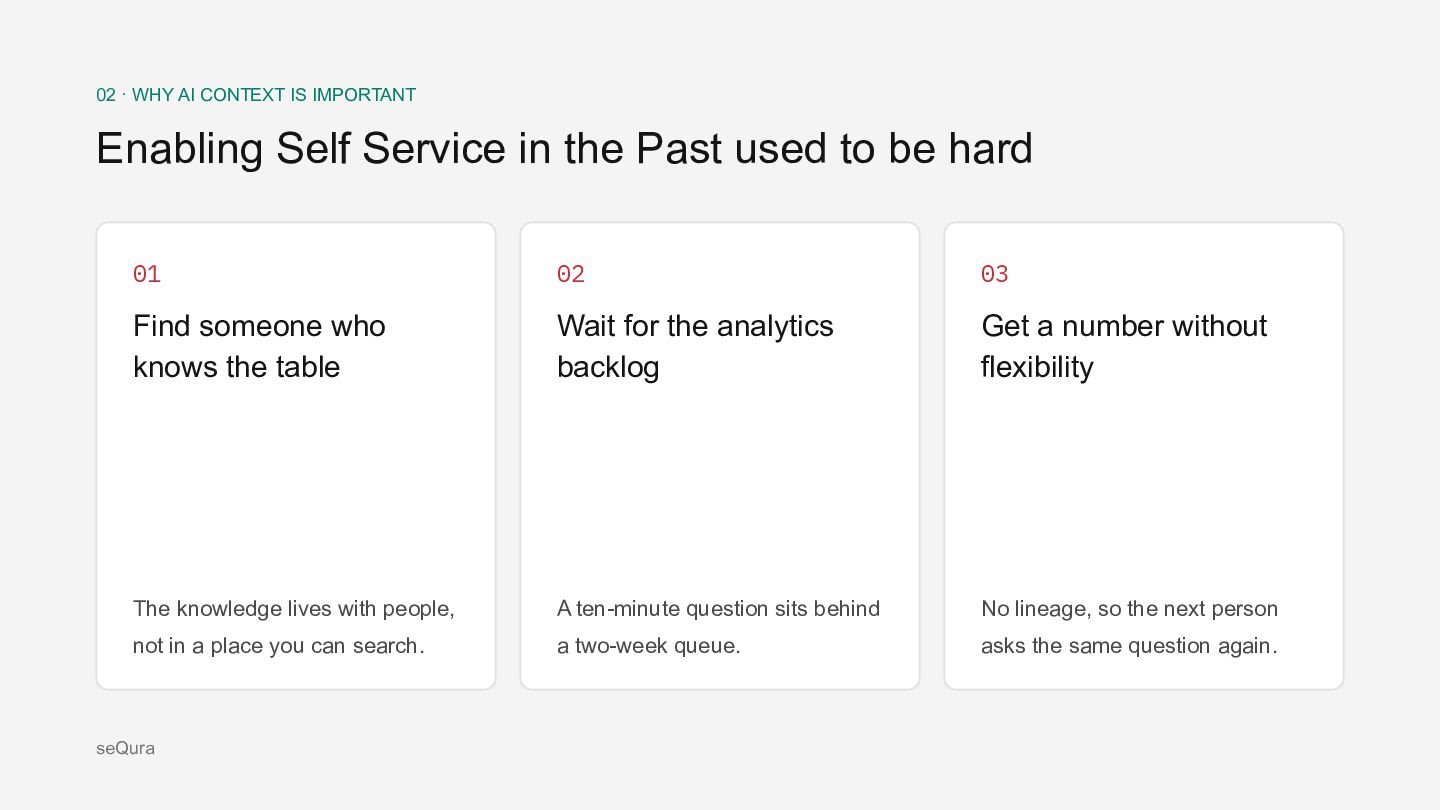
  6. 02 · WHY AI CONTEXT IS IMPORTANT Enabling Self Service

    in the Past used to be hard 01 02 03 Find someone who knows the table Wait for the analytics backlog Get a number without flexibility The knowledge lives with people, A ten-minute question sits behind No lineage, so the next person not in a place you can search. a two-week queue. asks the same question again. seQura
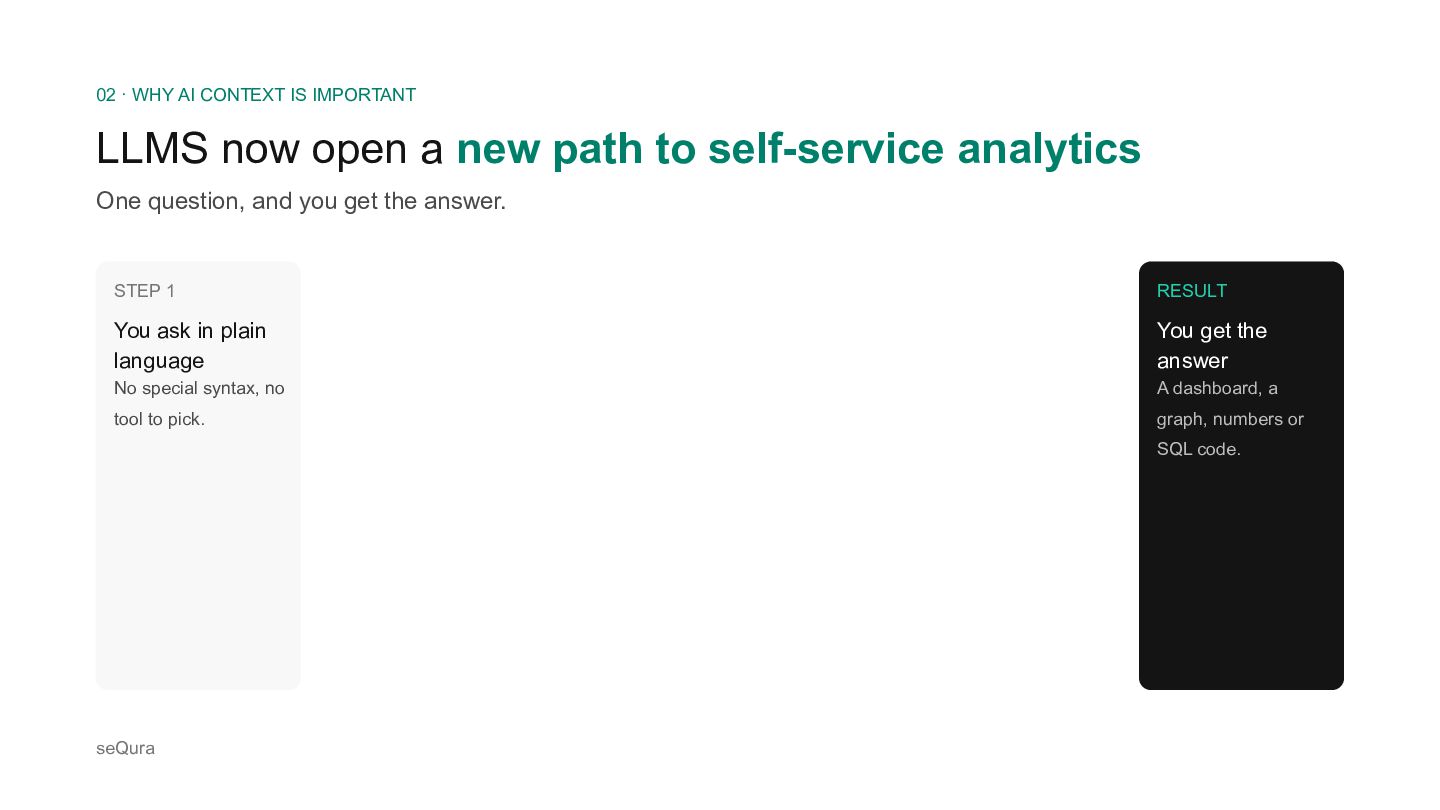
  7. 02 · WHY AI CONTEXT IS IMPORTANT LLMS now open

    a new path to self-service analytics One question, and you get the answer. STEP 1 RESULT You ask in plain language You get the answer No special syntax, no A dashboard, a tool to pick. graph, numbers or SQL code. seQura
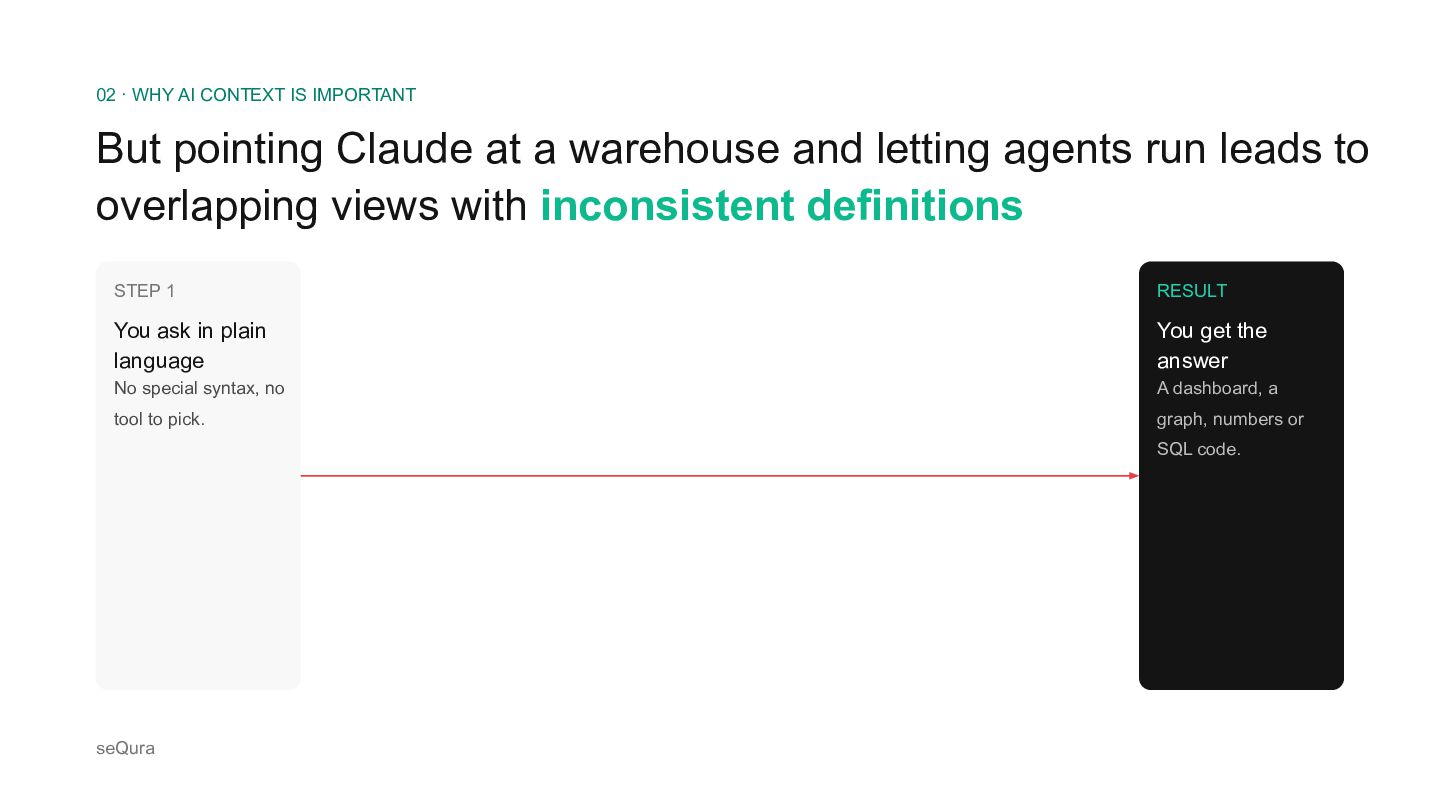
  8. 02 · WHY AI CONTEXT IS IMPORTANT But pointing Claude

    at a warehouse and letting agents run leads to overlapping views with inconsistent definitions STEP 1 RESULT You ask in plain language You get the answer No special syntax, no A dashboard, a tool to pick. graph, numbers or SQL code. seQura
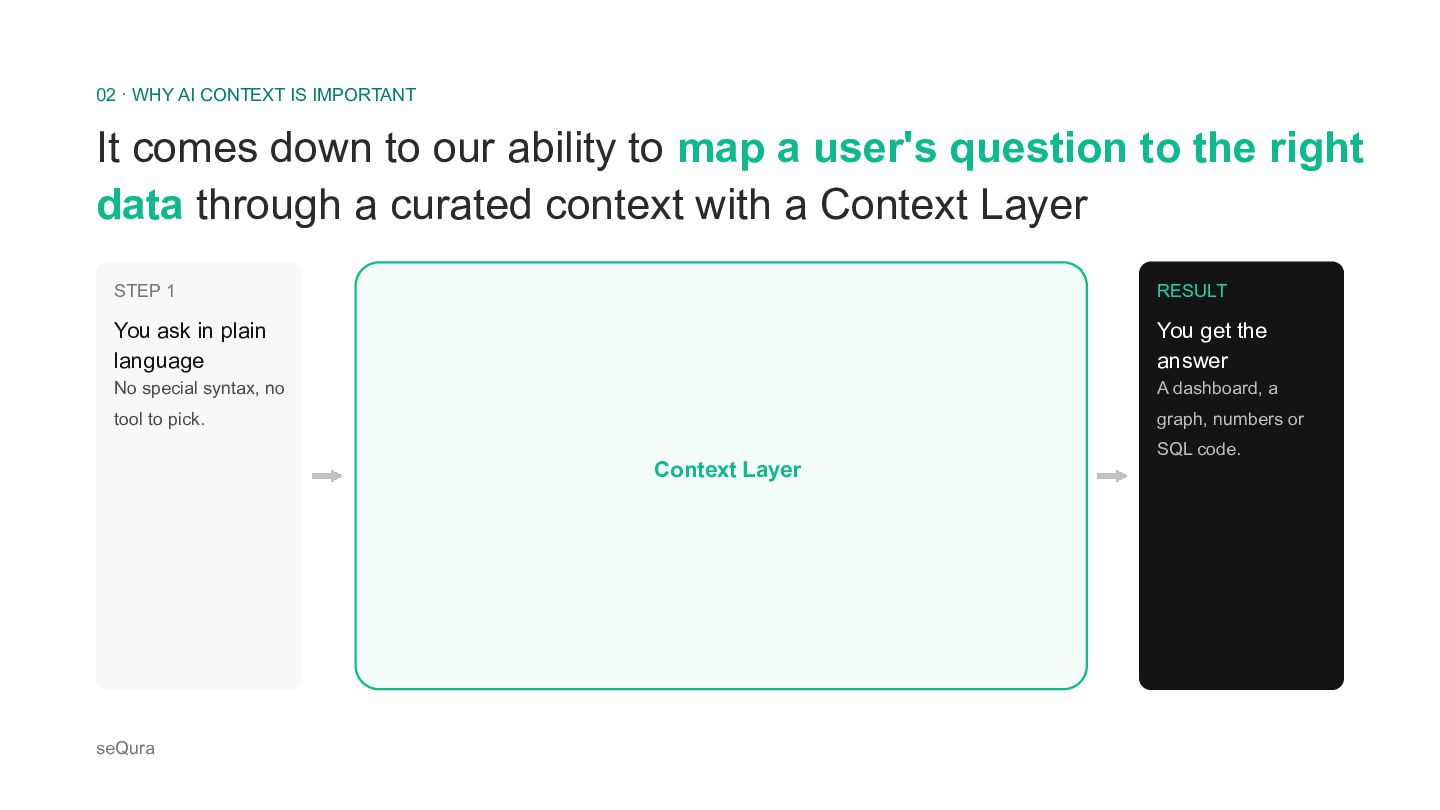
  9. 02 · WHY AI CONTEXT IS IMPORTANT It comes down

    to our ability to map a user's question to the right data through a curated context with a Context Layer STEP 1 RESULT You ask in plain language You get the answer No special syntax, no A dashboard, a tool to pick. graph, numbers or SQL code. Context Layer seQura
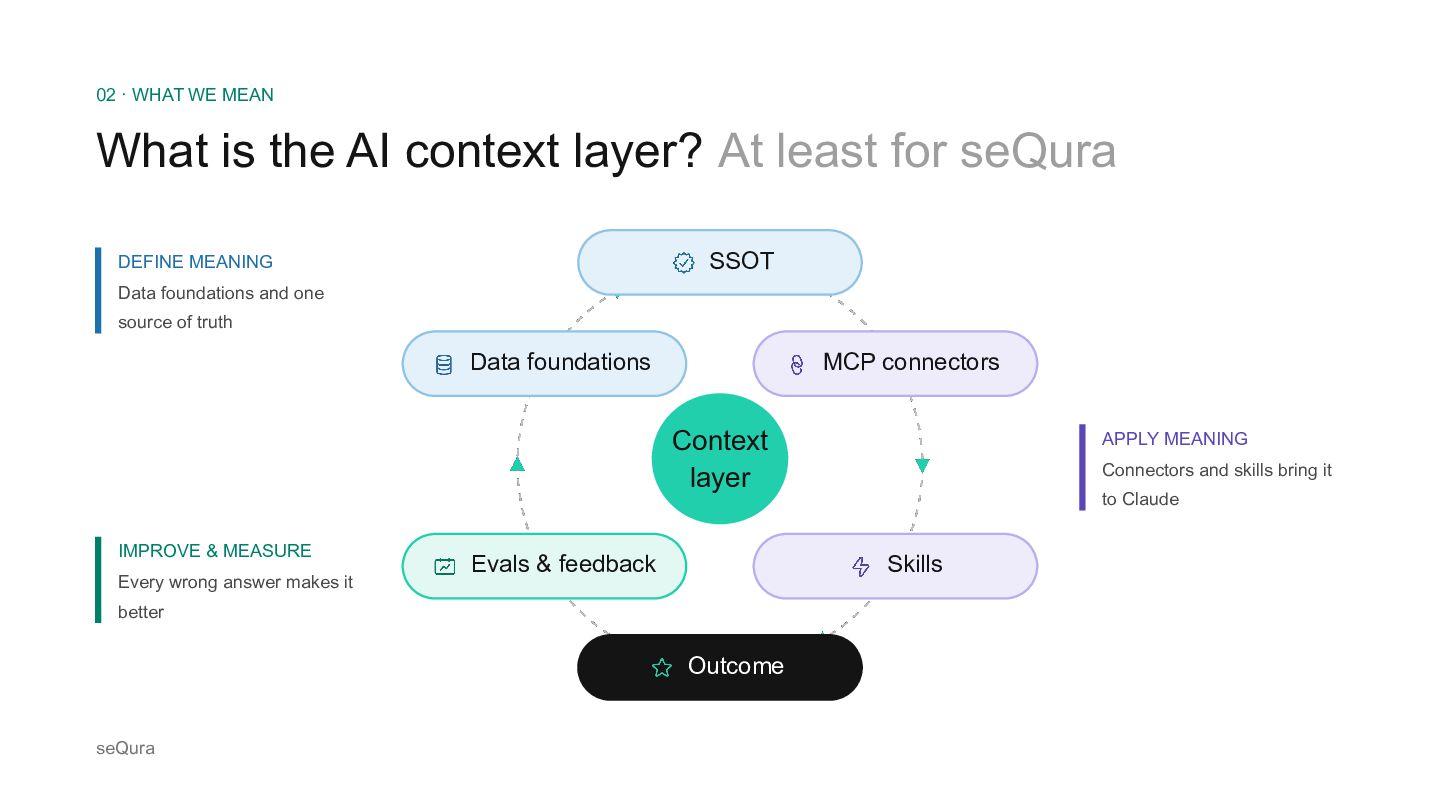
  10. 02 · WHAT WE MEAN What is the AI context

    layer? At least for seQura SSOT DEFINE MEANING Data foundations and one source of truth Data foundations MCP connectors Context layer IMPROVE & MEASURE Every wrong answer makes it Evals & feedback Connectors and skills bring it to Claude Skills better Outcome seQura APPLY MEANING
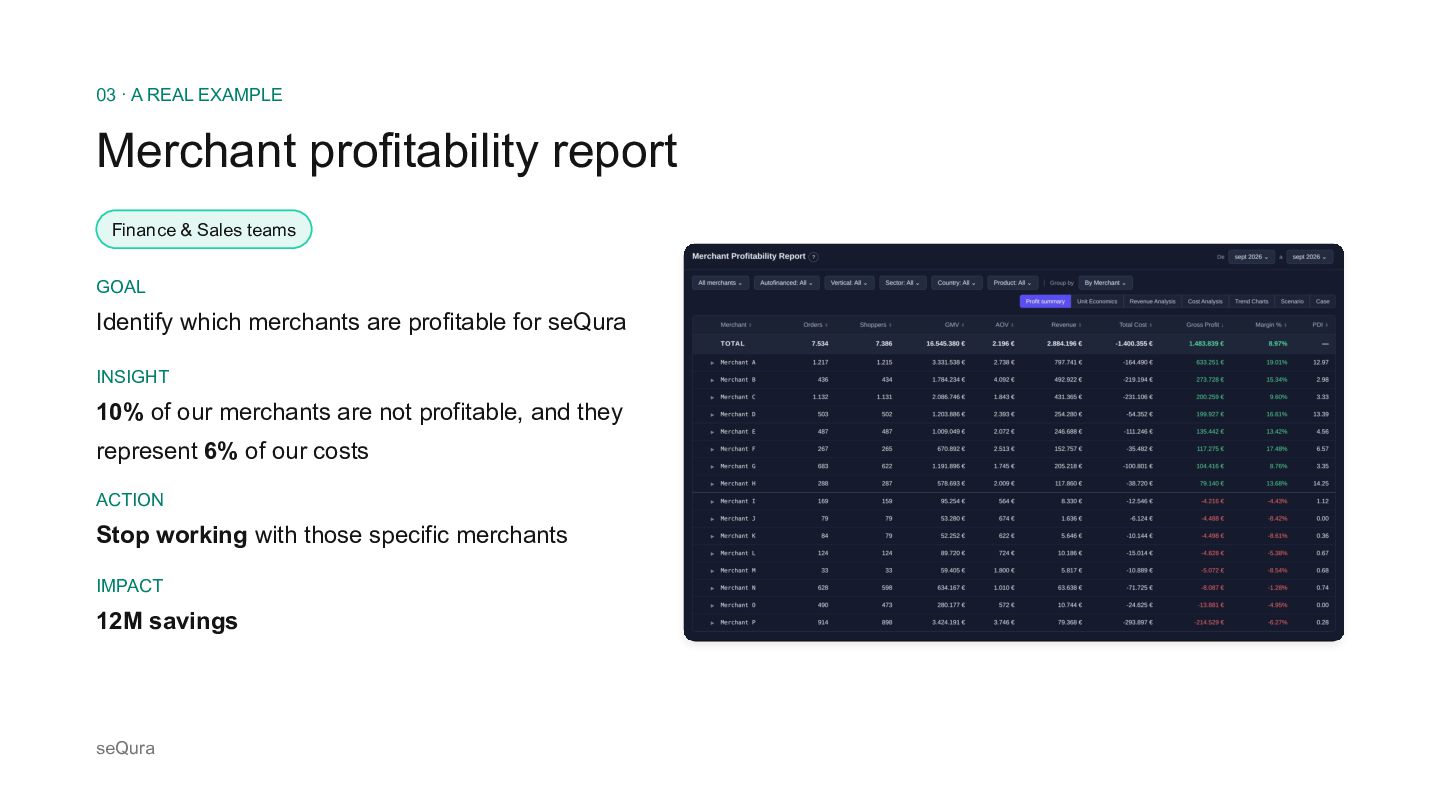
  11. 03 · A REAL EXAMPLE Merchant profitability report Finance &

    Sales teams GOAL Identify which merchants are profitable for seQura INSIGHT 10% of our merchants are not profitable, and they represent 6% of our costs ACTION Stop working with those specific merchants IMPACT 12M savings seQura
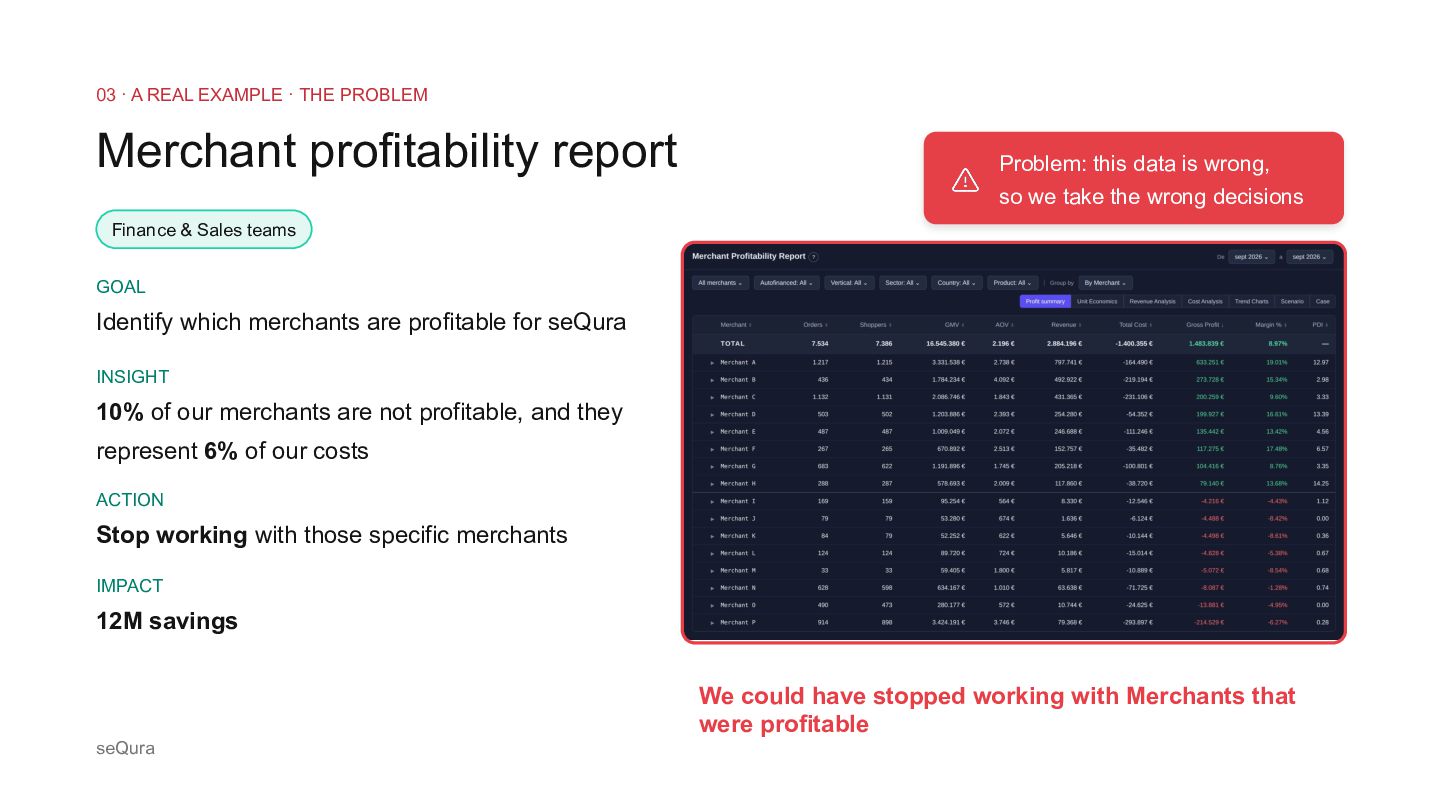
  12. 03 · A REAL EXAMPLE · THE PROBLEM Merchant profitability

    report Problem: this data is wrong, so we take the wrong decisions Finance & Sales teams GOAL Identify which merchants are profitable for seQura INSIGHT 10% of our merchants are not profitable, and they represent 6% of our costs ACTION Stop working with those specific merchants IMPACT 12M savings We could have stopped working with Merchants that were profitable seQura
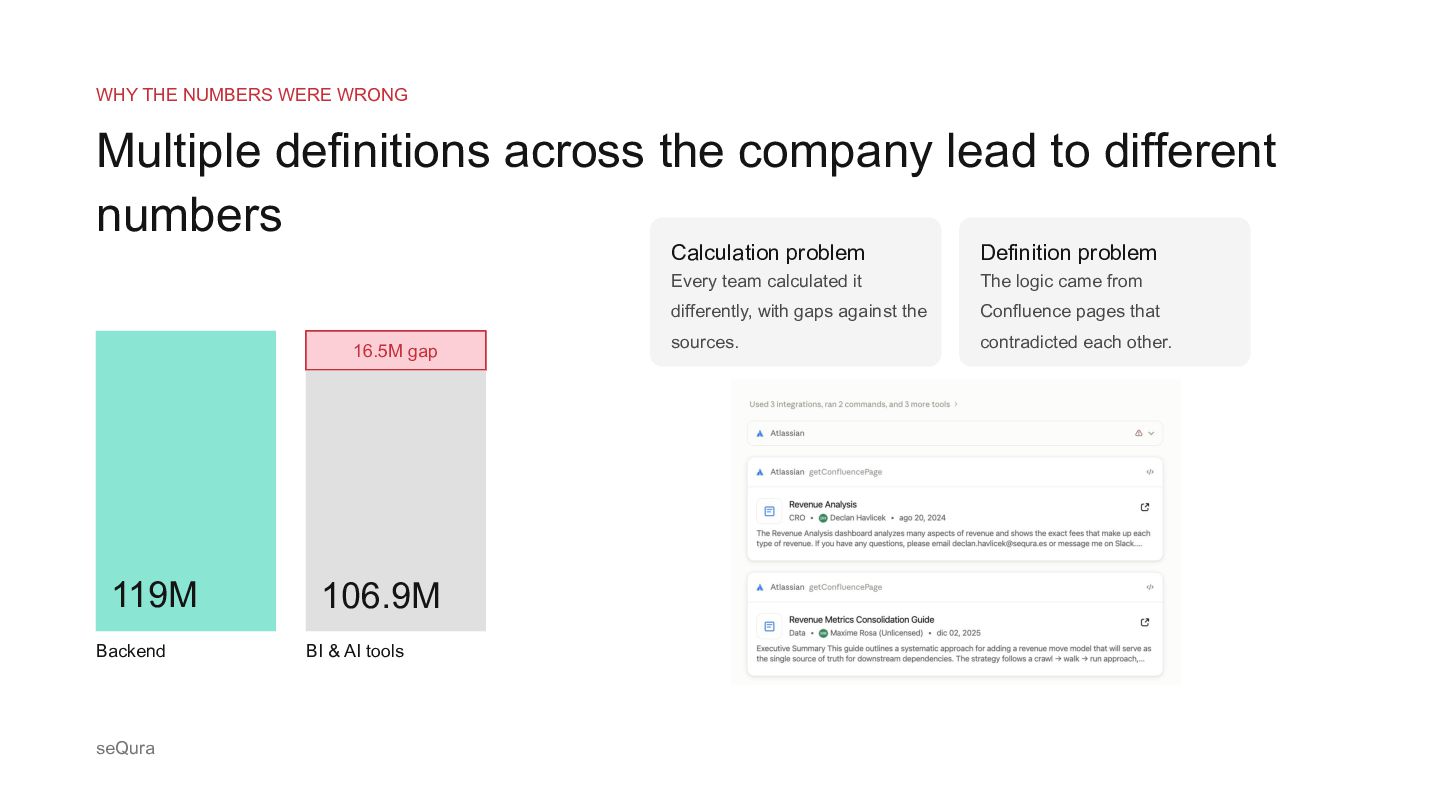
  13. WHY THE NUMBERS WERE WRONG Multiple definitions across the company

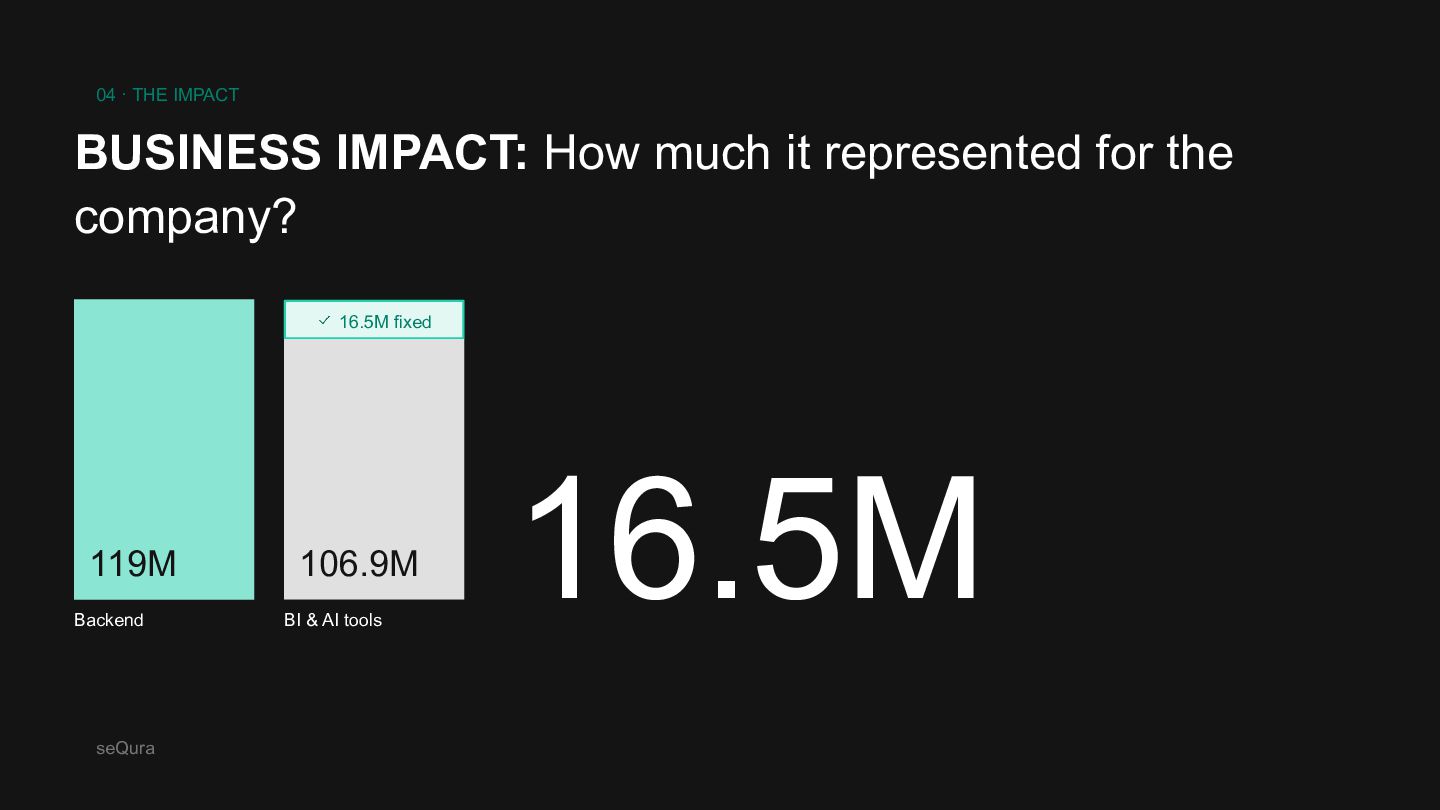
    lead to different numbers 16.5M gap 119M Backend seQura 106.9M BI & AI tools Calculation problem Definition problem Every team calculated it The logic came from differently, with gaps against the Confluence pages that sources. contradicted each other.
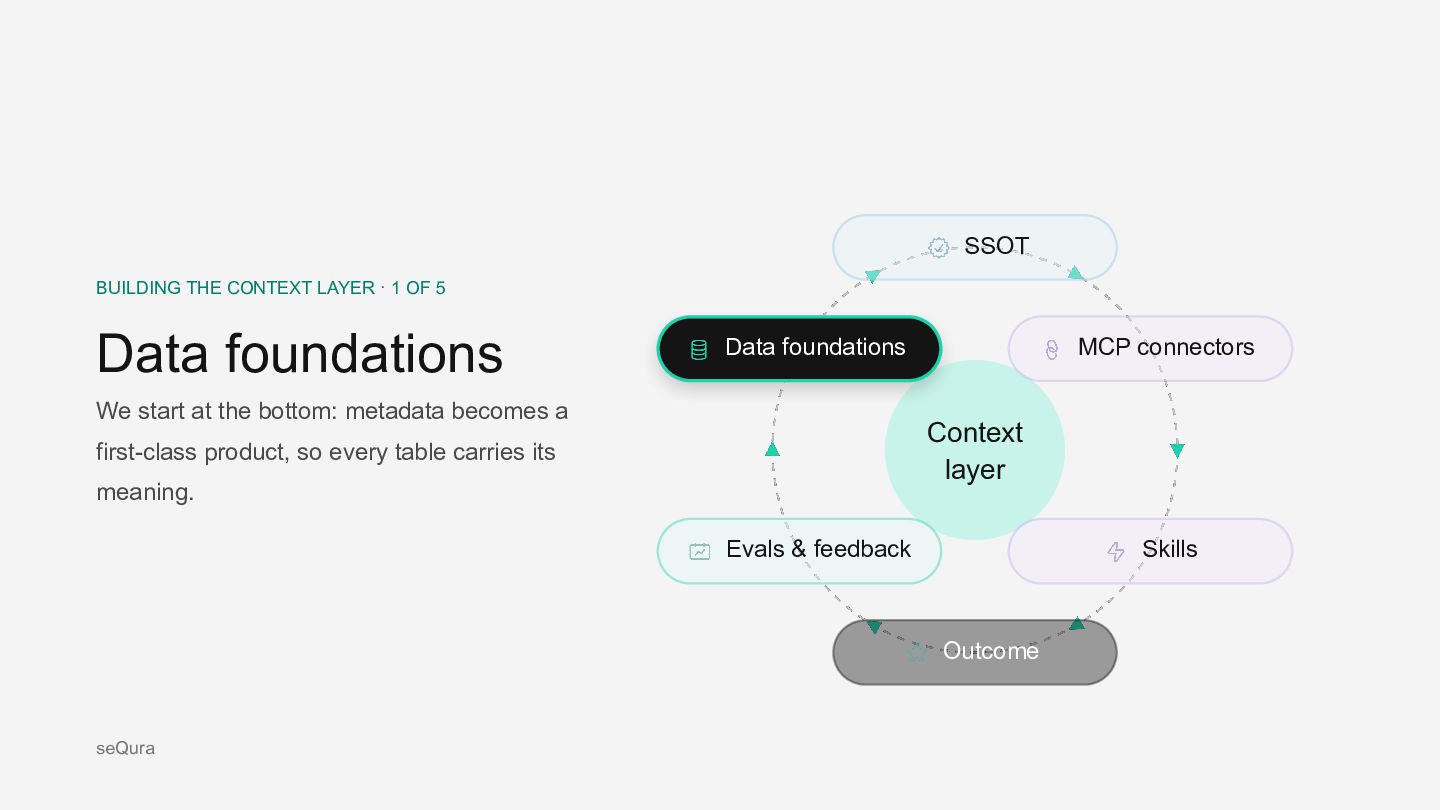
  14. SSOT BUILDING THE CONTEXT LAYER · 1 OF 5 Data

    foundations Data foundations We start at the bottom: metadata becomes a MCP connectors Context layer first-class product, so every table carries its meaning. Evals & feedback Skills Outcome seQura
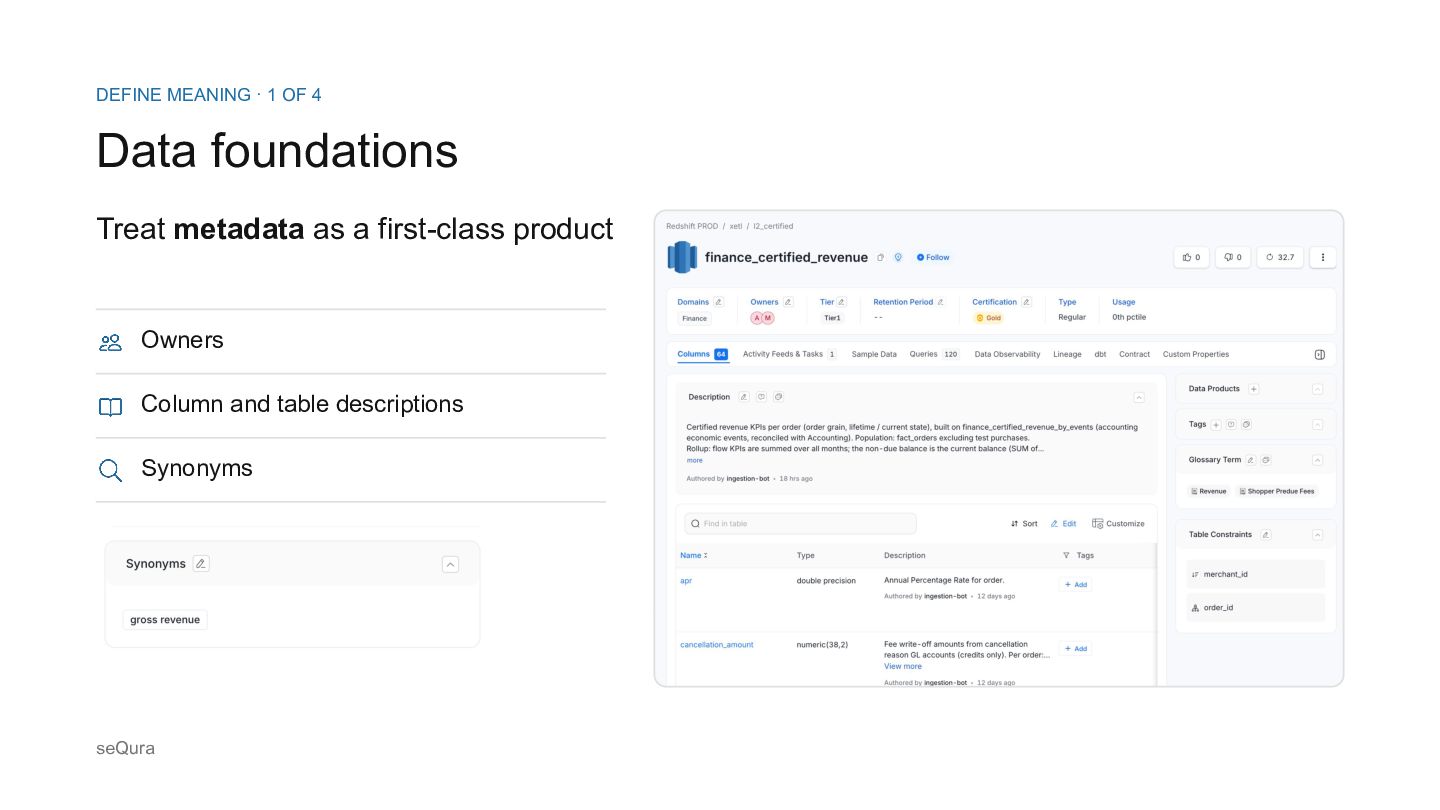
  15. DEFINE MEANING · 1 OF 4 Data foundations Treat metadata

    as a first-class product Owners Column and table descriptions Synonyms seQura
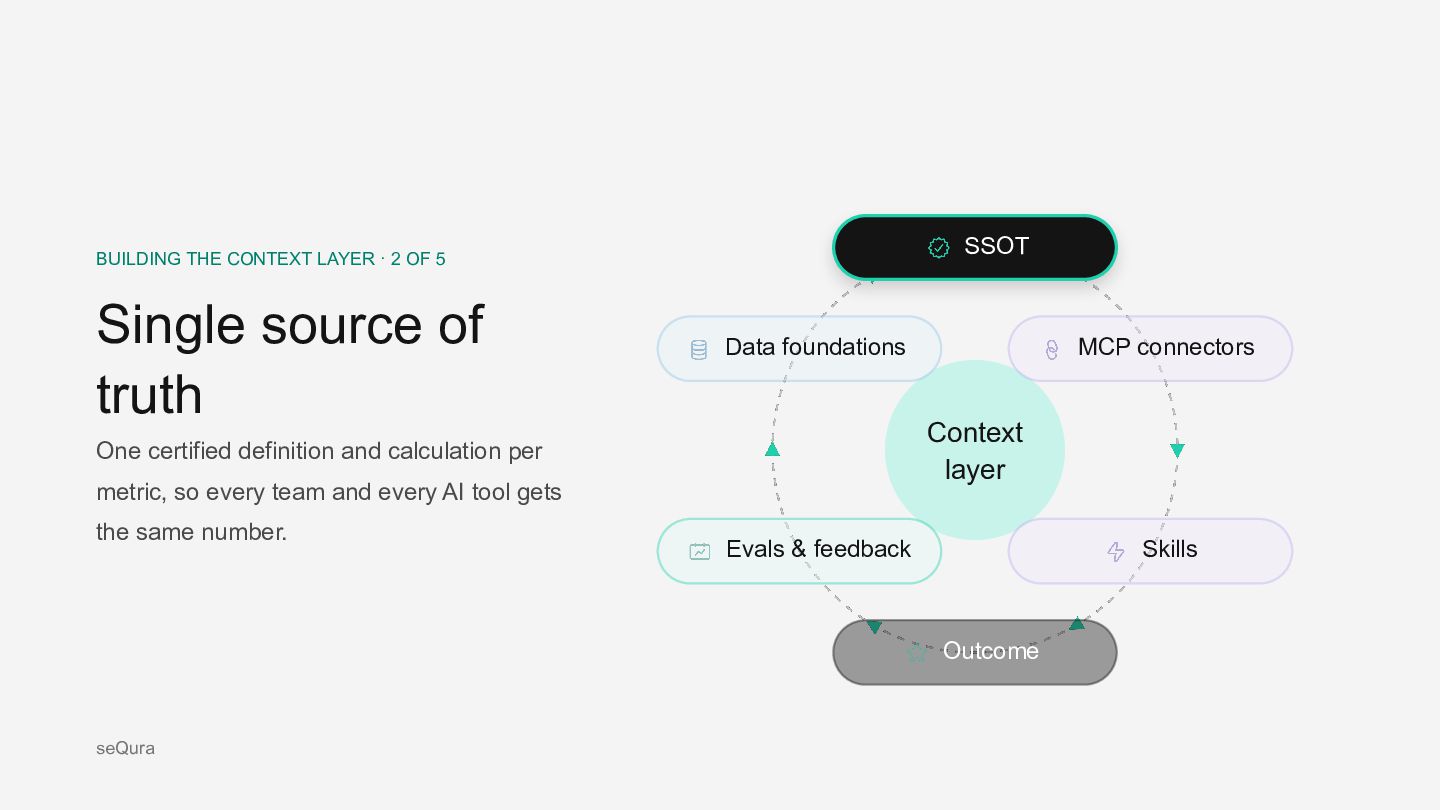
  16. SSOT BUILDING THE CONTEXT LAYER · 2 OF 5 Single

    source of truth Data foundations Context layer One certified definition and calculation per metric, so every team and every AI tool gets the same number. MCP connectors Evals & feedback Skills Outcome seQura
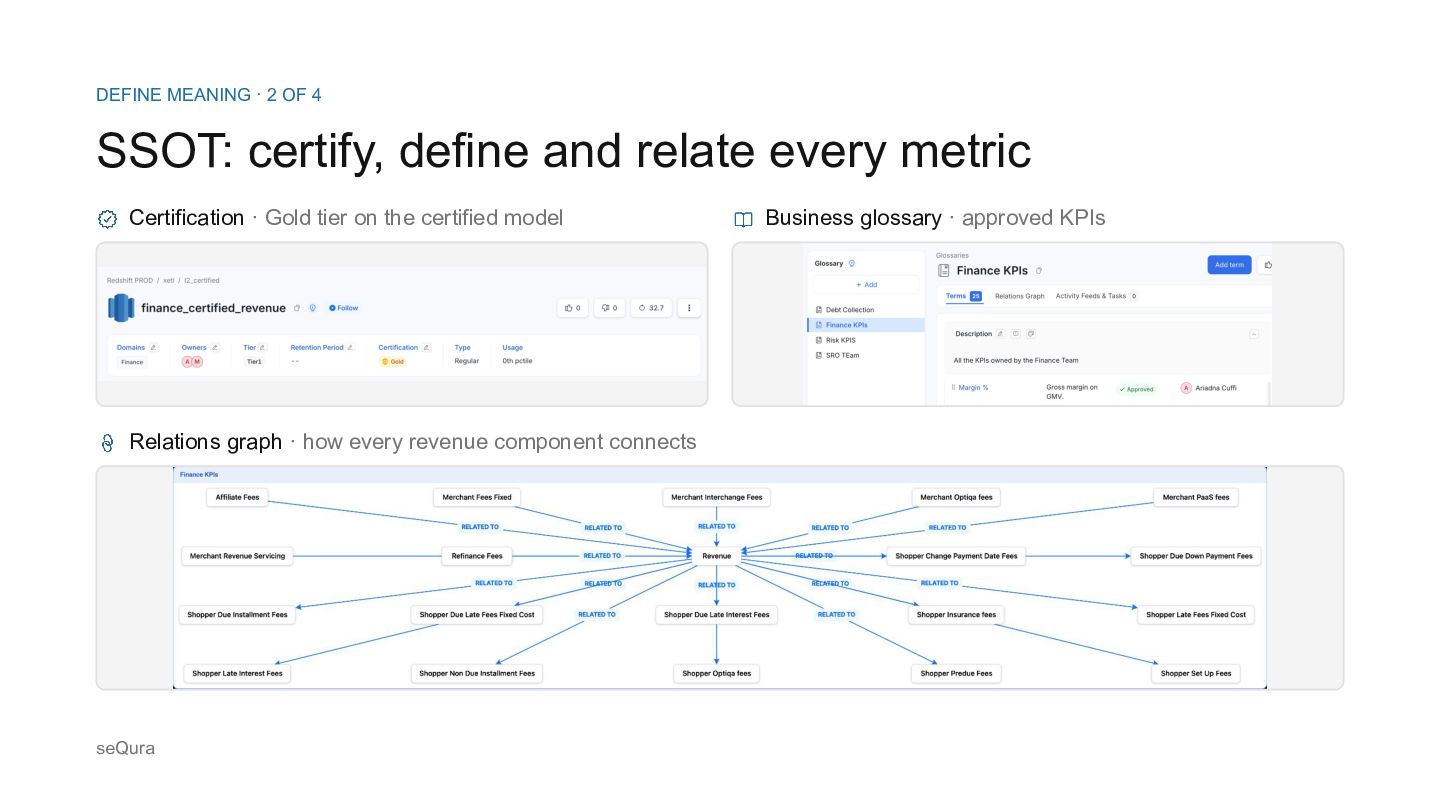
  17. DEFINE MEANING · 2 OF 4 SSOT: certify, define and

    relate every metric Certification · Gold tier on the certified model Relations graph · how every revenue component connects seQura Business glossary · approved KPIs
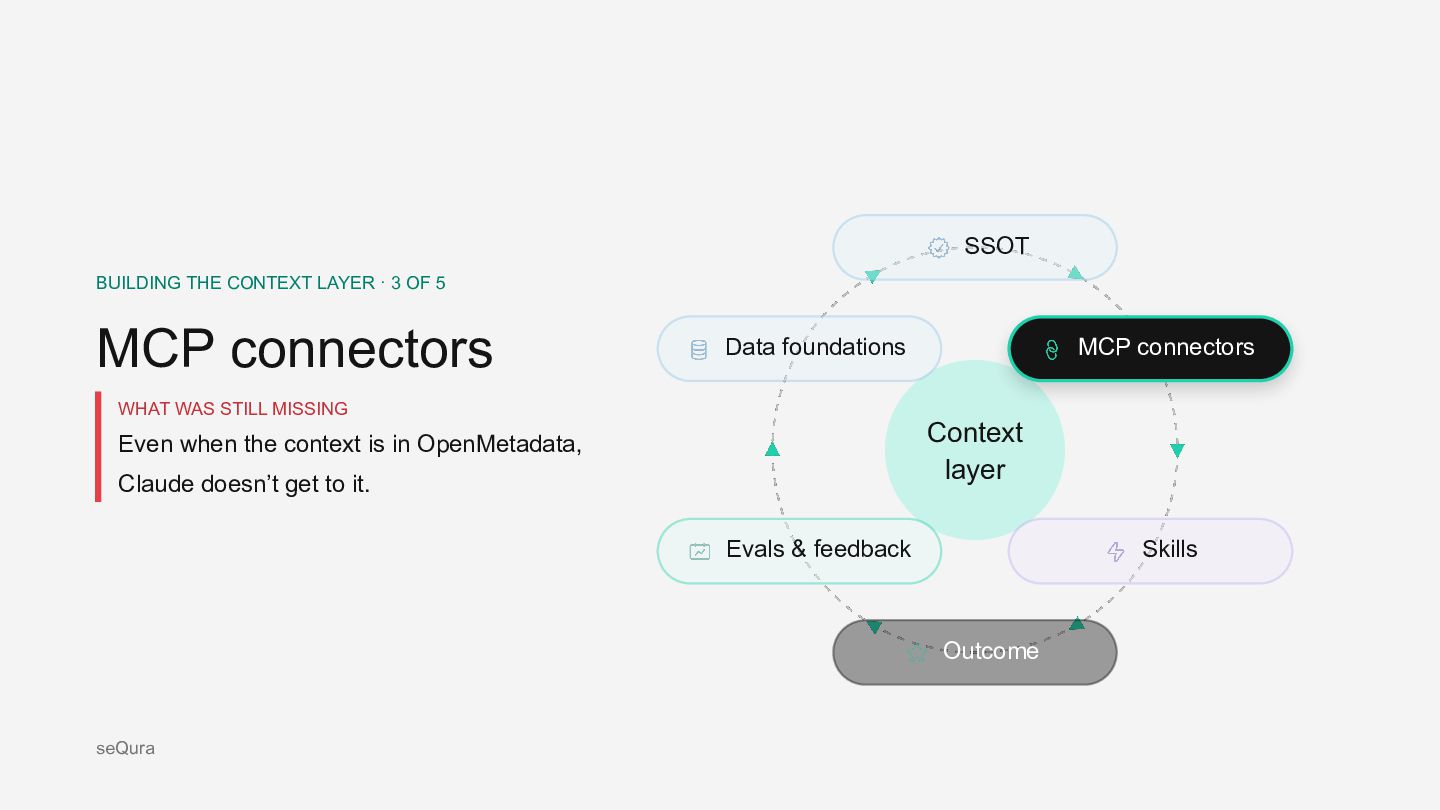
  18. SSOT BUILDING THE CONTEXT LAYER · 3 OF 5 MCP

    connectors Data foundations MCP connectors WHAT WAS STILL MISSING Context layer Even when the context is in OpenMetadata, Claude doesn’t get to it. Evals & feedback Skills Outcome seQura
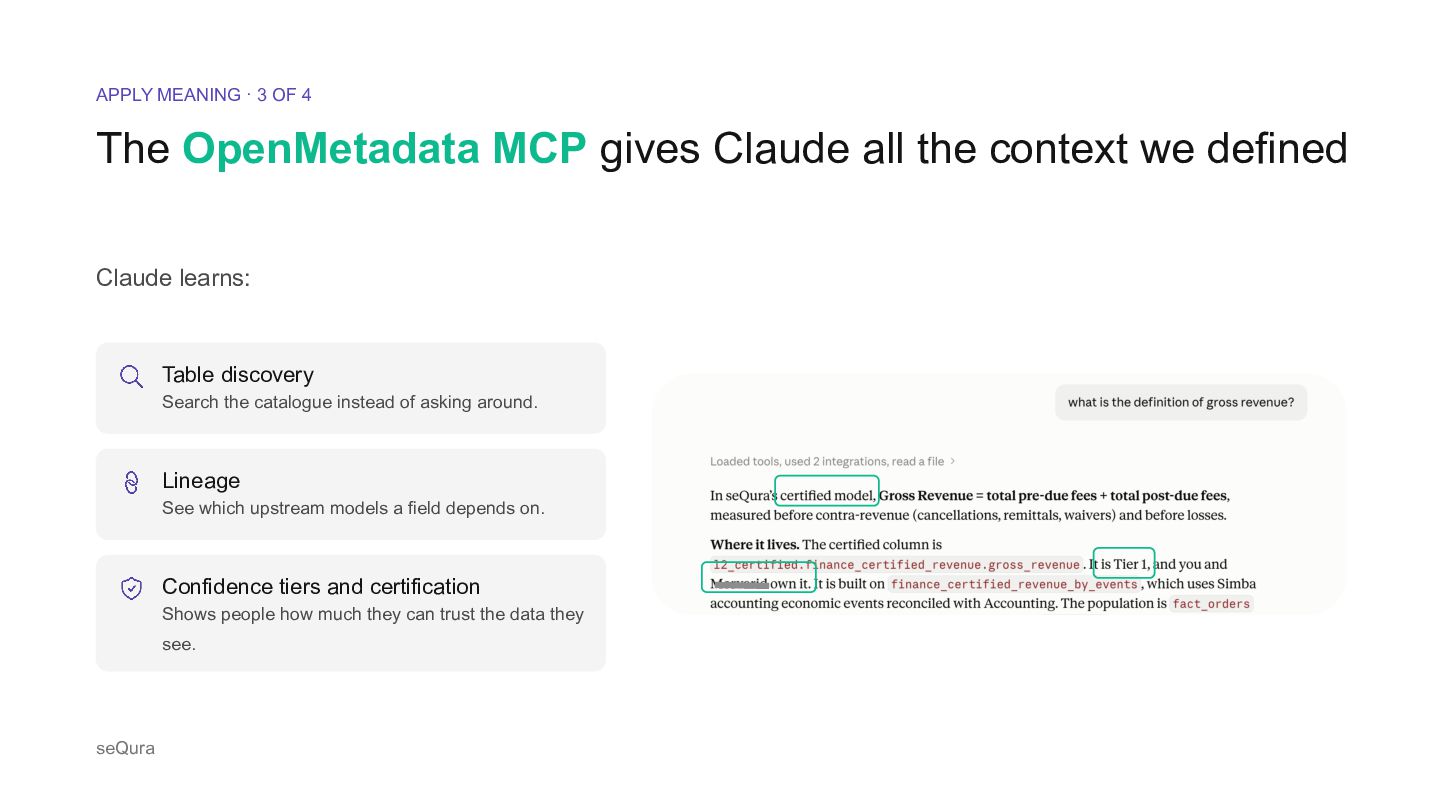
  19. APPLY MEANING · 3 OF 4 The OpenMetadata MCP gives

    Claude all the context we defined Claude learns: Table discovery Search the catalogue instead of asking around. Lineage See which upstream models a field depends on. Confidence tiers and certification Shows people how much they can trust the data they see. seQura
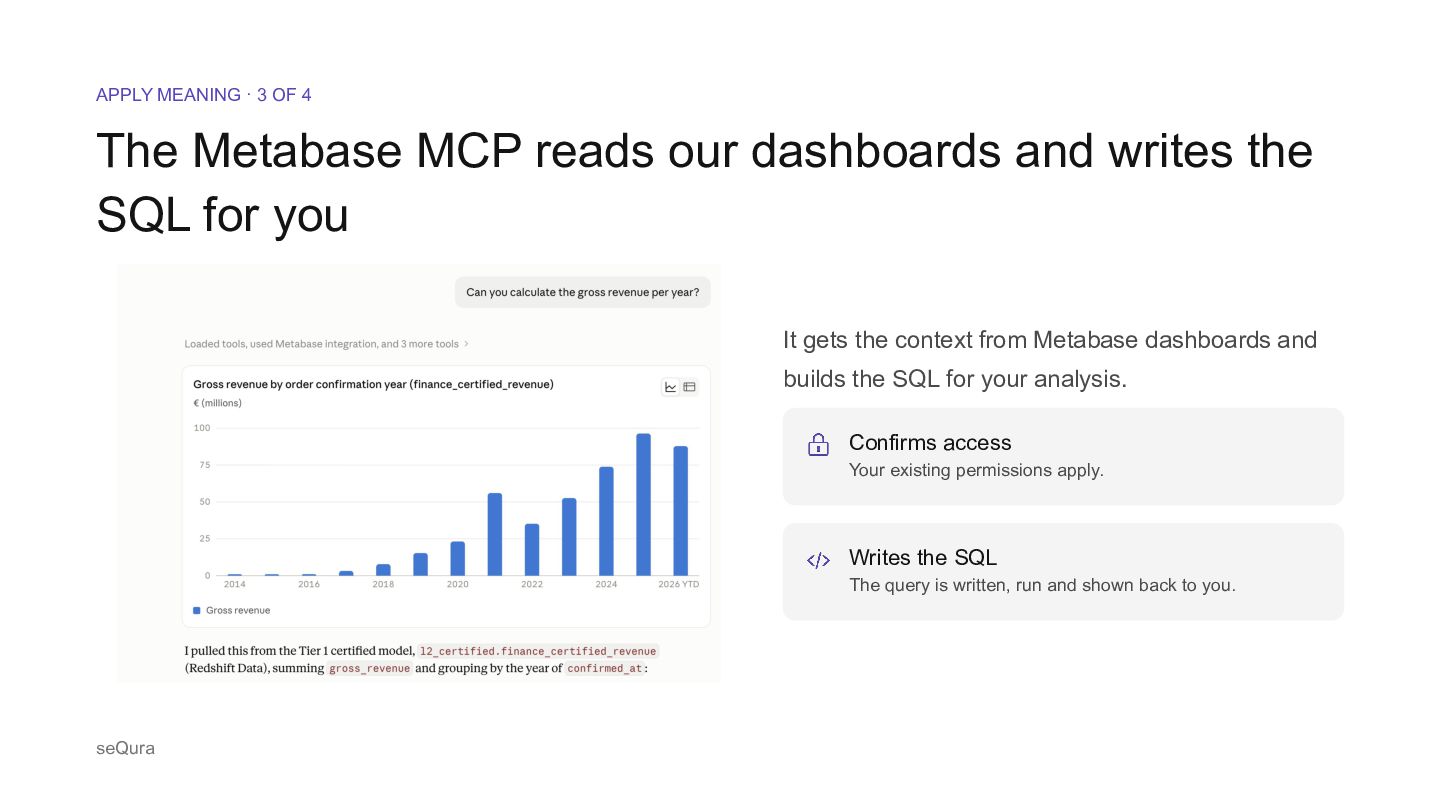
  20. APPLY MEANING · 3 OF 4 The Metabase MCP reads

    our dashboards and writes the SQL for you It gets the context from Metabase dashboards and builds the SQL for your analysis. Confirms access Your existing permissions apply. Writes the SQL The query is written, run and shown back to you. seQura
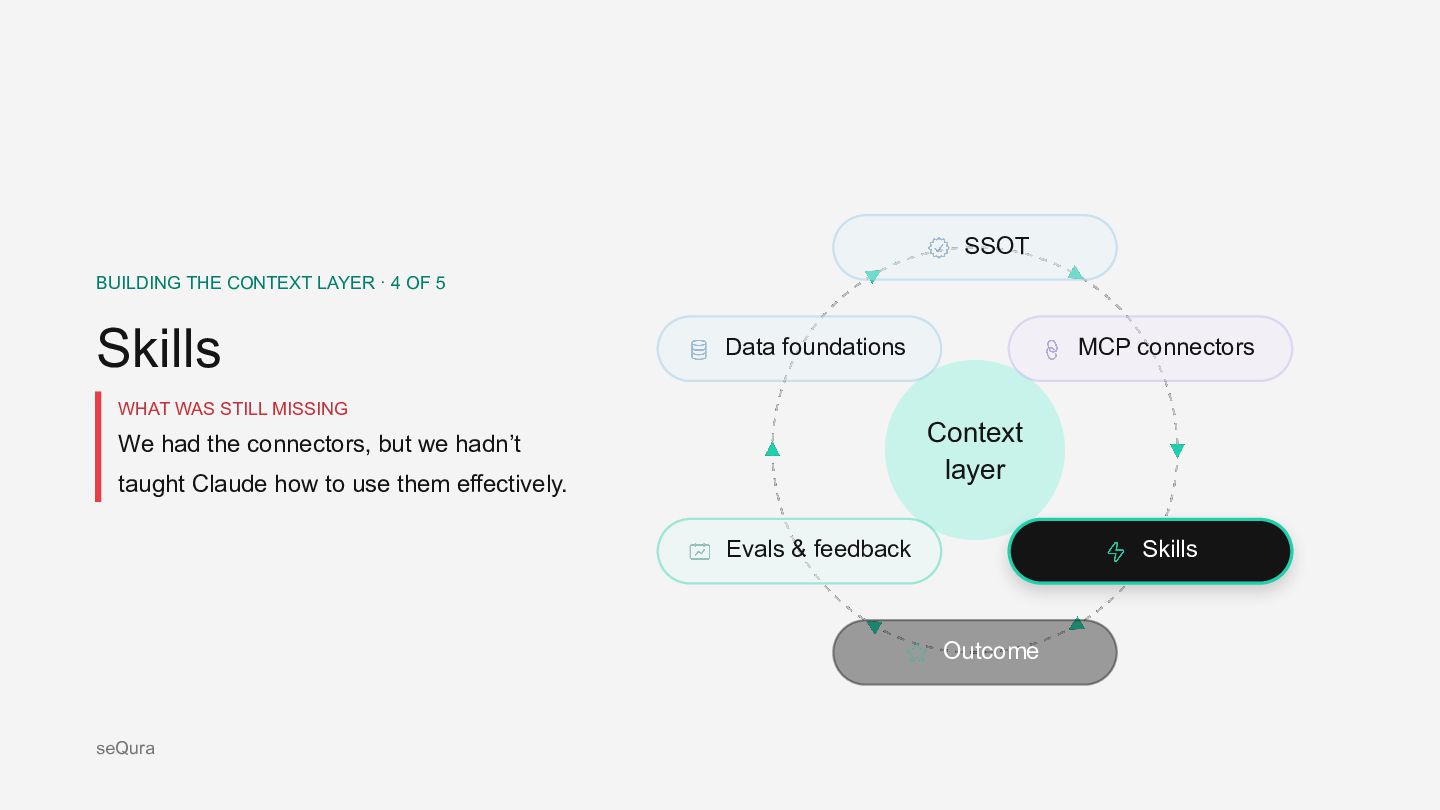
  21. SSOT BUILDING THE CONTEXT LAYER · 4 OF 5 Skills

    Data foundations MCP connectors WHAT WAS STILL MISSING Context layer We had the connectors, but we hadn’t taught Claude how to use them effectively. Evals & feedback Skills Outcome seQura
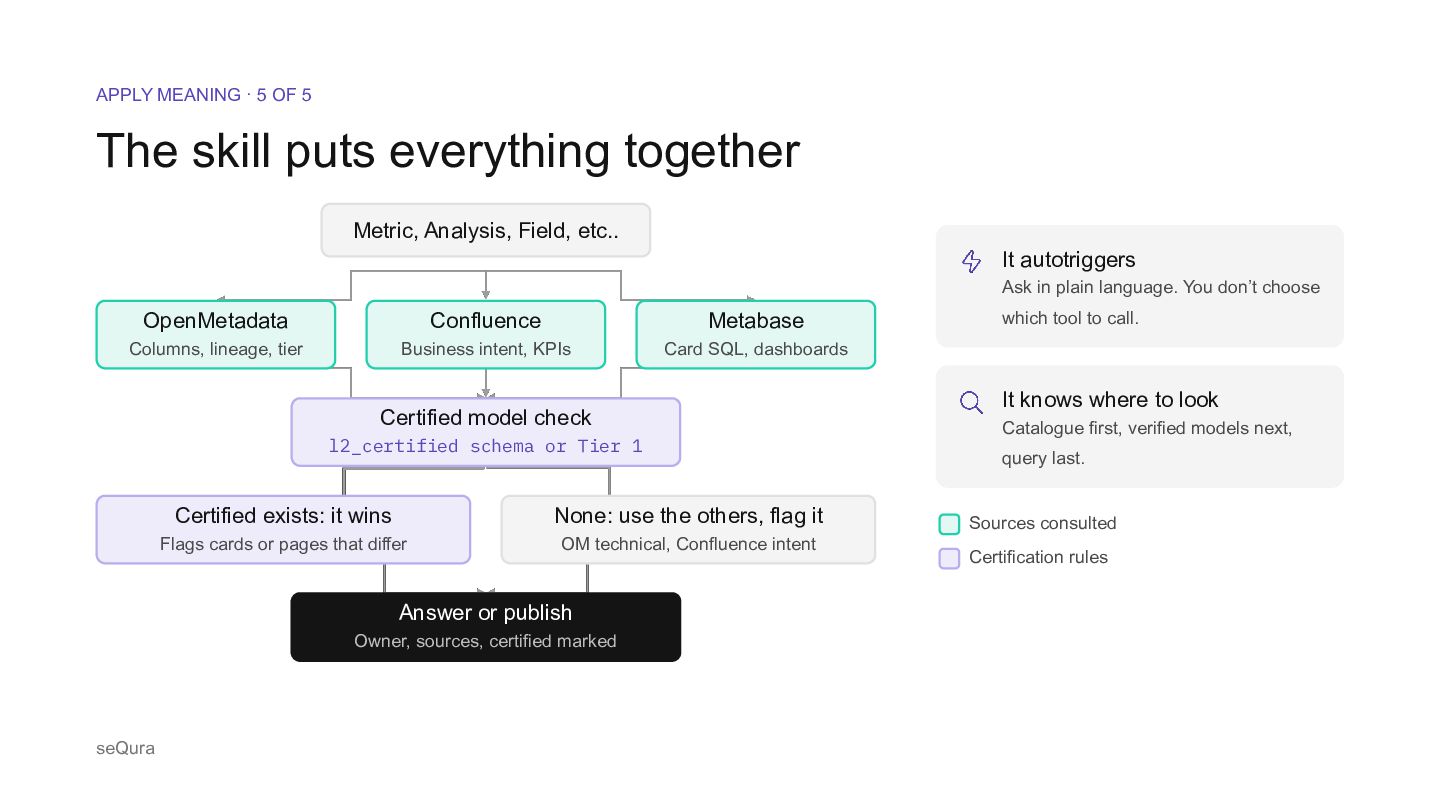
  22. APPLY MEANING · 5 OF 5 The skill puts everything

    together Metric, Analysis, Field, etc.. It autotriggers Ask in plain language. You don’t choose OpenMetadata Confluence Metabase Columns, lineage, tier Business intent, KPIs Card SQL, dashboards Certified model check l2_certified schema or Tier 1 Certified exists: it wins None: use the others, flag it Flags cards or pages that differ OM technical, Confluence intent Answer or publish Owner, sources, certified marked seQura which tool to call. It knows where to look Catalogue first, verified models next, query last. Sources consulted Certification rules
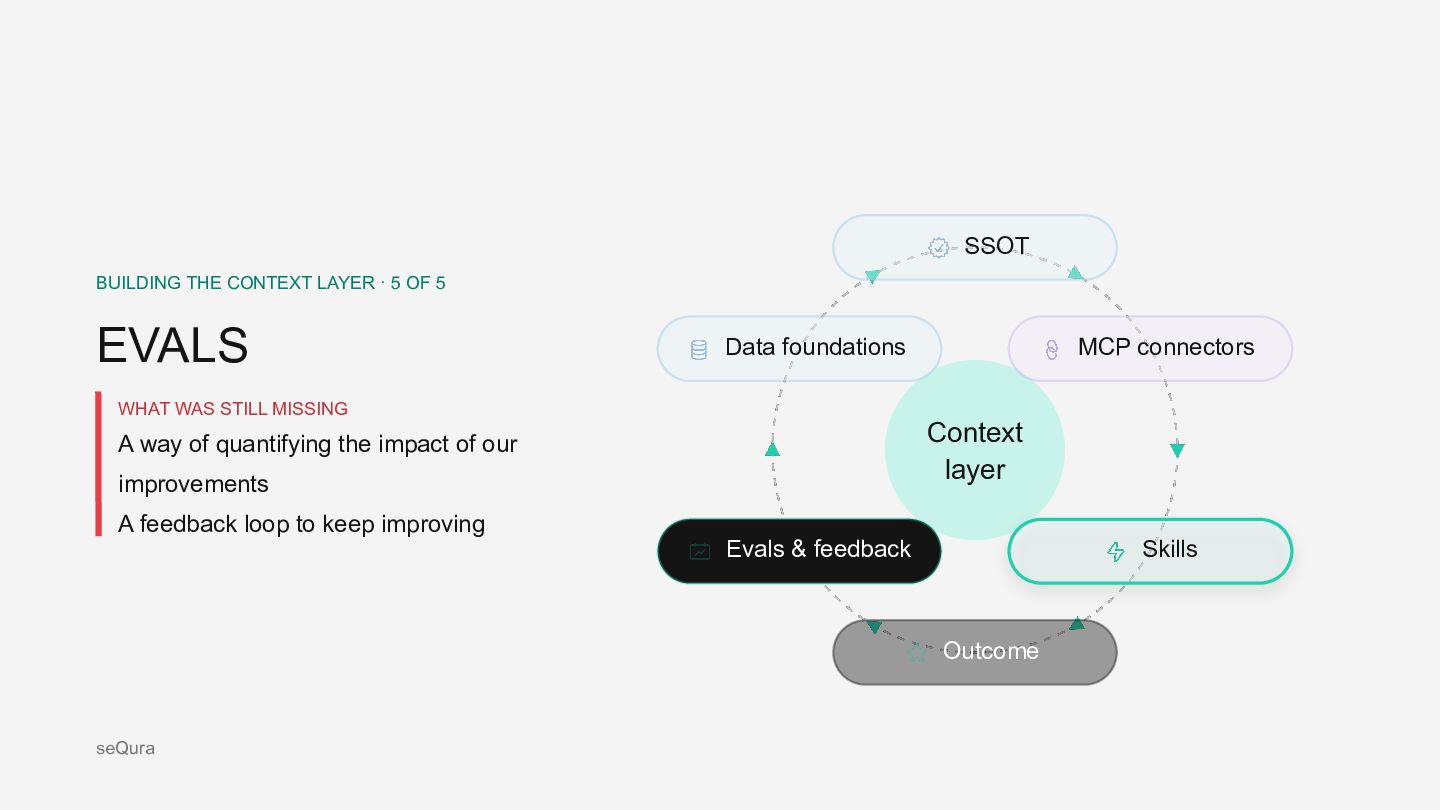
  23. SSOT BUILDING THE CONTEXT LAYER · 5 OF 5 EVALS

    Data foundations MCP connectors WHAT WAS STILL MISSING Context layer A way of quantifying the impact of our improvements A feedback loop to keep improving Evals & feedback Skills Outcome seQura
  24. 05 · VALIDATION & EVALS The feedback loop behind the

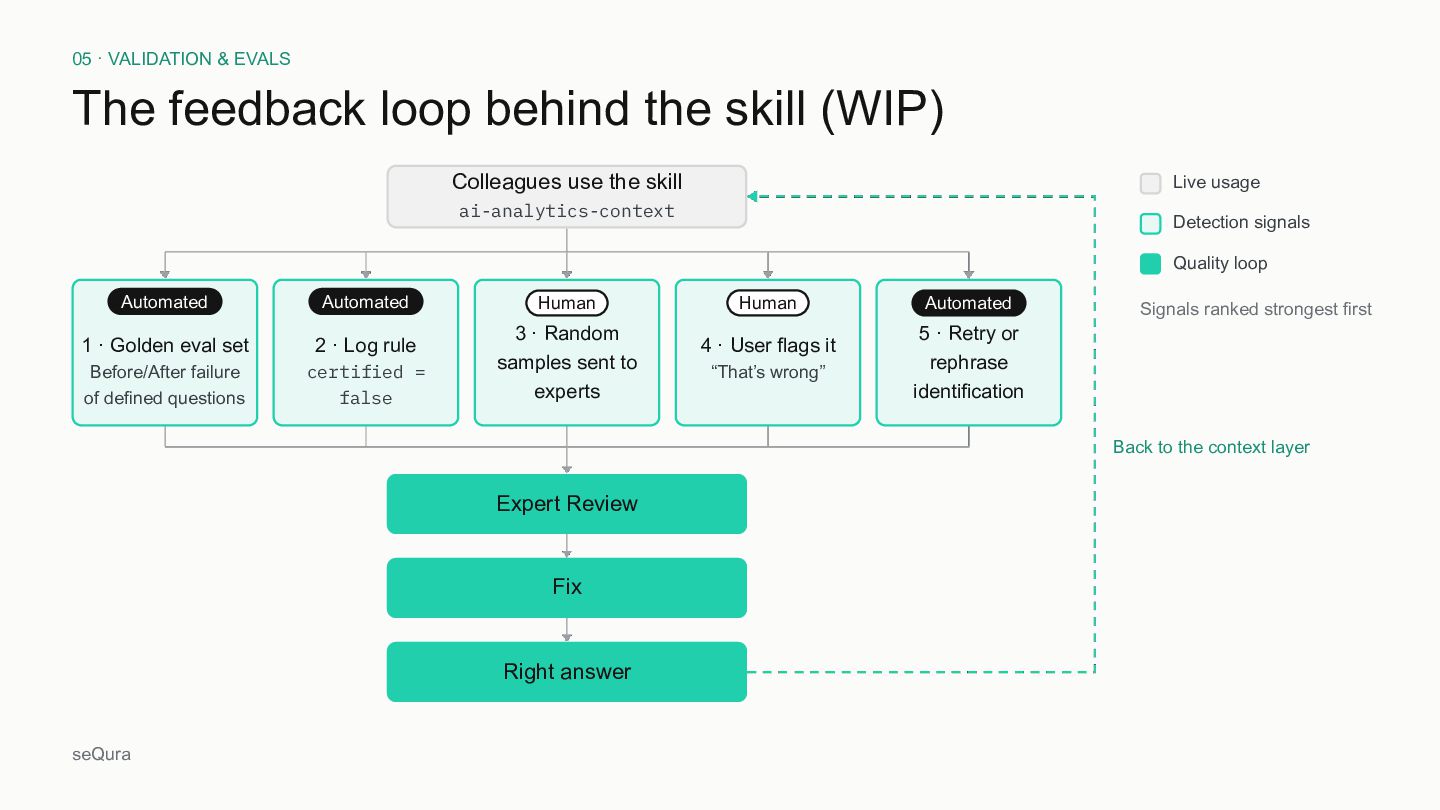
    skill (WIP) Colleagues use the skill Live usage ai-analytics-context Detection signals Quality loop Automated Automated 1 · Golden eval set 2 · Log rule Before/After failure of defined questions certified = false Human 3 · Random samples sent to experts Human 4 · User flags it “That’s wrong” Automated Signals ranked strongest first 5 · Retry or rephrase identification Back to the context layer Expert Review Fix Right answer seQura
  25. 04 · THE IMPACT USAGE: How much it has increased

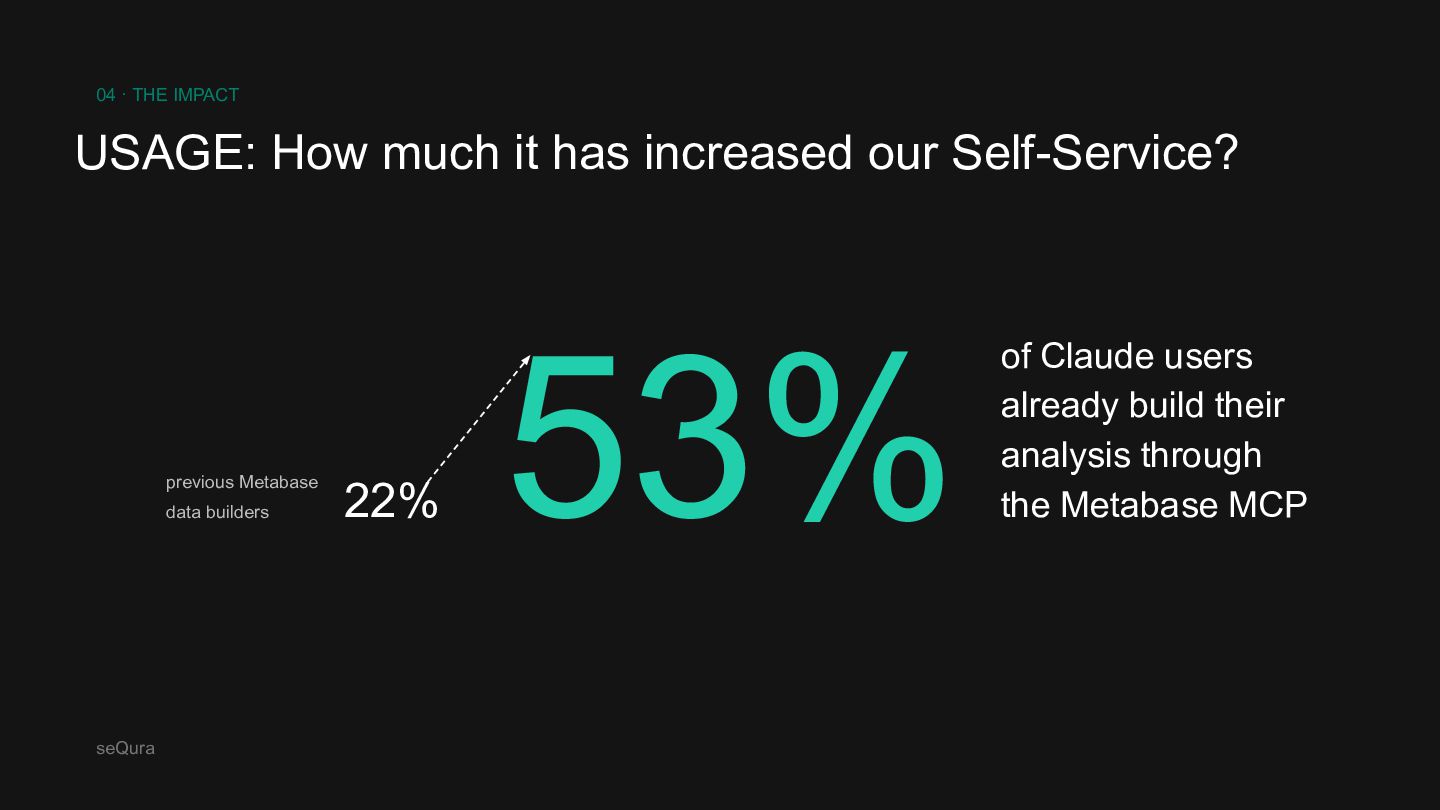
    our Self-Service? previous Metabase data builders seQura 22% 53% of Claude users already build their analysis through the Metabase MCP
  26. 04 · THE IMPACT HOURS: How much it has decreased

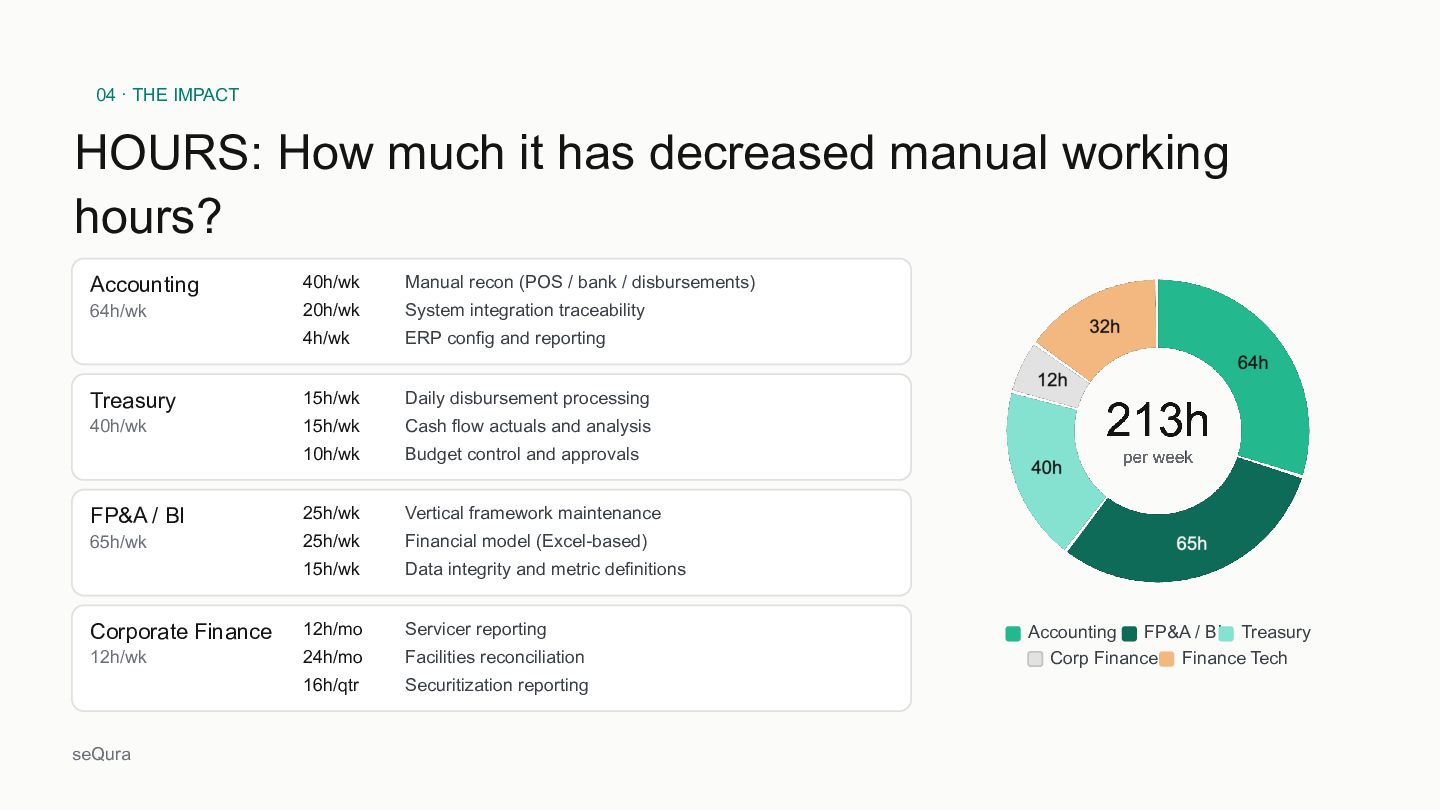
    manual working hours? Accounting 40h/wk Manual recon (POS / bank / disbursements) 64h/wk 20h/wk System integration traceability 4h/wk ERP config and reporting Treasury 15h/wk Daily disbursement processing 40h/wk 15h/wk Cash flow actuals and analysis 10h/wk Budget control and approvals FP&A / BI 25h/wk Vertical framework maintenance 65h/wk 25h/wk Financial model (Excel-based) 15h/wk Data integrity and metric definitions Corporate Finance 12h/mo Servicer reporting 12h/wk 24h/mo Facilities reconciliation 16h/qtr Securitization reporting seQura Accounting FP&A / BI Treasury Corp Finance Finance Tech
  27. 04 · THE IMPACT BUSINESS IMPACT: How much it represented

    for the company? 16.5M fixed 119M Backend seQura 106.9M BI & AI tools 16.5M
  28. Your catalog is a graph. Ask it like one. RDF,

    SPARQL and the agent Felipe Cardoso · 21 October 2026
  29. What is RDF? 1 · A fact is a triple

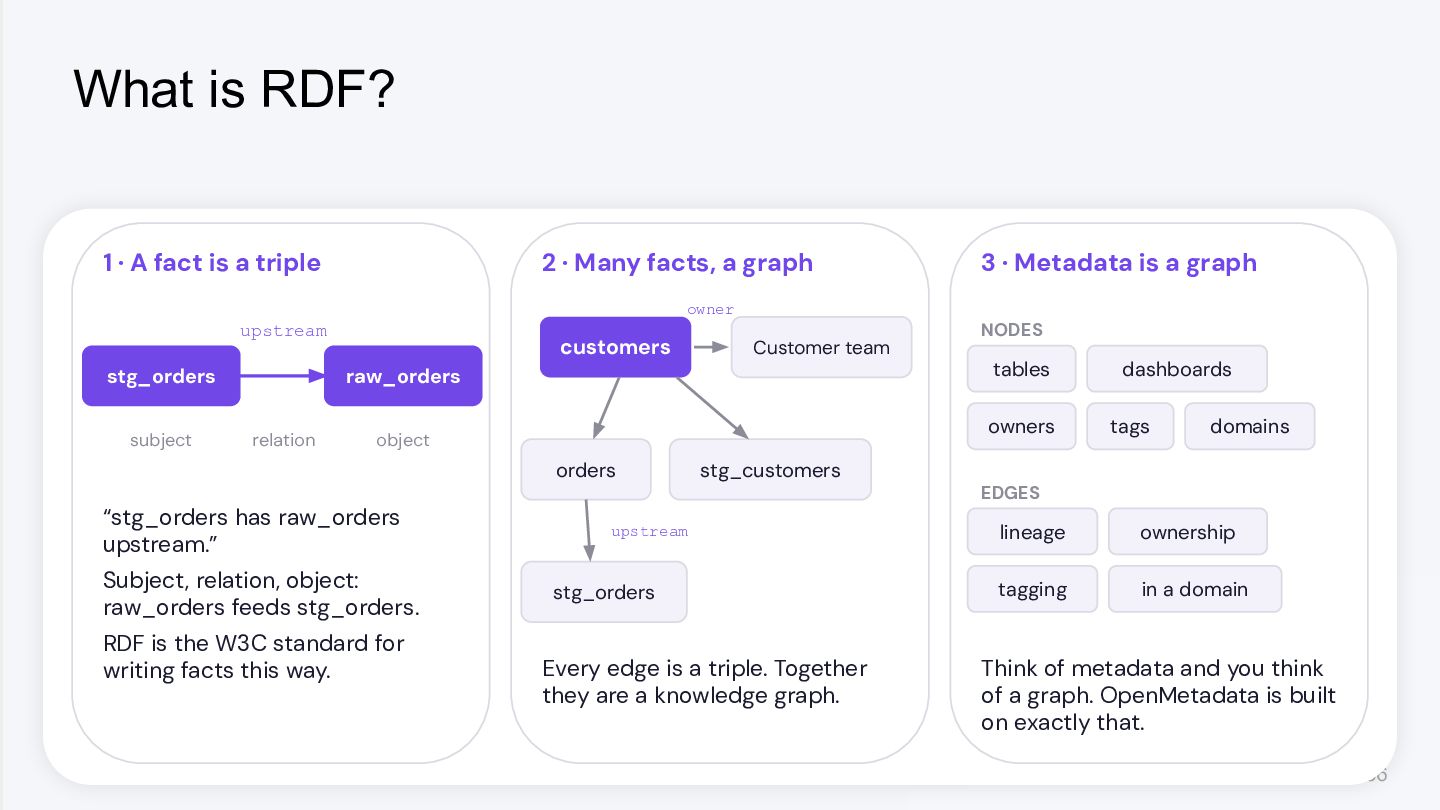
    2 · Many facts, a graph 3 · Metadata is a graph owner upstream stg_orders subject customers Customer team raw_orders relation object orders “stg_orders has raw_orders upstream.” Subject, relation, object: raw_orders feeds stg_orders. RDF is the W3C standard for writing facts this way. stg_customers upstream stg_orders Every edge is a triple. Together they are a knowledge graph. NODES tables dashboards owners tags domains EDGES lineage ownership tagging in a domain Think of metadata and you think of a graph. OpenMetadata is built on exactly that. 36
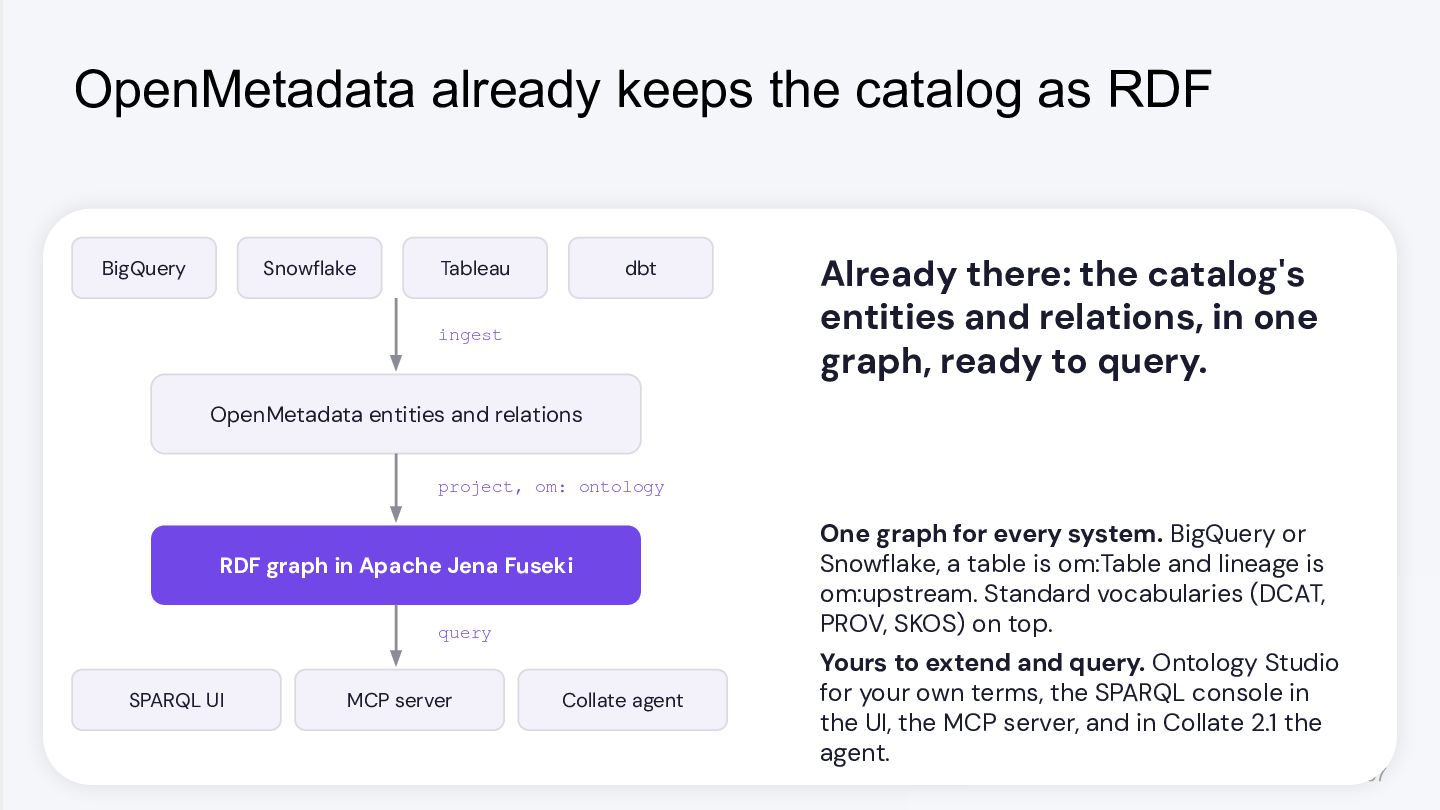
  30. OpenMetadata already keeps the catalog as RDF BigQuery Snowflake Tableau

    dbt ingest Already there: the catalog's entities and relations, in one graph, ready to query. OpenMetadata entities and relations project, om: ontology RDF graph in Apache Jena Fuseki query SPARQL UI MCP server Collate agent One graph for every system. BigQuery or Snowflake, a table is om:Table and lineage is om:upstream. Standard vocabularies (DCAT, PROV, SKOS) on top. Yours to extend and query. Ontology Studio for your own terms, the SPARQL console in the UI, the MCP server, and in Collate 2.1 the agent. 37
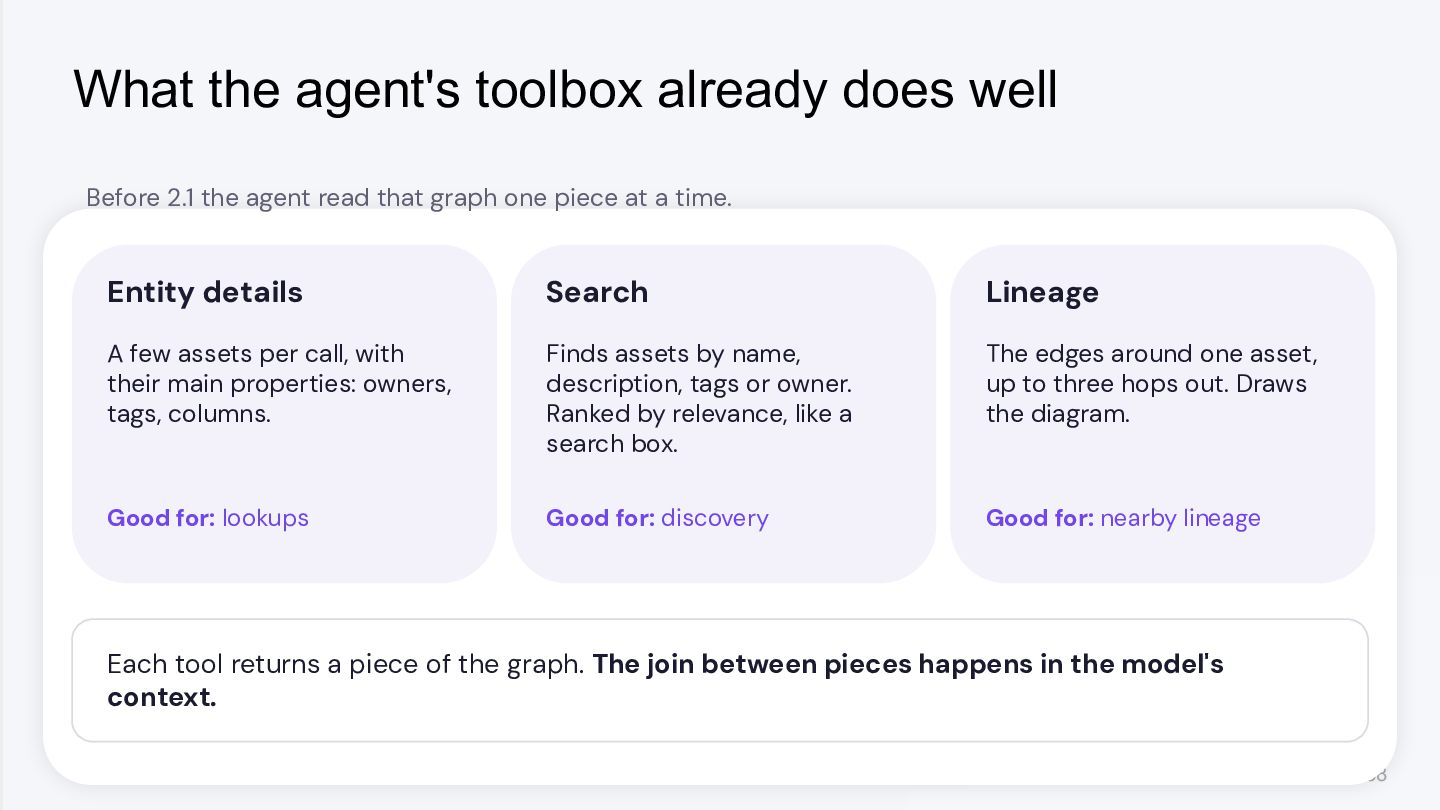
  31. What the agent's toolbox already does well Before 2.1 the

    agent read that graph one piece at a time. Entity details Search Lineage A few assets per call, with their main properties: owners, tags, columns. Finds assets by name, description, tags or owner. Ranked by relevance, like a search box. The edges around one asset, up to three hops out. Draws the diagram. Good for: lookups Good for: discovery Good for: nearby lineage Each tool returns a piece of the graph. The join between pieces happens in the model's context. 38
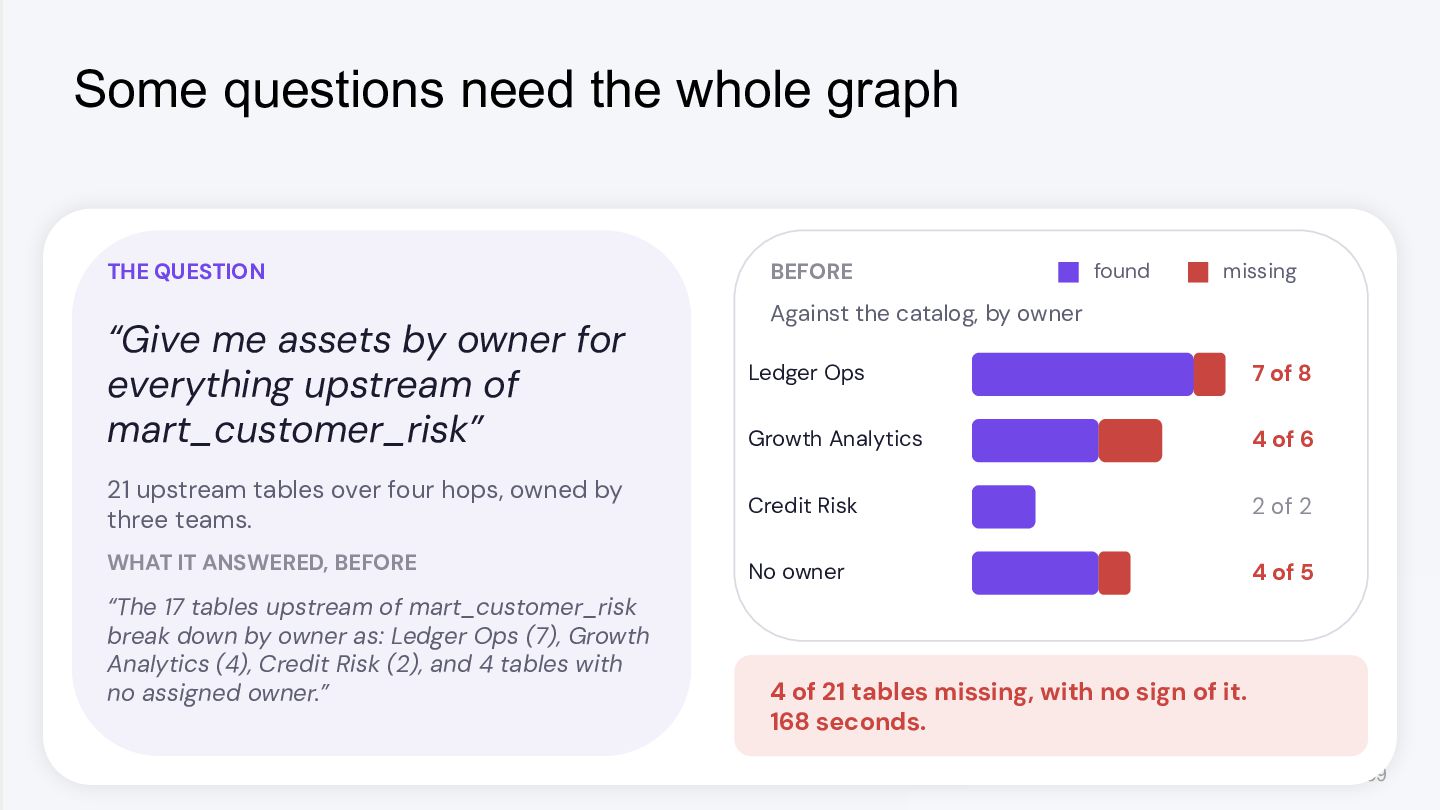
  32. Some questions need the whole graph THE QUESTION “Give me

    assets by owner for everything upstream of mart_customer_risk” BEFORE found missing Against the catalog, by owner Ledger Ops 7 of 8 Growth Analytics 4 of 6 21 upstream tables over four hops, owned by three teams. Credit Risk 2 of 2 WHAT IT ANSWERED, BEFORE No owner 4 of 5 “The 17 tables upstream of mart_customer_risk break down by owner as: Ledger Ops (7), Growth Analytics (4), Credit Risk (2), and 4 tables with no assigned owner.” 4 of 21 tables missing, with no sign of it. 168 seconds. 39
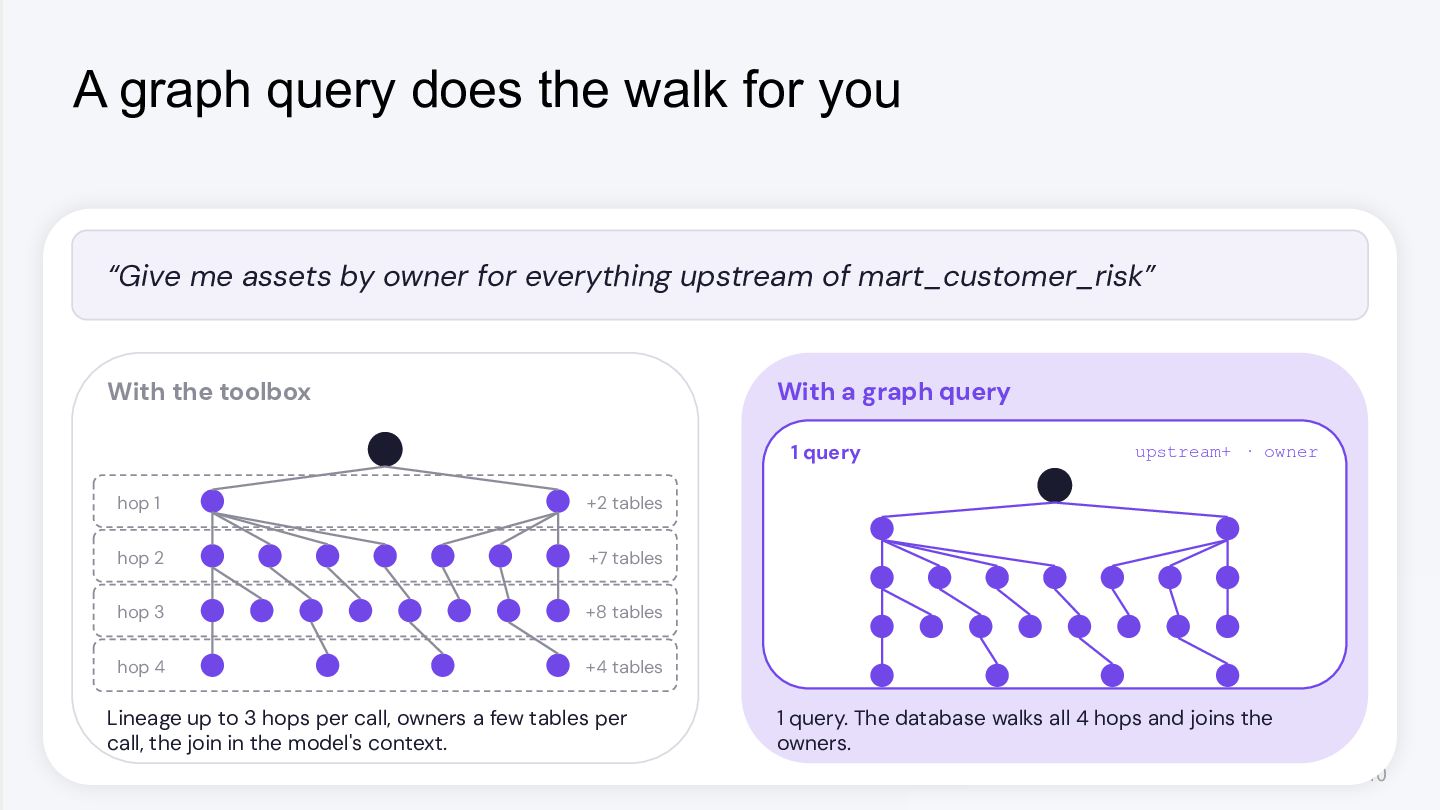
  33. A graph query does the walk for you “Give me

    assets by owner for everything upstream of mart_customer_risk” With the toolbox With a graph query 1 query hop 1 +2 tables hop 2 +7 tables hop 3 +8 tables hop 4 +4 tables Lineage up to 3 hops per call, owners a few tables per call, the join in the model's context. upstream+ · owner 1 query. The database walks all 4 hops and joins the owners. 40
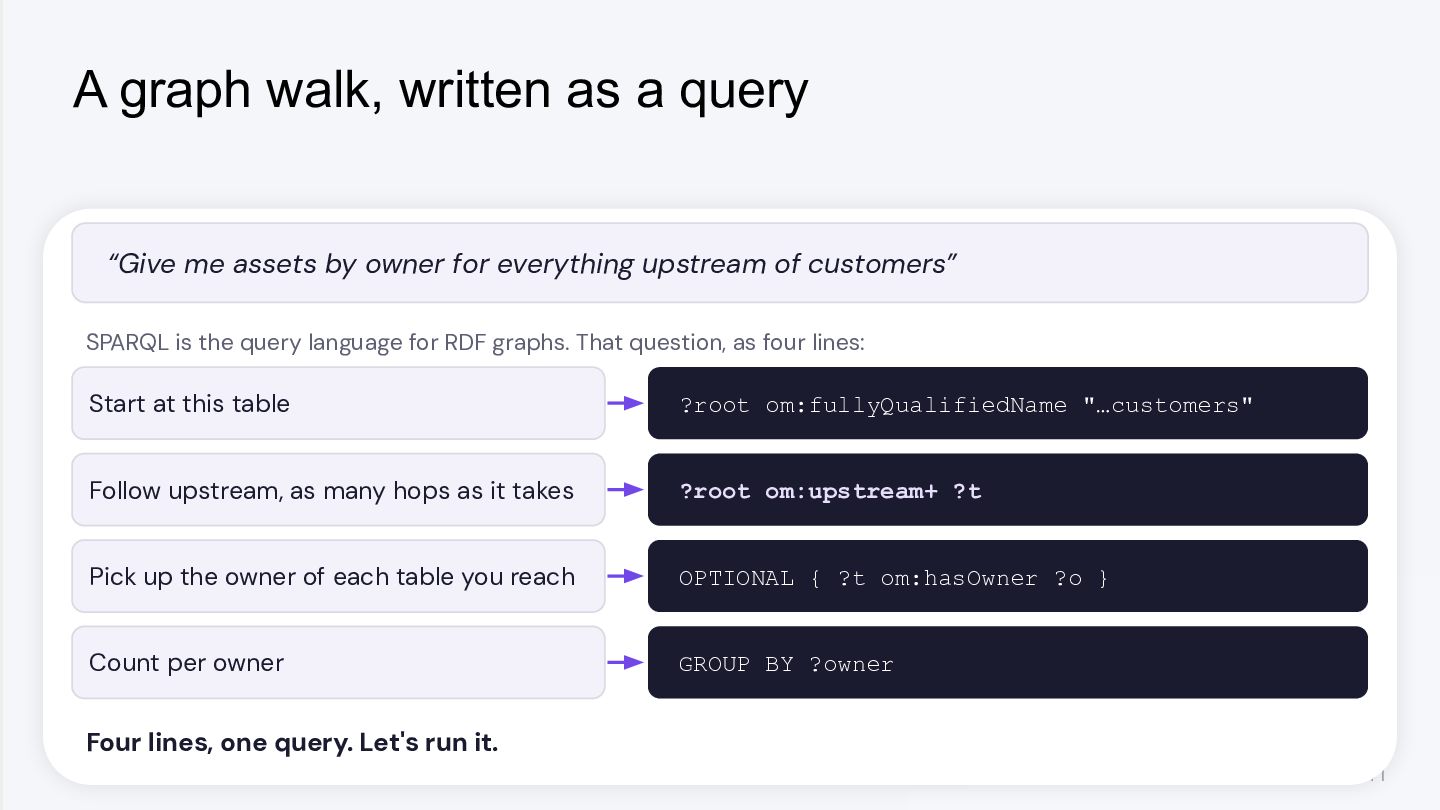
  34. A graph walk, written as a query “Give me assets

    by owner for everything upstream of customers” SPARQL is the query language for RDF graphs. That question, as four lines: Start at this table ?root om:fullyQualifiedName "…customers" Follow upstream, as many hops as it takes ?root om:upstream+ ?t Pick up the owner of each table you reach OPTIONAL { ?t om:hasOwner ?o } Count per owner GROUP BY ?owner Four lines, one query. Let's run it. 41
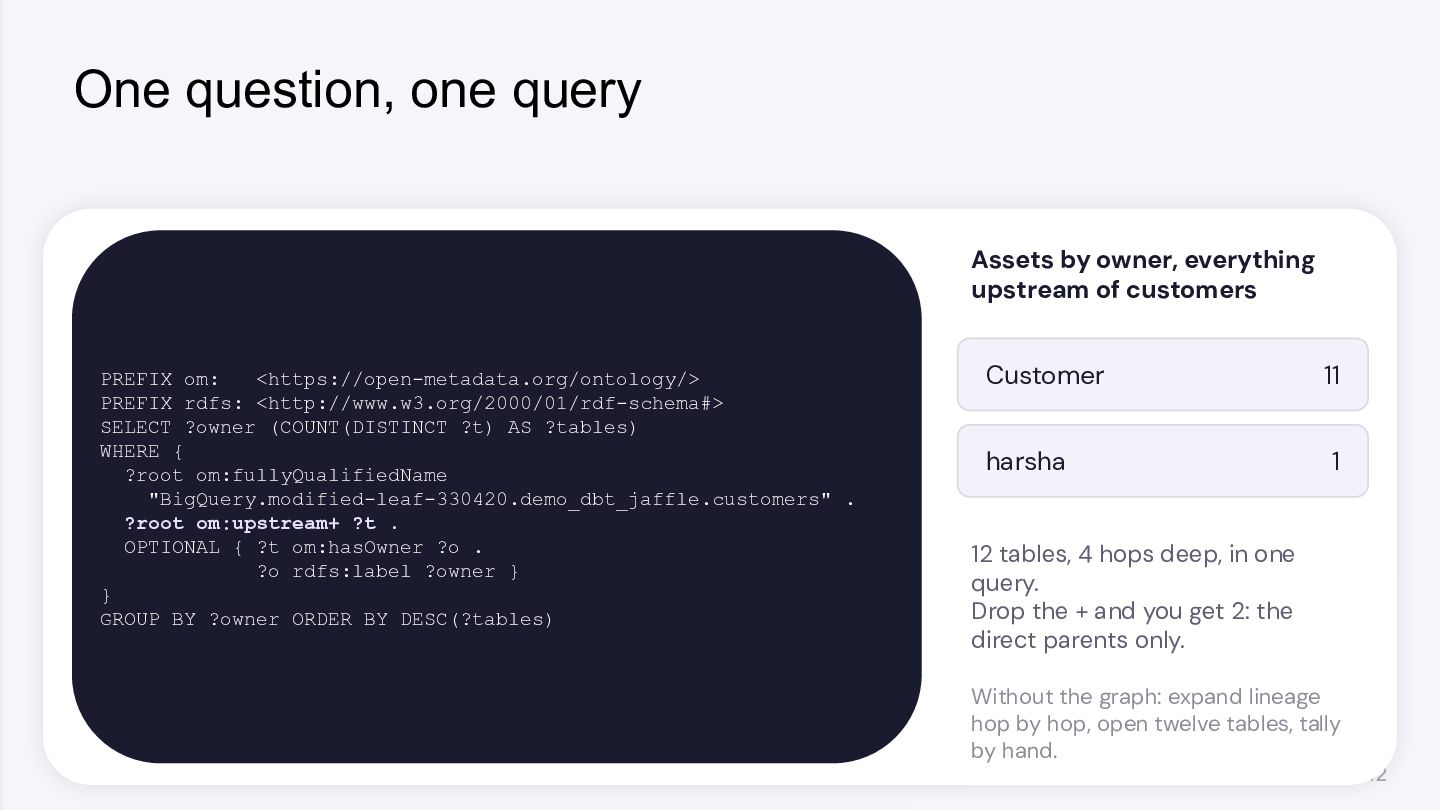
  35. One question, one query Assets by owner, everything upstream of

    customers PREFIX om: <https://open-metadata.org/ontology/> PREFIX rdfs: <http://www.w3.org/2000/01/rdf-schema#> SELECT ?owner (COUNT(DISTINCT ?t) AS ?tables) WHERE { ?root om:fullyQualifiedName "BigQuery.modified-leaf-330420.demo_dbt_jaffle.customers" . ?root om:upstream+ ?t . OPTIONAL { ?t om:hasOwner ?o . ?o rdfs:label ?owner } } GROUP BY ?owner ORDER BY DESC(?tables) Customer 11 harsha 1 12 tables, 4 hops deep, in one query. Drop the + and you get 2: the direct parents only. Without the graph: expand lineage hop by hop, open twelve tables, tally by hand. 42
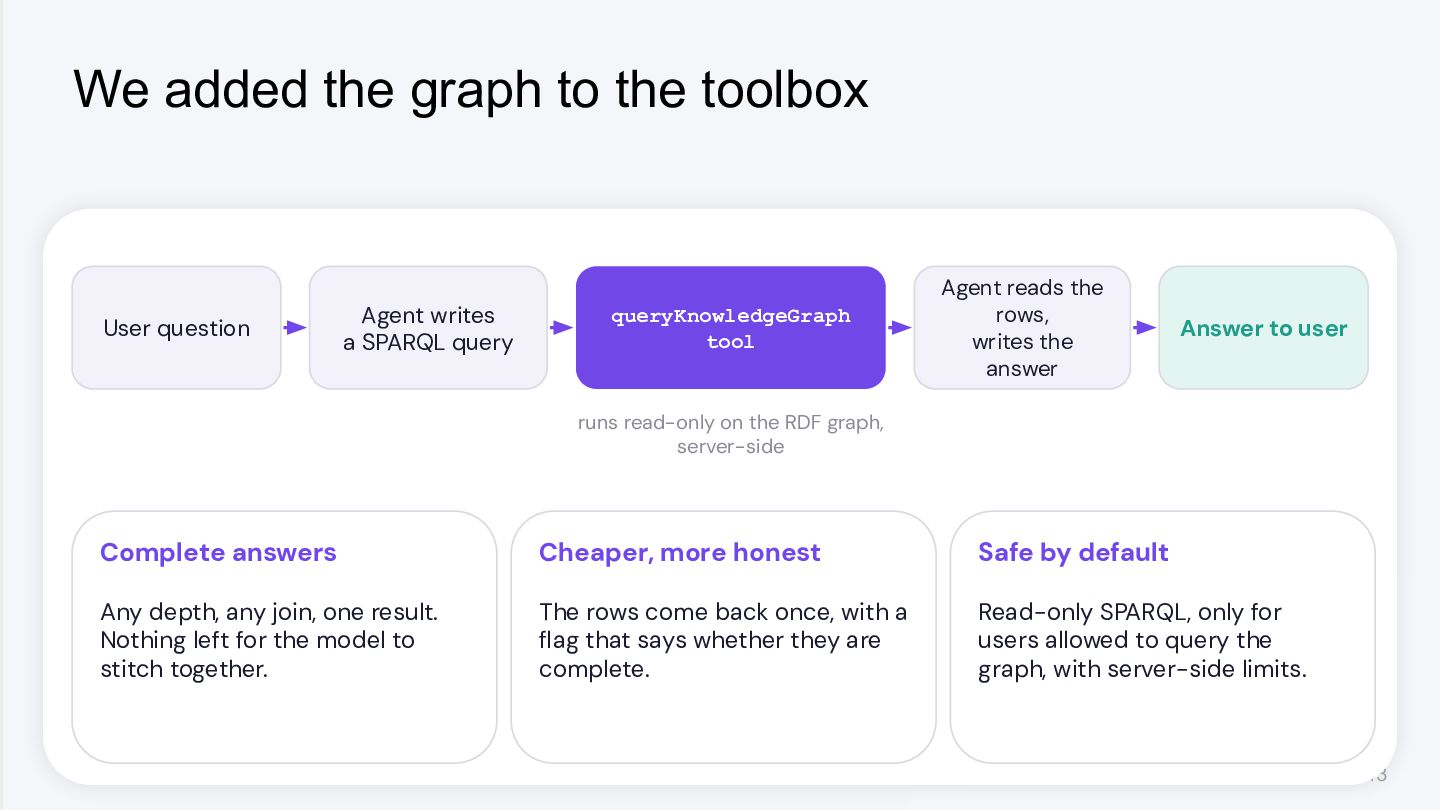
  36. We added the graph to the toolbox User question Agent

    writes a SPARQL query queryKnowledgeGraph tool Agent reads the rows, writes the answer Answer to user runs read-only on the RDF graph, server-side Complete answers Cheaper, more honest Safe by default Any depth, any join, one result. Nothing left for the model to stitch together. The rows come back once, with a flag that says whether they are complete. Read-only SPARQL, only for users allowed to query the graph, with server-side limits. 43
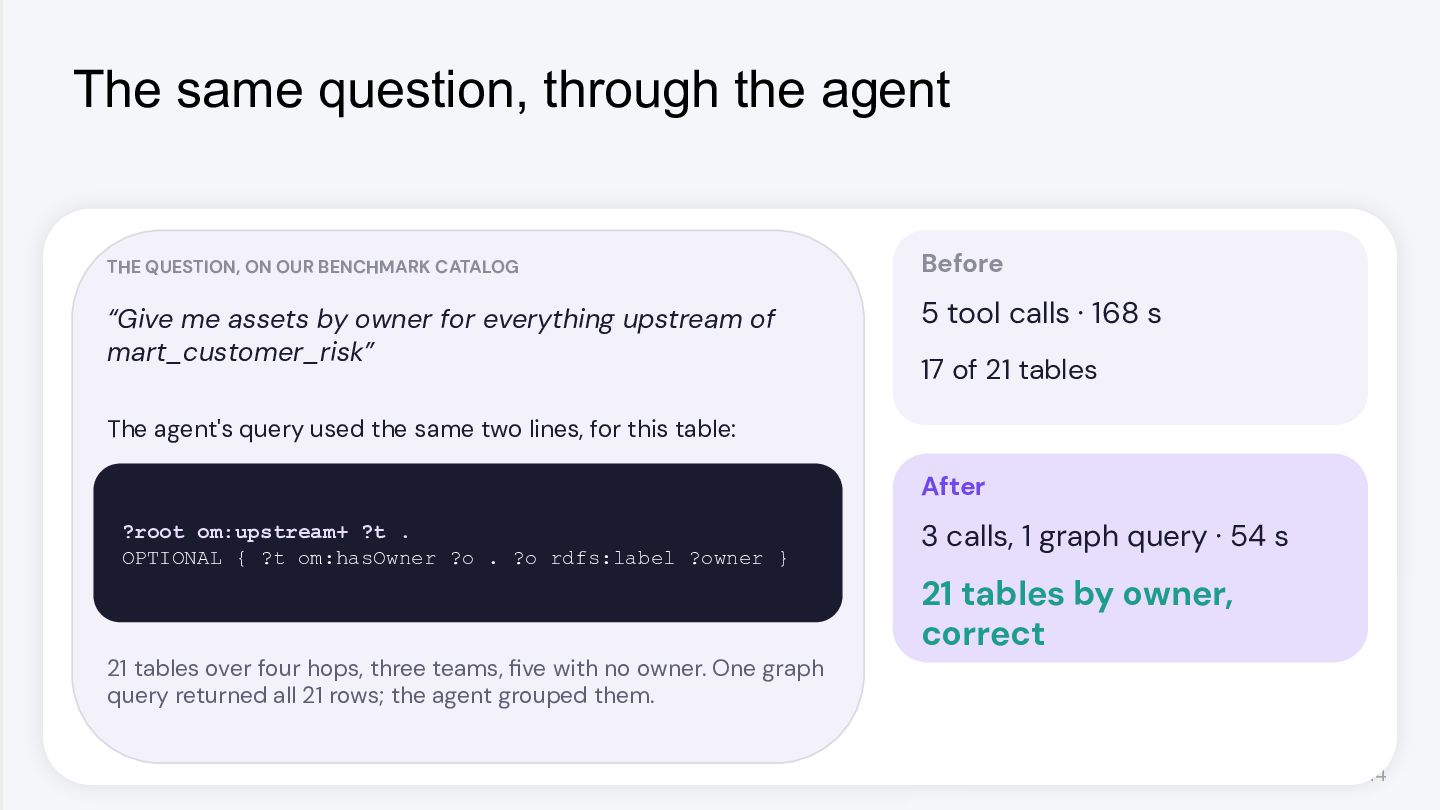
  37. The same question, through the agent THE QUESTION, ON OUR

    BENCHMARK CATALOG Before “Give me assets by owner for everything upstream of mart_customer_risk” 5 tool calls · 168 s 17 of 21 tables The agent's query used the same two lines, for this table: After ?root om:upstream+ ?t . OPTIONAL { ?t om:hasOwner ?o . ?o rdfs:label ?owner } 21 tables over four hops, three teams, five with no owner. One graph query returned all 21 rows; the agent grouped them. 3 calls, 1 graph query · 54 s 21 tables by owner, correct 44
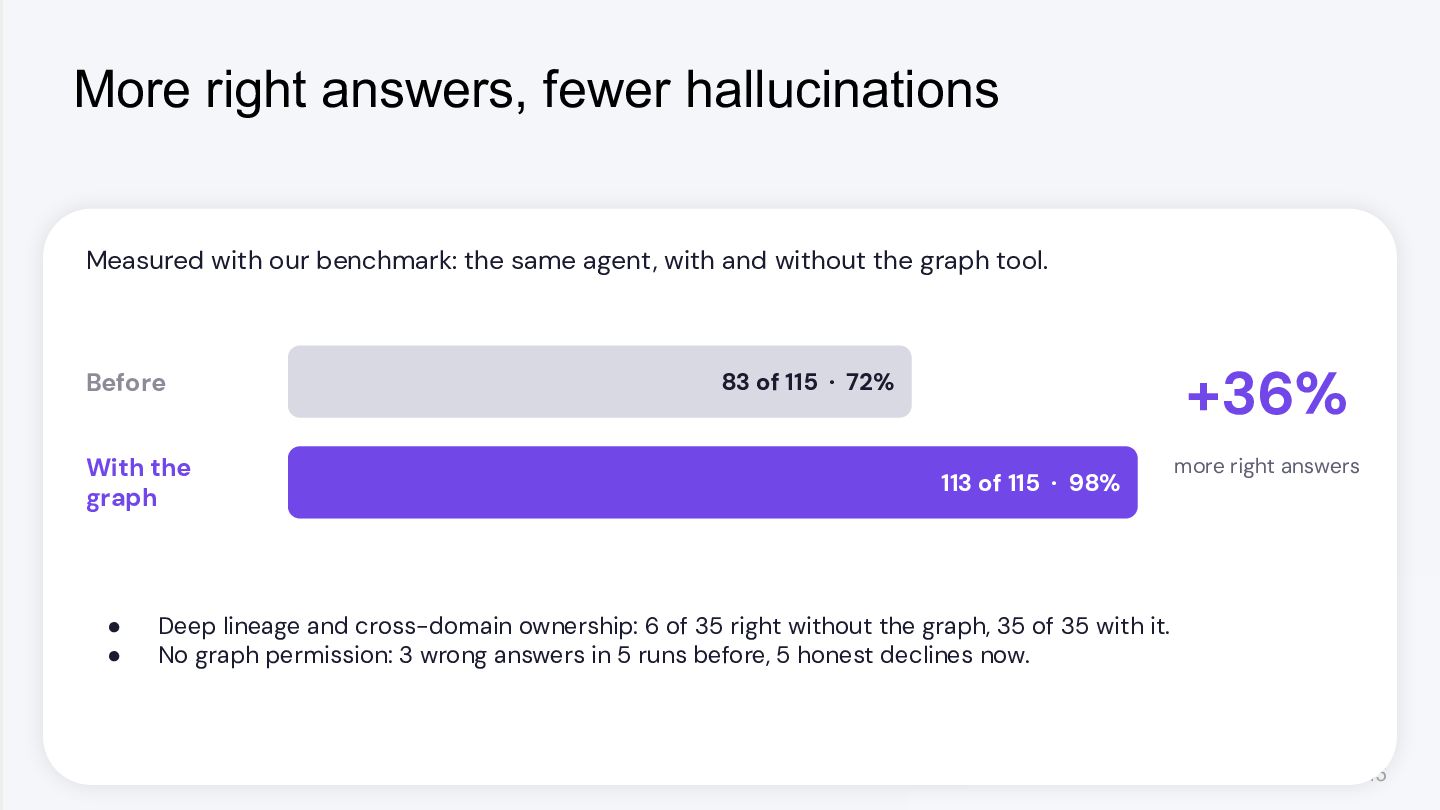
  38. More right answers, fewer hallucinations Measured with our benchmark: the

    same agent, with and without the graph tool. Before With the graph • • +36% 83 of 115 · 72% 113 of 115 · 98% more right answers Deep lineage and cross-domain ownership: 6 of 35 right without the graph, 35 of 35 with it. No graph permission: 3 wrong answers in 5 runs before, 5 honest declines now. 45
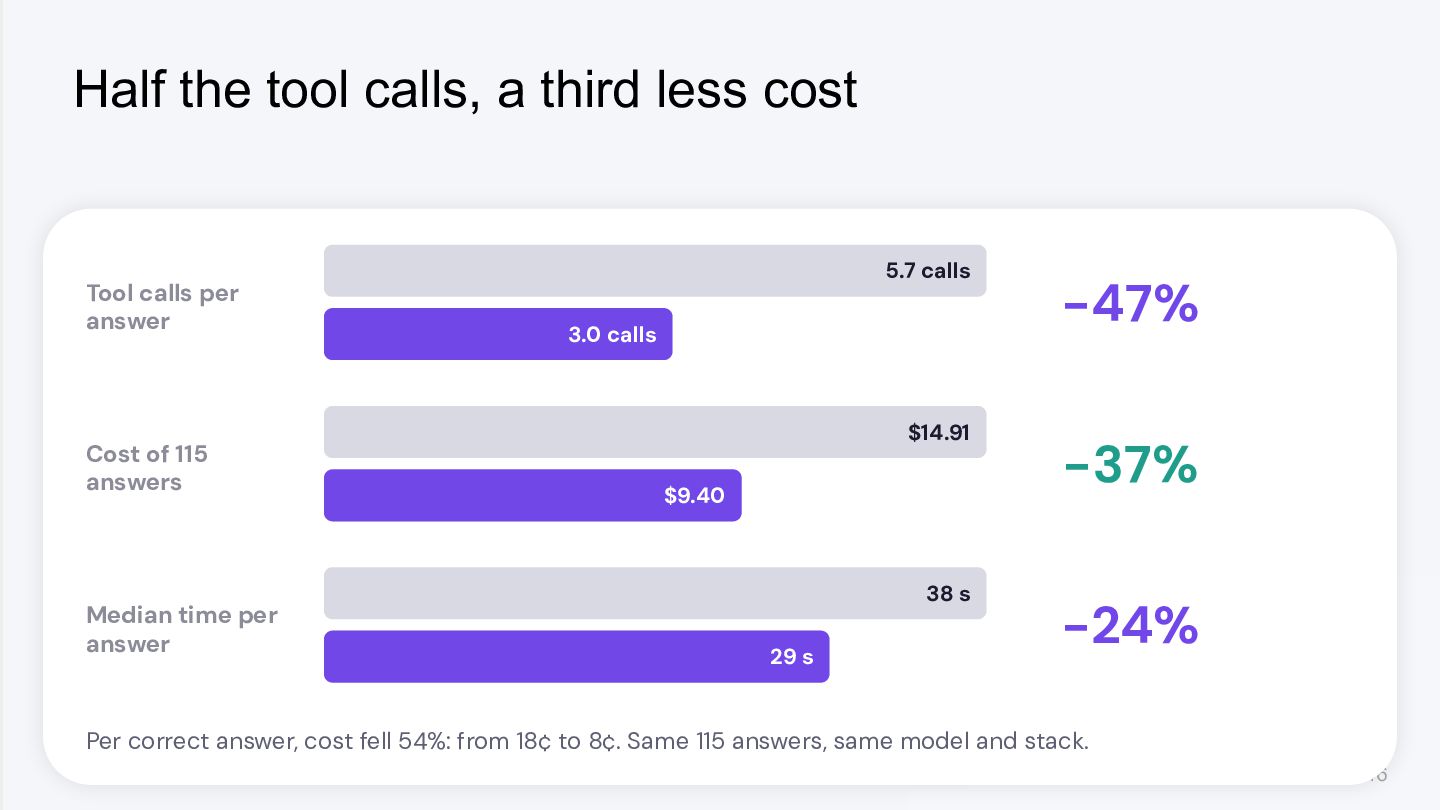
  39. Half the tool calls, a third less cost Tool calls

    per answer Cost of 115 answers Median time per answer 5.7 calls 3.0 calls $14.91 $9.40 38 s 29 s −47% −37% −24% Per correct answer, cost fell 54%: from 18¢ to 8¢. Same 115 answers, same model and stack. 46
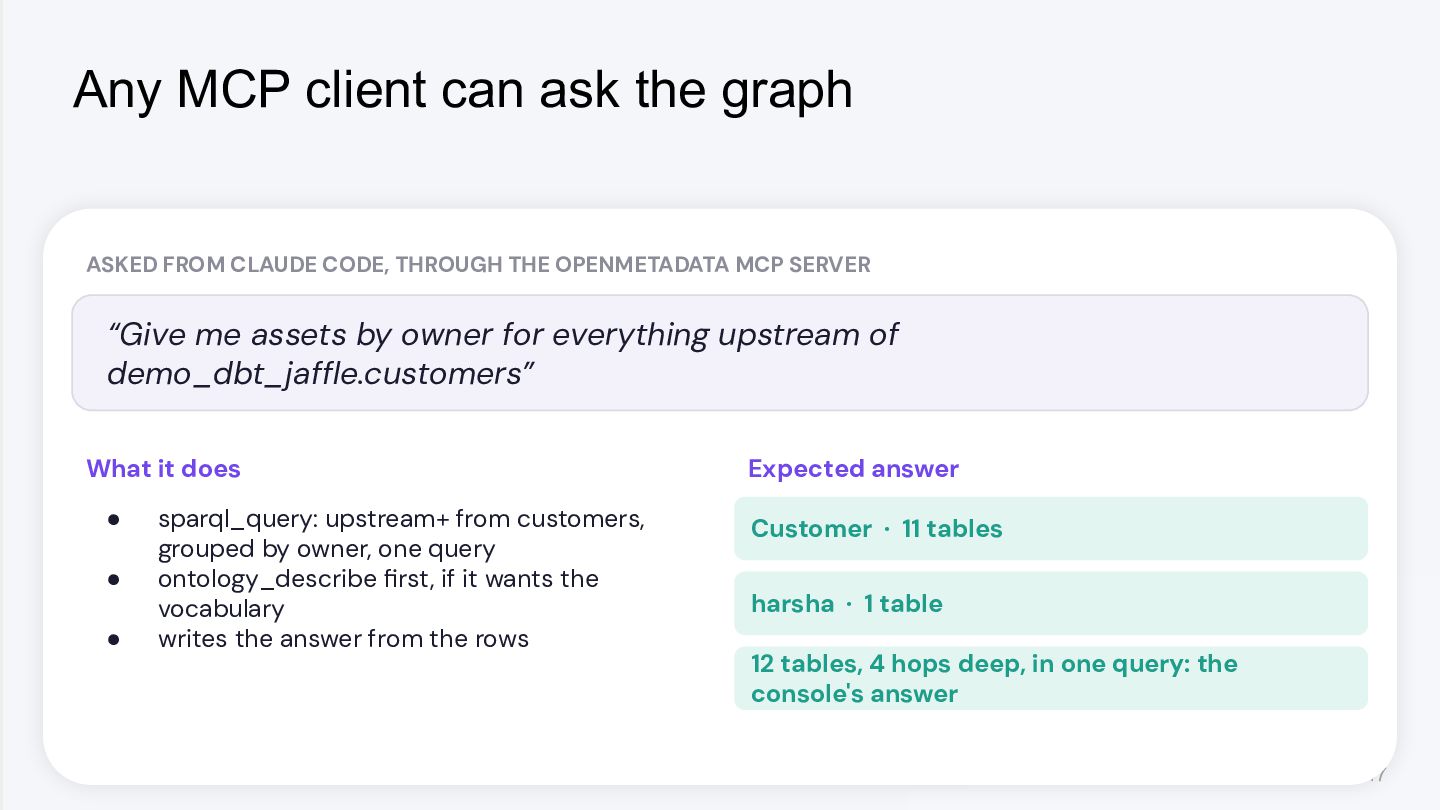
  40. Any MCP client can ask the graph ASKED FROM CLAUDE

    CODE, THROUGH THE OPENMETADATA MCP SERVER “Give me assets by owner for everything upstream of demo_dbt_jaffle.customers” What it does • • • sparql_query: upstream+ from customers, grouped by owner, one query ontology_describe first, if it wants the vocabulary writes the answer from the rows Expected answer Customer · 11 tables harsha · 1 table 12 tables, 4 hops deep, in one query: the console's answer 47
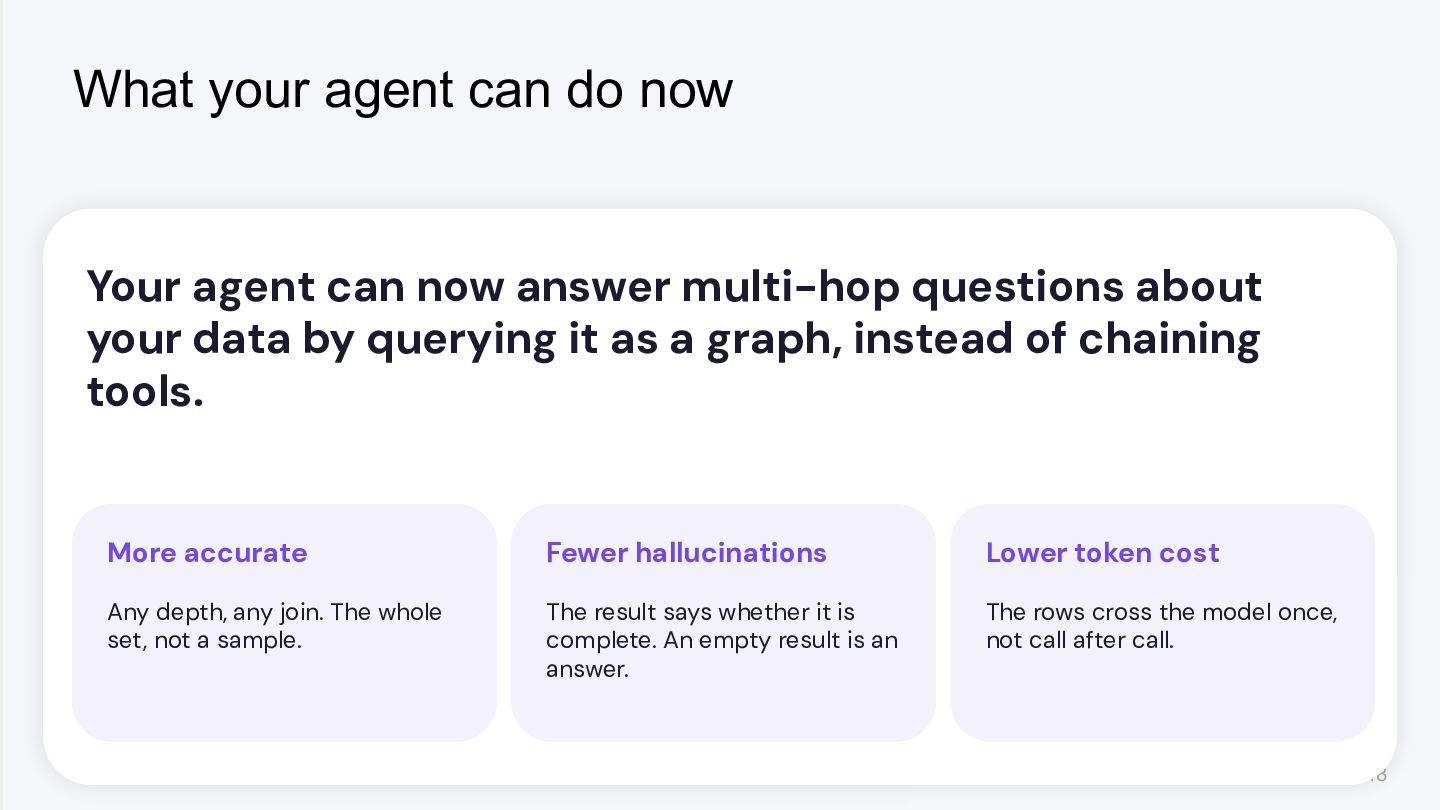
  41. What your agent can do now Your agent can now

    answer multi-hop questions about your data by querying it as a graph, instead of chaining tools. More accurate Fewer hallucinations Lower token cost Any depth, any join. The whole set, not a sample. The result says whether it is complete. An empty result is an answer. The rows cross the model once, not call after call. 48
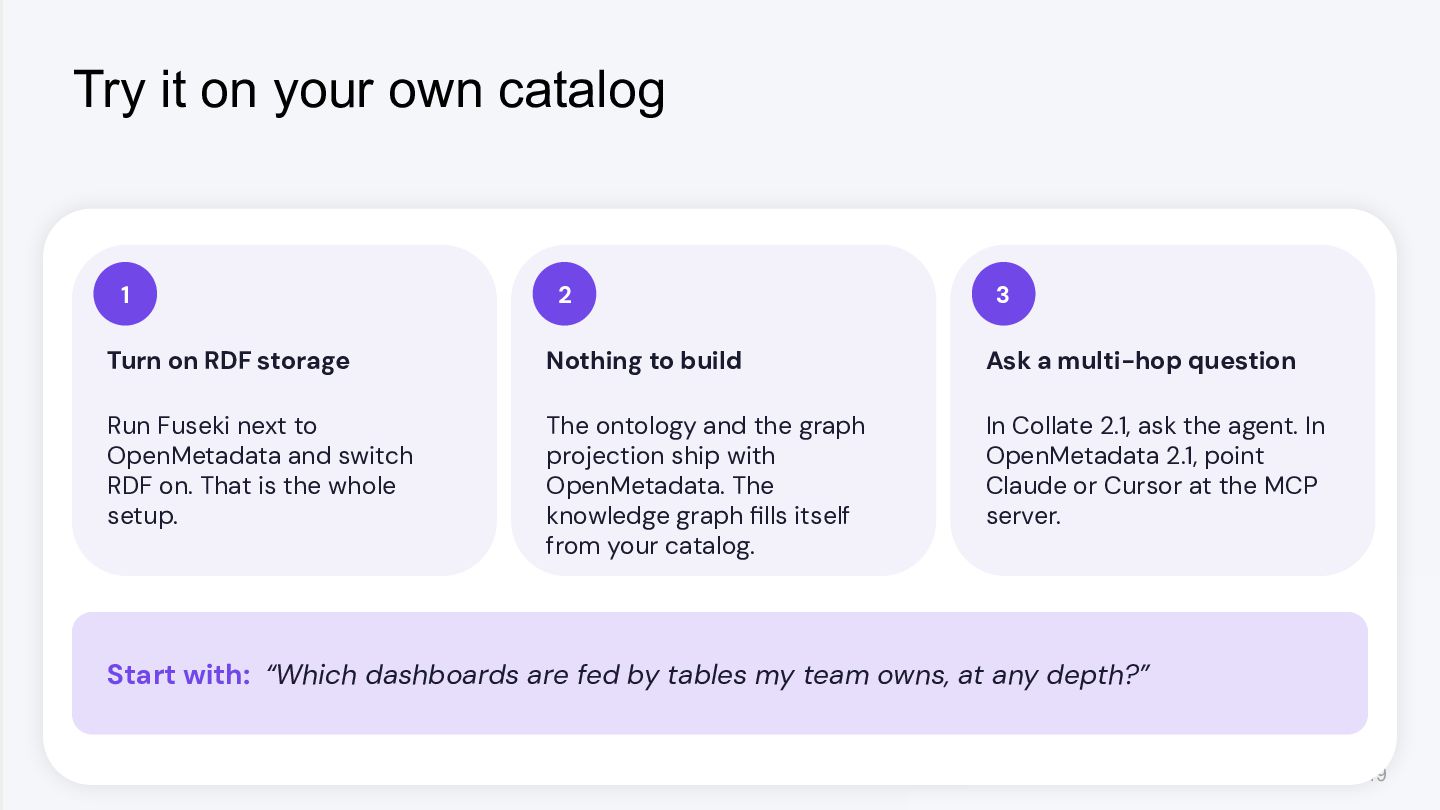
  42. Try it on your own catalog 1 2 3 Turn

    on RDF storage Nothing to build Ask a multi-hop question Run Fuseki next to OpenMetadata and switch RDF on. That is the whole setup. The ontology and the graph projection ship with OpenMetadata. The knowledge graph fills itself from your catalog. In Collate 2.1, ask the agent. In OpenMetadata 2.1, point Claude or Cursor at the MCP server. Start with: “Which dashboards are fed by tables my team owns, at any depth?” 49
  43. Q&A

  44. Star us on GitHub https://github.com/open-metadata/OpenMetadata Join our Slack https://slack.open-metadata.org/ Subscribe

    on Youtube https://www.youtube.com/OpenMetadataChannel Subscribe on Medium Blog https://blog.open-metadata.org/ Follow on Linkedin https://www.linkedin.com/company/openmetadata/ Discover Collate SaaS https://www.getcollate.io/