Upgrade to Pro — share decks privately, control downloads, hide ads and more …

[GopherCon 2026] Unlocking Real-World Go Mutex ...

[GopherCon 2026] Unlocking Real-World Go Mutex Usage Patterns by Writing a Mutex Linter

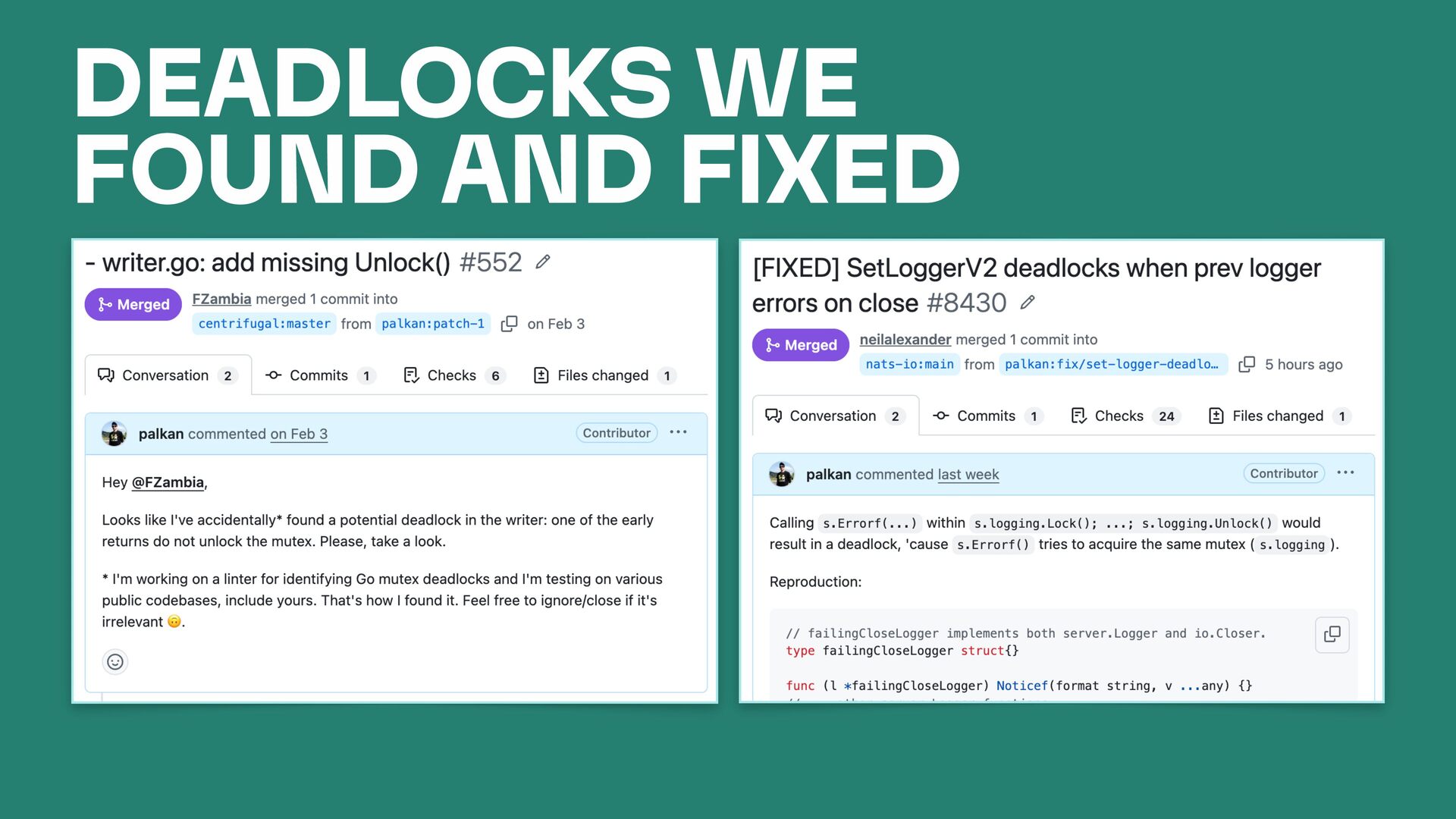
The trickiest and hardest-to-identify bugs are often those fixable with a single line of code. Hours, days, or months can be spent only to find a missing Unlock() in the (dead) end. After I suffered such a case, I asked myself two questions: "Am I using mutexes wrong?" and "How can I prevent bugs like this in the future?"

The search for answers led me to the depths of static analysis and an exploration of Go mutex usage patterns in the wild.

In my talk, I want to share my findings and present a new linter for detecting mutex misuse.

Avatar for Vladimir Dementyev

Vladimir Dementyev

August 05, 2026

More Decks by Vladimir Dementyev

Other Decks in Programming

Transcript

  1. UNLOCKING REAL-WORLD GO MUTEX USAGE PATTERNS by writing a mutex

    linter Vladimir Dementyev Evil Martians
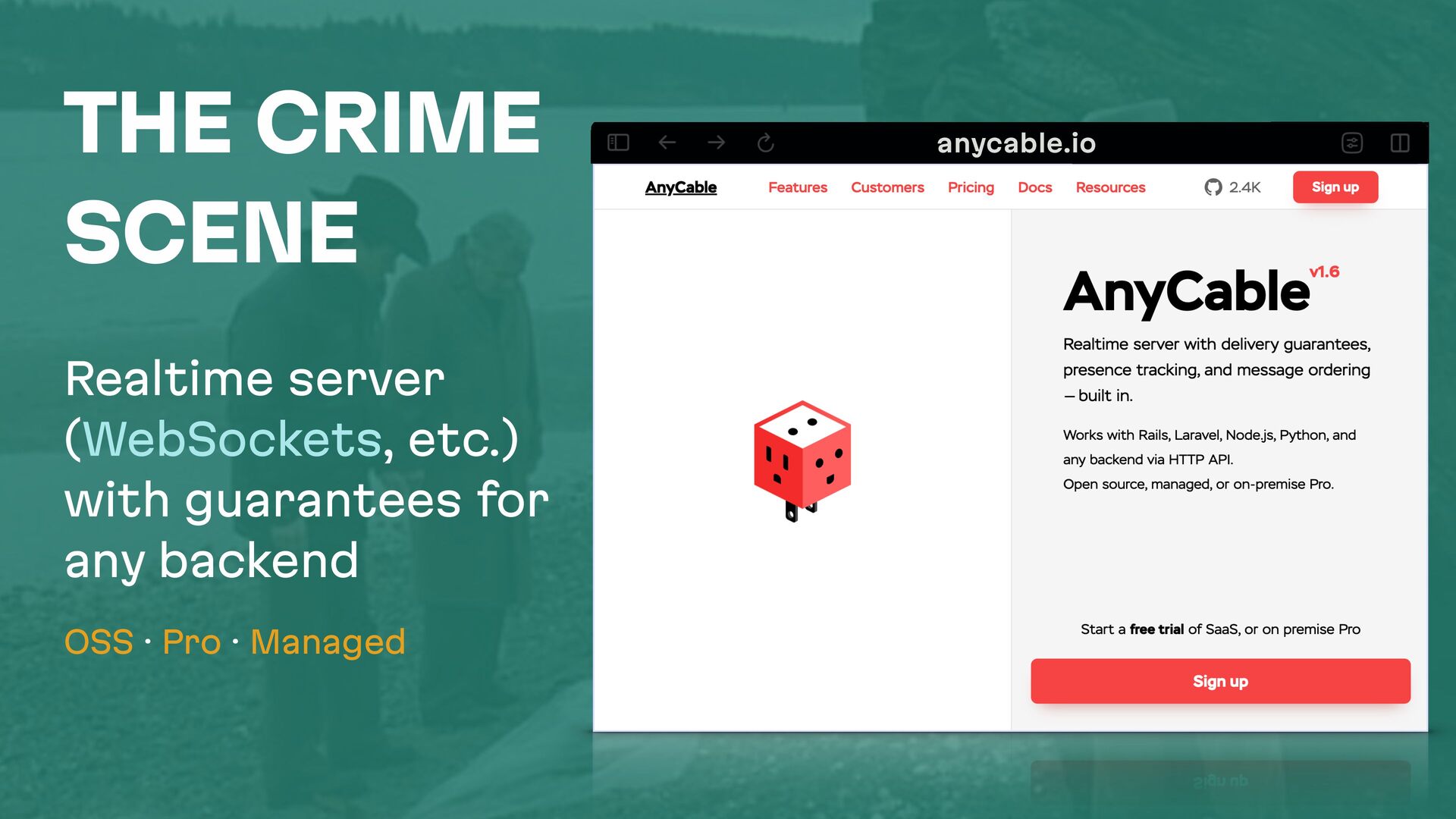
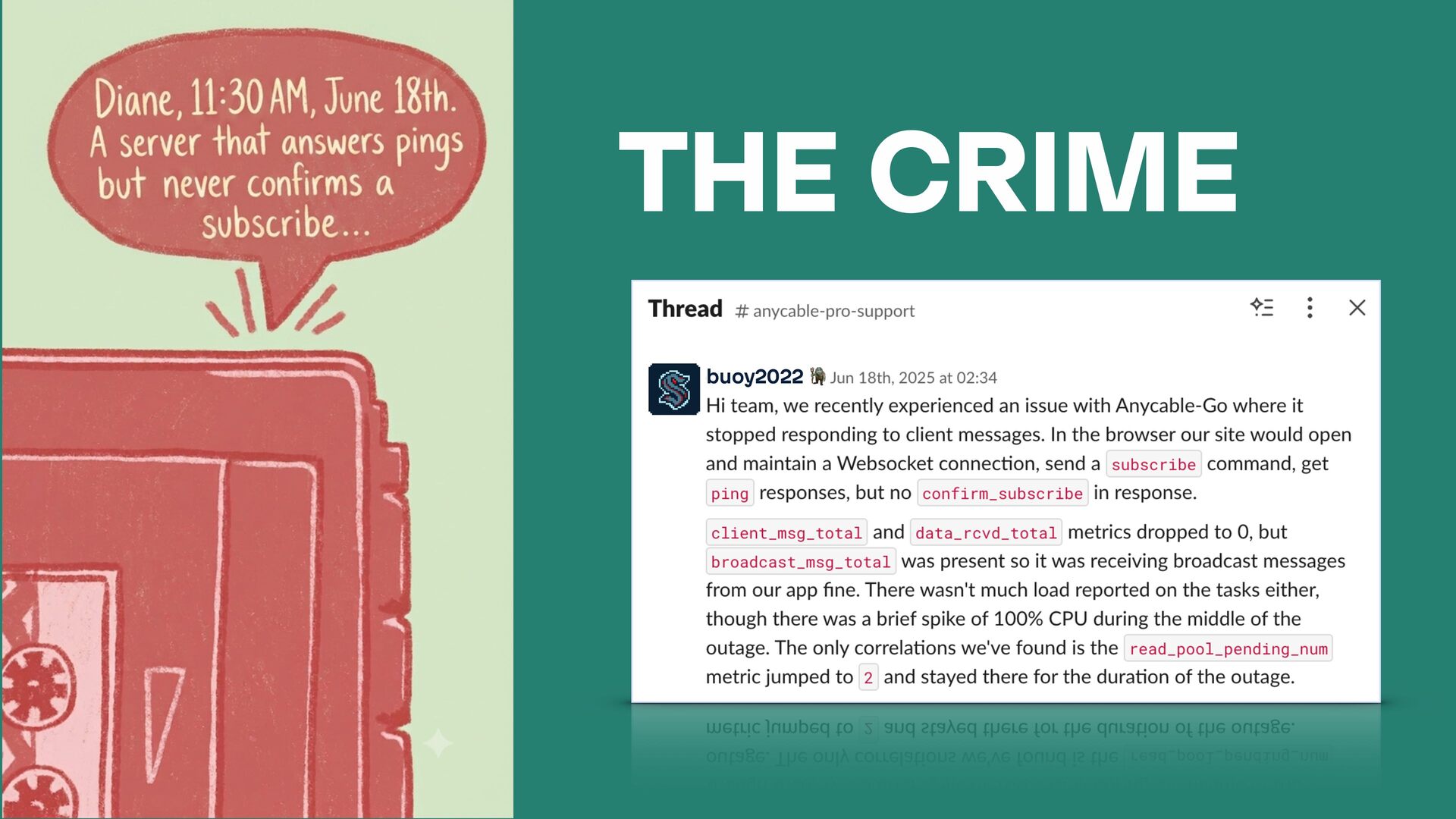
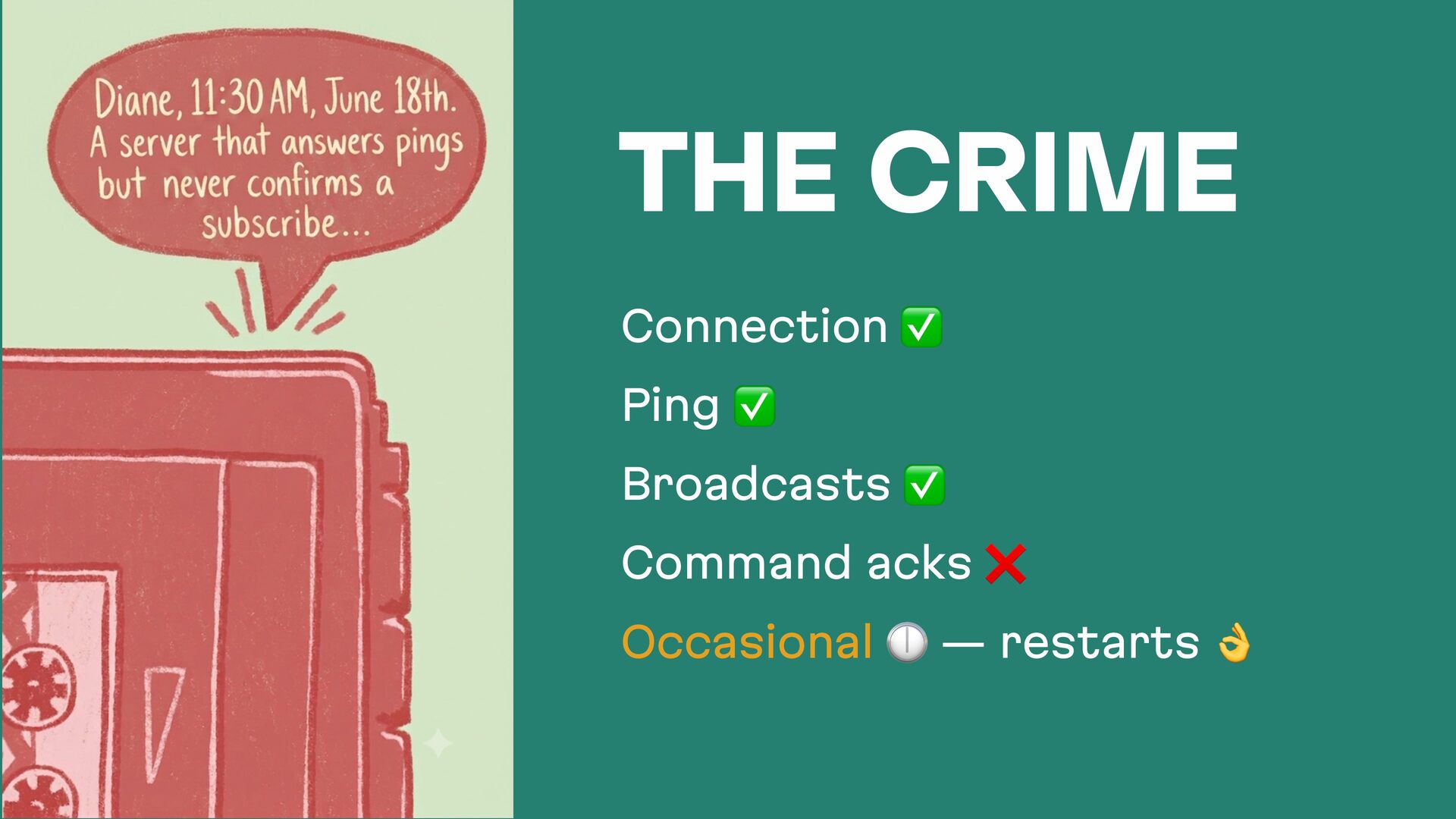
  2. THE CRIME SCENE Realtime server (WebSockets, etc.) with guarantees for

    any backend OSS · Pro · Managed anycable.io
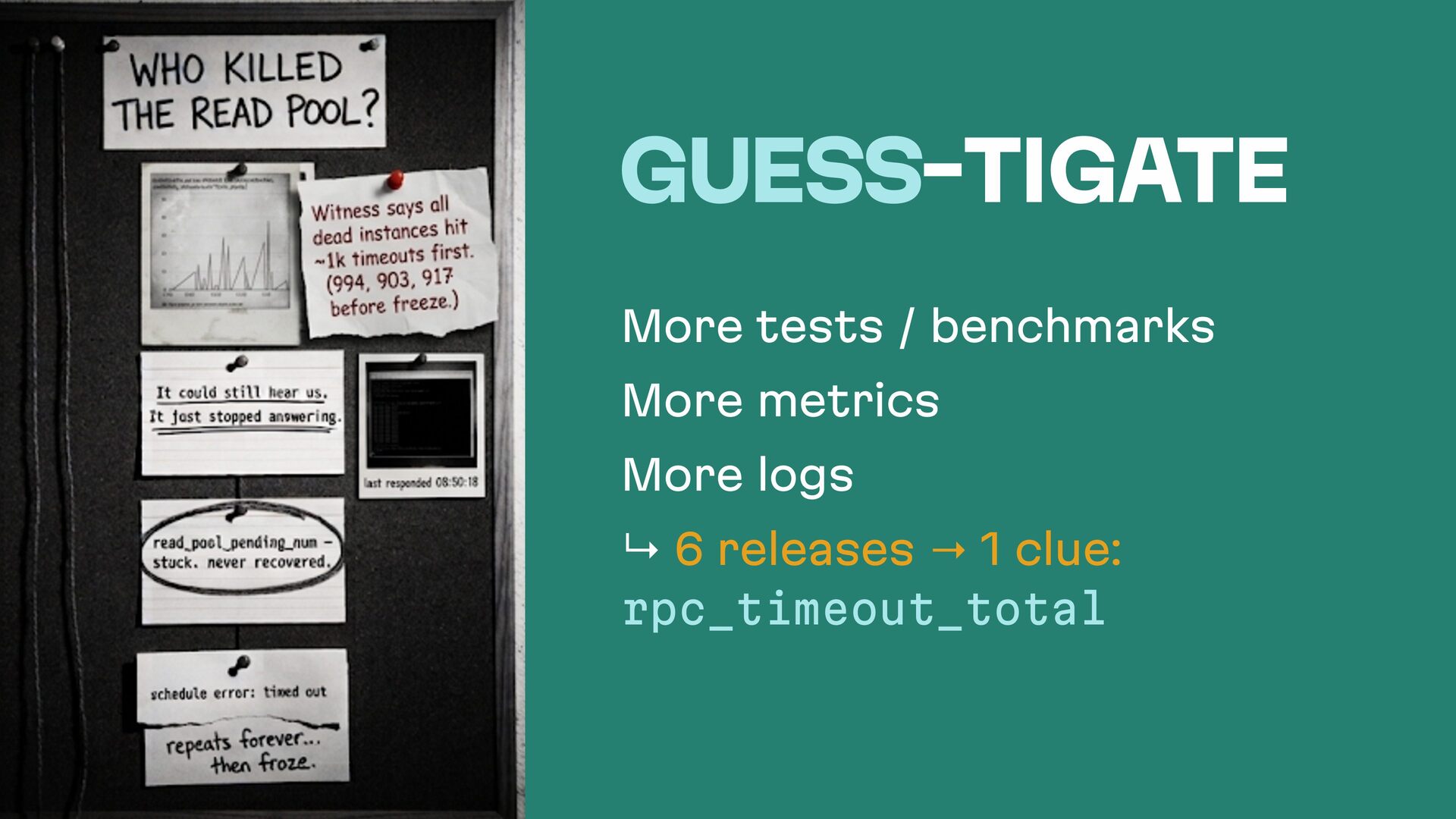
  3. GUESS-TIGATE More tests / benchmarks More metrics More logs ↳

    6 releases → 1 clue: rpc_timeout_total
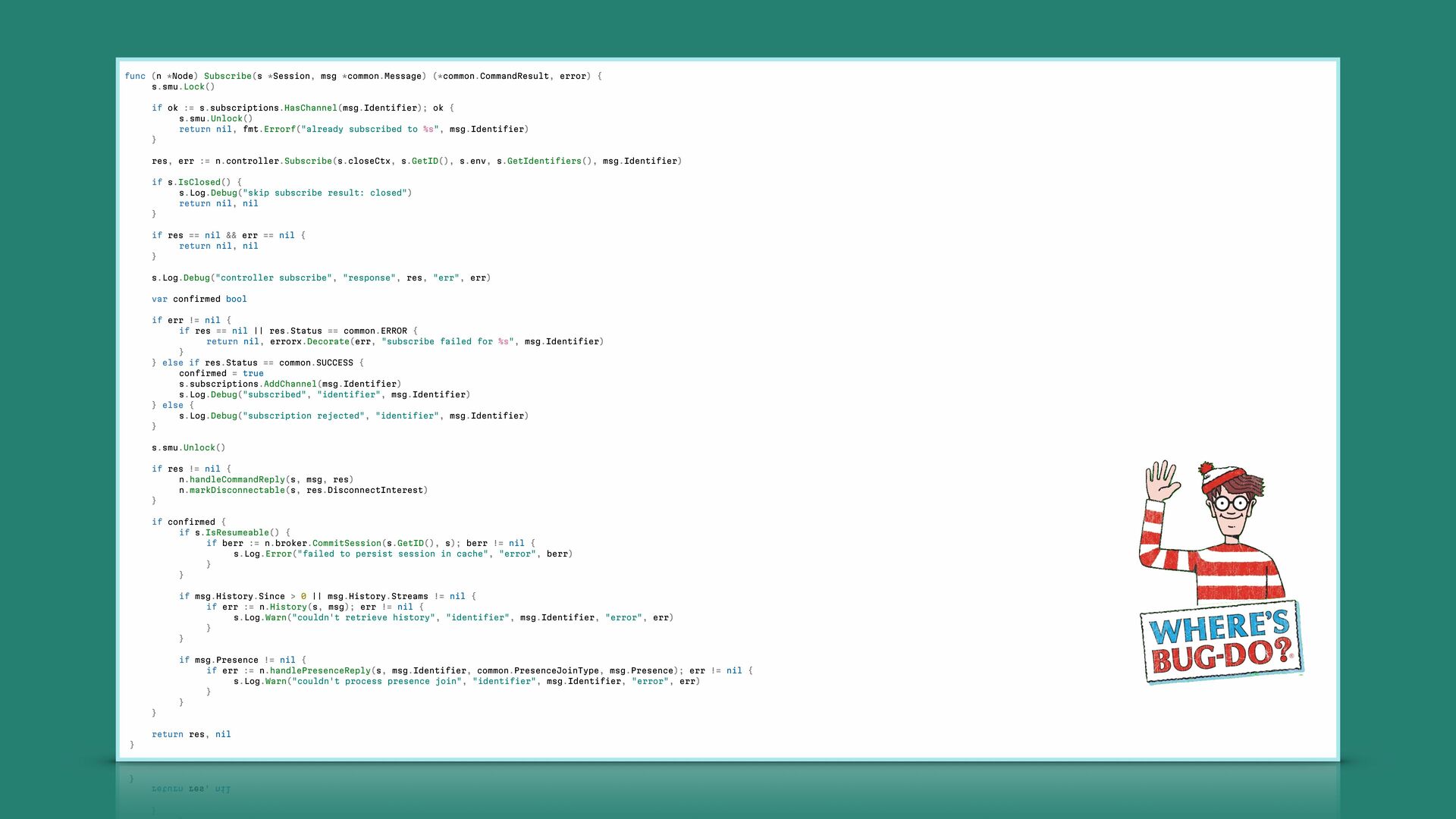
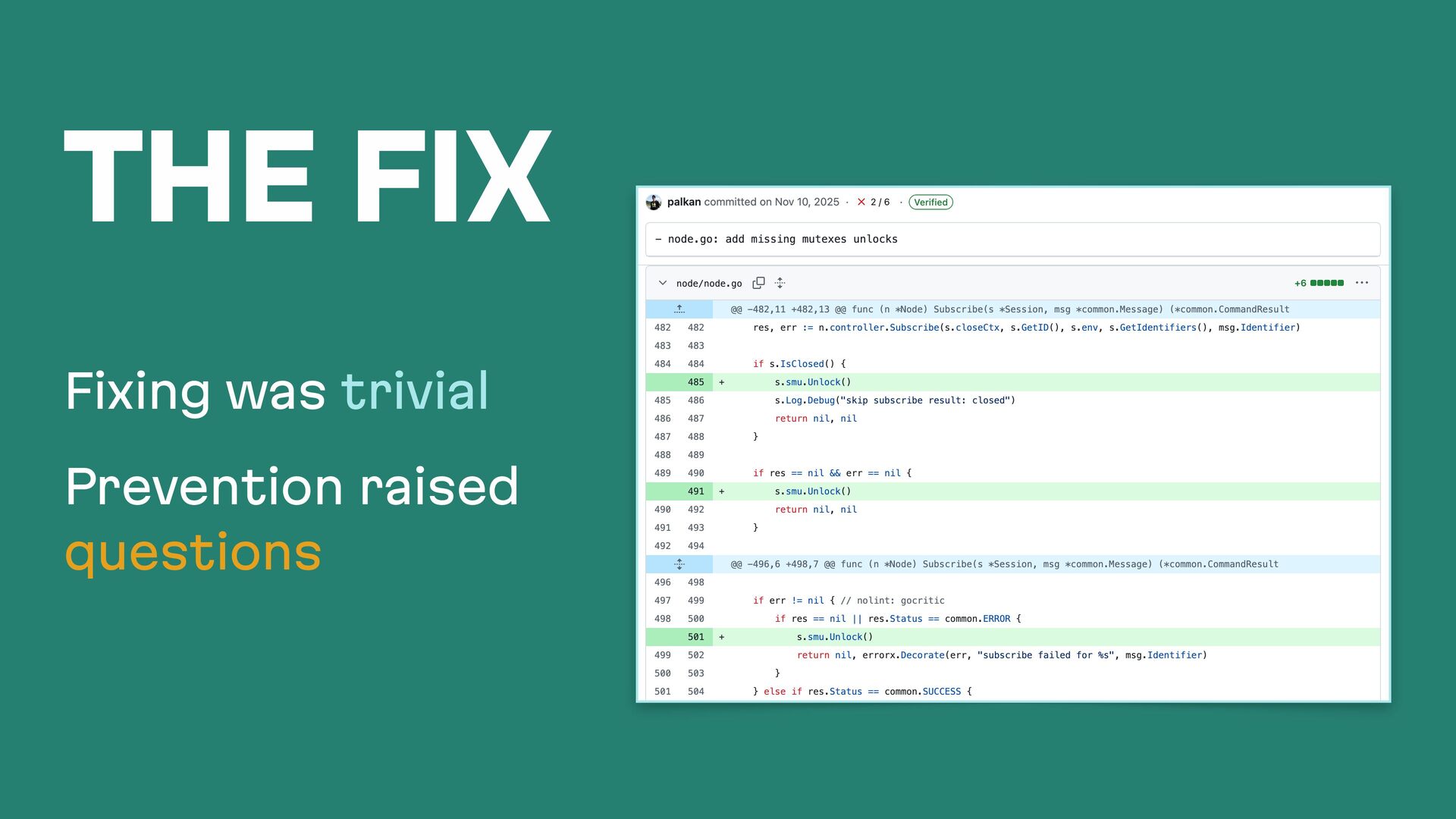
  4. func (n *Node) Subscribe(s *Session, msg *common.Message) (*common.CommandResult, error) {

    s.smu.Lock() if ok := s.subscriptions.HasChannel(msg.Identifier); ok { s.smu.Unlock() return nil, fmt.Errorf("already subscribed to %s", msg.Identifier) } res, err := n.controller.Subscribe(s.closeCtx, s.GetID(), s.env, s.GetIdentifiers(), msg.Identifier) if s.IsClosed() { s.Log.Debug("skip subscribe result: closed") return nil, nil } if res == nil && err == nil { return nil, nil } s.Log.Debug("controller subscribe", "response", res, "err", err) var confirmed bool if err != nil { if res == nil || res.Status == common.ERROR { return nil, errorx.Decorate(err, "subscribe failed for %s", msg.Identifier) } } else if res.Status == common.SUCCESS { confirmed = true s.subscriptions.AddChannel(msg.Identifier) s.Log.Debug("subscribed", "identifier", msg.Identifier) } else { s.Log.Debug("subscription rejected", "identifier", msg.Identifier) } s.smu.Unlock() if res != nil { n.handleCommandReply(s, msg, res) n.markDisconnectable(s, res.DisconnectInterest) } if confirmed { if s.IsResumeable() { if berr := n.broker.CommitSession(s.GetID(), s); berr != nil { s.Log.Error("failed to persist session in cache", "error", berr) } } if msg.History.Since > 0 || msg.History.Streams != nil { if err := n.History(s, msg); err != nil { s.Log.Warn("couldn't retrieve history", "identifier", msg.Identifier, "error", err) } } if msg.Presence != nil { if err := n.handlePresenceReply(s, msg.Identifier, common.PresenceJoinType, msg.Presence); err != nil { s.Log.Warn("couldn't process presence join", "identifier", msg.Identifier, "error", err) } } } return res, nil }
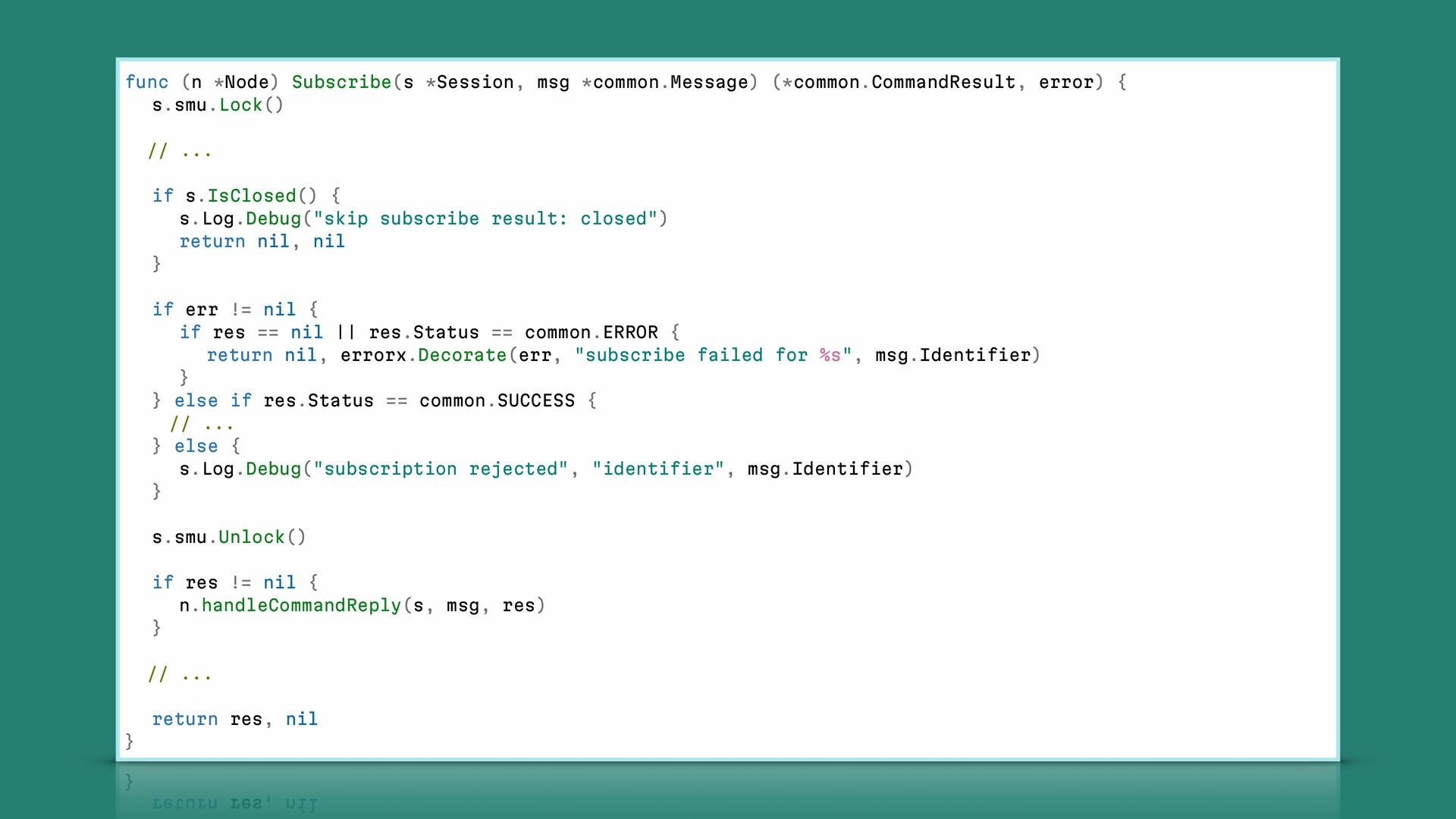
  5. func (n *Node) Subscribe(s *Session, msg *common.Message) (*common.CommandResult, error) {

    s.smu.Lock() // ... if s.IsClosed() { s.Log.Debug("skip subscribe result: closed") return nil, nil } if err != nil { if res == nil || res.Status == common.ERROR { return nil, errorx.Decorate(err, "subscribe failed for %s", msg.Identifier) } } else if res.Status == common.SUCCESS { // ... } else { s.Log.Debug("subscription rejected", "identifier", msg.Identifier) } s.smu.Unlock() if res != nil { n.handleCommandReply(s, msg, res) } // ... return res, nil }
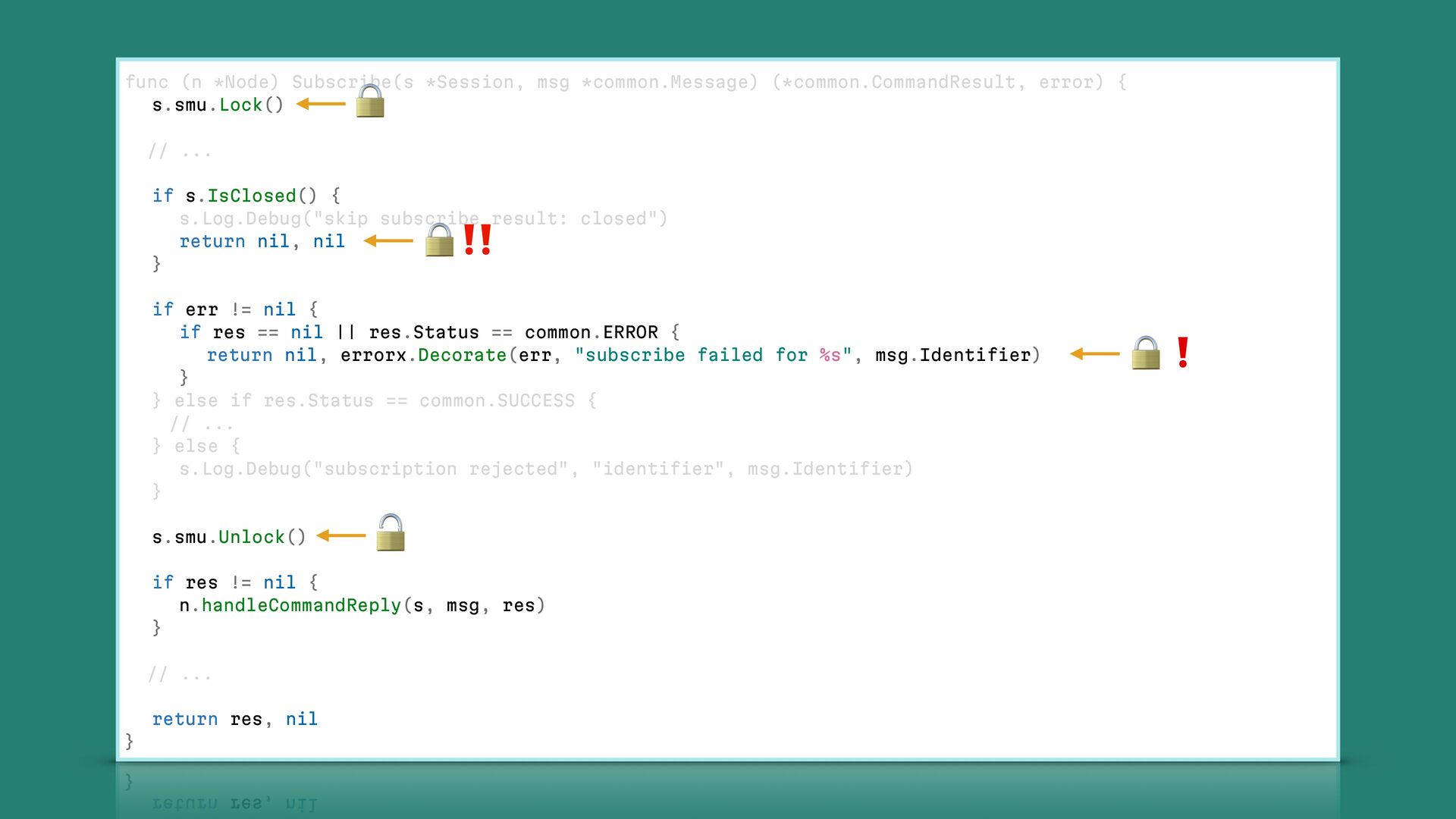
  6. func (n *Node) Subscribe(s *Session, msg *common.Message) (*common.CommandResult, error) {

    s.smu.Lock() & // ... if s.IsClosed() { s.Log.Debug("skip subscribe result: closed") return nil, nil } &‼ if err != nil { if res == nil || res.Status == common.ERROR { return nil, errorx.Decorate(err, "subscribe failed for %s", msg.Identifier) } } else if res.Status == common.SUCCESS { // ... } else { s.Log.Debug("subscription rejected", "identifier", msg.Identifier) } s.smu.Unlock() ' if res != nil { n.handleCommandReply(s, msg, res) } // ... return res, nil } &❗
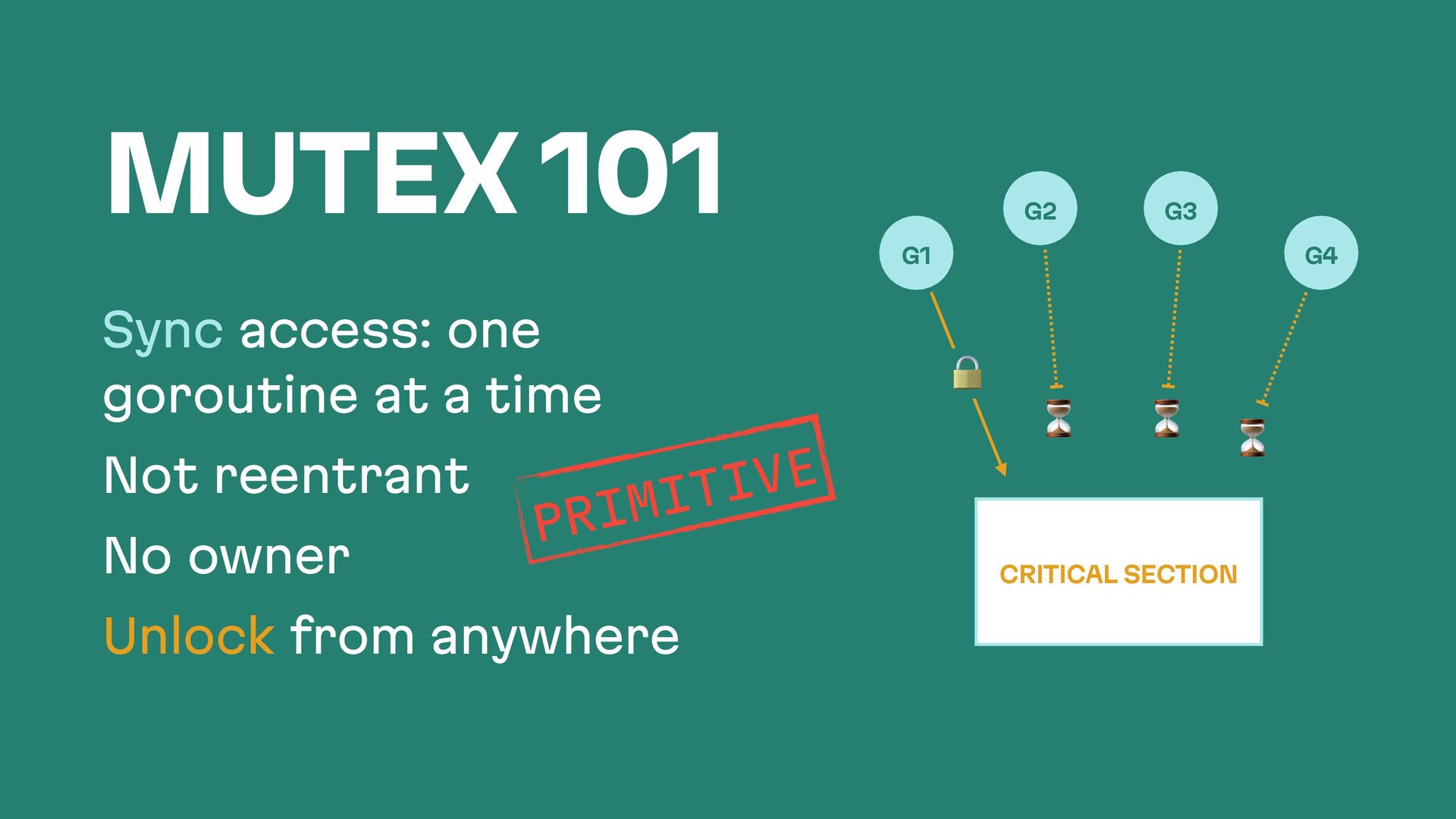
  7. MUTEX 101 G2 G3 G4 G1 Sync access: one goroutine

    at a time Not reentrant No owner & E V I T I ⏳ ⏳ ⏳ M I PR Unlock from anywhere CRITICAL SECTION
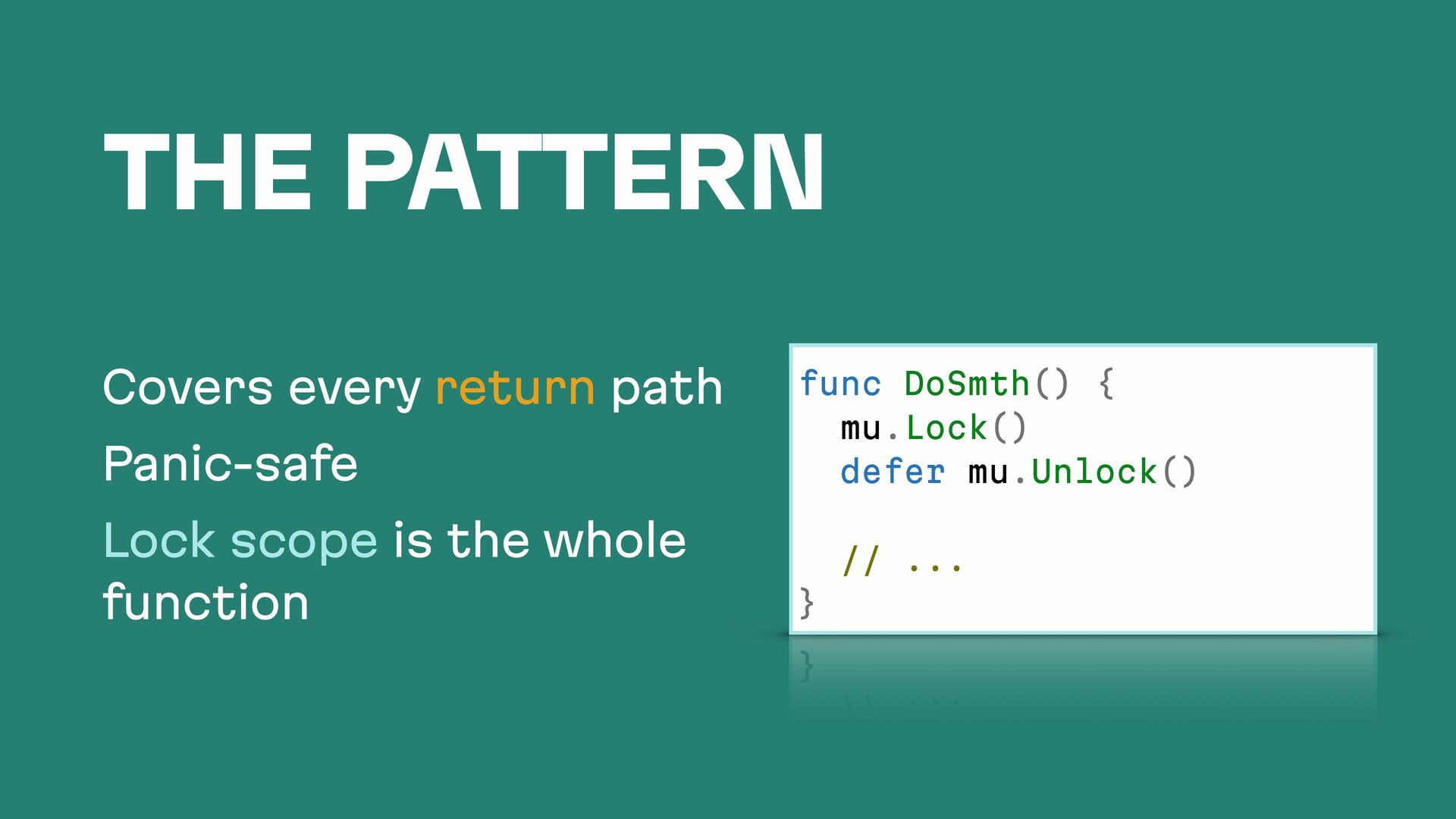
  8. THE PATTERN Covers every return path Panic-safe Lock scope is

    the whole function func DoSmth() { mu.Lock() defer mu.Unlock() // ... }
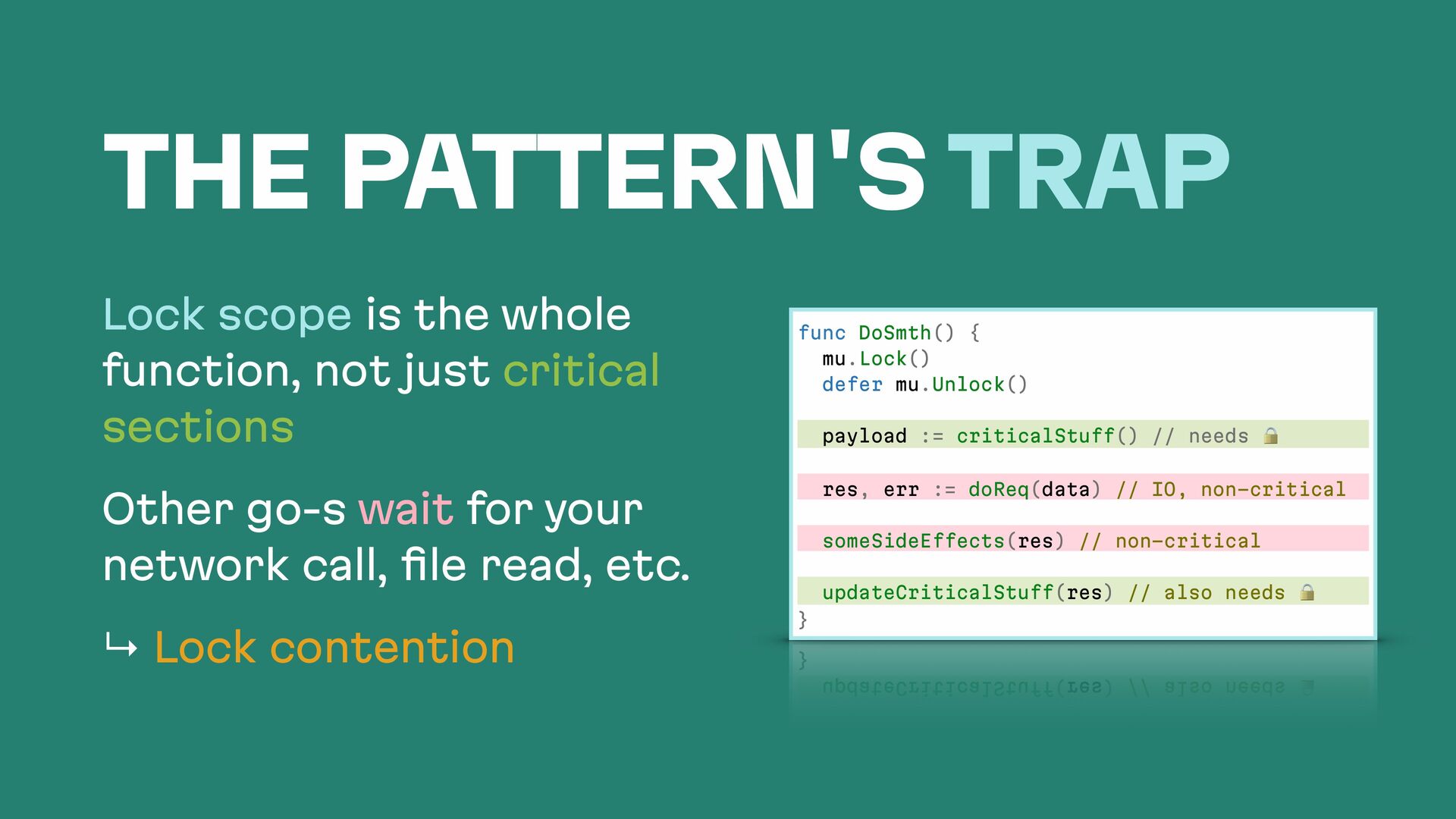
  9. THE PATTERN 'S TRAP Lock scope is the whole function,

    not just critical sections func DoSmth() { mu.Lock() defer mu.Unlock() payload := criticalStuff() // needs & res, err := doReq(data) // IO, non-critical Other go-s wait for your network call, file read, etc. ↳ Lock contention someSideEffects(res) // non-critical updateCriticalStuff(res) // also needs & }
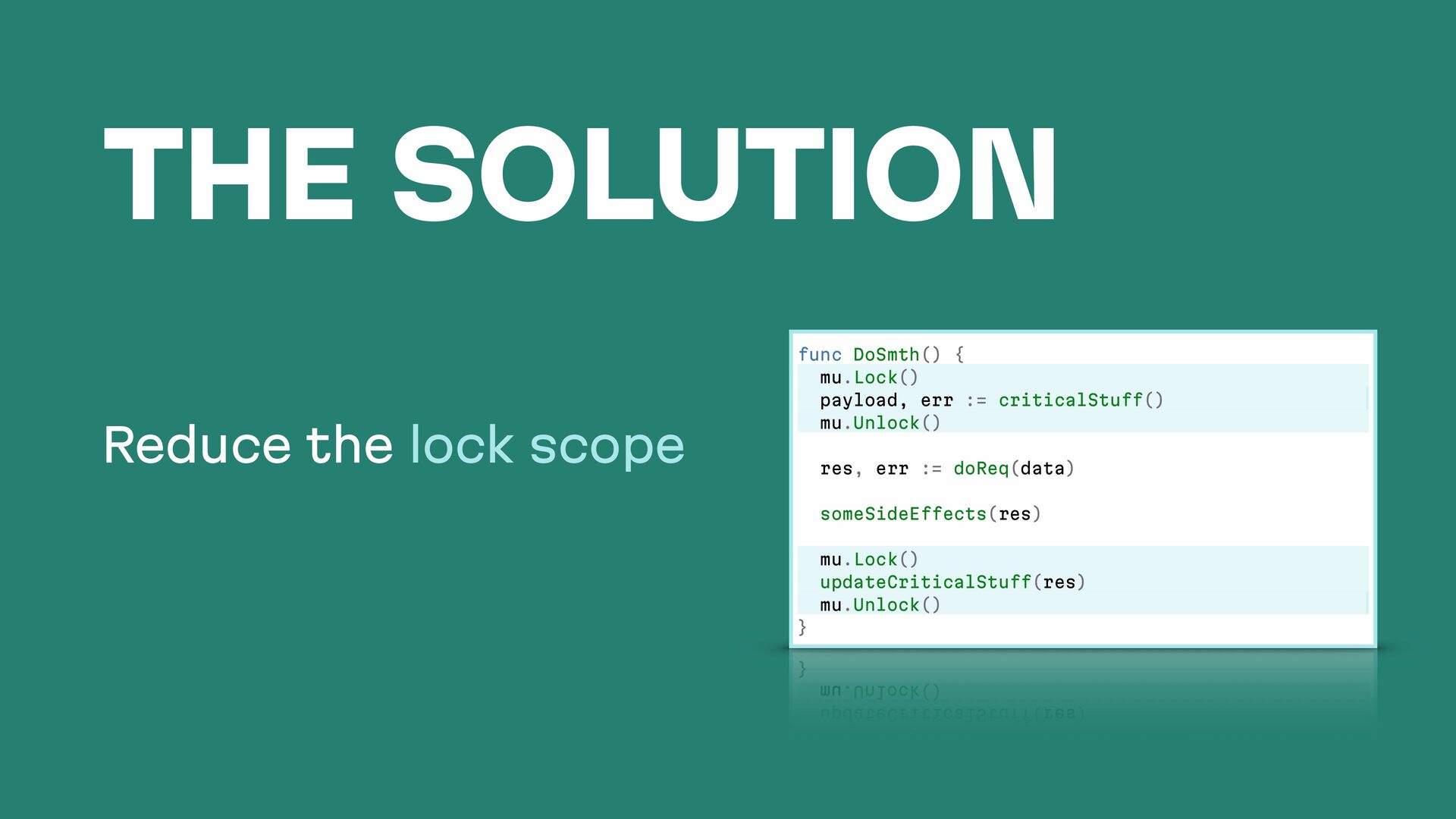
  10. THE SOLUTION Reduce the lock scope func DoSmth() { mu.Lock()

    payload, err := criticalStuff() mu.Unlock() res, err := doReq(data) someSideEffects(res) mu.Lock() updateCriticalStuff(res) mu.Unlock() }
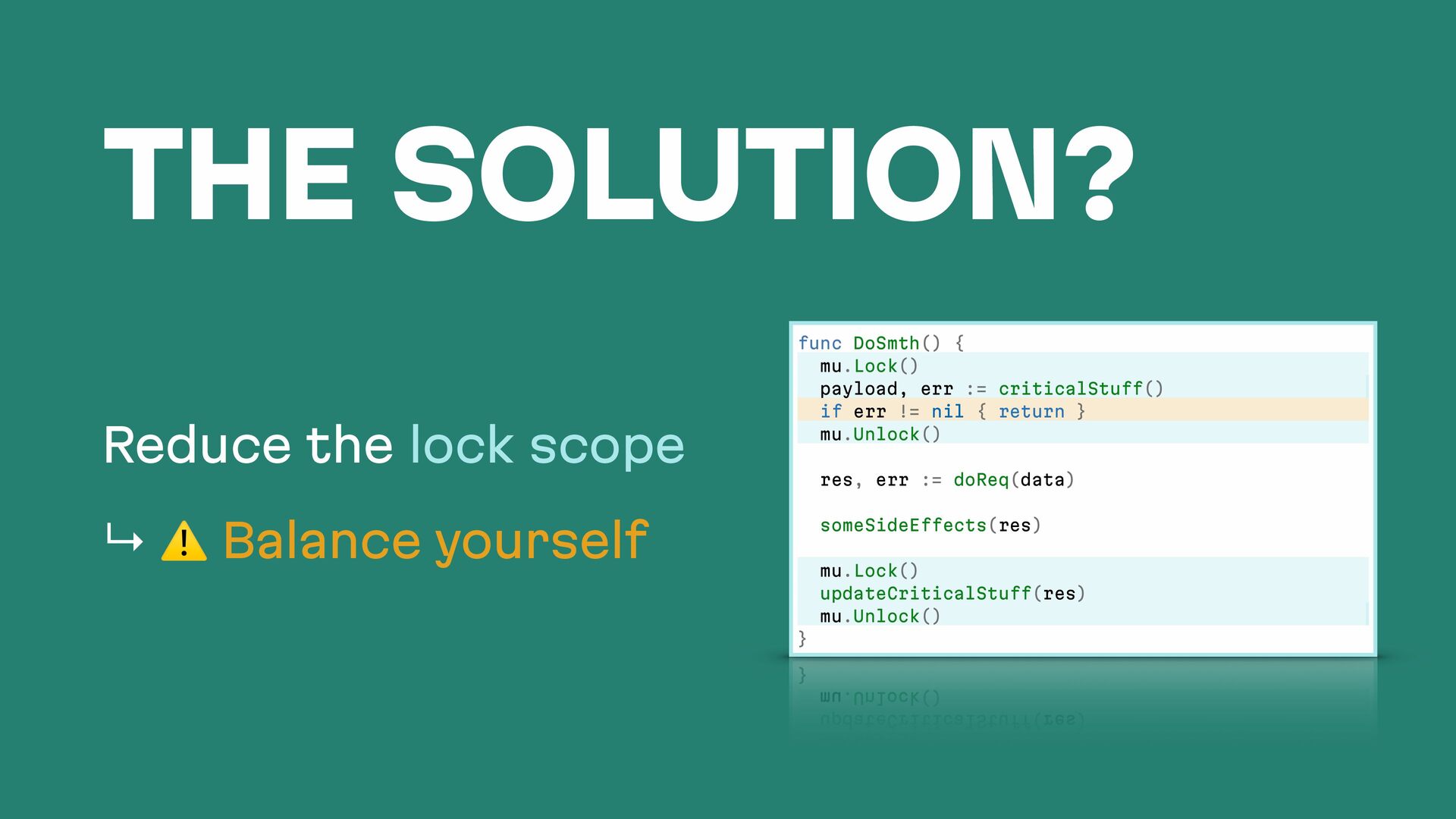
  11. THE SOLUTION? Reduce the lock scope func DoSmth() { mu.Lock()

    payload, err := criticalStuff() if err != nil { return } mu.Unlock() res, err := doReq(data) ↳ ⚠ Balance yourself someSideEffects(res) mu.Lock() updateCriticalStuff(res) mu.Unlock() }
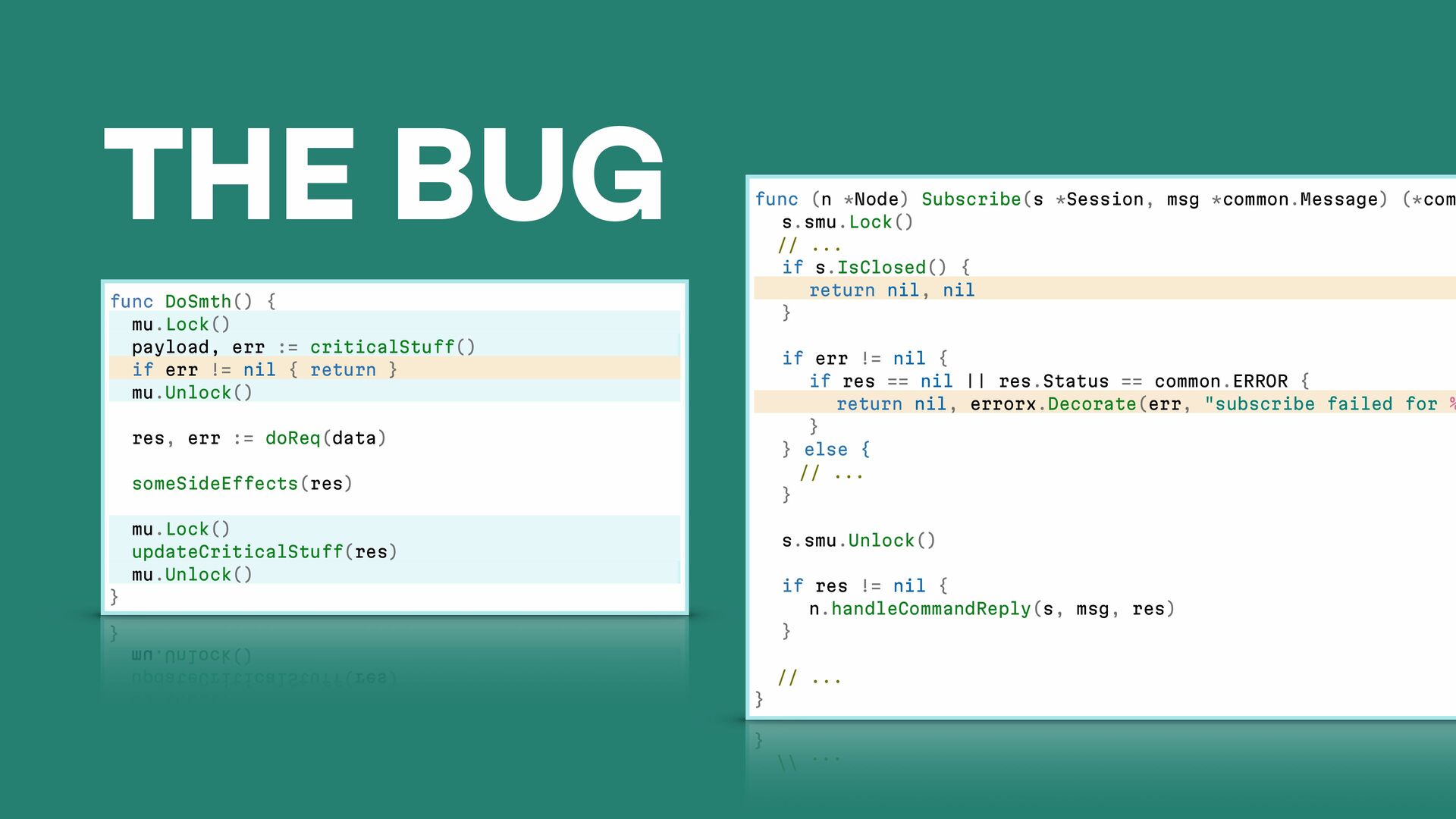
  12. THE BUG func DoSmth() { mu.Lock() payload, err := criticalStuff()

    if err != nil { return } mu.Unlock() func (n *Node) Subscribe(s *Session, msg *common.Message) (*com s.smu.Lock() // ... if s.IsClosed() { return nil, nil } if err != nil { if res == nil || res.Status == common.ERROR { return nil, errorx.Decorate(err, "subscribe failed for % } } else { // ... } res, err := doReq(data) someSideEffects(res) mu.Lock() updateCriticalStuff(res) mu.Unlock() s.smu.Unlock() if res != nil { n.handleCommandReply(s, msg, res) } } // ... }
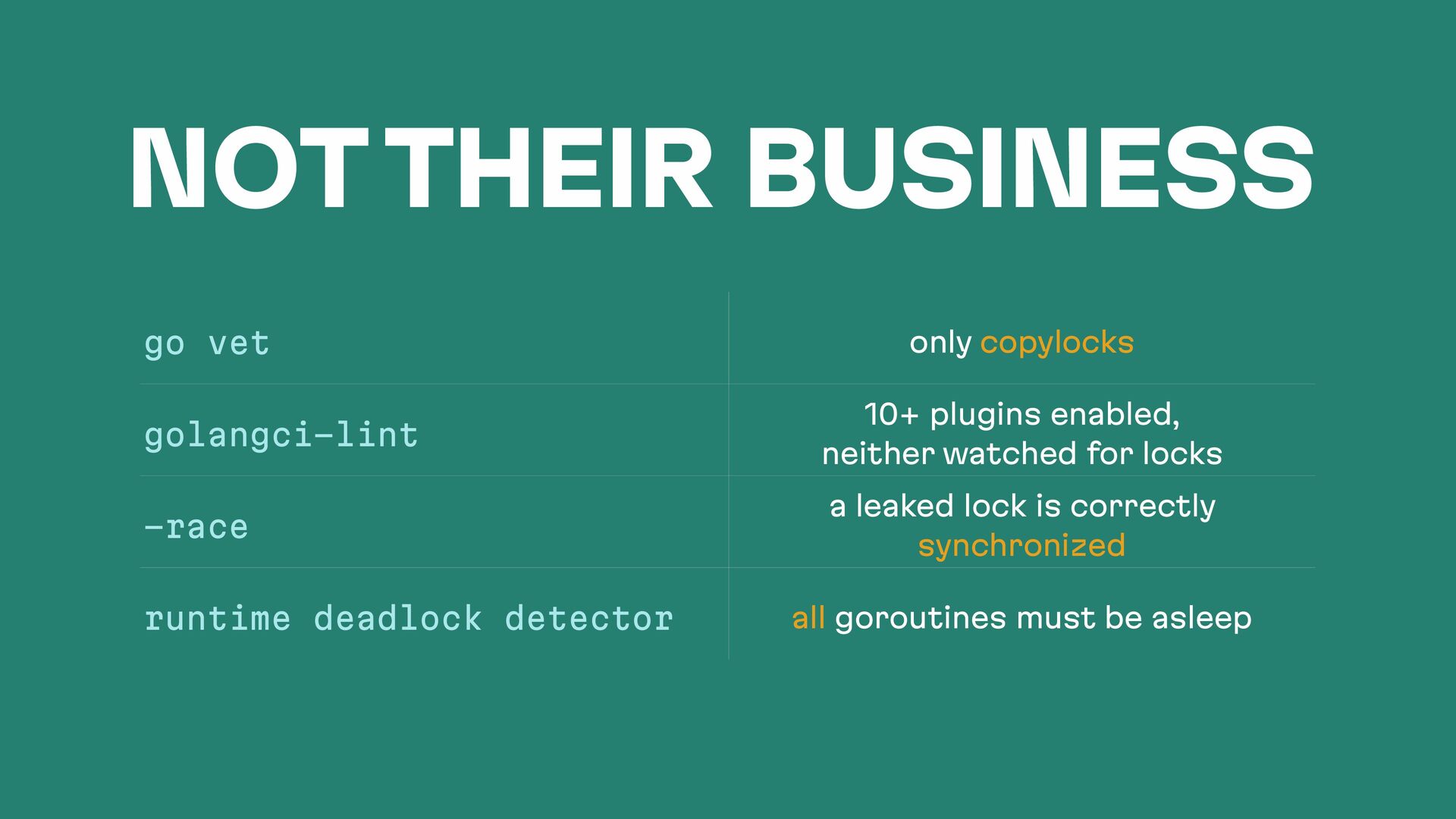
  13. NOT THEIR BUSINESS go vet only copylocks golangci-lint 10+ plugins

    enabled, neither watched for locks -race a leaked lock is correctly synchronized runtime deadlock detector all goroutines must be asleep
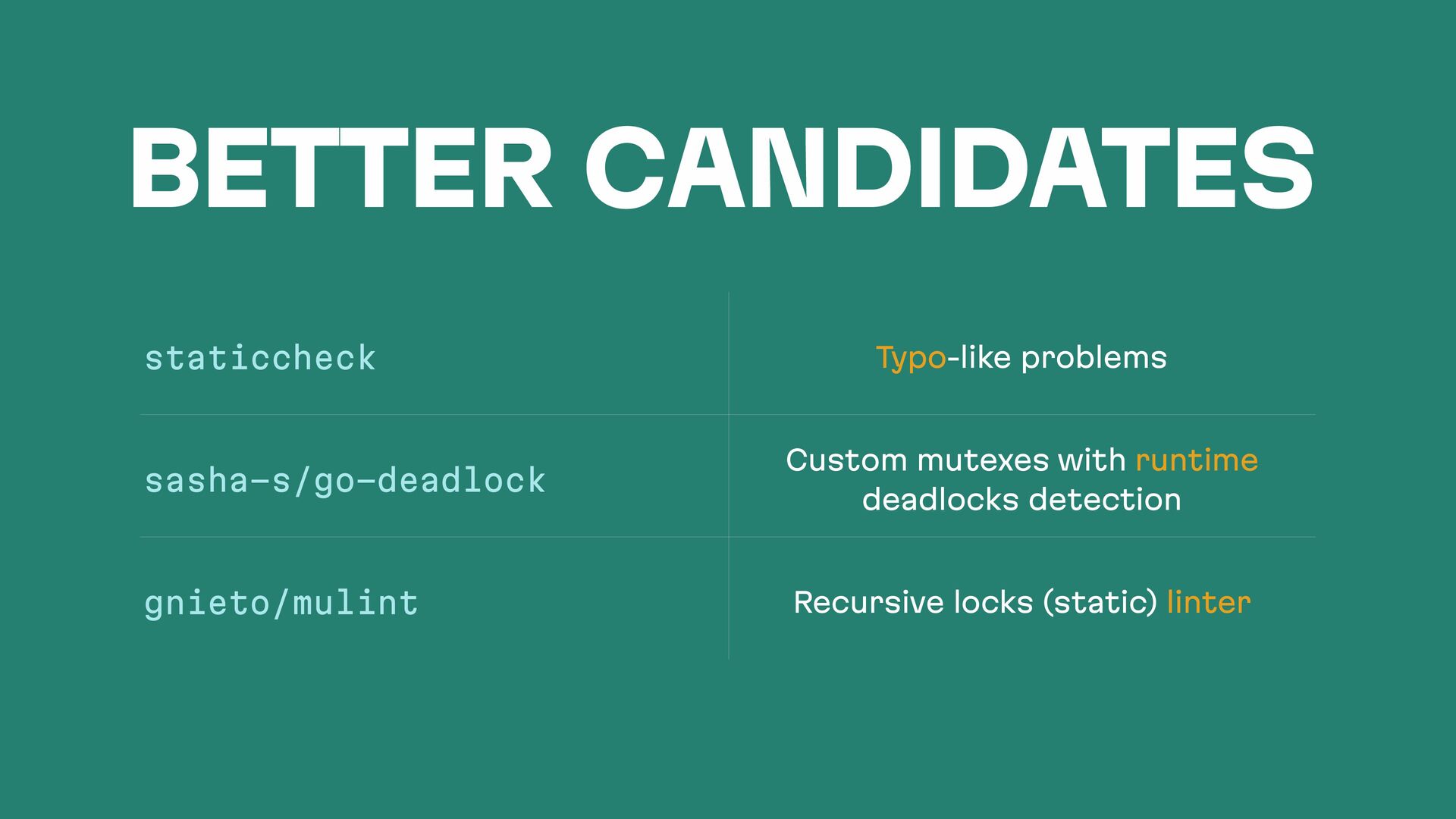
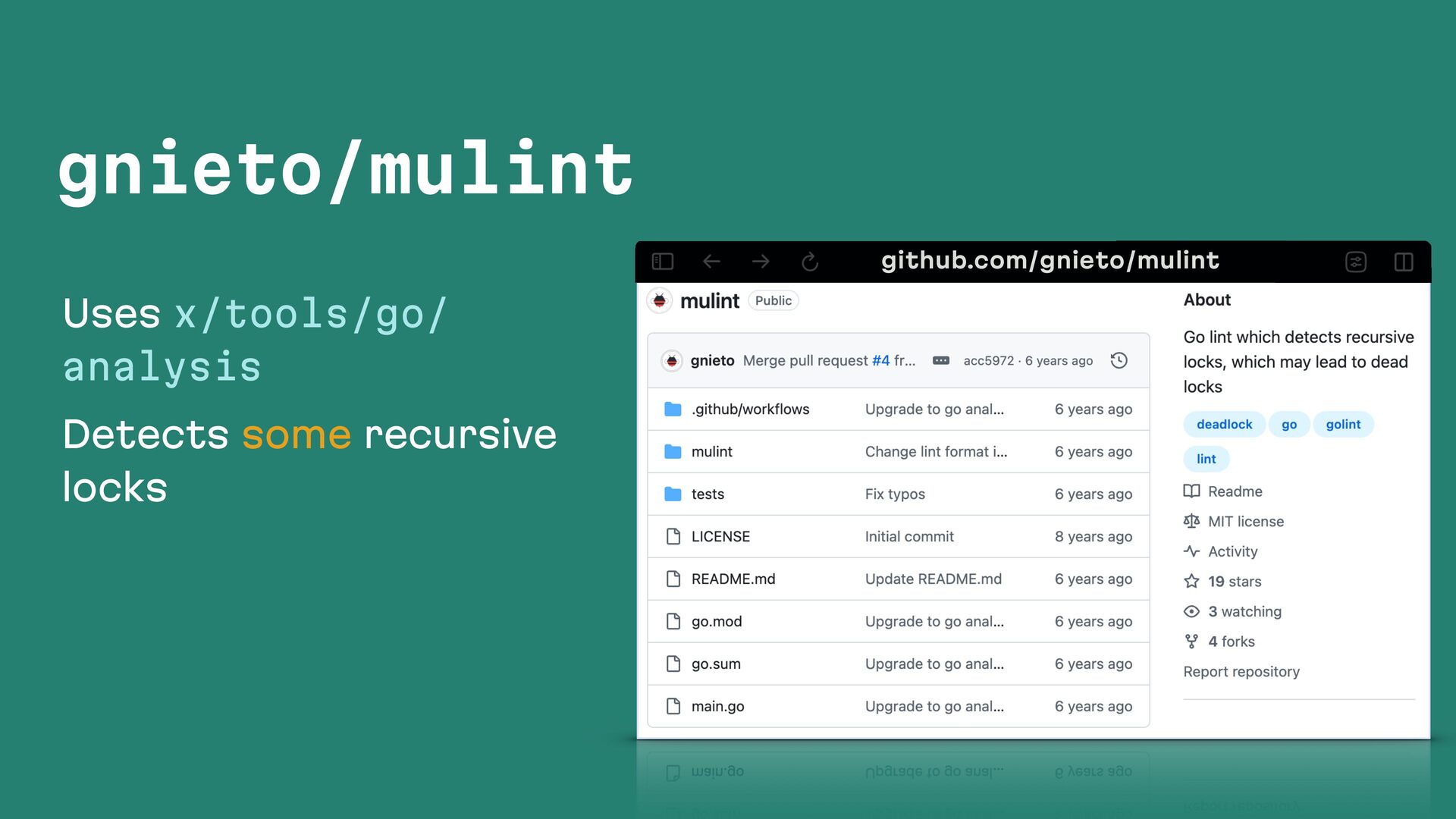
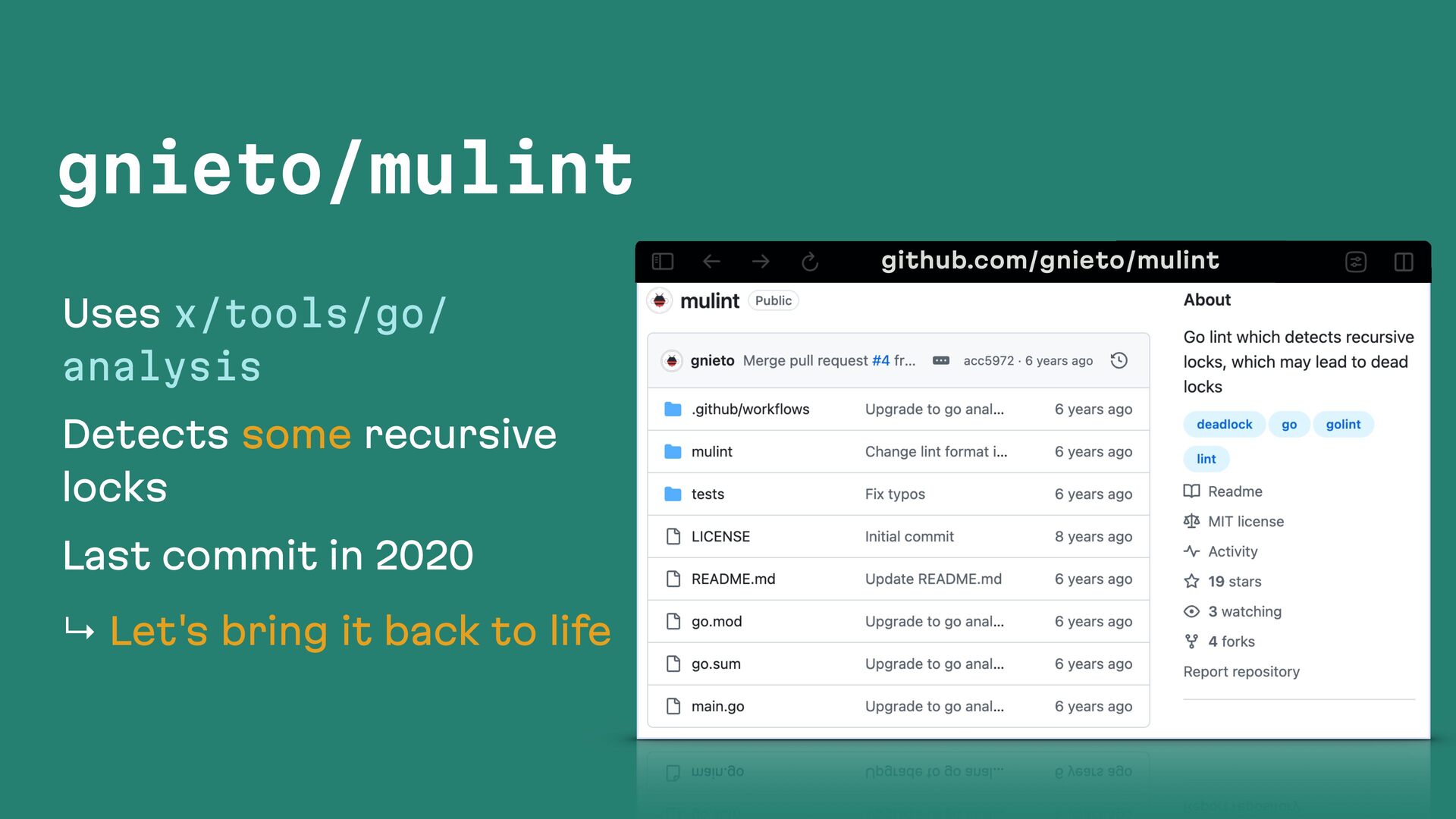
  14. BETTER CANDIDATES staticcheck Typo-like problems sasha-s/go-deadlock Custom mutexes with runtime

    deadlocks detection gnieto/mulint Recursive locks (static) linter
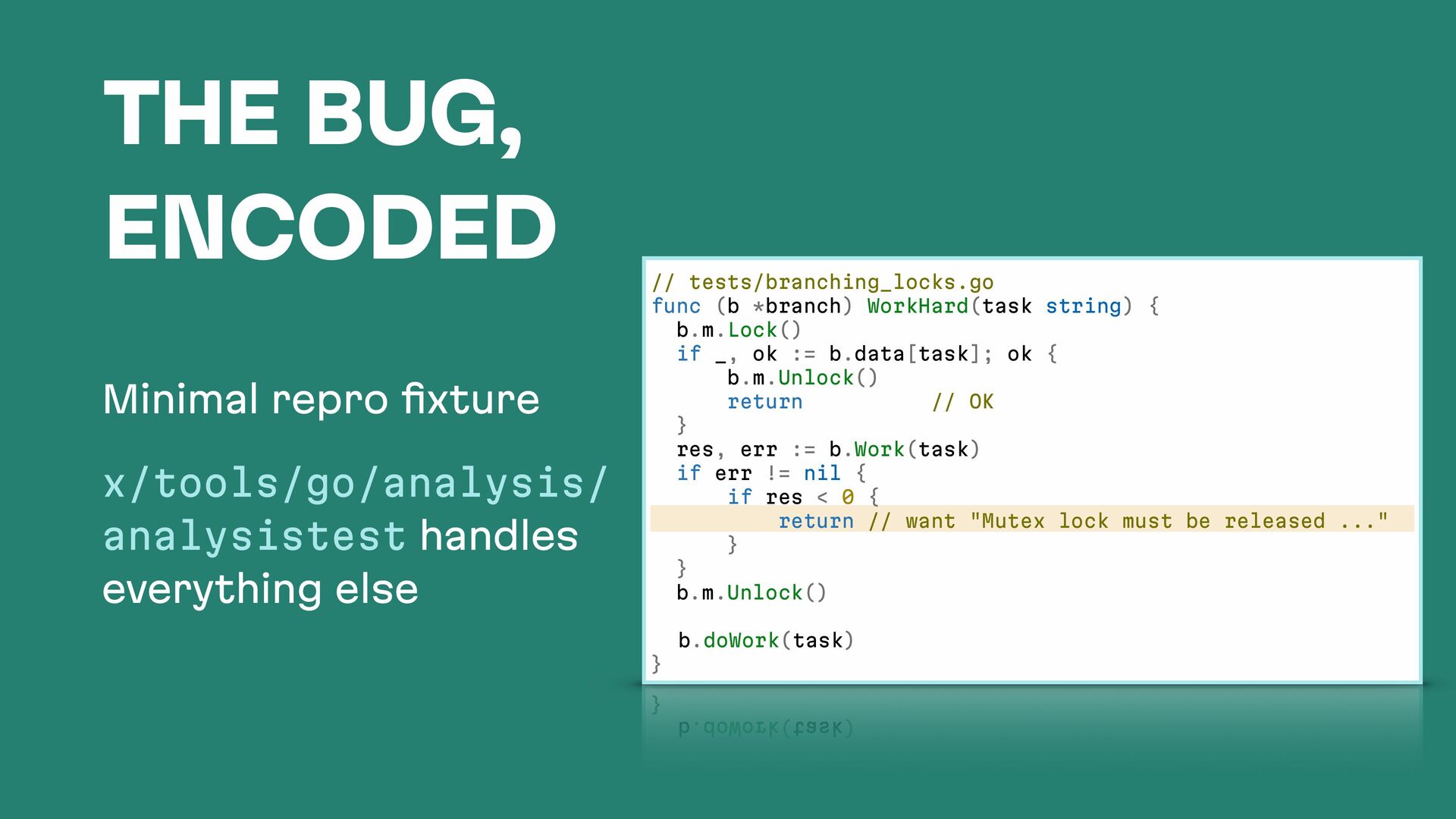
  15. THE BUG, ENCODED Minimal repro fixture x/tools/go/analysis/ analysistest handles everything

    else // tests/branching_locks.go func (b *branch) WorkHard(task string) { b.m.Lock() if _, ok := b.data[task]; ok { b.m.Unlock() return // OK } res, err := b.Work(task) if err != nil { if res < 0 { return // want "Mutex lock must be released ..." } } b.m.Unlock() b.doWork(task) }
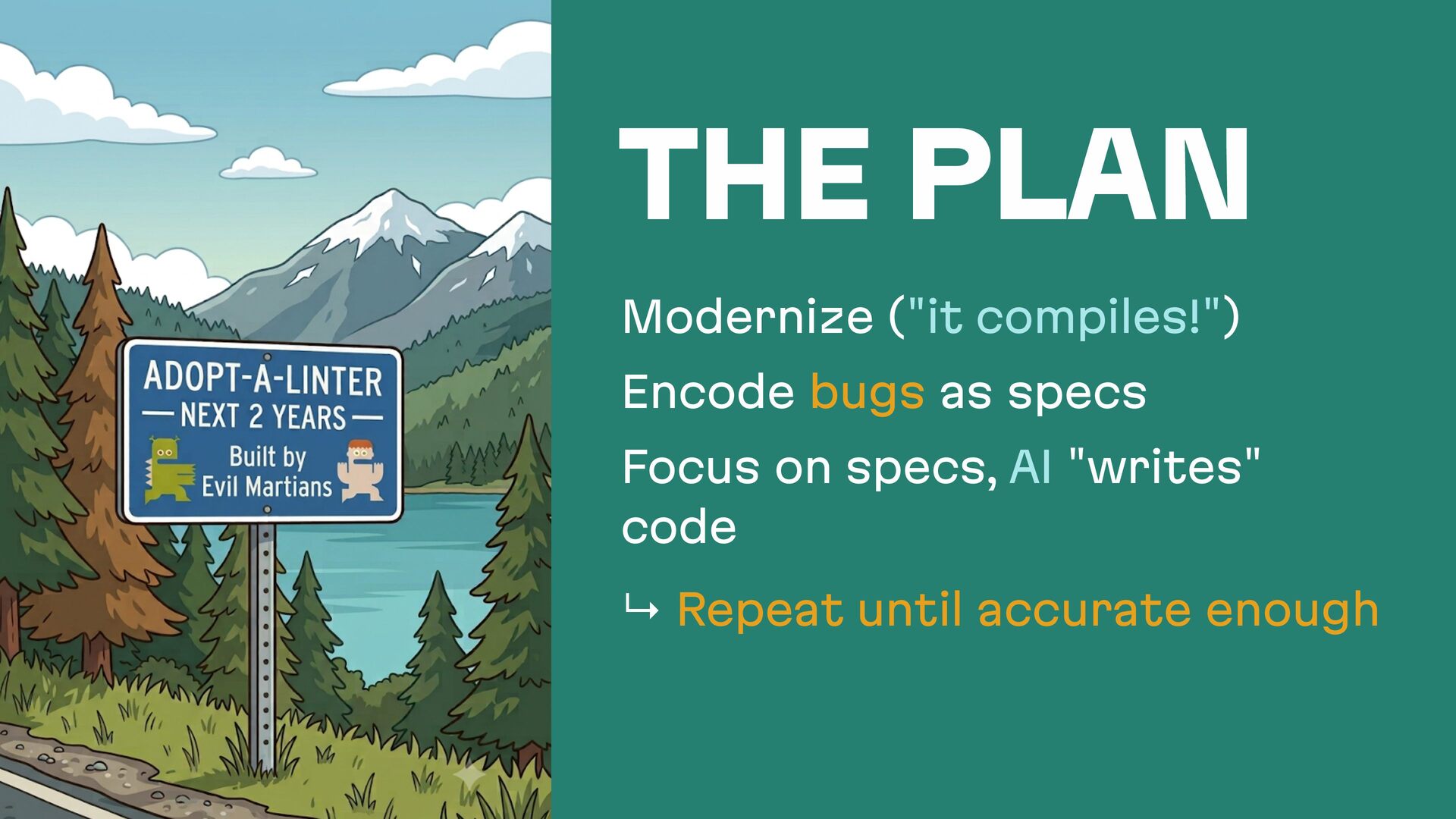
  16. THE PLAN Modernize ("it compiles!") Encode bugs as specs Focus

    on specs, AI "writes" code ↳ Repeat until accurate enough
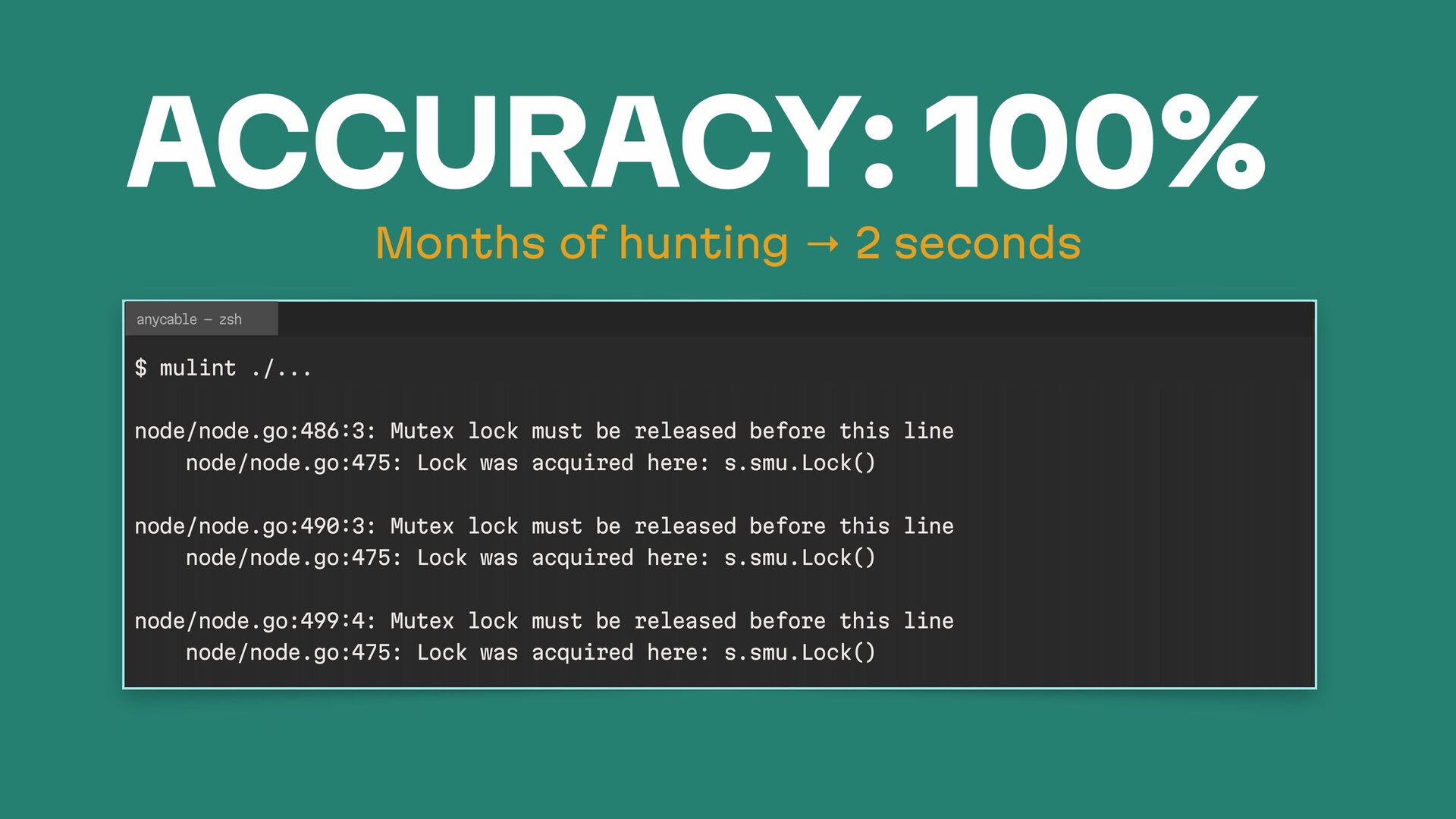
  17. ACCURACY: 100% Months of hunting → 2 seconds anycable —

    zsh $ mulint ./... node/node.go:486:3: Mutex lock must be released before this line node/node.go:475: Lock was acquired here: s.smu.Lock() node/node.go:490:3: Mutex lock must be released before this line node/node.go:475: Lock was acquired here: s.smu.Lock() node/node.go:499:4: Mutex lock must be released before this line node/node.go:475: Lock was acquired here: s.smu.Lock()
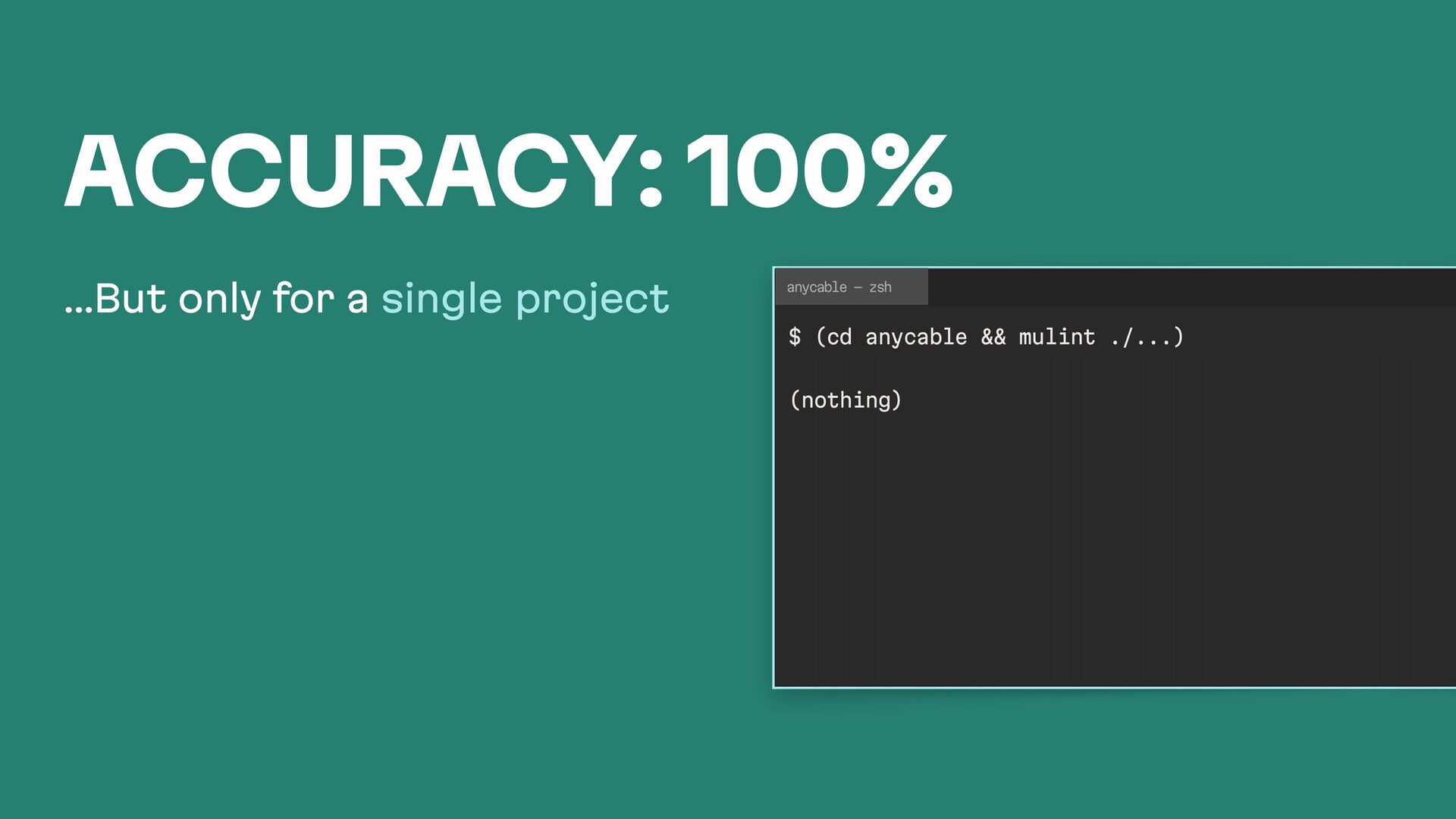
  18. ACCURACY: 100% ...But only for a single project anycable —

    zsh $ (cd anycable && mulint ./...) (nothing)
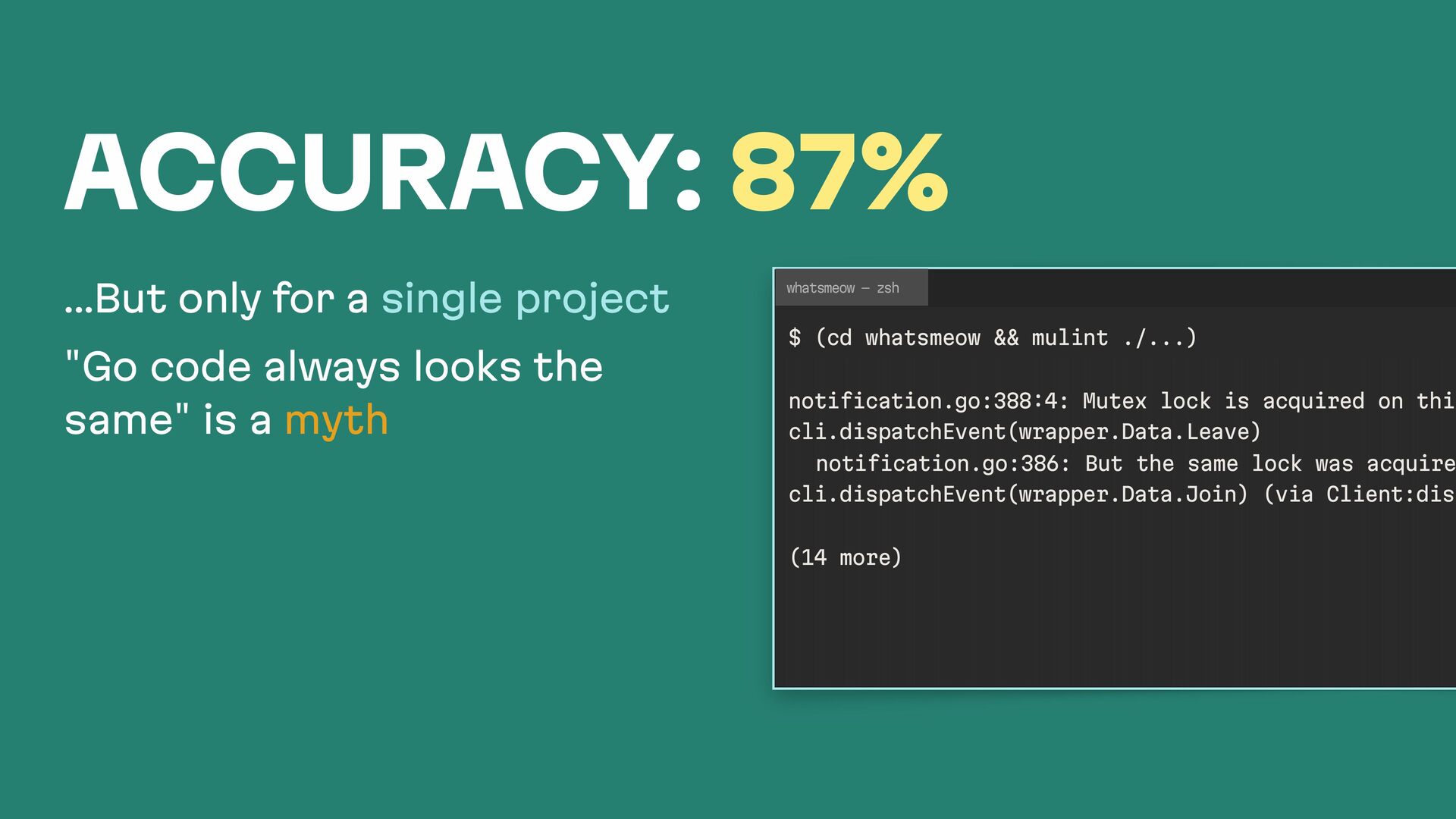
  19. ACCURACY: 87% ...But only for a single project "Go code

    always looks the same" is a myth whatsmeow — zsh $ (cd whatsmeow && mulint ./...) notification.go:388:4: Mutex lock is acquired on this cli.dispatchEvent(wrapper.Data.Leave) notification.go:386: But the same lock was acquire cli.dispatchEvent(wrapper.Data.Join) (via Client:disp (14 more)
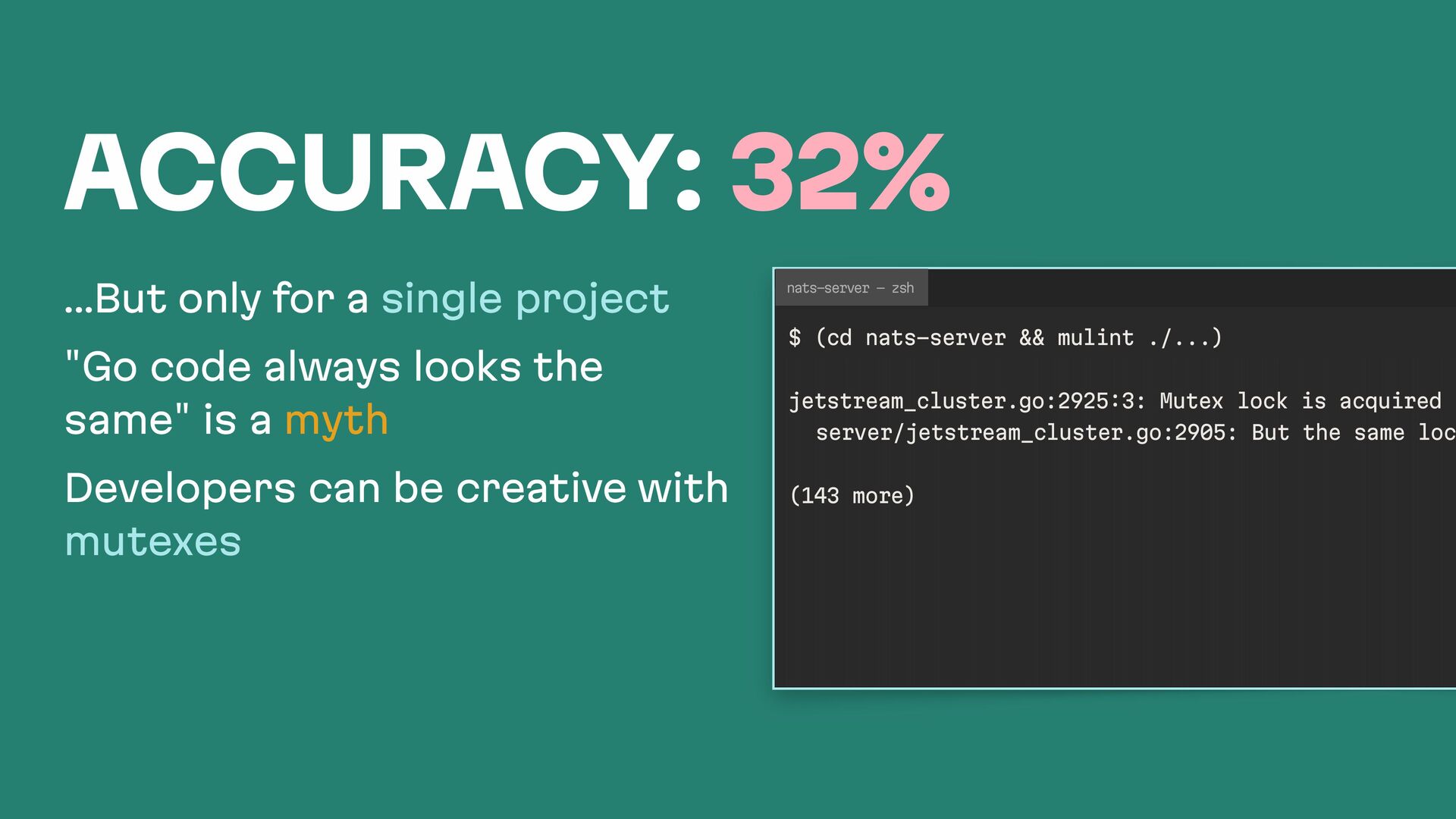
  20. ACCURACY: 32% ...But only for a single project "Go code

    always looks the same" is a myth Developers can be creative with mutexes nats-server — zsh $ (cd nats-server && mulint ./...) jetstream_cluster.go:2925:3: Mutex lock is acquired o server/jetstream_cluster.go:2905: But the same loc (143 more)
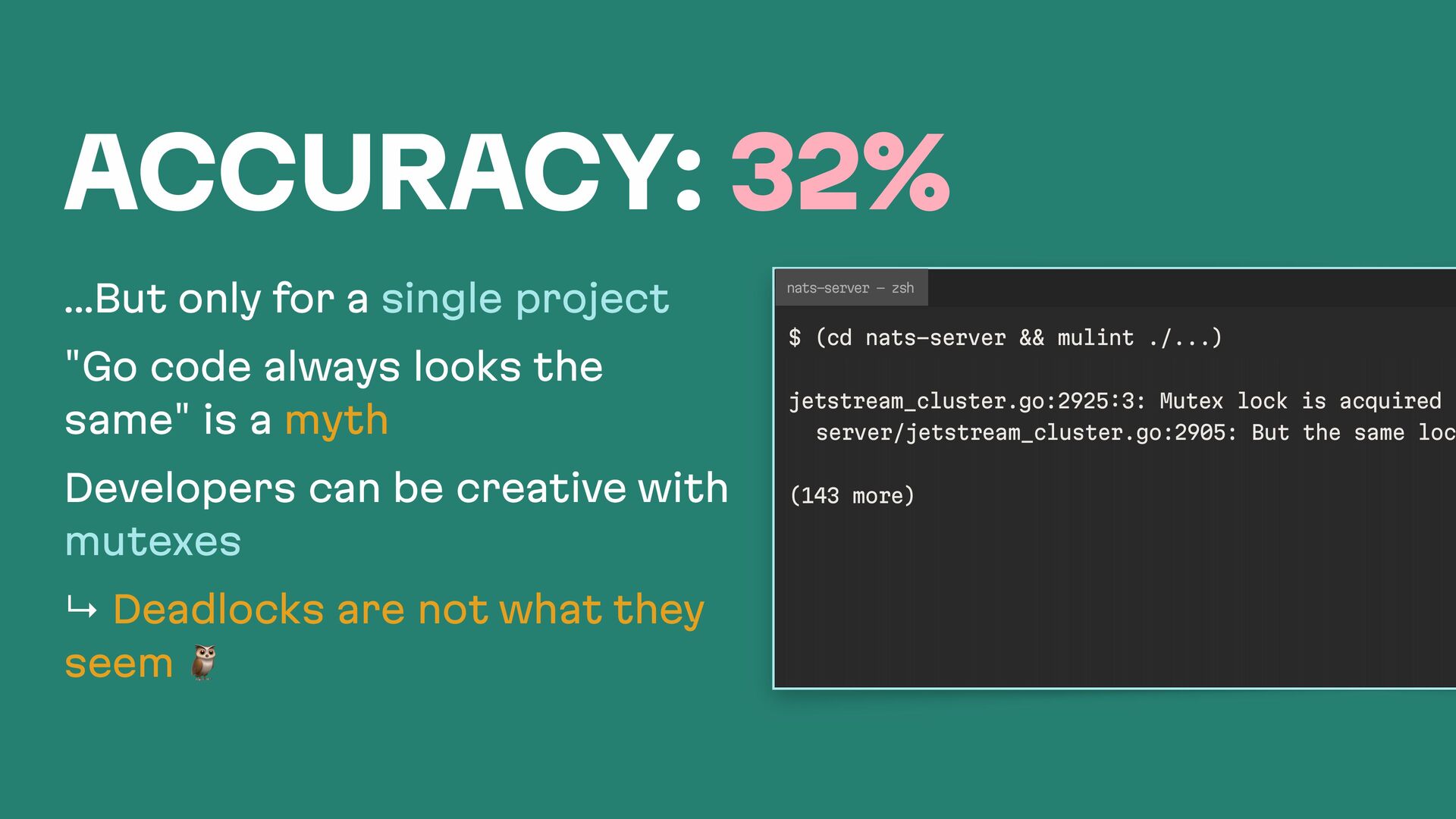
  21. ACCURACY: 32% ...But only for a single project "Go code

    always looks the same" is a myth Developers can be creative with mutexes ↳ Deadlocks are not what they seem , nats-server — zsh $ (cd nats-server && mulint ./...) jetstream_cluster.go:2925:3: Mutex lock is acquired o server/jetstream_cluster.go:2905: But the same loc (143 more)
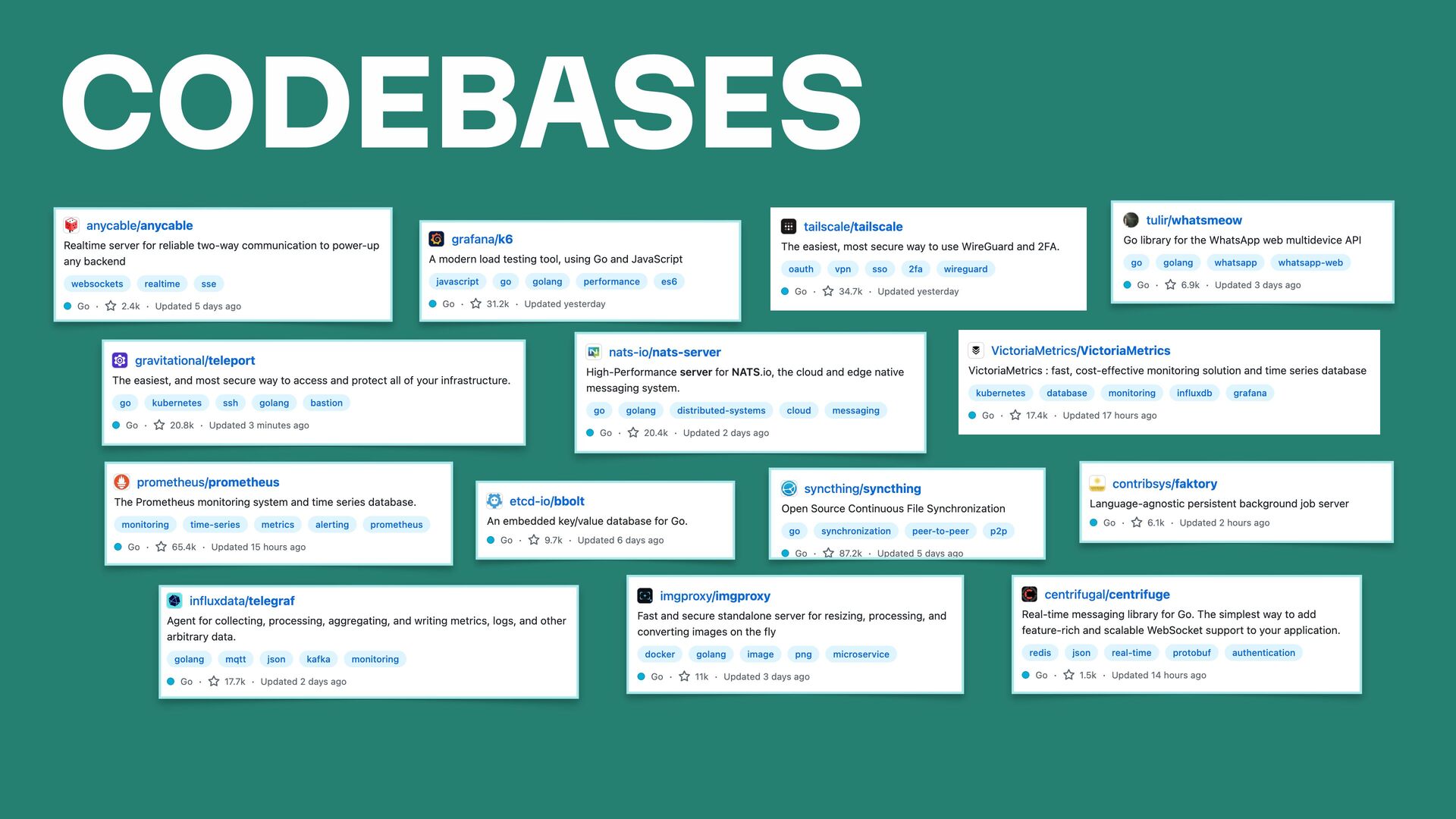
  22. THE PLAN, V2 Pick good codebases Encode false positives as

    specs Fix the linter ↳ Learn new patterns!
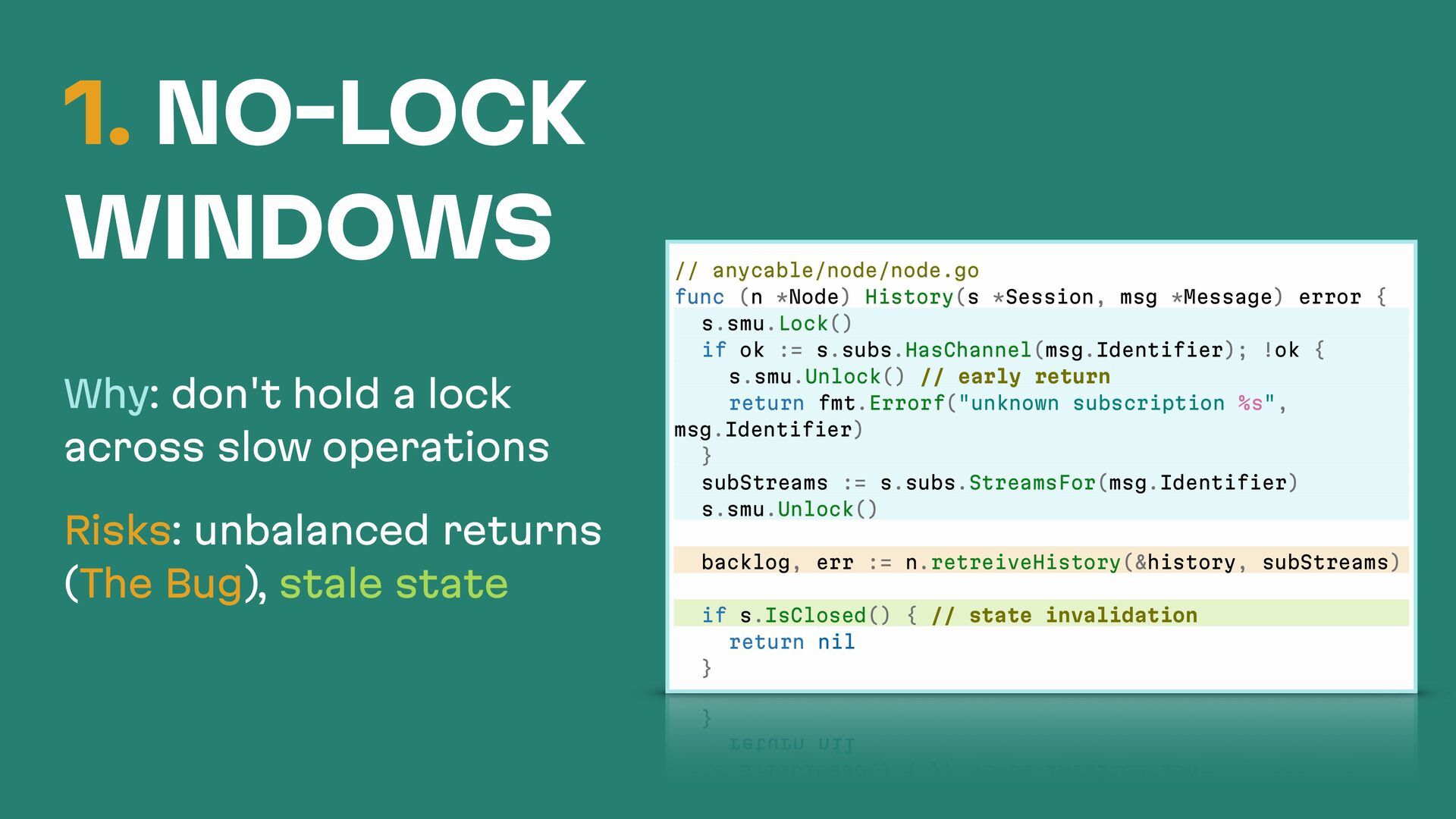
  23. 1. NO-LOCK WINDOWS Why: don't hold a lock across slow

    operations Risks: unbalanced returns (The Bug), stale state // anycable/node/node.go func (n *Node) History(s *Session, msg *Message) error { s.smu.Lock() if ok := s.subs.HasChannel(msg.Identifier); !ok { s.smu.Unlock() // early return return fmt.Errorf("unknown subscription %s", msg.Identifier) } subStreams := s.subs.StreamsFor(msg.Identifier) s.smu.Unlock() backlog, err := n.retreiveHistory(&history, subStreams) if s.IsClosed() { // state invalidation return nil }
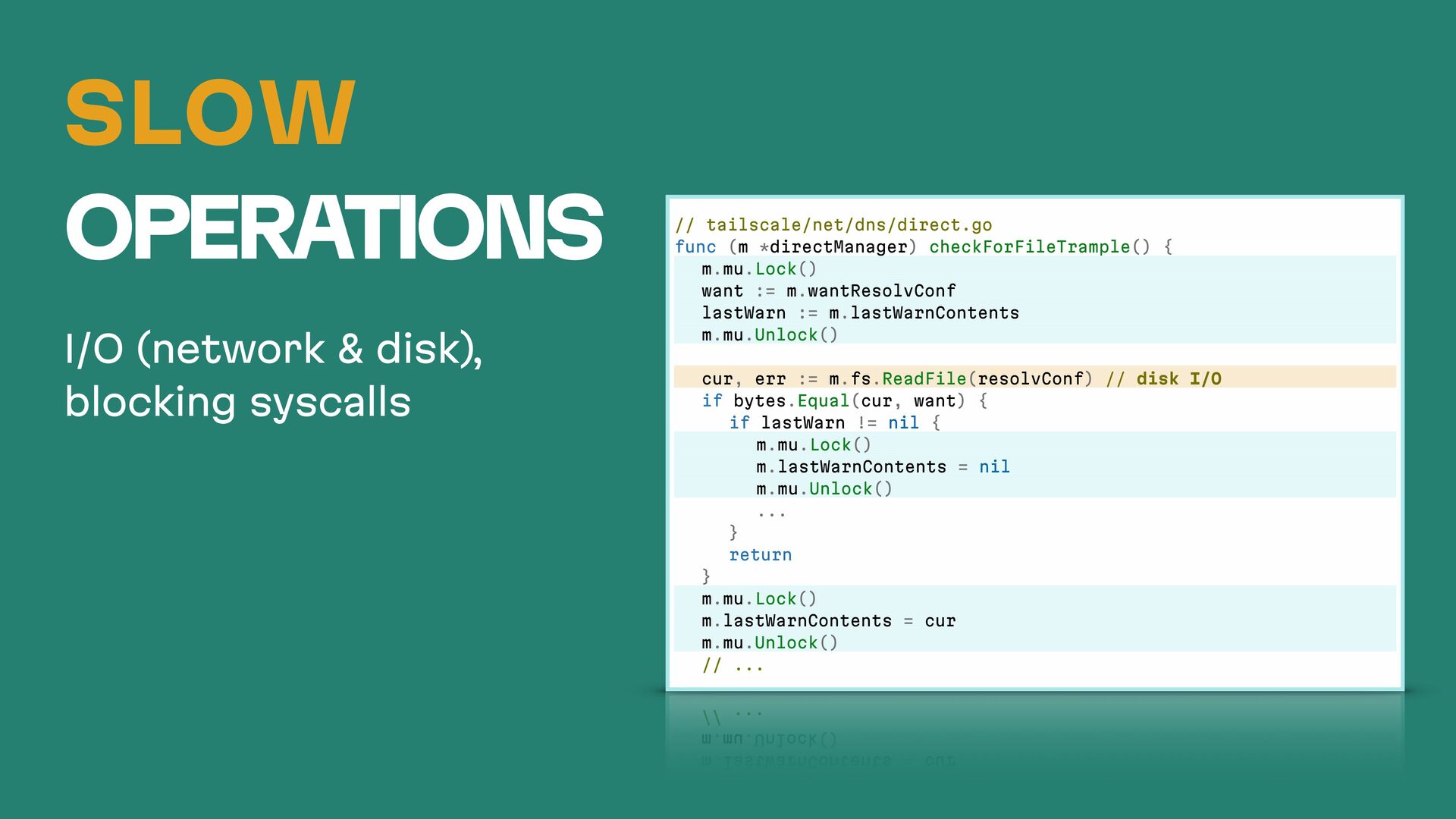
  24. SLOW OPERATIONS I/O (network & disk), blocking syscalls // tailscale/net/dns/direct.go

    func (m *directManager) checkForFileTrample() { m.mu.Lock() want := m.wantResolvConf lastWarn := m.lastWarnContents m.mu.Unlock() cur, err := m.fs.ReadFile(resolvConf) // disk I/O if bytes.Equal(cur, want) { if lastWarn != nil { m.mu.Lock() m.lastWarnContents = nil m.mu.Unlock() ... } return } m.mu.Lock() m.lastWarnContents = cur m.mu.Unlock() // ...
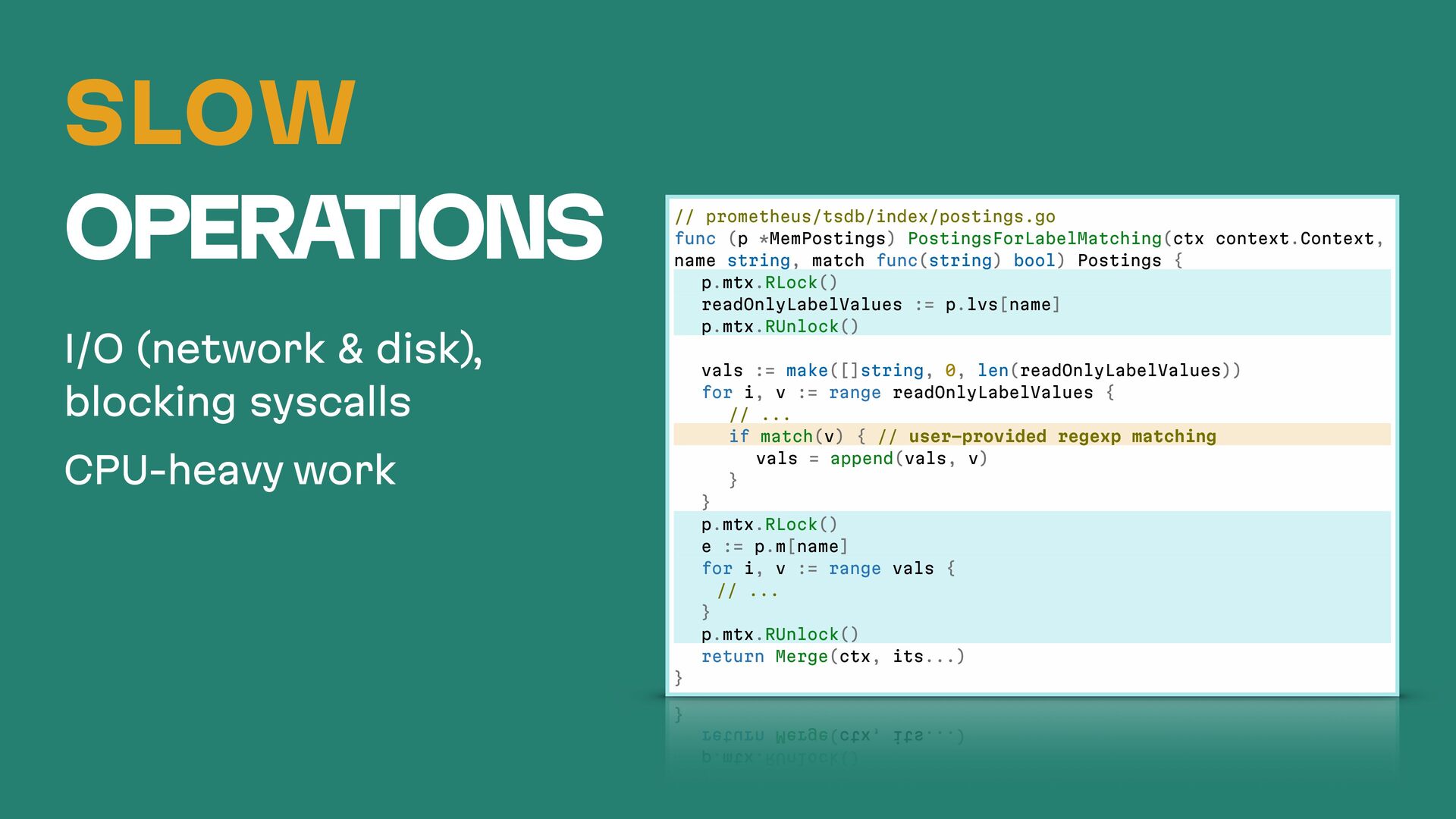
  25. SLOW OPERATIONS I/O (network & disk), blocking syscalls // prometheus/tsdb/index/postings.go

    func (p *MemPostings) PostingsForLabelMatching(ctx context.Context, name string, match func(string) bool) Postings { p.mtx.RLock() readOnlyLabelValues := p.lvs[name] p.mtx.RUnlock() vals := make([]string, 0, len(readOnlyLabelValues)) for i, v := range readOnlyLabelValues { // ... if match(v) { // user-provided regexp matching vals = append(vals, v) } } p.mtx.RLock() e := p.m[name] for i, v := range vals { // ... } p.mtx.RUnlock() return Merge(ctx, its...) CPU-heavy work }
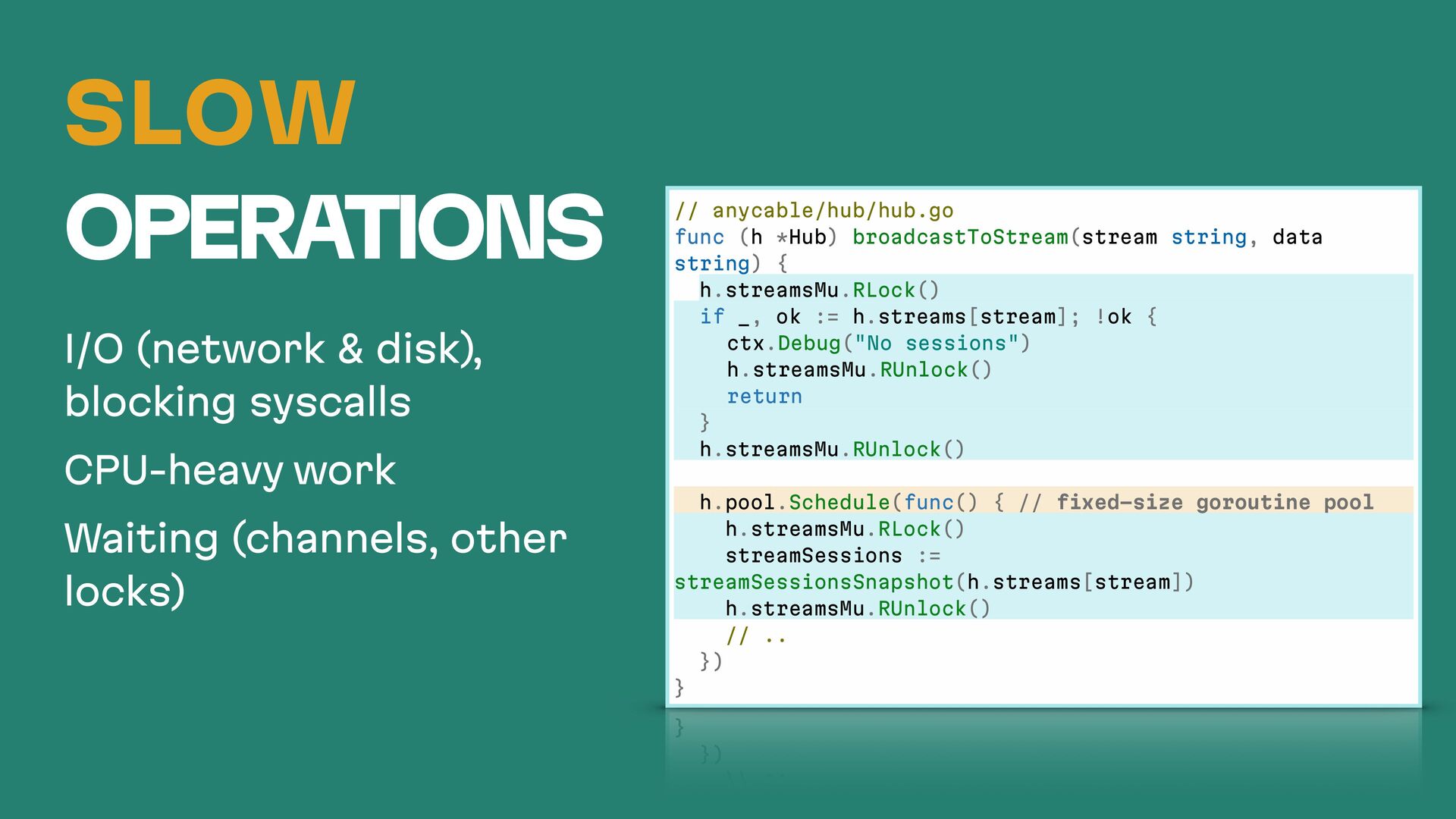
  26. SLOW OPERATIONS I/O (network & disk), blocking syscalls CPU-heavy work

    Waiting (channels, other locks) // anycable/hub/hub.go func (h *Hub) broadcastToStream(stream string, data string) { h.streamsMu.RLock() if _, ok := h.streams[stream]; !ok { ctx.Debug("No sessions") h.streamsMu.RUnlock() return } h.streamsMu.RUnlock() h.pool.Schedule(func() { // fixed-size goroutine pool h.streamsMu.RLock() streamSessions := streamSessionsSnapshot(h.streams[stream]) h.streamsMu.RUnlock() // .. }) }
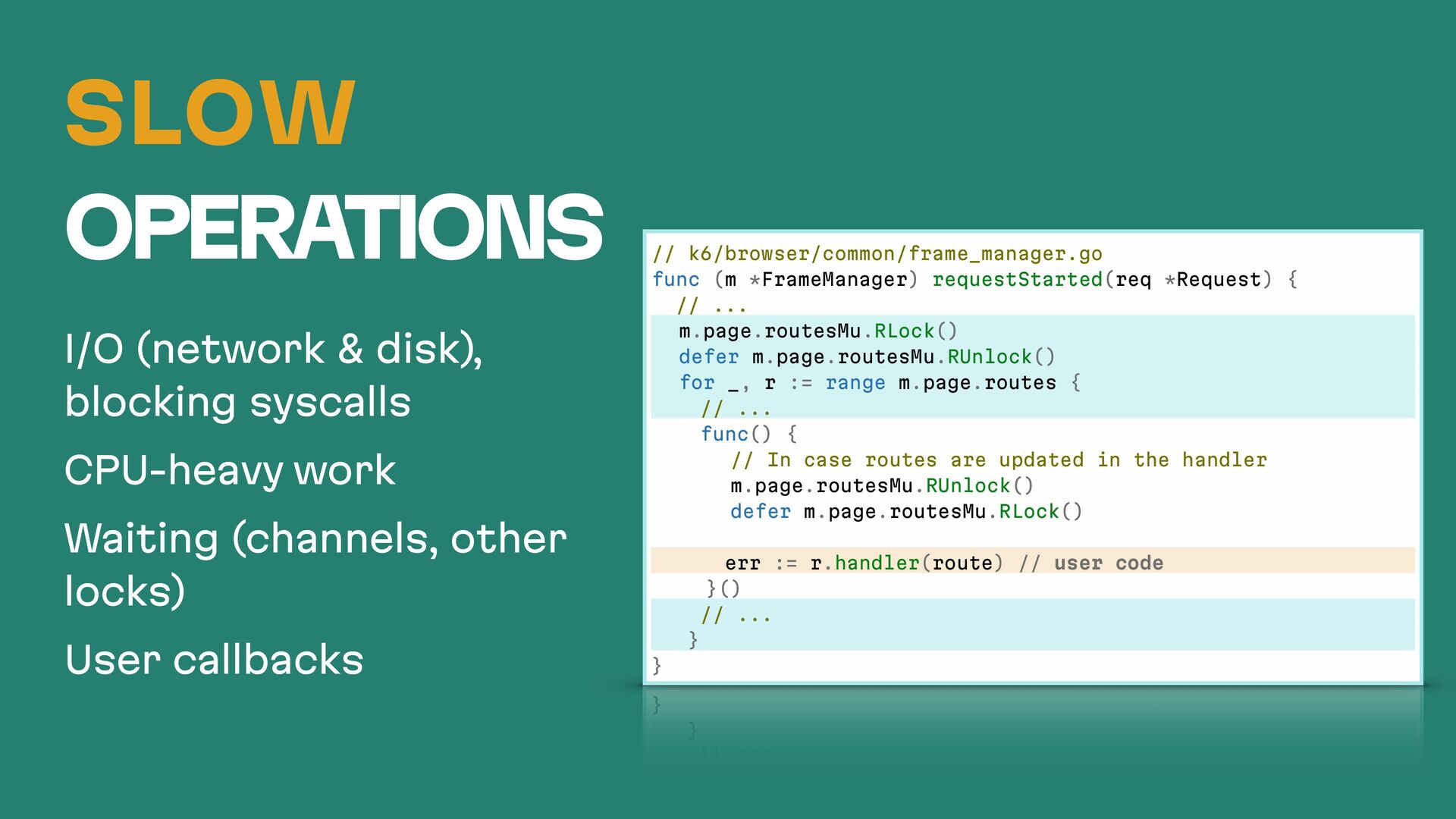
  27. SLOW OPERATIONS I/O (network & disk), blocking syscalls CPU-heavy work

    Waiting (channels, other locks) User callbacks // k6/browser/common/frame_manager.go func (m *FrameManager) requestStarted(req *Request) { // ... m.page.routesMu.RLock() defer m.page.routesMu.RUnlock() for _, r := range m.page.routes { // ... func() { // In case routes are updated in the handler m.page.routesMu.RUnlock() defer m.page.routesMu.RLock() err := r.handler(route) // user code }() // ... } }
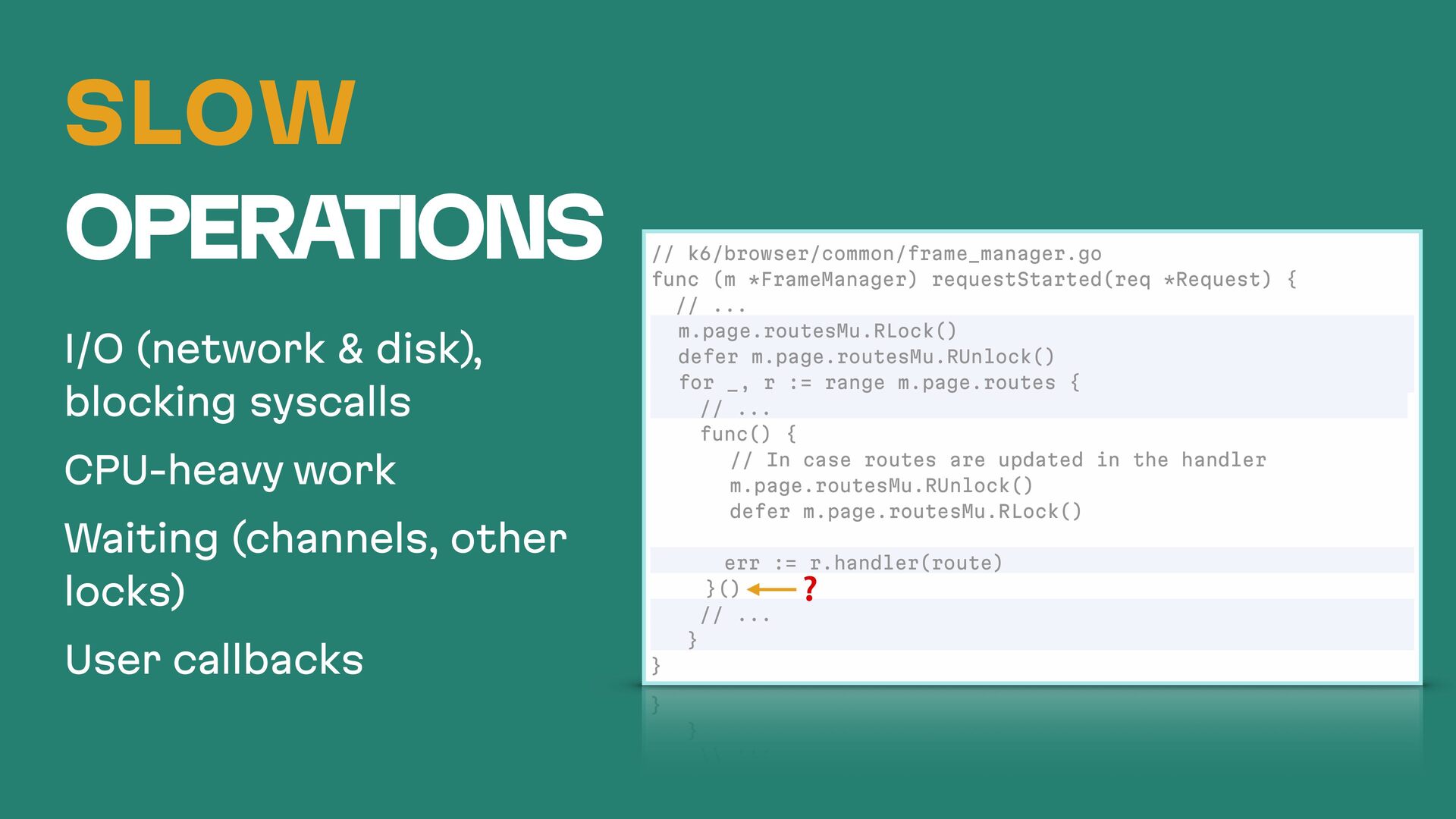
  28. SLOW OPERATIONS I/O (network & disk), blocking syscalls CPU-heavy work

    Waiting (channels, other locks) User callbacks // k6/browser/common/frame_manager.go func (m *FrameManager) requestStarted(req *Request) { // ... m.page.routesMu.RLock() defer m.page.routesMu.RUnlock() for _, r := range m.page.routes { // ... func() { // In case routes are updated in the handler m.page.routesMu.RUnlock() defer m.page.routesMu.RLock() err := r.handler(route) }() // ... ❓ } }
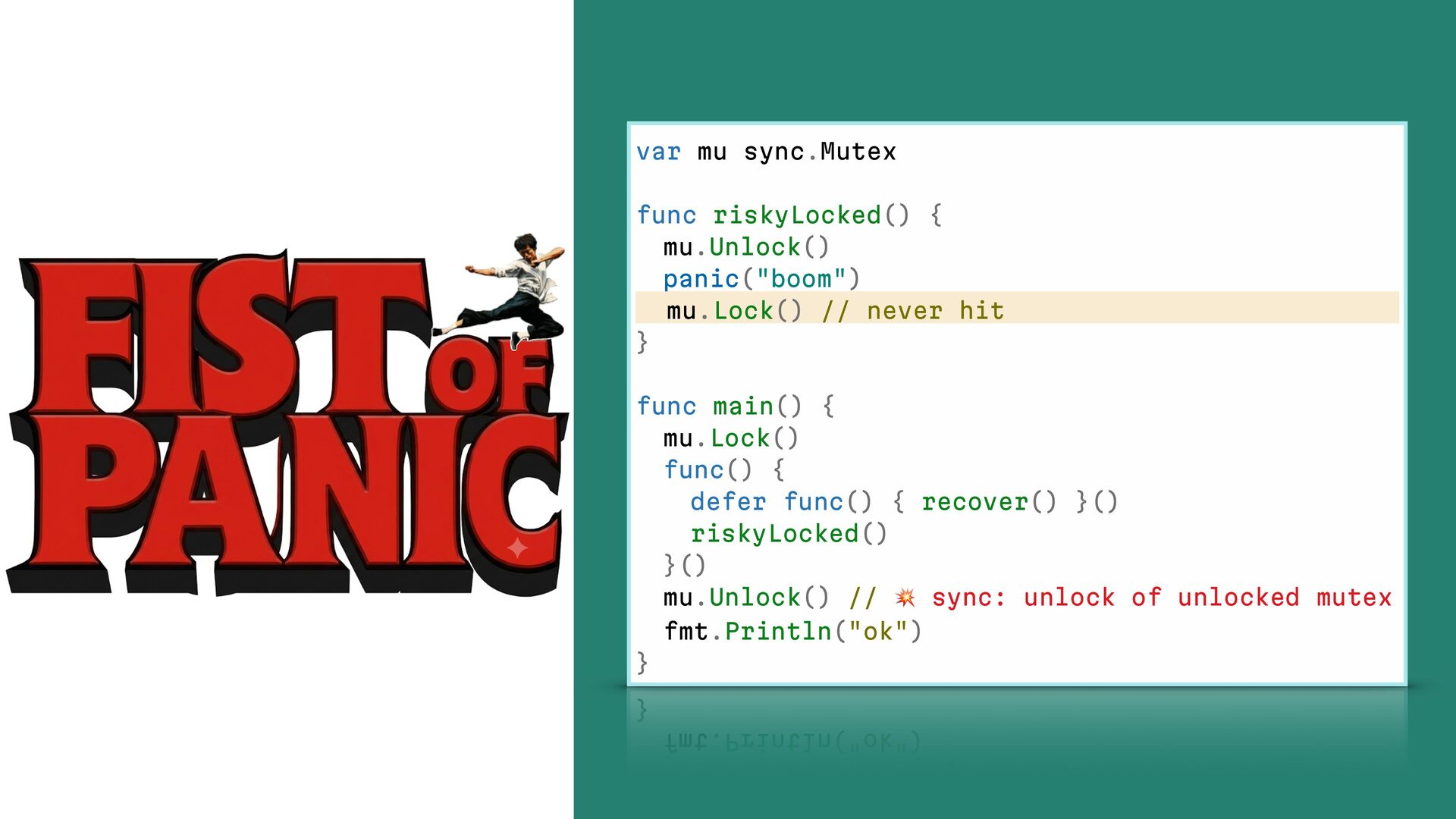
  29. var mu sync.Mutex func riskyLocked() { mu.Unlock() panic("boom") mu.Lock() //

    never hit } func main() { mu.Lock() func() { defer func() { recover() }() riskyLocked() }() mu.Unlock() // / sync: unlock of unlocked mutex fmt.Println("ok") }
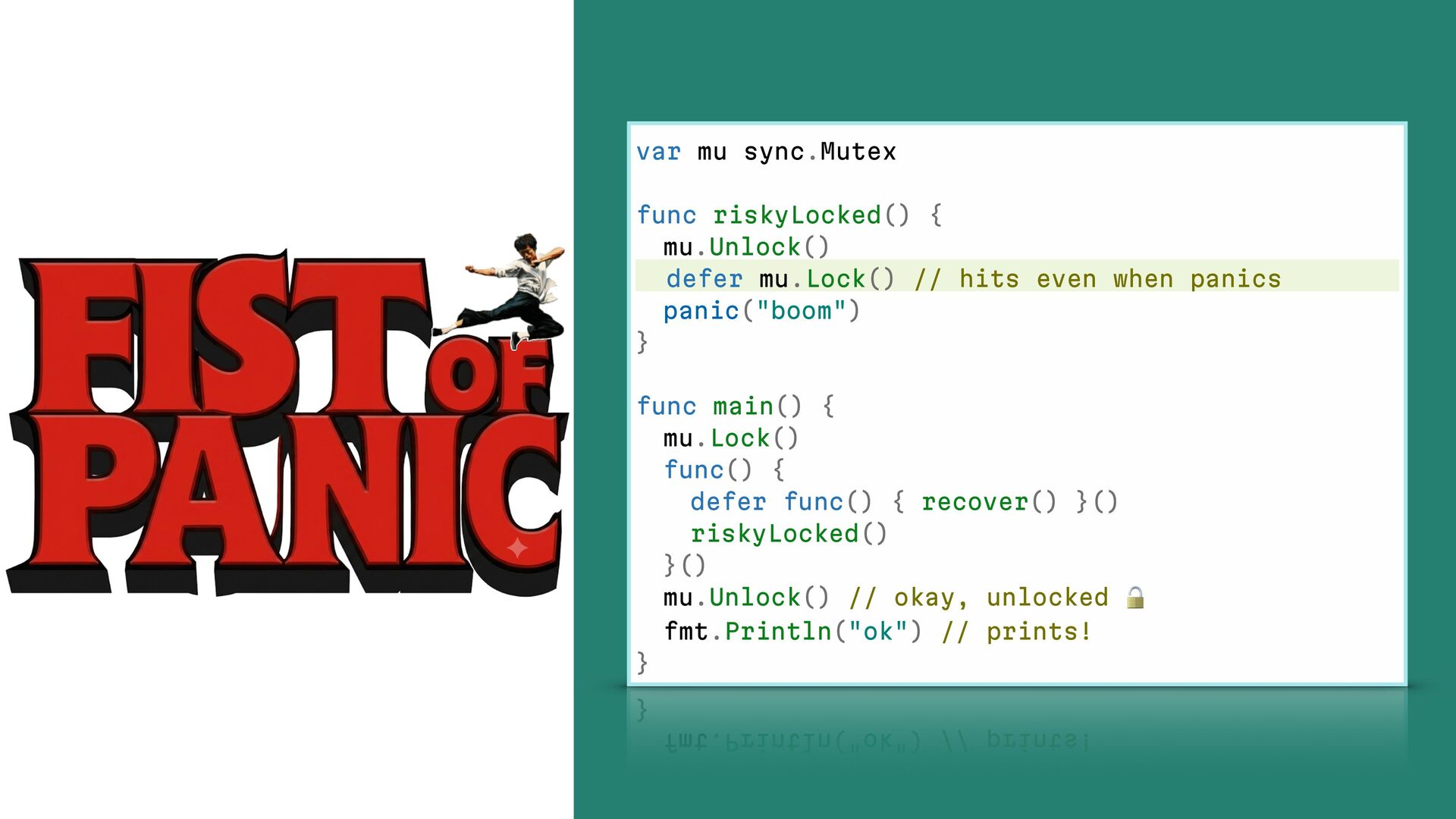
  30. var mu sync.Mutex func riskyLocked() { mu.Unlock() defer mu.Lock() //

    hits even when panics panic("boom") } func main() { mu.Lock() func() { defer func() { recover() }() riskyLocked() }() mu.Unlock() // okay, unlocked ' fmt.Println("ok") // prints! }
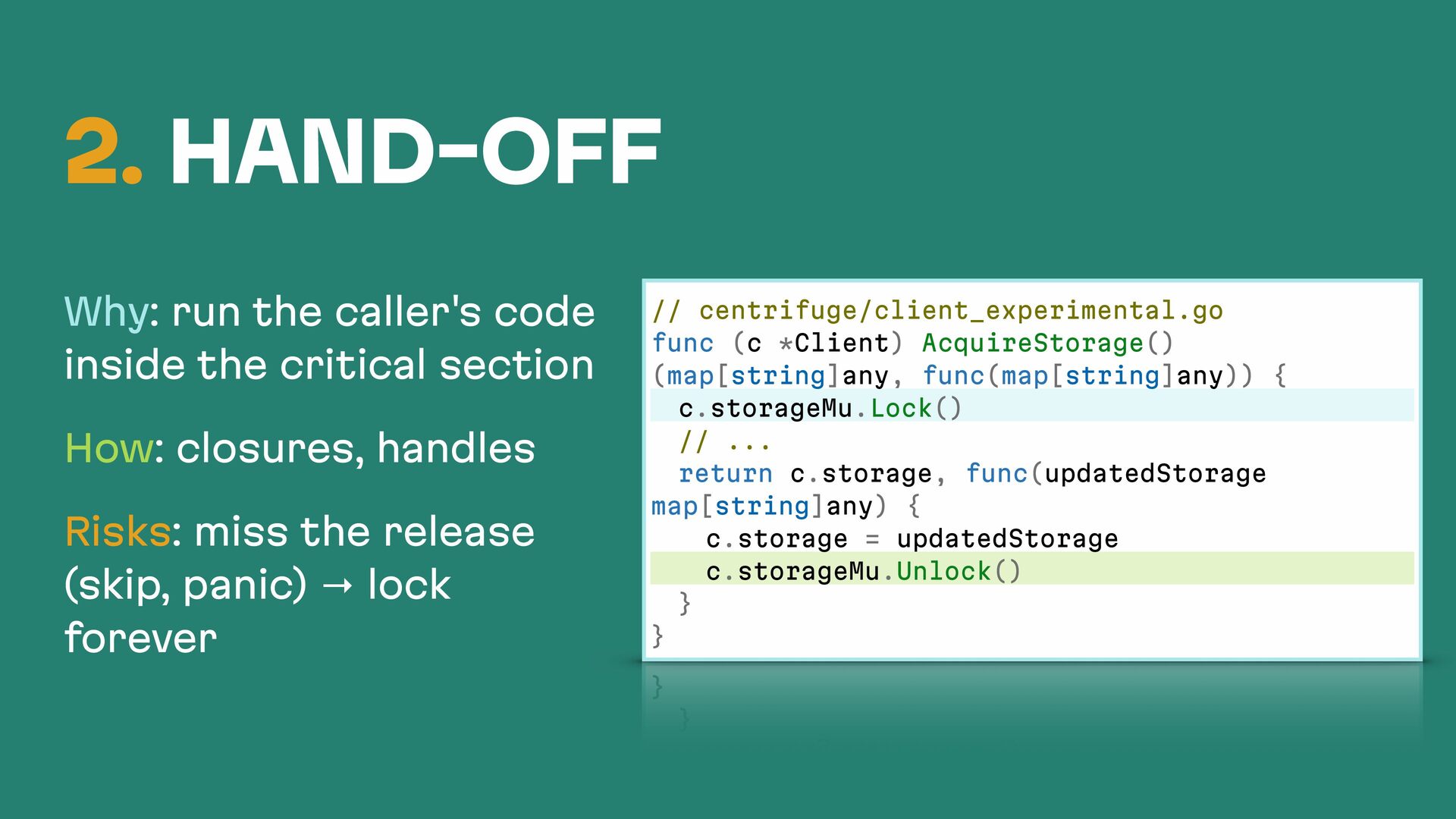
  31. 2. HAND-OFF Why: run the caller's code inside the critical

    section How: closures, handles Risks: miss the release (skip, panic) → lock forever // centrifuge/client_experimental.go func (c *Client) AcquireStorage() (map[string]any, func(map[string]any)) { c.storageMu.Lock() // ... return c.storage, func(updatedStorage map[string]any) { c.storage = updatedStorage c.storageMu.Unlock() } }
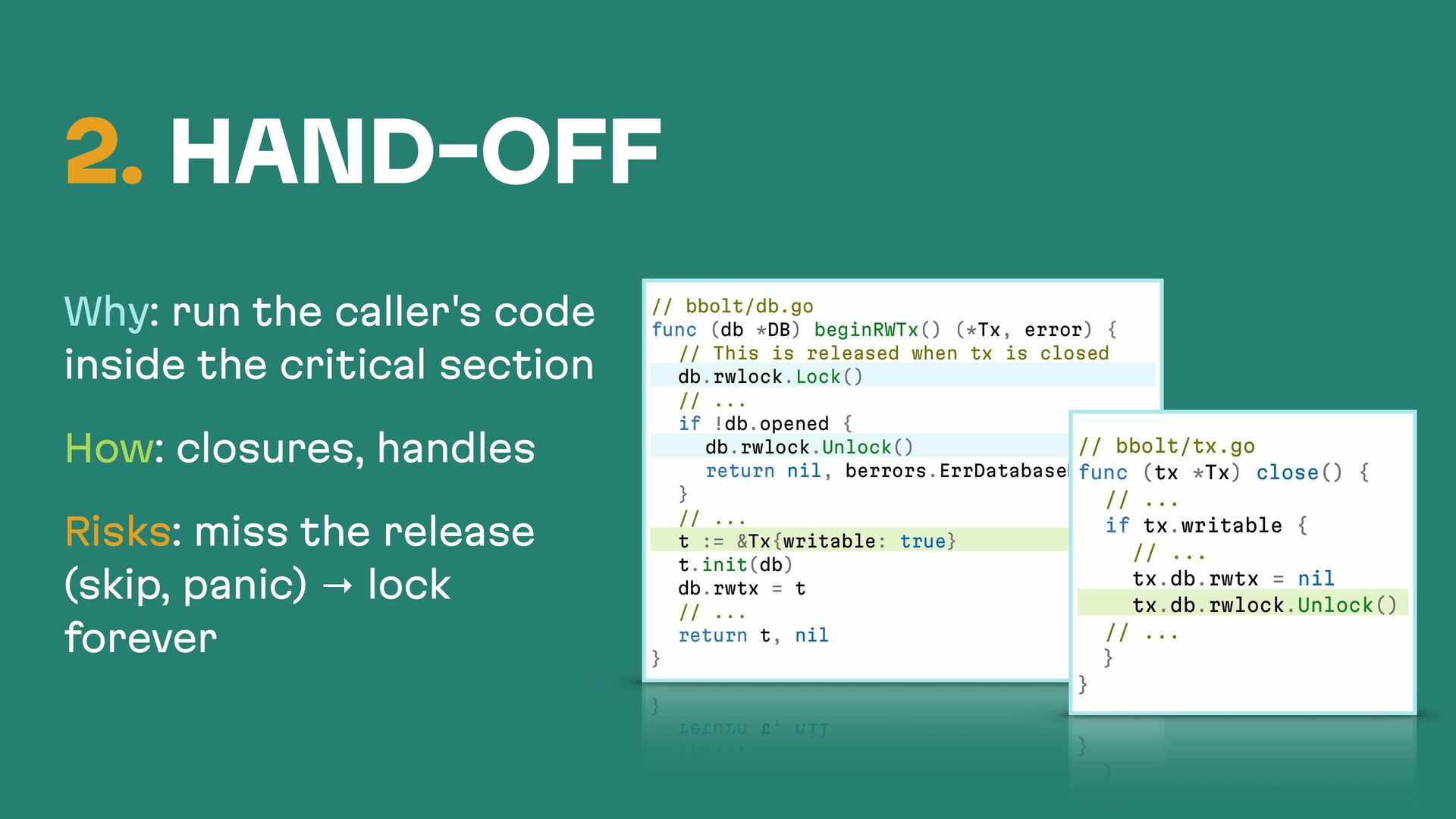
  32. 2. HAND-OFF Why: run the caller's code inside the critical

    section How: closures, handles Risks: miss the release (skip, panic) → lock forever // bbolt/db.go func (db *DB) beginRWTx() (*Tx, error) { // This is released when tx is closed db.rwlock.Lock() // ... if !db.opened { // bbolt/tx.go db.rwlock.Unlock() return nil, berrors.ErrDatabaseNotOpen func (tx *Tx) close() { } // ... // ... if tx.writable { t := &Tx{writable: true} // ... t.init(db) tx.db.rwtx = nil db.rwtx = t tx.db.rwlock.Unlock() // ... // ... return t, nil } } }
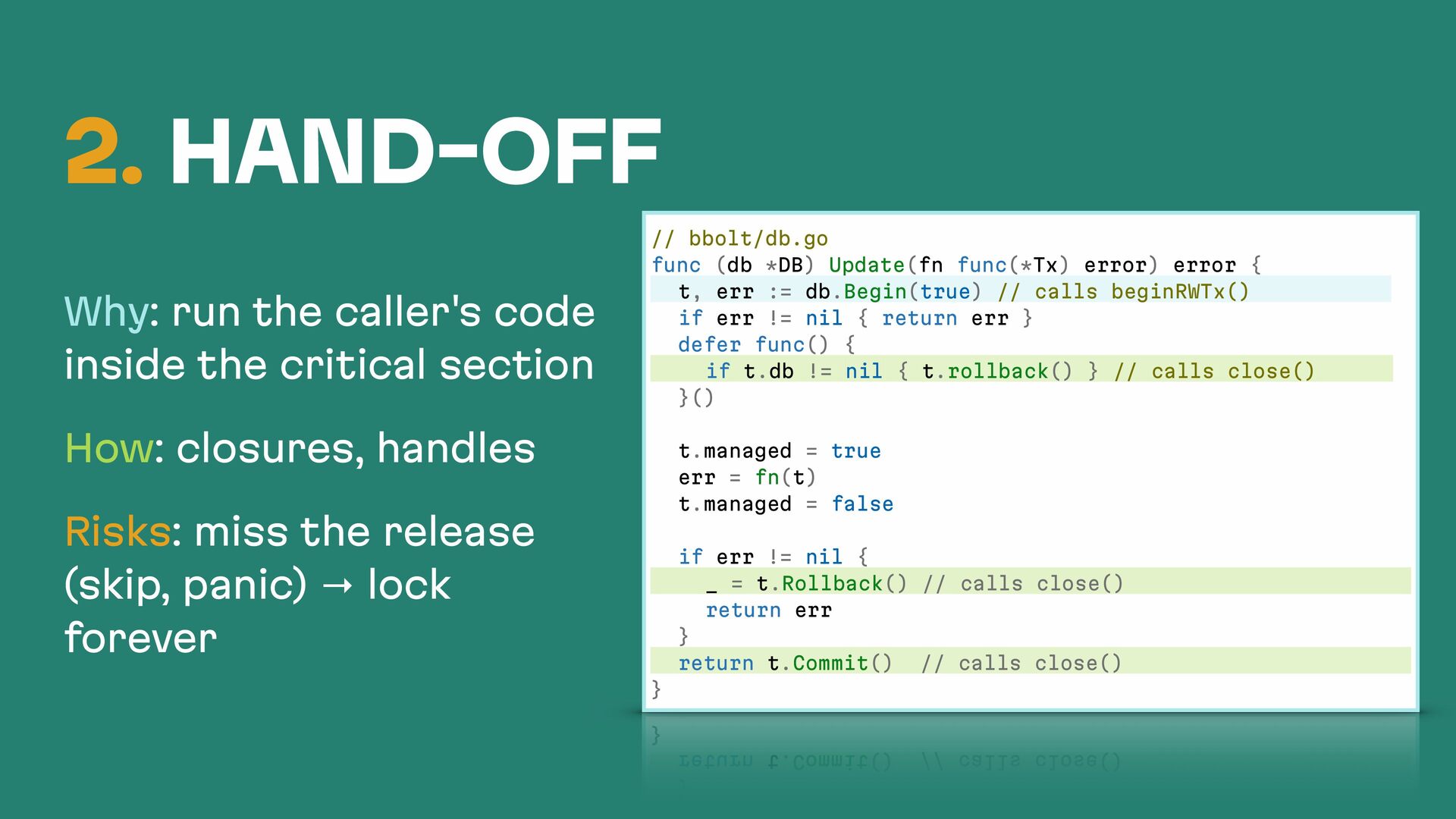
  33. 2. HAND-OFF Why: run the caller's code inside the critical

    section // bbolt/db.go func (db *DB) Update(fn func(*Tx) error) error { t, err := db.Begin(true) // calls beginRWTx() if err != nil { return err } defer func() { if t.db != nil { t.rollback() } // calls close() }() How: closures, handles t.managed = true err = fn(t) t.managed = false Risks: miss the release (skip, panic) → lock forever if err != nil { _ = t.Rollback() // calls close() return err } return t.Commit() // calls close() }
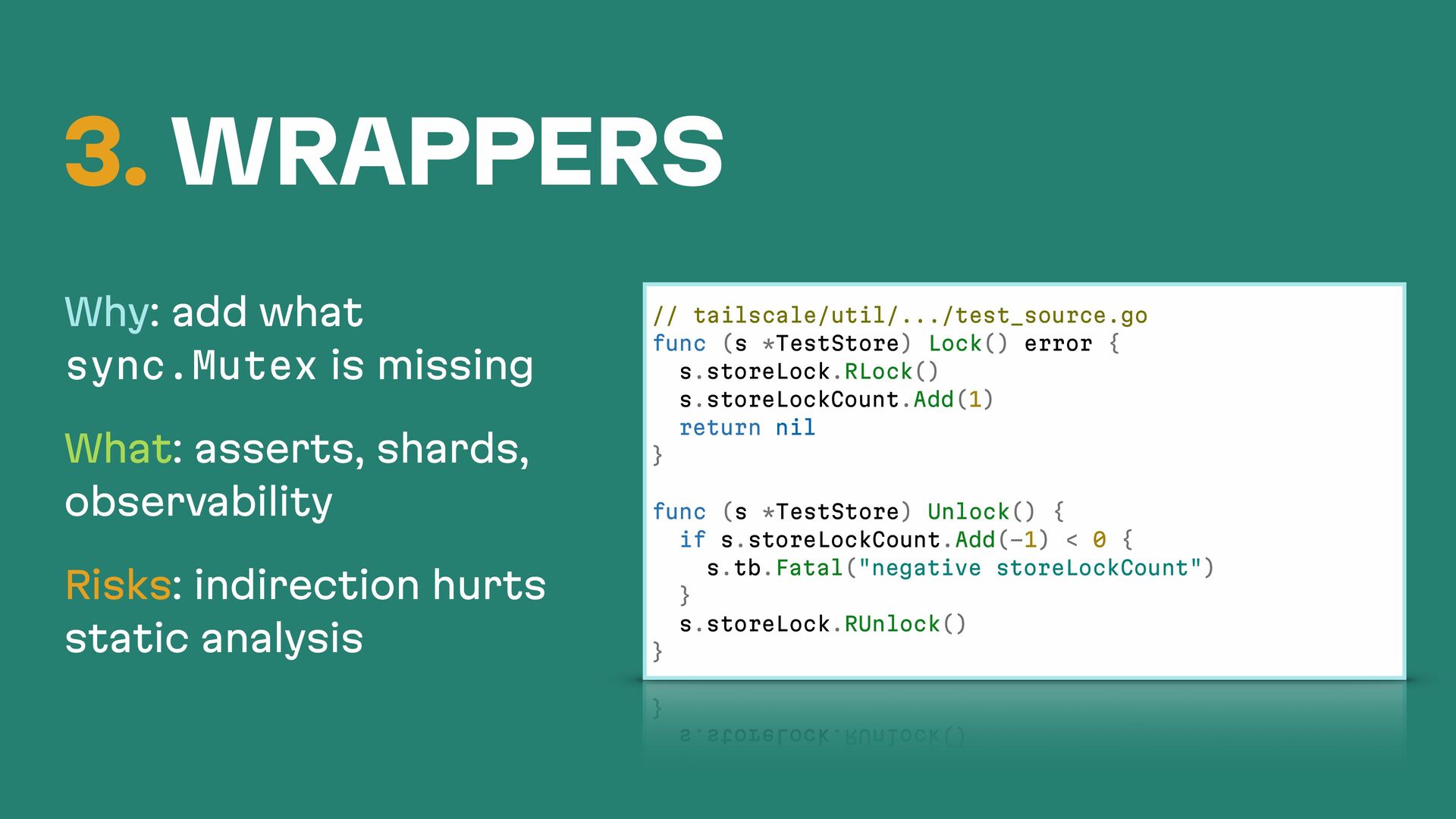
  34. 3. WRAPPERS Why: add what sync.Mutex is missing What: asserts,

    shards, observability Risks: indirection hurts static analysis // tailscale/util/.../test_source.go func (s *TestStore) Lock() error { s.storeLock.RLock() s.storeLockCount.Add(1) return nil } func (s *TestStore) Unlock() { if s.storeLockCount.Add(-1) < 0 { s.tb.Fatal("negative storeLockCount") } s.storeLock.RUnlock() }
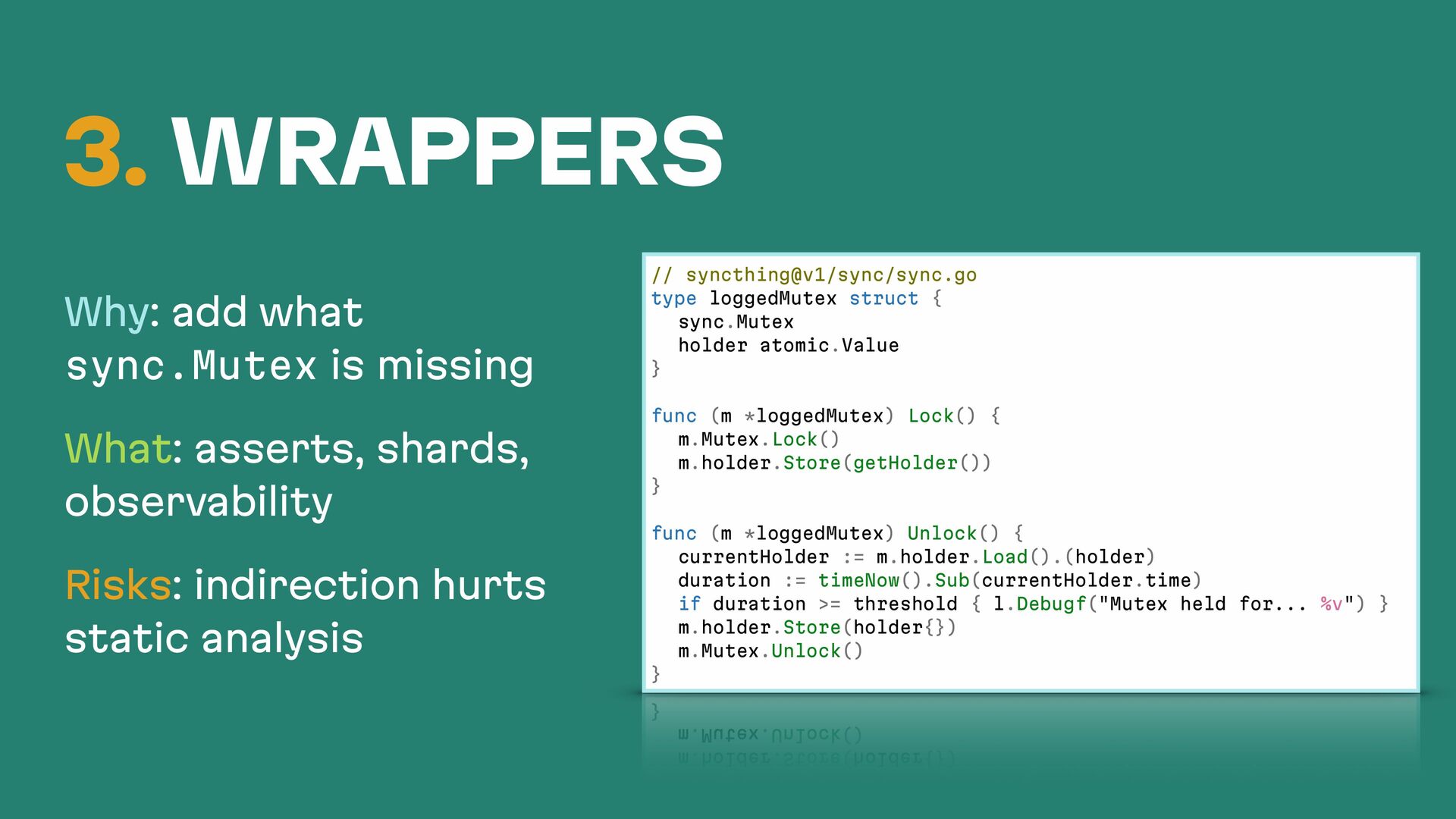
  35. 3. WRAPPERS Why: add what sync.Mutex is missing What: asserts,

    shards, observability Risks: indirection hurts static analysis // syncthing@v1/sync/sync.go type loggedMutex struct { sync.Mutex holder atomic.Value } func (m *loggedMutex) Lock() { m.Mutex.Lock() m.holder.Store(getHolder()) } func (m *loggedMutex) Unlock() { currentHolder := m.holder.Load().(holder) duration := timeNow().Sub(currentHolder.time) if duration >= threshold { l.Debugf("Mutex held for... %v") } m.holder.Store(holder{}) m.Mutex.Unlock() }
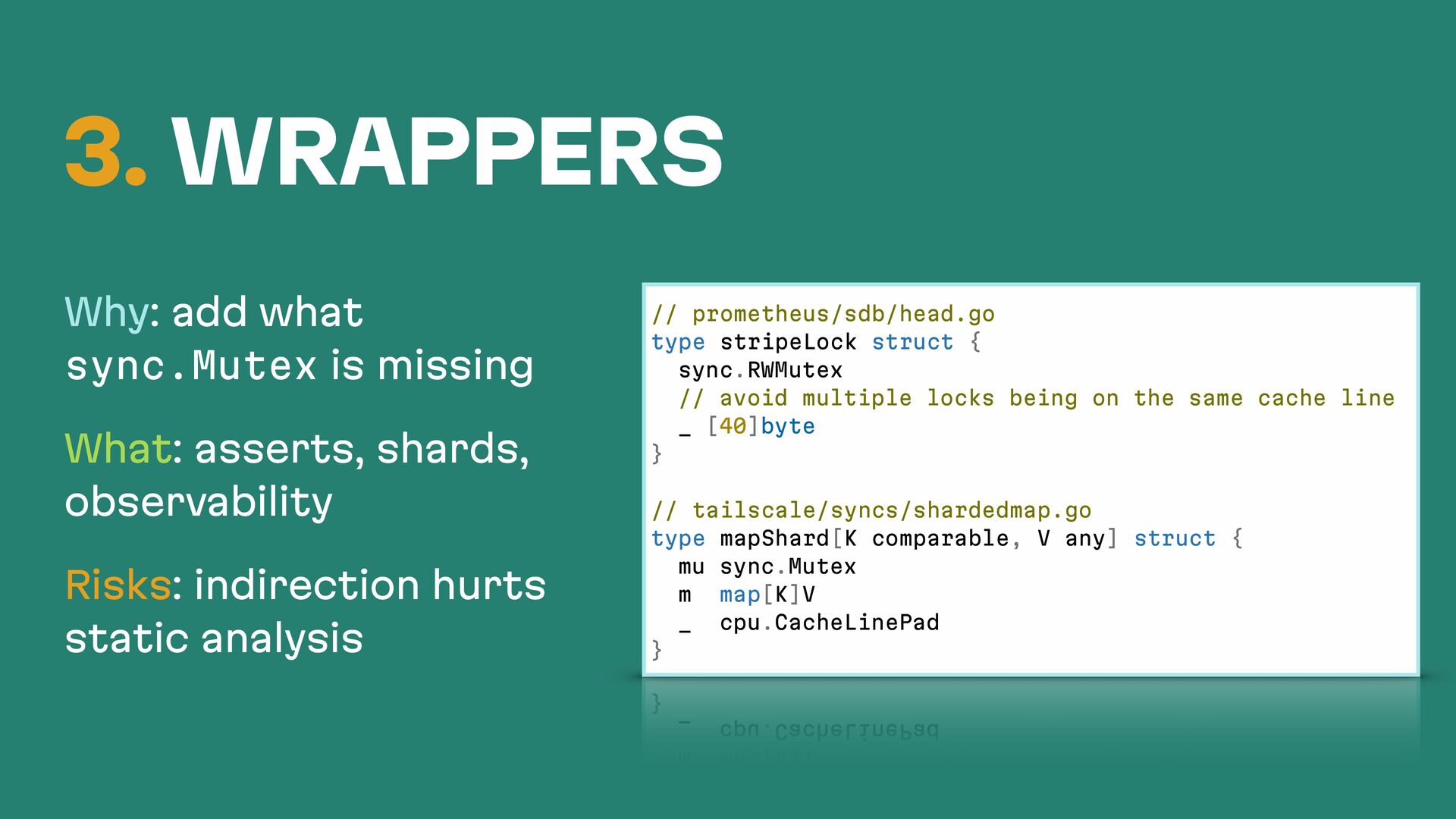
  36. 3. WRAPPERS Why: add what sync.Mutex is missing What: asserts,

    shards, observability Risks: indirection hurts static analysis // prometheus/sdb/head.go type stripeLock struct { sync.RWMutex // avoid multiple locks being on the same cache line _ [40]byte } // tailscale/syncs/shardedmap.go type mapShard[K comparable, V any] struct { mu sync.Mutex m map[K]V _ cpu.CacheLinePad }
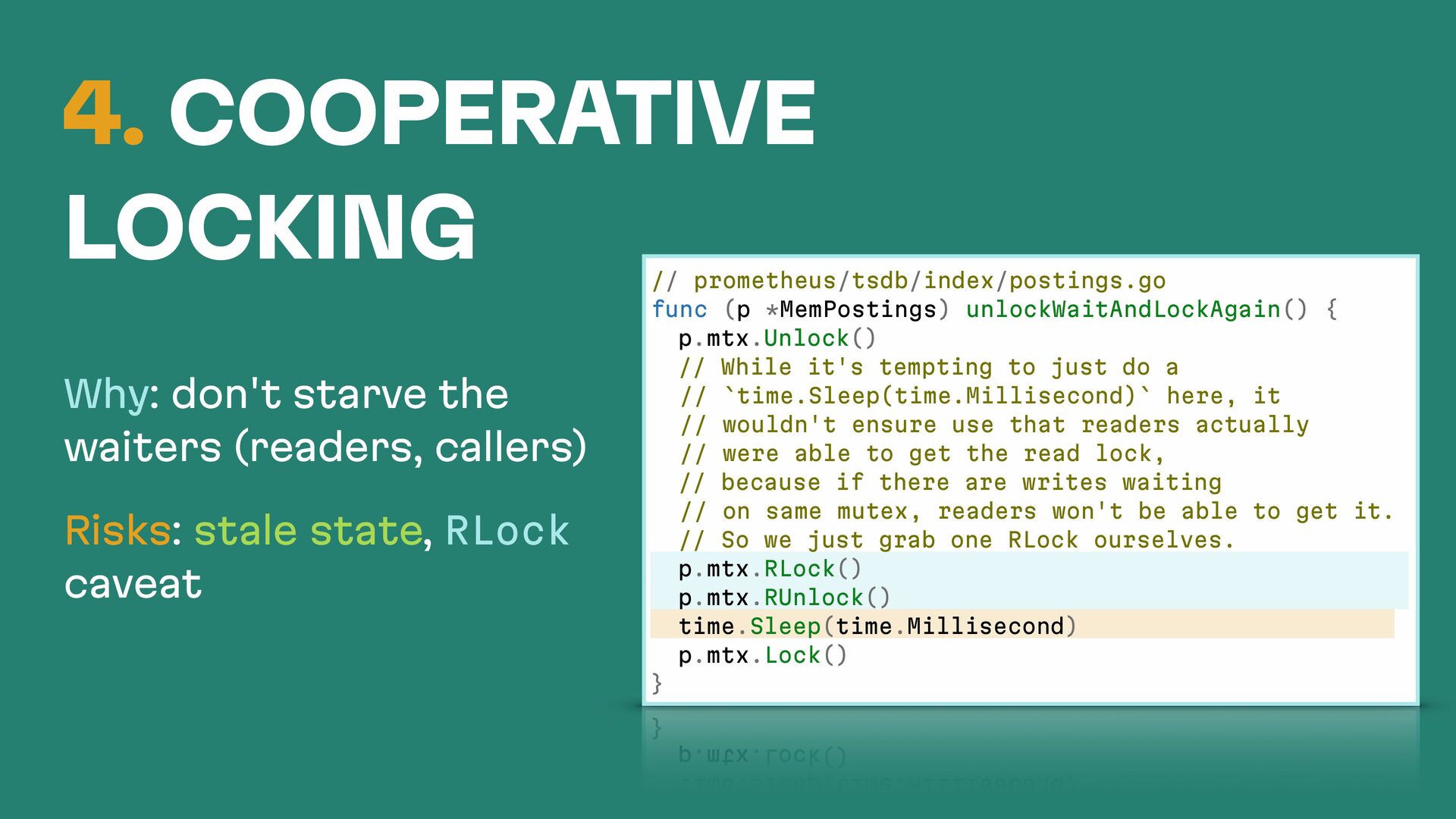
  37. 4. COOPERATIVE LOCKING Why: don't starve the waiters (readers, callers)

    Risks: stale state, RLock caveat // prometheus/tsdb/index/postings.go func (p *MemPostings) unlockWaitAndLockAgain() { p.mtx.Unlock() // While it's tempting to just do a // `time.Sleep(time.Millisecond)` here, it // wouldn't ensure use that readers actually // were able to get the read lock, // because if there are writes waiting // on same mutex, readers won't be able to get it. // So we just grab one RLock ourselves. p.mtx.RLock() p.mtx.RUnlock() time.Sleep(time.Millisecond) p.mtx.Lock() }
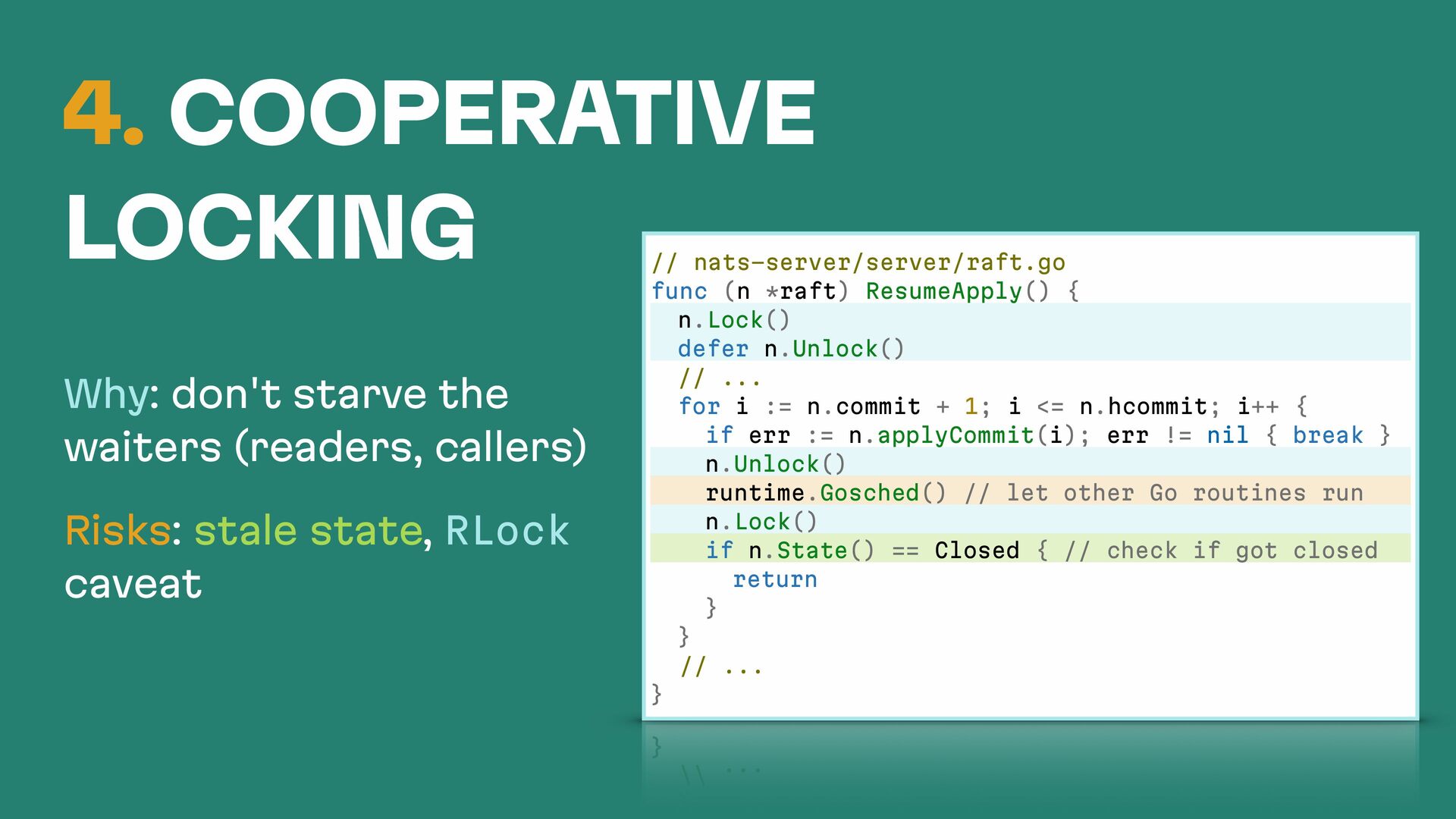
  38. 4. COOPERATIVE LOCKING Why: don't starve the waiters (readers, callers)

    Risks: stale state, RLock caveat // nats-server/server/raft.go func (n *raft) ResumeApply() { n.Lock() defer n.Unlock() // ... for i := n.commit + 1; i <= n.hcommit; i++ { if err := n.applyCommit(i); err != nil { break } n.Unlock() runtime.Gosched() // let other Go routines run n.Lock() if n.State() == Closed { // check if got closed return } } // ... }
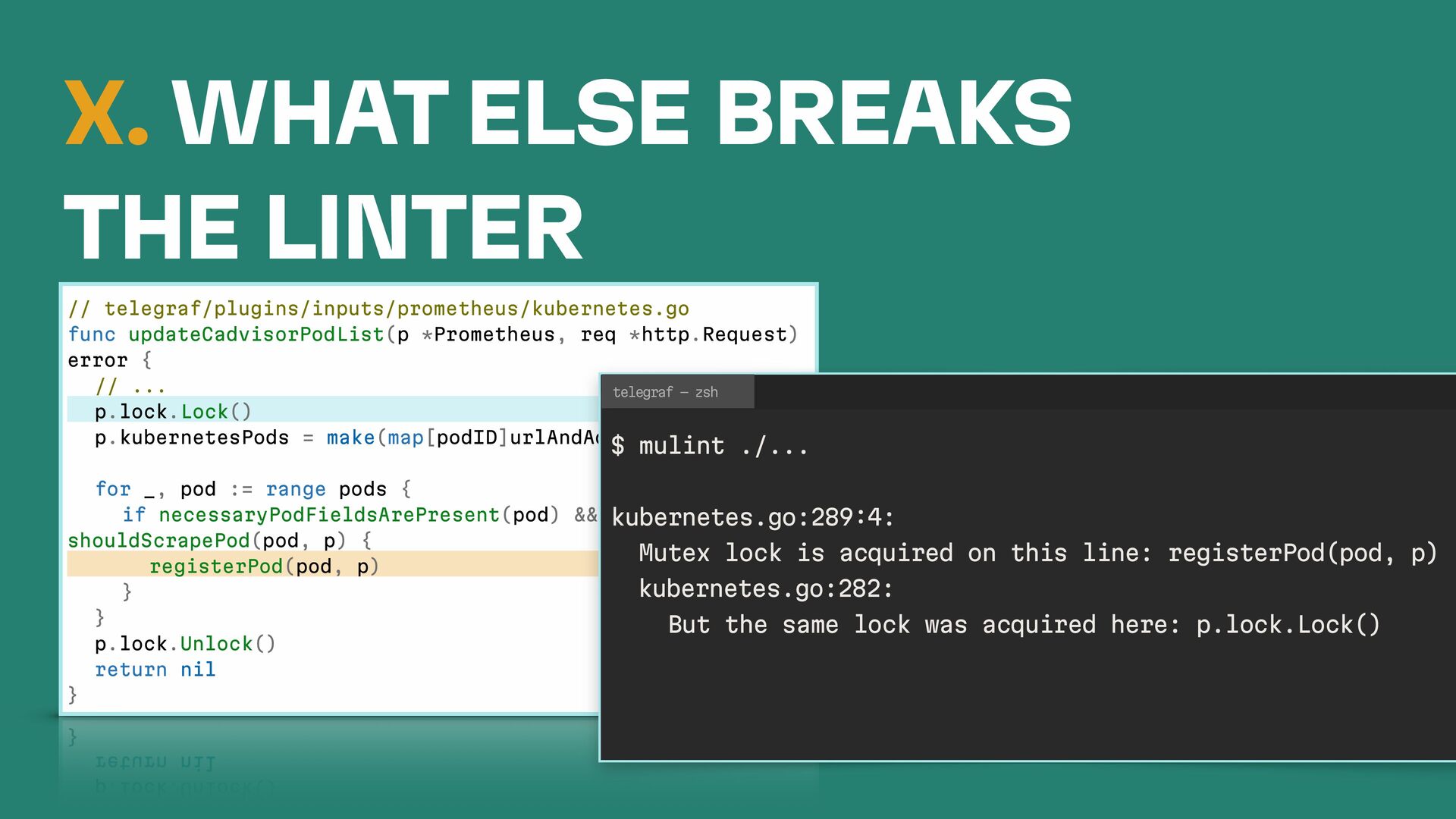
  39. X. WHAT ELSE BREAKS THE LINTER // telegraf/plugins/inputs/prometheus/kubernetes.go func updateCadvisorPodList(p

    *Prometheus, req *http.Request) error { // ... telegraf — zsh p.lock.Lock() p.kubernetesPods = make(map[podID]urlAndAddress) $ mulint ./... for _, pod := range pods { if necessaryPodFieldsArePresent(pod) && kubernetes.go:289:4: shouldScrapePod(pod, p) { Mutex lock is acquired on this line: registerPod(pod, registerPod(pod, p) kubernetes.go:282: } } But the same lock was acquired here: p.lock.Lock() p.lock.Unlock() return nil } p)
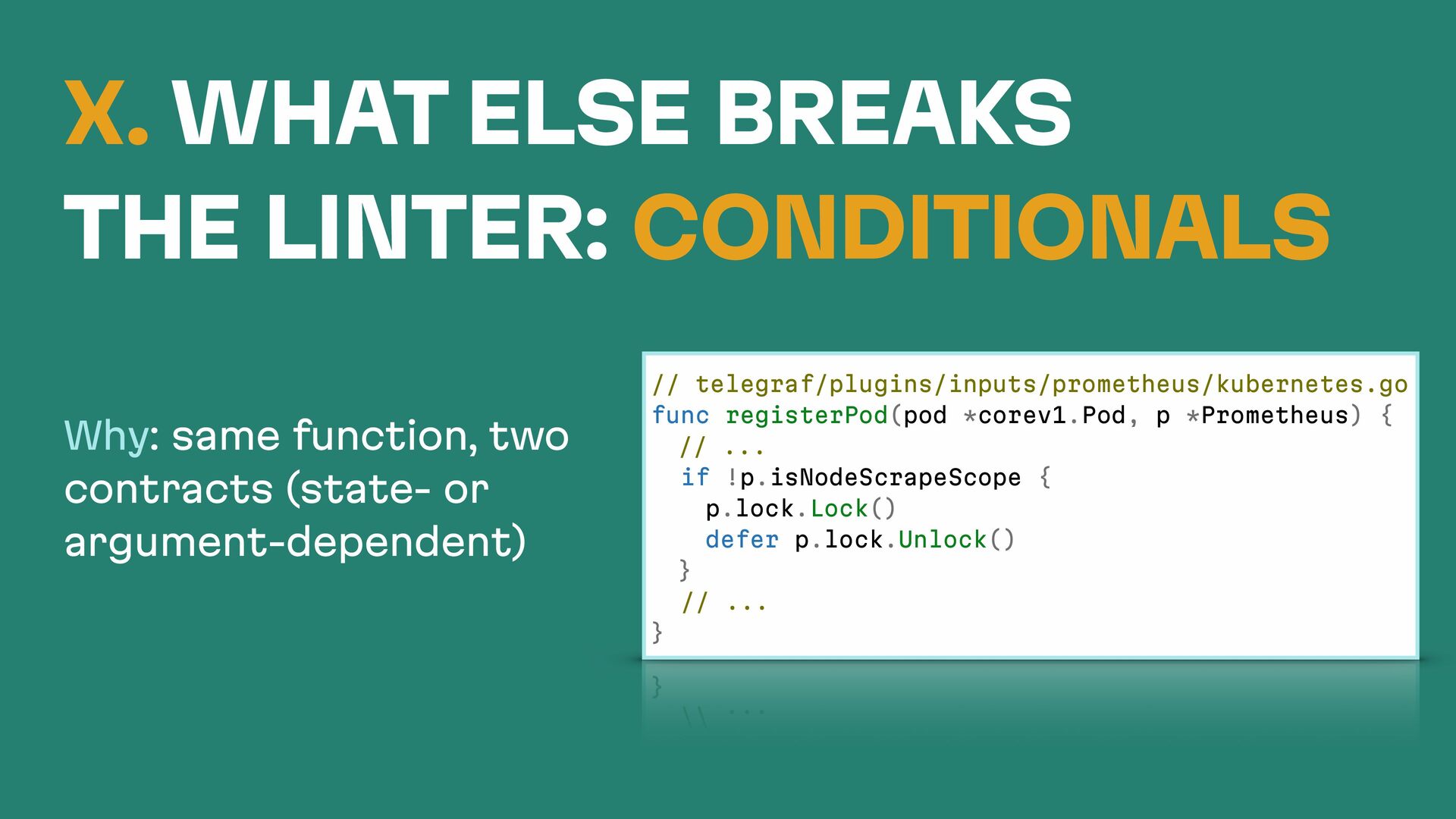
  40. X. WHAT ELSE BREAKS THE LINTER: CONDITIONALS Why: same function,

    two contracts (state- or argument-dependent) // telegraf/plugins/inputs/prometheus/kubernetes.go func registerPod(pod *corev1.Pod, p *Prometheus) { // ... if !p.isNodeScrapeScope { p.lock.Lock() defer p.lock.Unlock() } // ... }
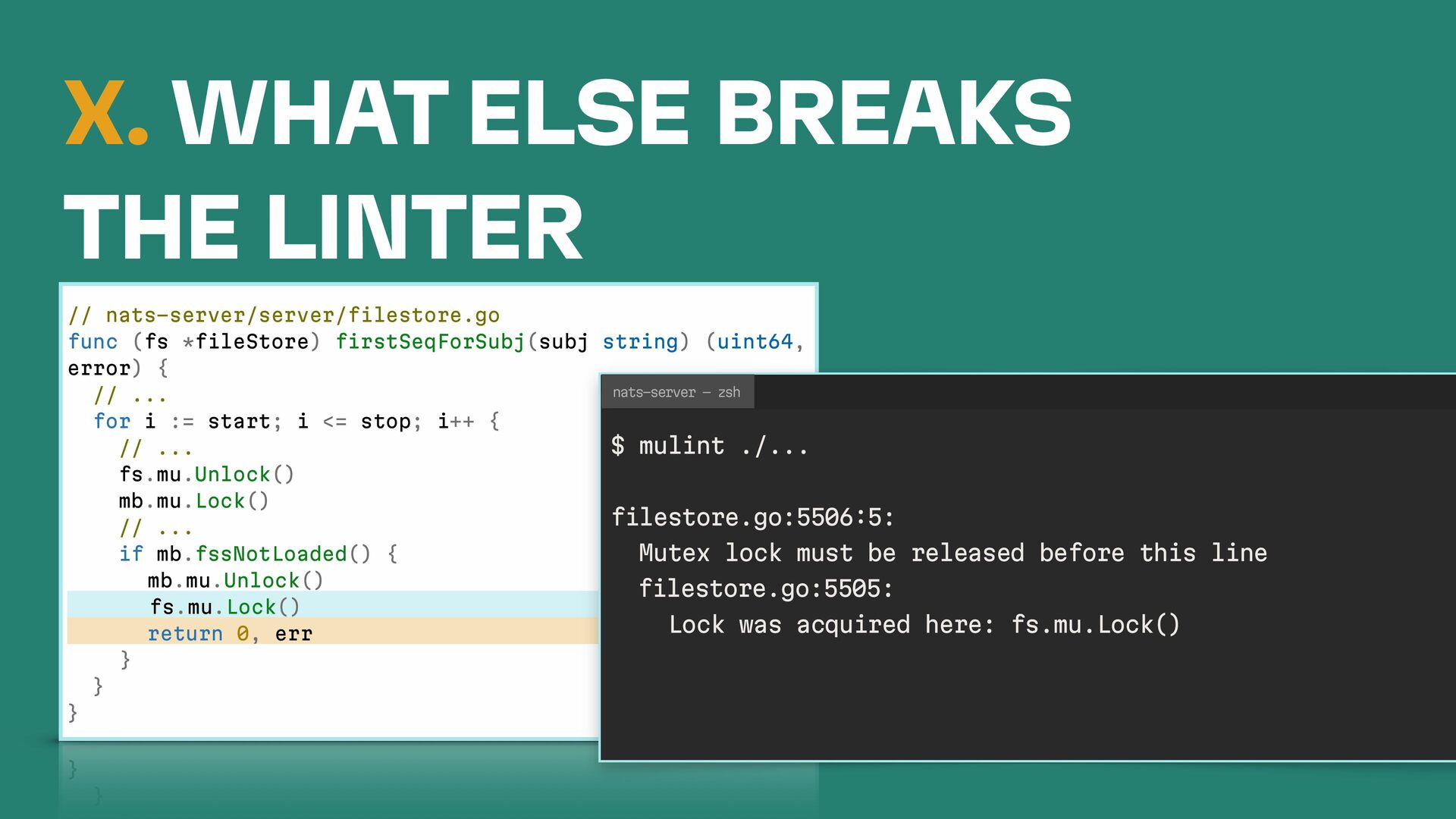
  41. X. WHAT ELSE BREAKS THE LINTER // nats-server/server/filestore.go func (fs

    *fileStore) firstSeqForSubj(subj string) (uint64, error) { nats-server — zsh // ... for i := start; i <= stop; i++ { $ mulint ./... // ... fs.mu.Unlock() mb.mu.Lock() filestore.go:5506:5: // ... if mb.fssNotLoaded() { Mutex lock must be released before this mb.mu.Unlock() filestore.go:5505: fs.mu.Lock() Lock was acquired here: fs.mu.Lock() return 0, err } } } line
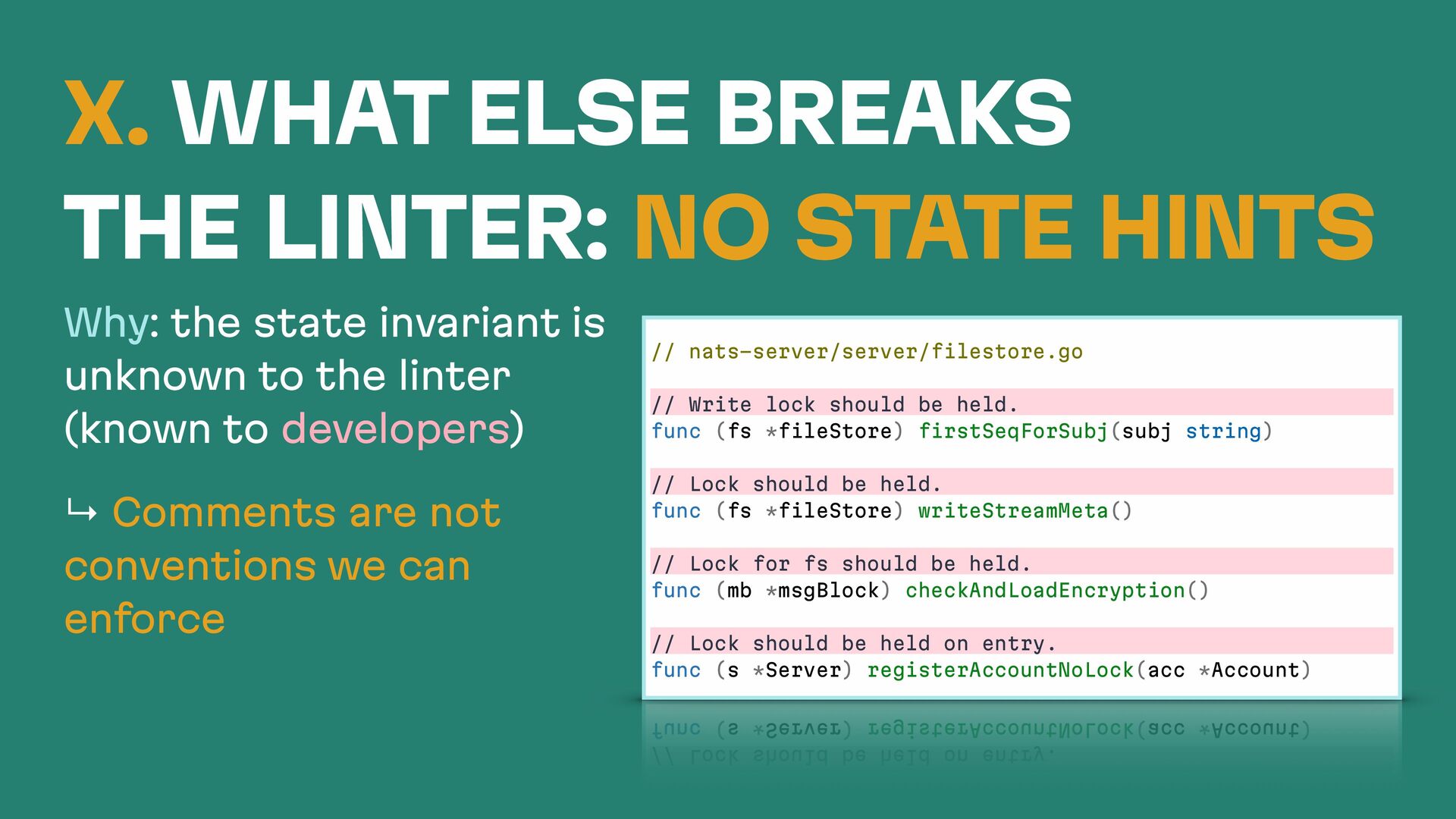
  42. X. WHAT ELSE BREAKS THE LINTER: NO STATE HINTS Why:

    the state invariant is unknown to the linter (known to developers) ↳ Comments are not conventions we can enforce // nats-server/server/filestore.go // Write lock should be held. func (fs *fileStore) firstSeqForSubj(subj string) // Lock should be held. func (fs *fileStore) writeStreamMeta() // Lock for fs should be held. func (mb *msgBlock) checkAndLoadEncryption() // Lock should be held on entry. func (s *Server) registerAccountNoLock(acc *Account)
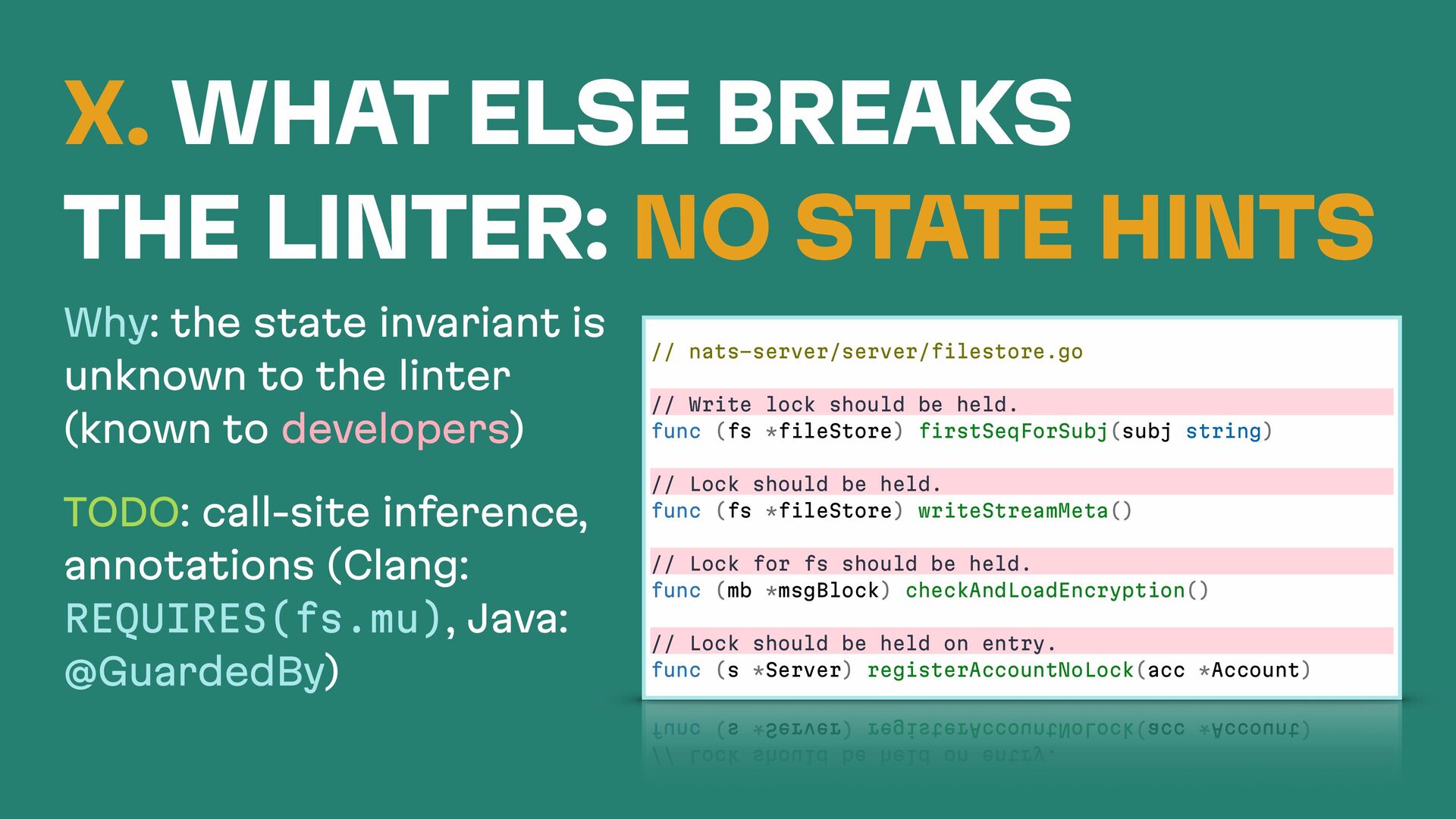
  43. X. WHAT ELSE BREAKS THE LINTER: NO STATE HINTS Why:

    the state invariant is unknown to the linter (known to developers) TODO: call-site inference, annotations (Clang: REQUIRES(fs.mu), Java: @GuardedBy) // nats-server/server/filestore.go // Write lock should be held. func (fs *fileStore) firstSeqForSubj(subj string) // Lock should be held. func (fs *fileStore) writeStreamMeta() // Lock for fs should be held. func (mb *msgBlock) checkAndLoadEncryption() // Lock should be held on entry. func (s *Server) registerAccountNoLock(acc *Account)
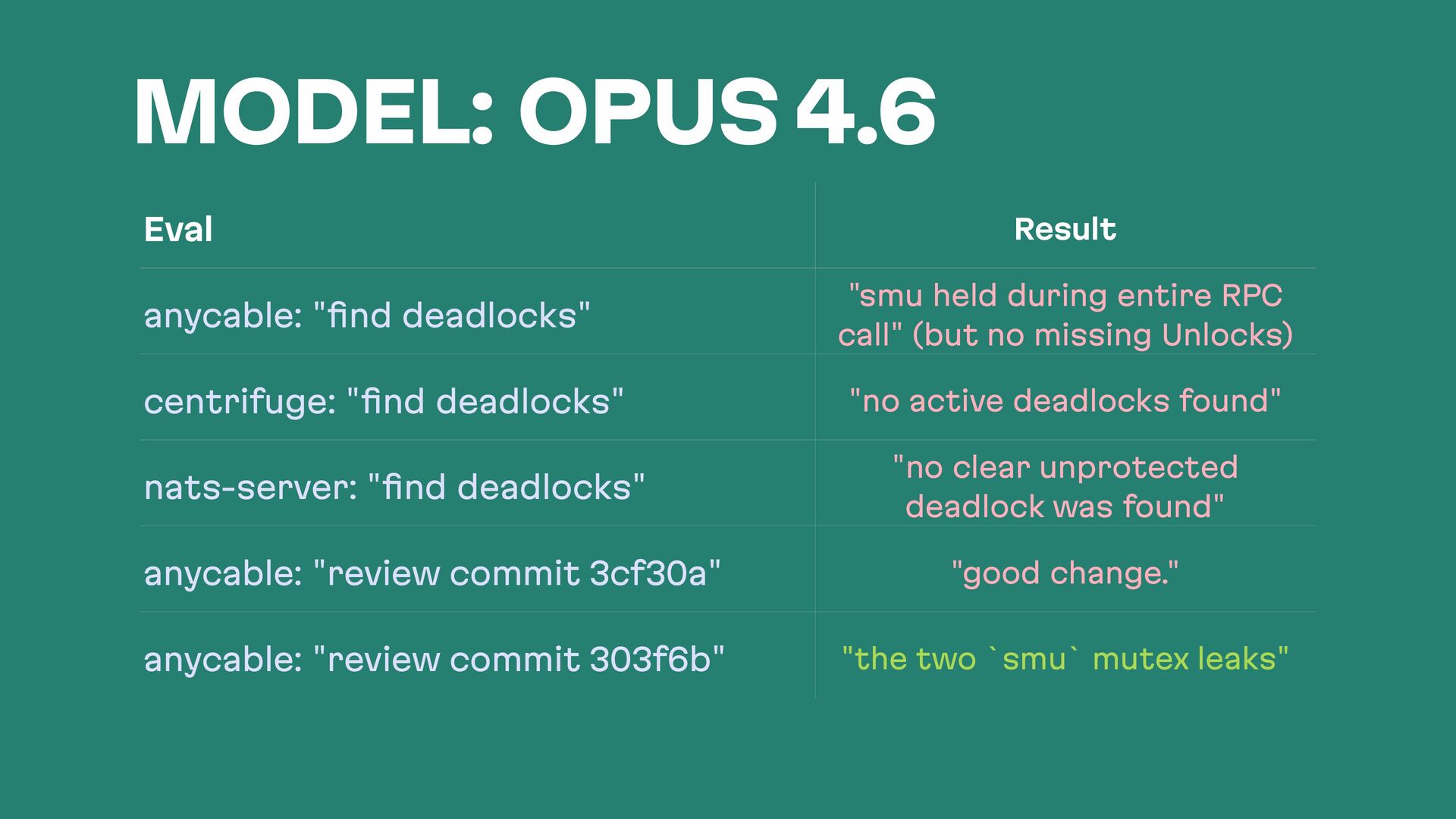
  44. MODEL: OPUS 4.6 Eval Result anycable: "find deadlocks" "smu held

    during entire RPC call" (but no missing Unlocks) centrifuge: "find deadlocks" "no active deadlocks found" nats-server: "find deadlocks" "no clear unprotected deadlock was found" anycable: "review commit 3cf30a" "good change." anycable: "review commit 303f6b" "the two `smu` mutex leaks"
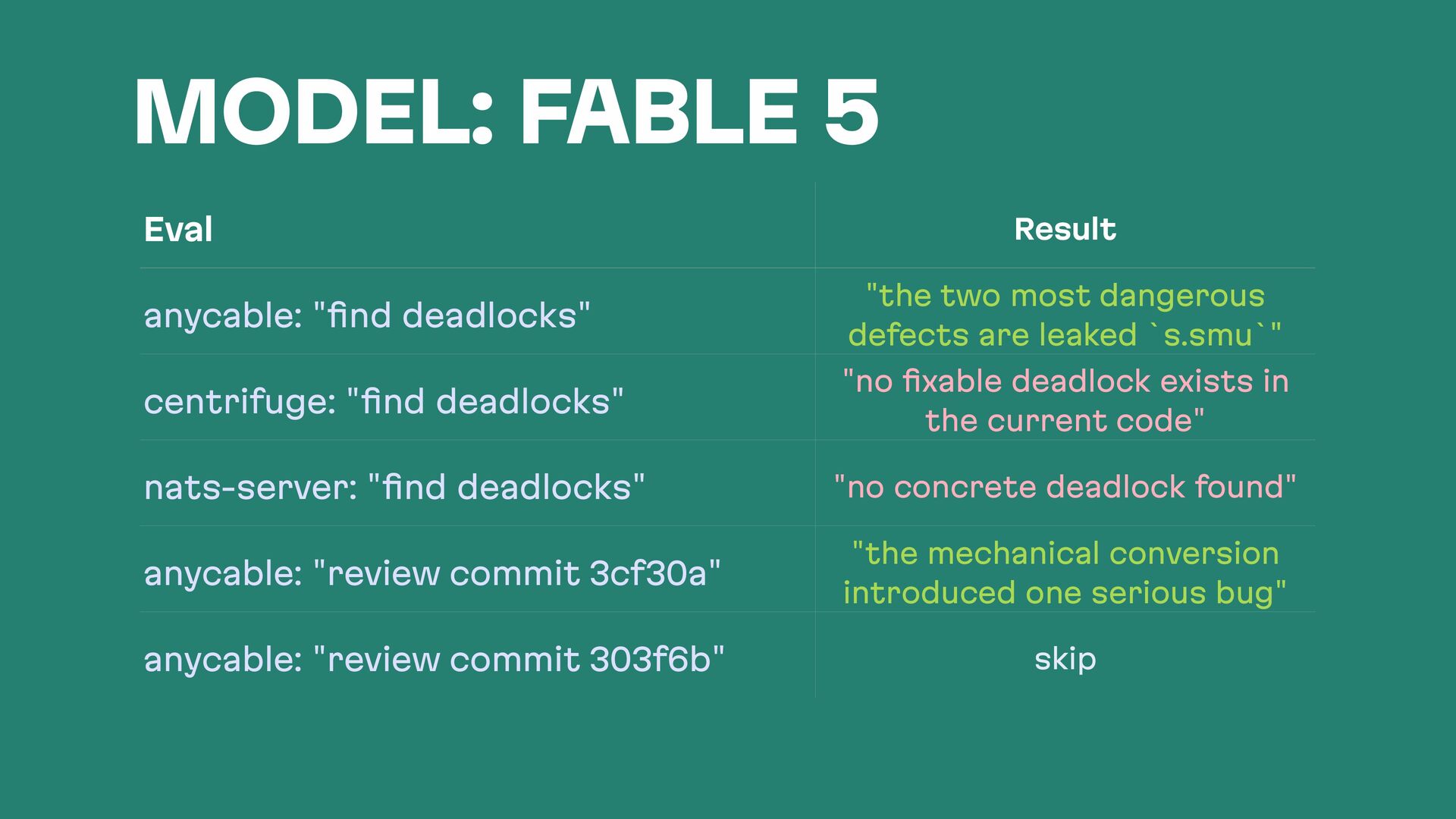
  45. MODEL: FABLE 5 Eval Result anycable: "find deadlocks" "the two

    most dangerous defects are leaked `s.smu`" centrifuge: "find deadlocks" "no fixable deadlock exists in the current code" nats-server: "find deadlocks" "no concrete deadlock found" anycable: "review commit 3cf30a" "the mechanical conversion introduced one serious bug" anycable: "review commit 303f6b" skip
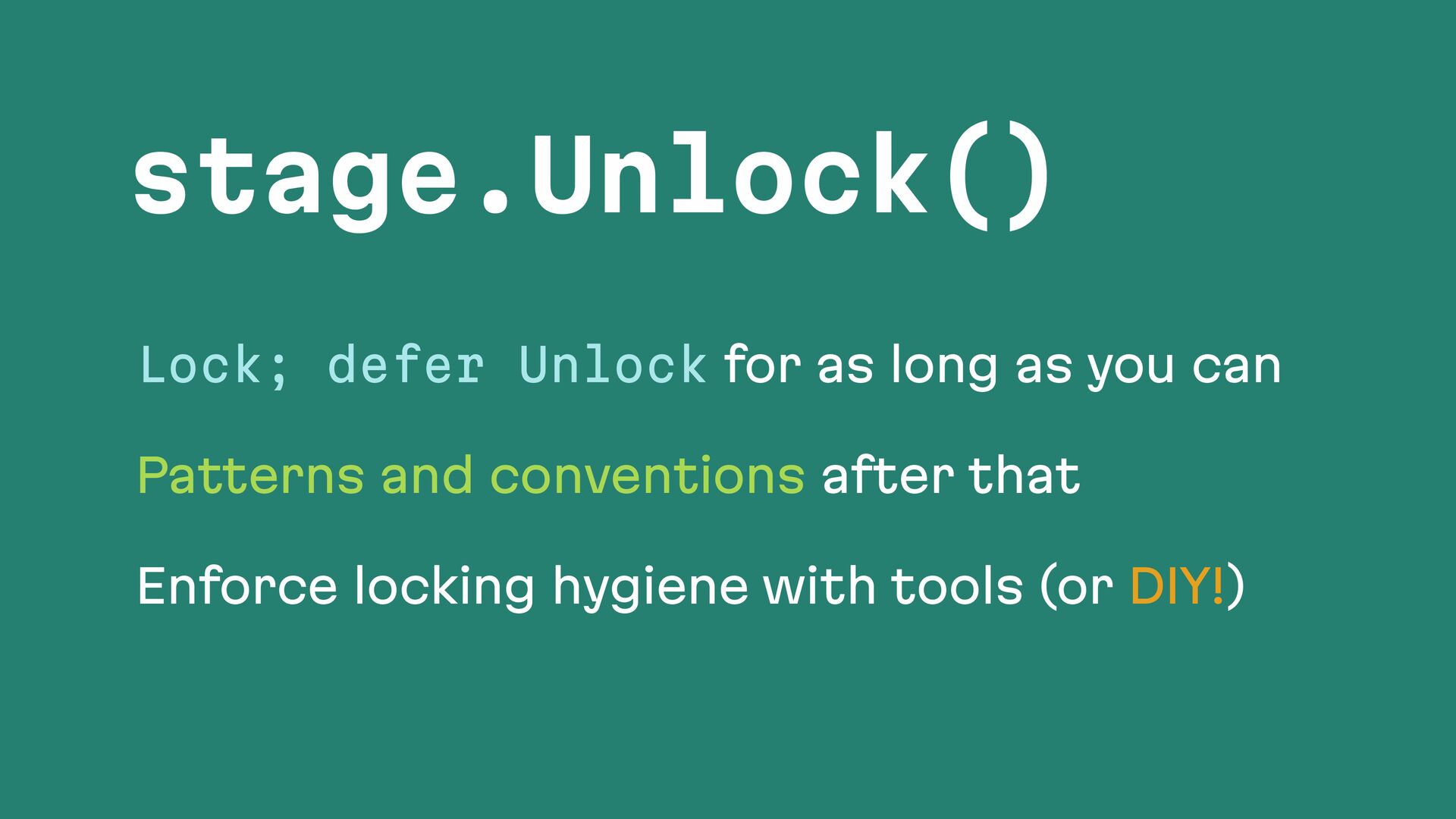
  46. stage.Unlock() Lock; defer Unlock for as long as you can

    Patterns and conventions after that Enforce locking hygiene with tools (or DIY!)
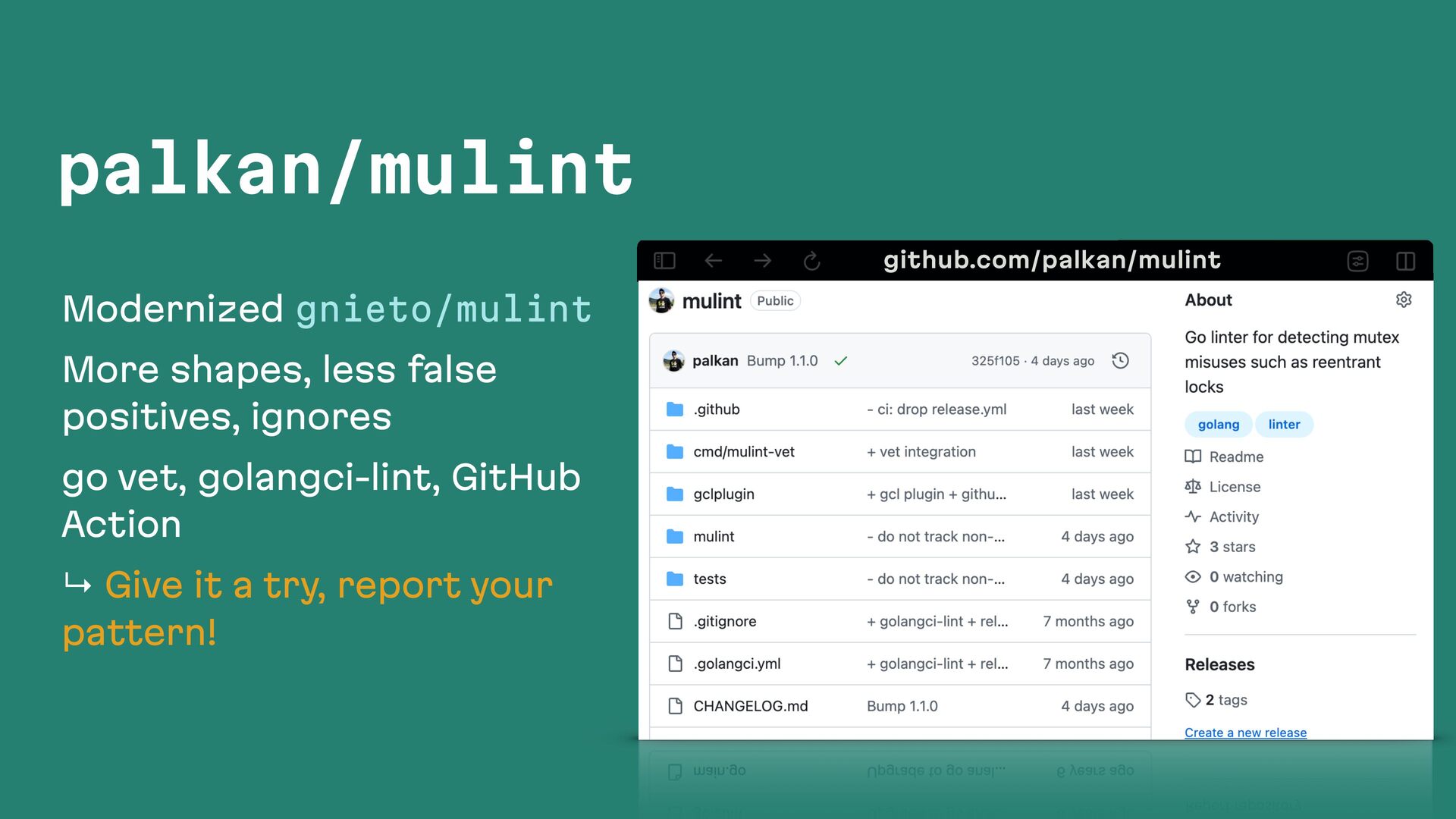
  47. palkan/mulint github.com/palkan/mulint Modernized gnieto/mulint More shapes, less false positives, ignores

    go vet, golangci-lint, GitHub Action ↳ Give it a try, report your pattern!