Upgrade to Pro — share decks privately, control downloads, hide ads and more …

Data Architecture & Patterns: Building Scalable...

Data Architecture & Patterns: Building Scalable, Resilient, and Future-Proof Systems

Avatar for Paul Karikari

Paul Karikari

August 07, 2025

More Decks by Paul Karikari

Other Decks in Technology

Transcript

  1. Data Architecture & Patterns Building Scalable, Resilient, and Future-Proof Systems

    Presented by: Paul Karikari, Principal Solutions Architect- Data & AI, TheDataLead AI
  2. Meet Our Client: ABC Bank ABC Bank is a mid-size

    bank expanding digital services. Pain points: slow analytics, fragmented data sources, regulatory pressure. Goal: Build a modern platform that scales with growth, ensures compliance, and accelerates insight delivery. "Every system has a story. Architecture is how we tell it well." — Anonymous Data Architecture and Patterns | Presented by: Paul Karikari, Principal Solutions Architect-Data & AI, TheDataLead AI
  3. What is Data Architecure? Apply problem-solving strategies in various contexts

    Data Architecture and Patterns | Presented by: Paul Karikari, Principal Solutions Architect - Data & AI, TheDataLead AI
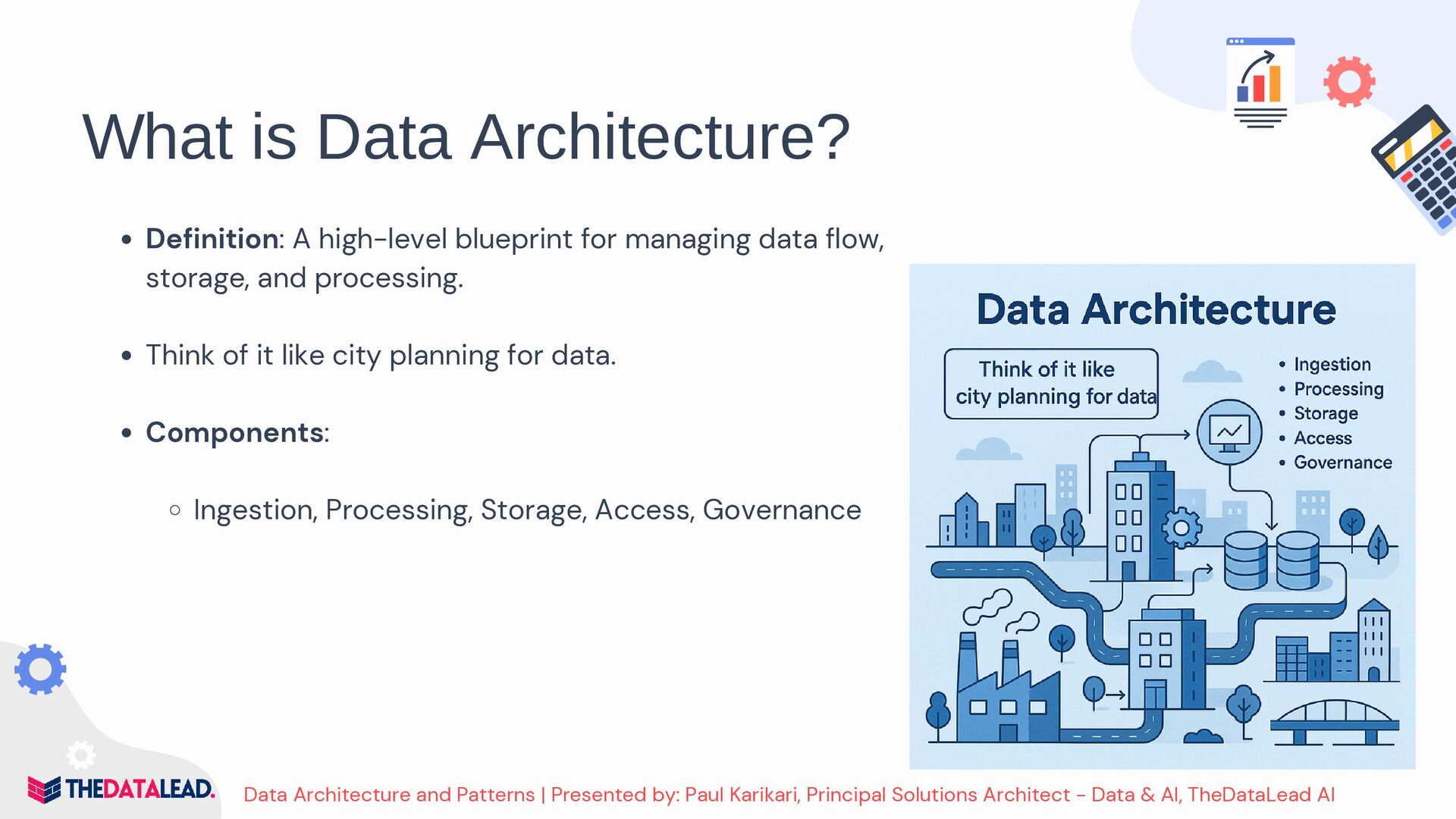
  4. What is Data Architecture? Definition: A high-level blueprint for managing

    data flow, storage, and processing. Think of it like city planning for data. Components: Ingestion, Processing, Storage, Access, Governance Data Architecture and Patterns | Presented by: Paul Karikari, Principal Solutions Architect - Data & AI, TheDataLead AI
  5. Why Businesses Need Data Architecture Aligns data with strategic goals

    Enables faster, more reliable decisions Reduces time to insight Provides a foundation for compliance and governance Scales with business growth Data Architecture and Patterns | Presented by: Paul Karikari, Principal Solutions Architect - Data & AI, TheDataLead AI
  6. What Does a Data Architect Do? Role Overview: Translate business

    needs into data systems Define blueprints for data ingestion, storage, processing, access Make trade-offs: cost vs performance, speed vs quality Set standards for data modeling, security, and quality Key Skills: Systems thinking, communication, tech fluency Hands-on knowledge of databases, pipelines, cloud infrastructure "A data architect is part engineer, part strategist, part diplomat." — Modern Data Leader Data Architecture and Patterns | Presented by: Paul Karikari, Principal Solutions Architect - Data & AI, TheDataLead AI
  7. Principles of Good Data Architecture Modularity: Build like LEGO, not

    spaghetti Scalability: Design for today, prepare for tomorrow Observability: You can't manage what you can't see Governance: Privacy and auditability from Day 1 Story: ABC Bank had nightly failures they couldn’t trace — observability changed the game. Data Architecture and Patterns | Presented by: Paul Karikari, Principal Solutions Architect - Data & AI, TheDataLead AI
  8. Common Architectural Patterns ETL vs ELT Lambda vs Kappa Medallion

    Architecture (Bronze → Silver → Gold) Event-Driven Architecture "Architecture is the skeleton; patterns are the joints that give it motion." — Martin Fowler Data Architecture and Patterns | Presented by: Paul Karikari, Principal Solutions Architect - Data & AI, TheDataLead AI
  9. Distributed Systems – What Every Data Engineer Must Know Why

    distributed systems? Big data is too big for one machine Key concepts: CAP Theorem (Consistency, Availability, Partition Tolerance) Latency Trade-offs: Coordination vs Speed Consistency Models: Strong Consistency: All nodes return the same value for the same query. Eventual Consistency: All updates eventually propagate, but not immediately. Causal Consistency: Operations that are causally related are seen in order. Read-your-writes Consistency: A system where a user always sees their own updates. Story: ABC Bank’s fraud detection engine needed real-time updates — eventual consistency broke alerts. We switched to strong consistency using a stateful streaming layer. “A distributed system is one where the failure of a remote machine renders your own unusable.” — Leslie Lamport Data Architecture and Patterns | Presented by: Paul Karikari, Principal Solutions Architect - Data & AI, TheDataLead AI
  10. Latency, Scalability, and Availability – Making It Relatable Latency =

    Speed What it is: Time delay between request and response. Relatable example: Waiting for a website to load—like waiting too long in a coffee queue. Why it matters: High latency = user frustration. Scalability = Growth Without Pain What it is: System’s ability to handle more users or data smoothly. Relatable example: Your favorite food truck expanding to serve 100 customers, not just 10. Why it matters: Unscalable systems crash under pressure. Availability = Always On What it is: How often the service is up and running. Relatable example: ATM that’s always working vs. one that’s down when you need cash. Why it matters: Downtime = lost trust, lost users. Balancing All Three = A Great User Experience You want your app/site to be fast, reliable, and ready to grow—just like your favorite online service. Data Architecture and Patterns | Presented by: Paul Karikari, Principal Solutions Architect - Data & AI, TheDataLead AI
  11. Latency Trade-offs: Coordination vs. Speed What is Latency in Distributed

    Systems? Latency is the time delay from making a request to receiving a response. In distributed systems, latency increases with the number of machines, geographic distance, and required coordination between nodes. More Coordination = Higher Consistency Systems pause to confirm state across multiple nodes. Example: Distributed databases using two-phase commit. Trade-off: Higher latency but strong consistency. Less Coordination = Faster Response Systems respond quickly, assuming updates will sync later. Example: Eventual consistency in DynamoDB, Cassandra. Trade-off: Lower latency but weaker guarantees. Real-World Analogy Imagine a group chat: Everyone checks with each other before replying → slow but consistent Everyone replies immediately, updates later → fast but possibly out of sync Data Architecture and Patterns | Presented by: Paul Karikari, Principal Solutions Architect - Data & AI, TheDataLead AI
  12. Database Internals – The Hidden Forces Indexing, Partitioning, Query Planning

    Columnar vs Row Stores Write vs Read optimisation OLTP vs OLAP ABC Bank: Choosing Delta Lake with Z-ordering reduced query time from 6 minutes to 14 seconds “If you're not thinking about internals, you're not designing — you're decorating.” — Joe Hellerstein Data Architecture and Patterns | Presented by: Paul Karikari, Principal Solutions Architect - Data & AI, TheDataLead AI
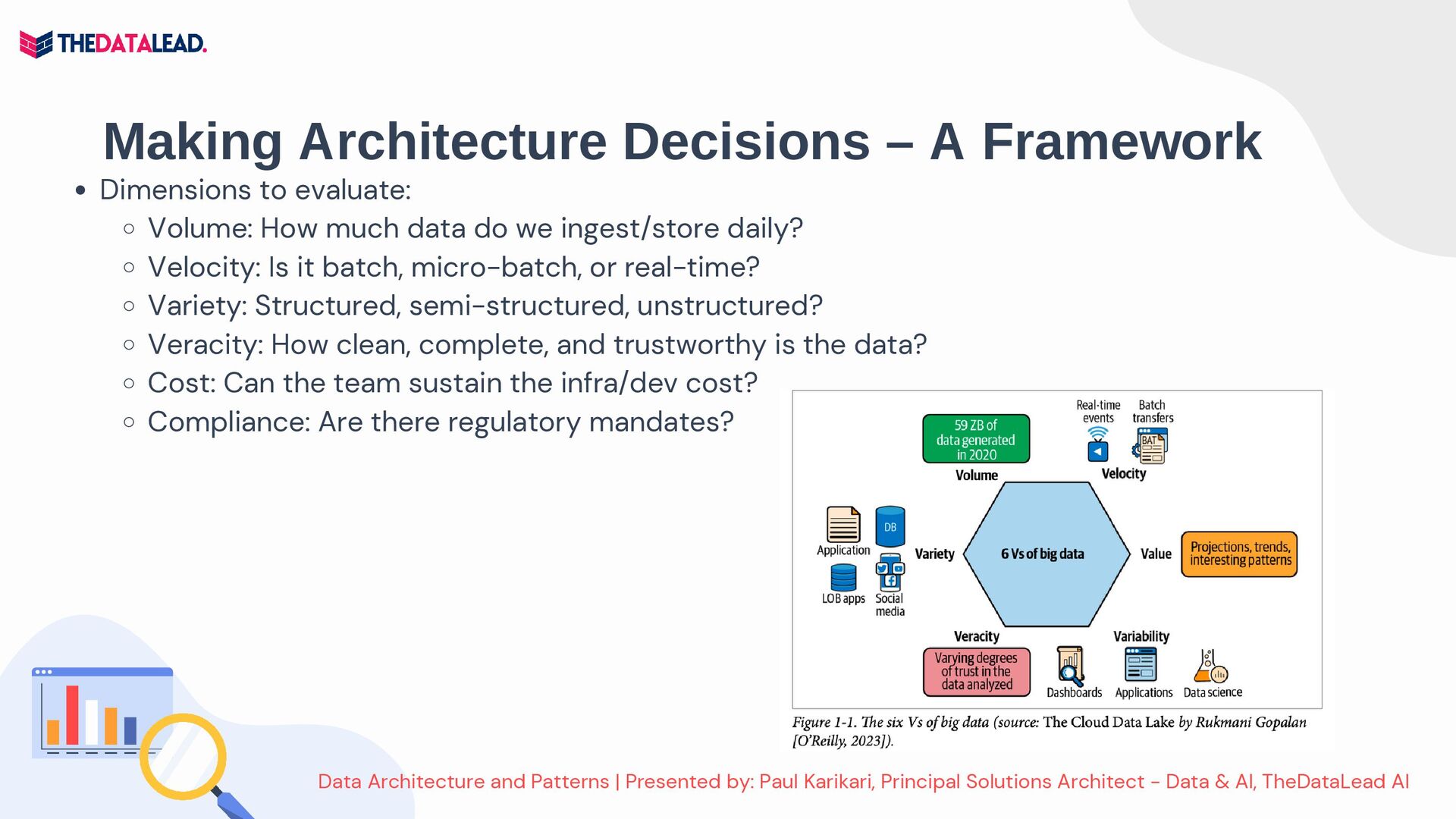
  13. Making Architecture Decisions – A Framework Dimensions to evaluate: Volume:

    How much data do we ingest/store daily? Velocity: Is it batch, micro-batch, or real-time? Variety: Structured, semi-structured, unstructured? Veracity: How clean, complete, and trustworthy is the data? Cost: Can the team sustain the infra/dev cost? Compliance: Are there regulatory mandates? Data Architecture and Patterns | Presented by: Paul Karikari, Principal Solutions Architect - Data & AI, TheDataLead AI
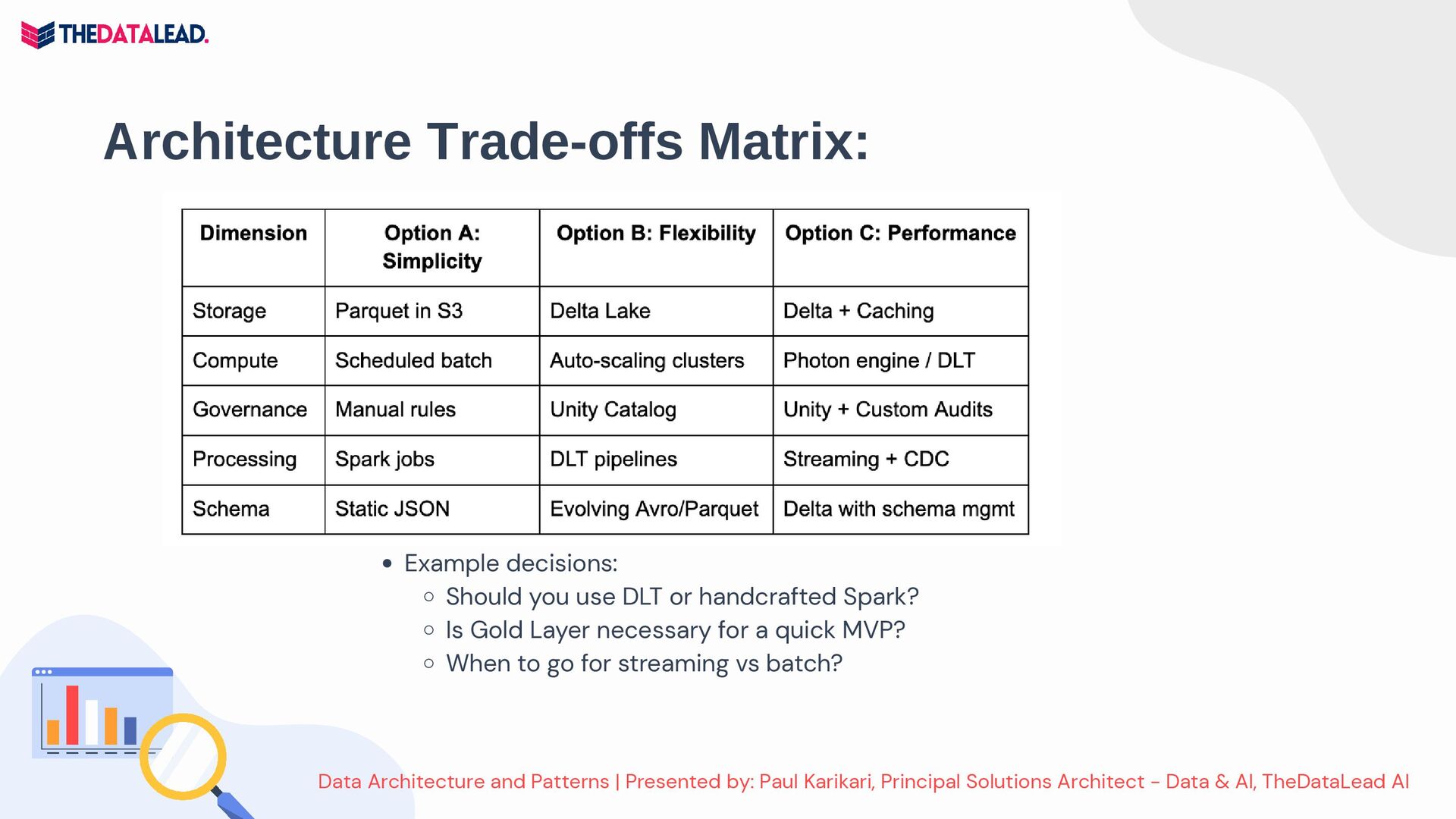
  14. Architecture Trade-offs Matrix: Example decisions: Should you use DLT or

    handcrafted Spark? Is Gold Layer necessary for a quick MVP? When to go for streaming vs batch? Data Architecture and Patterns | Presented by: Paul Karikari, Principal Solutions Architect - Data & AI, TheDataLead AI
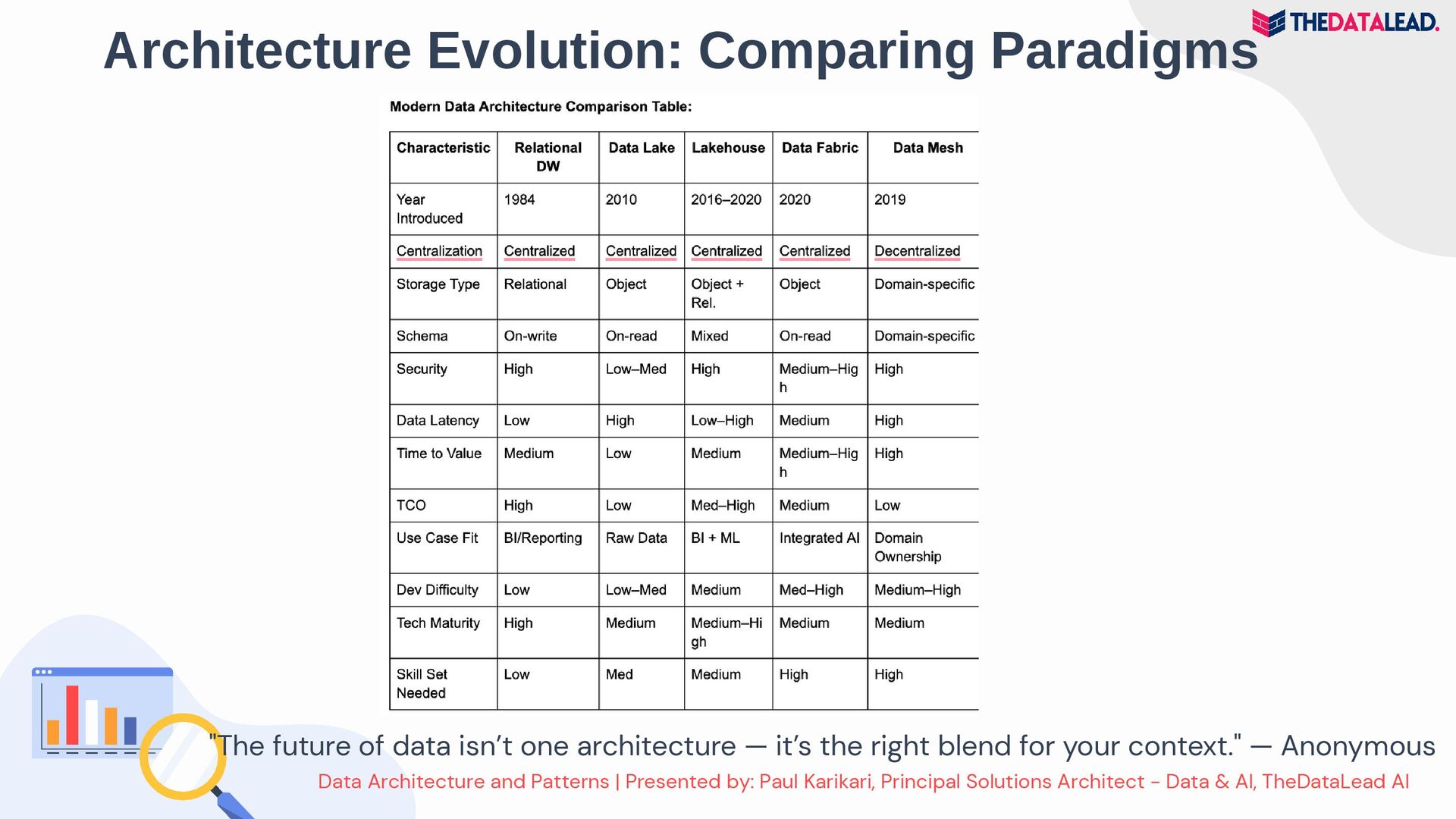
  15. Architecture Evolution: Comparing Paradigms "The future of data isn’t one

    architecture — it’s the right blend for your context." — Anonymous Data Architecture and Patterns | Presented by: Paul Karikari, Principal Solutions Architect - Data & AI, TheDataLead AI
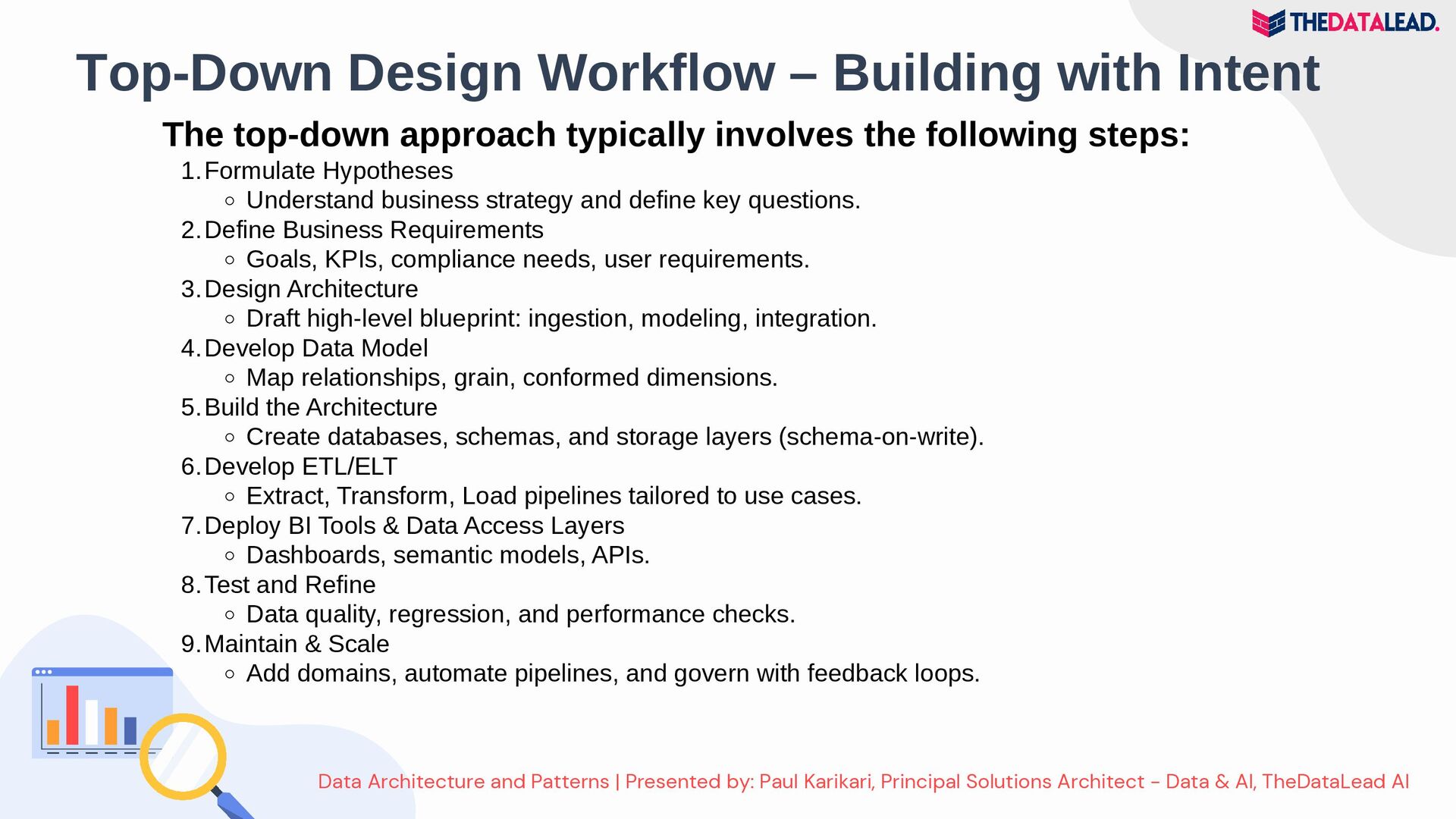
  16. Top-Down Design Workflow – Building with Intent The top-down approach

    typically involves the following steps: 1.Formulate Hypotheses Understand business strategy and define key questions. 2.Define Business Requirements Goals, KPIs, compliance needs, user requirements. 3.Design Architecture Draft high-level blueprint: ingestion, modeling, integration. 4.Develop Data Model Map relationships, grain, conformed dimensions. 5.Build the Architecture Create databases, schemas, and storage layers (schema-on-write). 6.Develop ETL/ELT Extract, Transform, Load pipelines tailored to use cases. 7.Deploy BI Tools & Data Access Layers Dashboards, semantic models, APIs. 8.Test and Refine Data quality, regression, and performance checks. 9.Maintain & Scale Add domains, automate pipelines, and govern with feedback loops. Data Architecture and Patterns | Presented by: Paul Karikari, Principal Solutions Architect - Data & AI, TheDataLead AI
  17. Real-Life Example – Applying the Workflow Case Study: ABC Bank’s

    Lending Analytics Modernisation Step 1–2: Identified KPI: Time to approve loan offers. Business needed < 30 mins from application to risk score. Step 3–4: Designed architecture with streaming ingestion, unified customer table, and real-time scoring service. Step 5–6: Built Delta Lake layers (Bronze → Gold), added CDC pipelines for transactions, used DLT to automate workflows. Step 7: Exposed data to dashboards and APIs for credit analysts. Step 8–9: Added validation and alerting, then scaled to support all lending products. Impact: Reduced decision latency from 6 hours to under 20 minutes. “Strategy without execution is hallucination. Execution without architecture is chaos.” Data Architecture and Patterns | Presented by: Paul Karikari, Principal Solutions Architect - Data & AI, TheDataLead AI
  18. Pitfalls and Patterns to Avoid "Your architecture reflects your org

    chart — fix both." — Conway’s Law Overengineering early Ignoring schema evolution Treating storage as free Misusing caching Skipping governance planning Data Architecture and Patterns | Presented by: Paul Karikari, Principal Solutions Architect - Data & AI, TheDataLead AI
  19. Bringing It All Together “Great architecture is invisible — it

    just works.” — Grady Booch Recap: Story of ABC Bank from chaos to control Tools used: Delta Lake, Unity Catalog, DLT, Structured Streaming Architecture is not static — it's evolving with the business Data Architecture and Patterns | Presented by: Paul Karikari, Principal Solutions Architect - Data & AI, TheDataLead AI
  20. Any Questions? Data Architecture and Patterns | Presented by: Paul

    Karikari, Principal Solutions Architect - Data & AI, TheDataLead AI
  21. "Design for the failure case. That’s when the architecture reveals

    itself." — Adrian Cockcroft [email protected] Data Architecture and Patterns | Presented by: Paul Karikari, Principal Solutions Architect - Data & AI, TheDataLead AI
  22. Key Takeaways – What Every Data Engineer Should Remember Architecture

    is Strategic, Not Just Technical It aligns with business goals and anticipates change. Don’t just build for today — build for resilience tomorrow. Patterns Guide, Context Decides ETL vs ELT, batch vs streaming, mesh vs fabric — each has trade-offs. Always ask: What problem am I solving? Distributed Systems Are Inevitable Understand consistency models, partitioning, and failure modes. It’s not “if” things fail — it’s how you design for recovery. Know the Internals to Design Externals Indexes, partitions, schemas, and query planners deeply affect performance and cost. Choose tools (Delta, Photon, Unity) based on workload needs. Make Trade-offs Explicit Use a framework or matrix to document decisions. Technical debt often comes from unconscious compromises. Think Top-Down, Build Bottom-Up Start with strategy, define KPIs, design with purpose. Let use cases pull architecture, not tech push it. Modern ≠ Hype — It’s Fit-for-Purpose Whether lakehouse, data mesh, or fabric, choose based on scale, domain ownership, latency, and team maturity. “Architectures age like milk or wine — your choices determine which.” — Anonymous Data Architecture and Patterns | Presented by: Paul Karikari, Principal Solutions Architect - Data & AI, TheDataLead AI