Agents on Databricks Paul Karikari Principal Engineer & Solutions Architect ,Data & AI - Databricks thedatalead.ai 60-minute session • 30 min talk + 30 minlab
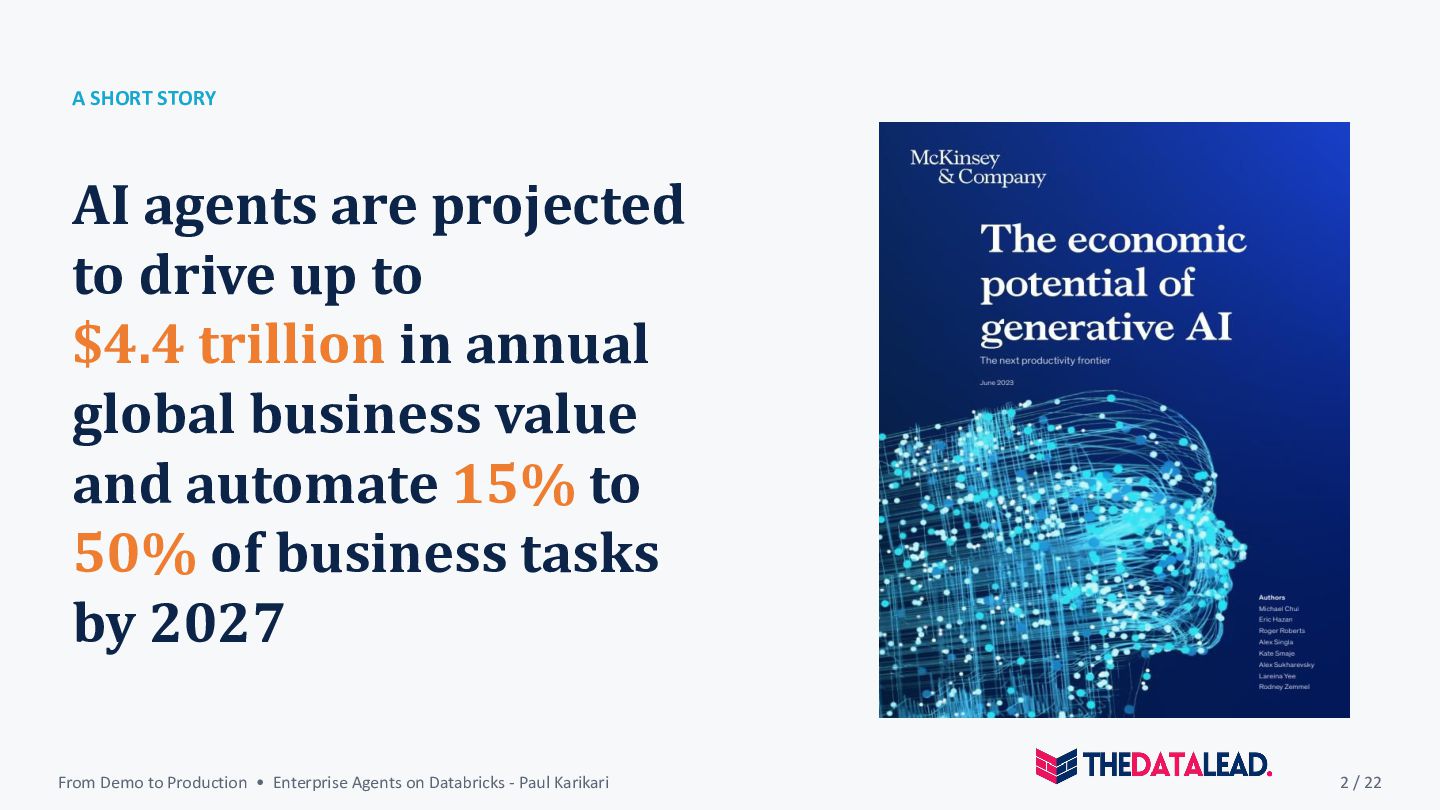
to $4.4 trillion in annual global business value and automate 15% to 50% of business tasks by 2027 From Demo to Production • Enterprise Agents on Databricks - Paul Karikari 2 / 22
IBM partnered in 2021 on an automated voice-ordering system, deployed across more than 100 US drive-thrus. Today: why most enterprise agent projects don't fail in production. they fail before production, because they were never the right tool for the job. From Demo to Production • Enterprise Agents on Databricks - Paul Karikari 2 / 22
covered three years and over 100 locations, but viral social media posts documented frequent misorders adding unwanted items, mixing adjacent lane orders, ignoring corrections before McDonald's confirmed it was ending the IBM partnership in June 2024. Today: why most enterprise agent projects don't fail in production — they fail before production, because they were never the right tool for the job. From Demo to Production • Enterprise Agents on Databricks - Paul Karikari 2 / 22
is for you ML / AI engineers Data engineers Tech leads & architects Building or about to build agents Owning the platform agents will run on Picking the patterns the team adopts Familiar with LLMs. New to agents in production. From Demo to Production • Enterprise Agents on Databricks -- Paul Karikari 3 / 22
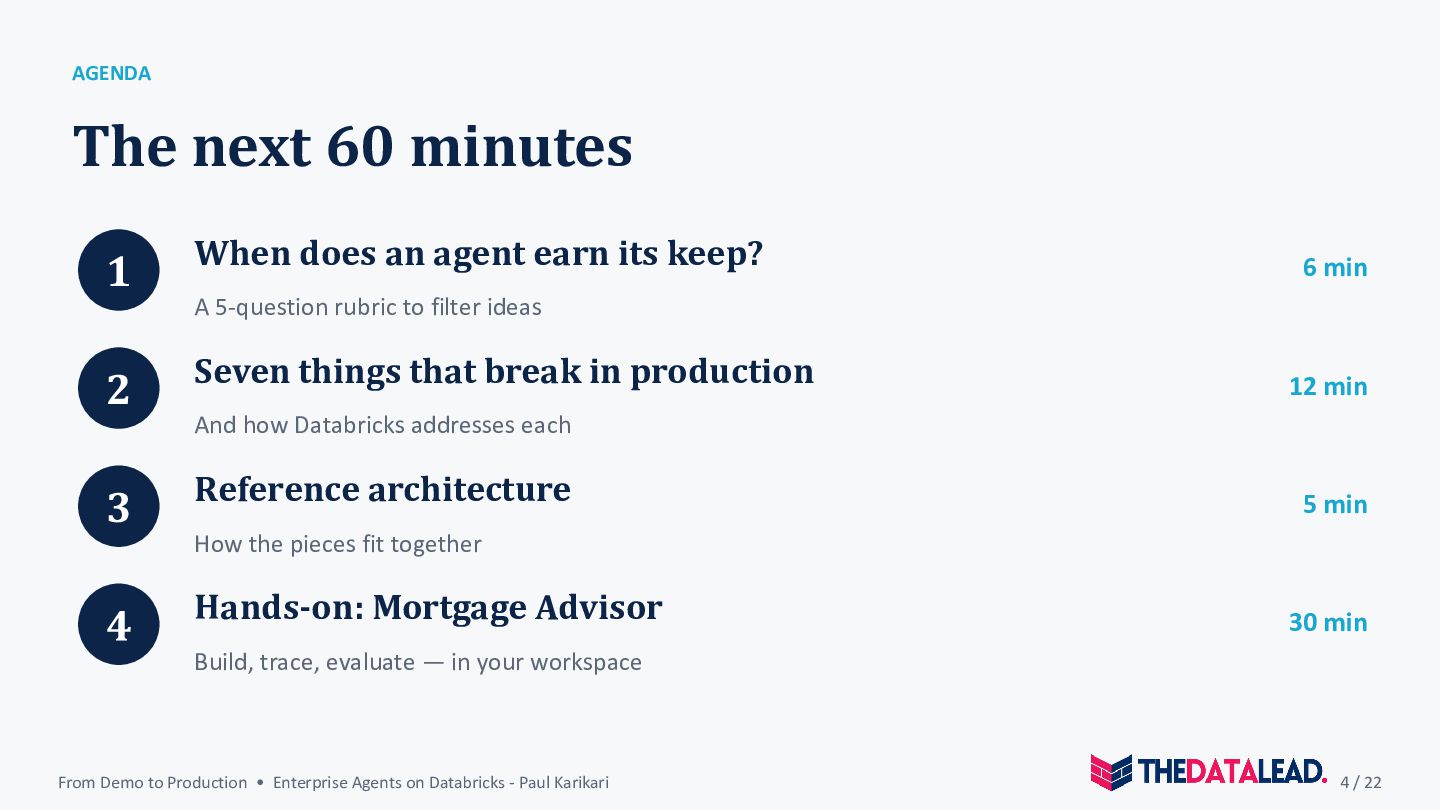
earn its keep? 6 min A 5-question rubric to filter ideas 2 Seven things that break in production 12 min And how Databricks addresses each 3 Reference architecture 5 min How the pieces fit together 4 Hands-on: Mortgage Advisor 30 min Build, trace, evaluate — in your workspace From Demo to Production • Enterprise Agents on Databricks - Paul Karikari 4 / 22
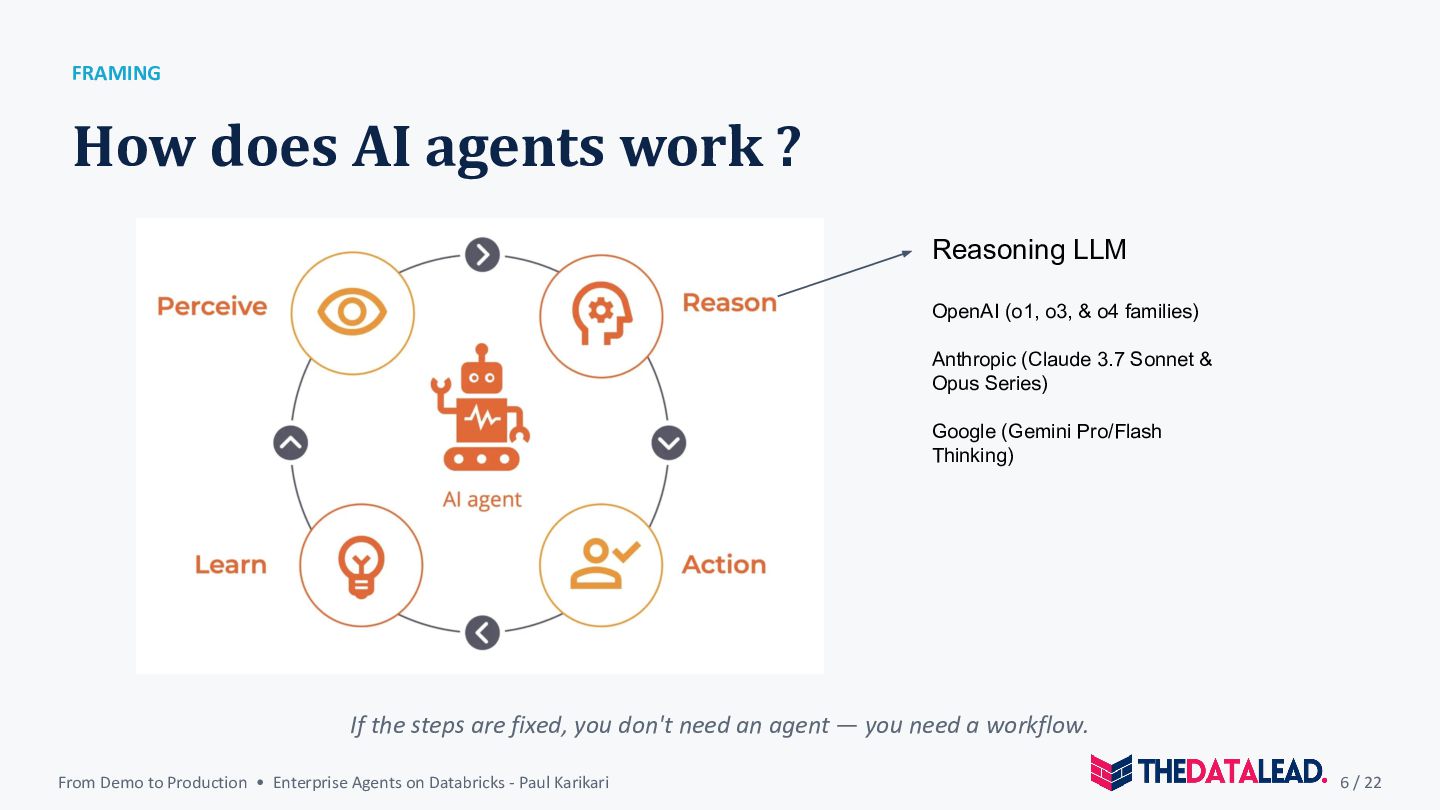
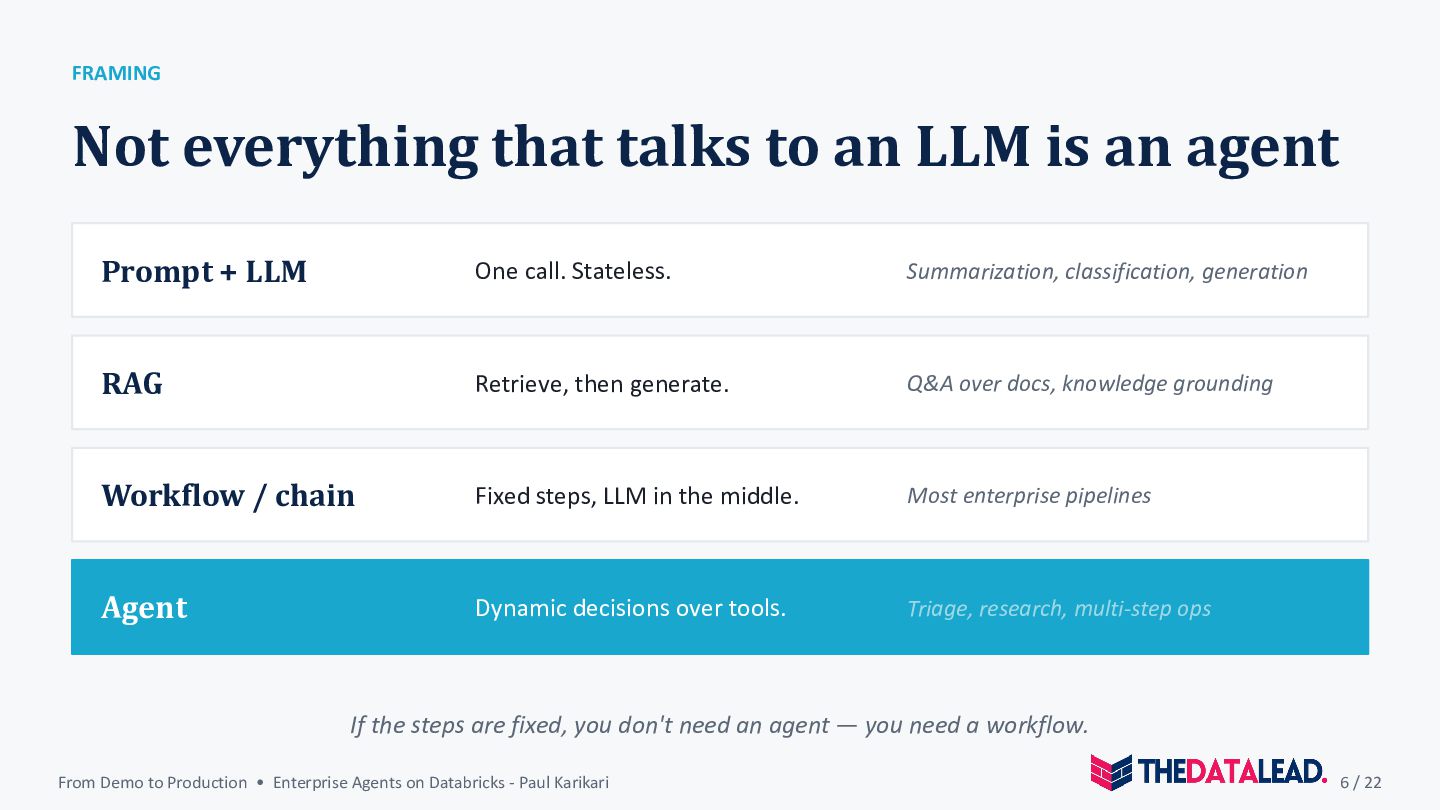
(o1, o3, & o4 families) Anthropic (Claude 3.7 Sonnet & Opus Series) Google (Gemini Pro/Flash Thinking) If the steps are fixed, you don't need an agent — you need a workflow. From Demo to Production • Enterprise Agents on Databricks - Paul Karikari 6 / 22
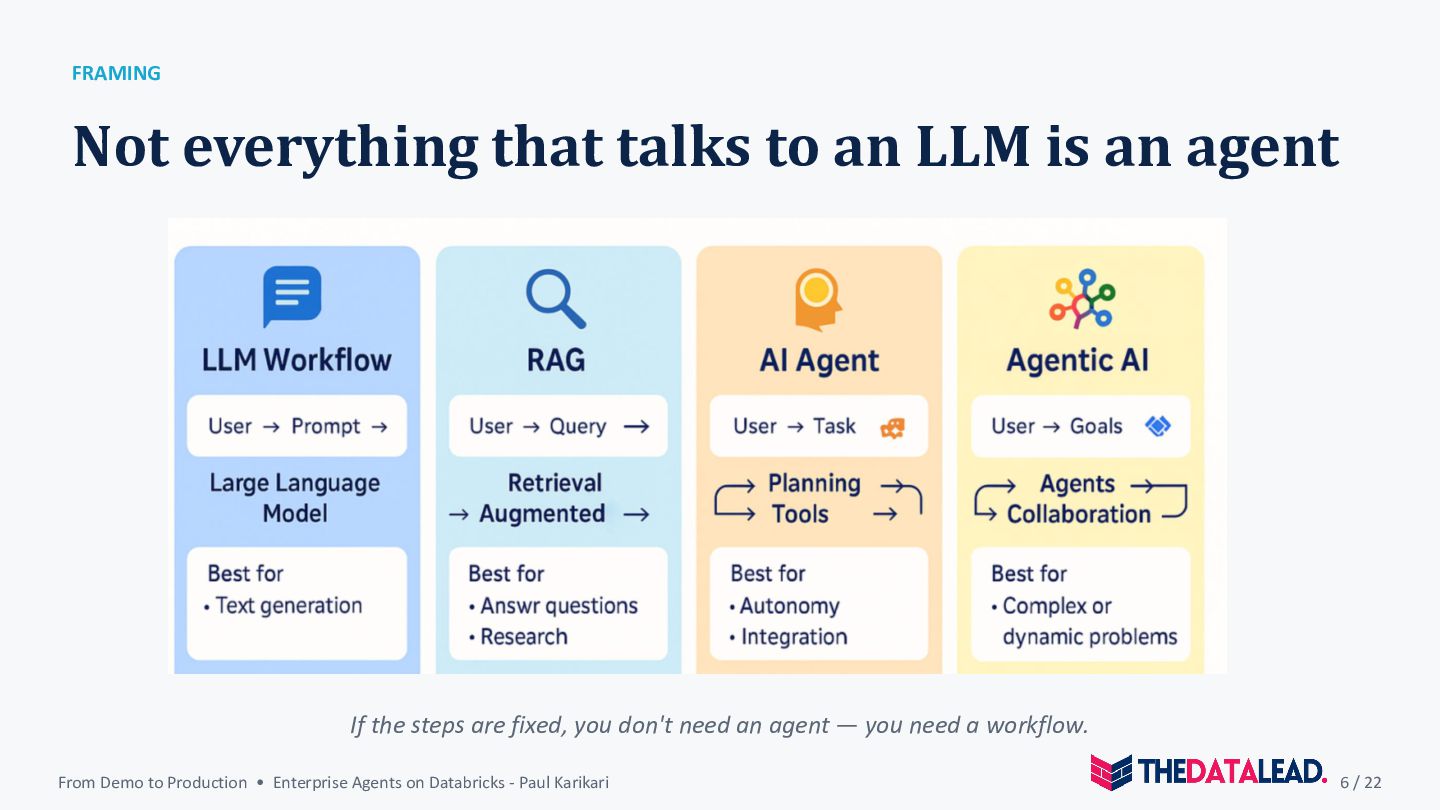
agent If the steps are fixed, you don't need an agent — you need a workflow. From Demo to Production • Enterprise Agents on Databricks - Paul Karikari 6 / 22
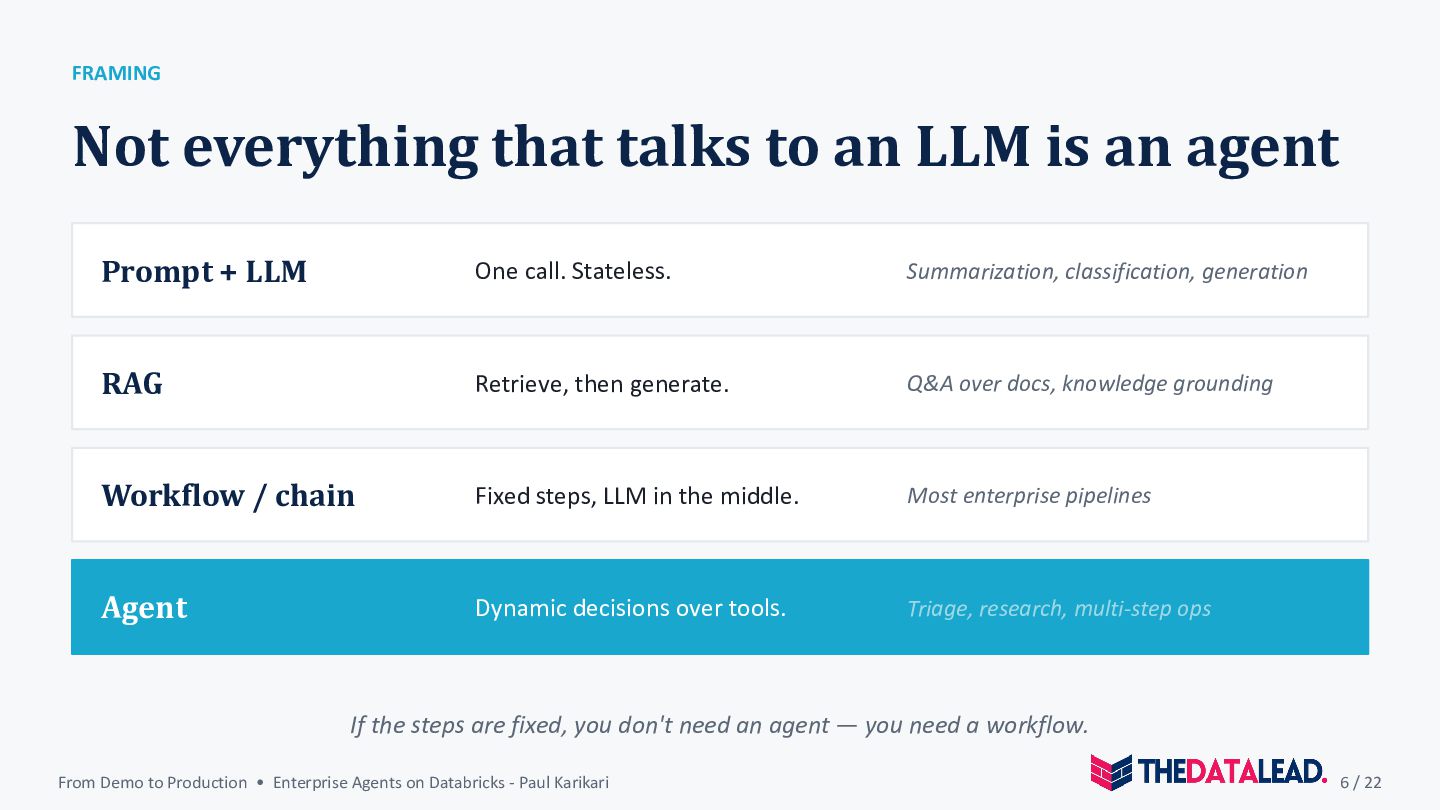
agent Prompt + LLM One call. Stateless. Summarization, classification, generation RAG Retrieve, then generate. Q&A over docs, knowledge grounding Workflow / chain Fixed steps, LLM in the middle. Most enterprise pipelines Agent Dynamic decisions over tools. Triage, research, multi-step ops If the steps are fixed, you don't need an agent — you need a workflow. From Demo to Production • Enterprise Agents on Databricks - Paul Karikari 6 / 22
agent Prompt + LLM One call. Stateless. Summarization, classification, generation RAG Retrieve, then generate. Q&A over docs, knowledge grounding Workflow / chain Fixed steps, LLM in the middle. Most enterprise pipelines Agent Dynamic decisions over tools. Triage, research, multi-step ops If the steps are fixed, you don't need an agent — you need a workflow. From Demo to Production • Enterprise Agents on Databricks - Paul Karikari 6 / 22
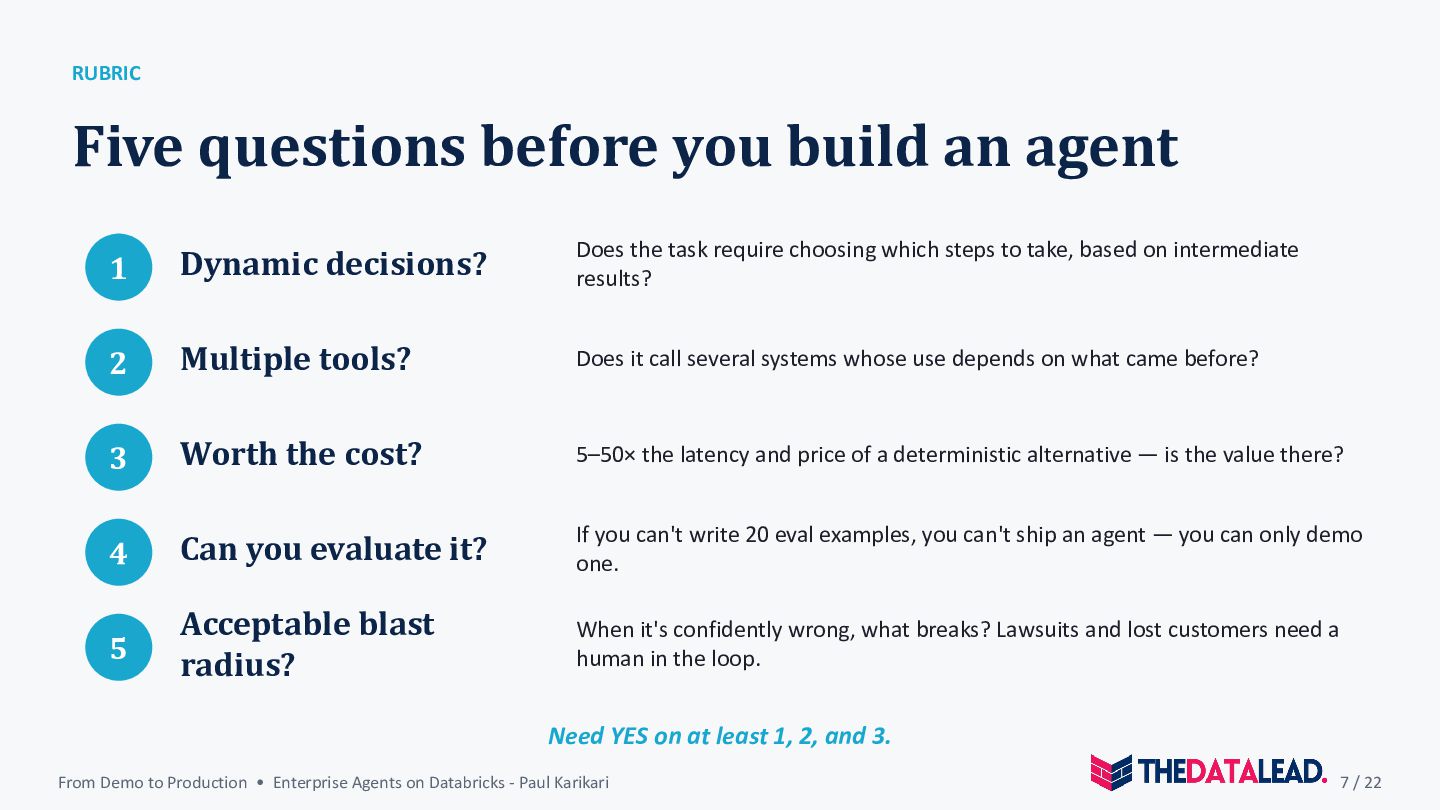
decisions? Does the task require choosing which steps to take, based on intermediate results? 2 Multiple tools? Does it call several systems whose use depends on what came before? 3 Worth the cost? 5–50× the latency and price of a deterministic alternative — is the value there? 4 Can you evaluate it? If you can't write 20 eval examples, you can't ship an agent — you can only demo one. 5 Acceptable blast radius? When it's confidently wrong, what breaks? Lawsuits and lost customers need a human in the loop. Need YES on at least 1, 2, and 3. From Demo to Production • Enterprise Agents on Databricks - Paul Karikari 7 / 22
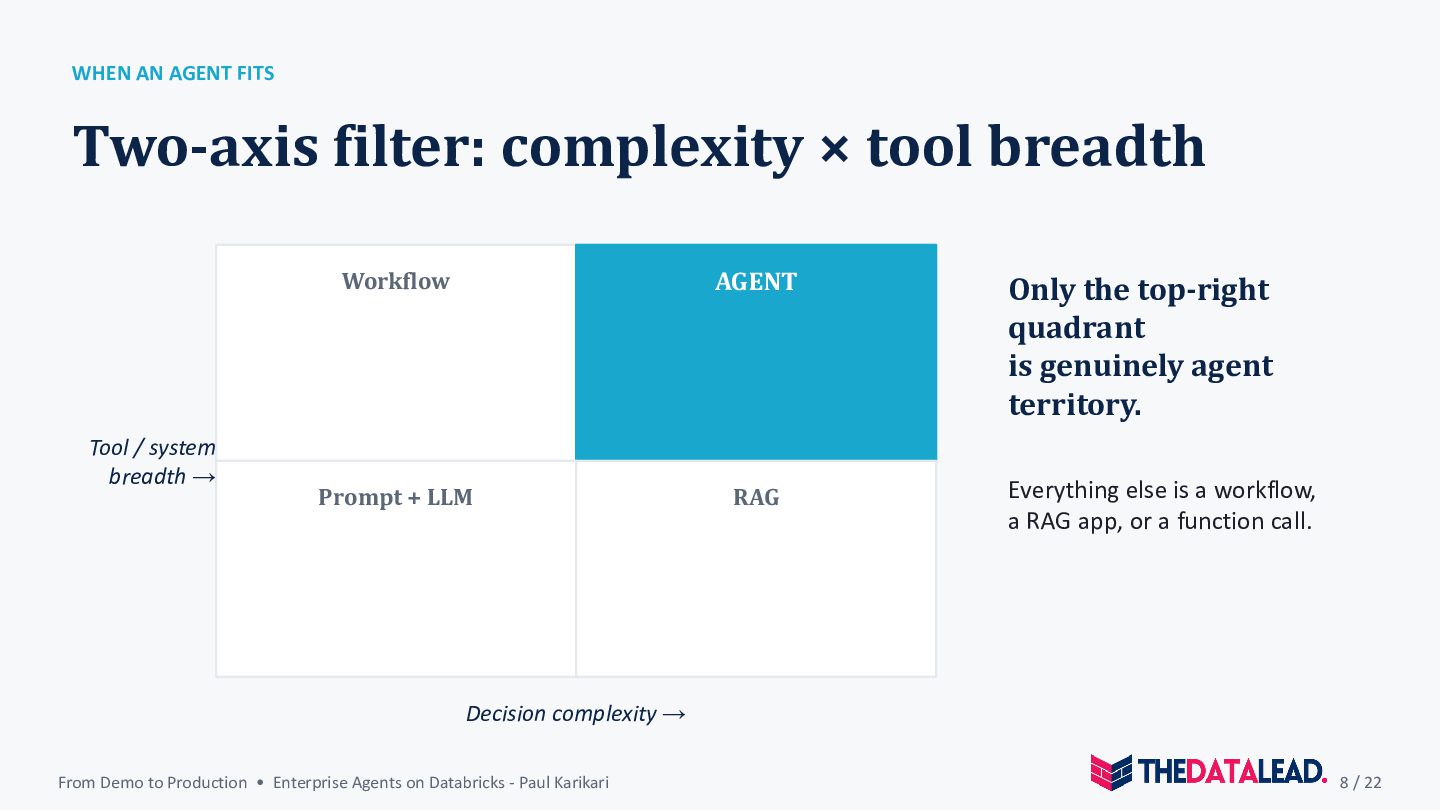
Tool / system breadth → Workflow AGENT Prompt + LLM RAG Only the top-right quadrant is genuinely agent territory. Everything else is a workflow, a RAG app, or a function call. Decision complexity → From Demo to Production • Enterprise Agents on Databricks - Paul Karikari 8 / 22
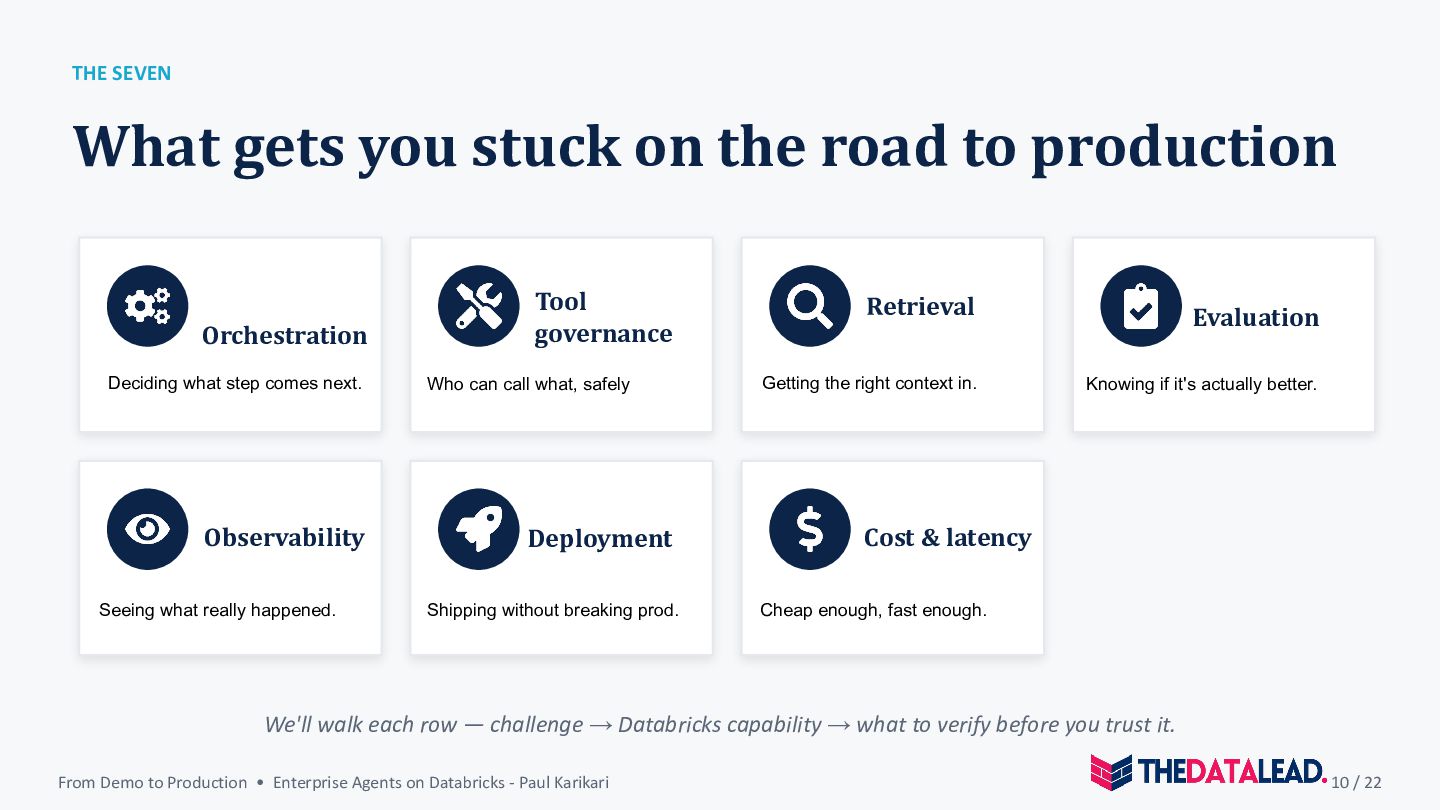
production Orchestration Deciding what step comes next. Observability Seeing what really happened. Tool governance Who can call what, safely Deployment Shipping without breaking prod. Retrieval Getting the right context in. Evaluation Knowing if it's actually better. Cost & latency Cheap enough, fast enough. We'll walk each row — challenge → Databricks capability → what to verify before you trust it. From Demo to Production • Enterprise Agents on Databricks - Paul Karikari 10 / 22
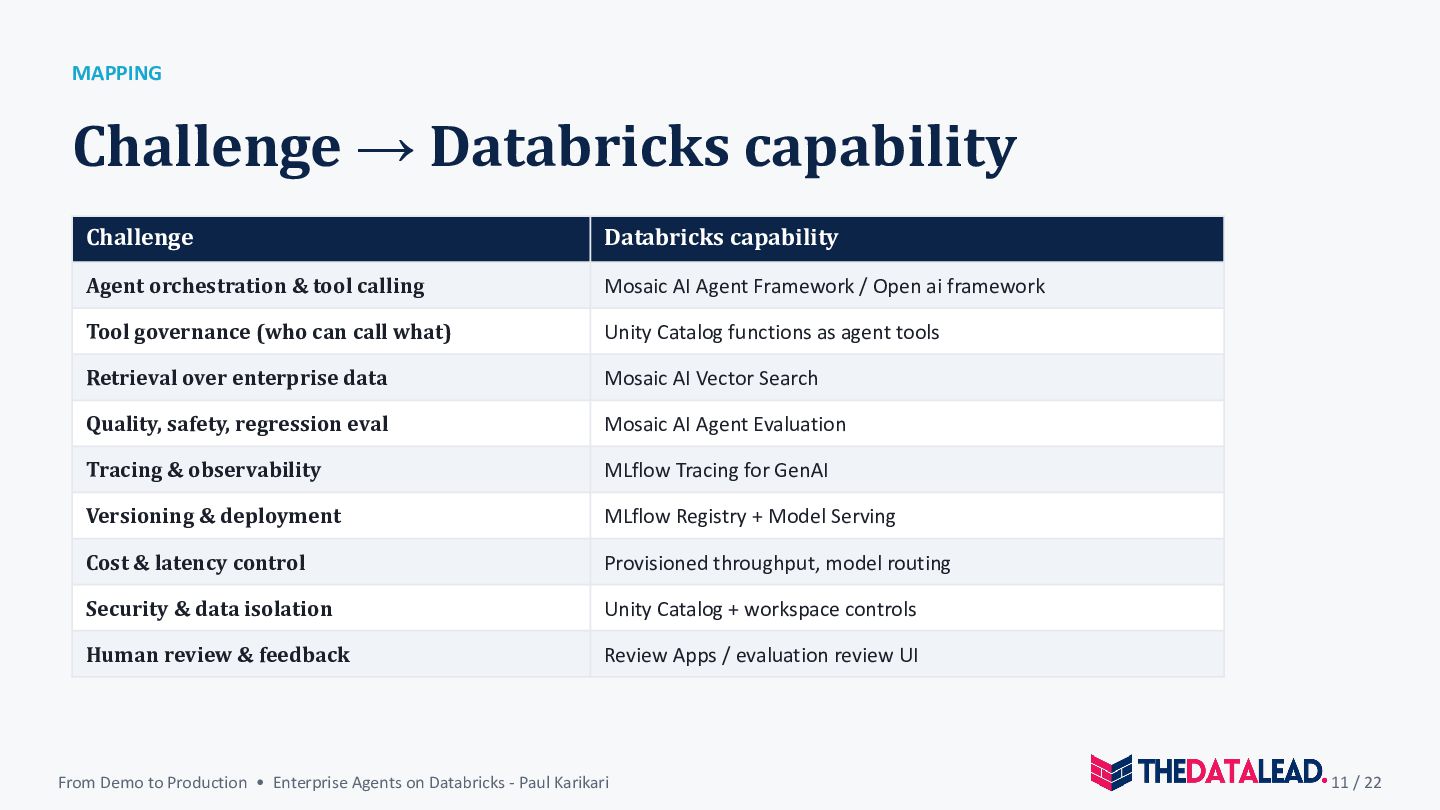
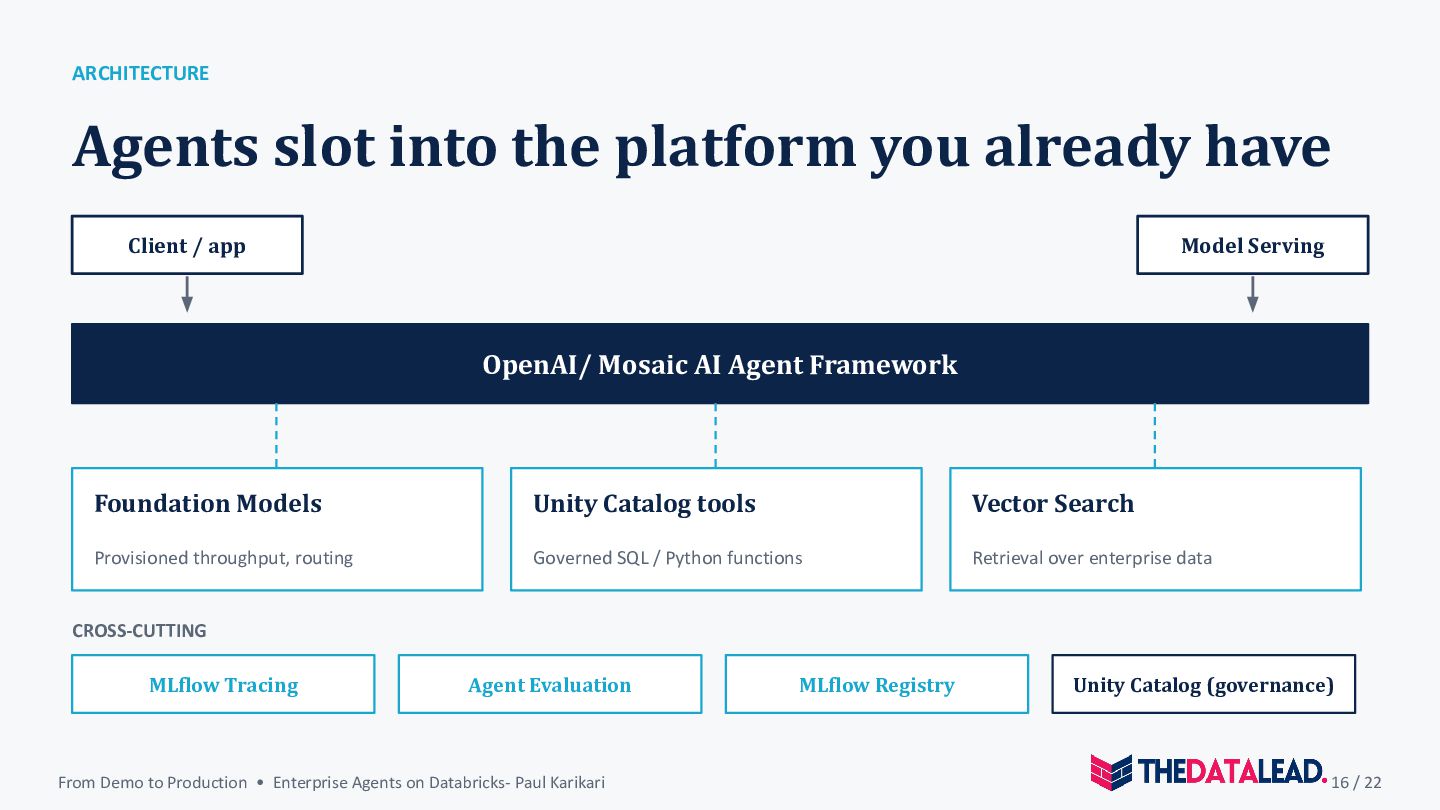
& tool calling Mosaic AI Agent Framework / Open ai framework Tool governance (who can call what) Unity Catalog functions as agent tools Retrieval over enterprise data Mosaic AI Vector Search Quality, safety, regression eval Mosaic AI Agent Evaluation Tracing & observability MLflow Tracing for GenAI Versioning & deployment MLflow Registry + Model Serving Cost & latency control Provisioned throughput, model routing Security & data isolation Unity Catalog + workspace controls Human review & feedback Review Apps / evaluation review UI From Demo to Production • Enterprise Agents on Databricks - Paul Karikari 11 / 22
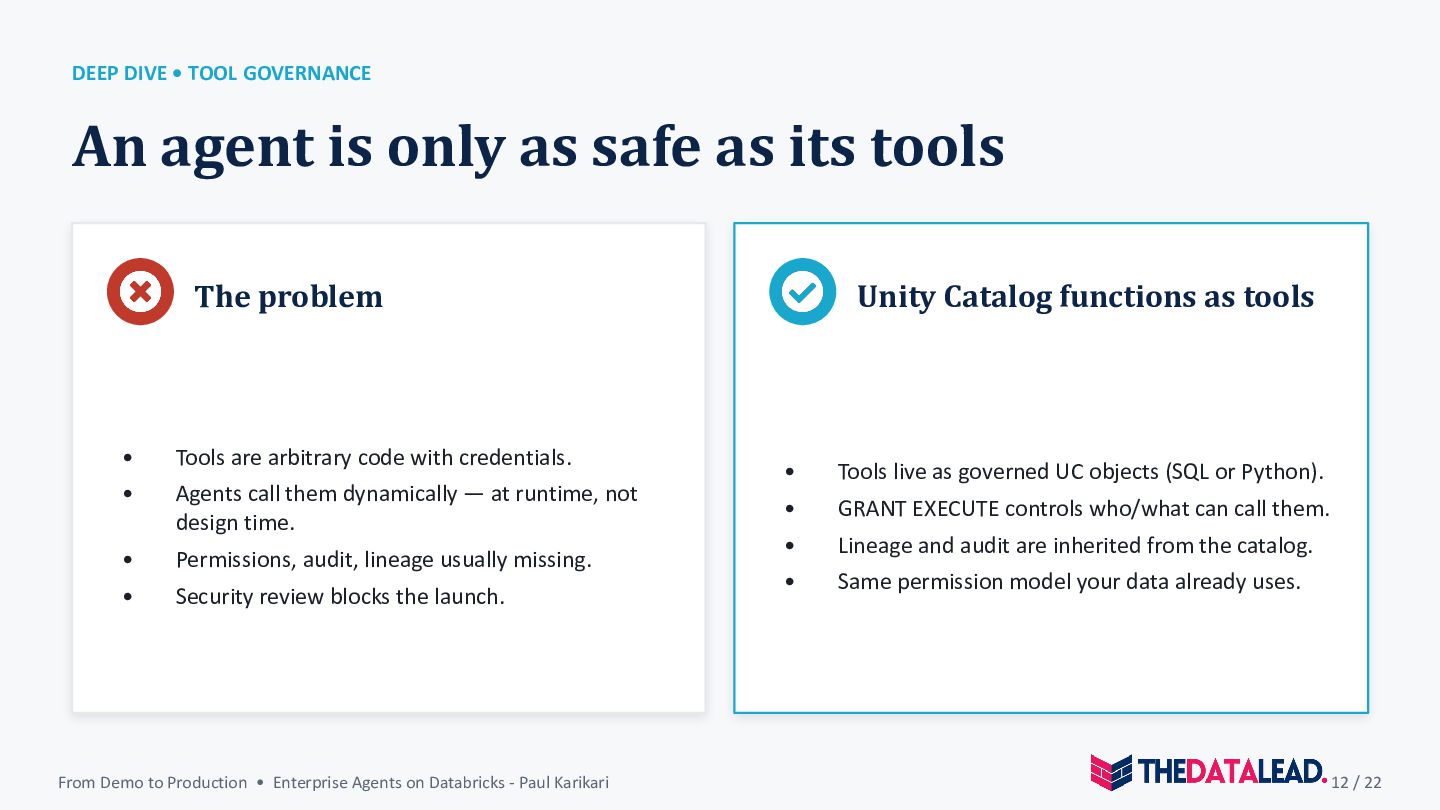
safe as its tools The problem • Tools are arbitrary code with credentials. • Agents call them dynamically — at runtime, not design time. • Permissions, audit, lineage usually missing. • Security review blocks the launch. From Demo to Production • Enterprise Agents on Databricks - Paul Karikari Unity Catalog functions as tools • Tools live as governed UC objects (SQL or Python). • GRANT EXECUTE controls who/what can call them. • Lineage and audit are inherited from the catalog. • Same permission model your data already uses. 12 / 22
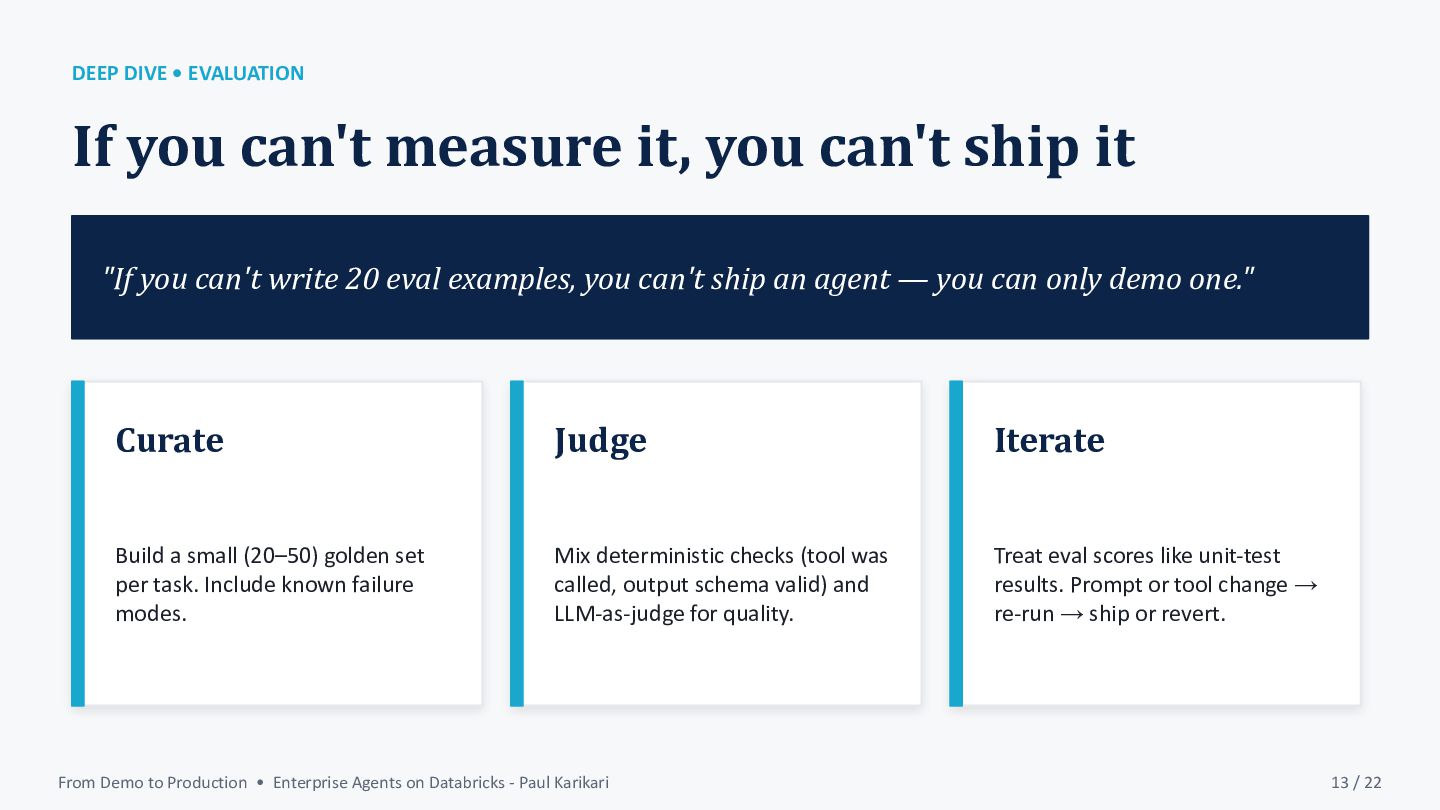
can't ship it "If you can't write 20 eval examples, you can't ship an agent — you can only demo one." Curate Judge Iterate Build a small (20–50) golden set per task. Include known failure modes. Mix deterministic checks (tool was called, output schema valid) and LLM-as-judge for quality. Treat eval scores like unit-test results. Prompt or tool change → re-run → ship or revert. From Demo to Production • Enterprise Agents on Databricks - Paul Karikari 13 / 22
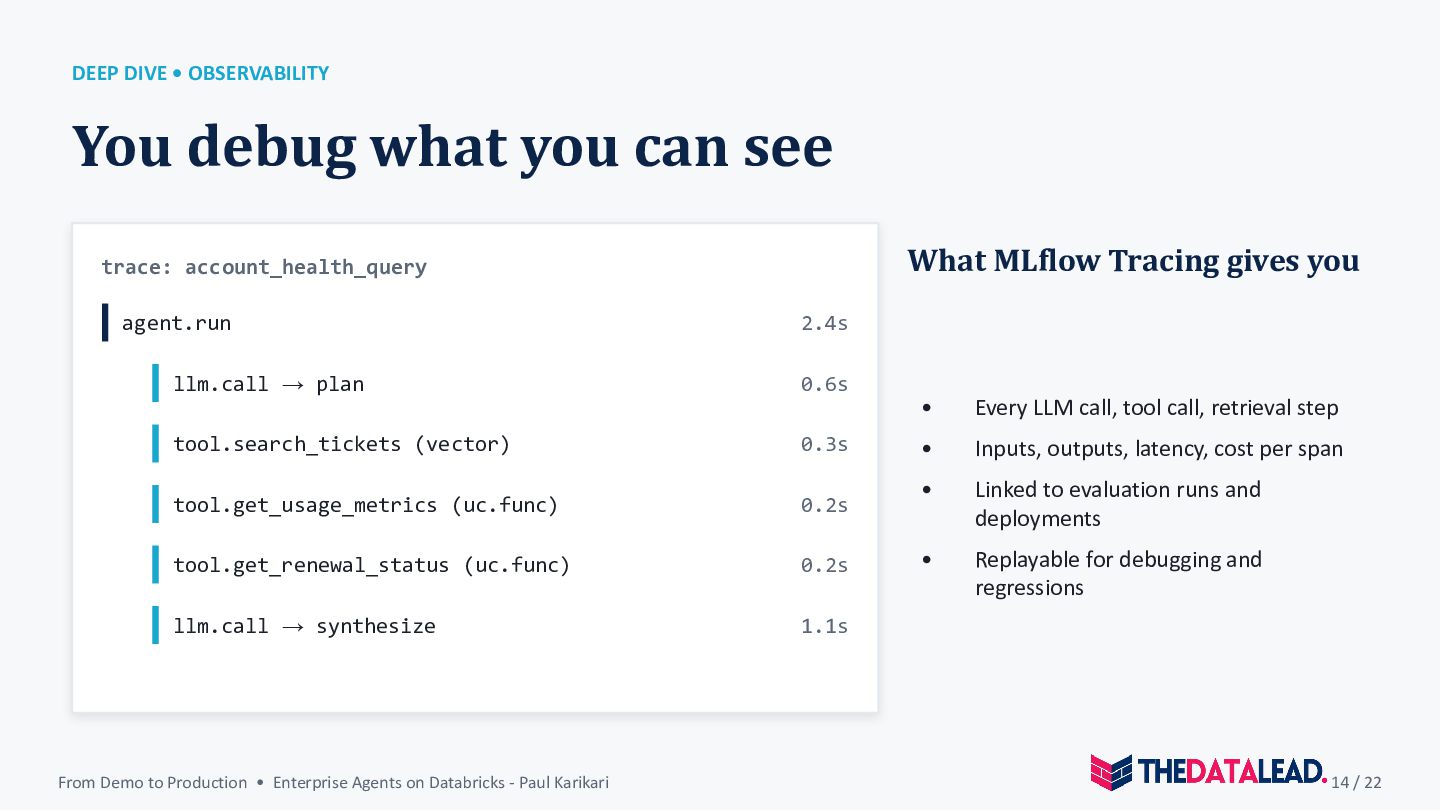
What MLflow Tracing gives you trace: account_health_query agent.run llm.call → plan 2.4s 0.6s tool.search_tickets (vector) 0.3s tool.get_usage_metrics (uc.func) 0.2s tool.get_renewal_status (uc.func) 0.2s llm.call → synthesize 1.1s From Demo to Production • Enterprise Agents on Databricks - Paul Karikari • Every LLM call, tool call, retrieval step • Inputs, outputs, latency, cost per span • Linked to evaluation runs and deployments • Replayable for debugging and regressions 14 / 22
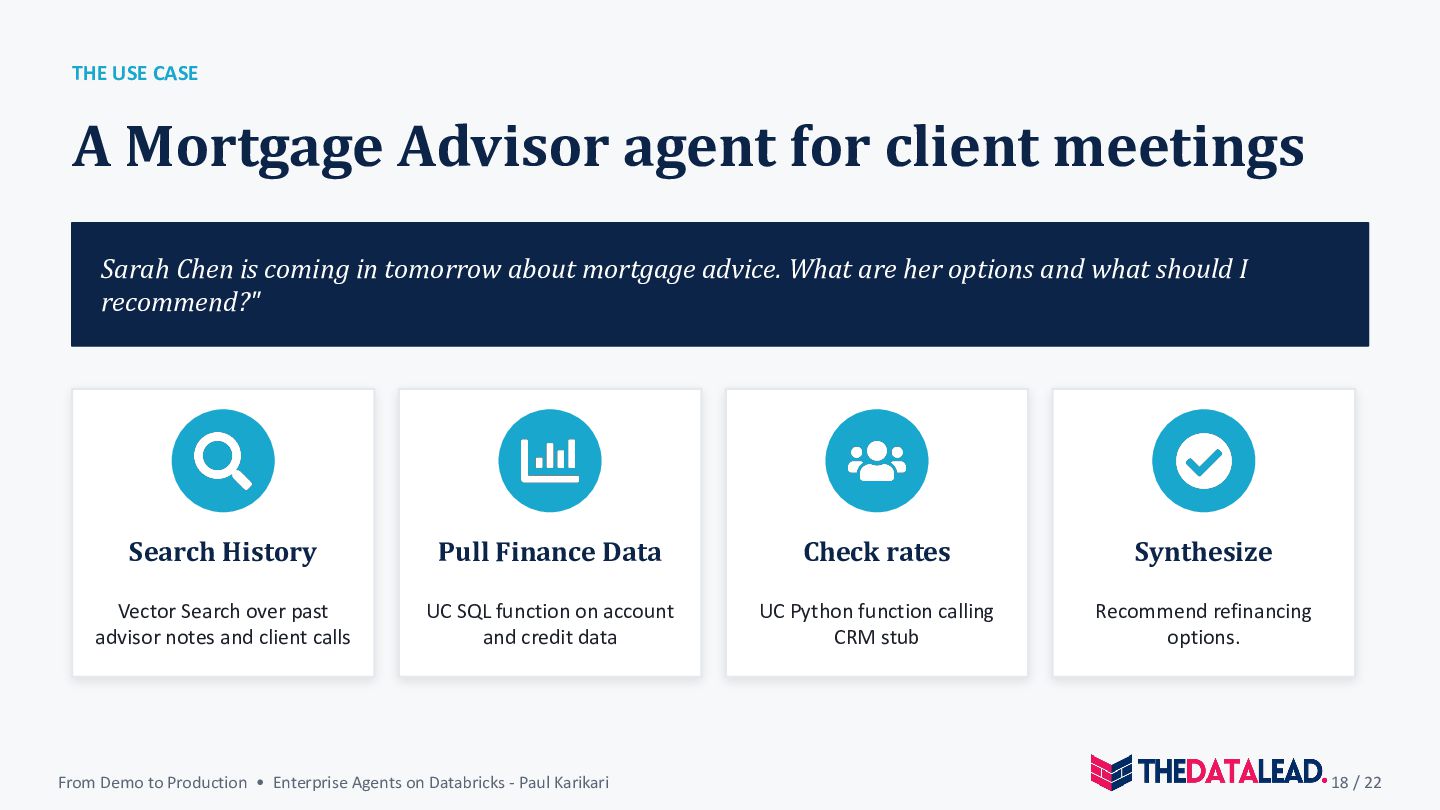
Sarah Chen is coming in tomorrow about mortgage advice. What are her options and what should I recommend?" Search History Pull Finance Data Check rates Synthesize Vector Search over past advisor notes and client calls UC SQL function on account and credit data UC Python function calling CRM stub Recommend refinancing options. From Demo to Production • Enterprise Agents on Databricks - Paul Karikari 18 / 22


 paul_karikari
 recruitengineers
 pfn
 gionn
 kworkdev
 ivry_presentationmaterials
 puhitaku
 tetsuya28
 takonda
 ymotongpoo
 gogutan
 yuuuuuuu168
 helenjbeal
 lindahogenes
 elsirapls
 jct
 kneath
 letsgokoyo
 eileencodes
 bethany
 axbom
 bluesmoon
 skoyamalab
 mojombo