Upgrade to Pro — share decks privately, control downloads, hide ads and more …

GHK-Cu Reconstitution Calculator: Water and Syr...

GHK-Cu Reconstitution Calculator: Water and Syringe Units

GHK-Cu reconstitution calculator steps from Peptides Vietnam (peptidesvietnam.com) are laid out in this 12 slide deck. It covers three sums: how strong the mixed vial is, what share of the vial sits in a given volume, and how that volume reads on a U-100 syringe.

Our free calculator does these three sums for any vial size and water volume, and shows the syringe reading: https://www.peptidesvietnam.com/tools/ghk-cu-calculator

Home: https://www.peptidesvietnam.com

This deck is general education. It is not medical advice.

Peptides Vietnam

October 23, 2026

Transcript

12 slides
  1. GHK-Cu Reconstitution Calculator: Water and Syringe Units GHK-Cu reconstitution calculator

    steps from Peptides Vietnam (peptidesvietnam.com) are laid out in this 12 slide deck. It covers three sums: how strong the mixed vial is, what share of the vial sits in a given volume, and how that volume reads on a U-100 syringe. 1
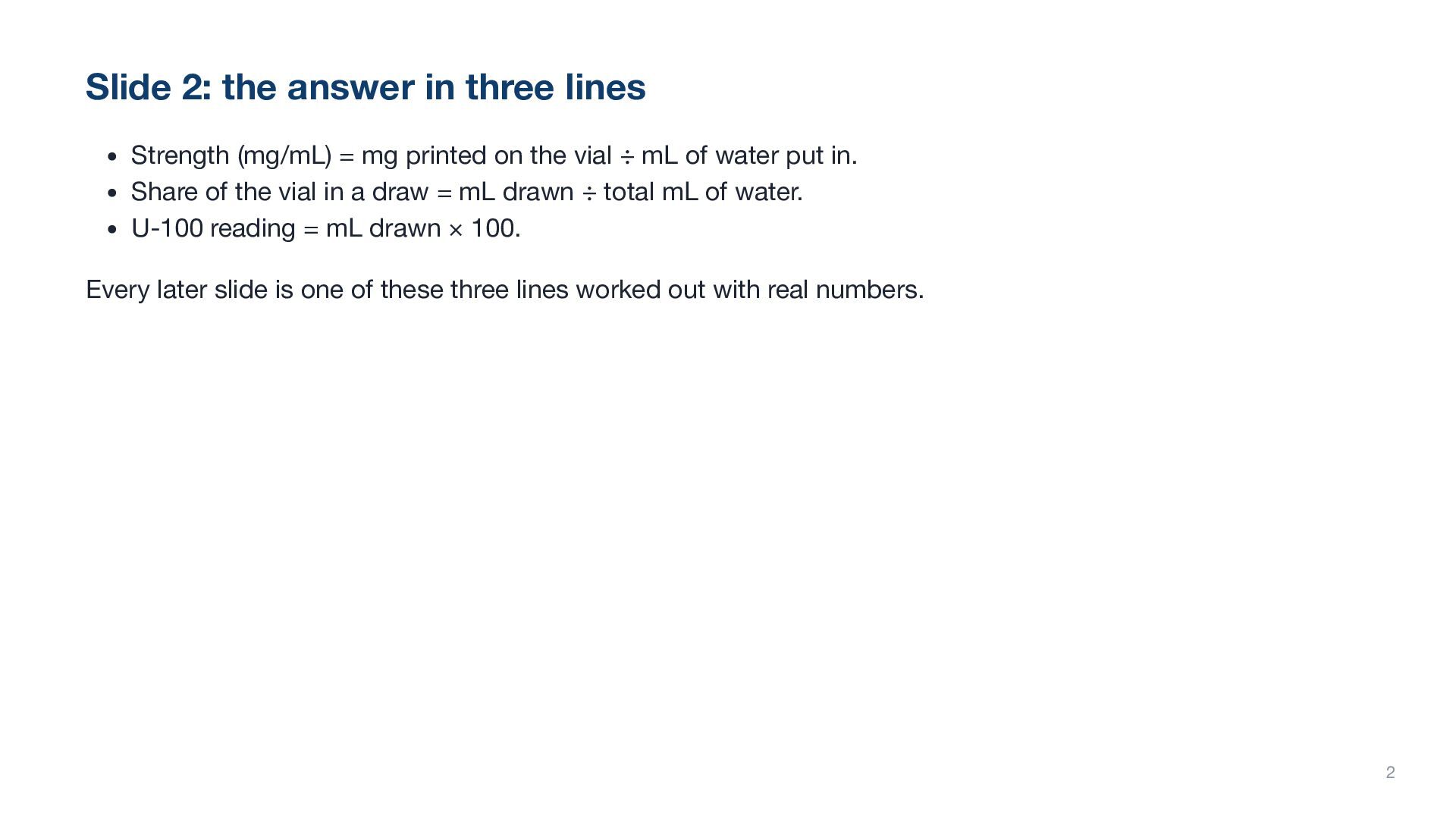
  2. Slide 2: the answer in three lines Strength (mg/mL) =

    mg printed on the vial ÷ mL of water put in. Share of the vial in a draw = mL drawn ÷ total mL of water. U-100 reading = mL drawn × 100. Every later slide is one of these three lines worked out with real numbers. 2
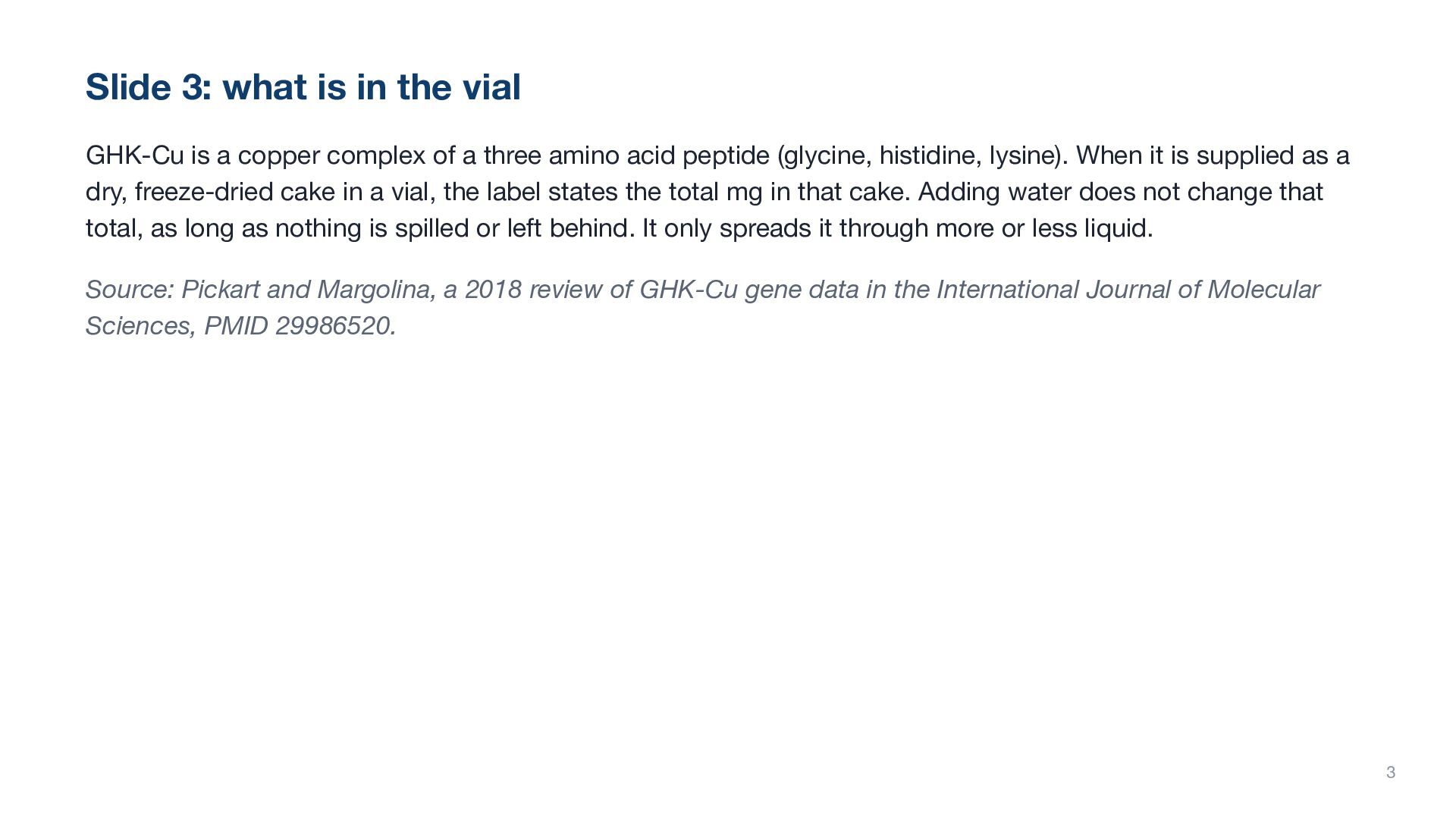
  3. Slide 3: what is in the vial GHK-Cu is a

    copper complex of a three amino acid peptide (glycine, histidine, lysine). When it is supplied as a dry, freeze-dried cake in a vial, the label states the total mg in that cake. Adding water does not change that total, as long as nothing is spilled or left behind. It only spreads it through more or less liquid. Source: Pickart and Margolina, a 2018 review of GHK-Cu gene data in the International Journal of Molecular Sciences, PMID 29986520. 3
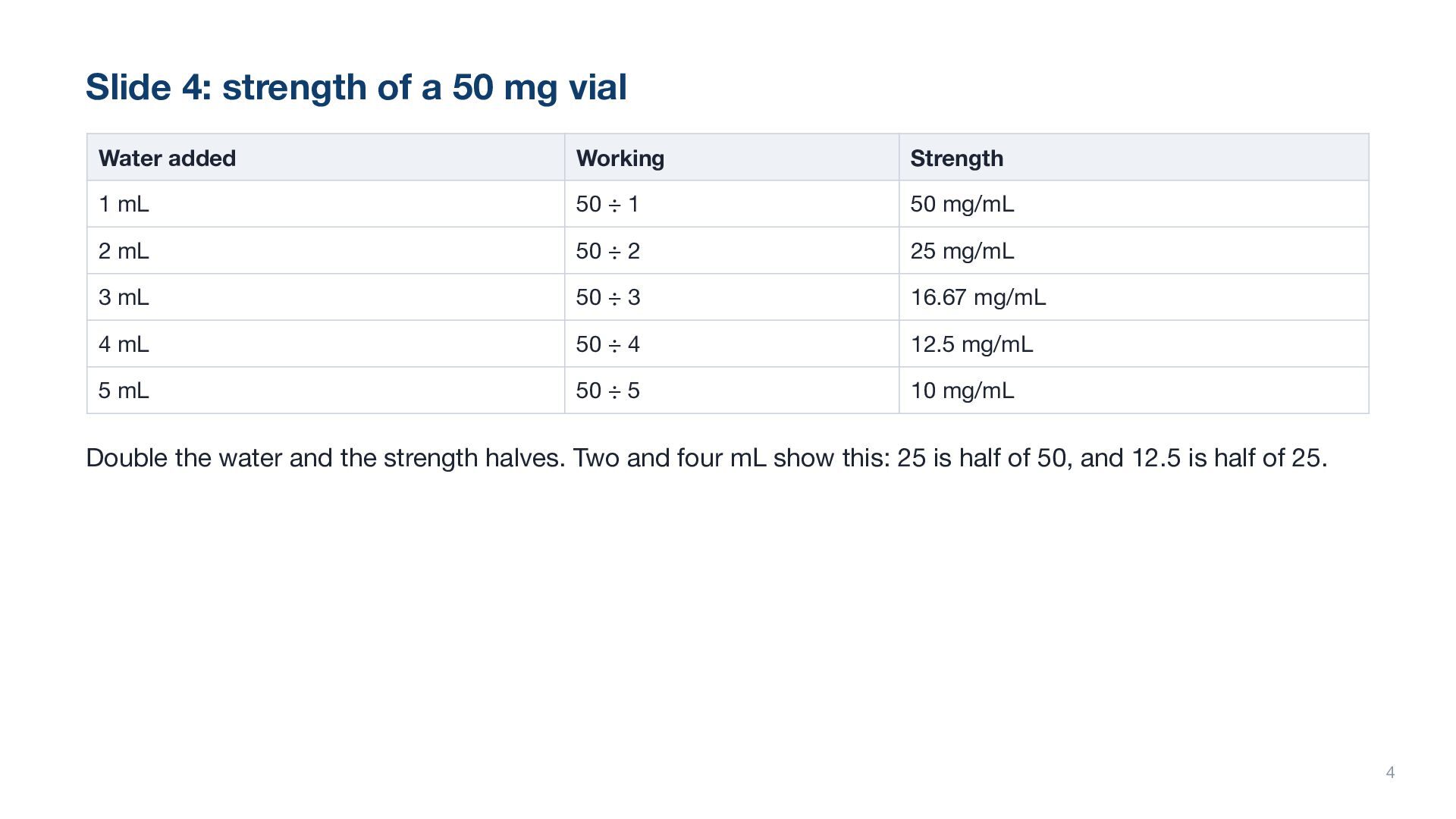
  4. Slide 4: strength of a 50 mg vial Water added

    Working Strength 1 mL 50 ÷ 1 50 mg/mL 2 mL 50 ÷ 2 25 mg/mL 3 mL 50 ÷ 3 16.67 mg/mL 4 mL 50 ÷ 4 12.5 mg/mL 5 mL 50 ÷ 5 10 mg/mL Double the water and the strength halves. Two and four mL show this: 25 is half of 50, and 12.5 is half of 25. 4
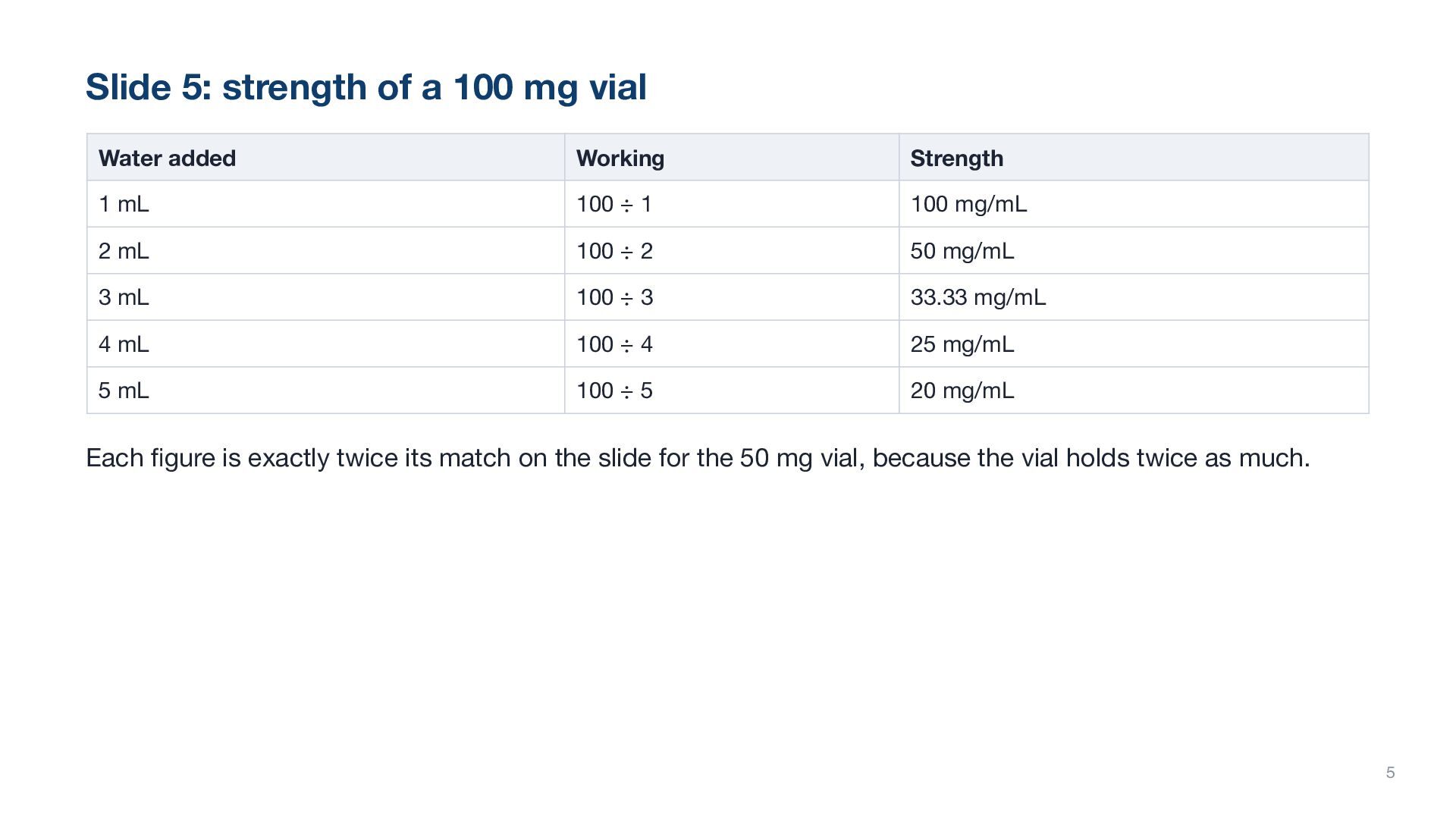
  5. Slide 5: strength of a 100 mg vial Water added

    Working Strength 1 mL 100 ÷ 1 100 mg/mL 2 mL 100 ÷ 2 50 mg/mL 3 mL 100 ÷ 3 33.33 mg/mL 4 mL 100 ÷ 4 25 mg/mL 5 mL 100 ÷ 5 20 mg/mL Each figure is exactly twice its match on the slide for the 50 mg vial, because the vial holds twice as much. 5
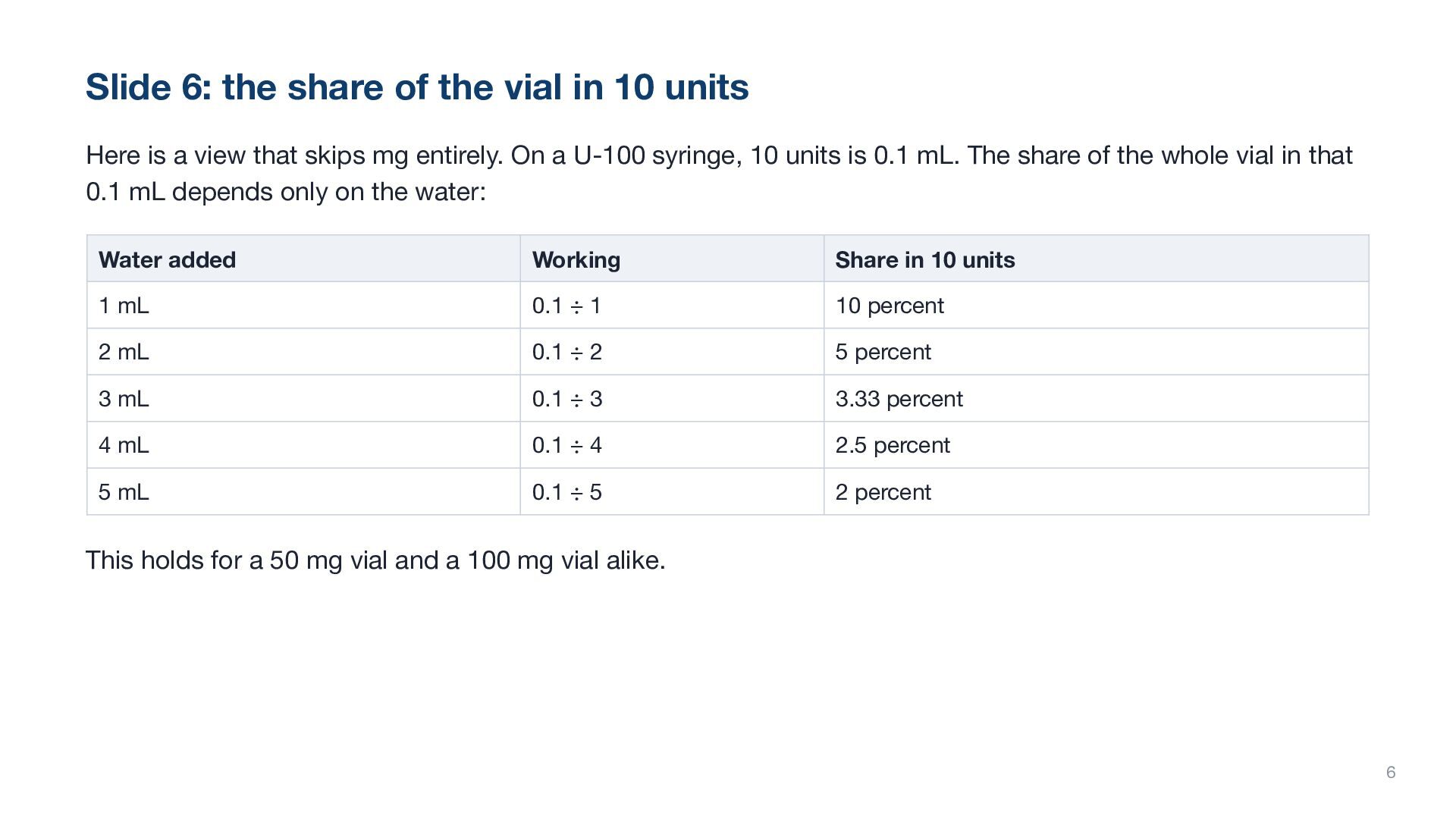
  6. Slide 6: the share of the vial in 10 units

    Here is a view that skips mg entirely. On a U-100 syringe, 10 units is 0.1 mL. The share of the whole vial in that 0.1 mL depends only on the water: Water added Working Share in 10 units 1 mL 0.1 ÷ 1 10 percent 2 mL 0.1 ÷ 2 5 percent 3 mL 0.1 ÷ 3 3.33 percent 4 mL 0.1 ÷ 4 2.5 percent 5 mL 0.1 ÷ 5 2 percent This holds for a 50 mg vial and a 100 mg vial alike. 6
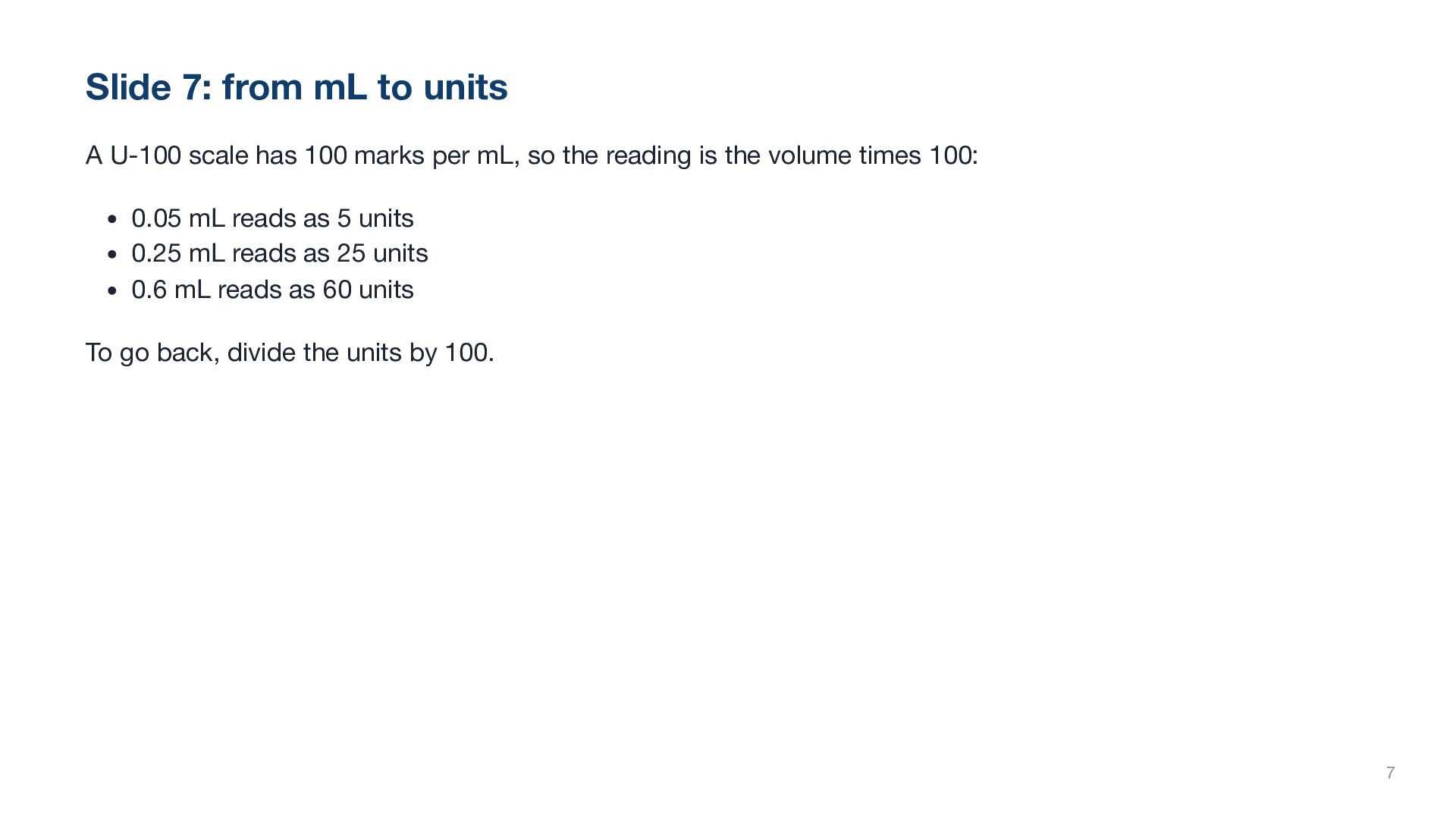
  7. Slide 7: from mL to units A U-100 scale has

    100 marks per mL, so the reading is the volume times 100: 0.05 mL reads as 5 units 0.25 mL reads as 25 units 0.6 mL reads as 60 units To go back, divide the units by 100. 7
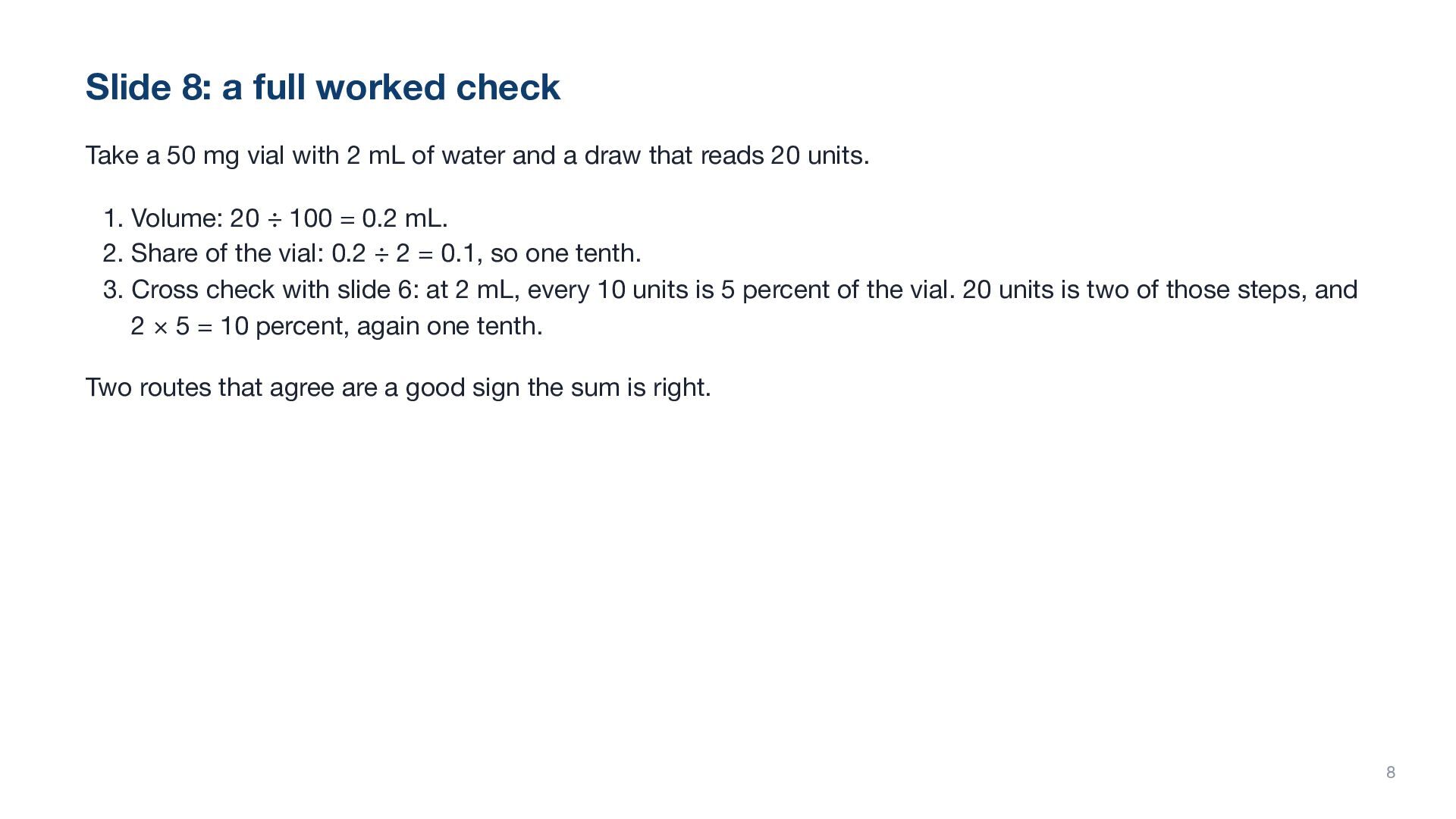
  8. Slide 8: a full worked check Take a 50 mg

    vial with 2 mL of water and a draw that reads 20 units. 1. Volume: 20 ÷ 100 = 0.2 mL. 2. Share of the vial: 0.2 ÷ 2 = 0.1, so one tenth. 3. Cross check with slide 6: at 2 mL, every 10 units is 5 percent of the vial. 20 units is two of those steps, and 2 × 5 = 10 percent, again one tenth. Two routes that agree are a good sign the sum is right. 8
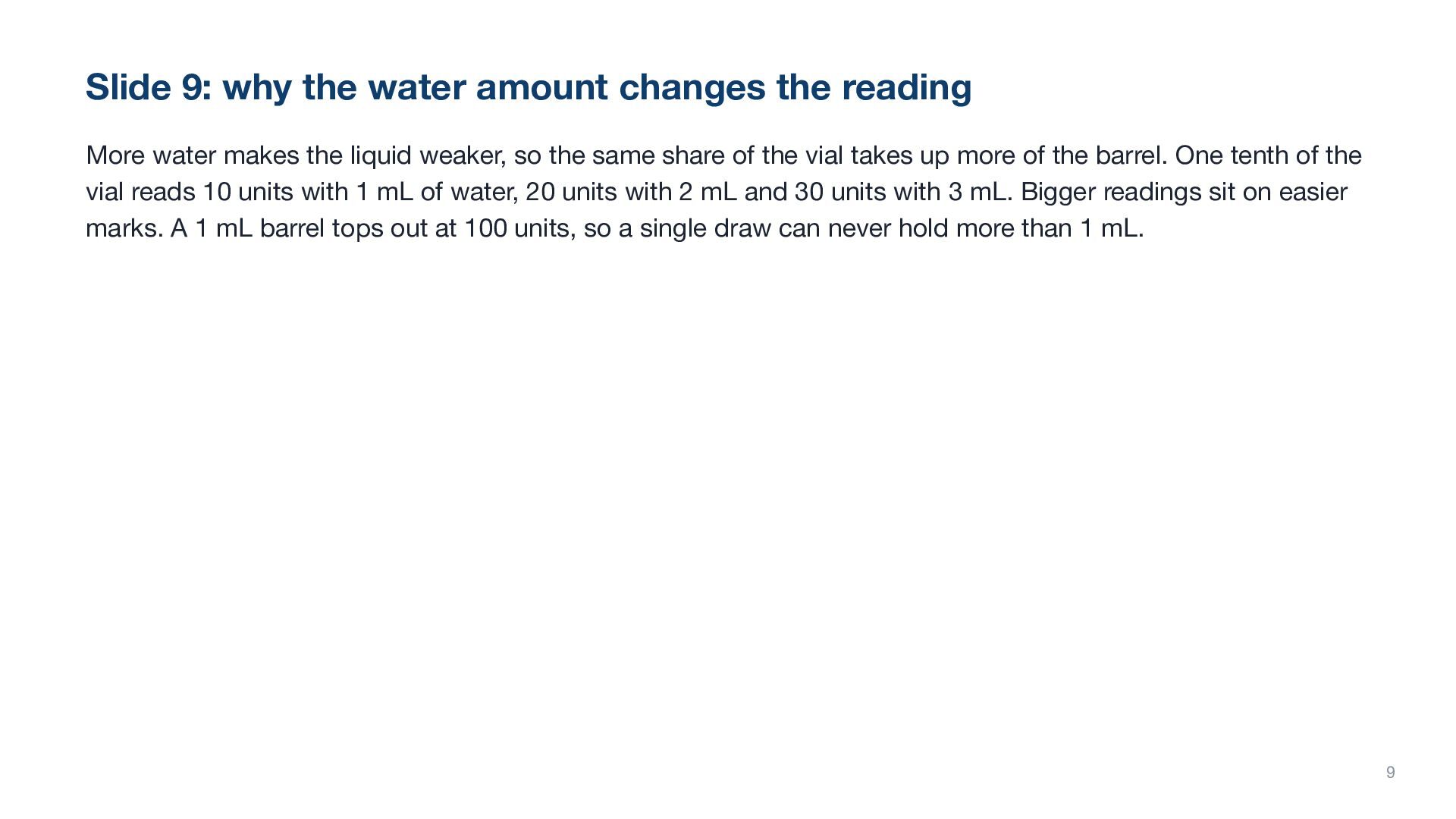
  9. Slide 9: why the water amount changes the reading More

    water makes the liquid weaker, so the same share of the vial takes up more of the barrel. One tenth of the vial reads 10 units with 1 mL of water, 20 units with 2 mL and 30 units with 3 mL. Bigger readings sit on easier marks. A 1 mL barrel tops out at 100 units, so a single draw can never hold more than 1 mL. 9
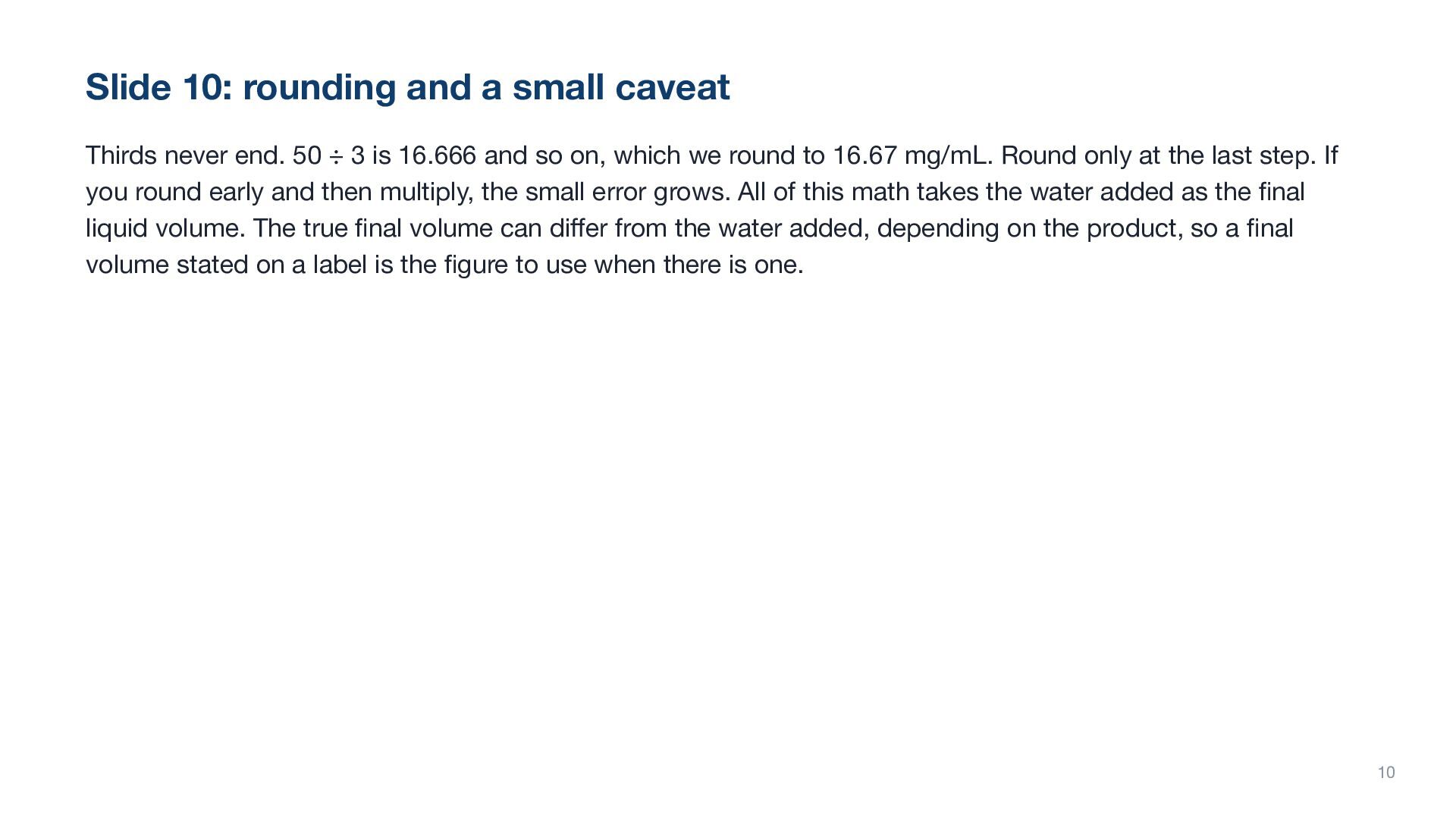
  10. Slide 10: rounding and a small caveat Thirds never end.

    50 ÷ 3 is 16.666 and so on, which we round to 16.67 mg/mL. Round only at the last step. If you round early and then multiply, the small error grows. All of this math takes the water added as the final liquid volume. The true final volume can differ from the water added, depending on the product, so a final volume stated on a label is the figure to use when there is one. 10
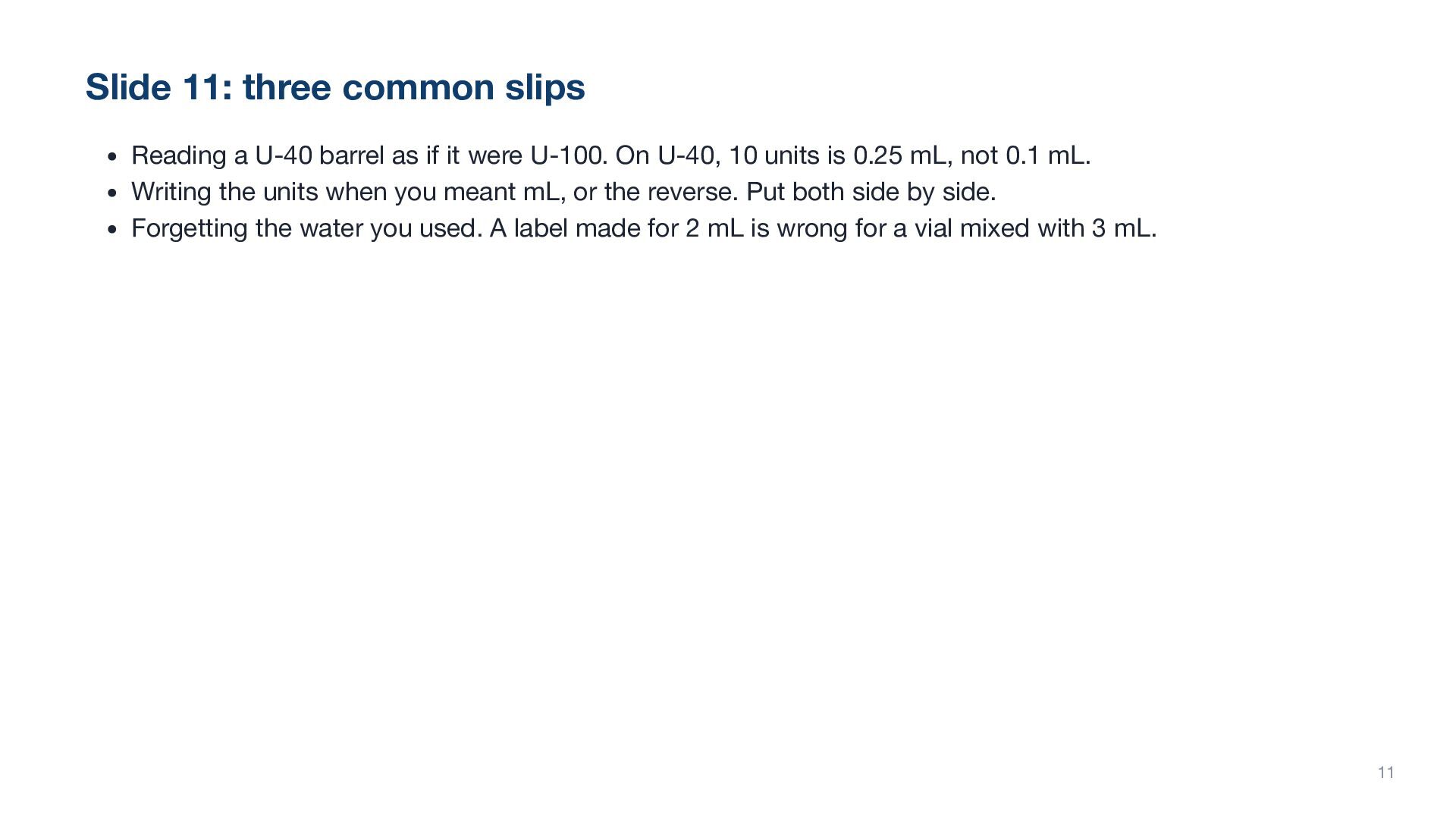
  11. Slide 11: three common slips Reading a U-40 barrel as

    if it were U-100. On U-40, 10 units is 0.25 mL, not 0.1 mL. Writing the units when you meant mL, or the reverse. Put both side by side. Forgetting the water you used. A label made for 2 mL is wrong for a vial mixed with 3 mL. 11
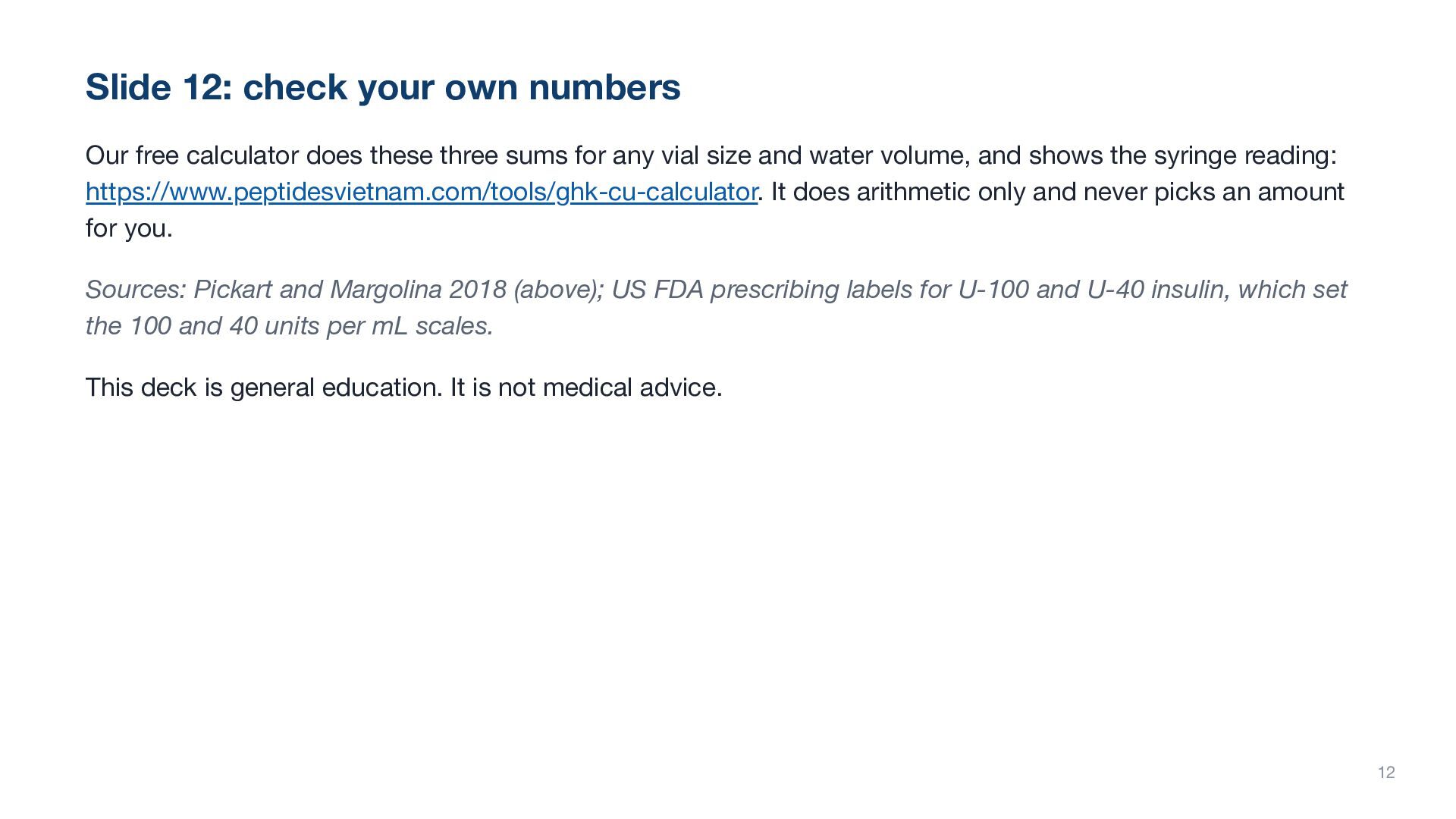
  12. Slide 12: check your own numbers Our free calculator does

    these three sums for any vial size and water volume, and shows the syringe reading: https://www.peptidesvietnam.com/tools/ghk-cu-calculator. It does arithmetic only and never picks an amount for you. Sources: Pickart and Margolina 2018 (above); US FDA prescribing labels for U-100 and U-40 insulin, which set the 100 and 40 units per mL scales. This deck is general education. It is not medical advice. 12

Other Decks in Education