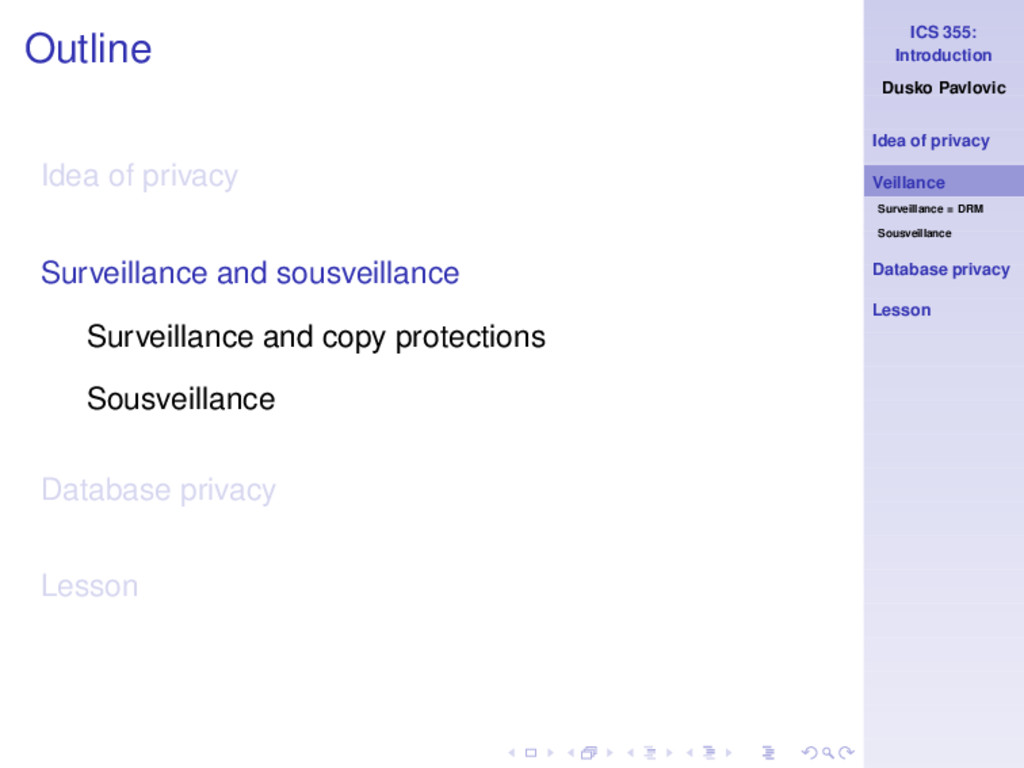
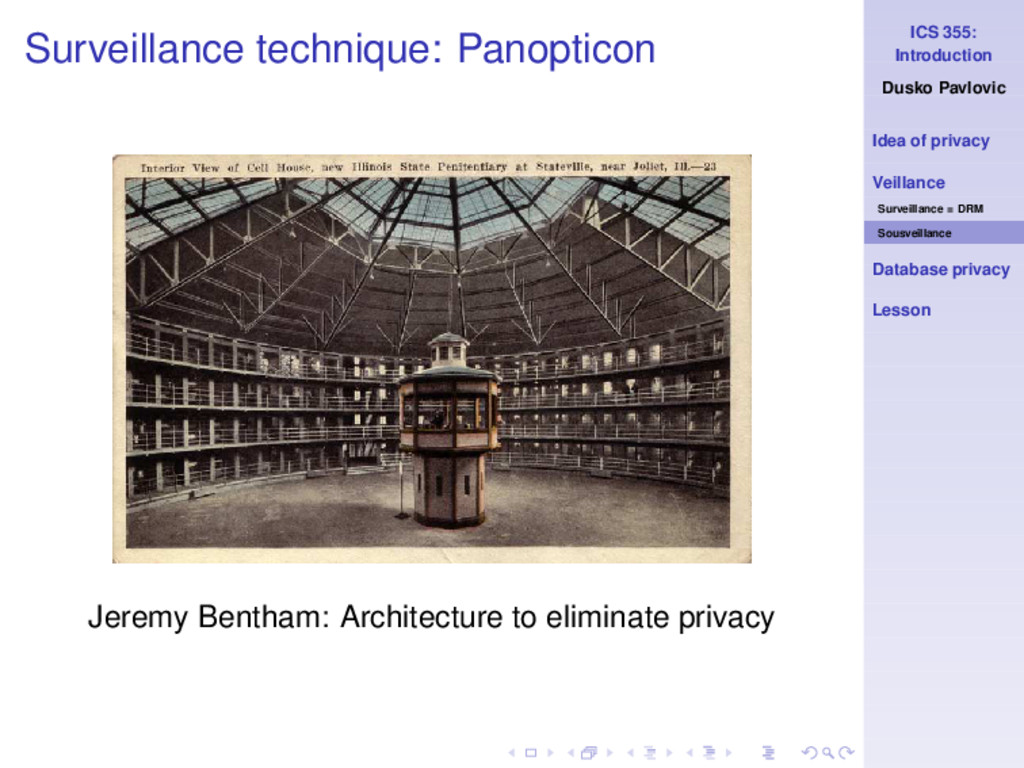
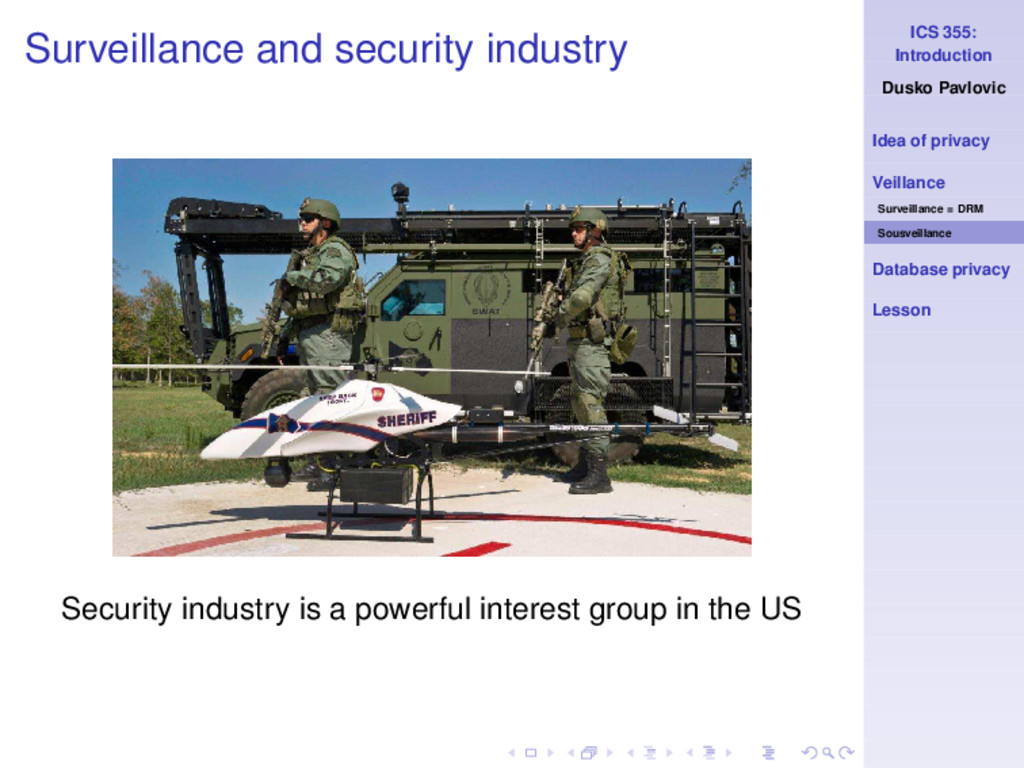
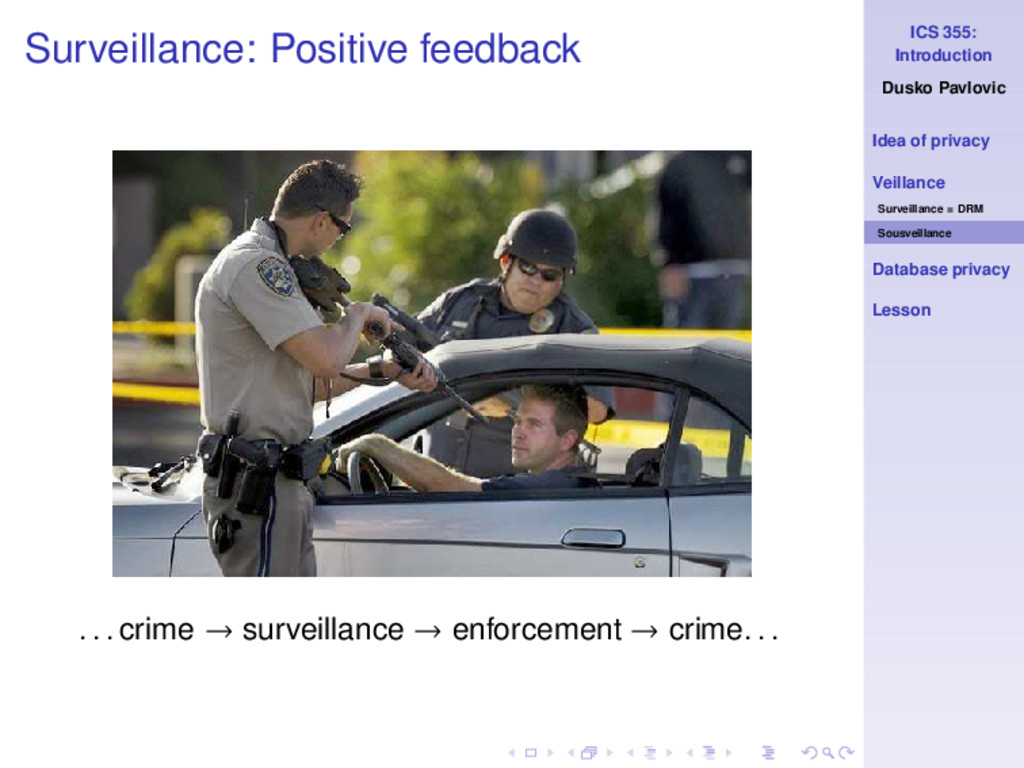
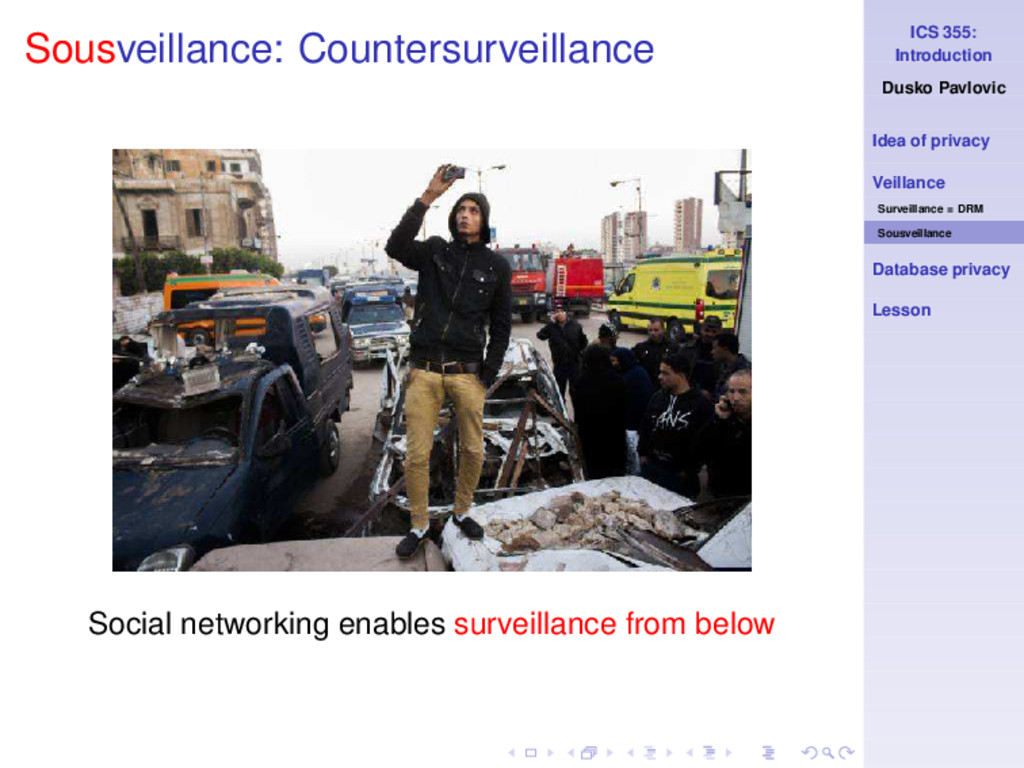
Beyond Veillance Database privacy Lesson Outline Idea of privacy Concept Privacy in US legal history Privacy is deeper Surveillance and sousveillance Database privacy Lesson
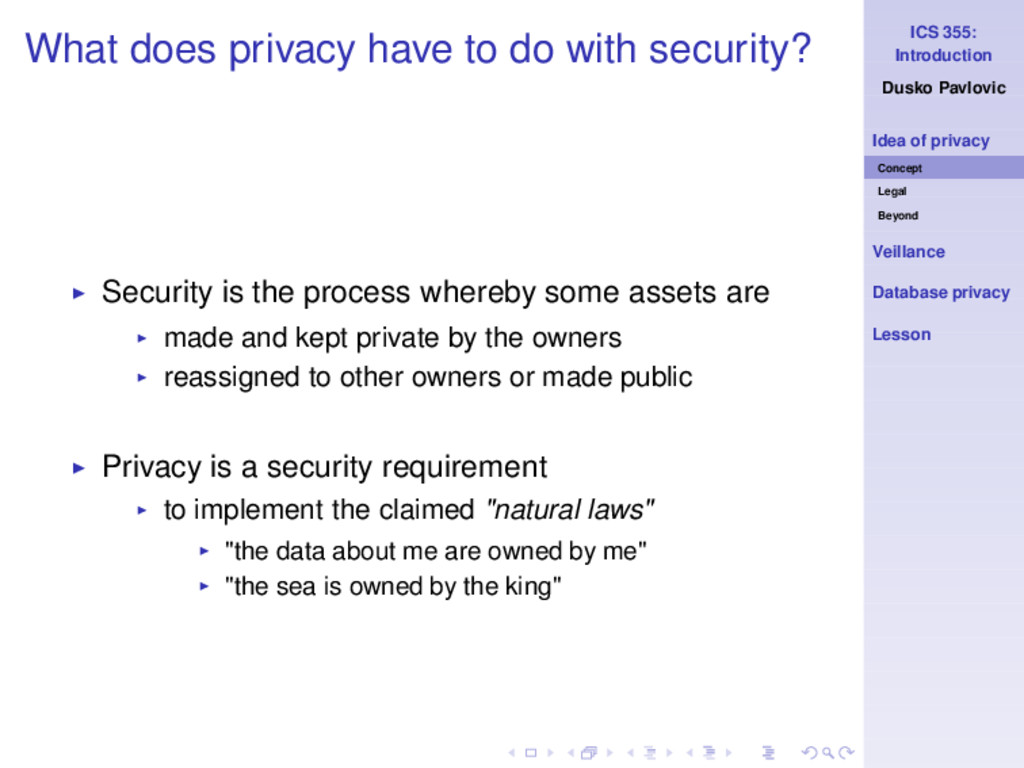
Beyond Veillance Database privacy Lesson What does privacy have to do with security? ◮ Security is the adversarial process of defending and attacking some privately owned assets.
Beyond Veillance Database privacy Lesson What does privacy have to do with security? ◮ Security is the adversarial process of defending and attacking some privately owned assets. ◮ Privacy is the owners’ right to enjoy their assets with no interference from others.
Beyond Veillance Database privacy Lesson What does privacy have to do with security? ◮ Security is the process whereby some assets are ◮ made and kept private by the owners ◮ reassigned to other owners or made public ◮ Privacy is a security requirement ◮ to implement the claimed "natural laws" ◮ "the data about me are owned by me" ◮ "the sea is owned by the king"
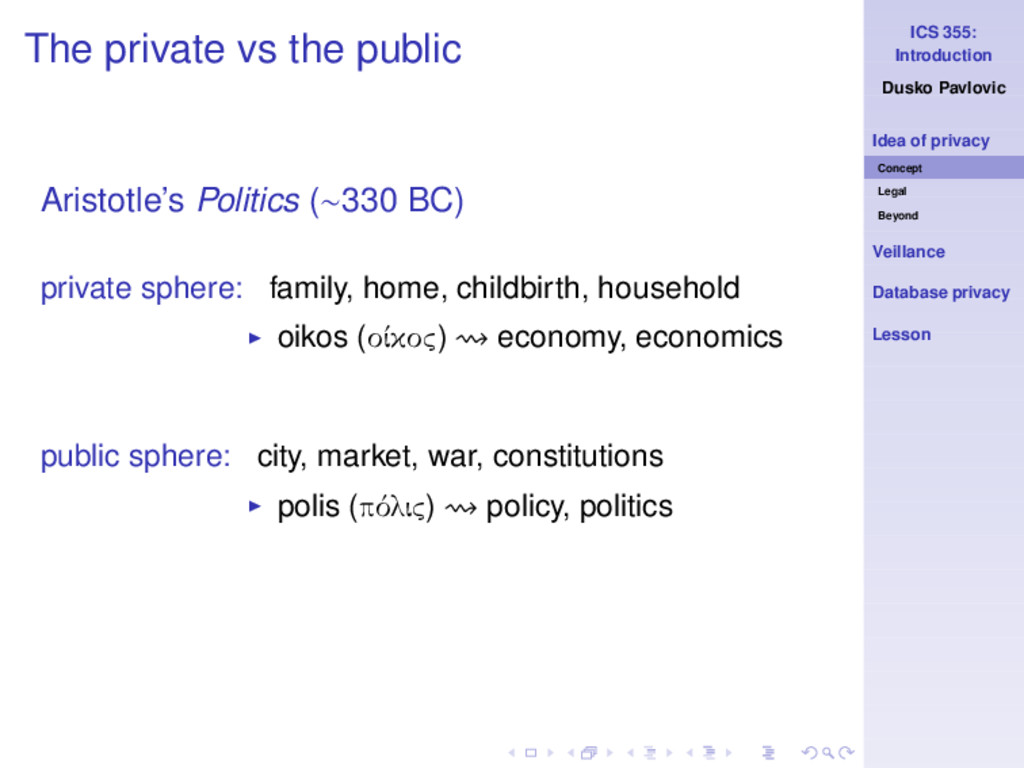
Beyond Veillance Database privacy Lesson The private vs the public Aristotle’s Politics (∼330 BC) private sphere: family, home, childbirth, household ◮ oikos (οίκος) economy, economics public sphere: city, market, war, constitutions ◮ polis (πόλις) policy, politics
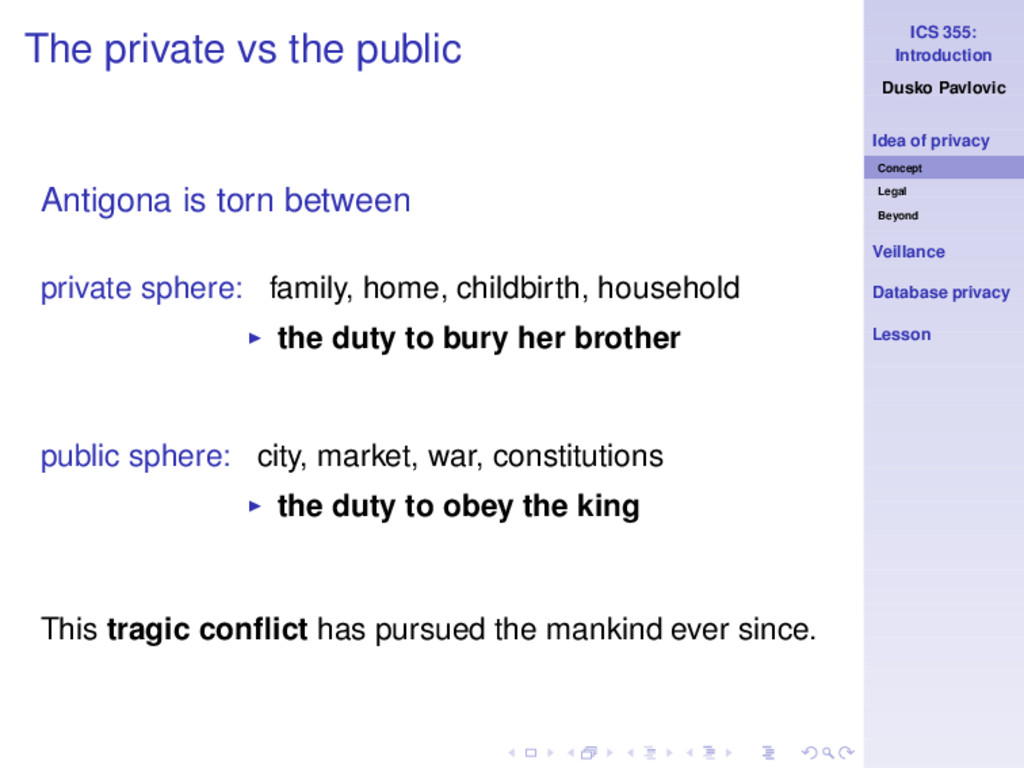
Beyond Veillance Database privacy Lesson The private vs the public Sophocles: The tragedy of Antigona (441 BC) private sphere: family, home, childbirth, household ◮ Antigona’s brothers Eteocles and Polyneices are on two sides in a war public sphere: city, market, war, constitutions ◮ Polyneices’ side loses and King Creon orders that his body be left to rot in the battlefield
Beyond Veillance Database privacy Lesson The private vs the public Antigona is torn between private sphere: family, home, childbirth, household ◮ the duty to bury her brother public sphere: city, market, war, constitutions ◮ the duty to obey the king
Beyond Veillance Database privacy Lesson The private vs the public Antigona is torn between private sphere: family, home, childbirth, household ◮ the duty to bury her brother public sphere: city, market, war, constitutions ◮ the duty to obey the king This tragic conflict has pursued the mankind ever since.
Beyond Veillance Database privacy Lesson Modern legal treatment of privacy Warren and Brandeis (1890) In very early times, the law gave a remedy only for physical interference with life and property, for trespasses vi et armis. Then the "right to life" served only to protect the subject from battery in its various forms; liberty meant freedom from actual restraint; and the right to property secured to the individual his lands and his cattle. Later, there came a recognition of man’s spiritual nature, of his feelings and his intellect. Gradually the scope of these legal rights broadened; and now the right to life has come to mean the right to enjoy life — the right to be let alone; the right to liberty secures the exercise of extensive civil privileges; and the term "property" has grown to comprise every form of possession – intangible, as well as tangible.
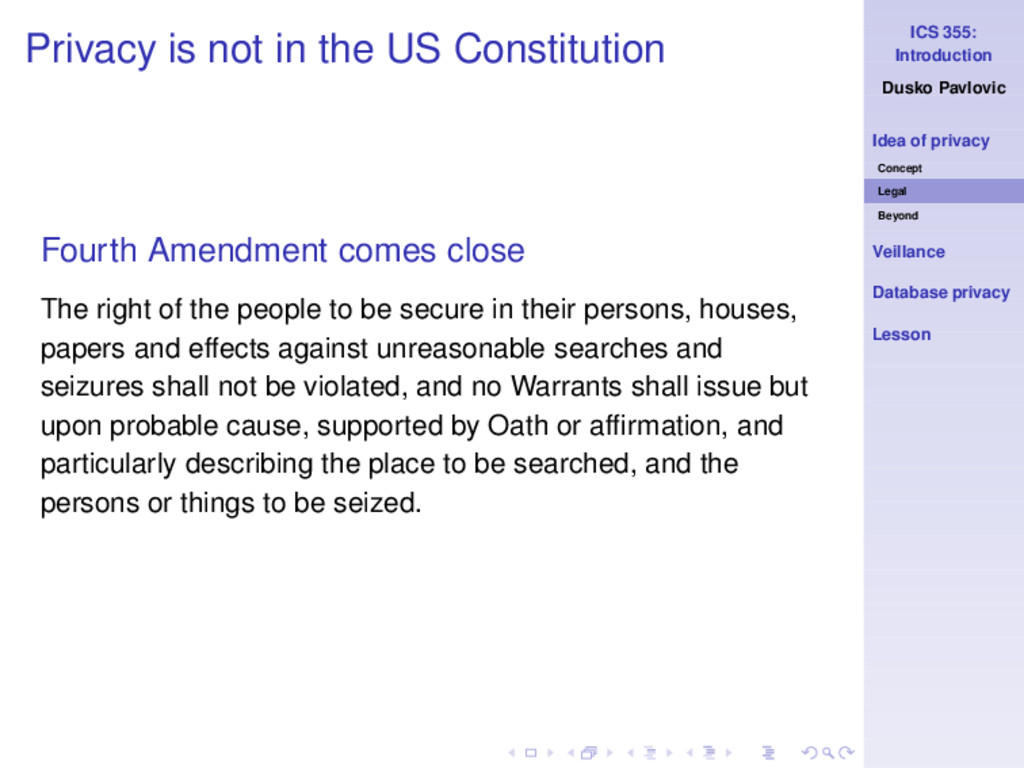
Beyond Veillance Database privacy Lesson Privacy is not in the US Constitution Fourth Amendment comes close The right of the people to be secure in their persons, houses, papers and effects against unreasonable searches and seizures shall not be violated, and no Warrants shall issue but upon probable cause, supported by Oath or affirmation, and particularly describing the place to be searched, and the persons or things to be seized.
Beyond Veillance Database privacy Lesson Privacy is not in the US Constitution Fourth Amendment context ◮ Trying to improve taxation on the imports in the Colonies, the Crown introduced had introduced the writs of assistance, which empowered officers of the Crown to search "wherever they suspected uncustomed goods to be" and to "break open any receptacle or package falling under their suspecting eye" ◮ Fourth Amendment curtails such sweeping searches. ◮ Protections of rights less tangible than "persons, houses, papers and effects" took a long to evolve.
Beyond Veillance Database privacy Lesson New communication channels Lous Brandeis (dissent Olmstead v US) The evil incident to invasion of privacy of the telephone is far greater than that involved in tampering with the mails. Whenever a telephone line is tapped, the privacy of persons at both ends of the line is invaded, and all conversations between them upon any subject, and although proper, confidential and privileged, may be overheard. Moreover, the tapping of one man’s telephone line involves the tapping of the telephone of every other person whom he may call or who may call him. As a means of espionage, writs of assistance and general warrants are but puny instruments of tyranny and oppression when compared with wire-tapping.
Beyond Veillance Database privacy Lesson . . . require new privacy protections Lous Brandeis (dissent Olmstead v US) The makers of our Constitution undertook to secure conditions favorable to the pursuit of happiness. They recognized the significance of man’s spiritual nature, of his feelings and his intellect. [. . . ] They sought to protect Americans in their beliefs, their thoughts, their emotions and their sensations. They conferred, as against the Government, the right to be let alone — the most comprehensive of rights and the right most valued by civilized man. To protect that right, every unjustifiable intrusion by the Government upon the privacy of the individual, whatever the means employed, must be deemed a violation of the Fourth Amendment. And the use, of evidence in a criminal proceeding, of facts ascertained by such intrusion must be deemed a violation of the Fifth.
Beyond Veillance Database privacy Lesson . . . and maintaining the old ones Watergate hearings (1973) Sen. Herman Talmadge: Do you remember when we were in law school, we studied a famous principle of law that came from England and also is well known in this country, that no matter how humble a man’s cottage is, that even the King of England cannot enter without his consent. Witness John Ehrlichman: I am afraid that has been considerably eroded over the years, has it not? Sen. Talmadge: Down in my country we still think of it as a pretty legitimate piece of law.
Beyond Veillance Database privacy Lesson Privacy goes deeper: Culture What are the private areas? ◮ home: multi-level security ◮ privacy from the outsiders ◮ privacy from each other: children from parents. . . ◮ public private spaces: bathrooms. . .
Beyond Veillance Database privacy Lesson Privacy goes deeper: Culture What are the private areas? ◮ home: multi-level security ◮ privacy from the outsiders ◮ privacy from each other: children from parents. . . ◮ public private spaces: bathrooms. . . ◮ body: private areas vs public areas separated by clothes ◮ sex is the realm of privacy ◮ the view of the private areas can be ◮ monetized (stripping, pornography) ◮ owned by others (in many traditions)
Beyond Veillance Database privacy Lesson Privacy goes even deeper: Biology Cooperation vs competition ◮ The evolution from solitary wasps to social insects shows the function of the public sphere ◮ Cooperation benefits all. ◮ The private assets of the dominant individuals in the hierarchical societies shows the function of the private sphere ◮ Privacy benefits the winners ◮ Private vices public benefits (B. Mandeville)
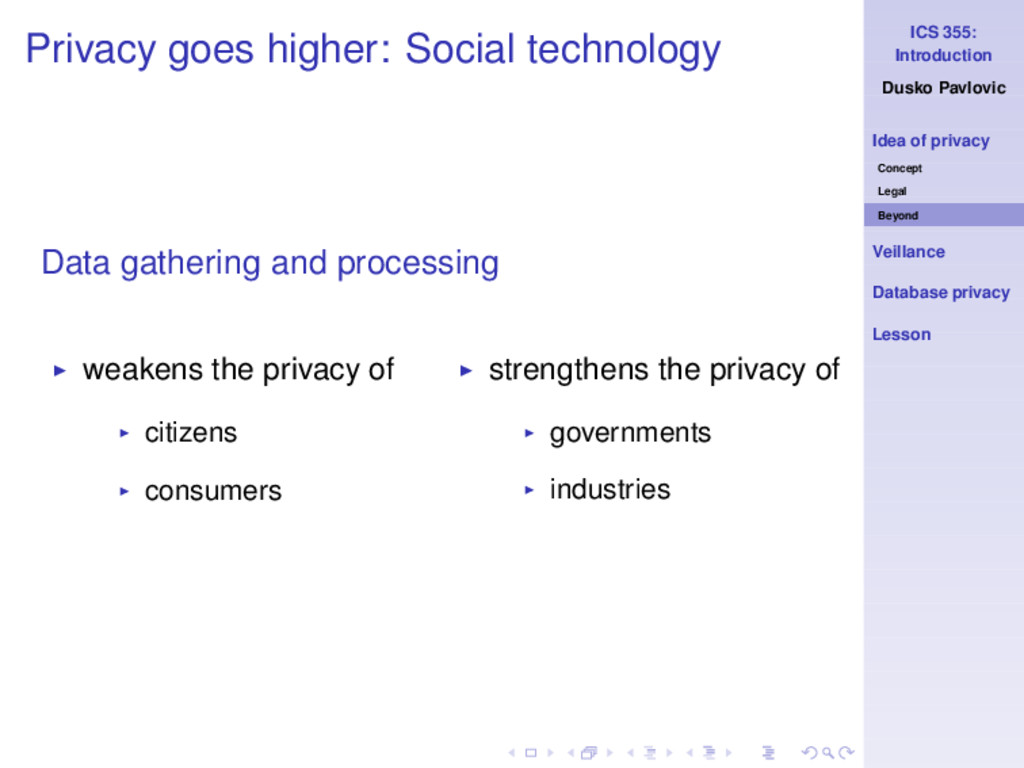
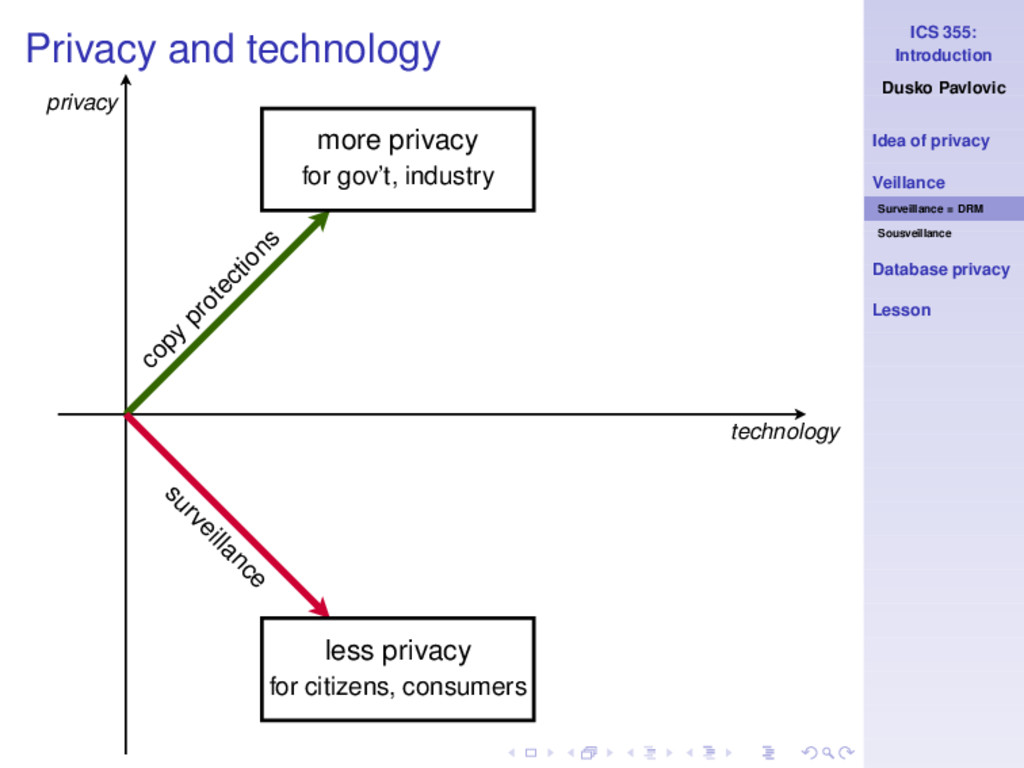
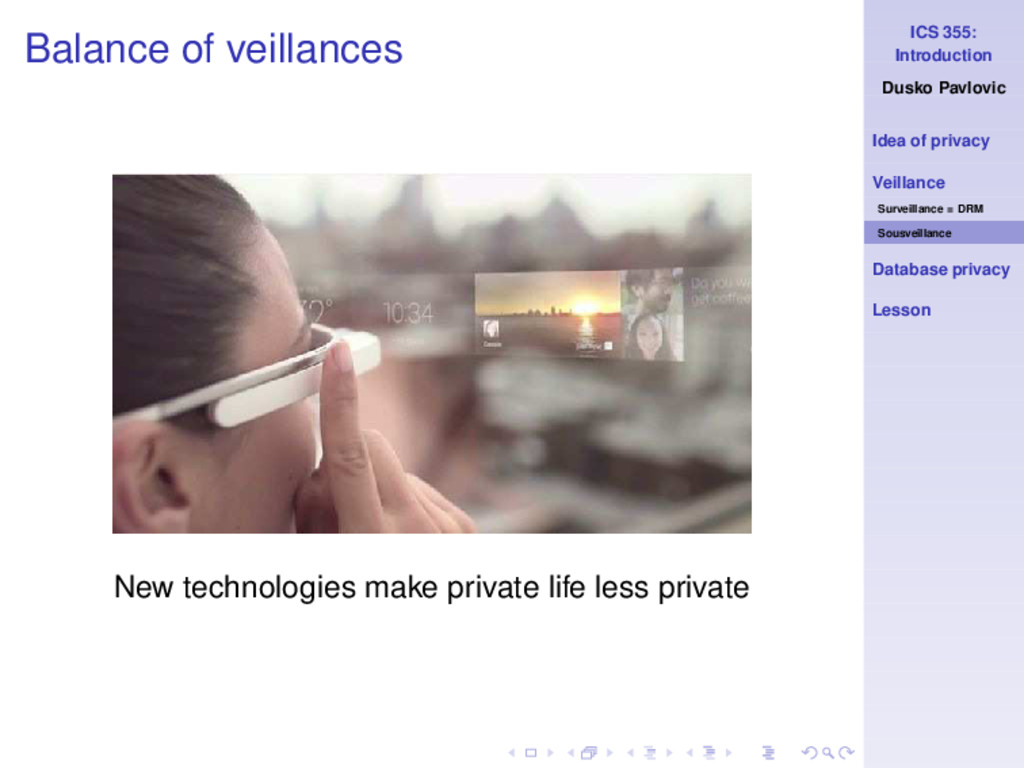
Beyond Veillance Database privacy Lesson Privacy goes higher: Social technology Data gathering and processing ◮ weakens the privacy of ◮ citizens ◮ consumers ◮ strengthens the privacy of ◮ governments ◮ industries
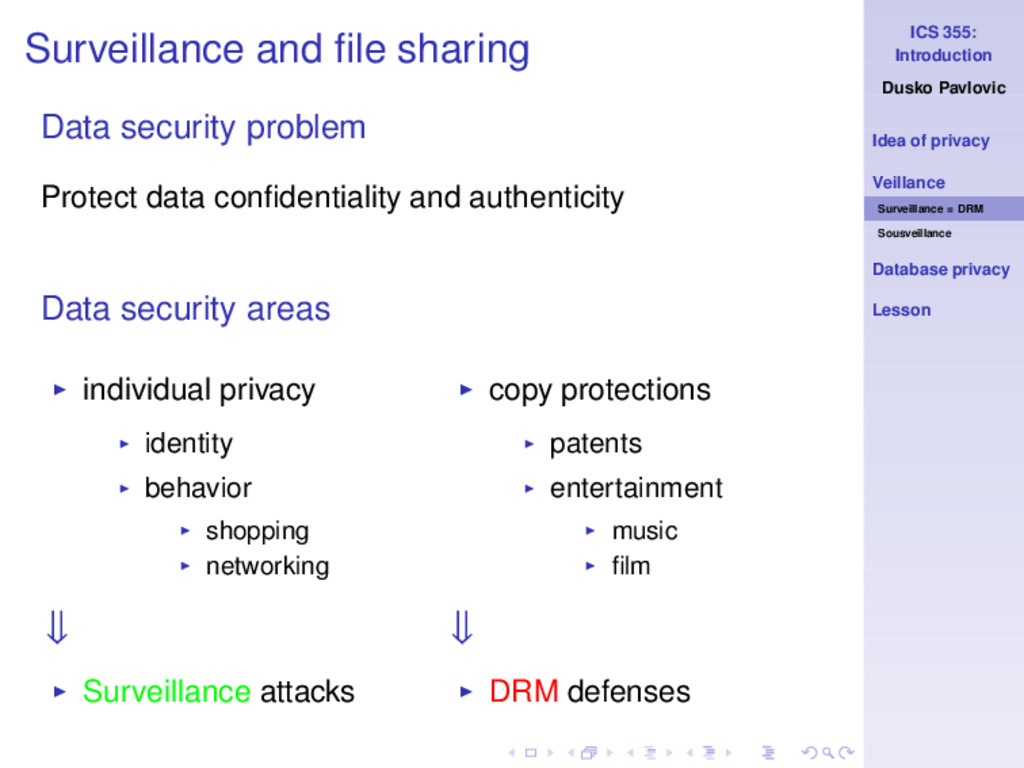
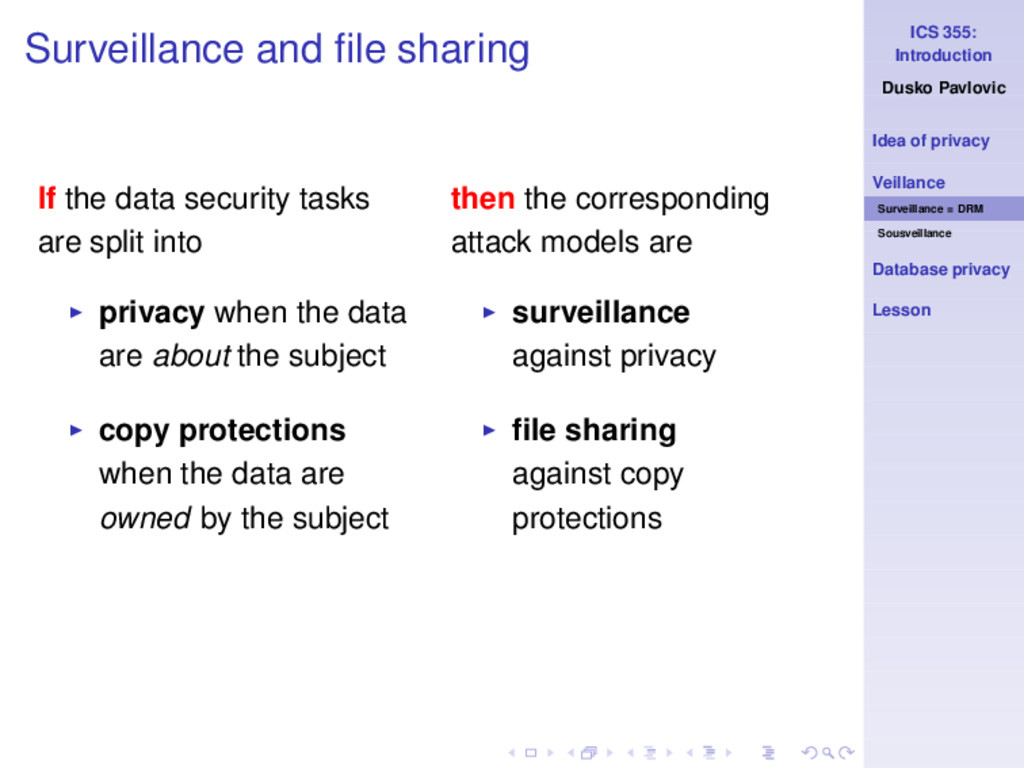
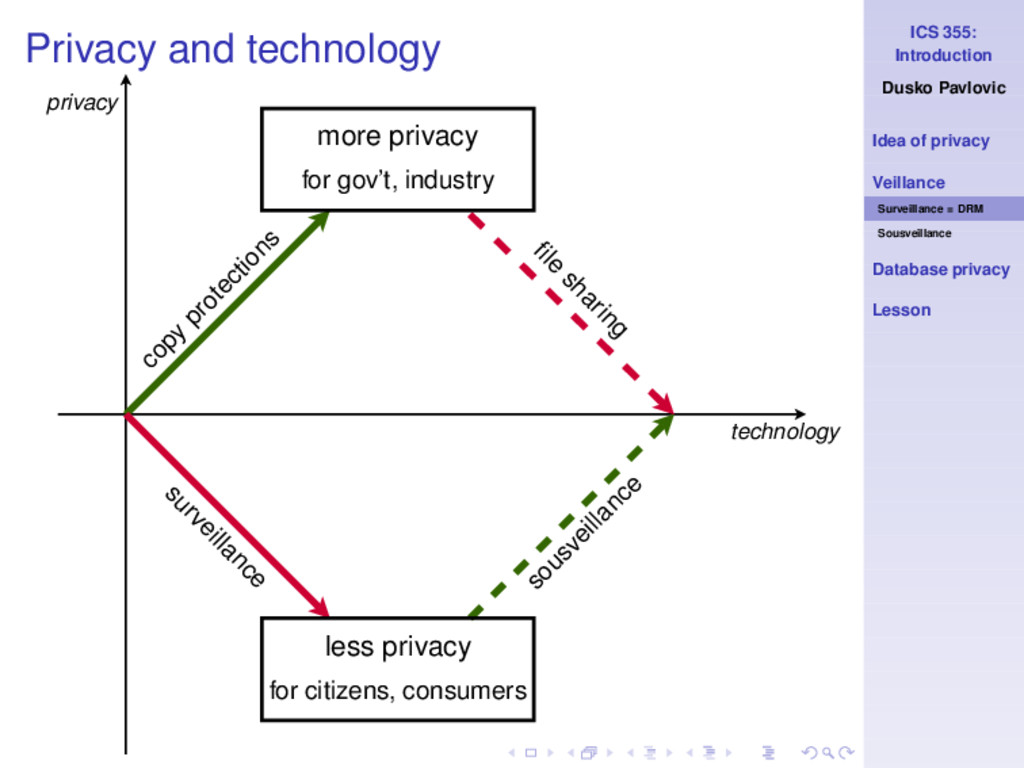
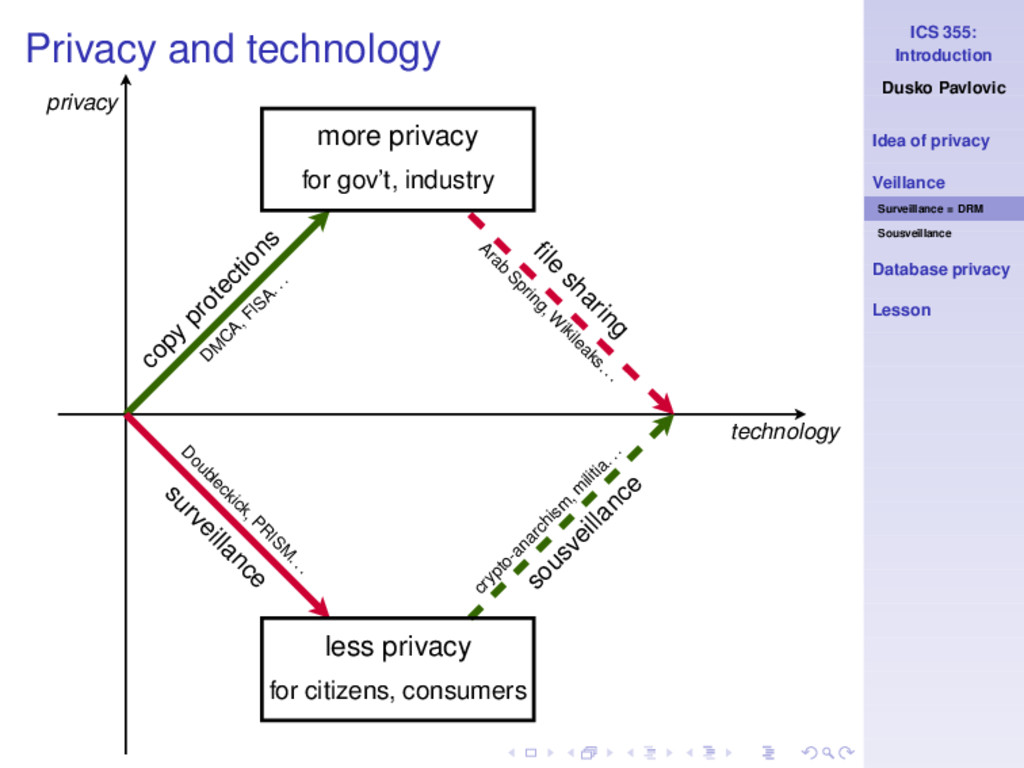
= DRM Sousveillance Database privacy Lesson Surveillance and file sharing If the data security tasks are split into ◮ privacy when the data are about the subject ◮ copy protections when the data are owned by the subject then the corresponding attack models are ◮ surveillance against privacy ◮ file sharing against copy protections
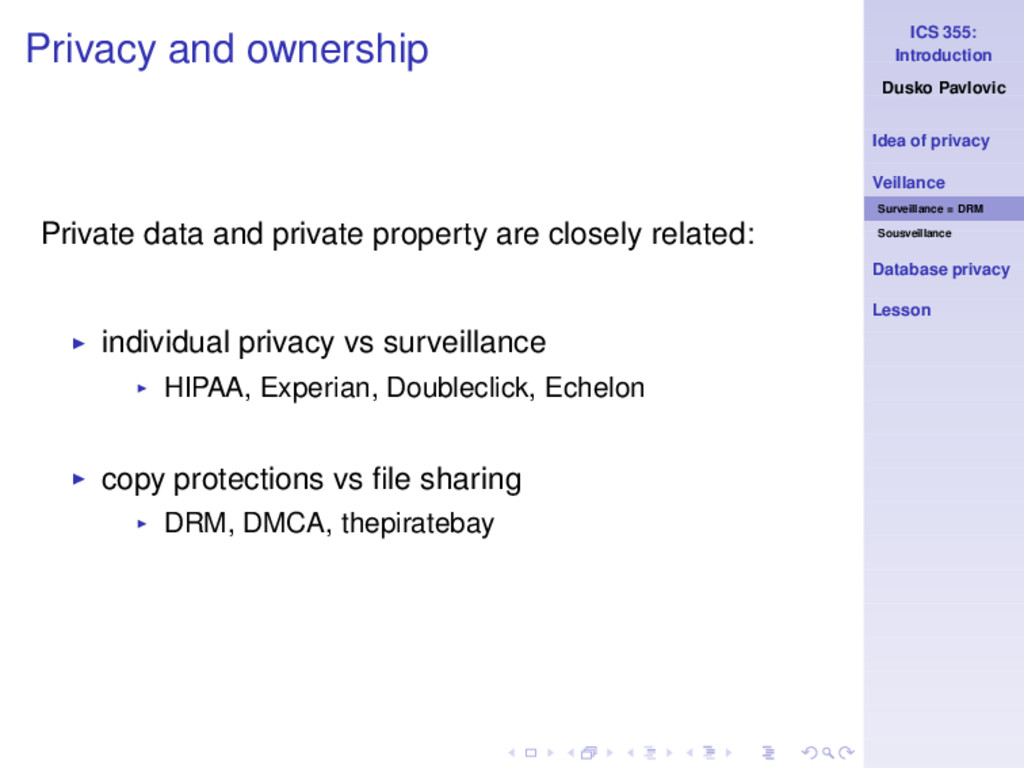
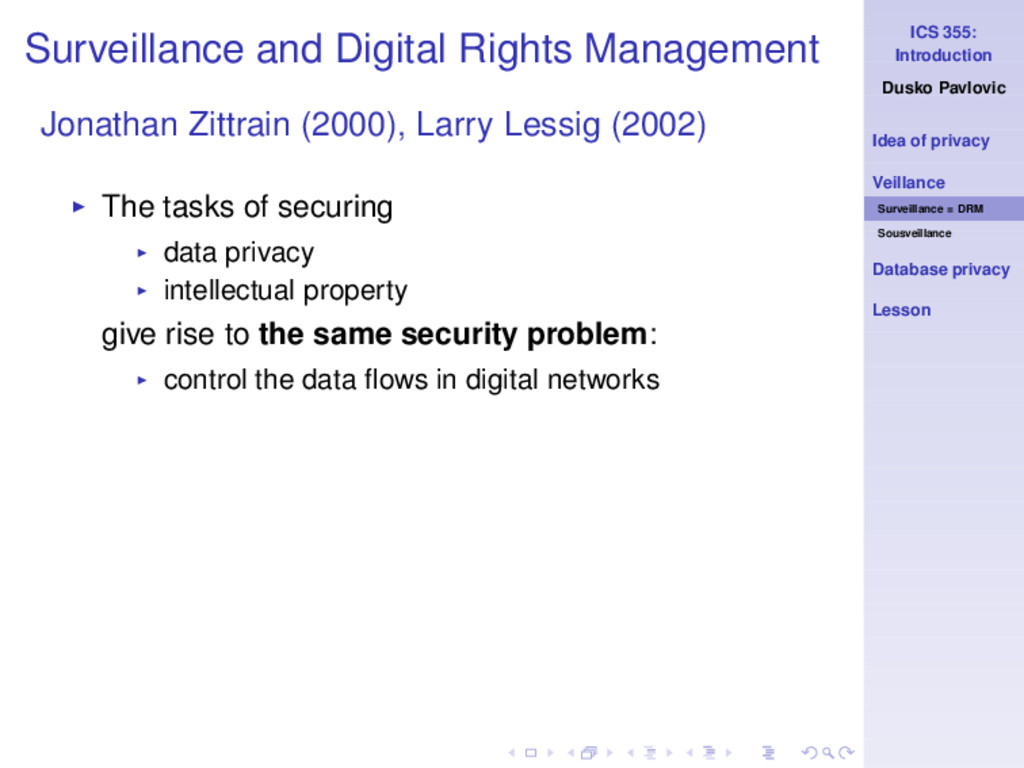
= DRM Sousveillance Database privacy Lesson Surveillance and Digital Rights Management Jonathan Zittrain (2000), Larry Lessig (2002) ◮ The tasks of securing ◮ data privacy ◮ intellectual property give rise to the same security problem: ◮ control the data flows in digital networks
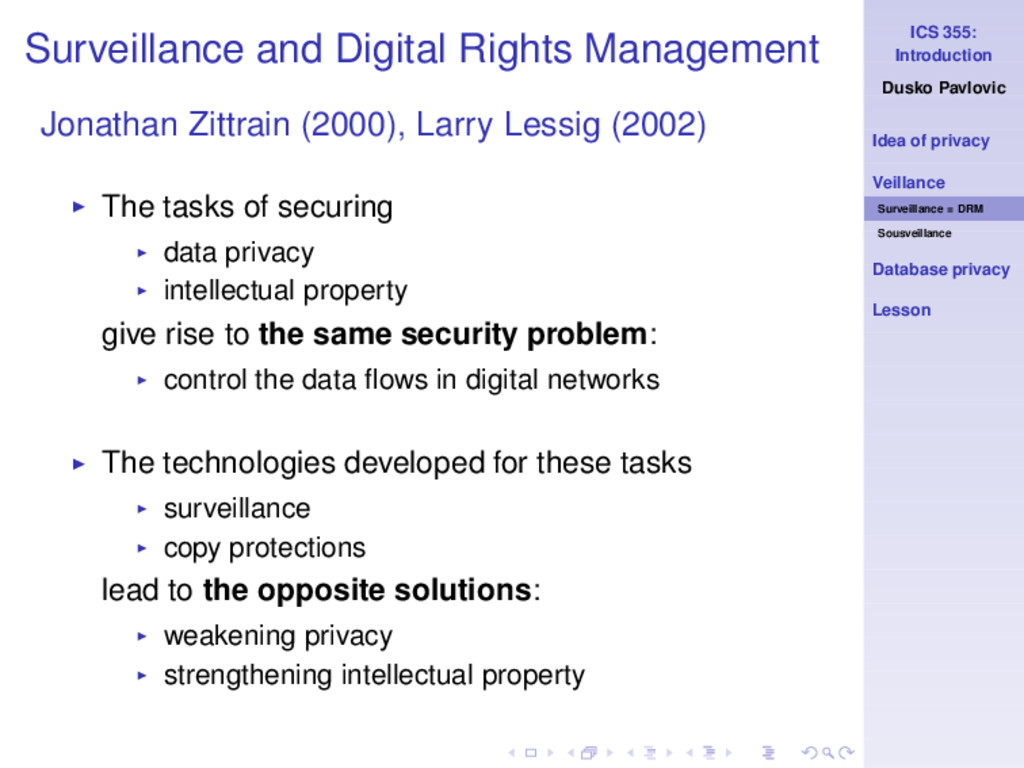
= DRM Sousveillance Database privacy Lesson Surveillance and Digital Rights Management Jonathan Zittrain (2000), Larry Lessig (2002) ◮ The tasks of securing ◮ data privacy ◮ intellectual property give rise to the same security problem: ◮ control the data flows in digital networks ◮ The technologies developed for these tasks ◮ surveillance ◮ copy protections lead to the opposite solutions: ◮ weakening privacy ◮ strengthening intellectual property
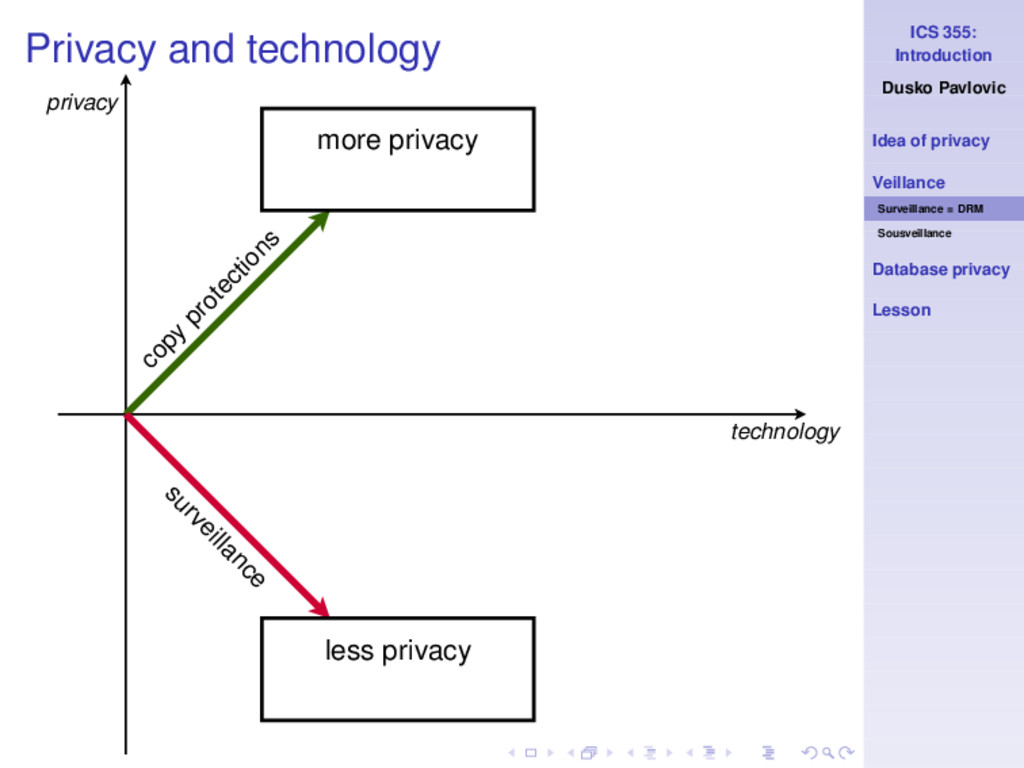
= DRM Sousveillance Database privacy Lesson Privacy and technology technology privacy surveillance copy protections more privacy for gov’t, industry less privacy for citizens, consumers
= DRM Sousveillance Database privacy Lesson Privacy and technology technology privacy surveillance copy protections sousveillance file sharing more privacy for gov’t, industry less privacy for citizens, consumers
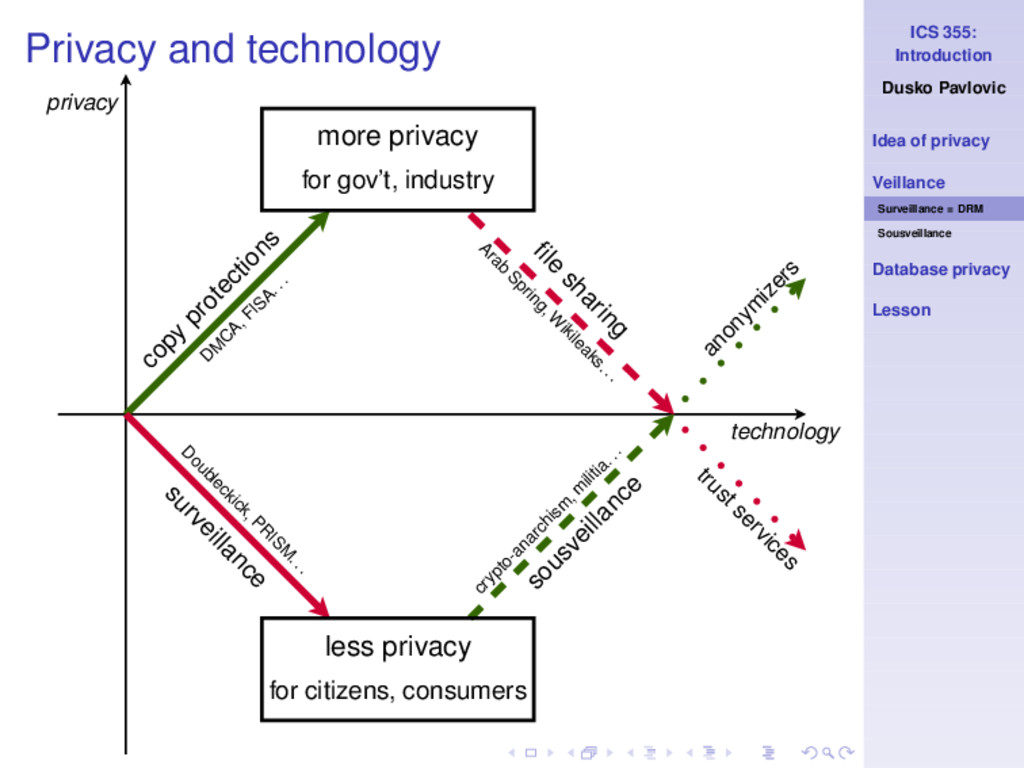
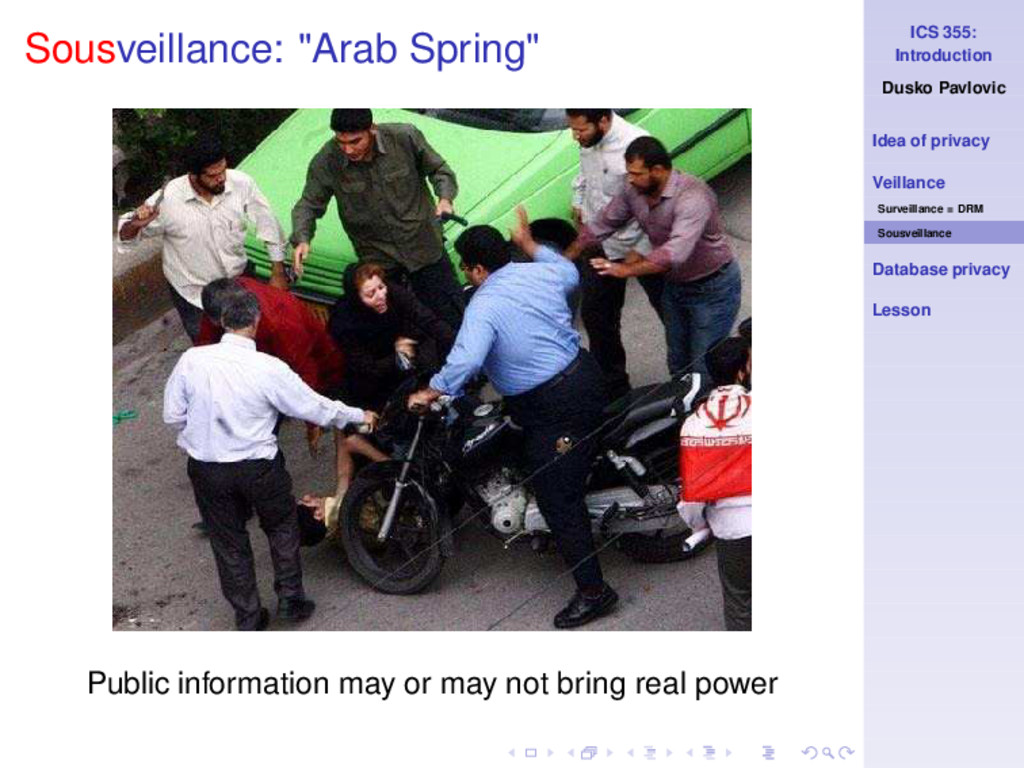
= DRM Sousveillance Database privacy Lesson Privacy and technology technology privacy surveillance copy protections sousveillance file sharing more privacy for gov’t, industry less privacy for citizens, consumers Arab Spring, W ikileaks... crypto-anarchism , m ilitia... D oubleckick, PR ISM ... D M C A, FISA...
= DRM Sousveillance Database privacy Lesson Privacy and technology technology privacy surveillance copy protections sousveillance file sharing more privacy for gov’t, industry less privacy for citizens, consumers Arab Spring, W ikileaks... crypto-anarchism , m ilitia... D oubleckick, PR ISM ... D M C A, FISA... anonym izers trust services
privacy Lesson Data privacy The life of data consists of ◮ data gathering (veillance) ◮ data storage and release (databases) ◮ data processing (mining and classification)
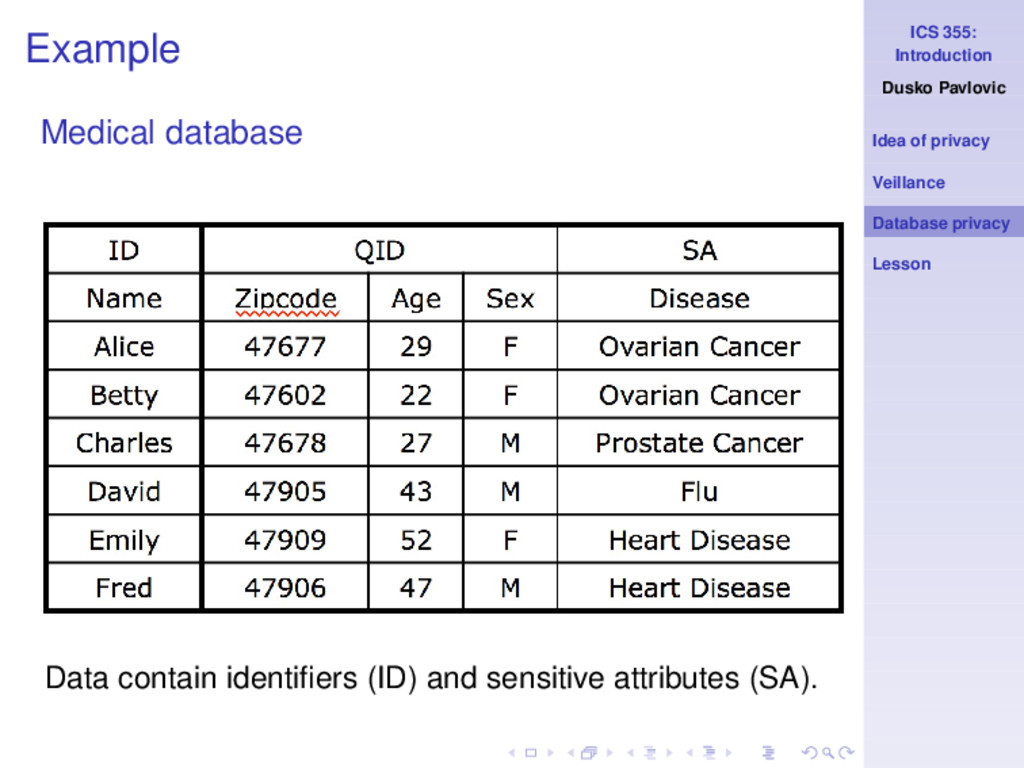
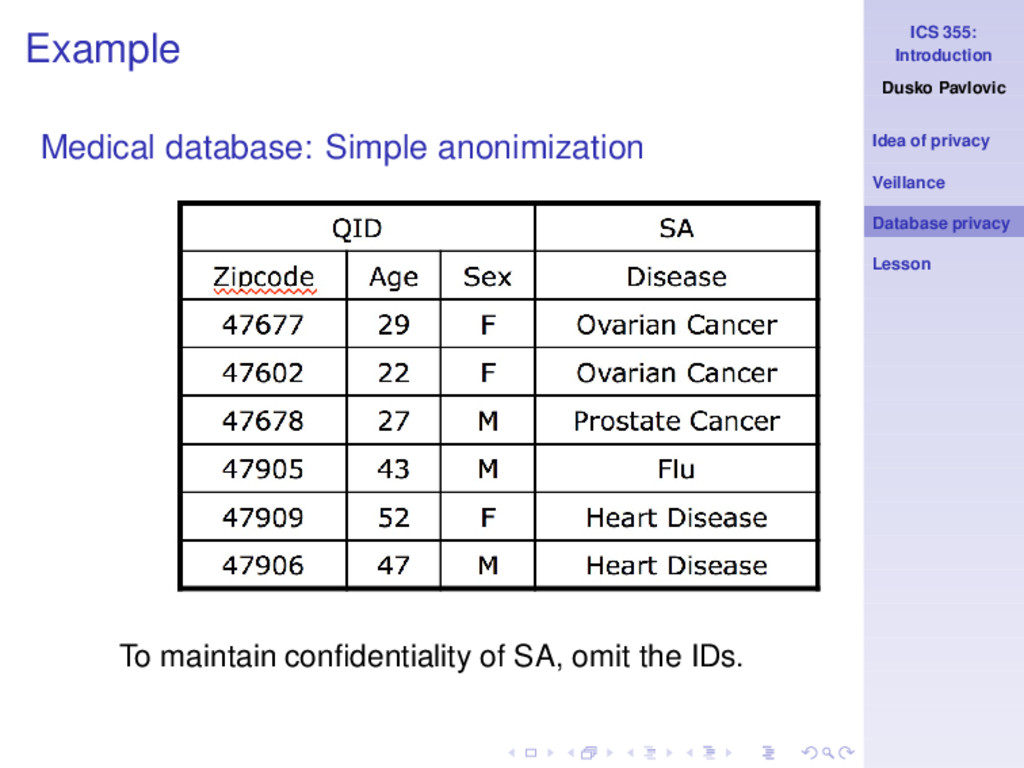
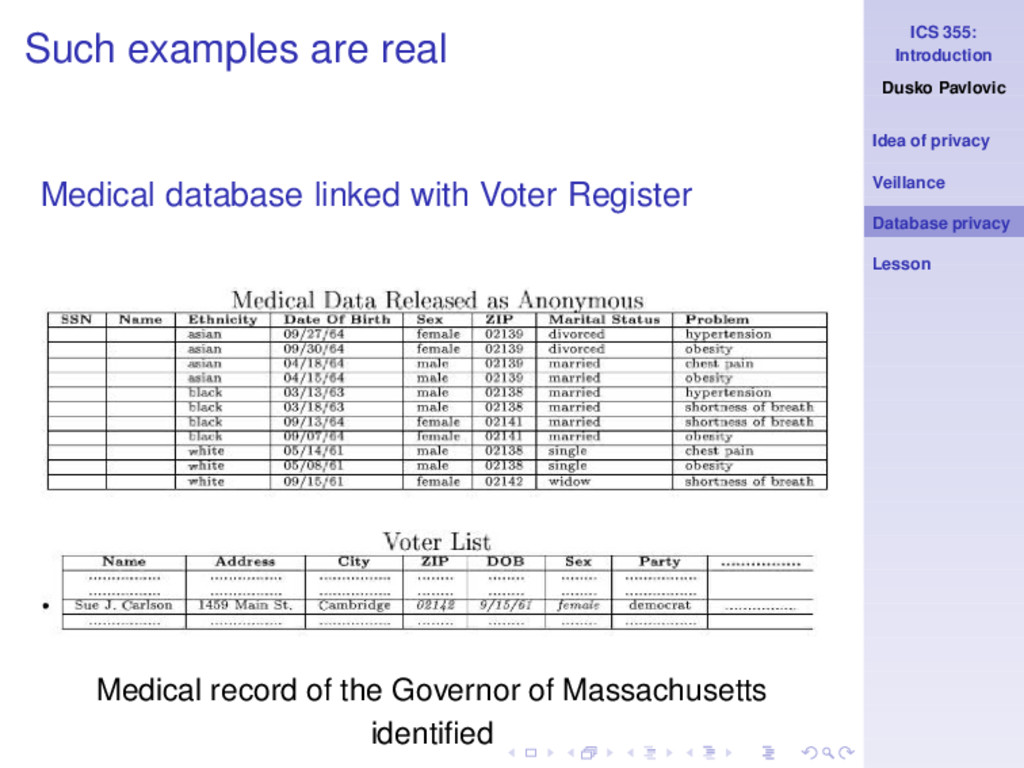
privacy Lesson Problem of anonymizing databases Statistical databases need to be anonymized ◮ Data are often used to calculate sums, averages, statistics ◮ voting, market research, science, medicine. . . ◮ Statistical database is a database released for statistical research ◮ to calculate averages, correlations. . . ◮ If a statistical database contains private data, then it needs to be anonymized
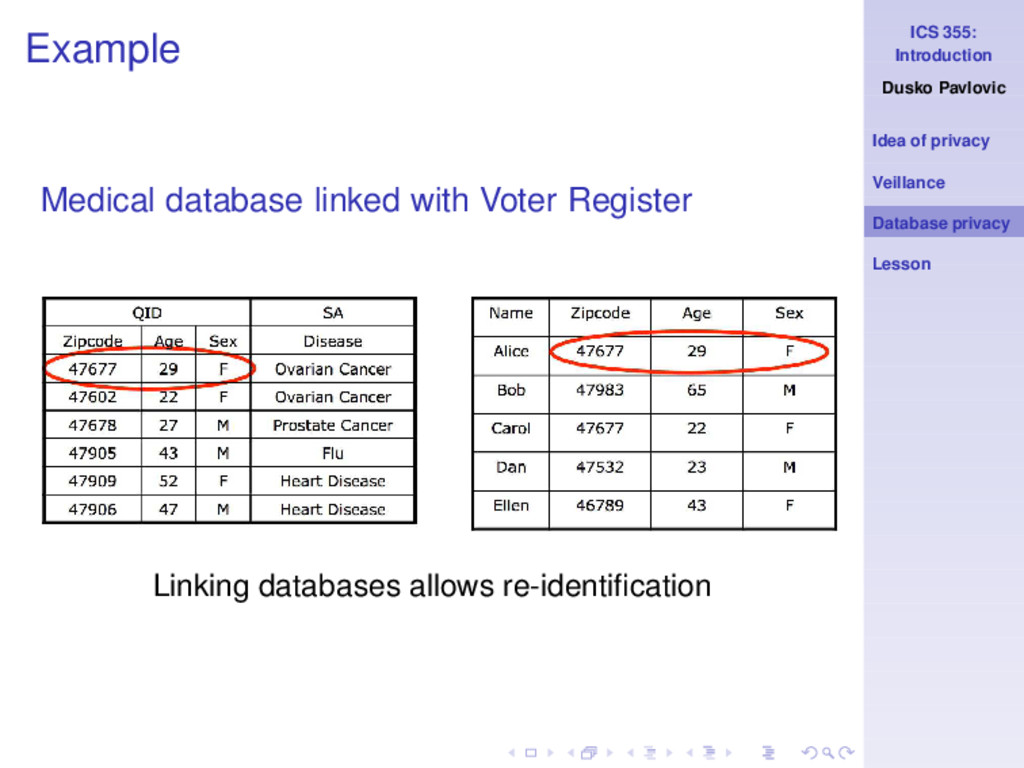
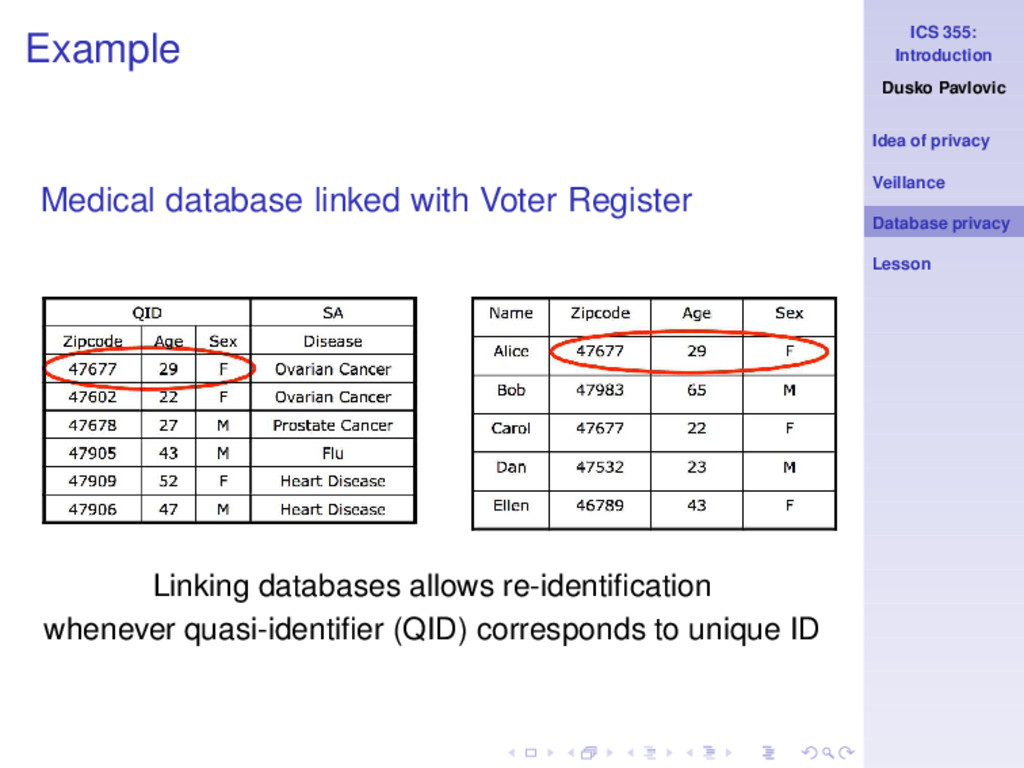
privacy Lesson Example Medical database linked with Voter Register Linking databases allows re-identification whenever quasi-identifier (QID) corresponds to unique ID
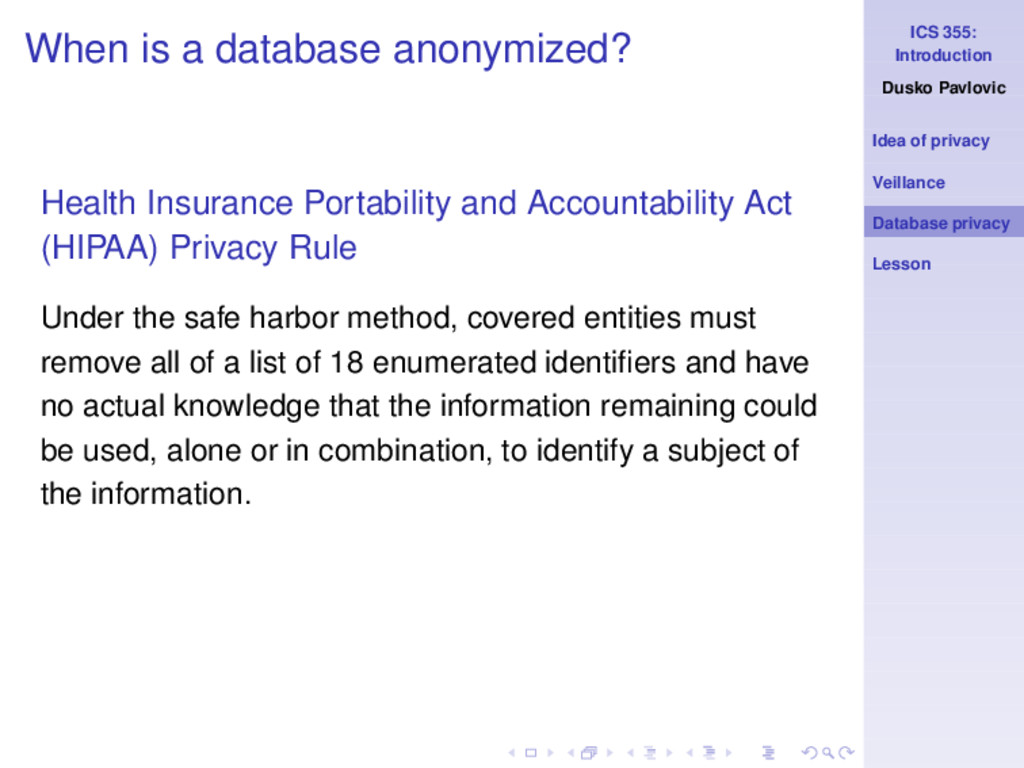
privacy Lesson When is a database anonymized? Health Insurance Portability and Accountability Act (HIPAA) Privacy Rule Under the safe harbor method, covered entities must remove all of a list of 18 enumerated identifiers and have no actual knowledge that the information remaining could be used, alone or in combination, to identify a subject of the information.
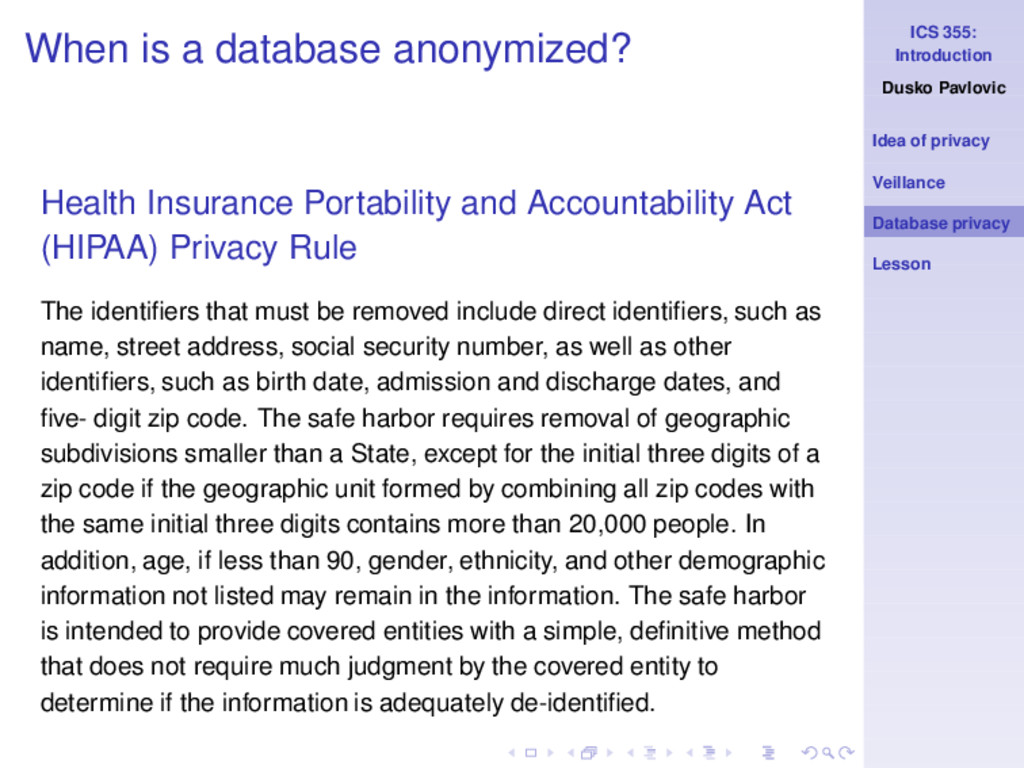
privacy Lesson When is a database anonymized? Health Insurance Portability and Accountability Act (HIPAA) Privacy Rule The identifiers that must be removed include direct identifiers, such as name, street address, social security number, as well as other identifiers, such as birth date, admission and discharge dates, and five- digit zip code. The safe harbor requires removal of geographic subdivisions smaller than a State, except for the initial three digits of a zip code if the geographic unit formed by combining all zip codes with the same initial three digits contains more than 20,000 people. In addition, age, if less than 90, gender, ethnicity, and other demographic information not listed may remain in the information. The safe harbor is intended to provide covered entities with a simple, definitive method that does not require much judgment by the covered entity to determine if the information is adequately de-identified.
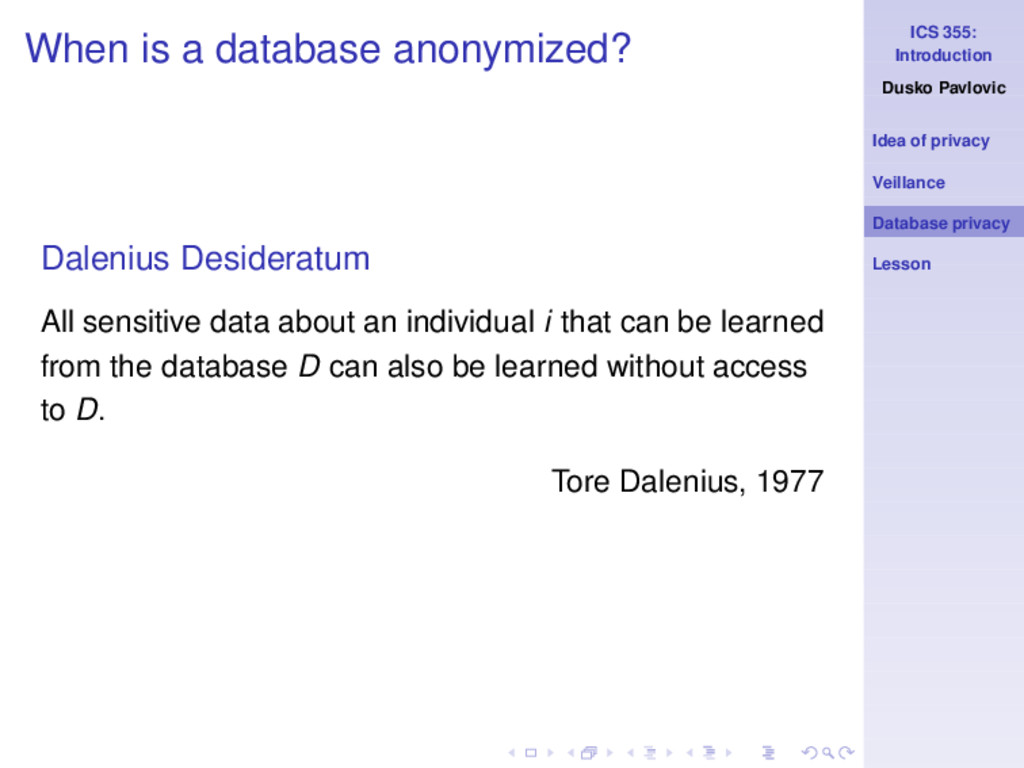
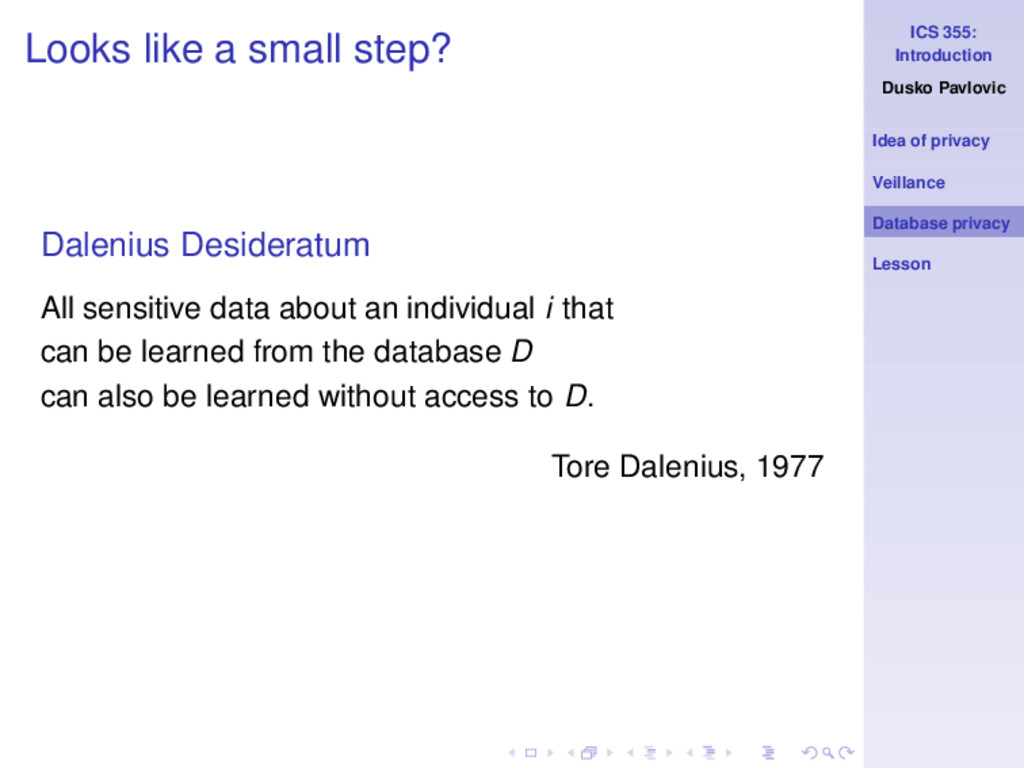
privacy Lesson When is a database anonymized? Dalenius Desideratum All sensitive data about an individual i that can be learned from the database D can also be learned without access to D. Tore Dalenius, 1977
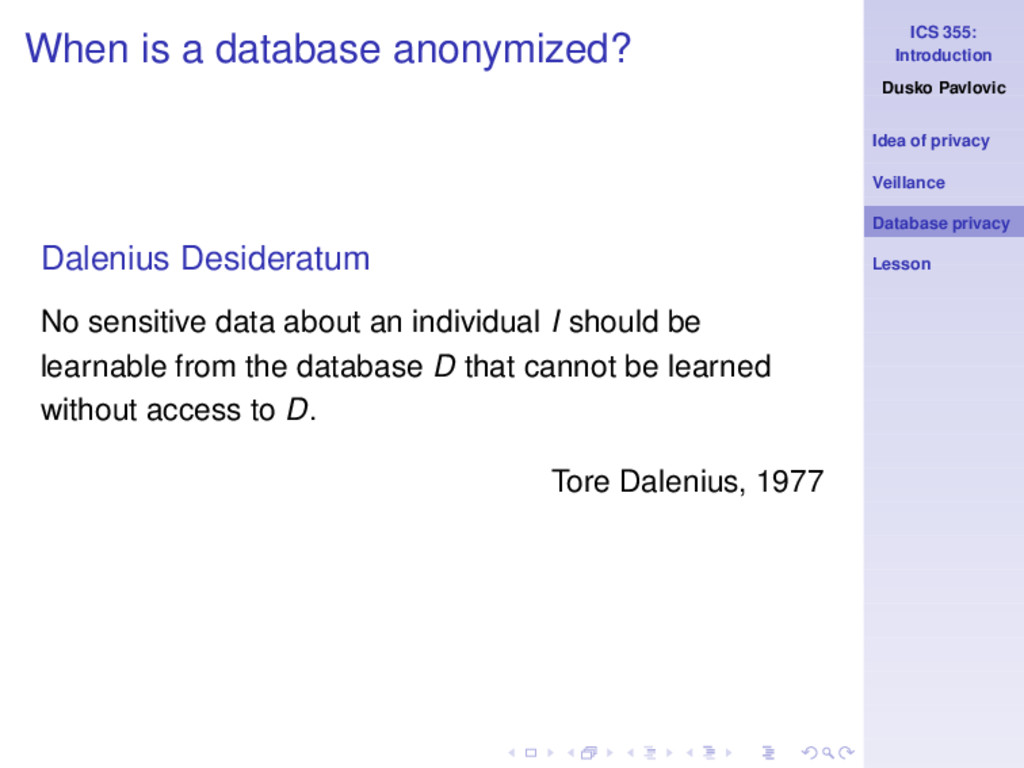
privacy Lesson When is a database anonymized? Dalenius Desideratum No sensitive data about an individual I should be learnable from the database D that cannot be learned without access to D. Tore Dalenius, 1977
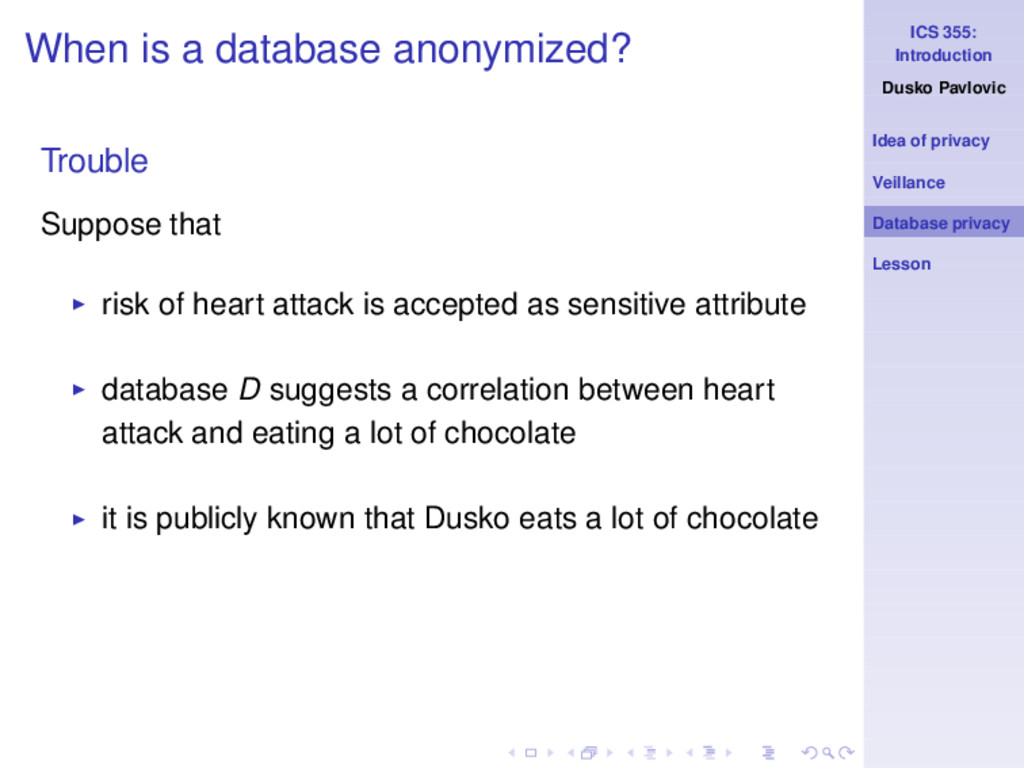
privacy Lesson When is a database anonymized? Trouble Suppose that ◮ risk of heart attack is accepted as sensitive attribute ◮ database D suggests a correlation between heart attack and eating a lot of chocolate ◮ it is publicly known that Dusko eats a lot of chocolate
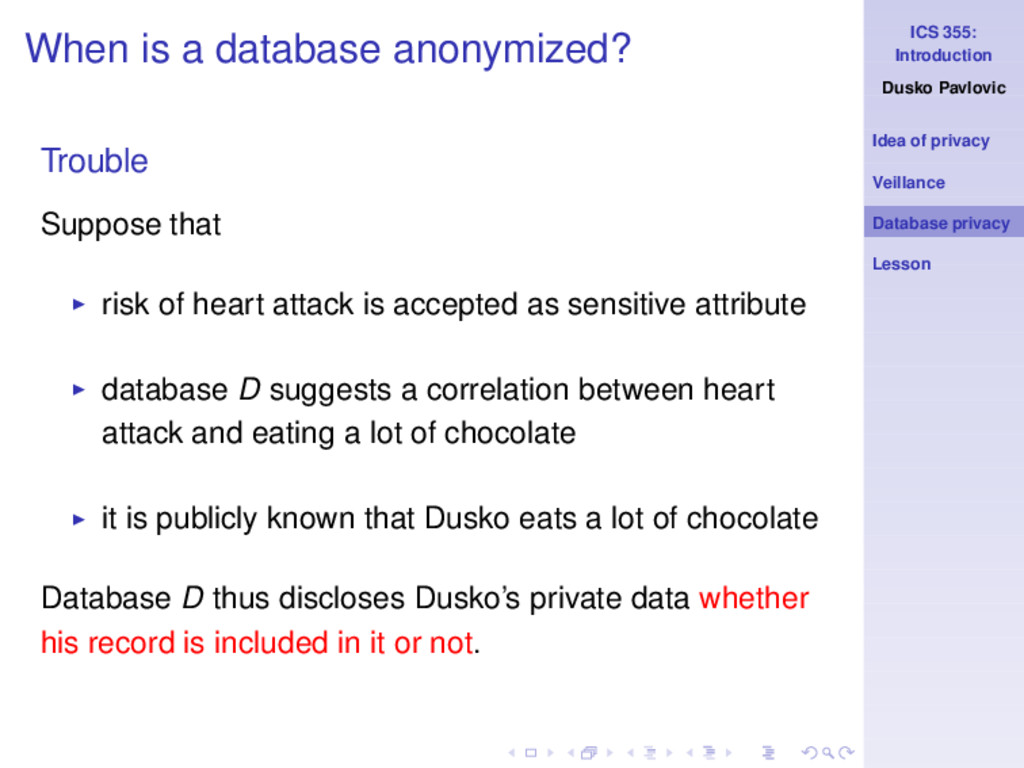
privacy Lesson When is a database anonymized? Trouble Suppose that ◮ risk of heart attack is accepted as sensitive attribute ◮ database D suggests a correlation between heart attack and eating a lot of chocolate ◮ it is publicly known that Dusko eats a lot of chocolate Database D thus discloses Dusko’s private data whether his record is included in it or not.
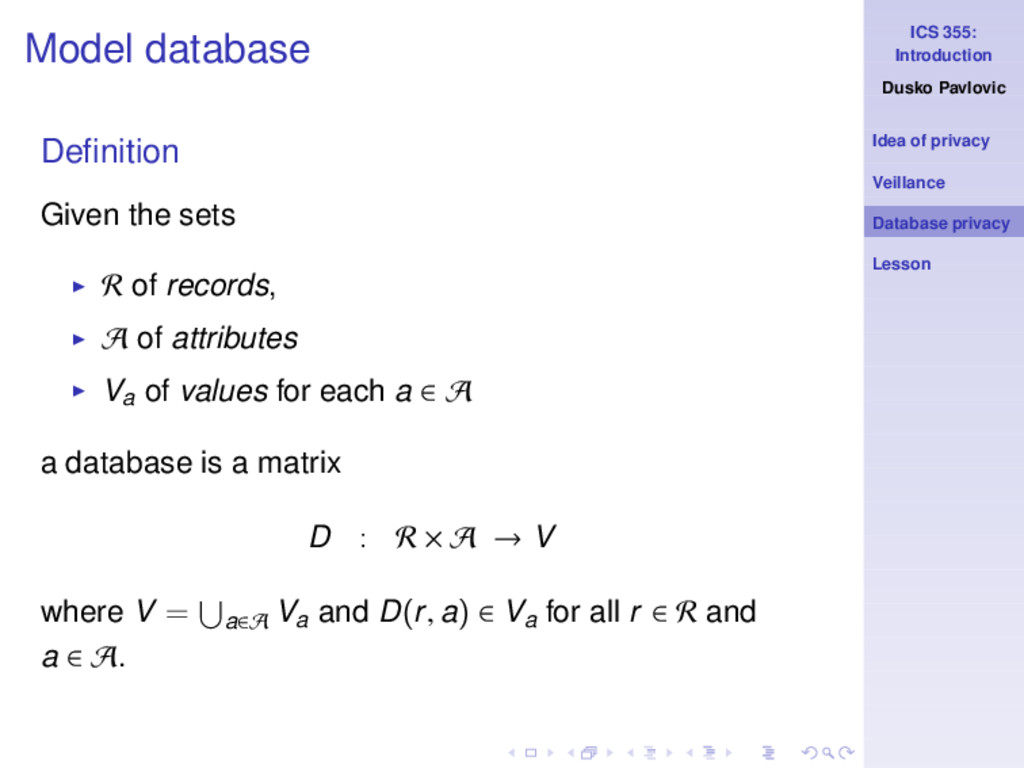
privacy Lesson Model database Definition Given the sets ◮ R of records, ◮ A of attributes ◮ Va of values for each a ∈ A a database is a matrix D : R × A → V where V = a∈A Va and D(r, a) ∈ Va for all r ∈ R and a ∈ A.
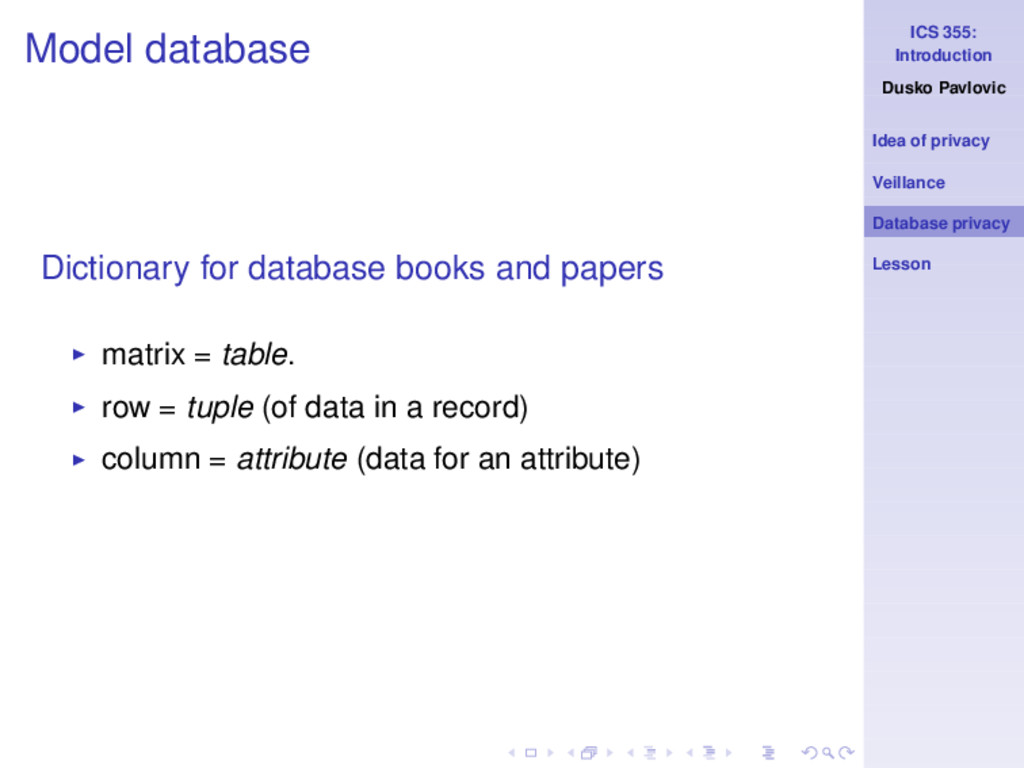
privacy Lesson Model database Dictionary for database books and papers ◮ matrix = table. ◮ row = tuple (of data in a record) ◮ column = attribute (data for an attribute)
privacy Lesson Model data collection and processing Definition Data are collected from a set of entities E. ◮ Data gathering is a map R : E → R, so that DR(e) is the tuple of the data corresponding to the entity e ∈ E. ◮ Data identification is a map E : R → E, such that E(R(e)) = e.
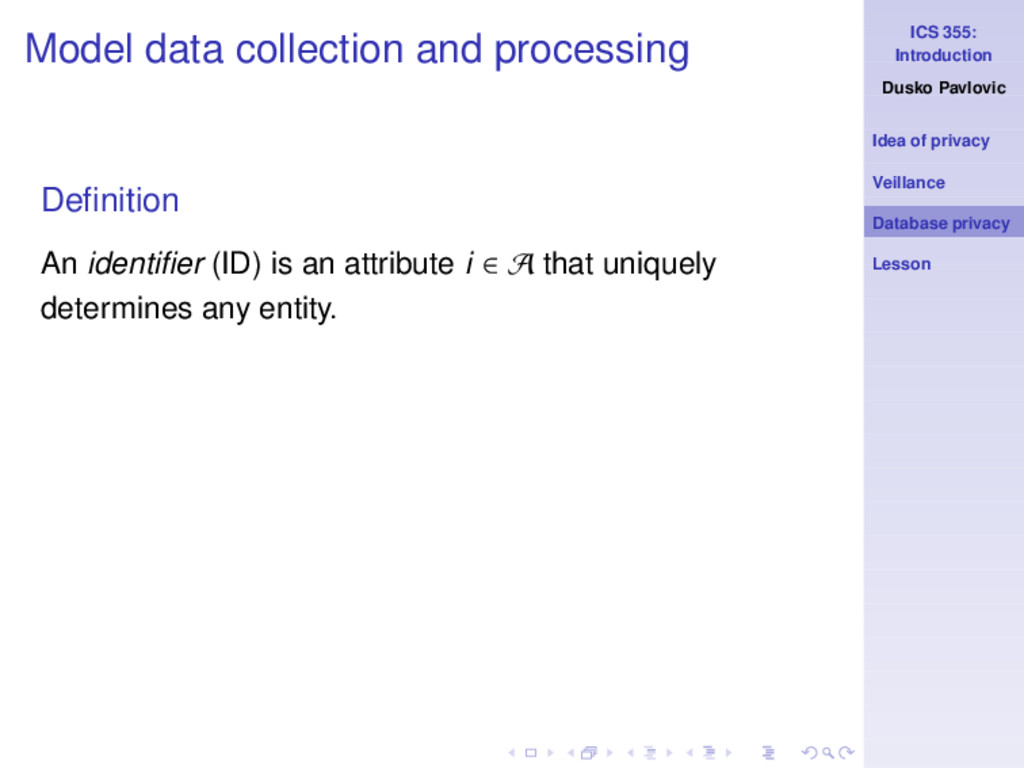
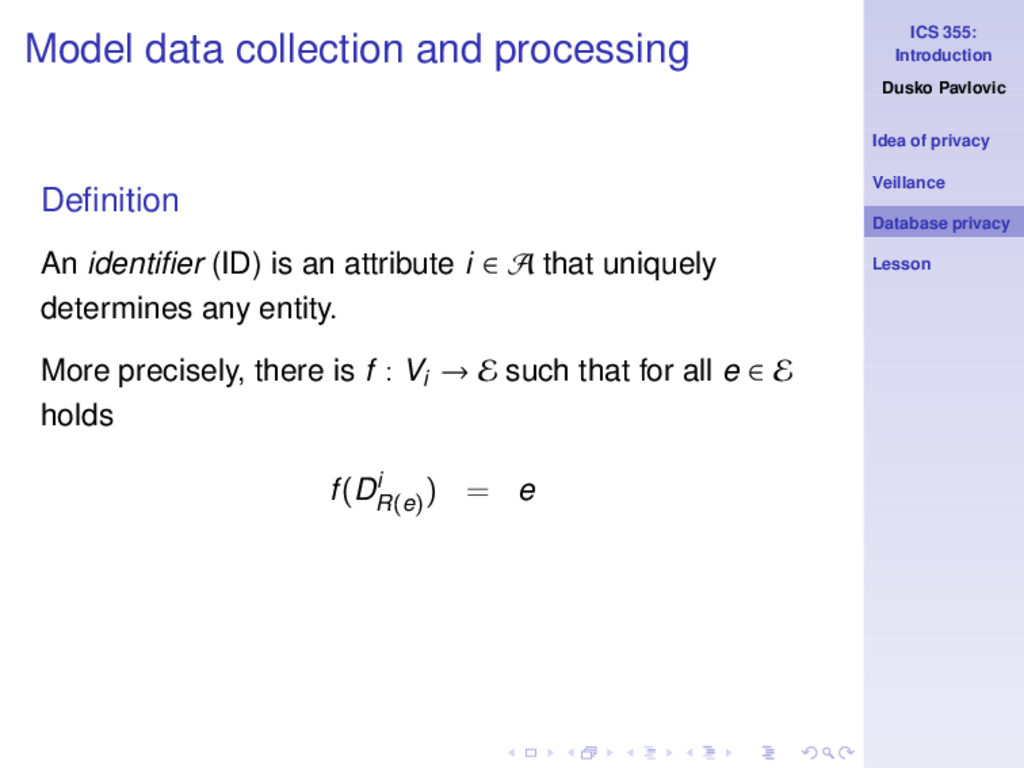
privacy Lesson Model data collection and processing Definition An identifier (ID) is an attribute i ∈ A that uniquely determines any entity. More precisely, there is f : Vi → E such that for all e ∈ E holds f(Di R(e) ) = e
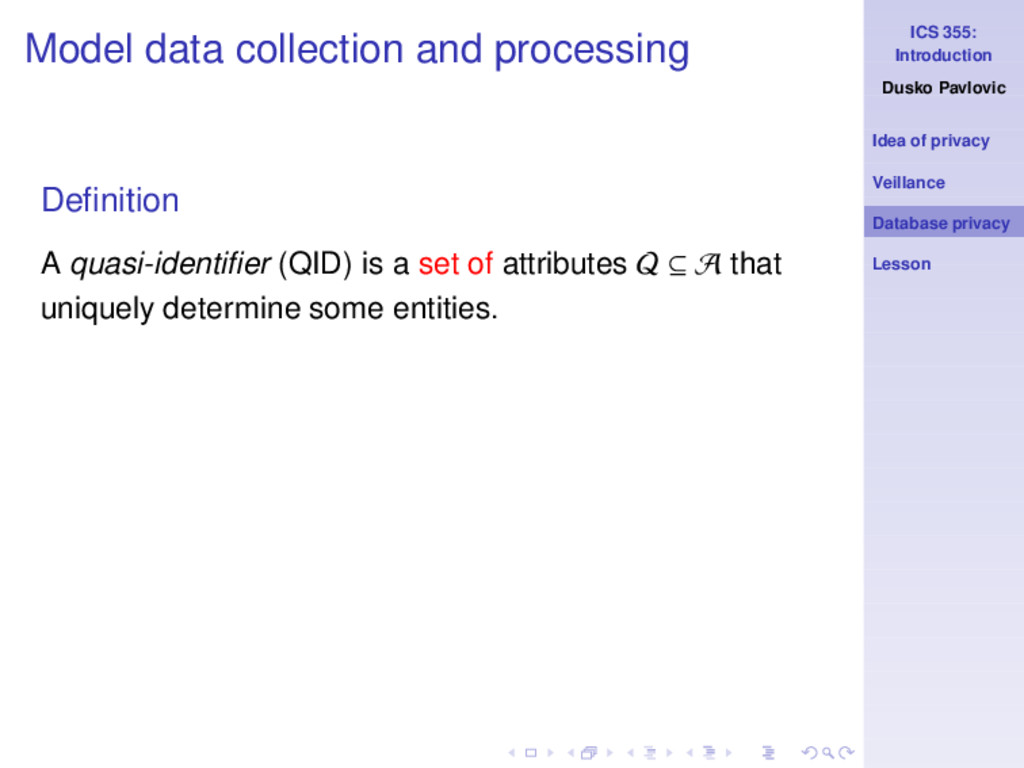
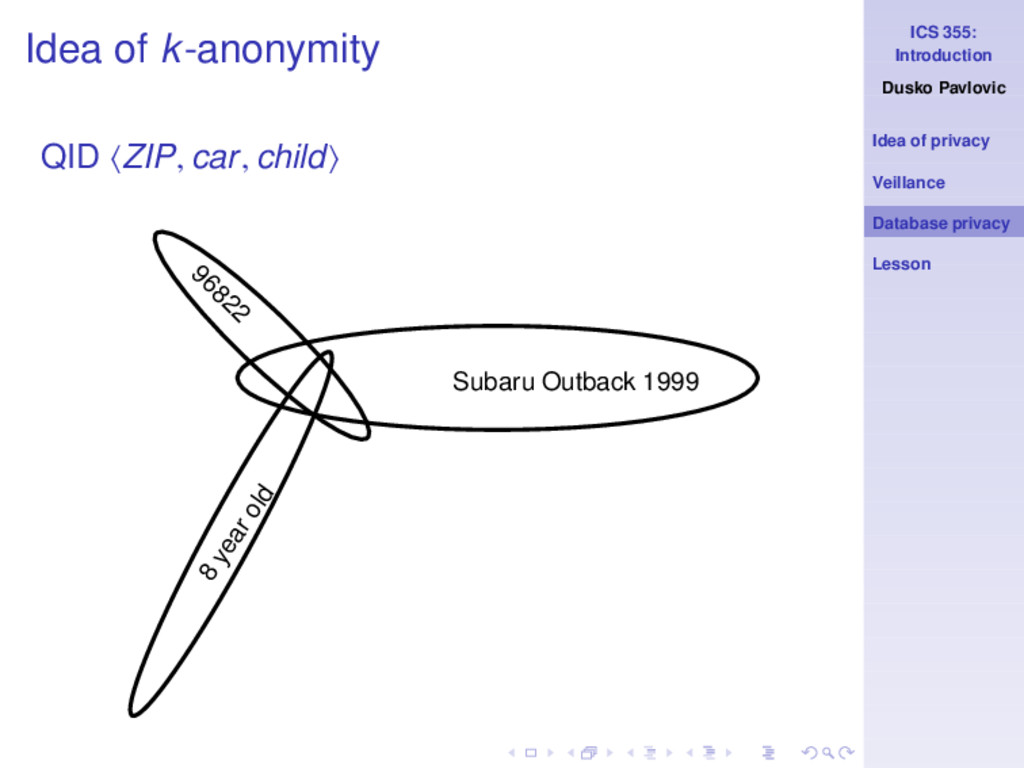
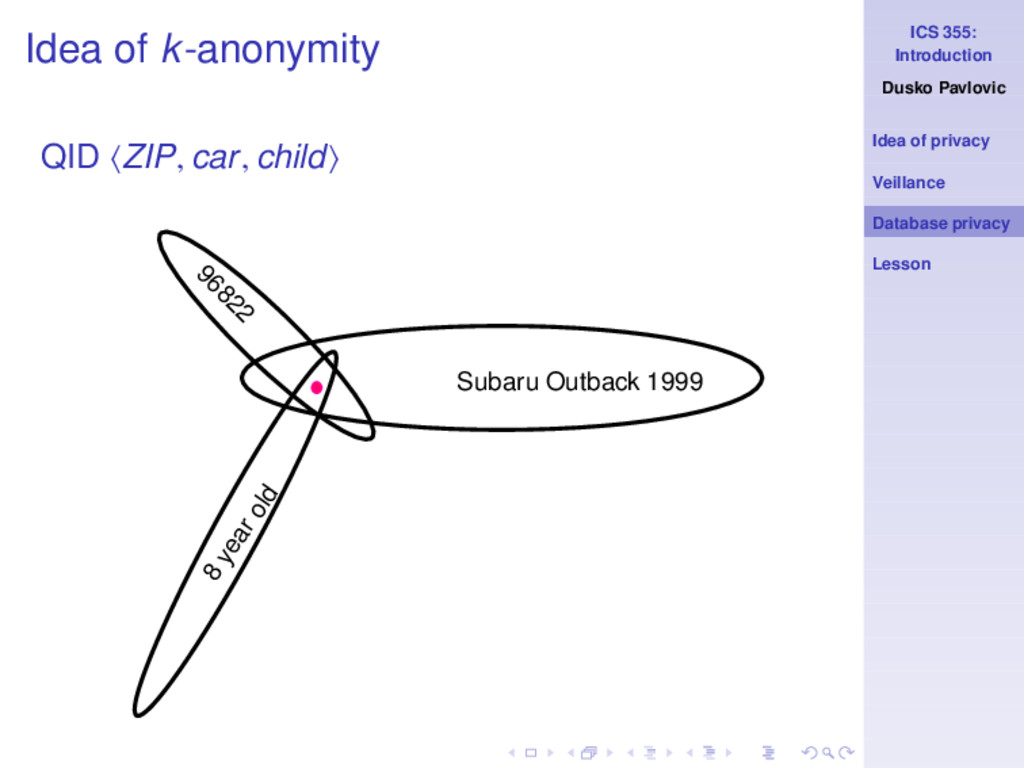
privacy Lesson Model data collection and processing Definition A quasi-identifier (QID) is a set of attributes Q ⊆ A that uniquely determine some entities.
privacy Lesson Model data collection and processing Definition A quasi-identifier (QID) is a set of attributes Q ⊆ A that uniquely determine some entities. More precisely, there is a partial function f : i∈Q Vi ⇁ E such that for some e ∈ E holds f(DQ R(e) ) = e where DQ R(e) is a Q-tuple of attributes in the database D
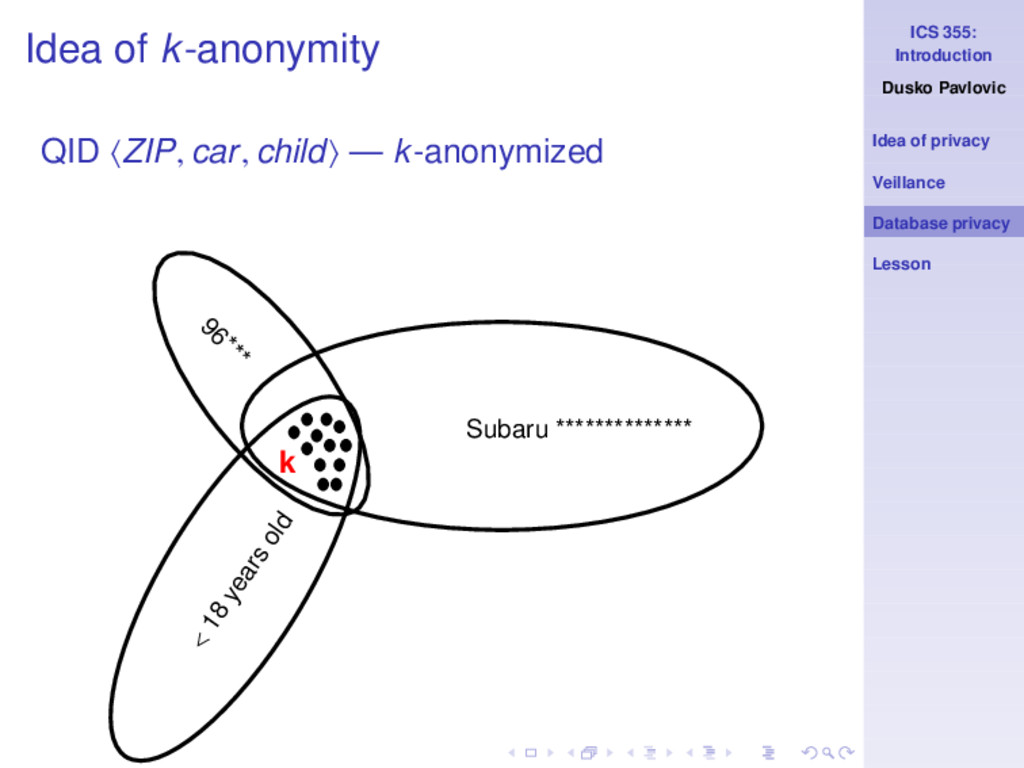
privacy Lesson Model data privacy Definition A database D satisfies the k-anonymity requirement if for every quasi-identifier Q and every Q-tuple of values DQ there are ◮ either at least k records with the same value DQ ◮ or no such records, i.e. DQ does not come about in D.
privacy Lesson Methods to achieve k-anonymity ◮ Generalization: replace the precise QID values with a more general value ◮ when the precise values together average out to the general value ◮ Suppression: suppress the records containing the "outlier" values ◮ generalizing the values far from other values would cause the distortion of the average and statistics
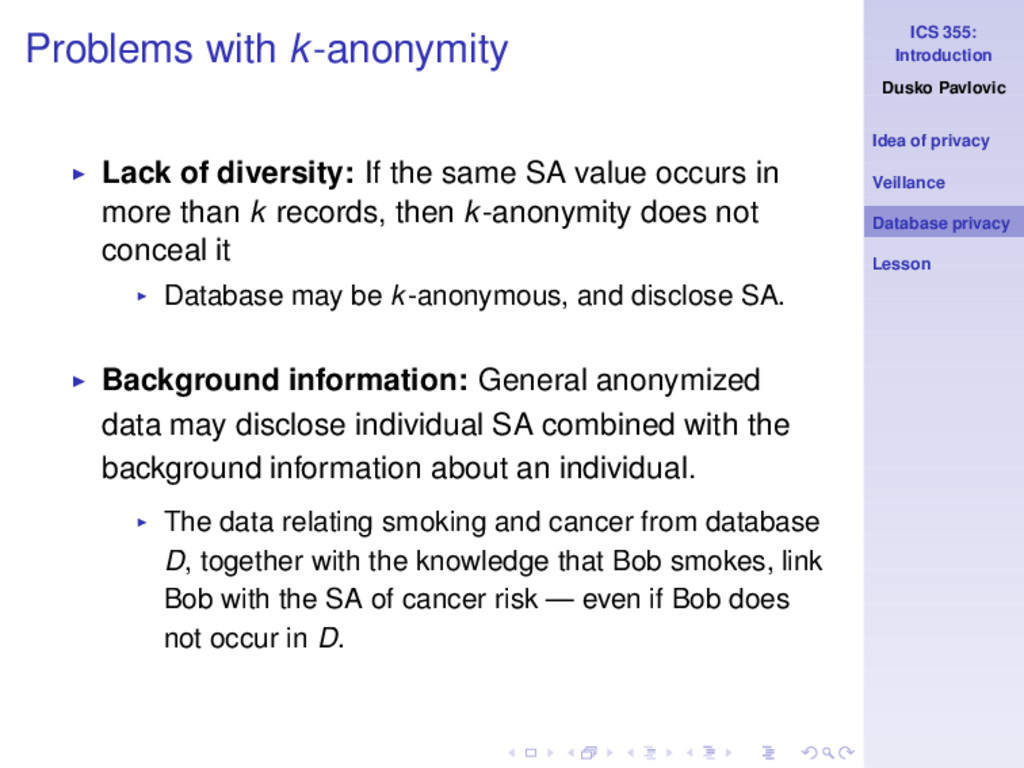
privacy Lesson Problems with k-anonymity ◮ Lack of diversity: If the same SA value occurs in more than k records, then k-anonymity does not conceal it ◮ Database may be k-anonymous, and disclose SA. ◮ Background information: General anonymized data may disclose individual SA combined with the background information about an individual. ◮ The data relating smoking and cancer from database D, together with the knowledge that Bob smokes, link Bob with the SA of cancer risk — even if Bob does not occur in D.
privacy Lesson Background information is a false problem Fact Anonymizing database D cannot eliminate the information available outside D. Consequence I must accept that a database D may disclose some sensitive information about me to those who know me — even if I do not occur in D.
privacy Lesson Idea Differential Privacy All sensitive data about an individual i that can be learned from the database D with a record r(i) can also be learned from the database D′ where r(i) is replaced by any r′. Cynthia Dwork 2008
privacy Lesson Looks like a small step? Dalenius Desideratum All sensitive data about an individual i that can be learned from the database D can also be learned without access to D. Tore Dalenius, 1977
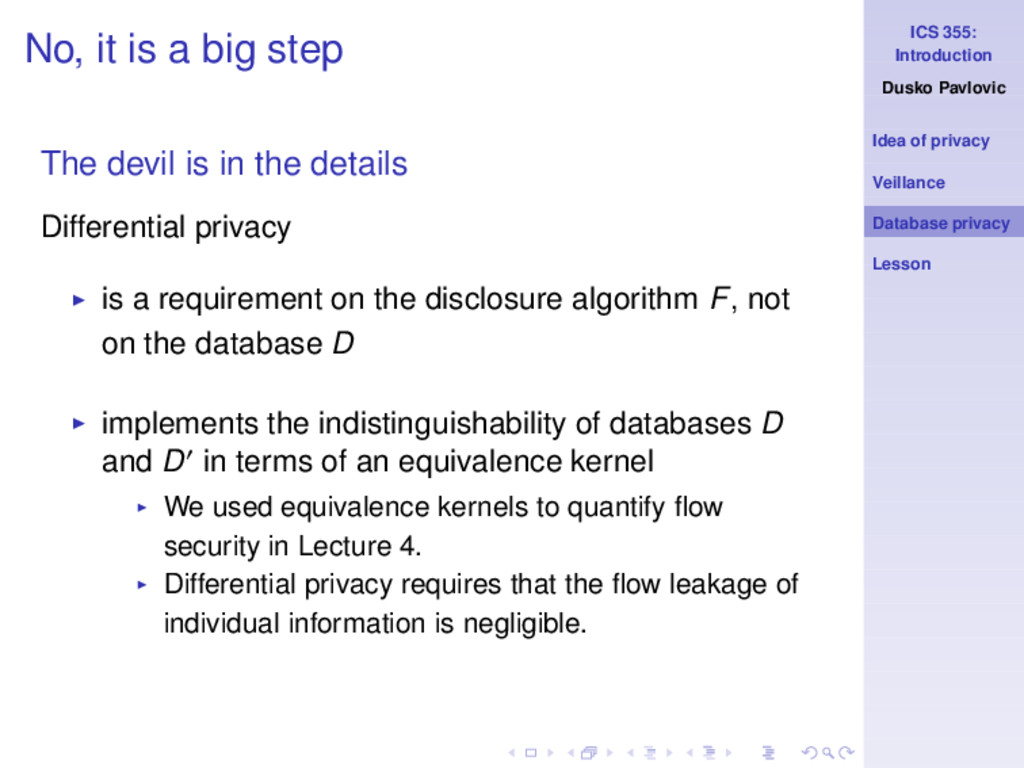
privacy Lesson No, it is a big step The devil is in the details Differential privacy ◮ is a requirement on the disclosure algorithm F, not on the database D ◮ implements the indistinguishability of databases D and D′ in terms of an equivalence kernel ◮ We used equivalence kernels to quantify flow security in Lecture 4. ◮ Differential privacy requires that the flow leakage of individual information is negligible.
privacy Lesson Differential privacy Definition Let ◮ D be a family of databases, ◮ P ⊆ a∈A Va a family of properties (viewed as sets of values in some attributes), and ◮ ε > 0 a real number. A disclosure algorithm F : D → P is ε-differentially private if for every property Y ∈ P holds | Pr(F(D) ∈ Y) Pr(F(D′) ∈ Y) | ≤ e−ε for any pair D, D′ ∈ D which differ in at most one record.
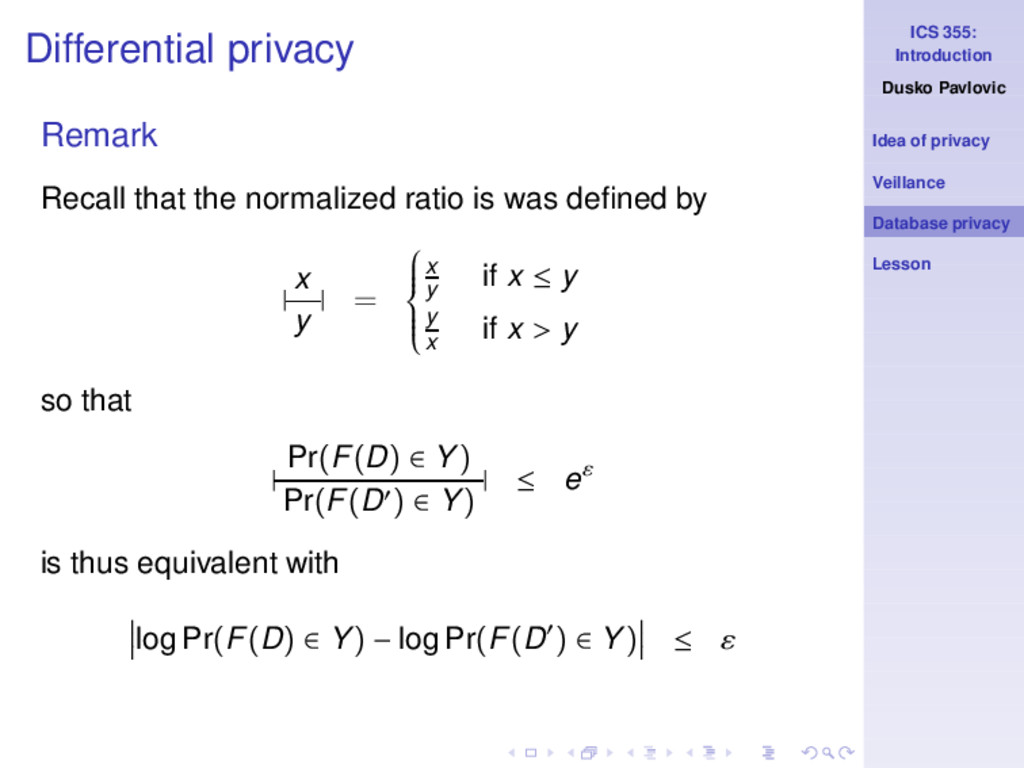
privacy Lesson Differential privacy Remark Recall that the normalized ratio is was defined by | x y | = x y if x ≤ y y x if x > y so that | Pr(F(D) ∈ Y) Pr(F(D′) ∈ Y) | ≤ eε is thus equivalent with log Pr(F(D) ∈ Y) − log Pr(F(D′) ∈ Y) ≤ ε
privacy Lesson Differential privacy Explanation The difference between the attacker’s information from D and from D′ is indistinguishable in the same sense in which his prior and posterior beliefs were indistinguishable when extracting information from probabilistic channels in Lecture 4.
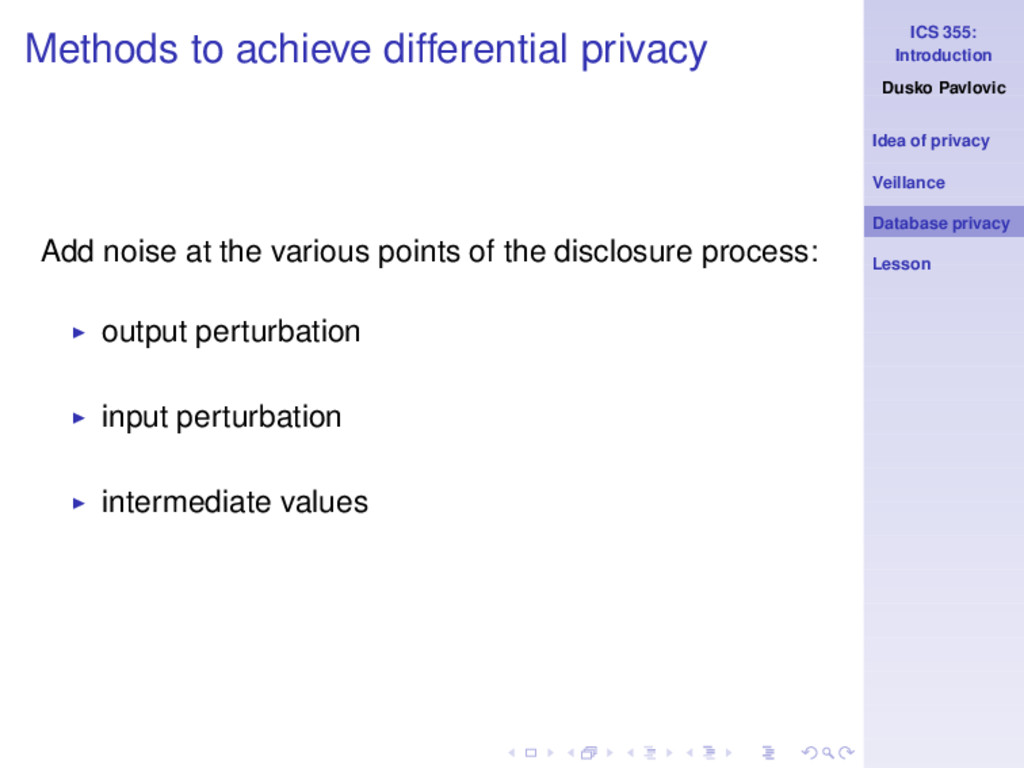
privacy Lesson Methods to achieve differential privacy Add noise at the various points of the disclosure process: ◮ output perturbation ◮ input perturbation ◮ intermediate values
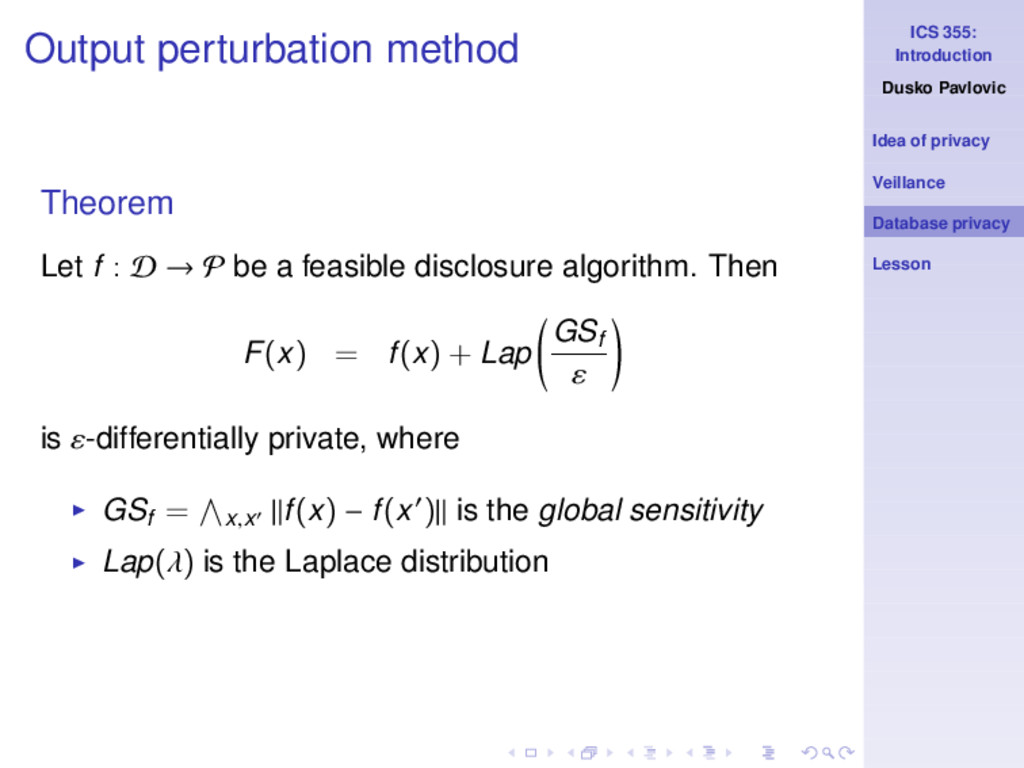
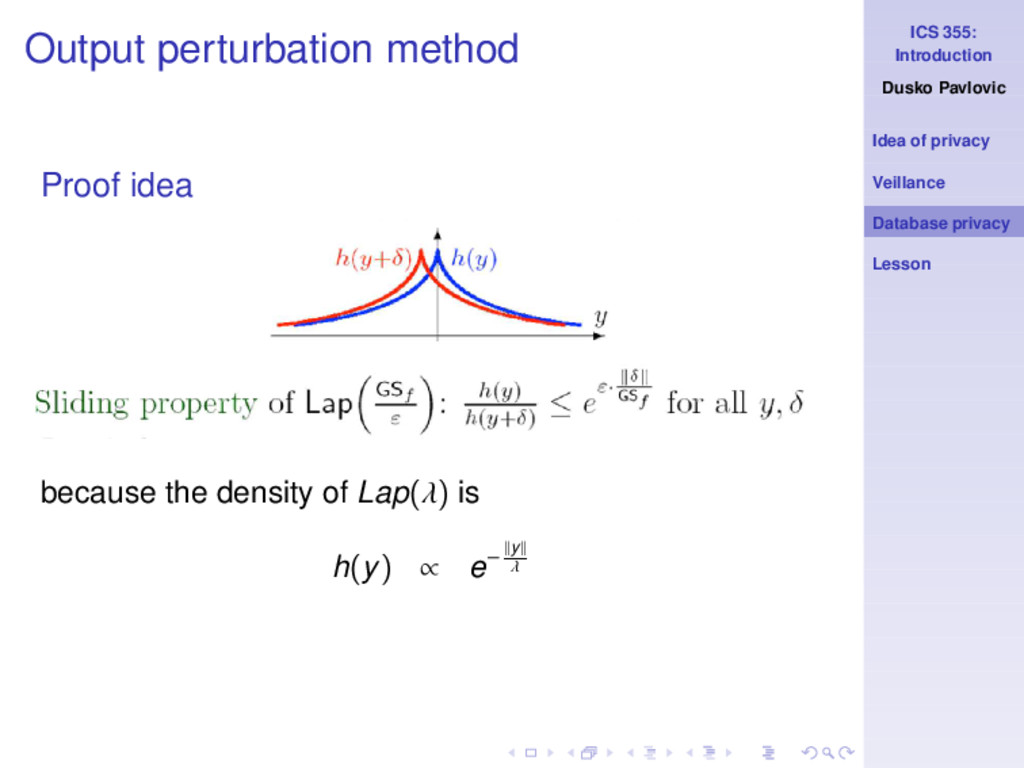
privacy Lesson Output perturbation method Theorem Let f : D → P be a feasible disclosure algorithm. Then F(x) = f(x) + Lap GSf ε is ε-differentially private, where ◮ GSf = x,x′ f(x) − f(x′) is the global sensitivity ◮ Lap(λ) is the Laplace distribution
privacy Lesson What did we learn? ◮ Privacy is the right to be left alone. ◮ The balance of the public sphere and the private sphere is a balance of political powers. ◮ The same technologies provide more privacy for those in power and less privacy for those under control. ◮ The new technologies facilitate both surveillance from above and sousveillance from below. ◮ Techniques to assure database privacy have a significant social impact.


 philipmjohnson
 juanmartin2026
 camel_404
 fmarot
 dragon2
 pawan_pharm
 signer
 ishii_mit
 naoji_taniguchi_ksk_0827
 matleenalaakso
 ainischool
 uchi8977
 palkan
 cassininazir
 notwaldorf
 katarinadahlin
 427marketing
 bryan
bryan
 aleyda
 62gerente
 chriscoyier
 addyosmani
 apolaine
 baasie