Upgrade to Pro — share decks privately, control downloads, hide ads and more …

Cut Through the Al Buzz - The Fundamentals That...

Cut Through the Al Buzz - The Fundamentals That Matter

AI terminology keeps changing — but the underlying systems don’t.

This deck presents a clear framework for understanding modern AI products through context, tools, and orchestration, and shows how concepts like agents, skills and MCP fit into that picture.

If you want a faster way to:
- evaluate AI tools
- see through product terminology
- and focus on what actually matters

Avatar for Qingkun Li

Qingkun Li

March 25, 2026

Other Decks in Technology

Transcript

  1. Cut Through the AI Buzz The Fundamentals That Matter Demystifying

    the terms and connecting the dots Qingkun Li · March 2026
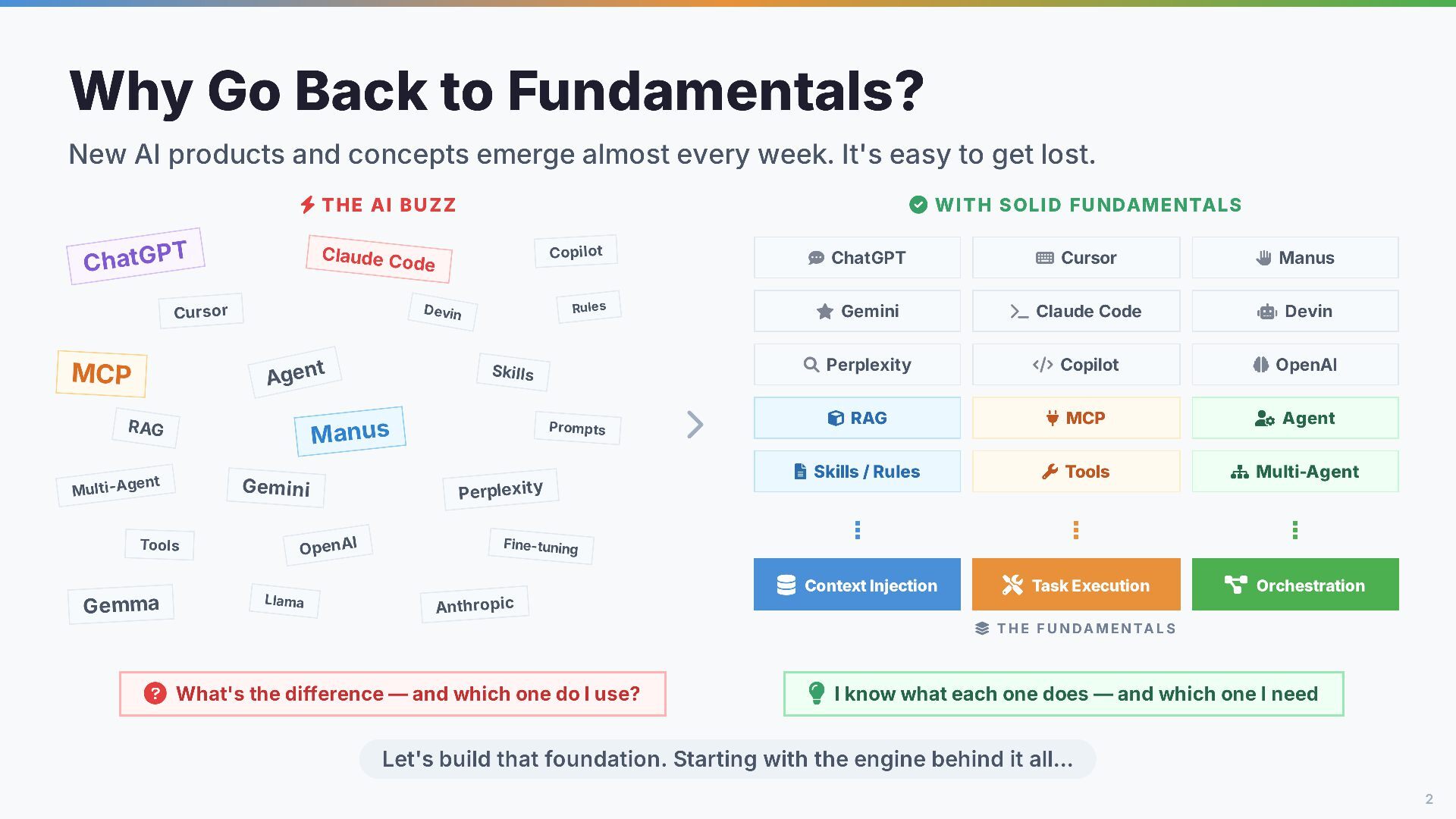
  2. Why Go Back to Fundamentals? New AI products and concepts

    emerge almost every week. It's easy to get lost. The AI Buzz ChatGPT Claude Code Copilot Cursor Devin Rules MCP Agent Skills RAG Manus Prompts Multi-Agent Gemini Perplexity Tools OpenAI Fine-tuning Gemma Llama Anthropic With Solid Fundamentals ChatGPT Gemini Perplexity RAG Skills / Rules Cursor Claude Code Copilot MCP Tools Manus Devin OpenAI Agent Multi-Agent Context Injection Task Execution Orchestration The Fundamentals What's the difference — and which one do I use? I know what each one does — and which one I need Let's build that foundation. Starting with the engine behind it all... 2
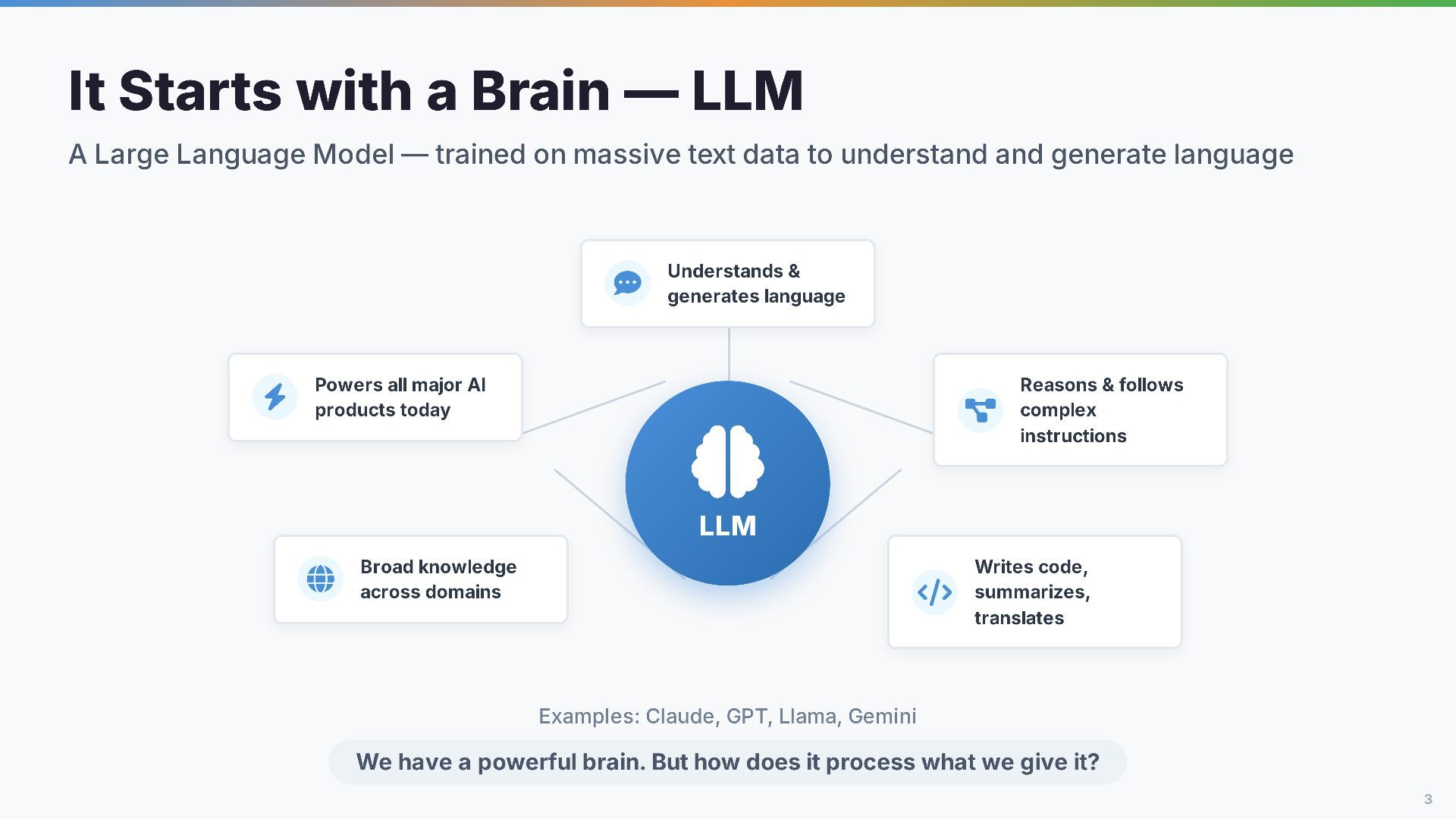
  3. It Starts with a Brain — LLM A Large Language

    Model — trained on massive text data to understand and generate language LLM Understands & generates language Understands & generates language Reasons & follows complex instructions Reasons & follows complex instructions Reasons & follows complex instructions Writes code, summarizes, translates Writes code, summarizes, translates Writes code, summarizes, translates Broad knowledge across domains Broad knowledge across domains Powers all major AI products today Powers all major AI products today Examples: Claude, GPT, Llama, Gemini We have a powerful brain. But how does it process what we give it? 3
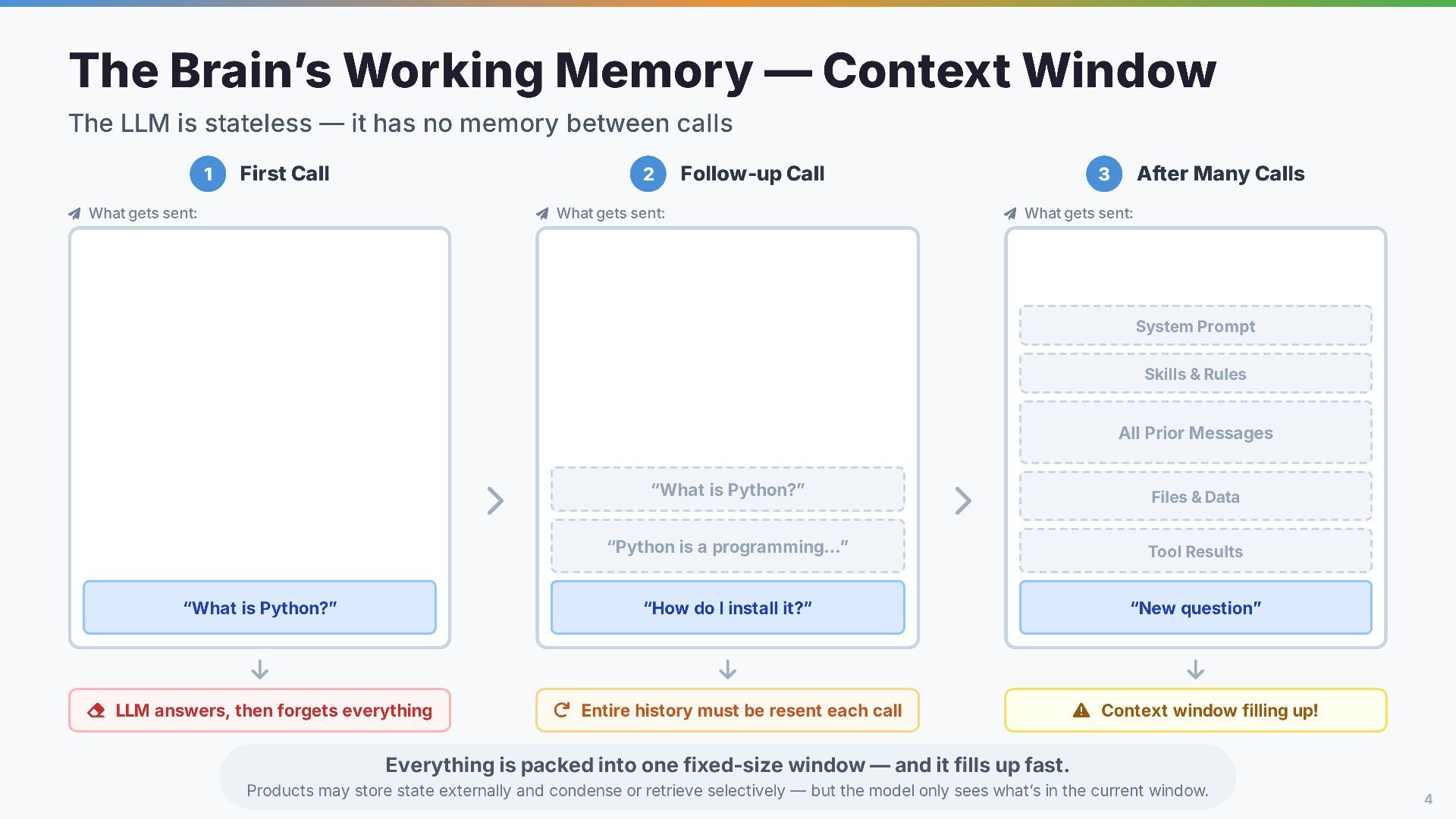
  4. The Brain’s Working Memory — Context Window The LLM is

    stateless — it has no memory between calls 1 First Call What gets sent: “What is Python?” LLM answers, then forgets everything 2 Follow-up Call What gets sent: “What is Python?” “Python is a programming...” “How do I install it?” Entire history must be resent each call 3 After Many Calls What gets sent: System Prompt Skills & Rules All Prior Messages Files & Data Tool Results “New question” Context window filling up! Everything is packed into one fixed-size window — and it fills up fast. Products may store state externally and condense or retrieve selectively — but the model only sees what’s in the current window. 4
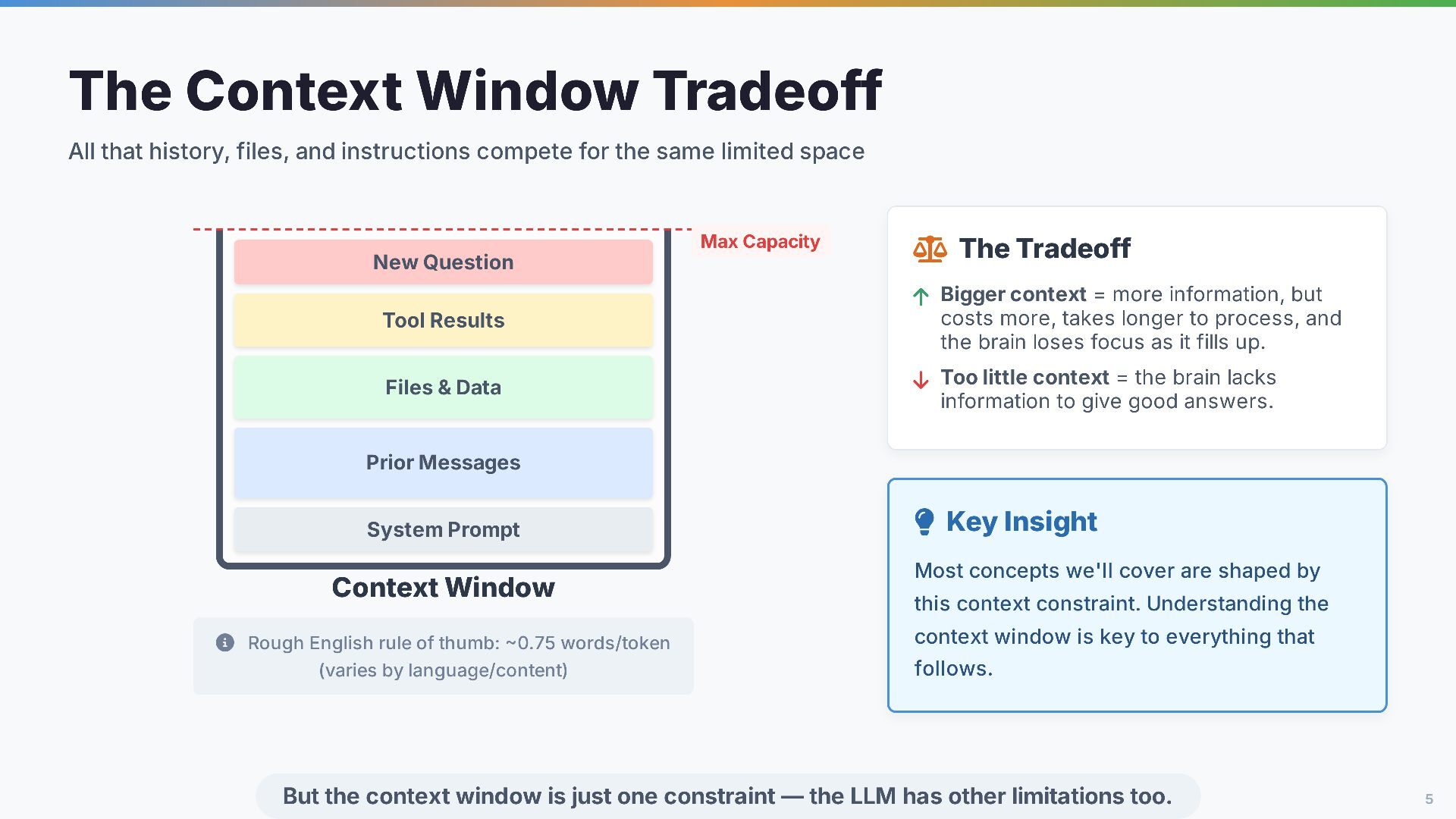
  5. The Context Window Tradeoff All that history, files, and instructions

    compete for the same limited space Max Capacity New Question Tool Results Files & Data Prior Messages System Prompt Context Window Rough English rule of thumb: ~0.75 words/token (varies by language/content) The Tradeoff Bigger context = more information, but costs more, takes = more information, but costs more, takes longer to proce = more information, but costs more, takes longer to proce Too little context = the brain lacks information to give go = the brain lacks information to give good answers. Key Insight Most concepts we'll cover are shaped by this context constra Most concepts we'll cover are shaped by this context constra Most concepts we'll cover are shaped by this context constra Most concepts we'll cover are shaped by this context constra But the context window is just one constraint — the LLM has other limitations too. 5
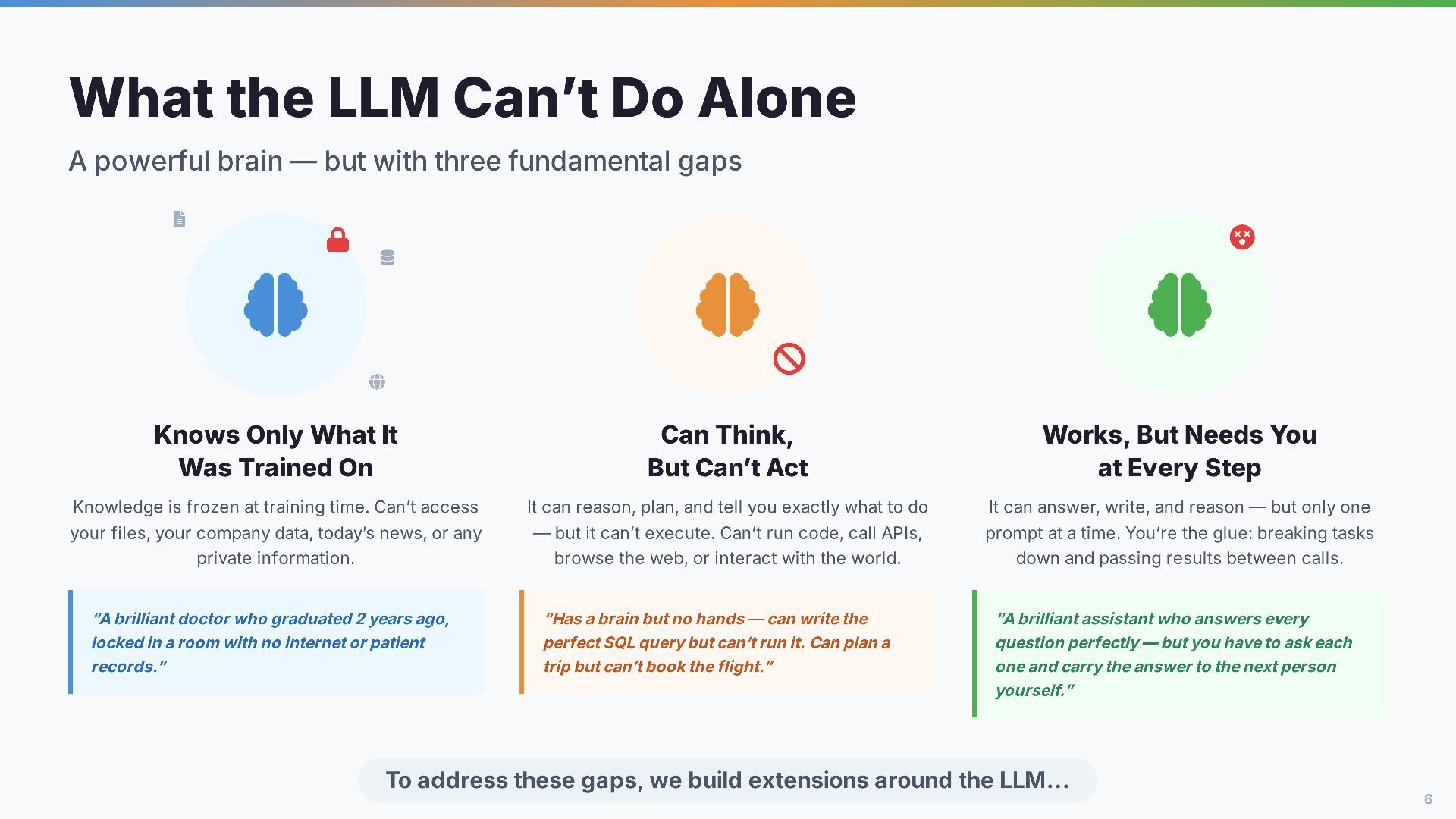
  6. What the LLM Can’t Do Alone A powerful brain —

    but with three fundamental gaps Knows Only What It Was Trained On Knowledge is frozen at training time. Can’t access your files, your company data, today’s news, or any private information. Knowledge is frozen at training time. Can’t access your files, your company data, today’s news, or any private information. Knowledge is frozen at training time. Can’t access your files, your company data, today’s news, or any private information. “A brilliant doctor who graduated 2 years ago, locked in a room with no internet or patient records.” “A brilliant doctor who graduated 2 years ago, locked in a room with no internet or patient records.” “A brilliant doctor who graduated 2 years ago, locked in a room with no internet or patient records.” Can Think, But Can’t Act It can reason, plan, and tell you exactly what to do — but it can’t execute. Can’t run code, call APIs, browse the web, or inte It can reason, plan, and tell you exactly what to do — but it can’t execute. Can’t run code, call APIs, browse the web, or inte It can reason, plan, and tell you exactly what to do — but it can’t execute. Can’t run code, call APIs, browse the web, or “Has a brain but no hands — can write the perfect SQL query but can’t run it. Can plan a trip but can’t book the flight.” “Has a brain but no hands — can write the perfect SQL query but can’t run it. Can plan a trip but can’t book the flight.” “Has a brain but no hands — can write the perfect SQL query but can’t run it. Can plan a trip but can’t book the flight.” Works, But Needs You at Every Step It can answer, write, and reason — but only one prompt at a tim It can answer, write, and reason — but only one prompt at a tim It can answer, write, and reason — but only one prompt at “A brilliant assistant who answers every question perfectly — but y “A brilliant assistant who answers every question perfectly — but y “A brilliant assistant who answers every question perfectly — but y “A brilliant assistant who answers every question perfectly — but y To address these gaps, we build extensions around the LLM... 6
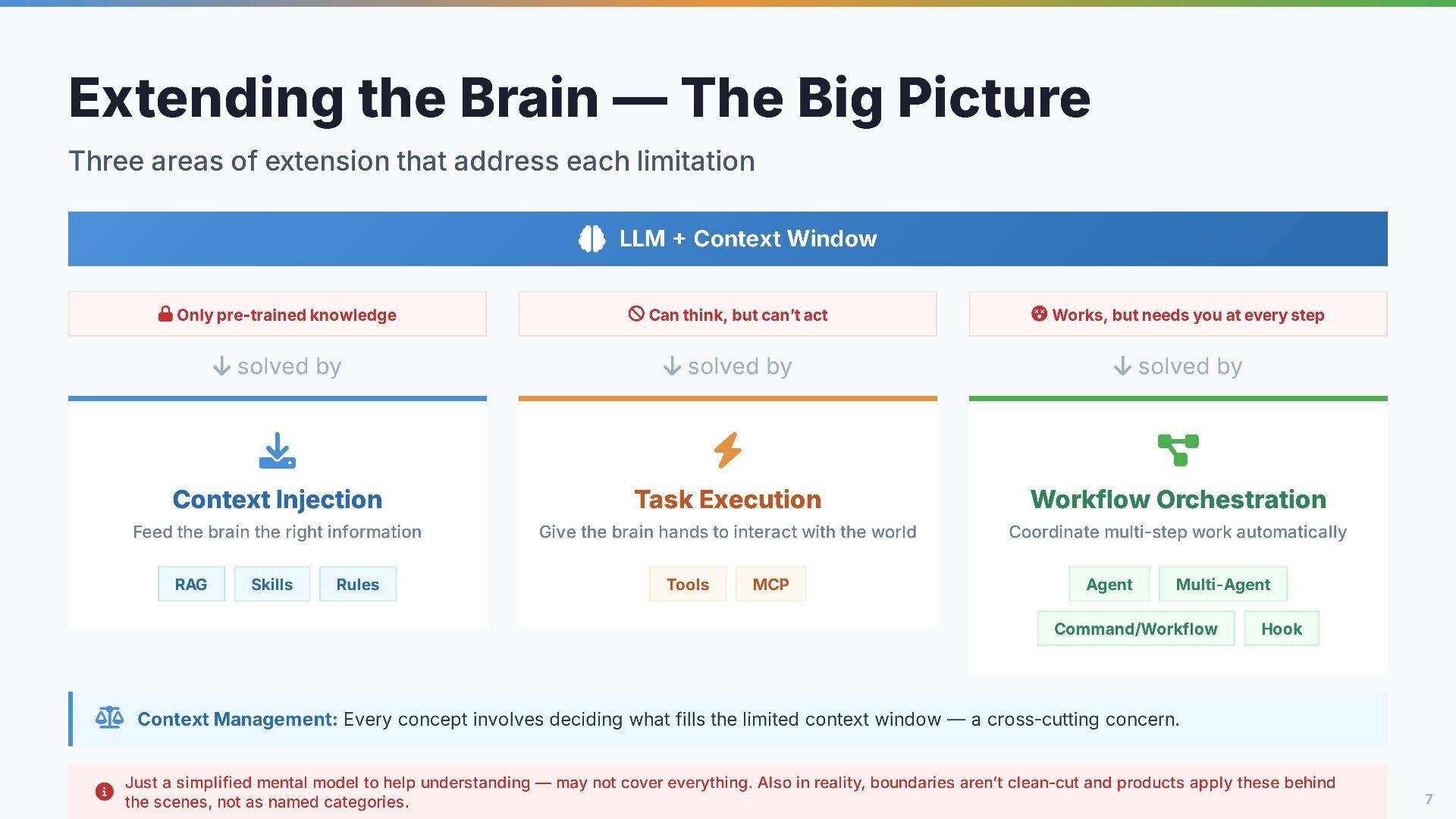
  7. Extending the Brain — The Big Picture Three areas of

    extension that address each limitation LLM + Context Window Only pre-trained knowledge solved by Context Injection Feed the brain the right information RAG Skills Rules Can think, but can’t act solved by Task Execution Give the brain hands to interact with the world Tools MCP Works, but needs you at every step solved by Workflow Orchestration Coordinate multi-step work automatically Agent Multi-Agent Command/Workflow Hook Context Management: Every concept involves deciding what fills the limited context window — a cross-cutting concern. Just a simplified mental model to help understanding — may not cover everything. Also in reality, boundaries aren’t clean-cut and products apply these behind the scenes, not as named cate Just a simplified mental model to help understanding — may not cover everything. Also in reality, boundaries aren’t clean-cut and products apply these behind the scenes, not as named cate 7
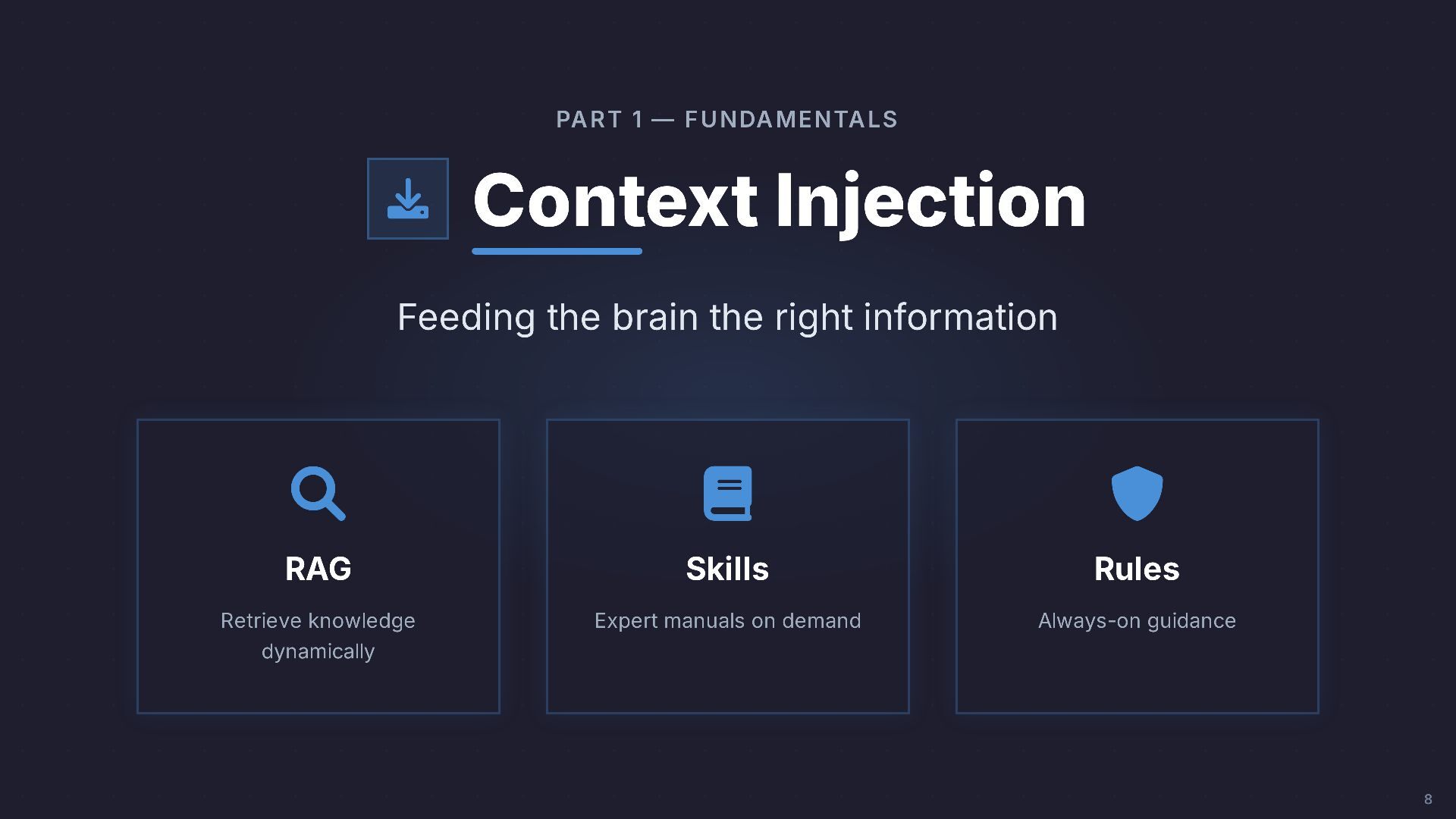
  8. Part 1 — Fundamentals Context Injection Feeding the brain the

    right information RAG Retrieve knowledge dynamically Retrieve knowledge dynamically Skills Expert manuals on demand Rules Always-on guidance 8
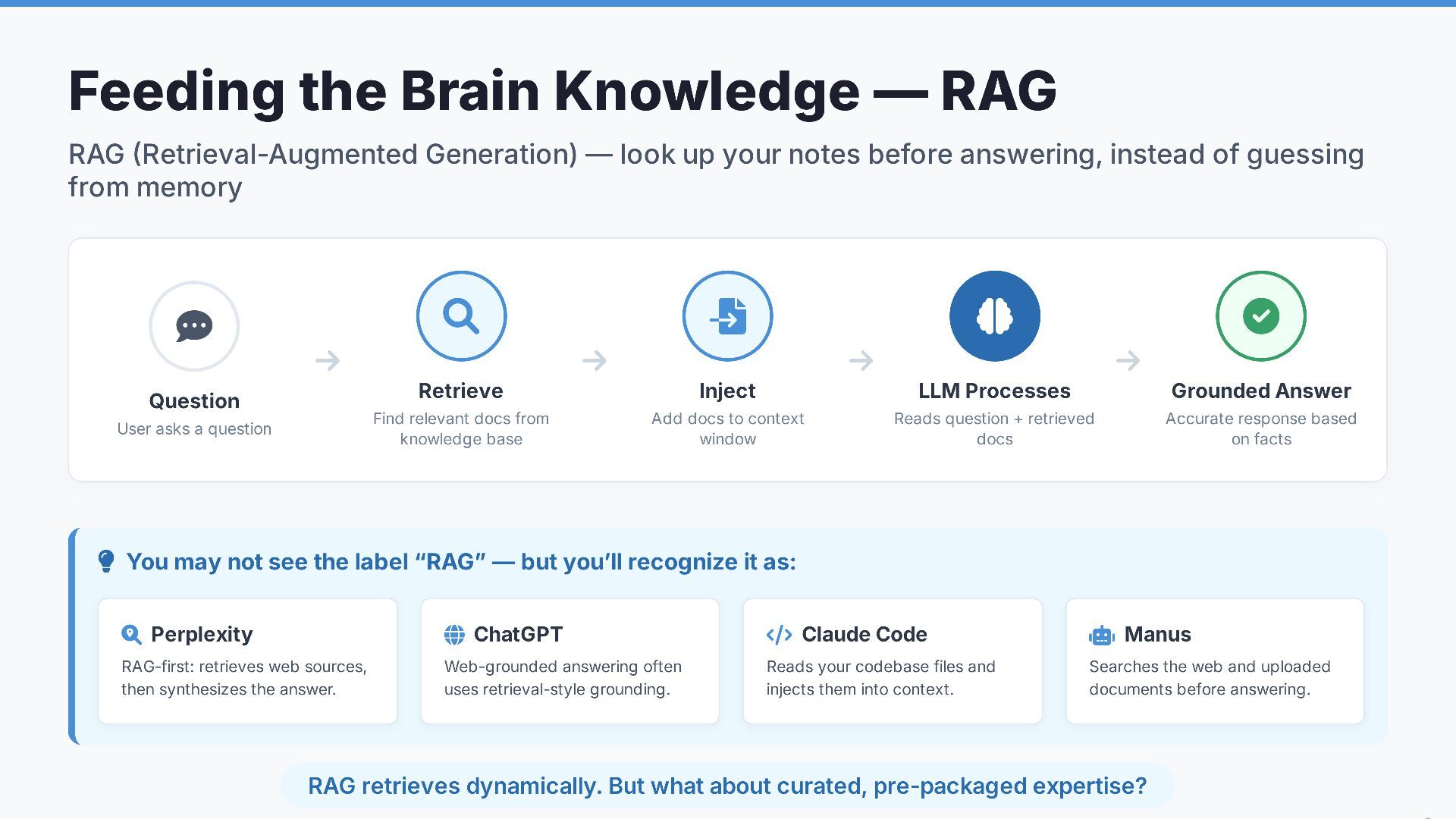
  9. Feeding the Brain Knowledge — RAG RAG (Retrieval-Augmented Generation) —

    look up your notes before answering, instead of guessing from memory RAG (Retrieval-Augmented Generation) — look up your notes before answering, instead of guessing from memory Question User asks a question Retrieve Find relevant docs from knowledge base Find relevant docs from knowledge base Inject Add docs to context window Add docs to context window LLM Processes Reads question + retrieved docs Reads question + retrieved docs Grounded Answer Accurate response based on facts Accurate response based on fac You may not see the label “RAG” — but you’ll recognize it as: Perplexity RAG-first: retrieves web sources, then synthesizes the answer. RAG-first: retrieves web sources, then synthesizes the answer. ChatGPT Web-grounded answering often uses retrieval-style grounding. Web-grounded answering often uses retrieval-style grounding. Claude Code Reads your codebase files and injects them into context. Reads your codebase files and injects them into context. Manus Searches the web and uploaded documents before a Searches the web and uploaded documents before a RAG retrieves dynamically. But what about curated, pre-packaged expertise?
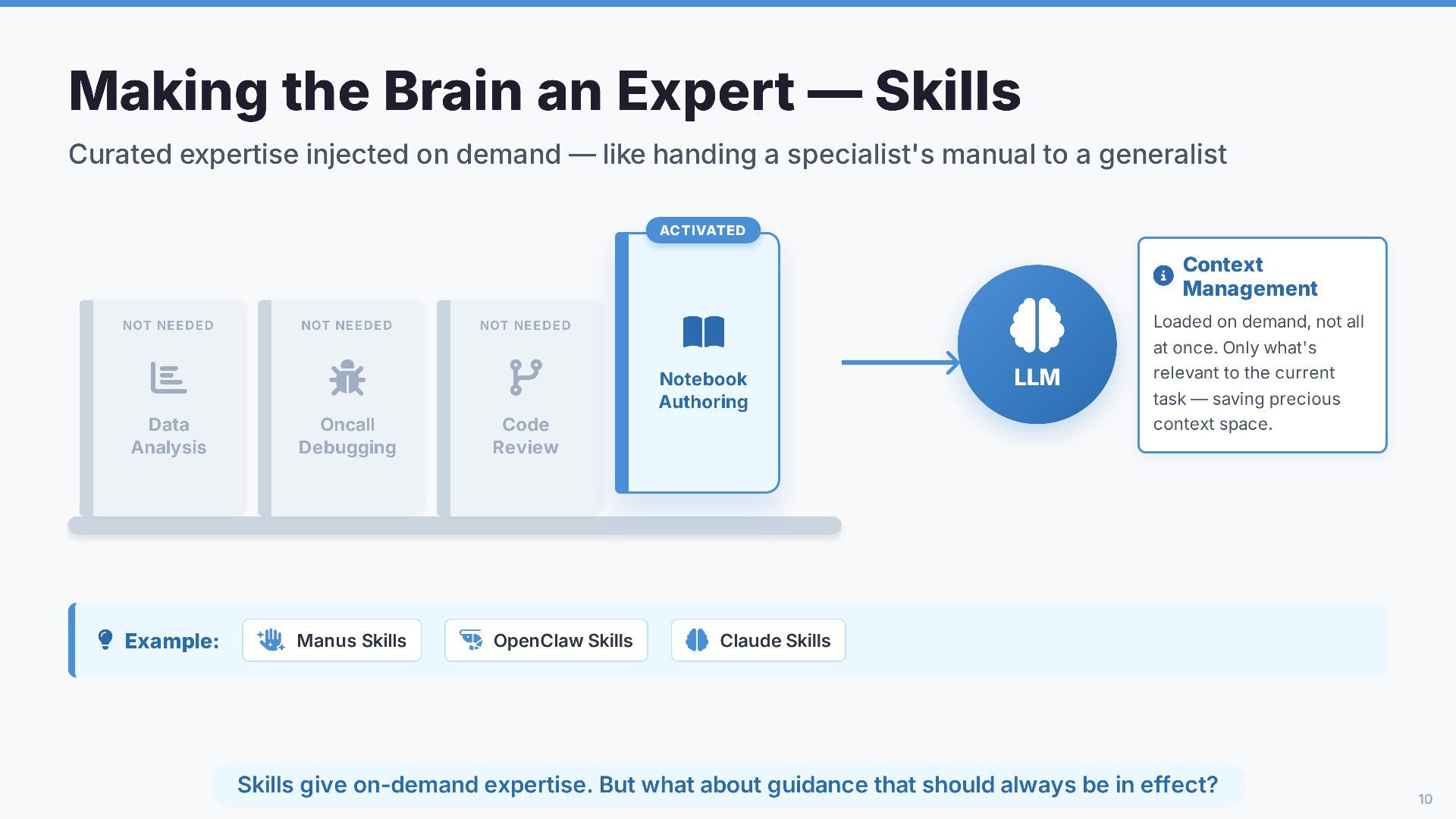
  10. Making the Brain an Expert — Skills Curated expertise injected

    on demand — like handing a specialist's manual to a generalist Not needed Data Analysis Data Analysis Not needed Oncall Debugging Oncall Debugging Not needed Code Review Code Review ACTIVATED Notebook Authoring Notebook Authoring LLM Context Management Context Management Loaded on demand, not all at once. Only Loaded on demand, not all at once. Only Loaded on demand, not all at once. Only Loaded on demand, not all at once. Only Loaded on demand, not all at once. Only Example: Manus Skills OpenClaw Skills Claude Skills Skills give on-demand expertise. But what about guidance that should always be in effect? 10
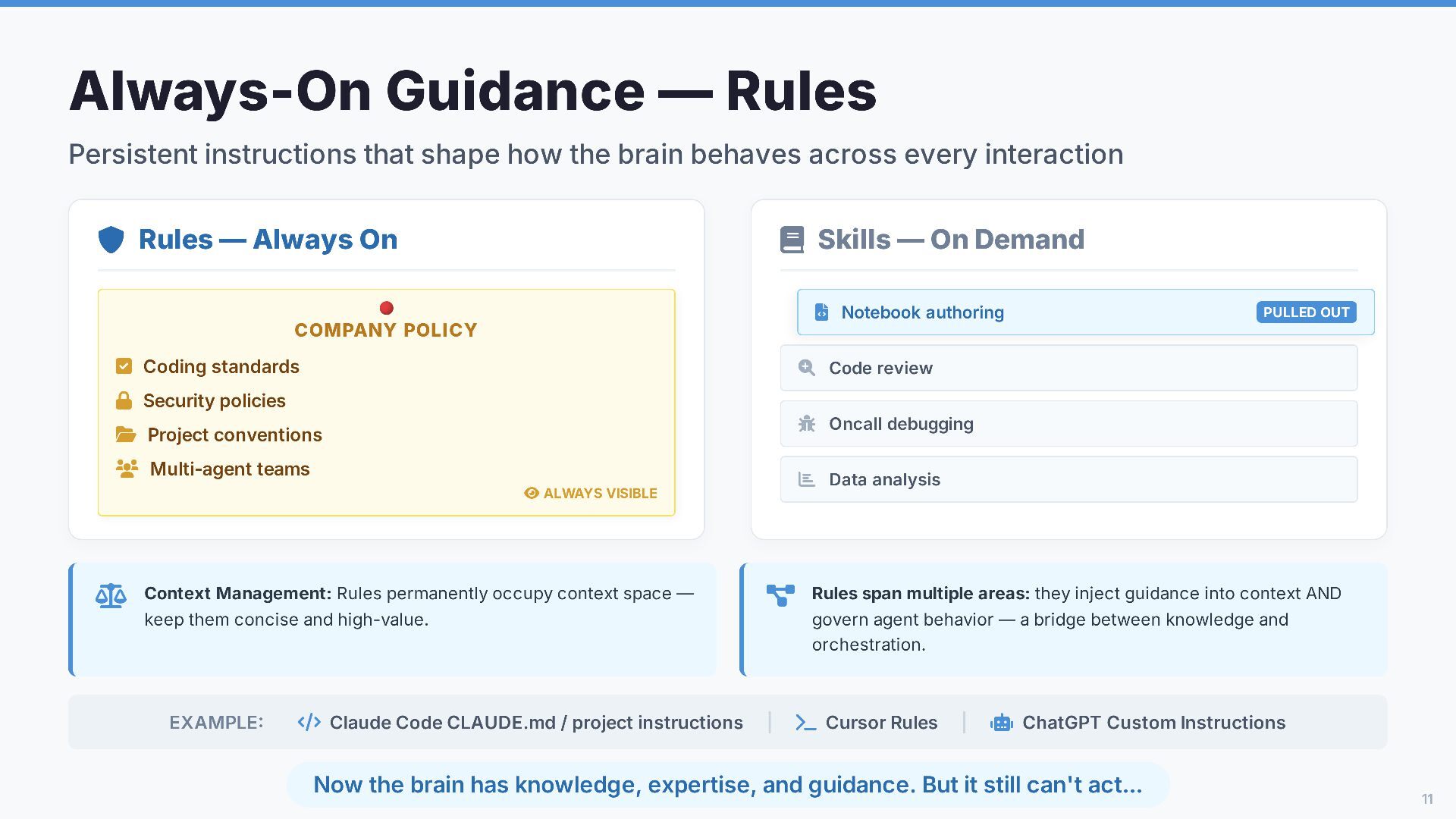
  11. Always-On Guidance — Rules Persistent instructions that shape how the

    brain behaves across every interaction Rules — Always On Company Policy Coding standards Security policies Project conventions Multi-agent teams ALWAYS VISIBLE Skills — On Demand Notebook authoring PULLED OUT Code review Oncall debugging Data analysis Context Management: Rules permanently occupy context space — keep them concise and high-value. Rules permanently occupy context space — keep them concise and high-value. Rules span multiple areas: they inject guidance into context AND govern agent beha they inject guidance into context AND govern agent behavior — a bridge between kno they inject guidance into context AND govern agent behavior — a bridge between kno EXAMPLE: Claude Code CLAUDE.md / project instructions | Cursor Rules | ChatGPT Custom Instructions Now the brain has knowledge, expertise, and guidance. But it still can't act... 11
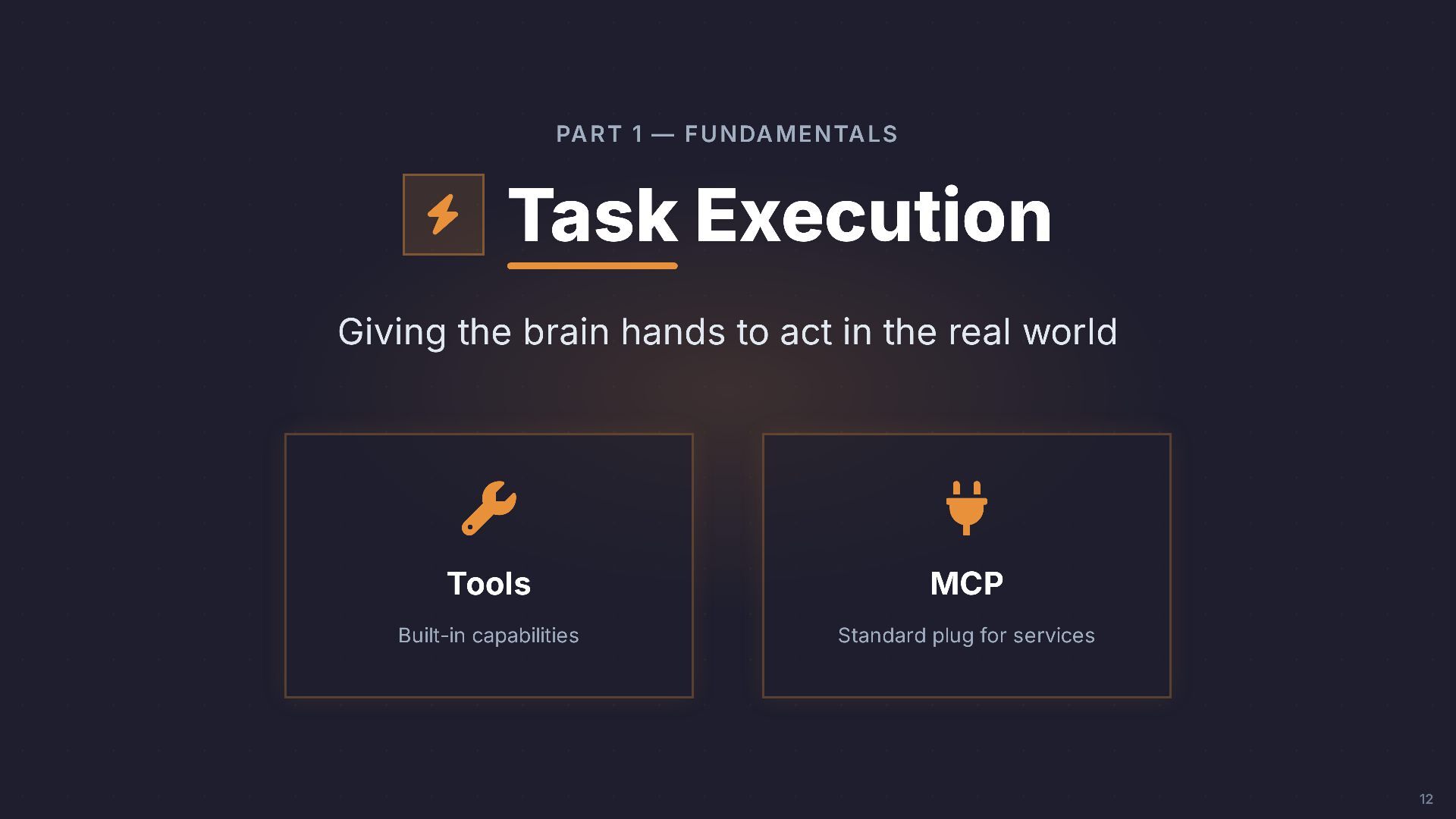
  12. Part 1 — Fundamentals Task Execution Giving the brain hands

    to act in the real world Tools Built-in capabilities MCP Standard plug for services 12
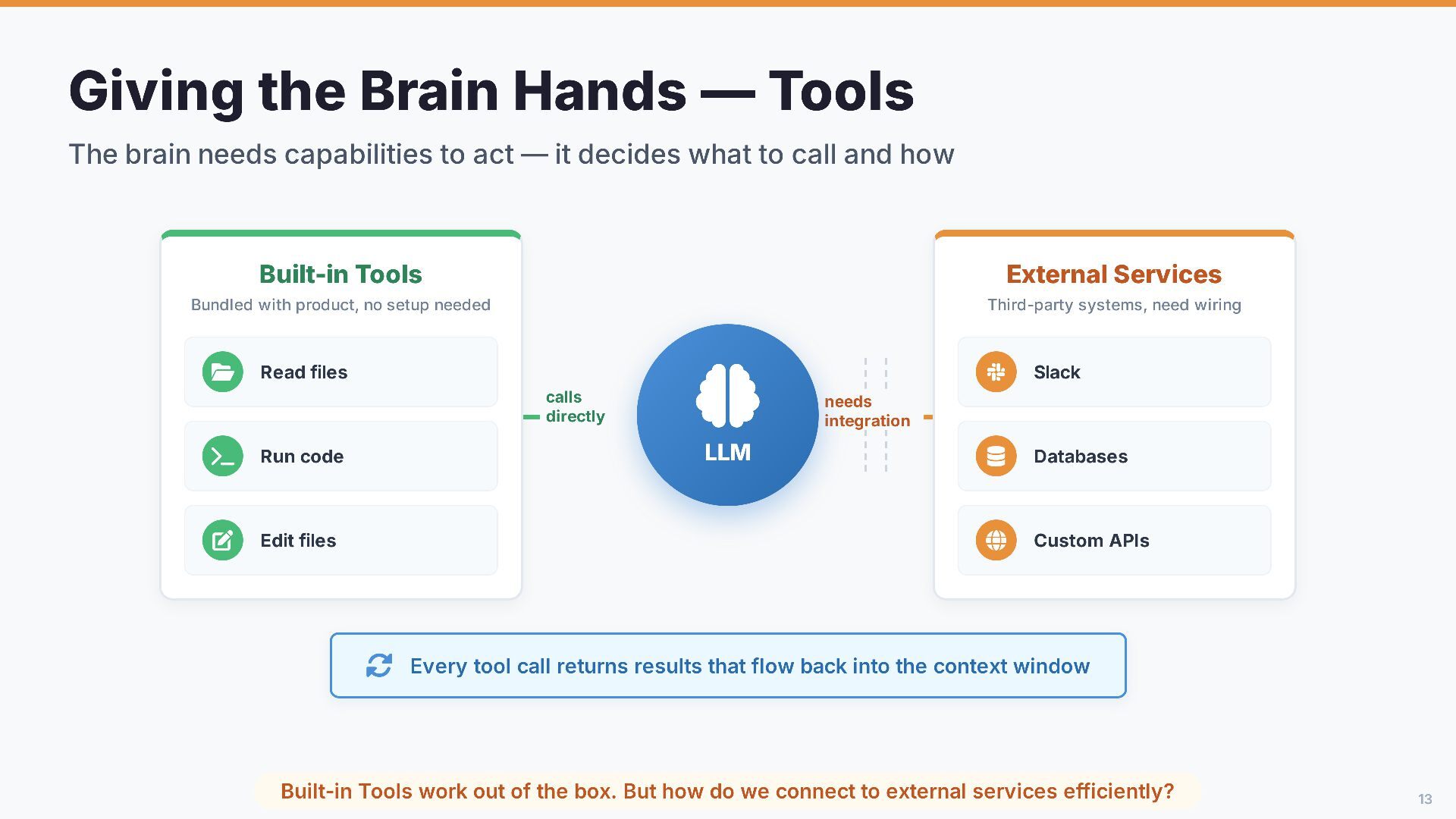
  13. Giving the Brain Hands — Tools The brain needs capabilities

    to act — it decides what to call and how Built-in Tools Bundled with product, no setup needed Read files Run code Edit files calls directly calls directly needs integration needs integration LLM External Services Third-party systems, need wiring Slack Databases Custom APIs Every tool call returns results that flow back into the context window Built-in Tools work out of the box. But how do we connect to external services efficiently? 13
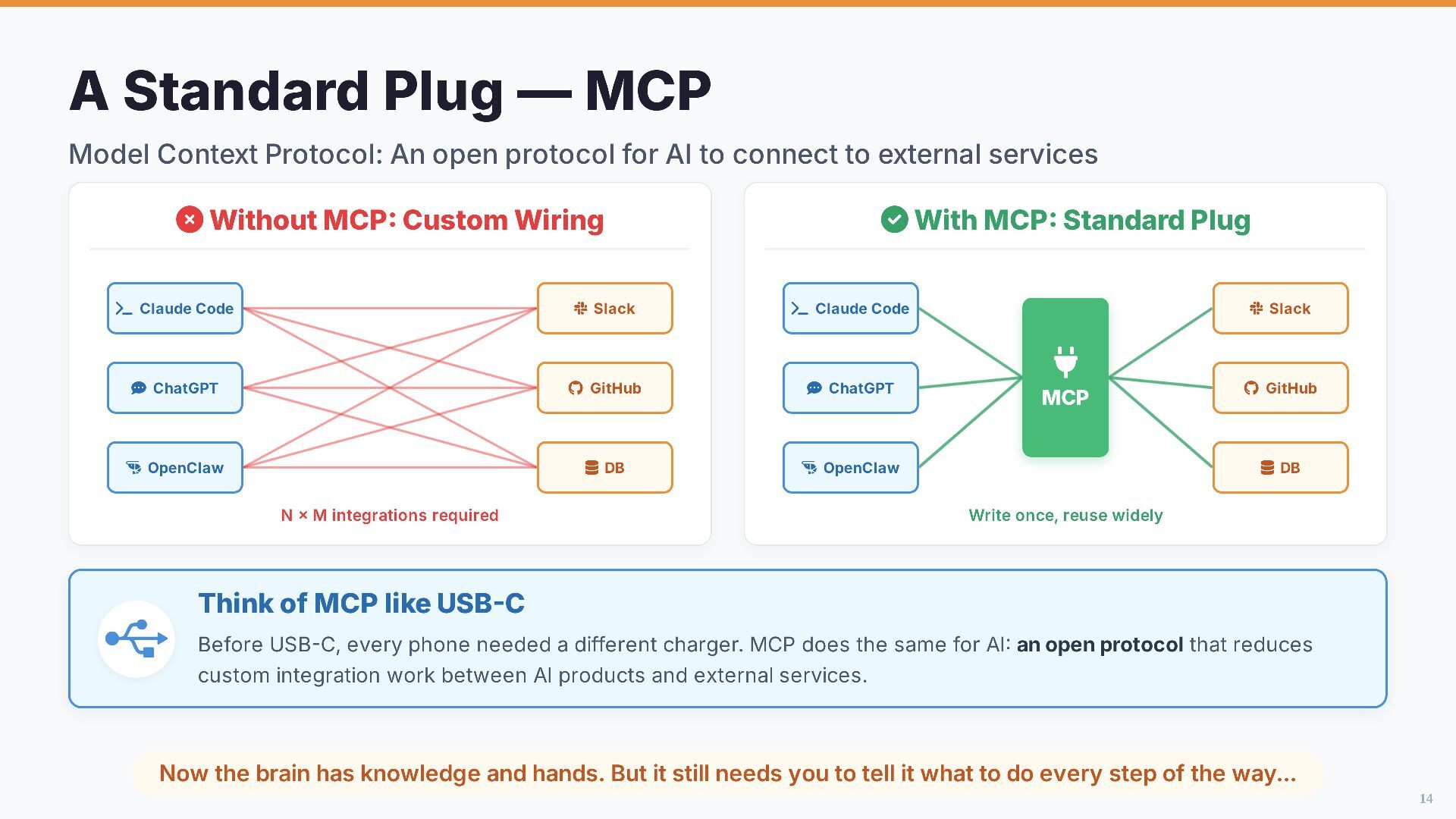
  14. A Standard Plug — MCP Model Context Protocol: An open

    protocol for AI to connect to external services Without MCP: Custom Wiring Claude Code ChatGPT OpenClaw Slack GitHub DB N × M integrations required With MCP: Standard Plug Claude Code ChatGPT OpenClaw MCP Slack GitHub DB Write once, reuse widely Think of MCP like USB-C Before USB-C, every phone needed a different charger. MCP does the same for AI: an open protocol that reduces custom integratio that reduces custom integration work between AI products and external services. Now the brain has knowledge and hands. But it still needs you to tell it what to do every step of the way...
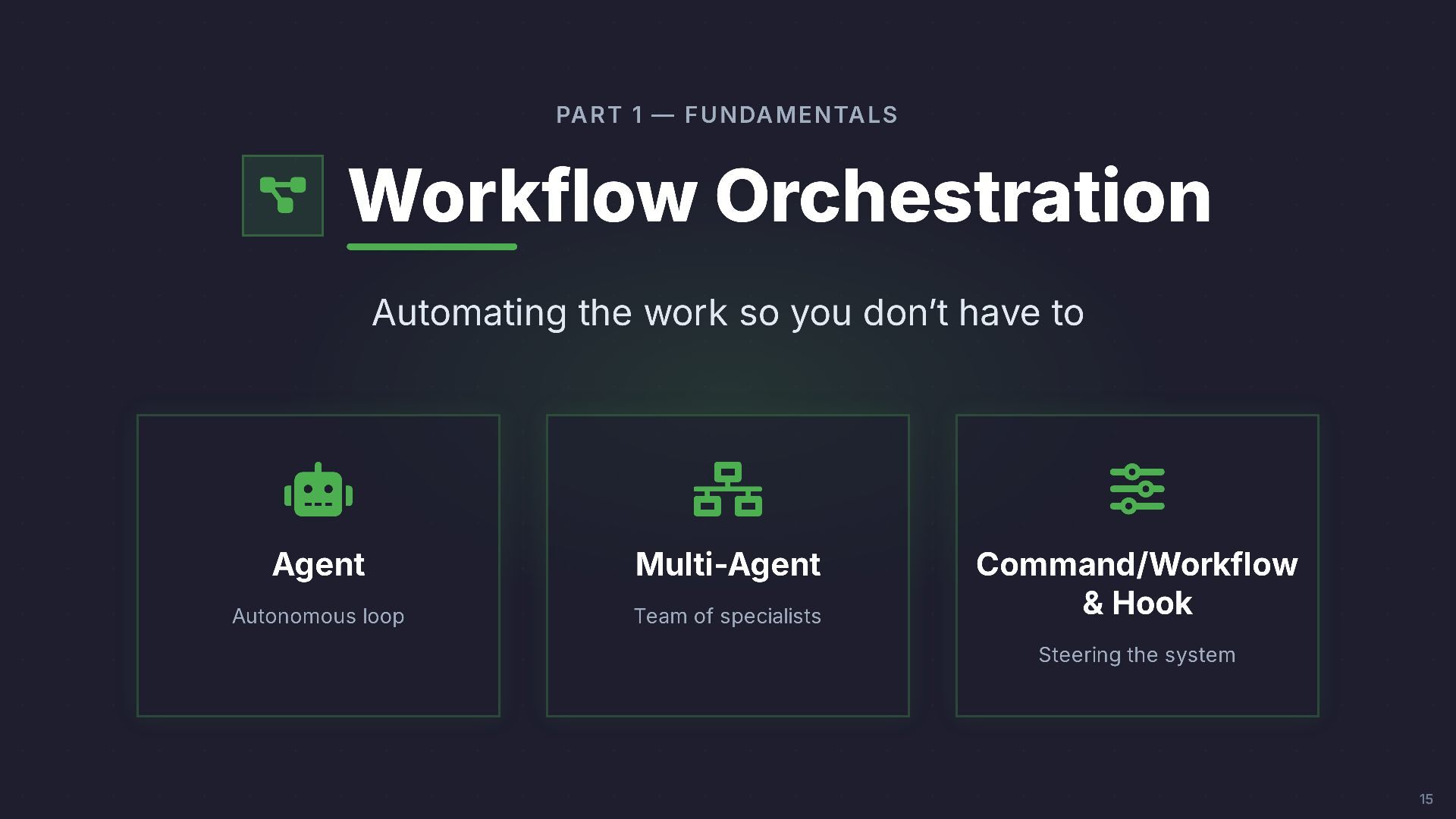
  15. Part 1 — Fundamentals Workflow Orchestration Automating the work so

    you don’t have to Agent Autonomous loop Multi-Agent Team of specialists Command/Workflow & Hook Command/Workflow & Hoo Steering the system 15
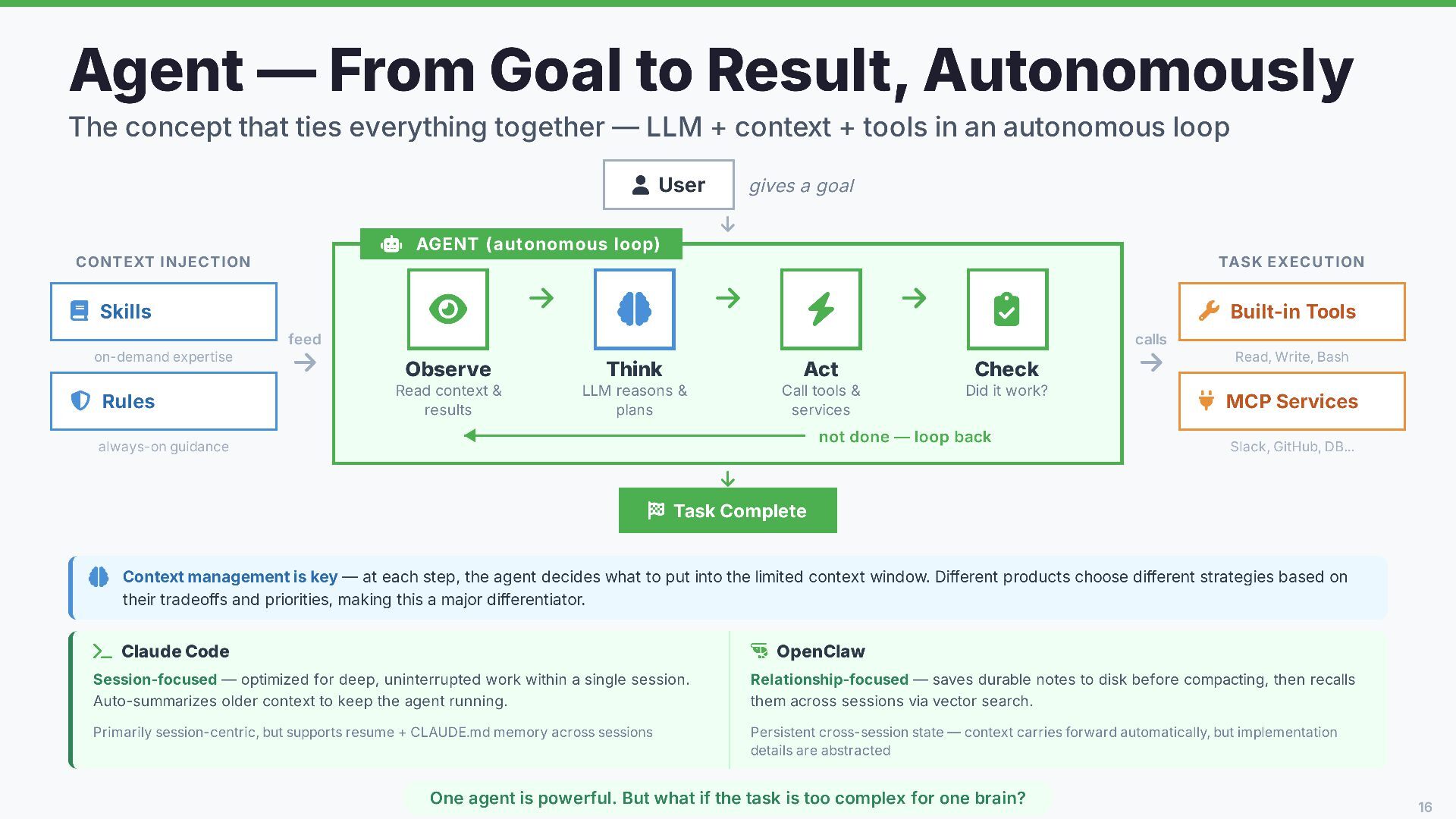
  16. Agent — From Goal to Result, Autonomously The concept that

    ties everything together — LLM + context + tools in an autonomous loop User gives a goal Context Injection Skills on-demand expertise Rules always-on guidance feed AGENT (autonomous loop) Observe Read context & results Read context & results Think LLM reasons & plans LLM reasons & plans Act Call tools & services Call tools & services Check Did it work? not done — loop back calls Task Execution Built-in Tools Read, Write, Bash MCP Services Slack, GitHub, DB... Task Complete Context management is key — at each step, the agent decides what to put into the limited context window. Different products choose different strategies based on their tradeoffs and prioriti — at each step, the agent decides what to put into the limited context window. Different products choose different strategies based on their tradeoffs and priorities, making this a major differen Claude Code Session-focused — optimized for deep, uninterrupted work within a single session. Auto-summarizes older context to keep the agent running. — optimized for deep, uninterrupted work within a single session. Auto-summarizes older context to keep the agent running. Primarily session-centric, but supports resume + CLAUDE.md memory across sessions OpenClaw Relationship-focused — saves durable notes to disk before compacting, then recalls them across sessions — saves durable notes to disk before compacting, then recalls them across sessions via vector search. Persistent cross-session state — context carries forward automatically, but implementation details are abstracted Persistent cross-session state — context carries forward automatically, but implementation details are abstracted One agent is powerful. But what if the task is too complex for one brain? 16
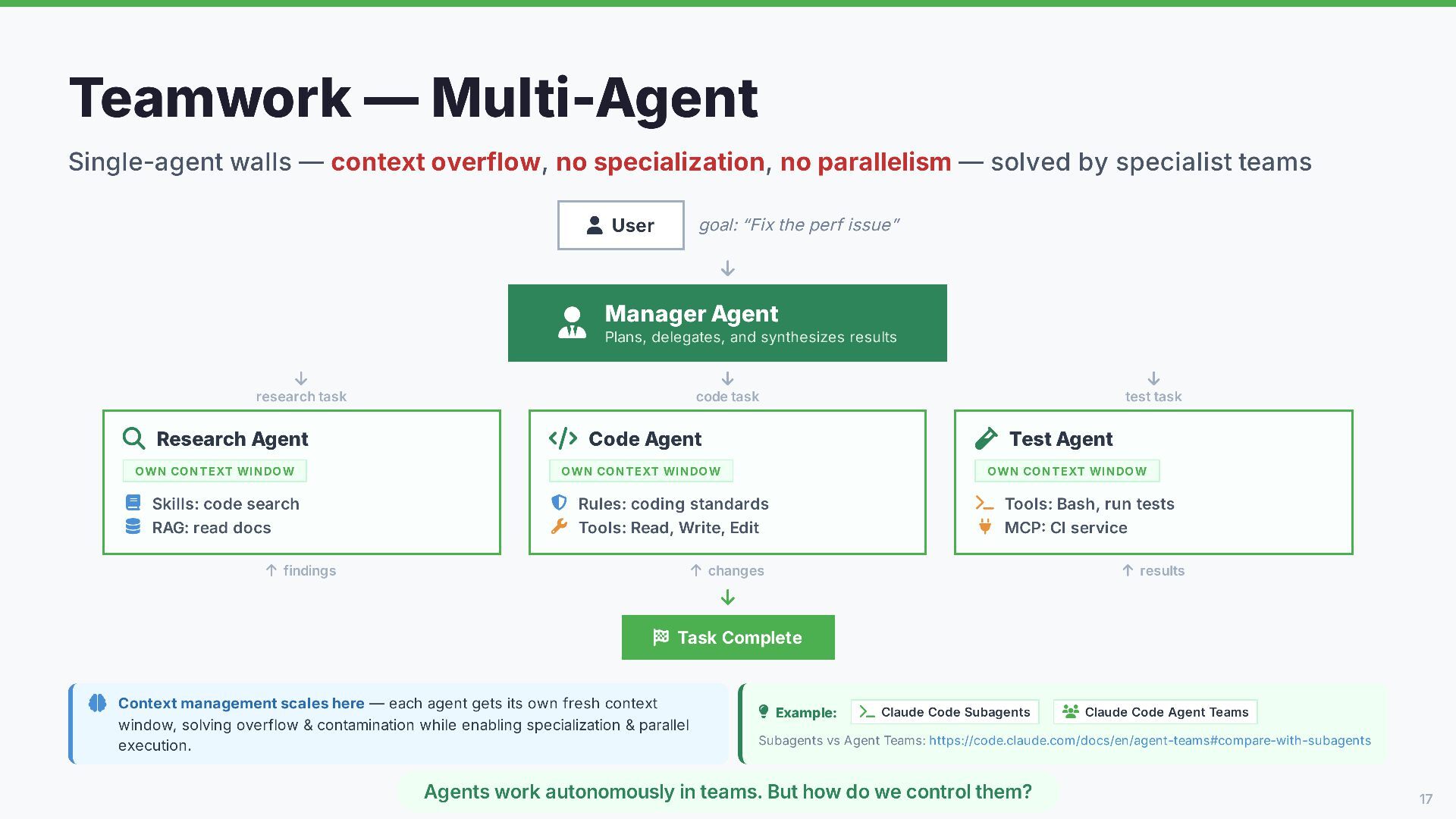
  17. Teamwork — Multi-Agent Single-agent walls — context overflow , no

    specialization , no parallelism — solved by specialist teams User goal: “Fix the perf issue” Manager Agent Plans, delegates, and synthesizes results research task Research Agent Own Context Window Skills: code search RAG: read docs findings code task Code Agent Own Context Window Rules: coding standards Tools: Read, Write, Edit changes test task Test Agent Own Context Window Tools: Bash, run tests MCP: CI service results Task Complete Context management scales here — each agent gets its own fresh context window, solving overflow & contamination while enabling specialization & parallel execution. — each agent gets its own fresh context window, solving overflow & contamination while enabling specialization & parallel execution. — each agent gets its own fresh context window, solving overflow & contamination while enabling specialization & parallel execution. Example: Claude Code Subagents Claude Code Agent Teams Subagents vs Agent Teams: https://code.claude.com/docs/en/agent-teams#compare-with-subagents Agents work autonomously in teams. But how do we control them? 17
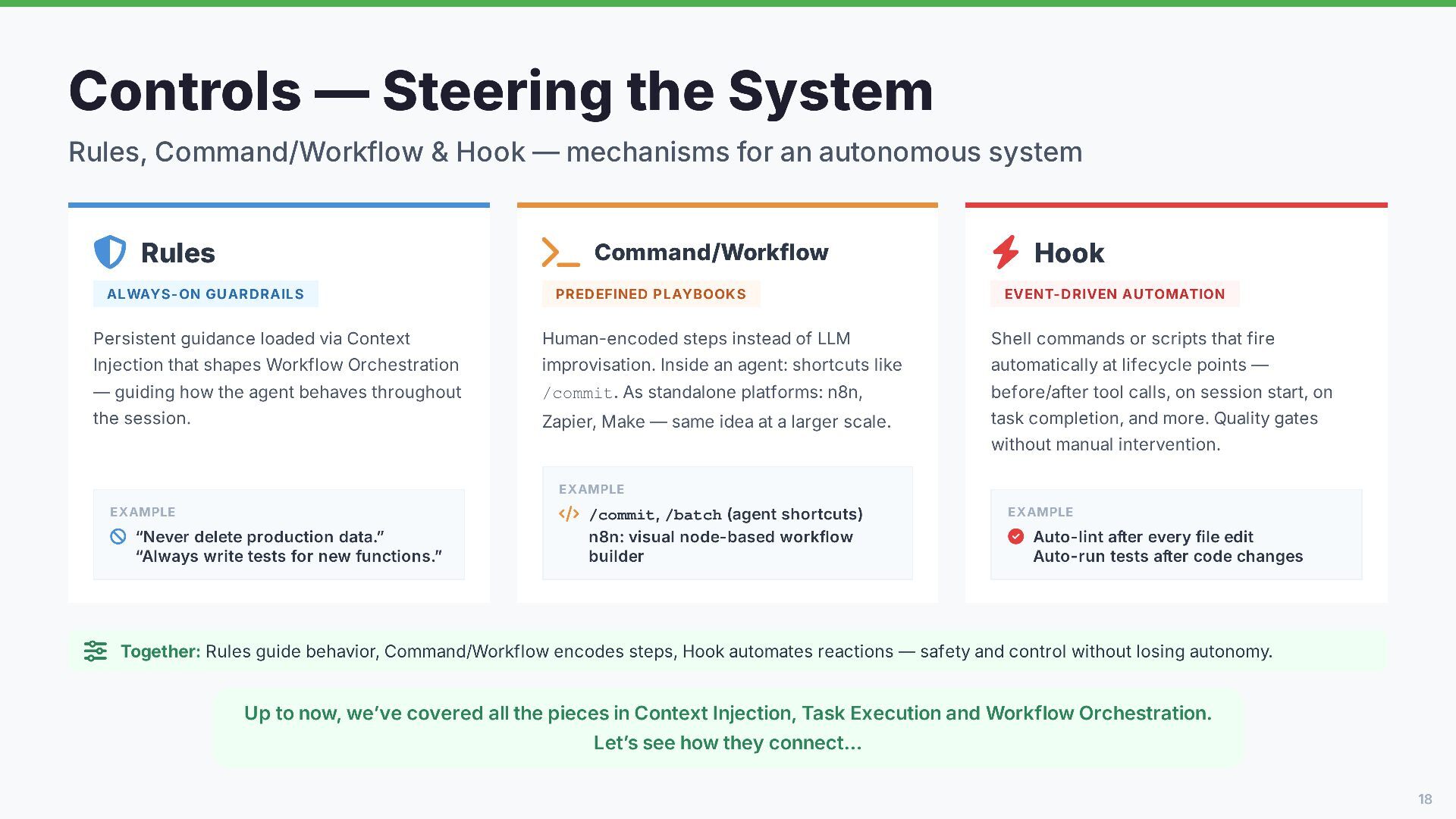
  18. Controls — Steering the System Rules, Command/Workflow & Hook —

    mechanisms for an autonomous system Rules Always-On Guardrails Persistent guidance loaded via Context Injection that shapes Workflow Orchestration — guiding how the agent behaves throughout the session. Persistent guidance loaded via Context Injection that shapes Workflow Orchestration — guiding how the agent behaves throughout the session. Persistent guidance loaded via Context Injection that shapes Workflow Orchestration — guiding how the agent behaves throughout the session. Persistent guidance loaded via Context Injection that shapes Workflow Orchestration — guiding how the agent behaves throughout the session. Example “Never delete production data.” “Always write tests for new functions.” Command/Workflow Predefined Playbooks Human-encoded steps instead of LLM improvisation. Inside an agent: shortcuts like Human-encoded steps instead of LLM improvisation. Inside an agent: shortcuts like /commit . As standalone platforms: n8n, Zapier, Make — same idea at a larger scale. . As standalone platforms: n8n, Zapier, Make — same idea at a larger scale. Example /commit , /batch (agent shortcuts) n8n: visual node-based workflow builder n8n: visual node-based workflow builder Hook Event-Driven Automation Shell commands or scripts that fire automatically at lifecycle po Shell commands or scripts that fire automatically at lifecycle po Shell commands or scripts that fire automatically at lifecycle po Shell commands or scripts that fire automatically at lifecycle po Shell commands or scripts that fire automatically at lifecycle po Example Auto-lint after every file edit Auto-run tests after code changes Together: Rules guide behavior, Command/Workflow encodes steps, Hook automates reactions — safety and control without losing autonomy. Up to now, we’ve covered all the pieces in Context Injection, Task Execution and Workflow Orchestration. Let’s see how they connect… 18
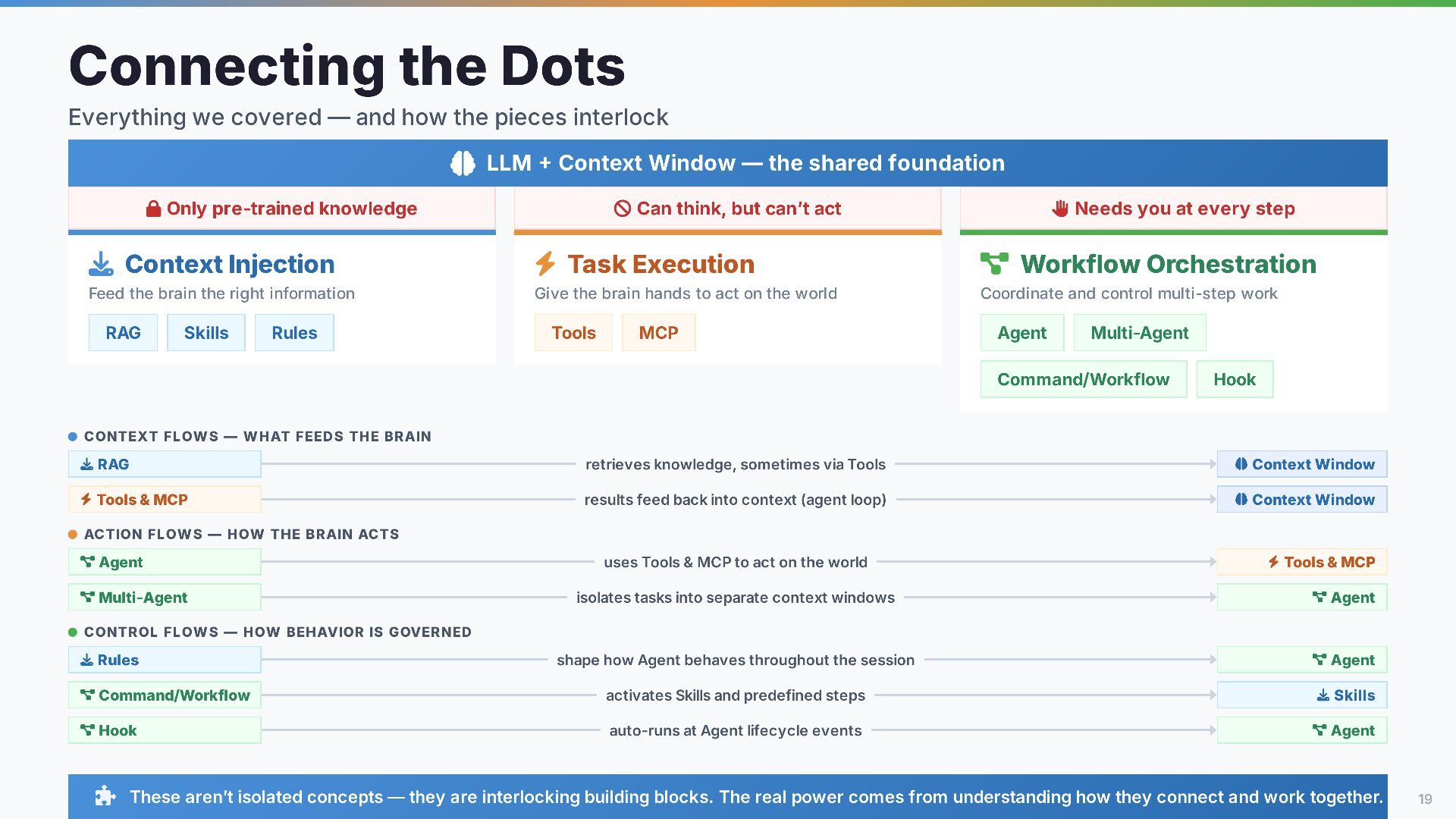
  19. Connecting the Dots Everything we covered — and how the

    pieces interlock LLM + Context Window — the shared foundation Only pre-trained knowledge Context Injection Feed the brain the right information RAG Skills Rules Can think, but can’t act Task Execution Give the brain hands to act on the world Tools MCP Needs you at every step Workflow Orchestration Coordinate and control multi-step work Agent Multi-Agent Command/Workflow Hook Context Flows — what feeds the brain RAG retrieves knowledge, sometimes via Tools Context Window Tools & MCP results feed back into context (agent loop) Context Window Action Flows — how the brain acts Agent uses Tools & MCP to act on the world Tools & MCP Multi-Agent isolates tasks into separate context windows Agent Control Flows — how behavior is governed Rules shape how Agent behaves throughout the session Agent Command/Workflow activates Skills and predefined steps Skills Hook auto-runs at Agent lifecycle events Agent These aren’t isolated concepts — they are interlocking building blocks. The real power comes from understanding how they connect and work together. 19
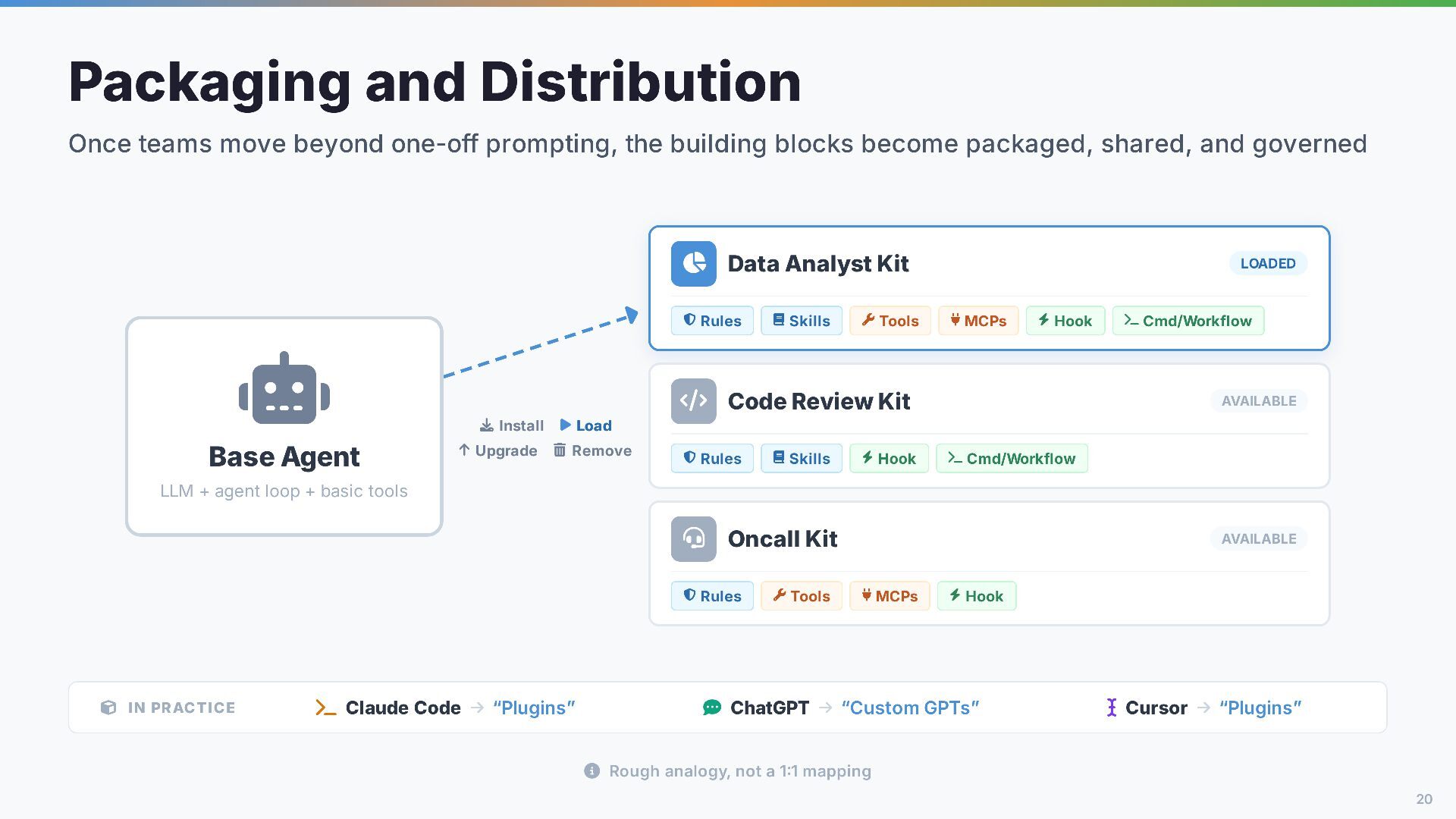
  20. Packaging and Distribution Once teams move beyond one-off prompting, the

    building blocks become packaged, shared, and governed Base Agent LLM + agent loop + basic tools Install Load Upgrade Remove Data Analyst Kit Loaded Rules Skills Tools MCPs Hook Cmd/Workflow Code Review Kit Available Rules Skills Hook Cmd/Workflow Oncall Kit Available Rules Tools MCPs Hook In practice Claude Code “Plugins” ChatGPT “Custom GPTs” Cursor “Plugins” Rough analogy, not a 1:1 mapping 20
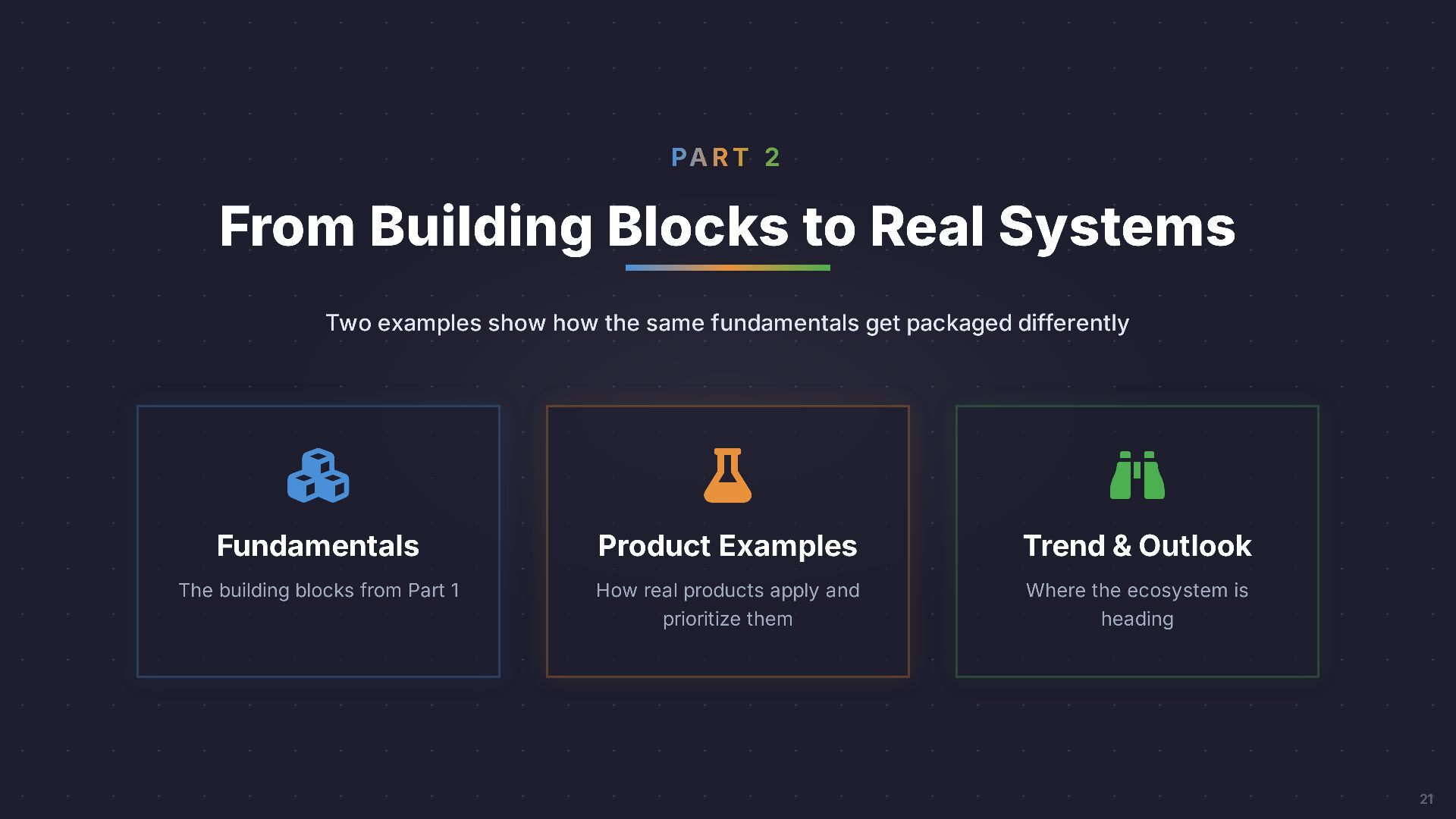
  21. Part 2 From Building Blocks to Real Systems Two examples

    show how the same fundamentals get packaged differently Fundamentals The building blocks from Part 1 Product Examples How real products apply and prioritize them How real products apply and prioritize them Trend & Outlook Where the ecosystem is heading Where the ecosystem is heading 21
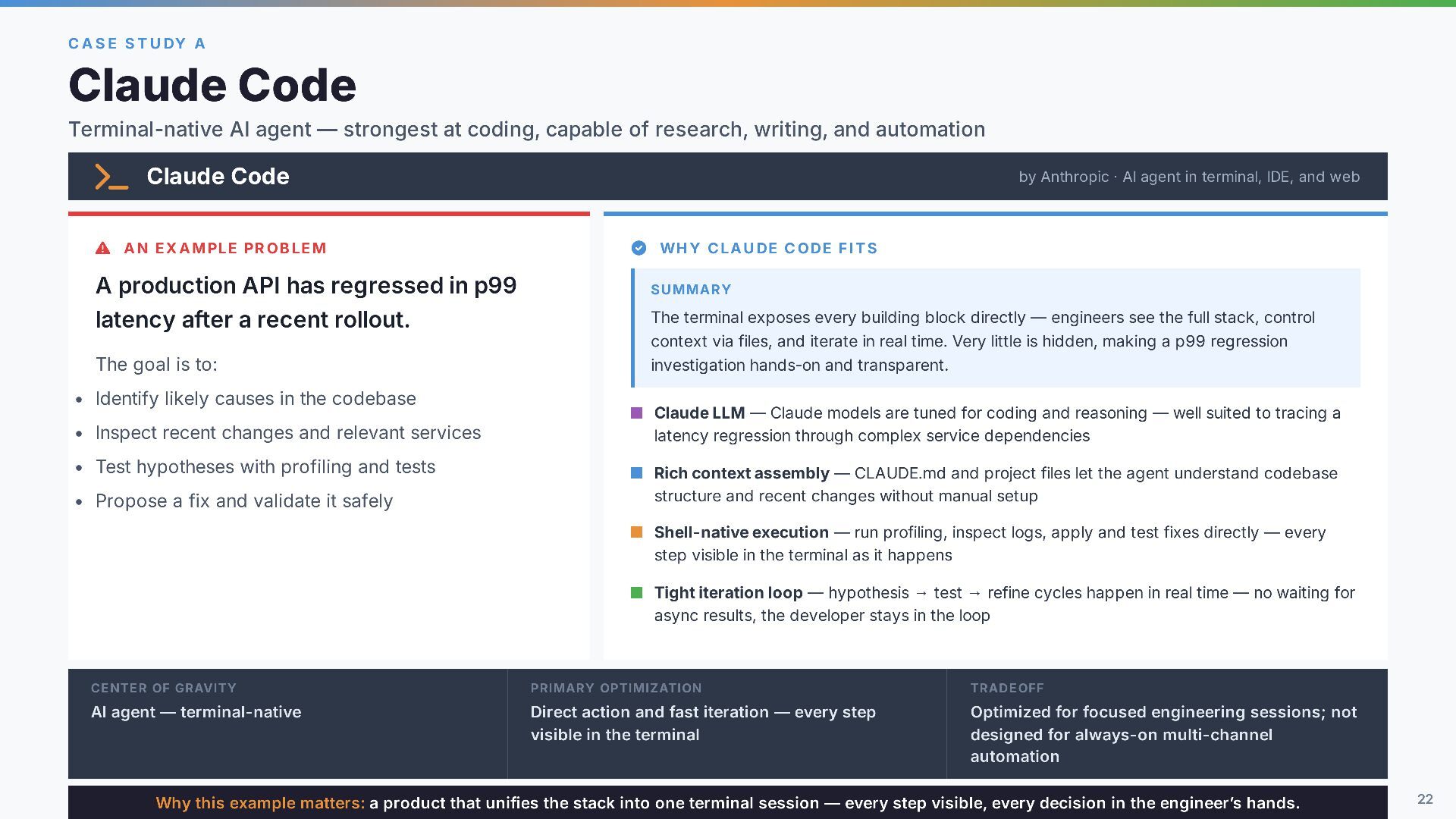
  22. Case Study A Claude Code Terminal-native AI agent — strongest

    at coding, capable of research, writing, and automation Claude Code by Anthropic · AI agent in terminal, IDE, and web An Example Problem A production API has regressed in p99 latency after a recent rollout. A production API has regressed in p99 latency after a recent rollout. The goal is to: Identify likely causes in the codebase Inspect recent changes and relevant services Test hypotheses with profiling and tests Propose a fix and validate it safely Why Claude Code Fits Summary The terminal exposes every building block directly — engineers see the full stack, control context via files, and itera The terminal exposes every building block directly — engineers see the full stack, control context via files, and itera The terminal exposes every building block directly — engineers see the full stack, control context via files, and itera Claude LLM — Claude models are tuned for coding and reasoning — well suited to tracing a latency regression th — Claude models are tuned for coding and reasoning — well suited to tracing a latency regression through comple Rich context assembly — CLAUDE.md and project files let the agent understand codebase structure and recent — CLAUDE.md and project files let the agent understand codebase structure and recent changes without manual Shell-native execution — run profiling, inspect logs, apply and test fixes directly — every step visible in the termi — run profiling, inspect logs, apply and test fixes directly — every step visible in the terminal as it happens Tight iteration loop — hypothesis → test → refine cycles happen in real time — no waiting for async results, the d — hypothesis → test → refine cycles happen in real time — no waiting for async results, the developer stays in the Center of Gravity AI agent — terminal-native Primary Optimization Direct action and fast iteration — every step visible in the terminal Direct action and fast iteration — every step visible in the terminal Tradeoff Optimized for focused engineering sessions; not designed for always- Optimized for focused engineering sessions; not designed for always- Optimized for focused engineering sessions; not designed for always- Why this example matters: a product that unifies the stack into one terminal session — every step visible, every decision in the engineer’s hands. 22
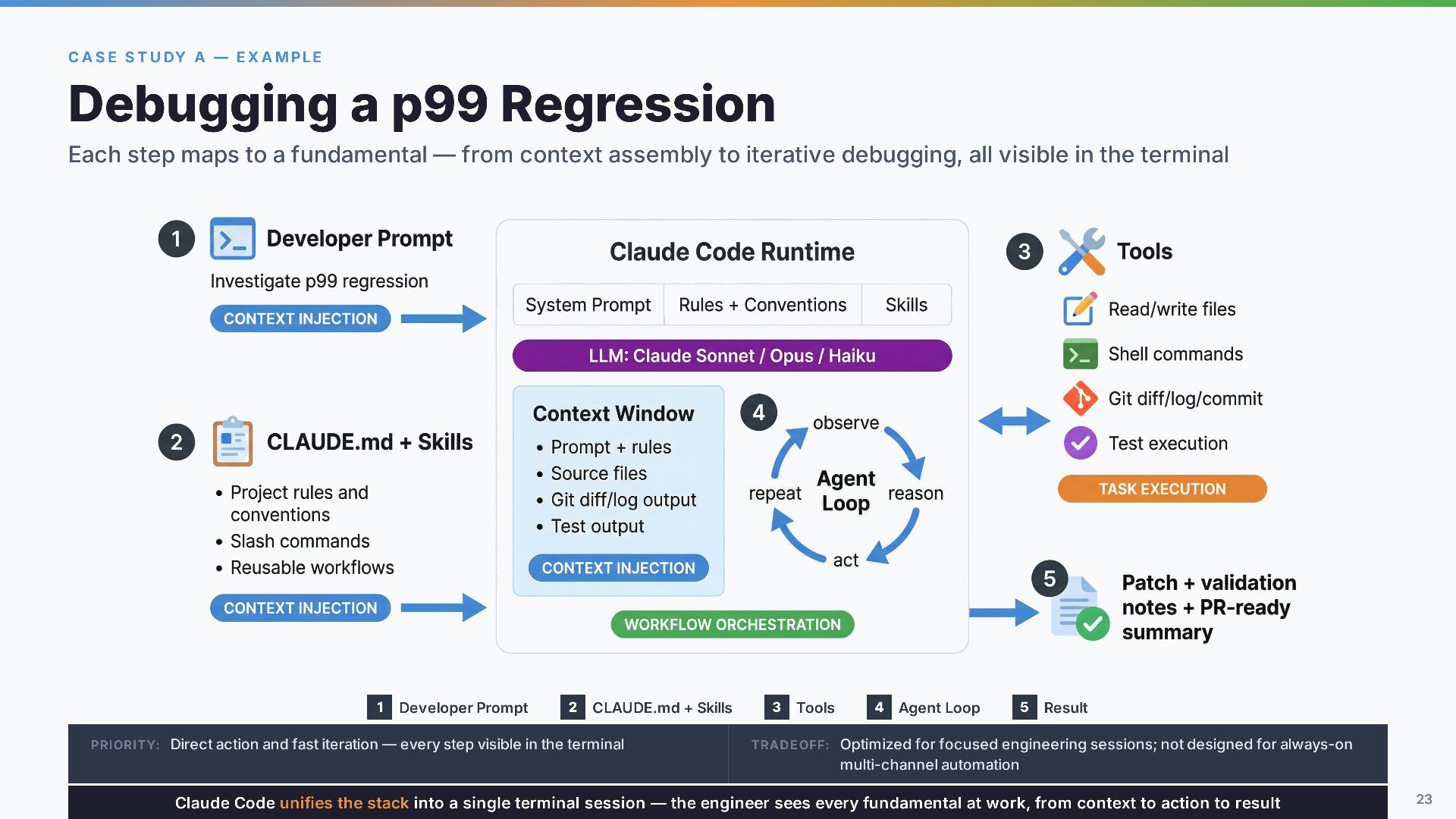
  23. Case Study A — Example Debugging a p99 Regression Each

    step maps to a fundamental — from context assembly to iterative debugging, all visible in the terminal 1 Developer Prompt 2 CLAUDE.md + Skills 3 Tools 4 Agent Loop 5 Result Priority: Direct action and fast iteration — every step visible in the terminal Tradeoff: Optimized for focused engineering sessions; not designed for always-on multi-channel automa Optimized for focused engineering sessions; not designed for always-on multi-channel automa Claude Code unifies the stack into a single terminal session — the engineer sees every fundamental at work, from context to action to result 23
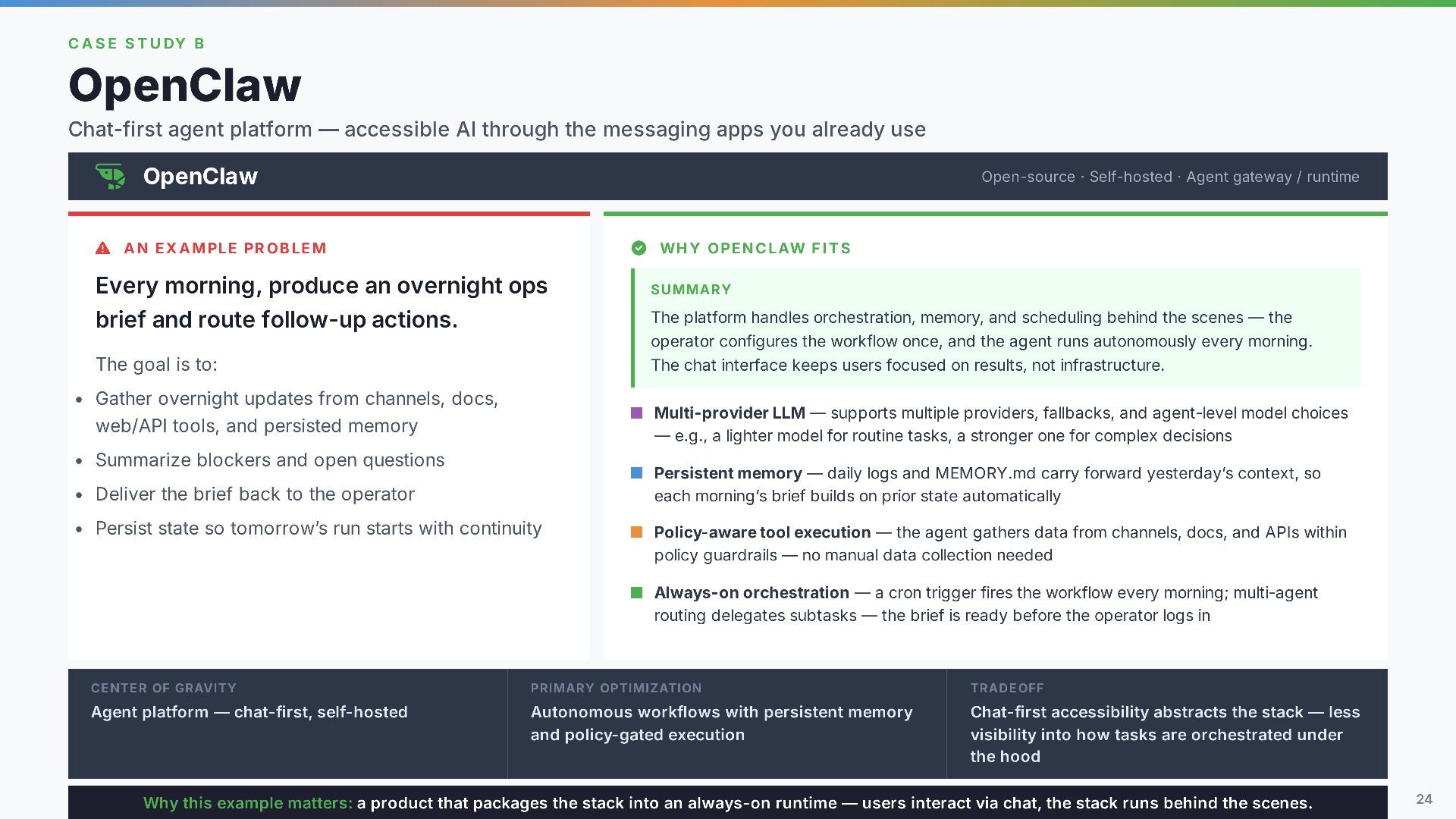
  24. Case Study B OpenClaw Chat-first agent platform — accessible AI

    through the messaging apps you already use OpenClaw Open-source · Self-hosted · Agent gateway / runtime An Example Problem Every morning, produce an overnight ops brief and route follow-up actions. Every morning, produce an overnight ops brief and route follow-up actions. The goal is to: Gather overnight updates from channels, docs, web/API tools, and persisted memory Gather overnight updates from channels, docs, web/API tools, and persisted memory Summarize blockers and open questions Deliver the brief back to the operator Persist state so tomorrow’s run starts with continuity Why OpenClaw Fits Summary The platform handles orchestration, memory, and scheduling behind the scenes — the operator configures the wor The platform handles orchestration, memory, and scheduling behind the scenes — the operator configures the wor The platform handles orchestration, memory, and scheduling behind the scenes — the operator configures the wor Multi-provider LLM — supports multiple providers, fallbacks, and agent-level model choices — e.g., a lighter mod — supports multiple providers, fallbacks, and agent-level model choices — e.g., a lighter model for routine tasks, a Persistent memory — daily logs and MEMORY.md carry forward yesterday’s context, so each morning’s brief bu — daily logs and MEMORY.md carry forward yesterday’s context, so each morning’s brief builds on prior state aut Policy-aware tool execution — the agent gathers data from channels, docs, and APIs within policy guardrails — — the agent gathers data from channels, docs, and APIs within policy guardrails — no manual data collection need Always-on orchestration — a cron trigger fires the workflow every morning; multi-agent routing delegates subtas — a cron trigger fires the workflow every morning; multi-agent routing delegates subtasks — the brief is ready befo Center of Gravity Agent platform — chat-first, self-hosted Primary Optimization Autonomous workflows with persistent memory and policy-gated execution Autonomous workflows with persistent memory and policy-gated execution Tradeoff Chat-first accessibility abstracts the stack — less visibility into how tas Chat-first accessibility abstracts the stack — less visibility into how tas Chat-first accessibility abstracts the stack — less visibility into how tas Why this example matters: a product that packages the stack into an always-on runtime — users interact via chat, the stack runs behind the scenes. 24
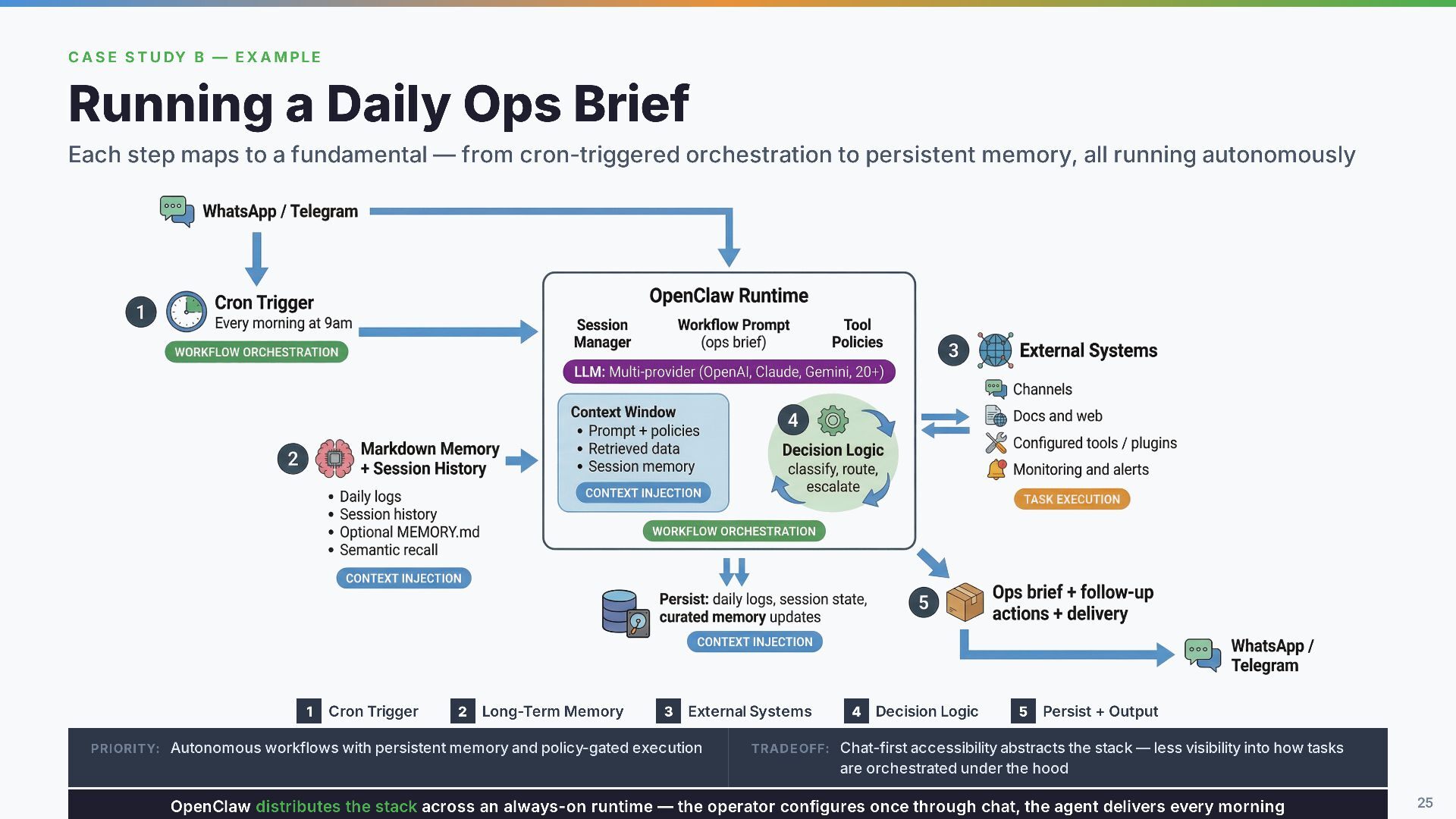
  25. Case Study B — Example Running a Daily Ops Brief

    Each step maps to a fundamental — from cron-triggered orchestration to persistent memory, all running autonomously 1 Cron Trigger 2 Long-Term Memory 3 External Systems 4 Decision Logic 5 Persist + Output Priority: Autonomous workflows with persistent memory and policy-gated execution Tradeoff: Chat-first accessibility abstracts the stack — less visibility into how tasks are orchestrated unde Chat-first accessibility abstracts the stack — less visibility into how tasks are orchestrated unde OpenClaw distributes the stack across an always-on runtime — the operator configures once through chat, the agent delivers every morning 25
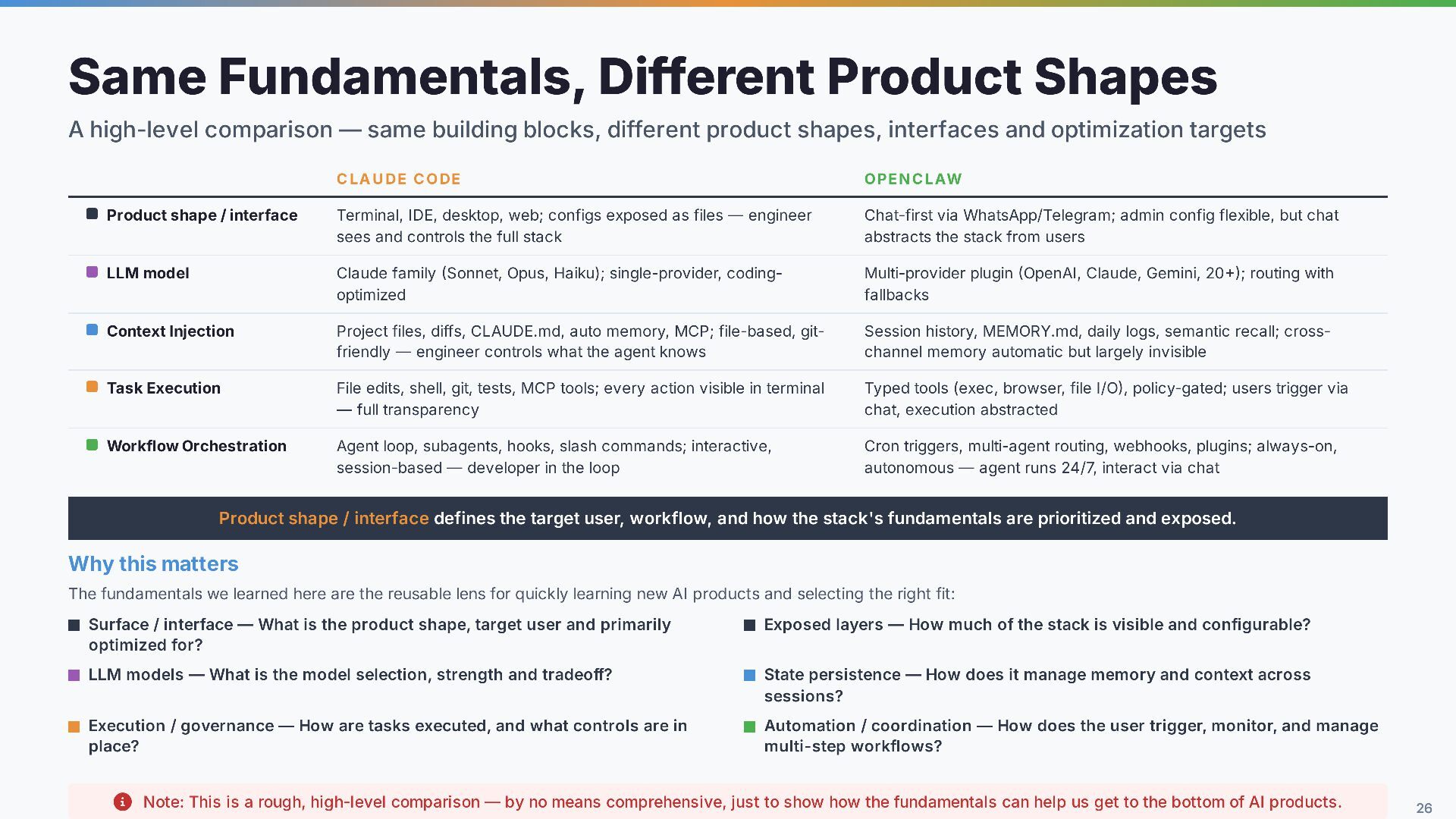
  26. Same Fundamentals, Different Product Shapes A high-level comparison — same

    building blocks, different product shapes, interfaces and optimization targets Claude Code OpenClaw Product shape / interface Terminal, IDE, desktop, web; configs exposed as files — engineer sees and controls the full stack Terminal, IDE, desktop, web; configs exposed as files — engineer sees and controls the full stack Chat-first via WhatsApp/Telegram; admin config flexible, but chat abstracts the stack fro Chat-first via WhatsApp/Telegram; admin config flexible, but chat abstracts the stack fro LLM model Claude family (Sonnet, Opus, Haiku); single-provider, coding-optimized Claude family (Sonnet, Opus, Haiku); single-provider, coding-optimized Multi-provider plugin (OpenAI, Claude, Gemini, 20+); routing with fallbacks Multi-provider plugin (OpenAI, Claude, Gemini, 20+); routing with fallbacks Context Injection Project files, diffs, CLAUDE.md, auto memory, MCP; file-based, git-friendly — engineer controls what the agent knows Project files, diffs, CLAUDE.md, auto memory, MCP; file-based, git-friendly — engineer controls what the agent knows Session history, MEMORY.md, daily logs, semantic recall; cross-channel memory autom Session history, MEMORY.md, daily logs, semantic recall; cross-channel memory autom Task Execution File edits, shell, git, tests, MCP tools; every action visible in terminal — full transparency File edits, shell, git, tests, MCP tools; every action visible in terminal — full transparency Typed tools (exec, browser, file I/O), policy-gated; users trigger via chat, execution abst Typed tools (exec, browser, file I/O), policy-gated; users trigger via chat, execution abst Workflow Orchestration Agent loop, subagents, hooks, slash commands; interactive, session-based — developer in the loop Agent loop, subagents, hooks, slash commands; interactive, session-based — developer in the loop Cron triggers, multi-agent routing, webhooks, plugins; always-on, autonomous — agent Cron triggers, multi-agent routing, webhooks, plugins; always-on, autonomous — agent Product shape / interface defines the target user, workflow, and how the stack's fundamentals are prioritized and exposed. Why this matters The fundamentals we learned here are the reusable lens for quickly learning new AI products and selecting the right fit: Surface / interface — What is the product shape, target user and primarily optimized for? Surface / interface — What is the product shape, target user and primarily optimized for? Exposed layers — How much of the stack is visible and configurable? LLM models — What is the model selection, strength and tradeoff? State persistence — How does it manage memory and context across sessions? State persistence — How does it manage memory and context across sessions? Execution / governance — How are tasks executed, and what controls are in place? Execution / governance — How are tasks executed, and what controls are in place? Automation / coordination — How does the user trigger, monitor, and manage multi-step workflows Automation / coordination — How does the user trigger, monitor, and manage multi-step workflows Note: This is a rough, high-level comparison — by no means comprehensive, just to show how the fundamentals can help us get to the bottom of AI products. 26
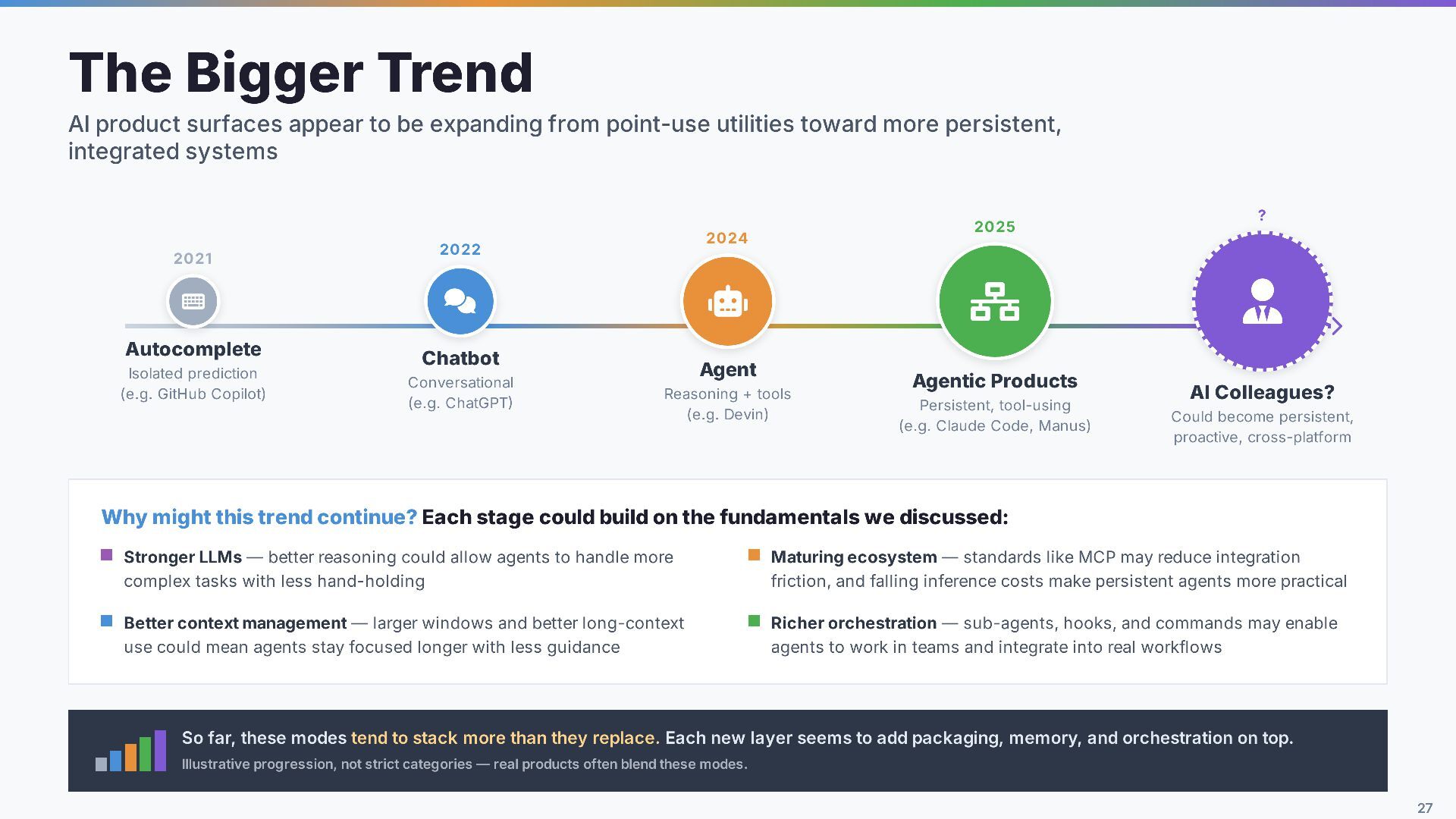
  27. The Bigger Trend AI product surfaces appear to be expanding

    from point-use utilities toward more persistent, integrated systems AI product surfaces appear to be expanding from point-use utilities toward more persistent, integrated systems 2021 Autocomplete Isolated prediction (e.g. GitHub Copilot) 2022 Chatbot Conversational (e.g. ChatGPT) 2024 Agent Reasoning + tools (e.g. Devin) 2025 Agentic Products Persistent, tool-using (e.g. Claude Code, Manus) ? AI Colleagues? Could become persistent, proactive, cross-platform Why might this trend continue? Each stage could build on the fundamentals we discussed: Stronger LLMs — better reasoning could allow agents to handle more complex tasks with less hand-holding — better reasoning could allow agents to handle more complex tasks with less hand-holding Maturing ecosystem — standards like MCP may reduce integration friction, and falling infere — standards like MCP may reduce integration friction, and falling inference costs make persist Better context management — larger windows and better long-context use could mean agents stay focused longer with less guidance — larger windows and better long-context use could mean agents stay focused longer with less guidance Richer orchestration — sub-agents, hooks, and commands may enable agents to work in tea — sub-agents, hooks, and commands may enable agents to work in teams and integrate into r So far, these modes tend to stack more than they replace. Each new layer seems to add packaging, memory, and orchestration on top. Illustrative progression, not strict categories — real products often blend these modes. 27
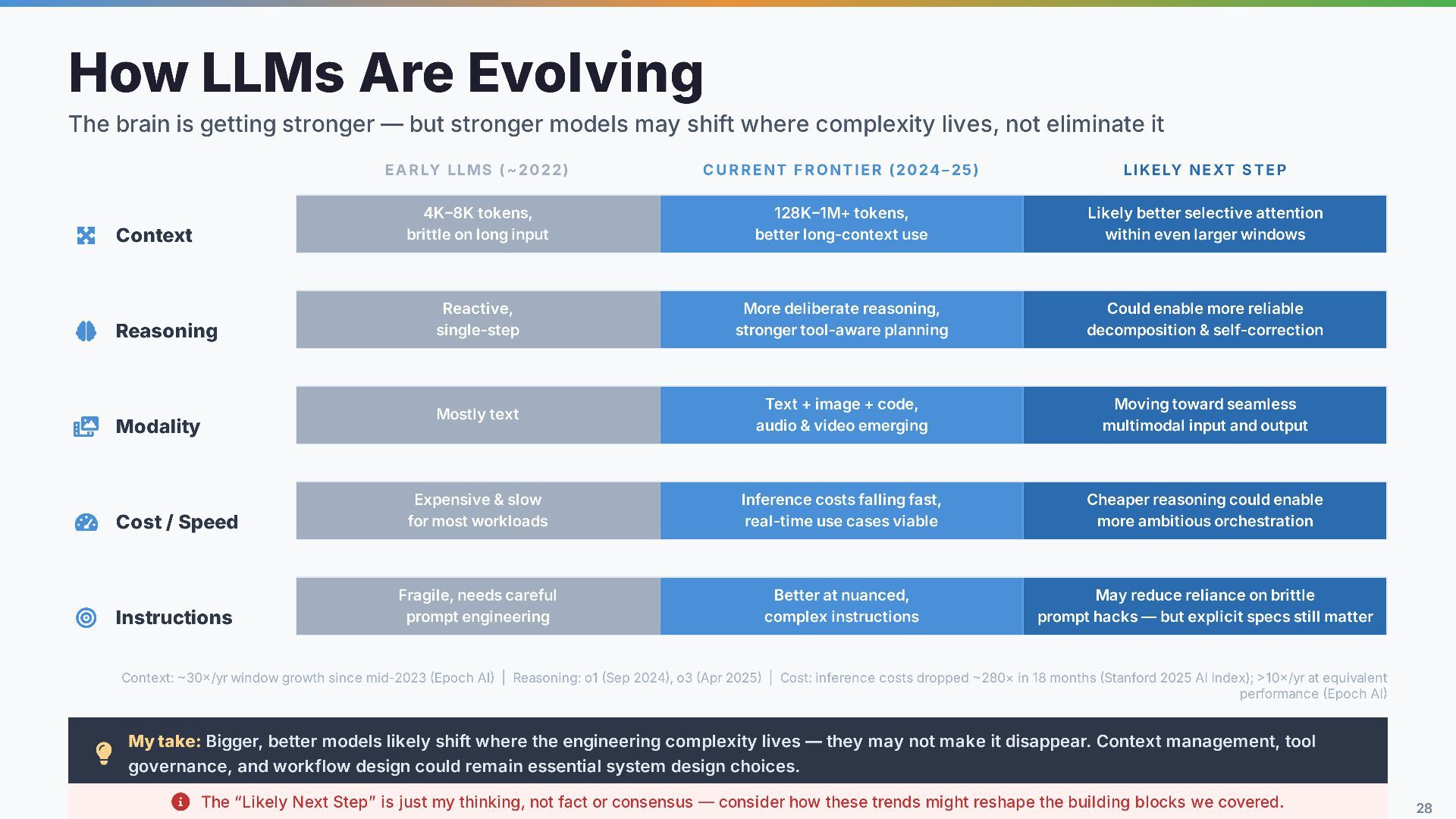
  28. How LLMs Are Evolving The brain is getting stronger —

    but stronger models may shift where complexity lives, not eliminate it Early LLMs (~2022) Current Frontier (2024–25) Likely Next Step Context 4K–8K tokens, brittle on long input 128K–1M+ tokens, better long-context use Likely better selective attention within even larger windows Reasoning Reactive, single-step More deliberate reasoning, stronger tool-aware planning Could enable more reliable decomposition & self-correction Modality Mostly text Text + image + code, audio & video emerging Moving toward seamless multimodal input and output Cost / Speed Expensive & slow for most workloads Inference costs falling fast, real-time use cases viable Cheaper reasoning could enable more ambitious orchestration Instructions Fragile, needs careful prompt engineering Better at nuanced, complex instructions May reduce reliance on brittle prompt hacks — but explicit specs still matter Context: ~30×/yr window growth since mid-2023 (Epoch AI) | Reasoning: o1 (Sep 2024), o3 (Apr 2025) | Cost: inference costs dropped ~280× in 18 months (Stanford 2025 AI Index); >10×/yr at equivalent performance (Epoch AI) Context: ~30×/yr window growth since My take: Bigger, better models likely shift where the engineering complexity lives — they may not make it disappear. Context management, tool governance, and workflow desig Bigger, better models likely shift where the engineering complexity lives — they may not make it disappear. Context management, tool governance, and workflow design could re The “Likely Next Step” is just my thinking, not fact or consensus — consider how these trends might reshape the building blocks we covered. 28
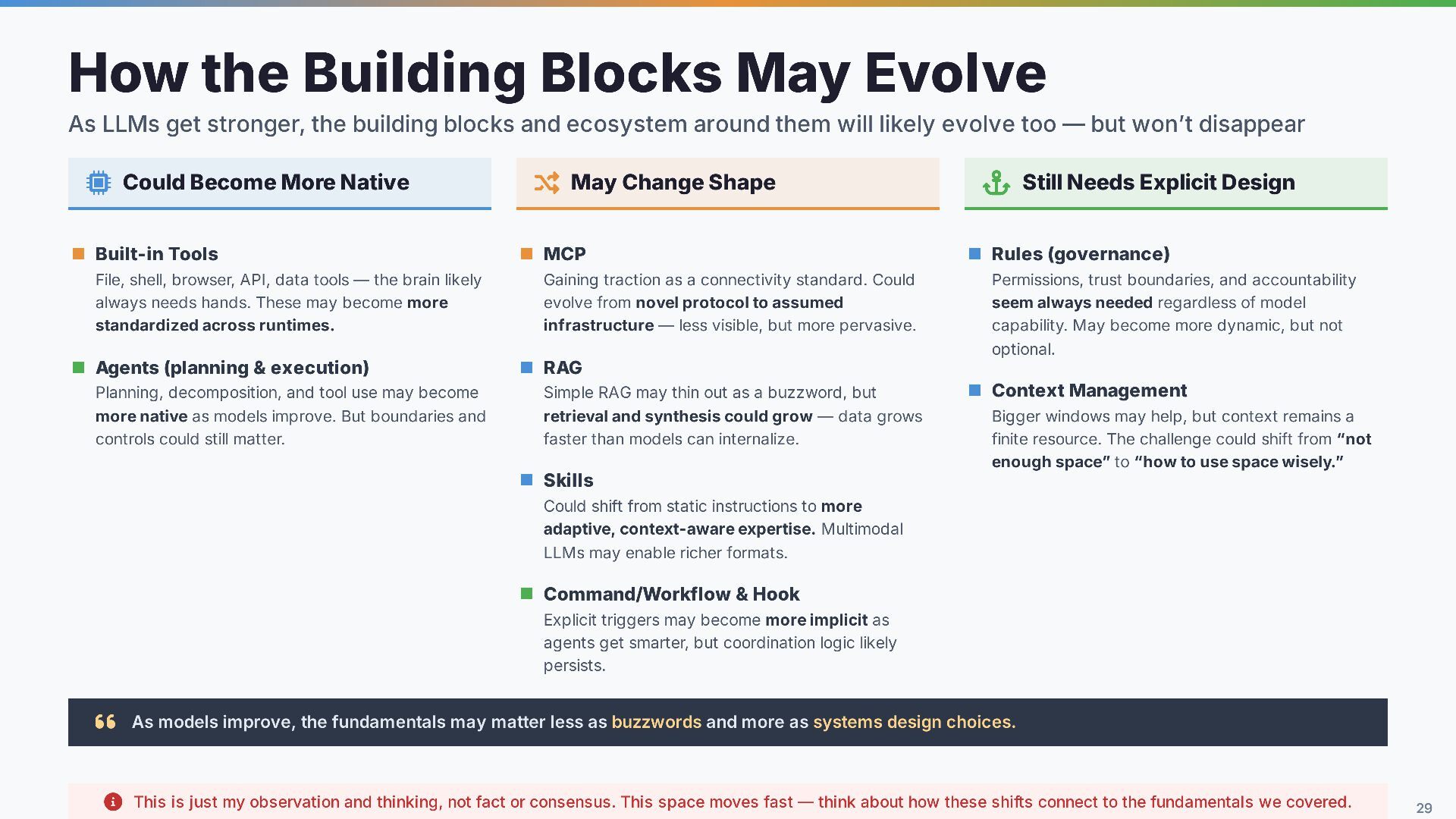
  29. How the Building Blocks May Evolve As LLMs get stronger,

    the building blocks and ecosystem around them will likely evolve too — but won’t disappear Could Become More Native Built-in Tools File, shell, browser, API, data tools — the brain likely always needs hands. These may become File, shell, browser, API, data tools — the brain likely always needs hands. These may become more standardized across runtimes. more standardized across runtimes. Agents (planning & execution) Planning, decomposition, and tool use may become more native as models improve. But boundaries and controls could still matter. as models improve. But boundaries and controls could still matter. May Change Shape MCP Gaining traction as a connectivity standard. Could evolve from Gaining traction as a connectivity standard. Could evolve from novel protocol to assumed infrastructure novel protocol to assumed infrastructure — less visible, but more pervasive. RAG Simple RAG may thin out as a buzzword, but retrieval and synthesis could grow — data grows faster than models can internalize. — data grows faster than models can internalize. Skills Could shift from static instructions to more adaptive, context-aware expertise. more adaptive, context-aware expertise. Multimodal LLMs may enable richer formats. Multimodal LLMs may enable richer formats. Command/Workflow & Hook Explicit triggers may become more implicit as agents get smarter, but coordination logic likely persists. as agents get smarter, but coordination logic likely persists. as agents get smarter, but coordination logic likely persists. Still Needs Explicit Design Rules (governance) Permissions, trust boundaries, and accountability seem always needed regardless of model capability. May become regardless of model capability. May become more dynamic, but no regardless of model capability. May become more dynamic, but no Context Management Bigger windows may help, but context remains a finite resource. T Bigger windows may help, but context remains a finite resource. T “not enough spac “not enough space” to “how to use space wisely.” As models improve, the fundamentals may matter less as buzzwords and more as systems design choices. This is just my observation and thinking, not fact or consensus. This space moves fast — think about how these shifts connect to the fundamentals we covered. 29
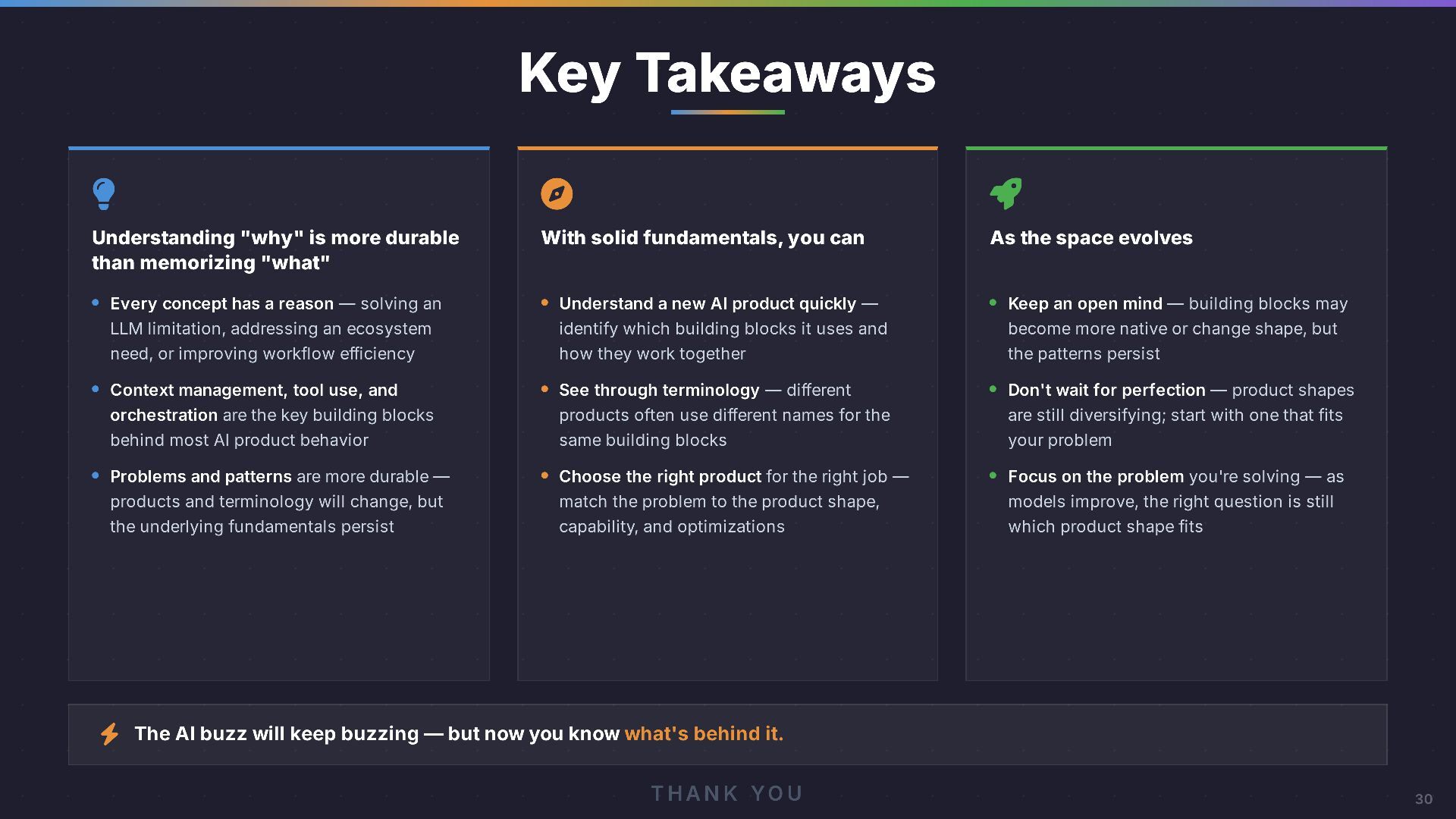
  30. Key Takeaways Understanding "why" is more durable than memorizing "what"

    Understanding "why" is more durable than memorizing "what" Every concept has a reason — solving an LLM limitation, addressing an ecosystem need, or improving workflow efficiency — solving an LLM limitation, addressing an ecosystem need, or improving workflow efficiency — solving an LLM limitation, addressing an ecosystem need, or improving workflow efficiency Context management, tool use, and orchestration Context management, tool use, and orchestration are the key building blocks behind most AI product behavior are the key building blocks behind most AI product behavior Problems and patterns are more durable — products and terminology will change, but the underlying fundamentals persist are more durable — products and terminology will change, but the underlying fundamentals persist are more durable — products and terminology will change, but the underlying fundamentals persist With solid fundamentals, you can Understand a new AI product quickly — identify which building blocks it uses and how they work together — identify which building blocks it uses and how they work together — identify which building blocks it uses and how they work together See through terminology — different products often use different names for the same building blocks — different products often use different names for the same building blocks — different products often use different names for the same building blocks Choose the right product for the right job — match the problem to the product shape, capability, and optimizations for the right job — match the problem to the product shape, capability, and optimizations for the right job — match the problem to the product shape, capability, and optimizations As the space evolves Keep an open mind — building blocks may become more na — building blocks may become more native or change shape, — building blocks may become more native or change shape, Don't wait for perfection — product shapes are still diversify — product shapes are still diversifying; start with one that fits y — product shapes are still diversifying; start with one that fits y Focus on the problem you're solving — as models improve, you're solving — as models improve, the right question is still you're solving — as models improve, the right question is still The AI buzz will keep buzzing — but now you know what's behind it. Thank You 30