Upgrade to Pro — share decks privately, control downloads, hide ads and more …

Ajax Tutorial

Ajax Tutorial

An Introduction To Ajax

Avatar for Rehmetjan Tursun

Rehmetjan Tursun

July 01, 2011

Other Decks in Technology

Transcript

  1. What We’ll Cover • What Ajax is • What Ajax

    is not • The fundamentals of Ajax • How to build better experiences with Ajax • Tools to make Ajax development easier
  2. How We’ll Get There • Demos • Deconstruction • Code

    examples • Introduction to debugging tools
  3. What You’ll Walk Away With • Enough code to be

    dangerous • Enough knowledge not to be • Tools of the trade • Places to look when you get stuck • How it all fits together • The lowdown on “what’s next”
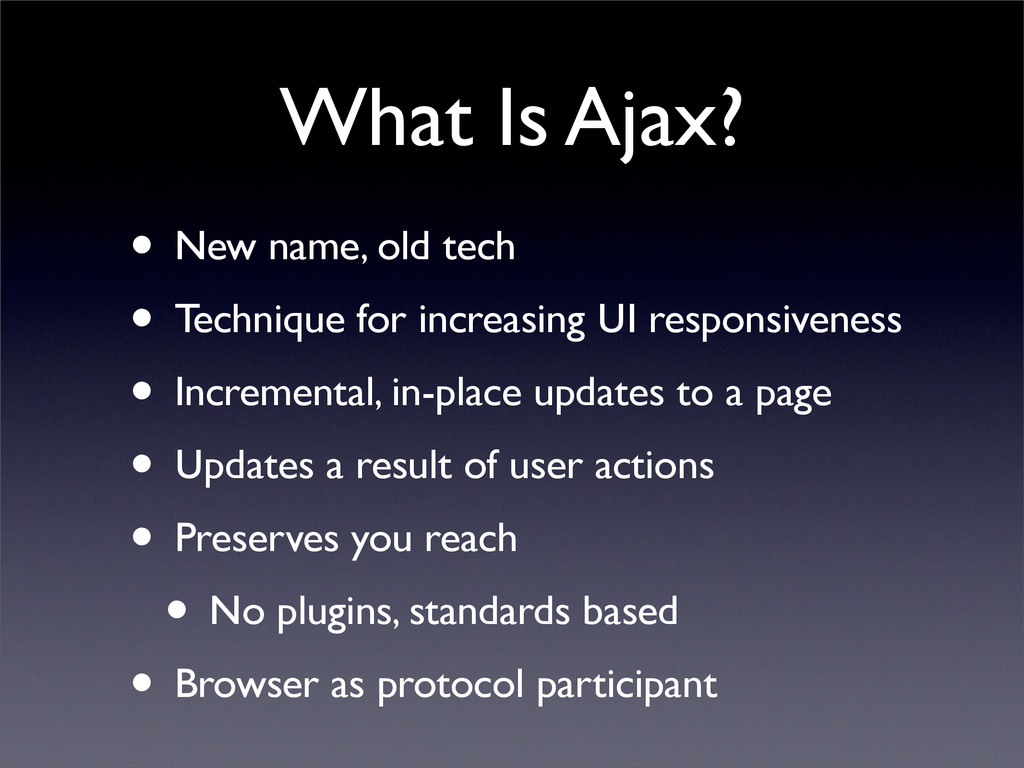
  4. What Is Ajax? • New name, old tech • Technique

    for increasing UI responsiveness • Incremental, in-place updates to a page • Updates a result of user actions • Preserves you reach • No plugins, standards based • Browser as protocol participant
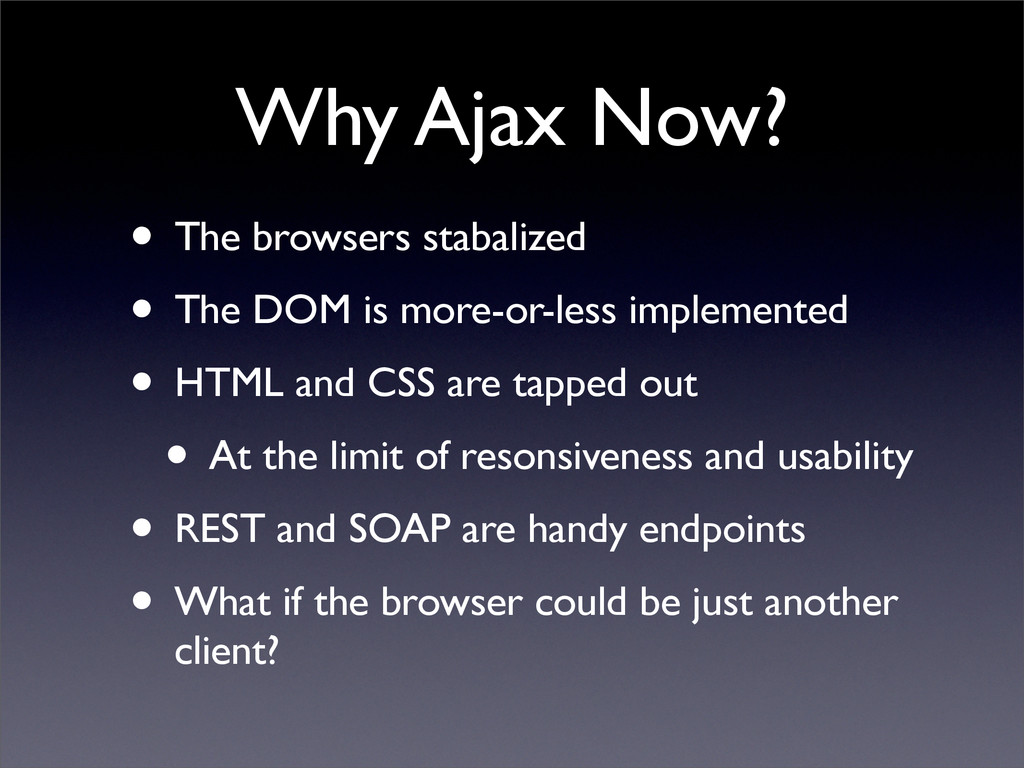
  5. Why Ajax Now? • The browsers stabalized • The DOM

    is more-or-less implemented • HTML and CSS are tapped out • At the limit of resonsiveness and usability • REST and SOAP are handy endpoints • What if the browser could be just another client?
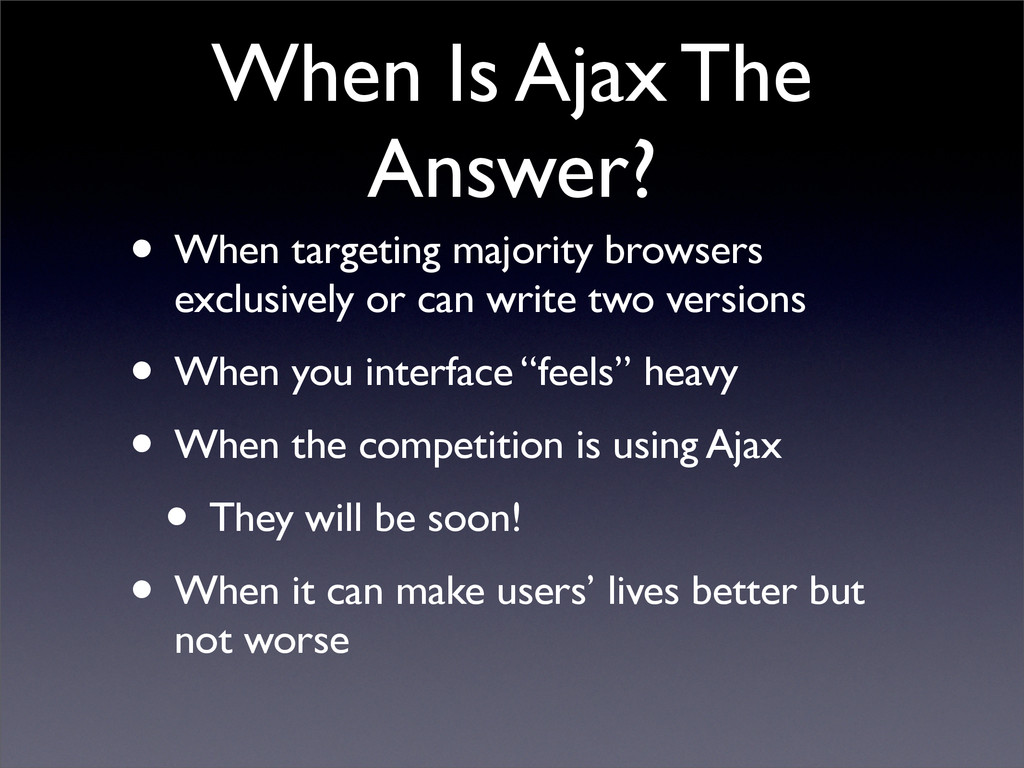
  6. When Is Ajax The Answer? • When targeting majority browsers

    exclusively or can write two versions • When you interface “feels” heavy • When the competition is using Ajax • They will be soon! • When it can make users’ lives better but not worse
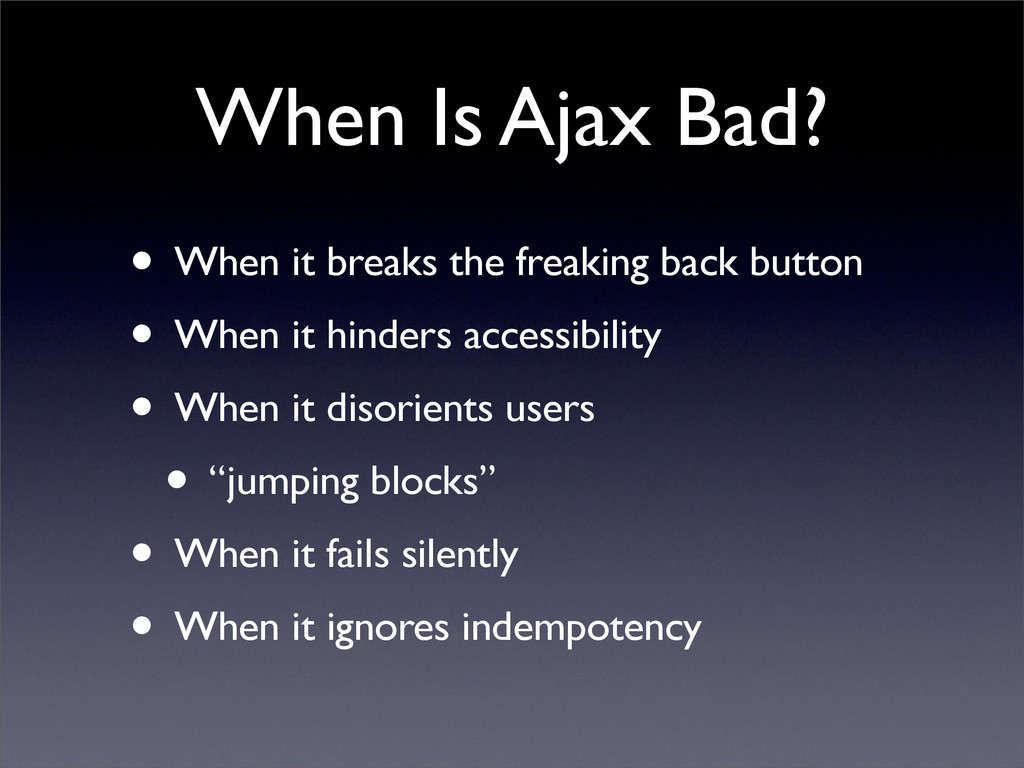
  7. When Is Ajax Bad? • When it breaks the freaking

    back button • When it hinders accessibility • When it disorients users • “jumping blocks” • When it fails silently • When it ignores indempotency
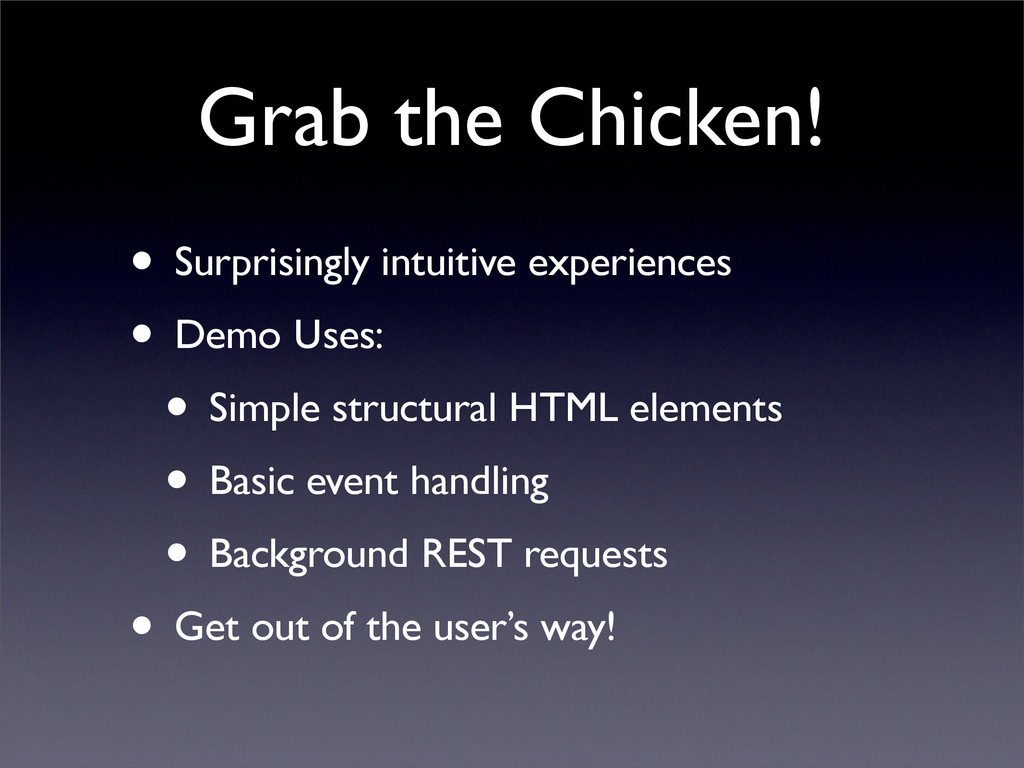
  8. Grab the Chicken! • Surprisingly intuitive experiences • Demo Uses:

    • Simple structural HTML elements • Basic event handling • Background REST requests • Get out of the user’s way!
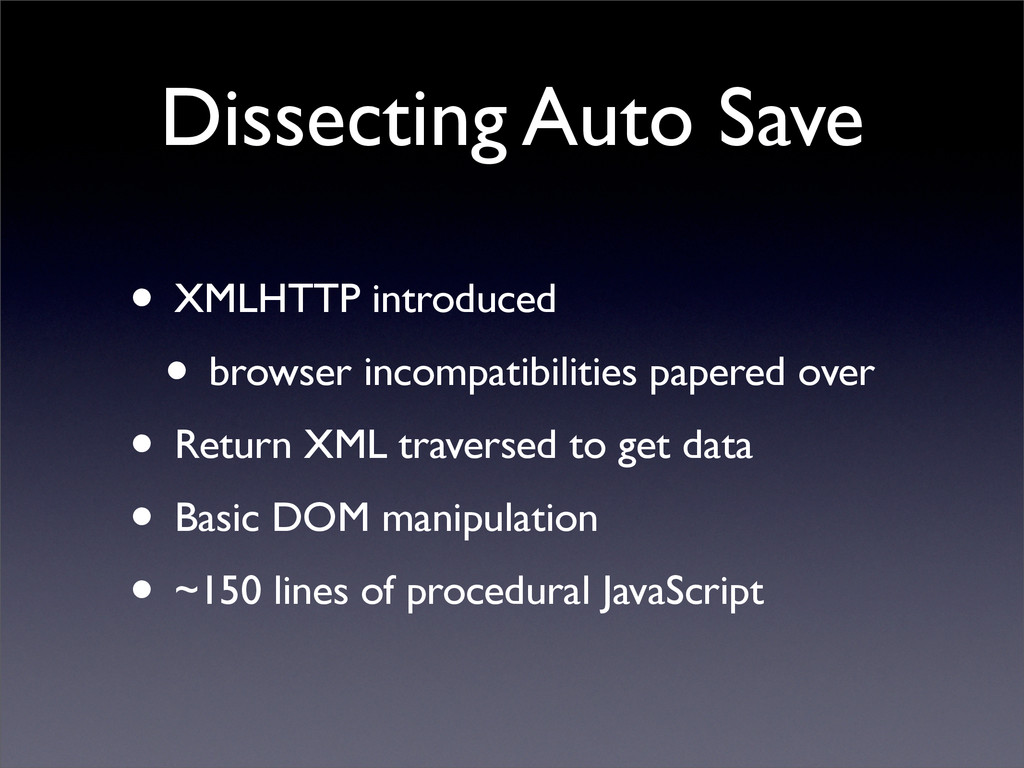
  9. Dissecting Auto Save • XMLHTTP introduced • browser incompatibilities papered

    over • Return XML traversed to get data • Basic DOM manipulation • ~150 lines of procedural JavaScript
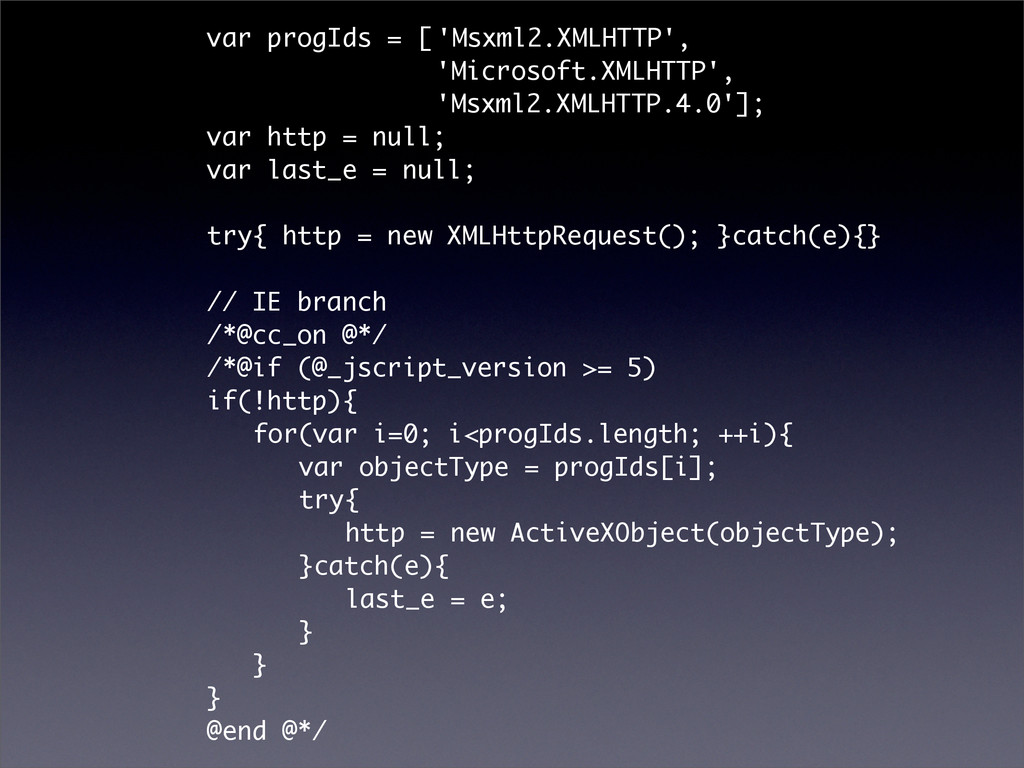
  10. var progIds = [ 'Msxml2.XMLHTTP', 'Microsoft.XMLHTTP', 'Msxml2.XMLHTTP.4.0']; var http =

    null; var last_e = null; try{ http = new XMLHttpRequest(); }catch(e){} // IE branch /*@cc_on @*/ /*@if (@_jscript_version >= 5) if(!http){ for(var i=0; i<progIds.length; ++i){ var objectType = progIds[i]; try{ http = new ActiveXObject(objectType); }catch(e){ last_e = e; } } } @end @*/
  11. Dissection contd. • Basic DOM manipulation • Getting “handles” to

    nodes • getElementsByTagName() • getElementById() • Creating elements - example • Deleting elements - example • Moving elements around - example • Changing the look of things - example
  12. Scheduled Saves • HTTP POST • We’re modifying data •

    setInterval() for occasional execution • Events hard-wired to IDs • This code is brittle and hard to reuse
  13. More on XMLHTTP • Sync or Async communication • Simple

    callback scheme for status • Can return either text or XML doc • Uses one of 2 available sockets • not x-domain • Return order NOT guaranteed • Interface NOT a standard (yet)
  14. Ajax “quirks” • Synchronous requests halt browser • Picky about

    response Content-Type • Some verbs problematic (HEAD, PUT) • File upload not available cross-browser • handled w/ iframes and form hacks • Bugs: • Caching (IE and FF 1.5 do, FF 1.0 doesn’t) • IE: which MSXML did I really get?
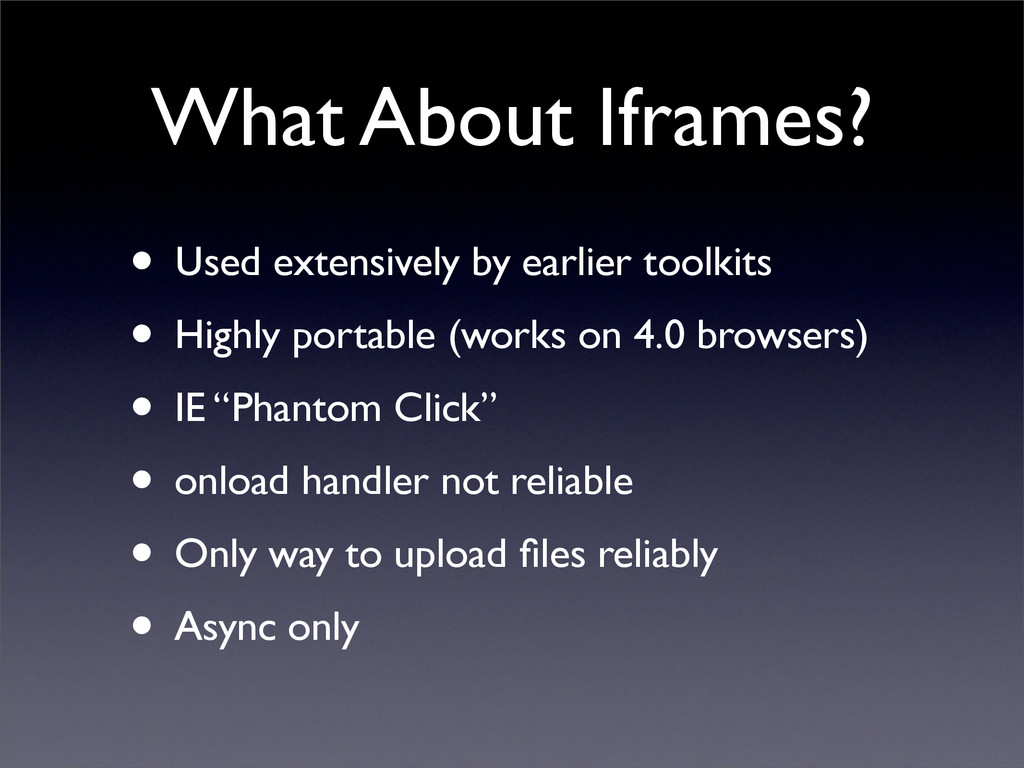
  15. What About Iframes? • Used extensively by earlier toolkits •

    Highly portable (works on 4.0 browsers) • IE “Phantom Click” • onload handler not reliable • Only way to upload files reliably • Async only
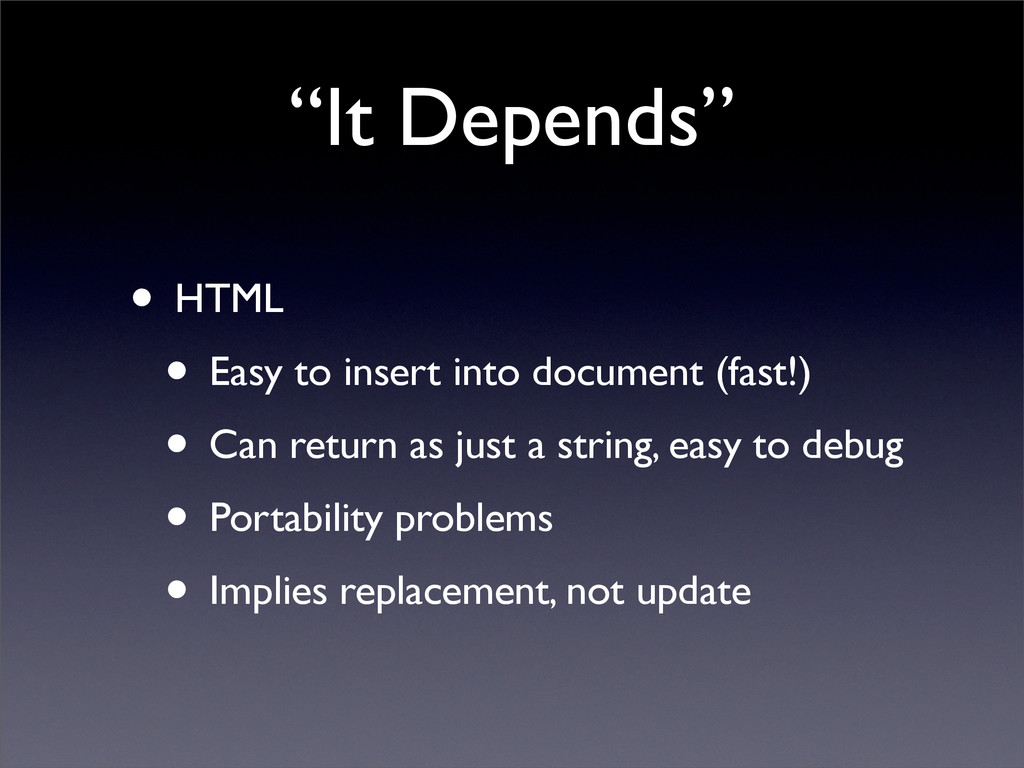
  16. “It Depends” • HTML • Easy to insert into document

    (fast!) • Can return as just a string, easy to debug • Portability problems • Implies replacement, not update
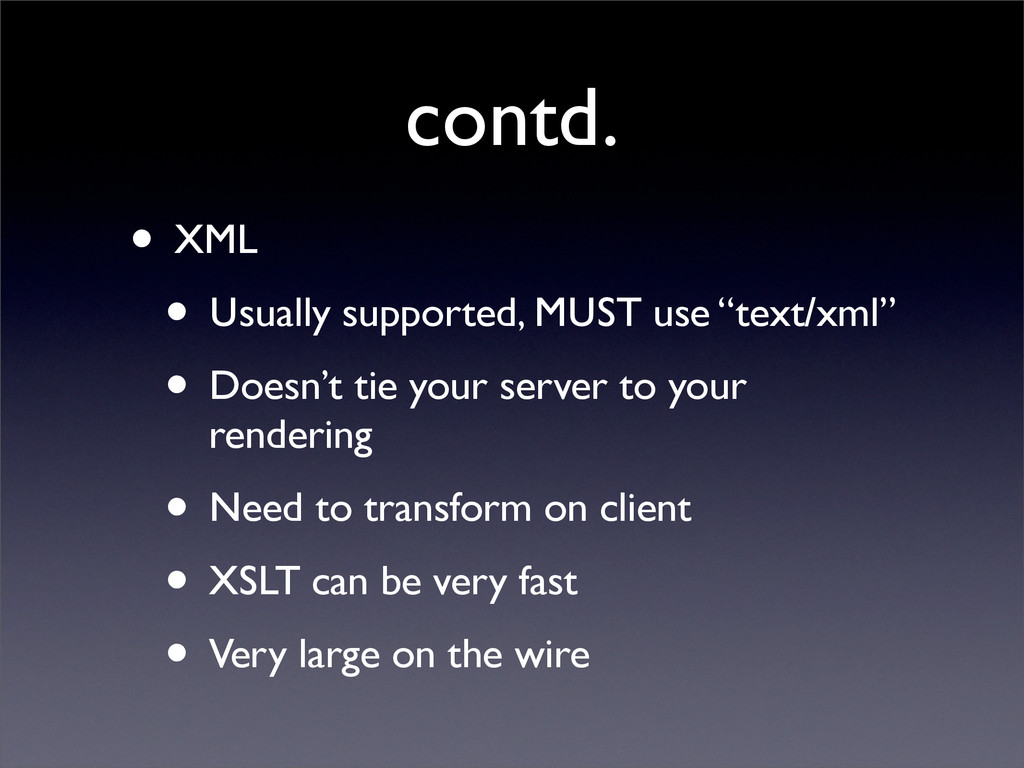
  17. contd. • XML • Usually supported, MUST use “text/xml” •

    Doesn’t tie your server to your rendering • Need to transform on client • XSLT can be very fast • Very large on the wire
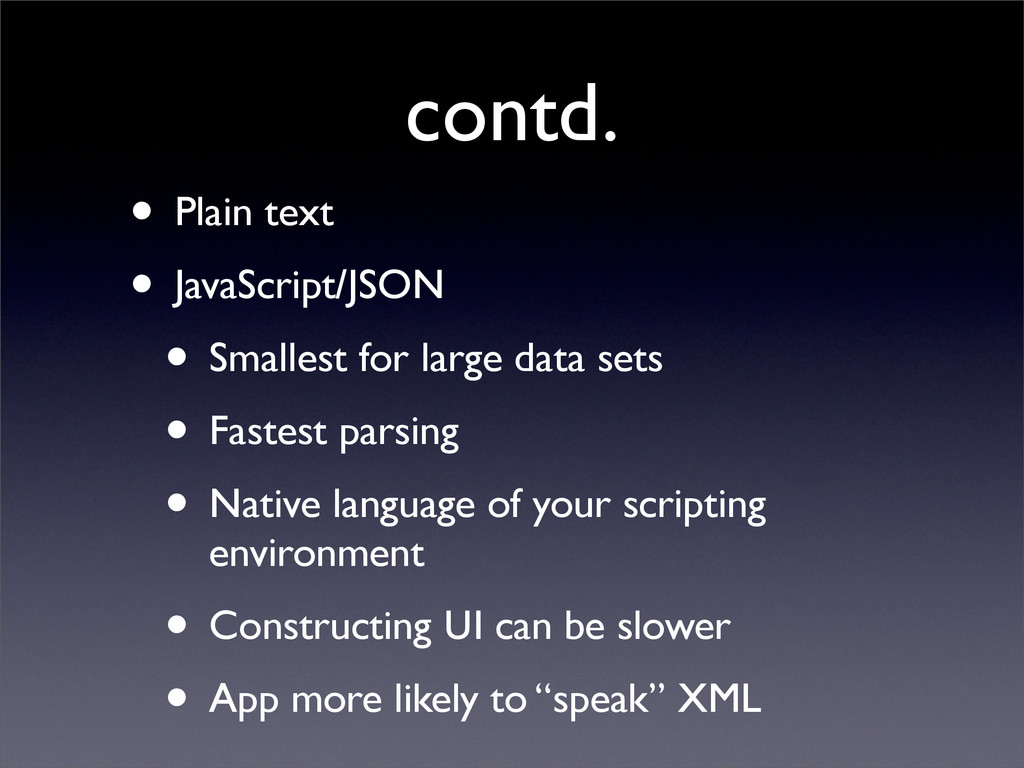
  18. contd. • Plain text • JavaScript/JSON • Smallest for large

    data sets • Fastest parsing • Native language of your scripting environment • Constructing UI can be slower • App more likely to “speak” XML
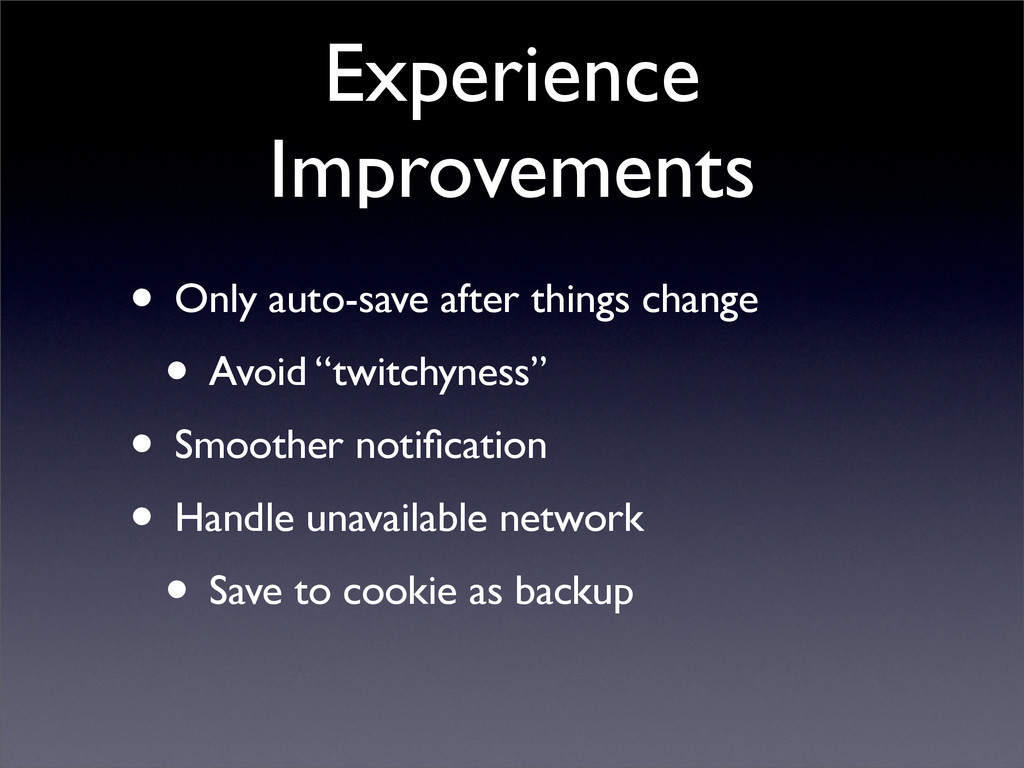
  19. Experience Improvements • Only auto-save after things change • Avoid

    “twitchyness” • Smoother notification • Handle unavailable network • Save to cookie as backup
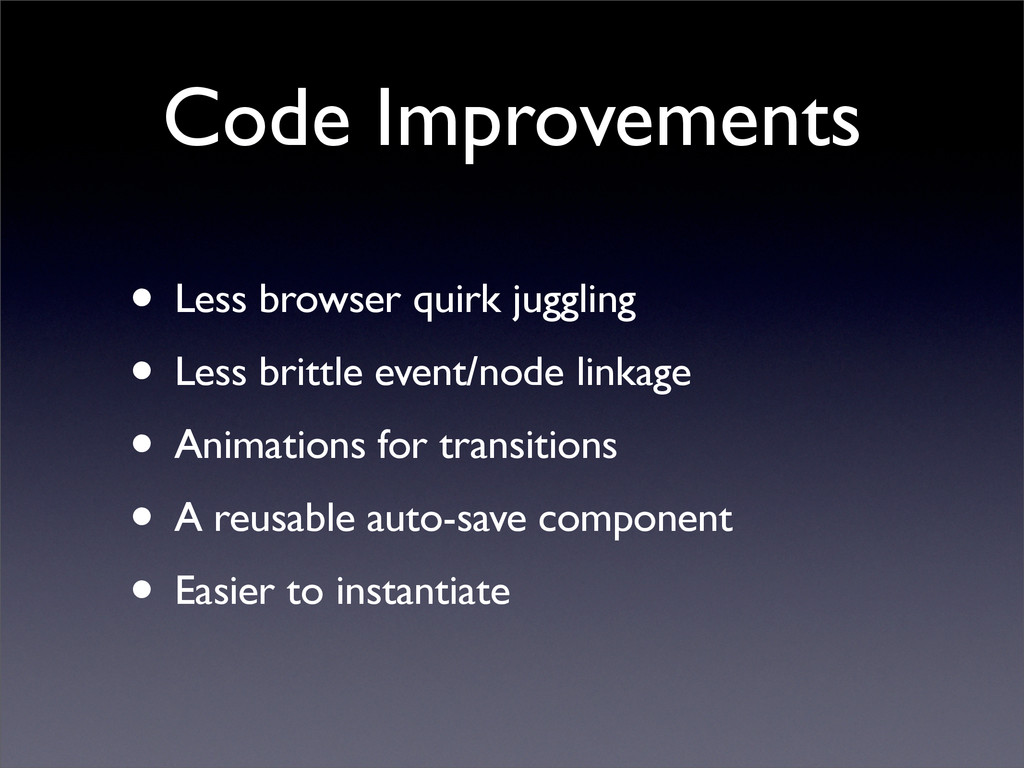
  20. Code Improvements • Less browser quirk juggling • Less brittle

    event/node linkage • Animations for transitions • A reusable auto-save component • Easier to instantiate
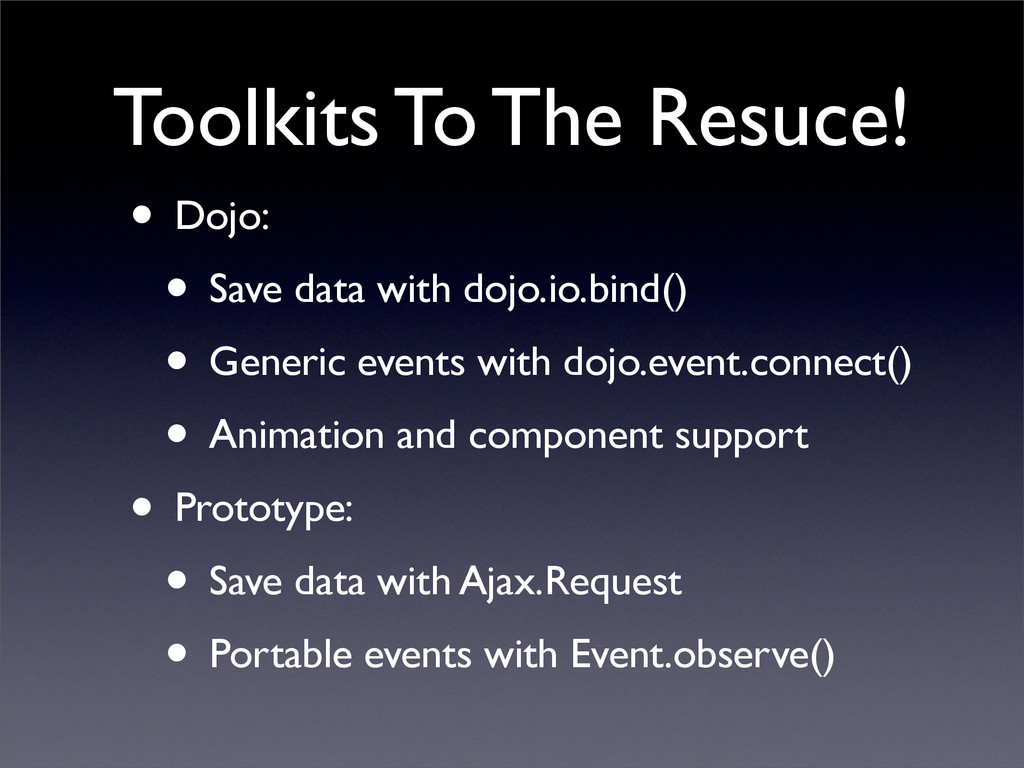
  21. Toolkits To The Resuce! • Dojo: • Save data with

    dojo.io.bind() • Generic events with dojo.event.connect() • Animation and component support • Prototype: • Save data with Ajax.Request • Portable events with Event.observe()
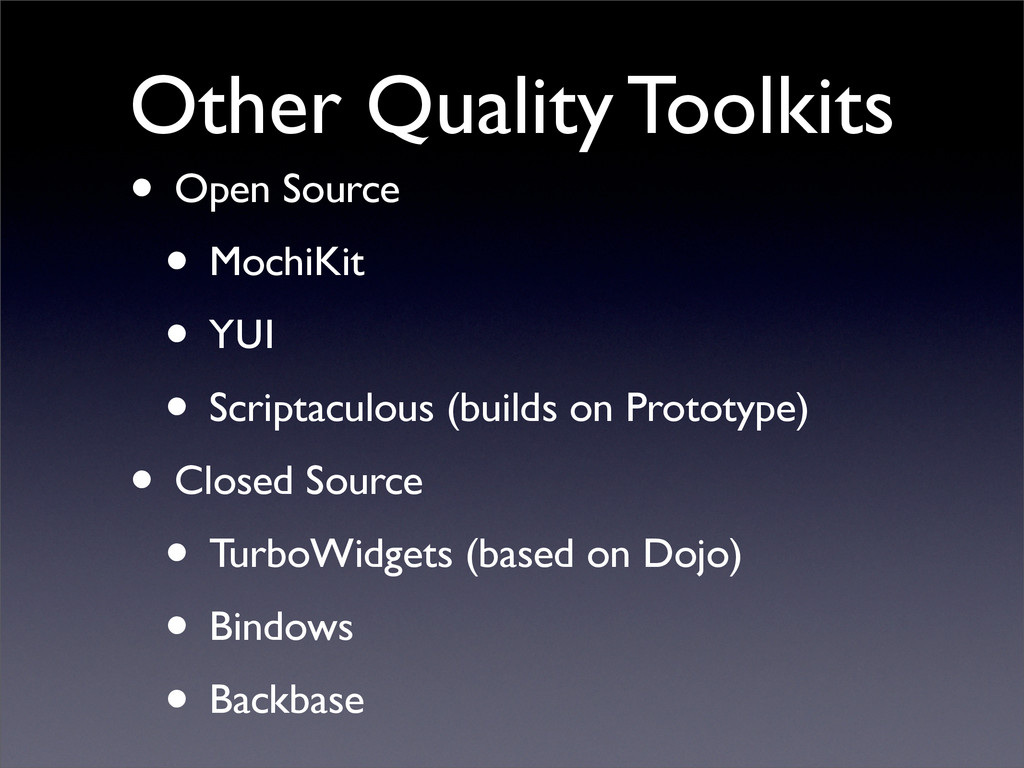
  22. Other Quality Toolkits • Open Source • MochiKit • YUI

    • Scriptaculous (builds on Prototype) • Closed Source • TurboWidgets (based on Dojo) • Bindows • Backbase
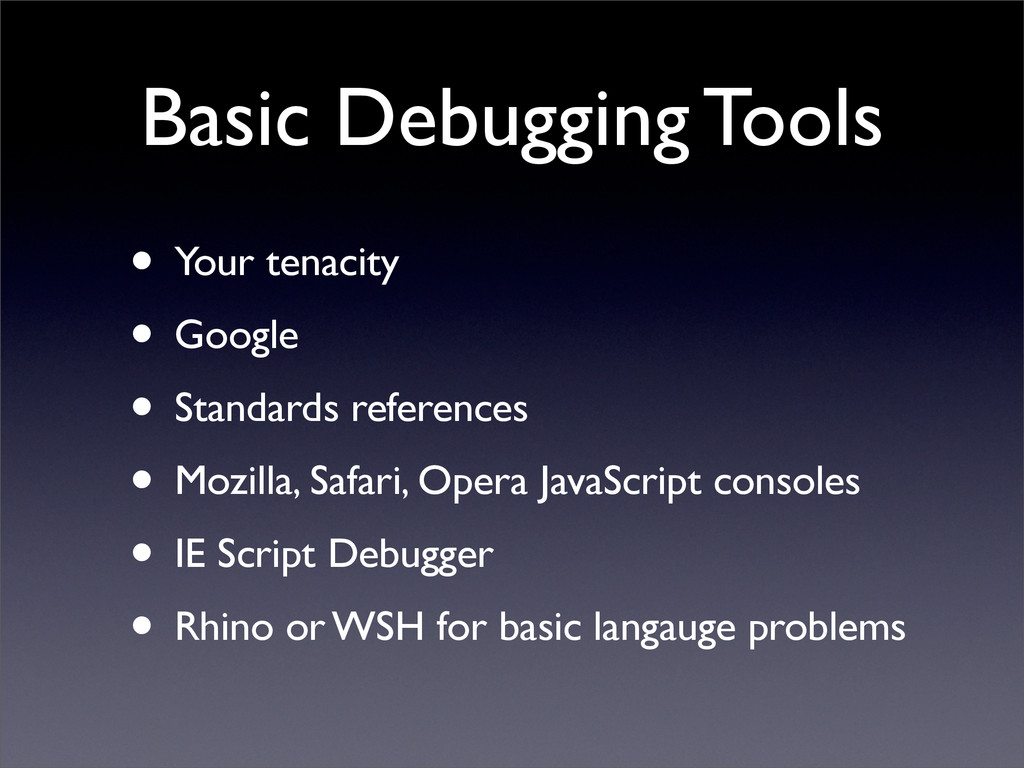
  23. Basic Debugging Tools • Your tenacity • Google • Standards

    references • Mozilla, Safari, Opera JavaScript consoles • IE Script Debugger • Rhino or WSH for basic langauge problems
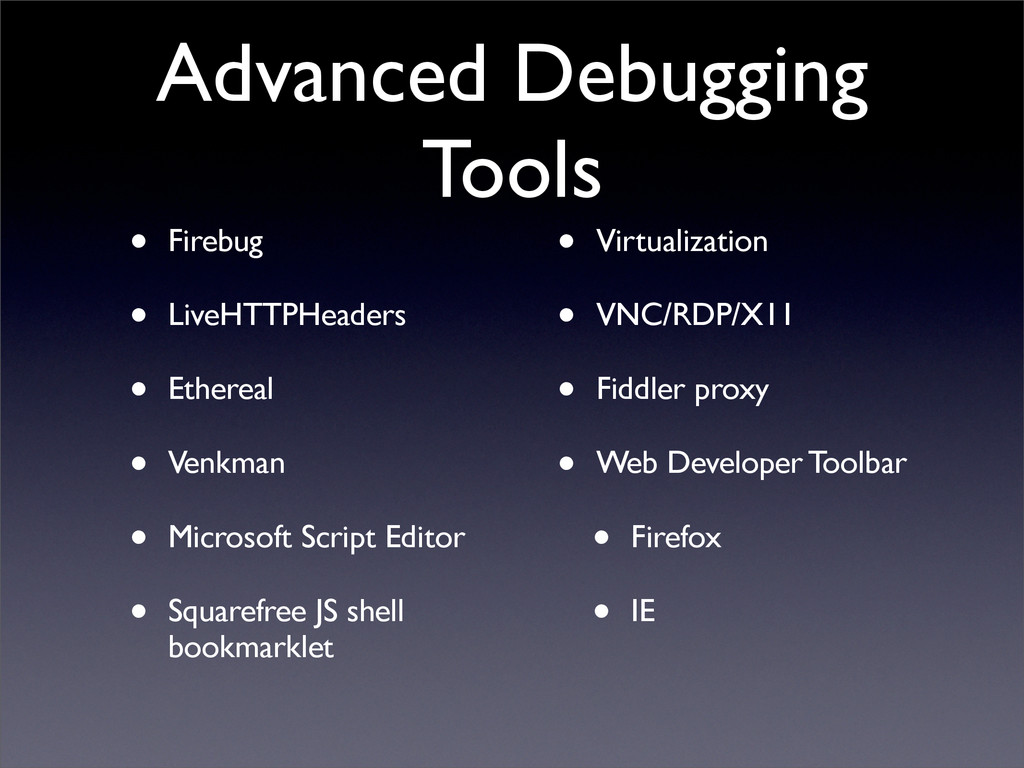
  24. Advanced Debugging Tools • Firebug • LiveHTTPHeaders • Ethereal •

    Venkman • Microsoft Script Editor • Squarefree JS shell bookmarklet • Virtualization • VNC/RDP/X11 • Fiddler proxy • Web Developer Toolbar • Firefox • IE
  25. Making It A Component • Auto-Save for any <textarea> •

    Why widgets? • Automatic property binding • Modularization • Easier to re-use
  26. It Works Now • Not a “toy” language • Dynamic,

    functional (has closures) • Classes and inheritance • Ubiquitous: browser, stand alone, flash, etc. • Debuggers available • Can be modularized/packaged • Libraries provide packaging, AOP, etc.
  27. The Chameleon Of Languages • Never what you expect •

    Whatever you make of it • Imperative to imperative programmers • OO (with quirks) to OO programmers • Functional to Functional hackers
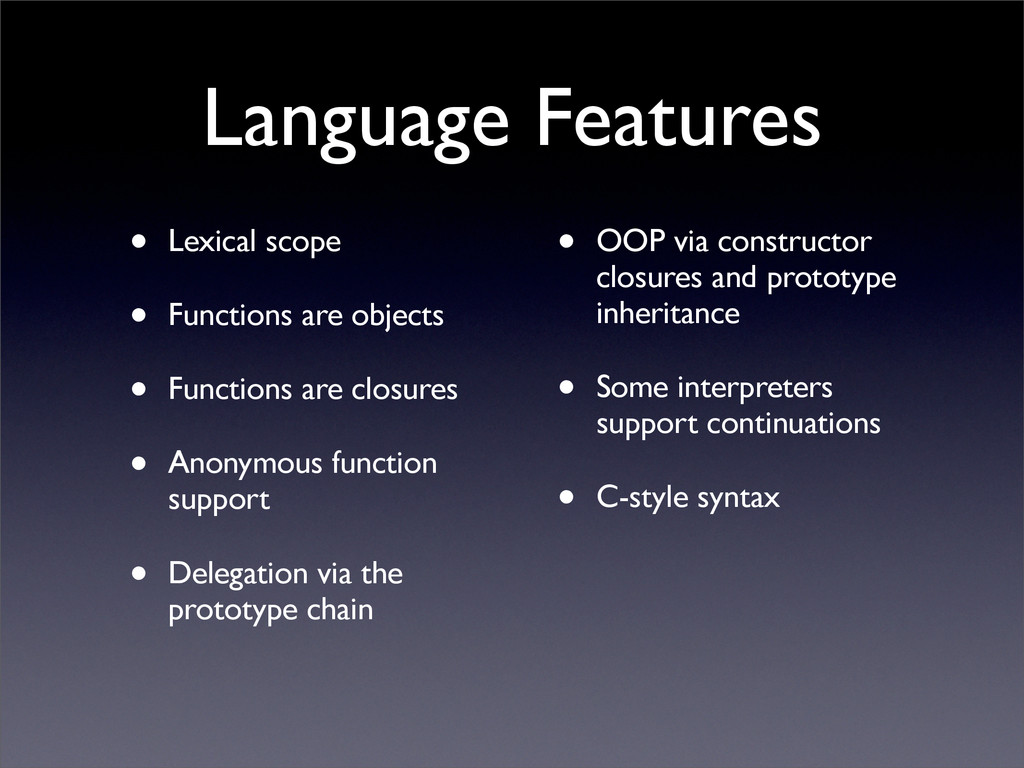
  28. Language Features • Lexical scope • Functions are objects •

    Functions are closures • Anonymous function support • Delegation via the prototype chain • OOP via constructor closures and prototype inheritance • Some interpreters support continuations • C-style syntax
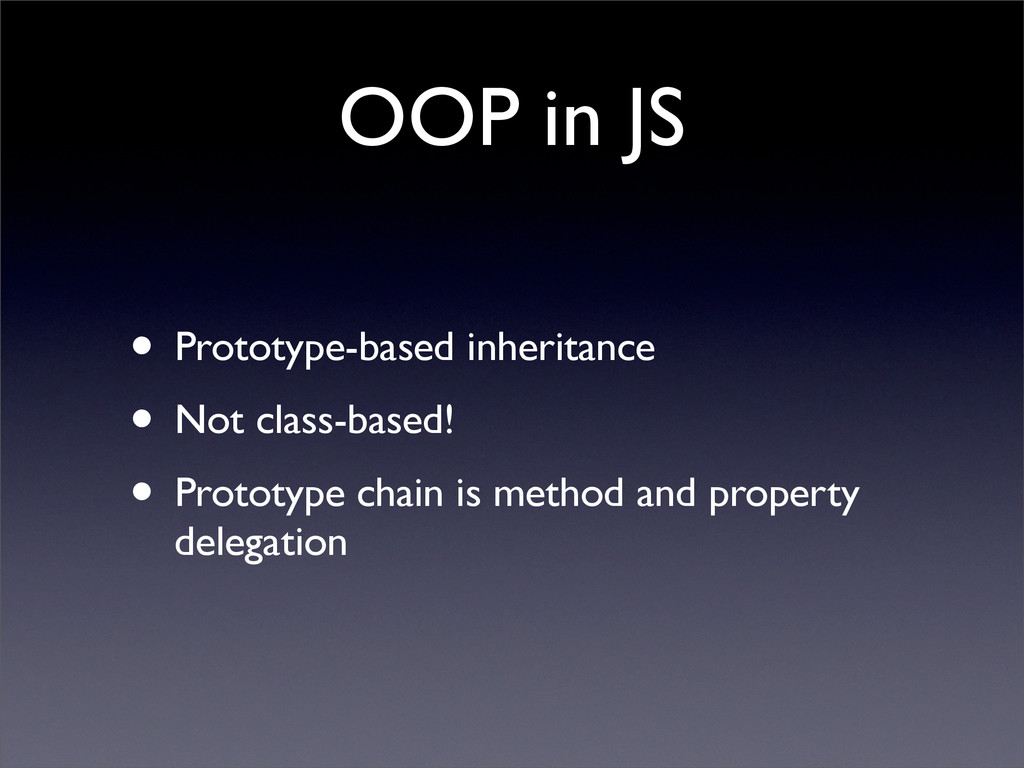
  29. OOP in JS • Prototype-based inheritance • Not class-based! •

    Prototype chain is method and property delegation
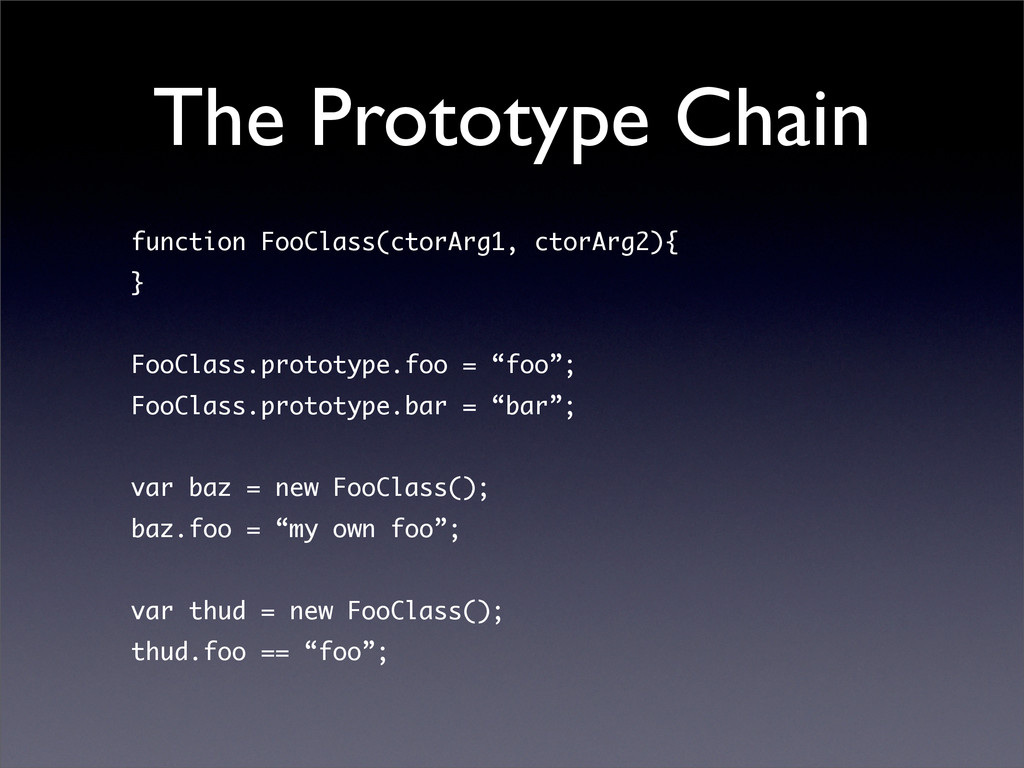
  30. The Prototype Chain function FooClass(ctorArg1, ctorArg2){ } FooClass.prototype.foo = “foo”;

    FooClass.prototype.bar = “bar”; var baz = new FooClass(); baz.foo = “my own foo”; var thud = new FooClass(); thud.foo == “foo”;
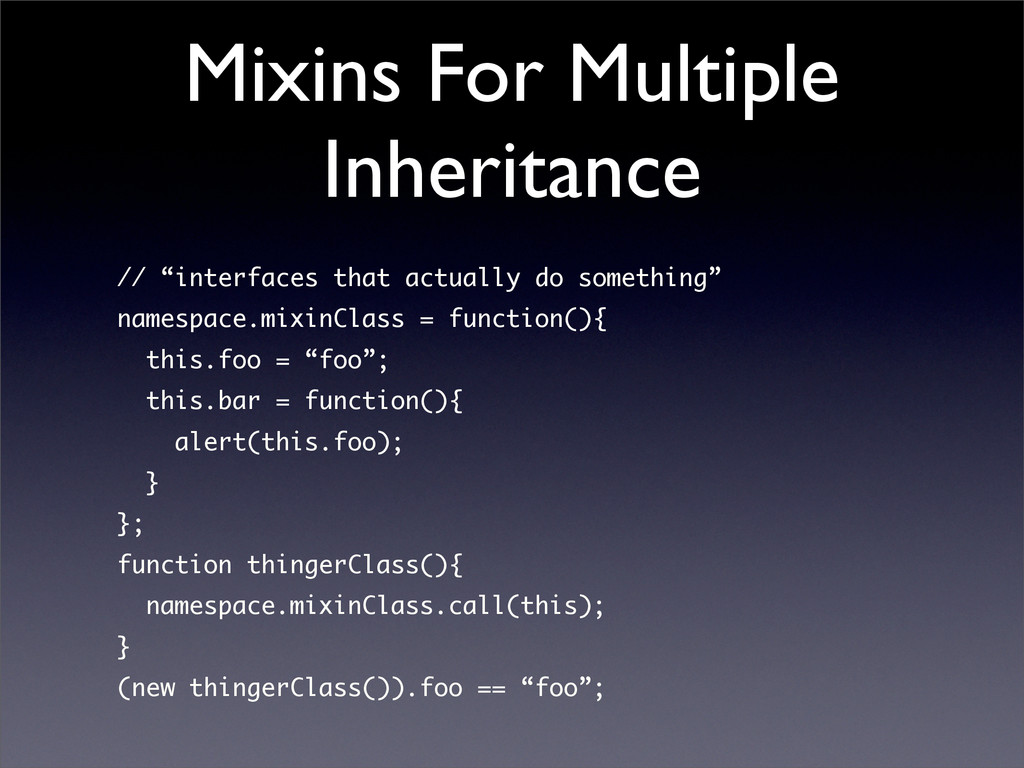
  31. Mixins For Multiple Inheritance // “interfaces that actually do something”

    namespace.mixinClass = function(){ this.foo = “foo”; this.bar = function(){ alert(this.foo); } }; function thingerClass(){ namespace.mixinClass.call(this); } (new thingerClass()).foo == “foo”;
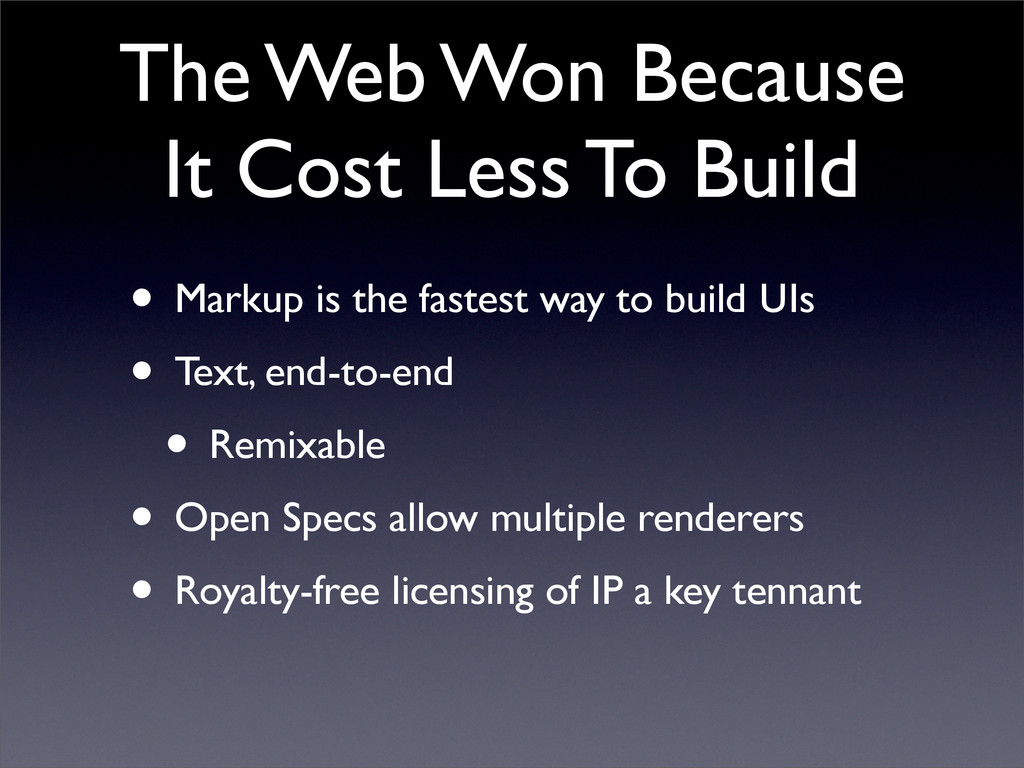
  32. The Web Won Because It Cost Less To Build •

    Markup is the fastest way to build UIs • Text, end-to-end • Remixable • Open Specs allow multiple renderers • Royalty-free licensing of IP a key tennant
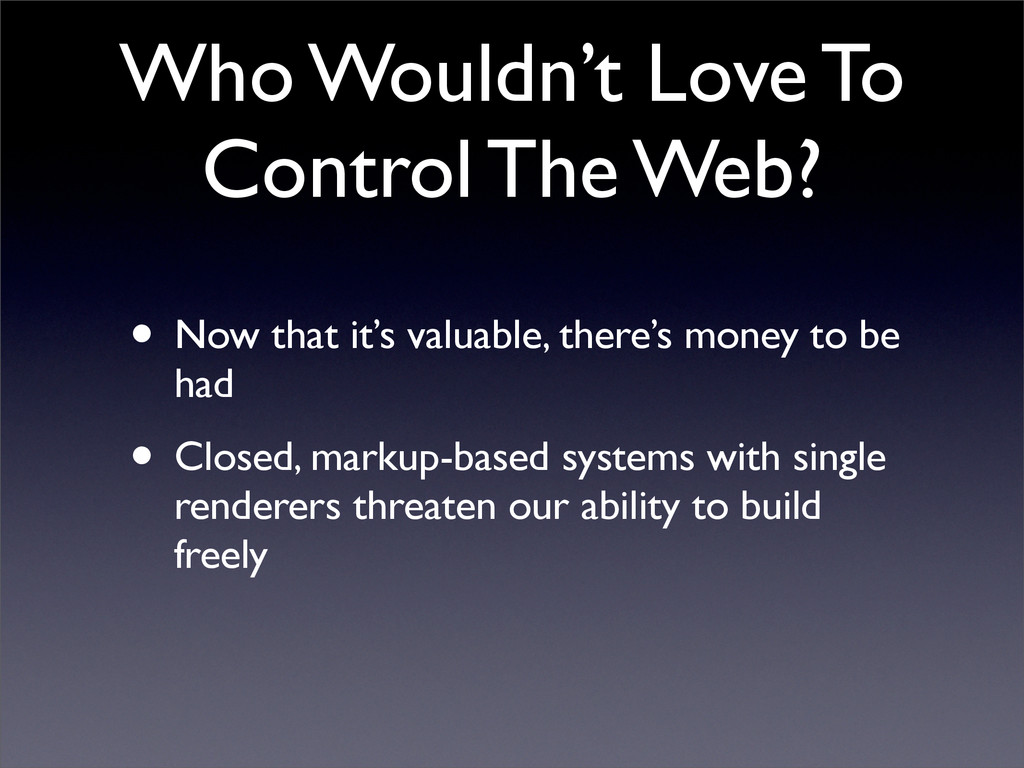
  33. Who Wouldn’t Love To Control The Web? • Now that

    it’s valuable, there’s money to be had • Closed, markup-based systems with single renderers threaten our ability to build freely
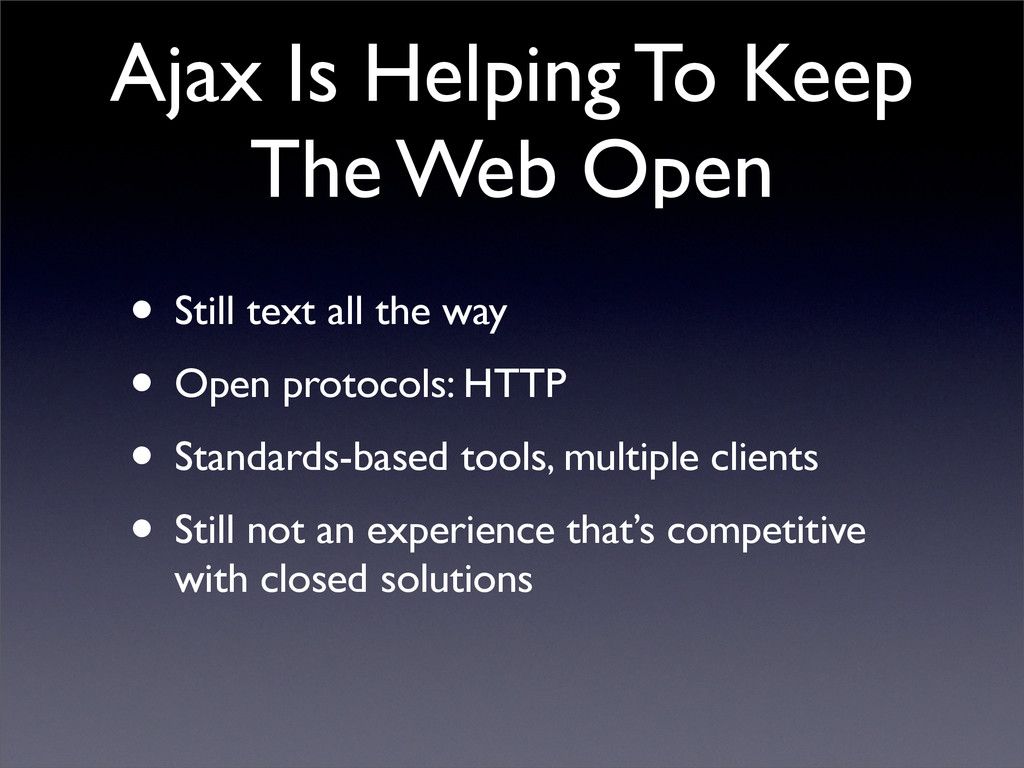
  34. Ajax Is Helping To Keep The Web Open • Still

    text all the way • Open protocols: HTTP • Standards-based tools, multiple clients • Still not an experience that’s competitive with closed solutions
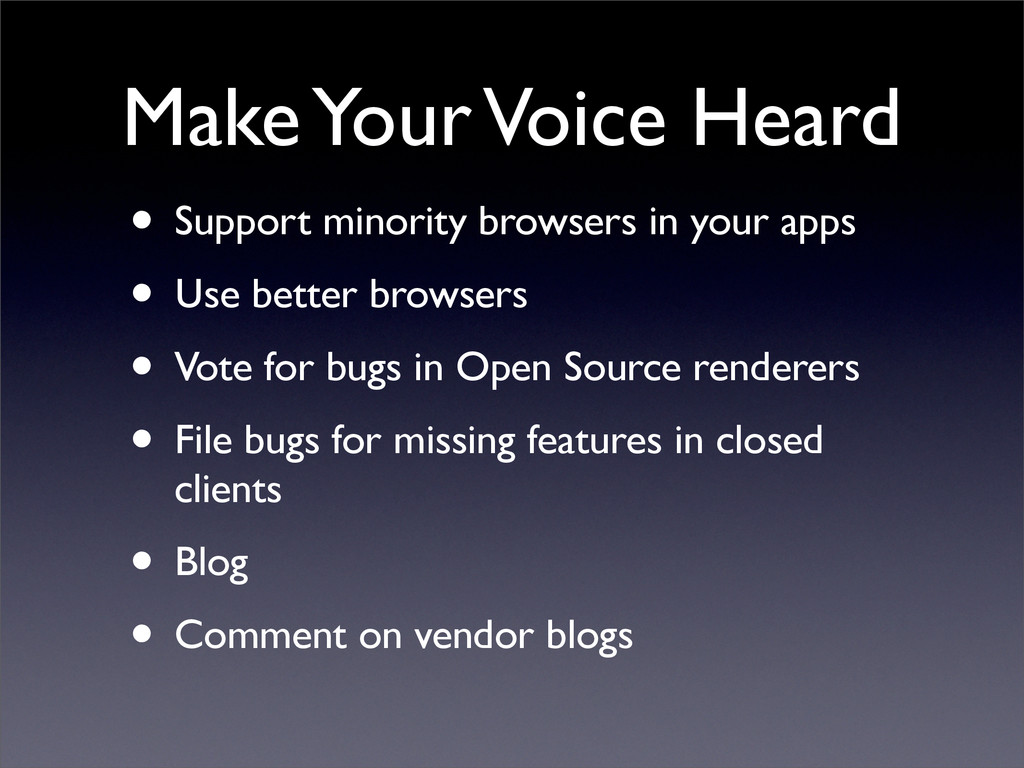
  35. Make Your Voice Heard • Support minority browsers in your

    apps • Use better browsers • Vote for bugs in Open Source renderers • File bugs for missing features in closed clients • Blog • Comment on vendor blogs
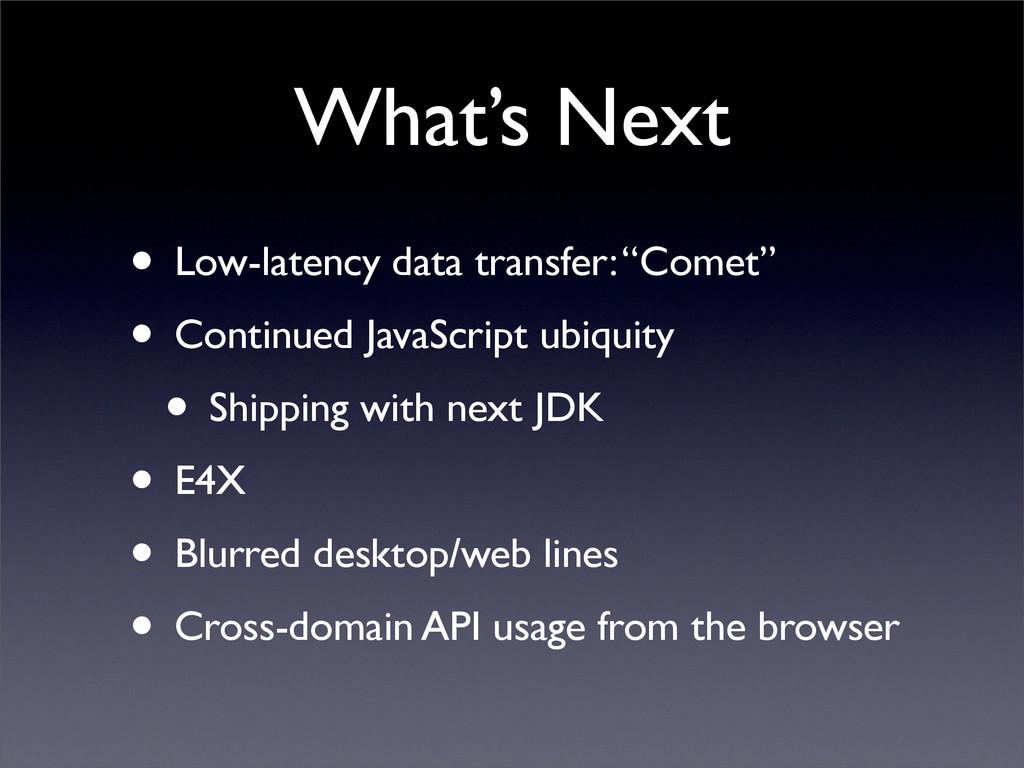
  36. What’s Next • Low-latency data transfer: “Comet” • Continued JavaScript

    ubiquity • Shipping with next JDK • E4X • Blurred desktop/web lines • Cross-domain API usage from the browser
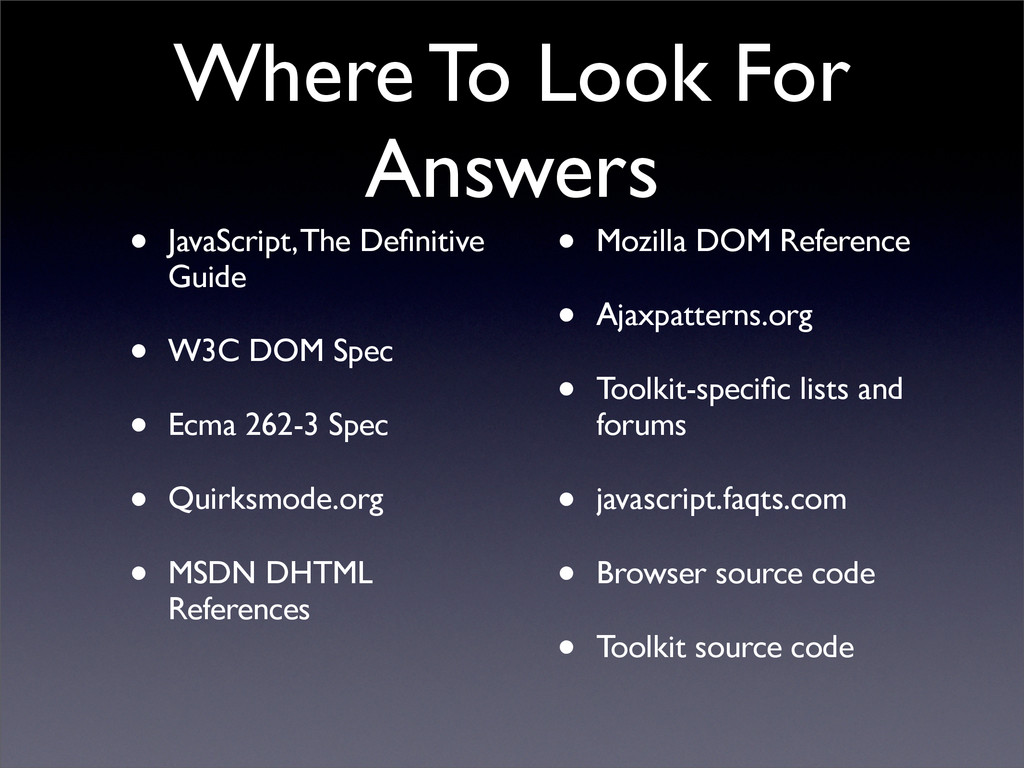
  37. Where To Look For Answers • JavaScript, The Definitive Guide

    • W3C DOM Spec • Ecma 262-3 Spec • Quirksmode.org • MSDN DHTML References • Mozilla DOM Reference • Ajaxpatterns.org • Toolkit-specific lists and forums • javascript.faqts.com • Browser source code • Toolkit source code