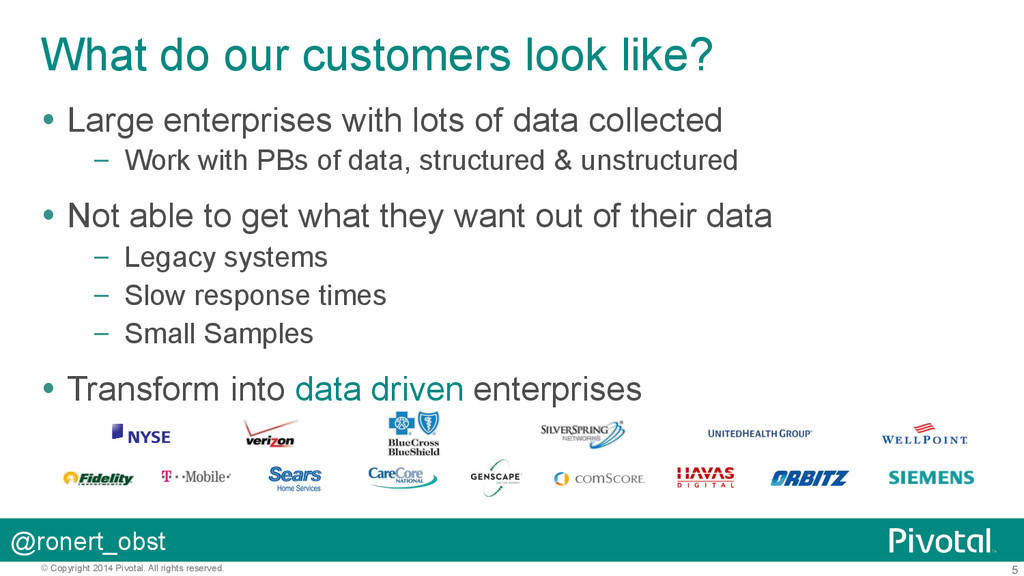
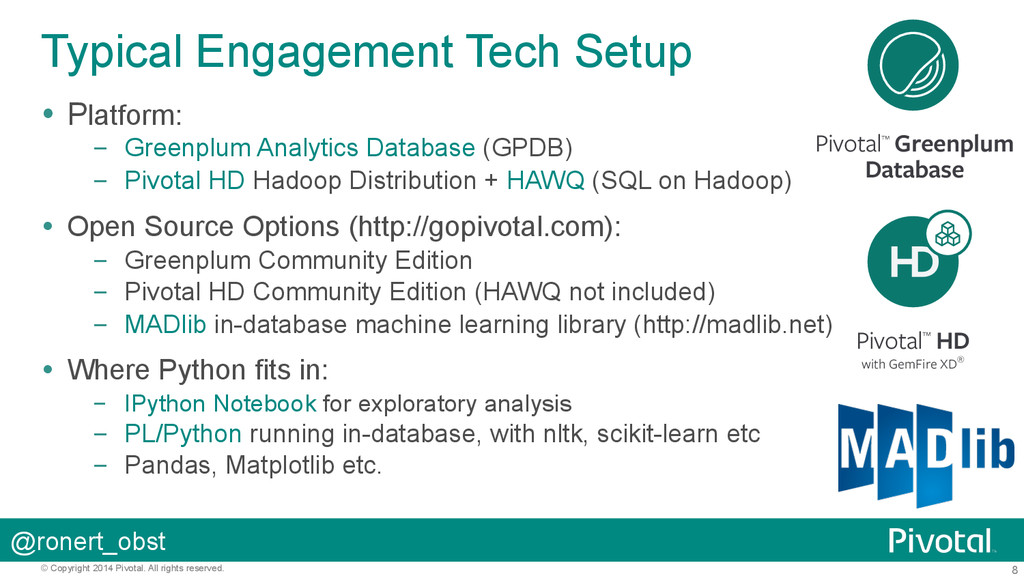
do our customers look like? Large enterprises with lots of data collected – Work with PBs of data, structured & unstructured Not able to get what they want out of their data – Legacy systems – Slow response times – Small Samples Transform into data driven enterprises
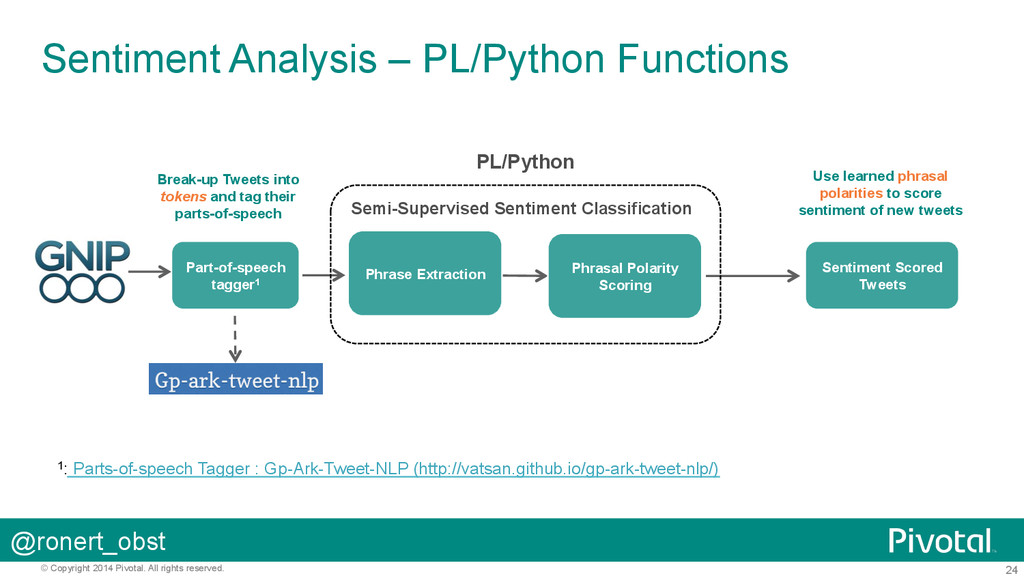
Open Source Contributions Lots more interesting small projects: • PyMADlib – Python Wrapper for MADlib https://github.com/gopivotal/pymadlib • PivotalR – R wrapper for MADlib http://github.com/madlib-internal/PivotalR • Part-of-speech tagger for Twitter via SQL http://vatsan.github.io/gp-ark-tweet-nlp/ • Pandas via psql (interactive PostgreSQL terminal) https://github.com/vatsan/pandas_via_psql
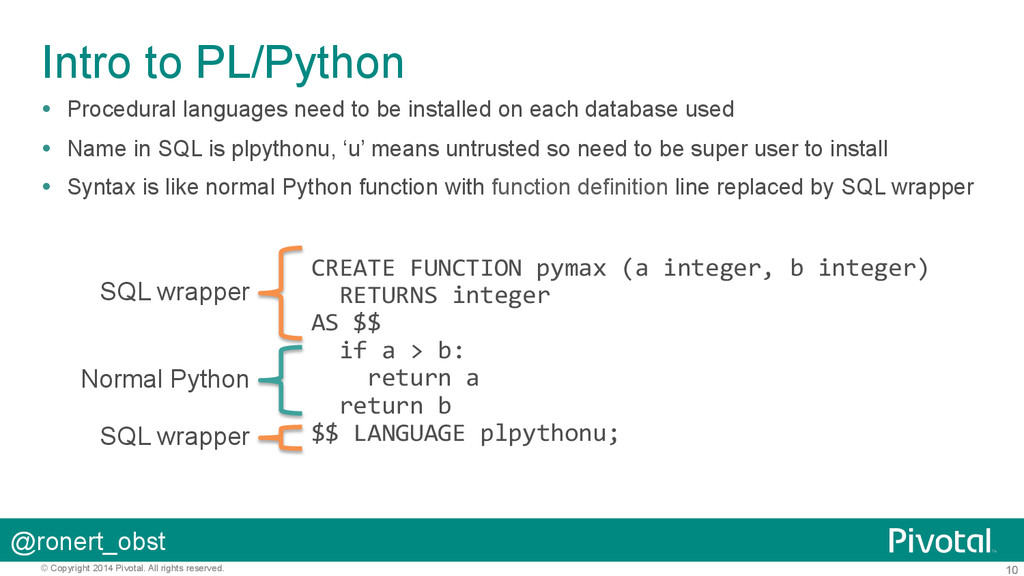
to PL/Python Procedural languages need to be installed on each database used Name in SQL is plpythonu, ‘u’ means untrusted so need to be super user to install Syntax is like normal Python function with function definition line replaced by SQL wrapper CREATE FUNCTION pymax (a integer, b integer) RETURNS integer AS $$ if a > b: return a return b $$ LANGUAGE plpythonu; SQL wrapper SQL wrapper Normal Python
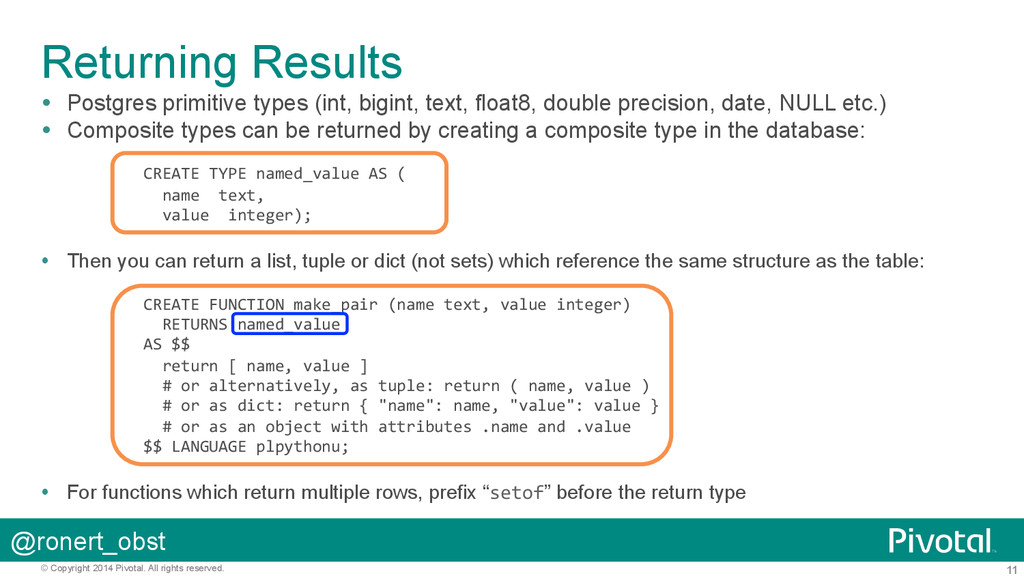
Results Postgres primitive types (int, bigint, text, float8, double precision, date, NULL etc.) Composite types can be returned by creating a composite type in the database: CREATE TYPE named_value AS ( name text, value integer); Then you can return a list, tuple or dict (not sets) which reference the same structure as the table: CREATE FUNCTION make_pair (name text, value integer) RETURNS named_value AS $$ return [ name, value ] # or alternatively, as tuple: return ( name, value ) # or as dict: return { "name": name, "value": value } # or as an object with attributes .name and .value $$ LANGUAGE plpythonu; For functions which return multiple rows, prefix “setof” before the return type
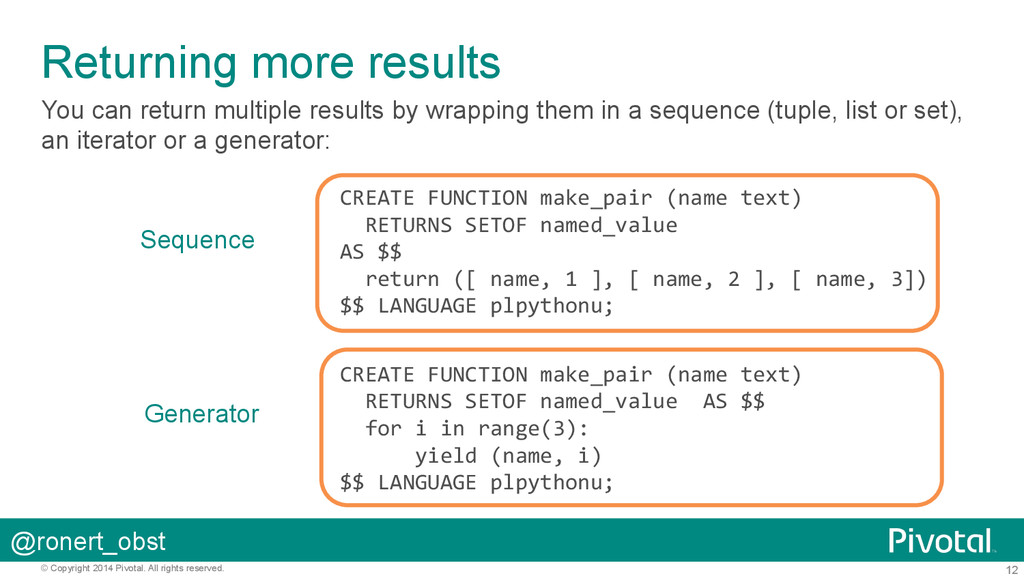
more results You can return multiple results by wrapping them in a sequence (tuple, list or set), an iterator or a generator: CREATE FUNCTION make_pair (name text) RETURNS SETOF named_value AS $$ return ([ name, 1 ], [ name, 2 ], [ name, 3]) $$ LANGUAGE plpythonu; Sequence Generator CREATE FUNCTION make_pair (name text) RETURNS SETOF named_value AS $$ for i in range(3): yield (name, i) $$ LANGUAGE plpythonu;
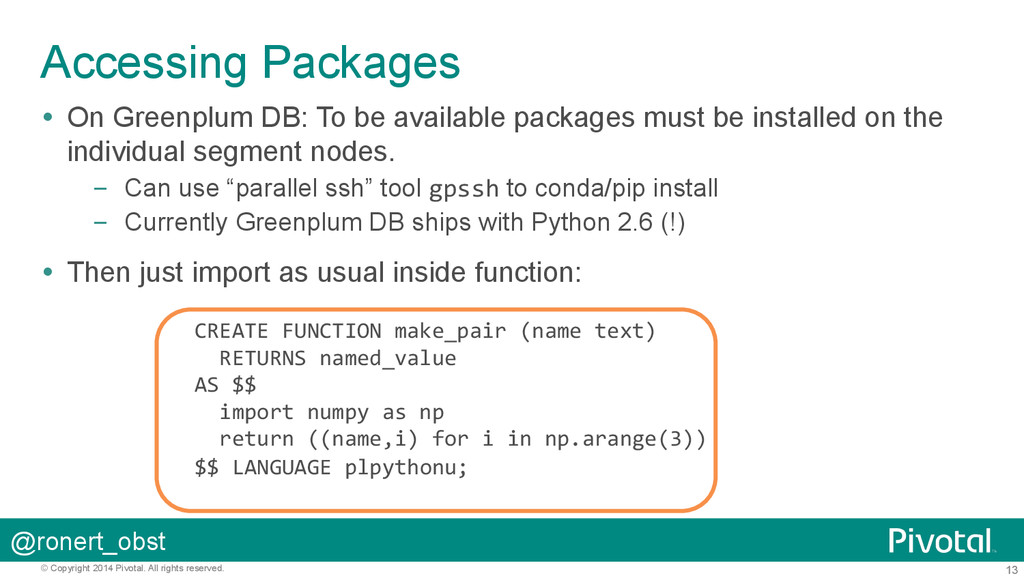
Packages On Greenplum DB: To be available packages must be installed on the individual segment nodes. – Can use “parallel ssh” tool gpssh to conda/pip install – Currently Greenplum DB ships with Python 2.6 (!) Then just import as usual inside function: CREATE FUNCTION make_pair (name text) RETURNS named_value AS $$ import numpy as np return ((name,i) for i in np.arange(3)) $$ LANGUAGE plpythonu;
of PL/Python Easy to bring your code to the data When SQL falls short, leverage your Python experience Apply Python across petabytes of data with minimal overhead or additional requirements Results are already in the database system, ready for further analysis or storage
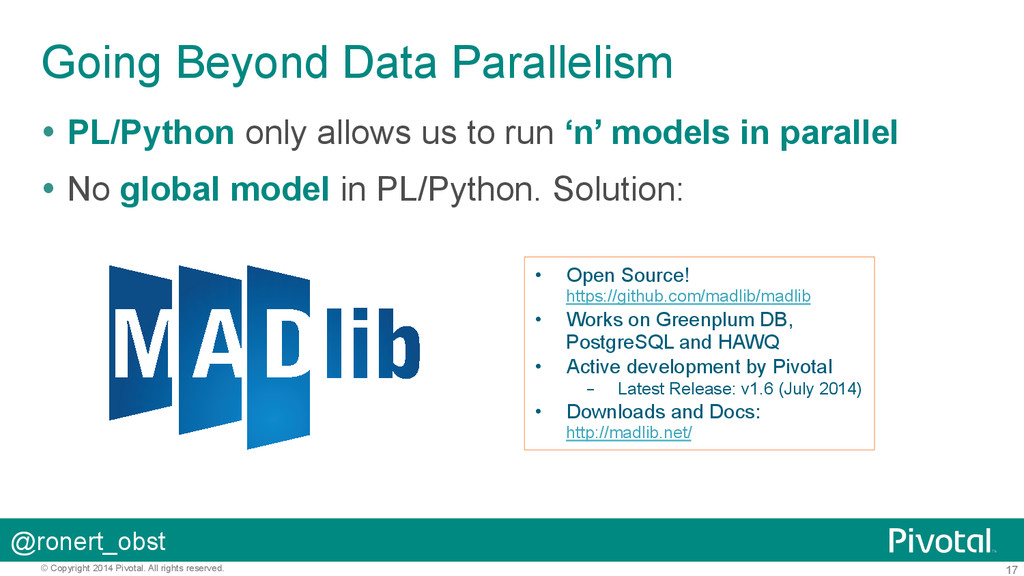
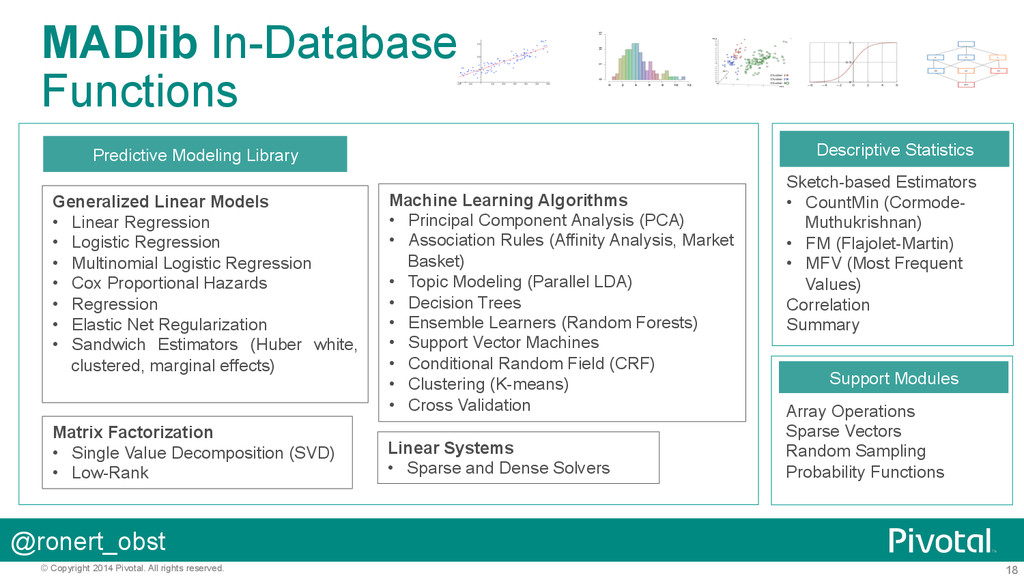
Beyond Data Parallelism PL/Python only allows us to run ‘n’ models in parallel No global model in PL/Python. Solution: • Open Source! https://github.com/madlib/madlib • Works on Greenplum DB, PostgreSQL and HAWQ • Active development by Pivotal - Latest Release: v1.6 (July 2014) • Downloads and Docs: http://madlib.net/
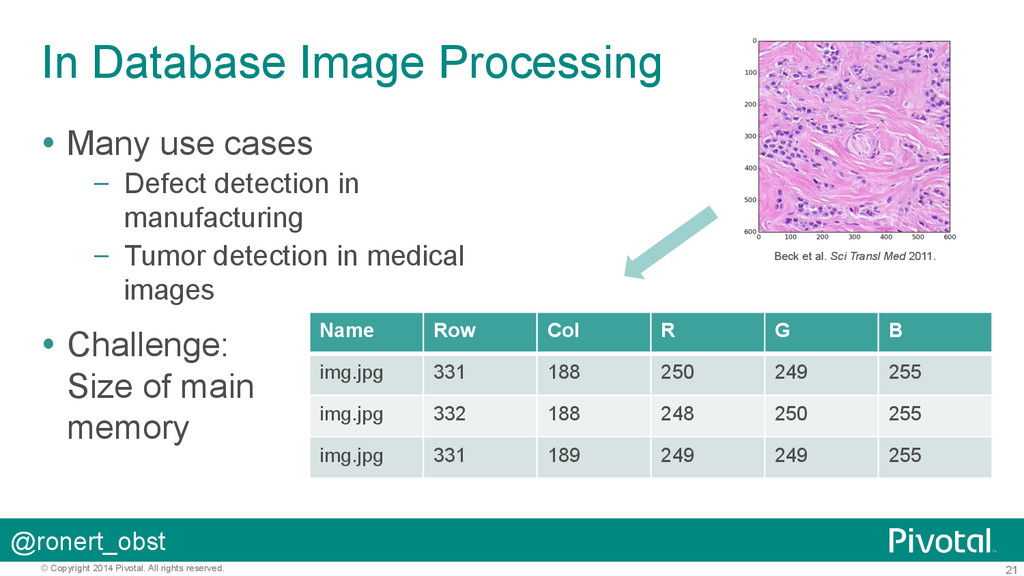
Database Image Processing Many use cases – Defect detection in manufacturing – Tumor detection in medical images Challenge: Size of main memory Beck et al. Sci Transl Med 2011. Name Row Col R G B img.jpg 331 188 250 249 255 img.jpg 332 188 248 250 255 img.jpg 331 189 249 249 255
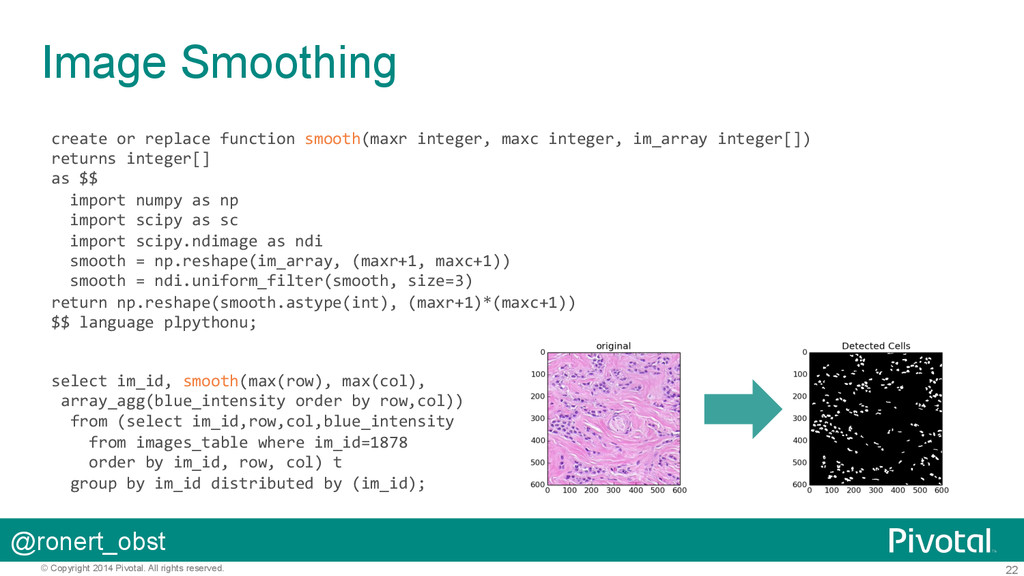
Smoothing create or replace function smooth(maxr integer, maxc integer, im_array integer[]) returns integer[] as $$ import numpy as np import scipy as sc import scipy.ndimage as ndi smooth = np.reshape(im_array, (maxr+1, maxc+1)) smooth = ndi.uniform_filter(smooth, size=3) return np.reshape(smooth.astype(int), (maxr+1)*(maxc+1)) $$ language plpythonu; select im_id, smooth(max(row), max(col), array_agg(blue_intensity order by row,col)) from (select im_id,row,col,blue_intensity from images_table where im_id=1878 order by im_id, row, col) t group by im_id distributed by (im_id);


 ronert
 utakaha
 ichirokano2
 yub0n
yub0n
 seike460
 htkym
htkym
 texmeijin
 irinanazarova
 nabondance
 kaityo256
 tanahiro2010
 neuecc
 moro
moro
 csswizardry
 eileencodes
 soudai
 frankvandijk
 honzajavorek
 tammyeverts
 techseoconnect
 twada
twada
 thirion
 mclloyd
 khoart