Upgrade to Pro — share decks privately, control downloads, hide ads and more …

Natural Language Processing

Natural Language Processing

Natural language processing (NLP) deals with the application of computational models to text or speech data. Application areas within NLP include automatic (machine) translation between languages; dialogue systems, which allow a human to interact with a machine using natural language; and information extraction, where the goal is to transform unstructured text into structured (database) representations that can be searched and browsed in flexible ways.

Avatar for Aruj Parajuli

Aruj Parajuli

April 28, 2014

More Decks by Aruj Parajuli

Other Decks in Technology

Transcript

  1. What is Natural Language Processing? Natural language processing (NLP) is

    the ability of computer programmes to understand human speech, as it is actually spoken.
  2. Also called "computational linguistics." Recently, someone call it "human language

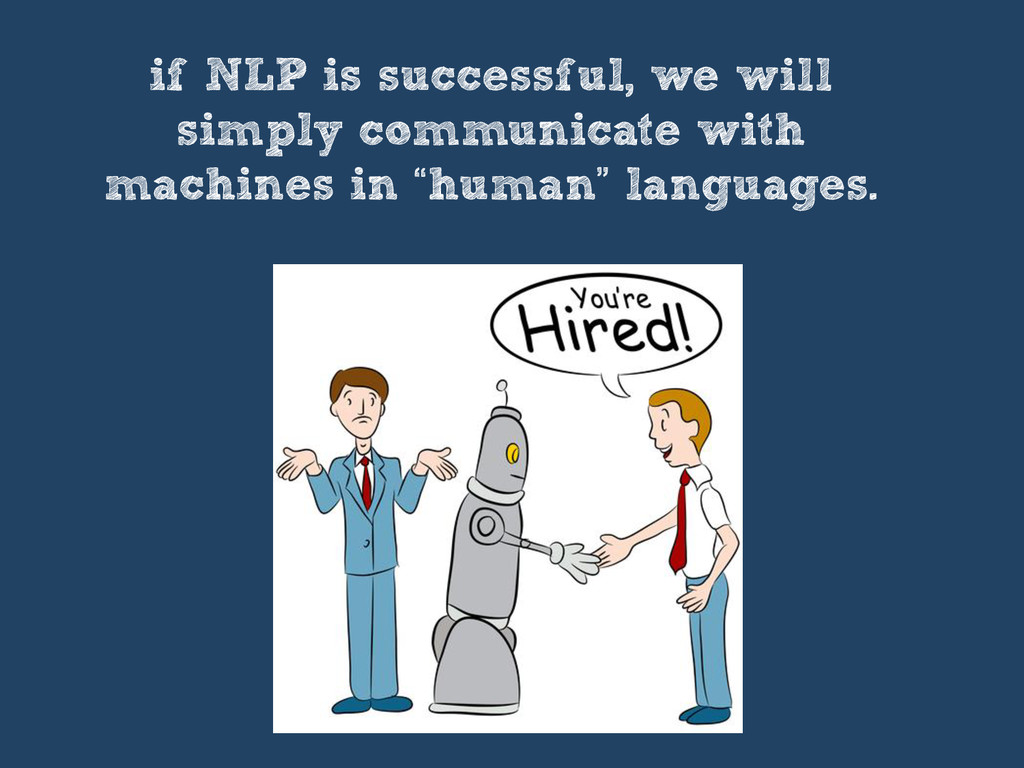
    technology.“ Ultimately the task for NLP is to eliminate the need for computer programming languages such as Java, PHP and ColdFusion. What is Natural Language Processing?
  3. What are the Challenges of NLP? •Meeting the expectations of

    the user. •Understanding ambiguity in natural language. •Understanding the effect of context on meaning. •Understanding the referents of phrases like: he, she, and it. (Anaphoric Referencing) •Speed and efficiency of the interface. •Recognizing relevant data, while disregarding the irrelevant data like age & gender.
  4. The main issues to solve are: understanding the meaning of

    a single word, understanding the meaning of that word in connection with other words in the syntax and finally understanding both those meanings in the context in which they are spoken. • Some of the these contexts in which utterances are spoken are: time, place, situation…
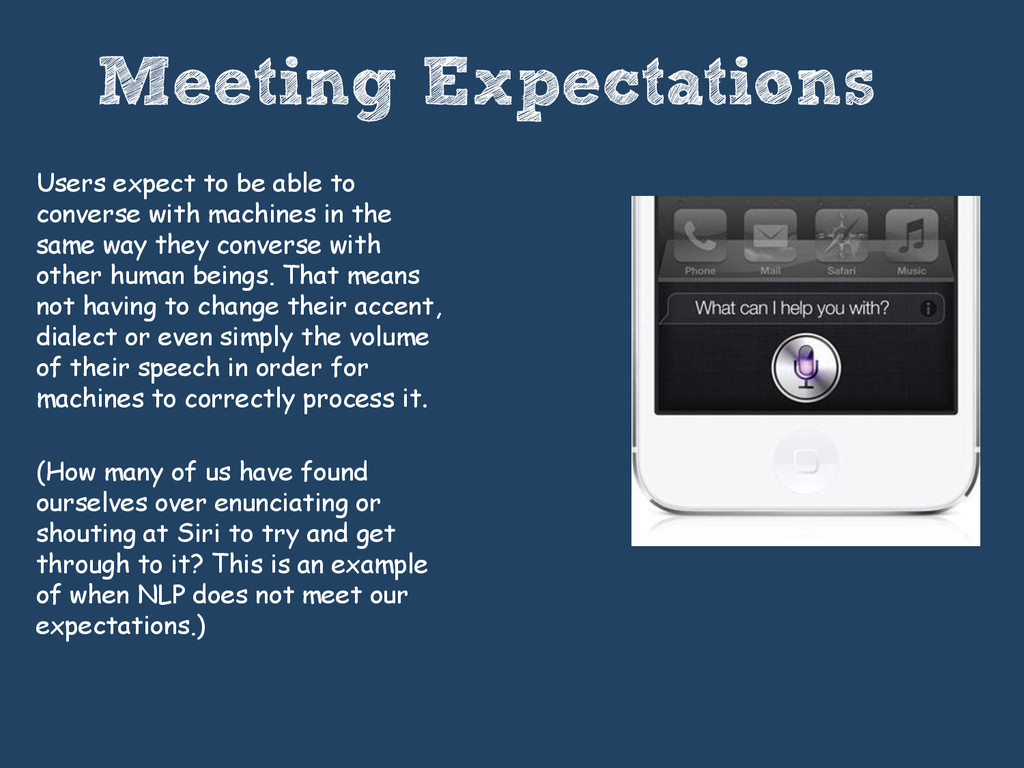
  5. Meeting Expectations Users expect to be able to converse with

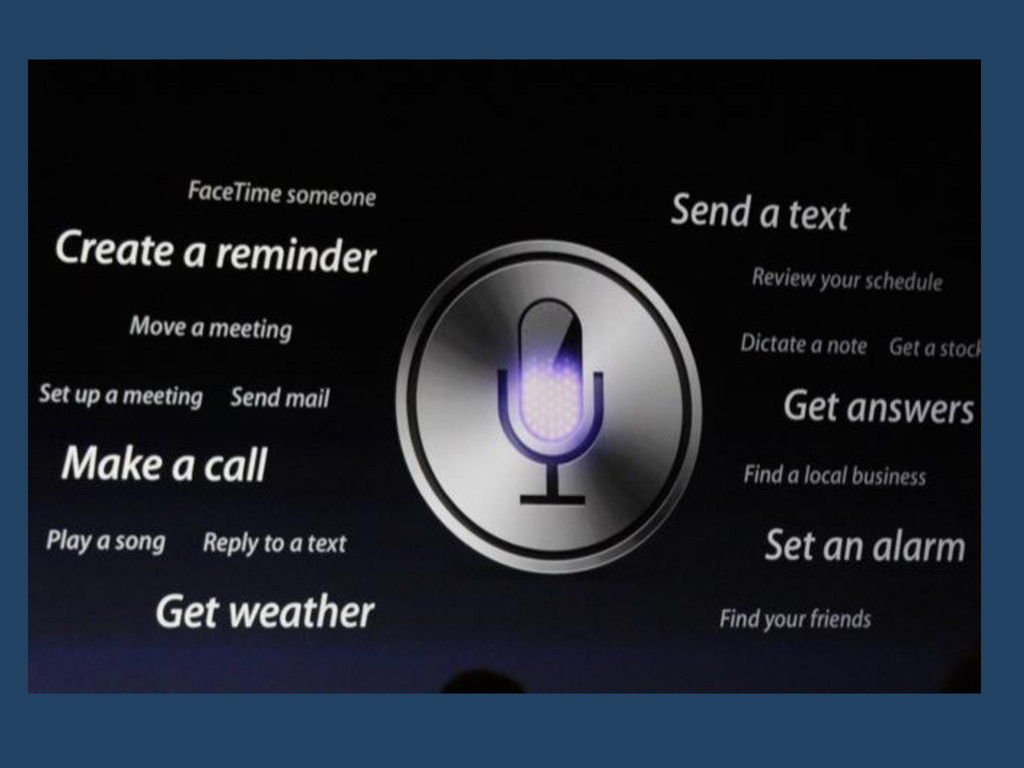
    machines in the same way they converse with other human beings. That means not having to change their accent, dialect or even simply the volume of their speech in order for machines to correctly process it. (How many of us have found ourselves over enunciating or shouting at Siri to try and get through to it? This is an example of when NLP does not meet our expectations.)
  6. Understanding Ambiguity & Context Something is ambiguous when it can

    be understood or interpreted in two or more possible ways and this can apply at the single word level or at the sentence level. As such, most attempts to solve the problem of ambiguity and context in natural language processing use knowledge based approaches, The difficulty with this though is that it requires a huge amount of information to be processed.
  7. Speed and Efficiency of Interface For the best user experience,

    NLP interfaces need to be able to respond to queries as quickly and efficiently as possible. However because actually processing natural language correctly is a complex process, actually producing an interface that can do it quickly and efficiently enough for users to tolerate it, or better still have a good user experience, can be very difficult.
  8. Relevant Data With any speech input into a NLP interface,

    there comes with it a lot of extra, yet irrelevant information such as the gender and age of the speaker. So the challenge for NLP is to distinguish between the relevant information needed to correctly process the verbal input while simultaneously filtering out any irrelevant information that isn't needed. This is one area where processing natural language can be made quicker and more efficient.
  9. Uses and Applications of NLP Siri Siri is Apple’s almost

    infamous personal assistant for the iOS operating system. Siri uses NLP to answer questions and make recommendations. Google Now Google Now is essentially Google’s answer to Siri, it is a personal assistant that uses NLP to answer questions, make recommendations and perform actions. It was named the innovation of the year in 2012.
  10. Google’s NLP Research • Google is working on processing multiple

    natural languages at web scale, and they aim to do this by leveraging the large amounts of data they have access to. • In true Google fashion this involves writing algorithms to predict things like: the part of speech tags for each word in a sentence and the various relationships between them. This handles the syntax of language.
  11. The Future of Search Search is most definitely going to

    move away from structured, keyword based search queries that search engines interpret using algorithms, towards more conversational and unstructured search queries.
  12. Future…………. The implications are that hands free technology could really

    being to dominate the search market by making voice search truly effective. Products like Apple’s iPhones and Google’s Glass could begin to replace other technologies that do not offer conversational, voice search. This means that the primary way we interact with technology is developing and changing and therefore so is the way we search and discover information.
  13. Future of Technology NLP has real benefit for end users

    as it will eliminate the need to formulate appropriate search queries in order to return the results you want, instead you will simple be in conversation with technology.