Upgrade to Pro — share decks privately, control downloads, hide ads and more …

containerd: Project Update and Deep Dive (KubeC...

Sponsored · Ship Features Fearlessly Turn features on and off without deploys. Used by thousands of Ruby developers. →
Samuel Karp
November 12, 2026

containerd: Project Update and Deep Dive (KubeCon + CloudNativeCon North America 2026)

Join containerd maintainers for project update and deep dive into the latest updates on containerd. LLM-assisted vulnerability discovery has had a big impact on containerd: we’ll discuss the impact on the project and changes we’ve made to improve our security response. For Kubernetes users, we will cover how the new containerd release cycle, support window, and upgrade safety changes make feature availability faster and make long-term support available across Kubernetes versions. We’ll then dive into the exciting work going on in the containerd ecosystem, including further developments in the Node Resource Interface (NRI) and EROFS snapshotter.

Samuel Karp

November 12, 2026

Transcript

27 slides
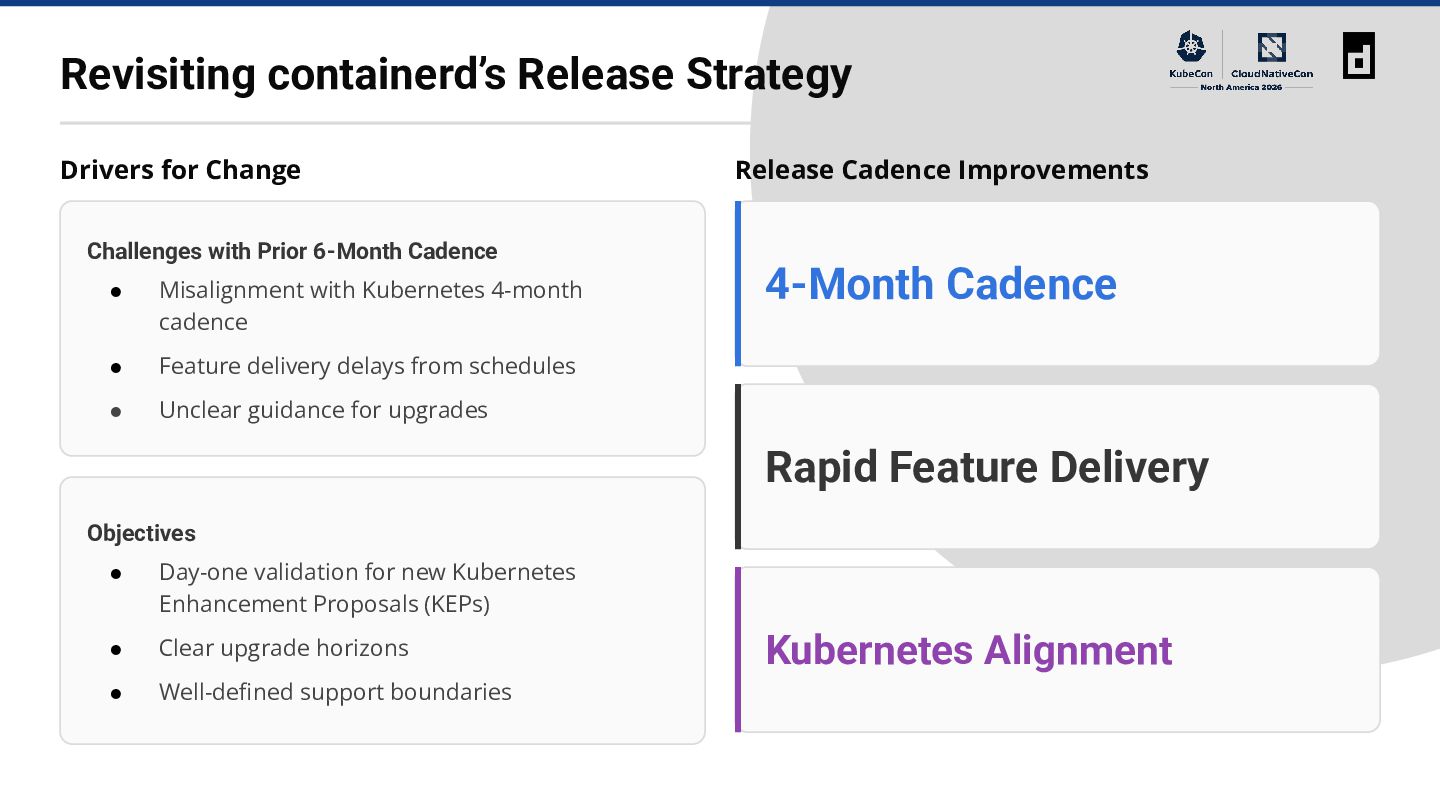
  1. Revisiting containerd’s Release Strategy Drivers for Change Release Cadence Improvements

    Challenges with Prior 6-Month Cadence • Misalignment with Kubernetes 4-month cadence • Feature delivery delays from schedules • Unclear guidance for upgrades 4-Month Cadence Rapid Feature Delivery Objectives • Day-one validation for new Kubernetes Enhancement Proposals (KEPs) • Clear upgrade horizons • Well-defined support boundaries Kubernetes Alignment
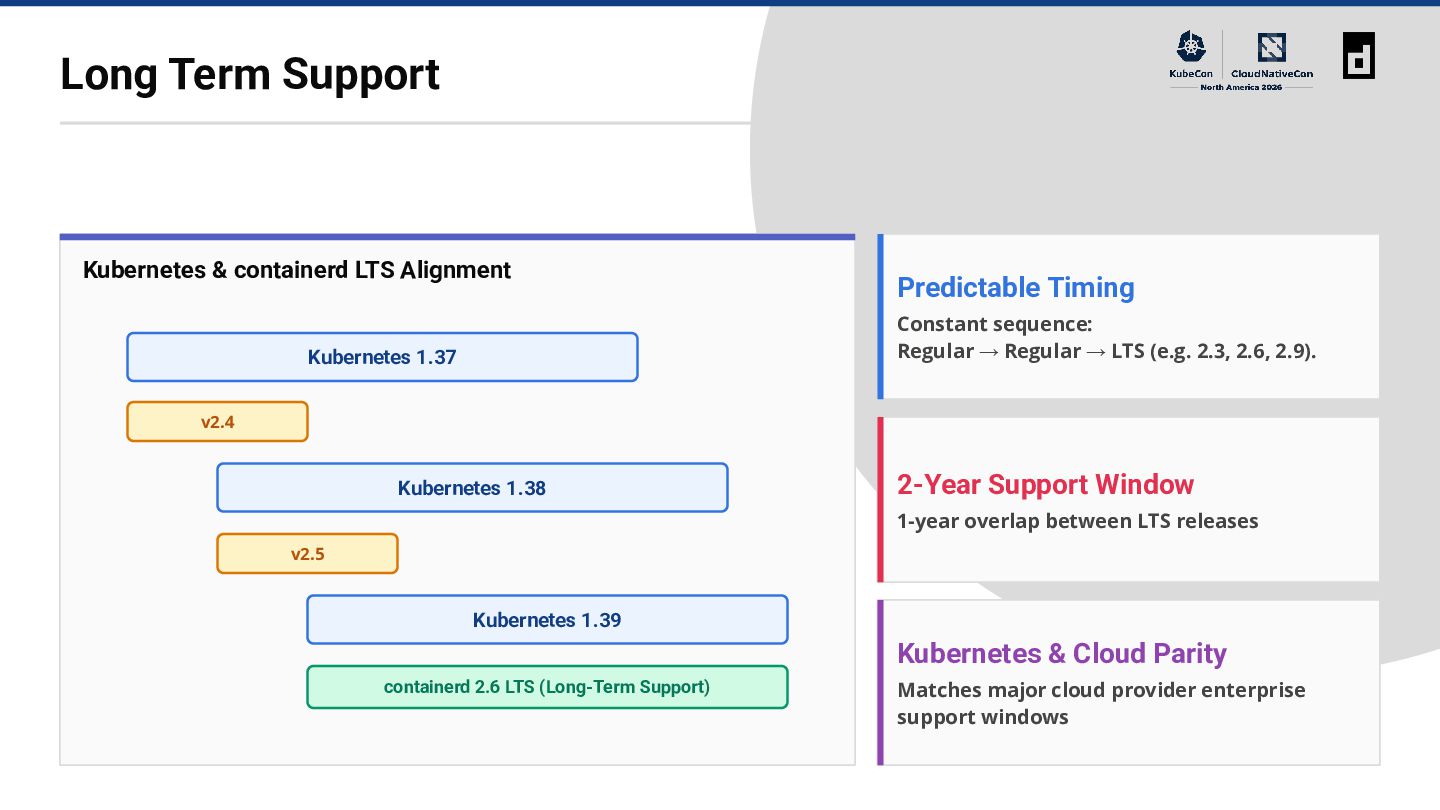
  2. Long Term Support Kubernetes & containerd LTS Alignment Predictable Timing

    Constant sequence: Regular → Regular → LTS (e.g. 2.3, 2.6, 2.9). Kubernetes 1.37 v2.4 Kubernetes 1.38 2-Year Support Window 1-year overlap between LTS releases v2.5 Kubernetes 1.39 Kubernetes & Cloud Parity containerd 2.6 LTS (Long-Term Support) Matches major cloud provider enterprise support windows
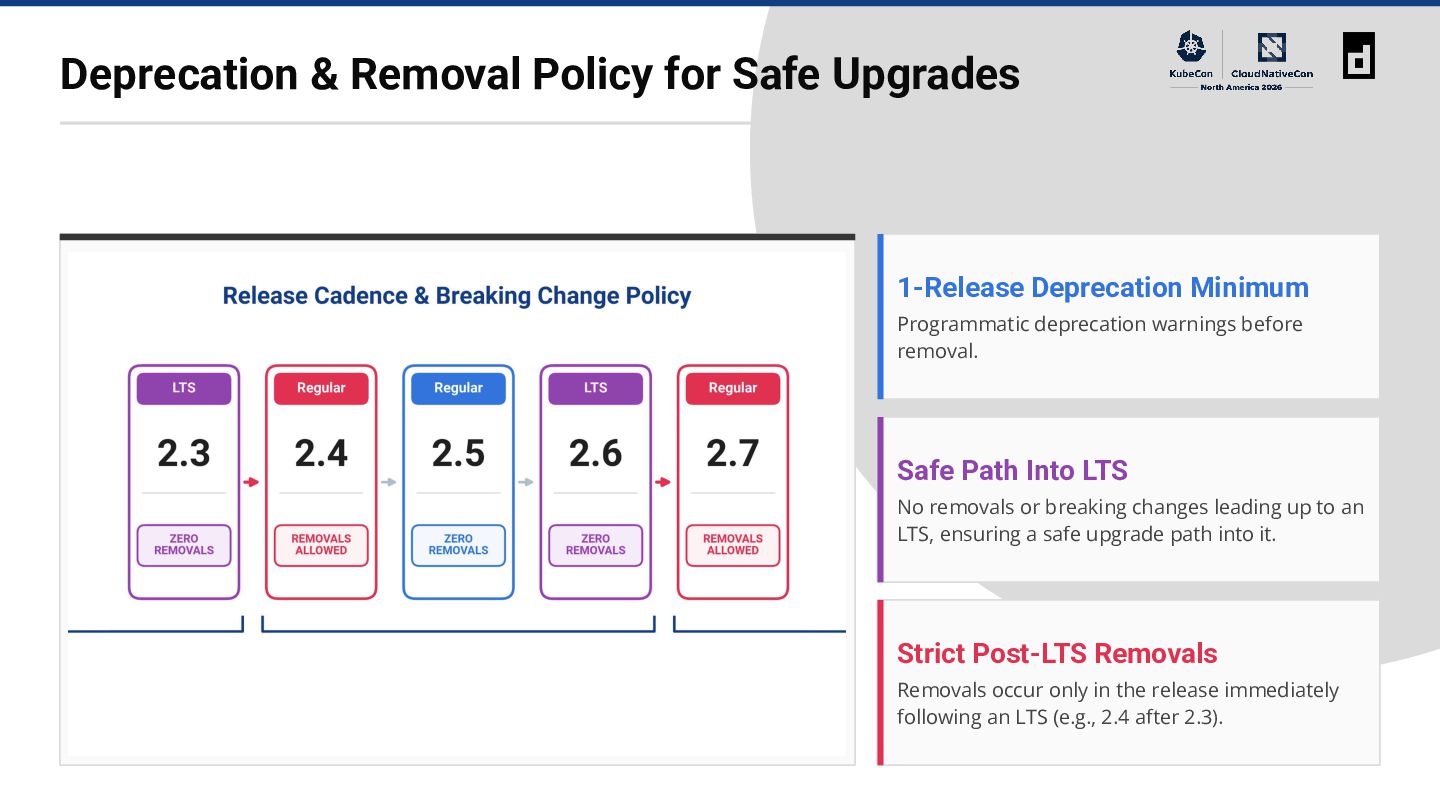
  3. Deprecation & Removal Policy for Safe Upgrades 1-Release Deprecation Minimum

    Programmatic deprecation warnings before removal. Safe Path Into LTS No removals or breaking changes leading up to an LTS, ensuring a safe upgrade path into it. Strict Post-LTS Removals Removals occur only in the release immediately following an LTS (e.g., 2.4 after 2.3).
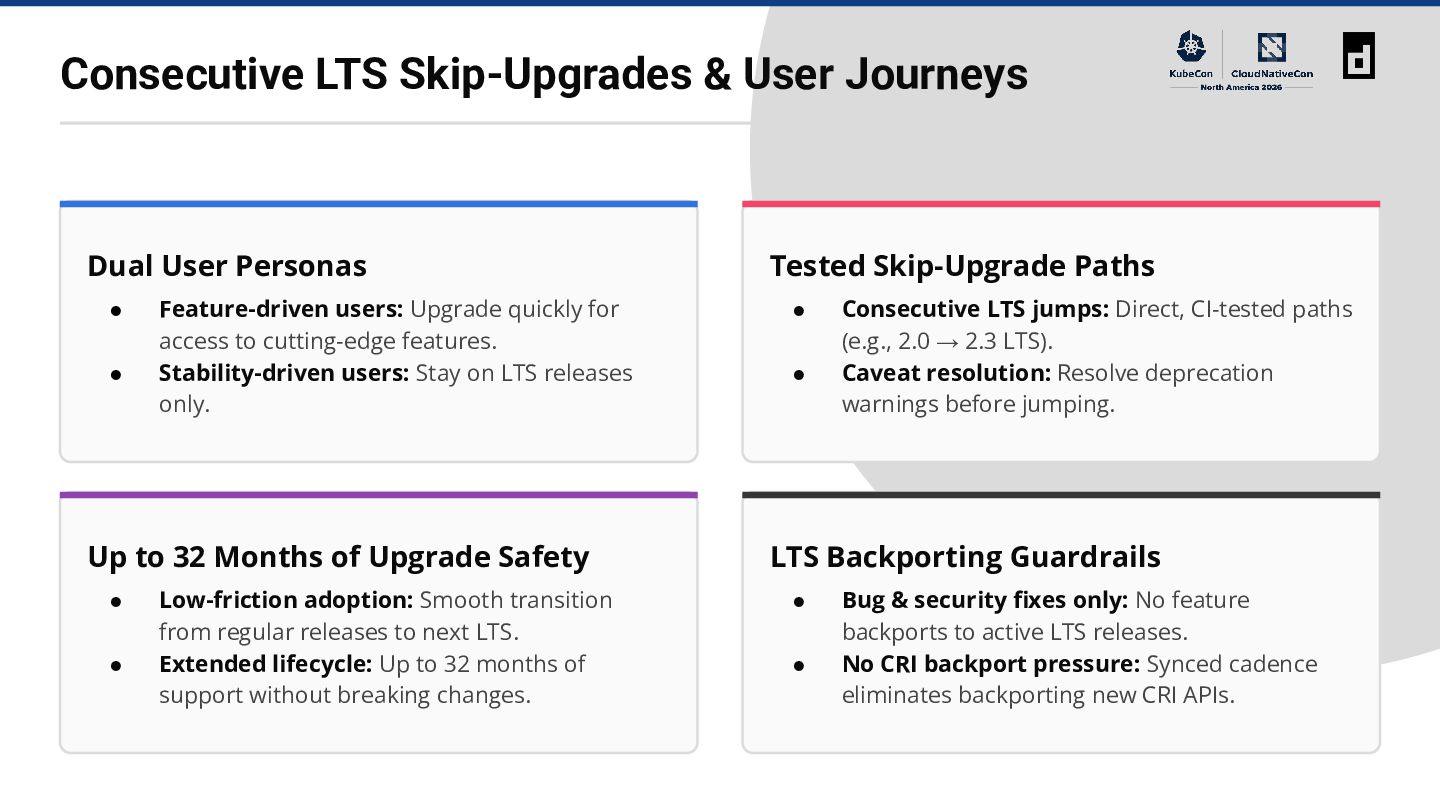
  4. Consecutive LTS Skip-Upgrades & User Journeys Dual User Personas •

    • Feature-driven users: Upgrade quickly for access to cutting-edge features. Stability-driven users: Stay on LTS releases only. Up to 32 Months of Upgrade Safety • • Low-friction adoption: Smooth transition from regular releases to next LTS. Extended lifecycle: Up to 32 months of support without breaking changes. Tested Skip-Upgrade Paths • • Consecutive LTS jumps: Direct, CI-tested paths (e.g., 2.0 → 2.3 LTS). Caveat resolution: Resolve deprecation warnings before jumping. LTS Backporting Guardrails • • Bug & security fixes only: No feature backports to active LTS releases. No CRI backport pressure: Synced cadence eliminates backporting new CRI APIs.
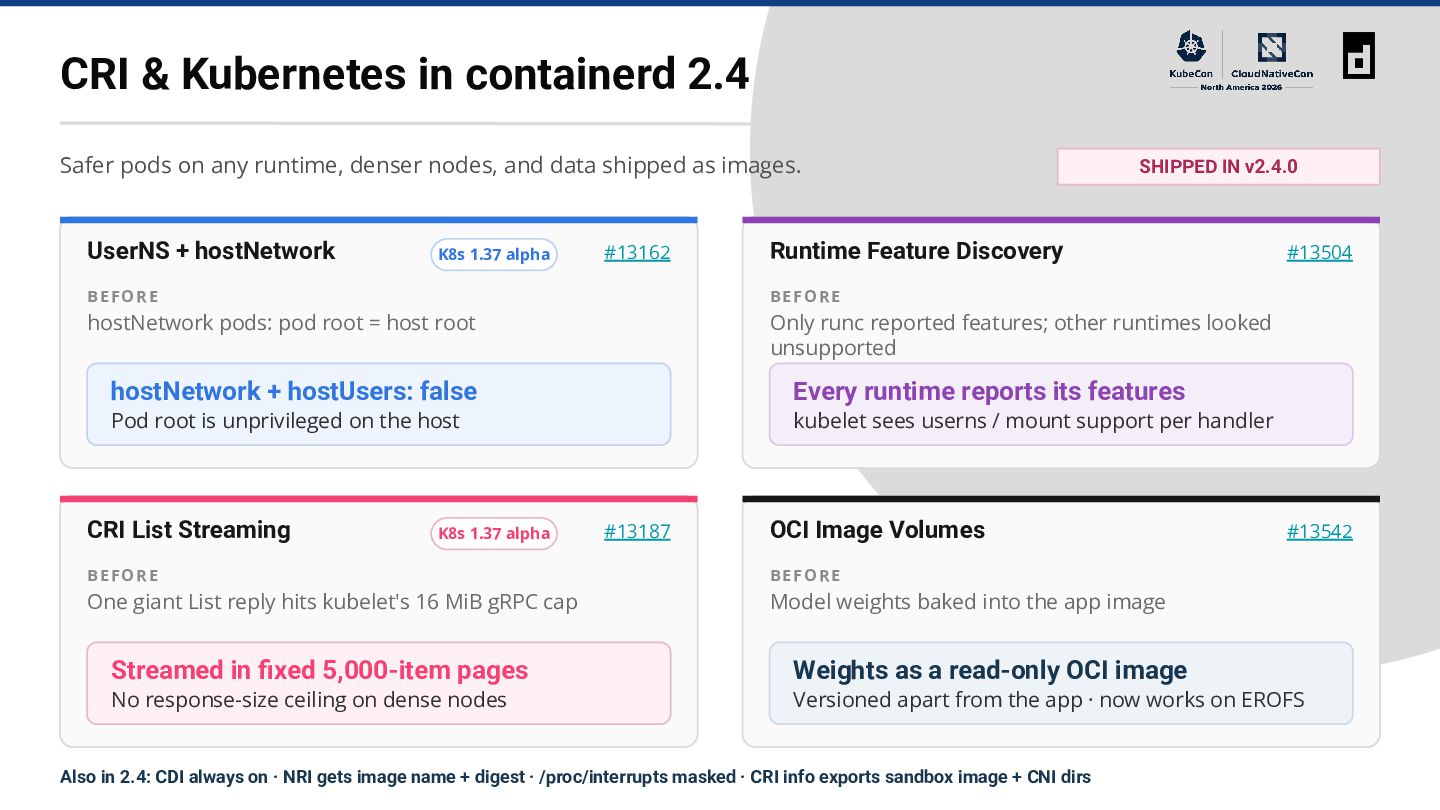
  5. CRI & Kubernetes in containerd 2.4 Safer pods on any

    runtime, denser nodes, and data shipped as images. UserNS + hostNetwork K8s 1.37 alpha #13162 SHIPPED IN v2.4.0 Runtime Feature Discovery BEFORE BEFORE hostNetwork pods: pod root = host root Only runc reported features; other runtimes looked unsupported hostNetwork + hostUsers: false Every runtime reports its features Pod root is unprivileged on the host CRI List Streaming K8s 1.37 alpha kubelet sees userns / mount support per handler #13187 OCI Image Volumes BEFORE BEFORE One giant List reply hits kubelet's 16 MiB gRPC cap Model weights baked into the app image Streamed in fixed 5,000-item pages No response-size ceiling on dense nodes #13504 Weights as a read-only OCI image #13542 Versioned apart from the app · now works on EROFS Also in 2.4: CDI always on · NRI gets image name + digest · /proc/interrupts masked · CRI info exports sandbox image + CNI dirs
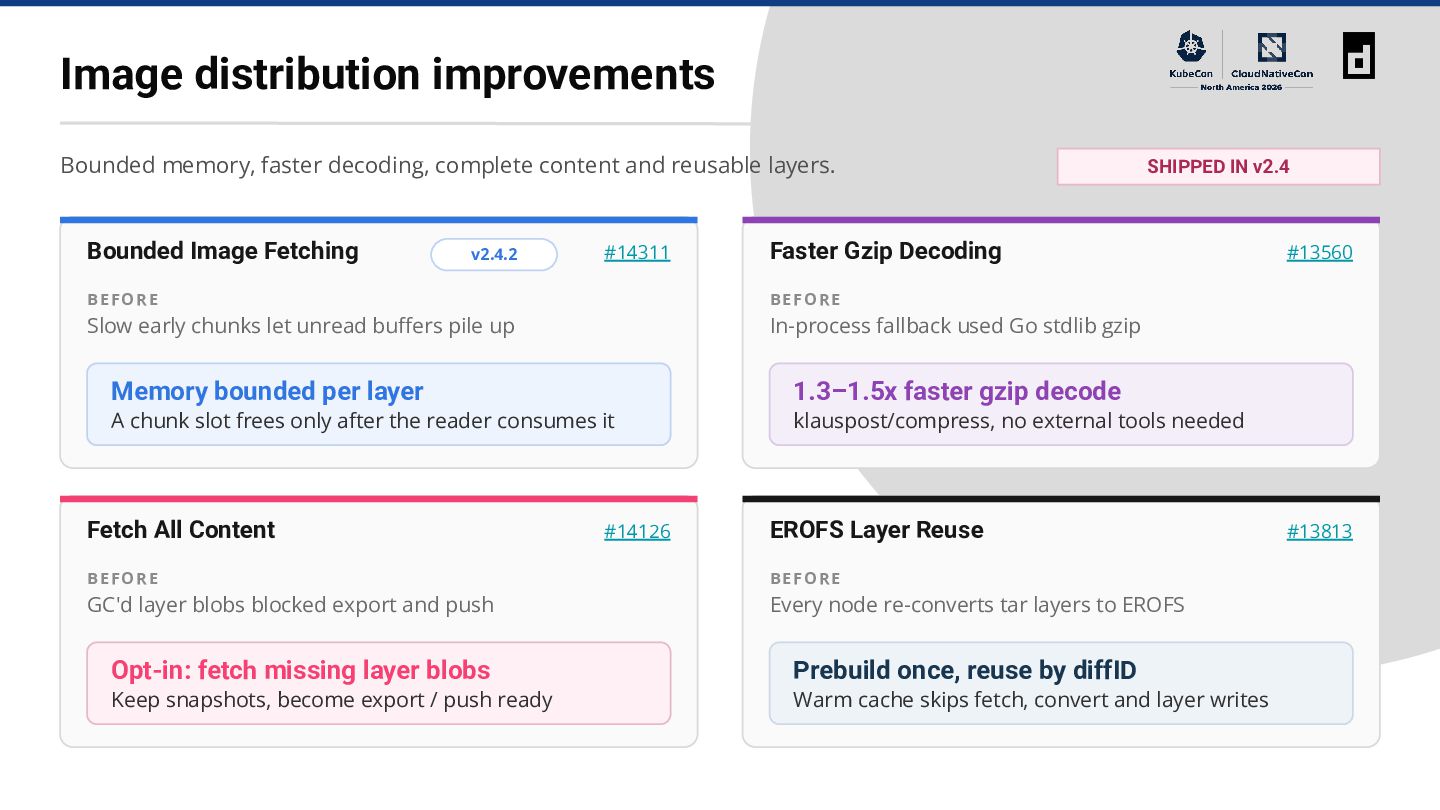
  6. Image distribution improvements Bounded memory, faster decoding, complete content and

    reusable layers. Bounded Image Fetching v2.4.2 #14311 Faster Gzip Decoding BEFORE BEFORE Slow early chunks let unread buffers pile up In-process fallback used Go stdlib gzip Memory bounded per layer A chunk slot frees only after the reader consumes it Fetch All Content #14126 SHIPPED IN v2.4 1.3–1.5x faster gzip decode klauspost/compress, no external tools needed EROFS Layer Reuse BEFORE BEFORE GC'd layer blobs blocked export and push Every node re-converts tar layers to EROFS Opt-in: fetch missing layer blobs Prebuild once, reuse by diffID Keep snapshots, become export / push ready #13560 Warm cache skips fetch, convert and layer writes #13813
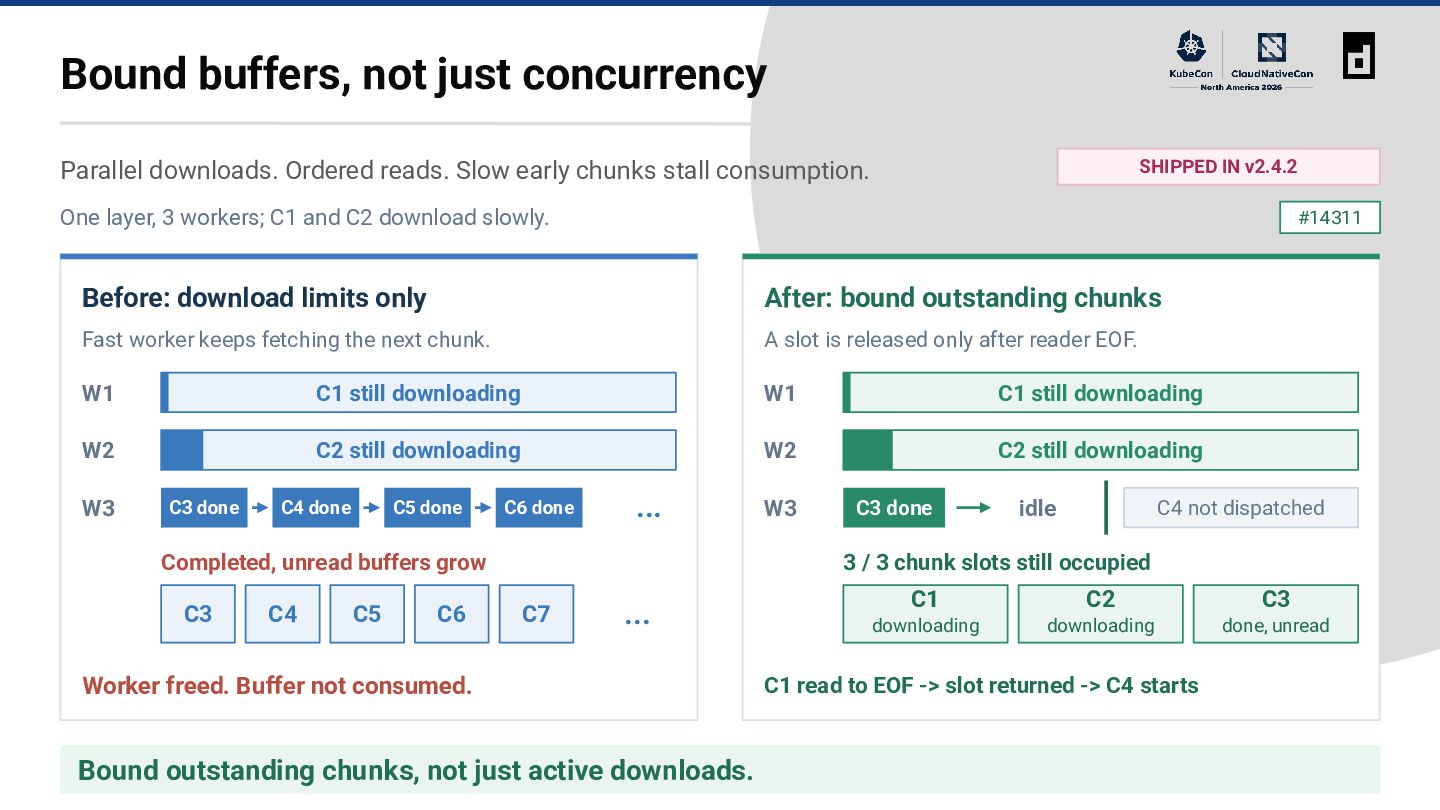
  7. Bound buffers, not just concurrency SHIPPED IN v2.4.2 Parallel downloads.

    Ordered reads. Slow early chunks stall consumption. One layer, 3 workers; C1 and C2 download slowly. #14311 Before: download limits only After: bound outstanding chunks Fast worker keeps fetching the next chunk. A slot is released only after reader EOF. W1 C1 still downloading W1 C1 still downloading W2 C2 still downloading W2 C2 still downloading W3 C3 done C4 done C5 done C6 done ... Completed, unread buffers grow C3 C4 C5 C6 W3 C3 done idle C4 not dispatched 3 / 3 chunk slots still occupied C7 ... Worker freed. Buffer not consumed. Bound outstanding chunks, not just active downloads. C1 C2 C3 downloading downloading done, unread C1 read to EOF -> slot returned -> C4 starts
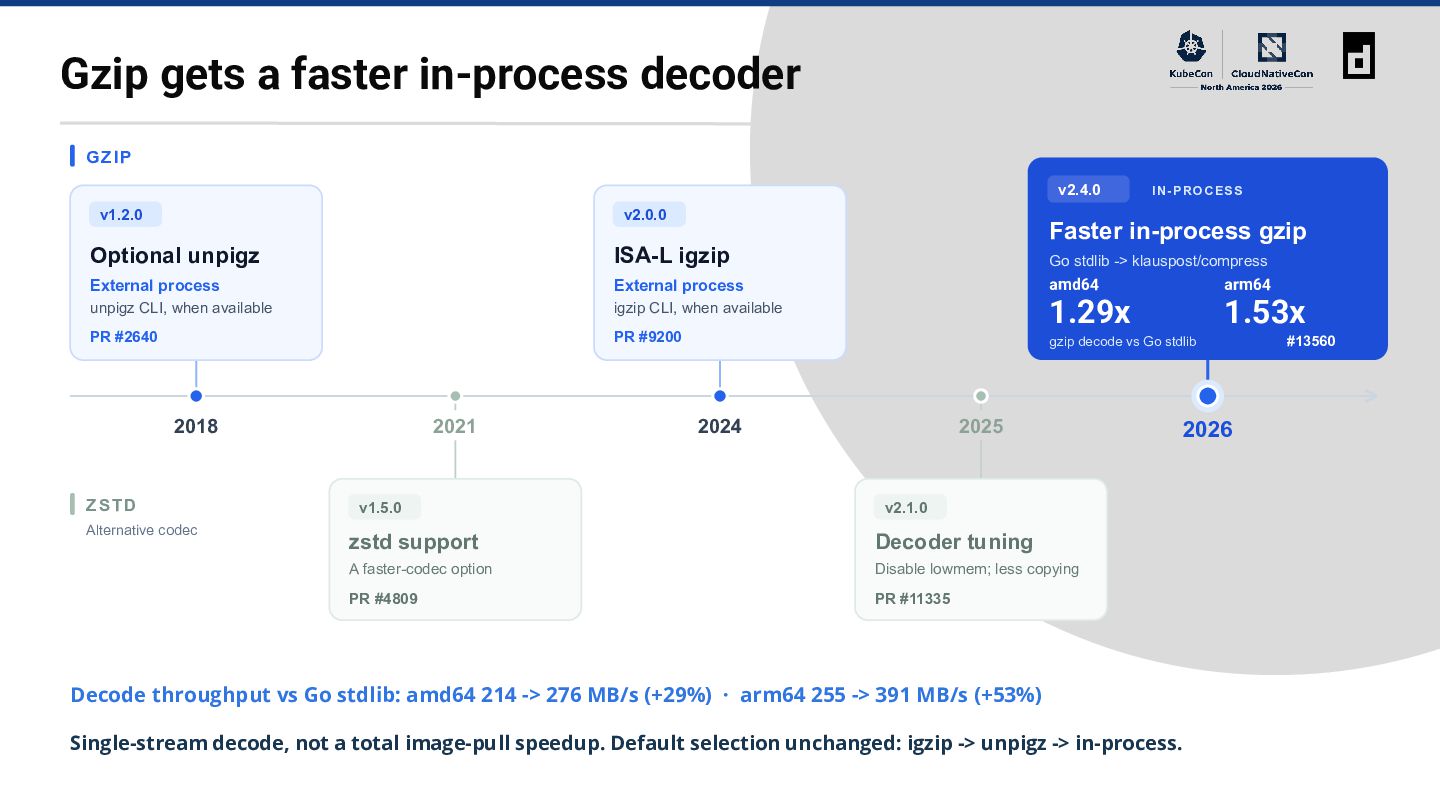
  8. Gzip gets a faster in-process decoder GZIP v2.4.0 IN-PROCESS v1.2.0

    v2.0.0 Optional unpigz ISA-L igzip Go stdlib -> klauspost/compress External process External process amd64 arm64 unpigz CLI, when available igzip CLI, when available PR #2640 PR #9200 1.29x 1.53x 2018 ZSTD Alternative codec 2021 Faster in-process gzip gzip decode vs Go stdlib 2024 2025 v1.5.0 v2.1.0 zstd support Decoder tuning A faster-codec option Disable lowmem; less copying PR #4809 PR #11335 Decode throughput vs Go stdlib: amd64 214 -> 276 MB/s (+29%) · arm64 255 -> 391 MB/s (+53%) Single-stream decode, not a total image-pull speedup. Default selection unchanged: igzip -> unpigz -> in-process. 2026 #13560
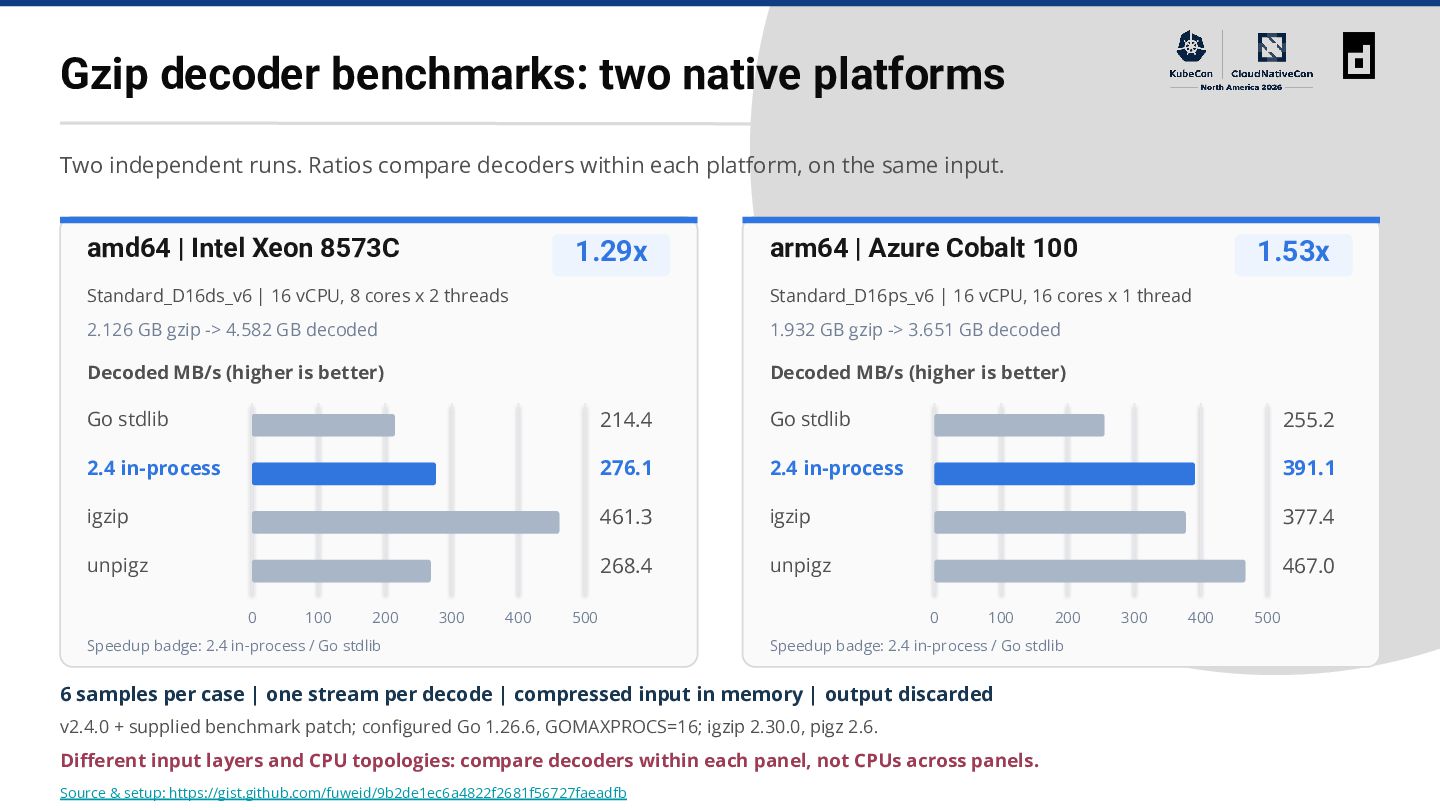
  9. Gzip decoder benchmarks: two native platforms Two independent runs. Ratios

    compare decoders within each platform, on the same input. amd64 | Intel Xeon 8573C 1.29x arm64 | Azure Cobalt 100 1.53x Standard_D16ds_v6 | 16 vCPU, 8 cores x 2 threads Standard_D16ps_v6 | 16 vCPU, 16 cores x 1 thread 2.126 GB gzip -> 4.582 GB decoded 1.932 GB gzip -> 3.651 GB decoded Decoded MB/s (higher is better) Decoded MB/s (higher is better) Go stdlib 214.4 Go stdlib 255.2 2.4 in-process 276.1 2.4 in-process 391.1 igzip 461.3 igzip 377.4 unpigz 268.4 unpigz 467.0 0 100 200 300 400 500 Speedup badge: 2.4 in-process / Go stdlib 0 100 Speedup badge: 2.4 in-process / Go stdlib 6 samples per case | one stream per decode | compressed input in memory | output discarded v2.4.0 + supplied benchmark patch; configured Go 1.26.6, GOMAXPROCS=16; igzip 2.30.0, pigz 2.6. Different input layers and CPU topologies: compare decoders within each panel, not CPUs across panels. Source & setup: https://gist.github.com/fuweid/9b2de1ec6a4822f2681f56727faeadfb 200 300 400 500
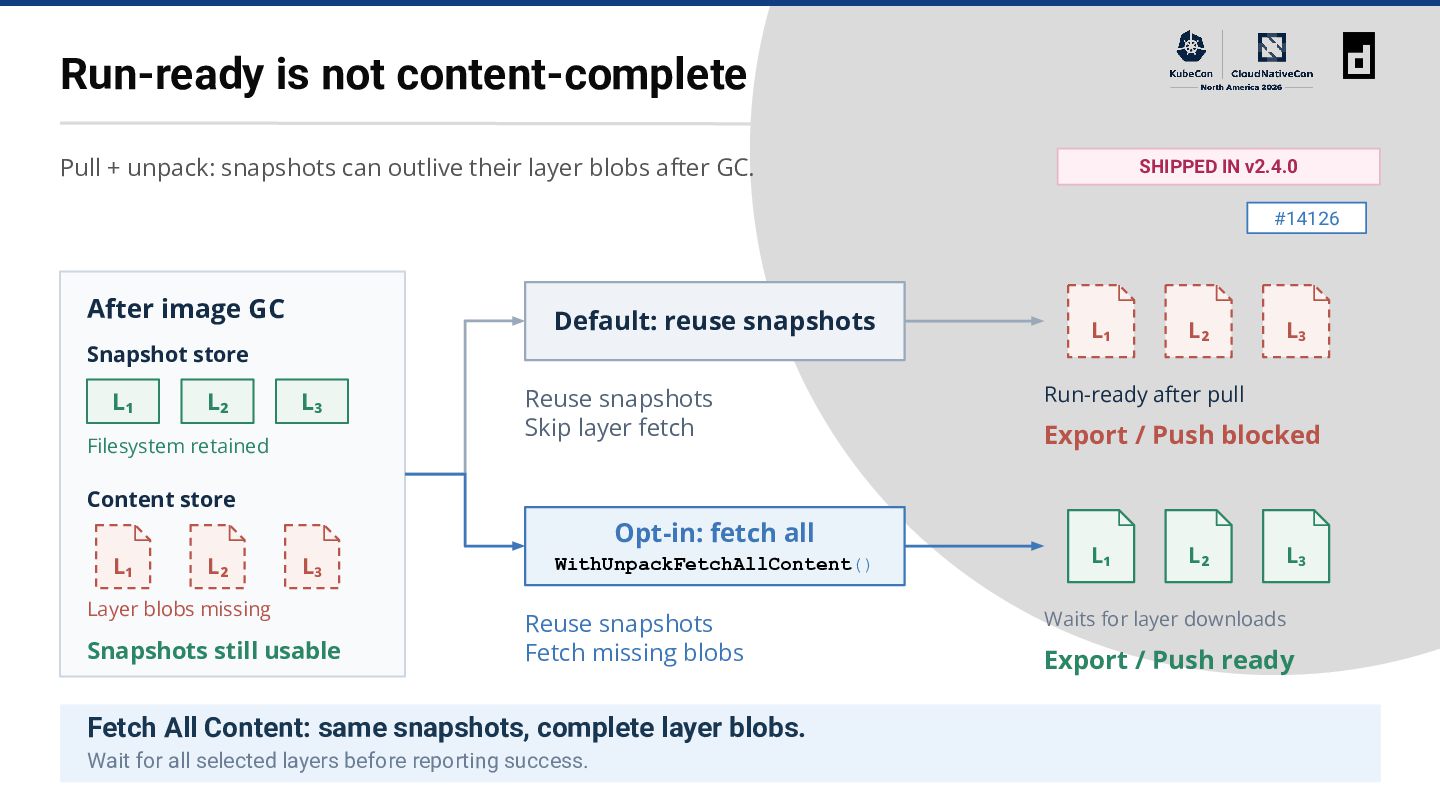
  10. Run-ready is not content-complete Pull + unpack: snapshots can outlive

    their layer blobs after GC. SHIPPED IN v2.4.0 #14126 After image GC Default: reuse snapshots Snapshot store L₁ L₂ L₃ Filesystem retained Reuse snapshots Skip layer fetch L₁ L₂ L₃ Run-ready after pull Export / Push blocked Content store Opt-in: fetch all L₁ L₂ L₃ Layer blobs missing Snapshots still usable WithUnpackFetchAllContent() Reuse snapshots Fetch missing blobs Fetch All Content: same snapshots, complete layer blobs. Wait for all selected layers before reporting success. L₁ L₂ L₃ Waits for layer downloads Export / Push ready
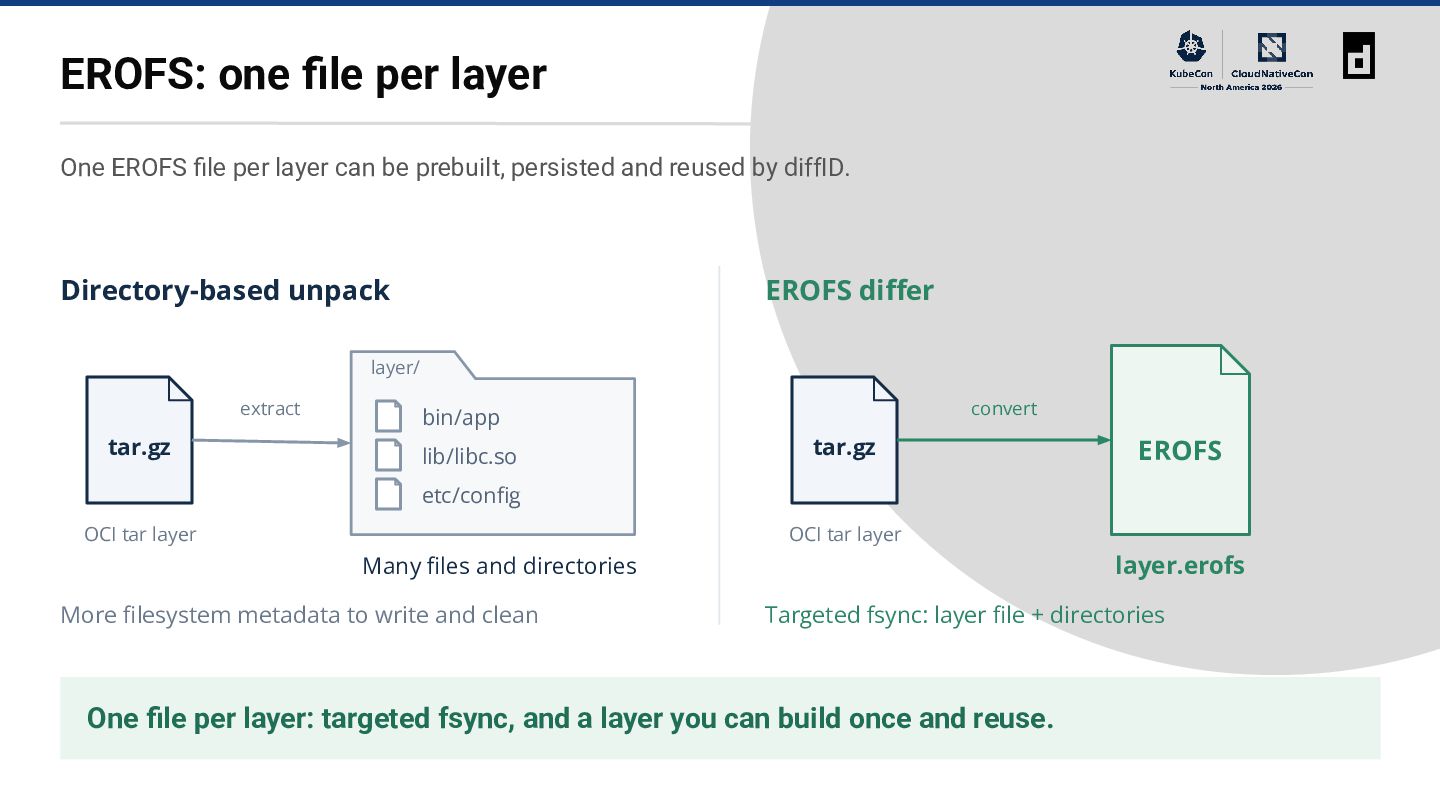
  11. EROFS: one file per layer One EROFS file per layer

    can be prebuilt, persisted and reused by diffID. Directory-based unpack EROFS differ layer/ extract tar.gz bin/app lib/libc.so convert tar.gz EROFS etc/config OCI tar layer OCI tar layer layer.erofs Many files and directories More filesystem metadata to write and clean Targeted fsync: layer file + directories One file per layer: targeted fsync, and a layer you can build once and reuse.
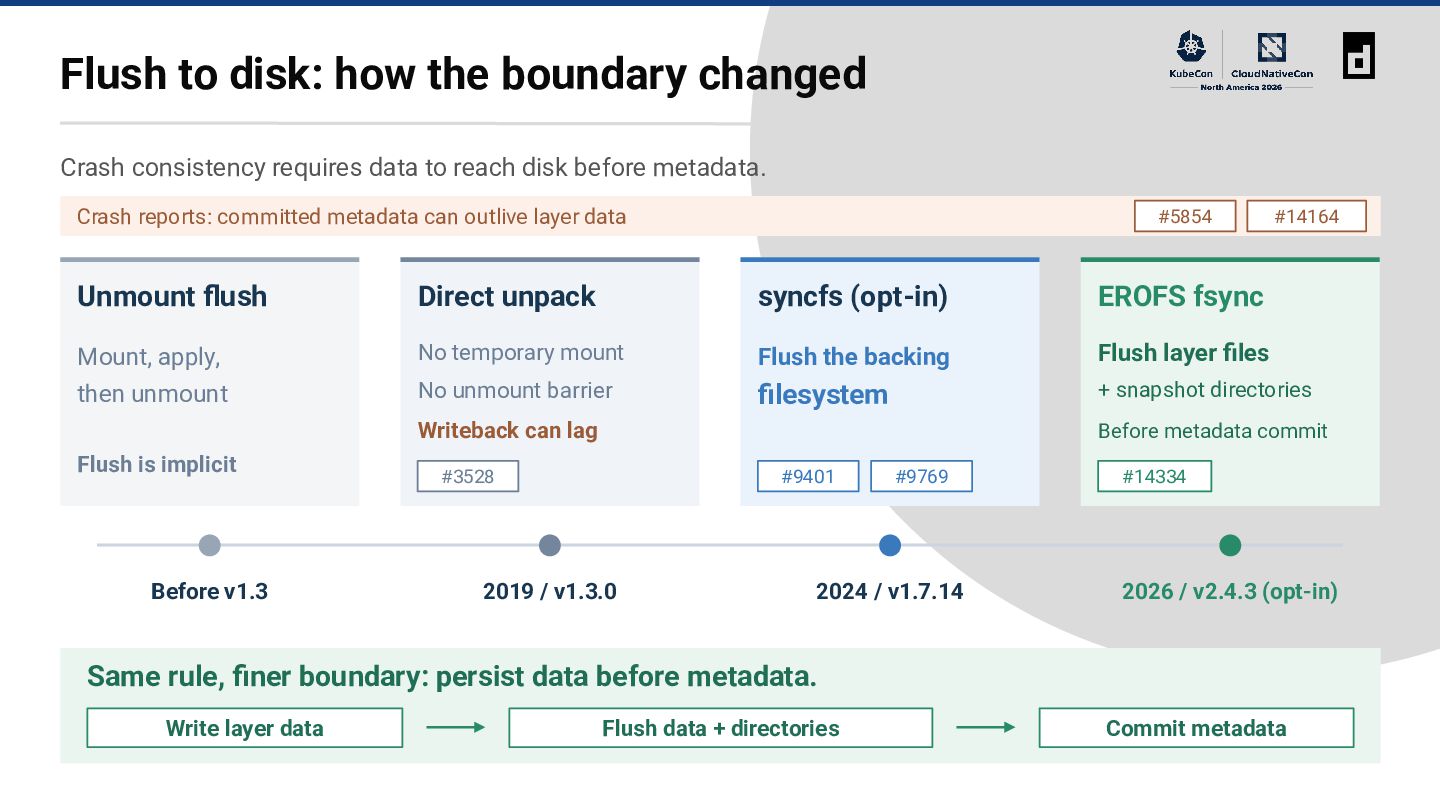
  12. Flush to disk: how the boundary changed Crash consistency requires

    data to reach disk before metadata. Crash reports: committed metadata can outlive layer data #5854 #14164 Unmount flush Direct unpack syncfs (opt-in) EROFS fsync Mount, apply, No temporary mount Flush the backing Flush layer files then unmount No unmount barrier filesystem + snapshot directories Writeback can lag Flush is implicit Before v1.3 Before metadata commit #3528 #9401 2019 / v1.3.0 #9769 2024 / v1.7.14 #14334 2026 / v2.4.3 (opt-in) Same rule, finer boundary: persist data before metadata. Write layer data Flush data + directories Commit metadata
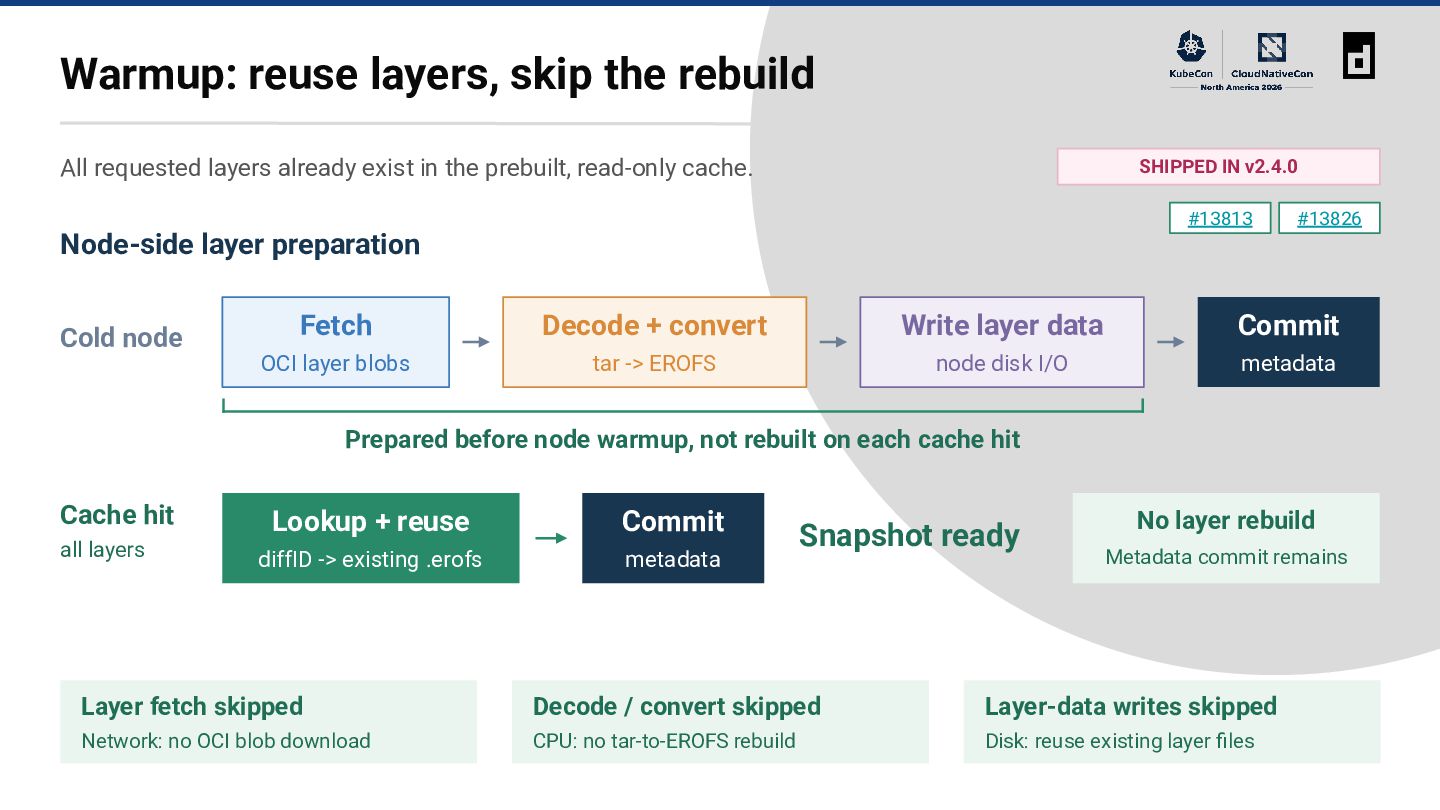
  13. Warmup: reuse layers, skip the rebuild All requested layers already

    exist in the prebuilt, read-only cache. SHIPPED IN v2.4.0 #13813 #13826 Node-side layer preparation Cold node Fetch Decode + convert Write layer data Commit OCI layer blobs tar -> EROFS node disk I/O metadata Prepared before node warmup, not rebuilt on each cache hit Cache hit Lookup + reuse Commit all layers diffID -> existing .erofs metadata Snapshot ready No layer rebuild Metadata commit remains Layer fetch skipped Decode / convert skipped Layer-data writes skipped Network: no OCI blob download CPU: no tar-to-EROFS rebuild Disk: reuse existing layer files
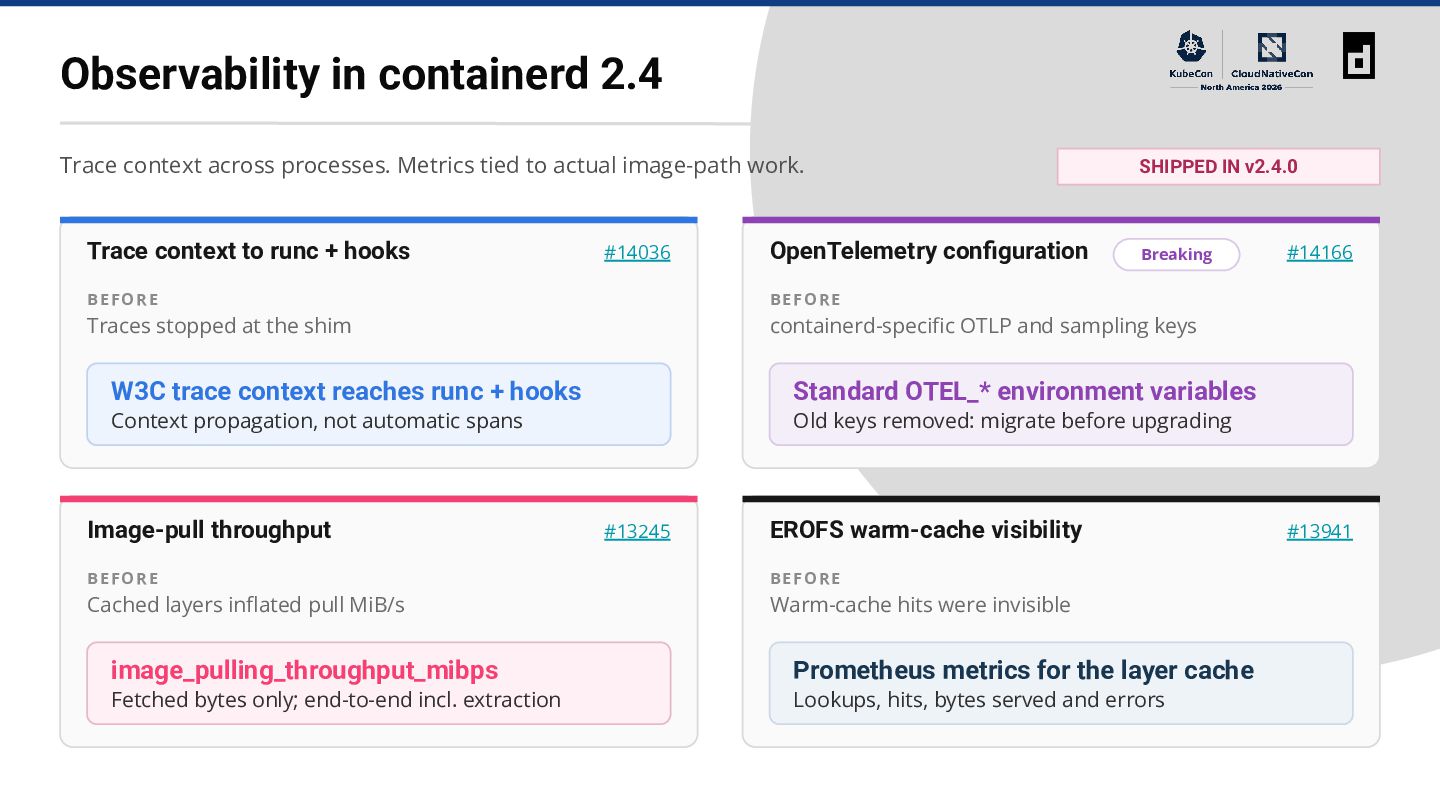
  14. Observability in containerd 2.4 Trace context across processes. Metrics tied

    to actual image-path work. Trace context to runc + hooks #14036 OpenTelemetry configuration SHIPPED IN v2.4.0 Breaking BEFORE BEFORE Traces stopped at the shim containerd-specific OTLP and sampling keys W3C trace context reaches runc + hooks Standard OTEL_* environment variables Context propagation, not automatic spans Image-pull throughput Old keys removed: migrate before upgrading #13245 EROFS warm-cache visibility BEFORE BEFORE Cached layers inflated pull MiB/s Warm-cache hits were invisible image_pulling_throughput_mibps Fetched bytes only; end-to-end incl. extraction #14166 Prometheus metrics for the layer cache Lookups, hits, bytes served and errors #13941
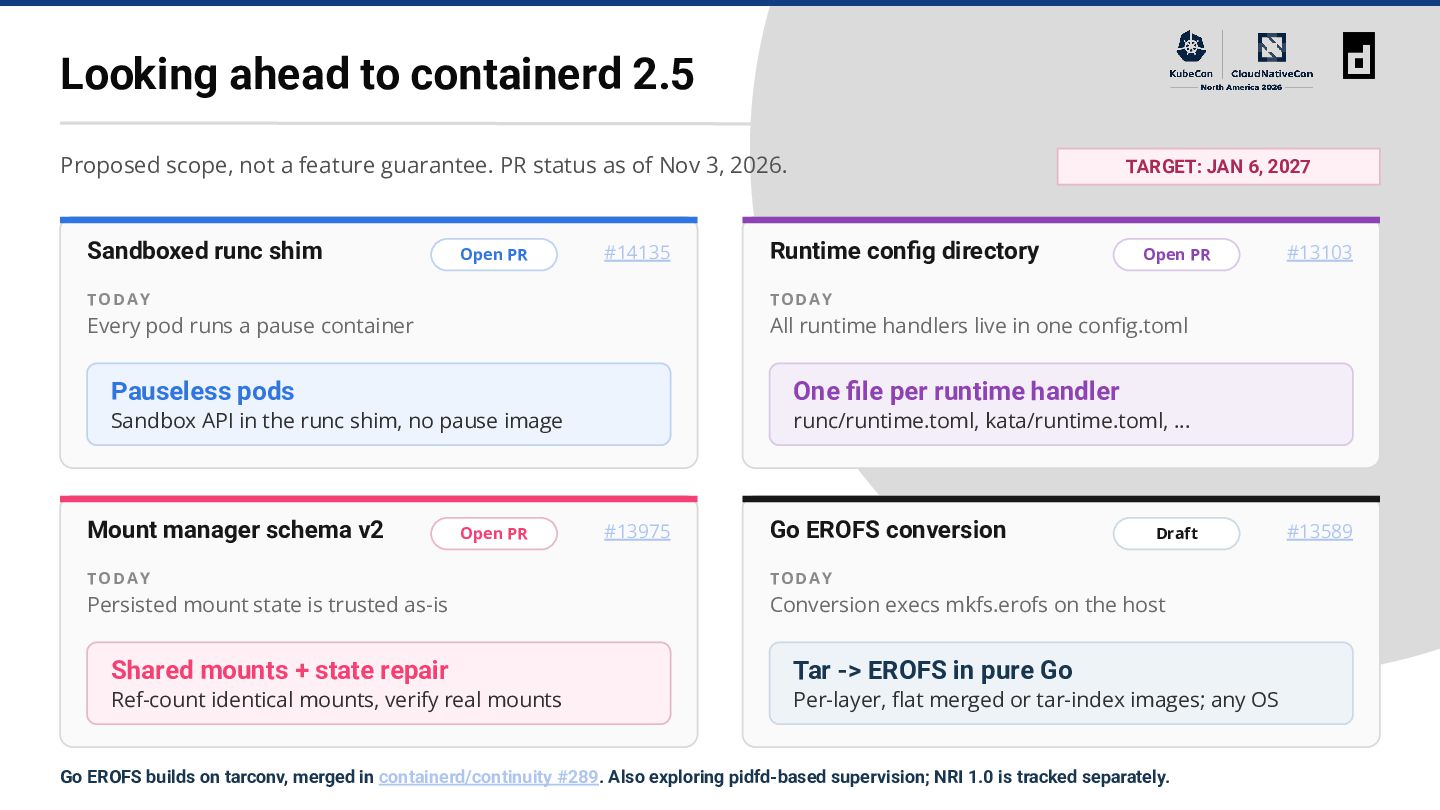
  15. Looking ahead to containerd 2.5 Proposed scope, not a feature

    guarantee. PR status as of Nov 3, 2026. Sandboxed runc shim Open PR #14135 TARGET: JAN 6, 2027 Runtime config directory Open PR TODAY TODAY Every pod runs a pause container All runtime handlers live in one config.toml Pauseless pods One file per runtime handler Sandbox API in the runc shim, no pause image Mount manager schema v2 Open PR runc/runtime.toml, kata/runtime.toml, ... #13975 Go EROFS conversion Draft TODAY TODAY Persisted mount state is trusted as-is Conversion execs mkfs.erofs on the host Shared mounts + state repair Ref-count identical mounts, verify real mounts #13103 Tar -> EROFS in pure Go Per-layer, flat merged or tar-index images; any OS Go EROFS builds on tarconv, merged in containerd/continuity #289. Also exploring pidfd-based supervision; NRI 1.0 is tracked separately. #13589
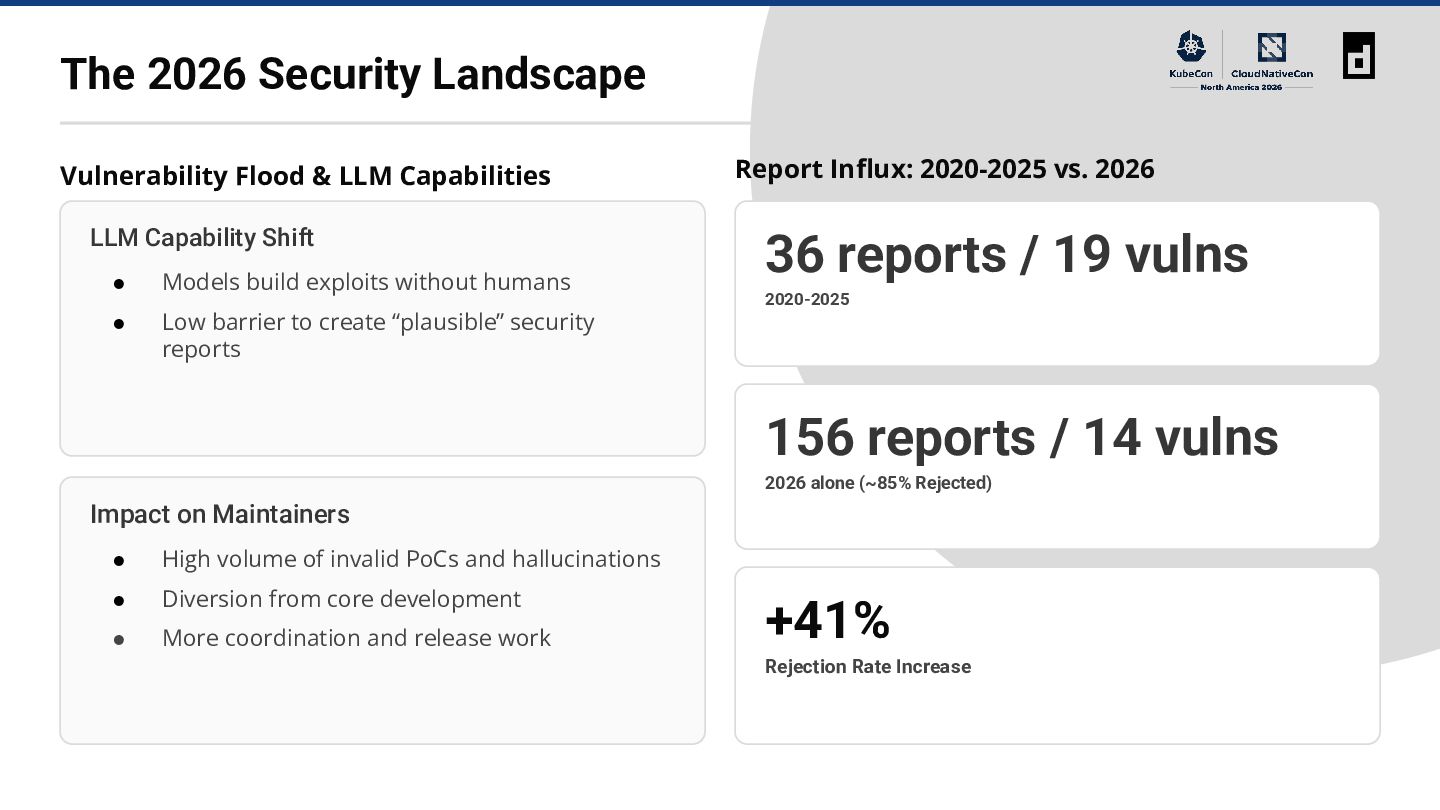
  16. The 2026 Security Landscape Vulnerability Flood & LLM Capabilities LLM

    Capability Shift • Models build exploits without humans • Low barrier to create “plausible” security reports Report Influx: 2020-2025 vs. 2026 36 reports / 19 vulns 2020-2025 156 reports / 14 vulns 2026 alone (~85% Rejected) Impact on Maintainers • High volume of invalid PoCs and hallucinations • Diversion from core development • More coordination and release work +41% Rejection Rate Increase
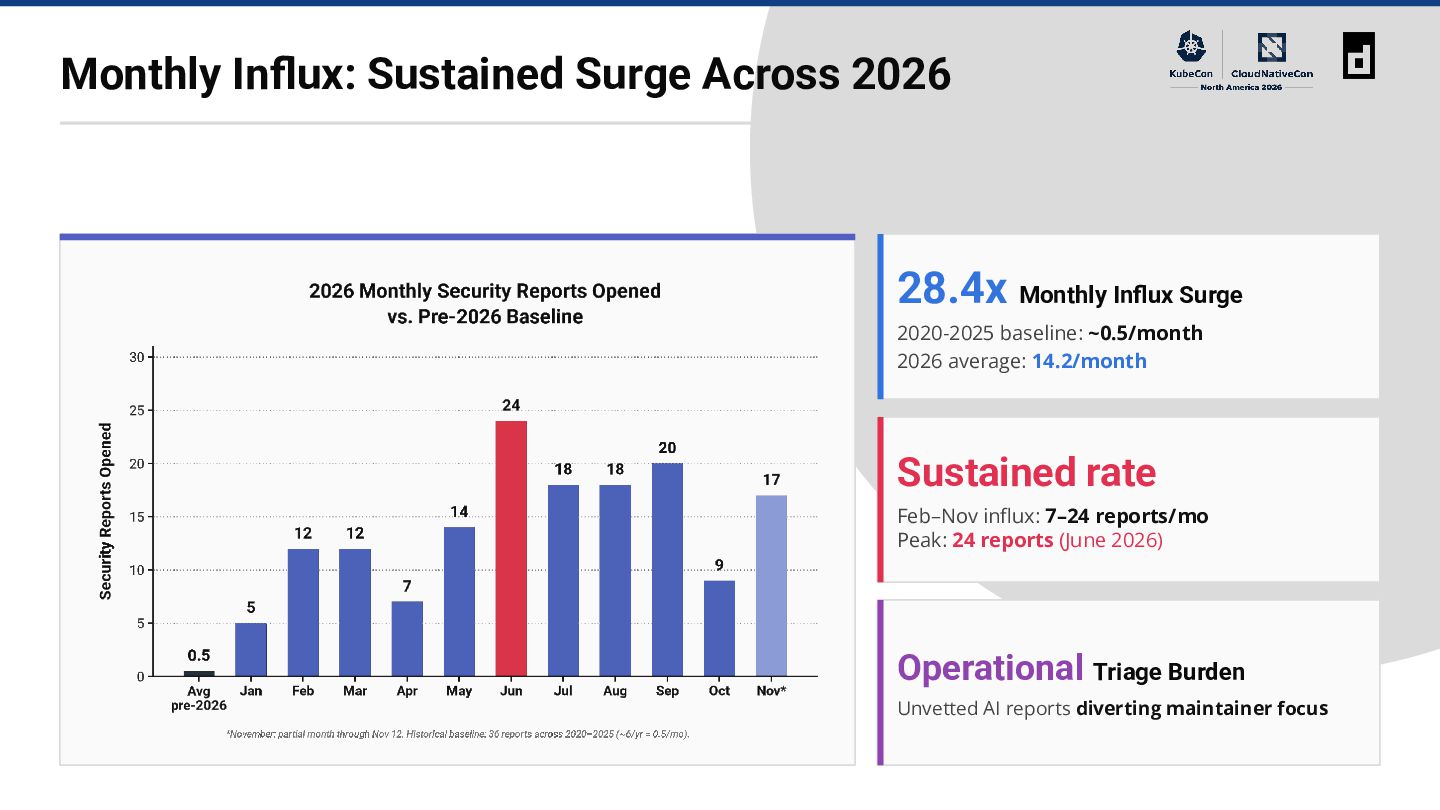
  17. Monthly Influx: Sustained Surge Across 2026 28.4x Monthly Influx Surge

    2020-2025 baseline: ~0.5/month 2026 average: 14.2/month Sustained rate Feb–Nov influx: 7–24 reports/mo Peak: 24 reports (June 2026) Operational Triage Burden Unvetted AI reports diverting maintainer focus
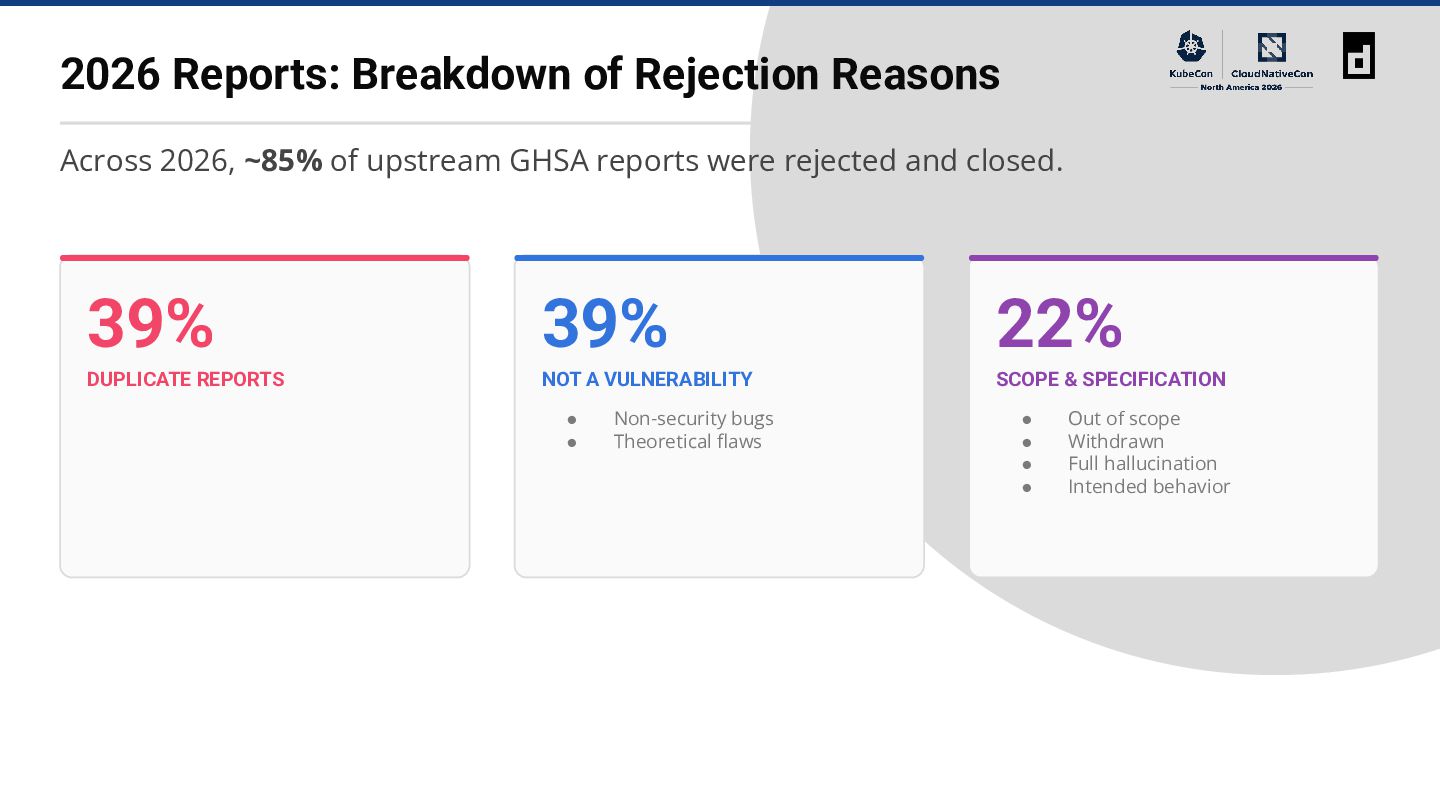
  18. 2026 Reports: Breakdown of Rejection Reasons Across 2026, ~85% of

    upstream GHSA reports were rejected and closed. 39% 39% 22% DUPLICATE REPORTS NOT A VULNERABILITY SCOPE & SPECIFICATION • • Non-security bugs Theoretical flaws • • • • Out of scope Withdrawn Full hallucination Intended behavior
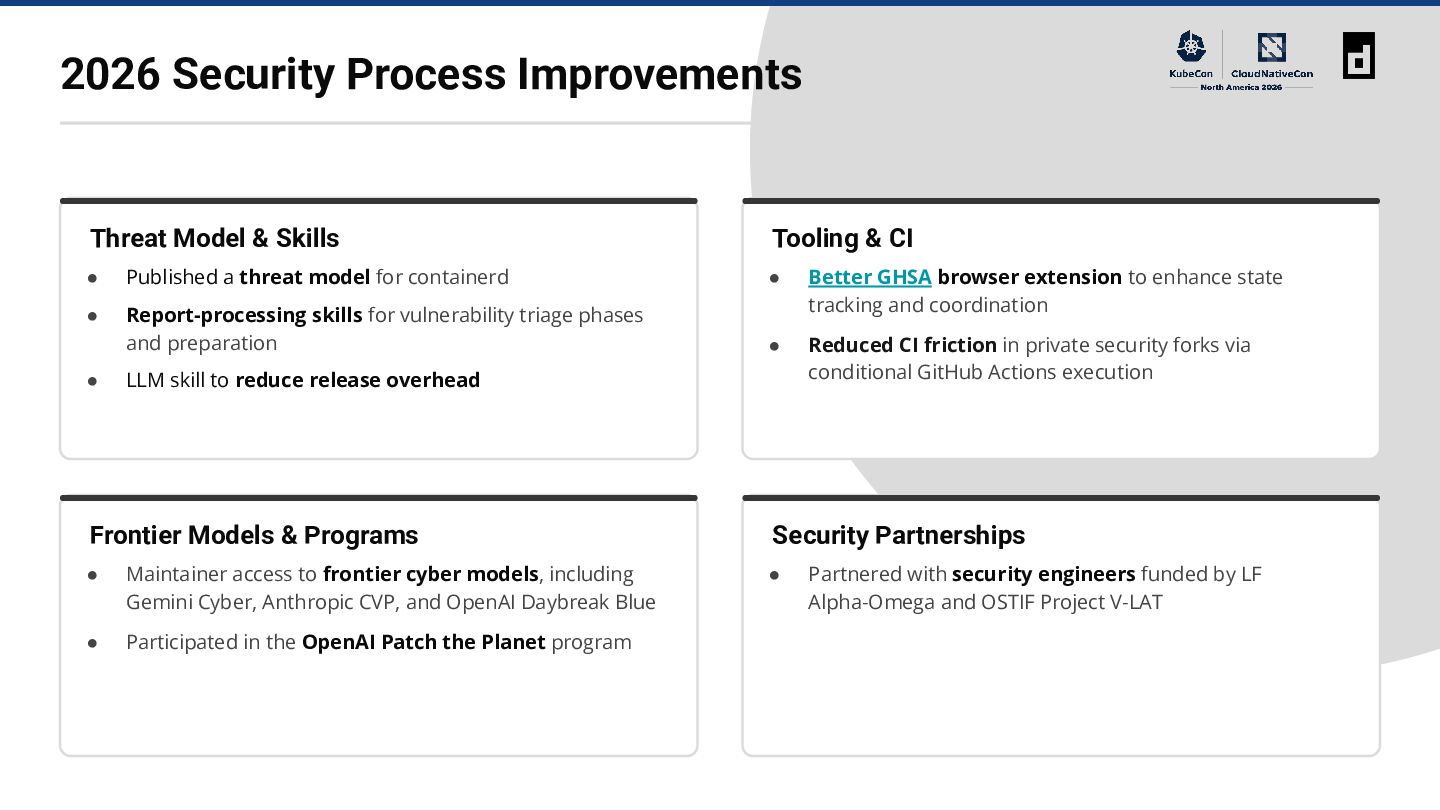
  19. 2026 Security Process Improvements Threat Model & Skills Tooling &

    CI • Published a threat model for containerd • • Report-processing skills for vulnerability triage phases and preparation Better GHSA browser extension to enhance state tracking and coordination • Reduced CI friction in private security forks via conditional GitHub Actions execution • LLM skill to reduce release overhead Frontier Models & Programs • Maintainer access to frontier cyber models, including Gemini Cyber, Anthropic CVP, and OpenAI Daybreak Blue • Participated in the OpenAI Patch the Planet program Security Partnerships • Partnered with security engineers funded by LF Alpha-Omega and OSTIF Project V-LAT
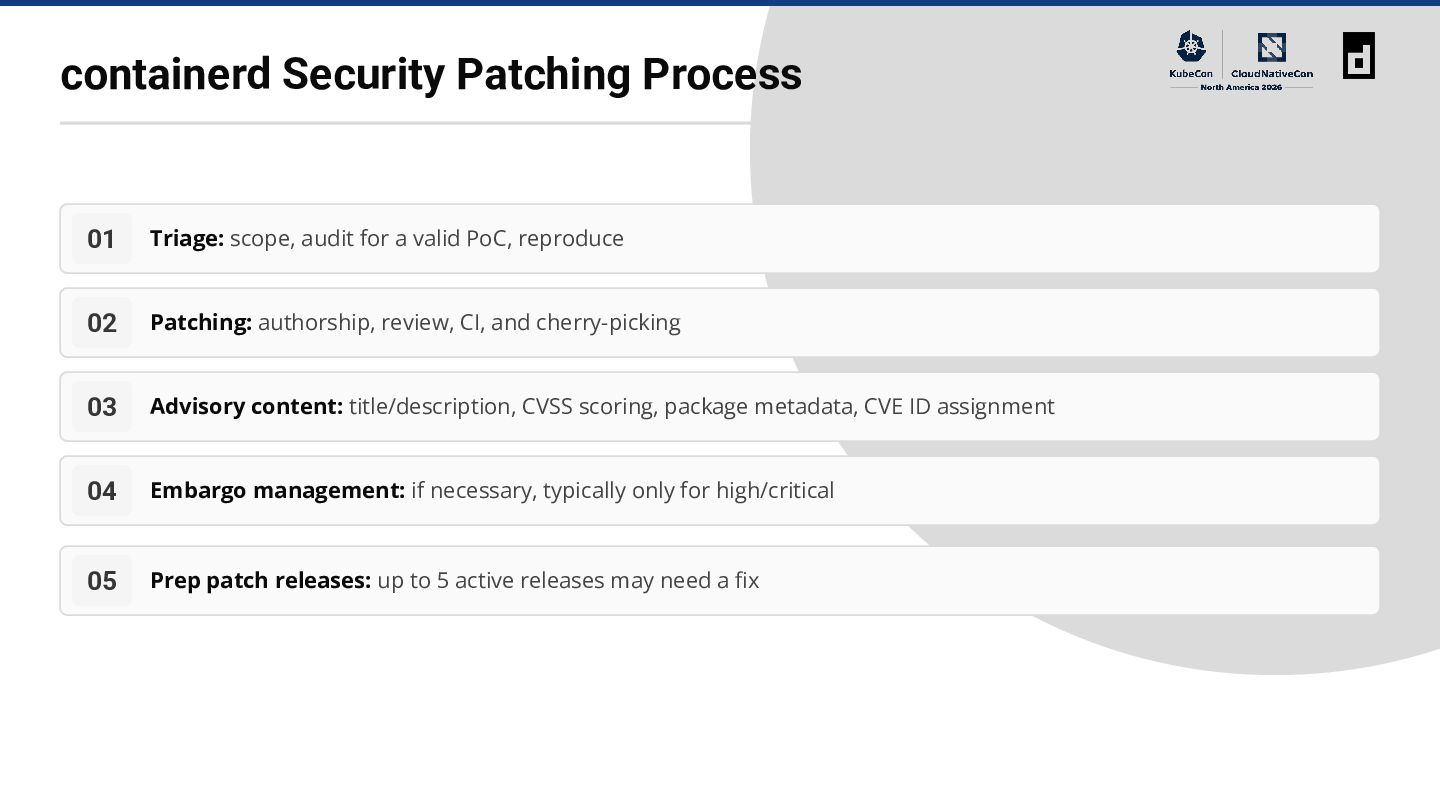
  20. containerd Security Patching Process 01 Triage: scope, audit for a

    valid PoC, reproduce 02 Patching: authorship, review, CI, and cherry-picking 03 Advisory content: title/description, CVSS scoring, package metadata, CVE ID assignment 04 Embargo management: if necessary, typically only for high/critical 05 Prep patch releases: up to 5 active releases may need a fix
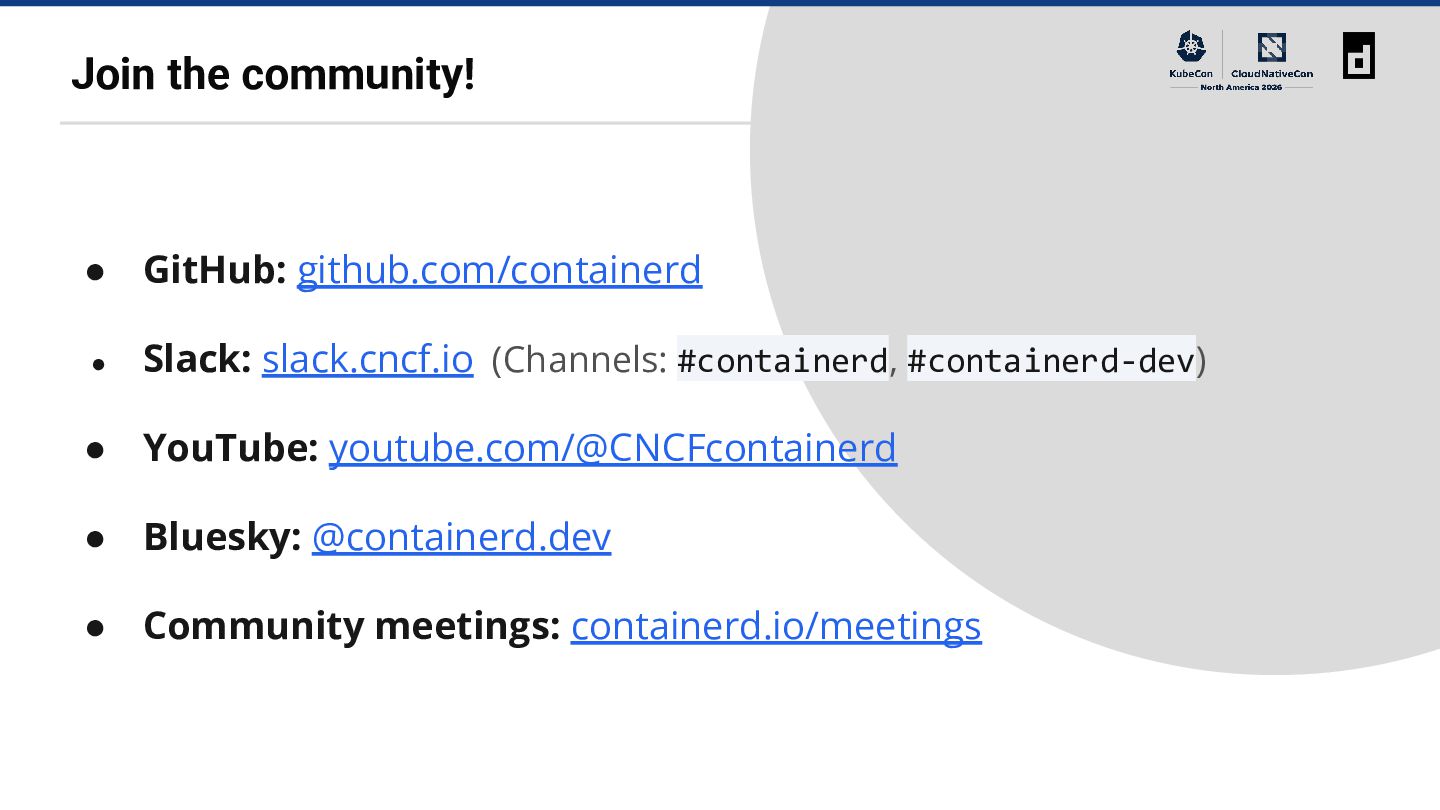
  21. Join the community! • GitHub: github.com/containerd • Slack: slack.cncf.io (Channels:

    #containerd, #containerd-dev) • YouTube: youtube.com/@CNCFcontainerd • Bluesky: @containerd.dev • Community meetings: containerd.io/meetings

More Decks by Samuel Karp

Other Decks in Technology