Upgrade to Pro — share decks privately, control downloads, hide ads and more …

AI Video Analytics Software: Turning Video Foot...

Sponsored · SiteGround - Reliable hosting with speed, security, and support you can count on. →
Avatar for Saranya S Saranya S
November 03, 2026

AI Video Analytics Software: Turning Video Footage into Actionable Intelligence

Discover how AI video analytics software transforms CCTV footage into actionable intelligence. Learn how businesses use AI-powered video monitoring to detect unusual activities, improve security, monitor operations and make smarter decisions in real time.

Avatar for Saranya S

Saranya S

November 03, 2026

Other Decks in Technology

Transcript

  1. AI Video Analytics Software: Turning Video Footage into Actionable Intelligence

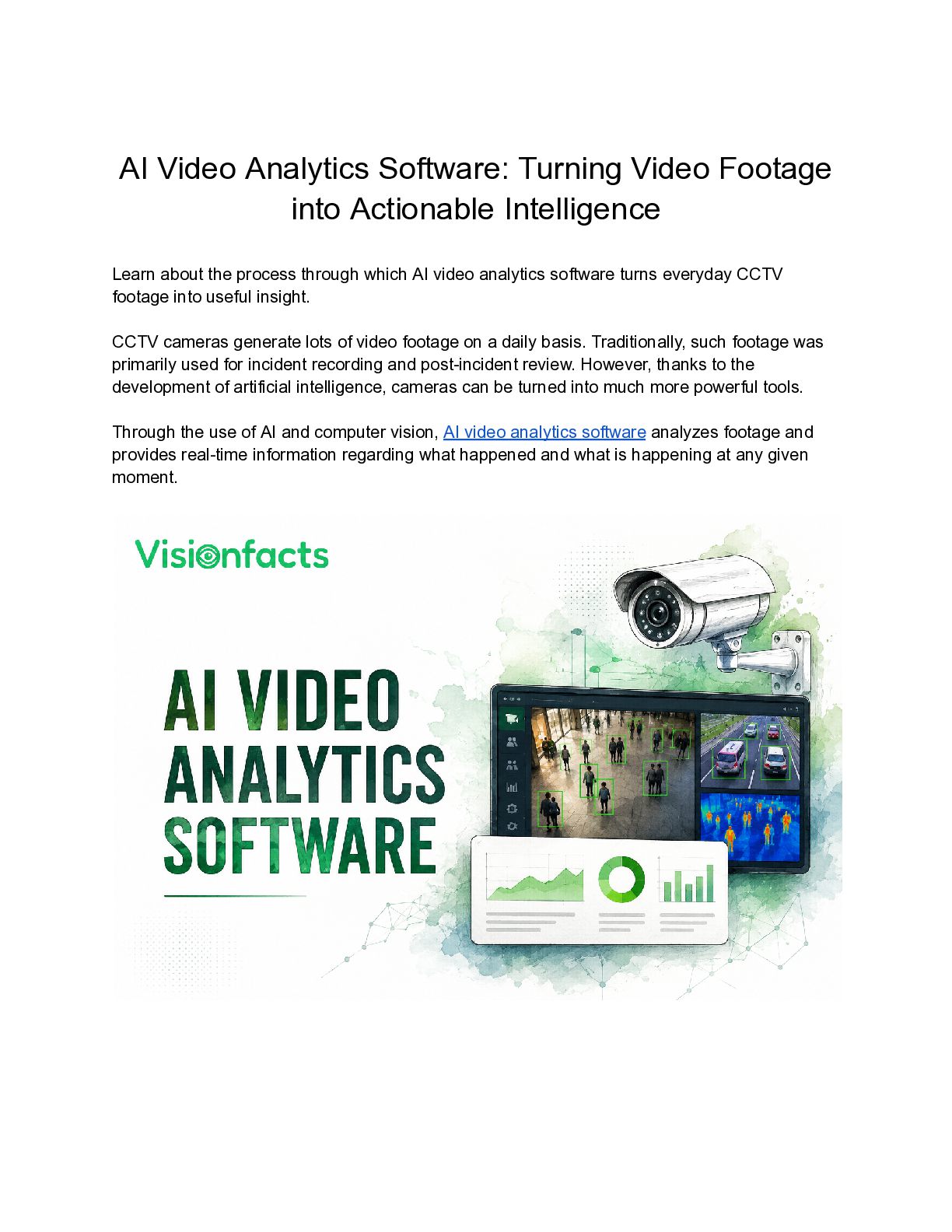
    Learn about the process through which AI video analytics software turns everyday CCTV footage into useful insight. CCTV cameras generate lots of video footage on a daily basis. Traditionally, such footage was primarily used for incident recording and post-incident review. However, thanks to the development of artificial intelligence, cameras can be turned into much more powerful tools. Through the use of AI and computer vision, AI video analytics software analyzes footage and provides real-time information regarding what happened and what is happening at any given moment.
  2. What Is AI Video Analytics Software? AI video analytics software

    is a tool based on the use of artificial intelligence and computer vision that helps the software analyze images and videos. The difference between this type of software and traditional surveillance footage is that the software not only records the footage but also identifies people, objects, movement, activities, etc. In other words, businesses can set the software up to detect events and activities relevant to the business processes. This makes video surveillance more intelligent and reduces the dependence on continuous manual monitoring. CCTV Recording → Intelligent Monitoring The classical CCTV systems produce very useful recordings but still rely on security staff monitoring the live stream or looking through the recording. Consider a company having dozens of cameras working round-the-clock. For a human being, it becomes virtually impossible to look at every camera all the time without overlooking some important events. Using AI video analytics makes the task much easier since the system will analyze what the cameras see by itself and highlight some unusual or predetermined events to the team. This way, security becomes more effective as people are not obliged to keep their eyes on everything but only on something that may be of interest. Business Security Among many possible uses of AI video analytics, security happens to be the most popular. Companies may use intelligent monitoring in order to control entrances, parking lots, warehouses, offices, factories, and restricted areas. Such events as: •​ Unauthorized access
  3. •​ Intrusion and perimeter breach •​ Loitering in sensitive areas

    •​ Suspicions movements •​ Access to the restricted zone •​ Unusual vehicle movement •​ After-hours activity are easily detected using AI systems and the alert may be sent to the security team about the occurrence of the relevant event. Improving Workplace Safety In addition to security and safety measures, AI video analytics systems can be applied in industrial settings like manufacturing plants, warehouses, construction sites, etc., where safety is one of the primary concerns. Safety analytics can check whether employees comply with the defined safety measures in place. This depends on the type of the solution and what exactly should be checked – lack of PPE, entering restricted areas, etc. So, if an employee enters restricted premises without protective clothing, this will be detected by AI and reported to the relevant team. This will enable companies to deal with any safety concerns faster and encourage better compliance with the workplace safety regulations. Understanding People and Customer Behavior Besides being used in security and safety processes, video analytics may be used to learn more about customer behavior in physical environments. For instance, retail outlets, shopping malls, and other businesses may use video analytics to assess customer movements, queues, traffic hotspots, etc.
  4. With such data, businesses can understand which areas of their

    facilities attract more attention from customers and where they spend more time. Better Monitoring of Vehicle Movements Those organizations that control parking spaces, warehouses, logistics centers, and industrial enterprises can use AI to monitor vehicle movements. AI analysis of vehicles can help detect any entering and exiting of vehicles, monitor the restricted areas, and analyze traffic patterns. The system can also enable controlled access of vehicles using number plate recognition if such measures are lawful and the appropriate configuration is used. Enhancing security, the technology will help companies control the vehicle movement better. Human Monitoring of Multiple Surveillance Cameras The main problem of classical surveillance systems is a large amount of human attention needed to monitor the cameras. Security officers may need to watch multiple screens during long periods of time, and this leads to fatigue making certain events hard to notice. AI analysis of videos constantly analyses the information from the cameras in the background. Unlike conventional systems, AI does not show all the events equally significant but recognizes the certain events according to pre-defined conditions. Therefore, the team can concentrate on certain events and investigation of them but not constant monitoring of the screens. Quick Response to Incidents Time can play an important role when there is an incident. The system with artificial intelligence will detect an occurrence and send alerts almost instantly.
  5. For instance, when someone gets into a restricted zone, the

    security officer will be able to receive an alert right away without having to find out about the event after examining recorded video. Quick alerts will help organizations react to incidents more quickly and take the necessary actions. Transforming Video Information Into Business Intelligence The application of AI to video data analysis goes far beyond detecting any security incidents. There is much information in video recordings about activities of people, vehicles, and spaces. It can be analyzed by organizations to reveal patterns and gain useful insights. For instance, a retailer will be able to understand what hours are characterized by the maximum number of customers visiting the premises. In a warehouse, congestion in loading zones can be identified. Facility managers may discover unusual activity in particular areas. Such insights will help organizations operate more efficiently. Benefits in Various Industries AI video analytics can be customized to suit the needs of various industries. Retail: The company will be able to track the footfall, customer activity, queue formation, and security. Manufacturing: The factory will be able to carry out safety monitoring, PPE monitoring, equipment area monitoring, and security. Warehousing and Logistics: AI can help track the presence of people, vehicles, restricted areas, and movement in loading and unloading zones. Commercial: Commercial properties will be able to perform intelligent surveillance that will help with access monitoring and security. Transportation: AI can help with vehicle detection, traffic analysis, parking, and license plate detection.
  6. The application will vary based on the cameras used, the

    AI algorithms, business need, and privacy laws. The Future of Intelligent Video Analytics As AI and computer vision technology become increasingly advanced, intelligent video analytics will become even more powerful in terms of detecting complex events and patterns. Future systems will offer greater accuracy in terms of detection and real-time analysis as well as greater integration with business and security systems. More businesses are likely to deploy cameras not only for surveillance purposes but as a source of operational intelligence. The idea is not simply to have more video footage recorded but rather to analyze this footage and derive meaningful information out of it. Conclusion Intelligent video analytics software transforms traditional CCTV into a valuable source of real-time information. Thanks to the power of AI, video footage can now be used for extracting useful information related to security, workplace safety, customer behavior, vehicle management, and many other things. With the help of AI video analytics, one can reduce manual monitoring and receive fast alerts and operational intelligence. This makes businesses proactive, more efficient, and driven by data. For those businesses who wish to get more out of their video cameras, AI video analytics software is a way to go. FAQs 1. What is AI video analytics software? AI video analytics software is used to process CCTV videos to recognize people, vehicles, objects, behavior, and predefined events using computer vision and artificial intelligence.
  7. 2. What are the security benefits of AI video analytics

    software? This technology can detect intrusion, unauthorized access, loitering, and suspicious behavior as well as trigger notifications about them in real time. 3. Is it possible to implement AI video analytics for workplace safety? Indeed, this technology can monitor safety related events like PPE violation and unauthorized access to hazardous zones. 4. Can I use AI video analytics software with existing CCTV cameras? Depending on your specific hardware and software architecture, it might be possible to integrate AI video analytics with existing CCTV/IP cameras. 5. Who needs AI video analytics software? Retail, manufacturing, logistics, warehouses, transportation, commercial facilities and many other industries can use AI video analytics software. 6. Can AI video analytics do anything other than security and safety tasks? Yes, it can also help you understand people and vehicle flows, occupancy rates and other operational intelligence.