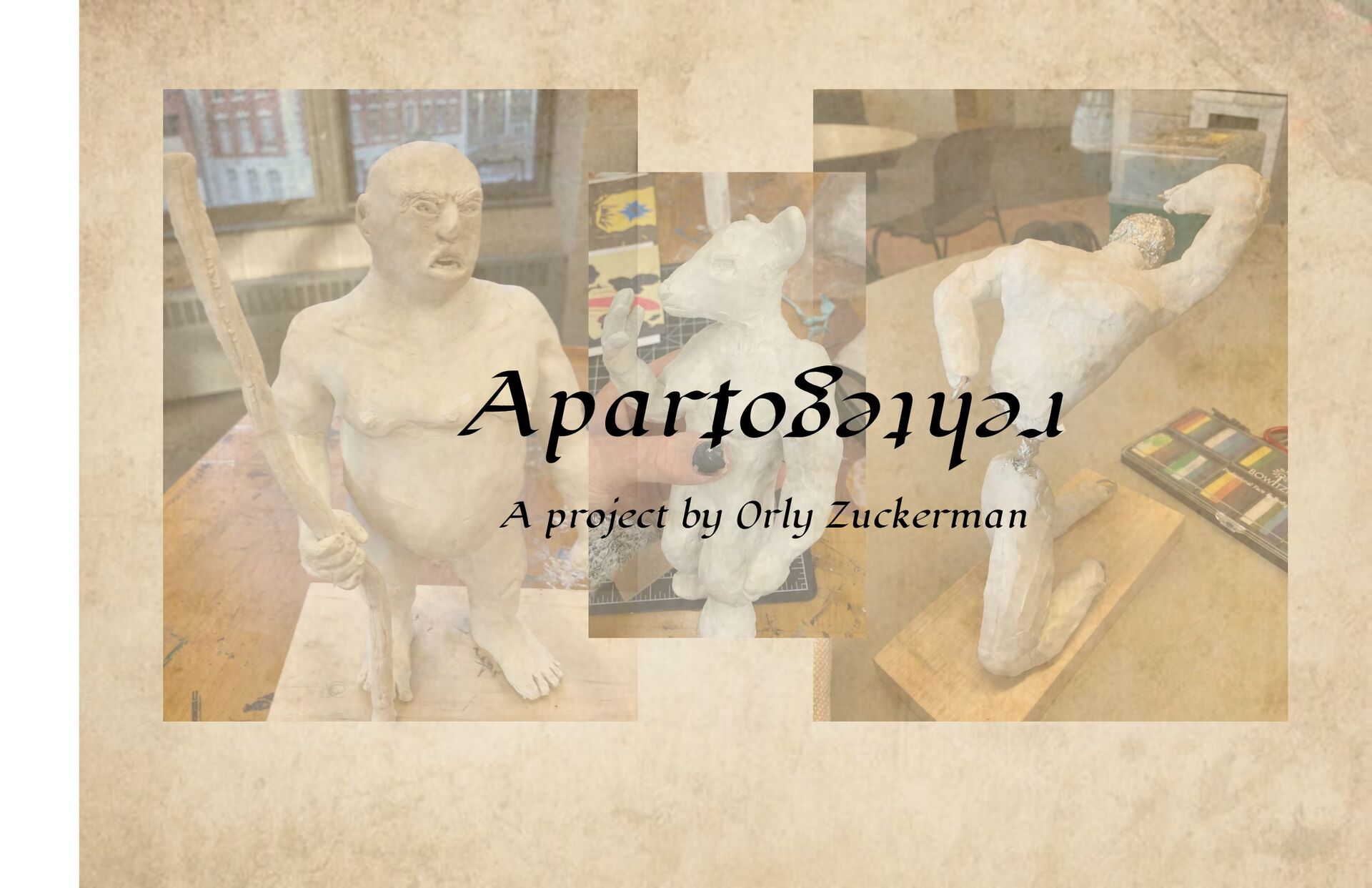
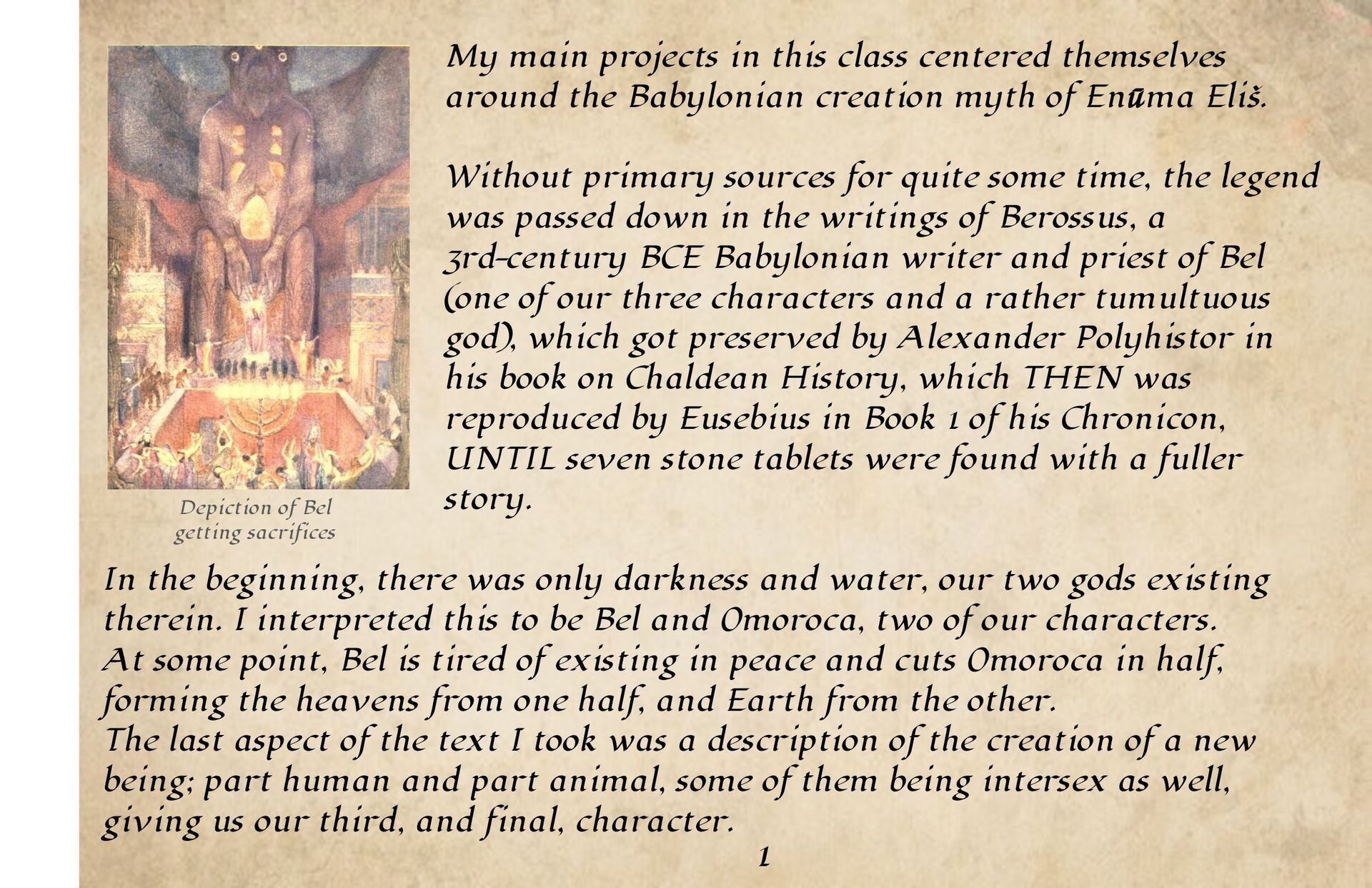
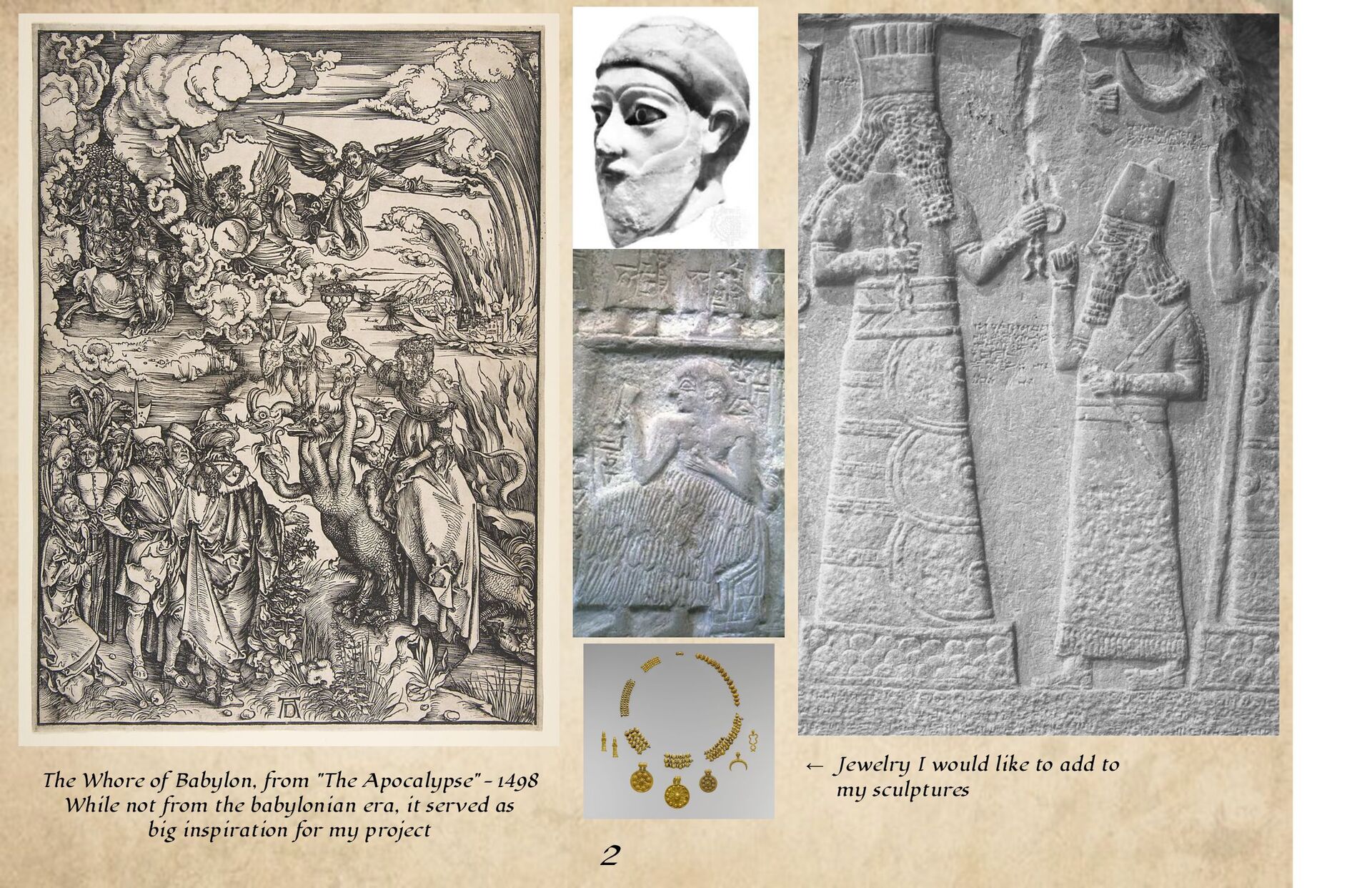
the Babylonian creation myth of Enū ma Eliš. Without primary sources for quite some time, the legend was passed down in the writings of Berossus, a 3rd-century BCE Babylonian writer and priest of Bel (one of our three characters and a rather tumultuous god), which got preserved by Alexander Polyhistor in his book on Chaldean History, which THEN was reproduced by Eusebius in Book 1 of his Chronicon, UNTIL seven stone tablets were found with a fuller story. In the beginning, there was only darkness and water, our two gods existing therein. I interpreted this to be Bel and Omoroca, two of our characters. At some point, Bel is tired of existing in peace and cuts Omoroca in half, forming the heavens from one half, and Earth from the other. The last aspect of the text I took was a description of the creation of a new being; part human and part animal, some of them being intersex as well, giving us our third, and final, character. Depiction of Bel getting sacrifices
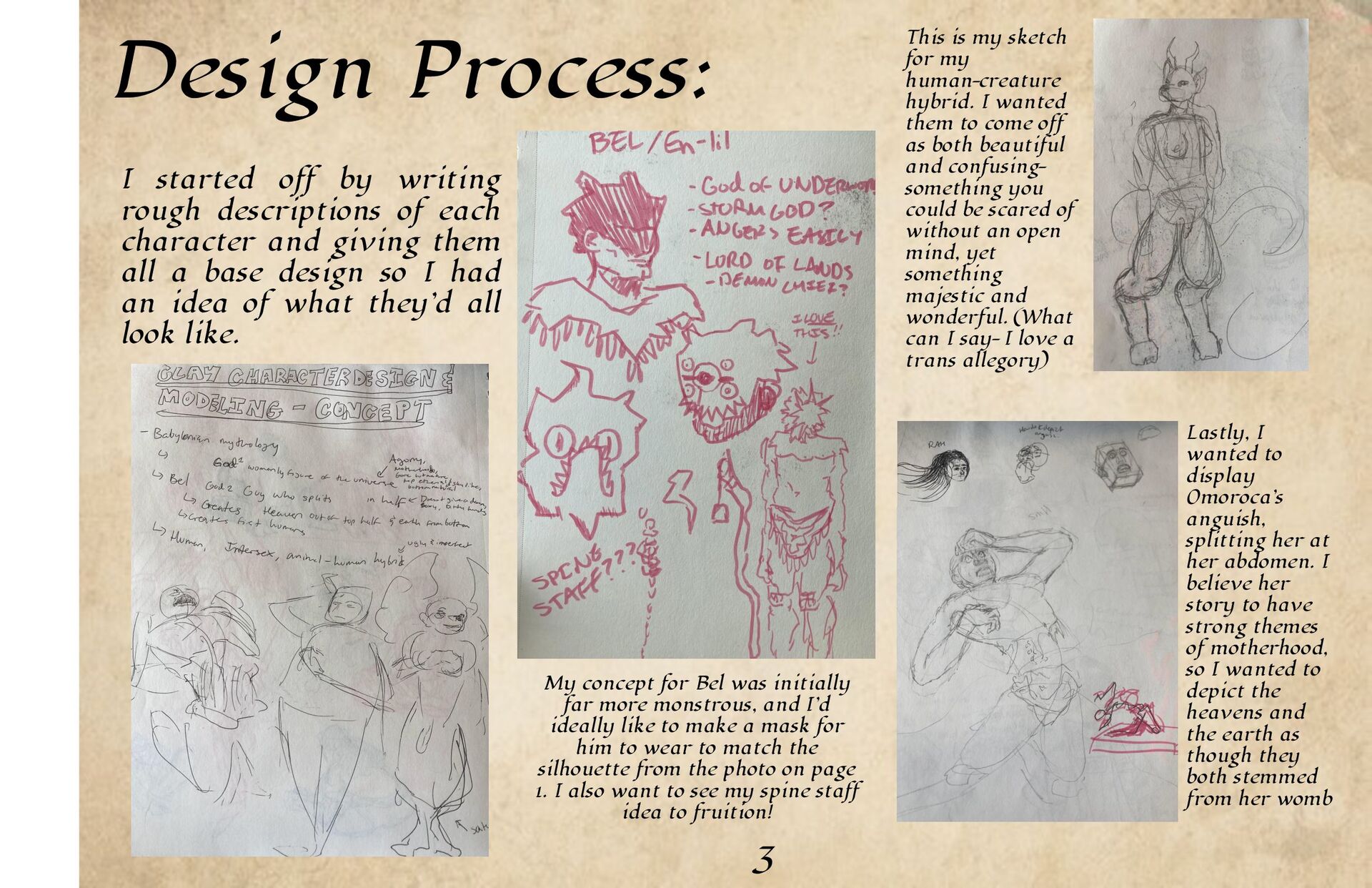
of each character and giving them all a base design so I had an idea of what they’d all look like. My concept for Bel was initially far more monstrous, and I’d ideally like to make a mask for him to wear to match the silhouette from the photo on page 1. I also want to see my spine staff idea to fruition! This is my sketch for my human-creature hybrid. I wanted them to come off as both beautiful and confusing- something you could be scared of without an open mind, yet something majestic and wonderful. (What can I say- I love a trans allegory) Lastly, I wanted to display Omoroca’s anguish, splitting her at her abdomen. I believe her story to have strong themes of motherhood, so I wanted to depict the heavens and the earth as though they both stemmed from her womb
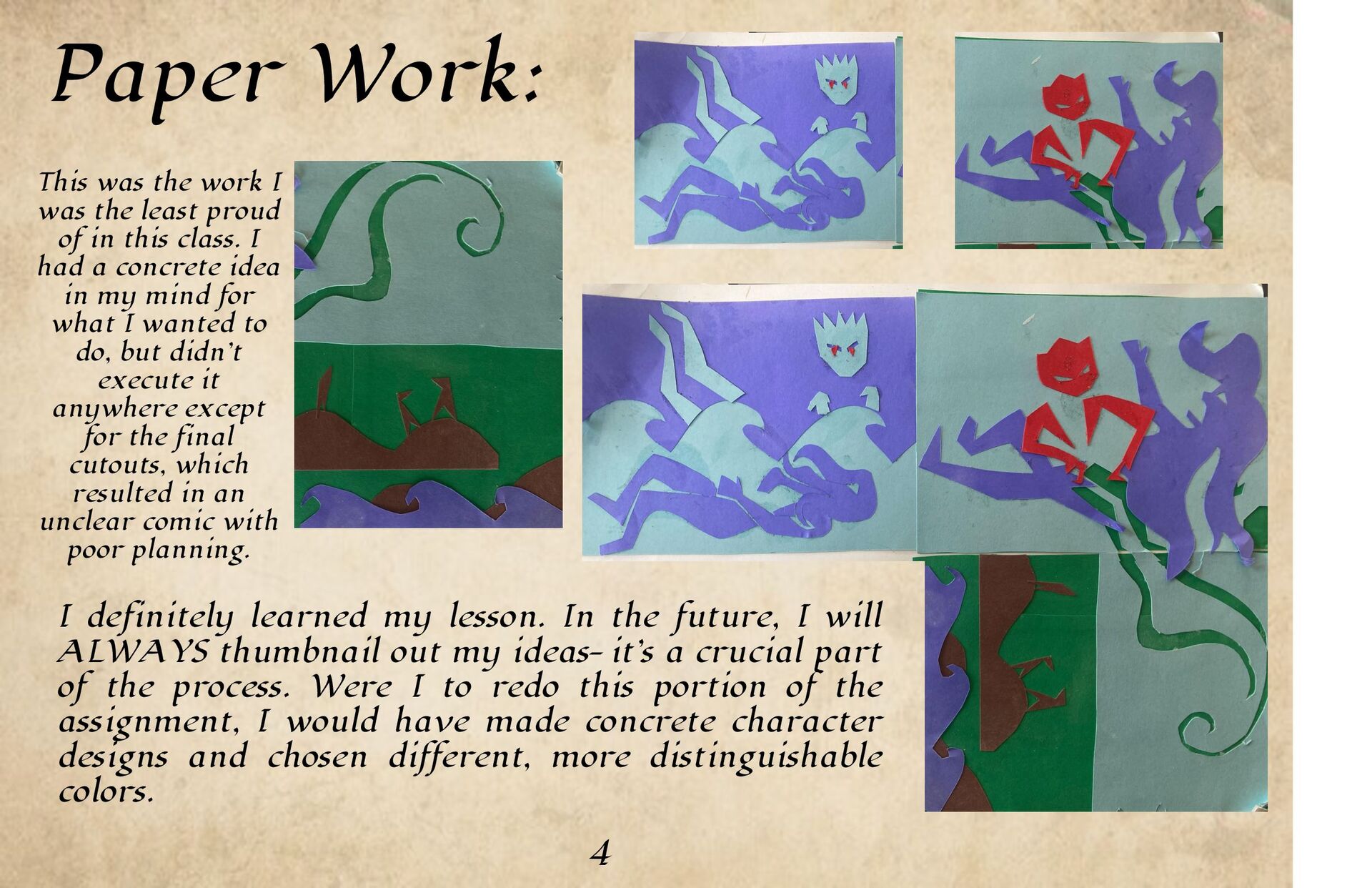
least proud of in this class. I had a concrete idea in my mind for what I wanted to do, but didn’t execute it anywhere except for the final cutouts, which resulted in an unclear comic with poor planning. I definitely learned my lesson. In the future, I will ALWAYS thumbnail out my ideas- it’s a crucial part of the process. Were I to redo this portion of the assignment, I would have made concrete character designs and chosen different, more distinguishable colors.
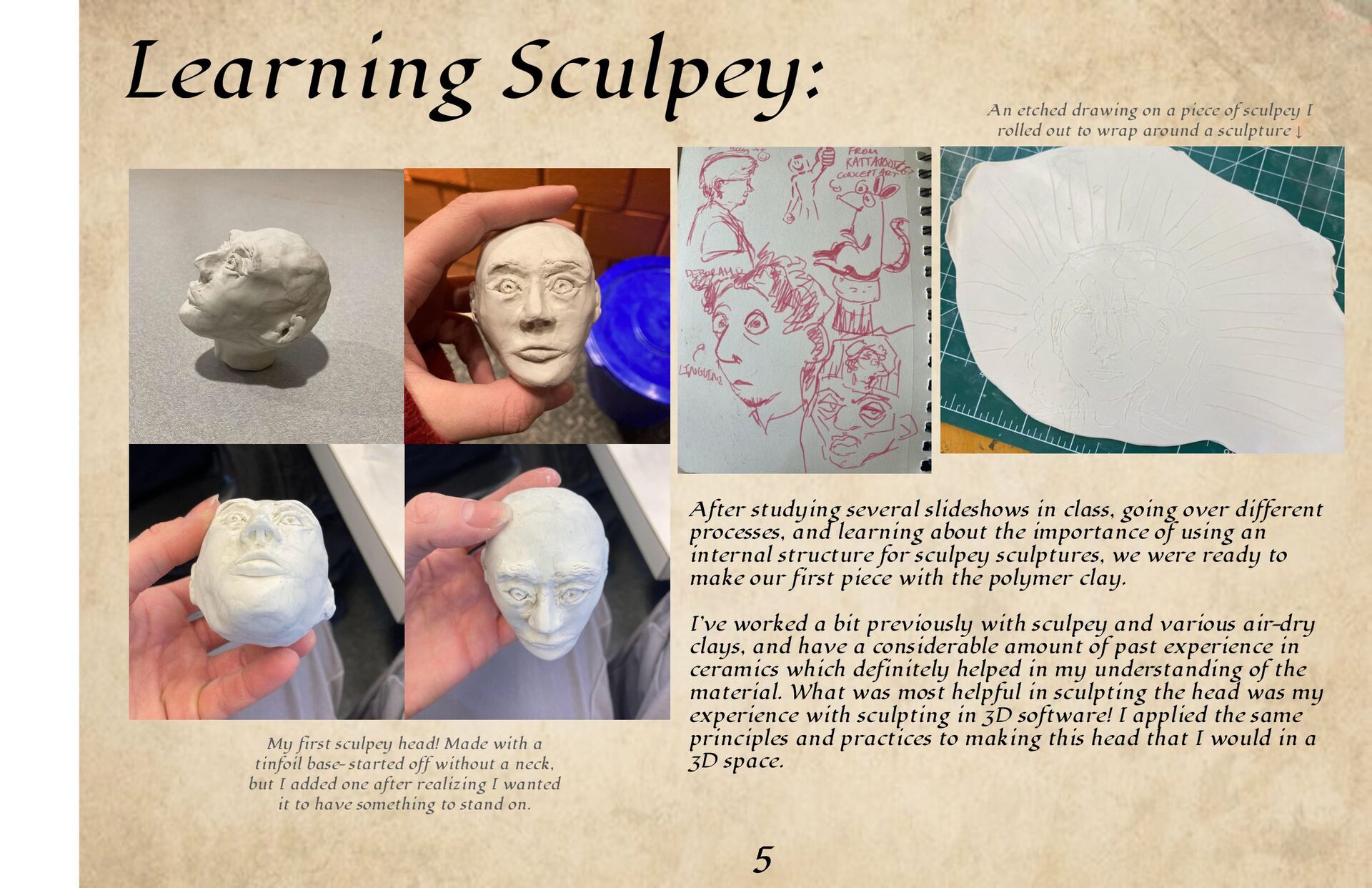
over different processes, and learning about the importance of using an internal structure for sculpey sculptures, we were ready to make our first piece with the polymer clay. I’ve worked a bit previously with sculpey and various air-dry clays, and have a considerable amount of past experience in ceramics which definitely helped in my understanding of the material. What was most helpful in sculpting the head was my experience with sculpting in 3D software! I applied the same principles and practices to making this head that I would in a 3D space. An etched drawing on a piece of sculpey I rolled out to wrap around a sculpture ↓ My first sculpey head! Made with a tinfoil base- started off without a neck, but I added one after realizing I wanted it to have something to stand on.
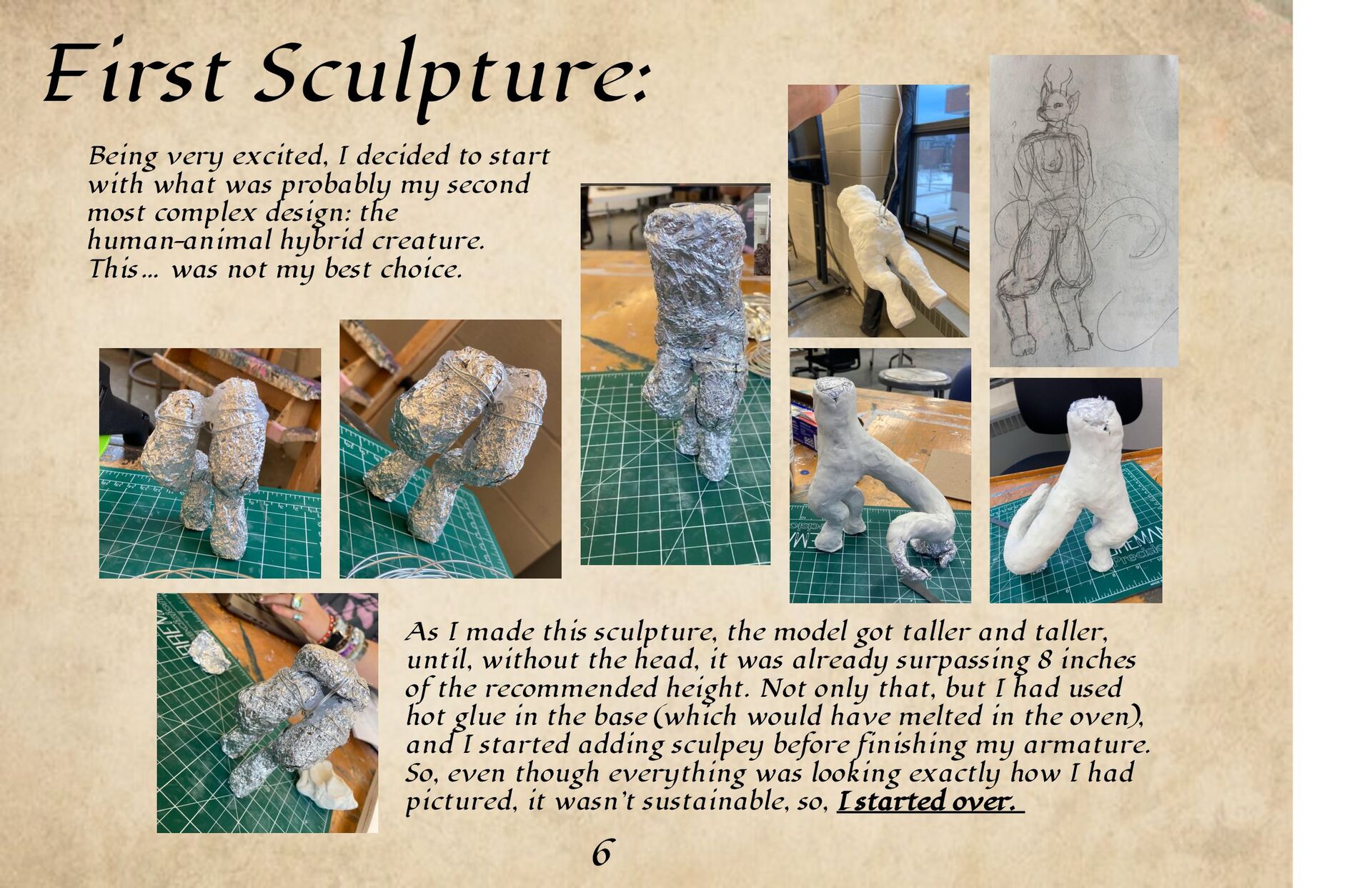
with what was probably my second most complex design: the human-animal hybrid creature. This… was not my best choice. As I made this sculpture, the model got taller and taller, until, without the head, it was already surpassing 8 inches of the recommended height. Not only that, but I had used hot glue in the base (which would have melted in the oven), and I started adding sculpey before finishing my armature. So, even though everything was looking exactly how I had pictured, it wasn’t sustainable, so, I started over.
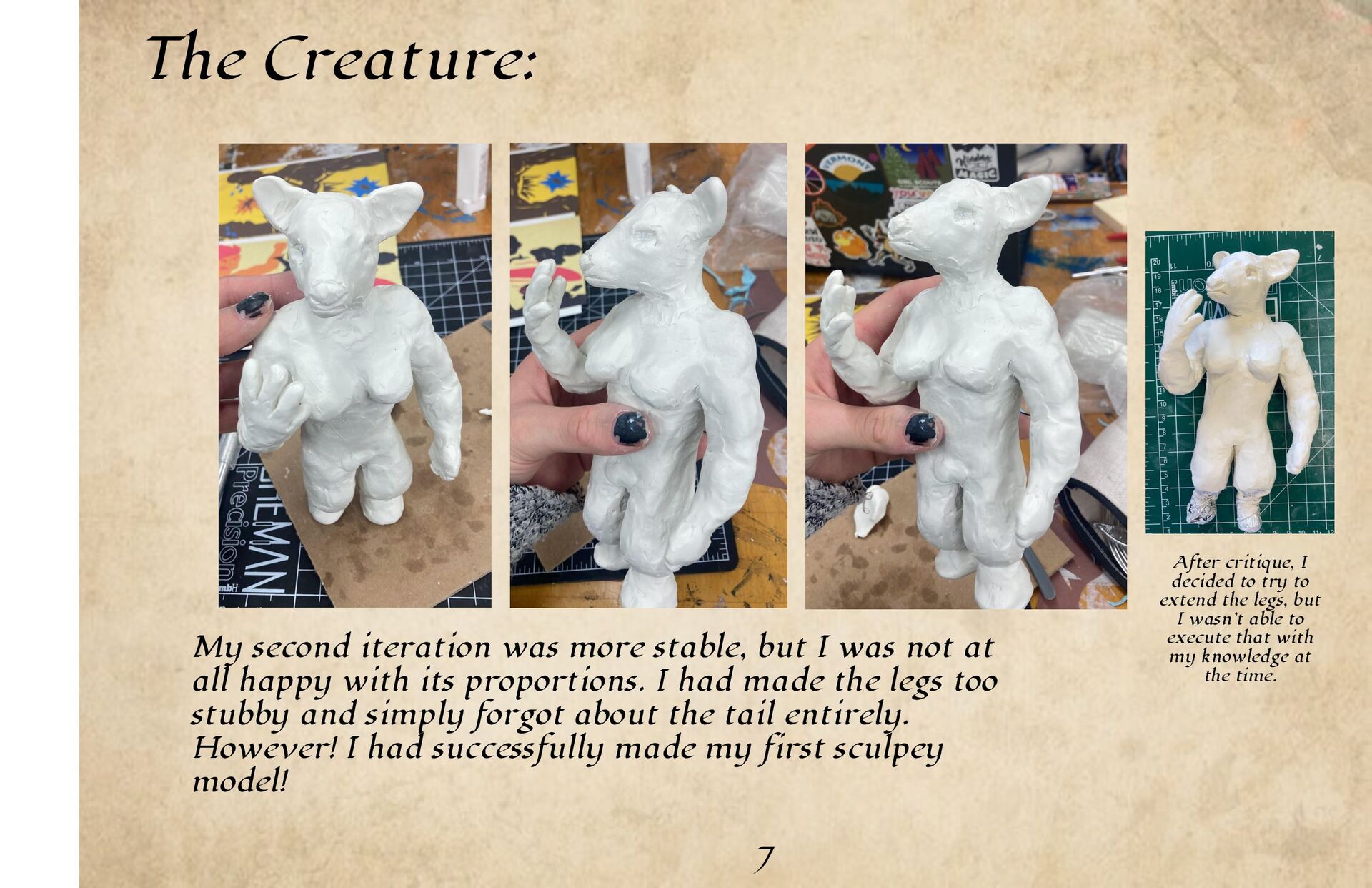
I was not at all happy with its proportions. I had made the legs too stubby and simply forgot about the tail entirely. However! I had successfully made my first sculpey model! After critique, I decided to try to extend the legs, but I wasn’t able to execute that with my knowledge at the time.
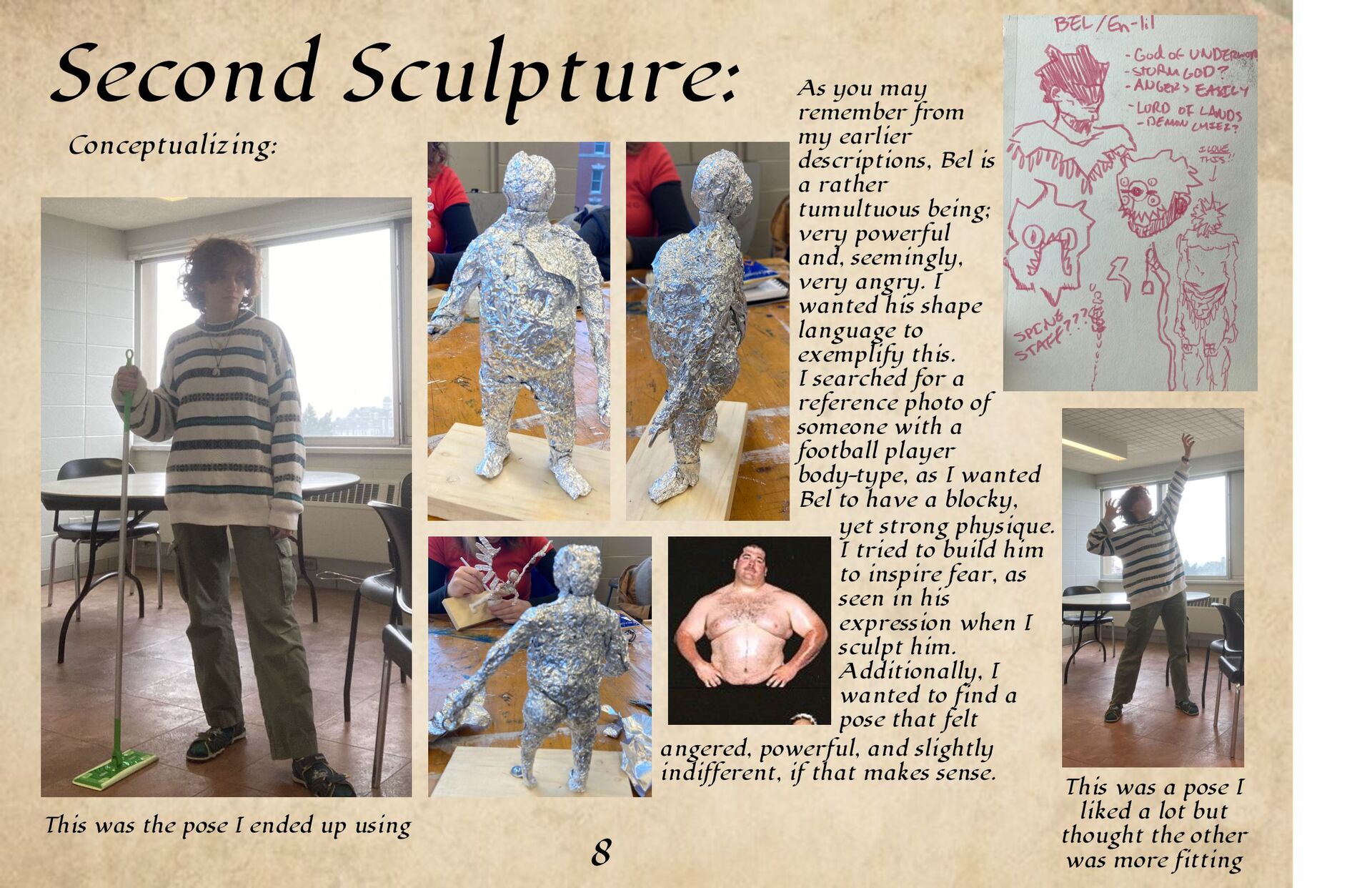
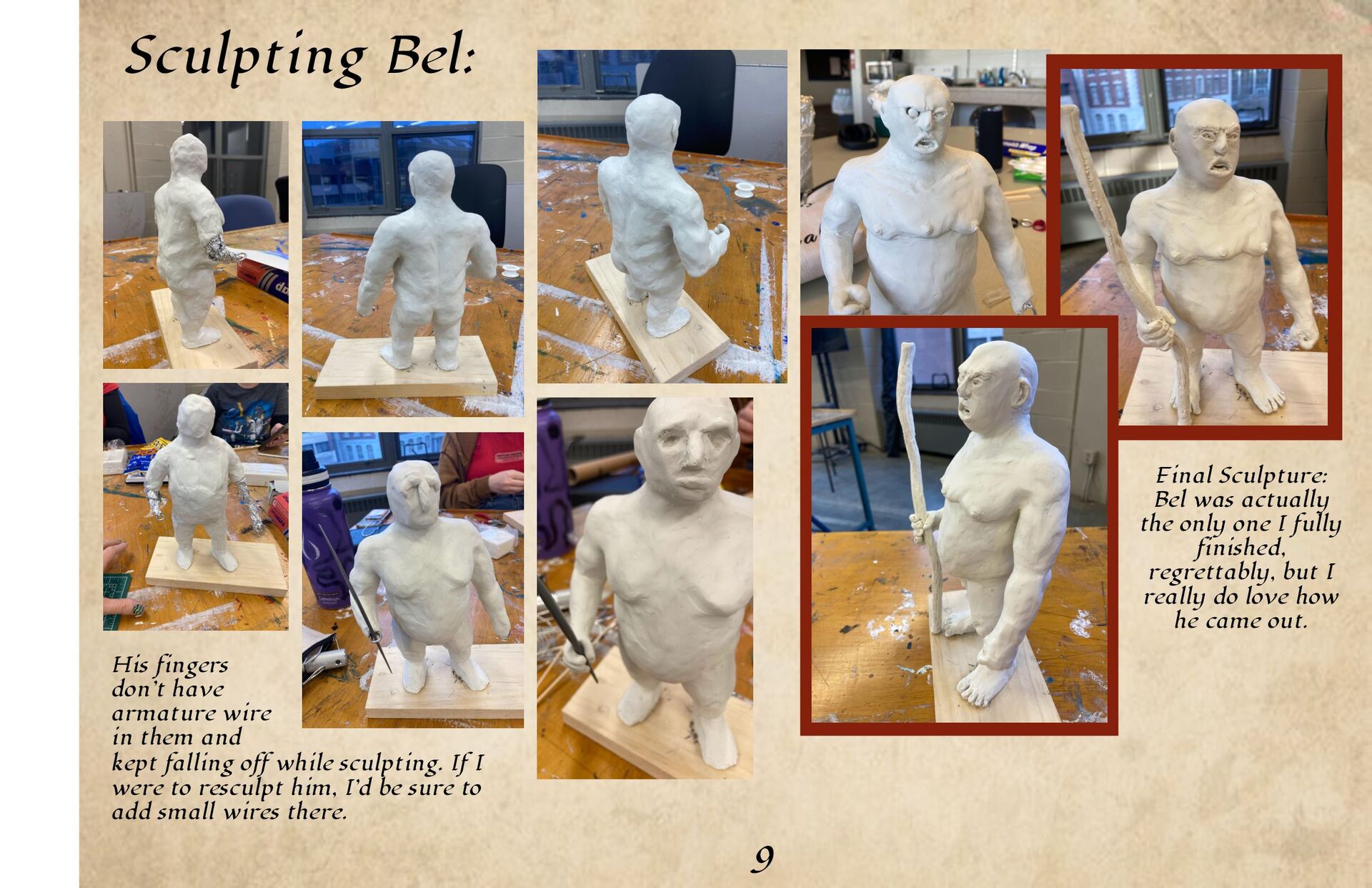
earlier descriptions, Bel is a rather tumultuous being; very powerful and, seemingly, very angry. I wanted his shape language to exemplify this. I searched for a reference photo of someone with a football player body-type, as I wanted Bel to have a blocky, yet strong physique. I tried to build him to inspire fear, as seen in his expression when I sculpt him. Additionally, I wanted to find a pose that felt angered, powerful, and slightly indifferent, if that makes sense. This was the pose I ended up using This was a pose I liked a lot but thought the other was more fitting
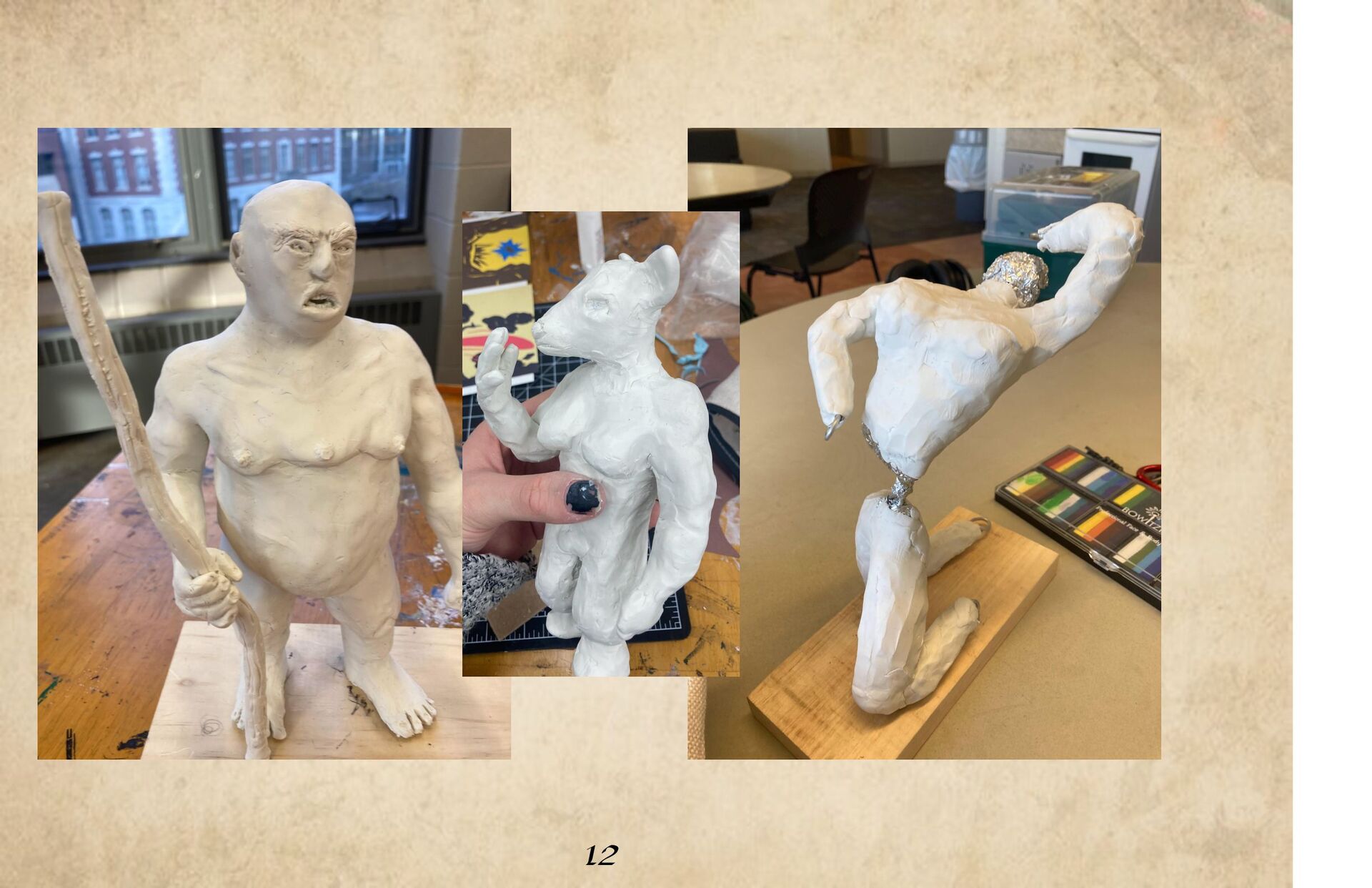
one I fully finished, regrettably, but I really do love how he came out. His fingers don’t have armature wire in them and kept falling off while sculpting. If I were to resculpt him, I’d be sure to add small wires there.
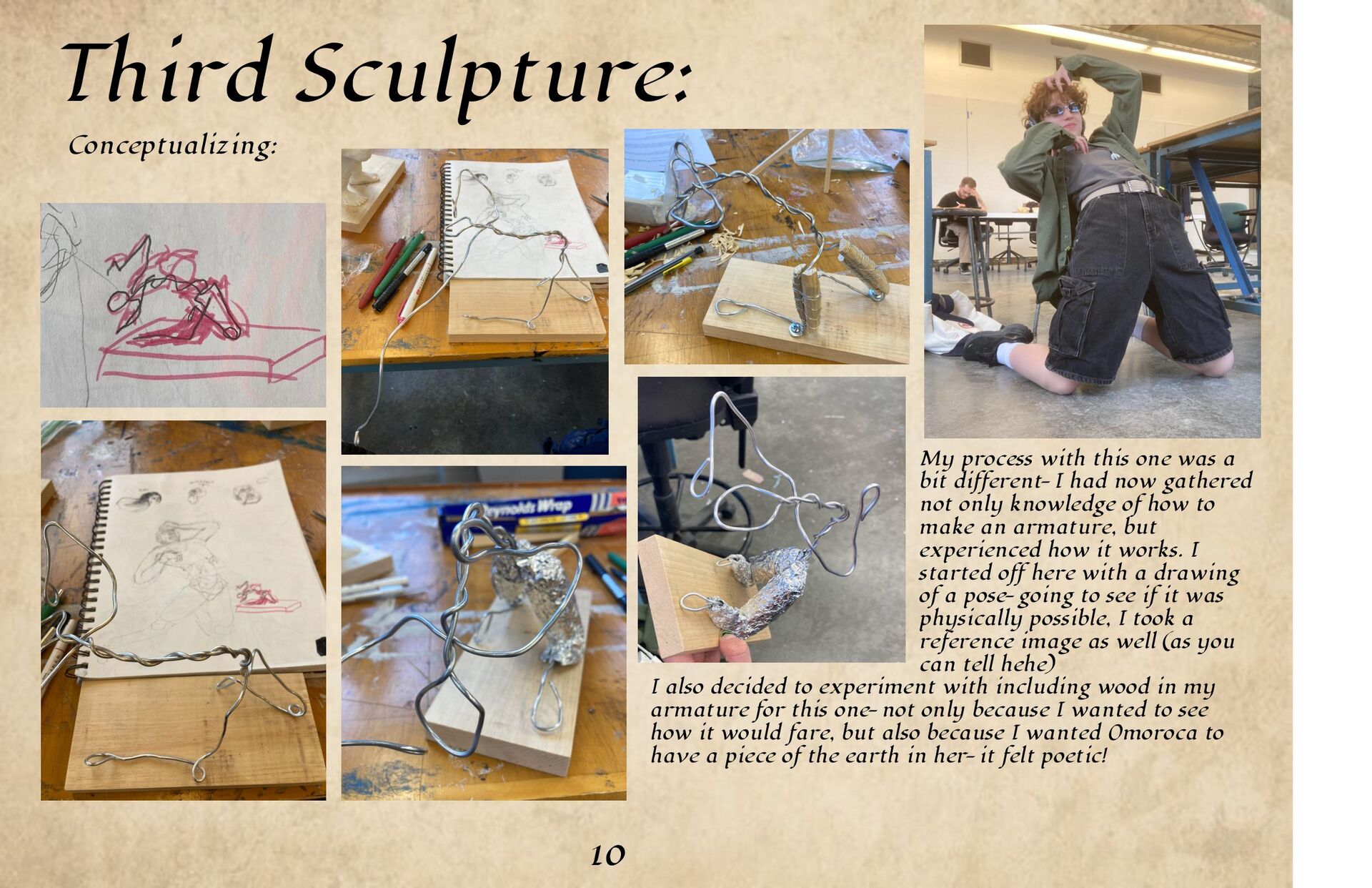
a bit different- I had now gathered not only knowledge of how to make an armature, but experienced how it works. I started off here with a drawing of a pose- going to see if it was physically possible, I took a reference image as well (as you can tell hehe) I also decided to experiment with including wood in my armature for this one- not only because I wanted to see how it would fare, but also because I wanted Omoroca to have a piece of the earth in her- it felt poetic!
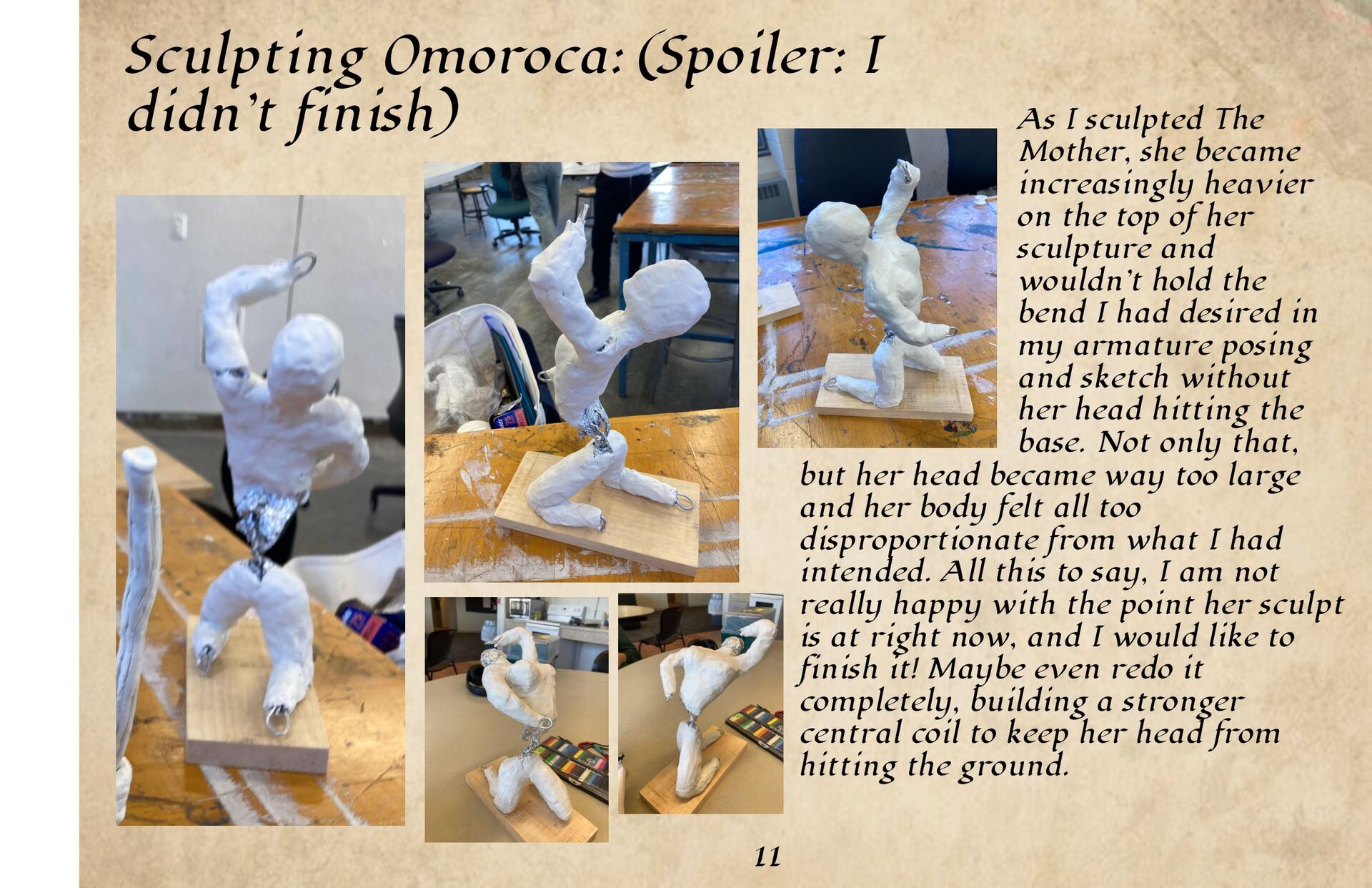
The Mother, she became increasingly heavier on the top of her sculpture and wouldn’t hold the bend I had desired in my armature posing and sketch without her head hitting the base. Not only that, but her head became way too large and her body felt all too disproportionate from what I had intended. All this to say, I am not really happy with the point her sculpt is at right now, and I would like to finish it! Maybe even redo it completely, building a stronger central coil to keep her head from hitting the ground.
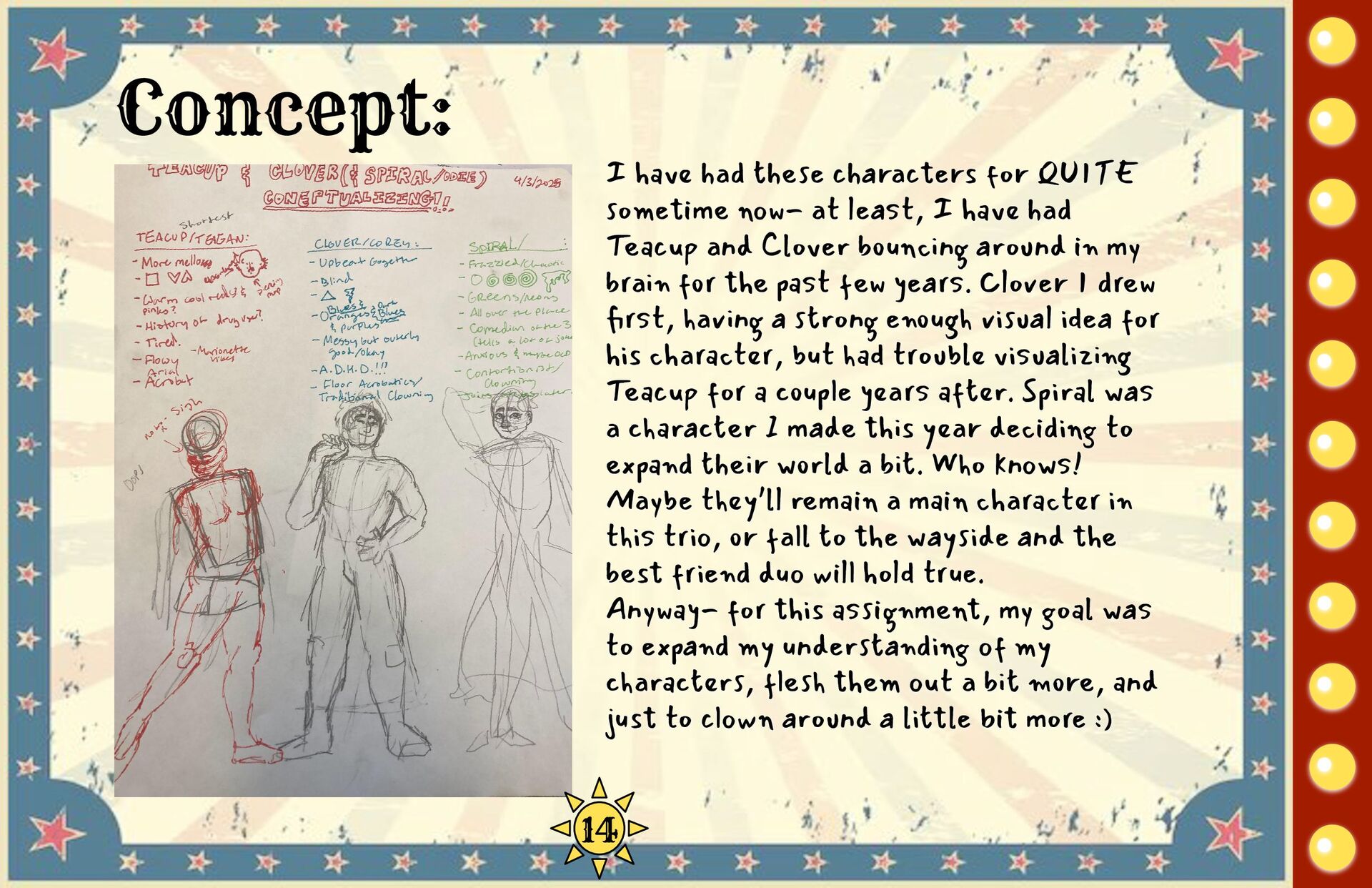
or E so me - at t, I h ad Te an lo b u n on m ba f he t e y. Co r de fit, a n s on ug is i fo hi ha t , ut to l ili g Te fo c u y a f . Si l a c ce me h ar di to ex d er l a b. Wo n! Ma t ’l em a m ha t i ti ti, r a l o h si n he be fi d u w ho tu. An y- fo hi s me , m ol to x d un s di f ca c s, es he t a b re, n ju to w on li l mo :)
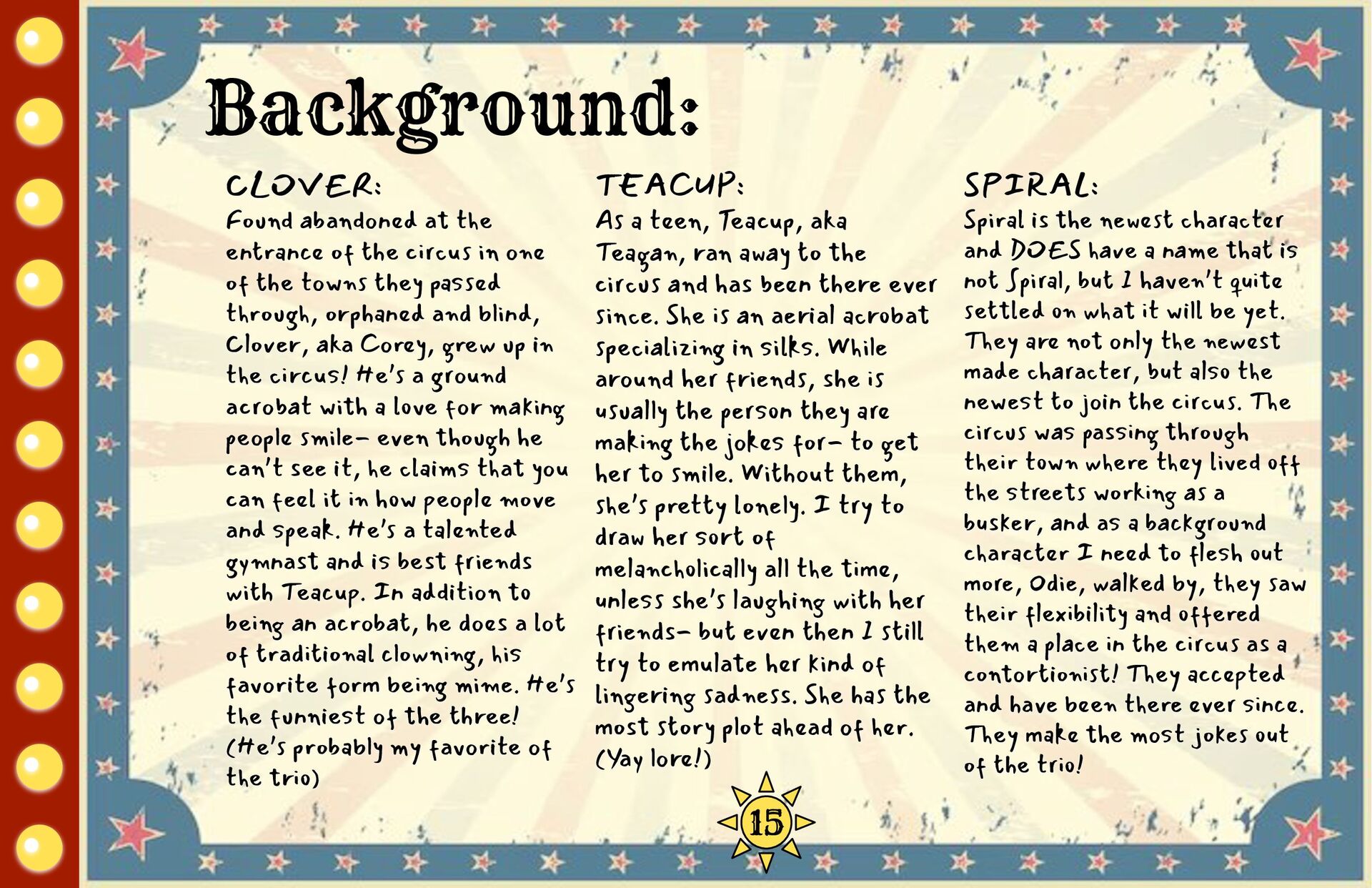
en n of e c s i of e t s ey s t og, or n a d in, Co r, ka y, ew te r ! He’s a g d ac t i h l e r in pe si - ev ho he ca’t e t, e l ta y ca l i h ep ov an pe. He’s a t te g na n be fi d wi Te . In ti be n a b, e d a l of ad o l ow g, i fa te m e g i . He’s te n et he re! (He’s ob y fa te f te r ) TE : As t e, ec , ak Te , ra y o h ci s ha n er ev si . Se s ar a r a se li g il. Wi ar he ri s, e s us y e p n ey ma g e j fo- to he s e. Wi t em, se’s et lo y. I t to da h r o me c ic y a te m , uns e’s a h wi he fi d- bu n en s l t to m a h in li r sa s. Se s e mo so y ot a f . (Ya r !) SI L: Si l he s ha t an OS e ne h no pi , bu he ’t u se l wa t l e t. Te r o n te w ma ha t, ut te net o n e c s. Te ci s pan ho h te t we t li f te te s o k s a bu r, n a b go d ca c I n o fh ut mo, di, w ed , te sa te fe b i y f e d te p e n e c s a co r o s! Te c te an av e te ve n . Te m he t o s ut of e t !
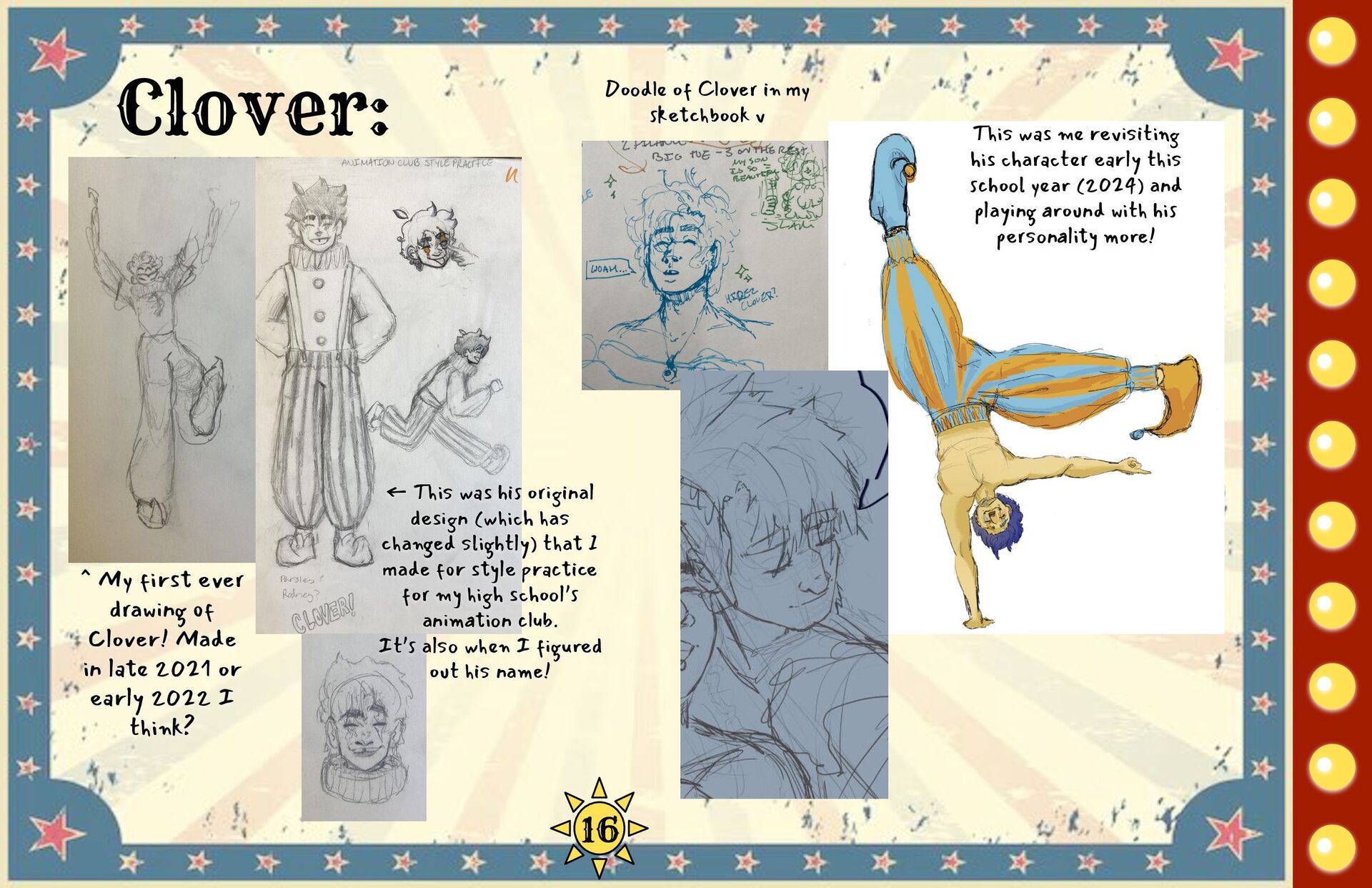
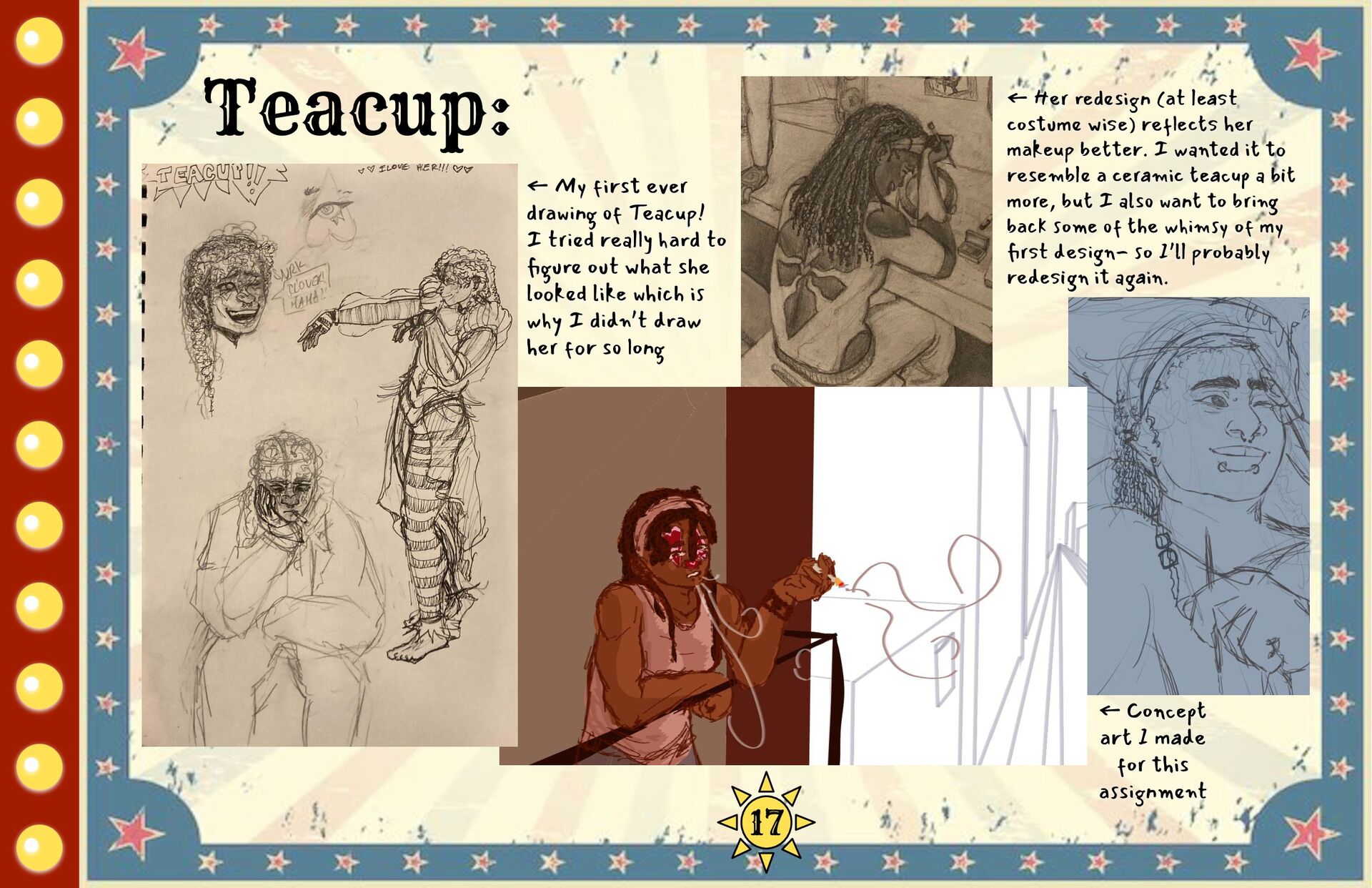
I t re y a d to fi ot at e lo li h is w I d ’t aw he r on ← Co p ar me fo hi as n t ← He d i n (at t co m i) re c he ma be r. I w d i re b a c ic up b mo, b I l an o b g ba so f e w s o m fit eg- so ’l ro l re g i gi.
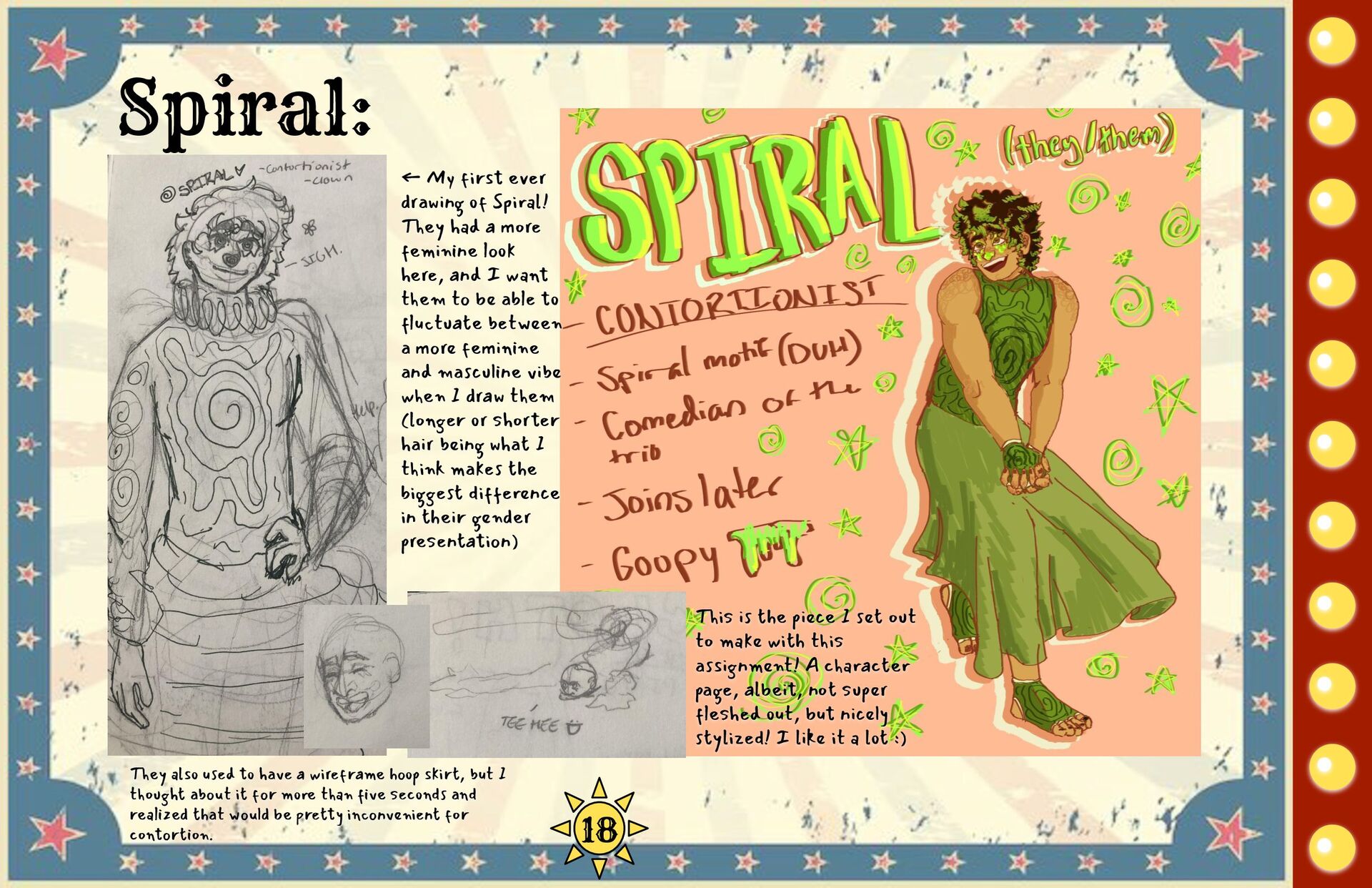
Te h mo fe ne he, n I w te t ab fu te t e a m em e an as ne we d te (lo r ho r ha in ha ti k a s e bi s if ne in er de pen in) Te l us ha wi re p ir, ut to h a t i r e t f e c s a re ed at d e r y i n in or co r o . Ti s e p e s ot to wi ti as n t! A c ce pa , le , no p feh ut, u n y s li ! I l it l :)
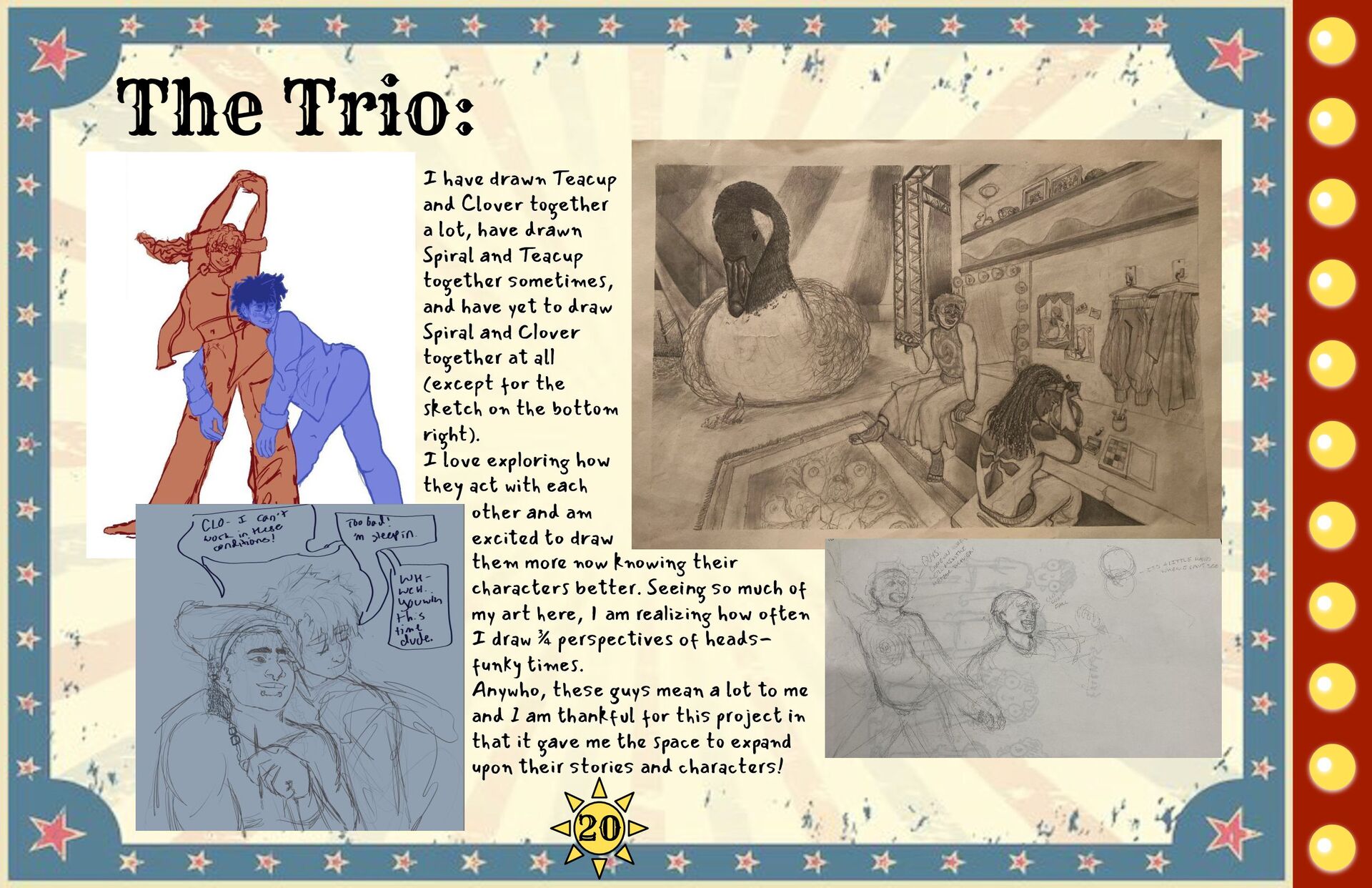
e h a l, av w Si l Te to h om es, an av to w Si l Co r to h a l (ex t o te se c o te t ri t). I l ex r ho te c it c ot n a ex d o r te m ow ow te ca c s e t. Se n o m f m a t e , am iz ho of I d ¾ pep ve h a- fu y i s. An ho, te g me lo m an m an l ti po c ta t e m sa t ex d up he to an ha t !
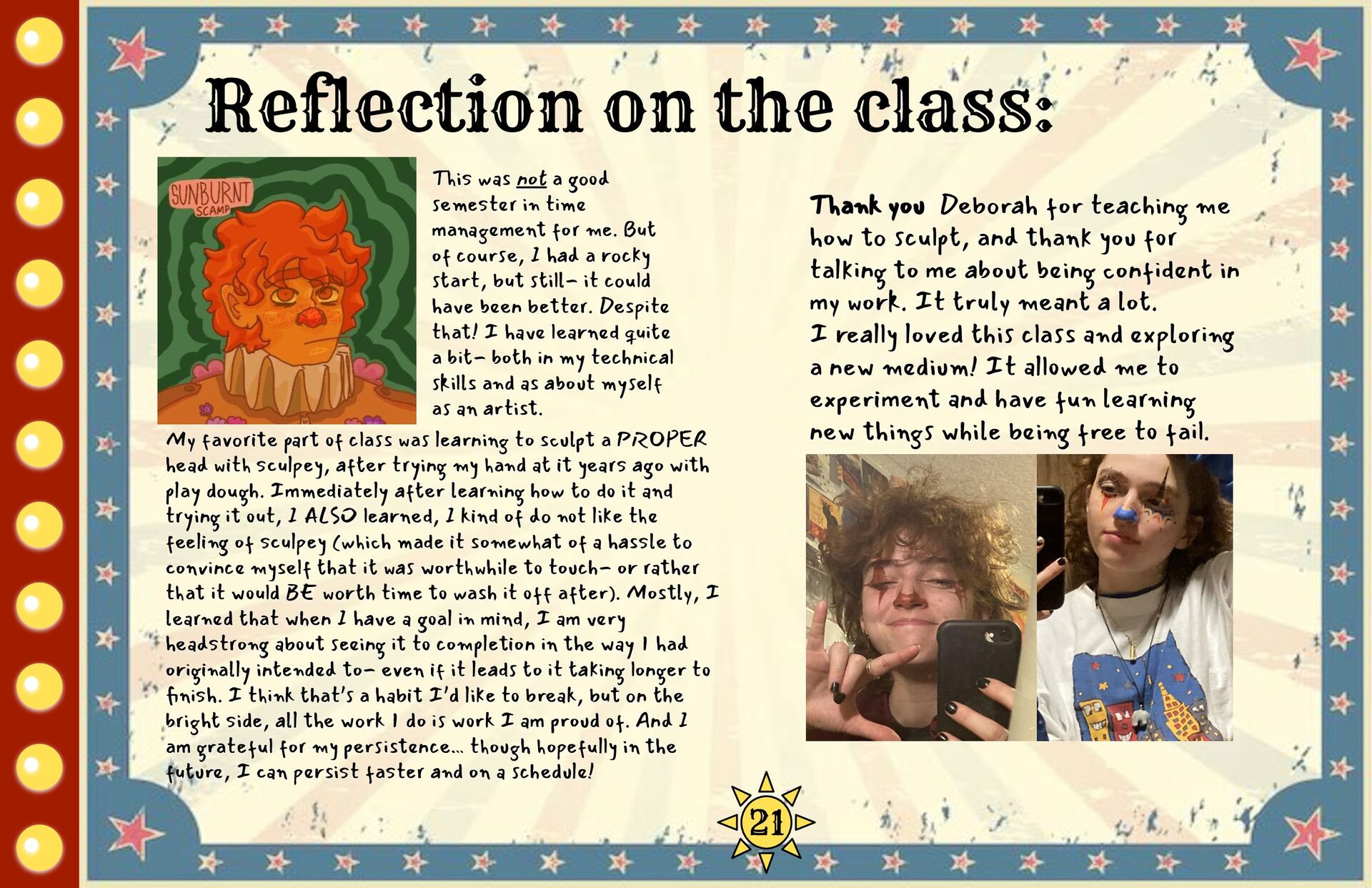
set i t ma me fo . Bu of se, h a r y sa t, u si l- it d ha en t . De t ta ! I h er qu a b- bo n te n si l a d ot se as ti . M av e p f as as ni to l a P R he t cu y, fe t in y a d ye go h pa d . Im at fe l in ow it t in ut, LO re , k of t i t fe g o cu y (wi h a t o w of hle co n ye f at s o t hi to - or h ta t u d E r ti wa t af ). Mo l, I le d at en he g a m , I m y heto g u s in t o p on he ha or al in d o- ev it s o t in on t fih. I t k at’s a h I’d i t ek, u n e bi h id, l he k do s k I m od . An am at fo y e s ne… to h o f y i he fu , I c rit at d o s ed ! Ta k o De h o t in e ho s p, an ha yo f ta n o m bo in on n in m or. It ul en lo. I r y o d is as d lo g a n di! It we t ex me n av le n ne hi s il i g e t a .

 Your Podcast. Everywhere. Effortlessly.


 scrampped
 jakevdp
 mayatellez
 codingconduct
 gr2m
gr2m
 rmw
rmw
 varn
varn
 cassininazir
 aleyda
 michielstock
 nikkihalliwell
.jpg) cargoodrich
cargoodrich
 kimpetersen