Upgrade to Pro — share decks privately, control downloads, hide ads and more …

Building Bridges from Asia to Global Open Sourc...

Sponsored · Your Podcast. Everywhere. Effortlessly. Share. Educate. Inspire. Entertain. You do you. We'll handle the rest.
Avatar for Shu Muto Shu Muto
August 08, 2026
50

Building Bridges from Asia to Global Open Source - COSCUP 2026 Prime Session

Open source is not only software we use, but a way for engineers, students, companies, communities, and even countries to learn and grow together. However, many people in Asia still face barriers when trying to join global open source communities: language, cultural distance, lack of confidence, and limited organizational support.
In this keynote, I will share how we have approached these challenges in Japan through Kubernetes Upstream Training Japan, Cloud Native Community Japan, localization activities, and corporate open source strategy. These efforts started as local-language onboarding, but gradually evolved into a pathway that helps users take their first steps toward real upstream contribution.
I will also discuss why sustainable contribution cannot depend only on heroic individuals. Companies, universities, OSPOs, policy makers, foundations, and local communities all have roles to play in building participation infrastructure. Through Japan’s experience, I hope to explore how Asian communities can learn from each other and build stronger bridges to global open source.

Avatar for Shu Muto

Shu Muto

August 08, 2026

Transcript

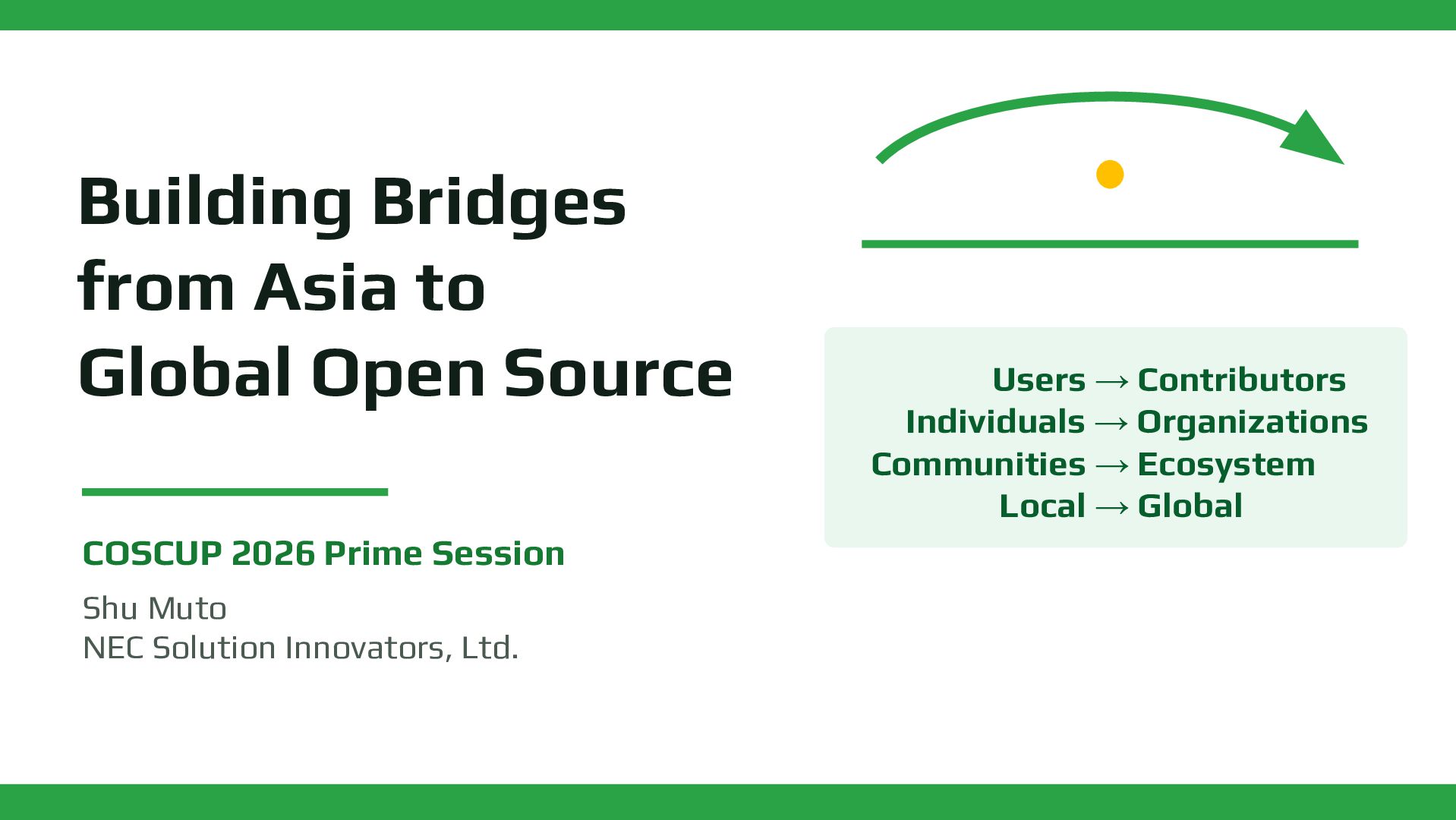
  1. Building Bridges from Asia to Global Open Source COSCUP 2026

    Prime Session Shu Muto NEC Solution Innovators, Ltd. Users → Contributors Individuals → Organizations Communities → Ecosystem Local → Global
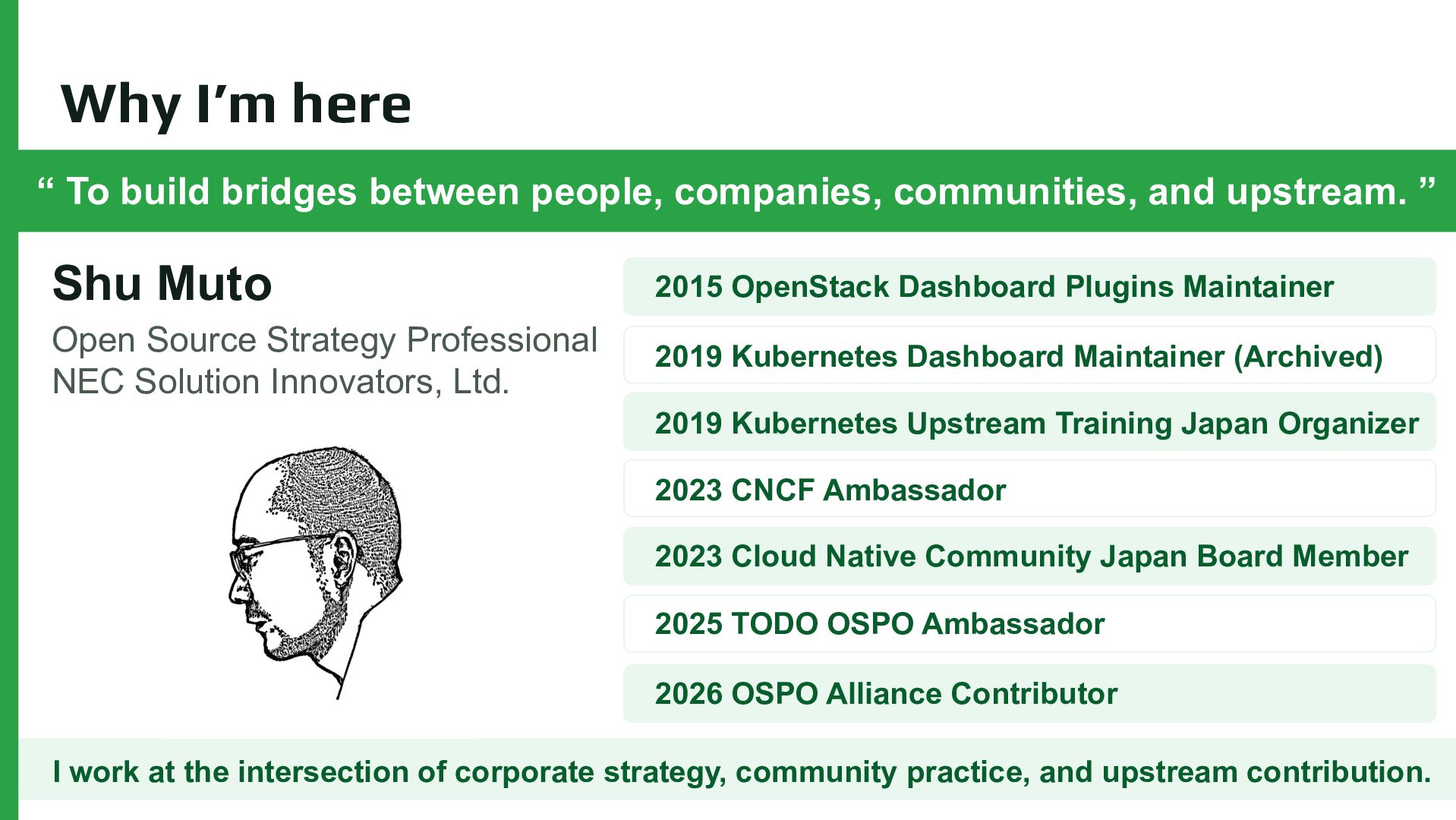
  2. Why I’m here “ To build bridges between people, companies,

    communities, and upstream. ” Shu Muto 2015 OpenStack Dashboard Plugins Maintainer Open Source Strategy Professional NEC Solution Innovators, Ltd. 2019 Kubernetes Dashboard Maintainer (Archived) 2019 Kubernetes Upstream Training Japan Organizer 2023 CNCF Ambassador 2023 Cloud Native Community Japan Board Member 2025 TODO OSPO Ambassador 2026 OSPO Alliance Contributor I work at the intersection of corporate strategy, community practice, and upstream contribution.
  3. The core idea Local communities are not detours from global

    open source. They are bridges to it. This is a key story about participation infrastructure, not only contribution counts.
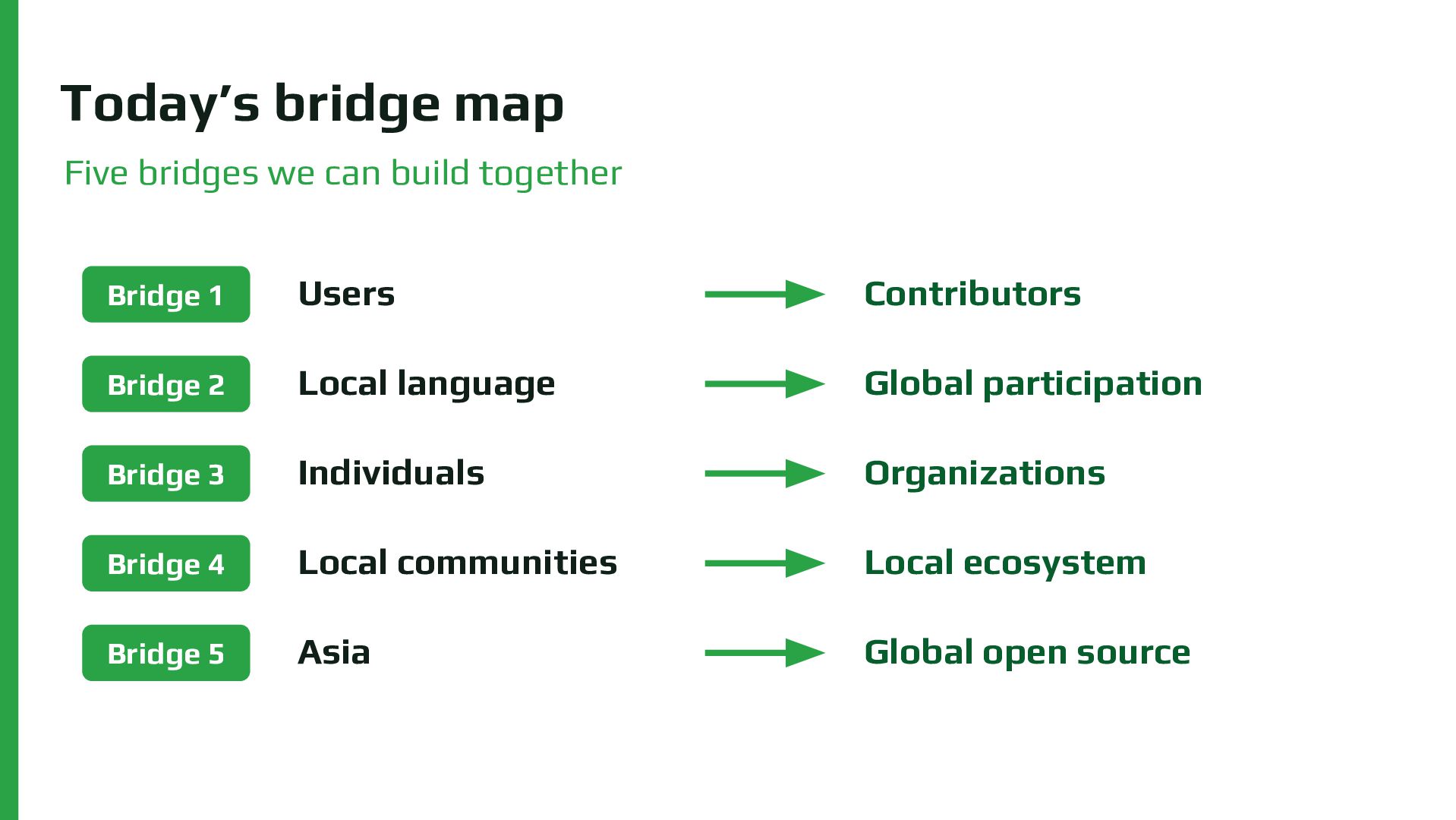
  4. Today’s bridge map Five bridges we can build together Bridge

    1 Users Contributors Bridge 2 Local language Global participation Bridge 3 Individuals Organizations Bridge 4 Local communities Local ecosystem Bridge 5 Asia Global open source
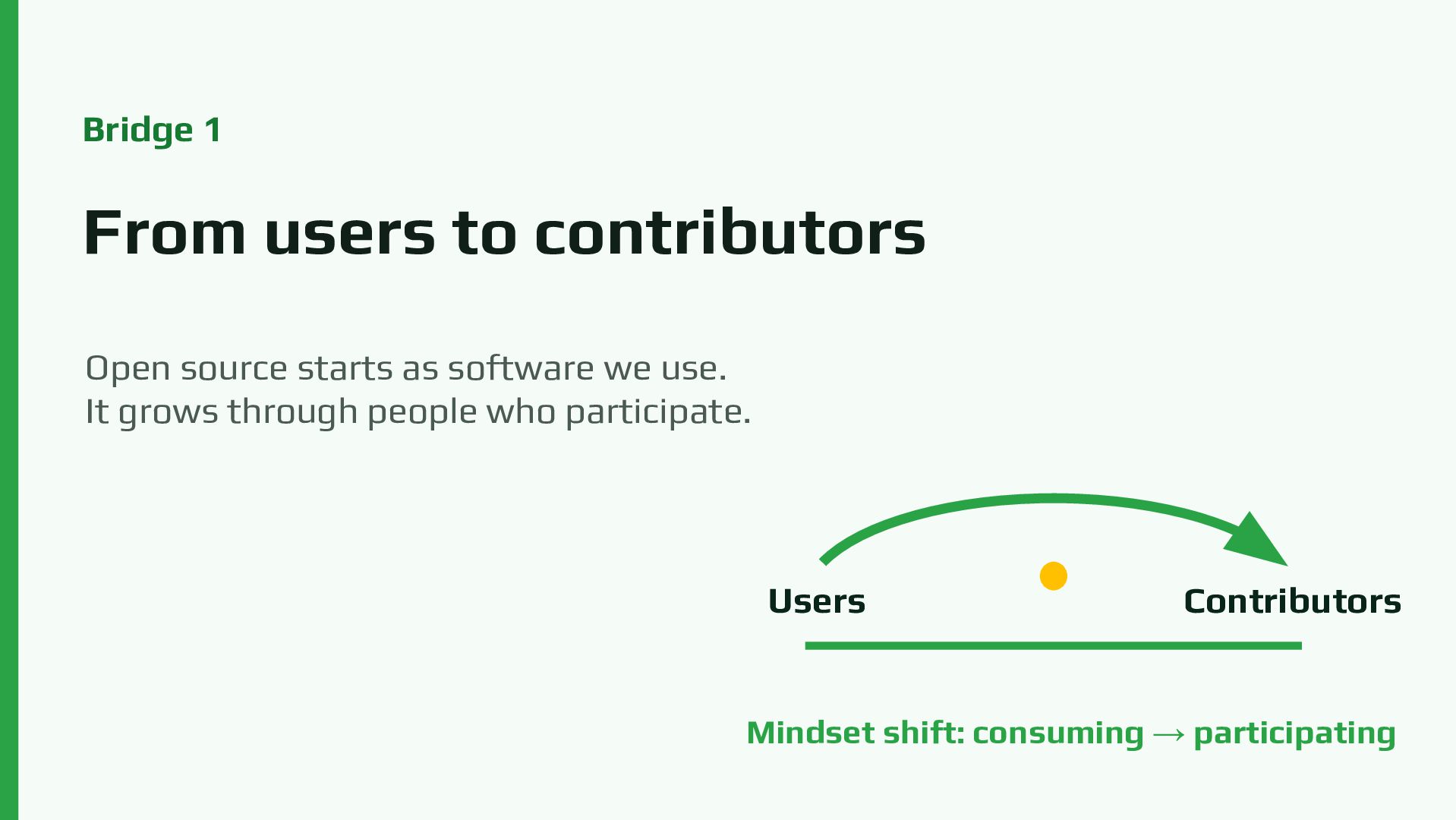
  5. Bridge 1 From users to contributors Open source starts as

    software we use. It grows through people who participate. Users Contributors Mindset shift: consuming → participating
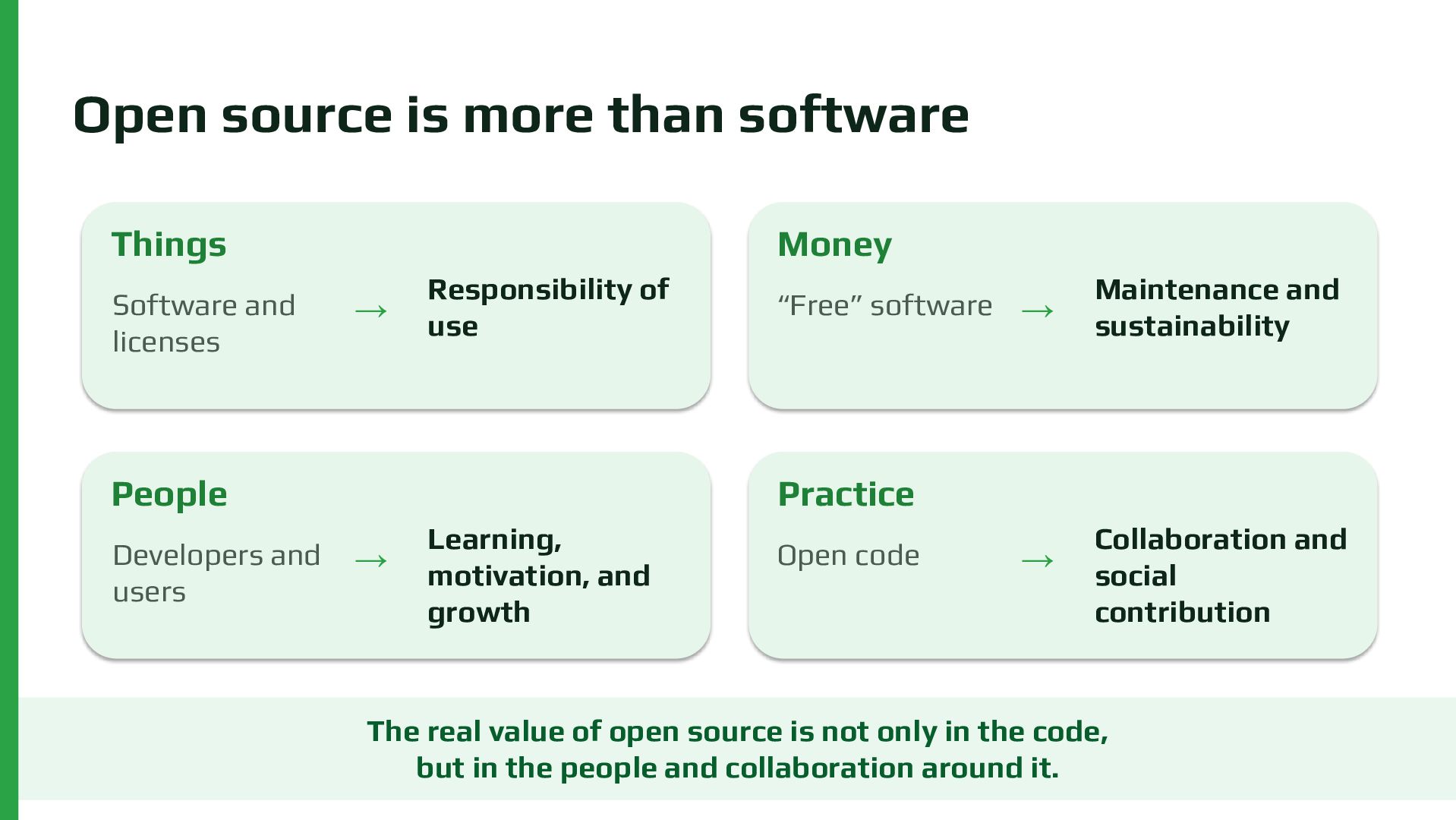
  6. Open source is more than software Things Software and licenses

    Money → Responsibility of use People Developers and users “Free” software → Maintenance and sustainability Practice → Learning, motivation, and growth Open code → Collaboration and social contribution The real value of open source is not only in the code, but in the people and collaboration around it.
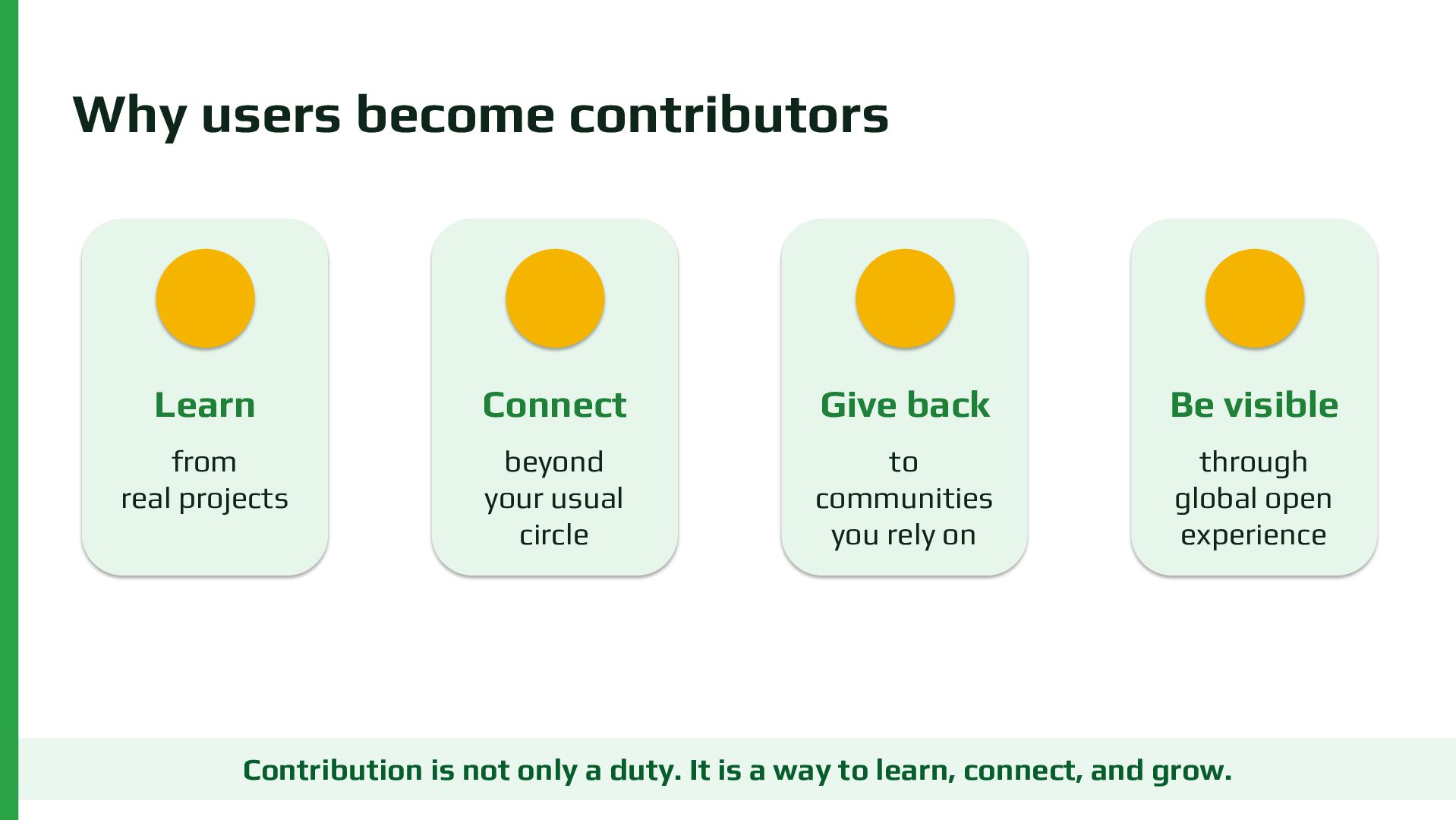
  7. Why users become contributors Learn Connect Give back Be visible

    from real projects beyond your usual circle to communities you rely on through global open experience Contribution is not only a duty. It is a way to learn, connect, and grow.
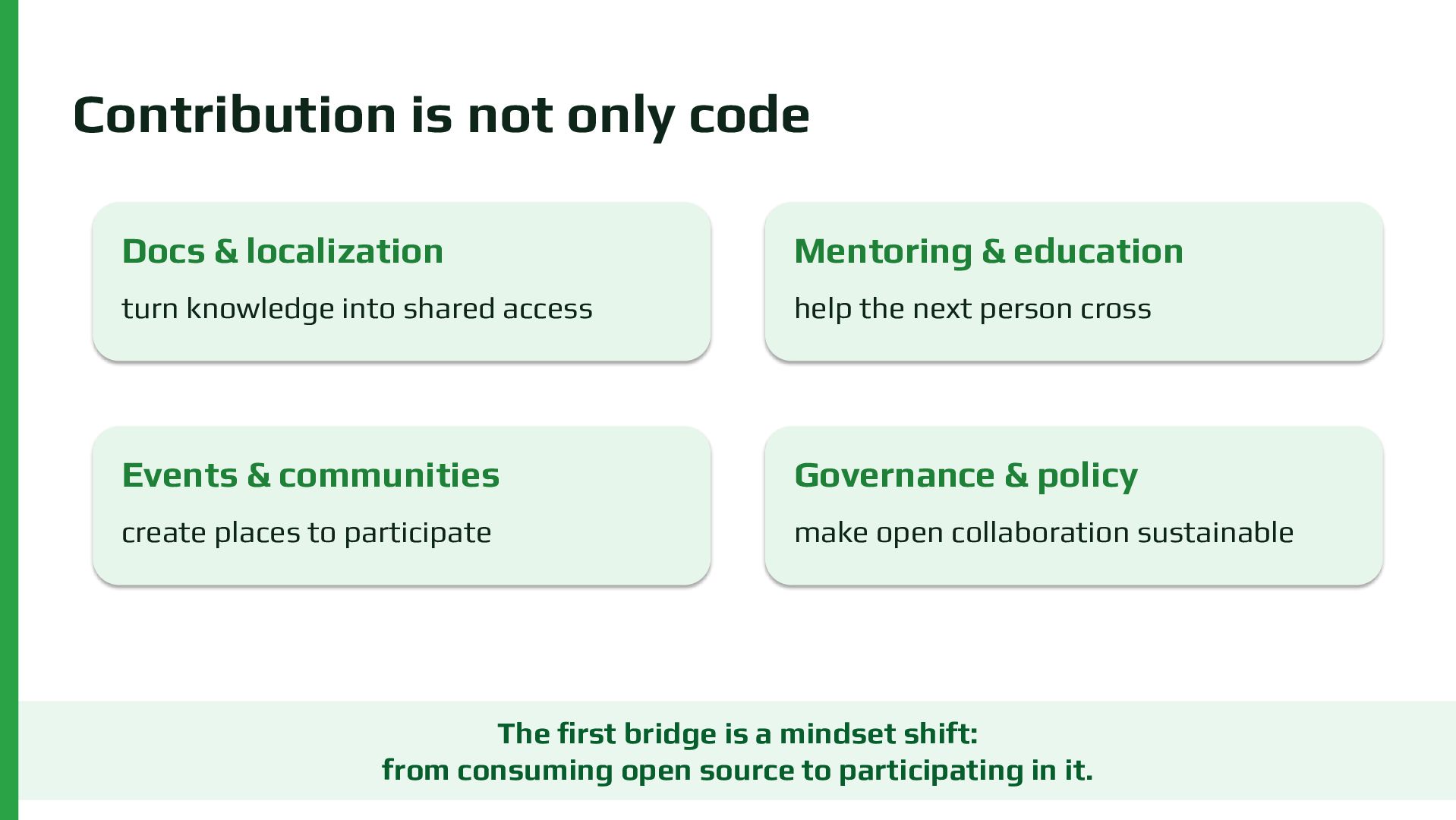
  8. Contribution is not only code Docs & localization Mentoring &

    education turn knowledge into shared access help the next person cross Events & communities Governance & policy create places to participate make open collaboration sustainable The first bridge is a mindset shift: from consuming open source to participating in it.
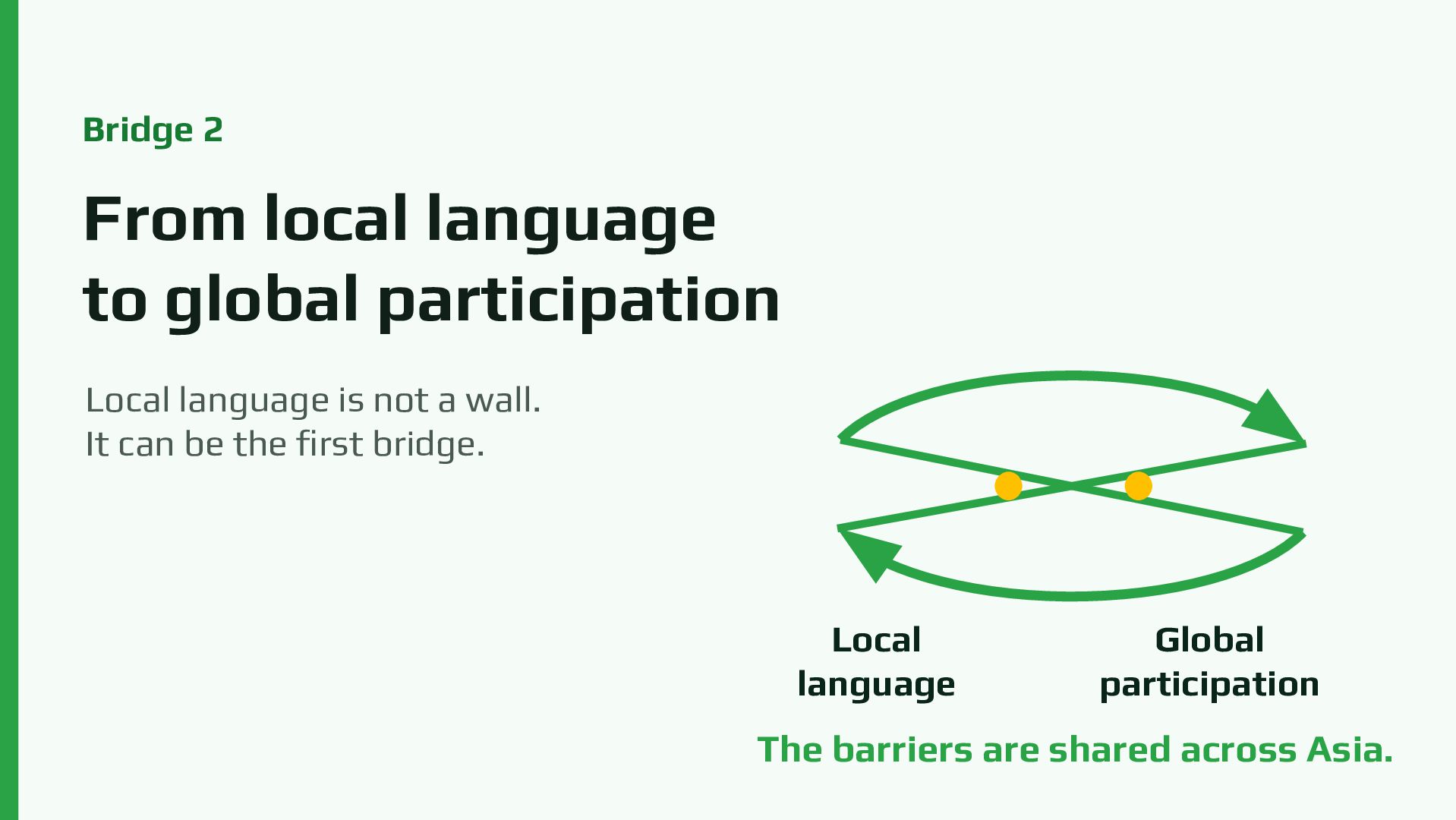
  9. Bridge 2 From local language to global participation Local language

    is not a wall. It can be the first bridge. Local language Global participation The barriers are shared across Asia.
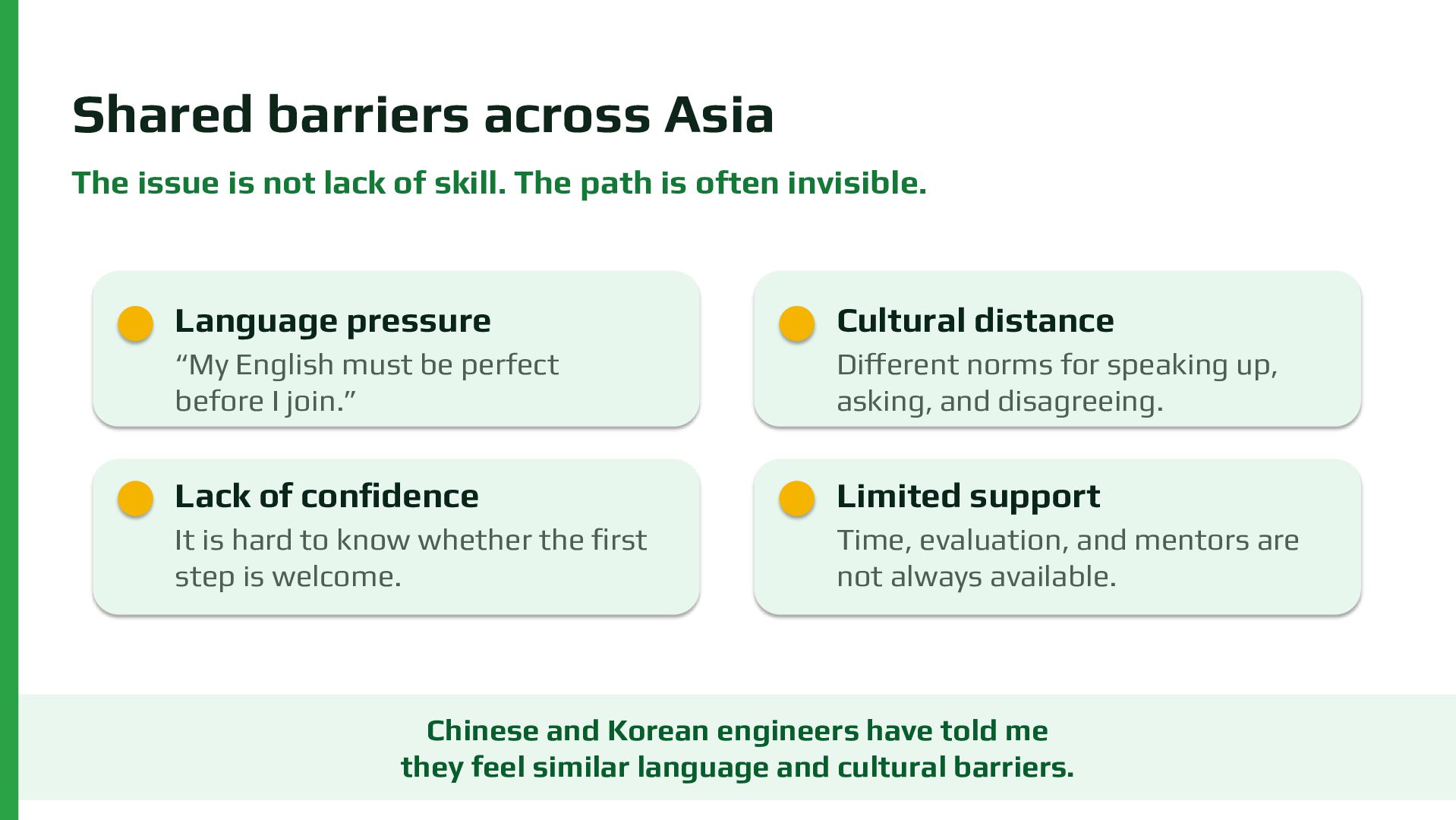
  10. Shared barriers across Asia The issue is not lack of

    skill. The path is often invisible. Language pressure Cultural distance “My English must be perfect before I join.” Different norms for speaking up, asking, and disagreeing. Lack of confidence Limited support It is hard to know whether the first step is welcome. Time, evaluation, and mentors are not always available. Chinese and Korean engineers have told me they feel similar language and cultural barriers.
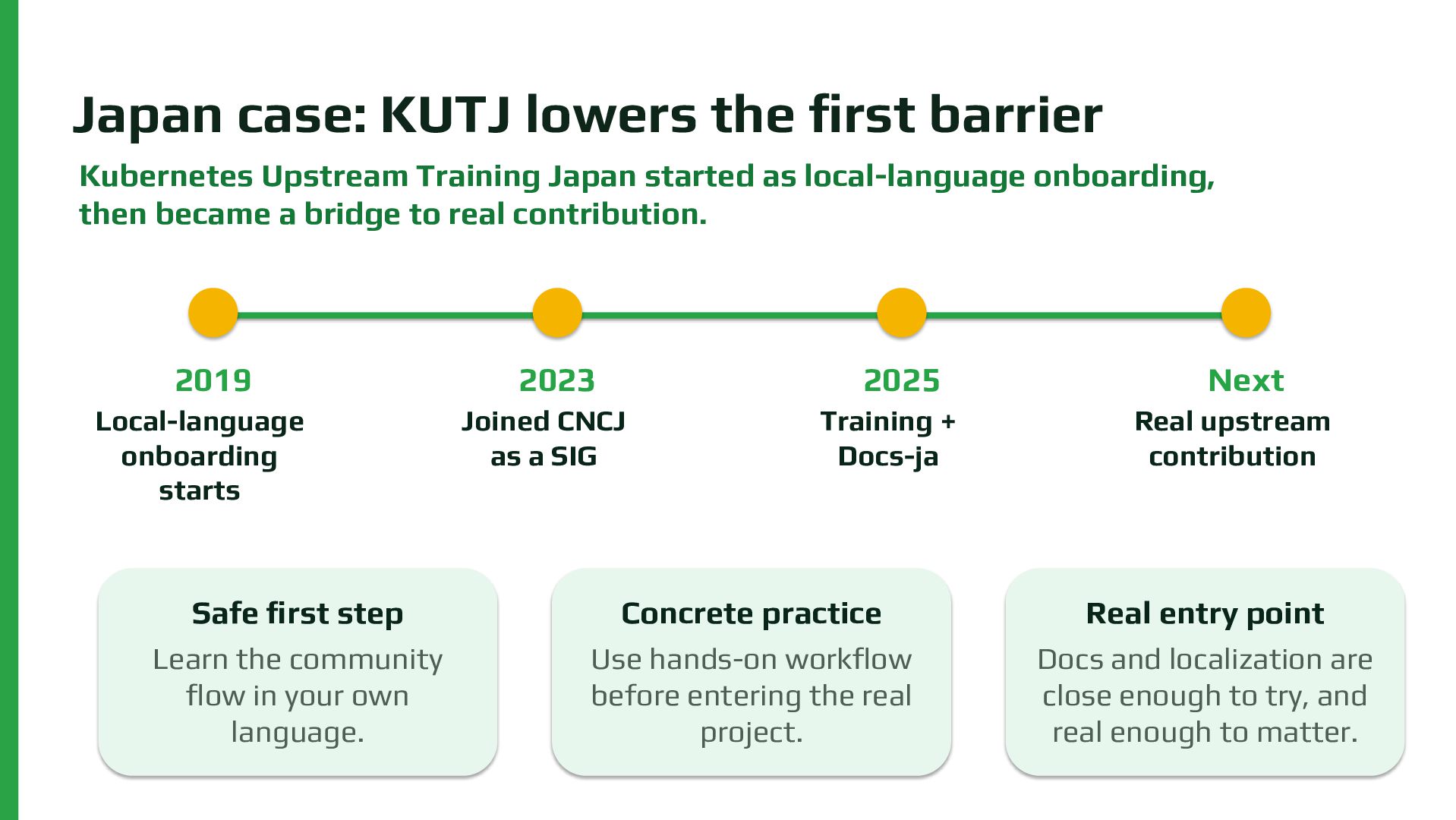
  11. Japan case: KUTJ lowers the first barrier Kubernetes Upstream Training

    Japan started as local-language onboarding, then became a bridge to real contribution. 2019 2023 2025 Next Local-language onboarding starts Joined CNCJ as a SIG Training + Docs-ja Real upstream contribution Safe first step Learn the community flow in your own language. Concrete practice Use hands-on workflow before entering the real project. Real entry point Docs and localization are close enough to try, and real enough to matter.
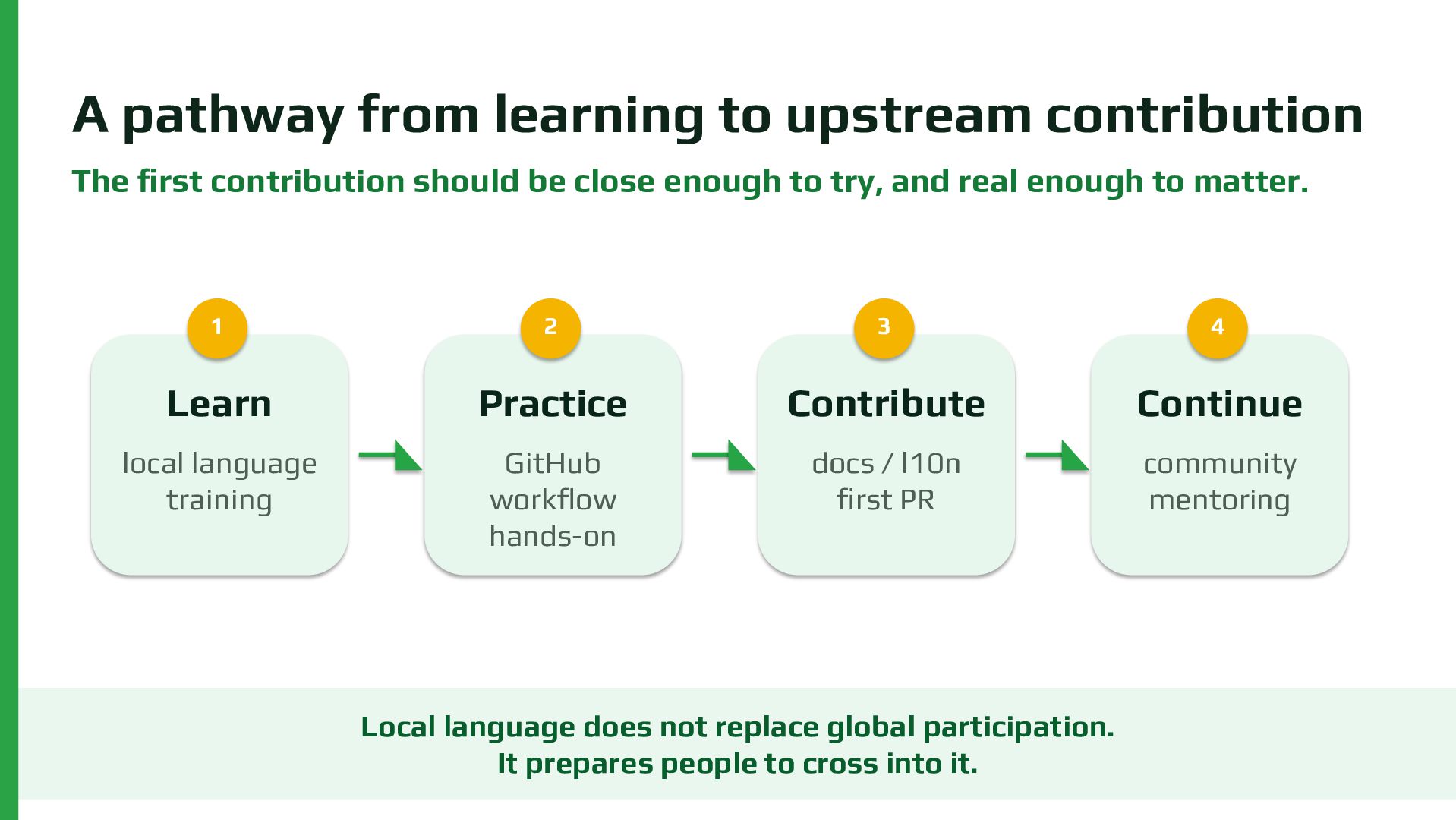
  12. A pathway from learning to upstream contribution The first contribution

    should be close enough to try, and real enough to matter. 1 2 3 4 Learn Practice Contribute Continue local language training GitHub workflow hands-on docs / l10n first PR community mentoring Local language does not replace global participation. It prepares people to cross into it.
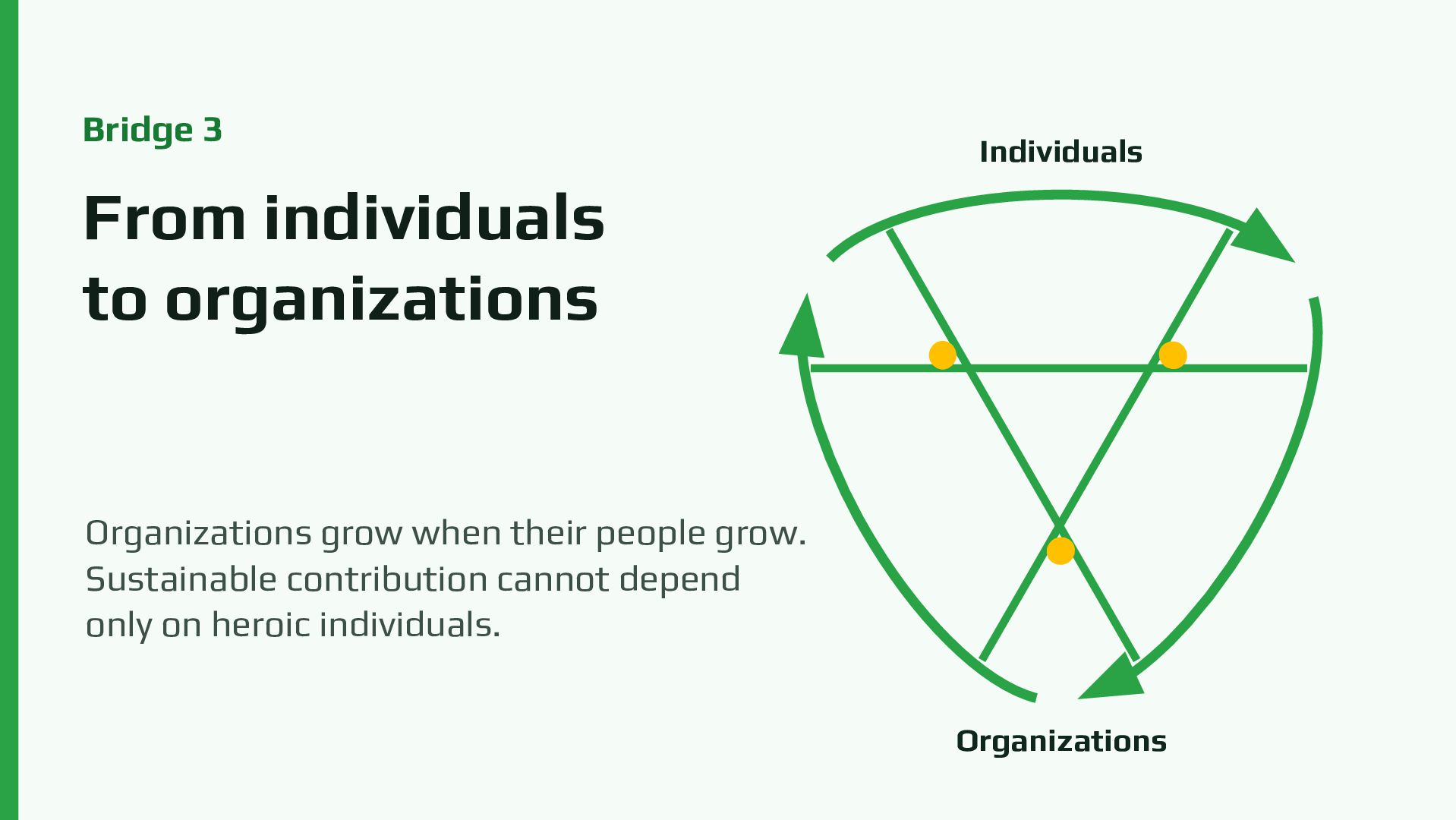
  13. Bridge 3 Individuals From individuals to organizations Organizations grow when

    their people grow. Sustainable contribution cannot depend only on heroic individuals. Organizations
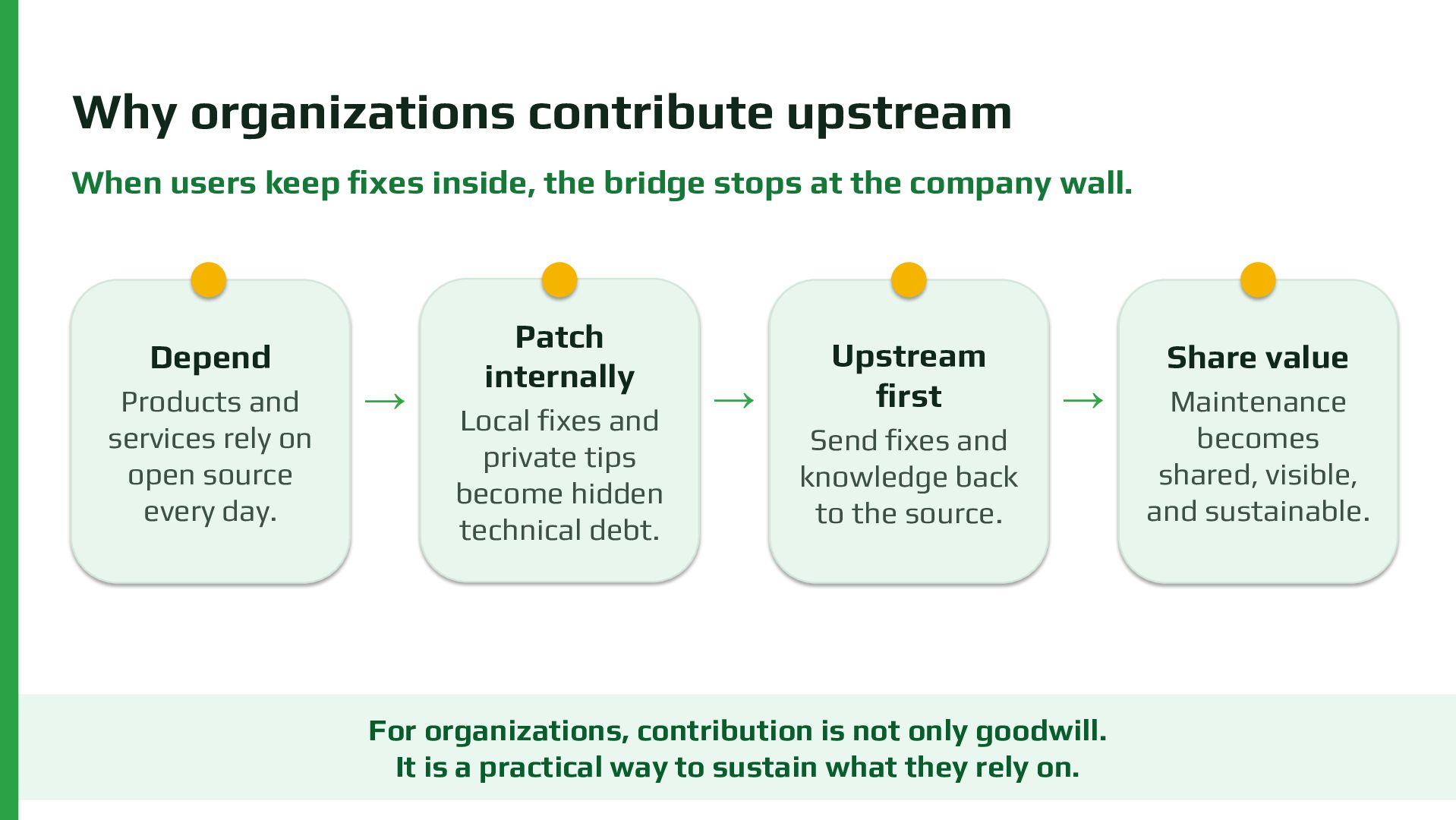
  14. Why organizations contribute upstream When users keep fixes inside, the

    bridge stops at the company wall. Depend Products and services rely on open source every day. → Patch internally Local fixes and private tips become hidden technical debt. → Upstream first Share value → Send fixes and knowledge back to the source. For organizations, contribution is not only goodwill. It is a practical way to sustain what they rely on. Maintenance becomes shared, visible, and sustainable.
  15. [1] 2021-9-6 https://digital-strategy.ec.europa.eu/en/news/commission-publishes-study-impact-open-source-european-economy [2] 2021-9-2 https://digital-strategy.ec.europa.eu/en/library/study-about-impact-open-source-software-and-hardware-technological-independence-competitiveness-and [3] 2026-2 https://www.linuxfoundation.org/research/contribution-roi The

    traditional answer was true The upstream contribution to reduced risk was measured as some metrics. GDP +0.5% “an increase of 10% in contributions to Open Source Software code would annually generate an additional 0.4% to 0.6% GDP” by EU[1] Contributors and Revenue “A significant positive correlation was revealed only between them” by EU[2] ROI 2–5× 90%+ “Benefit-to-cost ratio from OSS contribution across engagement types.” by LF[3] “Ad hoc contributors in mature large-company contribution patterns.” by me using DevStats data These are strong business reasons — but they are not the whole story. Risk reduction explains why organizations start. It does not fully explain why people stay, grow, and bring open collaboration back inside.
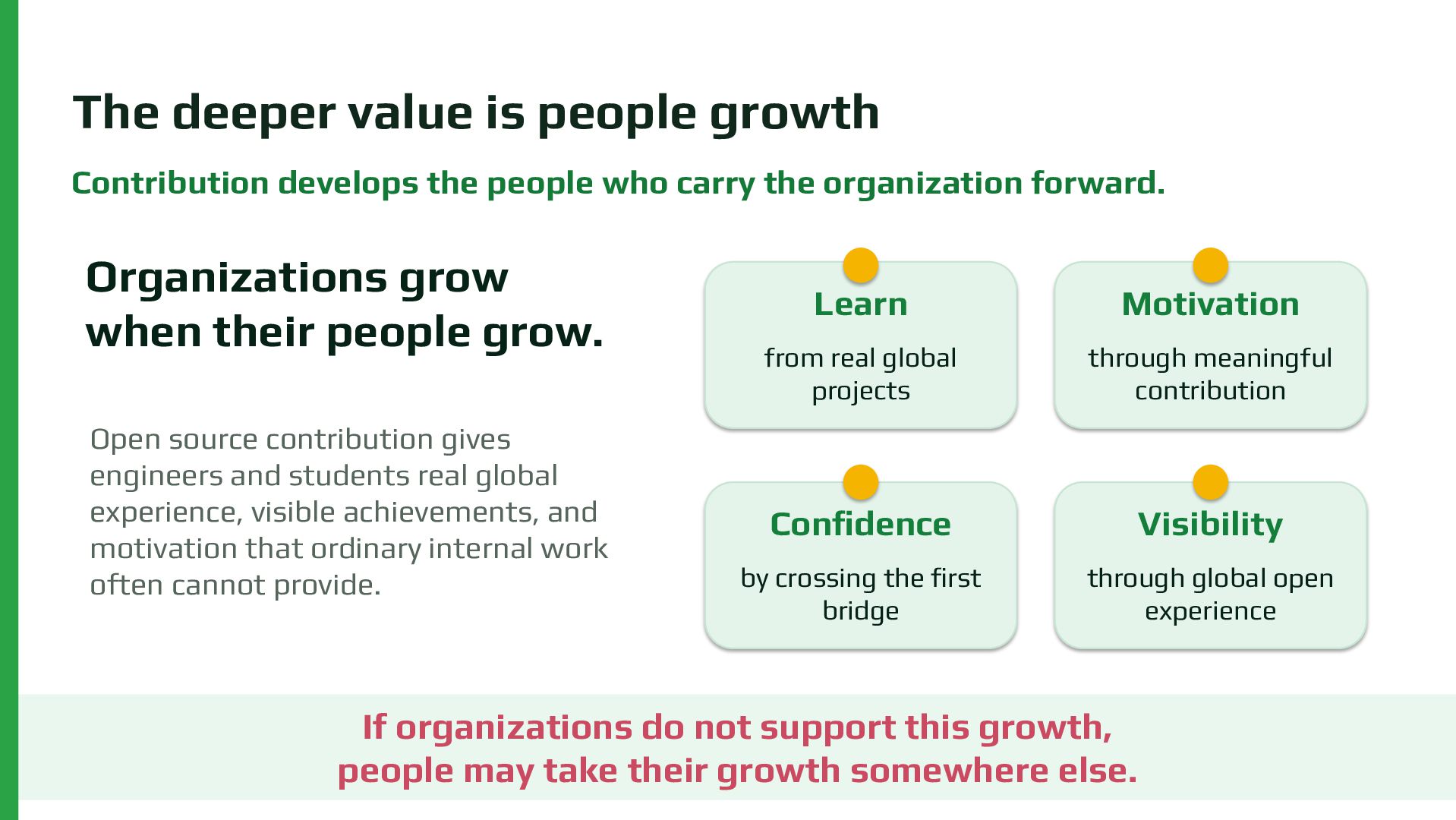
  16. The deeper value is people growth Contribution develops the people

    who carry the organization forward. Organizations grow when their people grow. Open source contribution gives engineers and students real global experience, visible achievements, and motivation that ordinary internal work often cannot provide. Learn Motivation from real global projects through meaningful contribution Confidence Visibility by crossing the first bridge through global open experience If organizations do not support this growth, people may take their growth somewhere else.
  17. [3] 2026-2 https://www.linuxfoundation.org/research/contribution-roi Individual value becomes organizational value The “people”

    benefits from Bridge 1 are not soft side effects. 68% say OSS contribution makes hiring and retaining talent easier 49% rate the benefit of accelerating developer skill growth through contributions as high or very high. Individual value 78% report becoming more efficient at contributing over time by LF[3] Organizational value Learning → Technical capability Motivation → Engagement and retention Global experience → Reputation and recruiting Open collaboration → Organizational culture People growth becomes organizational capacity.
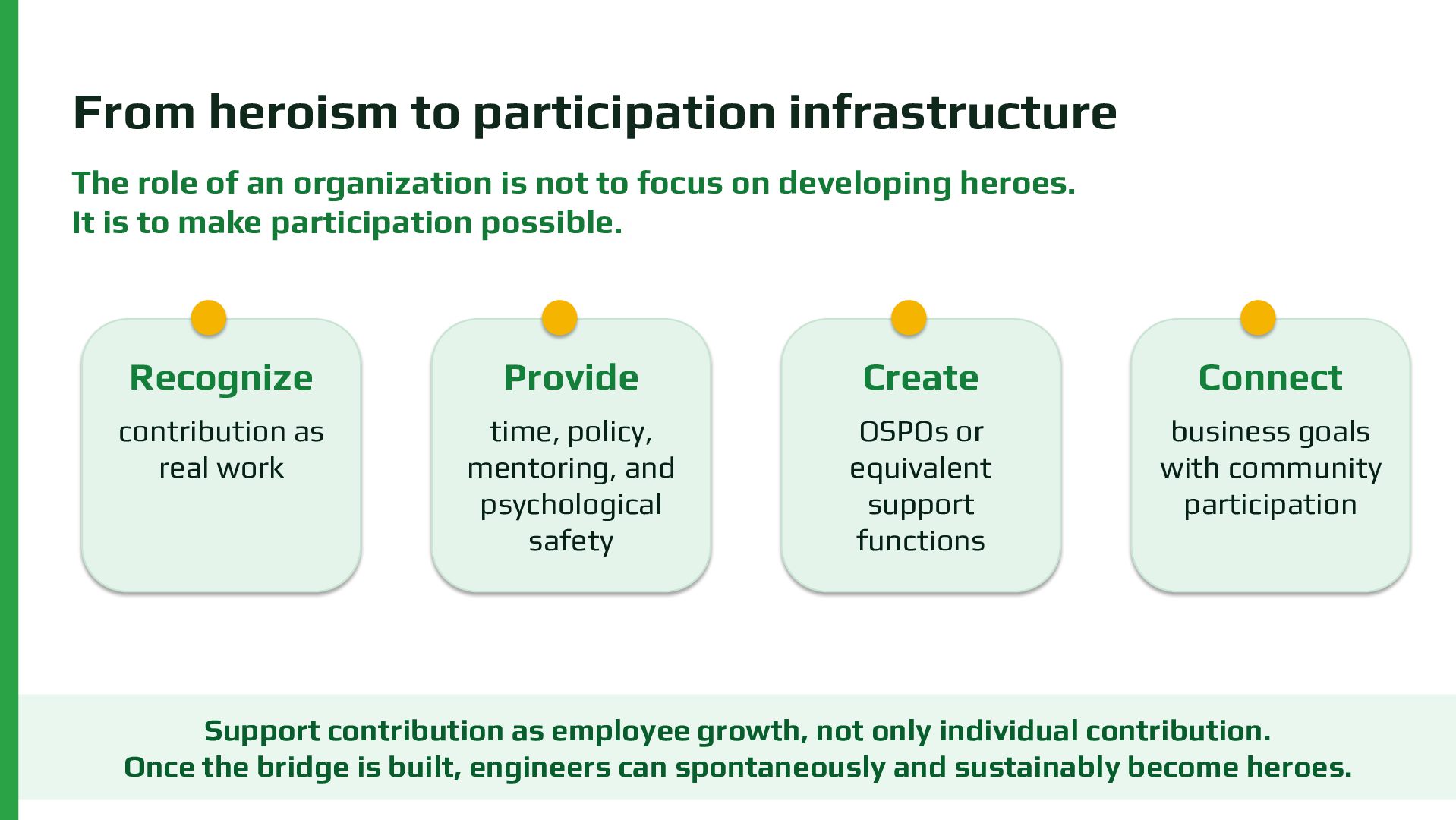
  18. From heroism to participation infrastructure The role of an organization

    is not to focus on developing heroes. It is to make participation possible. Recognize Provide Create Connect contribution as real work time, policy, mentoring, and psychological safety OSPOs or equivalent support functions business goals with community participation Support contribution as employee growth, not only individual contribution. Once the bridge is built, engineers can spontaneously and sustainably become heroes.
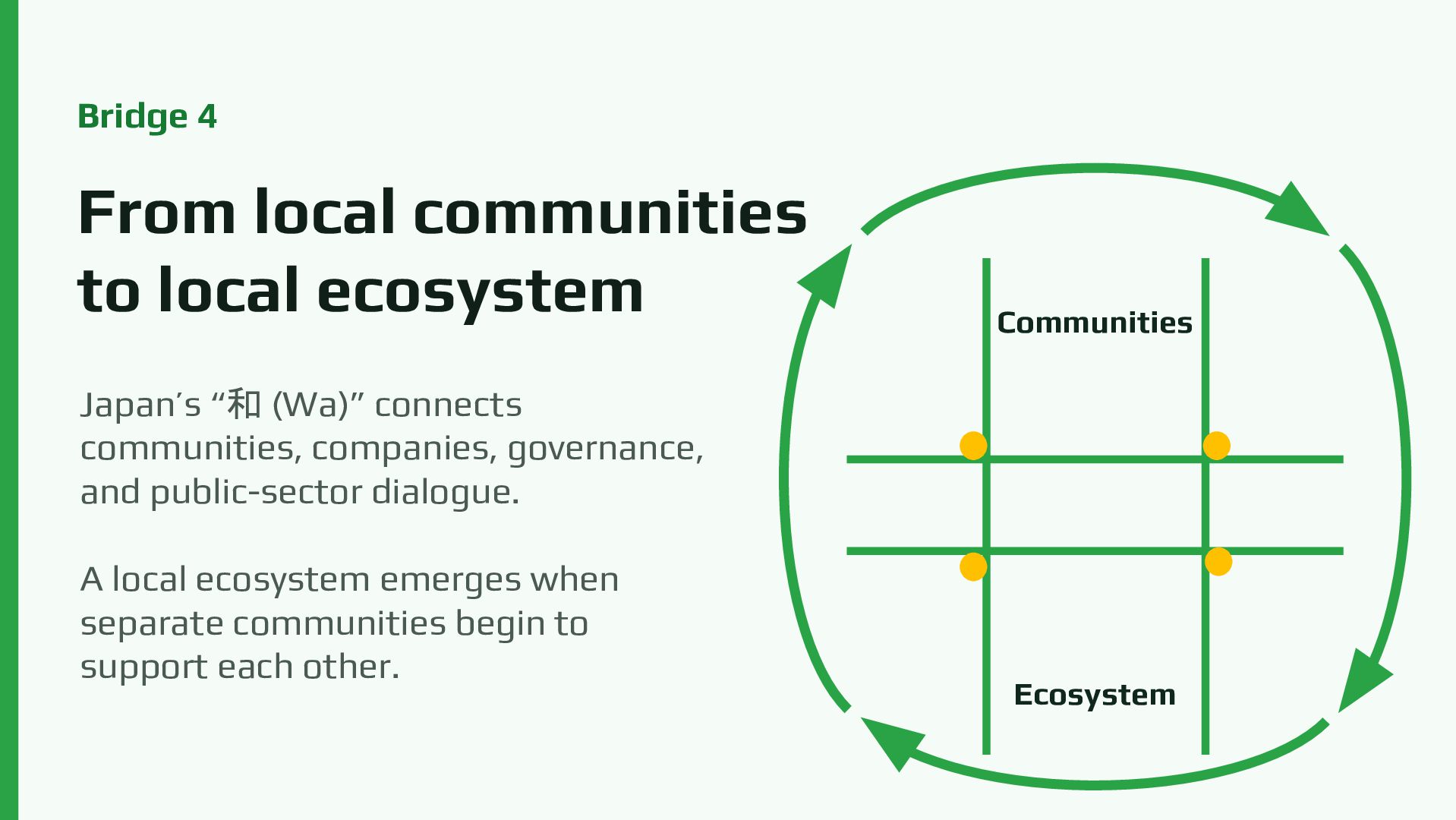
  19. Bridge 4 From local communities to local ecosystem Communities Japan’s

    “和 (Wa)” connects communities, companies, governance, and public-sector dialogue. A local ecosystem emerges when separate communities begin to support each other. Ecosystem
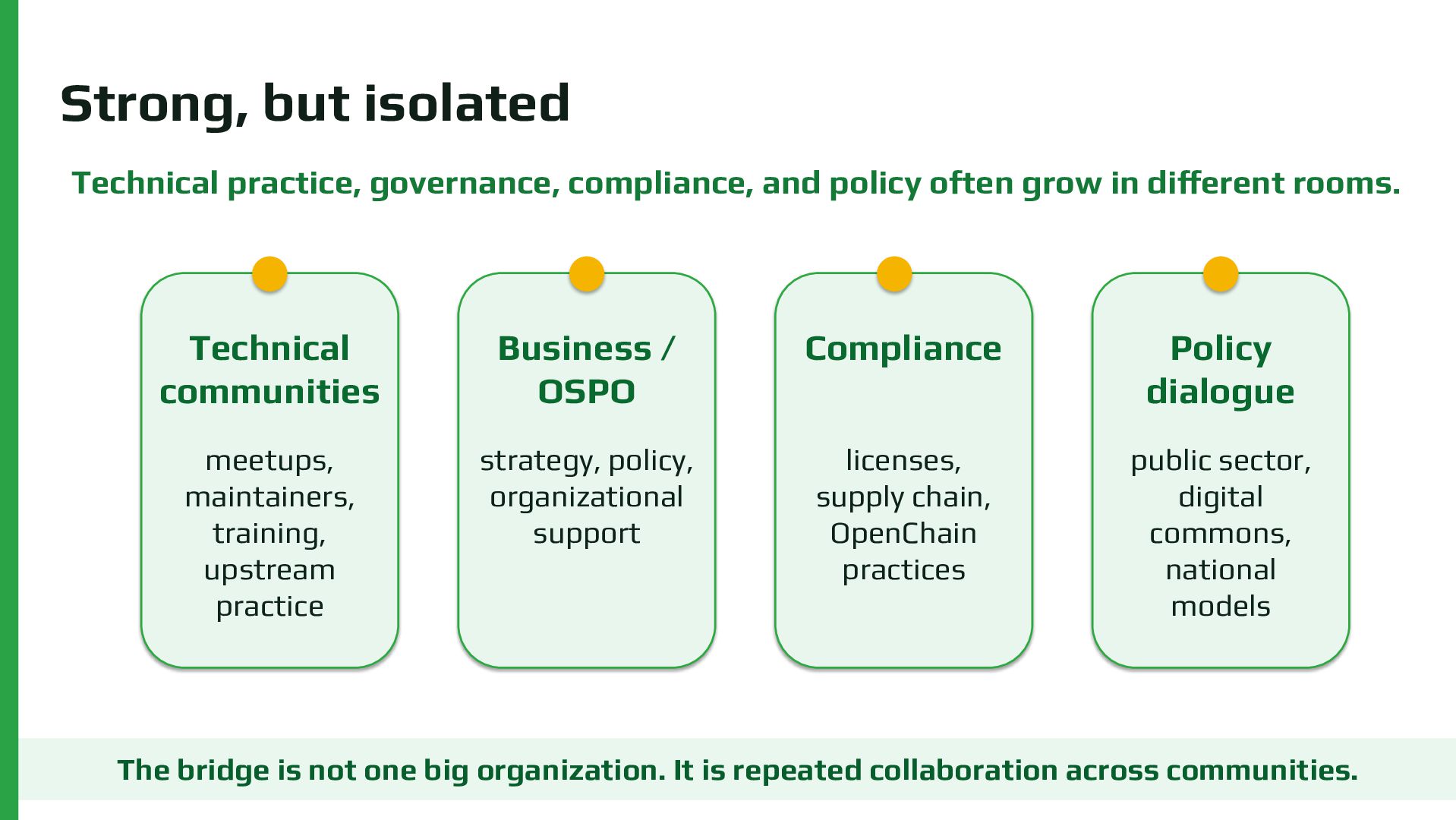
  20. Strong, but isolated Technical practice, governance, compliance, and policy often

    grow in different rooms. Technical communities Business / OSPO Compliance Policy dialogue meetups, maintainers, training, upstream practice strategy, policy, organizational support licenses, supply chain, OpenChain practices public sector, digital commons, national models The bridge is not one big organization. It is repeated collaboration across communities.
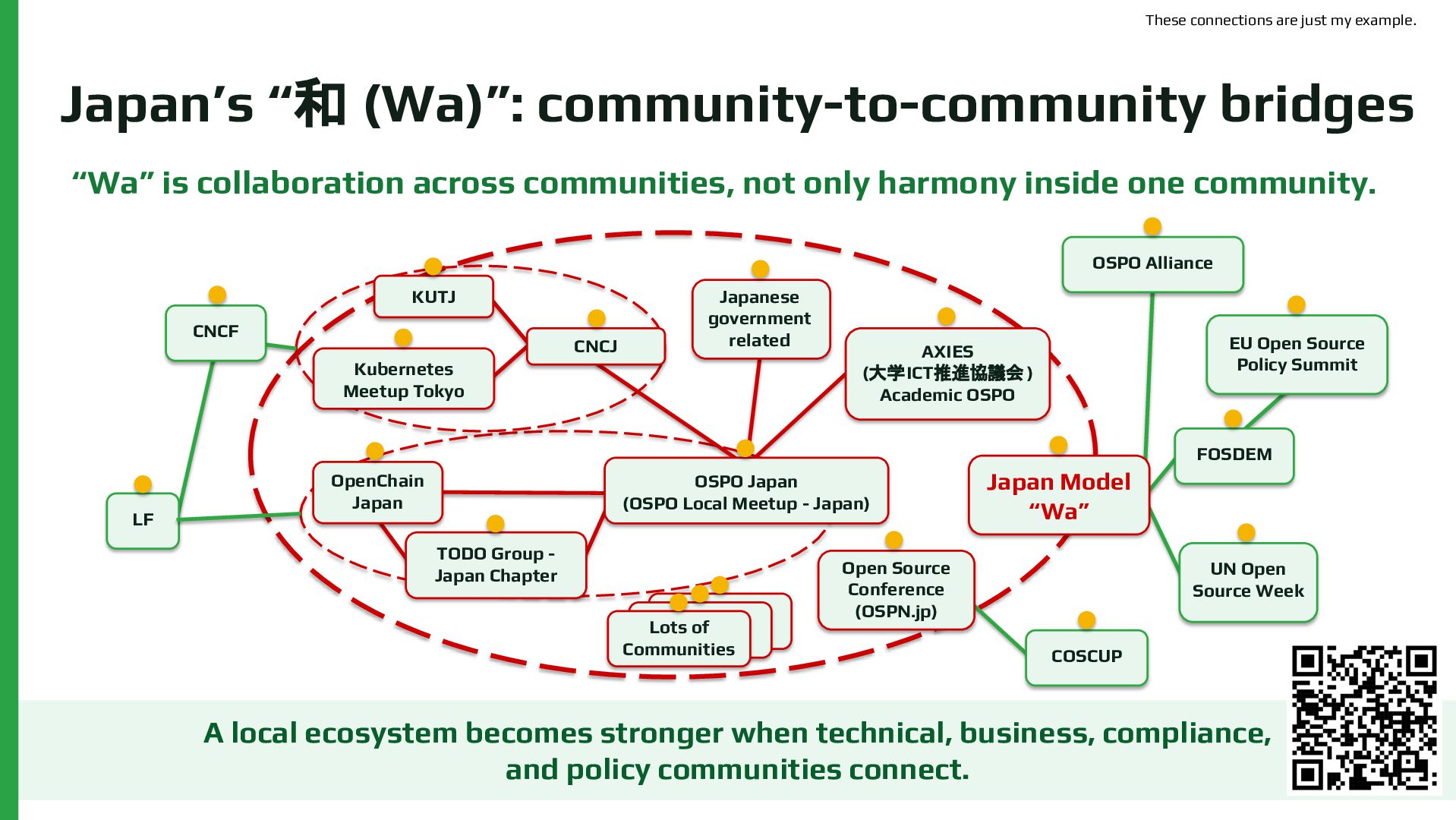
  21. These connections are just my example. Japan’s “和 (Wa)”: community-to-community

    bridges “Wa” is collaboration across communities, not only harmony inside one community. OSPO Alliance KUTJ CNCF CNCJ Japanese government related Kubernetes Meetup Tokyo EU Open Source Policy Summit AXIES (大学ICT推進協議会 ) Academic OSPO FOSDEM LF OpenChain Japan OSPO Japan (OSPO Local Meetup - Japan) TODO Group Japan Chapter Lots of Communities Japan Model “Wa” Open Source Conference (OSPN.jp) UN Open Source Week COSCUP A local ecosystem becomes stronger when technical, business, compliance, and policy communities connect.
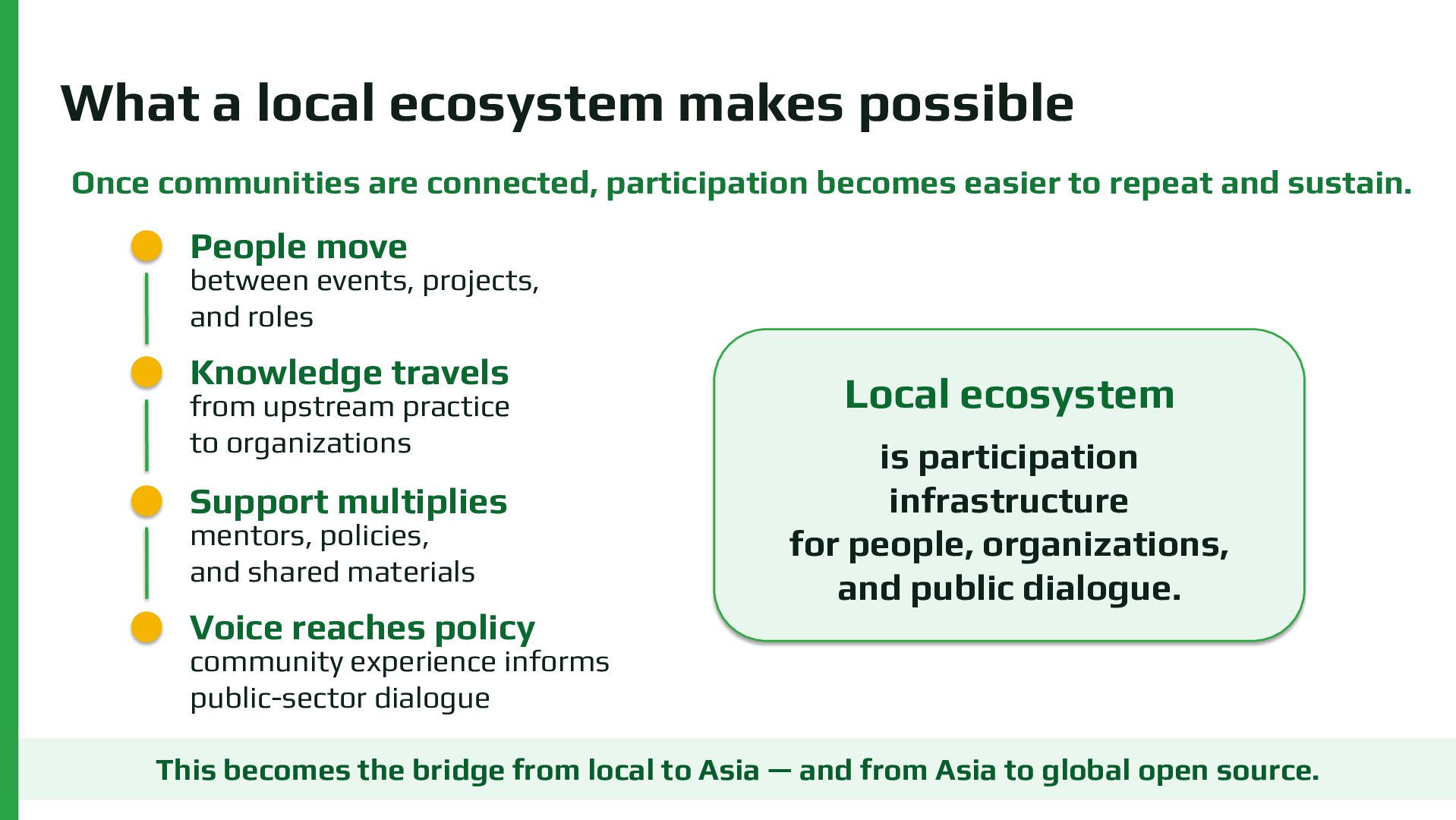
  22. What a local ecosystem makes possible Once communities are connected,

    participation becomes easier to repeat and sustain. People move between events, projects, and roles Knowledge travels from upstream practice to organizations Support multiplies mentors, policies, and shared materials Voice reaches policy Local ecosystem is participation infrastructure for people, organizations, and public dialogue. community experience informs public-sector dialogue This becomes the bridge from local to Asia — and from Asia to global open source.
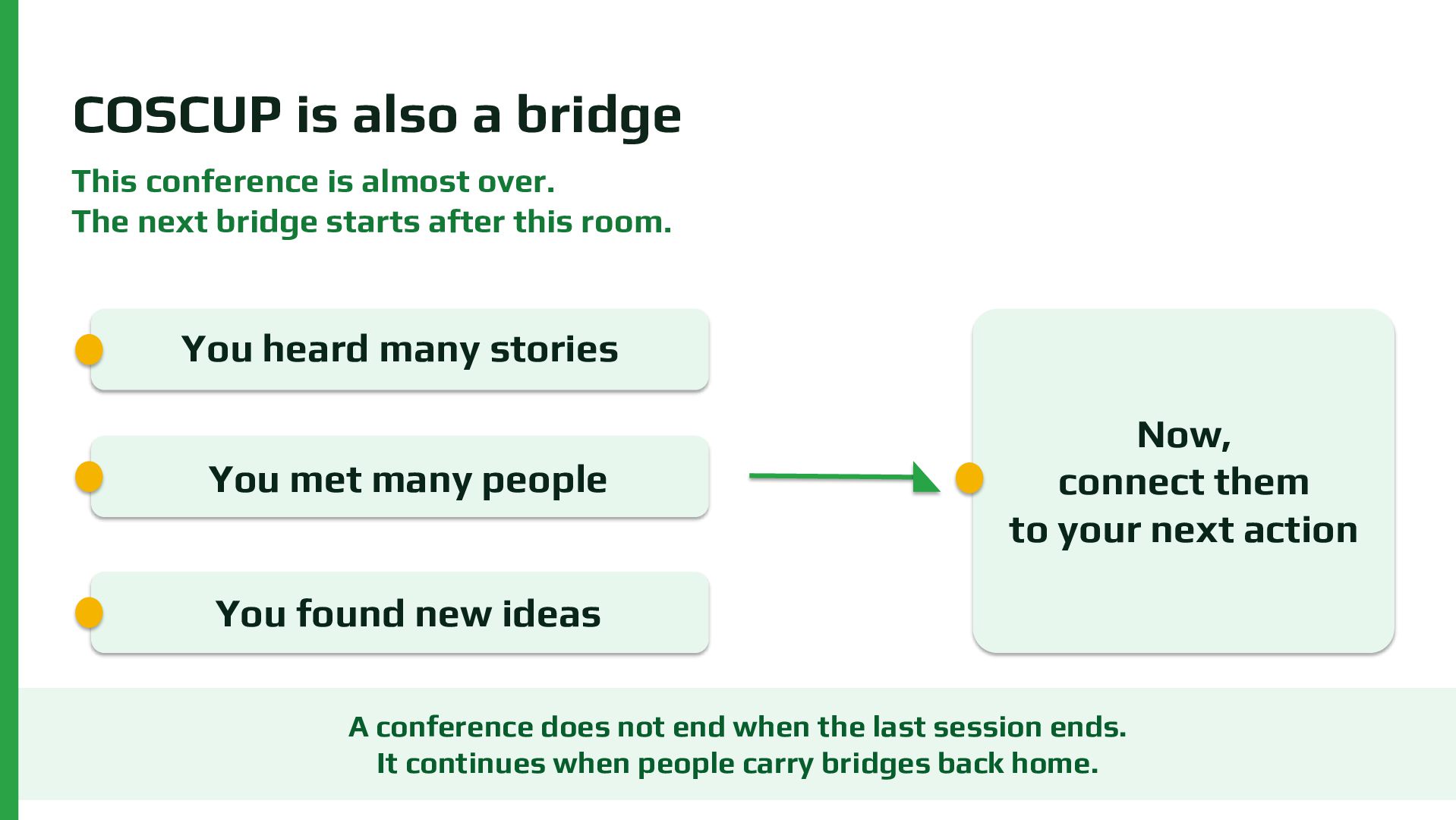
  23. COSCUP is also a bridge This conference is almost over.

    The next bridge starts after this room. You heard many stories You met many people Now, connect them to your next action You found new ideas A conference does not end when the last session ends. It continues when people carry bridges back home.
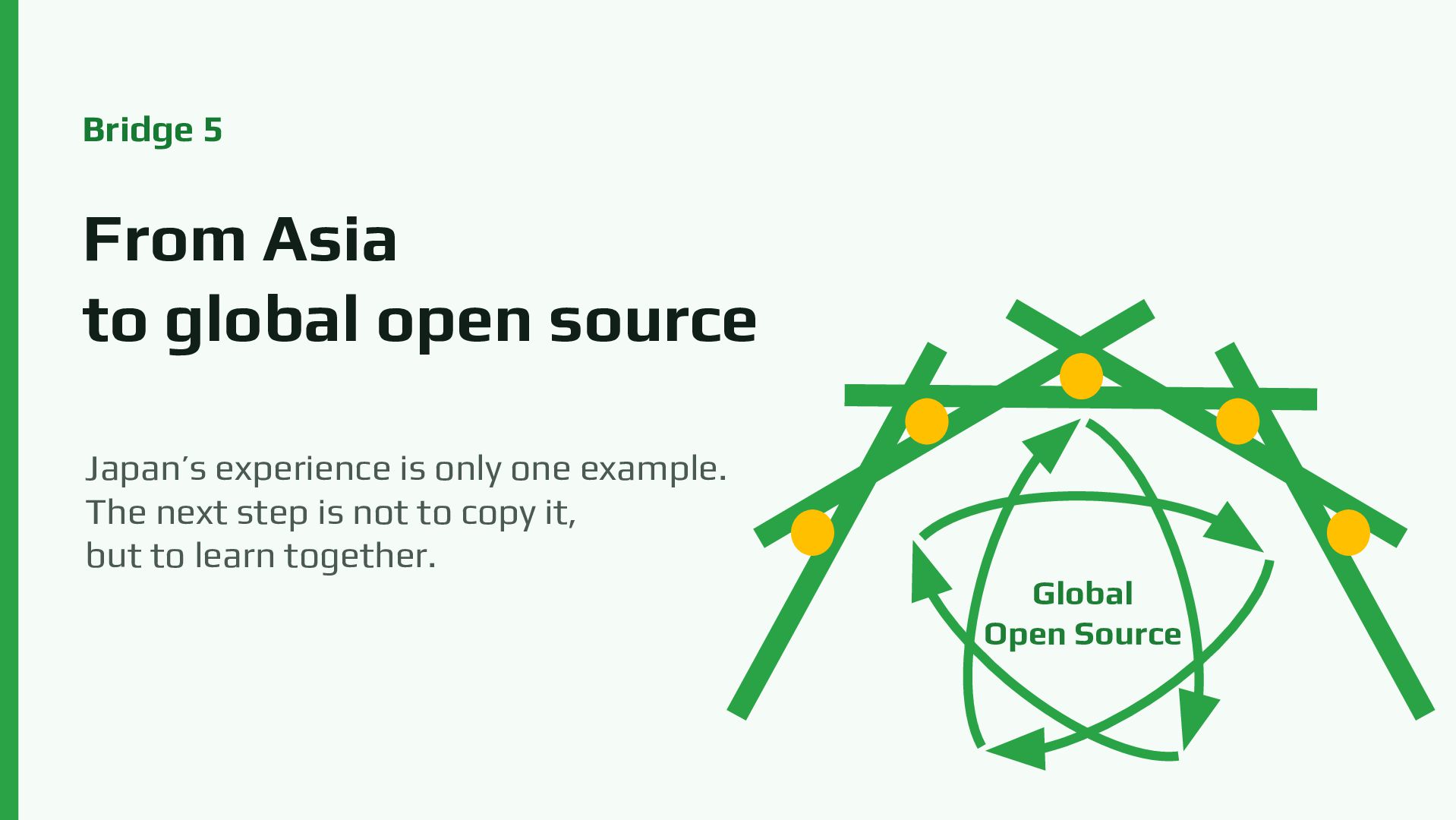
  24. Bridge 5 From Asia to global open source Japan’s experience

    is only one example. The next step is not to copy it, but to learn together. Global Open Source
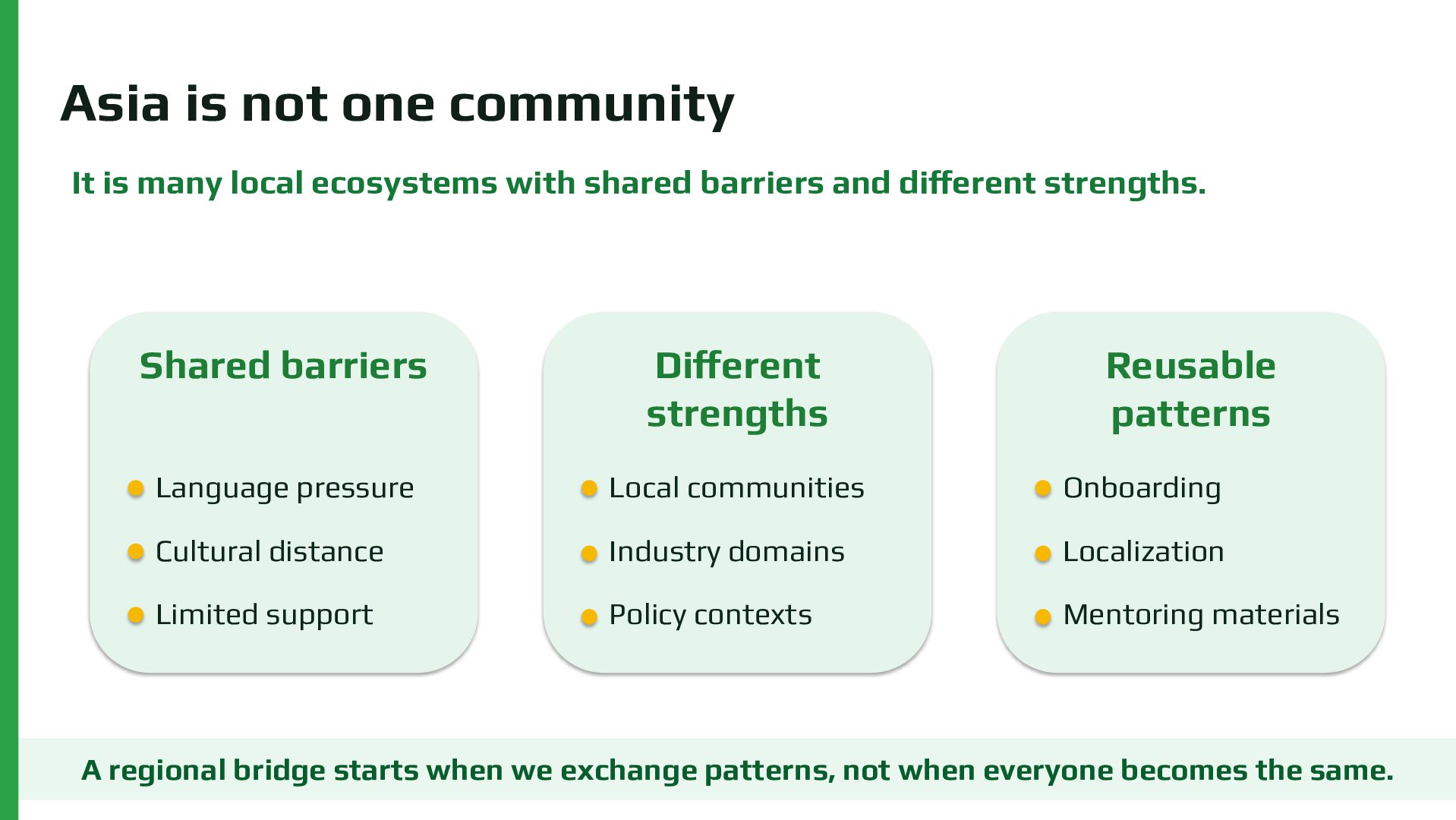
  25. Asia is not one community It is many local ecosystems

    with shared barriers and different strengths. Shared barriers Different strengths Reusable patterns Language pressure Local communities Onboarding Cultural distance Industry domains Localization Limited support Policy contexts Mentoring materials A regional bridge starts when we exchange patterns, not when everyone becomes the same.
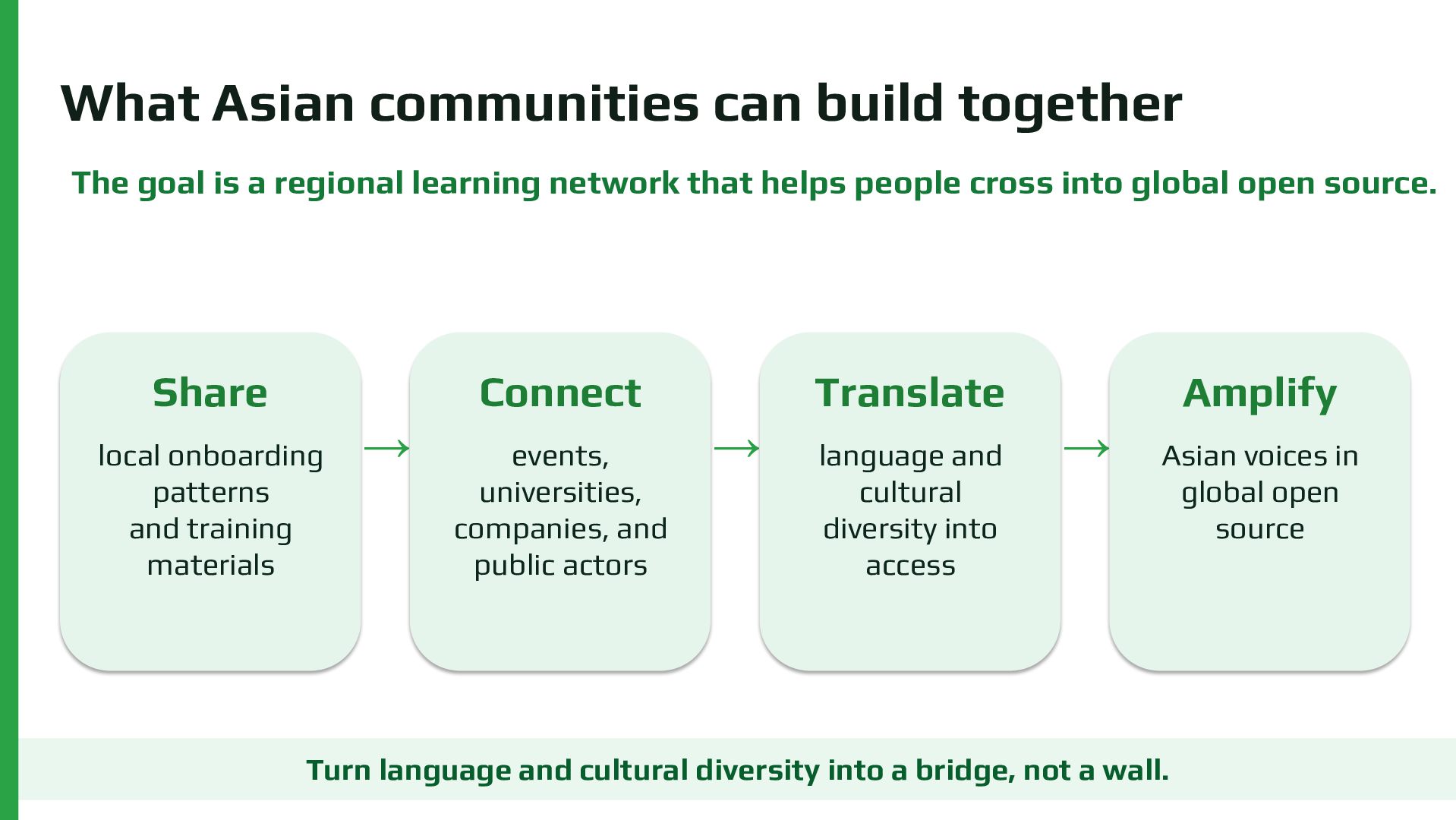
  26. What Asian communities can build together The goal is a

    regional learning network that helps people cross into global open source. Share Connect local onboarding patterns and training materials → events, universities, companies, and public actors Translate → language and cultural diversity into access Amplify → Asian voices in global open source Turn language and cultural diversity into a bridge, not a wall.
  27. We do not need to wait until everyone becomes fluent

    in global open source culture. We can build bridges together.
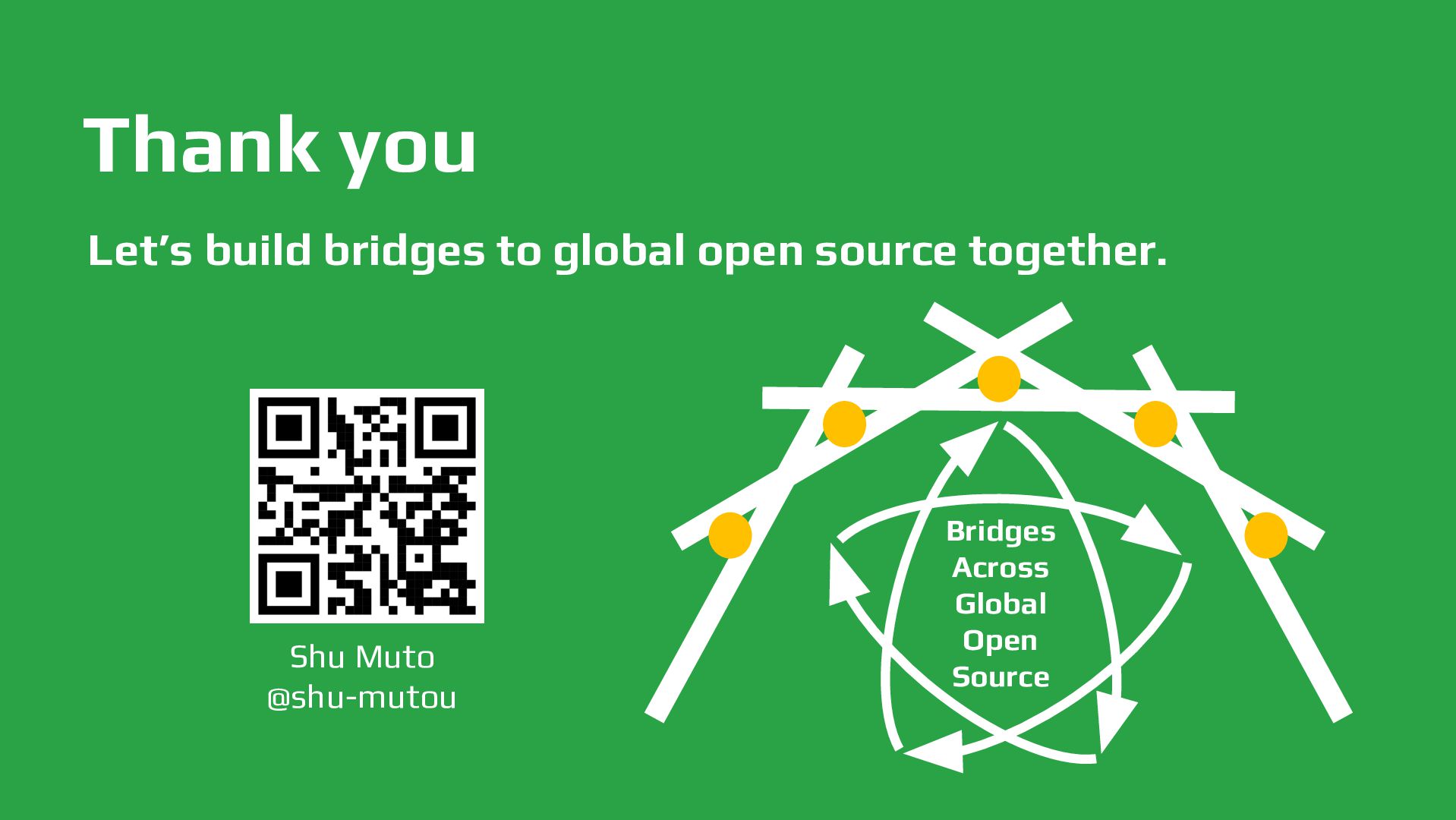
  28. Thank you Let’s build bridges to global open source together.

    Shu Muto @shu-mutou Bridges Across Global Open Source
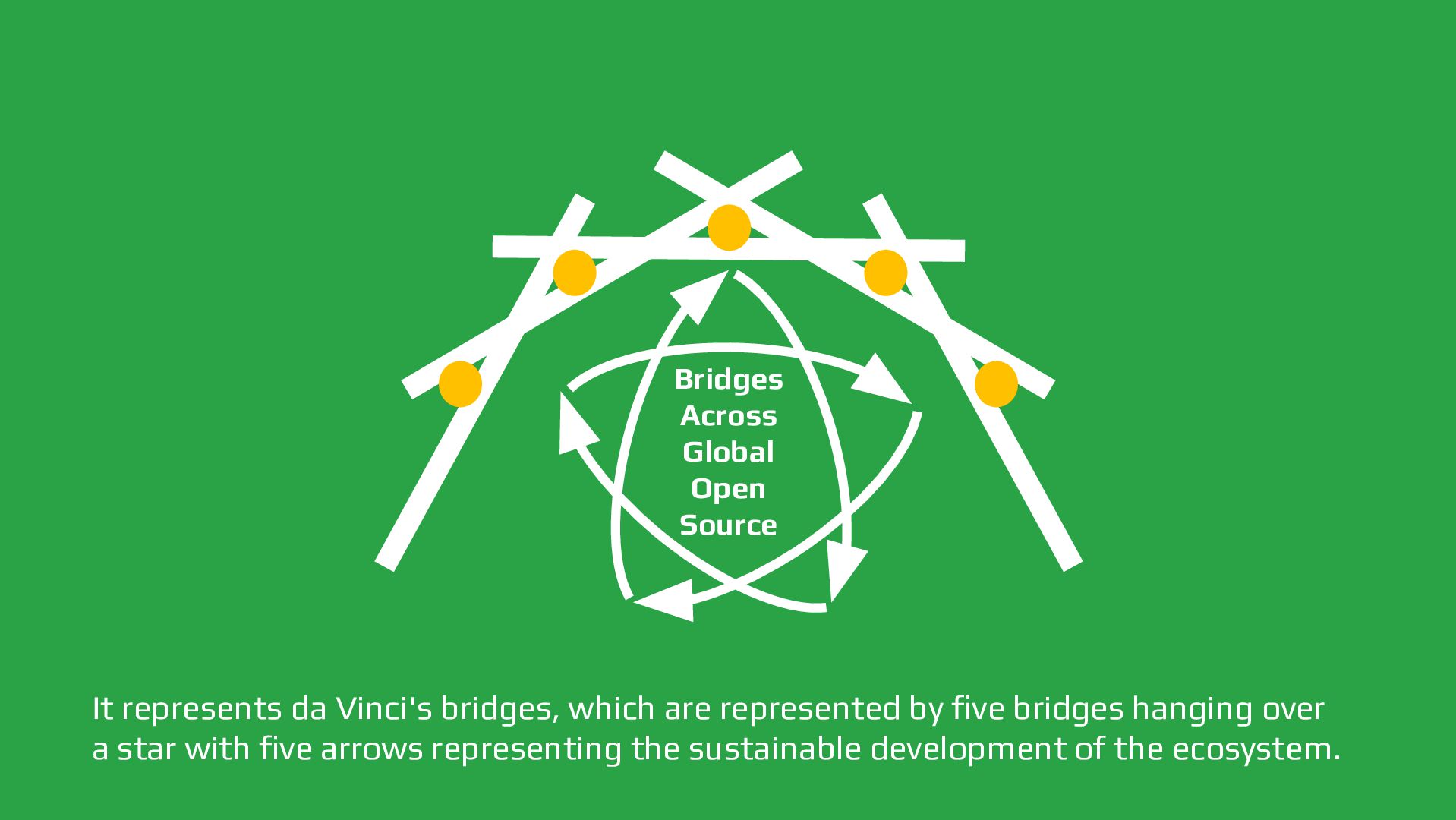
  29. Bridges Across Global Open Source It represents da Vinci's bridges,

    which are represented by five bridges hanging over a star with five arrows representing the sustainable development of the ecosystem.
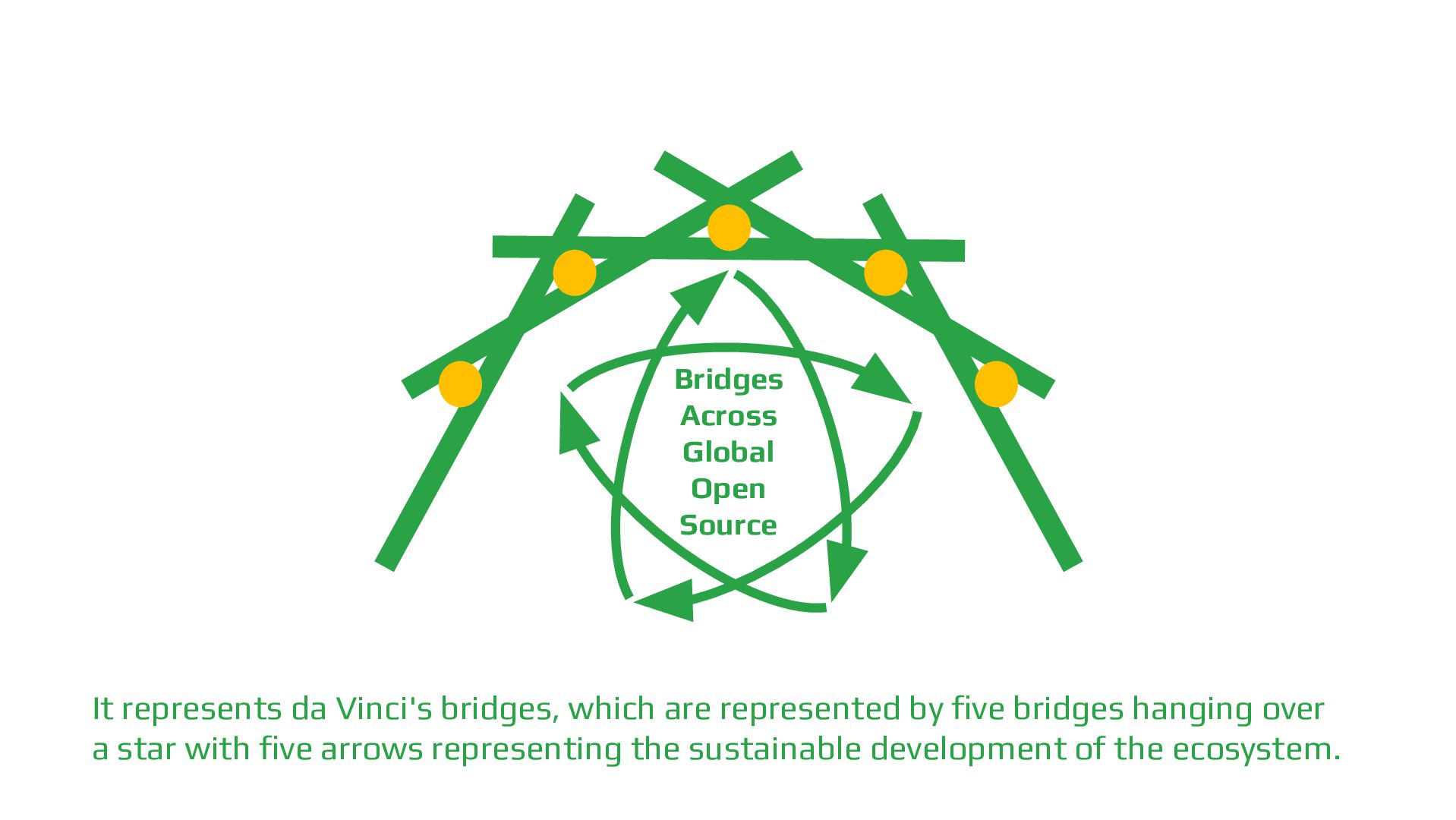
  30. Bridges Across Global Open Source It represents da Vinci's bridges,

    which are represented by five bridges hanging over a star with five arrows representing the sustainable development of the ecosystem.