Securing Containerized Workloads - AWS Community Days
This deck shows Insights on strengthening Kubernetes workloads using Kyverno policies and container image scanning to build resilient and compliant systems. This was created keeping in mind for AWS community day audience.
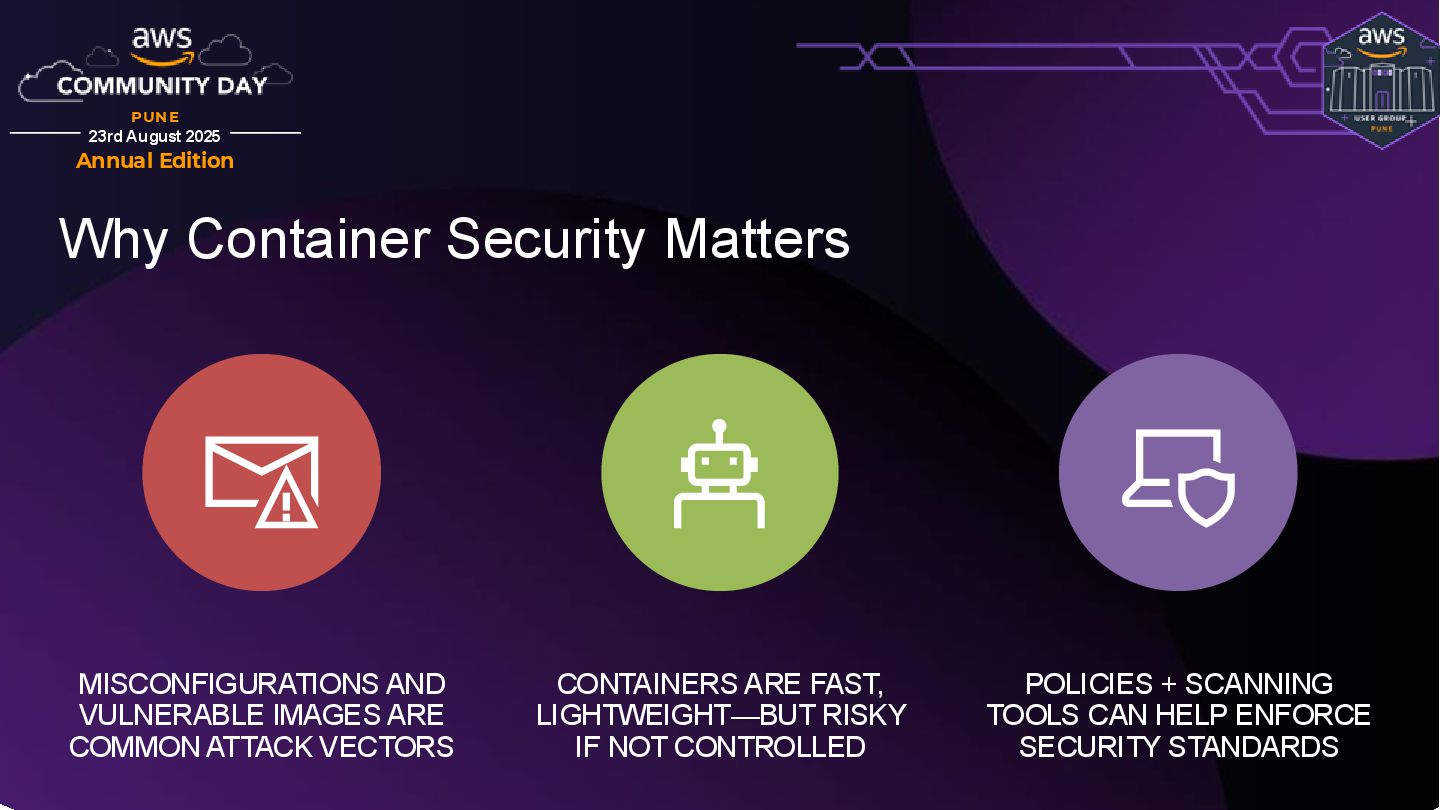
ARE COMMON ATTACK VECTORS CONTAINERS ARE FAST, LIGHTWEIGHT—BUT RISKY IF NOT CONTROLLED POLICIES + SCANNING TOOLS CAN HELP ENFORCE SECURITY STANDARDS Why Container Security Matters
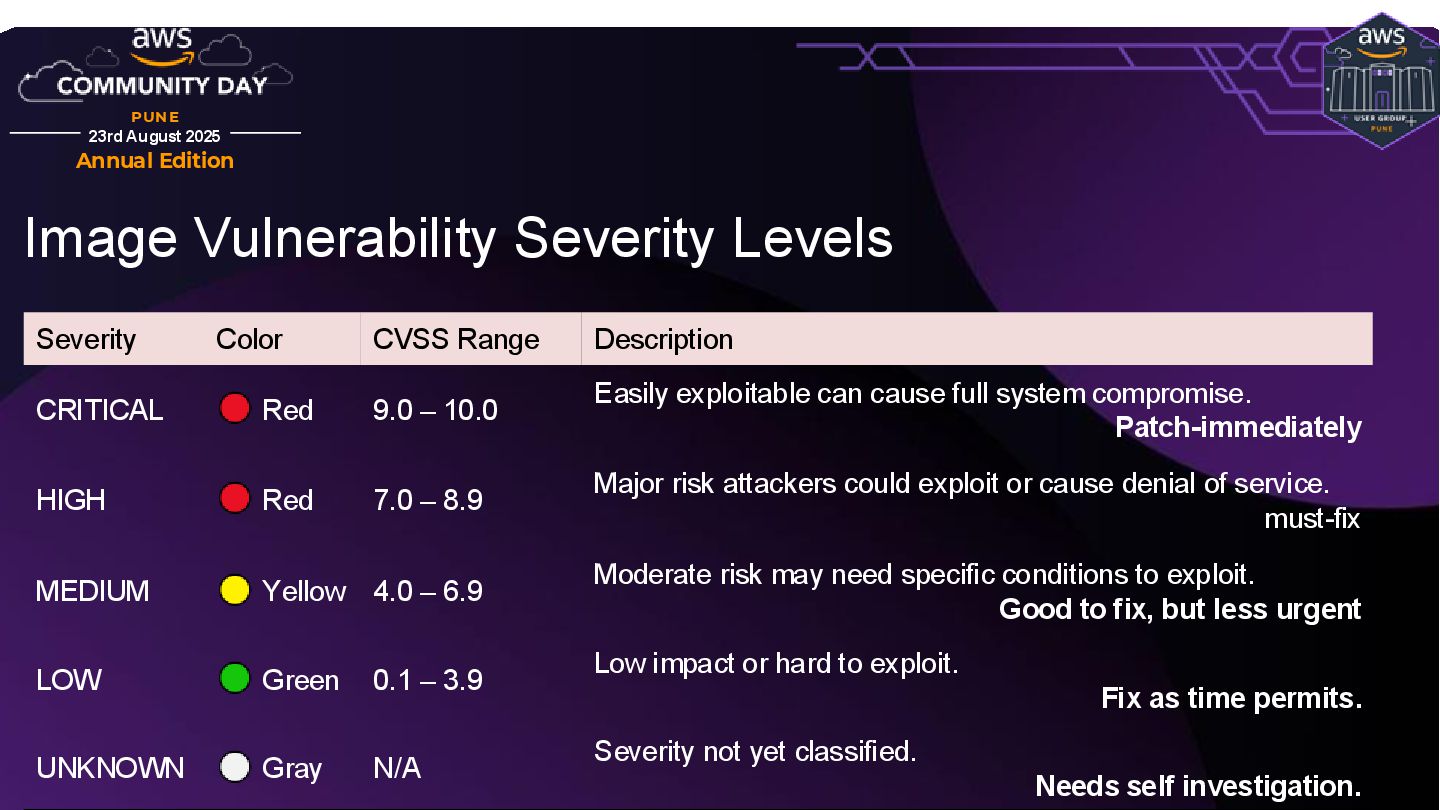
Severity Color CVSS Range Description CRITICAL Red 9.0 – 10.0 Easily exploitable can cause full system compromise. Patch-immediately HIGH Red 7.0 – 8.9 Major risk attackers could exploit or cause denial of service. must-fix MEDIUM Yellow 4.0 – 6.9 Moderate risk may need specific conditions to exploit. Good to fix, but less urgent LOW Green 0.1 – 3.9 Low impact or hard to exploit. Fix as time permits. UNKNOWN Gray N/A Severity not yet classified. Needs self investigation.
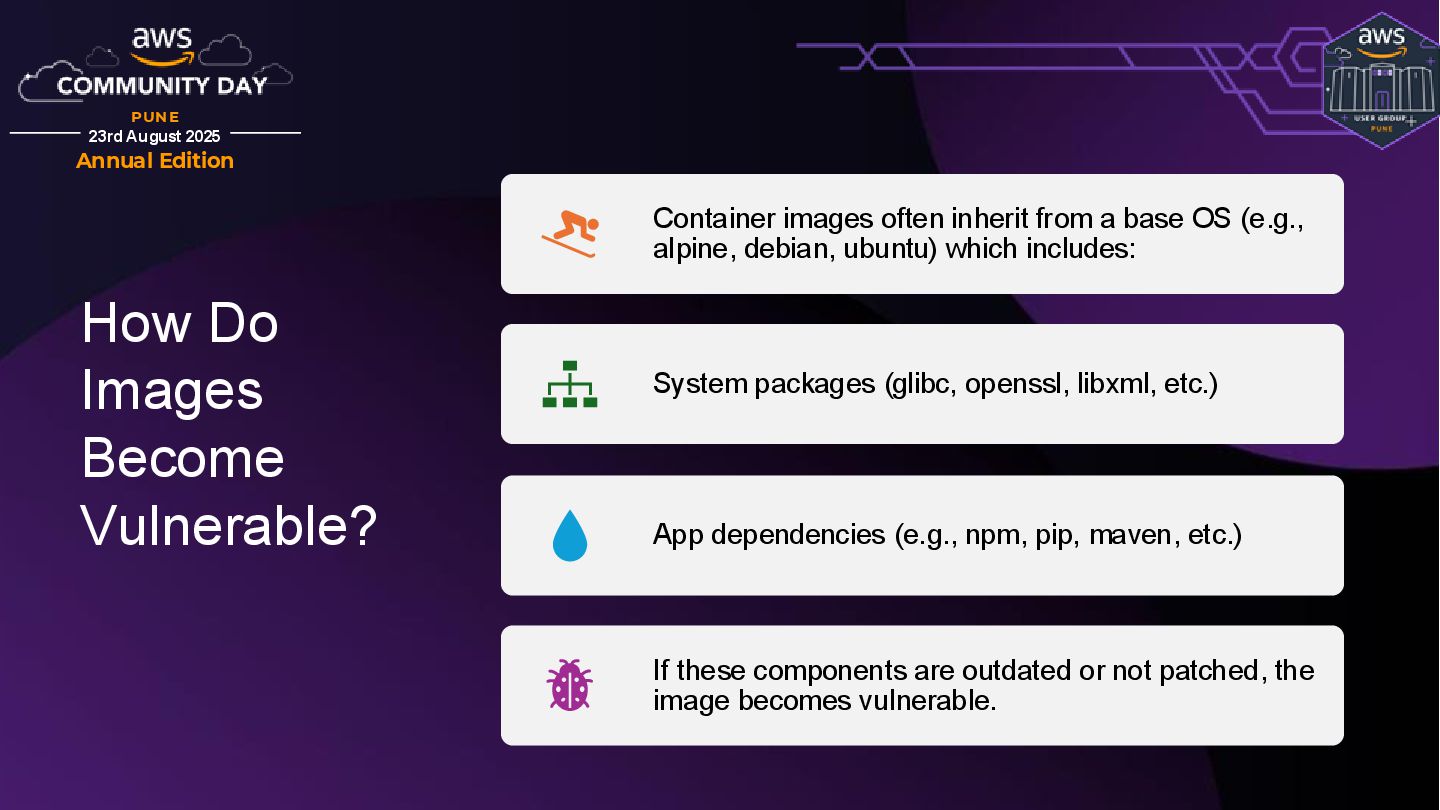
Vulnerable? Container images often inherit from a base OS (e.g., alpine, debian, ubuntu) which includes: System packages (glibc, openssl, libxml, etc.) App dependencies (e.g., npm, pip, maven, etc.) If these components are outdated or not patched, the image becomes vulnerable.
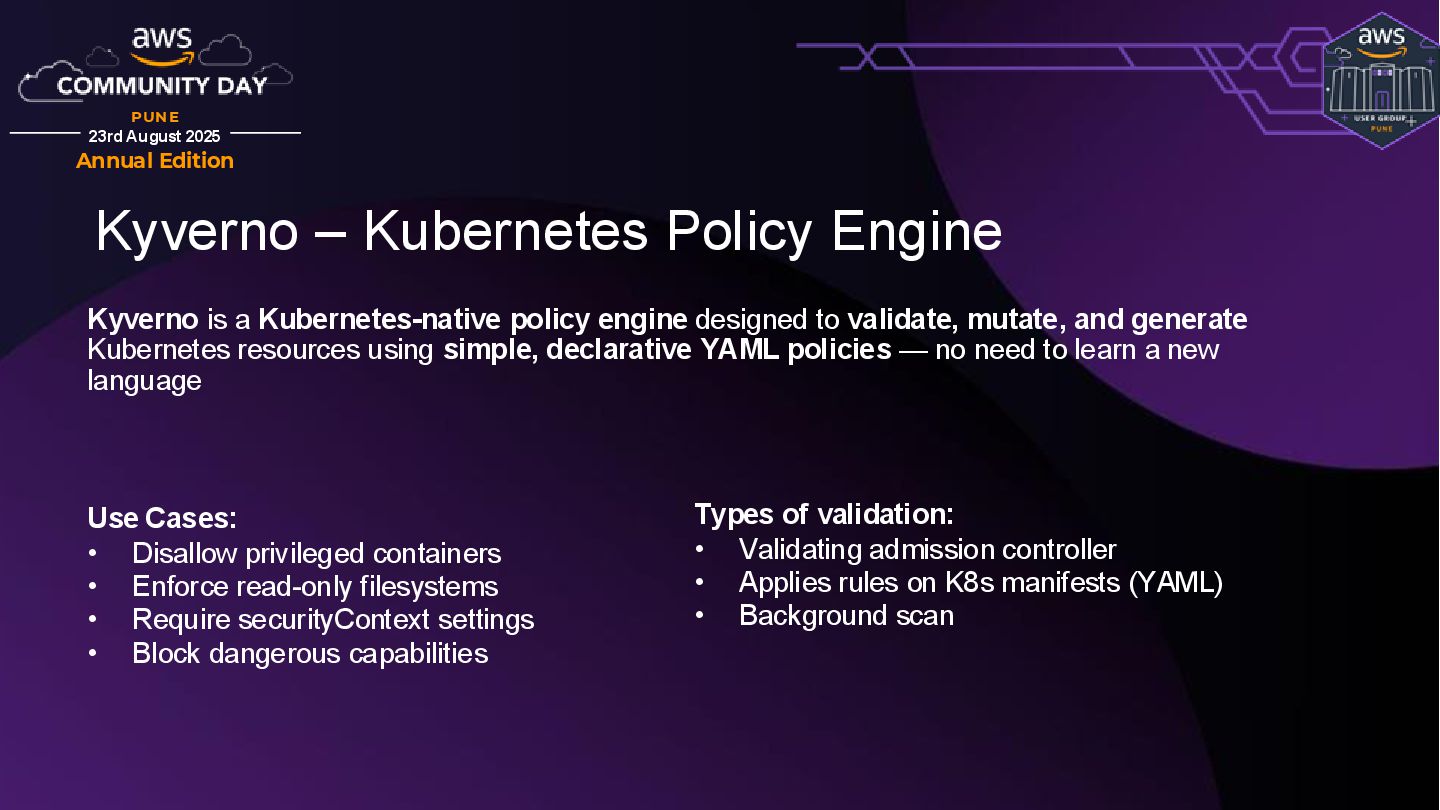
Engine Use Cases: • Disallow privileged containers • Enforce read-only filesystems • Require securityContext settings • Block dangerous capabilities Kyverno is a Kubernetes-native policy engine designed to validate, mutate, and generate Kubernetes resources using simple, declarative YAML policies — no need to learn a new language Types of validation: • Validating admission controller • Applies rules on K8s manifests (YAML) • Background scan
Let’s connect & continue the conversation! https://www.linkedin.com/in/subhashgehlot/ A decade full of Strong expertise in Kubernetes Platform development, DevSecOps practices and zero trust security. Having worked as full-stack developer, database architect handling on call operations


 subhashgehlot
 frievea
 signer
 yatabe
 matleenalaakso
 3l4l5
 bvr7352
 tasusu
 ishii_mit
 masakiokuda
 coloredviolet
 eileencodes
 jeffersonlam
 axbom
 baasie
 mayunak
 jlugia
 soysaucechin
 morganepeng
 davidcarrasco
 marketingsoph