Upgrade to Pro — share decks privately, control downloads, hide ads and more …

Liburd and Stoll Farrell "Copyright Essentials ...

Liburd and Stoll Farrell "Copyright Essentials From A to AI: A 2026 NISO Training Series, Session Four: Copyright in Pop Culture and Digital Media"

This presentation was given by Willa Liburd, Legal Knowledge Management Consultant and Scholarly Communication Professional, and Karen Stoll Farrell, Director, Scholarly Communication and Open Publishing Associate, both of Indiana University Bloomington for the fourth session of the NISO training series "Copyright Essentials From A to AI." Session Four, "Copyright in Pop Culture and Digital Media," was held October 22, 2026.

More Decks by National Information Standards Organization

Other Decks in Education

Transcript

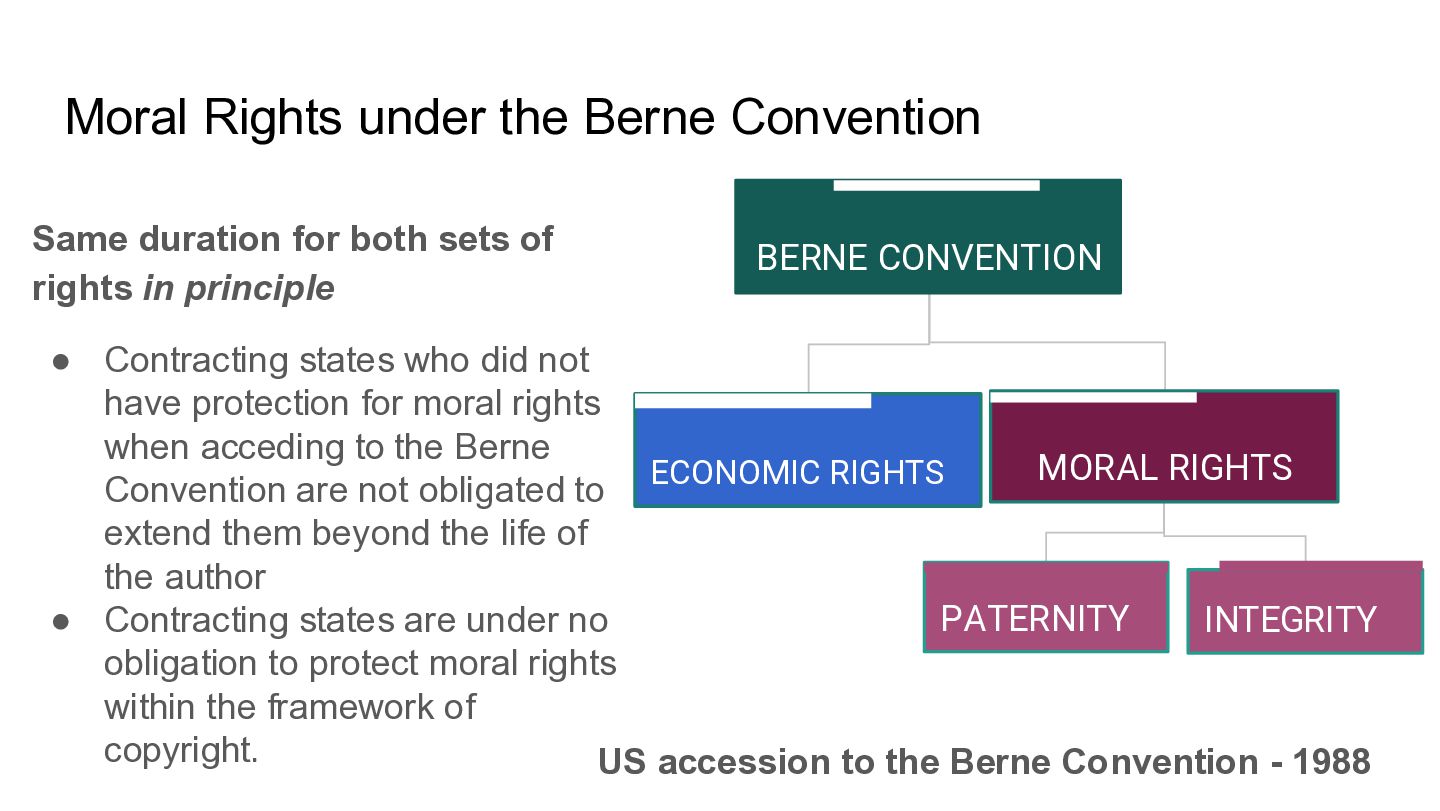
  1. Moral Rights under the Berne Convention Same duration for both

    sets of rights in principle BERNE CONVENTION • Contracting states who did not have protection for moral rights when acceding to the Berne MORAL RIGHTS ECONOMIC RIGHTS Convention are not obligated to extend them beyond the life of the author PATERNITY • Contracting states are under no INTEGRITY obligation to protect moral rights within the framework of copyright. US accession to the Berne Convention - 1988
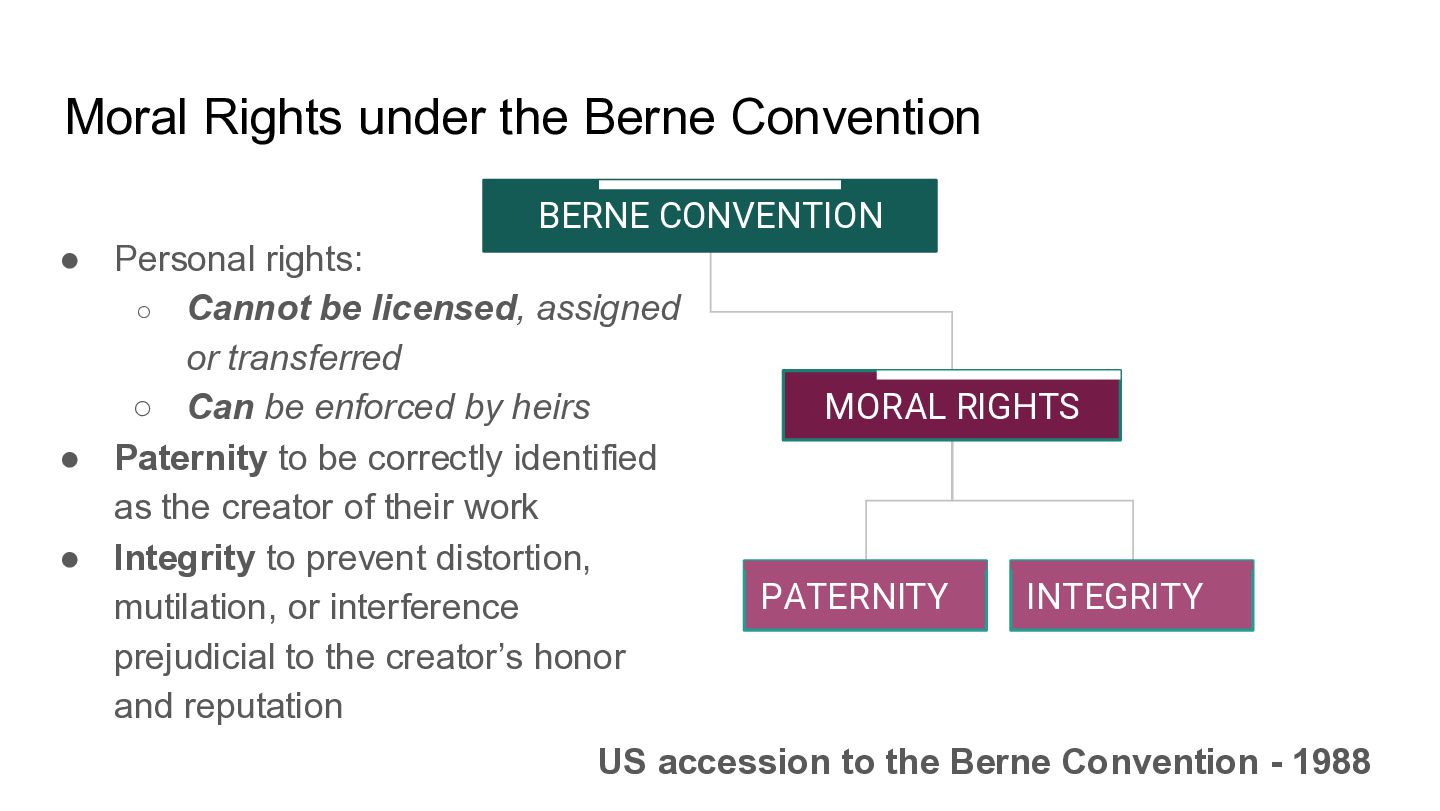
  2. Moral Rights under the Berne Convention BERNE CONVENTION • Personal

    rights: ◦ Cannot be licensed, assigned or transferred ◦ Can be enforced by heirs • Paternity to be correctly identified as the creator of their work • Integrity to prevent distortion, mutilation, or interference prejudicial to the creator’s honor and reputation MORAL RIGHTS PATERNITY INTEGRITY US accession to the Berne Convention - 1988
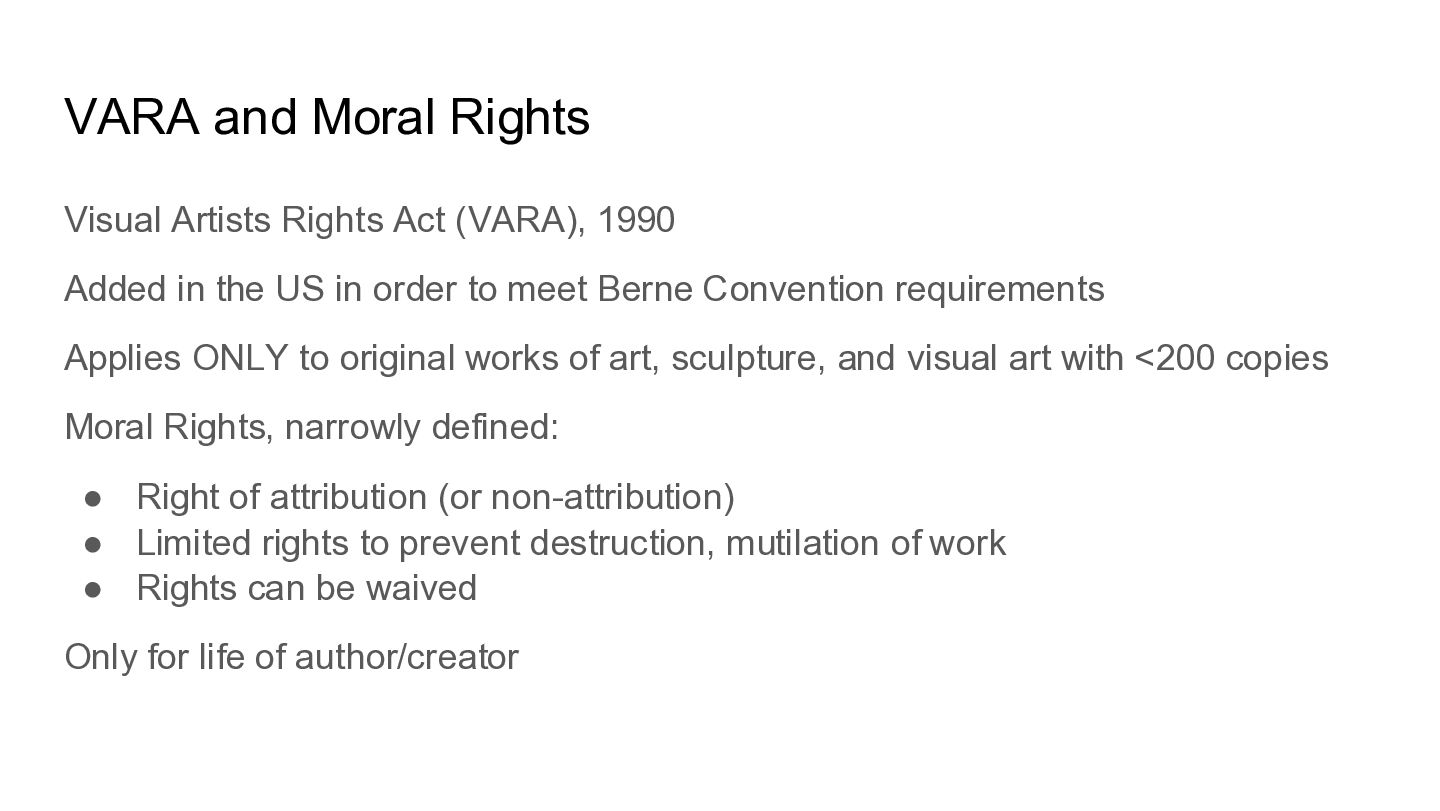
  3. VARA and Moral Rights Visual Artists Rights Act (VARA), 1990

    Added in the US in order to meet Berne Convention requirements Applies ONLY to original works of art, sculpture, and visual art with <200 copies Moral Rights, narrowly defined: • Right of attribution (or non-attribution) • Limited rights to prevent destruction, mutilation of work • Rights can be waived Only for life of author/creator
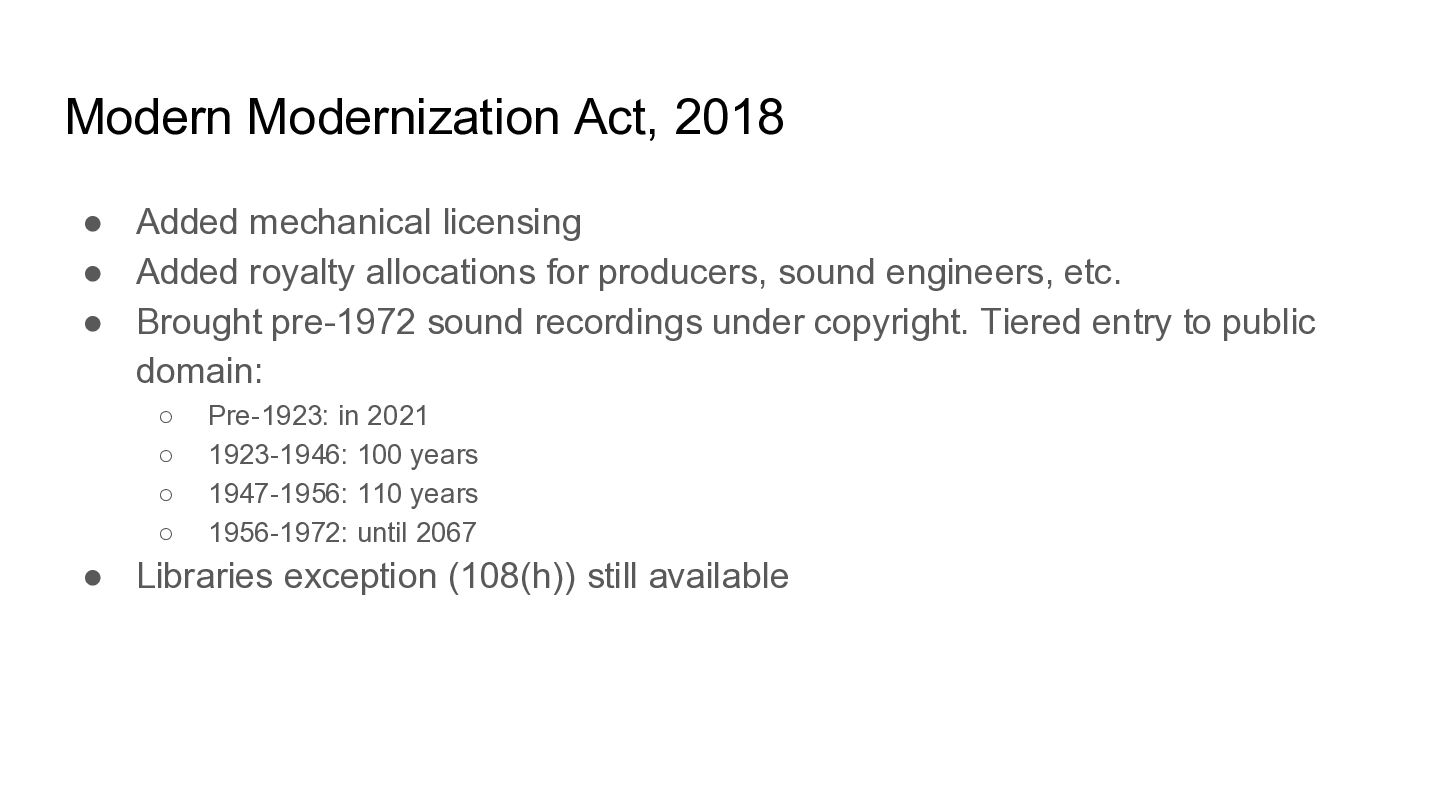
  4. Modern Modernization Act, 2018 • Added mechanical licensing • Added

    royalty allocations for producers, sound engineers, etc. • Brought pre-1972 sound recordings under copyright. Tiered entry to public domain: ◦ ◦ ◦ ◦ Pre-1923: in 2021 1923-1946: 100 years 1947-1956: 110 years 1956-1972: until 2067 • Libraries exception (108(h)) still available
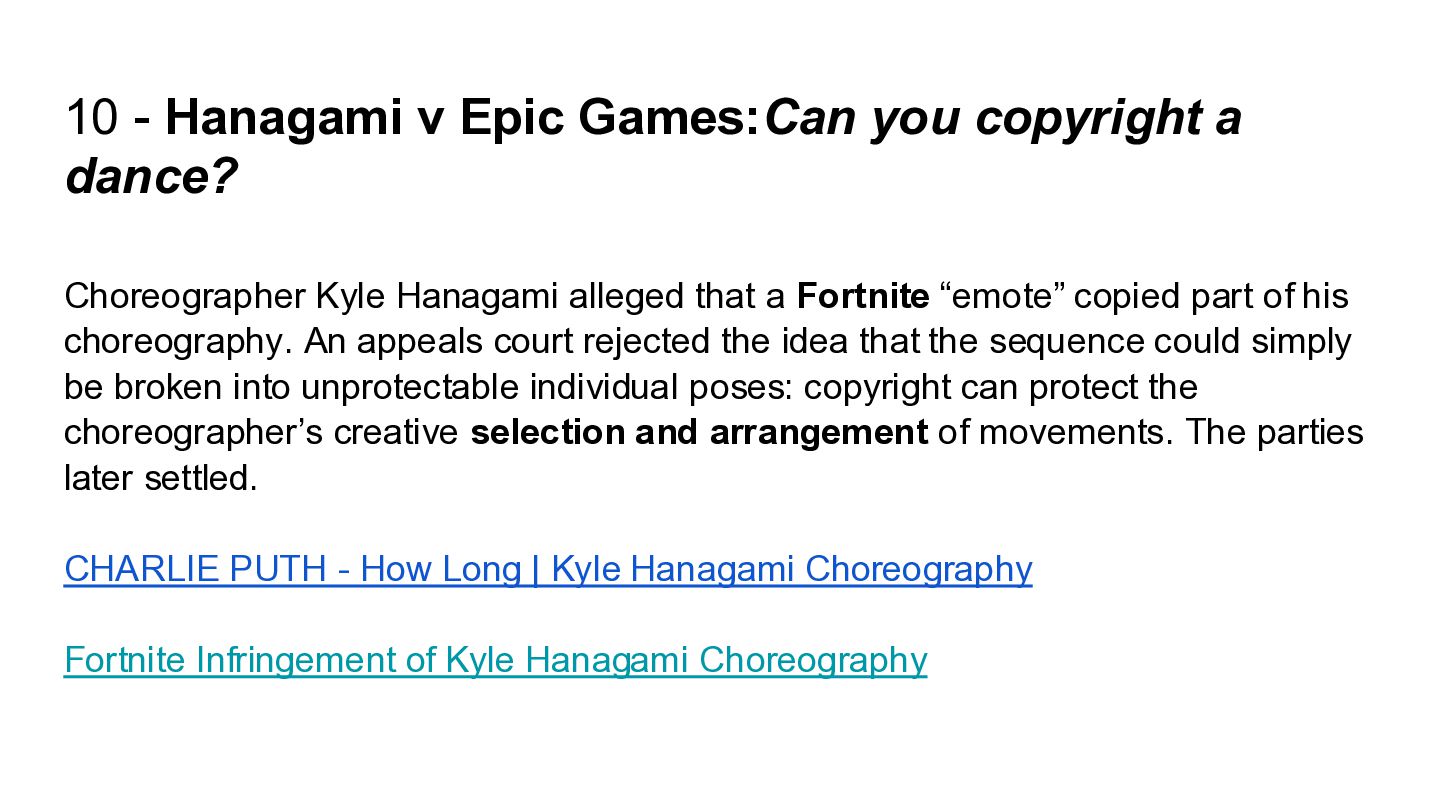
  5. 10 - Hanagami v Epic Games:Can you copyright a dance?

    Choreographer Kyle Hanagami alleged that a Fortnite “emote” copied part of his choreography. An appeals court rejected the idea that the sequence could simply be broken into unprotectable individual poses: copyright can protect the choreographer’s creative selection and arrangement of movements. The parties later settled. CHARLIE PUTH - How Long | Kyle Hanagami Choreography Fortnite Infringement of Kyle Hanagami Choreography
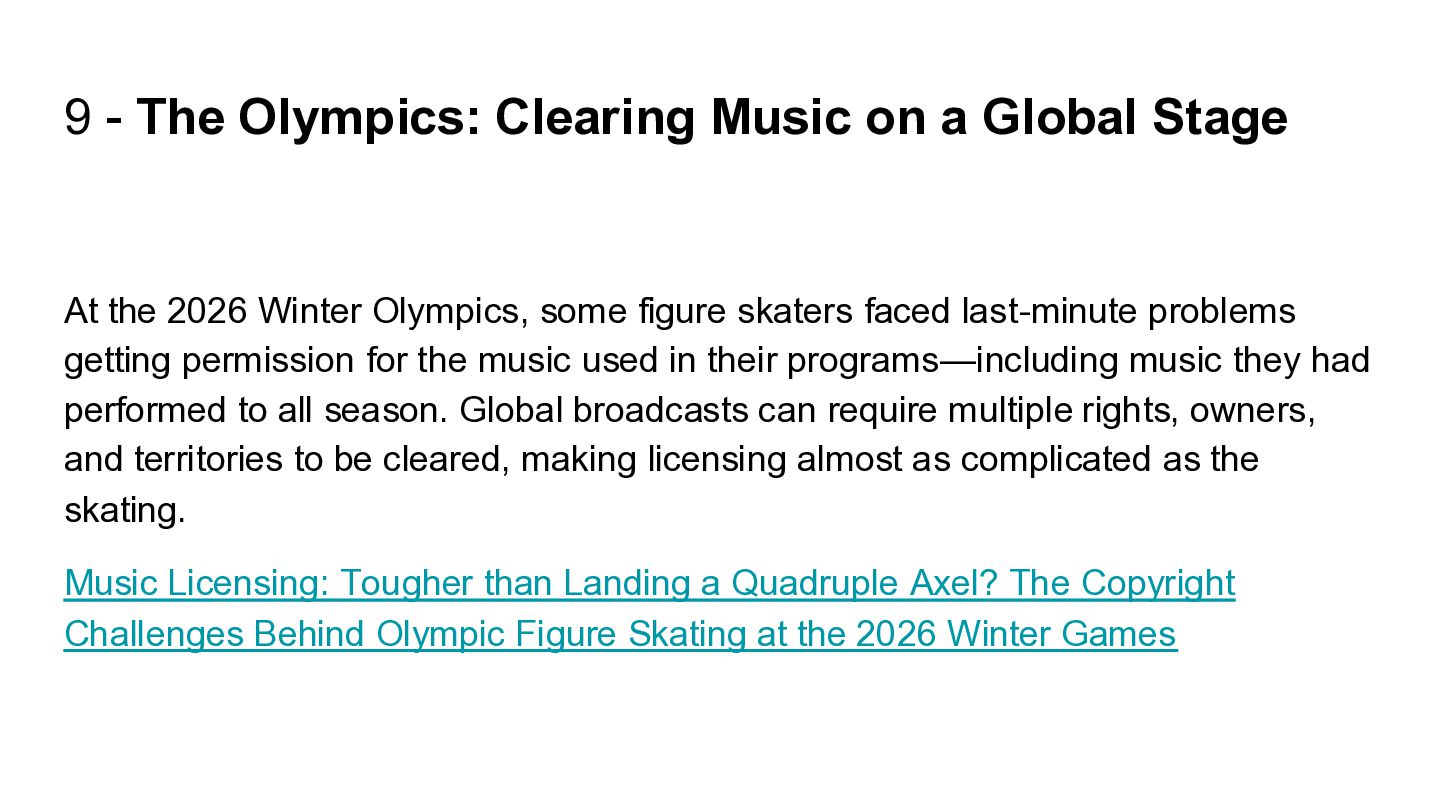
  6. 9 - The Olympics: Clearing Music on a Global Stage

    At the 2026 Winter Olympics, some figure skaters faced last-minute problems getting permission for the music used in their programs—including music they had performed to all season. Global broadcasts can require multiple rights, owners, and territories to be cleared, making licensing almost as complicated as the skating. Music Licensing: Tougher than Landing a Quadruple Axel? The Copyright Challenges Behind Olympic Figure Skating at the 2026 Winter Games
  7. 8 - SHAKIRA - Who owns ‘WAKA WAKA’? Parties: Golden

    Sounds, Shakira | Songs: Zangaléwa, Waka Waka In 2010, Shakira released “Waka Waka (This Time for Africa)” as the official song of the FIFA World Cup. Listeners noted that its chorus closely resembled “Zangaléwa,” a 1986 hit by Cameroonian band Golden Sounds that was also popular in Colombia, where Shakira had heard it as a child. But Golden Sounds did not originate all of the material: Zangaléwa drew on an older Cameroonian military marching chant of uncertain origin, versions of which circulated widely in Africa and beyond. Note: There is no court decision. Sony Music and Shakira’s management reached an out-of-court agreement with the Zangaléwa writers, who received co-writing credit. What do you hear as similar in the two songs? Lyrics, melody, mood, arrangement, rhythm, instruments, or recorded audio? https://archive.nytimes.com/thelede.blogs.nytimes.com/2010/05/24/shakira-remixes-african-hit-for-worldcup/?ref=soccer
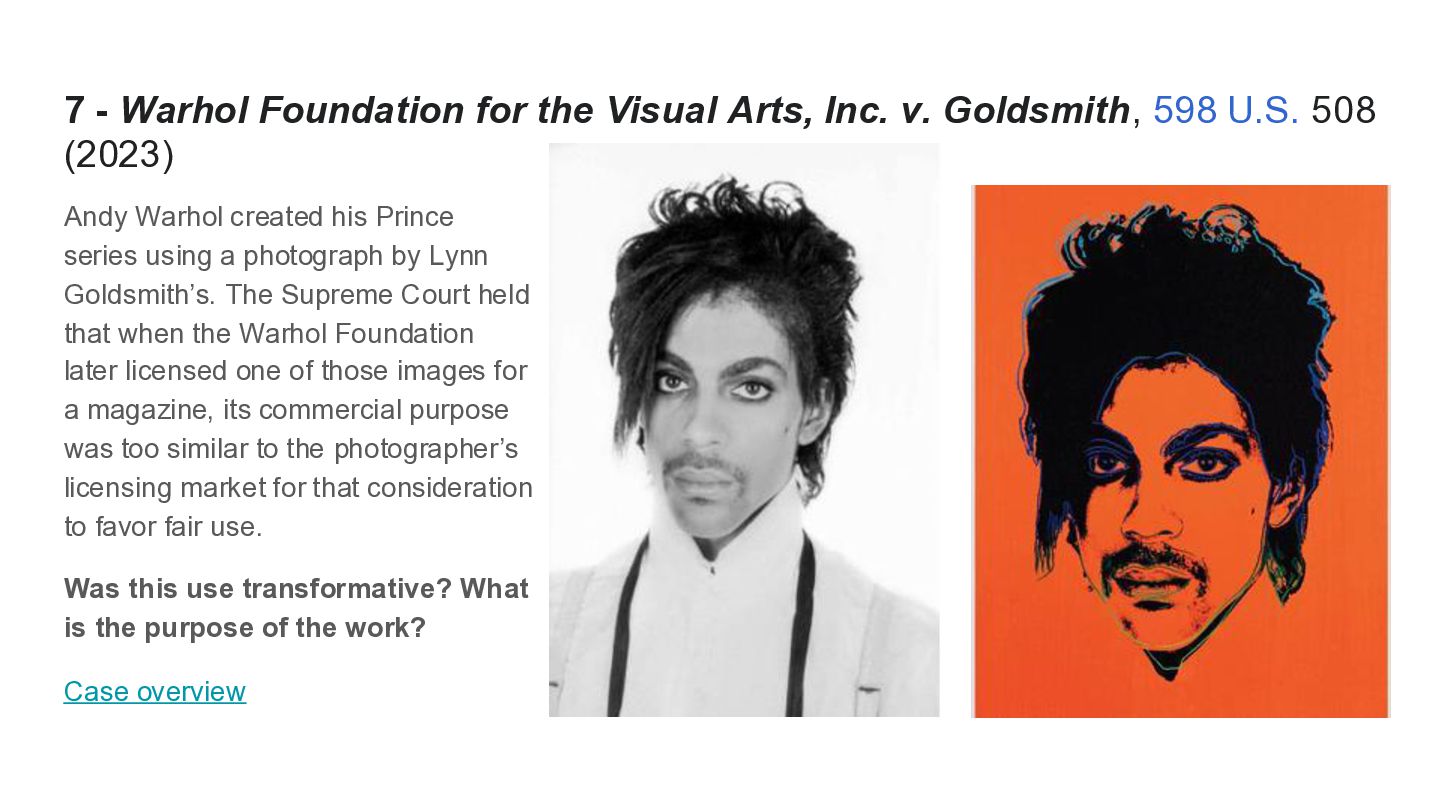
  8. 7 - Warhol Foundation for the Visual Arts, Inc. v.

    Goldsmith, 598 U.S. 508 (2023) Andy Warhol created his Prince series using a photograph by Lynn Goldsmith’s. The Supreme Court held that when the Warhol Foundation later licensed one of those images for a magazine, its commercial purpose was too similar to the photographer’s licensing market for that consideration to favor fair use. Was this use transformative? What is the purpose of the work? Case overview
  9. 6 - HBO’s LANTERNS: Can Copyright stop a spoiler? Before

    HBO’s Lanterns premiered, bloggers used trailers, casting announcements, and other public information to correctly predict plot details. Warner Bros. sent copyright takedown notices—raising the question of whether copyright can control an accurate guess about a story. Warner Brothers threatens legal action over educated guesses of 'Lanterns' upcoming plot details : NPR
  10. 5 - Kathryn Townsend Griffin et al v Ed Sheeran

    et al The owners of rights in Marvin Gaye and Ed Townsend’s “Let’s Get It On” argued that Ed Sheeran’s “Thinking Out Loud” copied elements of the earlier song. A jury found no infringement; common chord progressions and other musical building blocks cannot simply be taken out of circulation. How do different courts attempt to strike a balance between the goals of copyright protection? In the Courts: Ed Sheeran Succeeds in Music Copyright Infringement Case, but it’s not over yet…
  11. 4 - Arrow: A local song goes global Montserratian soca

    musician Arrow’s “Hot Hot Hot” became an international phenomenon, spawning covers around the world. The copyright system distributes rights, recognition, access, and power, and each distribution choice has consequences. The song’s journey from a small Caribbean island to a global standard illustrates how copyright can turn songwriting and recording rights into long-lasting economic assets. Thinking about the Shakira Waka-Waka controversy and this recording - both songs moved from relatively small cultural contexts into global popular culture. What is similar about that journey, and what differences seem important for copyright. https://www.independent.co.uk/news/obituaries/arrow-soca-singer-who-came-toworldwide-fame-with-his-hit-hot-hot-hot-2082611
  12. 3 - Taylor Swift: Same Songs, Different Copyrights Taylor Swift

    did not control the master recordings of her first six albums—but she retained rights as a songwriter. By recording new “Taylor’s Version” masters, she demonstrated one of music copyright’s most important distinctions: the song and the recording of the song can have different owners. How Taylor Swift Changed the Copyright Game by Remaking her own music Who held the power in this scenario and why? How will this affect future recording artistes?
  13. 2 - Empawa Africa Music Services Limited et al v.

    Benito Martinez Ocasio et al Bad Bunny was sued over an allegedly unauthorized sample in “Enséñame a Bailar.” The sample was from Afrobeats singers Ezeani Chidera Godfrey ft. Joeboy “Empty my Pockets”. The lawsuit was dismissed, but a judge later refused his request to recover more than $465,000 in legal fees—illustrating how expensive it can be simply to defend a copyright claim. Who is copyright meant to protect and why? What power structures were at play in this case? Case Report.
  14. 1 - DOLLY PARTON: KNOW WHAT YOU OWN In 1974,

    Dolly Parton turned down the chance for Elvis Presley to record “I Will Always Love You” because his manager wanted half of the publishing rights. Parton chose long-term ownership and control over an enormous short-term opportunity. When the song was covered by Whitney Houston in the 1990s it earned Dolly tens of millions. CNN reported “when she was 20, Parton had started a publishing company with her uncle (and sometimes co-writer) Bill Owens, maintaining a controlling interest in her music. Parton’s vision was clear: she wanted to retain a vested interest in her contributions, in no small part to ensure she would be able to provide for her family.” However, Dolly also used her massive financial success to fund philanthropic and humanitarian programs including her Imagination Library.
  15. SMALL GROUP QUESTIONS What’s the main copyright issue? ownership /

    infringement / fair use / licensing / public domain / something else. Who has the power here? Artist / publisher / platform / audience / nobody clearly. Your instinct on the outcome: fair / unfair / complicated. Create a copyright rule that in your view would provide a fair outcome.