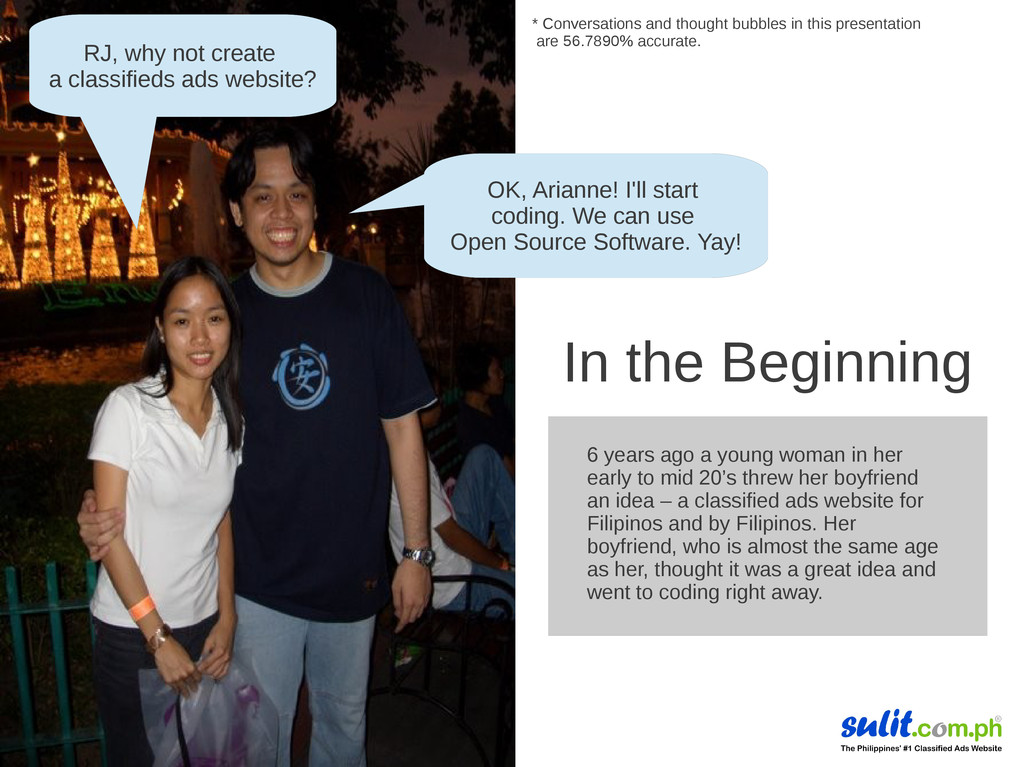
website? OK, Arianne! I'll start coding. We can use Open Source Software. Yay! * Conversations and thought bubbles in this presentation are 56.7890% accurate. 6 years ago a young woman in her early to mid 20’s threw her boyfriend an idea – a classified ads website for Filipinos and by Filipinos. Her boyfriend, who is almost the same age as her, thought it was a great idea and went to coding right away.
traffic website Welcome to my home office. This used to be the Sulit.com.ph main headquarters. Get your tissues (for nose bleed) and thinking caps ready! The following slides will be very ... INFORMATIVE.
why you should not use opcode caching (unless you cannot install it in a shared host). It can execute 5-10 times faster as compared with normal PHP processing.”
instead of deleting the cached data, access the database for the new data and then overwrite the cache (if using file- based caching, remember to lock the file before overwriting it so that the other connections trying to read from the file will wait for a moment and will not get a corrupted cache file and will end up hitting the database).”
a time- based caching functionality (e.g. cache will return the data if within the given duration else will return null or false). Avoid using this functionality as it will result to the same problem above (i.e. too many connections hitting the database when the cache expires).”
“I ended up discovering sphinxsearch (indexing application similar to lucene). Using this with MySQL, those complex queries can be completed to as fast as 0.01 second.”
If you will require large session data storage and also need query capability for a normal DB table, you can create a hybrid implementation wherein the other session values are being saved in DB but the session data is being saved in Memcached.”
solution is to move all cache/temporary files from hard disk to memory. Install mod_mem_cache for Lighttpd so that those frequently accessed static files will be kept and served from memory. This will result to lesser reads for the hard disks”


 sulittech
 atalie2m
 bengo4com
 amarelo_n24
 tomoki10
 kmiya84377
 takuyay0ne
 sue445
 minorun365
 tascript
 maguroalternative
 munenick
 cassininazir
 marktimemedia
 shpigford
 cromwellryan
 sabderemane
 eileencodes
 reverentgeek
 inesmontani
 aleyda
 addyosmani
 lindahogenes
 marcelosomers