Upgrade to Pro — share decks privately, control downloads, hide ads and more …

Angular vs React: What to Choose for Your Appli...

Sponsored · Ship Features Fearlessly Turn features on and off without deploys. Used by thousands of Ruby developers.

Angular vs React: What to Choose for Your Application

With the growing number of technologies, choosing the right framework for front-end web development might be challenging. However, among all frameworks, two stand out from the crowd, steadily enjoying popularity among developers: React and Angular. https://tech-stack.com/blog/techstack-experience-in-angular-vs-react-what-to-choose-for-your-application/

Avatar for Techstack

Techstack

March 07, 2023
Tweet

Other Decks in Programming

Transcript

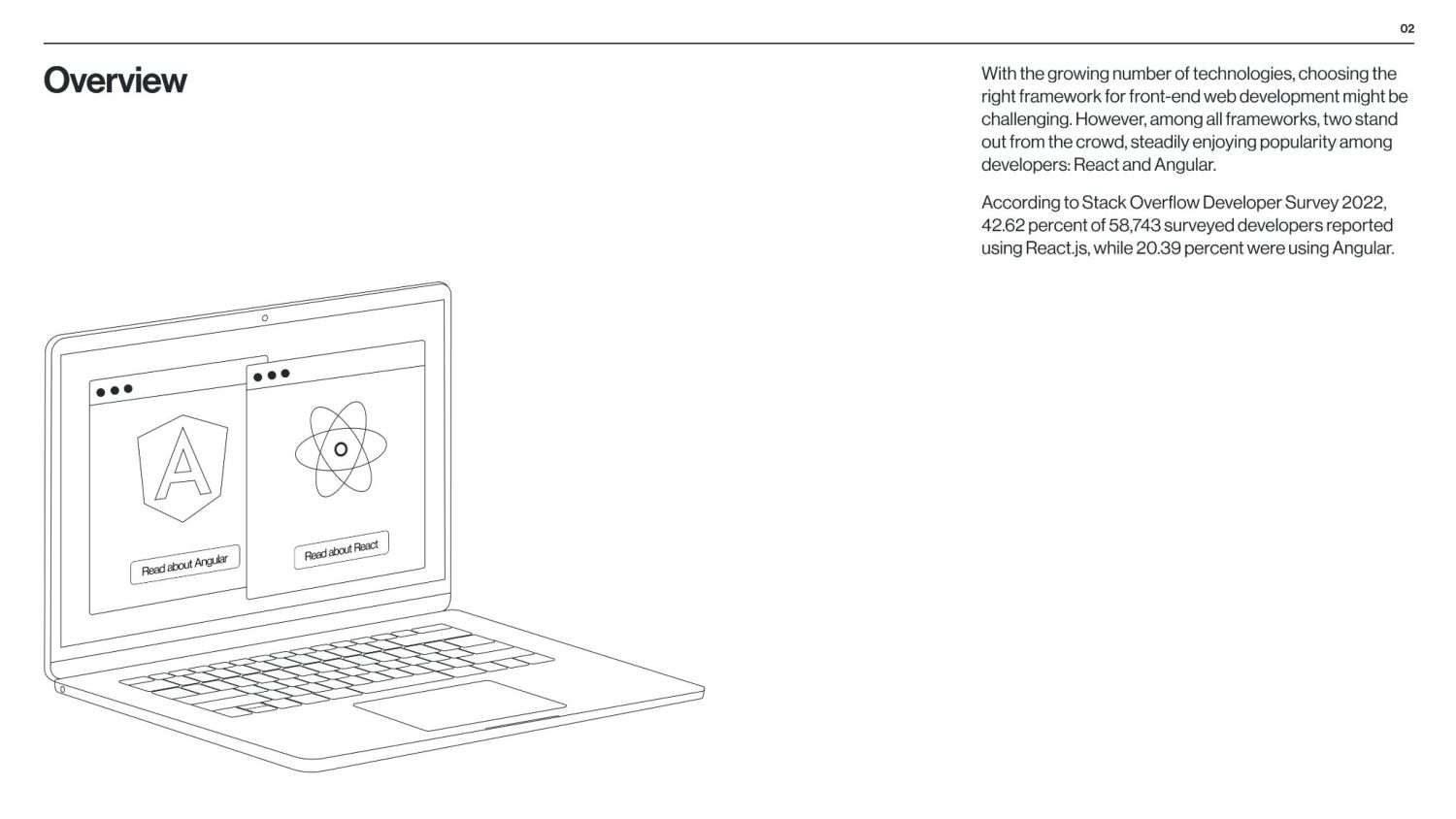
  1. Overview 02 With the growing number of technologies, choosing the

    right framework for front-end web development might be challenging. However, among all frameworks, two stand out from the crowd, steadily enjoying popularity among developers: React and Angular. According to Stack Overflow Developer Survey 2022, 42.62 percent of 58,743 surveyed developers reported using React.js, while 20.39 percent were using Angular. 01 02
  2. What is Angular? 3 Originally AngularJS was introduced in 2010.

    In 2016, a new version, a complete rewrite of Angular JS, was published as Angular 2 or simply Angular. Let’s look at the key characteristics of Angular: Angular is an open-source JavaScript front-end framework. Angular is written in TypeScript and developed by the Angular Team at Google and the individual contributors and corporations community. It is maintained primarily by the Google team. Angular supports the Model-View-Controller (MVC) programming model. The Angular framework is in the vast majority of Google apps you come across. Google support is one of the main benefits of utilizing Angular. This is why the Angular ecosystem is still expanding. Google uses it for its well-known Google Ads system, so every time you see a Google ad, it's because of Angular. Angular enables HTML to be used as a template language by developers and allows HTML's syntax to succinctly and precisely represent the components of the application. It is a fully functional JavaScript framework that aids in creating dynamic SPA – single-page applications.
  3. What is React? 4 Unlike Angular, React is not a

    full-fledged JavaScript framework, but a library. Below are some of the key characteristics of React: Released by Facebook in 2013. Maintained mainly by Facebook and individual contributors. Used by Facebook apps (Facebook, Instagram, and WhatsApp). MVVM (Model-View-View-Model) architecture. React is geared toward a user interface, just like Angular. It enables the creation of UI components, making it easier to build interactive user interfaces. The code in React is relatively easy to read and run. Utilizing server-side rendering, React provides a flexible, performance-driven alternative. React is frequently used to build single-page apps user interfaces from separate components. Because of React’s "learn once, write anywhere" principle, developers can create scalable and quick apps for many platforms.
  4. Advantages of Angular 5 Good dependency. There are many libraries

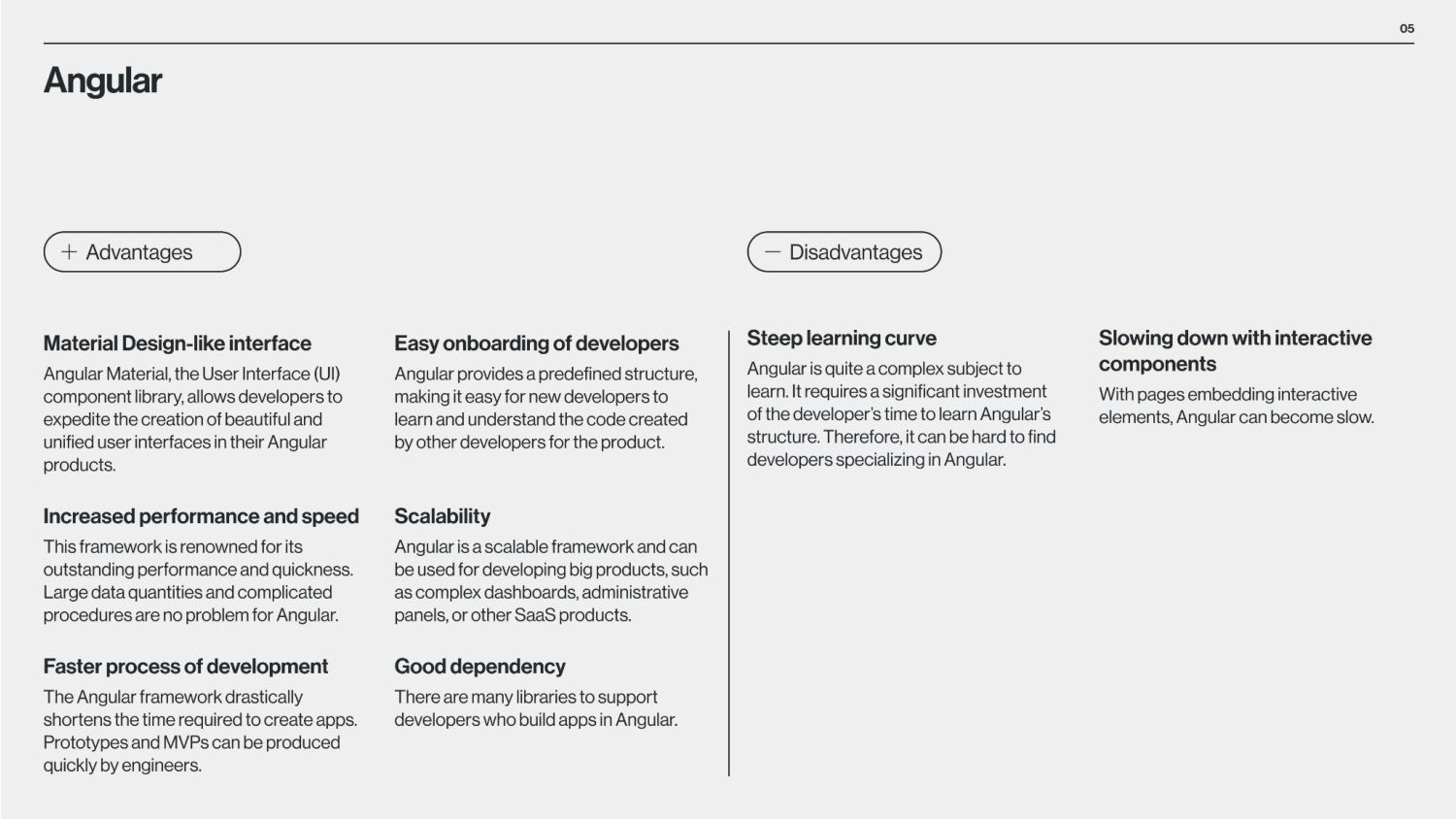
    to support developers who build apps in Angular. Easy onboarding of developers. Angular provides a predefined structure, making it easy for new developers to learn and understand the code created by other developers for the product. Increased performance and speed. This framework is renowned for its outstanding performance and quickness. Large data quantities and complicated procedures are no problem for Angular. Scalability. Angular is a scalable framework and can be used for developing big products, such as complex dashboards, administrative panels, or other SaaS products. Faster process of development. The Angular framework drastically shortens the time required to create apps. Prototypes and MVPs can be produced quickly by engineers. Material Design-like interface. Angular Material, the User Interface (UI) component library, allows developers to expedite the creation of beautiful and unified user interfaces in their Angular products.
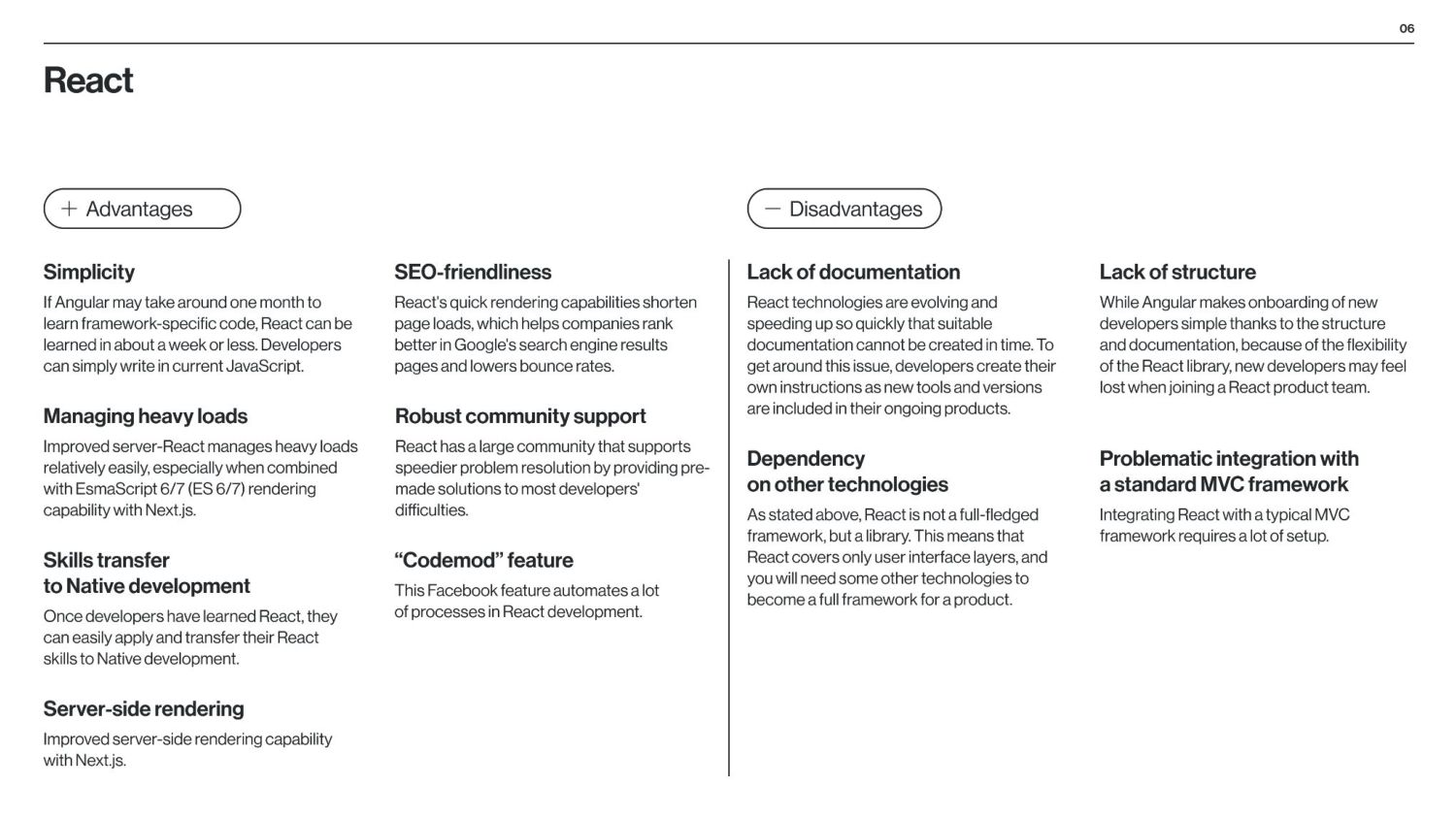
  5. Advantages of React 7 Simplicity. If Angular may take around

    one month to learn framework-specific code, React can be learned in about a week or less. Developers can simply write in current JavaScript. Therefore, React developers are easier to find and train. Skills transfer to Native development. Once developers have learned React, they can easily apply and transfer their React skills to Native development. Robust community support. React has a large community that supports speedier problem resolution by providing pre-made solutions to most developers' difficulties. SEO-friendliness. React's quick rendering capabilities shorten page loads, which helps companies rank better in Google's search engine results pages and lowers bounce rates. Improved server-side rendering capability with Next.js. Managing heavy loads. React manages heavy loads relatively easily, especially when combined with EsmaScript 6/7 (ES 6/7). “Codemod” feature. This Facebook feature automates a lot of processes in React development.
  6. Disadvantages of React 8 Lack of structure. While Angular makes

    onboarding of new developers simple thanks to the structure and documentation, because of the flexibility of the React library, new developers may feel lost when joining a React product team. Lack of documentation. React technologies are evolving and speeding up so quickly that suitable documentation cannot be created in time. To get around this issue, developers create their own instructions as new tools and versions are included in their ongoing products. Dependency on other technologies. As stated above, React is not a full-fledged framework, but a library. This means that React covers only user interface layers, and you will need some other technologies to become a full framework for a product. Problematic integration with a standard MVC framework. Integrating React with a typical MVC framework requires a lot of setup.
  7. Key Difference of Angular vs React 9 The critical difference

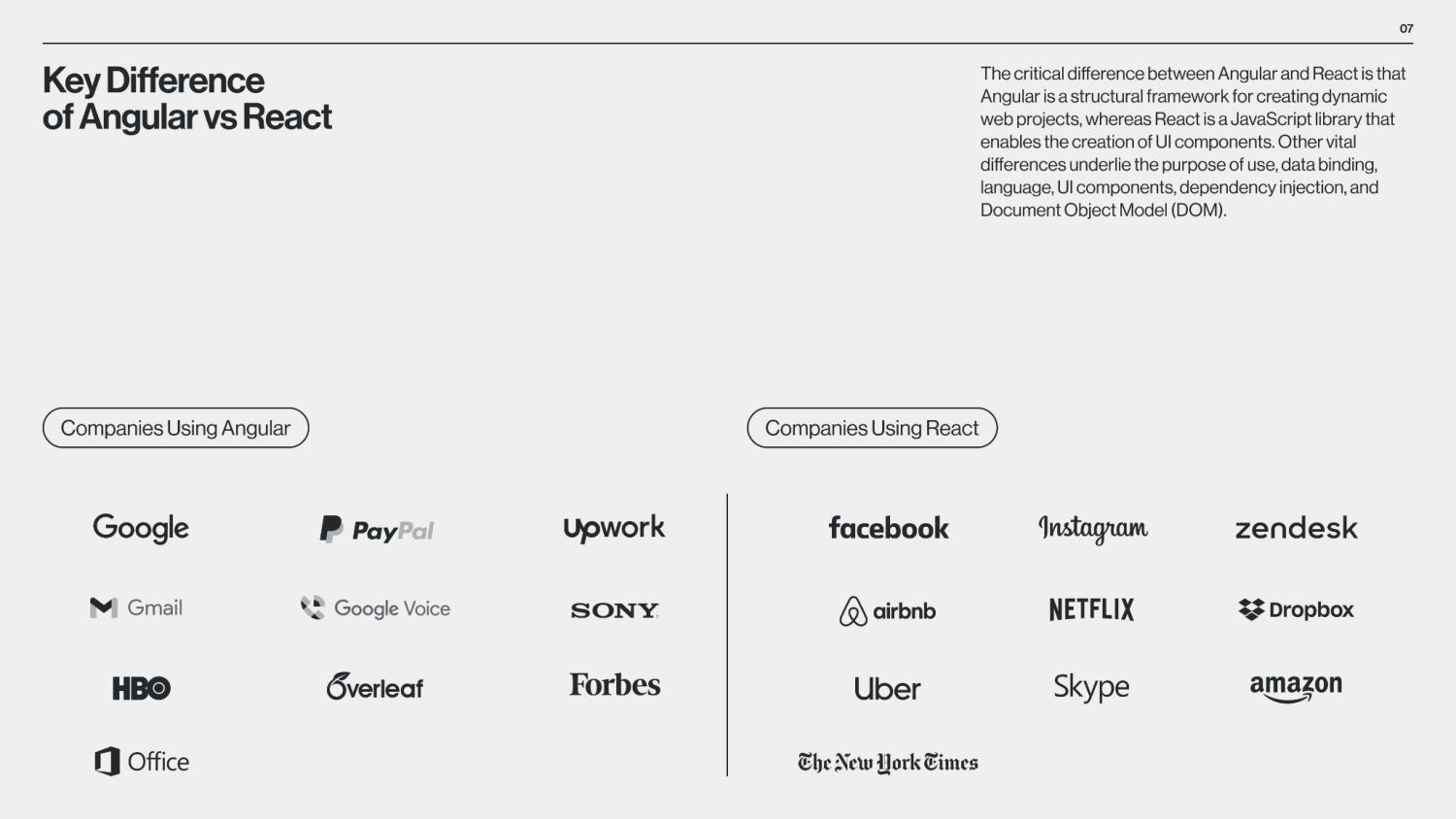
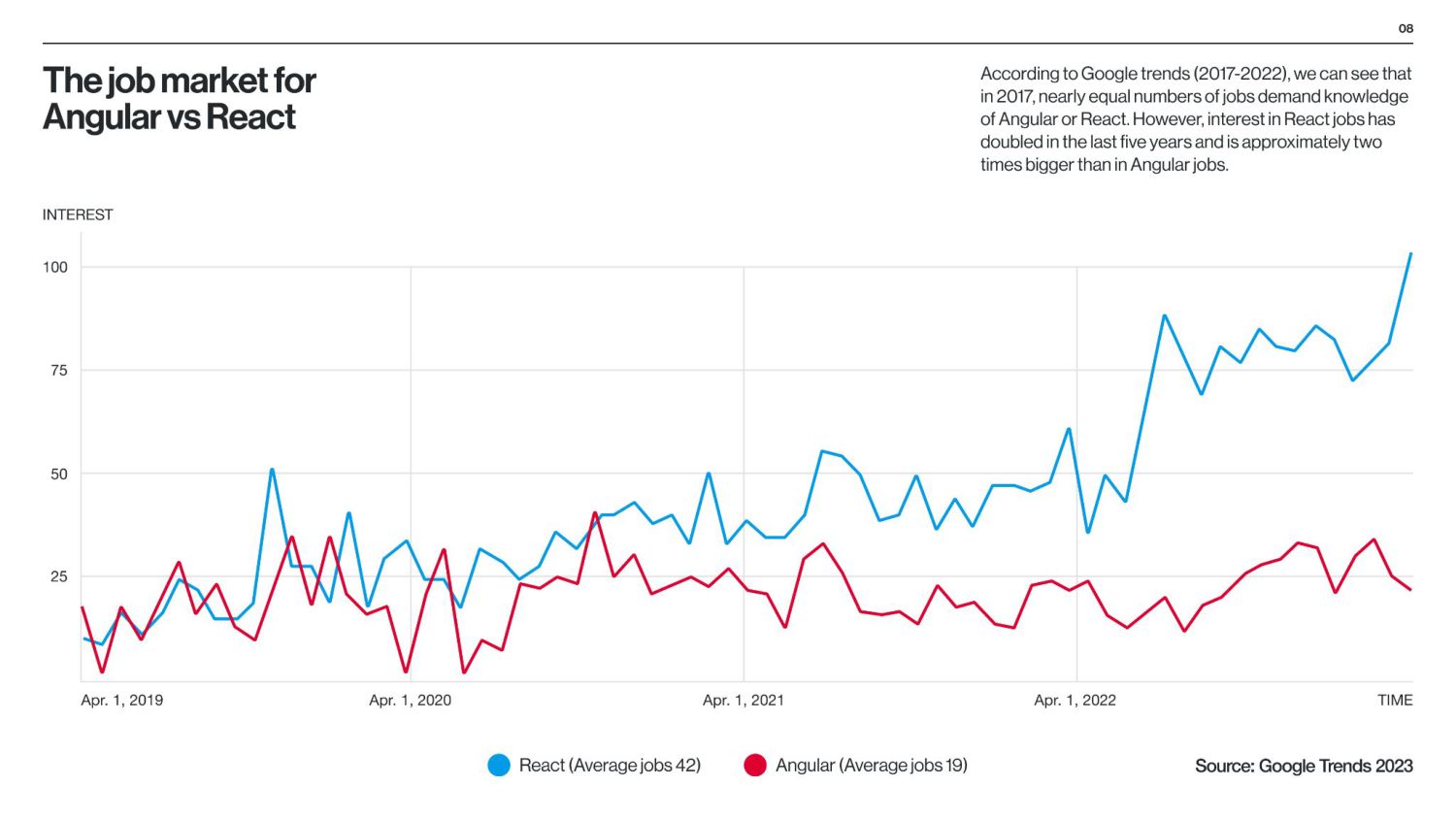
    between Angular and React is that Angular is a structural framework for creating dynamic web projects, whereas React is a JavaScript library that enables the creation of UI components. Other vital differences underlie the purpose of use, data binding, language, UI components, dependency injection, and Document Object Model (DOM). React is used by numerous social media platforms, including Facebook, Instagram, and Skype. Uber, Airbnb, Netflix, The New York Times, Dropbox, Zendesk, and Amazon are additional companies that have created apps utilizing React. Companies Using React Companies Using Angular Angular is used by Google, Microsoft Office Home, Upwork, Sony, and PayPal. Forbes, HBO, and Overleaf are examples of well-known applications created with Angular. The framework is also used by many Google applications, including Gmail and Google Voice. The job market for Angular vs React According to Google trends (2017-2022), we can see that in 2017, nearly equal numbers of jobs demand knowledge of Angular or React. However, interest in React jobs has doubled in the last five years and is approximately two times bigger than in Angular jobs.
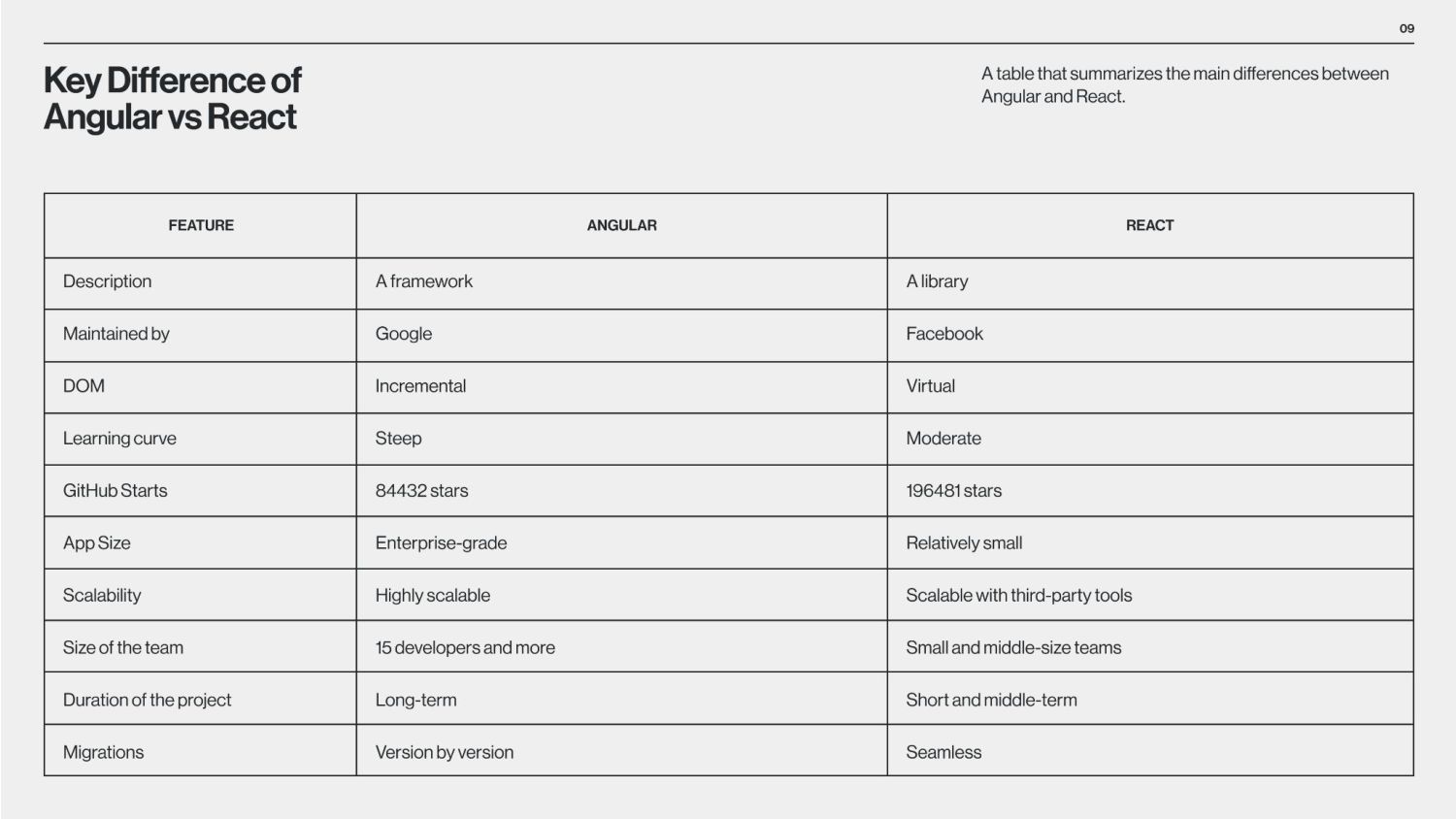
  8. Key Difference of Angular vs React 10 A table that

    summarizes the main differences between Angular and React
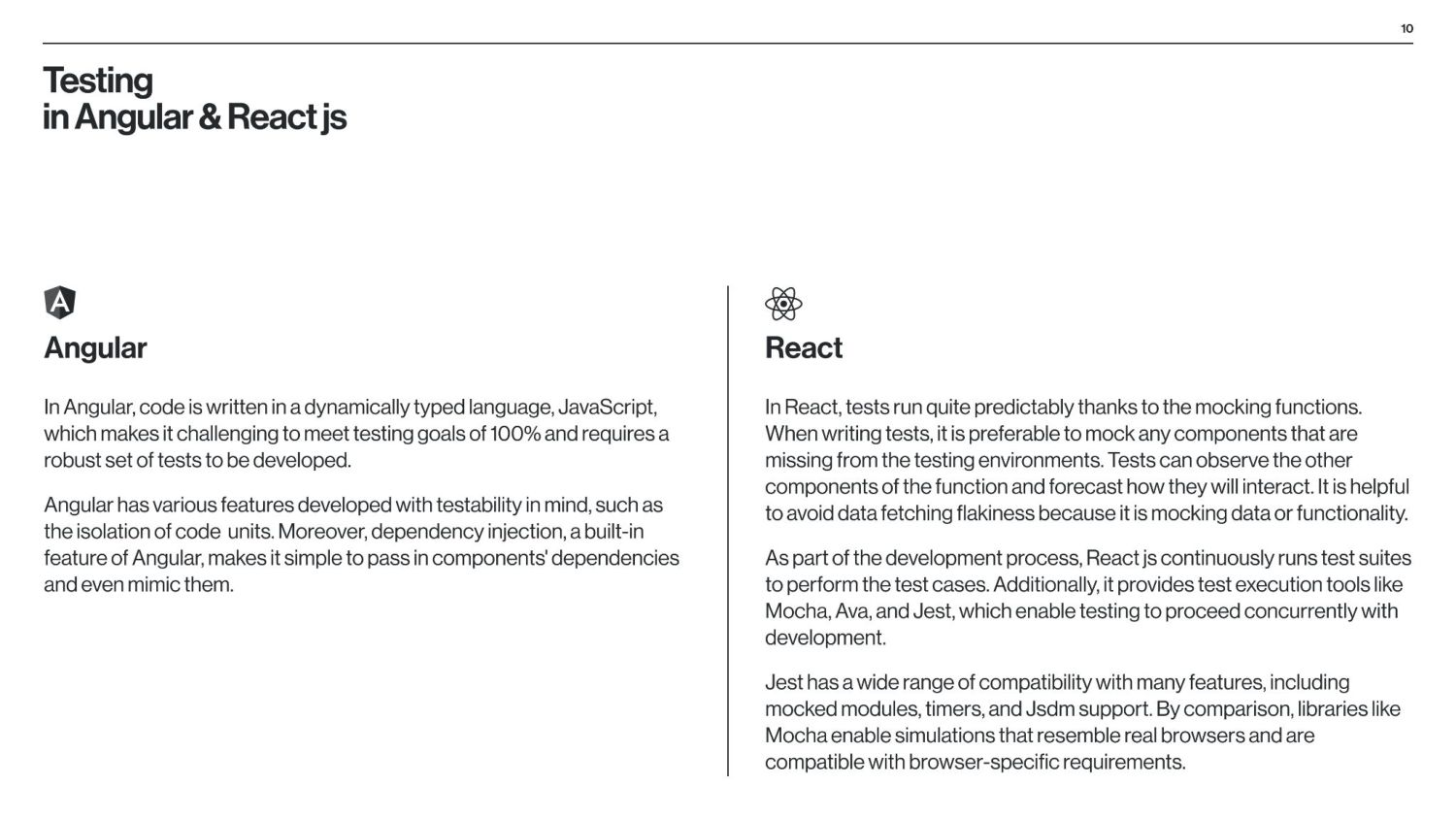
  9. Testing in Angular & React js 11 In Angular, code

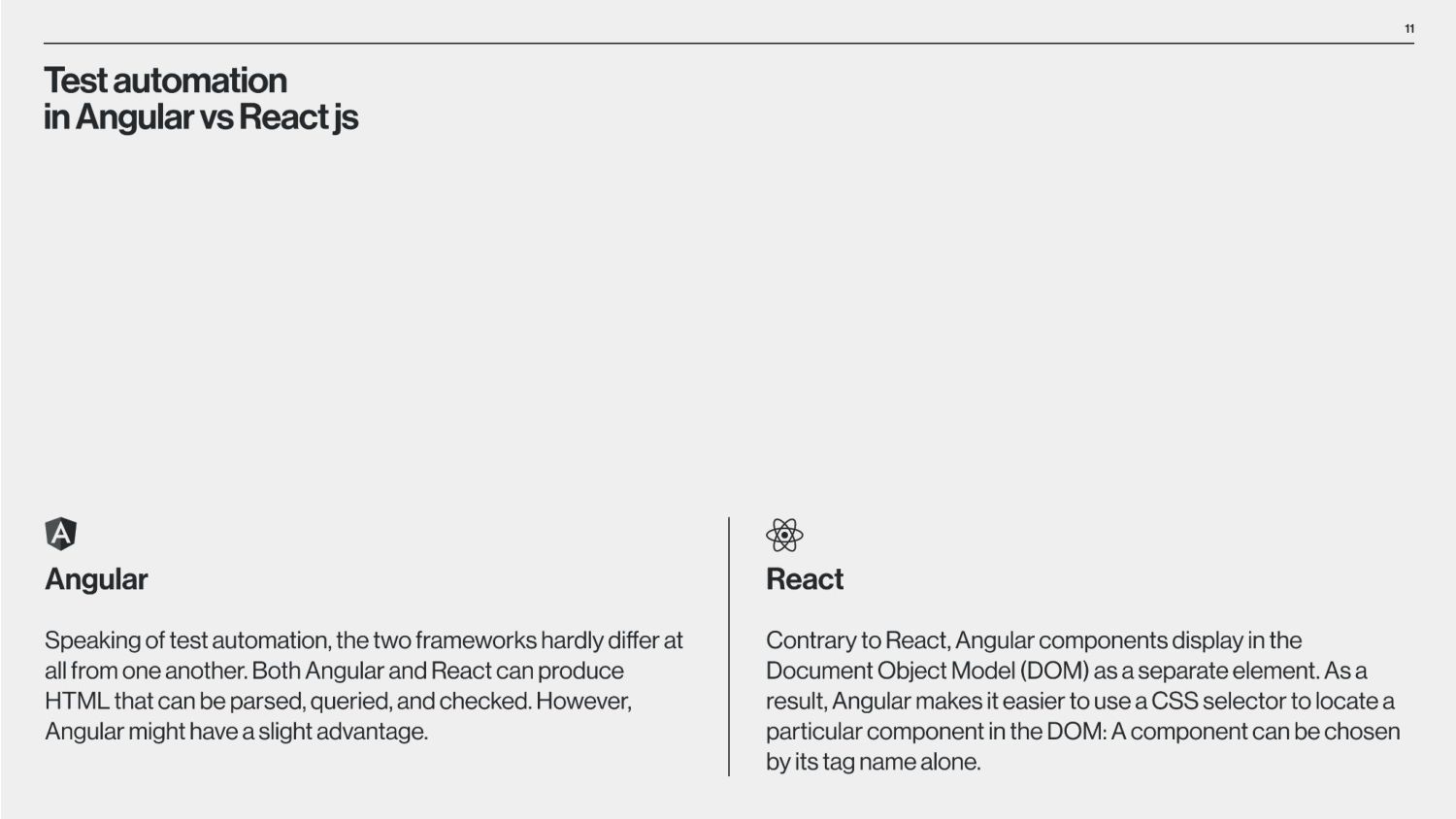
    is written in a dynamically typed language, JavaScript, which makes it challenging to meet testing goals of 100% and requires a robust set of tests to be developed. Angular has various features developed with testability in mind, such as the isolation of code units. Moreover, dependency injection, a built-in feature of Angular, makes it simple to pass in components' dependencies and even mimic them. Testing in Angular Speaking of test automation, the two frameworks hardly differ at all from one another. Both Angular and React can produce HTML that can be parsed, queried, and checked. However, Angular might have a slight advantage. Contrary to React, Angular components display in the Document Object Model (DOM) as a separate element. As a result, Angular makes it easier to use a CSS selector to locate a particular component in the DOM: A component can be chosen by its tag name alone. Test automation in Angular vs React
  10. Testing in Angular & React js 12 Testing in React

    In React, tests run quite predictably thanks to the mocking functions. When writing tests, it is preferable to mock any components that are missing from the testing environments. Tests can observe the other components of the function and forecast how they will interact. It is helpful to avoid data fetching flakiness because it is mocking data or functionality. As part of the development process, React js continuously runs test suites to perform the test cases. Additionally, it provides test execution tools like Mocha, Ava, and Jest, which enable testing to proceed concurrently with development. Jest has a wide range of compatibility with many features, including mocked modules, timers, and Jsdm support. By comparison, libraries like Mocha enable simulations that resemble real browsers and are compatible with browser-specific requirements.
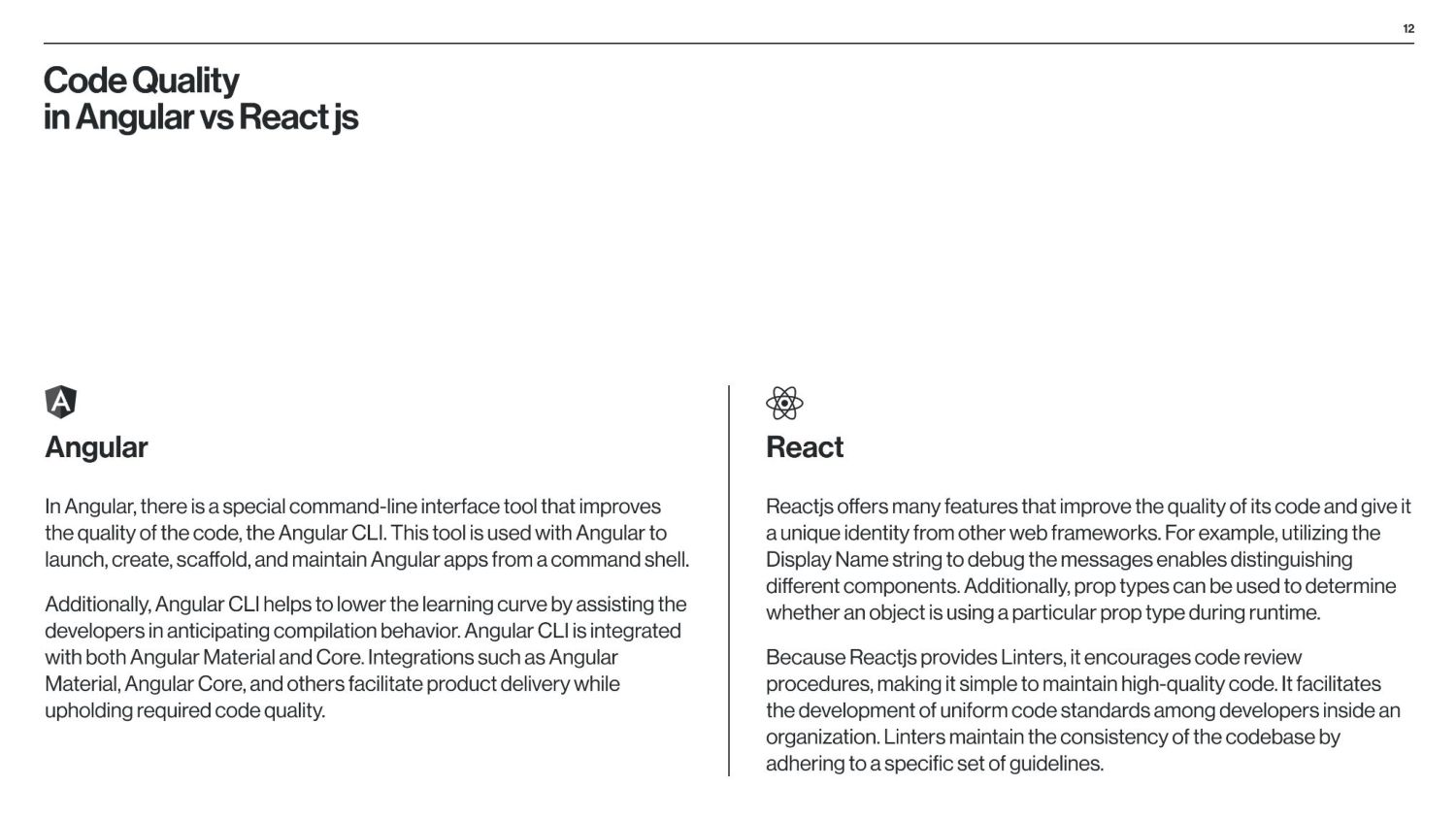
  11. Code Quality in Angular vs Reactjs 14 Reactjs offers many

    features that improve the quality of its code and give it a unique identity from other web frameworks. For example, utilizing the Display Name string to debug the messages enables distinguishing different components. Additionally, prop types can be used to determine whether an object is using a particular prop type during runtime. Because Reactjs provides Linters, it encourages code review procedures, making it simple to maintain high-quality code. It facilitates the development of uniform code standards among developers inside an organization. Linters maintain the consistency of the codebase by adhering to a specific set of guidelines. Code Quality in React Code Quality in Angular In Angular, there is a special command-line interface tool that improves the quality of the code, the Angular CLI. This tool is used with Angular to launch, create, scaffold, and maintain Angular apps from a command shell. Additionally, Angular CLI helps to lower the learning curve by assisting the developers in anticipating compilation behavior. Angular CLI is integrated with both Angular Material and Core. Integrations such as Angular Material, Angular Core, and others facilitate product delivery while upholding required code quality.
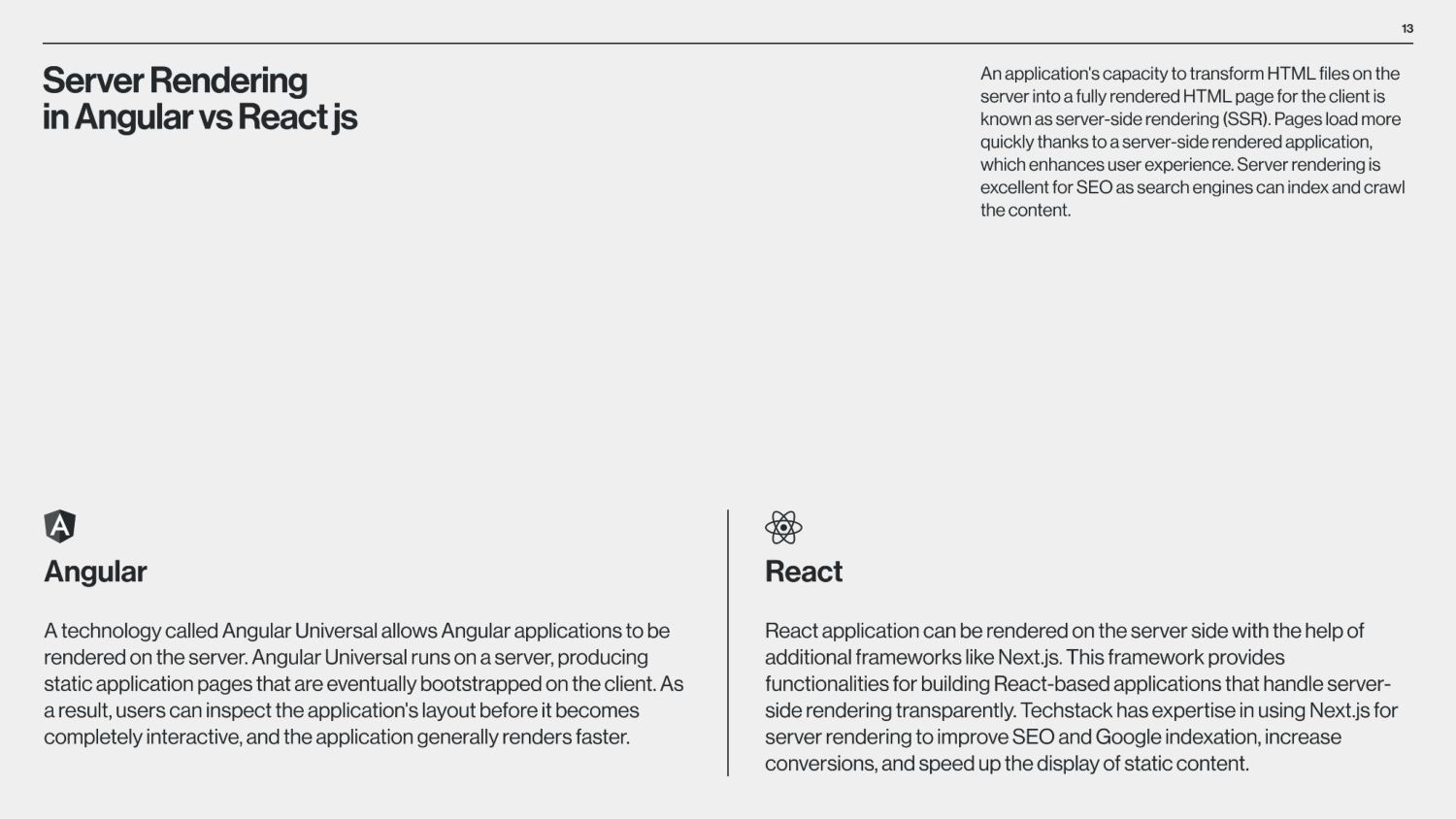
  12. Server Rendering in Angular vs. Reactjs 16 An application's capacity

    to transform HTML files on the server into a fully rendered HTML page for the client is known as server-side rendering (SSR). Pages load more quickly thanks to a server-side rendered application, which enhances user experience. Server rendering is excellent for SEO as search engines can index and crawl the content. A technology called Angular Universal allows Angular applications to be rendered on the server. Angular Universal runs on a server, producing static application pages that are eventually bootstrapped on the client. As a result, users can inspect the application's layout before it becomes completely interactive, and the application generally renders faster. Server Rendering in Angular Server Rendering in React React application can be rendered on the server side with the help of additional frameworks like Next.js. This framework provides functionalities for building React-based applications that handle server-side rendering transparently. Techstack has expertise in using Next.js for server rendering to improve SEO and Google indexation, increase conversions, and speed up the display of static content.
  13. Optimizing – Angular vs. Reactjs 17 Optimizing Angular and React

    apps often implies optimization of bundle file loading. The bundle file is the file that must be downloaded on the first page. To add compatibility between a browser and the code written in the bundle file, Angular needs a compiler. It expedites a browser's compilation process and improves its comprehension. However, the larger bundle as a result of the HTML code being written in components might be taken into account to enhance efficiency. Ahead-of-Time (AOT) is a compiler that converts HTML and TypeScript code into effective JavaScript code before the browser downloads and executes the code. As a result, an application renders in the browser more quickly if it is compiled while being built. Optimizing an Angular App Optimizing a React App Applications created using Reactjs frequently refer to components. However, the bundle file size is important for a large-scale program's seamless operation. In React apps, the bundle file often starts out as a small production file and becomes enormous. As new features are added and dependencies arise due to new business requirements, it is imperative to continuously assess the file size to improve click-through rate and search engine traffic.
  14. Maintainability of Code: Angular Vs. Reactjs 19 Maintainability of Code

    in Angular Angular single-page applications have intricate structures and several code modules. Program files are frequently placed in different files as a result. To maintain such a complicated structure while maintaining the richness of the application, the best framework that supports complex maintainability and can handle complex naming conventions must be chosen. When creating rich web clients, where mixing HTML and Javascript is challenging due to less modularization, developers frequently face major maintainability issues. In most situations when SPAs necessitate a full-proof standard practice of managing code, it is vital to adhere to the best practices outlined in the Angular style guide. The best part is that maintainability issues are solved in Angular by creating maintainable Javascript. It offers an HTML extension to address these issues, which offers developers some relief and results in significant time savings.
  15. Maintainability of Code: Angular Vs. Reactjs 20 Maintainability of Code

    in React Reactjs is a more effective way to write clean code with the same amount of time and quality production hours. Reactjs prohibits developers from writing split code, making it incredibly computer-usable and comprehensible for other developers. It makes it easier for code to be reused by providing a way to make reusable UI components.
  16. Performance & DOM in Angular vs Reactjs 23 DOM in

    Angular and React Document Object Model (DOM) is an interface that lets the script modify the document's structure, style, and content. Virtual DOM, which was introduced by React as the first widely used framework, is defined by the principle that each component builds a new virtual DOM tree each time it is presented. To make the browser DOM conform to the new virtual DOM tree, React first compares the new virtual DOM tree with the old one. Because it employs incremental DOM, Angular Ivy is a brand-new Angular renderer that differs significantly from anything we have seen in popular frameworks. The fundamental principle of incremental DOM, which is applied internally at Google, is that each component is converted into a set of instructions. When the data changes, these instructions generate DOM trees and update them immediately.
  17. Component Architecture in Angular vs Reactjs 24 Since React is

    a library, it creates user interfaces by splitting them into individual components. It indicates that programmers using React create independent components that have their own state before combining them to create more intricate user experiences. Since Angular is a full-fledged framework, it includes many features right out of the box, including RxJS, Angular CLI, and Angular Universal. Generally speaking, Angular’s ecosystem is as robust as that of React. Although React is simpler to understand, it needs multiple integrations, such as Redux, to reach its full potential.
  18. Backward Compatibility in Angular vs Reactjs 25 Backward compatibility assesses

    the possibility of upgrading frameworks, updating architecture, and adding new modules and libraries. When comparing Angular with React, it is worth mentioning that React has full backward compatibility while Angular has some limitations. React allows you to seamlessly update outdated libraries and add new releases to your application. On the other hand, in Angular, it is impossible to upgrade from Angular 2 straight to Angular 14. The versions must be upgraded one at a time. While updating Angular to the next version is not problematic, using external libraries that require Angular can cause some issues.
  19. Scalability in Angular vs Reactjs 26 Knowing the scope of

    work and the scaling potential of both React and Angular will help you decide on the right framework for your app. If scaling an app is important, then Angular must be the right choice. As a full-fledged framework, it has enormous potential and can be used to scale products to build large, complex apps. Angular ensures that developers follow proper techniques from the start. Since Angular components are more difficult to handle than React components, development teams must still proceed with prudence. While React components make it simple to scale the design without altering its foundation, in general, React is highly dependent on third-party tools. Developers must plan everything out to create a scalable application with React. However, in practice, the app may grow chaotically and become hard to control due to the lack of decent project documentation.
  20. Data Binding in Angular vs Reactjs 27 Data binding is

    connecting the user interface (UI) and the displayed data. Although the overall goal is the same, data binding can operate in many ways depending on the framework. Notably, Angular and React use two distinct types of data binding that differ significantly: one-way and two-way data binding. Let’s take a closer look. Angular uses two-way or bidirectional data binding. It means that any changes you make to the user interface in Angular also affect a component class on the other end of the process. It allows continuous updates of the same data across the two layers. This is done so that the model layer can be updated as the input value changes. Two-Way Binding in Angular One-Way Binding in React React mainly employs one-way or unidirectional data binding. It means that you can’t trace the data binding backward. The one-way binding process facilitates writing error-free code, effortless debugging, and greater control over data. Two-way binding can also be implemented in React with the help of a “change” event on one of the components.
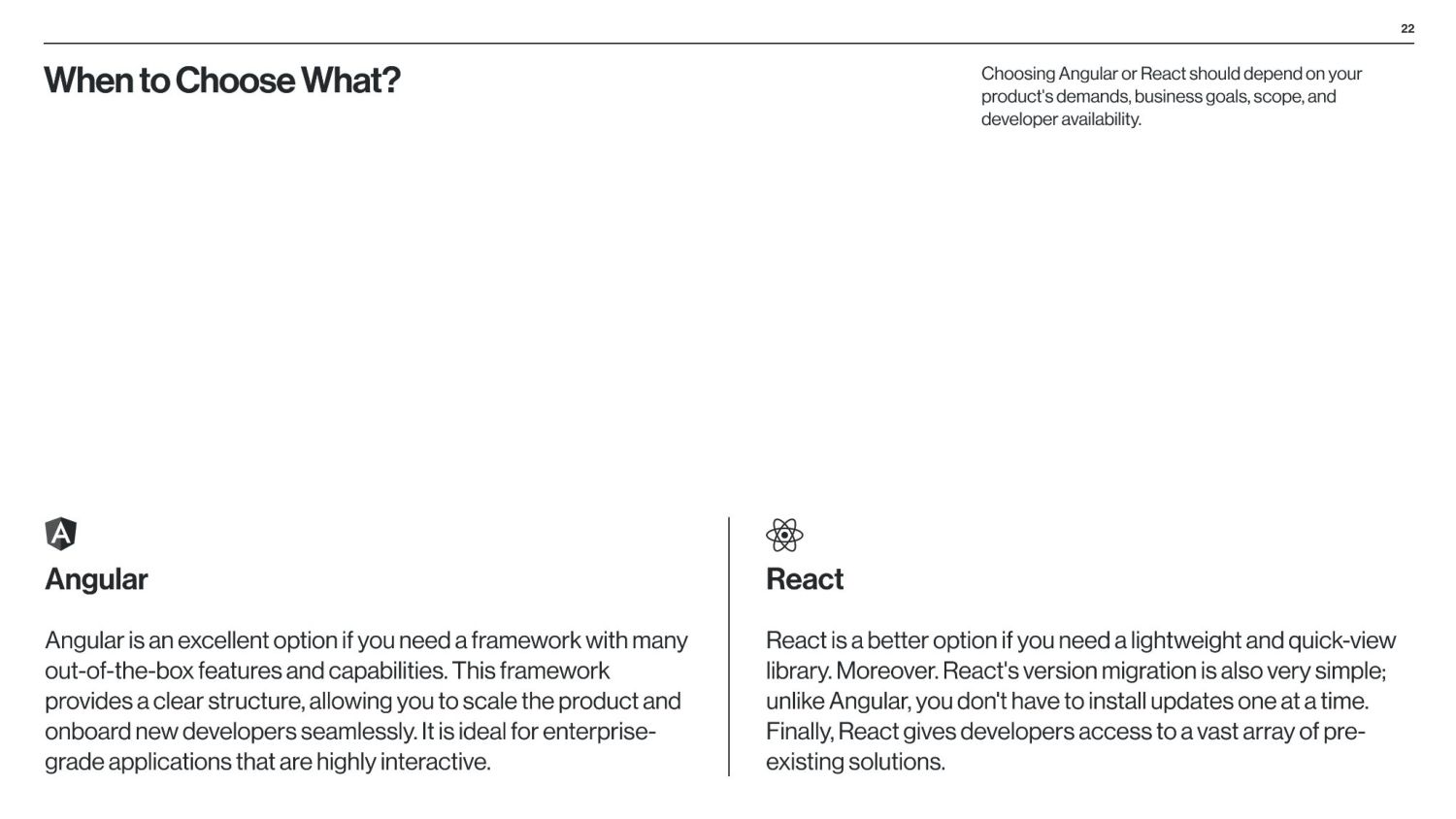
  21. When to Choose What? 28 Choosing Angular or React should

    depend on your product's demands, business goals, scope, and developer availability. Angular is an excellent option if you need a framework with many out-of-the-box features and capabilities. This framework provides a clear structure, allowing you to scale the product and onboard new developers seamlessly. It is ideal for enterprise-grade applications that are highly interactive. React is a better option if you need a lightweight and quick-view library. Moreover. React's version migration is also very simple; unlike Angular, you don't have to install updates one at a time. Finally, React gives developers access to a vast array of pre-existing solutions.
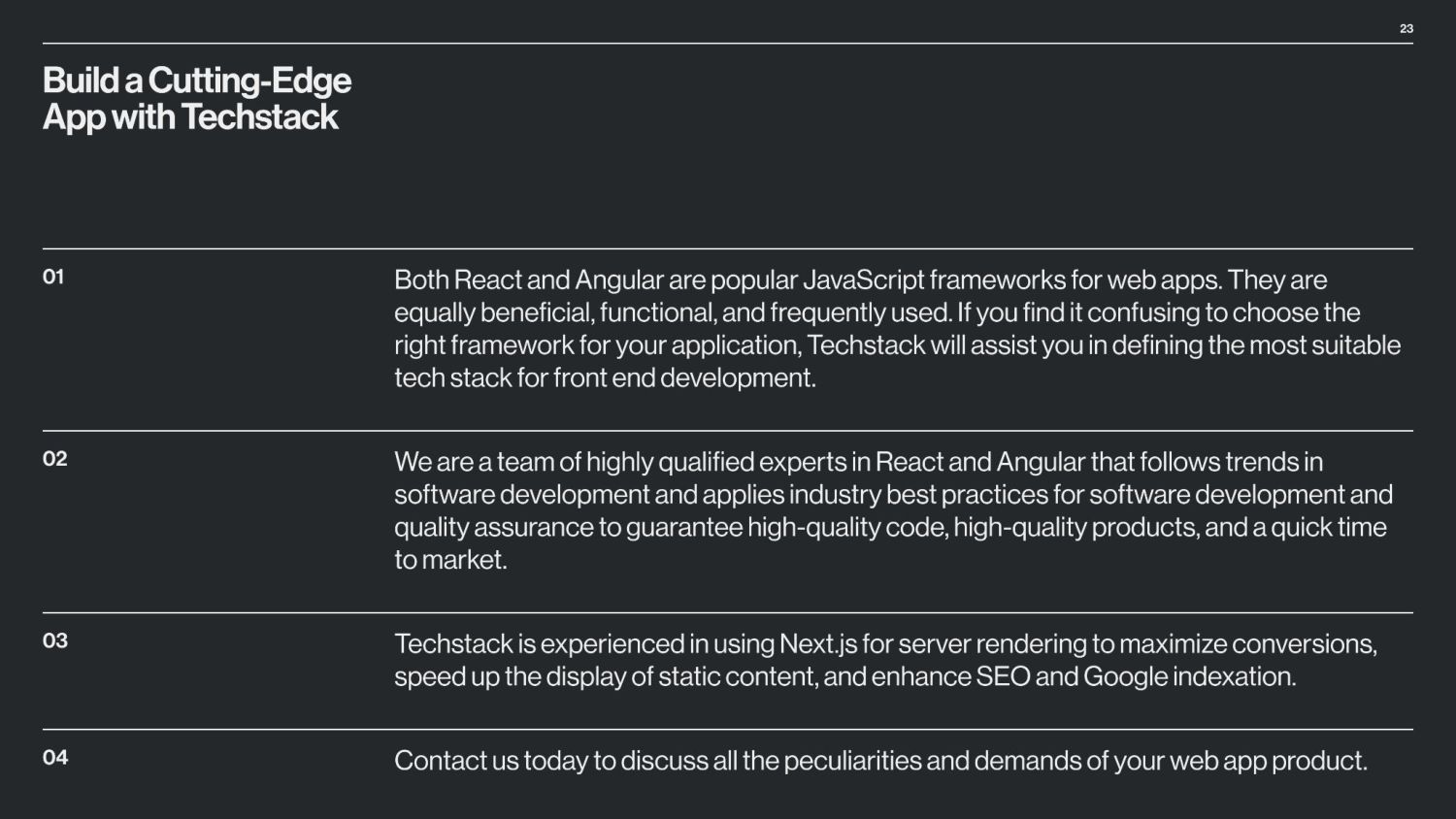
  22. Build a Cutting-Edge App with Techstack 29 Both React and

    Angular are popular JavaScript frameworks for web apps. They are equally beneficial, functional, and frequently used. If you find it confusing to choose the right framework for your application, Techstack will assist you in defining the most suitable tech stack for front end development. We are a team of highly qualified experts in React and Angular that follows trends in software development and applies industry best practices for software development and quality assurance to guarantee high-quality code, high-quality products, and a quick time to market. Techstack is experienced in using Next.js for server rendering to maximize conversions, speed up the display of static content, and enhance SEO and Google indexation. Contact us today to discuss all the peculiarities and demands of your web app product.