Share
Embed
Designing HTTP Interfaces and RESTful Web Services (SFLiveSanFrancisco2012 2012-09-27)
Presentation given at Symfony Live San Francisco 2012 conference in San Francisco, California, United States.
David Zuelke
September 27, 2012
Transcript
156 slides
-
THE RISE OF WEB SERVICES Ohai, I'm ur CEO, I
canhaz SOAP API plz, today, kthx? -
POST /soapendpoint.php HTTP/1.1 Host: localhost Content-‐Type: text/xml; charset=utf-‐8 <?xml version="1.0"
encoding="UTF-‐8"?> <SOAP-‐ENV:Envelope xmlns:SOAP-‐ENV="http://schemas.xmlsoap.org/soap/envelope/"> <SOAP-‐ENV:Body> <ns1:getProduct xmlns:ns1="http://agavi.org/sampleapp"> <id>123456</id> </ns1:getProduct> </SOAP-‐ENV:Body> </SOAP-‐ENV:Envelope> HTTP/1.1 200 OK Content-‐Type: text/xml; charset=utf-‐8 <?xml version="1.0" encoding="UTF-‐8"?> <SOAP-‐ENV:Envelope xmlns:SOAP-‐ENV="http://schemas.xmlsoap.org/soap/envelope/"> <SOAP-‐ENV:Body> <ns1:getProductResponse xmlns:ns1="http://agavi.org/sampleapp"> <product> <id>123456</id> <name>Red Stapler</name> <price>3.14</price> </product> </ns1:getProductResponse> </SOAP-‐ENV:Body> </SOAP-‐ENV:Envelope> -
POST /soapendpoint.php HTTP/1.1 Host: localhost Content-‐Type: text/xml; charset=utf-‐8 <?xml version="1.0"
encoding="UTF-‐8"?> <SOAP-‐ENV:Envelope xmlns:SOAP-‐ENV="http://schemas.xmlsoap.org/soap/envelope/"> <SOAP-‐ENV:Body> <ns1:getProduct xmlns:ns1="http://agavi.org/sampleapp"> <id>987654</id> </ns1:getProduct> </SOAP-‐ENV:Body> </SOAP-‐ENV:Envelope> HTTP/1.1 500 Internal Service Error Content-‐Type: text/xml; charset=utf-‐8 <?xml version="1.0" encoding="UTF-‐8"?> <SOAP-‐ENV:Envelope xmlns:SOAP-‐ENV="http://schemas.xmlsoap.org/soap/envelope/"> <SOAP-‐ENV:Body> <SOAP-‐ENV:Fault> <faultcode>SOAP-‐ENV:Server</faultcode> <faultstring>Unknown Product </faultstring> </SOAP-‐ENV:Fault> </SOAP-‐ENV:Body> </SOAP-‐ENV:Envelope> -
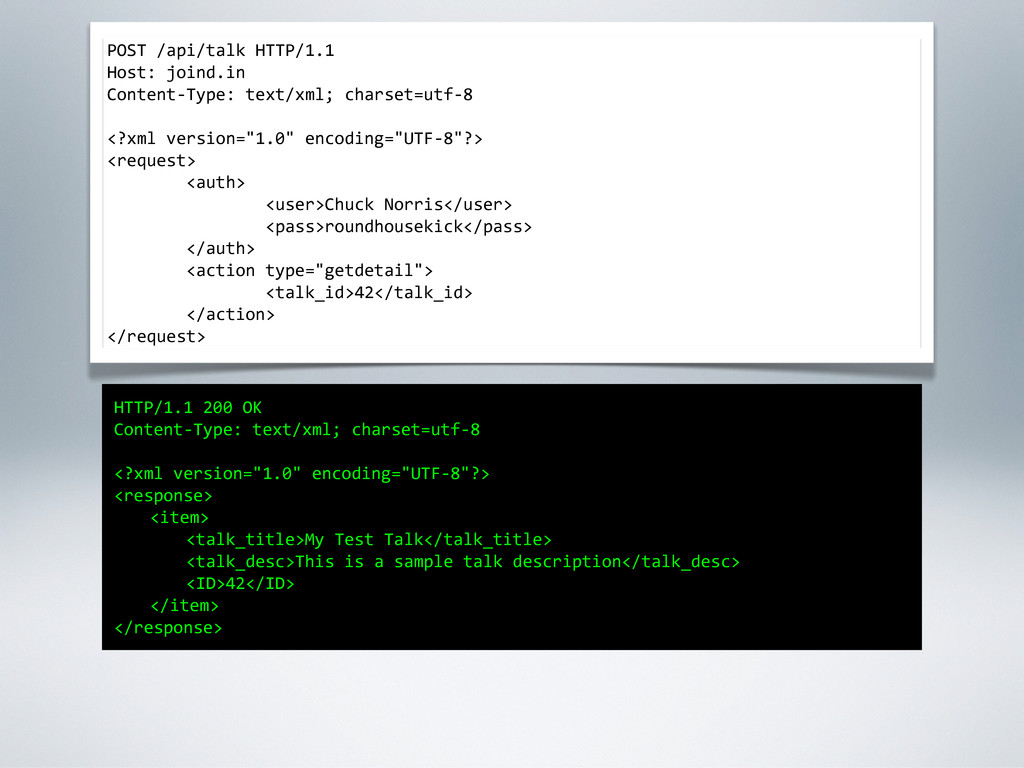
POST /api/talk HTTP/1.1 Host: joind.in Content-‐Type: text/xml; charset=utf-‐8 <?xml version="1.0"
encoding="UTF-‐8"?> <request> <auth> <user>Chuck Norris</user> <pass>roundhousekick</pass> </auth> <action type="getdetail"> <talk_id>42</talk_id> </action> </request> HTTP/1.1 200 OK Content-‐Type: text/xml; charset=utf-‐8 <?xml version="1.0" encoding="UTF-‐8"?> <response> <item> <talk_title>My Test Talk</talk_title> <talk_desc>This is a sample talk description</talk_desc> <ID>42</ID> </item> </response> -
PROBLEMS WITH THIS API • Always a POST • Doesn't
use HTTP Authentication • Operation information is enclosed in the request ("getdetail") • Nothing there is cacheable • Everything through one endpoint (/api/talks for talks) -
Level 0 in the Richardson Maturity Model: Plain old XML
over the wire in an RPC fashion -
Level 0 and Level 1 are a bag of hurt.
Do not use them. Ever. -
Roy Thomas Fielding: Architectural styles and the design of network
based software architectures. -
• Client-Server • Stateless • Cacheable • Layered System •
Code on Demand (optional) • Uniform Interface REST CONSTRAINTS -
• A URL identifies a Resource • Methods perform operations
on resources • The operation is implicit and not part of the URL • A hypermedia format is used to represent the data • Link relations are used to navigate a service UNIFORM INTERFACE -
GET /products/ HTTP/1.1 Host: acme.com Accept: application/json HTTP/1.1 200 OK
Content-‐Type: application/json; charset=utf-‐8 Allow: GET, POST [ { id: 1234, name: "Red Stapler", price: 3.14, location: "http://acme.com/products/1234" } ] GETTING JSON BACK -
GET /products/ HTTP/1.1 Host: acme.com Accept: application/xml HTTP/1.1 200 OK
Content-‐Type: application/xml; charset=utf-‐8 Allow: GET, POST <?xml version="1.0" encoding="utf-‐8"?> <products xmlns="urn:com.acme.products" xmlns:xl="http://www.w3.org/1999/xlink"> <product id="1234" xl:type="simple" xl:href="http://acme.com/products/1234"> <name>Red Stapler</name> <price currency="EUR">3.14</price> </product> </products> GETTING XML BACK -
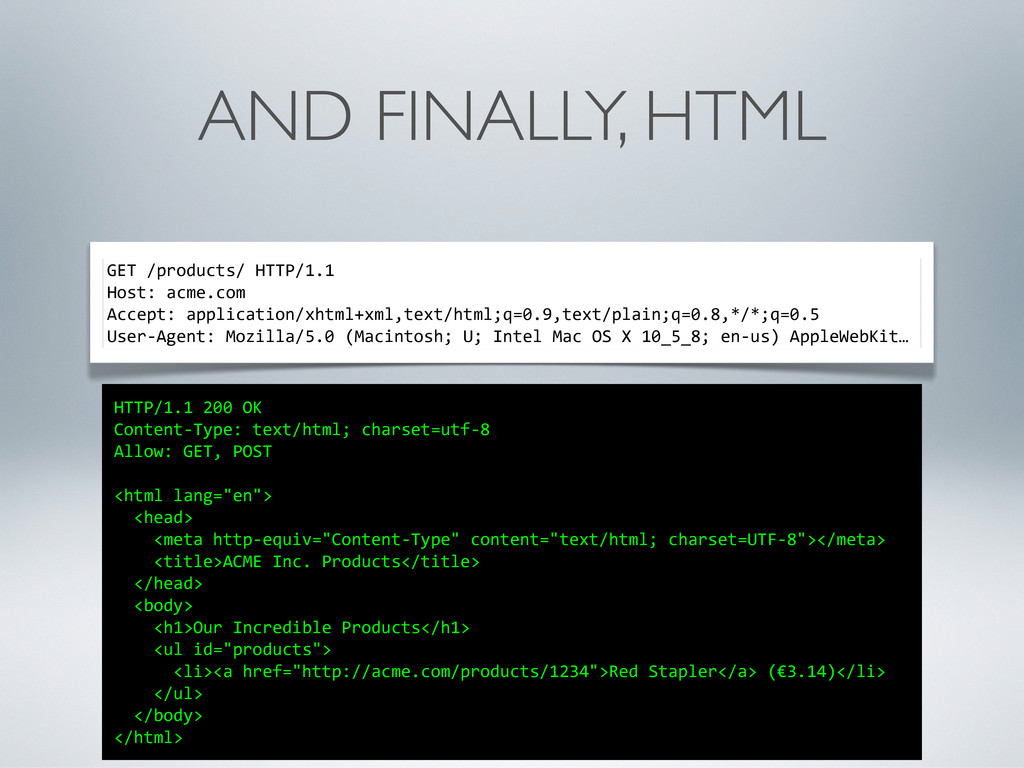
GET /products/ HTTP/1.1 Host: acme.com Accept: application/xhtml+xml,text/html;q=0.9,text/plain;q=0.8,*/*;q=0.5 User-‐Agent: Mozilla/5.0 (Macintosh;
U; Intel Mac OS X 10_5_8; en-‐us) AppleWebKit… HTTP/1.1 200 OK Content-‐Type: text/html; charset=utf-‐8 Allow: GET, POST <html lang="en"> <head> <meta http-‐equiv="Content-‐Type" content="text/html; charset=UTF-‐8"></meta> <title>ACME Inc. Products</title> </head> <body> <h1>Our Incredible Products</h1> <ul id="products"> <li><a href="http://acme.com/products/1234">Red Stapler</a> (€3.14)</li> </ul> </body> </html> AND FINALLY, HTML -
BAD URLS • http://www.acme.com/product/ • http://www.acme.com/product/filter/cats/desc • http://www.acme.com/product/1234 • http://www.acme.com/photos/product/1234
• http://www.acme.com/photos/product/1234/new • http://www.acme.com/photos/product/1234/5678 WTF? photo or product ID? new what? -
GOOD URLS • http://www.acme.com/products/ • http://www.acme.com/products/?filter=cats&sort=desc • http://www.acme.com/products/1234 • http://www.acme.com/products/1234/photos/
• http://www.acme.com/products/1234/photos/?sort=latest • http://www.acme.com/products/1234/photos/5678 a list of products filtering is a query a single product all photos -
COLLECTION OPERATIONS • http://www.acme.com/products/ • GET to retrieve a list
of products • POST to create a new product • returns • 201 Created • Location: http://www.acme.com/products/1235 -
ITEM OPERATIONS • http://www.acme.com/products/1234 • GET to retrieve • PUT
to update • DELETE to, you guessed it, delete -
RMM LEVEL 2 • Use HTTP verbs • GET (safe
and idempotent) • POST (unsafe, not idempotent) • PUT & DELETE (unsafe, idempotent) • Use HTTP status codes to indicate result success • e.g. HTTP/1.1 409 Conflict -
CURRENT STATE • GET http://api.twitter.com/1/statuses/show/12345.json • POST http://api.twitter.com/1/statuses/update.json • DELETE
http://api.twitter.com/1/statuses/destroy/12345.json • GET http://api.twitter.com/1/statuses/retweets/12345.json • PUT http://api.twitter.com/1/statuses/retweet/12345.json Doesn’t allow Accept header Why a PUT? Why the difference? Posts to auth’d user! “DELETE destroy”, RPC much? -
COULD BE SO MUCH SIMPLER • http://twitter.com/username/statuses/ • POST to
create a new tweet • http://twitter.com/username/statuses/12345 • DELETE deletes (PUT could be used for updates) • http://twitter.com/username/statuses/12345/retweets/ • POST creates a new retweet -
THE UNIFORM INTERFACE • Identification of Resources (e.g. through URIs)
• Representations are conceptually separate! • Manipulation Through Representations (i.e. they are complete) • Self-Descriptive Messages (containing all information) • Hypermedia As The Engine Of Application State ("HATEOAS") magic awesomesauce essential to REST -
ONE LAST PIECE IS MISSING • How does a client
know what to do with representations? • How do you go to the “next” operation? • What are the URLs for creating subordinate resources? • Where is the contract for the service? -
HYPERMEDIA AS THE ENGINE OF APPLICATION STATE • Use links
to allow clients to discover locations and operations • Link relations are used to express the possible options • Clients do not need to know URLs, so they can change • The entire application workflow is abstracted, thus changeable • The hypermedia type itself could be versioned if necessary • No breaking of clients if the implementation is updated! -
GET /products/1234 HTTP/1.1 Host: acme.com Accept: application/vnd.com.acme.shop+xml HTTP/1.1 200 OK
Content-‐Type: application/vnd.come.acme.shop+xml; charset=utf-‐8 Allow: GET, PUT, DELETE <?xml version="1.0" encoding="utf-‐8"?> <product xmlns="urn:com.acme.prods" xmlns:atom="http://www.w3.org/2005/Atom"> <id>1234</id> <name>Red Stapler</name> <price currency="EUR">3.14</price> <atom:link rel="payment" type="application/vnd.com.acme.shop+xml" href="http://acme.com/products/1234/payment"/> </product> re-use Atom for link relations meaning defined in IANA Link Relations list A CUSTOM MEDIA TYPE Remind clients of Uniform Interface :) -
<?xml version="1.0" encoding="utf-‐8"?> <product xmlns="urn:com.acme.prods" xmlns:atom="http://www.w3.org/2005/xlink"> <id>1234</id> <name>Red
Stapler</name> <atom:link rel="payment" type="application/com.acme.shop+xml" href="http://acme.com/products/1234/payment"/> <price>3.14</price> </product> { id: 1234, name: "Red Stapler", links: [ { rel: "payment", type: "application/vnd.com.acme.shop+json", href: "http://acme.com/products/1234/payment" } ], price: 3.14 } XML VERSUS JSON -
<?xml version="1.0" encoding="utf-‐8"?> <product xmlns="urn:com.acme.prods" xmlns:atom="http://www.w3.org/2005/xlink"> <id>1234</id> <name>Red
Stapler</name> <atom:link rel="payment" type="application/com.acme.shop+xml" href="http://acme.com/products/1234/payment"/> <price currency="EUR">3.14</price> </product> { id: 1234, name: "Red Stapler", links: [ { rel: "payment", type: "application/vnd.com.acme.shop+json", href: "http://acme.com/products/1234/payment" } ], price: { amount: 3.14, currency: "EUR" } } XML VERSUS JSON Content (“node value”) still the same Float becomes object, stuff breaks -
<?xml version="1.0" encoding="utf-‐8"?> <products xmlns="http://acme.com/shop/products"> <product id="123">
<name>Bacon</name> <price>5.99</price> </product> </products> -
<?xml version="1.0" encoding="utf-‐8"?> <products xmlns="http://acme.com/shop/products"> <product id="123">
<name>Bacon</name> <price>5.99</price> OMNOMNOM Bacon </product> </products> -
<?xml version="1.0" encoding="utf-‐8"?> <products xmlns="http://acme.com/shop/products"> <product id="123">
<name>Bacon</name> <price currency="USD">5.99</price> </product> </products> -
<?xml version="1.0" encoding="utf-‐8"?> <products xmlns="http://acme.com/shop/products"> <product id="123">
<name>Bacon</name> <price currency="USD">5.99</price> <price currency="EUR">4.49</price> </product> </products> -
<?xml version="1.0" encoding="utf-‐8"?> <products xmlns="http://acme.com/shop/products"> <product id="123">
<name xml:lang="en">Bacon</name> <name xml:lang="de">Speck</name> <price currency="USD">5.99</price> <price currency="EUR">4.49</price> </product> </products> -
<?xml version="1.0" encoding="utf-‐8"?> <products xmlns="http://acme.com/shop/products"> <product id="123">
<name xml:lang="en">Bacon</name> <name xml:lang="de">Speck</name> <price>5.99</price> <link rel="category" href="..." /> </product> </products> -
<?xml version="1.0" encoding="utf-‐8" standalone="yes"?> <search> <total_results>6</total_results> <items_per_page>1</items_per_page>
<start_index>1</start_index> <link href="http://openapi.lovefilm.com/catalog/games?start_index=1&items_per_page=1&term=old" rel="self" title="self"/> <link href="http://openapi.lovefilm.com/catalog/games?start_index=2&items_per_page=1&term=old" rel="next" title="next"/> <link href="http://openapi.lovefilm.com/catalog/games?start_index=6&items_per_page=1&term=old" rel="last" title="last"/> <catalog_title> <can_rent>true</can_rent> <release_date>2003-‐09-‐12</release_date> <title full="Star Wars: Knights of the Old Republic" clean="Star Wars: Knights of the Old Republic"/> <id>http://openapi.lovefilm.com/catalog/title/59643</id> <adult>false</adult> <number_of_ratings>574</number_of_ratings> <rating>4</rating> <category scheme="http://openapi.lovefilm.com/categories/catalog" term="games"/> <category scheme="http://openapi.lovefilm.com/categories/format" term="Xbox"/> <category scheme="http://openapi.lovefilm.com/categories/genres" term="Adventure"/> <category scheme="http://openapi.lovefilm.com/categories/genres" term="Role-‐playing"/> <category scheme="http://openapi.lovefilm.com/categories/certificates/bbfc" term="TBC"/> <link href="http://openapi.lovefilm.com/catalog/title/59643/synopsis" rel="http://schemas.lovefilm.com/synopsis" title="synopsis"/> <link href="http://openapi.lovefilm.com/catalog/title/59643/reviews" rel="http://schemas.lovefilm.com/reviews" title="reviews"/> <link href="http://www.lovefilm.com/product/59643-‐Star-‐Wars-‐Knights-‐of-‐the-‐Old-‐Republic.html?cid=LFAPI" rel="alternate" title="web page"/> </catalog_title> </search> -
ROOM FOR IMPROVEMENT IN THE LOVEFILM API • Uses application/xml
instead of a custom media type • Once that is fixed, all the link elements could also have a “type” attribute indicating the media type • Should use XML namespaces on the root element, with one namespace per type (e.g. “urn:com.lovefilm.api.item”, “urn:com.lovefilm.api.searchresult” and so on) • That way, clients can determine the resource type easily -
<document xmlns="http://schema.huddle.net/2011/02/" title="TPS report May 2010" description="relentlessly
mundane and enervating."> <link rel="self" href="..." /> <link rel="parent" href="..." title="..."/> <link rel="edit" href="..." /> <link rel="delete" href="..." /> <link rel="content" href="..." title="..." type="..." /> <link rel="thumb" href="..." /> <link rel="version-‐history" href="..." /> <link rel="create-‐version" href="..." /> <link rel="comments" href="..." /> <actor name="Peter Gibson" rel="owner"> <link rel="self" href="..." /> <link rel="avatar" href="..." type="image/jpg" /> <link rel="alternate" href="..." type="text/html" /> </actor> <actor name="Barry Potter" rel="updated-‐by"> <link rel="self" href="..." /> <link rel="avatar" href="..." type="image/jpg" /> <link rel="alternate" href="..." type="text/html" /> </actor> <size>19475</size> <version>98</version> <created>2007-‐10-‐10T09:02:17Z</created> <updated>2011-‐10-‐10T09:02:17Z</updated> <processingStatus>Complete</processingStatus> <views>9</views> </document> -
ROOM FOR IMPROVEMENT IN THE HUDDLE API • Uses custom
rels like “thumb” or “avatar” not defined in the IANA registry (http://www.iana.org/assignments/link-relations) • Risk of collisions and ambiguity; should use something like “http://rels.huddle.net/thumb” instead. • Uses one global XML schema and namespace for all entities • Clients cannot detect entity type based on namespace • Difficult to evolve schema versions independently -
GET /products/1234 HTTP/1.1 Host: acme.com Accept: application/vnd.com.myservice+xml HTTP/1.1 200 OK
Content-‐Type: application/vnd.com.myservice+xml; charset=utf-‐8 Allow: GET, PUT, DELETE <?xml version="1.0" encoding="utf-‐8"?> <product xmlns="urn:com.acme.products" xmlns:xl="http://www.w3.org/1999/xlink" id="1234" xl:type="simple" xl:href="http://acme.com/products/1234"> <name>Red Stapler</name> <price currency="EUR">3.14</price> </product> API VERSION 1 -
GET /products/1234 HTTP/1.1 Host: acme.com Accept: application/vnd.com.myservice+xml HTTP/1.1 404 Not
Found Content-‐Type: application/vnd.com.myservice+xml; charset=utf-‐8 API VERSION 1 -
API now offers a new protocol version with availability indicators
(breaking change!) -
GET /products/1234 HTTP/1.1 Host: acme.com Accept: application/vnd.com.myservice.v2+xml HTTP/1.1 200 OK
Content-‐Type: application/vnd.com.myservice.v2+xml; charset=utf-‐8 Allow: GET, PUT, DELETE <?xml version="1.0" encoding="utf-‐8"?> <product xmlns="urn:com.acme.products" xmlns:xl="http://www.w3.org/1999/xlink" id="1234" xl:type="simple" xl:href="http://acme.com/products/1234"> <name>Red Stapler</name> <price currency="EUR">3.14</price> <availability>false</availability> </product> API VERSION 2 -
If the version is in the URL, clients need to
regex those -
THE MERITS OF REST • Easy to evolve: add new
features or elements without breaking BC • Easy to learn: developers can "browse" service via link rels • Easy to scale up: grows well with number of features, users and servers • Easy to implement: build it on top of HTTP, and profit! • Authentication & TLS • Caching & Load Balancing • Conditional Requests • Content Negotiation -
"REST is software design on the scale of decades: every
detail is intended to promote software longevity and independent evolution. Many of the constraints are directly opposed to short-term efficiency. Unfortunately, people are fairly good at short-term design, and usually awful at long-term design." Roy Fielding -
"Most of REST's constraints are focused on preserving independent evolvability
over time, which is only measurable on the scale of years. Most developers simply don't care what happens to their product years after it is deployed, or at least they expect to be around to rewrite it when such change occurs." Roy Fielding -
FURTHER READING • Ryan Tomayko How I Explained REST to
my Wife http://tomayko.com/writings/rest-to-my-wife • Jim Webber, Savas Parastatidis & Ian Robinson How to GET a Cup of Coffee http://www.infoq.com/articles/webber-rest-workflow • Roy Thomas Fielding Architectural Styles and the Design of Network-based Software Architectures http://www.ics.uci.edu/~fielding/pubs/dissertation/top.htm -
BOOKS ON REST • Jim Webber, Savas Parastatidis, Ian Robinson
REST in Practice ISBN: 978-0596805821 • Subbu Allamaraju RESTful Web Services Cookbook ISBN: 978-0596801687 • Leonard Richardson, Sam Ruby RESTful Web Services ISBN: 978-0596529260