Upgrade to Pro — share decks privately, control downloads, hide ads and more …

Forget technical debt

Sponsored · Ship Features Fearlessly Turn features on and off without deploys. Used by thousands of Ruby developers.

Forget technical debt

This slide deck takes a broader look at the topic of technical debt. It starts with a brief look at why software engineers care about technical debt and what it is. Then it observes that commonly accepted criteria to measure technical debt do not exist which leads to a reexamination of the topic from first principles.

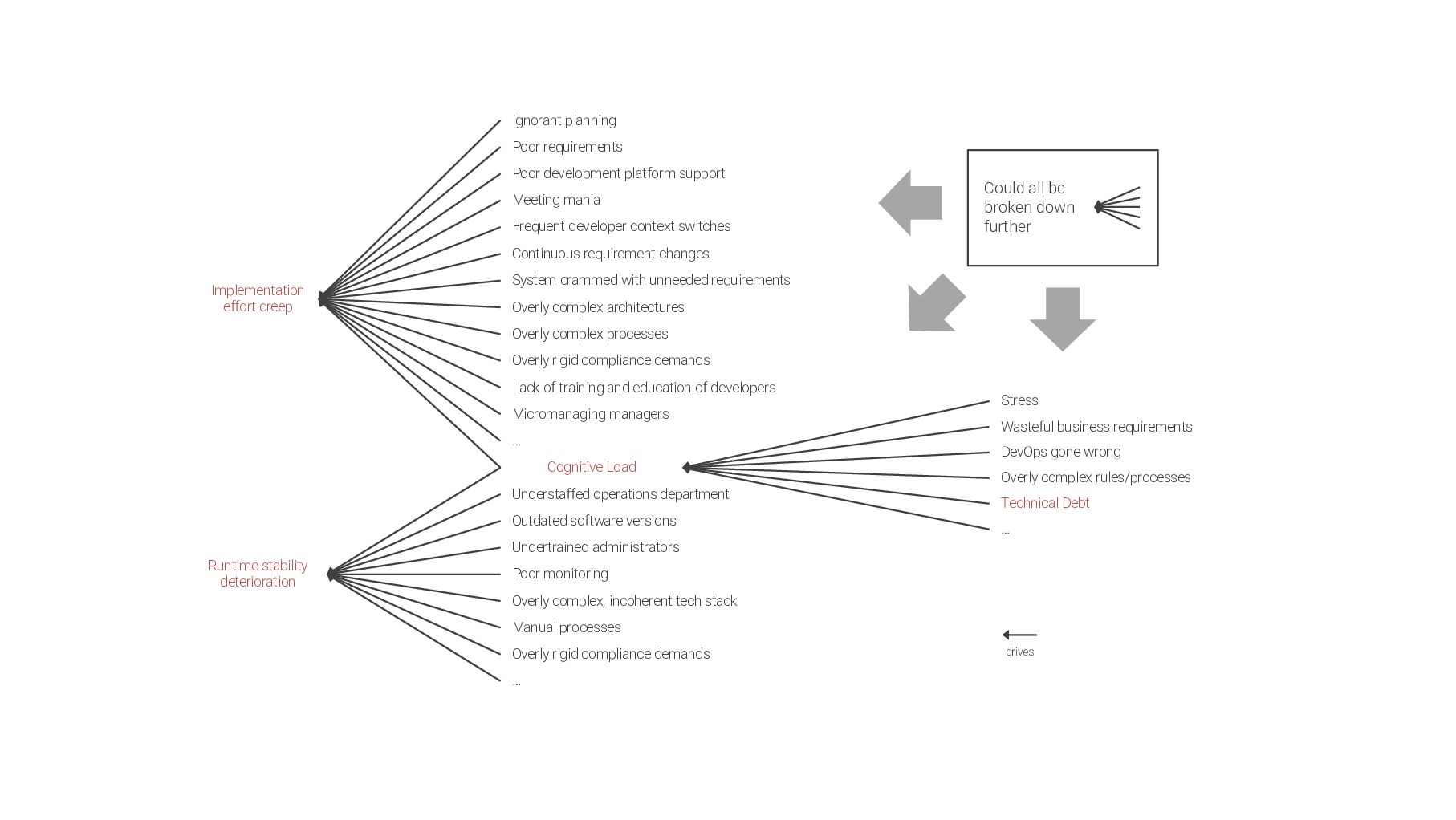
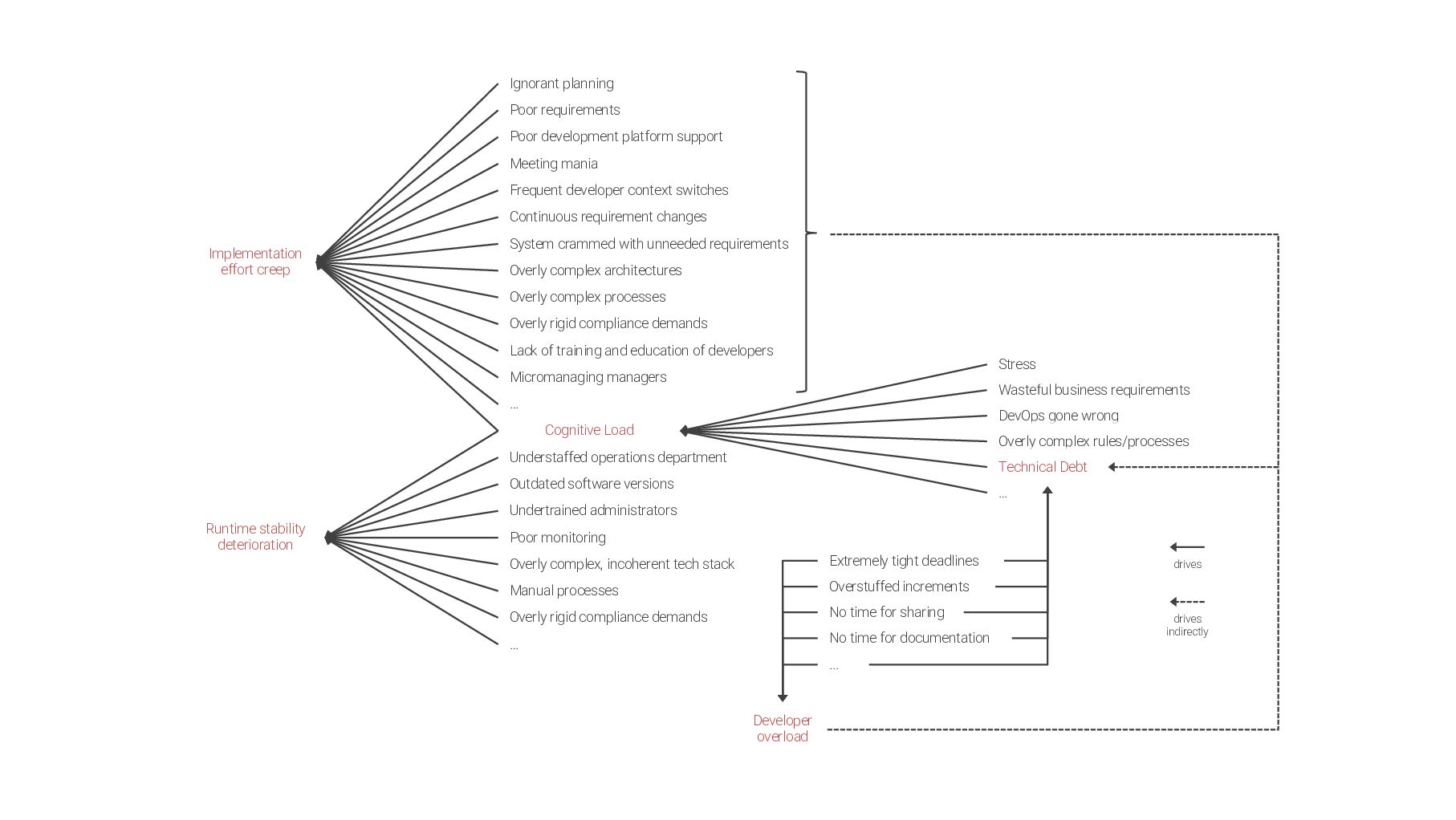
Starting with technical debt, the question what technical debt drives and what drives technical debt are asked, eventually resulting in a quite big graph that makes clear that looking at technical debt in isolation is not sufficient. It also makes clear that tackling other influencing factor will affect technical debt stronger than tackling technical debt itself.

The second part of the slide deck discusses 5+1 ideas how to tackle other influencing factors in order to eventually reduce technical debt.

Of course, the voice track is missing. Nevertheless, I hope the slides provide a few ideas to ponder.

Avatar for Uwe Friedrichsen

Uwe Friedrichsen

May 06, 2026

More Decks by Uwe Friedrichsen

Other Decks in Technology

Transcript

  1. Forget technical debt Why looking at technical debt alone is

    not enough Uwe Friedrichsen – codecentric AG – 2010-2026
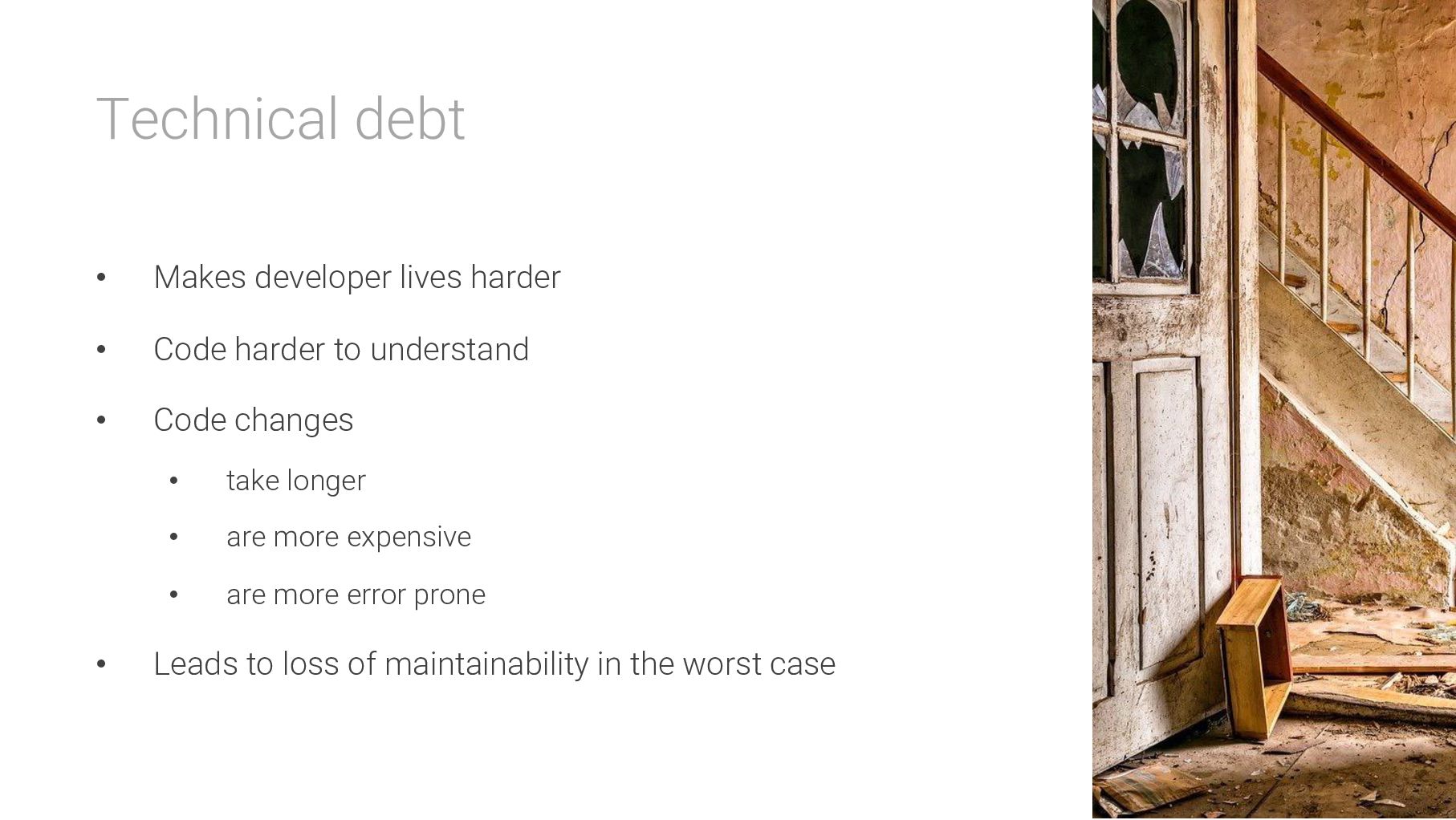
  2. Technical debt • Makes developer lives harder • Code harder

    to understand • Code changes • take longer • are more expensive • are more error prone • Leads to loss of maintainability in the worst case
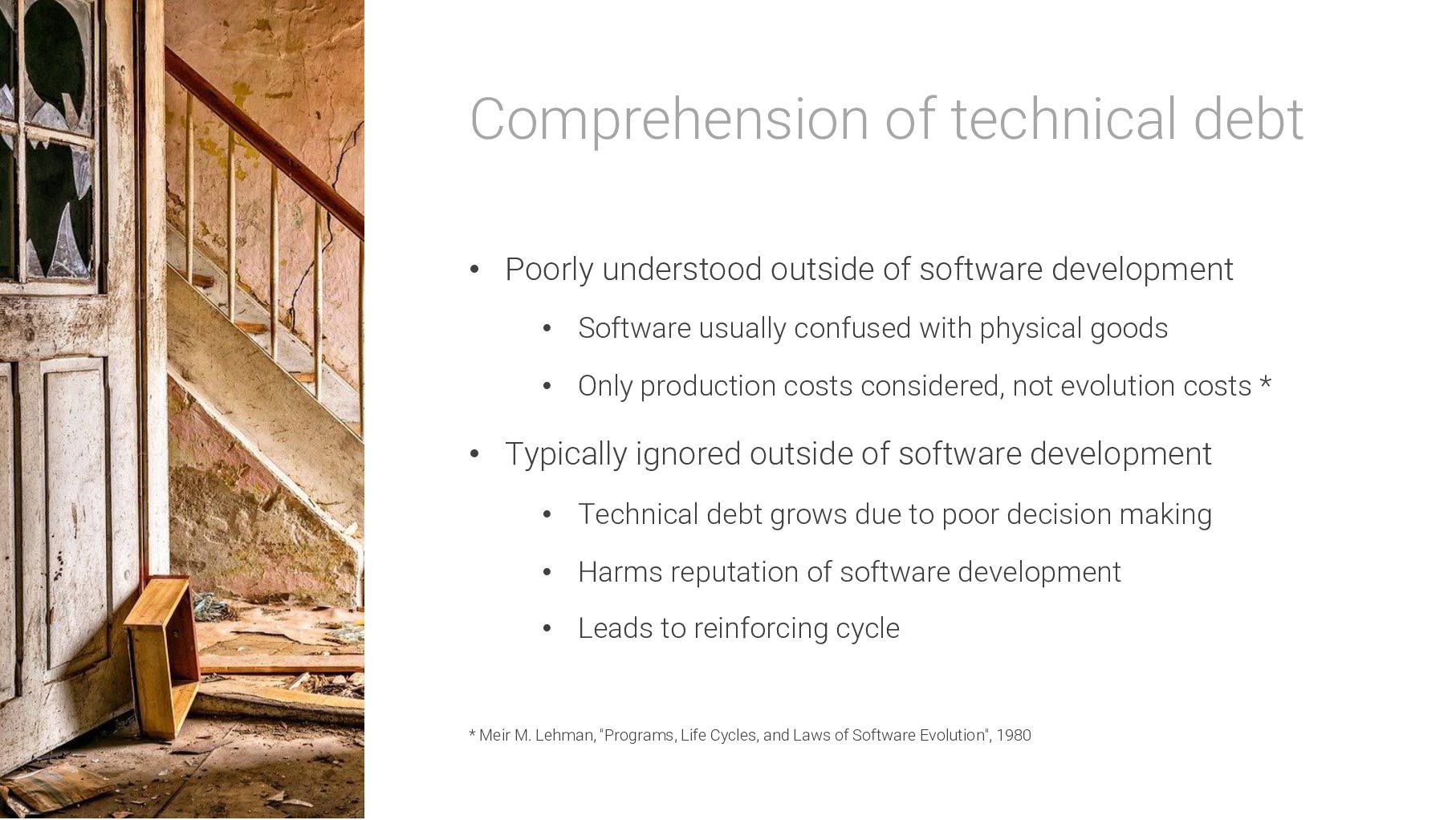
  3. Comprehension of technical debt • Poorly understood outside of software

    development • Software usually confused with physical goods • Only production costs considered, not evolution costs * • Typically ignored outside of software development • Technical debt grows due to poor decision making • Harms reputation of software development • Leads to reinforcing cycle * Meir M. Lehman, "Programs, Life Cycles, and Laws of Software Evolution", 1980
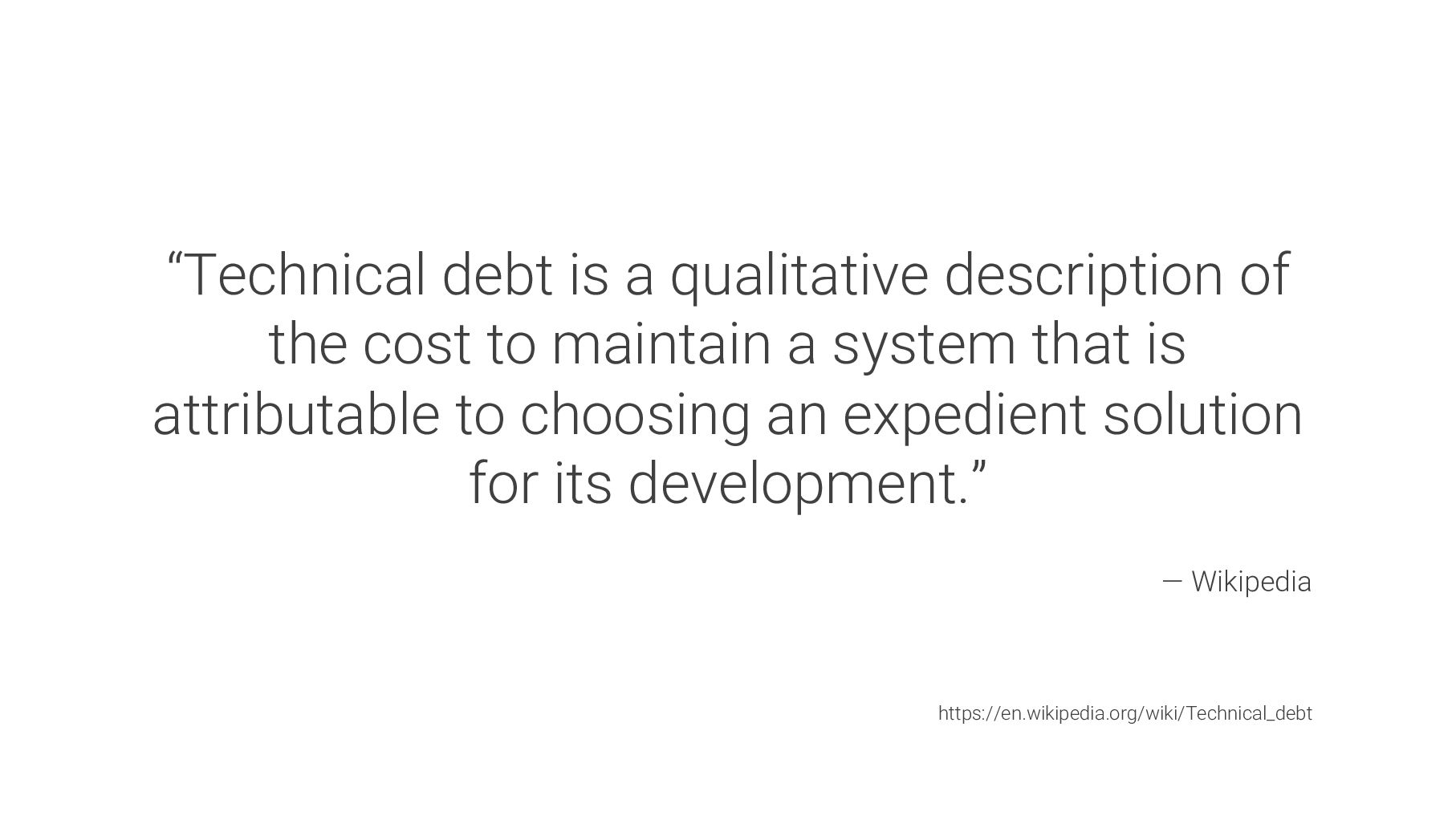
  4. “Technical debt is a qualitative description of the cost to

    maintain a system that is attributable to choosing an expedient solution for its development.” — Wikipedia https://en.wikipedia.org/wiki/Technical_debt
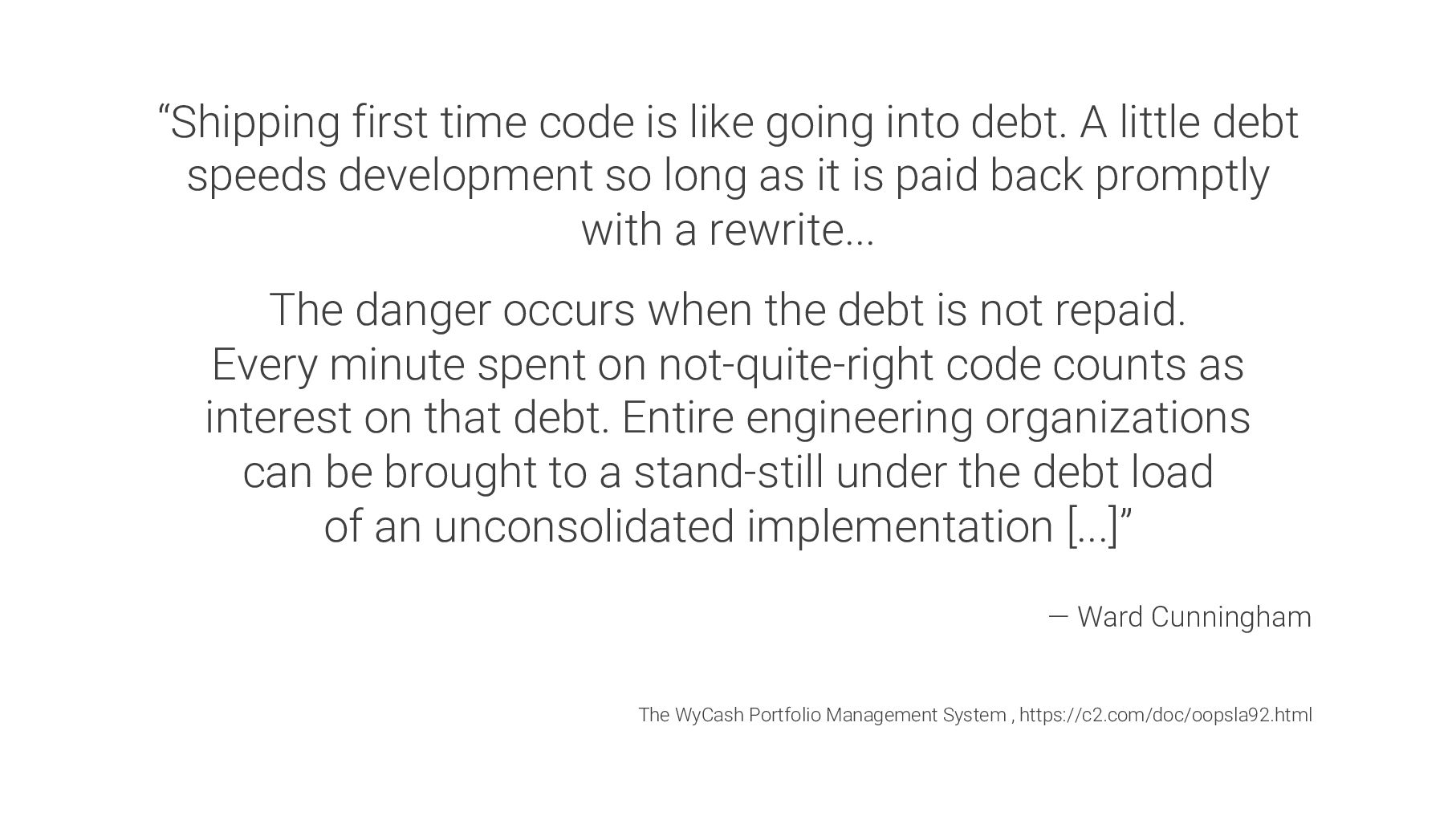
  5. “Shipping first time code is like going into debt. A

    little debt speeds development so long as it is paid back promptly with a rewrite... The danger occurs when the debt is not repaid. Every minute spent on not-quite-right code counts as interest on that debt. Entire engineering organizations can be brought to a stand-still under the debt load of an unconsolidated implementation [...]” — Ward Cunningham The WyCash Portfolio Management System , https://c2.com/doc/oopsla92.html
  6. “As an evolving program is continually changed, its complexity, reflecting

    deteriorating structure, increases unless work is done to maintain or reduce it.” — Meir M. Lehman "Programs, Life Cycles, and Laws of Software Evolution", IEEE, 1980
  7. Measuring technical debt • No clear criteria available • Results

    in heated debates often based on personal taste • Often, system complexity measured as proxy metric • However, complexity and debt are not necessarily related • System age can be used as very rough indicator • Can be refined, e.g., via system size and technology • Avoid the imagined precision trap
  8. Insights • Technical debt • Relevant topic • Big driver

    of problems in IT • Poorly understood • No clear way to visualize available
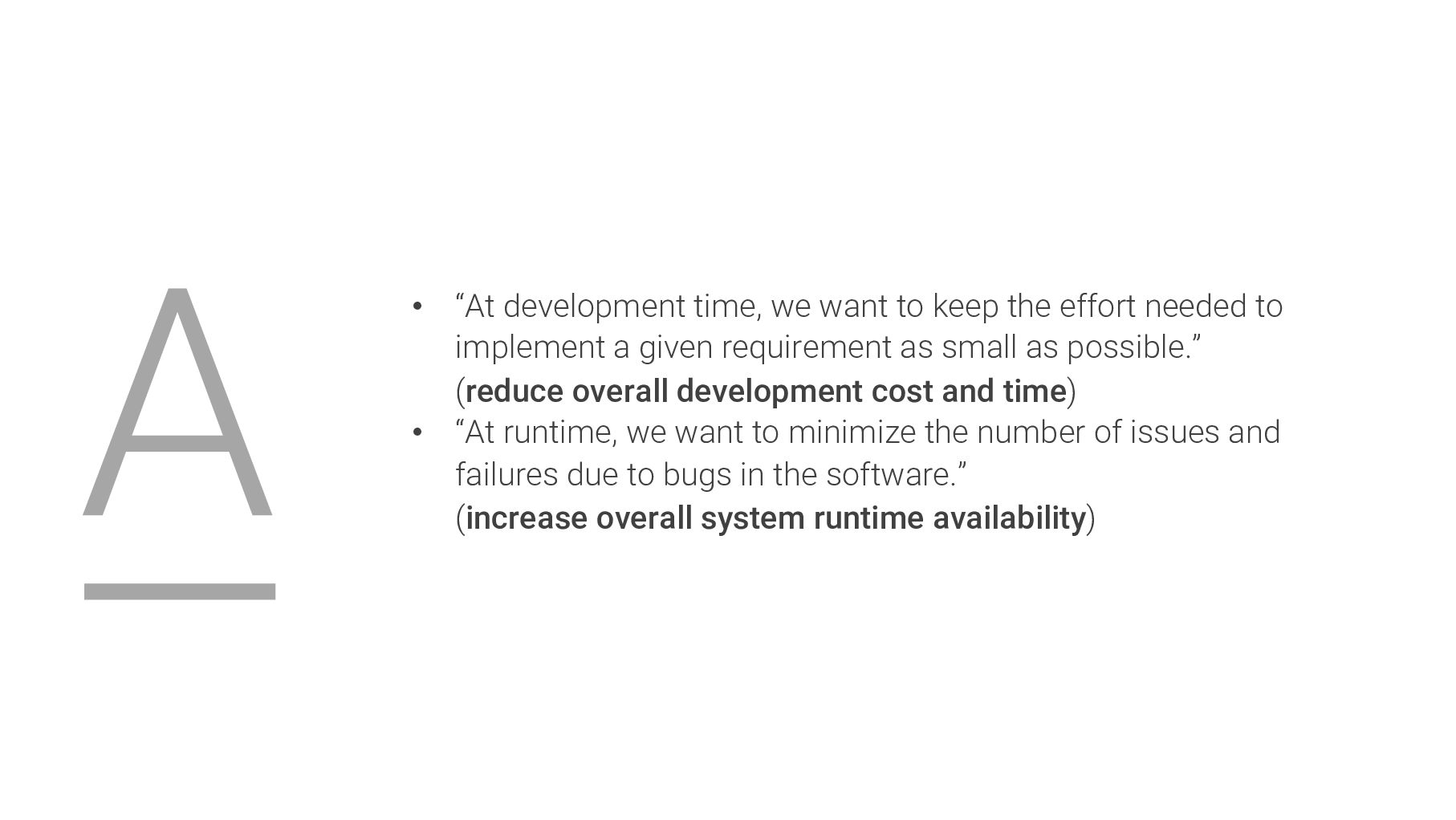
  9. A • “At development time, we want to keep the

    effort needed to implement a given requirement as small as possible.” (reduce overall development cost and time) • “At runtime, we want to minimize the number of issues and failures due to bugs in the software.” (increase overall system runtime availability)
  10. Insights • Primary goals of reducing technical debt • Avoid

    implementation effort creep • Avoid runtime stability deterioration • Both are cumulative, long-term effects
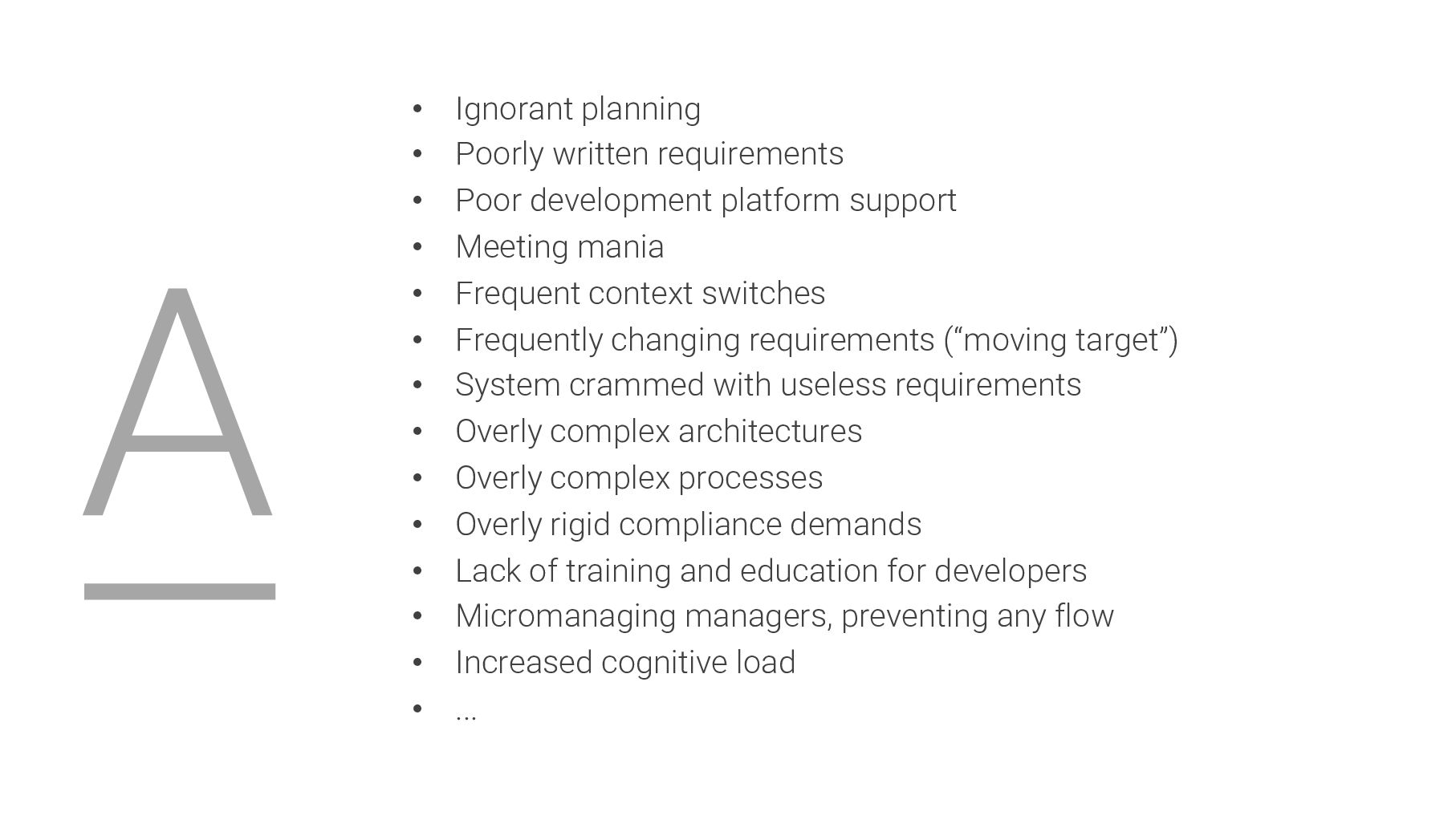
  11. A • Ignorant planning • Poorly written requirements • Poor

    development platform support • Meeting mania • Frequent context switches • Frequently changing requirements (“moving target”) • System crammed with useless requirements • Overly complex architectures • Overly complex processes • Overly rigid compliance demands • Lack of training and education for developers • Micromanaging managers, preventing any flow • Increased cognitive load • ...
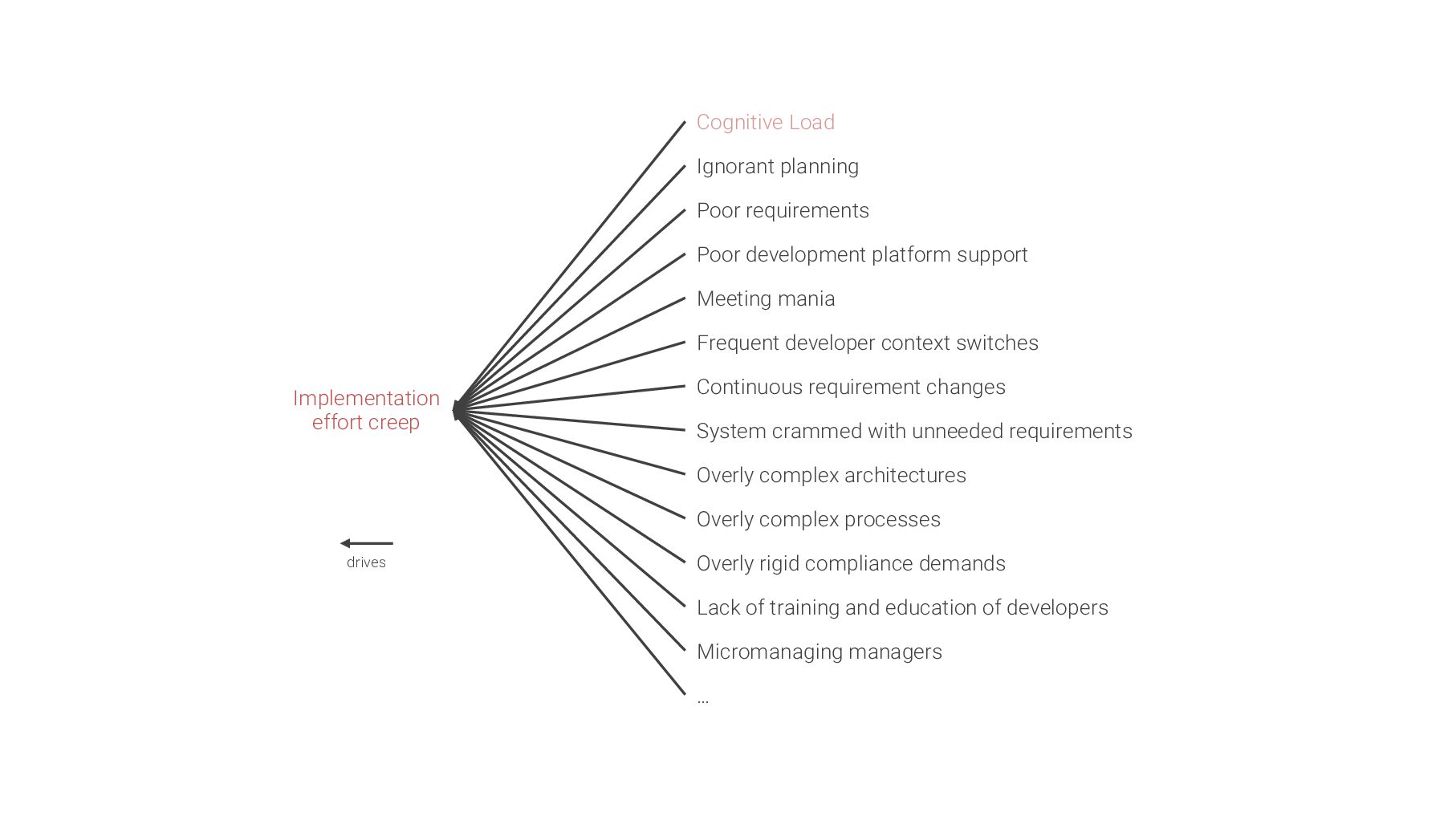
  12. Implementation effort creep drives Ignorant planning Poor requirements Poor development

    platform support Meeting mania Frequent developer context switches Continuous requirement changes System crammed with unneeded requirements Overly complex processes Overly complex architectures Overly rigid compliance demands Micromanaging managers Lack of training and education of developers … Cognitive Load
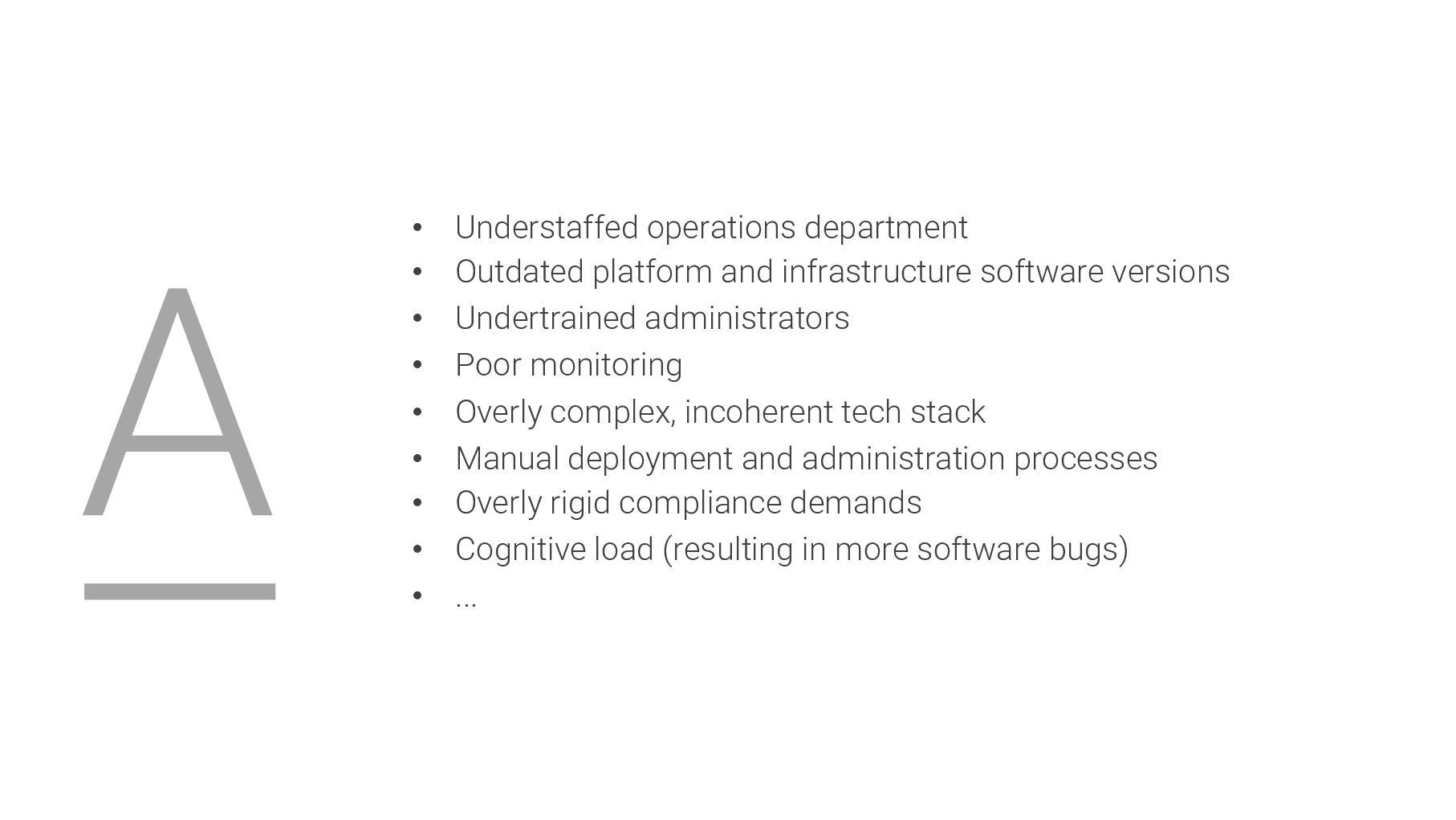
  13. A • Understaffed operations department • Outdated platform and infrastructure

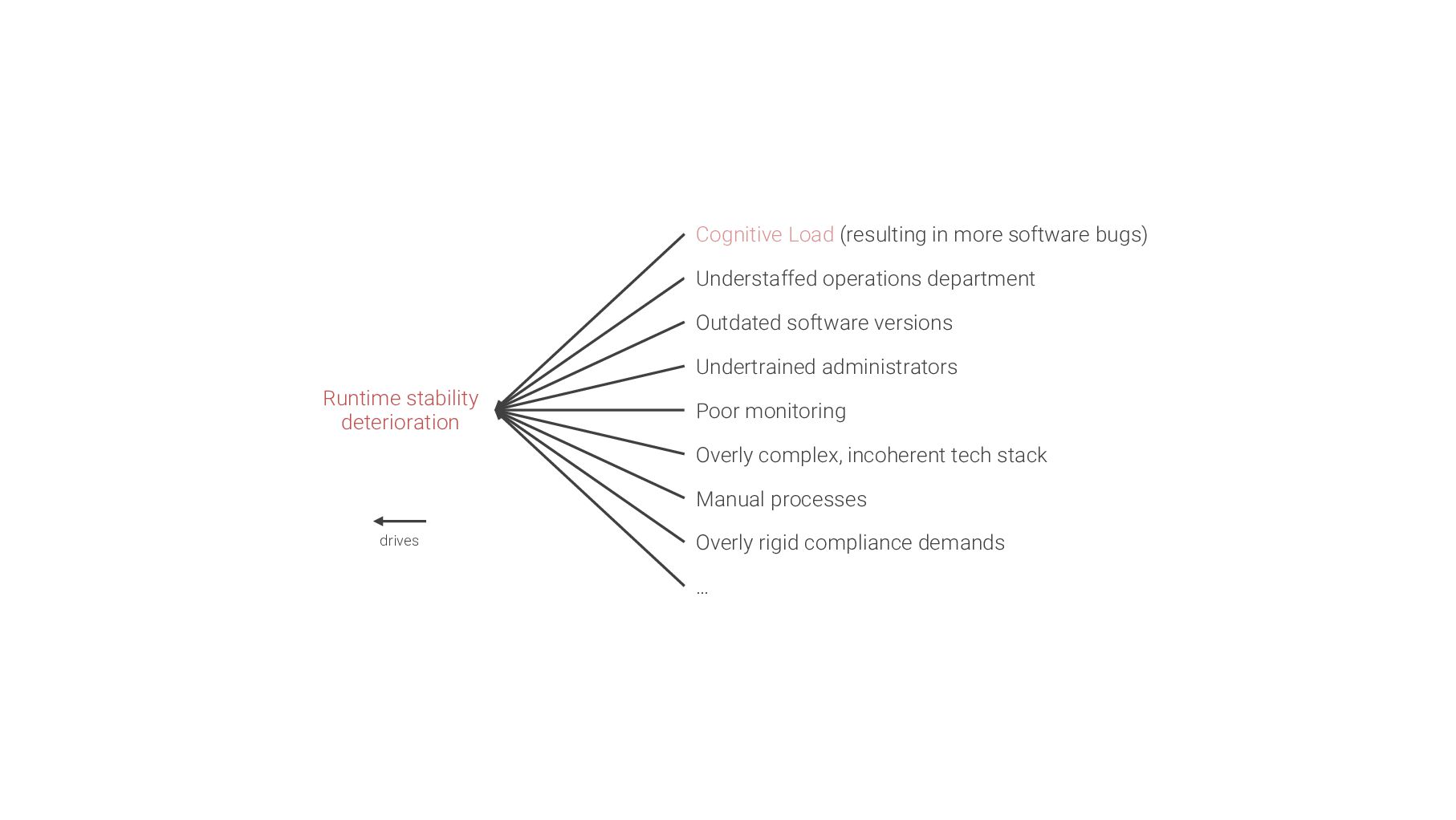
    software versions • Undertrained administrators • Poor monitoring • Overly complex, incoherent tech stack • Manual deployment and administration processes • Overly rigid compliance demands • Cognitive load (resulting in more software bugs) • ...
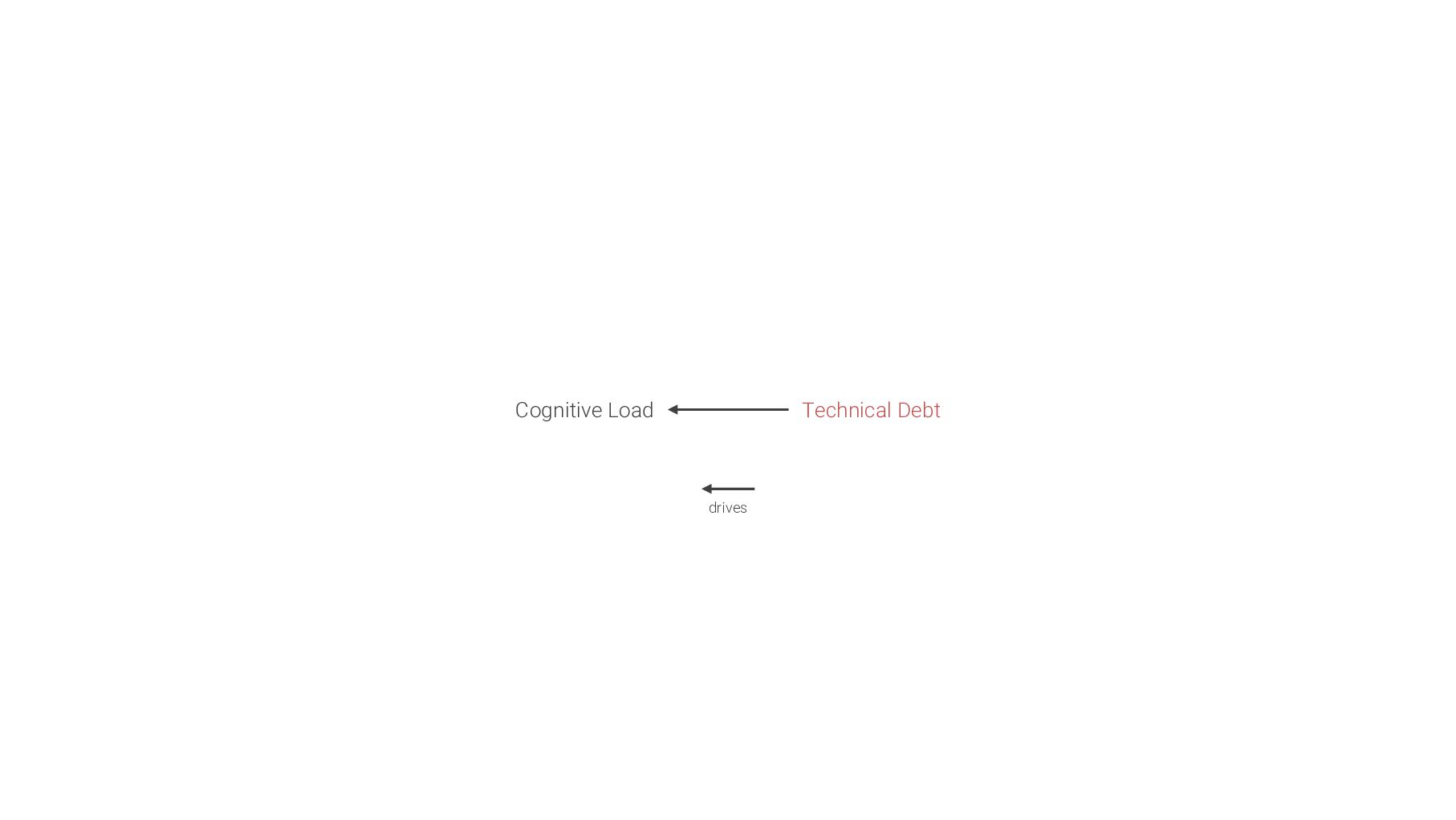
  14. Runtime stability deterioration Cognitive Load (resulting in more software bugs)

    Understaffed operations department Outdated software versions Undertrained administrators Poor monitoring Overly complex, incoherent tech stack Manual processes Overly rigid compliance demands … drives
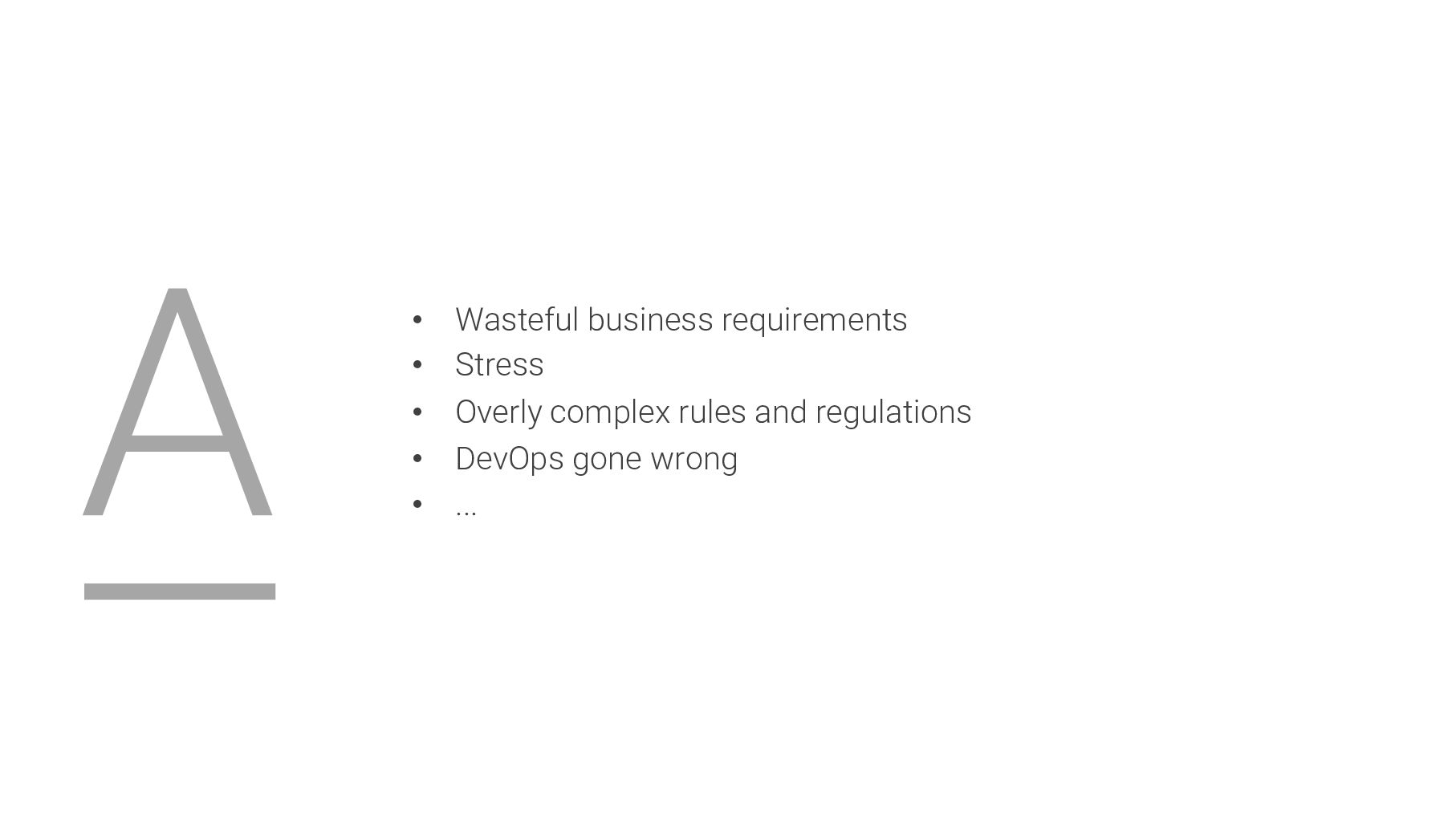
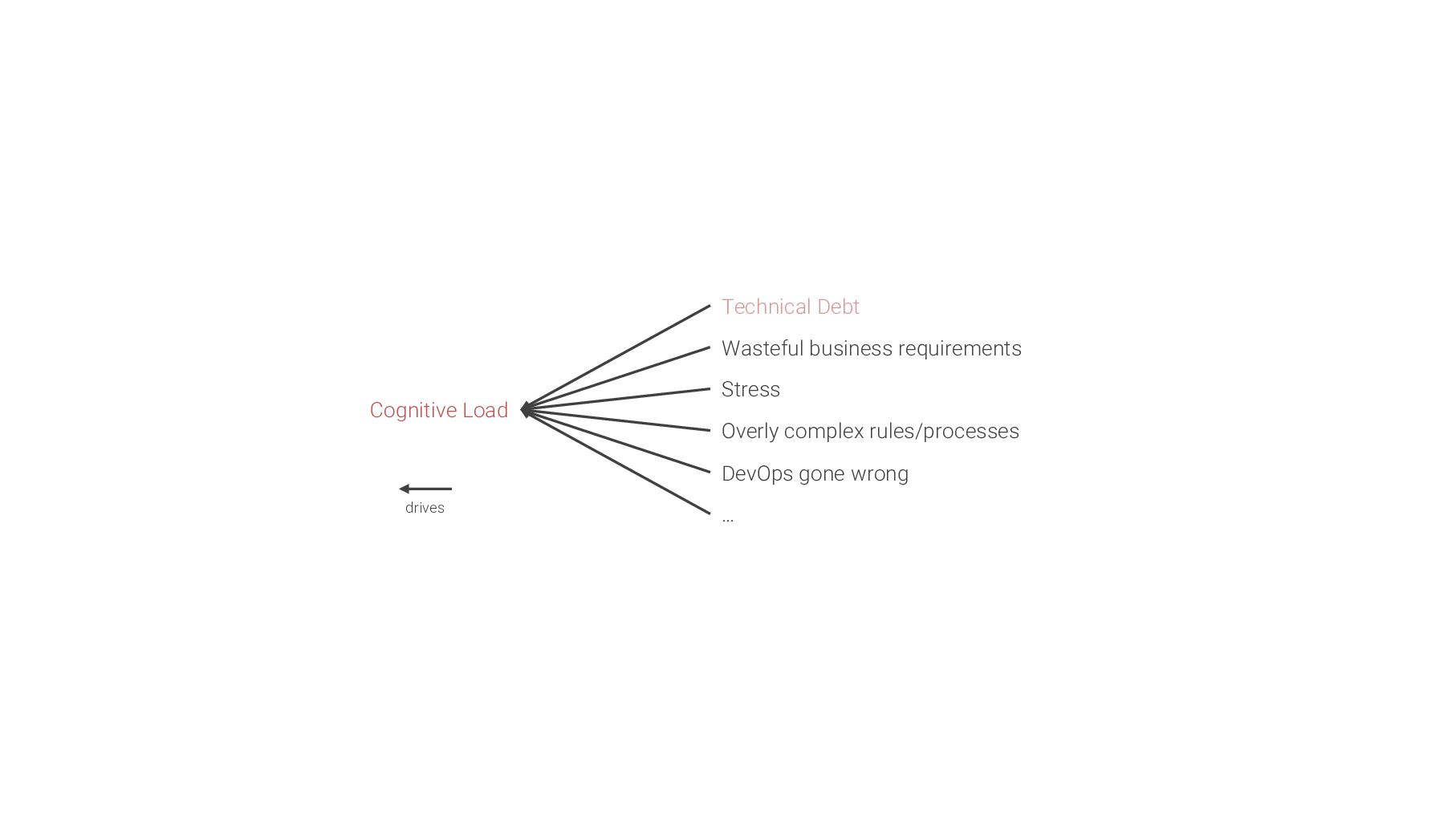
  15. A • Wasteful business requirements • Stress • Overly complex

    rules and regulations • DevOps gone wrong • ...
  16. Implementation effort creep drives Runtime stability deterioration Cognitive Load Poor

    requirements Poor development platform support Meeting mania Frequent developer context switches Continuous requirement changes System crammed with unneeded requirements Overly complex processes Overly complex architectures Overly rigid compliance demands Micromanaging managers Lack of training and education of developers … Understaffed operations department Outdated software versions Undertrained administrators Poor monitoring Overly complex, incoherent tech stack Manual processes Overly rigid compliance demands … DevOps gone wrong Wasteful business requirements Stress Overly complex rules/processes Technical Debt … Ignorant planning Could all be broken down further
  17. A • Everything that drives implementation effort creep • Everything

    that drives developer overload (often caused by the other drivers) • Extremely tight deadlines • Overstuffed development increments • Lack of time to document or share relevant information between development team members • ...
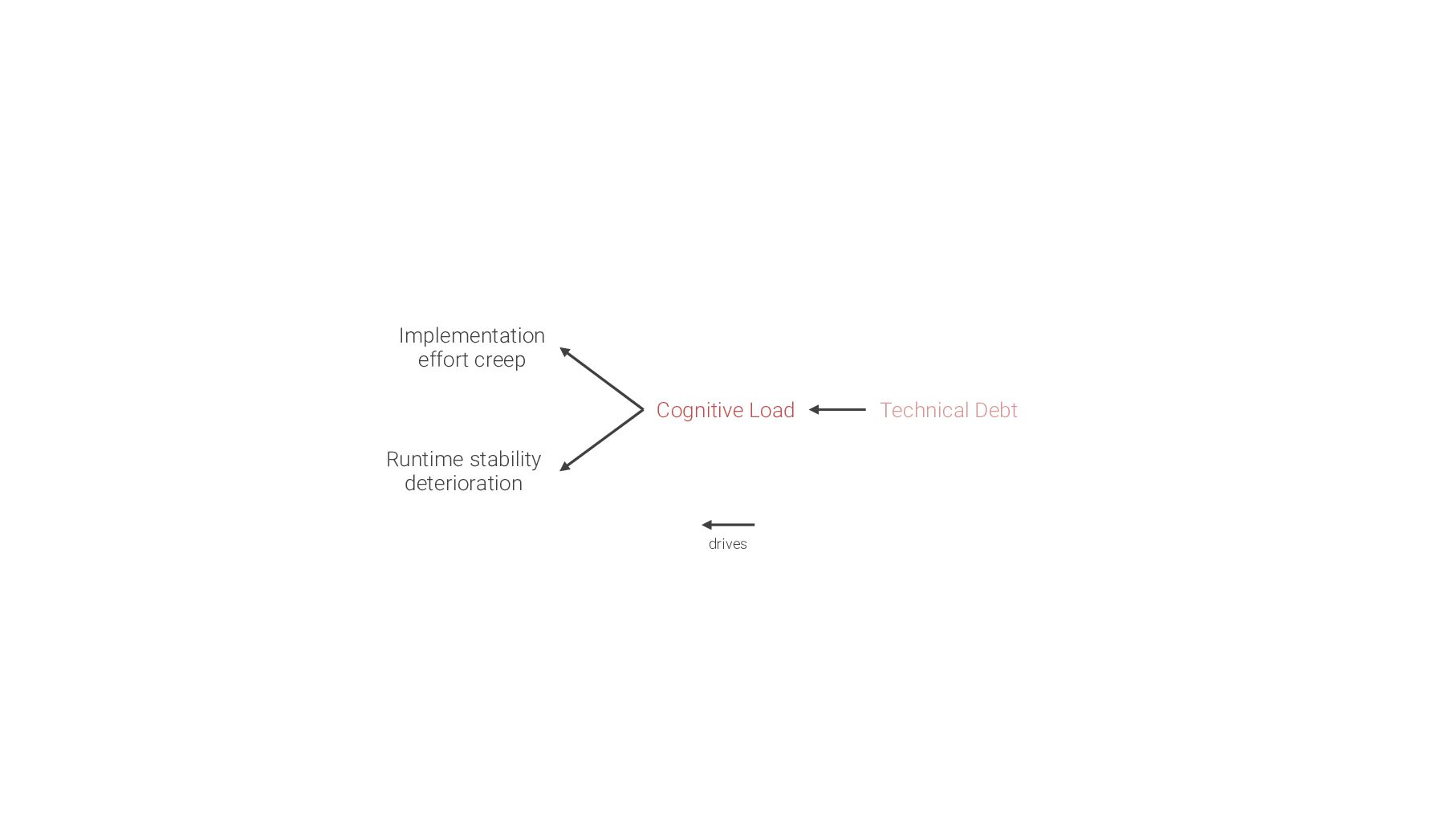
  18. Cognitive Load Implementation effort creep Poor requirements Poor development platform

    support Meeting mania Frequent developer context switches Continuous requirement changes System crammed with unneeded requirements Overly complex processes Overly complex architectures Overly rigid compliance demands Micromanaging managers Lack of training and education of developers … drives Runtime stability deterioration Understaffed operations department Outdated software versions Undertrained administrators Poor monitoring Overly complex, incoherent tech stack Manual processes Overly rigid compliance demands … DevOps gone wrong Wasteful business requirements Stress Overly complex rules/processes Technical Debt … Developer overload Extremely tight deadlines Overstuffed increments No time for sharing No time for documentation ... Ignorant planning drives indirectly
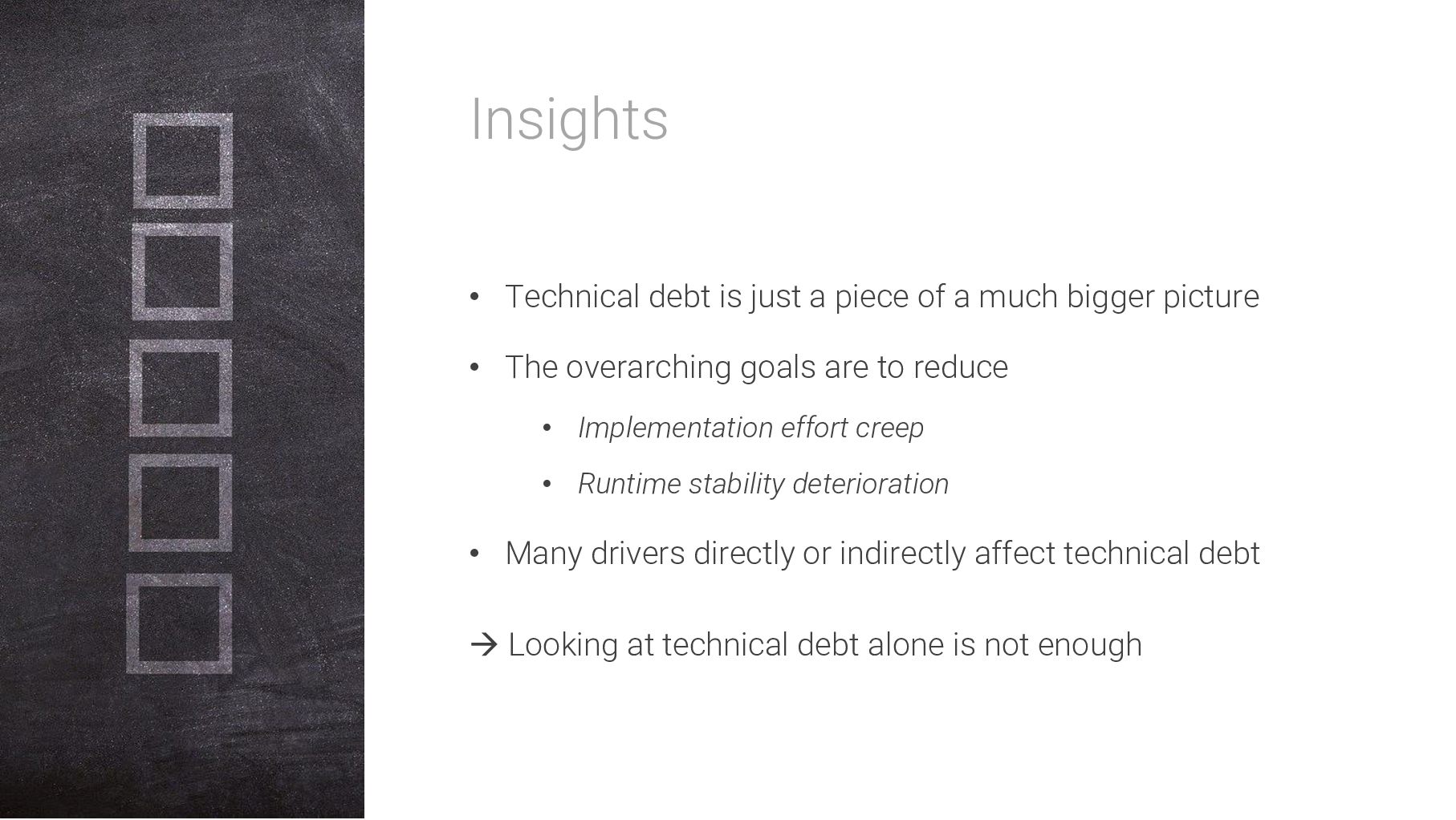
  19. Insights • Technical debt is just a piece of a

    much bigger picture • The overarching goals are to reduce • Implementation effort creep • Runtime stability deterioration • Many drivers directly or indirectly affect technical debt à Looking at technical debt alone is not enough
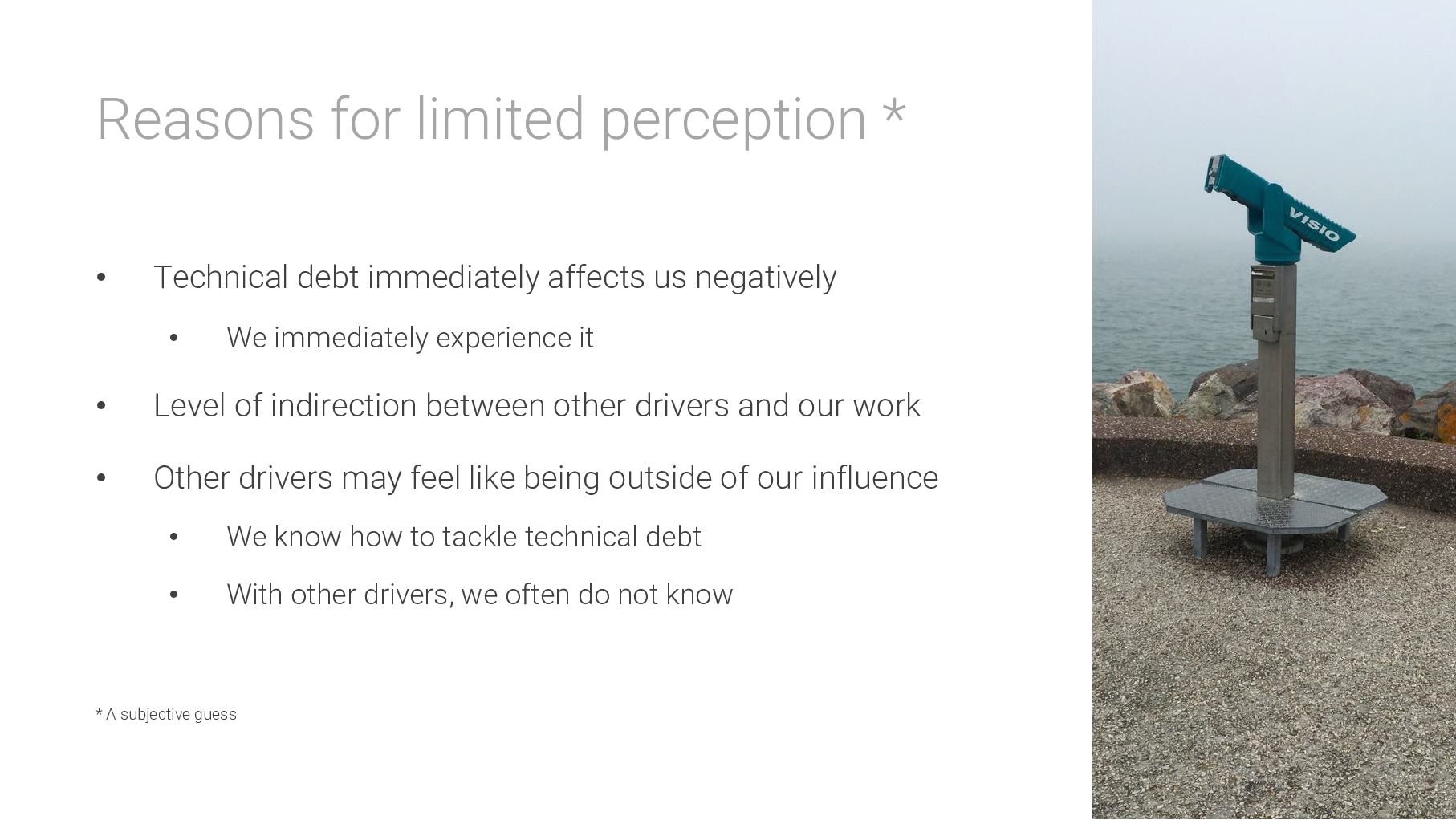
  20. Reasons for limited perception * • Technical debt immediately affects

    us negatively • We immediately experience it • Level of indirection between other drivers and our work • Other drivers may feel like being outside of our influence • We know how to tackle technical debt • With other drivers, we often do not know * A subjective guess
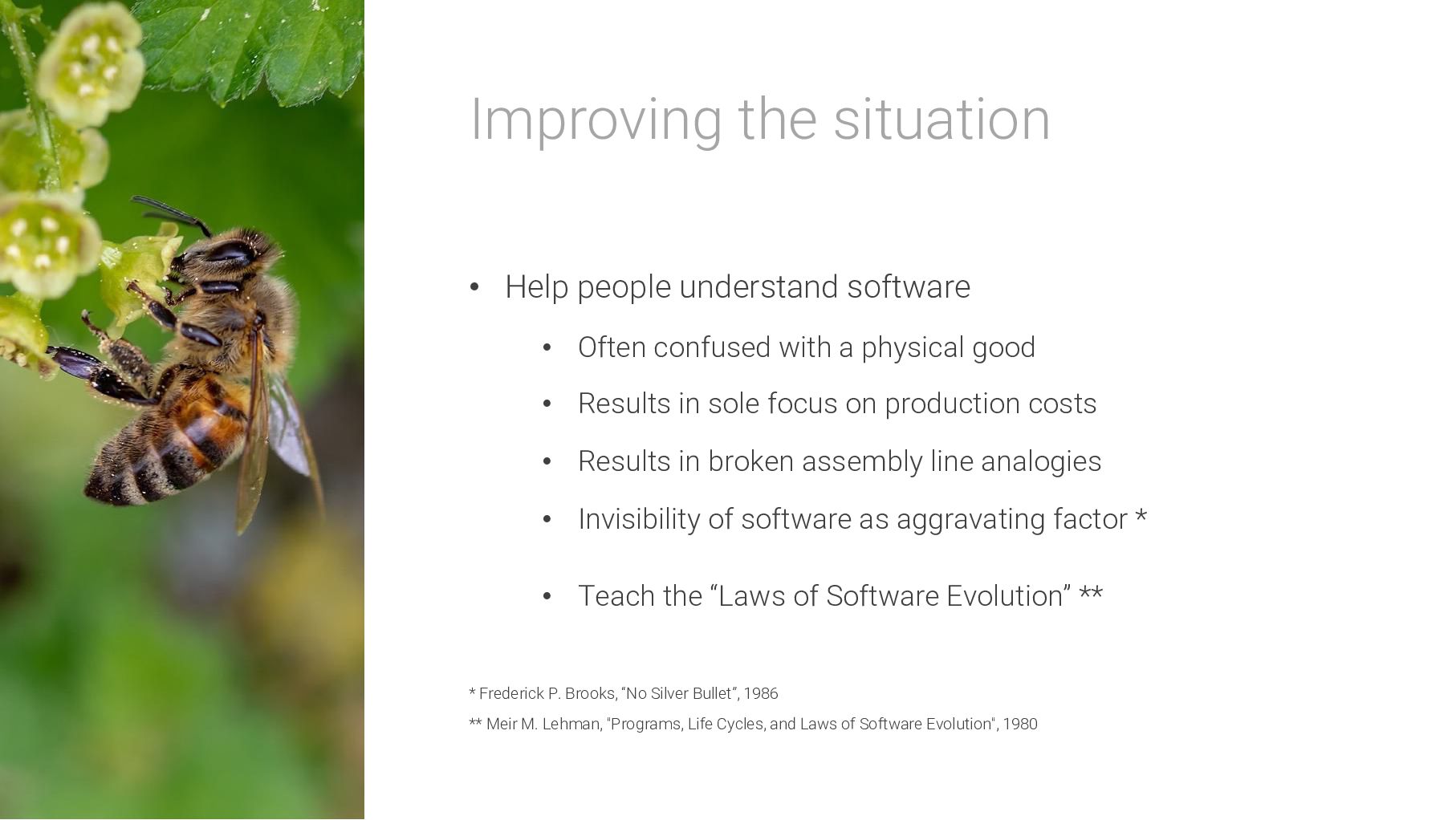
  21. Improving the situation • Help people understand software • Often

    confused with a physical good • Results in sole focus on production costs • Results in broken assembly line analogies • Invisibility of software as aggravating factor * • Teach the “Laws of Software Evolution” ** * Frederick P. Brooks, “No Silver Bullet”, 1986 ** Meir M. Lehman, "Programs, Life Cycles, and Laws of Software Evolution", 1980
  22. Meeting mania • Everybody is sitting in meetings all day

    • Information flow still does not work • More meetings are scheduled
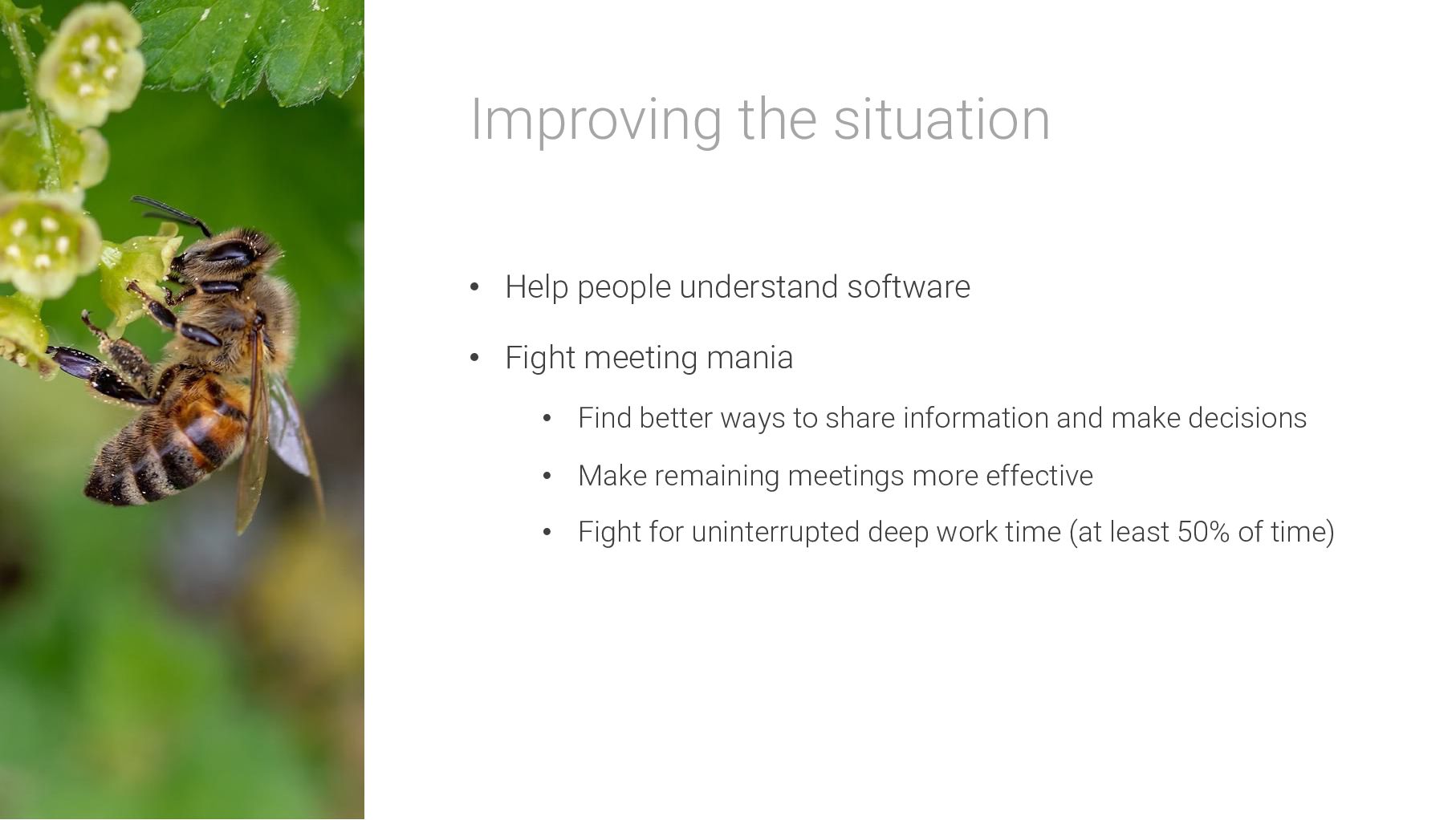
  23. Improving the situation • Help people understand software • Fight

    meeting mania • Find better ways to share information and make decisions • Make remaining meetings more effective • Fight for uninterrupted deep work time (at least 50% of time)
  24. Improving the situation • Help people understand software • Fight

    meeting mania • Go for hypothesis-driven development
  25. "Efficiency is the ability to do things well, successfully, and

    without waste.” — https://en.wikipedia.org/wiki/Efficiency
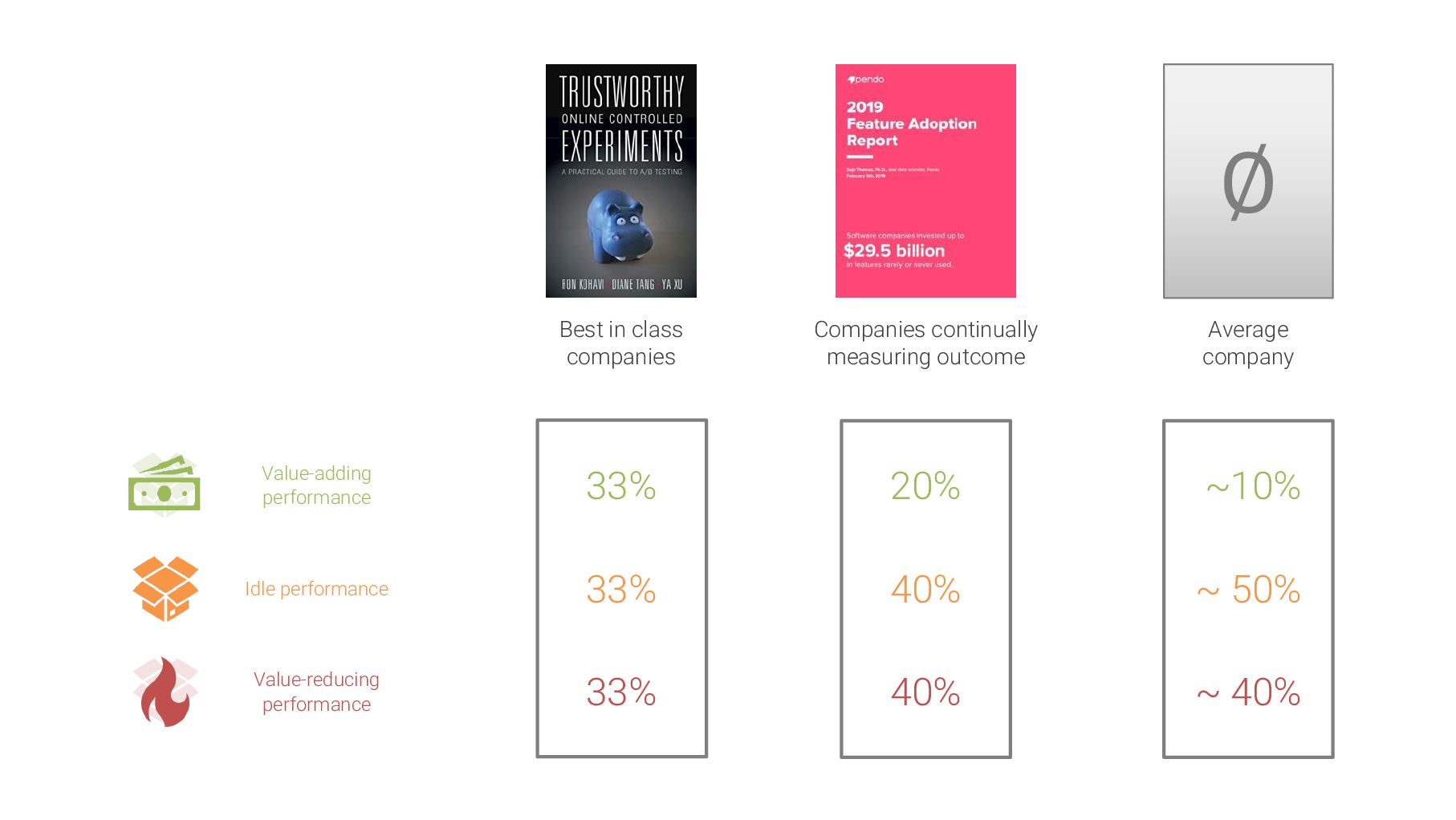
  26. Value-adding performance Idle performance Value-reducing performance Companies continually measuring outcome

    20% 40% 40% Best in class companies 33% 33% 33% Average company ~10% ~ 50% ~ 40% ∅
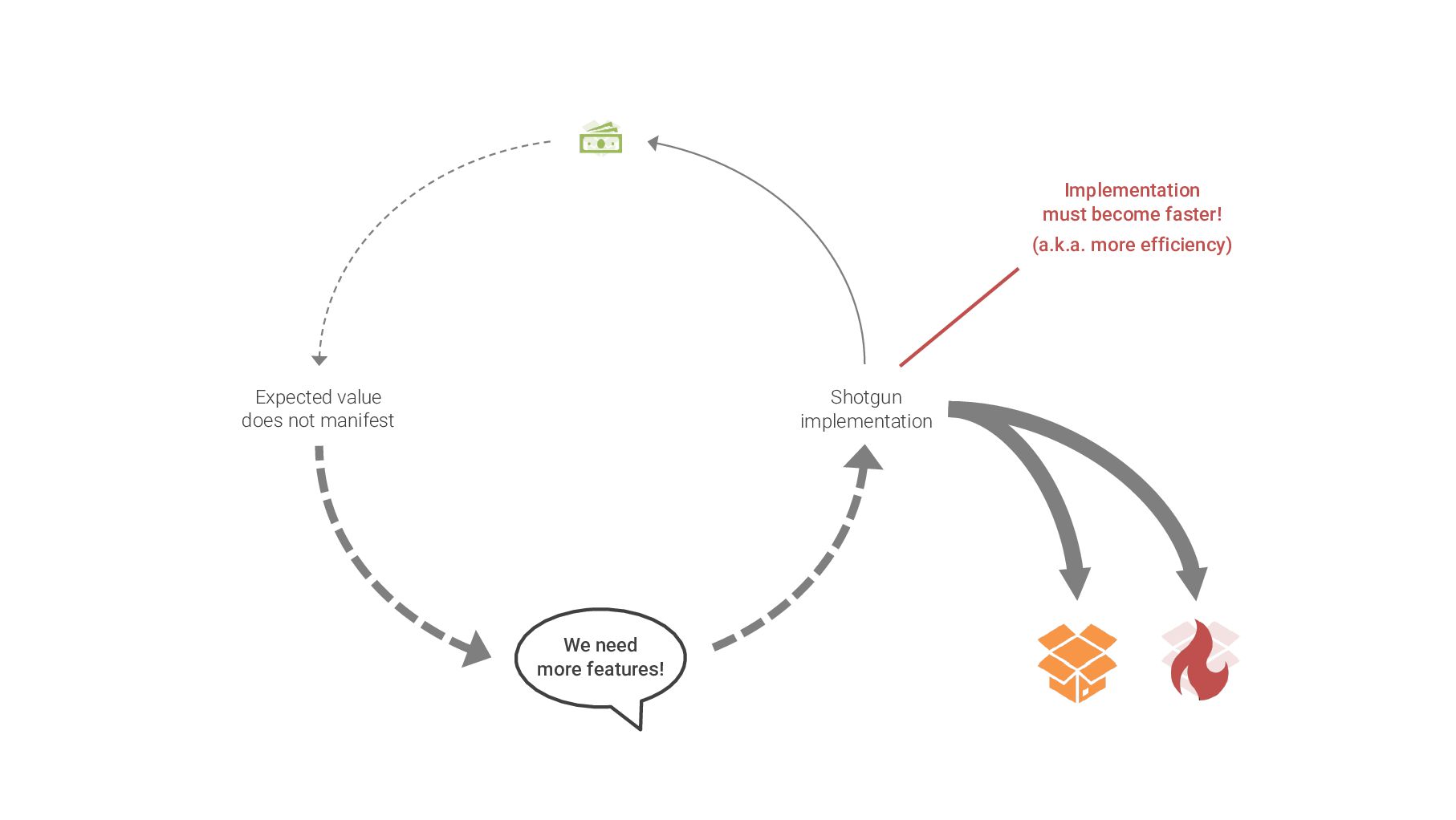
  27. Expected value does not manifest Shotgun implementation We need more

    features! Implementation must become faster! (a.k.a. more efficiency)
  28. Consequences • Huge waste of money and efforts • Massive
    developer burnout rates • Exploding system complexity • Exploding technical debt • Deteriorating system quality and dependability • Everyone else unsatisfied and stressed, too
  29. Our biggest challenge in IT is a lack of effectiveness,

    not a lack of efficiency. Software development, especially coding is extremely efficient.
  30. Our problem is not that we do not create enough

    software. We create way more software than we need. But most software created is just waste.
  31. Specify idea (poorly) in detail * Mind Wegner’s Lemma: "It

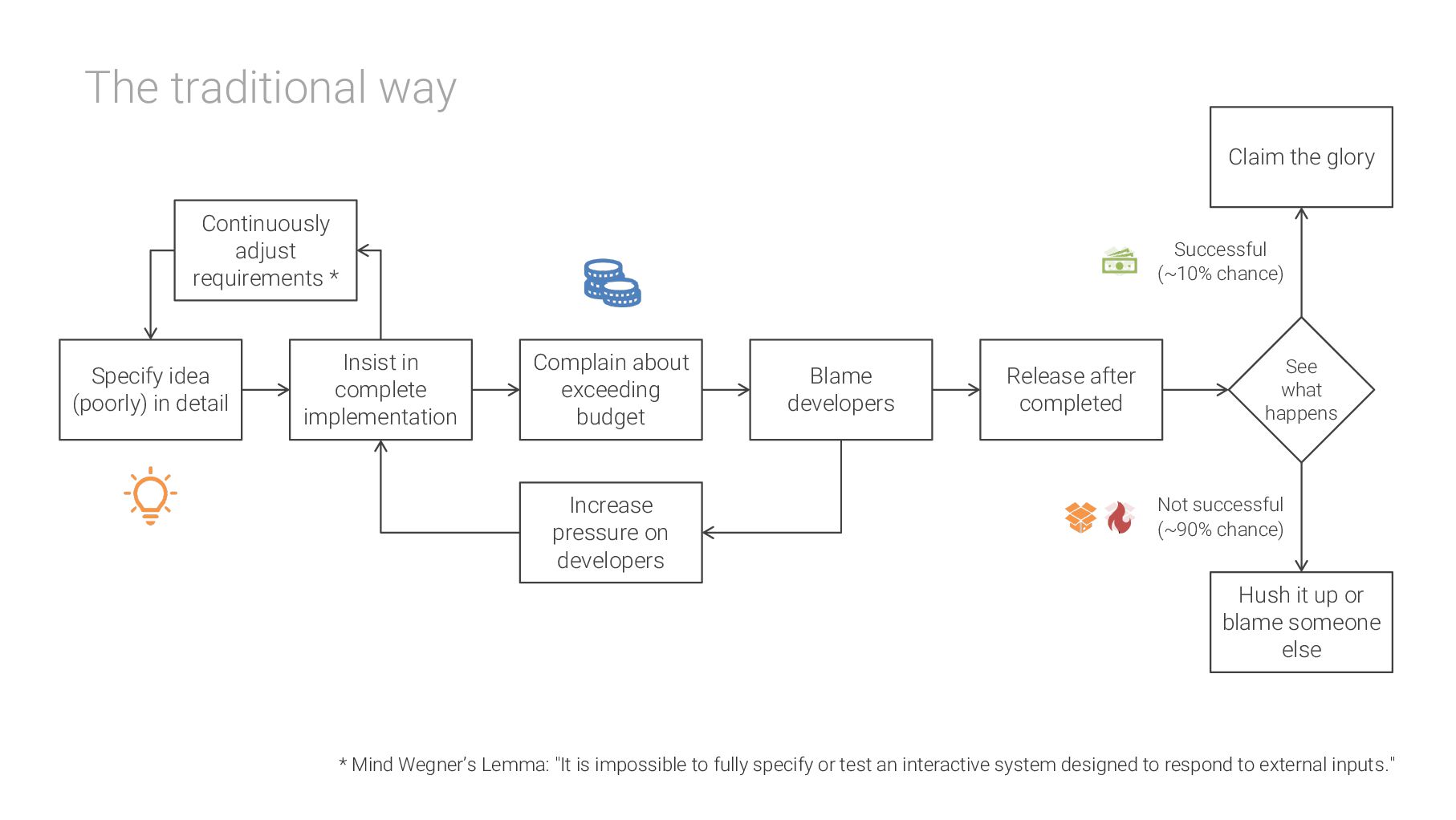
    is impossible to fully specify or test an interactive system designed to respond to external inputs." The traditional way Insist in complete implementation Complain about exceeding budget Blame developers Release after completed See what happens Claim the glory Successful (~10% chance) Not successful (~90% chance) Hush it up or blame someone else Increase pressure on developers Continuously adjust requirements *
  32. Imagine you have 10 ideas and EUR 10 million budget
    Where do you end up following the traditional way?
  33. Effects of the traditional way • > EUR 10 Mio

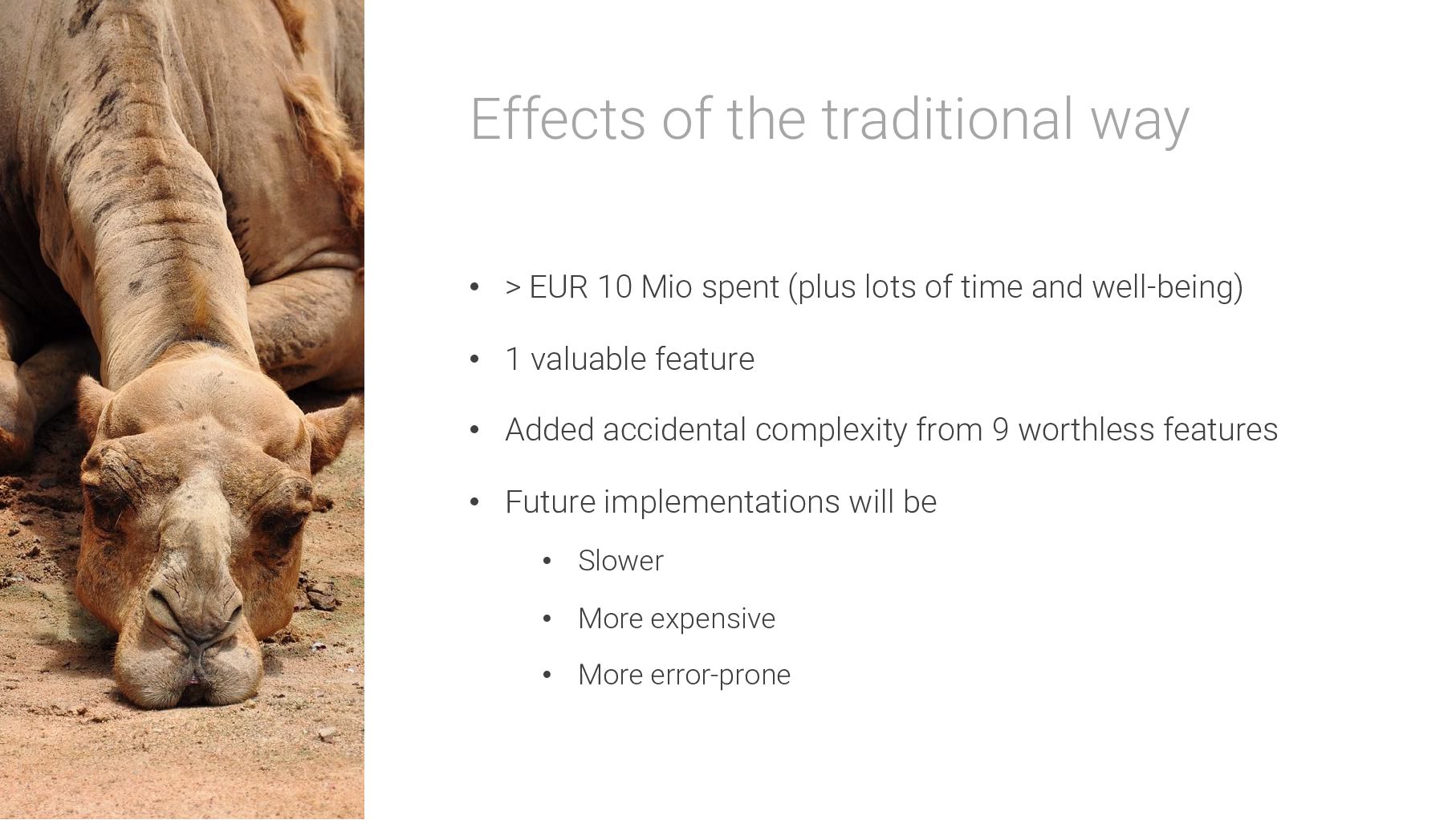
    spent (plus lots of time and well-being) • 1 valuable feature • Added accidental complexity from 9 worthless features • Future implementations will be • Slower • More expensive • More error-prone
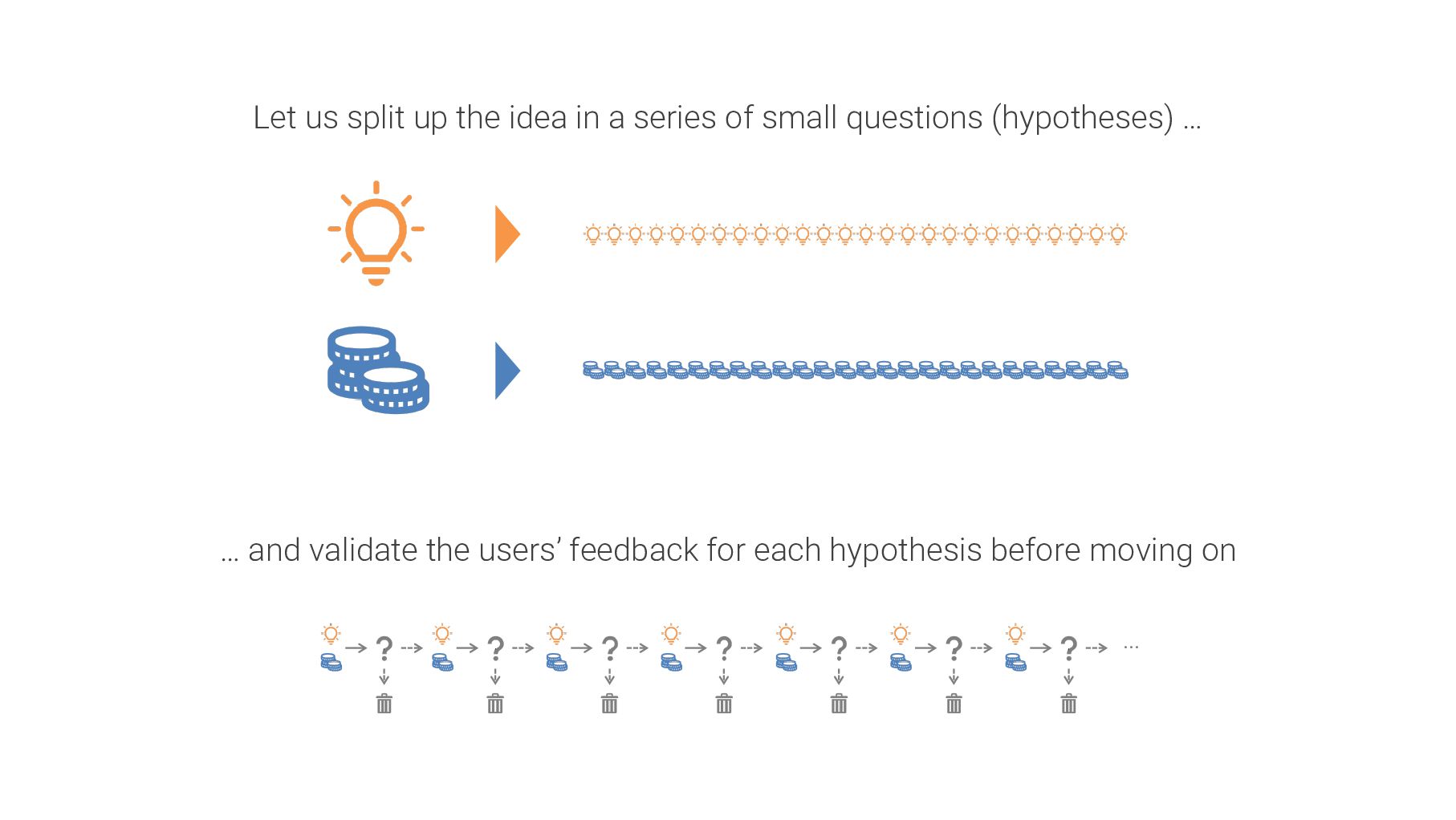
  34. Let us split up the idea in a series of

    small questions (hypotheses) … … and validate the users’ feedback for each hypothesis before moving on …
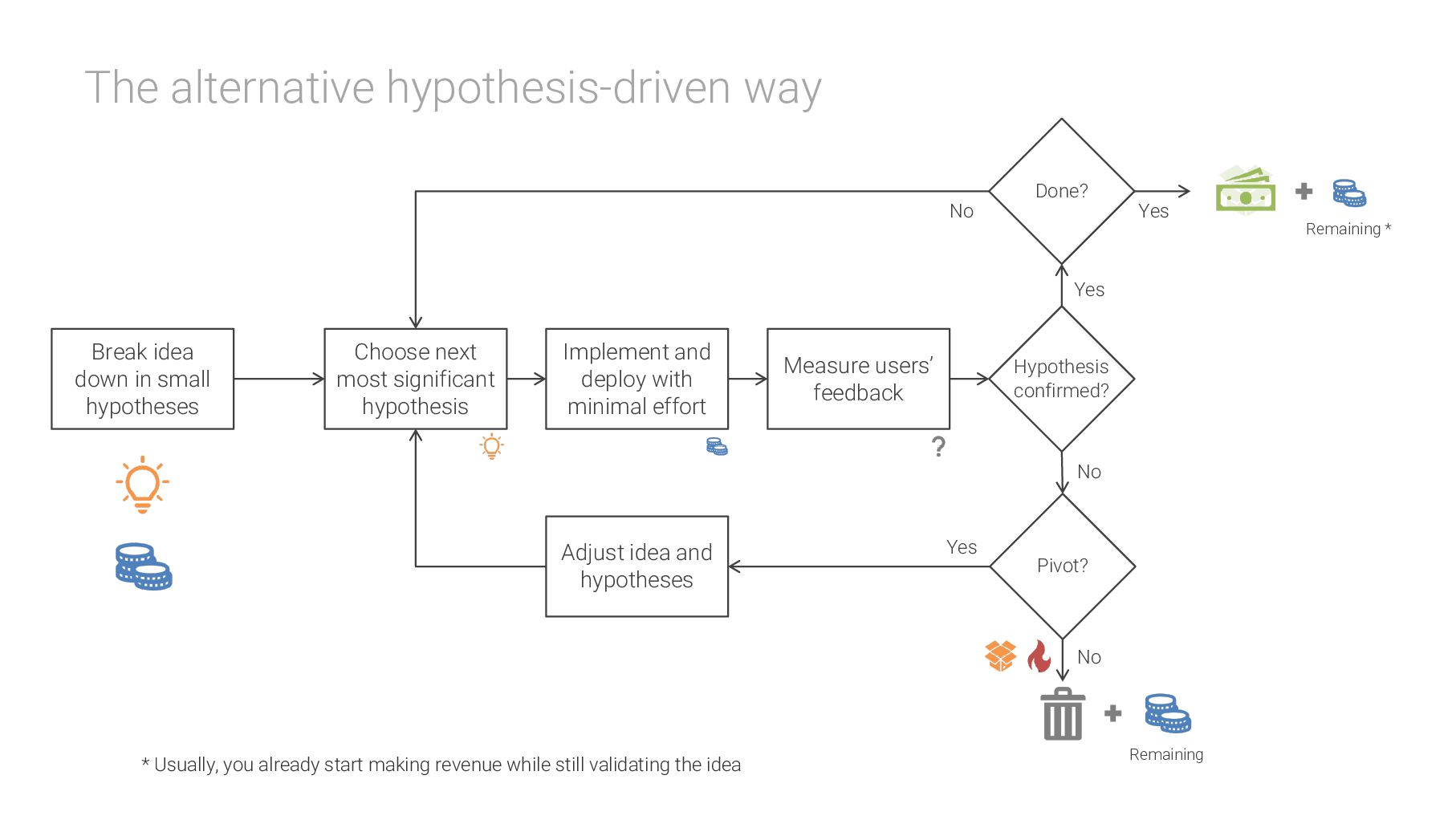
  35. The alternative hypothesis-driven way Hypothesis confirmed? Implement and deploy with

    minimal effort No Pivot? Choose next most significant hypothesis Measure users’ feedback Adjust idea and hypotheses Yes Done? Yes No Break idea down in small hypotheses Remaining * No Remaining Yes * Usually, you already start making revenue while still validating the idea
  36. Imagine you have 10 ideas and EUR 10 million budget

    Where do you end up following the alternative way?
  37. Assumptions • Unsuccessful ideas discarded after spending 1/10 of budget

    • Revenue made while validating ideas not considered
  38. Effects of the alternative way (1/2) • < EUR 2

    Mio spent (> 80% budget saved) • 1 valuable feature (unchanged) • 80% less developer capacity needed • Massively reduced burnout rate • Invest in higher dependability and sustainability • Powerful mitigation of skills shortage problem
  39. Effects of the alternative way (2/2) • No accidental complexity

    from 9 worthless features added • Less code • Less complexity • Future implementations will be • Faster • Less expensive • Less error-prone
  40. Improving the situation • Help people understand software • Fight

    meeting mania • Go for hypothesis-driven development • One of the biggest levers available • Can even lead to “technical credit” • Requires buy-in of the product managers • Start with automation to minimize IT lead times • Start to measure business value of features
  41. Improving the situation • Help people understand software • Fight

    meeting mania • Go for hypothesis-driven development • Fight for simplicity • Architecture • Implementation • Platform
  42. Improving the situation • Help people understand software • Fight

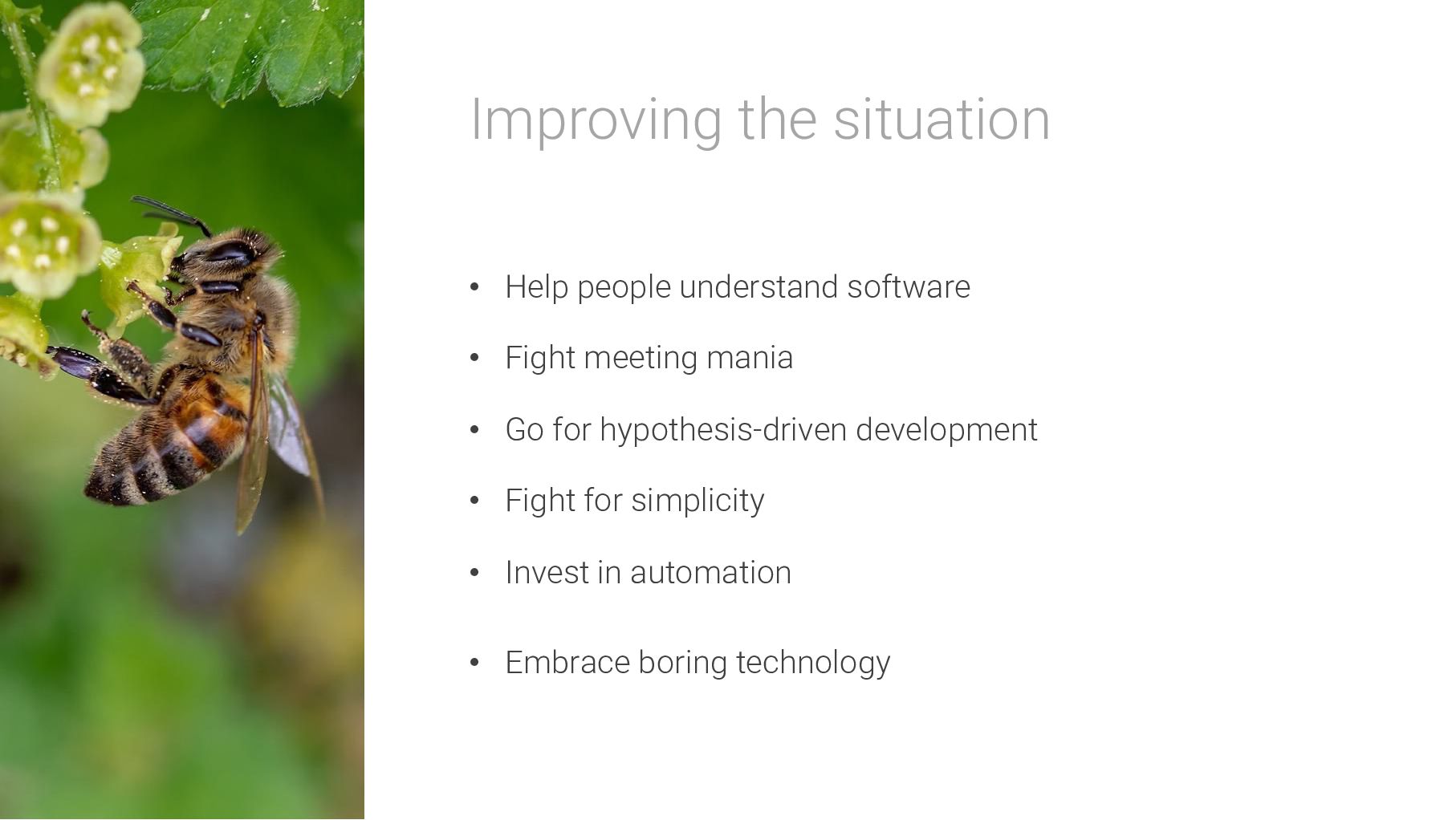
    meeting mania • Go for hypothesis-driven development • Fight for simplicity • Invest in automation • Reduces cognitive load • Reduces probability of getting something wrong
  43. Improving the situation • Help people understand software • Fight

    meeting mania • Go for hypothesis-driven development • Fight for simplicity • Invest in automation • Embrace boring technology
  44. Wrap-up • Technical debt hurts developers and companies • Poorly

    understood outside development, hence ignored • Looking at technical debt alone is not enough • Act on other drivers to improve the situation • Mind the "atomic habits"