Share
Embed
Streamline your Android app API with Kotlin
Since May of 2017, Kotlin became officially acknowledged by Google and promoted to first class citizen when we talk about native Android application development.
Android framework is fully written in Java, which means that in its core there is a lot of APIs that are robust and not so easy/straightforward to use. In this talk, we'll go through tips and tricks how Kotlin can help us to streamline those API-s in our apps and make the code more readable and more easy to use.
Nebojša Vukšić
May 17, 2019
Transcript
99 slides
-
SHORT OVERVIEW OF ANDROID HISTORY 3 2008 Initial launch 2009
2016 2010 2011 2012 2013 2014 2015 2017 2018 -
4 2008 Initial launch 2016 2009 2010 2011 2012 2013
2014 2015 2017 2018 SHORT OVERVIEW OF ANDROID HISTORY -
5 2008 2016 2009 Cupcake Donut Eclair 2010 Froyo Gingerbread
2011 Honeycomb Ice Cream Sandwich 2012 Jelly Bean 2013 2014 2015 2017 2018 SHORT OVERVIEW OF ANDROID HISTORY -
6 2008 2016 2009 2010 2011 2012 2013 KitKat 2014
2015 2017 2018 SHORT OVERVIEW OF ANDROID HISTORY -
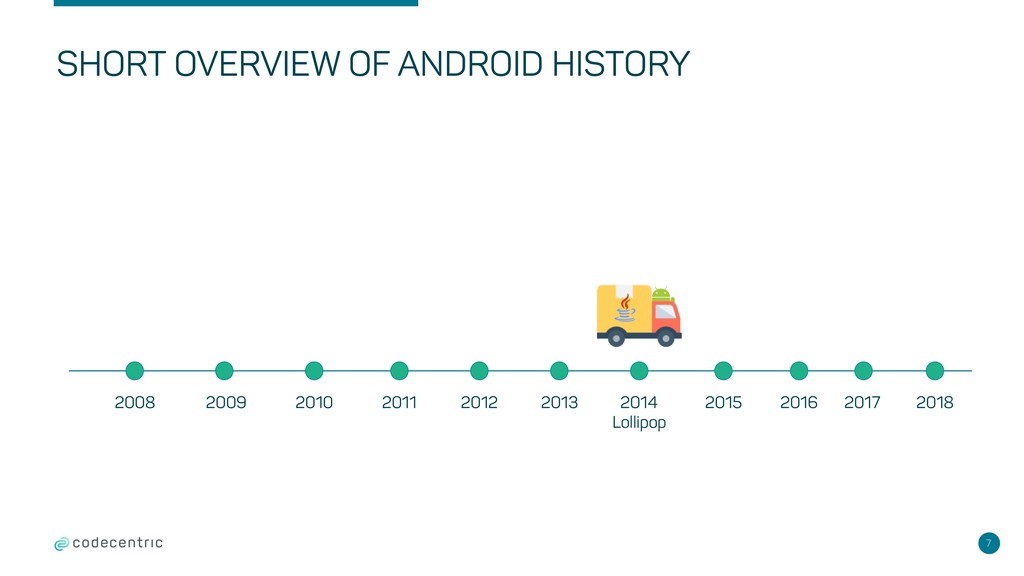
7 2008 2016 2009 2010 2011 2012 2013 2014 Lollipop
2015 2017 2018 SHORT OVERVIEW OF ANDROID HISTORY -
8 2008 2016 2009 2010 2011 2012 2013 2014 Lollipop
2015 2017 2018 SHORT OVERVIEW OF ANDROID HISTORY -
9 2008 2016 2009 2010 2011 2012 2013 2014 Lollipop
2015 2017 2018 SHORT OVERVIEW OF ANDROID HISTORY -
We are stuck in Java 7 world (few Java 8
features supported by platform) Android API ceremony Unable to extend Android platform types 10 Those backend devs are lucky ☹ -
11 2008 2016 2009 2010 2011 2012 2013 2014 Lollipop
2015 2017 2018 SHORT OVERVIEW OF ANDROID HISTORY -
12 2008 2016 2009 2010 2011 2012 2013 2014 Lollipop
2015 2017 2018 SHORT OVERVIEW OF ANDROID HISTORY -
13 2008 2016 2009 2010 2011 2012 2013 2014 Lollipop
2015 2017 2018 SHORT OVERVIEW OF ANDROID HISTORY -
14 2008 2016 2009 2010 2011 2012 2013 2014 Lollipop
2015 2017 2018 7.5 SHORT OVERVIEW OF ANDROID HISTORY -
15 2008 2016 2009 2010 2011 2012 2013 2014 Lollipop
2015 2017 2018 SHORT OVERVIEW OF ANDROID HISTORY -
16 2008 2016 Nougat 2009 2010 2011 2012 2013 2014
2015 Marshmallow 2017 Oreo 2018 SHORT OVERVIEW OF ANDROID HISTORY -
17 2008 2016 Nougat 2009 2010 2011 2012 2013 2014
2015 Marshmallow 2017 Oreo 2018 SHORT OVERVIEW OF ANDROID HISTORY -
JVM language interoperable with Java 1 Allows extensions of the
platform types Provides higher order functions on collections Type safety built in type system Many other modern language features 2 3 4 5 Kotlin 19 -
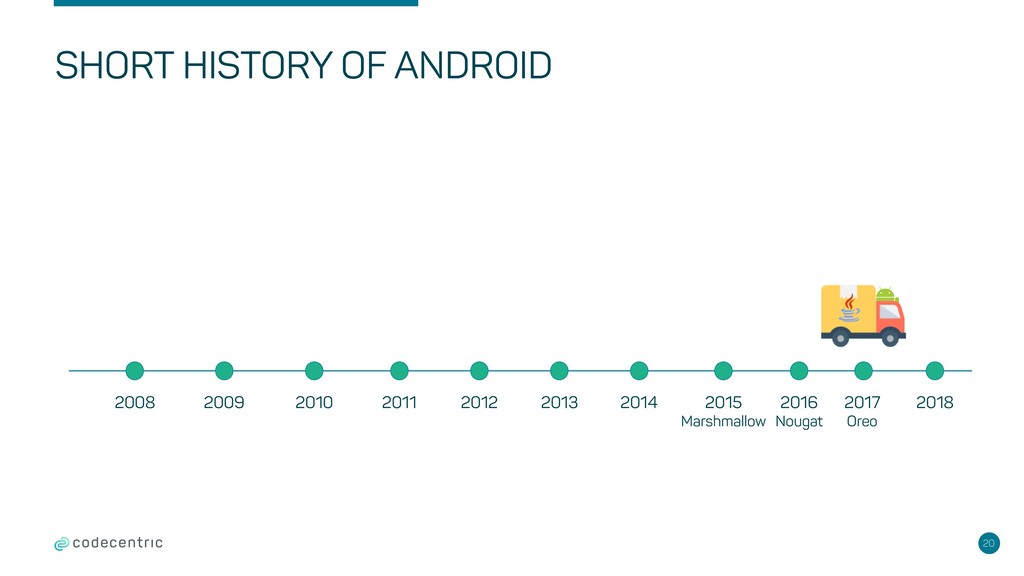
SHORT HISTORY OF ANDROID 20 2008 2016 Nougat 2009 2010
2011 2012 2013 2014 2015 Marshmallow 2017 Oreo 2018 -
SHORT HISTORY OF ANDROID 21 2008 2016 Nougat 2009 2010
2011 2012 2013 2014 2015 Marshmallow 2017 Oreo 2018 -
SHORT HISTORY OF ANDROID 22 2016 Nougat 2012 2013 2014
Lollipop 2015 Marshmallow 2017 Oreo 2018 2019 -
SHORT HISTORY OF ANDROID 23 2016 2012 2013 2014 2015
2017 2018 Pie 2019 Q -
if(screen.requiresSearchIcon) { searchIcon.visibility = View.VISIBLE } else { searchIcon.visibility =
View.GONE } 31 class Screen(…, val requiresSearchIcon: Boolean, …) -
{ } { } if(screen.requiresSearchIcon) { searchIcon.visibility = View.VISIBLE }
else { searchIcon.visibility = View.GONE } 32 class Screen(…, val requiresSearchIcon: Boolean, …) -
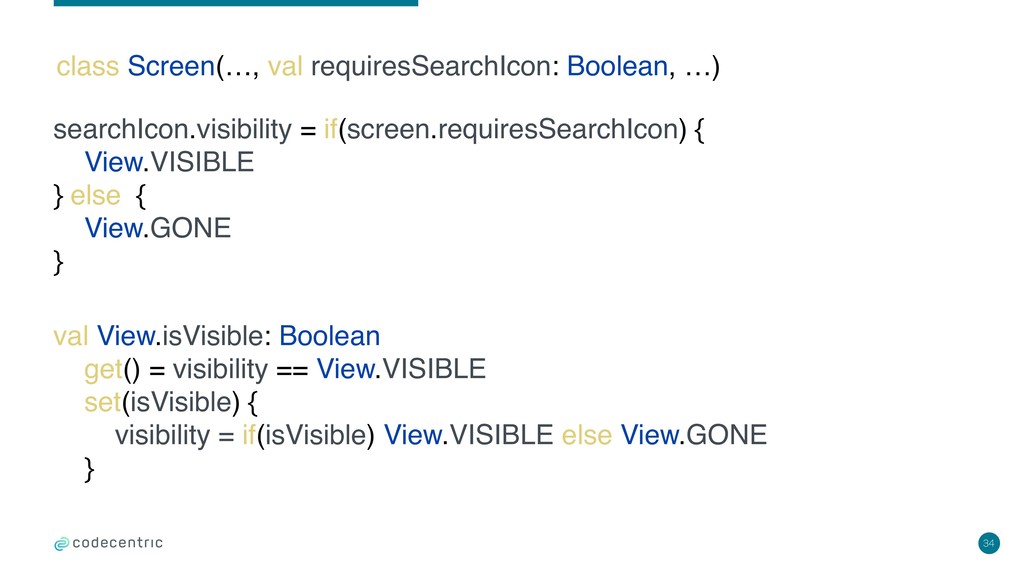
33 searchIcon.visibility = if(screen.requiresSearchIcon) { View.VISIBLE } else { View.GONE
} class Screen(…, val requiresSearchIcon: Boolean, …) -
searchIcon.isVisible 34 class Screen(…, val requiresSearchIcon: Boolean, …) val View.isVisible:
Boolean get() = visibility == View.VISIBLE set(isVisible) { visibility = if(isVisible) View.VISIBLE else View.GONE } searchIcon.visibility = if(screen.requiresSearchIcon) { View.VISIBLE } else { View.GONE } -
searchIcon.isVisible = screen.requiresSearchIcon class Screen(…, val requiresSearchIcon: Boolean, …) 35
val View.isVisible: Boolean get() = visibility == View.VISIBLE set(isVisible) { visibility = if(isVisible) View.VISIBLE else View.GONE } -
inline fun View.updatePadding( left: Int = paddingLeft, top: Int =
paddingTop, right: Int = paddingRight, bottom: Int = paddingBottom ) { setPadding(left, top, right, bottom) } sessionTitleView.setPadding( 10, message.paddingTop, 10, message.paddingBottom) 37 -
inline fun View.updatePadding( left: Int = paddingLeft, top: Int =
paddingTop, right: Int = paddingRight, bottom: Int = paddingBottom ) { setPadding(left, top, right, bottom) } inline fun View.updatePadding( left: Int = paddingLeft, top: Int = paddingTop, right: Int = paddingRight, bottom: Int = paddingBottom ) { setPadding(left, top, right, bottom) } sessionTitleView.setPadding( 10, message.paddingTop, 10, message.paddingBottom) 38 -
inline fun View.updatePadding( left: Int = paddingLeft, top: Int =
paddingTop, right: Int = paddingRight, bottom: Int = paddingBottom ) { setPadding(left, top, right, bottom) } sessionTitleView.updatePadding(left = 10, right = 10) 39 -
inline fun View.updatePadding( left: Int = paddingLeft, top: Int =
paddingTop, right: Int = paddingRight, bottom: Int = paddingBottom ) { setPadding(left, top, right, bottom) } sessionTitleView.updatePadding(left = 10, right = 10) 40 inline fun View.updatePadding( left: Int = paddingLeft, top: Int = paddingTop, right: Int = paddingRight, bottom: Int = paddingBottom ) { setPadding(left, top, right, bottom) } -
sessionTitleView.updatePadding(left = 10, right = 10) 41 Byte code: int
leftPadding$iv = 10; int rightPadding$iv = 10; int topPadding$iv = $this$updatePadding$iv.getPaddingTop(); int bottomPadding$iv = $this$updatePadding$iv.getPaddingBottom(); $this$updatePadding$iv.setPadding( leftPadding$iv, topPadding$iv, rightPadding$iv, bottomPadding$iv); -
val viewModel = ViewModelProviders.of(this).get(SpeakersViewModel::class.java) 42 inline fun <reified T :
ViewModel> FragmentActivity.getViewModel(): T = ViewModelProviders.of(this).get(T::class.java) val viewModel = this.getViewModel<SpeakersViewModel>() -
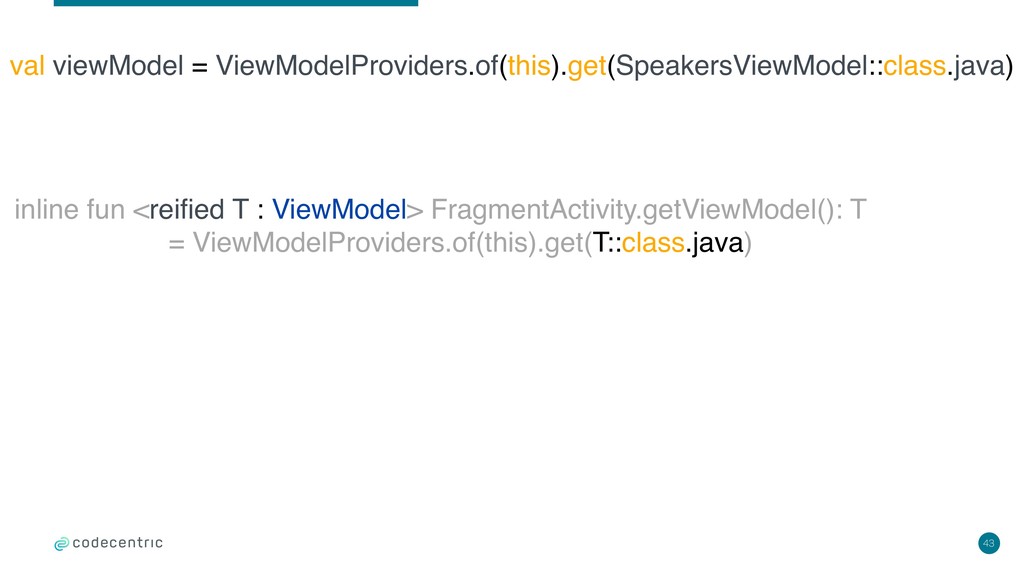
val viewModel = ViewModelProviders.of(this).get(SpeakersViewModel::class.java) 43 inline fun <reified T :
ViewModel> FragmentActivity.getViewModel(): T = ViewModelProviders.of(this).get(T::class.java) -
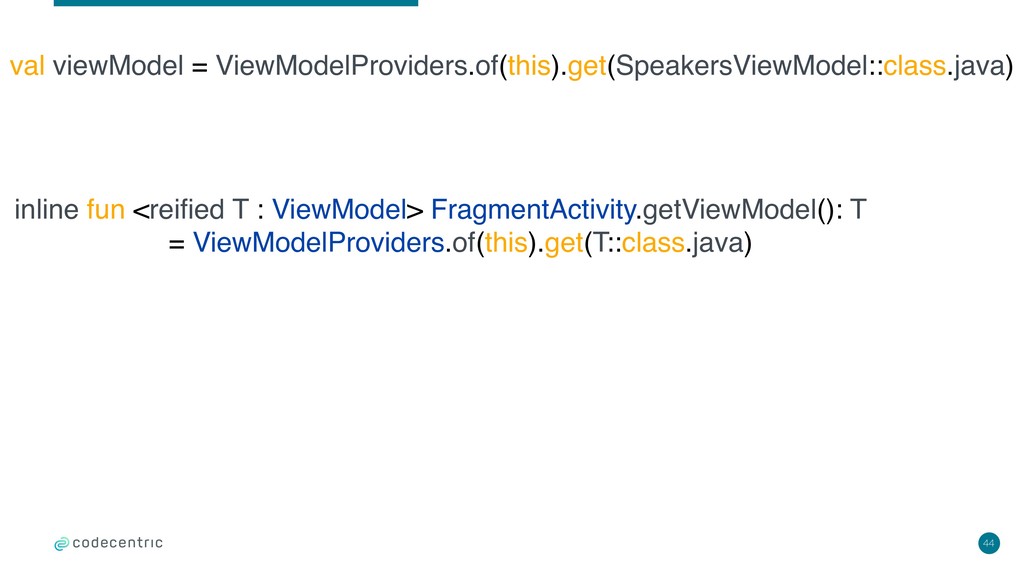
44 inline fun <reified T : ViewModel> FragmentActivity.getViewModel(): T =
ViewModelProviders.of(this).get(T::class.java) SpeakersViewModel val viewModel = ViewModelProviders.of(this).get(SpeakersViewModel::class.java) -
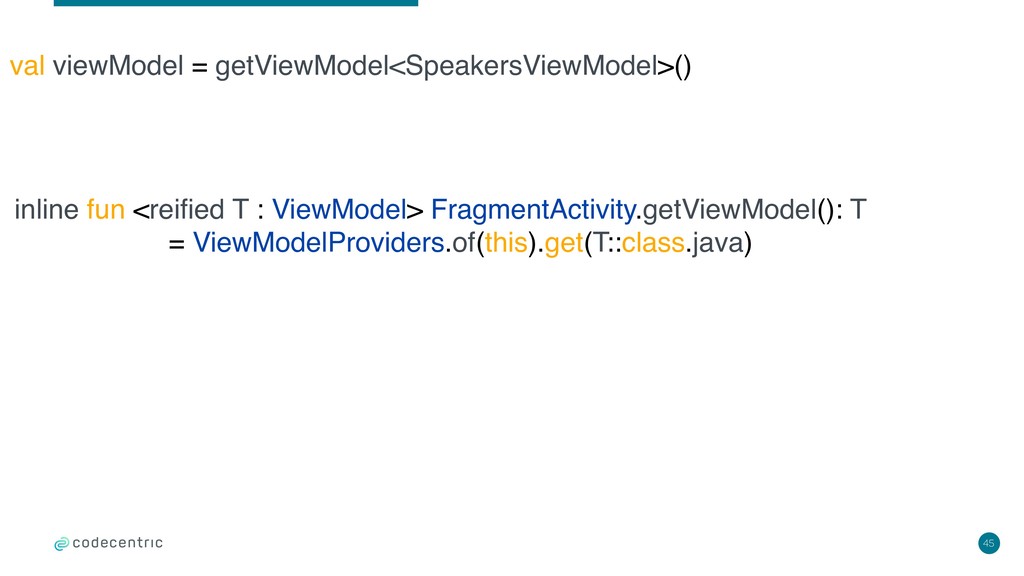
45 inline fun <reified T : ViewModel> FragmentActivity.getViewModel(): T =
ViewModelProviders.of(this).get(T::class.java) val viewModel = getViewModel<SpeakersViewModel>() -
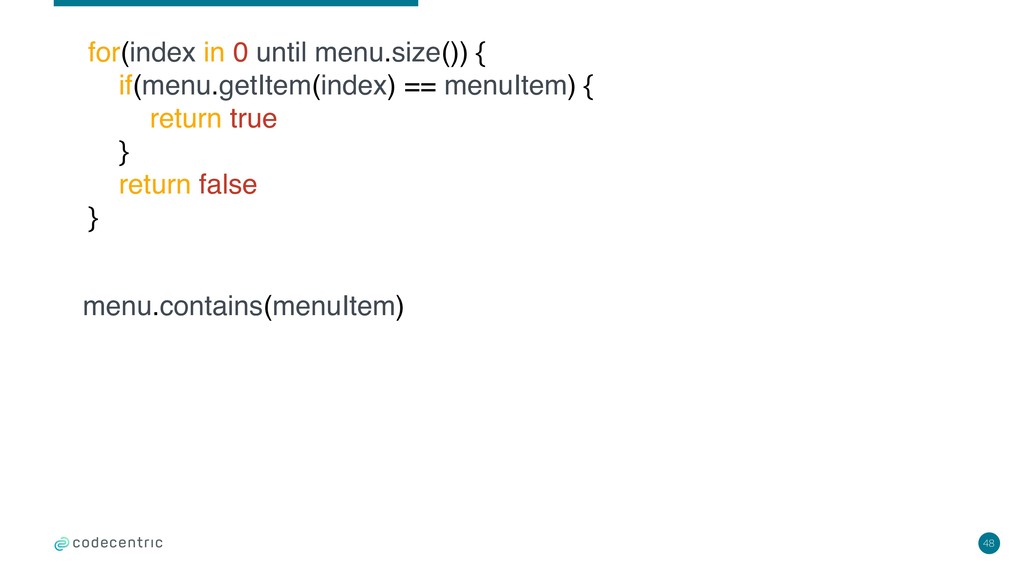
48 menu.contains(menuItem) for(index in 0 until menu.size()) { if(menu.getItem(index) ==
menuItem) { return true } return false } -
50 inline fun Handler.postDelayed(delay: Long, crossinline block: () -> Unit)
{ postDelayed({ block() }, delay) } sessionTitle.handler.postDelayed({}, 300) -
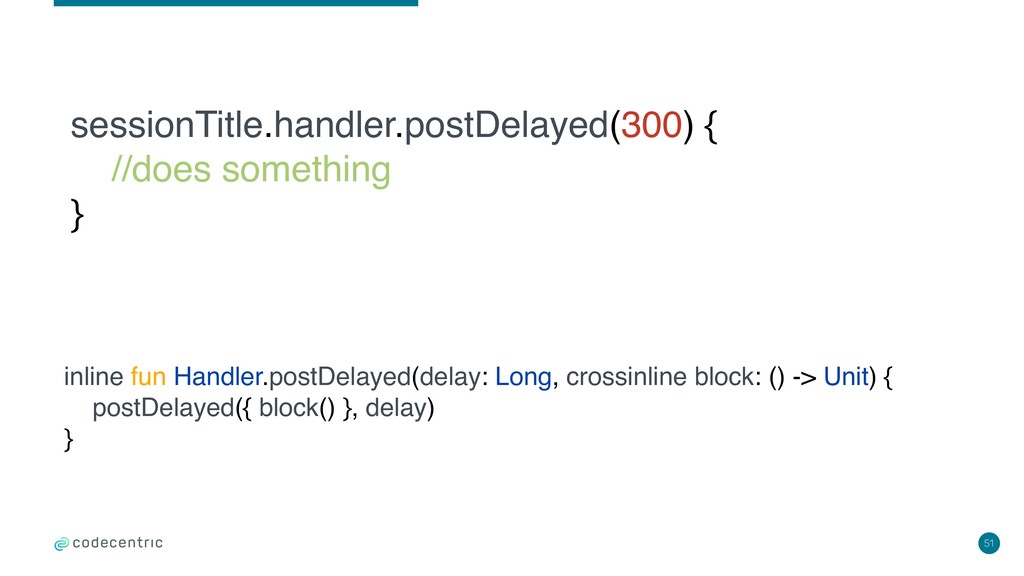
51 inline fun Handler.postDelayed(delay: Long, crossinline block: () -> Unit)
{ postDelayed({ block() }, delay) } sessionTitle.handler.postDelayed(300) { //does something } -
val color = Color.rgb(255, 64, 129) 52 val red =
Color.red(color) val green = Color.green(color) val blue = Color.blue(color) val invColor = Color.rgb(255 - red, 255 - green, 255 - blue) -
val color = Color.rgb(255, 64, 129) 53 val red, =
Color.red(color) val green, = Color.green(color) val blue, = Color.blue(color) val invColor = Color.rgb(255 - red, 255 - green, 255 - blue) -
val color = Color.rgb(255, 64, 129) 54 val red, =
color.red val green, = color.green val blue, = color.blue val invColor = Color.rgb(255 - red, 255 - green, 255 - blue) -
55 val red, = color.red val green, = color.green val
blue, = color.blue inline val @receiver:ColorInt Int.red: Int get() = Color.red(this) inline val @receiver:ColorInt Int.green: Int get() = Color.green(this) inline val @receiver:ColorInt Int.blue: Int get() = Color.blue(this) -
val color = Color.rgb(255, 64, 129) 56 val red, =
color.red val green, = color.green val blue, = color.blue val invColor = Color.rgb(255 - red, 255 - green, 255 - blue) -
val color = Color.rgb(255, 64, 129) 57 val red, =
color.red val green, = color.green val blue, = color.blue val invColor = Color.rgb(255 - red, 255 - green, 255 - blue) -
val color = Color.rgb(255, 64, 129) 58 val (red, green,
blue) = color val invColor = Color.rgb(255 - red, 255 - green, 255 - blue) -
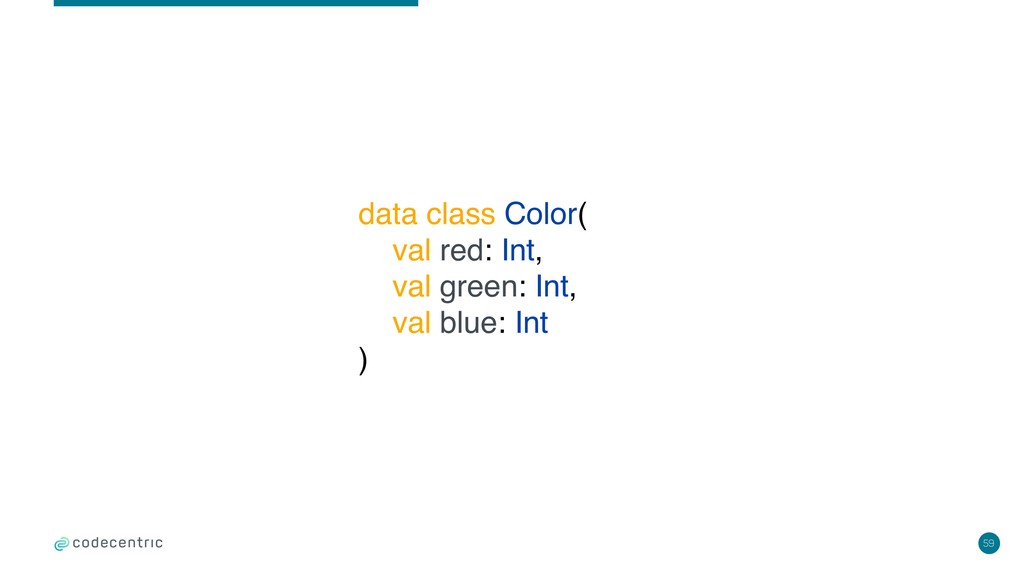
59 data class Color( val red: Int, val green: Int,
val blue: Int ) -
val color = Color.rgb(255, 64, 129) 60 val (red, green,
blue) = color val invColor = Color.rgb(255 - red, 255 - green, 255 - blue) -
61 val (red, green, blue) = color inline operator fun
@receiver:ColorInt Int.component1(): Int = this.red inline operator fun @receiver:ColorInt Int.component2(): Int = this.green inline operator fun @receiver:ColorInt Int.component3(): Int = this.blue -
speakerInputField.addTextChangedListener(object : TextWatcher { override fun afterTextChanged(speakerName: Editable?) { adapter.filterByName(speakerName.toString())
} override fun beforeTextChanged(s: CharSequence?, start: Int, count: Int, after: Int) { //does nothing } override fun onTextChanged(s: CharSequence?, start: Int, before: Int, count: Int) { //does nothing } }) speakerInputField.addTextChangedListener(object : TextWatcher { override fun afterTextChanged(speakerName: Editable?) { adapter.filterByName(speakerName.toString()) } override fun beforeTextChanged(s: CharSequence?, start: Int, count: Int, after: Int) { //does nothing } override fun onTextChanged(s: CharSequence?, start: Int, before: Int, count: Int) { //does nothing } }) 62 -
63 speakerInputField.addTextChangedListener(object : TextWatcher { override fun afterTextChanged(speakerName: Editable?) {
adapter.filterByName(speakerName.toString()) } … }) -
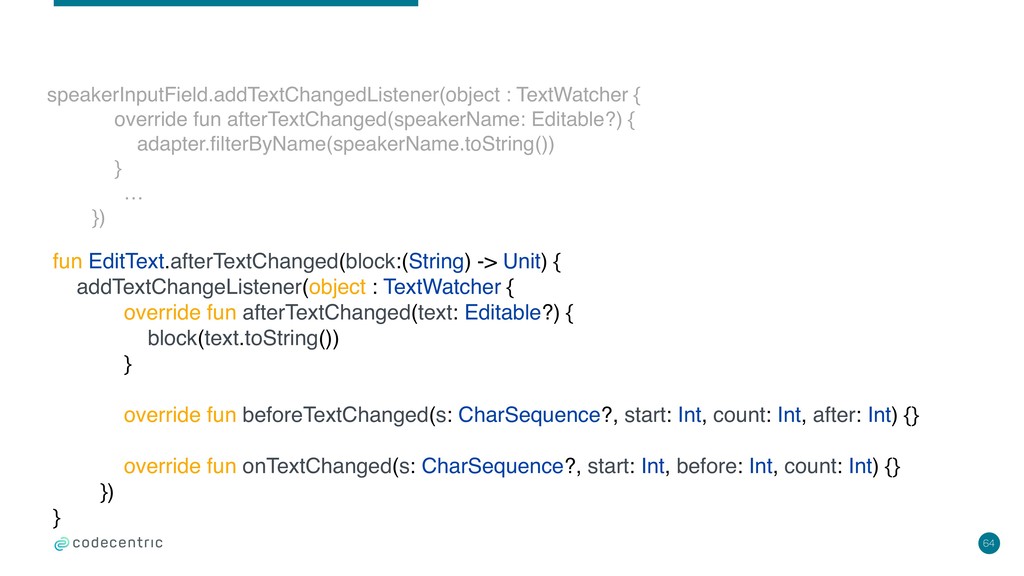
fun EditText.afterTextChanged(block:(String) -> Unit) { addTextChangeListener(object : TextWatcher { override
fun afterTextChanged(text: Editable?) { block(text.toString()) } override fun beforeTextChanged(s: CharSequence?, start: Int, count: Int, after: Int) {} override fun onTextChanged(s: CharSequence?, start: Int, before: Int, count: Int) {} }) } speakerInputField.addTextChangedListener(object : TextWatcher { override fun afterTextChanged(speakerName: Editable?) { adapter.filterByName(speakerName.toString()) } … }) speakerInputField.addTextChangedListener(object : TextWatcher { override fun afterTextChanged(speakerName: Editable?) { adapter.filterByName(speakerName.toString()) } … }) 64 -
fun EditText.afterTextChanged(block:(String) -> Unit) { addTextChangeListener(object : TextWatcher { override
fun afterTextChanged(text: Editable?) { block(text.toString()) } override fun beforeTextChanged(s: CharSequence?, start: Int, count: Int, after: Int) {} override fun onTextChanged(s: CharSequence?, start: Int, before: Int, count: Int) {} }) } fun EditText.afterTextChanged(block:(String) -> Unit) { addTextChangeListener(object : TextWatcher { override fun afterTextChanged(text: Editable?) { block(text.toString()) } override fun beforeTextChanged(s: CharSequence?, start: Int, count: Int, after: Int) {} override fun onTextChanged(s: CharSequence?, start: Int, before: Int, count: Int) {} }) } speakerInputField.addTextChangedListener(object : TextWatcher { override fun afterTextChanged(speakerName: Editable?) { adapter.filterByName(speakerName.toString()) } … }) speakerInputField.addTextChangedListener(object : TextWatcher { override fun afterTextChanged(speakerName: Editable?) { adapter.filterByName(speakerName.toString()) } … }) 65 -
fun EditText.afterTextChanged(block:(String) -> Unit) { addTextChangeListener(object : TextWatcher { override
fun afterTextChanged(text: Editable?) { block(text.toString()) } override fun beforeTextChanged(s: CharSequence?, start: Int, count: Int, after: Int) {} override fun onTextChanged(s: CharSequence?, start: Int, before: Int, count: Int) {} }) } fun EditText.afterTextChanged(block:(String) -> Unit) { addTextChangeListener(object : TextWatcher { override fun afterTextChanged(text: Editable?) { block(text.toString()) } override fun beforeTextChanged(s: CharSequence?, start: Int, count: Int, after: Int) {} override fun onTextChanged(s: CharSequence?, start: Int, before: Int, count: Int) {} }) } 66 speakerInputField.afterTextChanged { speakerName -> adapter.filterByName(speakerName) } -
67 speakerInputField.afterTextChanged { speakerName -> adapter.filterByName(speakerName) } speakerInputField.beforeTextChanged { }
speakerInputField.onTextChanged { } speakerInputField.addTextChangeListeners( afterTextChanged = { … }, onTextChanged = { … } ) -
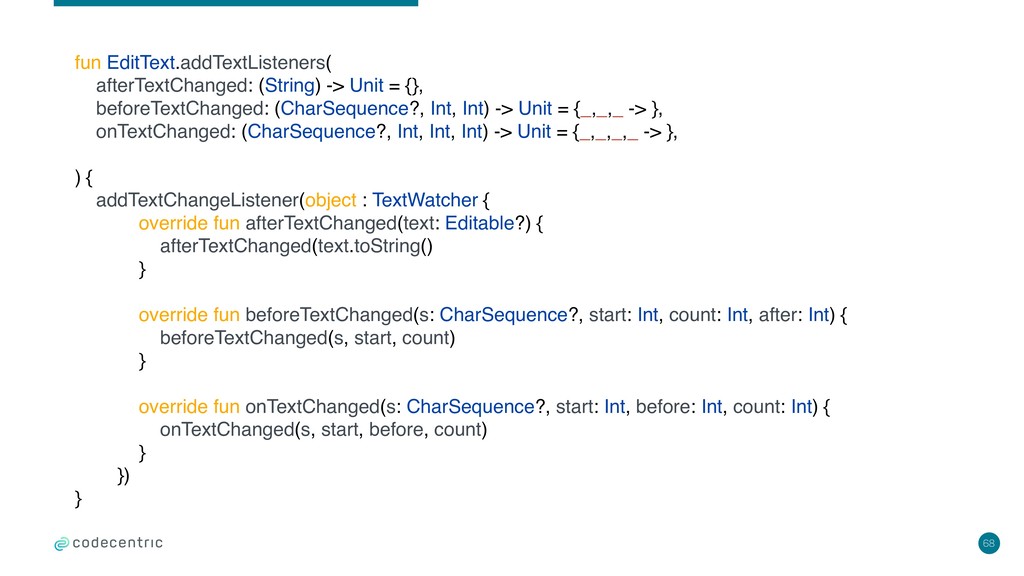
68 fun EditText.addTextListeners( afterTextChanged: (String) -> Unit = {}, beforeTextChanged:
(CharSequence?, Int, Int) -> Unit = {_,_,_ -> }, onTextChanged: (CharSequence?, Int, Int, Int) -> Unit = {_,_,_,_ -> }, ) { addTextChangeListener(object : TextWatcher { override fun afterTextChanged(text: Editable?) { afterTextChanged(text.toString() } override fun beforeTextChanged(s: CharSequence?, start: Int, count: Int, after: Int) { beforeTextChanged(s, start, count) } override fun onTextChanged(s: CharSequence?, start: Int, before: Int, count: Int) { onTextChanged(s, start, before, count) } }) } -
69 animator.addListener(object : Animator.AnimatorListener { override fun onAnimationRepeat(animation: Animator?) {
} override fun onAnimationEnd(animation: Animator?) { } override fun onAnimationCancel(animation: Animator?) { } override fun onAnimationStart(animation: Animator?) { } }) -
70 animator.addListener(object : Animator.AnimatorListener { override fun onAnimationRepeat(animation: Animator?) {
} override fun onAnimationEnd(animation: Animator?) { } override fun onAnimationCancel(animation: Animator?) { } override fun onAnimationStart(animation: Animator?) { } }) animator.doOnRepeat { } animator.doOnEnd { } animator.doOnCancel { } animator.doOnStart { } animator.addListener(doOnEnd = { }, doOnCancel = { }) -
71 class SpeakersAdapter : RecyclerView.Adapter<SpeakersAdapter.ViewHolder>() { private val speakerList: MutableList<Speaker>
= mutableListOf() override fun onCreateViewHolder(parent: ViewGroup, vt: Int): ViewHolder {...} override fun onBindViewHolder(vHolder: ViewHolder, position: Int) {...} override fun getItemCount(): Int {...} fun addAllSpeakers(speakers: List<Speaker>) { speakerList.clear() speakerList.addAll(speakers) notifyDataSetChanged() } } -
72 class SpeakersAdapter : RecyclerView.Adapter<SpeakersAdapter.ViewHolder>() { private val speakerList: MutableList<Speaker>
= mutableListOf() override fun onCreateViewHolder(parent: ViewGroup, vt: Int): ViewHolder {...} override fun onBindViewHolder(vHolder: ViewHolder, position: Int) {...} override fun getItemCount(): Int {...} fun addAllSpeakers(speakers: List<Speaker>) { speakerList.clear() speakerList.addAll(speakers) notifyDataSetChanged() } } class SpeakersAdapter : RecyclerView.Adapter<SpeakersAdapter.ViewHolder>() { private val speakerList: MutableList<Speaker> = mutableListOf() override fun onCreateViewHolder(parent: ViewGroup, vt: Int): ViewHolder {...} override fun onBindViewHolder(vHolder: ViewHolder, position: Int) {...} override fun getItemCount(): Int {...} fun addAllSpeakers(speakers: List<Speaker>) { speakerList.clear() speakerList.addAll(speakers) notifyDataSetChanged() } } -
73 class SpeakersAdapter : RecyclerView.Adapter<SpeakersAdapter.ViewHolder>() { … fun addAllSpeakers(speakers: List<Speaker>)
{ speakerList.clear() speakerList.addAll(speakers) notifyDataSetChanged() } } -
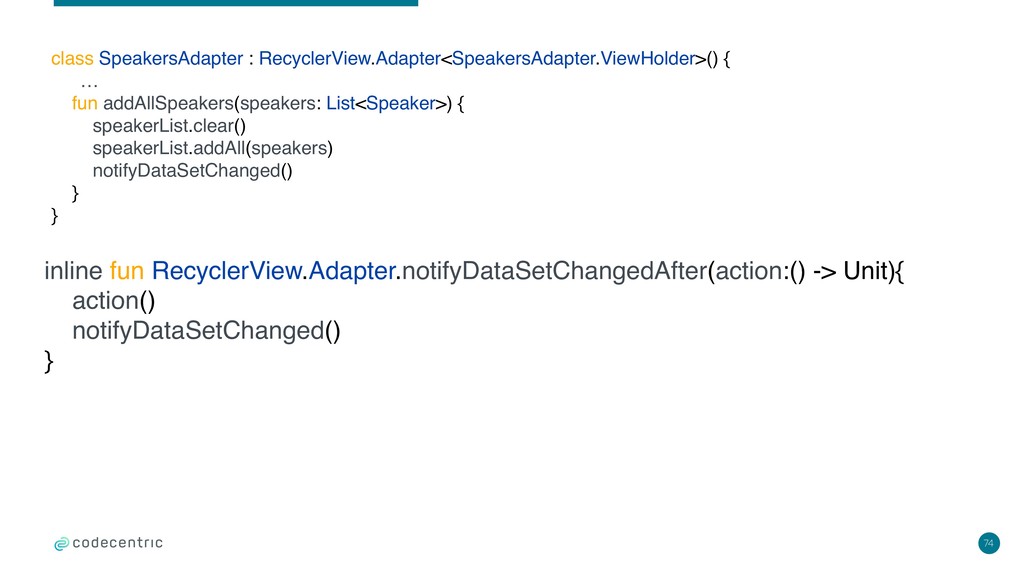
74 class SpeakersAdapter : RecyclerView.Adapter<SpeakersAdapter.ViewHolder>() { … fun addAllSpeakers(speakers: List<Speaker>)
{ speakerList.clear() speakerList.addAll(speakers) notifyDataSetChanged() } } inline fun RecyclerView.Adapter.notifyDataSetChangedAfter(action:() -> Unit){ action() notifyDataSetChanged() } -
75 class SpeakersAdapter : RecyclerView.Adapter<SpeakersAdapter.ViewHolder>() { … fun addAllSpeakers(speakers: List<Speaker>)
{ speakerList.clear() speakerList.addAll(speakers) notifyDataSetChanged() } } inline fun RecyclerView.Adapter.notifyDataSetChangedAfter(action:() -> Unit){ action() notifyDataSetChanged() } inline fun RecyclerView.Adapter.notifyDataSetChangedAfter(action:() -> Unit){ action() notifyDataSetChanged() } class SpeakersAdapter : RecyclerView.Adapter<SpeakersAdapter.ViewHolder>() { … fun addAllSpeakers(speakers: List<Speaker>) { speakerList.clear() speakerList.addAll(speakers) notifyDataSetChanged() } } -
76 inline fun RecyclerView.Adapter.notifyDataSetChangedAfter(action:() -> Unit){ action() notifyDataSetChanged() } inline
fun RecyclerView.Adapter.notifyDataSetChangedAfter(action:() -> Unit){ action() notifyDataSetChanged() } class SpeakersAdapter : RecyclerView.Adapter<SpeakersAdapter.ViewHolder>() { … fun addAllSpeakers(speakers: List<Speaker>) = notifyDataSetChangedAfter { speakerList.clear() speakerList.addAll(speakers) } } -
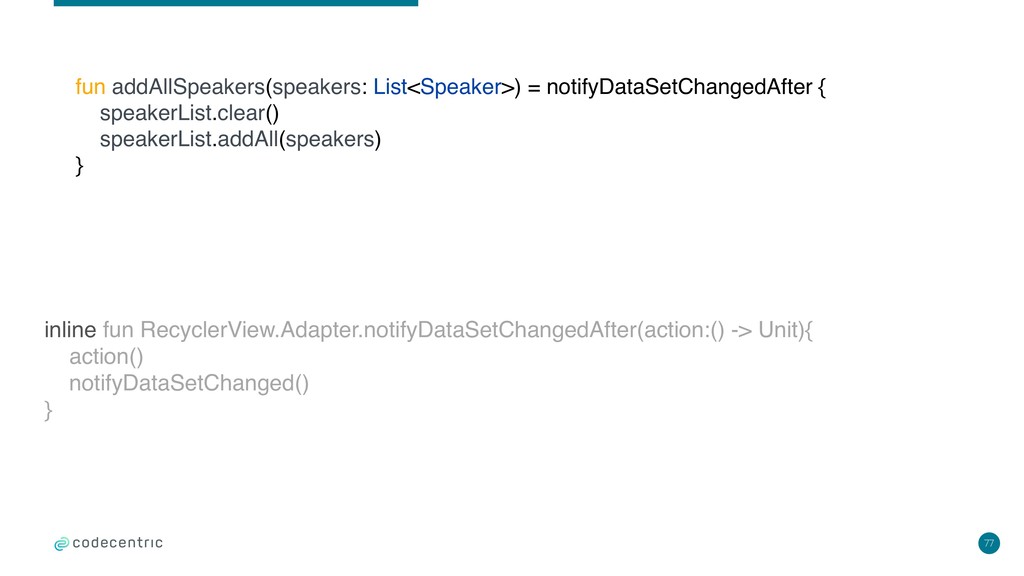
77 inline fun RecyclerView.Adapter.notifyDataSetChangedAfter(action:() -> Unit){ action() notifyDataSetChanged() } fun
addAllSpeakers(speakers: List<Speaker>) = notifyDataSetChangedAfter { speakerList.clear() speakerList.addAll(speakers) } inline fun RecyclerView.Adapter.notifyDataSetChangedAfter(action:() -> Unit){ action() notifyDataSetChanged() } -
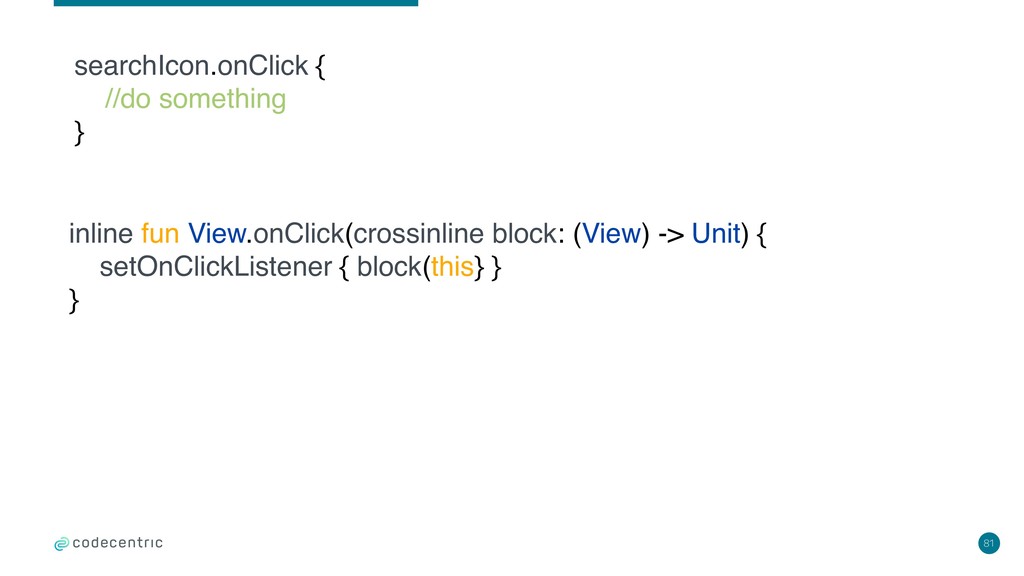
80 inline fun View.onClick(crossinline block: (View) -> Unit) { setOnClickListener
{ block(this} } } searchIcon.setOnClickListener { //do something } -
81 inline fun View.onClick(crossinline block: (View) -> Unit) { setOnClickListener
{ block(this} } } searchIcon.onClick { //do something } -
85 •make sure you are adding value to your code
•prefer readability over conciseness Guidelines -
86 •make sure you are adding value to your code
•prefer readability over conciseness Guidelines -
88 •make sure you are adding value to your code
•prefer readability over conciseness •be careful with optimizations Guidelines -
Use extension functions and properties to alias robust API 90
Leverage features unique to Kotlin -
Leverage features unique to Kotlin 91 •use extension functions and
properties to alias robust API -
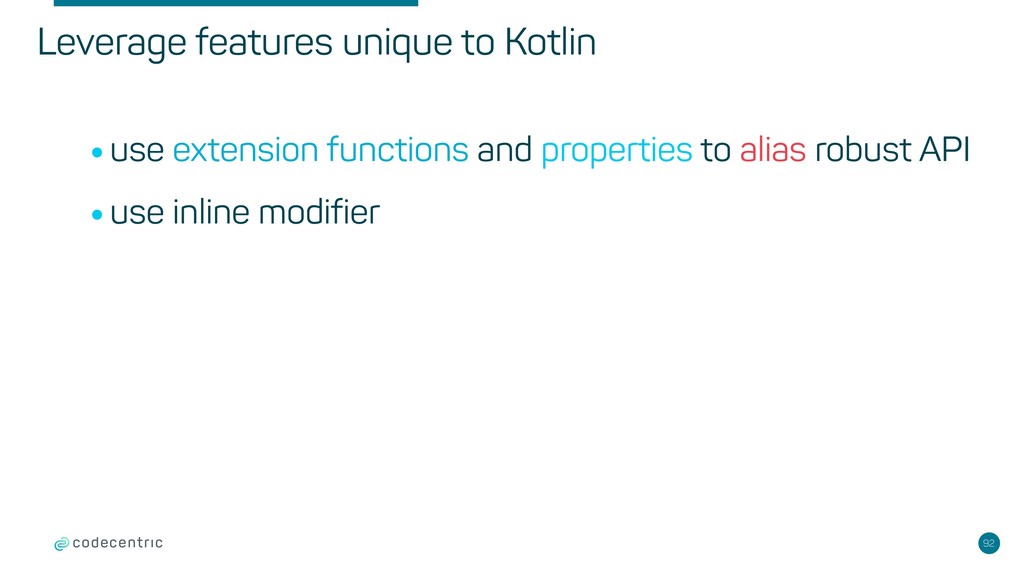
Leverage features unique to Kotlin 92 •use extension functions and
properties to alias robust API •use inline modifier -
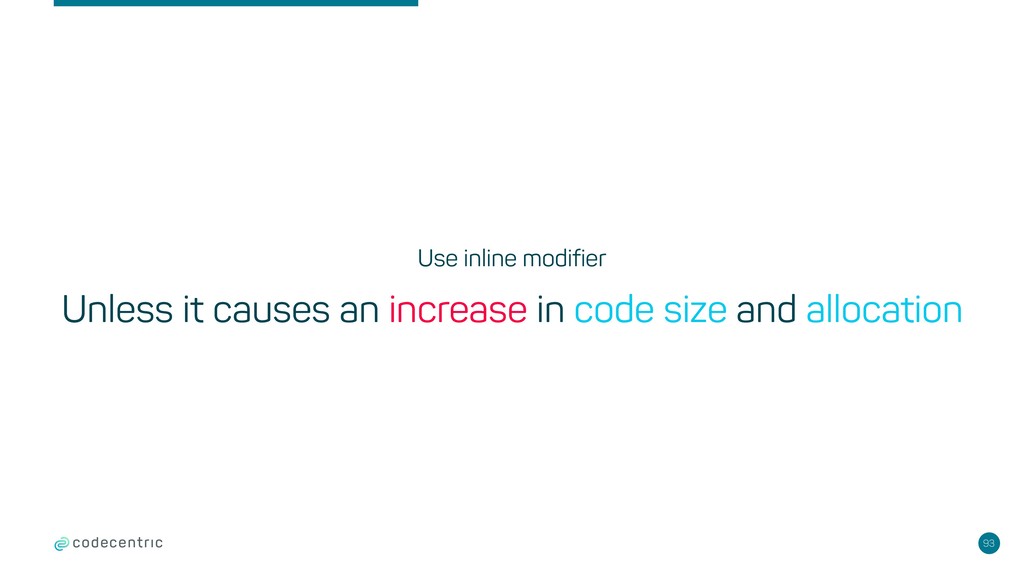
Use inline modifier 93 Unless it causes an increase in
code size and allocation -
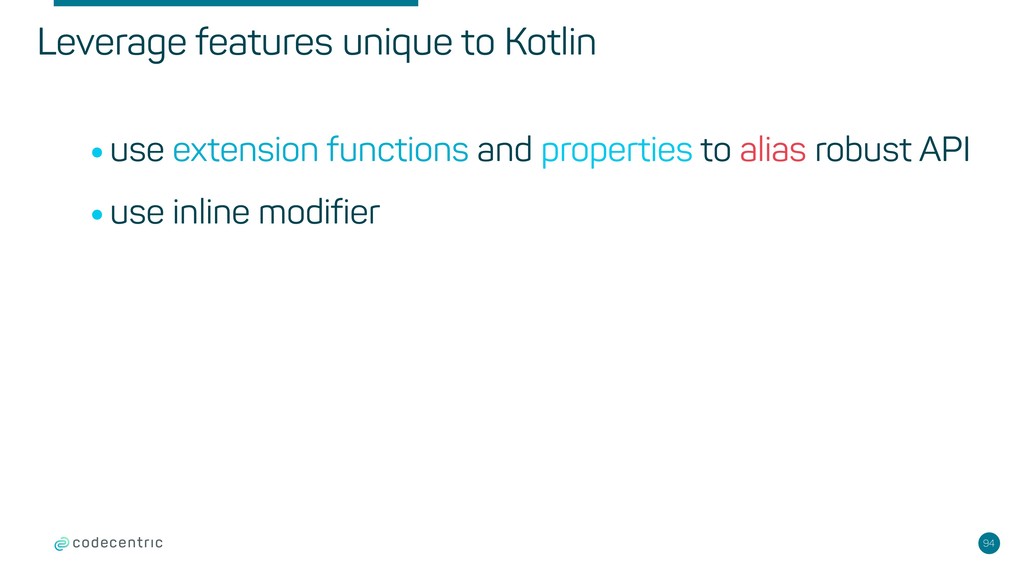
Leverage features unique to Kotlin 94 •use extension functions and
properties to alias robust API •use inline modifier -
Leverage features unique to Kotlin 95 •use extension functions and
properties to alias robust API •use inline modifier •use reified types -
Leverage features unique to Kotlin 96 •use extension functions and
properties to alias robust API •use inline modifier •use reified types •use object destructuring