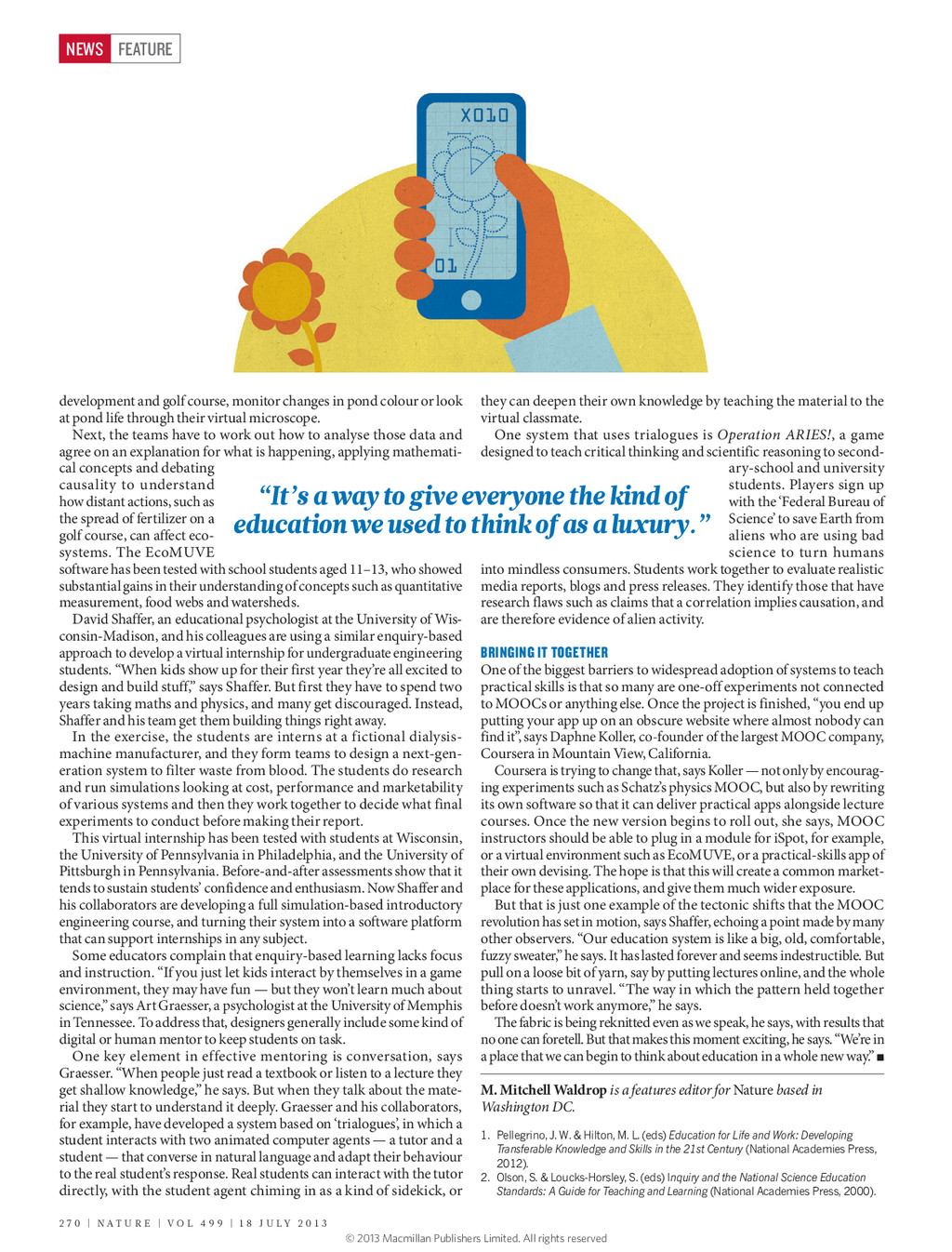
look at pond life through their virtual microscope. Next, the teams have to work out how to analyse those data and agree on an explanation for what is happening, applying mathemati- cal concepts and debating causality to understand how distant actions, such as the spread of fertilizer on a golf course, can affect eco- systems. The EcoMUVE software has been tested with school students aged 11–13, who showed substantial gains in their understanding of concepts such as quantitative measurement, food webs and watersheds. David Shaffer, an educational psychologist at the University of Wis- consin-Madison, and his colleagues are using a similar enquiry-based approach to develop a virtual internship for undergraduate engineering students. “When kids show up for their first year they’re all excited to design and build stuff,” says Shaffer. But first they have to spend two years taking maths and physics, and many get discouraged. Instead, Shaffer and his team get them building things right away. In the exercise, the students are interns at a fictional dialysis- machine manufacturer, and they form teams to design a next-gen- eration system to filter waste from blood. The students do research and run simulations looking at cost, performance and marketability of various systems and then they work together to decide what final experiments to conduct before making their report. This virtual internship has been tested with students at Wisconsin, the University of Pennsylvania in Philadelphia, and the University of Pittsburgh in Pennsylvania. Before-and-after assessments show that it tends to sustain students’ confidence and enthusiasm. Now Shaffer and his collaborators are developing a full simulation-based introductory engineering course, and turning their system into a software platform that can support internships in any subject. Some educators complain that enquiry-based learning lacks focus and instruction. “If you just let kids interact by themselves in a game environment, they may have fun — but they won’t learn much about science,” says Art Graesser, a psychologist at the University of Memphis in Tennessee. To address that, designers generally include some kind of digital or human mentor to keep students on task. One key element in effective mentoring is conversation, says Graesser. “When people just read a textbook or listen to a lecture they get shallow knowledge,” he says. But when they talk about the mate- rial they start to understand it deeply. Graesser and his collaborators, for example, have developed a system based on ‘trialogues’, in which a student interacts with two animated computer agents — a tutor and a student — that converse in natural language and adapt their behaviour to the real student’s response. Real students can interact with the tutor directly, with the student agent chiming in as a kind of sidekick, or they can deepen their own knowledge by teaching the material to the virtual classmate. One system that uses trialogues is Operation ARIES!, a game designed to teach critical thinking and scientific reasoning to second- ary-school and university students. Players sign up with the ‘Federal Bureau of Science’ to save Earth from aliens who are using bad science to turn humans into mindless consumers. Students work together to evaluate realistic media reports, blogs and press releases. They identify those that have research flaws such as claims that a correlation implies causation, and are therefore evidence of alien activity. BRINGING IT TOGETHER One of the biggest barriers to widespread adoption of systems to teach practical skills is that so many are one-off experiments not connected to MOOCs or anything else. Once the project is finished, “you end up putting your app up on an obscure website where almost nobody can find it”, says Daphne Koller, co-founder of the largest MOOC company, Coursera in Mountain View, California. Coursera is trying to change that, says Koller — not only by encourag- ing experiments such as Schatz’s physics MOOC, but also by rewriting its own software so that it can deliver practical apps alongside lecture courses. Once the new version begins to roll out, she says, MOOC instructors should be able to plug in a module for iSpot, for example, or a virtual environment such as EcoMUVE, or a practical-skills app of their own devising. The hope is that this will create a common market place for these applications, and give them much wider exposure. But that is just one example of the tectonic shifts that the MOOC revolution has set in motion, says Shaffer, echoing a point made by many other observers. “Our education system is like a big, old, comfortable, fuzzy sweater,” he says. It has lasted forever and seems indestructible. But pull on a loose bit of yarn, say by putting lectures online, and the whole thing starts to unravel. “The way in which the pattern held together before doesn’t work anymore,” he says. The fabric is being reknitted even as we speak, he says, with results that no one can foretell. But that makes this moment exciting, he says. “We’re in a place that we can begin to think about education in a whole new way.” ▪ M. Mitchell Waldrop is a features editor for Nature based in Washington DC. 1. Pellegrino, J. W. & Hilton, M. L. (eds) Education for Life and Work: Developing Transferable Knowledge and Skills in the 21st Century (National Academies Press, 2012). 2. Olson, S. & Loucks-Horsley, S. (eds) Inquiry and the National Science Education Standards: A Guide for Teaching and Learning (National Academies Press, 2000). “It’s a way to give everyone the kind of education we used to think of as a luxury.” 2 7 0 | N A T U R E | V O L 4 9 9 | 1 8 J U L Y 2 0 1 3 FEATURE NEWS © 2013 Macmillan Publishers Limited. All rights reserved


 drpoonamkc
 hiola
 signer
 juanmartin2026
 pawan_pharm
 frievea
 2720japanoke
 uranoken
 yasslab
 terasawat
 davetheseo
 ipullrank
 marktimemedia
 apolaine
 tmiket
 zakiyama
 varn
 cassininazir
 watany
 akihiro_kokubo
 danielanewman